




Abstract
With the international community’s commitment to the goals of the Paris Agreement and governments’ implementation of green recovery plans worldwide, the green economy is increasingly recognized as a key strategy to address environmental crises and as a driver of new economic growth. Based on the Web of Science database, this study analyzes 2,106 articles published between 1989 and 2024 and constructs a knowledge graph of the most active institutions and journals in contemporary times. It examines clustering networks and identifies emerging hotspots in recent green economy research. The results indicate that the Chinese Academy of Sciences has the highest number of publications, followed by the University of London and Nanjing University of Aeronautics and Astronautics. The publications predominantly focus on disciplines such as environmental science, environmental studies, and green sustainable science and technology. “Sustainability” is the journal with the most publications, and “Green Economy and Related Concepts: An Overview” is the most cited literature. Rockstrom’s work has played a pivotal role in the evolution of green economy research. The research topics mainly focus on three areas: the necessity of the green economy for human social survival and development, the theoretical framework, models, and pathways of the green economy, and the practice and effectiveness evaluation of green economy initiatives. In the past 5 years, the main keywords discussed include policy, circular economy, and CO2 emissions. These findings provide valuable references for researchers and practitioners engaged in green economy studies.
Introduction
With the increasingly severe issues of global climate change, resource depletion, and environmental pollution, the green economy, as an economic model that promotes sustainable development, has received widespread attention from the international community. Governments, businesses, and academia worldwide are actively exploring ways to achieve a green economy. The signing of the Paris Agreement has prompted countries to increase their research and application of green technologies. The term “green economy” was originated from British environmental economist Pierce’s 1989 book, “Blueprint of Green Economy.”United Nations Environment Programme (UNEP, 2011) defines a green economy as one that results in improved human well-being and social equity while significantly reducing environmental risks and ecological scarcities. Environmental economists emphasize the necessity of sustainable economic development that preserves the natural environment and human well-being. This approach rejects causing social divisions or ecological crises through the unchecked pursuit of production growth and aims to prevent economic sustainability challenges due to natural resource depletion. Advocates propose establishing a “sustainable economy” grounded in social and ecological considerations.
Scholarly interest in green economy research persists, with scholars exploring diverse dimensions. In environmental science and ecology, Su (2022) examines the impact of coordinated development of the ecological environment and technical innovation on the green economy in China. Higgs and Hill (2019) delve into the role of small and medium-sized enterprises in sustainable development and the green economy within South Africa’s waste sector from a business economics perspective. Science and technology studies by Busch et al. (2019) evaluate bionics and green technology in primary shipping using Salvia air layer hull coatings for drag and fuel reduction. In the engineering field, Ulrich and Lehr (2020) investigate the economic effects of an E-Mobility scenario, while Fakher et al. (2023) analyze the nexus between renewable energy, non-renewable energy, and environmental quality based on the N-shaped Environmental Kuznets Curve and six environmental indicators in energy fuel research.
Various research methods contribute to the understanding of green economy dynamics. Empirical analysis is exemplified by Yu and Chen’s (2021) study on regional ecological security evolution and green economy. Spatial analysis is employed by Jezierska-Thole et al. (2022) to examine the environmental, social, and economic aspects of the green economy in Polish rural areas. Quantitative evaluation is illustrated by Lei et al. (2021), exploring the local neighborhood effect of green credit on the green economy. Data envelopment analysis is used by D. Wu et al. (2020) to evaluate the efficiency and dynamic evolution of China’s regional green economy with the Super PEBM model and DEA window analysis.
According to databases such as Web of Science and Scopus, the number of published papers related to keywords such as green economy, sustainable development, and environmental economics has been increasing at a rate of approximately 10% per year since 2010. Especially in the past 5 years, the growth rate has further increased, indicating that the academic community’s attention to green economy-related issues and research output is rapidly increasing. The field of green economy research is expanding rapidly, presenting challenges in achieving a comprehensive understanding of its multifaceted developments. With the digitization of scientific literature and advancements in data analysis technology, bibliometric analysis emerges as a valuable method for comprehending the knowledge framework of this academic domain. At the same time, green economy involves multiple disciplines, such as economics, environmental science, management, sociology, etc. Its complexity requires the use of interdisciplinary research methods. Bibliometrics can precisely integrate interdisciplinary research results and provide a global perspective. This approach, distinct from traditional qualitative methods, offers objectivity and inclusivity in tracking disciplinary development, avoiding subjective biases. There are 10,483 papers written using bibliometric analysis methods (since 1965) in the Web of Science database, with a wide range of applications. With the development of big data technology and artificial intelligence, bibliometric analysis methods are constantly evolving, and their application fields and depths are also expanding, but there is no literature on bibliometric analysis of green economy research. This paper aims to bridge this gap by utilizing CiteSpace to construct a knowledge map, unveiling green economy research’s knowledge base, literature characteristics, architecture, research topics, and hotspots. The insights garnered are intended to serve as a valuable reference for future research in the field of green economy.
Methodology
Bibliometrics relies on literature as fundamental data for analysis. An examination of existing scientific research accomplishments can help delineate the system structure and internal interconnections of the discipline, elucidating the spatiotemporal characteristics of its development. The technical roadmap is as follows (Figure 1).

Technology roadmap.
Data Selection
In the process of literature retrieval, this article utilized subject words in the “Web of Science Core Collection” database to search for articles. The search focused on papers from 1989 to 2024 with the theme word “green economy.” The inclusion criteria were limited to articles and ongoing papers. Following these criteria, 2,133 papers were retrieved as of May 6, 2024. Excluding papers without full text, a meticulous review of the title, abstract, and keywords was conducted to exclude literature not closely related to the green economy. Ultimately, this study selected a sample of 2,106 literature from 2001 to 2024.
Network Methods
This article employs CiteSpace 6.3.R1 (Advanced) software for keyword co-occurrence and co-citation network analysis. It constructs a knowledge graph for green economy research, aiming to explore research topics, hotspots, and frontiers in this field.
Keywords Co-occurrence Network
The co-word analysis method was first proposed by French bibliometrists in the mid to late 1970s. The co-word analysis method mainly involves statistical analysis of the number of co-occurrences of vocabulary pairs or noun phrases in the same literature. Based on this, these words are stratified and clustered to reveal their close relationships, and then the structural changes of the disciplines and themes they represent are analyzed. Co-word analysis reveals patterns and trends in specific disciplines by measuring the strength of keyword associations. Based on co-occurrence frequency, a co-word network can be formed to observe the distance between network nodes, thereby reflecting the similarity of content. The keywords in a paper refer to the words annotated by scholars that can reflect the content of the article. They are the core summary of a paper. Co-word analysis of the keywords in a paper can provide insights into the topic and hot topics of the article.
Co-citation Network
The citation relationships among literature can offer insights into the centrality and evolution of the research field. A co-citation relationship between two papers occurs when both are cited by a third paper simultaneously. Utilizing this co-citation relationship, a citation network is generated, and clustering functions are applied to analyze the literature co-citation. This aids in uncovering common themes among similar literature.
CiteSpace Visualization
CiteSpace serves as a powerful tool for scientific literature analysis, offering diverse significance indicators, including temporal indicators like citation suddenness, structural indicators such as mediation centrality, modularity, and contour scores, along with a combined metric known as the sigma indicator. Citation suddenness identifies research hotspots, intermediaries’ centrality pinpoints key hub nodes, and sigma measurement integrates intermediary centrality as a structural attribute with citation suddenness as a temporal attribute. Higher sigma values signify greater influence. Simultaneously, network modularity (Q score) gauges the network’s divisibility into modules or clusters, while silhouette (S score) explains and validates consistency within data clusters.
Descriptive Statistical Analysis
This section presents a descriptive analysis of the literature samples, encompassing published papers and citation trends, subject categories of literature, high-publication journals, and prominent research institutions.
Overall Growth Trends of Published Papers and Citations
Figure 2 illustrates the overall growth trend of published papers and citations in academic papers on the green economy. The emergence of these papers dates back to 2001, with an average of 3.7 papers per year from 2001 to 2010, 85 papers per year from 2011 to 2014, 121 papers per year from 2015 to 2018, 207 papers per year from 2019 to 2020, and 360 papers per year from 2021 to 2023 (incomplete data in 2024), showcasing a phased jump in growth. Additionally, Figure 2 depicts citation trends from 2001 to 2024, with the frequency of citations steadily increasing since 2011 and reaching 12,822 in 2023. This publication and citation trend indicates a growing interest among researchers in the field of green economy research.
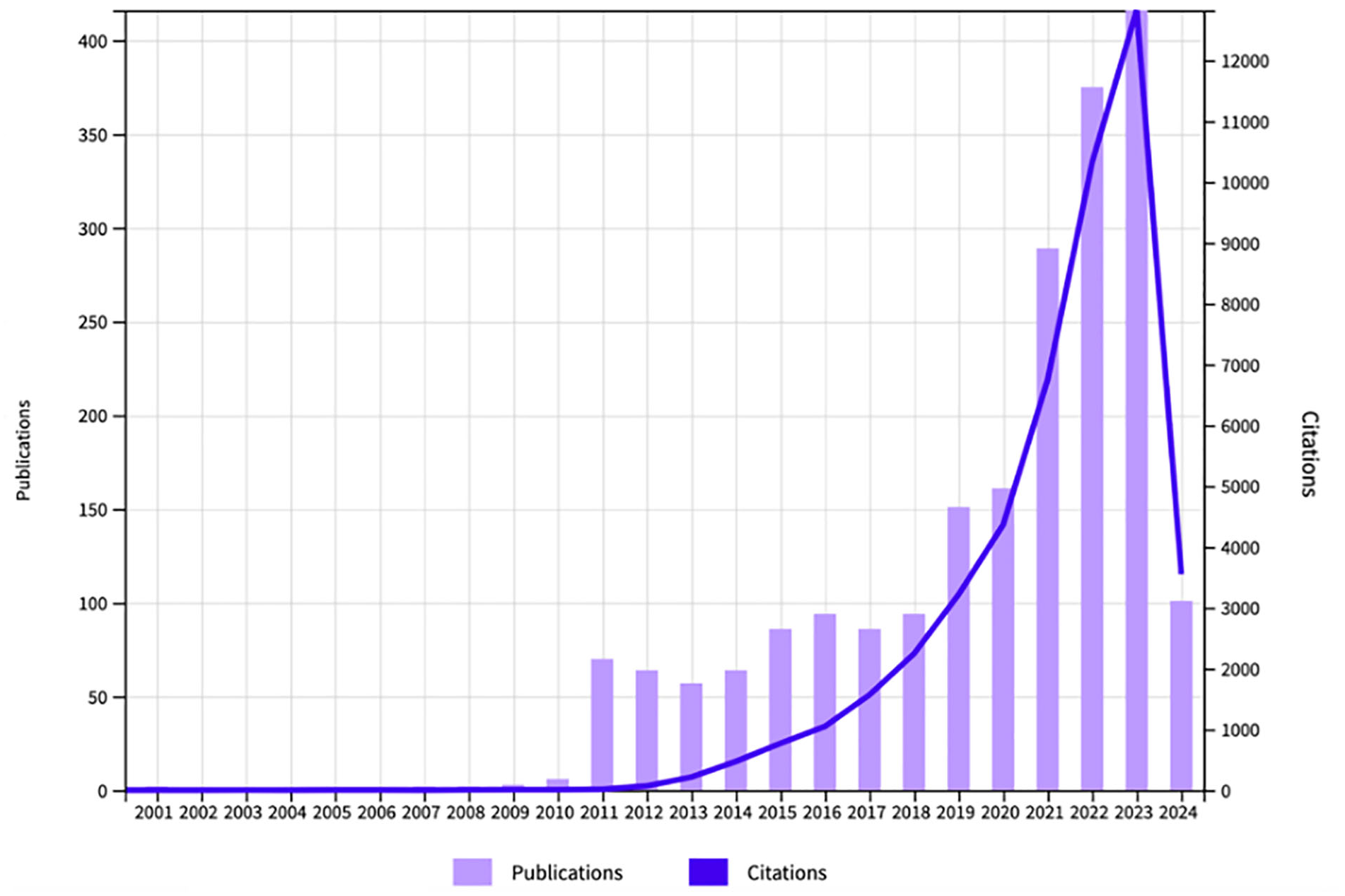
Number of publications and citations in green economy research.
Analysis of Disciplines Categories
Figure 3 illustrates the subject categories of the sample articles, with each category sourced from the Web of Science database. The graph highlights the top five research fields, namely environmental science, environmental studies, green sustainable science technology, economics, and energy fuels. Figure 3 reveals two distinct groups within these categories. The first group focuses on the theoretical aspects of the green economy discipline, while the second group is dedicated to the development of new technologies, new energy sources, and management models for the green economy. It underscores the interconnected relationship between technology and theory, emphasizing that technology should be grounded in theory, and theory should, in turn, depend on technology for practical application.

Discipline categories.
Highly-published Journals
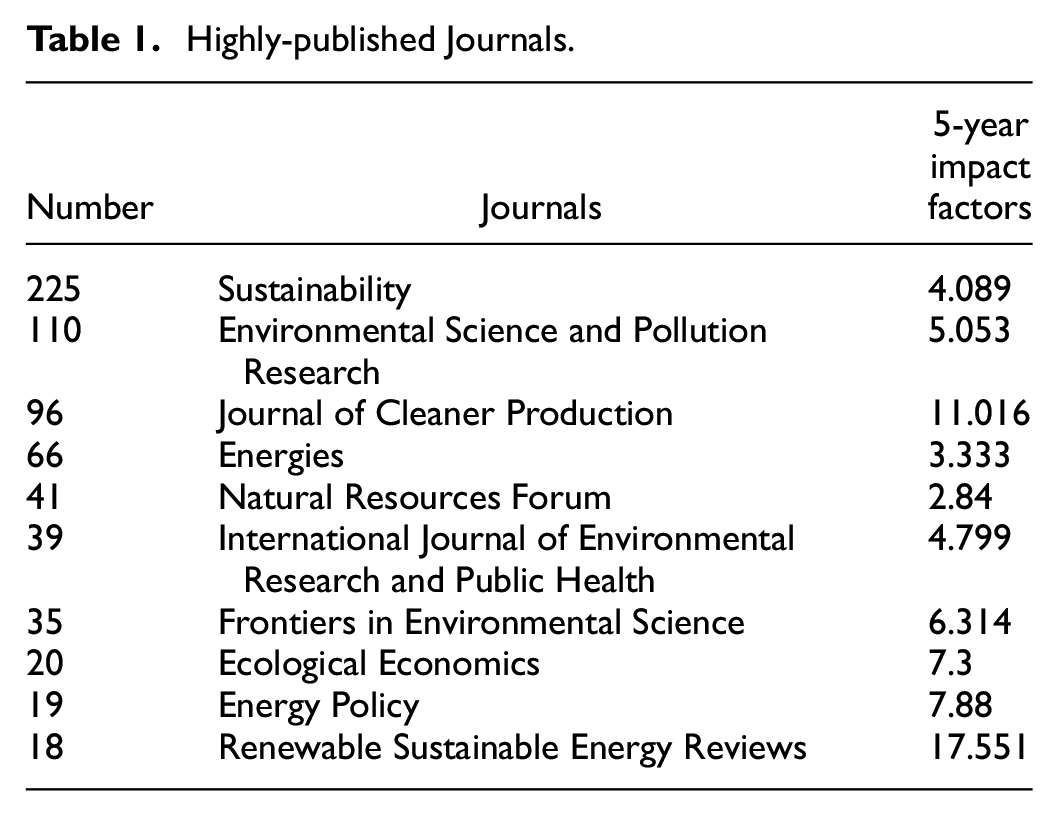
Academic journals serve as a crucial medium for the exchange of scientific and technological knowledge. They play a significant role in disseminating such knowledge, enhancing readers’ scientific and cultural literacy, facilitating the application of scientific achievements, fostering international scientific exchanges, and particularly driving the continuous progress of science and technology. An analysis of high-impact factors and prominent publication journals in the green economy field allows us to identify the core journal group, serving as a foundation for literature collection and management. We utilize the 5-year impact factors from the citation report of the Korui Weian Journal to illustrate the influence of the journal and assess the quality of research within this field.
Table 1 presents the top 10 journals with the highest publication volumes. Sustainability, leading in publications, is an international, interdisciplinary academic journal focusing on human, environmental, cultural, economic, and social sustainability. It serves as a prominent forum for research related to sustainability and sustainable development. Renewable Sustainable Energy Reviews, known for its substantial impact factors, primarily publishes review papers, original studies, case studies, and analyses of new technologies in the realm of renewable and sustainable energy. The Journal of Cleaner Production emphasizes research and practical applications in clean production, environmental issues, and sustainability.
Highly-published Journals.
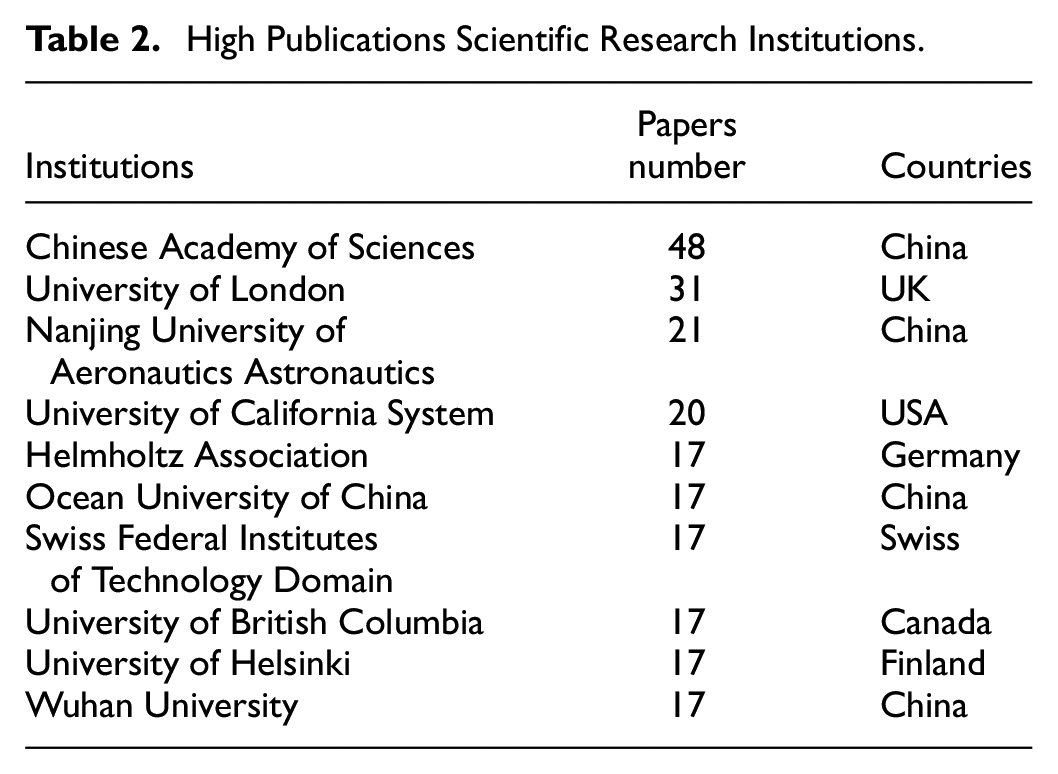
Highly Publications Scientific Research Institutions
Table 2 displays the top 10 research institutions, with Chinese Academy of Sciences leading in publications with 48 papers. Following closely is University of London with 31 papers. The Nanjing University of Aeronautics Astronautics and University of California System secure the third and fourth positions, respectively. Among the top ten institutions, five are situated in Europe, four in Asia, and one in North America. The global distribution of research institutions exhibits an uneven pattern.
High Publications Scientific Research Institutions.
Analysis of Co-Citation Network
In this section, we explore co-citation networks from two perspectives. Firstly, we delve into hub nodes and highly cited papers. Secondly, we examine co-citation clustering. The node size in the figure corresponds to the co-citation frequency, with circles representing highly co-cited literature. The color of the links indicates the timing of the first co-citation.
Analysis of Pivot Nodes and Highly Cited Papers
The significant contributions of hub nodes and highly cited papers in unraveling the evolution path and research field of co-cited networks merit attention. Hub nodes serve as connecting bridges between different types. In Figure 4, the pivotal node is a circle with purple circles (indicating high mesocentricity) and red nuclei (reflecting high burst intensity; Chen, 2006). A highly cited paper is represented as the largest node in the co-cited network, with this article setting a citation frequency threshold of 12 or above.

Co-citation network and clustering of green economy.
Table 3 outlines the hub nodes and highly cited papers. There are three hub nodes in the cited network: Rockstrom et al. (2009), Loiseau et al. (2016), and D’Amato et al. (2017). Rockstrom et al. (2009) delve into the necessity of establishing a safe operating space for humanity concerning planetary boundaries, climate change, rate of biodiversity loss, nitrogen and phosphorus cycles, etc. They argue that identifying and quantifying planetary boundaries that must not be transgressed could help prevent human activities from causing unacceptable environmental change. The evidence suggests that, as long as the thresholds are not crossed, humanity has the freedom to pursue long-term social and economic development. Loiseau et al. (2016) accomplish three objectives: (1) a comprehensive review of the theory, concepts, methods, and tools of green economy, (2) a framework that demonstrates the ability of green economy concepts, methods, and tools to support the transition toward sustainability, and (3) the impact of the green economy concept on strong and weak sustainability. By discussing the concept and related elements, methods, and tools of green economy, they strive to contribute to its definition and relationship as a prerequisite for implementing green economy. D’Amato et al. (2017) conduct a comparative analysis of the concepts of green economy, circular economy, and bio-economy from the perspective of bibliometric methods. Like Loiseau et al. (2016), their focus is on exploring the theory of green economy. These three nodes play a pivotal role among different clusters.
Pivot Nodes and Highly Cited Papers.

Loiseau et al. (2016) is the most cited literature on this topic, followed by the United Nations Environment Program’s 2011 report, “Towards a Green Economy - Pathways to Sustainable Development and Poverty Eradication” (UNEP, 2011). The UNEP report explores three main areas. First, it provides an overview of the crises and opportunities faced by humanity, introduces the concept of a green economy, elaborates on the prospects of developing a green economy, and discusses methods for evaluating its progress. Second, it examines the role of a green economy as a core element in poverty alleviation, emphasizing its potential to replace fossil fuels, achieve low-carbon transportation, and accelerate economic growth. Third, it outlines the conditions necessary for a green economy, including establishing a sound regulatory framework, implementing targeted government stimuli, managing capital expenditure, utilizing tax policies to promote innovation, and strengthening education and financing for green economic transformation. Shuai and Fan (2020) analyzed panel data from various regions in China between 2007 and 2018 and constructed a green economic efficiency measurement index system. Using the super-efficient DEA model, they measured the efficiency of China’s green economy.
Co citation Clustering Analysis
In Figure 4, there are 11 clusters (the software automatically displays the maximum connected subnet, while excluding the rest), which can be categorized into the following 3 parts.
Green Economy is a Requirement for the Survival and Development of Human Society (# 6)
Capitalism, an incredible human invention, marked the onset of the Industrial Revolution, leveraging fossil fuels for production. The industrial scale, which disrupted the natural equilibrium, has evolved into a global force, now posing a threat to our industrial civilization in a precarious state of collapse (Mathews, 2011). Various global metrics indicate that the Earth has exceeded its capacity to sustain resources without significant negative consequences. One pressing concern is climate change, which intensifies as evidence accumulates (Pretty, 2013).
There is a pervasive apprehension that the economy is colliding with the Earth, manifesting issues such as climate change, water depletion, and biodiversity loss. However, the global economy is projected to grow two- to four-fold to provide future inhabitants with the necessary average yearly income of $10,000 for a reasonable life expectancy and human development index (Tukker, 2013). In a scenario marked by the erosion of ecosystemic services and high social inequity, a new development model is imperative, one capable of fostering social progress while reducing its ecological footprint. The “Green Economy” model stands as one of the proposed solutions (Gallo et al., 2012). The Green Economy has transitioned from a choice to a necessity for the survival and advancement of human society.
Theoretical System, Model, and Path (#0 #1 #2 #9 #14)
Theoretical frameworks, models, and pathways in the green economy are rooted in societal needs and concurrently impact practical applications. Initially, scholars conducted a conceptual analysis, comparing 114 different definitions of the green economy (Kirchherr et al., 2017). While circular economy, green economy, and biobased economy share the idea of aligning economic, environmental, and social goals, there are distinctions. Green Economy serves as an overarching concept, encompassing elements from circular and biobased economies, such as ecological efficiency and renewable energy. Circular and biobased economies specifically focus on resources, whereas green economy recognizes the fundamental role of all ecological processes (D’Amato et al., 2017).
Natural resources serve as fundamental inputs for economic and social development. Unsustainable resource utilization leads to environmental degradation and resource depletion, posing risks to human well-being and the environment (Merino-Saum et al., 2018). Green growth not only safeguards the environment and human health but also replaces scarce natural resources (Abid et al., 2021). The green economy has become a global development mainstream, and the urgency of developing green industries intensifies for the world to achieve sustainable development goals. Sustainable transformation aims to comprehensively address contemporary societal challenges by harmonizing ecological integrity and social viability (Luederitz et al., 2017). The development path has been analyzed (D’Amato et al., 2017).
Green economic growth underscores the coordinated development of the economy and environment within the constraints of resource and environmental carrying capacity. Although green growth and sustainable development have garnered attention from decision-makers and governments, the green economy encounters numerous challenges. While recognized by society, it has also faced obstacles and introduced social conflicts among various groups striving for a low-carbon economy and a more equitable society (Weber & Cabras, 2017). Small and medium-sized enterprises may encounter hurdles when implementing a circular economy business model (Rizos et al., 2016).
Furthermore, the green economy not only ensures the healthy functioning of the Earth’s ecosystem but also promotes the well-being of workers, contributing to the reduction of health damage caused by occupational diseases and work-related accidents (Moreira et al., 2018).
Practice and Effect Evaluation of Green Economy (# 3 # 4 # 8 # 12#5)
The practice of a green economy aims to promote the harmonious coexistence of environmental protection and economic development through a series of strategies and actions, ensuring the effective utilization of resources and the sustainability of ecosystems. Energy production and consumption, as core components of global economic activities, are closely and profoundly connected to the green economy, significantly affecting environmental quality. A green economy is a sustainable approach to combating climate change and promoting sustainable development through the adoption of sustainable energy (Tang & Solangi, 2023). The causal relationship between the green economy and the level of energy utilization has been confirmed by the Granger test, indicating a long-term, balanced relationship characterized by benign and orderly development (He et al., 2022).
Green economy and environmental planning are indispensable aspects of promoting sustainable development, interacting and complementing each other to ensure economic development while protecting and restoring natural ecosystems and promoting social well-being. Environmental regulation has a significant positive effect on the efficiency of the green economy in resource-based cities and significantly promotes the green economy efficiency in growing cities (Yang et al., 2023).
The green economy, characterized by its environmentally friendly approach, holds immense significance for sustainable economic development and environmental protection. Evaluating its benefits correctly is a crucial area of study. Various methodologies such as Dea (Duan et al., 2022), entropy-weighted TOPSIS (Lin & Zhou, 2022), the Fermatean fuzzy system (FFS) (Karuppiah et al., 2022), DSGE model (H. Liu et al., 2022), the Belt and Road Green Development Index (BRGI) (Xue et al., 2021), and simultaneous spatial equation (Xu et al., 2022) have been applied in this context.
Analysis of Keywords Co-occurrence Network
Scholars choose keywords for their published papers based on the paper’s content, creating a concise representation of its core ideas. These keywords encapsulate the research theme, direction, methods, and other essential aspects of the paper. Consequently, keywords are frequently utilized as the primary focus in topic mining, hotspot analysis, and trend tracking of scientific papers.
Research Theme
Cluster the keyword map using the LLR algorithm in CiteSpace software to generate a Timeline view of 11 larger clusters, as depicted in Figure 5. The cluster labels are positioned on the right, with time displayed at the top, and keywords from the same cluster aligned on the same horizontal line. Clusters are organized vertically in descending order of size, and the closer the timeline is to the right, the more recent the time frame. Each node denotes a keyword, fixed in the year of its first occurrence, interconnected by lines between keywords. The timeline vividly illustrates the temporal span of each clustered literature and the progression of a specific clustering research from emergence to prosperity and decline. Nodes with a red tree ring or larger nodes indicate high noteworthiness, suggesting frequent appearances, strong highlighting intensity, or both.

Green economy cluster analysis timeline.
In Figure 5, the most extensive cluster is #0 (climate change), with the core keyword “governance” originating from the United Nations Sustainable Development Conference held in Rio de Janeiro in June 2012. The conference emphasized renewing political commitment to sustainable development (Linnér & Selin, 2013), promoting a green economy, and influencing global climate change (Never & Betz, 2014). After 2020, research on this topic gradually diminished.
Simultaneously, research topics included circular economy (#1), energy consumption(#2), sustainable development (#3), green finance(#7), and wood pellets (#9) during the same period. “Ecosystem services” is the primary keyword in #1. D’Amato D has published several papers elucidating the relationship between circular economy and sustainable development, constructing an appropriate framework, and integrating green economy, circular economy, and biobased economy (D’Amato, Droste, et al., 2019; D’Amato & Korhonen, 2021; D’Amato, Korhonen, & Toppinen, 2019). Energy consumption intensity significantly impacts green economy efficiency. When energy consumption intensity exceeds a certain threshold, the effects of science and technology input on green economy efficiency become pronounced (Li et al., 2020). The green economy, as highlighted in “Green Economy - Vector of Sustainable Development” (Ospanova et al., 2022), not only promotes economic growth but also ensures social welfare while enhancing environmental quality. Thus, it serves as a crucial pathway and practical framework for achieving sustainable development goals. Green finance plays a pivotal role in supporting green industries and advancing the green economy. It drives social capital toward energy-saving, low-carbon, and environmentally-friendly industries, thereby fostering technological innovation and industrial transformation (D. Liu et al., 2023). Additionally, wood pellets, as a form of biomass fuel, are integral to the green economy. They contribute to reducing environmental pollution and mitigating climate change, promoting effective resource utilization and sustainable economic development. Wood pellets are a vital component in the transition to a greener, low-carbon economy.
Evolution of Research Trends
The keyword co-occurrence network effectively portrays the evolution of research trends and the latest developments in the field by showcasing keywords from different periods and the most recently published literature. In this study, a time zone graph of keyword co-occurrence is utilized to illustrate the progression of research trends, excluding the search keyword “green economy.”Figure 6 depicts the keyword co-occurrence network across time zones. Node size corresponds to the frequency of keyword occurrences, with larger nodes indicating higher frequency and line color indicating the time of first co-occurrence. Lighter line colors signify more recent appearances. Nodes are presented with annual rings, where ring thickness correlates with the frequency of occurrence within a specific time zone, and ring color signifies the corresponding time period.

Evolution of research trends.
The Earlier Research Trends (2011–2015)
In Figure 6, the keyword “sustainable development” stands out as the most frequently used node. Green growth, improving energy efficiency, clean energy technologies, and sustainable development are often considered mutually reinforcing goals by international decision-makers (Barbier, 2011). Additionally, the emergence of terms like “policy, energy, performance, technology, and efficiency” indicates that key actors within the social and political system are experiencing direct impacts on sustainable development due to political and environmental shocks (Swilling et al., 2016). In the realm of energy, carbon dioxide (CO2) is identified as a crucial raw material for the future green economy (Schwander et al., 2016). The performance and efficiency of green projects have become focal points for scholars (Scholtens, 2011), and achieving energy transformation through “breakthrough” clean energy technologies is a strategic approach for many countries to attain green energy (Knuth, 2018). The color of node rings reveals that “sustainable development, policy, energy” has consistently been a research hotspot for scholars since its initial attention in 2011.
During the period 2012–2015, keywords such as “governance, climate change, ecosystem service, carbon, green job, politics, green growth, economic growth” gained prominence. The “governance” node is highlighted in red, indicating a sudden surge in interest within a short timeframe and signifying a hot topic during that period. Early on in the green economy discourse, understanding the green economy (Caprotti & Bailey, 2014) and exploring the transition to a green economy through environmental governance (Jacobi & de Almeida Sinisgalli, 2012) were primary areas of concern. Following the 17th Meeting of the Parties to the United Nations Framework Convention on Climate Change and the Rio+20 Summit on Sustainable Development in Durban (December 2011), attention shifted toward “green economy,”“natural capital,” and “payment for ecosystem services” (Sharife & Bond, 2013).
Midterm Research Trends (2016–2020)
With the global shift toward a green economy, “green growth” has emerged as a strategy to “pursue economic growth and development while preventing environmental degradation, biodiversity loss, and unsustainable use of natural resources” (Hamwey et al., 2013). Countries are actively mapping the green product space in this transition phase. To minimize environmental damage, foster technological innovation, optimize energy structures, and utilize renewable energy sources effectively, countries are exploring various alternatives such as wind power generation (Proskuryakova & Ermolenko, 2019), photovoltaic power generation (Siamanta, 2017), and hydropower generation (Satir et al., 2018).
Circular economy has gained prominence as the mainstream of global development and a focal point in both academic and policy research (Frone & Frone, 2017). The development of a green economy and the reduction of CO2 emissions have achieved international recognition (Ren et al., 2019). Leading innovation toward a green economy, revolutionizing energy technologies, and fostering innovation for a sustainable low-carbon environment have become widely acknowledged and implemented strategies.
Recent Research Trends (2021–2024)
At this juncture, biotechnology has undergone rapid development, significantly propelling the growth of the biological economy (D’Amato et al., 2020). Green development represents an innovative paradigm built upon traditional development, presenting a novel approach that prioritizes environmental protection as a crucial pillar of sustainable development within the confines of ecological and resource capacities. In the context of advancing the green economy, it is essential to navigate the relationship between the rule of law and environmental sustainability with precision (Wen, 2022).
Effectively promoting the synergistic development of the ecological environment and technological innovation holds paramount importance for the advancement of a green economy (Su, 2022). Industrial biotechnology and its industrialization stand as pivotal strategic measures supporting the growth of the green economy and the realization of sustainable economic development (Bakan et al., 2022).
The green economy sets the overall direction for achieving sustainable development goals, and green innovation is the specific path and means to achieve it. The two complement each other and jointly promote the development of the economic system toward a more environmentally friendly, efficient, and sustainable direction. Green innovation development is essential to achieve “carbon neutrality and carbon peaking” and drive sustainable urban growth, which significantly influences the global green economy (Wang et al., 2023).
Research Hotspots in the Past 5 Years
The CiteSpace keyword co-occurrence function was utilized to generate the co-occurrence network, visually represented in Figure 7. This network serves as a tool to identify evolving research hotspots within the field. In the figure, the circles’ sizes correspond to the co-occurrence frequency of keywords, the lines denote relationships between keywords, and the line thickness indicates the strength of the connections. The outermost circle of each node reflects its centrality, with nodes highlighted by purple circles. The width of the purple circles signifies the mediation capability of nodes, highlighting their influence in the network. Additionally, red nodes represent citation bursts, indicating frequent citations in a short timeframe and serving as “footprints” of hotspots or frontiers.

Keyword co-occurrence network.
In Figure 7, the network statistics reveal that there are n = 118 nodes, e = 212 edges, and the network density is 0.0307. Notably, the “growth” node stands out as the largest, signifying the keyword receiving the most attention from scholars. Over the past 5 years, “growth” has been associated with 100 research papers, covering diverse topics such as policy choices in green economy (Jian et al., 2021), comprehensive evaluation of green economy (M. Wu et al., 2021), and quantitative analysis of green economy (N. Liu et al., 2020). Other highly frequented nodes include Policy (21), Circular Economy (16), and CO2 Emissions (10). There is growing evidence that absolute decoupling is not enough, suggesting that high-income countries such as Norway may be ripe for a transition beyond policy focus on green growth to post-growth economies (Tenorio & Gomez-Baggethun, 2024).
Intermediary centrality, measuring a node’s bridging ability between two other nodes, highlights Policy with the highest intermediation centrality (0.50), followed by Environment (0.36), Emissions (0.35), and Economic growth (0.34).
CiteSpace’s burst detection function identifies significant changes in reference volume over time, highlighting peaks and declines in specific theme words or keywords. Circular economy (3.79), Ecosystem services (2.99), Green jobs (2.94), and Environment (2.81) are notable for experiencing surges.
From these perspectives, the research hotspots in green economy over the past 5 years revolve around “growth, Policy, Sustainability, Circular Economy, CO2 Emissions,” with additional emphasis on Sustainability, Governance, Technology, Energy Efficiency, and Innovation.
Discussion
The continuous growth of research literature on the green economy is primarily driven by increasing global attention to sustainable development, environmental protection, and climate change. As a development model that balances economic growth and environmental protection, the green economy has garnered significant attention and research. It offers effective solutions to environmental issues, supports economic transformation and upgrading, and meets people’s aspirations for a better quality of life.
One pivotal milestone in green economy research is the paper “A Safe Operating Space for Humanity” by Rockstrom et al., published in Nature in 2009. This landmark work provides a scientific benchmark for the global sustainable development agenda, influencing theoretical research and practical policy-making. It establishes a conceptual framework, offers guiding principles for green economy policies, provides a risk assessment framework, and enhances public awareness.
Sustainable development remains the most persistent issue in green economy research because it addresses the core challenge of balancing economic development and environmental protection. It is a focal point for the international community, governments, businesses, academia, and civil society organizations. Achieving sustainable development involves dynamic changes and ongoing challenges, necessitating continuous research and practical exploration. In the past 5 years, “growth” has become the most prominent issue in green economy research due to global environmental pressures and sustainable development goals. There is an urgent need to find and implement development models that maintain economic growth without causing irreversible environmental harm, a consensus in the international community.
As an economic system that coordinates economic development with ecological sustainability, future research on the green economy may focus on the effectiveness of policies, innovation in green technologies, promotion of green projects through green financial mechanisms, global economic integration, and international cooperation. This research will be interdisciplinary, leveraging big data to extract successful experiences and lessons learned. The goal is to provide a solid theoretical foundation and practical guidance for global sustainable development.
Through bibliometric analysis, this paper maps the knowledge graph of green economy research, illustrating the correlations between different research topics, theoretical frameworks, and core concepts. It systematically organizes the development and internal logic of green economy theory, revealing dynamic trends and emerging focuses. The analysis evaluates the academic influence of scholars, institutions, and literature, providing valuable insights for policy-making, education, talent cultivation, and cooperation networks. Despite these valuable insights, certain limitations are acknowledged. This study utilized the Web of Science database, which may have limitations in coverage compared to more comprehensive retrieval strategies. Synonyms of subject words may result in the omission of some documents. Additionally, the online publication of certain documents may lead to inconsistencies in collection dates compared to publication dates. Future studies should refine inclusion criteria to address these issues.
Conclusion
This paper employs the literature metrology method to scrutinize the keyword co-citation and co-occurrence patterns within a dataset of 2,106 relevant papers retrieved from the “Web of Science Core Collection” subject database. The resulting knowledge map encapsulates institutions, authors, keywords, and references, shedding light on the trajectory of global green economy research. This approach introduces a fresh perspective to the field of study, and the primary findings can be summarized as follows.
In terms of publication trends, the field demonstrates a discernible upward trajectory, with the annual average surging to 360 papers from 2021 to 2024, indicating a phased jump in growth. Research institutions are unevenly distributed globally, with five of the top ten institutions in Europe, four in Asia, and one in North America. Predominantly, papers were published in renowned journals such as Sustainability, Environmental Science and Pollution Research, and Journal of Cleaner Production.
Through literature co-citation analysis, three pivotal nodes and three highly cited papers were identified, elucidating the examination and synthesis of fundamental theories encompassing green economy theory, concepts, methods, and tools. Further cluster analysis categorizes the research foundation into three key aspects: the necessity of green economy for human society’s survival and development, the theoretical framework, models, and pathways, and the practical implementation and impact evaluation of green economy initiatives.
Keyword co-occurrence analysis explores research themes, trends, and recent hotspots. Climate change emerged as the most scrutinized topic, spurred by the United Nations Conference on Sustainable Development in Rio de Janeiro in June 2012. Additional research themes include circular economy, energy consumption, sustainable development, green finance, and wood pellets. Temporally, three distinct stages emerge: 2011–2015 as early research trends, 2016–2020 as midterm research trends, and 2021–2024 as recent research trends. Hotspots in the past 5 years concentrate on “growth, sustainability development, impact, performance, policy, and innovation.”
Footnotes
Acknowledgements
Thanks to Key Research Center of Philosophy and Social Science of Zhejiang Province: Modern Port Service Industry and Creative Culture Research Center support for this paper.
Declaration of Conflicting Interests
The author(s) declared no potential conflicts of interest with respect to the research, authorship, and/or publication of this article.
Funding
The author(s) received no financial support for the research, authorship, and/or publication of this article.

Data Availability Statement
The datasets generated during and/or analyzed during the current study are available from the corresponding author upon reasonable request.