




Abstract
A total of 1,207 papers related to competitive basketball research from 1986 to 2019 were retrieved from the Web of Science database. Taking the retrieved papers as research objects, the trend chart, keyword map, and citation map of international competitive basketball research were drawn using the visual software CiteSpaceIII, and the methods of literature review, knowledge map analysis, co-occurrence analysis, citation analysis, and word frequency analysis were used. The research status and hot spots of international competitive basketball in recent 30 years are analyzed, which clarify the research context of foreign competitive basketball, reveal the research trend of international competitive basketball, and provide theoretical reference for future competitive basketball research. The research shows that (a) competitive basketball research lacks influential scientific research institutions and leading figures, and the existing research institutions are in their own way with little cooperation. (b) The hot spots of competitive basketball research are “Competitive performance,” “Gender difference,” “Sports injury,” and so on. Co-occurrence network structure is relatively loose and the density is not high. (c) “Sports injury” has always been the hot spot and frontier of competitive basketball research, from the early rehabilitation basic research aimed at ensuring competitive participation to the fine-grained preventive research centered on “preventing diseases,” and then to the interdisciplinary comprehensive research of electronic science, neuroscience, and brain science. In this process, big data research began to emerge, reflecting the research characteristics of the era of mathematics and intelligence, and also showing the future research trend and development direction of competitive basketball.
Introduction
Basketball originated in America and flourished in Europe and America. In the nearly 130-year development course of basketball, competitive basketball academic research has gradually formed a stable and influential research field, set up special academic groups, founded a variety of academic journals with international influence, and published a large number of high-quality papers and monographs, which has matured as an independent research field. Previous research results can be roughly divided into two categories, one is empirical research paradigm, that is, research conducted by researchers to collect research data in person to put forward or test theoretical assumptions, which is mostly supported by data and quantitatively analyzed by experimental methods or statistical methods. For example, when Eyel and Akkaya (2020) discussed the influence of emotion on women basketball players, 135 women basketball players were randomly selected to collect data with Newman Emotional Scale, and the data were analyzed with SPSS22. The second one is the humanistic research paradigm. Sarlis and Tjortjis (2020) reviewed the evolution law of statistical indicators in basketball games by the National Basketball Association of the United States and the European Basketball League and made a critical analysis of statistical indicators by logical analysis. By using the methods of literature review and logical analysis, Li (2020) discussed the present situation and development path of the training of competitive basketball reserve talents. Previous studies have shown that competitive basketball researchers have erected a barrier between positivism and humanism, separating the two research paradigms into isolated islands, especially the summary research, which emphasizes theoretical speculation and neglects quantitative analysis, which is incompatible with the research paradigm in the era of big data, and also makes the research results lack of science. Based on this, this article introduces the metrological analysis software CiteSpace.
Theoretical research of sports science is an important foundation and source of competitive sports progress (T. Tian et al., 2005). Physical education has the attributes of both natural science and social science (Gao et al., 2020). SCI and SSCI databases in the Web of Science (WOS) database have good compatibility with the characteristics of multiple intersections of physical education, covering most fields of competitive basketball research. However, it is particularly worth considering how to screen out the whole picture of competitive basketball research from numerous documents: it is necessary to take a glance at all the documents in the field of competitive basketball as much as possible and to filter out the “pollution” of irrelevant search results in other fields (Qian et al., 2019). The premise of conducting the academic research dialogue between the East and the West is to have a holistic understanding of the hot spots, characteristics, and trends of international academic research, so as to effectively feed for the academic achievements flowing at high speed. In view of this, this article explores the frontier hot spots and development context of international competitive basketball through scientific quantitative visual analysis of the related research documents of competitive basketball collected by WOS since 1986, to provide reference for domestic scholars to grasp the development trend of competitive basketball, understand the research hot spots, and promote the perfection and development of theoretical system.
Data Sources and Research Methods
Data Sources
The database of WOS core set of American Institute of Science and Technology Information (ISI) is used as the index. Combined with the research purpose of this article, after repeated combination, analysis, and comparison of multiple search formulas, the final search formula of topic is: TS = (competitive basketball or athlete*basketball or professional basketball). The search time range was from 1986 to 2019, and the subject “sport science,” literature type “Article,” and language “English” were selected as the refining basis, and 1,207 initial literatures were finally retrieved. The retrieval and data download time is November 6, 2019.
Research Methods
Method of documentation
Technical support and theoretical basis for this study are provided through consulting related materials and electronic documents of CNKI and Shandong University Library and consulting a large number of related books such as visual analysis and knowledge map related to basketball.
Visual analysis
By using relevant tools, this article analyzes the national institutions, authors of knowledge sources, and journals’ co-citation, and so on; draws a visual map related to this article; and explores the frontier hot spots and development context of international competitive basketball.
Keyword clustering analysis
By consulting CNKI and Shandong University Library, the keywords such as “basketball,” “sports,” “practice,” and “injury” are taken as the research objects, and their relationship is simplified as the relationship of groups.
In this study, CiteSpaceIII software based on JAVA platform is used to analyze knowledge map.
Results and Analysis
Distribution of Countries and Institutions in Foreign Competitive Basketball Research
In general, the level of scientific research activities of a country (region) is roughly related to the overall national strength and exerts a far-reaching influence on the international competitiveness of competitive sports (M. J. Tian, 2006). Regional statistics on competitive basketball research is helpful to find out the scientific research hot spots among various countries (regions), to peek at the distribution of scientific research achievements, to capture the frontier trends in this field, and to improve the timeliness of research information on competitive sports.
Figure 1 shows the country (region) distribution of competitive basketball research. Through an in-depth study of the amount of published articles in China, it is found that the output of competitive basketball literature is highly correlated with the level of competitive basketball in China. From the distribution of countries and regions, 1,207 papers on competitive basketball came from 41 countries, with the largest number of papers (562) in the United States, followed by Australia (99) and England (90), ranking 2 to 10. Except Australia, the rest are European and American countries, and the United States occupies an absolute dominant position in this field, with 46.56% of the research results coming from Figure 2 not only intuitively show the number of published articles in countries (regions) where competitive basketball is studied, but also reveal an important information-betweenness centrality, which is an index to measure the importance of nodes in the network and a method to reveal the law of knowledge flow among documents. CiteSpace uses this index to discover and measure the importance of documents and highlights such documents (or authors, periodicals, and national institutions, etc.; Chen, 2006). According to the central statistics of CiteSpace’s back-office posts, Scotland ranks first with 0.98, and the countries ranked 2 to 10 are England (0.96), New Zealand (0.93), Spain (0.84), Wales (0.83), Croatia (0.81), Finland (0.69), and Portugal (0.67). The literature of these countries in the field of competitive basketball research is highly mobile, which guides the development direction of competitive basketball research and occupies an important position in the international academic circles of competitive basketball research. On one hand, the number of documents ranked 24th in China and the centrality of publication of 0.00 shows that English-speaking countries have unique advantages in publishing in WOS scientific citation index database. On the other hand, it also requires Chinese researchers to improve their foreign language level, strengthen their international communication ability, study foreign academic trends, and establish a long-term and stable cooperation mechanism with foreign scientific research institutions and groups. The most notable research institutions are Cincinnati University, Ohio State University, and Cincinnati Children’s Hospital. These three institutions cooperate closely with each other, with 48, 42, and 24 papers, respectively. Among them, Cincinnati University and Ohio State University have the highest centrality, which are 0.13 and 0.10, respectively, indicating that the research results of the two institutions have great influence and occupy an authoritative position in the academic circles of competitive basketball research.

The cluster of distribution countries.
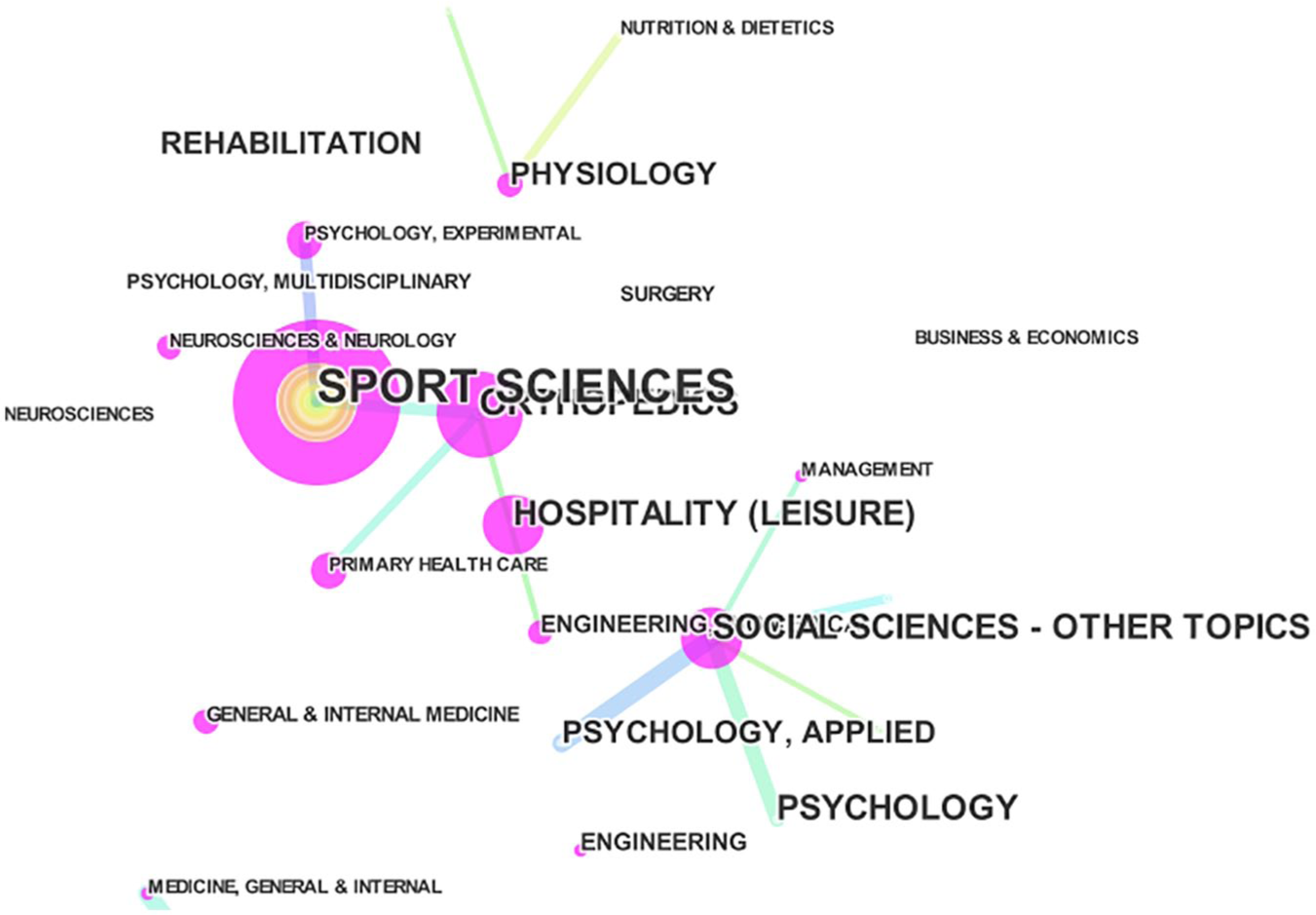
The cluster of main subjects.
Analysis of the Source of Knowledge in Foreign Competitive Basketball Studies
The quantity of literature reflects the author’s ability to produce knowledge, whereas the quality of literature reflects academic influence. Compared with the number of publications, the publication quality is more objective and accurate in evaluating the academic status of authors. The citation frequency can be used as an important evaluation index of literature quality, whereas the centrality can be used as an index to evaluate the importance of authors (Xin et al., 2014). According to the author of the article, there are 519 authors in 1,207 articles. According to the internationally accepted calculation formula of the core author Price, N = 0.749×, N ≈ 5 can be obtained. When running CiteSpace software, background data showed that there were 10 core authors who published more than five articles, accounting for 2% of all authors. From this proportion, core authors’ group has not yet been formed, and the author group is relatively scattered. Tables 1 and 2 show the top 10 authors, respectively, in terms of number of posts published and citation frequency. As with competitive basketball in the United States, American academics are particularly prominent, with Aoki from Brazil and Goosey-Tolfrey from Britain among the top 10 authors. Hewett, Article 51, with cited frequency 214 times, centricity 0.54, is in the first place, with the main research directions of biological medicine, sports medicine, especially in sports injury prevention and recovery, clinical diagnosis, and other fields, and has high academic status, followed by Myer, the University of Cincinnati professor, and Ford, Pacific Northwest Research Station, ranking the third. In-depth study on the literature found that Hewett with Myer and Ford, three professors in research direction and content, is more closely linked, forming a small academic community, and jointly published many valuable papers (Hewett, 2005, 2006a, 2006b; Ford et al., 2003); this also proves that the more prolific authors, the closer cooperation, literature is, the more output, from academic research to verify the “Matthew effect.”
Main Authors (TOP10).

Main Cited Authors (TOP10).

Analysis of Disciplinary Cooperation Network
Multidisciplinary and multiperspective comprehensive research occupies a prominent position in competitive basketball research, and the knowledge of different disciplines and specialties also provides us with the basis for studying the theory and methods of competitive basketball. From 1986 to 2019, the research papers in the field of competitive basketball were distributed in 26 disciplines of WOS. Apart from sports science, the other interdisciplinary studies mainly came from 10 disciplines, including 248 orthopedics and 162 social sciences. There are 162 articles on leisure sport, 154 articles on psychology, and 105 articles on rehabilitation. From the analysis of the importance of disciplines in the knowledge network, apart from sports science, the highest centrality is social science (0.66), which shows the sociological attribute of sports science.
Journal Co-Citation Analysis
Journal analysis in an academic field can determine the distribution of core journals in this discipline (Zhao & Wang, 2011). Analyzing the research field and orientation of journals can help us deepen our understanding of the subject connotation of competitive basketball. CiteSpaceIII’s output results reflect the importance of nodes with two indexes: citation frequency and centrality. Set the main interface of CiteSpace software, select the time span from 1986 to 2019, set the time slice as a stage every 2 years, and divide the whole time span into 16 time periods.
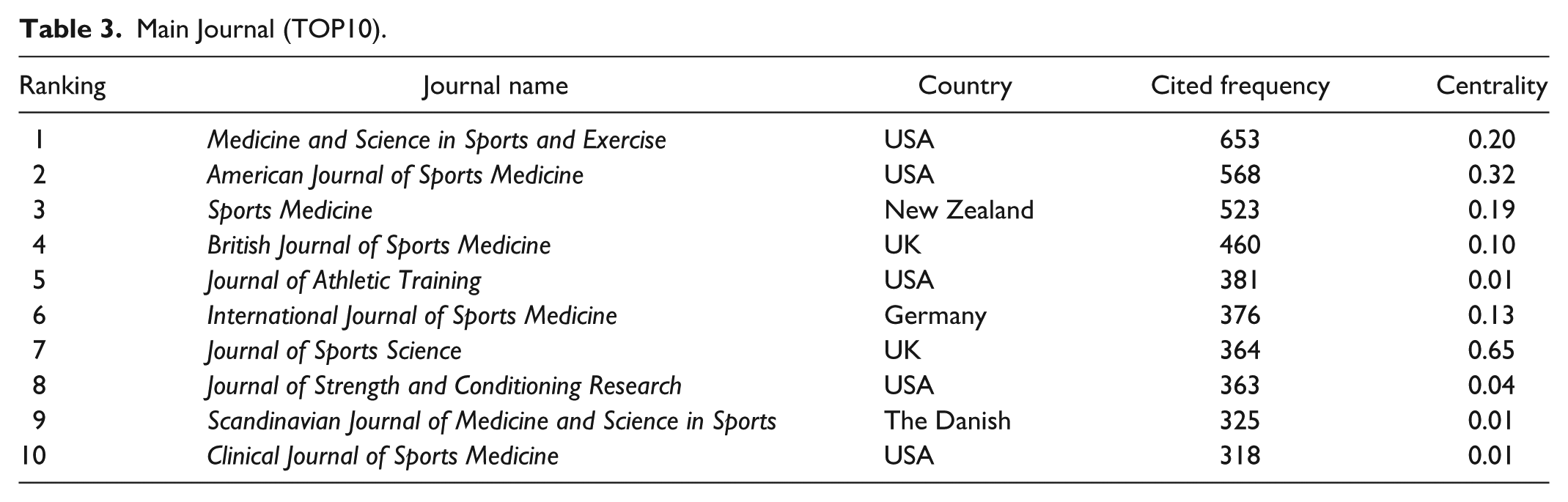
Figure 3 shows the distribution of journals cited in competitive basketball research. Some journals stand out because of their high cited frequency and centrality and can intuitively see their core position in the field of competitive basketball research. The biggest node in the graph is Medicine and Science in Sports and Exercise. Basic investigation is a comprehensive collation of a large number of original data and materials in a specific field in a certain period of time, which often has a strong reference value for new research, so it also has a high frequency of citation (Jiang et al., 2008). In the past 30 years, this journal has been cited by competitive basketball research literature for 653 times, with a centrality of 0.20. Followed by the American Journal of Sports Medicine, with a total citation frequency of 568 times. The most central journal is British Journal of Sports Science. Table 3 shows the main published journal information of foreign competitive basketball research achievements. These cited top 10 academic journals provide reference for Chinese researchers to contribute and are also the goal of international development and learning of Chinese sports academic journals.

The network of cited journal.
Main Journal (TOP10).
Co-Citation Analysis of Literature
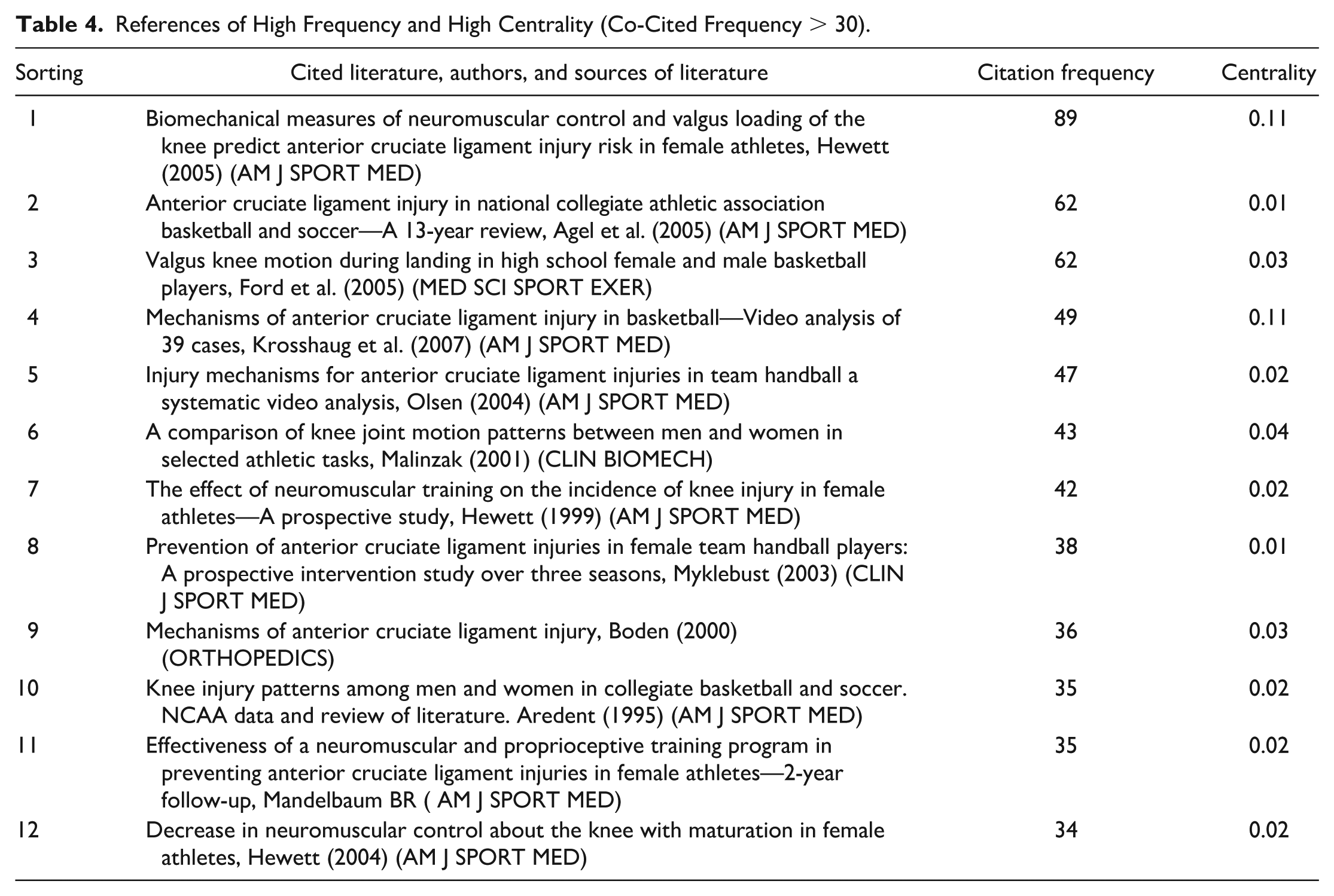
If we regard a series of related issues and concepts concerned in the papers published in recent years as the latest development status of this field, the references of these studies will form their knowledge base, and these classic literatures will have a far-reaching impact on the follow-up studies (Persson, 1994). In CiteSpace software main interface, the node type selection literatures were cited (cited reference), the threshold selection “TOP30” through the critical path algorithm (Pathfinder) running software, 1,207 papers, 26,359 article citations, and finally choose 148 cited nodes and 198 wire draw athletic basketball abroad research literature citations were cited in a network graph (Figure 4), and through the background data, highly cited frequency > (30) documents list was produced (Table 4). Figure 4 shows the influential literature in the field of competitive basketball research. Through the in-depth analysis of important nodes, it is found that the research literature on knee joint injury of elite basketball players is in a cornerstone position in the whole network. The largest node is “Biomechanical measures of neuromuscular control and valgus loading of the knee predict anterior cruciate ligament injury risk in Female athletes” published by Hewett in the American Journal of Sports Medicine in 2005. Of 205 women athletic basketball, football, and volleyball players in the experiment of jumping deep knee joint, angle and the torque change in 3D dynamic measurement, using the method of variance analysis, linear regression analysis of data, through the nine knee-injured athletes, 196 healthy athletes are found; landing knee abducent angles, outreach torque, and ground reaction force are the main causes of a knee injury. Coming in second was “Cruciate ligament injury in National Collegiate Athletic Association Basketball and Soccer—A 13-year review” which received 62 quotes. “Valgus knee motion during landing in high school female and male basketball players,” ranked third, has been cited 62 times with a centrality of 0.03. What is worthy of further discussion is that these research literatures discuss the mechanism of knee joint injury of basketball players, the monitoring and diagnosis of knee joint injury, and other sports medicine issues, which should belong to the research category of sports human science in a strict sense. The reason why they are cited so frequently is that they constitute the physiological basis for protecting the performance of competitive sports and play an important role in promoting the development of competitive basketball.

The network of co-cited references.
References of High Frequency and High Centrality (Co-Cited Frequency > 30).
Keywords
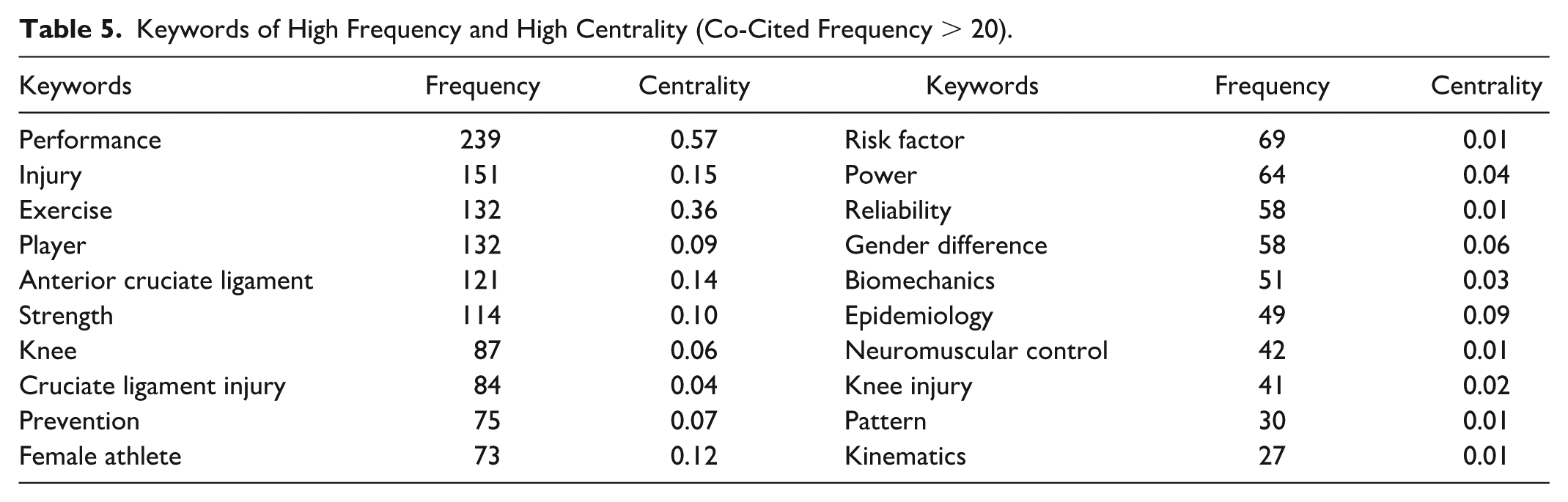
The keywords are the high extraction of the core content of the literature and the high concentration of the author’s academic thoughts. From the perspective of knowledge theory, keywords with high frequency and centrality are generally the common concerns of many researchers in a period of time, which is also the research hot spot and frontier. The co-occurrence analysis of high-frequency keywords can reveal the research hot spots in this field to some extent, while the time zone view is a view that focuses on representing the evolution of knowledge from the time dimension. Through the changes of high-frequency keywords, the research hot spots and development context in this field can be explored. Set and run various thresholds of CiteSpace analysis software, enter the visualization window, and use the node correction function to merge keywords with the same or overlapping meanings in the research topics. In this article, the keywords of background data merging are women and female; Men and male; Football and soccer; Football player and soccerplayer; Injuries and injuries; Young and adolescent; the processing result is to merge the occurrence frequency of the former into the latter to obtain a keyword research hot spot map composed of 148 nodes and 198 links (Figure 5). After merging and summarizing the specifications, some high-frequency and high school mental keywords are obtained (Table 5). After adjusting the time zone view of the keyword knowledge map, we can see the chronological changes of keyword evolution (Figure 6).

The network of main keywords.
Keywords of High Frequency and High Centrality (Co-Cited Frequency > 20).

The time zone viewing map of hot keywords.
Keywords distribution
Figure 5 shows the high-frequency keywords in competitive basketball research in the past 30 years. The circle size represents the frequency of the keyword in the literature, the font size represents the centrality of the keyword, and the thickness of the line between the circles indicates the strength of the correlation between the two (Chen & Chen, 2014). Stripped of the two dominant keywords, “basketball” and “sport,” the top 10 keywords and their occurrence frequency in the field of competitive basketball research in the past 30 years are as follows (see Table 5). Among these high-frequency keyword nodes, performance has the largest node and the highest degree of centrality, indicating that the research hot spot of competitive basketball in the past 30 years has been centering on competitive performance and competition results, which reflects the unique charm of competitive basketball and the essential characteristics of competitive basketball. The high-intensity competition of competitive sports and the fierce antagonism of competitive basketball will inevitably lead to the frequent occurrence of sports injuries. The research on sports injuries has attracted the attention of scholars. The occurrence frequency of injuries reaches 151 times, accounting for the second place. High-frequency keywords such as Exercise, Player, Anterior cruciate ligament can also be seen on the nodes. Through the analysis of these high-frequency keywords, it is found that the research hot spots of competitive basketball abroad in the past 30 years cover sports injury, competitive performance, training methods, strength quality, research methods, and other fields. The groups involved are mainly elite athletes, female athletes, and young athletes. The research methods mainly include dynamics method, video analysis method, and kinematics method. These studies are highly active, time-sensitive, and have a wide range of research perspectives. Their research contents span disciplines such as sports science, medicine, physiology, and system dynamics, providing multidisciplinary and all-round theoretical support for the development of competitive basketball.
Research on development context based on keywords time zone view
The time zone view shows the growth of domain literature. The more documents in a certain time zone, the more published results, and the domain is in a prosperous period. The connection relationship between time zones can be used to see the inheritance relationship between time zones. Foreign high-frequency keywords for competitive basketball research have appeared since 1992 and have changed with the advancement of time. Research topics have breakthroughs almost every year. According to the time zone view of high-frequency keywords (Figure 6) and the 10 keywords with the highest emergence rate (Table 6), this article divides the evolution process into three stages in combination with documents with higher citation frequency in the same period.
Burst Terms of High Frequency (TOP10).

The first stage is the basic theoretical research guided by competitive performance (1992–1998). The high-frequency keywords in this stage mainly include performance, gender, elite athlete injury, and so on. Based on the above-mentioned high-frequency keywords and literature achievements, the biggest characteristic of this period is the “comprehensiveness” of the research content, which covers a wide range of research fields, many topics, parallel theoretical exploration and practical research; closely follows the pulse of the development of international competitive basketball; takes successful participation as a guide; opens the prelude of scientific exploration of competitive basketball; and lays a foundation for further research.
The second stage is the deepening research based on theoretical basis (1999–2006). During this period, WOS recorded 271 articles on the theme of competitive basketball, an increase of more than 3 times, which belongs to the boom period in the field of competitive basketball research. High-frequency keywords mainly include prevention, fatigue, knee joint, injury pattern, gender difference, soccer player, neuromuscular control, and so on. We can see the inheritance and subtle changes of the research hot spots of foreign scholars at this stage on the basis of the previous research period. For example, the research on sports injury is developing in the direction characterized by prevention and prediction on the basis of exploring the injury mechanism and analyzing the injury site. McGuine believes that measuring ankle joint balance can predict athletes’ susceptibility to injury in competition. Taking 210 high school basketball players as experimental objects, the correlation between gender, dominant foot, balance score, and ankle joint sprain is predicted by unconditional multiple regression analysis after the test of one-sided foot balance ability. Through the statistical data of ankle joint sprain in pre-season of the subjects, it is found that the number of athletes with lower average score of balance ability (1.74 0.31) is 7 times higher than the average score (2.01 0.32) (McGuine et al., 2000). Based on the combination of laboratory and on-the-spot sports experiments, this article makes a predictive analysis on the susceptibility of basketball players’ ankle joint injuries, which is of great significance to the prevention of athletes’ ankle joint sprains and the maintenance of sports life. It also provides a reference for the research field of sports injuries and becomes a forward-looking document for the transfer of the concept of injury rehabilitation from passive postinjury recovery to active preinjury prevention. Schroder based on Spain’s professional basketball players’ heavy exercise, high-intensity training, and competition easily lead to the generation of oxygen free radicals, discussed the effect of vitamin antioxidant mixture on the oxidative stress degree of excellent basketball players, and reported that vitamin antioxidant mixture can effectively reduce oxidative stress reaction and basketball players should pay attention to vitamin C supplement in the daily training process to avoid being lower than the critical value (Schroder et al., 2000). Ibanez analyzed the general statistical data of the 1999 Portugal World Youth Men’s Basketball Championship. Through analysis, it was found that the more time the team had possession of the ball, the lower the attack efficiency and the smaller the chance of winning. Similar to very close scores, defensive rebounds, 2-point shooting, and free throw shooting are the key factors that determine the outcome of the match. Similar to close scores, the effects of defensive rebounds, 2-point hit rate, 3-point hit rate, and free throw hit rate on the match results are significantly different from other indexes (Ibanez et al., 2003). While questioning the conventional technical indexes of competitive basketball matches, this article also provides a reference for coaches’ on-the-spot decision-making and training in the preparation period of competitions and provides a basis for grasping the winning rules of competitive basketball. In addition to the above, researches on neuromuscular control of sports technology, physiological mechanism of sports fatigue, and energy consumption characteristics of different competitive events are also important hot issues in the academic field of competitive basketball.
The third stage is multidisciplinary cross-disciplinary comprehensive research based on scientific methods (from 2007 till now). In nearly 10 years of neuroscience, electronic science, and big data science, “the fourth technological revolution” brought by the role in athletic basketball research increasingly highlights concussion (concussion), spinal cord injury (spinal cord injury), video analysis (video analysis), program (the program), kinematics (kinematics), heart rate (heart rate), dynamics (kinetics), and other high-frequency keywords that extracted the research focus in the athletic basketball. Although emergent words such as Fitness, Validity, and Elite appear in a low frequency, the common emergence of such words buries the seeds of the frontier discipline into the fertile soil of competitive basketball theory research. With the in-depth study of competitive basketball theory, interdisciplinary research has broken through the scope of medicine and physiology and gradually revealed the characteristics of multidiscipline and comprehensiveness. Aglioti, for example, combined with psychology, physics, and transcranial magnetic stimulation investigation, professional athletes’ expected actions of the relationship between the dynamic characteristics and potential of neural connections, found that athletes than coaches and sports journalists can more accurately and more timely anticipate after basketball to hit (Aron et al., 2018); in observing the process of shooting, visual motion experts showed increasing motion evoked potential of brain waves. However, the athletes experienced transient changes in the activation of potentials when they observed the missed shots. The results show that the excellent performance in competitive sports may be related to the regulation of the specific resonance mechanism of the brain nerve of elite athletes, which gives athletes the ability to predict the behavior of others in advance and has immeasurable potential significance for the specific development of basketball players (Salvatore et al., 2008). Six international experts used kinematics methods and video analysis software to analyze the injuries of 39 basketball players. The results showed that female athletes were more likely to be interfered with by their opponents, their knee and crotch dislocation were significantly more than that of male athletes, and the ratio of knee valvular sprain was 5.3 times that of male athletes. The author suggests that the focus of improving knee joint control should be on avoiding knee valvancy and improving the anti-interference ability of female basketball players in competitions (Krosshaug et al., 2007). The above two literatures have a broader research perspective, but the research perspective is more concentrated and the research level is deeper, which has aroused strong repercussions in the academic circle. Both papers were classified as being in the top 1% of clinical medicine based on the high citation threshold for the respective field and mid-year of publication. It is worth noting that the article “Effects of high-intensity training and killer training on macroelement and microelement of elite basketball athletes” published by Chinese scholar Wang Lijuan and others in 2012 was included in WOS. 10 Chinese excellent basketball athletes in 2 hours before and after high intensity training plasma constant element (chlorine, sodium, potassium, calcium), creatine kinase (CK), creatine kinase isoenzyme (CK - MB) test, a week before and after high intensity training and a week before and after rehabilitation programme trace elements (zinc, copper, iron, selenium) were tested. After high-intensity training, the blood CK and CK-MB levels of excellent basketball players were significantly increased, while the levels of chlorine, sodium, and calcium were significantly increased. After 1 week of intensive training, there was no significant difference in zinc and copper content, but plasma selenium and iron levels were significantly reduced. After a week of recovery training, except zinc, the content of other trace elements recovered to the initial level. These results show that high-intensity training can cause changes in trace element content and lead to electrolyte disturbances. Current studies have shown that a week of high-intensity training has an impact on the content of trace elements, especially selenium and iron (L. J. Wang et al., 2012). After 30 years of development, the foreign competitive basketball research system is becoming more and more perfect, but the academic research enthusiasm is not diminished, and related research is emerging one after another. In the 10 years since 2007, there have been 834 articles in the field of competitive basketball research, and six of them were in the top 1% in the academic field of neuroscience and behavior because of high citations. Although “Big Data”, “Data Mining” keyword nodes in knowledge map is very small, it is important to note that these researches have begun to emerge in the field of athletic basketball in recent years. Through the background data analysis, it can be found that “Big Data” dash forward with frequency of 2.17 for 2017, and “Data mining” dash forward with frequency of 1.03 for 2018. Big data is not only a large amount of data, but also a research method and a way of thinking. In recent years, thanks to the iterative development of internet technology, the wave of big data at the speed of it is hard to imagine and in unexpected way, raises include value concept, lifestyle, production mode, social relations and social order, significant changes in all directions, or even disruptive alternative, and open a new epoch in using data to explore the world law.
To sum up, in terms of discipline development rule, the development of any subject shows the characteristics of high degree of the balance, is an important symbol of its development from the height of the early research differentiation into mature period of highly integrated, and also confirms the development differentiation and comprehensive discipline of opposites and unity; this is the nature of the development trend of the modern discipline (Liu et al., 2020). Similarly, the research evolution of competitive basketball also follows the objective laws of the development of things, and the development of its theories and methods will also present a more three-dimensional trend in the future research.
Conclusion
This article uses CiteSpace software to conduct a bibliometric visualization analysis, draws a knowledge map of the literature related to competitive basketball research in the WOS database in the past 40 years, and clarifies the competition based on core countries, related institutions, keywords co-occurrence and clustering, and key literature analysis. The research hot spots, temporal and spatial distribution, research frontiers, and evolutionary paths in the field of basketball research have come to the following conclusions: (a) The spatial distribution map shows that competitive basketball research lacks scientific research institutions and leading figures with sufficient influence, and existing research institutions are in their own way with less cooperation. (b) The map of keyword co-occurrence shows that the structure of keyword co-occurrence network is relatively loose and the density is not high. In the future, researchers need to keep in-depth research on topics, contents, and directions and increase their attention. (c) The time-series diagram of the research frontier shows that the research of big data has begun to emerge, which reflects the research characteristics of the era of digital intelligence, and also shows the future research trend and development direction of competitive basketball.
As an exploratory research, there are still many shortcomings in this research. For example, there is not enough theoretical support to determine the threshold, and to a great extent, it is subjective to choose the threshold based on experience. In addition, the analysis of key points should be carried out by means of expert interpretation to analyze each key point concretely. In the future research, the author will further study these problems.
Footnotes
Acknowledgements
We thank the National Social Science Fund Project of China (17BTY077) and the Social Science Planning Project of Shandong Province (18CTYJ20) for financial support.
Declaration of Conflicting Interests
The author(s) declared no potential conflicts of interest with respect to the research, authorship, and/or publication of this article.
Funding
The author(s) disclosed receipt of the following financial support for the research, authorship, and/or publication of this article: The authors were supported by the National Social Science Fund Project of China (17BTY077) and the Social Science Planning Project of Shandong Province (18CTYJ20).
