




Abstract
Over the past decade, accelerators have demonstrated their pivotal contribution to the economic and entrepreneurial ecosystem growth. In recent years, a large number of businesses and organizations use corporate accelerators to internalize opportunities provided by startups and idea generators outside the organization. Although this phenomenon has received much attention, especially in Iran, there are still many unclear points regarding the structure, processes, and acceleration programs. In this article, we did a systematic review of 49 articles out of 486 articles published in different journals in the last 5 years. Then, through the PRISMA method, the reviewed data was converted into a structured format in Excel software. At the end, we examined the findings of this study by presenting a conceptual framework detailing the antecedents and consequences of corporate accelerators. Also, in this research, we found that the five main success factors of corporate accelerators are the acceleration program, the creation of a large and committed external communication network, mentoring, the determination of accurate evaluation criteria and the competitive process in selecting startups.
Keywords
Introduction
In recent years, the impact of accelerators on the entrepreneurial ecosystem and economic growth have been proven (Hochberg & Fehder, 2015; Lall et al., 2013; Uhm et al., 2018). Many studies have presented in the field of this phenomenon, and perhaps the best of them is Cohen’s definition of the accelerator concept. He has introduced accelerators as a program with a specific time and process that provides services such as mentoring, training courses and investment services to startup teams (S. Cohen & Hochberg, 2014). In another definition of Dori and Wright in 2018, the primary aim of accelerators is to stimulate the entrepreneurial spirit (Drori & Wright, 2018).
Paul Graham founded Y Combinator, the world’s pioneering accelerator in 2005, which has had a significant impact on the innovation community and the entrepreneurial ecosystem (S. Cohen & Hochberg, 2014; Drori & Wright, 2018). After 2 years, in 2007, the Tech-starts Accelerator was launched. They helped launch more than 2000 startups and fundraised more than 16 billion dollars (S. Cohen et al., 2019).
There are different types of accelerators, including startup accelerators, seed accelerators, corporate accelerators, etc. In recent years, researchers have concluded that accelerators can serve as a prospective innovation model for established companies (Heshmati & Shafiee, 2021). Corporate accelerators represent distinctive corporate entities designed to facilitate an external open innovation process (Heshmati & Shafiee, 2021; Weiblen & Chesbrough, 2015). The outside-in open innovation process refers to “the incorporation of external knowledge through external collaborators (such as startups, universities, customers, idea generators) to enhance the quality and pace of the company’s innovation endeavors” (Gassmann & Enkel, 2006; Heshmati & Shafiee, 2021; Miller & Bound, 2011).
Moreover, corporate accelerators are described as “time-bound programs wherein startups can apply, provided their product/service falls within a specific domain aligned with the accelerator’s scope of activity” (Weiblen & Chesbrough, 2015). Hochberg (2016) offers an alternative definition, asserting that “a corporate accelerator is employed by a company to achieve desired business outcomes through the engagement or management of external organizations” (Hochberg, 2016). Recently there has been a notable surge in corporate accelerator programs worldwide, especially since the early 2010s, with a considerable number of companies leveraging these accelerators to internalize opportunities presented by startups (Heshmati & Shafiee, 2021).
Based on the various definitions put forth by researchers, it can be inferred that accelerators have a direct impact on fostering entrepreneurial tendencies (Del Sarto et al., 2020; Mohammadi & Sakhteh, 2023; Stayton & Mangematin, 2019), the creation and growth of startups (Brown et al., 2019; Pauwels et al., 2016), enlarging stakeholders’ collaboration and entrepreneurs’ knowledge (Goswami et al., 2018; Thai et al., 2023), employment generation (Breznitz & Zhang, 2019), business development (Brown & Mawson, 2016; Shankar & Shepherd, 2019), innovation development (Coste & Gatzke, 2017; Kupp et al., 2017) and enhancing the depth of entrepreneurial knowledge (Cuvero et al., 2019; Del Sarto et al., 2020).
Undoubtedly, accelerators can lead to the economic growth of the country by influencing these issues (Brown & Mawson, 2016; Radojevich-Kelley & Hoffman, 2012). In recent years, acknowledging the significance of accelerators’ contribution to sustainable economic development (Cuvero et al., 2019; Hochberg & Fehder, 2015), the trend of studies in this field has increased. These studies have addressed the topic of the accelerator and its functions and processes from different aspects. The dispersal and non-unification of different views of researchers regarding accelerators and the lack of a comprehensive process and model of the acceleration program is one of the gaps expressed in previous studies (Crişan et al., 2021; Drori & Wright, 2018; Heshmati & Shafiee, 2021; Qin et al., 2019). On the other hand, the concept of corporate accelerators has been less closely investigated due to its novelty and the lack of research in this area. Especially in Iran, the issue of corporate accelerators has not been investigated in terms of structure, antecedents and consequences, acceleration process, success factors, etc.
In some articles, such as Sohail et al. (2023) and Pattanasak et al. (2022), a systematic review of incubation centers has been discussed, but in this article, we will specifically deal with the issue of corporate accelerators (Pattanasak et al., 2022; Sohail et al., 2023). Although accelerators offer a variety of services as incubators, including mentoring and connections, they have characteristics that make them different (Rostarova & Rentkova, 2016). Another feature of our article is that we presented a comprehensive model for successful factors of corporate accelerators that this model is applicable to all members of the ecosystem, including the government, actors and activists, companies and businesses, startups, etc.
In this study, we tried to present the results in the field of study process, reviews of journals, programs and services of accelerators, as well as their complications and success factors. At the beginning and after the introduction and research method section, all reviewed articles are presented in detail in the form of a table. In the discussion section, the results obtained from the systematic literature review of these 49 articles are fully described.
Methodology
In this study, we employed the Systematic Literature Review (SLR) approach to methodically examine the articles published in the field of corporate accelerators. SLR is a review method that follows a predefined process to analyze the literature in a repeatable manner using available published articles (Kraus et al., 2020). SLR tries to follow a research question and answer it in the best way through clear methodology and qualitative ranking of articles (Frank & Hatak, 2014). Actually as Ed-Dafali et al. (2023) mentioned, “a systematic literature review is combining quantitative and qualitative techniques to examine the past, present, and future research directions” (Ed-Dafali et al., 2023). Considering that unstructured data and information can be converted into structured data through this method, therefore it is a suitable method for this research. This method has been used in all fields and different topics, including the field of entrepreneurship and innovation (Rhaiem & Amara, 2021), and includes three main steps, which we will discuss in the following (Tranfield et al., 2003).
Review Planning
In the first step, it is necessary to provide more complete information about the reviewed articles. This information includes the title of the article, the year of publication, the journal where it was published, the number of references, the rank and index of the journal, and the research questions or hypotheses that are needed to formulate the search strategy (Mohammadi & Sakhteh, 2023; Petticrew & Roberts, 2008). In this article, the field of study is corporate accelerators. To search for these articles, all articles published in Google Scholar and Scopus citation database have been reviewed.
The search query for this research encompasses keywords such as entrepreneurial accelerator, startup accelerator, seed accelerator, business accelerator, and corporate accelerator. These keywords were carefully selected and arranged to encompass various vocabulary variations and contexts. The results of this review included 486 studies. These studies include articles, review articles, conference articles, etc., using the PRISMA method (Liberati et al., 2009), by examining the title, abstract, and content, in several consecutive steps (Moher et al., 2010), finally reaching 49 articles.
Review Implementation
This stage involves gathering primary data from the article repository, processing, categorization, synthesis and transforming unstructured data from article texts into structured data. To accomplish this, Excel software is utilized in this study, where each article is assigned to a row, and each column corresponds to specific information extracted from each article, which is thoroughly analyzed in this research. The information reviewed and extracted from 49 selected articles includes the study process, review of journals, acceleration program and success factors of corporate accelerators.
Reporting
This section shows the information derived from the data analysis of the articles and organized in the second phase. This section is presented as a report from the results of each section. In the following, the report related to the previous two steps has been explained and a thorough presentation of the research results and discoveries is provided. Table 1 presents a subset of the information extracted from the unstructured content of the reviewed articles, encompassing details such as the article reference, publication year, citation, journal classification, the number of articles references in the Google Scholar database, and questions and hypotheses related to the research. These items are only a small part of the information extracted from the unstructured content of the reviewed articles.
Structured Data Details Related to 49 Articles Examined in the SLR.

Findings and Examination
In this step, an account of the examined articles and their respective details is provided. To analyze the outcomes comprehensively, all articles were identified and thoroughly studied, with their data entered into Excel software in a semi-structured format. Subsequently, through several stages of data structuring, structured information pertaining to each article was prepared, leading to the presentation of the results in this section. These steps were reviewed by four other researchers of this article to enhance data entry and editing accuracy. As outlined in the preceding section, a total of 49 articles were selected for systematic literature review from Google Scholar and Scopus. The final Excel file contains 49 rows of data (each corresponding to an article) and 38 columns (structured information related to various characteristics), amounting to a total of 1,862 cells.
The Research Procedure
The chosen studies in this research all originate from 2016 onwards, highlighting the novelty of this research domain. Furthermore, Figure 1 illustrates an upward trajectory of published articles, signifying the growing attention of researchers towards this influential factor in the entrepreneurial ecosystem. The decline in the number of articles in 2020 can be attributed to the impact of the COVID-19 pandemic. The publication timeline of the scrutinized articles is comprehensively displayed in the chart below.

Review planning using the PRISMA method.
The Characteristics of the Questions and Hypotheses
One of the paramount aspects in the research process of any field involves focusing on research questions and hypotheses. To this end, the questions pertaining to the chosen articles have been categorized into three groups: “why,”“how,” and “what,” and the evolution of this categorization over time has been explored. Overall, the most substantial contribution of studies lies in inquiries that aim to unravel the essence of corporate accelerators. The figure below provides more detail on these questions/hypotheses as well as how much attention has been paid to them over time. This trend shows the level of researchers’ special attention to the existence and nature of corporate accelerators, and then paying attention to how they function, effects, designed, etc. Figure 2 shows the trend of the selected articles in terms of the nature of the questions and hypotheses.

The publication process of chosen articles in this study categorized by the year of publication.
Journals
The chosen articles have been published across diverse journals. A significant portion of these journals is focused on technology management and entrepreneurship management, including renowned publications like Technovation, Journal of Business Venturing, Journal of Technology Transfer, R&D Management, Entrepreneurship Research Journal, and others. The Table 2 below exhibits journals in which two or more of the 49 selected articles in this research were published.
Journals in Which More Than Two Articles Out of 49 Selected Articles Have Been Published.

Also, in terms of ranking Q1 to Q4 journals that is shown in Figure 3, it can be stated that most of the selected articles have been published in the best journals (Figure 4).

The process of selected articles according to the nature of questions and hypotheses.

Number of selected articles based on Q1 to Q4 rankings of journals.
Discussion and Review
Acceleration Program
Accelerators offer a variety of services as incubators, including mentoring and connections, they have characteristics that make them different (Rostarova & Rentkova, 2016). The main difference is that the role of accelerators is mainly in the later stages of formation and looking for nurturing, while incubators focus on supporting (Komi et al., 2015; Ojaghi et al., 2019). Also, as Ojaghi et al. (2019) mentioned “accelerators are more profit-oriented than incubators” (Ojaghi et al., 2019). Corporate accelerators necessitate a well-structured and precise acceleration program to transform startup teams’ initial ideas into marketable products. The noteworthy aspect of corporate accelerators is their similarity in acceleration program and general structure to startup accelerators. However, their main difference lies in the share transfer and the method of participation with the investor or parent company. In essence, the acceleration program in corporate accelerators is not vastly different from that of startup accelerators. These programs are tailored to each accelerator based on the specific needs and capabilities of the startup teams.
In this section, all the acceleration programs presented in the 49 selected articles have been scrutinized, and a comprehensive program encompassing the entire acceleration process has been delineated. This program can serve as a guide for accelerators, allowing each accelerator to design its own acceleration program according to its unique requirements and resources. The Table 3 below outlines the 19 steps of the acceleration program, which are categorized into 5 main phases: planning, admission, pre-acceleration, acceleration, and post-acceleration. The program commences with the fundamental actions of an accelerator to determine its acceleration program strategy and priority areas for recruiting teams, progressing until the teams are presented to external investors through a demo-day event, followed by post-acceleration programs to support the accelerated startup teams.
Acceleration Program Steps in Corporate Accelerators.

These programs are conducted within varying timeframes, with each accelerator establishing a specific duration to complete its program, based on its strategy. Determining this timeframe is contingent upon several factors, including the startup teams’ area of activity, the accelerator’s and parent company’s strategy, the desired industry and etc. This time varies from 1 month to 1 year.
Key Determinants of Corporate Accelerators’ Success
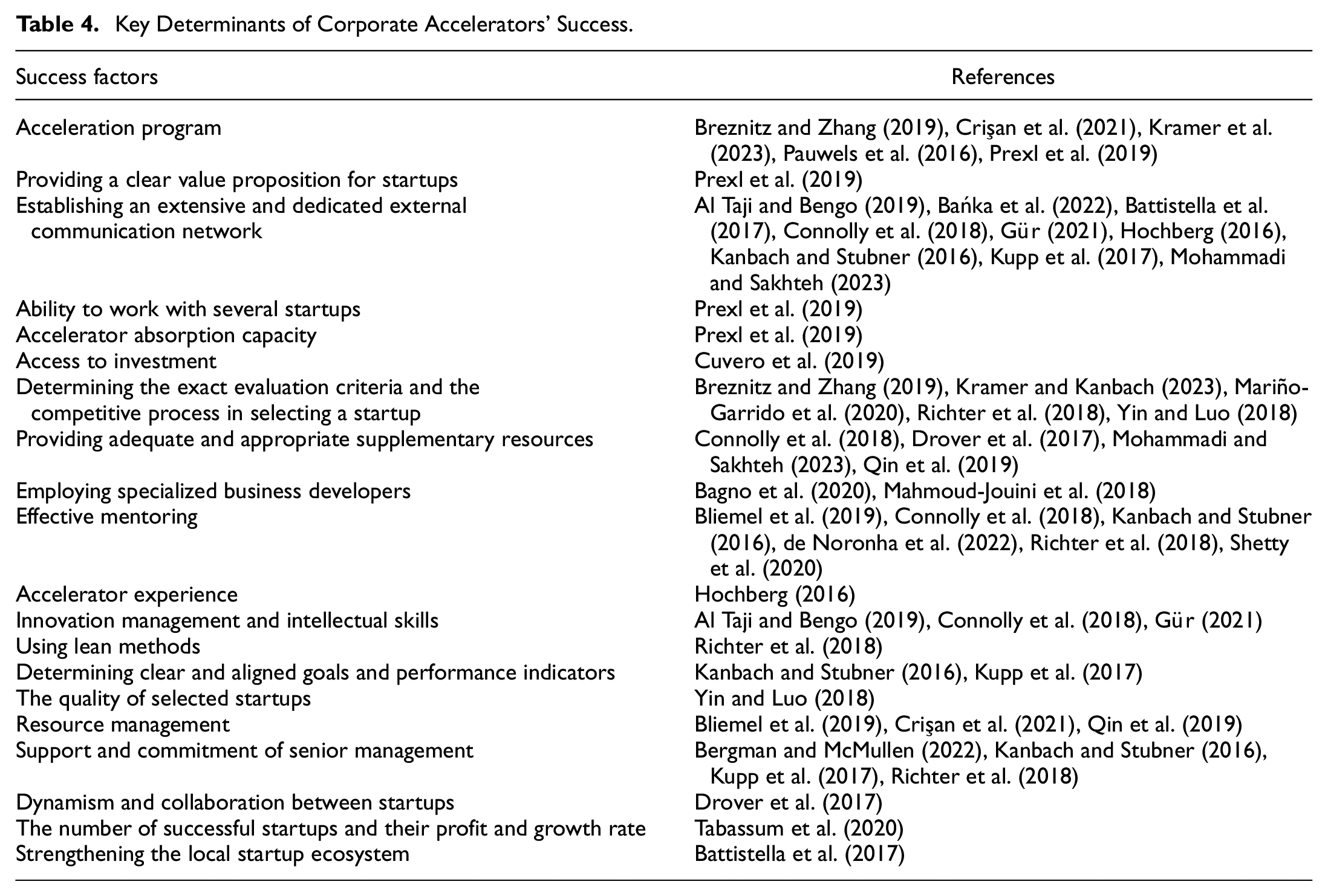
In this step, the critical success factors of accelerators discussed in the 49 selected papers are examined. The key success factors of accelerators are the factors that, if you pay attention to them and improve the quality of each of them, the path to achieving the success of the accelerator will be smoother. These factors are presented in the form of 20 main factors in the Table 4 below. Using these factors, researchers can design and present structures for evaluating the success of accelerators in future research.
Key Determinants of Corporate Accelerators’ Success.
Corporate Accelerator’s Antecedents and Consequences
In this section, we seek to present a model about the corporate accelerator’s antecedents and consequences in the literature. As mentioned, in corporate accelerators, there are six main antecedents, which include mentor, acceleration program, structure and infrastructure of accelerator, startup, entrepreneurial ecosystem, and parent company. We find out some consequences in literature which is shown in the following model (Figure 5):

A model of corporate accelerator’s antecedents and consequences in the literature.
Discussion and Suggestions for Future Research
According to the systematic literature review of 49 articles out of 486 articles published in the last 5 years, we came to the conclusion that these articles mostly deal with the study process or other factors related to the structure or acceleration program. Also, a number of studies have researched in areas similar to corporate accelerators, such as business incubation centers, corporate venture capitals (CVCs), etc. The critical literature review reveals that, despite significant insights provided by prior research, future research can address the following five research avenues:
The necessity for a process model of a successful corporate accelerator: According to the review of the conducted research, there is no system to evaluate and review the key success factors of an accelerator. A few research has been done in the field of appropriate process and structural model, especially for specialized corporate accelerators. This topic can be an opportunity for future research because established company and policy makers of entrepreneurial ecosystem are looking for it. Also, research on corporate accelerators needs more deep contextualization due to their different dimensions and multi-levels. As mentioned, most of the studies conducted in the field of corporate accelerators have been based on their nature and what they are. It is suggested that studies focus on the performance, structure, model of acceleration and especially on acceleration programs in corporate accelerators.
The Success Factors of corporate accelerators in deferent entrepreneurial ecosystems: The impact of some factors on the success of a corporate accelerator has not been investigated in depth. For example, the impact of the ecosystem and policymakers, the differences between the established company and startup, the infrastructure of the accelerators, etc. Furthermore, acknowledging the influence of the entrepreneurial ecosystem in each region on the corporate accelerators’ performance, it is imperative to conduct research in this domain tailored to various ecosystems.
The role of corporate accelerators in crises: The role of corporate accelerators in crises can also be an important topic in future research. For example, the role of accelerators in the recent Corona crisis can be a very important and practical issue. In fact, how corporate accelerators were able to affect startups and the entrepreneurial ecosystem in general, as well as what measures they have taken to resolve the corona disease, can be a useful topic for future crises.
Value-added and impacts of corporate accelerators: It is necessary to conduct in-depth studies on the value-added of corporate accelerators for organizations, companies and businesses. In other words, the effects that corporate accelerators have on the growth of the entrepreneurial ecosystem and GDP, the development and greater profitability of the parent companies and startups, etc., must be carefully investigated and evaluated.
Substituting a long-term acceleration period instead of a short-term one: The focus of most studies so far has been on short-term acceleration periods in organizational accelerators. Future studies should focus on longer periods as well as a greater variety of services. In other words, the results and consequences of the long-term acceleration period, the process and how to implement it, the infrastructure and requirements and many other factors should be investigated.
The common language of corporations and startups: Future research can be based on the issue of the type of interactions and common language between organizations, companies and businesses with startups. This issue is one of the serious challenges in corporate accelerators, and it is necessary to address this issue seriously in the future studies, because the new generation that forms startups have a long generation gap with the generation that manages established companies.
Conclusions
In a highly competitive market where changes happen at a very high speed and diversity, the research and development (R&D) department of industries, factories and established companies no longer meets their needs. For this reason, the established companies should be brought to the corporate accelerator. This element, officially emerging in the global landscape since 2010 with the establishment of the Y Combinator accelerator, still holds numerous unexplored facets that necessitate investigation by researchers and practitioners in the realms of entrepreneurship and innovation. In this study, the objective is to unveil and explore some of these concealed aspects through a comprehensive and in-depth review of all studies published in reputable journals. For this purpose, a total of 49 articles from various journals were meticulously examined and analyzed using Google Scholar and Scopus reference databases, with all the pertinent information meticulously extracted and tabulated as unstructured data in Excel software. Finally, after several steps of data structuring, information related to the study process, review of journals, acceleration program and success factors of corporate accelerators have been presented. On the other hand, in this research, we came to the conclusion that the five key determinants of corporate accelerators’ success are the acceleration program, the creation of a large and committed external communication network, mentoring, the determination of accurate evaluation criteria and the competitive process in selecting startups.
Ultimately, given the significance of corporate accelerators and their influence on the emerging entrepreneurial ecosystem and economy of a nation like Iran, a framework depicting the precursors and outcomes of corporate accelerators is proposed. In fact, it can be said that since the entrepreneurial ecosystem in each country is different, the corporate accelerator model can also be different. For example, in Germany, which has a dynamic entrepreneurial ecosystem, compared to Iran, which is a developing country and has a nascent entrepreneurial ecosystem, they naturally have a different acceleration model and process. Also, radical innovation, strategic renewal, international communication and many other factors that exist in Germany’s innovation ecosystem naturally have different results and effects on corporate accelerators and startups compared to Iran, which benefits less from these issues. On the other hand, research has shown that in Germany, most established companies seek to support startups in their later stages of early venture development. Meanwhile, in Iran, corporate accelerators focus more on nascent startups (Seitz et al., 2024). Therefore, in this study, an attempt was made to present a comprehensive model of the antecedents, consequences and key determinants of corporate accelerators’ success.
Undoubtedly this model will prove valuable for established companies aiming to establish a corporate accelerator but lack the understanding of the essential factors and infrastructures required for its success. Based on the systematic literature review of corporate accelerators, the results make several practical and theoretical contributions. First, this study has addressed the topic of the accelerator and its functions and processes from different aspects. The dispersal and non-unification of different views of researchers regarding accelerators and the lack of a comprehensive process and model of the acceleration program is one of the gaps expressed in previous studies (Crişan et al., 2021; Drori & Wright, 2018; Heshmati & Shafiee, 2021; Qin et al., 2019). Second, the concept of corporate accelerators has been less closely investigated due to its novelty and the lack of research in this area. Especially in Iran, the issue of corporate accelerators has not been investigated in terms of structure, antecedents and consequences, acceleration process, success factors, etc. In some articles, such as Sohail et al. (2023) and Pattanasak et al. (2022), a systematic review of incubation centers has been discussed, but in this article, we will specifically deal with the issue of corporate accelerators (Pattanasak et al., 2022; Sohail et al., 2023). Third, we presented a comprehensive model for successful factors of corporate accelerators that this model is applicable to all members of the ecosystem, including the government, actors and activists, companies and businesses, startups, etc.
Our study, like every empirical study, had several limitations. Since the phenomenon of corporate acceleration is relatively new and few studies have been conducted in this area compared to other topics in the field of entrepreneurship, we had little access to historical data. On the other hand, many documents such as financial documents of startups were not available or they were not allowed to present them. Furthermore, given that we do not have detailed insight into why certain startups are selected or rejected from an acceleration program, this limitation creates challenges in fully understanding of selection effects and their potential impact on acceleration model and process and may lead to the involvement of some biases in our personal judgment. On the other hand, the data related to other countries is only limited to the articles that we studied. This is despite the fact that there is no reliable information bank of the activities of the world’s corporate accelerators accurately and quantitatively.
Footnotes
Correction (December 2024):
Article updated to modify the affiliation for Aidin Salamzadeh and Kamal Sakhdari.
Declaration of Conflicting Interests
The author(s) declared no potential conflicts of interest with respect to the research, authorship, and/or publication of this article.
Funding
The author(s) received no financial support for the research, authorship, and/or publication of this article.

Data Availability Statement
Data sharing not applicable to this article as no datasets were generated or analyzed during the current study.