




Abstract
This study aims to conduct a systematic literature review (SLR) of the entrepreneurial ecosystem (EE) to synthesize and advance the knowledge of how it is investigated and evolved in the previous periods. This study pursues the PRISMA method to review selected EE research and the work of Garrard is applied to construct a SLR matrix to analyze EE literature in peer-reviewed English publication. A total of 100 studies published in 58 journals between 1993 and 2021 were gathered and evaluated. The results indicate three major findings. First, the research on EE has been emerged in the past decades. Second, EE has been defined in several ways and sectors, but the common definition of EE can be expressed through five criteria. Third, the most well-known theory, framework, and measurement of EE are clarified, while the nomological network of EE research was concurrently developed providing the summary of what has been examined. This study provides crucial implications for both theory and practice. In theoretical context, this study gives an updated summary of the trends of EE research; the most popular definition, theory framework, measurement, and nomological network of EE; and the agenda for future research; providing comprehensive overview of EE research and generates new insights for further research in this field. In practice, this study stimulates the awareness of the governors, managers, and other stakeholders of a specific region on building a healthy and effective EE and provides them the methods to improve the EE to generate successful entrepreneurship.
Keywords
Introduction
Entrepreneurship is a new and nascent field, which is promoting in all forms of nations. It has been received significant concentrations from the scholars because of its influences on global professional environment. In the literature of the entrepreneurship, the concept which was introduced by Schumpeter (1934) created remarkable foundation of entrepreneurship by distinguishing the entrepreneurs from the classical types. An essential activity in the procedure of entrepreneurship is the interaction between an entrepreneur and their climates to take benefits of chances (Ratten, 2014), obtaining the success in his/her career path promoting performance of the organization and outcomes of the nations (Aoyama, 2009). Those business climates are frequently named as entrepreneurial ecosystem (EE) which has been perceived by diverse professional individuals, firms, governments, in the past decades as a crucial component of the entrepreneurship procedure (Hermanto & Suryanto, 2017). In entrepreneurship field, the notion of EE has been developed to demonstrate the systemic view of entrepreneurship, which expresses the urban, social, and regional environment that surrounded and influenced the ambitious entrepreneurship process (Cavallo et al., 2019; F. C. Stam & Spigel, 2016). Through the pioneering research of Cohen (2006), D. J. Isenberg (2010), and Feld (2012), EE has emerged and adapted by the scholars, policy-makers, organizations, governments, and nations like OECD, World Economic Forum (WEF), Global Entrepreneurship Monitor (GEM) (Mason & Brown, 2014; Spigel, 2017; E. Stam, 2015; E. Stam & van de Ven, 2021).
Despite a tremendous extent of EE research has been conducted, the researchers also produced concerns, ultimately turning into the research gaps. Firstly, even though there have been a significant number of papers that strengthened the concept of EE which was acknowledged as the systemic perspective of entrepreneurship, those studies were incoherent and were not aggregated, resulting the lack of a typical conception of EE and evolutionary trends of the EE research. Secondly, the lack of common and accepted framework of EE and its measurements in the literature has been emerged as a crucial issue. Although the researchers have been dedicated to develop a wide range of EE framework, a universal agreement on the dominant EE framework has not been created. Thirdly, the EE literature have given a wide range of the causes and effects of the EE, but it was not absolute transparent what causes what (E. Stam, 2015), resulting a lack of a precise analytical framework which displays and makes explicit the antecedents and outcomes of the EE (Alvedalen & Boschma, 2017). Finally, due to the growth of the empirical examinations of EE papers, the results of those studies have not been merged yet to the rational research agenda for forthcoming research in EE area.
Due to the growing number of studies of EE in numerous industries, contexts, and nations; the urgency of a work that summarizes and synthesizes the results of those studies is rising as a persistent issue among the entrepreneurship field. Although there were some literature reviews in the past decade (Alvedalen & Boschma, 2017; Cavallo et al., 2019; Credit et al., 2018; Malecki, 2018; Maroufkhani et al., 2018; Purbasari et al., 2019; Robertson et al., 2020; Wadichar et al., 2022; Wurth et al., 2021), this study broadens and supports their findings by pursuing the systematic literature review (SLR) because of its advantage which resolves the lack of synthesis quality in the traditional literature review, satisfying the request of Kraus et al. (2020). Based on the proposed research gaps, it aims to critical analyze and synthesize the noteworthy trends, definitions, frameworks, measurements, nomological network of the EE, providing the areas for future EE studies. The purpose of this research is to fulfill the following research questions:
(1) What are the evolutionary trends and current trend in EE research?
(2) How is EE defined in the existing literature?
(3) What are the important contents addressed in EE research in terms of theory, conceptual framework, measurement, and causal relationships?
(4) What are the possible research areas for the future EE research and investigations?
The structure of this paper is organized as follows: Section 2 provides the theoretical background which determines the definitions of EE. Section 3 displays the research methodology. The results of the data analysis are interpreted in Section 4, following by Section 5 which provides the direction for future research; and conclusions, implications, and limitation in Section 6.
Theoretical Background
The notion of EE is the combination of two distinct particular terms which are “entrepreneurial” and “ecosystem.” The conception of ecosystem illustrates the roots in biological science, which is identified correlatively to the natural climate and its components. In 1930s, the term ecosystem was initially generated by Roy Clapham to display the “physical and biological” factors within a climate and their connections among that particular climate (Willis, 1994). According to Nicotra et al. (2018), when considering the term ecosystem biological science, it is clarified as a structure which combines all living creatures (biotic components) in a region and the physical climate (abiotic components). Moore (1993) was the pioneer amongst the scholars who utilized the term “ecosystem” into the management field, which is widely accepted as the most prevalent foundation of EE. EE can be observed as the consequences of developments in various relevant notions: “infrastructure for entrepreneurship” (Van De Ven, 1993), “ecosystem” (Bahrami & Evans, 1995), “entrepreneurial system” (Neck et al., 2004; Spilling, 1996); “entrepreneurial environment” (Feldman, 2001), “entrepreneurial climate” (Kline et al., 2013), “national system of entrepreneurship” (Acs et al., 2014). Cohen (2006) was the first to use the word EE, which was then adapted dominantly in the literature, and displayed it as a distinct mixture of inter-dependent actors in a geological territory which impacts the construction and consequent trajectory of the integrated combination of actors and probably the economy as an entity.
In the years of 2010s, numerous authors suggested the term “entrepreneurship ecosystem” which is the major antecedent of the broad adoption of EE in the following periods to express and explore the rational structures for the start-ups. D. J. Isenberg (2010) provided the most well-known comprehensive viewpoint of the EE, which is named as “entrepreneurship ecosystem,” includes a combination of particular components which are associated in complicated systems. D. Isenberg (2011) complimented that concept through stating that an “entrepreneurship ecosystem” consists of 12 major components which can be grouped into six domains include policy, finance, culture, supports, human capital, and markets; that, although they are unique because they are associated in complicated systems, are always existed whether entrepreneurship is self-sustaining, and vice versa. His notion and framework were then adapted broadly within entrepreneurship research (Adams, 2021). Moreover, D. Isenberg and Onyemah (2016) placed an emphasis on the actors instead of the components in the EE by proposing an entrepreneurship ecosystem as a socioeconomic structure whereas equilibrium or quasi-equilibrium is achieved through actors’ chasing of their attraction or pleasure of their demands, with limited management of the external particular procedures. In the similar viewpoint, E. Stam (2015) demonstrated that EE is a mixture of interdependent actors and components organized in a system which they facilitate effective entrepreneurship. The components of the EE consist of “framework conditions and systemic conditions”; whereas the “systemic conditions” are the center of the ecosystem that includes “networks of entrepreneurs, leadership, finance, talent, knowledge and support services.”Spigel (2017) supported those EE frameworks by proposing EE as the combination of social, political, economic, and cultural components in a territory that assist the advancement and improvement of innovative new ventures and motivate nascent entrepreneurs and other actors to take the hazards of establishing, investing, and otherwise supporting high-risk firms.
Regardless of an immense quantity of EE concepts has been developed, the research stream of EE was disjointed and fragmented. The previous reviews of EE literature have put their efforts in accumulating this dynamic and swiftly expanding research area (Alvedalen & Boschma, 2017; Cavallo et al., 2019; Credit et al., 2018; Malecki, 2018; Maroufkhani et al., 2018; Purbasari et al., 2019; Robertson et al., 2020; Wadichar et al., 2022; Wurth et al., 2021). Robertson et al. (2020) conducted a bibliographic analysis and concluded that innovation and initiatives related to territorial innovation stimulate entrepreneurial advancement are major interest in EE literature. Malecki (2018) concentrated on the dynamic procedure which builds and sustains an EE, in which the EE is sustainable existed through its own renewal based on the continuous establishment of new enterprises using the support of the EE and entrepreneurs. Cavallo et al. (2019) outlined the transformation of EE concepts and its antecedents derived from entrepreneurship, strategy and territorial advancement literature. By utilizing the network theory, Purbasari et al. (2019) investigated the EE as a network-rich system—a system comprises both informal and formal networks amongst various elements which interact in complicated ways. Wurth et al. (2021) categorized the EE concepts based on three aspects. However, all of them only summarized the prominent concepts of EE and its foundations based on different perspectives instead of forming an extensive definition of EE. Credit et al. (2018) promoted the concerns on the rational metrics and data sources for EE. Maroufkhani et al. (2018) aimed their attention at creating the comprehensive EE frameworks through modifying the framework of D. Isenberg (2011) by adding two domains including industrial dynamics and crowdsourcing, while E. Stam’s (2015) EE framework was utilized in the work of Wurth et al. (2021). Wadichar et al. (2022) synthesized and proposed research gaps presented in EE literature, resulting road map for future EE research. Nevertheless, the weakness of EE literature which was given by Alvedalen and Boschma (2017), who proposed a lack of a logical framework which explicates the causes and effects in an EE, were not resolved completely because of the empirical evidence was missing in those reviews. Moreover, those reviews tended to synthesize and organize the important findings in extant EE research instead of generating novel knowledge that contributed to make the difference in the field, causing a significance of conducting a SLR which synthesizes and reflects the holistic accumulated knowledge combining to the supportive empirical evidence to generate the logical research direction in the EE field. Thus, this study is conducted to fulfill the research gaps embedded in the extant reviews on EE through creating novel knowledge which can be found in our proposed definition, framework, measurement, nomological network of the EE, resulting potential research areas for further EE investigations.
Methodology
Research Approach
This research objective is to review and synthesize the existed studies of the EE in a systematical way to propose the promising research direction for forthcoming studies. Thus, this study adapted the SLR approach which is highly recommended in entrepreneurship research (Korsgaard, 2013). Phillips et al. (2015) claimed that the purpose of a SLR is to solve the problems of investigators’ biases which are usually presented in narrative literature reviews by applying an extensive inquiry and analysis model. It greatly enhances the validity, accuracy, and generalizability of the research results (Wilson et al., 2017).
Research Method
This study utilizes the Preferred Reporting Items for Systematic Reviews and Meta-Analyses (PRISMA) as a method of review, which combines a four-phase flow diagram (Moher et al., 2009). PRISMA is appropriated due to three advantages: explication of research questions, accurate screening metrics (inclusion and exclusion criteria), and time-limited searching of the proper databases (Sierra-Correa & Cantera Kintz, 2015). Moreover, PRISMA is valuable for SLR because of its comprehensiveness, application in various research fields worldwide, and capabilities to develop consistency throughout reviews (Pahlevan-Sharif et al., 2019). Therefore, PRISMA is suitable for conducting SLR on EE because it enables the researchers to perform accurate search for appropriate research and to extract relevant information in the EE field. The process of using PRISMA in this study is demonstrated in Figure 1.

PRISMA flowchart of this review study.
Systematic Review Process: PRISMA Method
Identification
The first phase comprises two tasks including initial search and elimination of irrelevant articles and duplicates based on the title. In initial search, the rational research papers were determined through the comprehensive advanced search in diverse databases including Scopus, Web of Science, and Google scholar. A set of keywords was applied consisting of “entrepreneurial ecosystem,” “entrepreneurship ecosystem,” “ecosystem for entrepreneurship,” “ecosystem of entrepreneurship,” “startup ecosystem,” and “start-up ecosystem”; which was exactly appeared in the title of the papers. The authors also used the following criteria: (1) the paper must be a study which is written in English, (2) the paper must be a peer-review publication, (3) the paper must be a journal article because they are examined to deliver the most influences and are more reliable than other resources (Podsakoff et al., 2005), (4) keywords exactly appear in the title of the papers, (5) publication date range up to 31st December 2021; causing the number of journal articles identified through database searching equal 2,808 journal articles. After that, we eliminated irrelevant articles and duplicates through skimming the title of the articles displaying in results of the search within the proposed databases until the irrelevant journal articles appeared mainly in the search results, integrating the rational papers into a single publication pool while concurrently deleted the duplicated articles, resulting a set of 528 qualified journal articles. The details of the first phase are shown in Table 1.
A Summary of the First Phase of PRISMA—Identification—in This Study.

Screening
In the second stage, the 528 qualified articles were investigated. For an article to be remained in our analysis, it must concentrate on the EE as an essential construct or research field. Thus, both the authors screened the abstracts of the rest articles based on the following inclusive criteria: (1) concentrate on the EE as an essential variable or subject area, and (2) focus on the definition, framework, theory, and measurement of the EE or investigate the EE and its causal relationships in either conceptual or empirical method to make sure that all related articles are included in the final database which is matched the aim of this research. The database was decreased to 225 studies after the agreement between the authors on the assessment of articles’ abstract.
Eligibility
The third stage required the authors to read independently the whole text of the remaining 225 articles to carefully re-evaluate whether those studies are significantly appropriated for this study based on two suggested criteria in the second phase. They helped the authors to certainly exclude the irrelevant articles which did not absolutely concentrate on EE. This phase made the number of papers reduce to 100 articles in the final database.
Included
After these comprehensive phases, 100 journal articles were considered eligible and included in the final synthesis and analysis.
Data Analytic Strategy
By consulting the work of Garrard (2004), the authors constructed a SLR matrix as a content analysis tool to analyze and systemize the crucial information which is excerpted from the 100 elected articles. The data that was sought and summarized in the matrix table includes name of the author; year of publication; journal title; articles types; the context of the research including country and industry; definition of EE; theory utilized; framework utilized; measurement of EE; causal relationships of the EE; data collection method; and data analysis technique.
Findings and Discussions
Trends in EE Articles
EE Publications by Year and Type
This study reviews wide range of papers, which spans 28 years (1993–2021). The first paper which placed the foundation for the EE research is the work of Moore (1993) which was published in 1993. In summary, this study has reviewed 100 academic journals from 1993 to December 2021. According to Figure 2, The most typical research methodology, which is pursued in the EE research, is qualitative method that is utilized in 46 papers; following by quantitative method (23), conceptual papers (22), and mixed method (9). 2014 is a notable point where EE went from a lesser-known term, to an influential and potential research area, whereas the scholars began to utilize several EE measurements and databases to conduct quantitative research onward, especially 2019 with the number of quantitative studies is 10. According to Table 2, because entrepreneurship has the characteristic of multidisciplinary, EE studies have been detected in an extensive range of research journals (n = 58), whereas 94 studies were published in 53 SCOPUS-indexed journals.

EE publications by year and type.
Literature Review Matrix Table of EE Research.

Research Context and Methodology
The term EE has been investigated in distinct countries and industries. According to Table 2, among 78 empirical studies in the sample of this study, the scholars conducted their investigation in at least two countries to examine, evaluate, and compare the EE in diverse countries; turning to the largest number of cross-national studies (n = 18). Besides that, the EE research was found in 30 particular countries, whereas the United States (n = 13) is the most attractive research context for EE field, following by India (n = 6), Canada (n = 4), and other countries.
Moreover, most of the EE studies focus on investigating and evaluating an EE in a specific location, and comparing two or more EE. Thus, most of the scholars have not clarified the industries of the research, which means that not conducted in a specific industry (n = 36), following by multi-industry (n = 18), education (n = 5), manufacturing (n = 4), and other industries.
Furthermore, the researchers tended to analyze the EE in a particular region located within a country, leading to the highest number of local/regional/sub-national analysis (n = 42) in the level of analysis of EE research. In addition, on the national level, there are 18 papers which demonstrated the circumstance of an EE of a country. The scholars also compared the EE of more than two distinct countries, resulting 18 articles which pursued the cross-national level of analysis.
The qualitative research on EE has the tendency to focus on single case study (n = 28) and multiple-case study (n = 18); applying in-depth and semi-structured interview, focus group, secondary data, and observations. Almost those studies used the content analysis to analyze their data through coding and analyzing the underlying themes to define the components and actors which are appeared in the research context to evaluate a specific EE or the causal relationships of EE. In addition, the comparative analysis is the common technique which is applied in most of the multiple-case study papers to compare more than two EEs. The restricted number of mixed method research on EE (n = 9) frequently operated a survey follow up interviews or secondary data; to achieve deeper knowledge and explain the results of the qualitative analysis. The quantitative research on EE has tended to apply regression analysis (n = 8); structural equation modeling (SEM) (n = 3); and other techniques.
Definitions of EE
The term EE is the most well-known concept which is accepted and employed in most of the studies that investigated ecosystem in the entrepreneurship area. It is defined in several ways. Wurth et al. (2021) reviewed and clarified the EE concept through three aspects; including “ontology and epistemology,” “one for all or all in one,” “metaphorical interdependence versus real interdependence.” However, they did not propose a common EE definition through their analysis. In this study, we propose the comprehensive definition of the EE which can be clarified regarding five typical criteria including whether a definition contains (1) set of factors or not; (2) interrelation of factors; (3) in a geographical territory; (4) components, actors, or both; (5) promote or inhibit the entrepreneurship.
Despite some definitions did not display completely five criteria, they demonstrated at least one out of those criteria. Nevertheless, the viewpoints of the mixture of the presence of all the five common criteria include Kline et al. (2014) proposed EE definition, which focused on the components, as an interdependent combination of “physical, legal, cultural, financial, human, and organizational” components in a society, displaying the capability to assist or oppose the entrepreneurs’ movement. On the other hand, there were several scholars focused on the actors of the EE instead of the certain components. EE is a coordinated combination of coevolving stakeholders within a territory (Cao & Shi, 2021); or individual and institutional agents, on the national level (Sitaridis & Kitsios, 2020); or varied market players’ roles (Hess, 2020) focused on chasing economic improvement through the exploration and exploitation of entrepreneurial chances.
By taking an inclusive viewpoint that combines both the actors and components in EE, Roundy and Fayard (2019) proposed an EE as the interrelated consolidation of actors, firms, resources, and values which create and support regional entrepreneurial actions. Moreover, Yan and Guan (2019) illustrated that EE displays a society of interacting entrepreneurs and their climates, which is crucial for entrepreneurial outcomes of entrepreneurs, industries, territories, and societies. Then, Lux et al. (2020) proposed a simple explanation of EE as a set of inter-related actors and components, within a geographic region, that enable productive entrepreneurship. In summary, we create and suggest the unified and comprehensive definition of the EE as:
EE is the (1) combination of (2) interrelated diverse (3) actors and components in (4) a given geographical territory which reinforce and support each other, which (5) facilitates or impedes human being’s choice to become an entrepreneur; his/her performance; and the development of entrepreneurship, industries, societies, and nations.
Important Contents Addressed in EE Research
Theories Utilized in EE Research
Table 3 exhibits the theories which are applied in EE literature. Network theory, which was proposed by Bower (1981), is the most applied theory in the EE research to review the literature and focus on the relative formation and the degree of connectivity among several stakeholders in the EE (Purbasari et al., 2020); and as social networks which displays the relations of the EE at varied tiers including entrepreneurs, support organizations, and the mixture of them (Motoyama & Knowlton, 2017). The formations of those networks are modified as an operation of elements between the distinct levels in an EE. To evaluate the relational social networks of distinct stakeholders in an EE, the network theory provides a myriad of assessments (Neumeyer & Santos, 2018; Neumeyer, Santos, Caetano, and Kalbfleisch, 2019; Neumeyer, Santos, & Morris, 2019). The importance of network theory has been recommended by diverse scholars who argued to analyze the EE through its lens. The concept of an EE exploits the heretical literature; containing the research on clusters, innovations, economic geography, social capital, and networks; whereas networks express an existence of social networks that link entrepreneurs, consultants, investors, and employees, stimulating the free stream of information, knowledge, and skills both among EE members and from outside the EE (Spigel, 2017). The EE comprises both forceful formal and informal network amongst its elements which lessens the deficiency of new firms’ resources and stimulates the procedure of implicit knowledge (D. J. Isenberg, 2010). Despite the highest frequency of application, the topic of network theory is still insufficient (Purbasari et al., 2019). In other words, the EE literature has not yet completely manipulated understanding from network theory (Alvedalen & Boschma, 2017).
Theories Utilized in EE Research.

Therefore, through the network theory perspective, we highly recommend the further studies investigate EE as a network system to clarify the ways the EE components are associated—the relationships between EE components.
EE Framework Utilized in EE Research
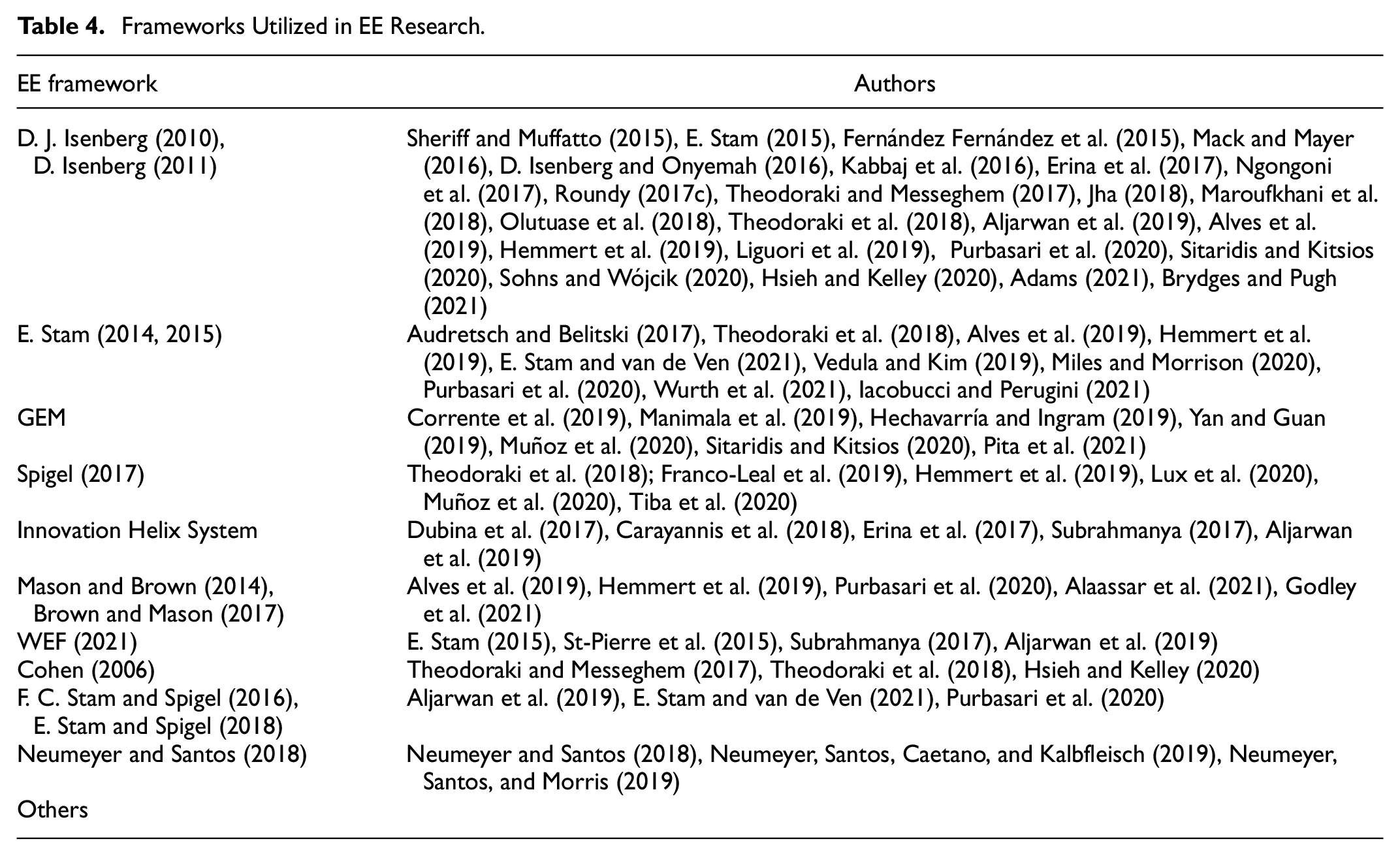
The recent literature reviews of EE (Cao & Shi, 2021; Maroufkhani et al., 2018; Nicotra et al., 2018; Wurth et al., 2021) were constructed based on a specific EE framework. For instance, D. Isenberg’s (2011) framework (Maroufkhani et al., 2018), E. Stam’s (2015) model (Wurth et al., 2021). However, they did not illustrate the empirical evidence for applying those typical models created the bias in the analysis, causing the limited validity of their results. This research offers a comprehensive picture of EE framework utilization in the EE literature through eliminating prejudices in our synthesis. According to Table 4, the EE framework which is built by D. J. Isenberg (2010) and D. Isenberg (2011) is the most well-known framework which is frequently adapted in the EE research. It is consulted and utilized in 24 articles, following by the model of E. Stam (2014, 2015) (n = 10); GEM (n = 7); Spigel (2017) (n = 6); Innovation Helix System (n = 5); Mason and Brown (2014) (n = 5); and others.
Frameworks Utilized in EE Research.
Through conducting the Babson Entrepreneurship Ecosystem Project which was rooted in the Babson College, D. Isenberg (2011) proposed that an EE consists of 12 major components which can be grouped into six domains such as policy, finance, culture, supports, human capital, and markets.
Policy is the degree to which leadership and government not only assist and encourage the entrepreneurial actions, but also establish directives and laws in a particular region to manage them. The process of leadership requires the presence of public leaders who are supporters of entrepreneurs and entrepreneurship. The government contains governmental institutions to foster entrepreneurship and eliminate fundamental obstructions for entrepreneurship. This domain has the same characteristics as government policy in GEM’s model, and leadership and formal institution in E. Stam’s (2015) model.
Finance concentrates mainly on the capabilities to access to financial capital for the entrepreneurs, which are the financial institutions take the responsibility for entrepreneurs’ funding, including the “micro-loan, angel investors, zero-stage venture capital, venture capital funding, private equity, public capital markets, and debt” (D. Isenberg, 2011). This domain also appears with the same label in E. Stam’s (2015) and GEM’s framework.
Culture composes all social characteristics of a society and the subjective conditions associated with the behaviors through which human beings connect to others. It excuses honest omissions, sincere faults, risk taking, and opposite thoughts, recognizes the entrepreneurship as an honorable business, and success stories. This domain is presented with the same name in E. Stam’s (2015) model, while it is represented as cultural and social norms in GEM’s model.
Supports include the institutions that are not belonged or relevant to the governments but support the entrepreneurship growth. They include infrastructure; support professions; and non-government institutions. This domain has the same nature as the combination of commercial and legal infrastructure, physical infrastructure, and government entrepreneurship program in GEM’s model; and the mixture of physical infrastructure and intermediate services in E. Stam’s (2015) framework.
Human capital consists of both education institutions and labor. Education institutions generate the high quality work forces through educating the financial knowledge and entrepreneurship for the youths. Moreover, they provide their faculty the day-offs to involve in entrepreneurship process. The labor consists of the professionals who obtain their skills and knowledge; including establishing firms, employing, and creating structures, formations, and managements; through education and experience; and the mass workforce. This domain is similar to entrepreneurial education in GEM’s framework, and talent in E. Stam’s (2015) model.
Markets are preferred to the presence of the existing as well as the potential consumers who have the tendency to purchase and provide advice on the new goods and services, then promote them through national and universal network. Besides that, those consumers are flexible in payment methods to give the necessary cash flow for the start-ups and nascent suppliers. This domain is displayed as entry regulation in GEM’s model, and as demand in E. Stam’s (2015) model.
However, D. J. Isenberg (2010) and D. Isenberg (2011) did not encompass the factors of EE entirely because of the neglect of other valuable domains that were investigated in the literature. By merging the three most frequently used EE frameworks like D. J. Isenberg (2010), D. Isenberg (2011), E. Stam (2014, 2015), and GEM; we integrate two additional necessary domains including R&D transfer and networks.
R&D transfer, which has the root in GEM’s model and has the same characteristic as new knowledge in E. Stam’s (2015) model, which played an important role in the entrepreneurship process, representing the degree that national research and development creates new commercial chances and is available to SMEs. It related to transfer of knowledge from educational institutions or scientific parks or related organizations to the business or the contrary, the cooperation between them, initiatives in the business sectors, public or private programs, incubators, etc. (Global Entrepreneurship Monitor, 2021). A procedure of innovative destruction appeared during the transferring of R&D in which the stream of data is enlarged stimulating information access, causing an improvement in competitiveness of the existing firms and new ventures (Audretsch & Thurik, 2001). Hence, R&D transfer causes a resource redistribution toward new products (Verheul et al., 2002), turning into a more extraordinary demand for entrepreneurship (Casson, 1995).
The next domain is networks, which can be found in E. Stam’s (2015) model, is the social environment of entrepreneurs, especially the extent to which they are socially affiliated, which gives an information flow, facilitating a productive allocation of knowledge, labor, and capital (Malecki, 1997). Networks referred to the communal context of the actors, particularly the extent to which they are socially linked, and the connectivity of organizations for new value creation (E. Stam & van de Ven, 2021). An essential attribute of a prosperous start-up society is networks which are a deep and well-structured society of new ventures and entrepreneurs combining to committed and obvious investors, directors, consultants, and supporters (Feld, 2012). Networks give the new ventures the social assistance, self-confidence, and strategic competence to learn and implement for new actions (Johannisson, 1995). Hence, networks are crucial to the establishment, survival, development, and success of existed and new ventures (Johannisson, 1990); which are considered as a necessary factor of EE.
Through integrating the three most frequently used EE frameworks including D. J. Isenberg (2010), D. Isenberg (2011), E. Stam (2014, 2015), and GEM, we provide a comprehensive EE framework:
An EE consists of eight domains include policy, finance, culture, supports, human capital, markets, R&D transfer, and networks.
Measurement of EE
Amongst the empirical research, there were only a limited number of publications that utilized the longitudinal approach in their examination. Seventy-five empirical papers were cross-sectional, with all variables and EE components were gathered, analyzed, and measured at the same time. Those studies aimed to evaluate the EE and its causal relationship at one specific point in time, whereas they focused on identifying the current status of a particular EE in their research context. On the contrary, there were only one paper utilized two phases longitudinal approach, and two papers applied three phases longitudinal approach. Of those who have pursued temporal separation, the time between surveys has typically been years to analyze the evaluation of a particular EE. Hence, they tended to focus on assess the variation in the quality of a particular EE clarifying its evolution, which provided the useful benchmarks for determining the development of an EE. Most of the research utilized the self-developed scale to measure the EE. However, according to Table 5, the measurement, which is created by GEM—National Experts Survey (NES) (n = 7), appeared as the trendy scale in the EE field.
Measurement of EE.

GEM has been operated since 1999 as a cooperative project between Babson College and London Business School, covering approximately 115 countries around the world. GEM claimed that the dynamics of entrepreneurship are associated with the conditions that promote or prevent new firms establishment, which are analyzed regarding the NES questionnaire that is applied annually to gather the perceptions of experts on numerous EE indicators containing 56 items that reflect 12 elements which can be grouped into nine major components containing “entrepreneurial finance”; “government policy” (including governmental support; and taxes or regulation); “government entrepreneurship programs”; “entrepreneurship education” (including entrepreneurship education at basic school; and post-secondary levels entrepreneurship education); “R&D transfer”; “commercial and legal infrastructure”; “entry regulation” (including market dynamics; and market openness); “physical infrastructure”; and “cultural and social norms.”
Furthermore, there were few researchers have put their effort on generate the measurement scale for the most noteworthy EE framework which is D. J. Isenberg (2010) and D. Isenberg (2011). Olutuase et al. (2018), Liguori et al. (2019), and Hsieh and Kelley (2020) who utilized and built the appropriate scale to measure D. J. Isenberg’s (2010) and D. Isenberg’s (2011) model; including 6, 43, and 39 items, respectively. In addition, the reputable measurement can be found in EE area consists of Regional Entrepreneurship and Development Index (REDI); The Global Entrepreneurship Index (GEI); and others.
Nomological Network of EE Research
Korber and McNaughton (2018) expressed the conceptualization of entrepreneurship based on three basic levels of analysis like individual, firm, and socioeconomic systems, combining to their cross-level structure to review the literature of resilience and entrepreneurship. In order to systematically synthesize the 76 empirical studies of entrepreneurship especially in the agricultural sector, Fitz-Koch et al. (2018) classified them regarding whether the antecedents or outcomes were investigated on an individual, household/family/firm, or environment level, displaying in their framework producing a typology of studies of entrepreneurship which was motivated by Payne et al. (2011). Furthermore, since EE represents the urban, social, and regional environment—the external environment—that surrounded and influenced the ambitious entrepreneurship process (Cavallo et al., 2019; F. C. Stam & Spigel, 2016), this study utilizes and replaces the environment level with ecosystem level to ensure the consistency throughout the research. Thus, through consulting the research of Fitz-Koch et al. (2018), this study classifies the causal relationships of EE based on three major levels including individual, organizational, and ecosystem level and integrates them into a nomological network representing our organizing framework in Figure 3.

The nomological network of EE research.
Antecedents of EE
Figure 3 demonstrates the causal relationships of EE in both theoretical and practical context. Individual-level antecedents relate to the attributes of the individuals, especially the entrepreneurs and leaders of EE regarding their competencies, skills, identity, values, attitudes, motivations, goals, tendencies, or leadership styles. Roundy (2017b) recommended that social entrepreneurs can form the EEs because they affect the heterogeneity of ecosystem members, collect concentration for the ecosystem, and raise the attraction to stakeholders. Roundy et al. (2018) focused on the entrepreneurs who positively drive the establishment and emergence of the EE complex system through their “intentionality and adaptive tensions.”Goswami et al. (2018) suggested that accelerators have positive effects on creating EE by enlarging stakeholders’ collaboration and entrepreneurs’ knowledge. Besides that, Miles and Morrison (2020) also provided a proposition that suggested the role and importance of effectual leadership to creation and growth of rural EEs, through the activities affect systemic conditions in the EE. That statement is extended by Roundy (2021) because incubator leaders built an EE leadership model, which will be adopted and modified in distinct regions, resulting in an effective regional EE.
Organizational-level antecedents refer to the organizational characteristics and resources available which foster and hinder EE. Hybrid support organizations play essential roles in creating EE by revealing members to entrepreneurial and community logics because they combine both logics (Roundy, 2017a). Tiba et al. (2020) confirmed that successful start-ups, which are called as lighthouses, have positive impact on EE through shaping the “cultural, social and material attributes” of an EE.
Ecosystem-level antecedents concentrate on the drivers and barriers for EE in the external environment that existed in the particular territories. In addition, to increase small town EE’s components, it might pursue several EE strategies (Roundy, 2017c). The creation and emergence of the EE complex system is also a result of “system-level” attributes which generate “coherence in entrepreneurship activities,” and continued “injections of resources” into the incipient system which promotes additional coherence between actors (Roundy et al., 2018). Moreover, Audretsch and Belitski (2017) concluded that the combination of culture and norms; physical infrastructure and amenities; formal institutions; and information technologies and internet are associated positively with EE through generating useful conditions for enterprises, and encouraging business activities and chances. In digital circumstance, Sussan and Acs (2017) proposed that the combination of entrepreneurship, infrastructure governance, marketplace, user citizenship build and positively enhance the digital EE.
Outcomes of EE
EE creates several individual-level outcomes that stimulate or impede the perceptions and competencies of the individuals toward the entrepreneurship. EE can assist the individuals like the positive impacts of EE; especially the increase in technology, culture, and business protection; on the entrepreneurial orientation and entrepreneurial intention (Olutuase et al., 2018). Roundy and Fayard (2019) also proposed that EE will develop entrepreneurs’ sensing, seizing, reconfiguration activities and, therefore, their dynamic capabilities. (Suryanto, 2019) confirmed the positive impacts of EE on the growth of new entrepreneurs in universities through several EE elements.
Organizational-level outcomes determine the business performance which is influenced by the presence and quality of the EE. The researchers illustrated the influences of EE on business performance including Velt et al. (2018) who concluded seven systemic EE components affect the launch and 10 components affect the growth of “born global startups.” Franco-Leal et al. (2019) verified the positive impacts of institutional and social conditions in EE on the development of academic spinoffs’ performance. Corrente et al. (2019) proposed that EE facilitates the establishment and actions of high-growth start-ups. Vedula and Kim (2019) recommended that context plays essential and consistent role for business survival, turning into the negative significant effects of EE on business closure. Entrepreneurial actors who perceive the opportunities in the EE and utilize them can make the firm more productive, valuable, and profitable (Miles & Morrison, 2020). The national EE has positive influences on firm competitiveness through the “exploitation of resources and capabilities” which fluctuates based on the circumstances of the institutional formation whereas firms are embedded (Lafuente et al., 2021). On the contrary, EE might actually hinder the entrepreneurship in a specific region. St-Pierre et al. (2015) concluded that EE provides a plenty of imperfections which cause significant negative influence on firm growth, including “generally speaking, corruption, financing constraints and the country’s economic situation.” These findings supported our proposed fifth criterion of EE definition which clarifies “EE facilitates or impedes the entrepreneurship.”
Ecosystem-level outcomes represent societal outcomes and the influences of the EE on the extant external context in the specific territories. The scholars also provided several propositions to clarify the outcomes of EE; consisting of entrepreneurial activity (E. Stam, 2015); social entrepreneurship (Roundy, 2017b); “Gross” entrepreneurship, assumption-based productive entrepreneurship, and performance-based productive entrepreneurship (Nicotra et al., 2018); and number of viable businesses, number and quality of jobs, quality of life, and place identity (Miles & Morrison, 2020). Moreover, numerous empirical studies approved the positive influences of EE on the entrepreneurial activity in various contexts; including the number of small firm per capita (Kline et al., 2014); proportion of new ventures in a city (Audretsch & Belitski, 2017); regional activities which are business concentration and stakeholder assessment (Erina et al., 2017); the new business activity (Hechavarría & Ingram, 2019); entrepreneurial activity of three alternative levels combining early-stage business, high-growth business, and low-growth business (Muñoz et al., 2020); entrepreneurial activity in small towns (Roundy, 2019); and productive activity in entrepreneurship (E. Stam & van de Ven, 2021). In the similar side, there were various focused on the impacts of EE on entrepreneurship. Yan and Guan (2019) demonstrated that EE conditions impact directly and positively on the entrepreneurship rate and entrepreneurship innovation. In some research, EE influenced positively on the number of new firm created in high-tech industry (Ghio et al., 2019), or rate of knowledge-intensive service business (Horváth & Rabetino, 2019); the tourism activity (Kline et al., 2014); turning into productive entrepreneurship (Kansheba, 2020). In the broader scope, Xie et al. (2019) approved the positive effect of EE, which consists of both internal and external factors, on the performance of Internet culture industries. Szerb et al. (2019) also validated the positive influence of EE on the regional performance of several EU regions. EE is confirmed as a key factor in interpreting the resilience of local systems to economic shocks (Iacobucci & Perugini, 2021). On the contrary, Kansheba (2020) proved that social capital (supporting culture) showed a negative significant effect on productive entrepreneurship. Yan and Guan (2019) proposed that that “R&D transfer and market dynamics” are significant but negative drivers of entrepreneurship rate and entrepreneurship innovation, which supported our proposed fifth criterion of EE definition.
Mediators and Moderators of EE
There is only one article examined the innovation as the mediator of the relationship between EE and productive entrepreneurship (Kansheba, 2020). Kansheba (2020) exposed a weak and mixing direct effect of EE factors on productive entrepreneurship without the mediating role of innovation because approximately half of them delivered insignificant impact on productive entrepreneurship. He illustrated that the influence of eco-factors of EEs on productive entrepreneurship is more noticeable and significant while innovations, which are clarified in terms of product and process innovations, mediate the relationship; whereas product innovation represents the entrepreneurs’ capabilities to develop novel products and services or promote extant products and services while process innovation describes the entrepreneurs’ capabilities to implement or introduce novel technology which strengthen competitiveness and capacities to fulfill consumers’ needs. That influence is completely mediated by innovation through the evidences that EE provides the entrepreneurs with essential resources like institutional capital through government entrepreneurial programs, physical infrastructures, knowledge capital through R&D transfer, and internal market dynamics positively and significantly affect their innovation which in turn promotes their entrepreneurial performance, causing productive entrepreneurship.
The impacts of regional EE on new business survival are moderated by the entrepreneurs’ experience because the more experience the founder have, the less dependent they display on the EE during business operation, especially approach a “region’s venture finance, human capital, and innovation capability” to survive (Vedula & Kim, 2019). Moreover, the effects of EE on entrepreneurial activity are moderated by entrepreneurship attention because under the high concentration on the entrepreneurship circumstance, “physical infrastructure and cultural and social norms” significantly and positively influence entrepreneurial rate (Yan & Guan, 2019).
Because of the high proportion of conceptual research in the literature, the restrictions of the causal relationships of EE emerged, providing vital opportunities for other scholars to validate the propositions which are indicated in the conceptual papers to accomplish a thorough nomological network of EE. The further studies are encouraged to take advantage of the establishment of reliable and valid measurements and data sources of the EE in recent period to investigate, evaluate, and verify those propositions. Besides that, in the entrepreneurship literature, the scholars have examined and confirmed the relationships between numerous variables and the EE elements. Thus, the upcoming investigations can utilize those relationships to enlarge and encompass an outstanding nomological framework of the EE through testing them in broader scope—entire EE instead of examining separately.
Due to the massive deficiency of nomological network of EE, especially the mediators and moderators, we request the future research exploring, examining, and validating (1) the given propositions in EE literature and (2) the relevant and promising variables which indicated the causal relationships with EE elements in the entrepreneurship literature like policy, finance, culture, supports, human capital, markets, R&D transfer, and networks, etc. to expand and achieve a more comprehensive nomological network of EE.
Areas for Future Research
By reviewing the literature on EE, there are still valuable gaps which needs considering for future research. Based on this research results, we suggest research guidelines for further studies in various areas.
Research Context
Most of the publications on the EE were conducted mainly in America and Europe. The database of EE, which was conducted by GEM, gathered from 115 economies around the world, generates the opportunities for the researchers to perform further investigation on the EE within other nations, especially Asia and Africa.
Moreover, almost of the EE research did not clarify the industry of the research, or focused on education, high-technology, and manufacturing; ignoring other crucial industries in the EE field. Because entrepreneurship is essential for the development of all industries across the world, it provides the chances for future research to be conducted in a specific industry that contributes to the economic growth like insurance, commercial real estate, and tourism (IBISWorld, 2020).
The EE literreg/regional/sub-national level of analysis. Wurth et al. (2021) suggested that these analyses should be assumed as complementary instead of opposing utilization of the EE. Therefore, the further research should be conducted in a broader scope (e.g., national level and cross-national level) and at aggregated level in order to provide the multicalar viewpoint of EE.
Research Design
A half of research sample pursued the qualitative approach using case study and interview, proposing the urgency of operating quantitative and mixed research in this field, which stimulates identifying the diversification and abundance of EE elements and generating new measurement to validating EE. Moreover, the over-reliance on cross-sectional research and single database creates the biases within the studies (Podsakoff et al., 2003). Hence, the further studies should consider gathering data from multiple sources in the design phases; utilizing a longitudinal perspective through collecting, analyzing, and evaluating data in multiple-time points.
EE Definition
Because of the lack of prevalent definition of EE, we generated a comprehensive definition of the EE, which combined five criteria, through entirely accumulating its concepts in the literature. It can be considered adapting and testing in the future research.
EE Theory
EE literature is dominated by the network theory. The further research is requested to distinguish in what way EE theories can be utilized at diverse level of analysis. Moreover, despite the highest frequency of application, the topic of network theory is still insufficient, generating a research direction for examining EE as a network system to clarify the relationships between EE components.
EE Framework
By integrating the three most frequently used EE frameworks including D. J. Isenberg (2010), D. Isenberg (2011), E. Stam (2014, 2015), and GEM, we provide a comprehensive EE framework which include eight domains like policy, finance, culture, supports, human capital, markets, R&D transfer, and networks. The future investigations should concentrate on assessing and broadening this framework through adjusting the components according to the specific circumstance to maximize the advantages and potential of several EE models regarding their particular context.
EE Measurement
There is a lack of reliable measurement which can be utilized for measuring the most commonly used framework which is D. J. Isenberg (2010) and D. Isenberg (2011). The researchers mainly employed the scale of GEM—NES, while only three measurement scales for D. J. Isenberg (2010) and D. Isenberg (2011) are found in the literature (Hsieh & Kelley, 2020; Liguori et al., 2019; Olutuase et al., 2018), causing the needs for generating and advancing the measurement of EE in the future studies, offering the opportunities for the expansion of the number of quantitative studies in EE literature, creating the significant variation within the research design trends in following periods.
Nomological Network
Due to the insufficient number of quantitative, the causal relationships of the EE were not comprehensively explored. Therefore, to broaden the nomological network of EE and advance the knowledge in the EE field, future research should focus on exploring, examining, and validating (1) the given propositions in EE literature and (2) the relevant and promising variables which indicated the causal relationships with EE elements in the entrepreneurship literature like policy, finance, culture, supports, human capital, markets, R&D transfer, and networks, etc.
Conclusions, Implications, and Limitation
This study conducted a SLR of the EE to synthesize and advance the knowledge of how it is investigated and evolved in the previous periods through utilizing PRISMA method and the work of Garrard (2004). This paper provides three major findings which contribute to the literature. First, the research on EE has been emerged in the past decades, especially from 2014. Qualitative method is the most frequently utilized approach in various industries and countries. Second, EE has been defined in several ways and sectors, but the common definition of EE can be expressed through five major criteria including set of factors or not; interrelation of factors; in a geographical territory; components, actors, or both; and promote or inhibit the entrepreneurship. Third, the most well-known theory, framework, and measurement of EE were clarified; which are network theory, D. J. Isenberg (2010), D. Isenberg (2011), and GEM—NES, respectively; while the nomological network of EE research was concurrently developed providing the summary of what has been examined. Based on the findings, the authors provide the research guidelines for future research in various areas in terms of research context, research design, definition, theory, framework, measurement, and nomological network of EE.
Therefore, this study provides crucial implications for both theory and practice. In theoretical context, it contributes significantly to the literature by providing comprehensive overview of EE research and generating new insights and potential areas for further research in the field. By providing an updated review on the trends of EE research, this study guides further research in selecting appropriate methodology in order to create new findings in EE research regarding that essential information as the evidence to support decisions in research and practice. After that, this study solves the fragmentation in EE research through giving the significant evidence and demonstrating the most well-known definition, theory foundation, framework, and measurement of EE; which helps the other researchers to focus on analyzing important domains of EE instead of investigating them randomly. Then, this systematic review goes beyond a synthesizing and organizing review since it proposes a comprehensive definition and framework of EE through integrating the crucial findings of previous EE research, which can be adopted and examined in future studies. Finally, it produces a map of all the knowledge which was collected in the EE area by offering a nomological network including antecedents, outcomes, mediators, and moderators. By doing so, it provides a holistic view of what have been examined and confirmed in the literature that satisfies the request of Alvedalen and Boschma (2017) and enables other researchers to set a research concentration and clarify a niche which gives the research directions of the field for further studies.
In practical area, through discussing causal relationships of EE combining into the nomological network of EE, this study provides the governors, managers, and other stakeholders of a specific region the methods to improve the EE to generate successful entrepreneurship which is promoting in all forms of nations. Moreover, the stakeholders will be more aware of building a healthy and effective EE because it is the driver of the high performance of several levels including individual, organizational, and regional.
The limitation of this study can be accounted to the guideline for further research is the research sample only consists of English publications. The future research may consider including other languages in the sample.
Footnotes
Declaration of Conflicting Interests
The author(s) declared no potential conflicts of interest with respect to the research, authorship, and/or publication of this article.
Funding
The author(s) disclosed receipt of the following financial support for the research, authorship, and/or publication of this article: This research is funded by International University, VNU-HCM under grant number SV2020-BA-01.
