



Abstract
Globally, entrepreneurial ecosystems (EEs) have gained attention as enablers of innovation and entrepreneurship. This paper explores entrepreneurial ecosystems in developed countries. Entrepreneurship is a globally important phenomenon for economic development and addressing socio-economic challenges such as unemployment, inequality, and poverty. Systematic literature review (SLR), with the aid of the Preferred Reporting Items for Systematic Reviews and Meta-Analysis (PRISMA) approach was used in the items selection process. A final sample of 28 primary articles was used. Additionally, bibliometric analysis was conducted using VOSviewer software to determine publication patterns and citation trends. More relevant and recent articles were incorporated into the bibliometric analysis to improve the results. Isenberg’s six domains of entrepreneurial ecosystems framework, supported by the Dynamic capabilities (DC) theory underpinned the study. Results show that though entrepreneurial ecosystems are prevalent, they face many challenges. However, opportunities are also available but may be difficult to access. Globally, scholars agree that entrepreneurial ecosystems enhance economic development, and they help to solve socio-economic challenges such as unemployment, inequality, and poverty. This paper recommends that entrepreneurial ecosystems should be fostered in all regions to promote economic development and provide solutions to solve socio-economic problems. Local and global leaders should invest in the development of entrepreneurial ecosystems to promote economic development. The original value is based on exploring the dynamic nature of entrepreneurial ecosystems in the global environment using a developed country perspective. The findings provide important insights to policymakers and other stakeholders for developing strategies and interventions for enhancing economic growth through entrepreneurship.
Plain Language Summary
The purpose of the paper is to explore entrepreneurial ecosystems in developed countries. Entrepreneurship is a globally important phenomenon for economic development and addressing socio-economic challenges such as unemployment, inequality, and poverty. Systematic literature review (SLR) and bibliometric analysis (using VOSviewer software) were used as research methods. Isenberg’s six domains of entrepreneurial ecosystems framework, supported by the Dynamic capabilities (DC) theory underpinned the study. Results show that though entrepreneurial ecosystems are prevalent, they face many challenges, but opportunities are available. Entrepreneurial ecosystems should be fostered in all regions to promote economic development and provide solutions to solve socio-economic problems. The findings provide important insights to policymakers and other stakeholders for developing strategies and interventions for enhancing economic growth through entrepreneurship.
Keywords
Introduction
This paper focuses on entrepreneurial ecosystems or entrepreneurship ecosystems (EEs) as a hot topic among entrepreneurs, policymakers, development practitioners, and the media, among other stakeholders (Audretsch et al., 2023; Brooks et al., 2019; Carayannis et al., 2022; Guerrero & Espinoza-Benavides, 2021; Ratten, 2020; E. Stam 2015; F. C. Stam & Van de Ven, 2018; Roundy, 2016). Studies have generally focused on EEs in advanced economies, and their emergence is considered a global phenomenon (Cao & Shi, 2021). The paper adopts a systematic literature review and bibliometrics methods to explore EEs in developed economies.
Recently, the EEs concept has gained much attention from researchers and scholars who are calling for a dynamic and holistic approach to EEs (Fredin & Lidén, 2020; Roundy, 2016, p. 232; Shwetzer et al., 2019). It is an emerging study area in entrepreneurship and development (Shwetzer et al., 2019). Despite it being traceable to Quinn (1979), Moore (1993, 1996), Bahrami and Evans (1995), Spilling (1996), and Cohen (2006), Fredin and Lidén (2020) argue that the EEs concept is relatively new and untheorized (see also Spigel, 2017). They further argue that it is still in its formative stage, and an analytical framework must be developed to explicate it. Their arguments align with Roundy et al. (2019), who argued that the theoretical framework to guide EEs is still missing. In addition, Brooks et al. (2019) posit that under-theorization has become a generally lingering gap in entrepreneurial ecosystems research, with current models failing to analyze interdependencies between EEs elements.
Researchers’ interest in EEs has spawned various studies to understand the concept from various perspectives and its effect on economic growth and development, job creation, poverty alleviation, individual and community welfare, and livelihoods in different regions (Roundy, 2016). Spigel (2017) notes that EEs are essential for making economies resilient through collaborative innovations. Israel’s Tel Aviv, the USA’s Silicon Valley, and Singapore (named the Entrepreneurs’ Paradise by EHL Insights, 2020) are examples of established EEs at the global level (Roundy, 2016). Other areas with EEs include Chattanooga (USA) and Waterloo-Ontario (Canada). Developed countries among the world’s top 10 most entrepreneurial economies are Canada, Luxembourg, Ireland, Austria, and the United States (Latona, 2020).
It is not clear when entrepreneurial ecosystems started. A historical check provides different views about the evolution of EEs. They evolved from the 1940s, citing an example of Phoenix’s entrepreneurial ecosystem, Arizona (Mack & Mayer, 2016, p. 2119). Ideas behind the development of EEs were realized in the 1980s and 1990s (Stam & van de Ven, 2019). “Entrepreneurial ecosystem emerged only in the 2000s but has become dominant since 2016” (Malecki, 2018, p. 1). In support, Boutillier et al. (2016) state that it emerged in the early 21st Century.” Researchers, policymakers, and entrepreneurs shifted entrepreneurship ideas from an individualistic perspective toward incorporating the broader territorial spaces. Entrepreneurship studies focused on communities, interrogating the role of society, culture, the economy, politics, institutions, technology, ecology, and other forces on entrepreneurship (Mack & Mayer, 2016; Stam & van de Ven, 2019). Entrepreneurship refers to a collective achievement requiring the involvement of several entrepreneurs (Stam, 2018; Stam & van de Ven, 2019).
The prevalence of EEs is reinvigorating the world’s business environment. However, on the one hand, in developing countries, many challenges apply brakes on the progress expected by entrepreneurs. Entrepreneurial support programs are a significant component of building and growing EEs (Biru et al., 2020). Such support programs are commonplace in developed countries. However, they are not always available in developing countries. Research in EEs is less in developing countries than in developed countries (see, e.g., GEM Reports). It is, therefore, important to explore such challenges to open avenues for enhancing EEs.
Geographical environments differ from country to country, with some being more conducive to entrepreneurial activities while others inhibit them (Audretsch et al., 2018). For example, on the other hand, exploitable opportunities are visible, but prevailing conditions greatly influence these in different spatial settings. Developed countries tend to have expanded versions of EEs because of available supports and resources barely available in developing countries. For example, the famous Silicon Valley is in the United States of America (USA). Because of its first-mover advantage, Silicon Valley has attained first-tier EEs status. This status recognizes its hyper-competitiveness, wide scope, strong university linkages, vibrant venture capital system, high technology (HiTech) and well-developed knowledge infrastructure (Mack & Mayer, 2016). Geographically, Silicon Valley is a “60-mile strip in the Bay Area between San Francisco and San Jose” (Ester, 2017, p. 21). In addition, it is “the world’s premier high-tech hotspot for innovation and entrepreneurship” (Ester, 2017, p. 21). Its ability and magnetic effect of attracting high-tech start-ups, it became the global leader in hosting many start-ups entrepreneurs (Ester, 2017). Most high-tech companies such as Apple, Google, Oracle, Hewlett-Packard, Cisco, WhatsApp, Facebook, Uber, Twitter, Instagram, and LinkedIn are headquartered in “the Valley.” Immigrant entrepreneurship plays a critical collaborative role in “the valley.” According to Ester (2017, p. 22), “There is no Silicon Valley without its highly educated army of immigrant coders, software engineers, and technologists.” A combination of high-tech activities has made Silicon Valley an innovative epicenter.
The giant Silicon Valley was perhaps responsible for persuading entrepreneurship stakeholders to work collaboratively for improved results (Audretsch et al., 2018, p. v). They further argue that since “it takes a village to raise a child, it also takes an ecosystem to build and foster an entrepreneur” (see O’Connor et al., 2018, p. 1; Peters et al., 2021).
Ratten (2020, p. 627) stated that “Entrepreneurial ecosystems are at an exciting stage of development when everyone is interested in it, yet it is still somewhat elusive. This means for researchers there is still much to do on how to measure the concept and then how to implement it in practice.” Our paper, therefore, contributes to academic debates in entrepreneurial ecosystems. Policy-makers, researchers, funders, communities, and entrepreneurs still need to understand this novel concept hence the need for further debates since many gaps still exist (Carayannis et al., 2022; Ratten, 2020) Furthermore, an understanding of the intellectual landscape of entrepreneurial ecosystems helps stakeholders to determine regions that still need to be developed (Audretsch et al., 2023; Guerrero & Espinoza-Benavides, 2021; Ratten, 2020; Roundy, 2016). Bibliometric analysis of authors and co-author analysis will help researchers to identify potential research networks or communities for possible collaborations.
This paper conceptualizes the concept, and related concepts, constructs, and terminologies by providing an analysis of EEs from many perspectives provided by different researchers. Isenberg’s six domains of entrepreneurial ecosystems framework, supported by the Dynamic capabilities (DC) theory was used to underpin the study. Systematic literature review and bibliometric analysis methods were used in this paper to provide answers to the pre-determined research questions relating to EEs.
To explore the EEs in developed countries, this paper was guided by the following research questions:
The remainder of the paper is framed as follows; the following section discusses the study’s concepts. The second section elaborates on the systematic literature review and bibliometric analysis methodologies applied herein. The third section presents the results from the analysis to answer the predetermined questions. Penultimately, a discussion is provided, suggesting directions for future studies. Finally, conclusions and recommendations are provided to close the paper.
Literature Review
The literature review is essential to analyze, explain, and explore phenomena. Additionally, it is vital for identifying the knowledge gaps in the extant literature and answering predetermined research questions to enhance the gap-filling process.
The Concepts, Terminologies, and Contexts
Ecosystems and Entrepreneurial Ecosystems
The concept of EEs was hybridized from two constructs, “ecosystems” and “entrepreneurship.” In 1935 Arthur Tansley coined the term “ecosystem,” explaining the biotic assemblage of the ecological environment (Beugré 2016). In other words, an ecosystem refers to a community of interacting living organisms (biotic), non-living physical materials (abiotic) and their environment, living in a symbiotic relationship (Beugré, 2016; Neumeyer & Corbett, 2017; Stam, 2015; Tsujimoto et al., 2018). Beugré (2016) further states that biologists and ecologists agree that the complex and dynamic interaction between the organisms and the environment has an impact on both the environment and the organisms themselves. Merriam-Webster Inc (2020) describes an “ecosystem” as “the complex of a community and its environment functioning as an ecological unit.” The interaction of different species creates various relationships, such as predator-prey and/or symbiosis, to create and maintain stability in the ecosystem (Neumeyer & Corbett, 2017). The interdependencies are dynamic and evolving, thus determining the overall system’s functioning.
Furthermore, Cavallo et al. (2019, p. 1295) provided a detailed description of the word ecosystem as follows:
“Etymologically, the term ecosystem is composed of the Greek words “öȼιχöȼς”–“eco”, which means “home”– and “συστημα” - “system”, which means “complex”, and so it evokes both a sense of hospitality and acceptance and of complexity. An ecosystem is, therefore, a complex system hosting some entities.”
As a biological analogy, the ecosystem concept was used by scholars such as Marshall in 1898, Alchian in 1950, and Nelson and Winter in 1982 in the non-biological fields of management and economics (Cavallo et al., 2019). Moore (1993) suggested that “…a company be viewed not as a member of a single industry but as part of a business ecosystem that crosses a variety of industries.” Moore is regarded as the pioneer in using the concept of “ecosystems” in competitive business dynamics (Neumeyer & Corbett, 2017; Malecki, 2018). Quinn’s (1979, p. 19) use of the concept of “individual entrepreneurial ecosystem” is acknowledged by very few scholars such as (Cavallo et al., 2019). Quinn (1979) used the concept to suggest how large enterprises can develop large-scale strategies and innovations to overcome challenges. Later in 2004, Iansiti and Levien introduced it in strategic management (Cavallo et al., 2019). The penetration of the “ecosystem” concept in the management field of study resulted in various types of ecosystems, such as university-based ecosystems, business ecosystems, organizational ecosystems, industrial ecosystems, innovation ecosystems, sector-based ecosystems, IT ecosystems and digital ecosystems (Cavallo et al., 2019; Tsujimoto et al., 2018).
Tsujimoto et al. (2018) investigated publications on the ecosystem concept in economics, management, and innovation between 1995 and 2014. A growing interest in the use of the concept is represented in Figure 1.

Number of papers on ecosystems in economics and management.
In 1995, Bahrami and Evans used the term “ecosystem” in their entrepreneurship study in Silicon Valley, thus re-introducing it in the entrepreneurship field of study. Spilling’s (1996, p. 91) works introduced the term “entrepreneurial system,” referring to “the complexity and diversity of actors, roles, and environmental factors that interact to determine the entrepreneurial performance of a region or locality” (see also Roundy et al., 2018, p. 2). Spilling’s term became the forerunner of the term “entrepreneurial ecosystem” (Malecki, 2018, p. 5).
Prahalad’s (2005) works are also recognized for using the concept of the ecosystem in business. “The ecosystem for wealth creation and market-based ecosystem” were used as frameworks to express how actors can come together to create wealth through marketing activities in a symbiotic relationship (Prahalad, 2005, p. 64). Prahalad (2005, p. 65) expressed that a business system is the heart of wealth creation. In addition, the market-based ecosystem framework facilitates a symbiotic relationship among actors in creating wealth together. Various individuals and institutions coexist and complement each other in resilient and flexible fashions to achieve a dynamic equilibrium in their wealth-creation activities. Coexistence has the potential to maximize collaborative action, thus producing helpful information and knowledge and sharpening economic intelligence for business success (Boutillier et al., 2016, p. 54).
Another example is where Teece (2007) referred to an ecosystem as “…the community of organizations, institutions, and individuals that impact the enterprise and the enterprise’s customers and supplies” (p. 1325). Like living organisms within a biological or ecological ecosystem, members in a business ecosystem interact and share the spinoffs of the holistic network (Beugré, 2016). The metaphor has gained traction and acceptability in the field of entrepreneurship, leading to the development of the “entrepreneurial ecosystems” concept also called “entrepreneurship ecosystem” (Malecki, 2018, p. 2).
Recently, the ecosystem concept has been gaining traction as scholars use it to explain the interplay between business enterprises and their contexts. It has attracted much attention (Alvedalen & Boschma, 2017; Audretsch et al. 2023; Cao & Shi, 2021; Guerrero & Espinoza-Benavides, 2021; Malecki, 2018). Scholars agree that entrepreneurship is the engine of economic growth in the global economy (Cavallo et al., 2019, p. 1291). They view the entrepreneurial ecosystem as a “systemic view of entrepreneurship, " enhancing high-growth entrepreneurship (p. 1291).
The EEs concept’s growing popularity has led scholars into in-depth investigations. For example, in their research, Cavallo et al. (2019, p. 1291) established an increasing trend in the number of journal articles on “Entrepreneurial Ecosystems” in the SCOPUS academic database. Figure 2 represents their findings on the journal articles and conference proceedings as of September 2017.
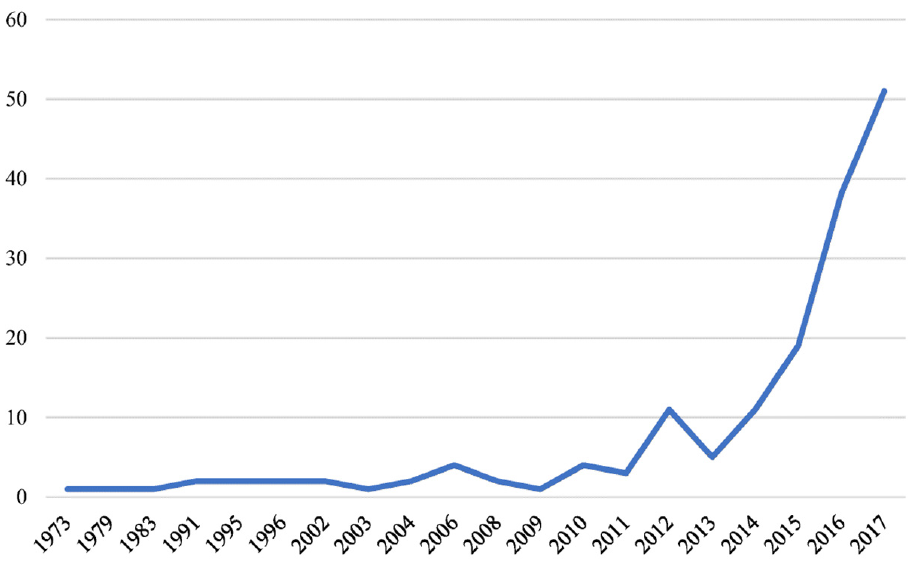
Publications on the entrepreneurial ecosystem: Scopus database.
The trend indicates that the debate on EEs is still ongoing (Cavallo et al., 2019). This implies that the field of study is still a virgin ground for further research contributions.
Boutillier et al. (2016, p. 44) compiled a comprehensive characteristic definition of EEs by stating that: “The entrepreneurial (or business) ecosystem is characterised by the diversity of players which comprise it and through their shared objectives and skills. It is a system of heterogeneous independent players who, in so-called “coopetition”, establish a common strategic interest by sharing resources, skills and norms/standards of strategic behaviour, which take many forms (technological standards, shared know-how, shared visions, informal rules, etc.” (Boutillier et al., 2016, p. 48).
From the definition, the diversity of players refers to all individuals and institutions involved in entrepreneurship, such as entrepreneurs, banks, universities, the government, and customers. The actors or players share skills, knowledge, and resources to achieve a common objective of wealth creation, as discussed by Prahalad (2005). These players work collaboratively, sharing several things, to achieve a common strategic objective. In place of rivalry or cutthroat competition, “coopetition” is used to create a business environment that benefits all the players of the ecosystem. Such “coopetition” builds synergism among the actors, thus creating a formidable entrepreneurial ecosystem that allows business sustainability.
EEs are similar to concepts such as innovation systems, industrial parks, science parks, export processing zones (EPZs), industrial districts, and clusters (Malecki, 2018, p. 7). Various definitions of EEs can be drawn from the literature. Following their historical trajectory, it is important to provide some selected definitions of the concept. Table 1 provides selected definitions of EEs from the extant literature to demonstrate the definitional variousness of the concept and its variants.
Entrepreneurial Ecosystems: Selected Definitions.

Theoretical Reflection
Researchers such as Moore (1993), Bihrami and Evans (1995), Cohen (2006), Isenberg (2010, 2011), Rahabattulah Khan (2013), Koltai (2016), and Spigel (2017), among others, contributed immensely to the discourse on EEs. Several scholars have argued that EEs are theoretically underdeveloped. Theoretical explanations are still found at an infant stage with bits and pieces of models that attempt to explain the characteristics, processes, outlook, composition of stakeholders, and measurements. Different theoretical perspectives still need to be integrated to understand the concept.
This theoretical section briefly discusses some models that have been used to explain EEs. The selected models include Bahrami and Evans’ (1995) six constituents model, Cohen’s (2006) seven elements model, Isenberg’s (2010) six domains model, The GEI Model of Entrepreneurial Ecosystems (Ács et al., 2016), Koltai’s Six + Six Entrepreneurship Ecosystem Model (Boutillier et al., 2016; Khattab & Al-Magli, 2017; Koltai, 2016; Stough, 2017), World Economic Forum (WEF) eight-pillar model (Foster et al., 2013), Funke’s entrepreneurial ecosystem canvas (Funke, 2015; Segers, 2015), and Chapman & Company’s Chapco Method (Chapman, 2020; Gehling, 2019) which supports business associations (Branham, 1964). Isenberg’s six domains model is used to underpin the study hence it will be discussed in detail. In the strict scientific sense, the models mentioned are not theories per se, but can be used to provide a theoretical reflection. To support Isenberg’s framework, the Dynamic capabilities (DC) theory was used to strengthen the theoretical underpinning.
Isenberg’s Six Domains Model
Isenberg developed the six domains of entrepreneurial ecosystems in 2010. The consolidated domains are policy, finance, culture, support, human capital, and markets. The six-domains diagram helps explain EEs (Isenberg, 2011; Isenberg & Onyemah , 2016). However, he acknowledges a weakness that it does not show a lack of causal paths or arrows that indicate the causal relationship between the factors (Isenberg, 2011; Spigel, 2017; Figure 3).
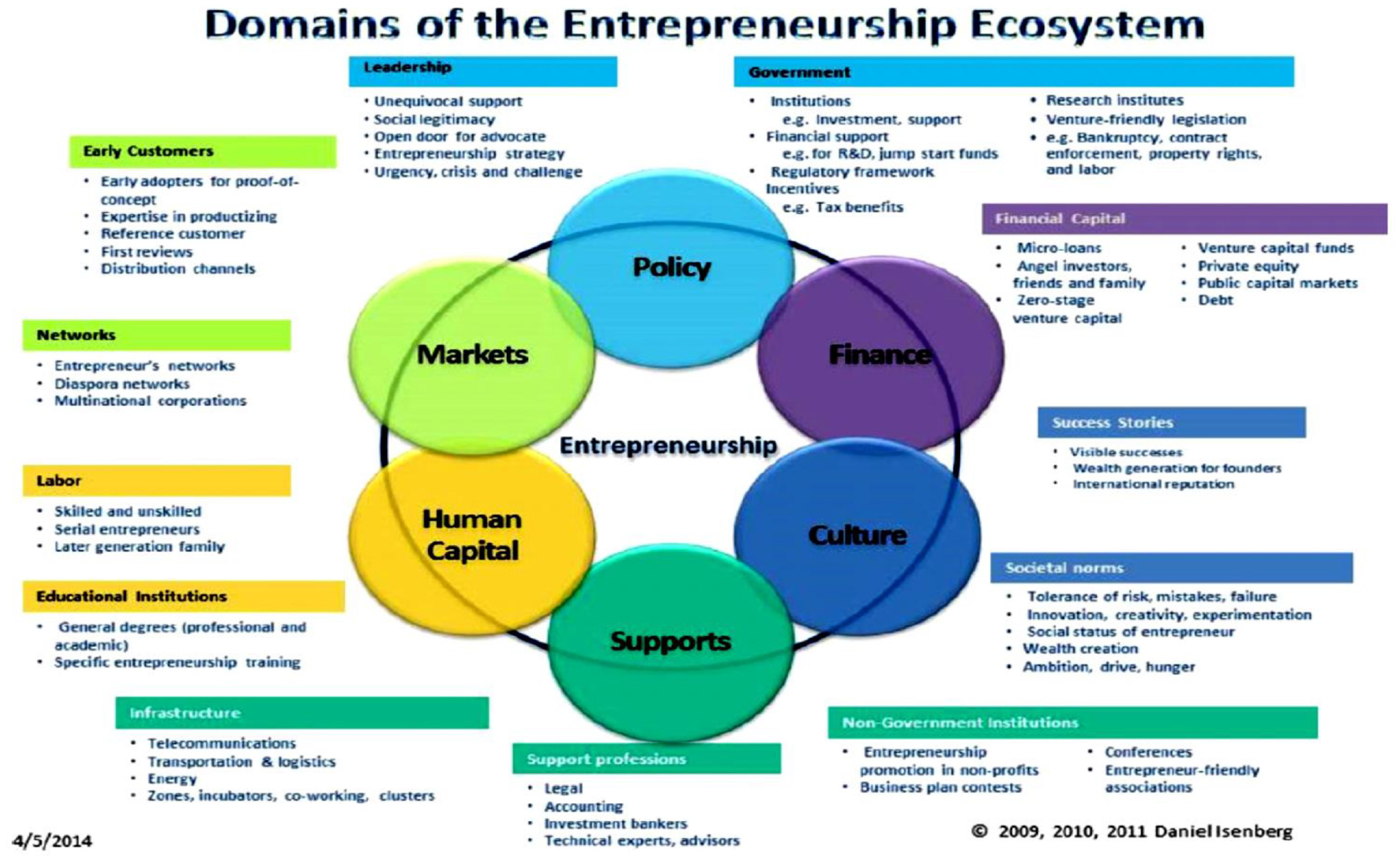
The six domains of entrepreneurial ecosystems
The six domains or pillars of EEs are briefly discussed below:
(i)
(ii)
(iii)
Culture varies with countries, creating different contexts for entrepreneurial activity. It impacts entrepreneurial spirit, orientation, risk-taking behavior, and other essential factors for entrepreneurship. argue that “Culture plays a fundamental role in the entrepreneurial activity of a society” (Castillo-Palacio et al., 2017, p. 2). Success stories about visible successes, wealth creation, risk tolerance, innovation and creativity, ambition, and social status of entrepreneurs create a desirable culture within a given environment, thus stimulating entrepreneurship within communities (Morant-Martínez et al., 2019). It is however important to be cognizant of the local cultural beliefs because of their powerful influence in polarizing the perceptions of entrepreneurial activity may affect the emergence of new ventures (Morant-Martínez et al., 2019).
(iv)
(v)
Developed economies can easily attract labor resources from the local and diaspora markets, thus having the advantage of hiring cheap labor.
(vi)
The Dynamic Capabilities (DC) Theory
“Dynamic capabilities (DC) theory emerged as both an extension to and a reaction against the inability of the resource-based view (RBV) to interpret the development and redevelopment of resources and capabilities to address rapidly changing environments” (Bleady et al., 2018, p. 1). This theory was proposed by Teece (Rashid & Ratten, 2021; see also Teece, 2007; Teece et al., 1997). The theory is based on the competencies and capabilities of entrepreneurs to respond to volatile environments such as pandemics and economic shocks. DCs are based on three important areas of action including sensing (the ability to identify opportunities and trends to stay ahead of environmental dynamics), seizing (entrepreneurs’ ability to act opportunities with agility and dicsivenes), and transforming (the capability to (Rashid & Ratten, 2021; the capability to effectively reconfigure or redeploy resources in pursuance of identified opportunities; Rashid & Ratten, 2021; Roundy & Fayard, 2019; Teece, 2007; Teece et al., 1997). Competencies and capabilities help entrepreneurs in entrepreneurial ecosystems to predict opportunities and challenges and then use existing resources to embrace the opportunities and at the same time address the challenges. The COVID-19 pandemic for example induced lockdowns and entrepreneurs were forced to adapt to new ways of doing business, such as embracing digital technologies.
As an extension of the RBV theory, DCs help entrepreneurs to identify opportunities, maintain competitive advantage and improve resilience during uncertainty (Bleady et al., 2018; Rashid & Ratten, 2021). According to Verbeke (2020), DCs help “entrepreneurs in integrating the technology, business and strategy in a complex environment” (cited in Rashid & Ratten, 2021, p.461). Isenberg’s six domains are strengthened by the competencies and capabilities explicated by the DC theory. The DC framework allows entrepreneurs to address current market problems in the market by enabling them to redesign their business models in line with the volatile environment thus improving the vibrancy of the EEs (Roundy & Fayard, 2019).
Methodology
Systematic Literature Review
A systematic literature review is defined as; “[a] review of a formulated question that uses systematic and explicit methods to identify, select, and critically appraise relevant research, and to collect and analyse data from the studies included in the review. Statistical methods (meta-analysis) may or may not be used to analyse and summarise the results of the included studies” (Cochrane Collaboration, 2005, p. 45).
Because systematic reviews follow well-defined, logical, and transparent ways of synthesizing findings, they are considered the “gold standard” for extant literature reviews (Boland et al., 2017, p. 2). Therefore, extant EEs literature is surveyed to provide answers to the predetermined research questions and achieve the stated objectives.
Journal Articles Selection
The journal selection process was done using search engines to identify peer-reviewed articles. Using search terms, articles for the systematic literature review were identified. The search process was guided by Boolean operators or connectors, search strings, and the inclusion/exclusion criteria (See Table 2). Boolean search allows a combination of keywords and synonyms with the operators to get relevant results. Boolean operators “AND,”“NOT,” and “OR” were used to pass search strings to the search engines and achieve inclusion and exclusion.
Inclusion and Exclusion Criteria.

Data Search and Search Strings
Search strings were developed using the “Advanced search” facility in the searched databases illustrated in Table 3. The facility used Boolean operators “OR,”“AND,” and “NOT” to narrow the search process. Synonyms were obtained from Merriam-Webster Inc (2020)-Mobile version. The strings used are listed below:
1.) [(“entrepreneurial ecosystems” OR “entrepreneurship ecosystems” OR “enterprise ecosystems” OR “business ecosystems” OR “innovation ecosystems” OR “business clusters” AND “developed countries” OR “developed economies” OR “developed nations” OR “high income countries” OR “high income economies” OR “industrialized countries” OR “highly industrialized countries”)]
2. [(“entrepreneurial ecosystems” OR “entrepreneurship ecosystems” OR “enterprise ecosystems” AND “challenges” OR “problems” OR “difficulties” AND “opportunities” OR “chances” AND “developed countries” OR “developed nations” OR “high income countries” OR “high income economies” OR “industrialized countries” OR “highly industrialized countries”)]
Searched Databases.

Finalizing Article Selection Strategy
The selection follows the Preferred Reporting Items for Systematic Reviews and Meta-Analysis (PRISMA) approach. Developed and widely used in the field of medical science, the PRISMA is an upgrade of the Quality of Reporting of Meta-analyzes (QUOROM) developed by Moher et al. (1999). After identifying various journal articles, the PRISMA flowchart (Figure 4) guided the final selection of articles for the systematic literature review.

PRISMA flow diagram: article selection process.
Results and Discussion
This section answers the predetermined questions about EEs in developed countries based on selected primary studies. Primary sources selected following the systematic literature review protocol were read and analyzed to extract relevant data. A summary of primary journal articles reviewed and other publications are represented in Appendix A. Document identifiers are listed as A1 to A28.
Research Question 1: What Is the Prevalence of Entrepreneurial Ecosystems?
Data from selected primary studies were extracted and analyzed to provide answers to the question of the prevalence of EEs in developed countries.
As illustrated in Table 4, the prevalence of EEs is high in developed countries. All documents (100%) confirmed many EEs in developed countries. It was noted that in some countries, different terms are used to describe entrepreneurial ecosystems. The terms used are clusters, science parks, industrial parks, business parks/zones, innovation zones, incubators, start-up hubs, and export processing zones. For example, in China, Shenzhen, a replica of Silicon Valley, is referred to as an Export Processing Zone, yet its equivalent (Silicon Valley) is called an EE.
The Prevalence of Entrepreneurial Ecosystems in Developed Countries.

Bibliometric Analysis
To further explicate the prevalence and dynamics of entrepreneurial ecosystems in developed countries, bibliometric analysis methods were applied. Bibliometric analysis is a scientific technique that “summarizes large quantities of bibliometric data to present the state of the intellectual structure and emerging trends of a research topic or field” (Donthu et al., 2021, p. 287). It has the capability to handle large amounts of data. The advancement of science in the development of databases such as Scopus, Web of Science, Dimensions, and PubMed has made it popular. In addition, the advancement in creation of bibliometric software such as VOSviewer, Gephi, Leximamncer (Donthu et al., 2021), RStudio, Biblioshiny, and CiteNet has enhanced its usage and effectiveness. This paper used VOSviewer software to analyze data on entreprenuerial ecosystems, extracted from the Dimensions database.
Data Extraction and Analysis
Using the search string: “entrepreneurial ecosystems or entrepreneurship ecosystems AND developed countries,” and limiting to open access articles published between 2014 to 2023, there were 10,842 document results.
Data analysis was performed using graphs and map visualizations using Dimensions analytical views functionality and VOSviewer software. The analyzes performed were (i) Number of publications per year (Figure 5) (ii)Bibliometric coupling (analysis) and authors (unit of analysis) (Figure 6). (iii) Co-authorship analysis (Figure 7). (iv) Bibliometric coupling of countries (Figure 8). and (vi) Bibliometric coupling of organizations (Figure 9).

Number of publications per year.

Bibliometric coupling and authors.
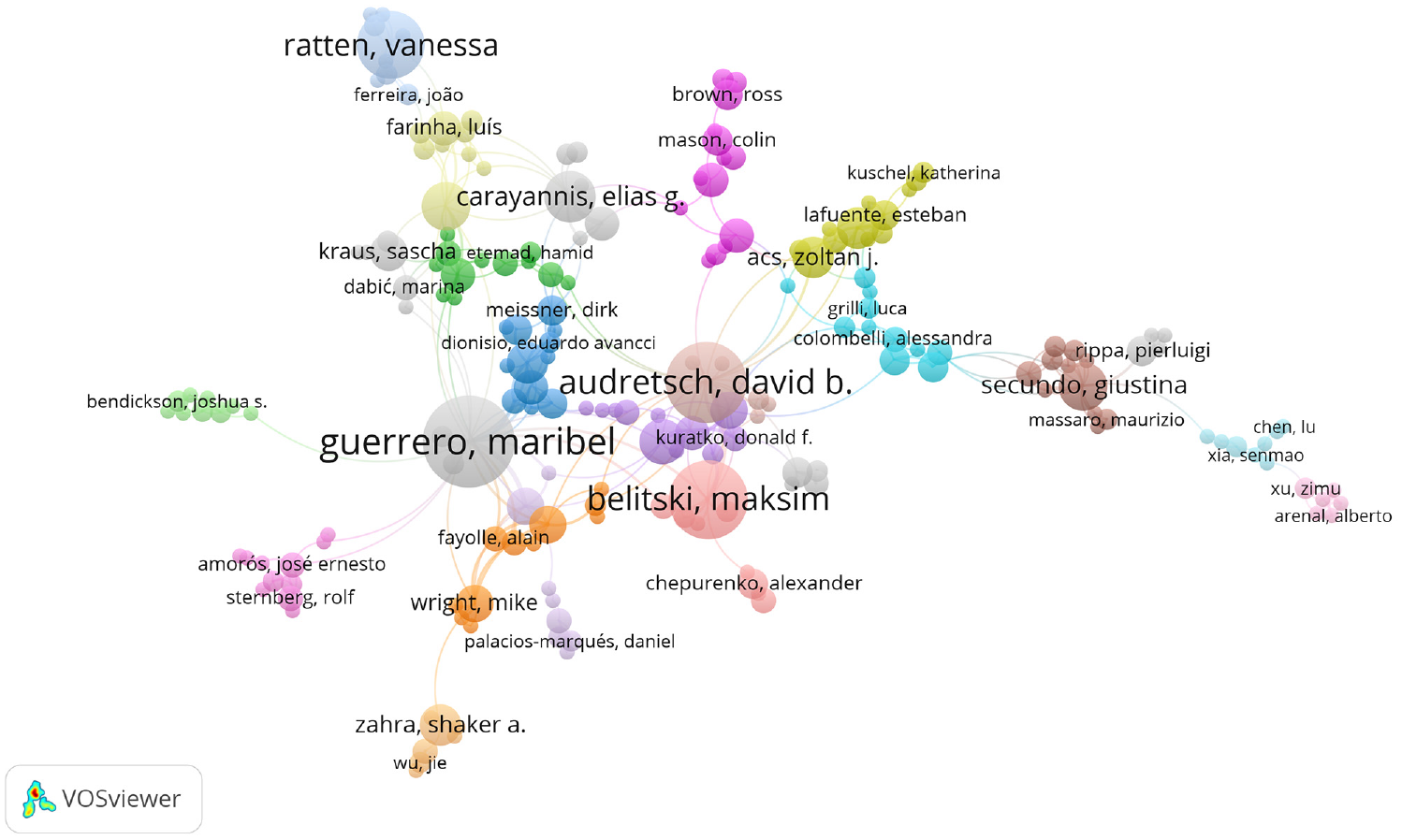
Co-authorship analysis.

Bibliometric coupling of countries.

Bibliometric coupling of organizations.
Number of Publications Per Year
The graphical visualization (Figure 5) shows an exponential increase in the number of publications from 2014 to 2021which leveled up in 2022. It is noteworthy to know that there were publications in the field prior to 2014.
Bibliometric Coupling and Authors
Bibliometric analysis of authors is a technique for mapping authors’ similar research interests. It analyzes the patterns of co-citations between authors, thus enhancing future netwokings (Donthu et al., 2021).
Figure 6 is a visualization of the bibliometric coupling of authors.
Table 5 summarizes the top contributors as demonstrated by the number of documents, their links and the total link strength (it quantify the overall strength of connections within the network). Guerrero, Maribel is at the top of the list with 25 document, 53 links, and a total link strength of 12,836. Belitski, Maksim has 20 documents but has the TLS of 14,834, showing how the author has strong connections in the network.
Authorship (Number of Documents, Links, and Total Link Strength).

Co-Authorship Analysis
This is a bibliometrics technique used to determine co-authorship relationships and connections thus analyzing the dynamics of author research collaborations. It is a strong tool for analyzing the “social interactions or relationships among authors” (Donthu et al., 2021, p. 288). It is a useful tool for examining patterns in research collaborations, identifying possible collaboration opportunities, measuring how research productivity is influenced by collaborations and examining the social interactions in scholarly communities. Researchers, research funders, institutions, and policy-makers seeking can use the findings to explore collaborative networks to foster interdisciplinary research collaborations (Donthu et al., 2021).
The map (Figure 7). shows how authors are orgnaized into clusters, as determined by the different colors. For example, author Audretsch David Bruce is in the green cluster and connected to Belitski Maksim, Guerrero, Maribel, and Acs Zoltan.
Bibliometric Coupling of Countries
A bibliometrics method for the analysis of similarities and collaborations in research between countries. It assesses intellectual links and patterns by identifying shared citations across country-specific publications. Researchers, funders and policy-makers can use the tool to explore potential areas for collaborations in the global landscape and inter-country knowledge. Overall, results generated using VOSviewer show 6 clusters, 73 items, 2,584 links, and a total link strength of 1,887,226 (Figure 8).
Table 6 summarizes leading countries researching in the field of entrepreneurial ecosystems. The US is at the top followed by China in terms of both number of documents and total links strength.
Summary of Results: Selected Countries From the Network.

Bibliometric Coupling of Organizations
A bibliometrics method for the analysis of similarities and collaborations in research between organizations such as research institutes, universities, think-tanks, government institutes, non-governmental organizations, and private companies. It assesses intellectual links and patterns by identifying shared citations across organization specific publications. Researchers, funders, and policy-makers can use the tool to explore potential areas for collaborations among organizations (see Figure 9).
The input into VOSviewer software involved a minimum of five documents and five citations per organization. Of the 2,063 organizations, 243 met the threshold. The leading organizations are listed in Table 7.
Summary: Bibliometric Coupling of Top Organizations.
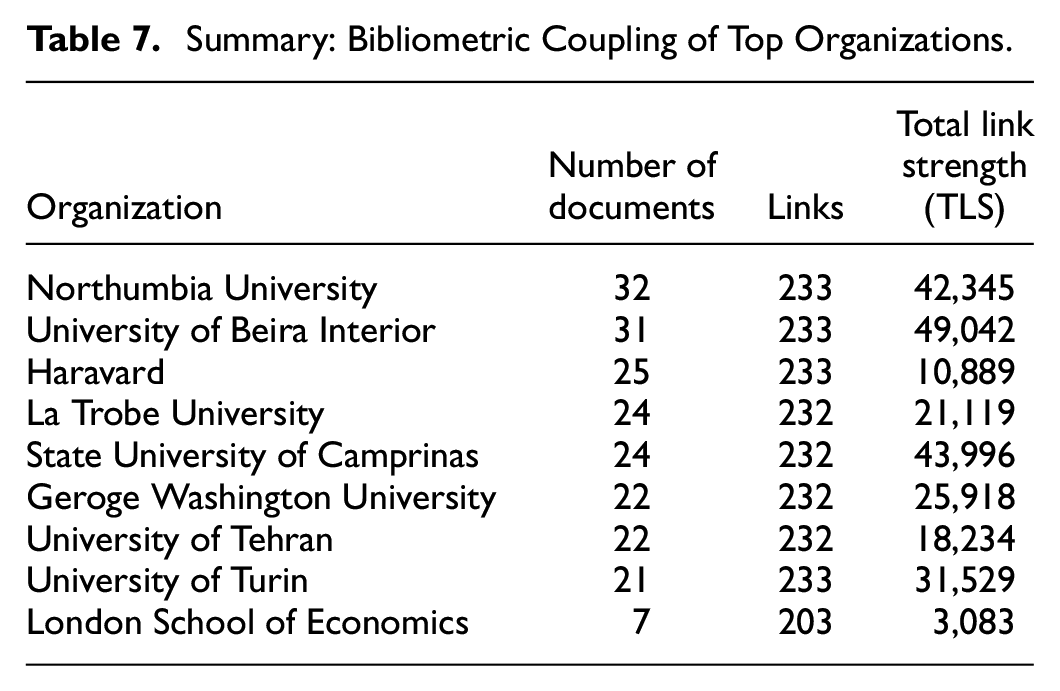
Table 7 shows that Northumbia University is at the top with 32 documents, 233 links, and 42,345 total link strength. The University of Beira Interior comes second with respect to documents, it has 31 documents but the TLS of 49,042 which is higher than that of Northumbia University. Organizations can be ranked in terms either the of number of documents or the TLS.
Research Question 2: What Are the Challenges and Opportunities of Entrepreneurial Ecosystems?
Table 9 illustrates the extent of the challenges faced by EEs. Challenges identified from primary studies used in the systematic literature review include barriers to sustainability, the complexity of ecosystems, stiff competition, lack of capital, poor policies for fostering the ecosystems and poor collaboration. From the primary studies, only 36% of the documents mentioned the challenges. The majority, 64%, did not raise any concern about the challenges. They indicated that developed economies have well-developed policies and support structures for the growth and survival of EEs.
Challenges and Opportunities of Entrepreneurial Ecosystems.

Entrepreneurial Ecosystems and Economic Development.

Opportunities available to entrepreneurs are represented by 50%, demonstrating that entrepreneurial ecosystems can function well in the environments created by stakeholders. The governments make opportunities available, which create enabling environments through policy and support. For example, entrepreneurial support organizations (ESOs) are well-resourced in the UK and the USA and provide vital support to developing and fostering entrepreneurial ecosystems. Collaboration was pointed out as an essential enabler for entrepreneurship growth.
Research Question 3: How Do Entrepreneurial Ecosystems Promote Economic Development?
EEs attract entrepreneurs who will support each other for improved business opportunities. This translates to increased productivity, increased job creation, and welfare. Most (57%) of the primary studies analyzed revealed that EEs are important drivers of economic development. Table 9 illustrates that 57% of the primary studies agreed that EEs drive economic development.
Research Question 4: What Are the Possible Strategies for Mitigating Challenges Faced by Entrepreneurial Ecosystems?
As represented in Table 10, 69% of the primary studies concurred that developed countries have strategies to mitigate the challenges faced by EEs. The strategies include strengthening the elements or domains of EEs, collaboration or “coopetition” among stakeholders, and identifying opportunities. Many governments of developed economies develop deliberate policies for promoting EEs. For example, Australia, the US, and the Netherlands have programs supporting the establishment of EEs. Innovation and technological development lead to the growth of high-tech firms, which have become ubiquitous in Silicon Valley. Such developments result from research and knowledge transfer by universities.
Strategies for Mitigating Challenges.

Conclusion and Recommendations
Entrepreneurial ecosystems are prevalent in developed countries. Their governments and other stakeholders support them to ensure growth and sustainability. Elements or domains of EEs such as policy, finance, markets, human resources, support, and infrastructure are crucial for solid ecosystems. These elements must be well-developed to create enabling environments for the growth and sustainability of entrepreneurial ecosystems. This study established that developed countries have fewer challenges and more opportunities for ecosystems. It is, however, recommended that governments and other stakeholders continue to identify gaps to promote the intensity and extensity of EEs, which are celebrated for stimulating economic growth and development. Governments of developed economies support entrepreneurship growth through deliberate policies meant to create enabling environments. In addition, they provide several forms of support such as finance, human resources development, markets, supports, infrastructure, and policy.
The searched literature shows that EEs are gaining credence by the day. Their development is important and is attracting the attention of academicians, researchers, research institutes, universities, policy-makers, entrepreneurs, research funders and other stakeholders. This paper was developed as an effort to contribute to the EEs discourse to identify new lines of future research.
The findings proved the prevalence of EEs in developed countries through the use of bibliometrics, showing author, country, and organization research connections. Despite their growth, EEs still face some challenges. The challenges were identified but differed in magnitude and severity from one country to the next. The challenges are associated with Isenberg’s (2010, 2011) six domains (finance, policy, markets, human resources, supports, and culture), complexity, and barriers to sustainability. On the other hand, opportunities are also available within the six domains, innovation, and technology.
The findings conclude that EEs play a critical role in economic growth and development. Further, primary sources reviewed the importance of EEs in enhancing the livelihoods of entrepreneurs and their communities.
This paper’s contribution is fourfold. First, it possibly will stimulate debates on EEs in developed countries. Despite developed countries being rich, they still need to have strong entrepreneurial ecosystems for the sustainability of their economies.
Second, our paper adds to the extant literature on EEs in developed countries. The focus was on developed countries to check their prevalence, challenges, opportunities, and strategies that could be employed to maintain sustainability. Our second paper will focus on developing countries. It is an attempt to broaden the analysis of EEs from the developed country focus. The bibliometric analysis applied in the paper helped us to observe a considerable number of publications EEs in developed countries yet there is a dearth of similar studies in poor countries. Additionally, many scholars lamented (e.g., Ratten, 2020; Guerrero & Espinoza-Benavides, 2021; Audretsch, Belitski & Guerrero, 2023) that more research is still needed to understand the concept and to develop sound theories which could be used to underpin debates in the field of study.
Third, this paper suggests strategies that could be used to strengthen and sustain EEs for economic growth and development. The strategies are hinged on EEs support programs from the government and other stakeholders with regard to finance, markets, human resources, infrastructure, policy and culture. The discussions in this paper may open avenues for government, researchers, financing agencies, and policy-makers to explore innovative ways of supporting and strengthening EEs for entrepreneurship development.
Fourth, this paper contributes to the provision of a foundation for policy formulation. Policy directions will help to promote EEs in different communities for sustainable economic development. Policy-makers have the prerogative to develop a friendly entrepreneurial ecosystems environment for the promotion of entrepreneurship. Literature has identified EEs as a catalyst for rejuvenating and/or sustaining economies.
This paper recommends the formulation and implementation of EEs supportive policy frameworks by governments and other stakeholders to strengthen entrepreneurship in their regions. Researchers, academics, funders, and institutions could support entrepreneurship by coming up with innovative strategies. Communities need to be involved in the EEs development process and entrepreneurs should be put at the center.
This paper is not without limitations. Its limitations include the focus on developed economies in a world of emerging and developing economies. Though it might be a daunting task, exploring global EEs could provide unique results because of the complex variations that exist in the world of entrepreneurship. Another limitation stems from the selection of primary articles for the study. The SLR methodology is not exhaustive. However, the further use of bibliometrics helped us to have access to more and newer publications. Bibliometric analysis is capable of handling large amounts of data, allowing a deeper and broader analysis of EEs. Data extracted from the Dimensions database was not developed for scientific bibliometric analysis such that it cannot be exonerated from errors, which could have negatively influenced the results (Donthu, 2021).
Future lines of research could be country or regional-specific because of numerous spatial variations related to entrepreneurship. Further, comparative studies could also be carried out. Another future line of research relates to using bibliometric data from other databases such as Scopus, Web of Science, and Google Scholar. Though Google Scholar is criticized for carrying gray literature, it is an important source of bibliometric data that can be extracted using Harzing’s Publish or Perish software (Diepolder et al., 2021; Harzing, 2010). From a theoretical perspective, the field of EEs still suffers from a theoretical lacuna. Future researches on EEs need to focus on developing theories and models that can be effectively used to enhance the development of EEs. Another future research topic is technology and EEs, targeting entrepreneurs, and policy-makers as the world faces dynamic shifts in the field of technology especially the emergence of artificial intelligence (AI). Policy-makers have the responsibility to create conducive environments for the growth and sustainability of EEs.
Footnotes
Appendix
Primary Research Studies Used in the Review.

| Identifier | Country/region | Findings | Method/theory | Source |
|---|---|---|---|---|
| A1 (Moore, 1993) | United States | Silicon Valley-IBM (with suppliers like Intel, Microsoft, and Lotus), Apple, and Tandy business ecosystems leaders in personal computing identified, with suppliers such as Motorola and Sony. “Microsoft-Intel” ecosystem was also identified. Wal-Mart built a strong ecosystem. Hewlett-Packard, Sun Microsystems, and Motorola were found to be part of the ecosystem (they cooperatively developed an innovative software OS (operating system). |
Literature review/evolutionary approach | Google Scholar |
| A2 (Bahrami & Evans, 1995) | United States | California’s Silicon Valley, a unique ecosystem with high-tech, innovative, and pioneering firms. South San Francisco Bay area, and Santa Clara Valley. Identified many “clusters” including “Austin’s Silicon Hills,”“Seattle’s Technology Corridor,”“Illinois’s Silicon Prairie,”“New Jersey’s Princeton Corridor,”“San Diego’s Golden Triangle,” and “Utah’s Software Valley.” They also identified “Silicon Glen” in Scotland, Sofia Antipolis in France, and Cambridge in the UK. |
Case study/flexible recycling model | Google Scholar |
| A3 (Löfsten & Lindelöf, 2003) | Sweden | Sweden and the UK: Science Parks |
Quantitative/science parks | Science Direct—Elsevier |
| A4 (Neck et al., 2004) | United States | Boulder County (USA), Silicon Valley. Elements-university (Stanford), government support, professional services, capital, talent pool, large corporations, physical infrastructure, culture (very important-100% responses). Outcomes—“Job creation, wealth creation, business growth, and economic prosperity,” Cluster development for sustainable technologies. | Qualitative/sociological theory of isomorphism | Taylor & Francis |
| A5 (Cohen, 2006) | Canada | Silicon Valley, Boston’s Route (North American community). Development of eco-industrial parks. Victoria, British Columbia (Canada). Government (local and national). University (Victoria), large firms, social networks, formal & informal networks, Technology Parks, capital resources, private sector, NGOs, professional services, talent pool, physical infrastructure, culture. |
Quantitative/no theory | Google Scholar |
| A6 (Bosma & Levie, 2010) | Switzerland | Quantitative/no theory | GEM Reports | |
| A7 (Foster et al., 2013) | Switzerland | Silicon Valley (USA), US—Other Cities, North America, the United Kingdom, Singapore, Australia, New Zealand, Ireland, Switzerland. |
Quantitative/no theory | Google Scholar |
| A8 (Rahatullah Khan, 2013) | Saudi Arabia | Saudi Arabia. Mapping entrepreneurial ecosystems. Used Isenberg’s six domain—“policy, markets, human capital, supports, culture and finance.” Identified the existence of entrepreneurial ecosystems in USA and Australia. Economic development in Saudi Arabia | Mixed/theory of business incubation | Emerald Insights |
| A9 (Stam, 2014) | Netherlands | Netherlands—“the Dutch Entrepreneurship Miracle.” Nine attributes that should be present for a successful start-up are leadership, intermediaries (mentors and advisors), network density (deeply and well networked with stakeholders), government (policies), talent (expertise with universities support), support services (professional services), engagement (community connections, conferences, pitch days, and boot camps), large companies (supporting start-ups), capital (venture capitalists, angel investors, bankers, microfinance institutions, microinsurance, relatives, and friends | Literature review/no theory | Google Scholar |
| A10 (Amorós & Bosma, 2014) | Switzerland | Developed countries have high entrepreneurial activity and have several advantages in accessing resources for entrepreneurial ecosystems. However, challenges can be seen in some pockets such as marginalized areas in some cities. | Quantitative/no specific theory | GEM Reports |
| A11 (Cavallo et al., 2019) | Italy | The development of EEs requires guidelines that could be used to direct the processes. Poor conceptualization makes it difficult to operationalize. Policymakers have a crucial work to influence the development of EEs to encourage economic growth. Policy challenges need to be addressed. | Literature review/no specific theory | Springer |
| A12 (Kelly et al., 2015) | Switzerland | Norway, Australia, and the United Kingdom report the highest Entrepreneurial Employee Activity (EEA). They are innovative-driven economies. Entrepreneurial ecosystems most developed in North American and less developed in Africa. Luxembourg, Switzerland, Croatia, Slovenia, and Canada are highly entrepreneurial. Innovation-driven countries have many ecosystems for example, Israel, the UK, the US, Ireland, Japan, Finland, Germany, The Netherlands, Norway, Sweden, Switzerland, and Canada. | Quantitative/no theory | GEM Reports |
| A13 (Fuerlinger et al., 2015) | Germany | Silicon Valley (USA), “New York, Chicago, Austin, and Seattle; and globally, Tel Aviv, Singapore, London, and Berlin” (p. 4). Hi-tech players who are high job creators, Apple, Yahoo, Google, and Facebook. The state supports the entrepreneurial ecosystems. The state plays a vital role in developing science parks and innovation hubs. Germany, the UK, Denmark, and Belgium introduced legislation for supporting commercialization of publicly funded research at universities. | Mixed/triple helix model | Springer |
| A14 (Spigel, 2017) | Edinburgh, Scotland | Edinburgh, Scotland (UK). “Public and privately-run entrepreneurship support organisations (ESOs) form a critical part of entrepreneurial ecosystems” (p. 141). Groups such as universities, Scottish Enterprise and the Scottish Funding Council support entrepreneurial ecosystems in different ways. ESOs provide professional services (such as tax filing, basic training, ecosystem coordination, financial advice, networking, and inspiring) | Literature review/institutional thickness theory | Google Scholar |
| A15 (Guerrero et al., 2016) | European | Entrepreneurial universities in Europe. Support through education and training. Human capital is used to measure the contribution. Technology and knowledge transfer, providing professional services and engagements (conference and community meetings or seminars). | Quantitative/institutional theory | Springer |
| A16 (Ester, 2017) |
United States | Silicon Valley: “HQ of high-tech companies such as Google, Apple, HP, Oracle, Cisco, Facebook, LinkedIn, Uber, Airbnb, WhatsApp, Twitter, Dropbox, Instagram, Salesforce, WMware.” Has between 14,000 and 19,000 start-ups. Pool of talent with the support of private and public universities such as Stanford and Berkeley. Houses many R&D labs. Immigrant human capital is very important. Emulating Silicon Valley, “Cities such as London, Berlin, Paris, Amsterdam, Eindhoven, Barcelona, Madrid, Dublin, Milan, Tallinn, and Helsinki are quickly developing into profiled European start-up innovation hubs.”(p. 22). |
Mixed/Innovation Theoretical frameworks | Google Scholar |
| A17 (Miller & Acs, 2017) |
United States | University of Chicago campus as an entrepreneurial ecosystem. Student entrepreneurs are important. Most rich companies can be traced back to student entrepreneurship. Student activities interact with the immediate environment (local economic development) and regional economies, thus promoting entrepreneurial ecosystems. | Qualitative/Frederick Jackson Turner’s Frontier Thesis of American democracy | Springer |
| A18 (Ács et al., 2018) |
Global/Various | The top countries in terms of entrepreneurship are “The United States, Switzerland, Canada, Sweden, Denmark, Iceland, Australia, United Kingdom, Ireland, and the Netherlands.” They have strong entrepreneurial ecosystems elements. Economic development is promoted. | Quantitative/Kirznerian entrepreneurship and Schumpeterian entrepreneurship | Springer |
| A19 (Harper-Anderson 2018) |
United States | The US regions of Chicago, Pittsburgh, and Richmond. The presence of entrepreneurial support organizations (ESOs). There are many start-ups and stakeholders. Universities such as Chicago, Northwestern and DePaul are important. Policymakers, ESOs, universities, leaders, government, | Multiple case-study approach/institutional proximity and organizational proximity | Google Scholar |
| A20 (Rong et al., 2018) |
Asia (China, Japan, and South Korea) | Co-evolution is an essential aspect of business ecosystems (entrepreneurial ecosystems). Companies in China, Japan, and South Korea became leaders of entrepreneurial ecosystems. |
Literature review/value-chain and network theories | Springer |
| A21 (Reidolf et al., 2019) |
Estonia. | High entrepreneurial activity in Estonia. An innovation-driven economy. Stakeholders are universities, venture capitalists, banks, business angels, enterprises, and financing bodies. Local conditions (political, economic, social, cultural, technological, and legal/regulatory/policy) influence entrepreneurs. Examples of entrepreneurial ecosystems: Silicon Valley (in the US), Calgary (in Canada), and Cambridge (in the UK). |
Qualitative/no specific theory | Google Scholar |
| A22 (Roundy, 2019) | United States | Conducted study in Ohio (Newton Falls and Geneva). Small towns become economically significant as ecosystems develop, jobs are created, and the economy grows. All stakeholders in a village are essential for a robust entrepreneurial ecosystem. | Qualitative/community building approach | Springer |
| A23 (Pugh et al. 2021) | United Kingdom. | North West of England, Lancaster case. Entrepreneurial ecosystems were identified—the role of elements focusing on learning. Lancaster University plays a crucial role. | Mixed/entrepreneurial learning theory | Springer |
| A24 (Brown & Mawson, 2019) | OECD countries | There is widespread adoption of entrepreneurial ecosystems. OECD countries (Australia, Canada, Ireland, the Netherlands, Poland, and the UK) have good entrepreneurial ecosystems and Nordic countries (Finland & Denmark). They also spotted entrepreneurial ecosystems in Estonia, Russia, Tel Aviv (Israel), New Zealand, China, Ireland, and Canada. All have supportive policies. They are cognizant of the ecosystem elements. | Qualitative (documentary analysis and interviews) | Google Scholar |
| A25 (Brooks et al., 2019) | Poland | Entrepreneurial ecosystems exist in Poland. They identified in Polish regions Malopolska, Mazowieckie, and Pomorskie. Policymakers have challenges understanding the appropriate strategies for developing entrepreneurial ecosystems. Unclear definitions and under theorization of the concept affect its practical usage. | Qualitative/institutional theory | Emerald Insights |
| A26 (Yan & Guan, 2019) | OECD countries | A longitudinal study on all OECD countries. Ecosystems identified in all the 34 OECD countries studied. They have identified the importance of entrepreneurial ecosystem elements in fostering their development and growth. The entrepreneurial ecosystem is not limited to nine elements. “People are also motivated via international investment, entrepreneurial capabilities and opportunities.” | Quantitative (longitudinal study)/social cognition theory (SCT) | Springer |
| A27 (Szerb et al., 2019) | European Union region | 121 European Union regions. Regional entrepreneurial ecosystems. Performance enhanced by good systems elements. | Literature review/no theory | Taylor and Francis |
| A28 (Bosma et al., 2020) | Global/Various | The 50 Economies Participated In the GEM Survey In 2019. They Were Grouped Into Regions (Europe And North America, Middle East & Africa (MEA), Latin America & Caribbean, And Asia & Pacific. Of the 50 economies, 33 are classified as high-income. The entrepreneurial elements, policy, finance, culture, support, human capital, and markets were essential for the development and sustainability of entrepreneurial ecosystems. | Quantitative/no theory | GEM Reports |
Acknowledgements
This work is part of my PhD work which is in progress. I want to thank my supervisor; Prof. SP van der Merwe for the guidance.
Author Note
NB: I have listed double affiliation because I am employed by Nelson Mandela University, which is funding the study, and I am conducting the research, from which the paper was drawn, in association with the North-West University. Furthermore, I am obligated to include North-West University as I am registered with them for this study.
Declaration of Conflicting Interests
The author(s) declared no potential conflicts of interest with respect to the research, authorship, and/or publication of this article.
Funding
The author(s) disclosed receipt of the following financial support for the research, authorship, and/or publication of this article: I want to thank Nelson Mandela University for funding the studies.
Ethical Approval Statement
Since the paper does not use human subjects, there is no requirement for ethics approval by the Research Ethics Committee. However, the bigger study received an ethical clearance from the North-West University Ethics Scientific Committee. The Ethics clearance number is NWU—00622—22—A4.

Data Availability Statement
Data sharing not applicable to this article as no datasets were generated or analyzed during the current study.