




Abstract
Entrepreneurial behavior has been substantially addressed in entrepreneurship literature, but the mechanisms by which social capital influences entrepreneurial behavior among college students remain unclear, especially the potential mediating and moderating interplay among them. Therefore, drawing on social capital theory and the Stimulus-Organism-Response (S-O-R) model, this study proposed a moderated mediation model of social capital on entrepreneurial behavior. Sample data were collected via questionnaires from entrepreneurial team members participating in the Innovation and Entrepreneurship Competition in Southwest China. Results showed that (1) social capital has a positive impact on entrepreneurial behavior; (2) entrepreneurial passion partially mediates the relationship between social capital and entrepreneurial behavior; and (3) entrepreneurial risk perception positively moderates the relationship between entrepreneurial passion and behavior and thus enhances the mediating effect of entrepreneurial passion. This study provides insights into the internal mechanism of social capital on entrepreneurial behavior and also offers practical guidance for individuals, universities, and governments.
Plain Language Summary
The purpose of this study is to explore the impact of social capital on the entrepreneurial behavior of college students. Therefore, this study puts forward a moderated mediation framework to show how social capital stimulates entrepreneurial behavior through entrepreneurial passion and risk perception. An empirical study of 206 Chinese college students confirmed all the proposed hypotheses. The results indicate that (1) social capital has a positive impact on entrepreneurial behavior; (2) entrepreneurial passion partially mediates the relationship between social capital and entrepreneurial behavior; and (3) entrepreneurial risk perception positively moderates the relationship between entrepreneurial passion and behavior and thus enhances the mediating effect of entrepreneurial passion. Thus, this study contributes to the research of entrepreneurial behavior and relevant practical fields. However, some limitations remain. First, social capital is discussed as a whole variable so we can’t explore the influence of each dimension on entrepreneurial behavior. Second, entrepreneurial passion is characterized by several boundary conditions but this study focused only on entrepreneurial risk perception as the boundary condition. Third, the use of cross-sectional data in this study limits the ability to establish causal relationships in the observed associations. Finally, this study focused on college students in Southwest China, which may affect the representativeness and universality of the results. We hope that the directions proposed in this study will inspire many colleagues to enrich our understanding of the role of social capital in stimulating entrepreneurship and innovation.
Keywords
Introduction
Entrepreneurship is regarded as one of the most powerful economic strategies and a measure to tackle the escalating challenges of globalization, such as rising employment pressures and the unemployment rate (Maheshwari et al., 2022; Servaes & Tamayo, 2017). However, the majority of prior studies have been conducted in developed countries (i.e., Europe and the United States), and there is little evidence from developing countries, which is concerning, so it is necessary to explore entrepreneurship in the context of developing countries (Neneh, 2022). In China, with the deepening and advancement of innovation and entrepreneurship strategy, building an innovative country has become an important goal of future development (Liu et al., 2019). In recent years, researchers have focused their attention on potential entrepreneurs to encourage their active participation in economic development (Mamun et al., 2017). College students, with their extensive knowledge and active thinking, serve as the backbone and driving force for future national development. In 2022, the number of Chinese college graduates exceeded 10 million for the first time, but only about 2% of Chinese graduates choose to start their own business, which is a huge gap compared with developed countries (Li et al., 2020). Therefore, how to improve college students’ entrepreneurial behavior has attracted the attention of researchers.
Entrepreneurial behavior refers to the behavioral response to potential profit opportunities with uncertainty (McMullen & Shepherd, 2006). Entrepreneurial behavior is influenced by various background factors and conditions (Khoshmaram et al., 2020). However, there is a lack of comprehensive perspective when exploring the mechanisms between environmental factors and entrepreneurial behavior (Cai et al., 2021). According to the S-O-R model, environmental factors can impact individuals’ behavior by shaping their emotions and cognition (Mehrabian & Russell, 1974). Given this, the objective of this study is to investigate the influence of contextual variables and individual variables on entrepreneurial behavior among college students in China.
Recently, researchers have found that social capital plays a significant role in driving entrepreneurship (Khoshmaram et al., 2020; Mahfud et al., 2020). Social capital is a resource and value existing in interpersonal relationships and social networks (Liao & Welsch, 2005). It can foster an encouraging entrepreneurial environment by providing resources from family members, friends, communities, and society to individuals (Cai et al., 2021). Therefore, this study speculates that social capital is an important contextual variable in facilitating entrepreneurial behavior. Specifically, college students’ social capital, as initial resources of entrepreneurship, supports the demand for initial resources and can help individuals transform resources into actions with higher efficiency (Battisti & McAdam, 2012). Coleman (1988) proposed that social capital is not an innate and unchangeable thing, but the result of the flow of resources in the social structure. Therefore, college students can benefit from their own acquired efforts to gather personal social capital and establish interpersonal relationships. In addition, they can also make full use of their teachers’ social capital and combine it to further enhance personal capital, thereby promoting self-entrepreneurship (Allan & Catts, 2014). Indeed, research on social capital, particularly focusing on college students, is relatively limited and has not received sufficient attention in practical work (Allan & Catts, 2014; Hayter et al., 2017; Muscio et al., 2022). Therefore, the objective of this study is to investigate the mechanism of social capital on college students’ entrepreneurial behavior under the background of China.
Entrepreneurial passion is a strong positive emotion generated by entrepreneurs when they engage in activities related to entrepreneurship (Neneh, 2022). This passion is influenced by an individual’s social capital and is an important factor that promotes entrepreneurial behavior (Cardon et al., 2009). Entrepreneurs can obtain various resources, including information, financial support, and emotional support, from their social networks (Yi, 2021). However, few studies have examined how these resources spill over and contribute to the development of entrepreneurial passion (Stenholm & Nielsen, 2019). In addition, entrepreneurial passion is a key driving factor that motivates individuals to engage in relevant behaviors (Cardon et al., 2013; Li et al., 2020). However, the growing body of literature about passion in entrepreneurship neglect to explore the role of entrepreneurial passion in shaping entrepreneurial behavior within a relevant and effective theoretical framework (Huyghe et al., 2016; Karimi, 2020). Therefore, this study aims to eliminate this gap in the literature by integrating entrepreneurial passion into the S-O-R model, and further open the black box of the role of social capital in entrepreneurial behavior.
Entrepreneurial activities are context-dependent, and such contextual factors affect entrepreneurial cognition, emotion, and behavior (Shepherd et al., 2019). Given such importance, entrepreneurial risk perception has attracted research attention (Zhao et al., 2021). Entrepreneurial risk perception is considered an entrepreneur’s understanding and judgment of risk uncertainty and potential loss in decision-making (Forlani & Mullins, 2000). In real life, risk perception varies from person to person (Hoogendoorn et al., 2019). Even in the same decision-making environment, the risks perceived by different individuals or the same individuals at different times also change. Therefore, this study attempts to take entrepreneurial risk perception as a moderating factor and explore the moderating effects at different levels on the entrepreneurial passion and behavior of college students. Specifically, when entrepreneurs have a higher level of entrepreneurial risk perception, they tend to be more keenly aware of potential risks and challenges (Sitkin & Weingart, 1995). This heightened risk perception can enhance the stimulating effect of entrepreneurial passion, motivating entrepreneurs to actively take action in response to risks and challenges. Therefore, this study predicts that entrepreneurial risk perception positively moderates the relationship between entrepreneurial passion and behavior.
In summary, the main contributions are as follows: First, the S-O-R model is a significant theoretical model in consumer behavior research (Bigne et al., 2020; Cao & Sun, 2018). This paper applies the S-O-R model to the field of entrepreneurship, thus facilitating further in-depth exploration and expansion of entrepreneurship research. Second, this paper responds to the appeal of focusing on the entrepreneurs’ social capital and network process (Smith et al., 2017), clarifies the essence of social capital and its mechanism in the process of entrepreneurial behavior, and provides a reference path for improving college students’ entrepreneurial behavior. Third, this study unpacks the “black box” between social capital and entrepreneurial behavior. By examining the mediating role of entrepreneurial passion, this study addresses the crucial role of positive emotion in explaining how environmental factors influence entrepreneurial behavior. Finally, this study proposes and confirms the moderating role of entrepreneurial risk perception, which helps explain the reasons and timing of entrepreneurial passion affecting entrepreneurial behavior, and further clarifies pathways through which social capital occurs. Figure 1 shows the conceptual model.

The conceptual model.
Theoretical Background and Hypotheses
Social Capital Theory
The concept of “capital” originally belongs to the field of economics. Capital, along with land and labor, is referred to as the three primary factors of production in economics (Schultz, 1961). Recognizing the crucial role of individuals in economic growth, an American economist (Schultz, 1961) introduced the concept of human capital, expanding the notion of capital. Subsequently, sociologists and political scientists (e.g., Coleman, 1988; Putnam, 1993) extended the discussion on capital beyond the realm of pure economics by introducing the concept of social capital. They emphasized that social members can leverage non-economic social relationships to obtain valuable benefits. This fusion of economic and sociological perspectives enabled a comprehensive exploration of capital-related issues.
Social capital is traditionally conceptualized as a set of social resources embedded within relationships (Andriani & Christoforou, 2016). Subsequently, a more comprehensive concept suggests that social capital encompasses not only social relationships but also the associated norms and values (Coleman, 1988; Putnam, 1993). Recently, social capital has been extended to the field of entrepreneurship research. In this context, Liao and Welsch (2005) put forward the notion that social capital is not merely a structure or network, but encompasses numerous facets of the social background, such as social interactions, social relationships, trust relationships, and the value system that facilitates individual actions within specific social contexts. In summary, this study holds that social capital is a kind of resource and value existing within interpersonal relationships and social networks.
The core proposition of social capital theory is that social networks are vital resources for handling social affairs, providing a collective form of capital known as social capital (Nahapiet & Ghoshal, 1998). Within the social capital theory, individuals’ social relationships are considered as “credentials” that can be utilized to access credit and other resources, thereby facilitating individuals’ success and achievement. The social capital theory offers a framework that highlights the significance of social relations and interactions to individuals and society. It emphasizes the various benefits of social ties formed by people through mutual trust and cooperation. Based on this, this study mainly discusses the role of social capital in the field of entrepreneurship concerning entrepreneurial passion and behavior.
S-O-R Model
Mehrabian and Russell (1974) initially proposed the S-O-R paradigm, which describes the relationship among stimuli, organisms, and responses. Stimuli are external environmental factors, while organisms are the individuals who receive and process the stimuli. Responses include the intentions and behaviors exhibited by individuals. This model emphasizes the influence and interpretation of behavior by both environmental stimuli and internal factors within the individuals.
Most existing studies have primarily applied the S-O-R model to predict consumer behavior. Donovan and Rossiter (1982) first introduced the S-O-R model in the retail industry, thinking that atmosphere as the external stimuli, can influence an individual’s emotions or cognition and respond accordingly. In recent years, an increasing number of researchers have employed the S-O-R model in various disciplines. In the field of entrepreneurship research, Shaver and Scott (1992) first proposed the S-O-R model and introduced psychological methods to study the creation of new ventures, emphasizing the significant influence of individual psychological factors on entrepreneurial behavior. Cai et al. (2021), based on the S-O-R model, proposed that entrepreneurship education and social capital act as stimuli that influence individuals’ entrepreneurial passion and self-efficacy, which ultimately leads to entrepreneurs’ responses. Based on the S-O-R model, this study explores the pathway of “social capital-entrepreneurial passion-entrepreneurial behavior.”
Hypotheses
Social Capital and Entrepreneurial Behavior
Chinese society is linked by human relationships, and the collection of information depends on the establishment of social networks (Cai et al., 2021). The richer the social capital of an individual, the more resources and policy information he or she can access, and the more conducive to grasp entrepreneurial opportunities (Audretsch, 2012). Social capital plays various important roles in the field of entrepreneurship, and its positive effect has been affirmed (de Zúñiga et al., 2017; Kwon & Arenius, 2010; Pitas & Ehmer, 2020), providing a basis for discussion. In particular, social capital is increasingly used to understand entrepreneurial behavior. For example, Liao and Welsch (2003) started from the relational, cognitive, and structural dimensions of social capital and confirmed its positive effects on the growth desire of new entrepreneurs. Lans et al. (2015) proved that social capital plays an important role in the start-up and growth of a business. Khoshmaram et al. (2020) proposed and confirmed that social capital, including both strong and weak ties, has a positive effect on farmers’ entrepreneurial behavior.
Early scholars have conducted extensive theoretical research on how social capital affects entrepreneurship (Liao & Welsch, 2005; Slotte-Kock & Coviello, 2010), but empirical studies remain lacking, especially those on college students (Allan & Catts, 2014; Hayter et al., 2017; Muscio et al., 2022). Therefore, to enrich the existing literature, this study conducts an empirical analysis of Chinese college students, proposing that social capital positively affects their entrepreneurial behavior. First, social capital enables entrepreneurs to gain access to valuable information and resources (Andriani & Christoforou, 2016). Through extensive social contacts and networks, entrepreneurs can obtain information about market trends, business opportunities, partners, and investors, which can help them overcome difficulties in the entrepreneurial process. Second, social capital can provide social support and recognition for entrepreneurs and enhance their confidence and passion (Audretsch, 2012; Baron, 2008; Pham & Talavera, 2018). Through social networks and social relationships, entrepreneurs can get support and encouragement from family, friends, and communities. This kind of social support and recognition can alleviate the pressure and isolation in the entrepreneurial process and enhance the determination and willingness of entrepreneurs. Third, social capital is confirmed to have significant potential in improving educational outcomes (Boldureanu et al., 2020; Neneh, 2022). Colleges provide valuable opportunities for knowledge sharing, mentorship, collaboration, and access to resources and support (Tomy & Pardede, 2020). The richer the social capital of college students, the more likely they are to engage in entrepreneurial activities and strengthen their relevant psychological identity, thus promoting their entrepreneurship (Ozaralli & Rivenburgh, 2016). Based on the above discussion, this study puts forward the following hypothesis:
H1: Social capital plays a positive role in college students’ entrepreneurial behavior.
Mediating Role of Entrepreneurial Passion
Entrepreneurial passion refers to a positive emotion generated by individuals who make full use of their social relationships and strive to explore entrepreneurial opportunities with development potential (Cardon et al., 2009). The S-O-R model points out the important role of individual factors such as cognition, motivation, and emotion in this process, and reveals the relationship between environmental factors and behavioral tendencies (Mehrabian & Russell, 1974). Therefore, this study proposed that entrepreneurial passion can mediate the relationship between social capital and the entrepreneurial behavior of college students.
Entrepreneurship involves various environmental factors that can influence an individual’s psychology (Virick et al., 2015). Social capital can be regarded as environmental factors that can stimulate entrepreneurial passion (Stenholm & Nielsen, 2019). Social capital can positively affect entrepreneurial passion in several ways. Firstly, social capital plays a crucial role in alleviating the challenges posed by resource scarcity and information barriers (Baron, 2008). Through social networks, entrepreneurs can access valuable industry information and professional knowledge, and receive support and advice, thus enhancing their entrepreneurial passion (Audretsch, 2012; Engbers et al., 2017). Secondly, social capital provides opportunities for entrepreneurs to interact with successful entrepreneurs and entrepreneurial teams (Boldureanu et al., 2020). Such interactions can inspire entrepreneurs’ passion for entrepreneurship and provide practical role models and avenues for acquiring experiences. Finally, social capital establishes trust and collaboration opportunities among individuals, which can enhance the personal sense of security and confidence, ultimately stimulating the emergence and enduring impact of entrepreneurial passion (Neneh, 2022).
Scholars increasingly agree that passion is the key driving force for the success of new enterprises, and has an important influence on entrepreneurial behavior and results (Cardon et al., 2009; Neneh, 2022). Specifically, entrepreneurial passion helps coordinate the cognition and behavior of entrepreneurs, providing the flame that drives innovation, persistence, and ultimately success (Cardon et al., 2017). In addition, entrepreneurial passion further encourages entrepreneurs to pursue their entrepreneurial goals, driving them to overcome risks and challenges in order to achieve their entrepreneurial vision (Cardon et al., 2009; Obschonka et al., 2019). Moreover, entrepreneurs with entrepreneurial passion are more adaptable to market changes and trends, enabling them to make quick decisions and take action to adapt to environmental shifts (Li et al., 2020). Empirically, entrepreneurial passion has been shown to mediate the relationship between environmental factors and behavior (De Carolis & Saparito, 2006). For instance, Cai et al. (2021) demonstrated that entrepreneurship education and social capital promote the entrepreneurial behavior of nascent entrepreneurs through the mediating effects of entrepreneurial passion and self-efficacy. Thus, based on the above discussion, this study speculated that social capital can stimulate college students’ entrepreneurial passion, and then promote their relevant behavior. Therefore, this study puts forward the following hypothesis:
H2: Entrepreneurial passion mediates the relationship between social capital and the entrepreneurial behavior of college students.
Moderating Role of Entrepreneurial Risk Perception
Compared with other common emotions, entrepreneurial passion is persistent and stable (Cardon et al., 2009), but as an emotional factor, its effectiveness is inevitably affected by external factors (Syed et al., 2020). Entrepreneurial risk perception is defined as the entrepreneur’s understanding and judgment of the uncertainty and potential risk of loss in decision-making (Forlani & Mullins, 2000). Entrepreneurial risk perception can predict loss and profit (Veld & Veld-Merkoulova, 2008). Whether entrepreneurs engage in entrepreneurship depends on their perception of both losses and profits and their risk preference (Yi, 2021). Therefore, we proposed that entrepreneurial risk perception produces a regulatory relationship between entrepreneurial passion and behavior.
First, when college students have a high level of entrepreneurial risk perception, they tend to conduct in-depth market research, risk assessment, and planning to reduce risks and increase the chances of success (Cooper et al., 1988; Stroe et al., 2018). This cautious decision-making process can enhance the confidence and entrepreneurial passion of entrepreneurs, prompting them to take more prepared steps toward entrepreneurship (Frese & Gielnik, 2014). Thus, a high level of entrepreneurial risk perception can enhance the positive effect of entrepreneurial passion on college students’ relevant behavior.
Second, from the perspective of risk-taking, the vast majority of passionate entrepreneurs have high-risk tendency, that is, they are willing to embrace high-risk opportunities (Boldureanu et al., 2020; Krueger & Dickson, 1994). Specifically, when entrepreneurs have a clear understanding of the risks and uncertainties involved in entrepreneurship, they may value and pursue entrepreneurial opportunities more eagerly and be motivated to embrace challenges (Cardon et al., 2009). This high degree of risk perception triggers an inner passion in entrepreneurs, compelling them to actively engage in entrepreneurial activities.
In addition, entrepreneurial risk perception can cultivate the adaptability and flexibility of entrepreneurs (Boldureanu et al., 2020). Entrepreneurs with a high level of risk perception are often more sensitive to market changes and trends, enabling them to quickly make adjustments and decisions to adapt to environmental shifts. This enhanced adaptability strengthens their entrepreneurial passion and motivates them to actively engage in entrepreneurial behaviors.
Drawing from the preceding analysis, this study posits that entrepreneurial risk perception plays a significant moderating role in the connection between entrepreneurial passion and the behavior of college students. That is, the positive effect of entrepreneurial passion on relevant behavior increases with high entrepreneurial risk perception but weakens with low entrepreneurial risk perception. Thus, this study puts forward the following hypothesis:
H3: Entrepreneurial risk perception has a positive moderating effect between entrepreneurial passion and behavior. The relationship is stronger when entrepreneurial risk perception is high.
Integrated Model
The above theoretical research showed the mediating role of entrepreneurial passion and the moderating role of entrepreneurial risk perception. On this basis, this study integrated social capital and entrepreneurial passion, risk perception, and behavior into one model to further examine their roles. We speculated that entrepreneurial risk perception moderates the mediating effect of entrepreneurial passion on social capital and entrepreneurial behavior. Therefore, this study proposed the following hypotheses:
H4: Entrepreneurial risk perception positively moderates the mediating effect of entrepreneurial passion in the relationship between social capital and entrepreneurial behavior, such that the positive indirect relationships become stronger when entrepreneurial risk perception is high than when it is low.
Methods
Sample and Procedure
Using the method of convenience sampling survey, this study distributed printed questionnaires to 69 entrepreneurial teams participating in the Innovation and Entrepreneurship Competition for college students in Southwest China. The original questionnaire was in English, and this study designs scales through the back-translation program (Brislin, 1970). A pilot study was conducted involving 30 college students who were administered the questionnaire. This step aimed to gather feedback and evaluate the comprehensibility and reliability of the questionnaire before its wider distribution. During the formal questionnaire survey, participants were informed that their responses would be anonymous and confidential. Participants were given a description of the scope and purpose of the study before responding, and all responses were self-reported. In the completed surveys, we excluded a portion that had issues, such as missing key information, invalid or duplicate responses, non-compliance with research requirements, and unreasonable response patterns. During the research process, a total of 281 questionnaires were distributed to respondents, and from this, 206 questionnaires were successfully collected and considered valid for further analysis (response rate = 73.31%).
Among the respondents, the demographics were as follows: 35.9% were male and 64.1% were female; 64.2% were under 22 years old, 27.4% were between 23 and 26 years old, and 8.4% were over 26 years old; 16.5% had entrepreneurial experience and 83.5% had no entrepreneurial experience. The research objects involve economics, science, engineering, and other disciplines.
Measures
The questionnaire consisted of five parts: basic information and scales in social capital, entrepreneurial behavior, entrepreneurial passion, and entrepreneurial risk perception. All scales were from the authoritative scales of entrepreneurship research, which were appropriately modified according to the present purpose and finally formed a formal questionnaire (Brislin, 1970). All items were scored by the 5-point Likert scale (1 = strongly disagree, 5 = strongly agree).
Social Capital
The social capital scale used 10 items developed by Liao and Welsch (2005). Three dimensions were examined, namely, structural, relational, and cognitive, including “My friend has started a business,”“Society encourages young people to pursue independence and start their own business,” and “Successful entrepreneurs receive a lot of attention and envy.” Cronbach’s α value of the scale was .764.
Entrepreneurial Behavior
The entrepreneurial behavior scale drew on three items developed by Guo and Ning (2017), including “I am continuing to spend time and energy preparing for my business,”“I am looking out for suitable opportunities to start a business,” and “I am actively raising some capital to start my own business.” Cronbach’s α value of the scale was .886.
Entrepreneurial Passion
The entrepreneurial passion scale used nine items developed by Cardon et al. (2013) and examined both positive emotions and identity, including questions such as “I am passionate about searching for new entrepreneurial opportunities,”“I am passionate about starting my own company,” and “I am passionate about becoming an entrepreneur.” Cronbach’s α value for this scale was .916.
Entrepreneurial Risk Perception
The entrepreneurial risk perception scale used five items developed by Simon et al. (2000) and included questions such as “I think the risk of starting a business is high,”“I think the likelihood of failure in starting a business is high,”“I think it may be a loss to start a business.” Cronbach’s α value for this scale was .812.
Control Variables
Drawing from human capital theory, experience accumulation can help individuals obtain better jobs, higher income, and more resources. Consequently, factors such as tenure, educational background, and work experience play a vital role in shaping work attitudes and behavior (Bernerth & Aguinis, 2016). In this study, gender, age, entrepreneurial experience, and discipline were included as control variables to exclude their potential effects, thus ensuring the accuracy and reliability of the study’s findings.
Analyses and Results
Reliability and Validity
The reliability and validity of the scales were tested by using SPSS 24.0. Table 1 showed that the overall Cronbach’s α values of each scale were above .7, indicating good reliability. Kaiser–Meyer–Olkin (KMO) values of each scale exceeded .7, indicating the scales had good validity. Additionally, the average variance extracted (AVE) for each variable surpassed .5, and the composite reliability (CR) exceeded .7, further proving strong convergent validity (Fornell & Larcker, 1981). Table 2 showed that the square root of the AVE value of each variable was higher than the correlation coefficient between that variable and others, indicating good sample differential validity. In addition, confirmatory factor analysis by using LISREL8.8 showed that the model has a high fitting degree and good discrimination validity (χ2/df = 2.056, CFI = .95, TLI = .94, IFI = .95, NFI = .90, and RMSEA = .072). Additionally, the average variance extracted (AVE) for each variable surpassed 0.5, and the composite reliability (CR) exceeded 0.7, further confirming strong convergent validity for each variable was higher than the correlation coefficient between that variable and others
Reliability Test of the Scales.

Descriptive Statistical Results and Correlation Coefficient Matrix of Variables.

Note. Values in diagonals are the square root of AVE. Value below diagonals is correlations.
p < .05. **p < .01.
Descriptive Statistics
Table 2 displayed the means, standard deviations, correlations of variables, and square roots of AVE. Social capital showed a positive influence on entrepreneurial passion and behavior (r = .314, p < .01; r = .317, p < .01). In addition, entrepreneurial passion had a positive influence on entrepreneurial behavior (r = .515, p < .01). These results were in line with our hypothesis and offered initial support for it. To address multicollinearity concerns, we calculated the variance inflation factor (VIF) of each regression equation. The maximum VIF was below 1.155, which is significantly lower than the threshold of 5.00 or 10.00 (O’brien, 2007). This indicates that the present research had minimal issues with multicollinearity.
Common Method Bias
Utilizing Harman’s one-factor test (Podsakoff & Organ, 1986), the analysis revealed that four factors explained 70.867% of the total variance. Notably, the first factor accounted for 26.223% of the variance. This suggests that despite the data being collected from a single source, common method bias did not significantly affect the outcomes of this study.
Hypothesis Testing
Direct Effect of Social Capital
After controlling for gender, age, entrepreneurial experience, and discipline, Table 3 shows the results. Social capital significantly affects entrepreneurial behavior (β = .330, p < .001, model 4), and can explain 12.3% of its total variation. Thus, H1 is supported.
Hypothesis Analysis.
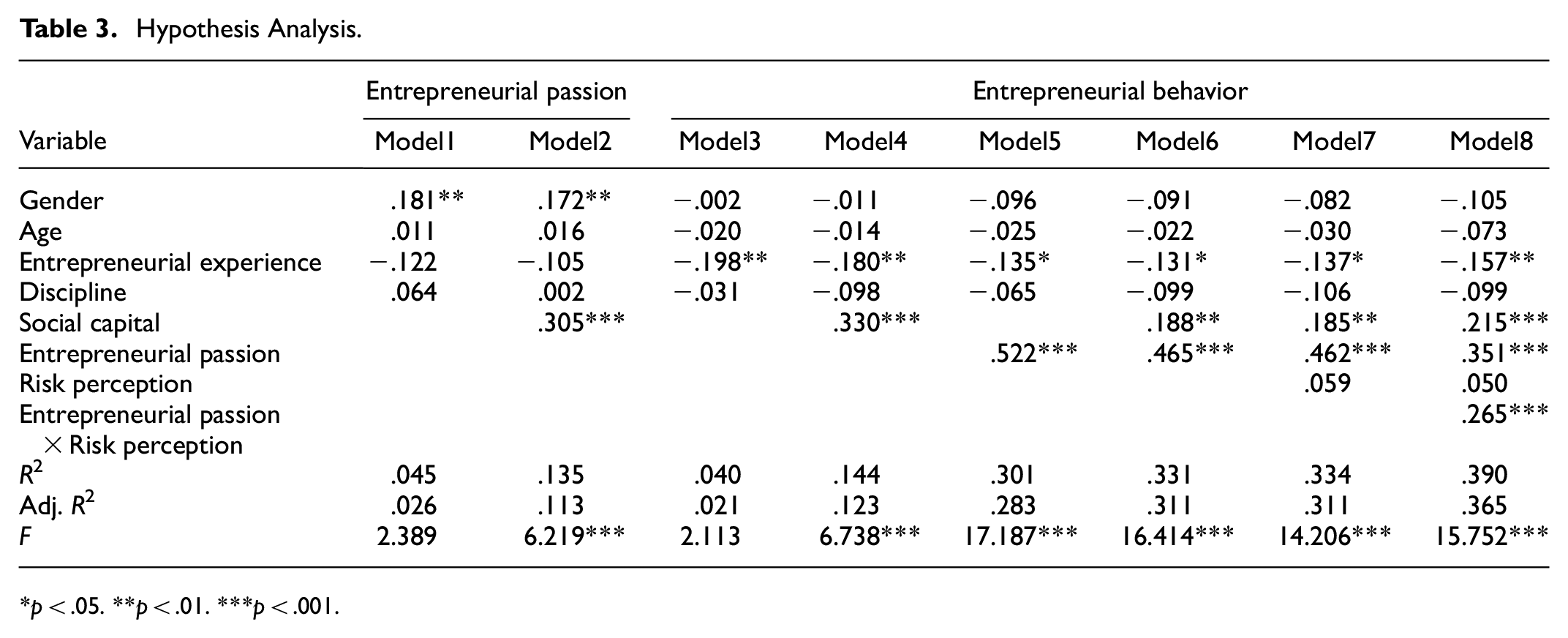
p < .05. **p < .01. ***p < .001.
Mediation Effect of Passion
After controlling for gender, age, entrepreneurial experience, and discipline, Table 3 shows that social capital also has a significant effect on entrepreneurial passion (β = .305, p < .001, model 2), indicating that independent variables have a significant impact on intermediary ones. Social capital plays a significant role in entrepreneurial behavior (β = .330, p < .001, model 4), indicating that independent variables have a significant impact on dependent ones. When social capital and entrepreneurial passion are in a regression equation at the same time, the regression coefficient of entrepreneurial passion to entrepreneurial behavior becomes significant (β = .465, p < .001, model 6), but that of social capital to entrepreneurial behavior obviously and significantly decreases (β = .188, p < .01, model 6). The results indicate that the participation of entrepreneurial passion reduces the influence of social capital on entrepreneurial behavior, indicating a partial mediation. Entrepreneurial passion satisfies the conditions as an intermediary variable, and thus H2 is supported.
Moderation Effect of Entrepreneurial Risk Perception
After controlling for gender, age, entrepreneurial experience, and discipline, Table 3 shows that when social capital, entrepreneurial passion, entrepreneurial risk perception, and the interaction items of the latter two are in a regression equation at the same time, the interaction items of entrepreneurial passion and risk perception have a significant impact on entrepreneurial behavior (β = .265, p < .001, model 8). Therefore, entrepreneurial risk perception has a significant moderating effect on entrepreneurial passion and entrepreneurial behavior, and thus H3 is supported.
Figure 2 further explains the moderating effect of entrepreneurial risk perception by drawing an interaction diagram. The interaction plot shows that the regression line of entrepreneurial behavior is steeper for college students with high entrepreneurial risk perception compared with those with low entrepreneurial risk perception. In the case of high entrepreneurial risk perception, college students with high entrepreneurial passion exhibit much higher relevant behavior than those with low entrepreneurial passion; while under low entrepreneurial risk perception, college students with high entrepreneurial passion exhibit less difference in relevant behavior than those with low entrepreneurial passion. This result further suggests that entrepreneurial risk perception has a significant moderating role in the relationship between entrepreneurial passion and behavior; that is, among college students, when entrepreneurial passion increases to a certain level, those with high entrepreneurial risk perception are more likely to exhibit high levels of entrepreneurial behavior, and thus H3 is further proven.

Interaction between entrepreneurial passion and risk perception.
Moderated Mediating Effects Test
The mediating effect of regulation is further tested by using the bootstrap method. Table 4 reveals that when individuals perceive a low level of entrepreneurial risk, the influence of social capital on entrepreneurial behavior is not significant (Conditional indirect effect = 0.086, SE = 0.70, 95% CI [−0.043, 0.235]), but significant under a high level of entrepreneurial risk perception (Conditional indirect effect = 0.342, SE = 0.080, 95% CI [0.201, 0.516]). The higher the perception of entrepreneurial risk, the stronger the intermediary role of entrepreneurial passion between social capital and entrepreneurial behavior, and thus H4 is supported.
Mediating Effects.

Discussion
Research Findings
This study investigates the impact of social capital on entrepreneurial behavior and its indirect effects through entrepreneurial passion and risk perception. In summary, hypotheses H1, H2, H3, and H4 are supported. The main findings are given below:
First, social capital has a positive effect on entrepreneurial behavior. This finding implies that social capital plays a crucial role in motivating entrepreneurial behavior. As an important social resource, college students’ social capital can provide entrepreneurial resources, form an entrepreneurial identity and drive entrepreneurial behavior.
Second, Entrepreneurial passion serves as a partial mediator in the relationship between social capital and entrepreneurial behavior. It proves that emotion plays an intermediary role between environmental factors and personal behavior. It also further confirms the previous research that individuals with high entrepreneurial passion are more likely to take entrepreneurial behavior (Li et al., 2020; Murnieks et al., 2014).
Third, entrepreneurial risk perception plays a moderating role between entrepreneurial passion and behavior, and entrepreneurial risk perception can positively moderate the indirect path of entrepreneurial passion. The boundary mechanism of the intermediary path is further clarified.
Theoretical Implications
This study provides the following theoretical implications.
First, this study contributes to the application of the S-O-R model. Previous research on entrepreneurship has largely been based on theories such as the theory of planned behavior (Liu et al., 2019), institutional theory (Guerrero et al., 2016), and social cognitive theory (Neneh, 2022). Limited research has applied the S-O-R model in the field of entrepreneurship research (Cai et al., 2021; Shaver & Scott, 1992). This study is mainly based on the interdisciplinary theory of the S-O-R model and takes social capital as a stimulus (S), which affects the entrepreneurial passion of the organism (O), thus producing the entrepreneurial behavior reaction (R). To some extent, this addresses the limitations of existing theories in entrepreneurship research and provides a broader perspective for future studies.
Second, this paper responds to the appeal of focusing on the entrepreneurs’ social capital and network process (Smith et al., 2017), and clarifies the essence of social capital in the process of entrepreneurship. Additionally, this study helps respond to the call to expand the antecedents of entrepreneurial passion to entrepreneurs’ networks (Stenholm & Nielsen, 2019), particularly in the context of higher education. Moreover, it empirically supports the argument that social capital and personal factors can affect entrepreneurial behavior (De Carolis & Saparito, 2006). The results provide evidence that social capital plays a crucial role in creating an environment that nurtures and sustains entrepreneurial passion, leading individuals to actively engage in entrepreneurial activities.
Third, this study innovatively proposes and verifies the moderating role of entrepreneurial risk perception in the relationship between entrepreneurial passion and behavior, which empirically reveals the contexts in which entrepreneurial passion can more effectively promote behavior, therefore, this study offers a fresh perspective that contributes to the existing knowledge. Furthermore, this study enhances the predictive effectiveness of the model by integrating a moderated mediation analysis and unpacks the “black box” between social capital and entrepreneurial behavior.
Practical Implications
The findings provided several practical implications for promoting the entrepreneurial behavior of college students.
First, college students need to continuously enrich their social capital by establishing connections with society and making good use of social networks. At the same time, they need to maintain a positive attitude and be brave to face setbacks and challenges in entrepreneurial activities. In addition, college students should enhance their ability to identify potential risks. Entrepreneurship is a high-risk activity, and conducting risk assessments and evaluations before starting a business can improve the likelihood of entrepreneurial success.
Second, it is essential to enhance the entrepreneurship education system in China, which should not only impart entrepreneurial knowledge but also guide college students to focus on personal characteristics and skills development, enhancing their risk perception and tolerance. Additionally, colleges should fully utilize the social capital of teachers, strengthen the integration between students and school organizations, enhance college students’ social capital, and promote their active engagement in entrepreneurial activities. Moreover, colleges should expand the platform of school-enterprise cooperation and provide opportunities for entrepreneurial practice, so that college students can internalize entrepreneurial knowledge as valuable experiences and improve their entrepreneurial ability.
Third, the government needs to formulate policies to support innovation and entrepreneurship. However, the situation varies across provinces, and it is necessary for each region not only to implement national policies but also to actively introduce complementary policies that align with the local context. In addition, government can use mainstream media to report on typical entrepreneurial deeds and cases, and assist college students in gaining access to the latest entrepreneurial policies and market trends, thereby creating an atmosphere that encourages innovation and tolerates failure. Moreover, the government can act as a bridge for communication, urging businesses to actively support college students’ entrepreneurship. This includes not only offering their enterprises for practical training and mentoring but also providing financial support for promising entrepreneurial projects, thereby stimulating college students’ entrepreneurial passion.
Limitations and Future Research
Although this study enriched the study of entrepreneurial behavior to a certain extent, some limitations remain. First, in this study, social capital is discussed as a whole variable, and future research can try to divide social capital into dimensions, explore the influence of each dimension on entrepreneurial behavior, and observe the respective effects of each dimension. Second, similar to previous studies (Biraglia & Kadile, 2017; Syed et al., 2020), the effectiveness of entrepreneurial passion is characterized by several boundary conditions. However, this study focused only on entrepreneurial risk perceptional as the boundary condition. Future research can try to explore other boundary conditions for this relationship to provide a nuanced understanding of the relationship between entrepreneurial passion and entrepreneurial behavior. Third, the use of cross-sectional data in this study limits the ability to establish causal relationships in the observed associations. To address this limitation and provide stronger evidence of causality, future research could employ longitudinal designs or experimental methods. Finally, this study focused on college students of entrepreneurial teams in Southwest China as the sample. All the research objects came from the same place, which may affect the representativeness and universality of the results. Future research can collect reliable and larger samples nationwide to improve the relevance and application value of the study.
Footnotes
Acknowledgements
The authors thank the editors and reviewers for their valuable contributions to the improvement of the article.
Declaration of Conflicting Interests
The author(s) declared no potential conflicts of interest with respect to the research, authorship, and/or publication of this article.
Funding
The author(s) disclosed receipt of the following financial support for the research, authorship, and/or publication of this article: Sichuan Information Management and Service Research Center Project (Grant no: SCXX2022YB01); The Open Fund of Sichuan Province Cyclic Economy Research Center (Grant no:XHJJ-2217).
Ethical Approval
Ethical review and approval was not required for the study on human participants in accordance with the local legislation and institutional requirements. Written informed consent for participation was not required for this study in accordance with the national legislation and the institutional requirements.

Data Availability Statement
Data sharing not applicable to this article as no datasets were generated or analyzed during the current study.