




Abstract
Practical training is an important component of initial teacher education (ITE). Interactions with the educational reality in schools and with school-based teacher educators (SBTEs) are crucial to practical training. Often, SBTEs lack specific and consistent training to work with future teachers. This study aimed to identify the practices and needs of SBTEs guiding the pedagogical practicum of students, future teachers working in Romanian kindergarten and primary education. A questionnaire provided by the International Forum for Teacher Educator Development (InFo-TED) was administered in December 2021 to January 2022 to 116 SBTEs conducting mentoring activities for future teachers in primary schools and kindergartens. The analysis of their responses by level of education and experience highlighted the perceived usefulness of activity types considered relevant and less relevant in mentoring, training activities previously accessed, professional training needs, and how research is valued in mentoring. Specific training practices and needs are highlighted, providing grounds for developing training programs and interventions aimed at enhancing SBTEs’ competencies in mentoring prospective teachers.
Keywords
Introduction
Initial teacher education (ITE) is the first step in the process of professional development, enjoying relatively different arrangements from one country to another and from one educational system to another. The responsibility of educating future teachers is falling on university programs (Cochran-Smith et al., 2020) in many educational systems, including one in Romania. These programs include theoretical training subjects in teaching and specialized teaching practicums in educational institutions. Irrespective of the adopted ITE model, the practicum part of the program is essential for developing professional competencies and identity.
The teaching practicum is recognized as having great importance for training future teachers as a place where student teachers meet the realities of the teaching profession and school. This part of the ITE takes place under the supervision of a school-based teacher educator (SBTE). We will generically use in this article the term “school-based teacher educator” (SBTE) to cover all professionals involved in the mentoring and professional development of student teachers, irrespective of whether they are named teacher educators, mentors, trainers, tutors, supervisors, coaches, and so forth. Different terms can be used and may differ from country to country. That is why we brought them together under the broader definition of “school-based teacher educator,” in accordance with the agreement within the international research group InFo-TED (Czerniawski et al., 2017). Sometimes, the term mentor will be used, with the same meaning, because the term “mentor” is commonly used in the Romanian documents and practices.
Mentoring is predominant in ITE teaching practicum programs (Stanulis et al., 2019). The quality of mentoring activities contributes to the quality of the training of future teachers, as SBTEs’ personal attributes, pedagogical knowledge, modeling, and feedback influence student-teacher self-efficacy beliefs (Nikoçeviq-Kurti, 2022). System requirements and expectations add to what has been empirically proven as a five-factor mentoring model (Nikoçeviq-Kurti, 2022). The SBTE has an important role as a mentor in the training program, being the one who formally or informally supports the professional development of teachers. The SBTE`s role goes beyond offering technical and scientific advice about teaching process, but also inspires as a model, with the possibility to influence attitudes and views over the future teaching career and the professional development of teachers. As pointed out by Montgomery (2017) in her model of the “mentoring roadmap,” the mentor-mentee relationship can be long-term, so the mentor engaging in such a process needs to reflect on their roles and influence on the mentee.
Despite the acknowledged importance of SBTEs as models and guides for the familiarization of teachers with the teaching profession in real teaching situations, they are insufficiently trained to provide adequate and quality support for future teachers (Clarke & Mena, 2020; Vanassche et al., 2015), leaving them to rely on intuition and their own experiences (Clarke et al., 2014). It is also known that being a SBTE is challenging because it does not have a formal route to follow to teach future teachers (Ping et al., 2021). At the European level, such a situation is recognized, and thus, the policy recommendations draw attention to the need to train SBTE to increase the quality of teacher education (European Commission, 2013, 2015, 2021).
Researchers and training program providers have long ignored SBTEs (Loughran, 2014; Vanassche et al., 2015). However, this situation has changed in the last decade when dedicated research concerns have been noticed (Nesje & Lejonberg, 2022; White & Berry, 2023), and explicative mentoring models and theoretical grounds for advancing professional growth have been elaborated (Kuhn et al., 2022; Kurti, 2023). At the international level, there are dedicated concerns about identifying how prepared the SBTEs are to carry out mentoring activities that lead to the training of the necessary skills for future teachers. Specialists from the International Forum for Teacher Educator Development (InFo-TED) tried to answer, conducting several transnational studies (Czerniawski et al., 2017; Guberman, Macphail et al., 2021, Guberman, Ulvik, et al., 2021; MacPhail et al., 2019). The results showed that SBTEs valued learning opportunities and were interested in participating in mentoring training activities (MacPhail et al., 2019).
Although we identified some studies that sought to identify the training needs of SBTEs, we did not identify studies that focused on the training needs of those responsible for educating future teachers in primary education and kindergarten.
In this article, we aim to portray the training practices and needs of SBTEs mentoring for kindergarten and primary school student teachers in Romania. The data included the types of learning activities considered useful in mentoring, the activities already carried out to enhance their professional competencies in mentoring student teachers in ITE, the issues that should be addressed in future training, and how research is valued as part of their role as SBTEs. Using the same investigative concept and tools as in the InFo-TED survey, we add data gathered in Romania to the international findings. In this way, similarities and differences are pointed out, and patterns of continuing professional development (CPD) in SBTE can be derived.
Theoretical Framework
Learning to teach—in a practical, concrete manner, preparing to become a teacher—is a complex process due to the variety of information, competencies, and abilities that should be mastered, a personal process, depending on the student’s learning experiences, conceptions and beliefs regarding teaching and learning, and context-specific (Hauge, 2000; Lee & Schallert, 2016), as the beliefs and conceptions about teaching can be significantly influenced by the models teacher educators were exposed to in their practicum. Student teachers learn to teach in educational institutions under the supervision of SBTEs, having them as models.
SBTEs must fulfill many roles and responsibilities during training activities, from classroom teacher to teacher trainer, researcher, guide/mentor, curriculum specialist, and facilitator, responsible for facilitating students’ understanding of the teaching profession (Murray et al., 2021; White, 2019). Other researchers have differentiated roles as hosts, tour guides to the profession, encouragers, planners, instructional advisors, and teaching partners (Rakes et al., 2023). All these roles lead to different levels of participation in the process of initial practical training, from the minimum level of a teacher who welcomes students into the classroom to the maximum level of a teacher educator (Clarke et al., 2014). Overall, an SBTE is a “dual professional” (White & Berry, 2023), acting simultaneously as a classroom teacher and a SBTE.
To help SBTEs conduct specific mentoring activities, develop specific skills, and cope with multiple roles, specific training programs must be developed based on real and specific needs. Ping et al. (2018) in their literature review on what, how and why teacher educators learn, found that teacher educators learn about teaching, research and reflection, professional identity, and knowledge bases. They also learn through academic engagement, attentive professional development programs, collaborative activities and learn from reflective activities.
Numerous other opportunities for professional learning and development in informal and non-formal contexts complement dedicated preparation through training programs to become mentors. Whether they exchange experiences and share them with colleagues who are (or are not) part of professional communities of practice at the school level, participate in workshops or other dedicated activities, inform themselves, participate in conferences, or access other training opportunities (Loughran, 2014; Lunenberg et al., 2017), SBTEs can develop their skills to guide future teachers in various ways. Of course, this concern is often not self-evident, unless favorable; sometimes quasi-coercive contexts are created, with conditions and facilities to perform in this role (Lofthouse, 2018). They are often demotivated to perform this role, with no clear responsibilities, facilities, or quality and performance evaluation standards to carry out mentoring activities. The expectancy-value theory (Kuhn et al., 2022) states that most SBTEs voluntarily accept this position, sometimes without compensation, to foster competent prospective educators and share experiences and be open to learning. They sometimes consider it a professional duty to give back, share their expertise, and contribute to enabling future teachers with professional know-how and ethos that allow them to advance their teaching career without dropping out.
Therefore, despite the dissonance they sometimes experience in the role of the SBTE, they feel that they contribute to the professional growth of future colleagues by experiencing their own professional growth (Andreasen, 2023). Some SBTE see the mentoring experience as a way of keeping up with developments in universities and research, both through interacting with university-based practicum coordinators and with students (Andreasen, 2023; Simmie & Lang, 2021). Many SBTEs require additional learning about mentoring (Murray et al., 2021), and such learning can occur according to the ecosystem arrangements of university-school partnerships to conduct practical training in ITE (Andreasen, 2023; Simmie & Lang, 2021). Effective teachers may not necessarily be effective mentors (Evertson & Smithey, 2000); therefore, dedicated efforts and infrastructure should be considered to enhance mentoring competence (Nesje & Lejonberg, 2022). Otherwise, their limitations in performing the mentoring role may disrupt certain mentoring relationships (Hudson & Hudson, 2018).
The specific training to do mentoring activities should focus on things like working together, communicating, building relationships, helping people learn, making the link between theory and practice, helping students with their initial training, and learning how to make decisions based on facts and real-world examples (Ellis et al., 2020; Loughran & Hamilton, 2016; White & Berry, 2023) and the list can go on. Moreover, SBTEs must be experts in making informed decisions, connecting theory and previous research to substantiate their knowledge in the field they teach (Loughran & Hamilton, 2016; MacPhail et al., 2019). Because teaching and research are connected in various ways, the trainers of future teachers must be prepared to critically analyze research in the field to base their teaching on the experiences of the professional community to which they belong to (Loughran, 2014; MacPhail et al., 2019), enabling future teachers’ actions to be evidence-based. However, despite these arguments, SBTEs do not always recognize the need to improve their professional competencies in different regards.
According to the research findings, there are four different types of training needs for SBTEs: normative (resulting from formal rules), relative (pertaining to this professional group and their mentoring situation), expressed (the SBTEs demonstrated a desire to improve their professional skills in this area by participating in some training opportunities), and perceived needs (indicated by SBTEs themselves; Sava, 2012). In our investigative study, we try to reveal individual needs, expressed or perceived, while directly interrogating SBTEs themselves. The more socially driven needs, normative or relative ones, are pointed out in the following subsection, while framing the context, system, and country-specific characteristics.
School-Based Teacher Educators in Romania
In Romania, children aged 3 to 6 attend kindergarten, and those aged 6 to 11 attend primary schools. Most teachers who teach in primary education and kindergartens are double-qualified after graduating from the Pedagogy of Primary and Pre-Primary Education (PIPP) BA university program. Teaching practices for future teachers take place in kindergartens and primary elementary schools under the supervision of a mentor. A mentor is the SBTE from school placements who “coordinates the organization and implementation of the practical pedagogical internship in school placements from the initial teacher training and/or the practical pedagogical internship necessary to occupy a teaching position” (Ministry of Education, 2022). They must be able to respond to the immediate demands of implementing the practical internship and supporting future teachers to overcome the problems that arise in practice, as stated in the relevant laws (Ministry of Education, 2022).
To supervise student teachers’ practicums, schools where SBTEs work collaborate with universities. Universities choose SBTEs primarily based on their academic performance and compliance with some formal requirements, such as holding a second or first teaching degree (the highest level of career advancement). SBTEs often perform this job voluntarily or with very little payment from universities. They cooperate with the university-based practicum coordinator(s), who provide the aims of the practicum activity and have the responsibility to evaluate it, giving marks and related credits, based on the SBTEs feedback. The SBTE, however, provides most of the teaching activity’s content as well as direction and supervision on how to carry it out.
In Romania, there have been concerns about regulating SBTEs activity in ITE for more than 20 years. The Law of education, 1/2011, regulates the mentor as a professional guiding the teaching practice in ITE and professional induction. Meanwhile, there were accredited training courses on mentoring that were accessible to professionals in education as part of their CPD, whether they acted as SBTE or not. Most often, such CPD programs are paid for, and participation depends on the interest and initiative of teachers to follow them. Therefore, it cannot be guaranteed that the SBTE has attended dedicated qualitative training to perform the role of SBTE for the student teacher. Nowadays, the concerns for training the SBTEs as part of integrative approaches to enhance the quality of professional paths and of the teaching career are again under consideration, within the large-scale project “PROF – Professionalization of the teaching career” (2021–2024) coordinated by the Ministry of Education. Therefore, our study adds to such efforts by providing data about the practices and needs of SBTEs for CPD that could be used to improve mentor abilities.
We were interested in identifying to what extent the SBTE in ITE has undertaken dedicated further development activities to enhance their mentoring competence, what kind, what they value more as training opportunities, and what they need to further improve qualitatively as SBTEs.
Research Methodology
The Purpose and Objectives of the Study
Because SBTEs are important for ITE and because they need to be trained to do good mentoring (Loughran, 2014; Vanassche et al., 2015), we did a quantitative descriptive study (Gaciu, 2021), to find out what are the SBTEs training needs. We focused on the SBTEs in charge of training future teachers for primary schools and kindergartens. During their ITE, the students, future teachers, giving their double specializations for both primary and pre-school education, are expected to attend practicum activities both in kindergartens and in primary schools, to an equal extent. They benefit from the guidance of distinct mentors, ones working in kindergarten, and, respectively, in primary schools.
We obtained approval from the coordinators of the International Study InFo-Ted to apply in Romania the investigative tools they developed (Czerniawski et al., 2017). InFo-Ted brings together an international group of specialists from England, Belgium, Ireland, Israel, Holland, Norway, Austria, Australia, and the USA (InFo-TED, 2019) to promote the professional development of teacher educators. Their work aims to develop and implement a knowledge base for teacher educators. Surveys based on the questionnaire commonly developed have been conducted in more than ten countries (Guberman, Macphail, et al., 2021, Guberman, Ulvik, et al., 2021; Murray et al., 2021). As partners in international studies, we can comparatively reflect the training needs of SBTEs in different countries and ensure that the training practices are compatible with those developed in different teacher training systems.
This study aimed to analyze the professional learning needs of SBTEs who carry out training activities for future teachers preparing to work in kindergarten or primary education. Applying the same investigative tool from the InFo-Ted study to the Romanian context, we attempt to answer the following research questions that guided the study:
•(Q1) What types of professional training activities do SBTEs consider useful for mentoring kindergarten and primary education teachers?
•(Q2) What categories of professional training activities did the SBTEs follow?
•(Q3) What issues would SBTEs benefit from training for mentoring students and future teachers?
•(Q4) How do SBTEs value research in mentoring roles?
The answers to the above questions allowed us to obtain a comprehensive picture of SBTEs’ opinions regarding their training needs, since many of them acquire experience after taking on the role of SBTEs (Czerniawski et al., 2017). By pointing out the training undertaken or relevant training activities, as well as by indicating the aspects they feel they will need to be addressed in further training (the perceived needs as gaps of knowledge and competence; Sava, 2012), better tailored training opportunities can be designed, and evidence is provided.
Procedure
The questionnaire provided by InFo-Ted was translated using direct and reverse translation techniques and pre-tested to ensure that it was culturally adequate. To run the study, we obtained the approval of the ethics commission of the university.
The research instrument was conducted online on Google Form, in December 2021, being distributed nation-wide, with the support of the “PROF” project managers, within their network. In January 2022, a questionnaire was sent to all 22 BA programs in PIPP in Romania, with a request to distribute it to SBTEs.
The InFo-Ted study coordinators sent a coding manual with instructions on how to code the data collected through the administration of the questionnaire. The results were analyzed with Jeffreys’s Amazing Statistics Program (JASP Team, 2022), to obtain a descriptive frequency analysis of the data. The University of Amsterdam supports JASP, a free and open-source program for statistical analysis. To determine if there were differences between mentors mentoring in kindergarten and those mentoring in primary education, we used T-tests for independent samples. We also used One-Way ANOVA to analyze whether SBTEs mentoring experience (<6 years, 6–10 years, >10 years of experience in mentoring activities) had any relevance in the selection of useful mentoring activities, in the decision to follow specific training programs, or in getting involved in research activities.
Tool
A questionnaire with 27 questions structured in four dimensions was used. The first-dimension reunited questions regarding the valued professional activities in teacher education (seven questions). Questions like “What professional learning activities would be useful / do you value in assisting you with supporting student and qualified teachers in your school?” were answered on a 7-point Likert scale, ranging from 1 (least value) to 7 (most value). The second dimension is related to the existing and desirable professional learning opportunities. It poses questions like “To what extent would you like to receive further professional learning in the following areas?” with answers on a 7-point Likert scale, ranging from 1 (not at all) to 7 (very much). The third dimension, with questions like “What experience do you have in research / scholarly activities?” and answers differentiated with a 7-point Likert scale from 1 (strongly disagree) to 7 (strongly agree), is meant to create an image of SBTE research practices and interests. The last dimension was dedicated to the participants’ backgrounds in teacher education. In addition, eight were open questions to allow for more specific answers, such as “What are the two most important professional learning opportunities you have experienced so far in relation to your work as a school-based teacher educator?” Moreover, to identify the SBTE mentoring experience, the last part of the questionnaire reunites twelve questions with multiple choice answers, such as “How long you have worked as a school-based teacher educator?” with five options, from 1 to more than 20 years.
For the Romanian version of the instrument, Cronbach’s alpha showed high consistency, with a reliability of .95 for valued professional learning activities, of .90 for the professional learning opportunities, and of .90 for learning associated with research.
Participants
The participants in the study were SBTEs, members in the “PROF” project and collaborators within the practice programs of PIPPs. A total of 116 SBTEs coordinating the pedagogical practice activities of future teachers in primary schools (N = 71, 61.2%) or kindergartens (N = 45, 38.8%) offered valid answers.
Regarding the experience of mentoring for ITE, 48 participants (41.38%) declared less than 6 years of experience in mentoring, 36 (31%) had between 6 and 10 years of experience, and 32 (27,59%) declared experience of more than 10 years in mentoring future teachers for primary education or kindergarten.
Results and Data Analysis
The results presented in the following are grouped around the derived research questions, to point out the professional learning activities considered useful (Q1), the ones already undertaken (Q2), the aspects for which SBTEs would like to receive further training (Q3), and how SBTEs value research as part of their mentoring role (Q4).
To identify the types of professional learning activities considered useful in facilitating the mentoring (Q1) of student teachers in primary education or kindergarten, the questionnaire proposed 19 possible alternatives that capture various types of activities. The activities range from academic and formal to those of self-study, and up to those involving research skills: training courses certified or not; secondment to another position; study leave/sabbatical year; observing professional activity; informal discussions with colleagues; various forms of research; exchange of experience in other institutions; individual study; participation in conferences or professional organizations.
The activities assessed by the participants as the most useful to train for mentoring were exchange of experience/international visits (mean 5.77), reading books or journals (mean 5.36), visits to other schools/ colleagues/ teacher training institutions (Mean 5.33), as shown in Table 1.
Types of Professional Learning Activities Considered Useful.
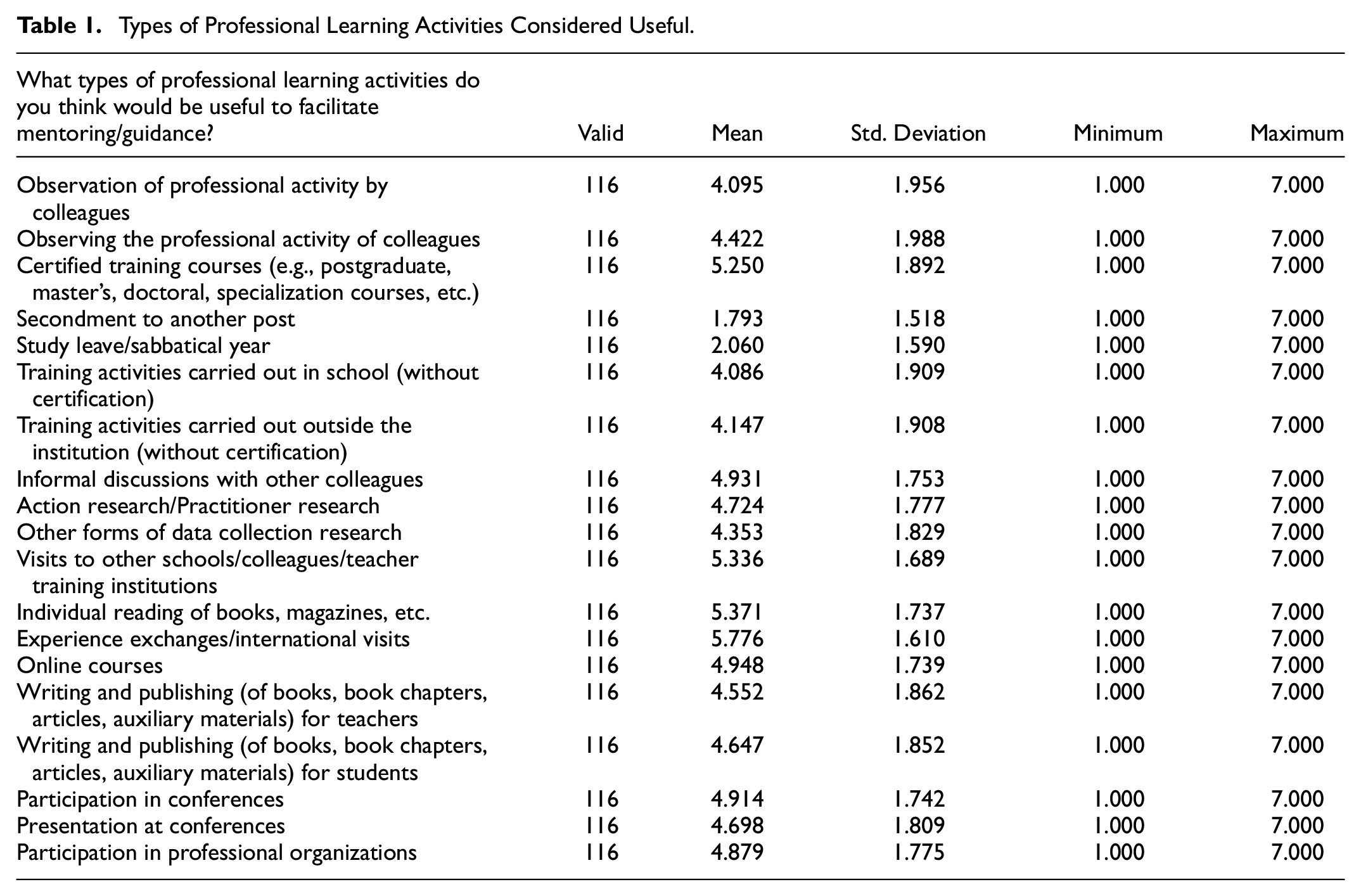
In contrast, the least useful SBTEs were training activities such as secondment to another position (mean 1.79) and study leave/sabbatical year (mean 2.06). A possible explanation for being considered less useful is that secondment could involve additional adaptive efforts, familiarization with another institutional culture, or the specifics of another job that is less attractive. The “sabbatical year” is an extremely rare practice in Romania. Similarly, the “study leaves for improvement in mentoring activities” were not a desirable option, as they are hardly accessed.
The independent sample T-test and One-Way ANOVA revealed that there were no significant differences between the types of professional training activities considered useful in mentoring and that there was no influence of the education level at which the respondents were mentoring (F = 1.409, p > .05). Neither mentoring experience (F (2, 113) = 1.820, p > .01) determines significant differences between the professional learning activities considered useful. However, small differences were observed between the types of activities evaluated as useful for mentoring (Table 2).
Types of Mentoring Activities Considered Useful by Levels of Education and Experience in Mentoring.

P = primary school; K = kindergarten.
Regardless of their level of mentoring experience, mentors in primary education and those working with children in kindergarten shared an interest in the high mean values reported by the option exchange of experience/international visits and the low mean values reported by the options regarding the usefulness of secondment and the study leave/sabbatical year for mentoring activities.
What differentiates them is the preference of kindergarten SBTEs with 6 to 10 years of experience in mentoring for individual reading of some materials (mean 5.615), while for SBTEs from primary education, experience exchange/international visits (mean 5.783) are preferred.
The differences between the opinions of the SBTEs are interesting because we observed that despite the common path in ITE, the professional activity carried out by the SBTEs for the two levels of education can influence the preference for a certain type of activity considered useful. If primary school teacher trainers indicate more useful certified courses that are organized as formal, certified training, those who train future teachers in kindergarten indicate informal activities such as individual reading as more useful.
To identify what categories of professional training activities for mentoring the SBTEs followed (Q2), the data in Table 3 were analyzed.
Categories of Professional Training Activities for Mentoring by Education Levels.

The findings indicated that training through a particular training program (N = 64), formal participation in collaborative learning activities with other fellow tutors in or outside the school (N = 60), guidance and supervision at work (in relation to the guidance activity of students, future teachers) (N = 57), and informal participation in activities with other tutor colleagues in or outside the school were the most frequently accessed activities. A small number of SBTEs declared that they received no support from a local university (N = 15) and that they had no formal or informal support for the mentoring activity (N = 6).
The most frequently mentioned professional learning opportunities experienced by teacher trainers were informal ones: discussions with colleagues, reflections on one’s own activity to improve it, individual studies, and self-improvement. In terms of formal opportunities, training courses and exchanges with other schools and within mobility projects with European funding were mentioned.
By analyzing education levels, we observed that SBTEs from primary education participated in activities with other mentors from the school (N = 39) to a greater extent than those from kindergarten (N = 16), the latter accessing specific training programs for the guidance of teachers (N = 27).
Moreover, most mentors declare themselves satisfied with the training opportunities from which they had benefited, and the results indicated an average of 5.698 on a scale from 1 to 7, with 7 indicating an increased level of satisfaction.
Considering the types of training activities that the mentors benefited from, it is important to identify the training needs that emerged and remain to be addressed.
Therefore, further analysis was conducted to identify for what issues would mentor teachers like to receive training to mentoring future student teachers? (Q3). To identify the issues for which SBTEs would like to receive training, possible directions were offered: the development of mentoring activities, teaching professionals’ practices in primary education or kindergarten, and research practices.
The training needs that the mentors pointed out were oriented toward developing their skills in integrating technology into teaching and learning strategies (Mean 5.66). Equally important, with high scores, is training for the purpose of improving knowledge related to the subjects taught (mean 5.55) and training and/or mentoring students, future teachers (mean 5.51). The least indicated training needs were academic writing (mean 4.62) and, with equal scores, teacher training and/or mentoring, development of managerial skills and research skills in general (mean 4.28) (Table 4).
Possible Professional Training Needs.

Analyzing the experience in mentoring and the level of education at which they carry out the activity with a T-test and One-Way ANOVA, no significant differences between groups could be identified. The training needs were not dependent on the educational level they were mentoring (F = 1.671, p > .05) or their mentoring experience (F (2, 113) = 2.094, p > .01).
Despite this, we noticed that SBTEs in primary education with less than 6 years of mentoring experience were interested in training for training students, future teachers (mean 6.040), while those in kindergarten were interested in training in aspects related to pedagogy (in relation to the training and professional development of teachers; mean 5.826; Table 5). Regarding mentors with 6 to 10 years of experience, regardless of the mentored education level, the first option is aimed at training students, future teachers (mean 5.609 for primary education and 5.692 for kindergarten). The situation was different for mentors with more than 10 years of experience who were interested in the integration of technology in teaching and learning strategies (mean 5.565 for primary education and 5.667 for kindergarten), followed by training to improve knowledge related to the subjects taught (mean 5.522 for primary education and 5.111 for kindergarten).
Possible Professional Training Needs by Education Levels and Experience in Mentoring.

Mentors assess the importance of training in conducting mentoring activities, professional development, and research differently, with research being the least accessible. For this reason, we wanted to identify the extent to which research was appreciated and implemented as part of professional activity.
Thus, aiming to identify how mentors value research as part of the mentoring role (Q4), we examined the continuing professional activities they have undertaken in this regard, the extent to which they identify training needs related to improving research skills, their actual research competence, and so forth.
A distinct section of the proposed study is dedicated to mentors’ competencies in the field of research. T-tests (F = 3.357, p > .05) and one-way ANOVA (F (2, 113) = 0.594, p > .01) showed no significant differences between the subject groups in terms of education level due to their experience in mentoring. Research is acknowledged by teacher educators as part of the role of supporting future teachers (Table 6).
Assessing Research as Part of the Mentor Role.

Thus, mentors state that they read research articles and participate in conferences and seminars and inform themselves of trends in education. In addition, mentors admitted that it was necessary to conduct research and that they were encouraged to get involved in it by school management (mean 4.82), colleagues (mean 4.49), and staff members with relevant experience (mean 4.45). Even if they are encouraged to be involved in research, they do not have the experience or need training.
An increased need for training to develop research skills emerged from quantitative analysis. The mentors’ opinion was that if they were going to carry out research activities, they need professional training for the development of research skills (mean = 5.54). A lower value (4.81) was attributed to the statement that mentors/guides in schools should carry out research on a regular basis to improve their practical work (see Table 6).
Regardless of whether they were mentoring at the primary or kindergarten level and their experience in mentoring, the study participants stated that if they were to conduct research, they would need professional training to develop research skills. In addition, participants recognized that mentors in schools should conduct research to expand knowledge about teacher training, while also acknowledging that they are reading research articles related to teacher training and that the role of mentor/guide is informed by research. According to the analysis below (Table 7), the means obtained were very high, which indicates an interest in aspects related to research as a way of informing the professional decisions they must make during their activities. The smallest means were reported for the need to carry out research on a regular basis to improve their practical activity, which can explain the need for training in carrying out research.
Assessing Research as Part of the Mentor Role by Education Levels and Experience in Mentoring.

Research experience can lead to involvement in specific activities. For this reason, we analyzed the respondents’research experience. The scores obtained were lower than those for the previous items. Even if mentors stated they were involved in editing/writing/publishing materials for their colleagues, books, and auxiliaries, the scores obtained were below average. Regarding actual involvement in the research and what is related to it, from data collection to the analysis of the results and their presentation, it was observed that this is at a minimum level (Table 8). This may be due to their low competence in educational research or a lack of interest in such activities.
Experience in Research.
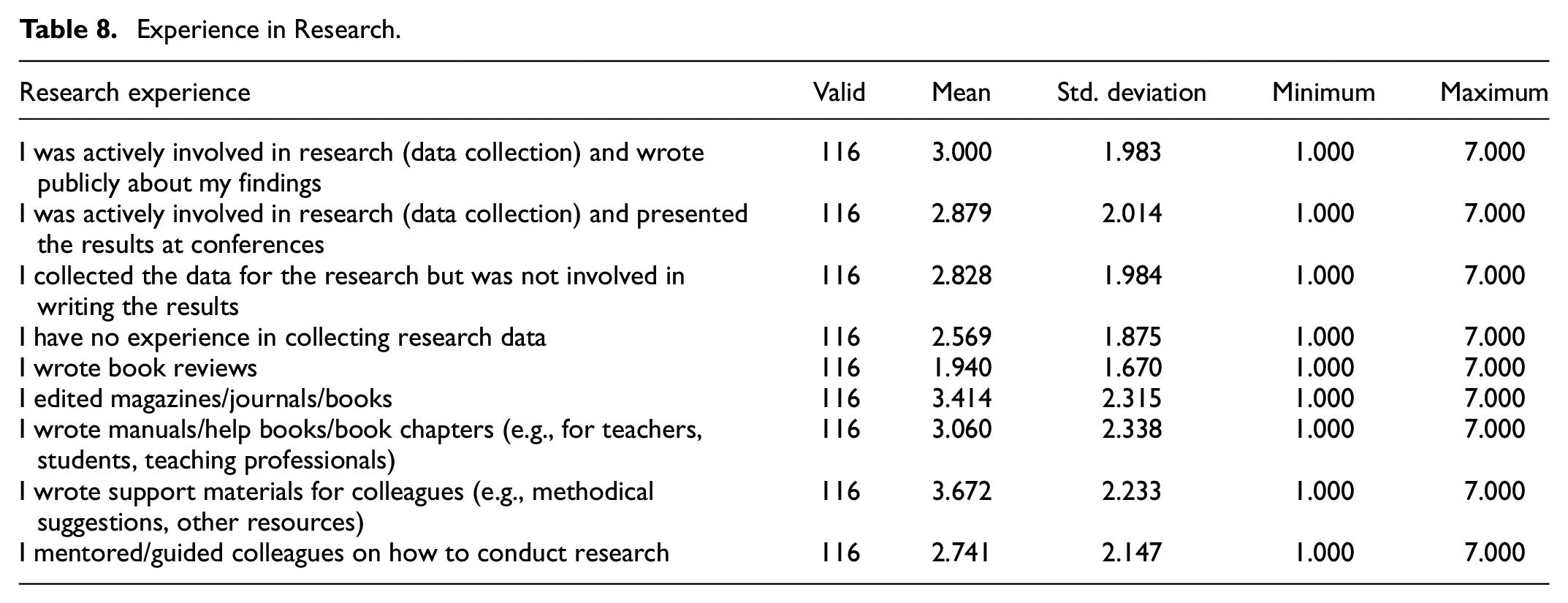
The analysis by education level showed that mentors from kindergarten with less than 6 years of experience in mentoring wrote support materials for colleagues (e.g., methodical suggestions, other resources) and mentored/guided colleagues on how to conduct research, were actively involved in research, mainly in data collection (Table 9). Mentors in primary education state that they edited magazines/journals and wrote support materials for their colleagues (e.g., methodical suggestions, other resources). More experienced mentors reported the same types of research activities. However, the averages obtained for this question are lower than the previous questions. Insufficient training in this area of research can explain this.
Research experience according to mentorship expertise and educational level.

If we analyze the data regarding the need for further training in research, it can be noticed that teacher trainers do not indicate training in the field of research among their top preferences. Among the proposed SBTEs, presentation and participation in conferences is the first option for those regarding research skills. For teacher educators in primary education, researching their own practices and research skills in general is first, while for kindergarten teachers, academic writing is one of the top preferences regarding research.
The results provide insight into the types of professional learning activities teacher educators consider useful for improving the mentoring skills of future teachers. Moreover, the results provide insight into the types of training the mentors have benefited from so far. Regarding the training needs, they point to training mentors more effectively in the professional field, especially in research.
Discussion
Improving the quality of ITE is desirable for international and national policies. This raises questions related to the skills and training of SBTEs, teaching professionals from educational institutions responsible for the practical training of students, given their role in fostering the development of practical skills and competencies for prospective teachers. The quality of their guidance is decisive for developing teaching skills and the ethos of the teaching profession. Dedicated training of SBTEs to guide teachers’ pedagogical practice qualitatively is an increasing concern. Such concerns are reflected both in the growing research on the issue (Cochran-Smith et al., 2020; MacPhail et al., 2019; Orland-Barak & Wang, 2021; Ping et al., 2018; White & Berry, 2023) and in the educational policy measures and recommendations formulated and implemented (European Commission, 2021), mainly related to CPD programs for mentoring teachers.
To design training programs tailored to the real needs of SBTEs, it is necessary to identify the training activities they consider useful and the ones they have already carried out, to complement and continue them. In this context, using the investigational concept developed in the international InFo-Ted study regarding the professional development practices and needs of SBTEs, we highlighted, in the present study, data about those in Romania mentoring ITE students for primary education and kindergarten.
Even if a relatively small number of participants responded to the online survey (satisfactory, given the entire population of pedagogical practice mentors from the 22 university undergraduate programs in PIPP in Romania), a picture could be drawn regarding their needs and training opportunities. The data show the SBTEs’ needs throughout the country.
SBTEs shared their openness and concern for improving their skills for mentoring in ITE and perceived as especially valuable the opportunities for professional development (participation in courses, professional discussions, and exchanges of good practices) or personal development (such as self-directed learning). The aspects differentiating the Romanian SBTEs from the international ones (Czerniawski et al., 2017) refer to the type of professional learning activities they prefer to undertake to improve their mentoring skills. Thus, teacher educators from international studies indicate a preference for informal discussions with colleagues and developing their teaching and mentoring skills. In contrast, SBTEs from Romania consider (international) sharing and exchanging experience or participation in certified training courses more useful.
The high preference for experience exchange/international visits shows the desire of Romanian SBTEs to become part of professional learning communities to learn in a focused way, inspired by exchanging with those with similar concerns and comparable experience and expertise. Reflecting together and analyzing their own practice, sharing about “making explicit their tacit knowledge” that such learning contexts can foster is a need that is more widely met (White & Berry, 2023). Practices from abroad, which have proven to be more efficient in preparing teacher students to perform better, are considered useful sources of learning.
Romanian SBTEs participate in certified training courses and consider them useful. The SBTEs declared themselves satisfied with the existing formal training opportunities. They were interested in self-improvement activities in updating information regarding the mentoring activities they carried out, irrespective of their years of experience in mentoring. This finding might be explained by the fact that the Romanian CPD system requires the accumulation of recognized professional credit points. Therefore, it is a common pattern of CPD not only for SBTEs mentoring at the kindergarten or primary school levels but for all SBTEs, as our data showed (Scorţescu et al., 2023).
However, the SBTEs mentoring for kindergarten, despite having the same pre-service training as the SBTEs mentoring for primary school, indicate less interest in training courses. Such data needs to be contextualized, as they possibly benefited from more certified courses recently, as a large-scale project for improving early childhood education ended in 2021.
The respondents pointed to space for improvement, such as training needs, further training in the use of technology, and updating of subject knowledge. This fact may be explained by the pandemic period, forcing awareness of the need for more extended use of technologies. Improved competencies in the pedagogical use of technologies and diversified teaching methods are complemented by the need to carry out teaching activities in line with the latest trends in education and scientific advancement so that they can ensure that the mentoring activities they offer future teachers are updated and appropriate, the same being true for their daily teaching practice. However, when it comes to grounding didactic decision-making in research findings, their research skills and practices seem to be rather limited. SBTEs acknowledge that the need to develop research skills is real need for which they seek training.
The commonly expressed training need for research competencies aligns with the initial training of future teachers, which is increasingly grounded in the scientific data of educational research. Empowering teachers to obtain data-informed didactic decision-making requires dedicated solutions. Therefore, covering InFo-Ted and specifically focusing on identifying aspects related to the research skills and needs of SBTEs, as well as aiming to identify and mirror their practices to use the research results in didactic practice, is a novel, timely, pioneering approach to studying SBTEs in Romania. This study captures the relatively limited skills and practices of grounding didactic decisions on research data, a situation similar to SBTEs from Romania and to those from most countries where the InFo-Ted study was conducted (Czerniawski et al., 2017). This aspect requires improving solutions and formative interventions in pre-service and in-service training. SBTEs in Romania show little enthusiasm for participating in research activities, preferring to focus on teaching. Comparable scenarios exist in all nations where the InFo-TED survey has been conducted (Czerniawski et al., 2017). The discrepancy between practitioners and their implementation of research findings, and the need to enhance teaching quality through evidence-based practices, is a key issue to be tackled in the continuous professional development of SBTEs, as highlighted by the European Commission (2021).
In summary, the training needs and practices of Romanian SBTEs do not substantially differ from those of their counterparts in other educational systems. Research competence for data-informed decisions in teaching activities is perceived as a vulnerability by the SBTEs, the ones from Romania indicating this aspect to a larger extent than those from the international study.
Both SBTEs in primary school and kindergarten share certain common elements, but they also exhibit distinguishing factors. The shared elements stem from their initial training and yearly utilization of a standardized national assessment sheet of their professional activities. The disparities identified in the research arise from variations in organizational cultures within their respective workplaces, or variances in the emphasis placed on specific aspects during CPD.
The study has some limitations, mainly from the relatively small sample. According to the SBTEs in the current study, a possible explanation could be their limited time, openness to research activities, or lack of research experience. There is also the possibility that the way we comprehend and operationalize the research capacity of teaching staff is another limitation. This is not the same thing as being a researcher. One of the most important skills for a teacher to possess is the ability to study pertinent specialized literature and to base his educational decisions on the findings of relevant research. There is a research component involved in activities such as attending conferences, publishing manuals and guides, and providing specialized curricular supports; nevertheless, these activities are not as standardized and demanding as we might typically define the term “research.” Qualitative data are also missing to provide a more in-depth understanding of SBTE realities. The qualitative data will be collected in the second phase of the study, while interviewing the participants and indicating their willingness to support further data gathering. More detailed qualitative data might explain, for instance, if the preference for international visits and exchanges are just wishes or perceived needs with the potential to turn into expressed needs (Sava, 2012). Also, further qualitative data might illuminate what SBTEs have mainly found useful in the training courses they attended to capitalize on in further training. The employment of mixed study designs, in conjunction with the questionnaire, which serves as a quantitative approach, as well as the utilization of qualitative methods to complete the data gathered in more depth and detail, is something that we propose for the subsequent studies.
Conclusions
The practical component of training future teaching staff is considered relevant to the quality of ITE. SBTE plays an important role in the school–student–university triangle. In this study, we tried to identify and provide data on practices and the self-perceived training needs of SBTEs for improving their mentoring skills.
Overall, the study demonstrates that we cannot discuss an integrated professional profile of the practitioner and researcher SBTEs, like a study by Czerniawski et al. (2017). However, the activities of a teacher and SBTE are to be grounded in empirical findings. Comparing data from Romania with those gathered at the international level, there is an increased need for training in the field of research to conduct mentoring activities; even the SBTEs do not prioritize such needs. Needs for improved research skills can be found in Romanian SBTEs and those from Belgium, Ireland, Israel, the Netherlands, Norway, and Great Britain. The least expressed or conscious need for research skills can be explained from two perspectives. Both the ITE training systems and the activities carried out by the teaching staff in Romania fall short of adequately utilizing these skills.
Summing up the findings, firstly, the types of activities teacher educators considered most useful and would be open to attending to improve their mentoring competence were those allowing for sharing and (international) exchange of experience. Individual study or training courses were also considered useful. As a result, opportunities for collegial and collaborative learning, direct observation, reflection, sharing, and exchange within professional communities of practice at the school level or in professional networks are increasingly necessary to supplement training that is primarily based on courses.
Secondly, the data from the study provide benchmarks for aspects to insist on in CPD training offers, which is of interest to universities concerned with strengthening the quality of ITE while collaborating with well-trained SBTEs. The fact that SBTEs are dedicated to mentoring activities and that they support future teachers even though their training does not entirely meet their expectations necessitates rethinking how they are trained to carry out quality mentoring activities.
Thirdly, while using the data from needs analysis studies, knowing the context of the existing training opportunities undertaken so far is crucial, as otherwise, misleading interpretations might occur. As revealed in the present study, the kindergarten SBTEs seemed less interested in training courses than the ones from primary school, but a possible explanation is that they simply benefited more by such opportunities in the recent past. Additionally, it’s crucial to comprehend the contexts unique to each nation, such as the CPD requirements that shape normative needs, the definition of research activities, related research skills, and so forth.
Fourthly, even if the data provided by the present study are informative for the Romanian context, they complement the international debate and research on SBTEs as a comparative reference for further studies, both regarding the identification of the training needs of SBTEs to perform mentoring activities for future teachers, as well as to share training practices accessed or valued by them as inspiration for their counterparts or training providers.
Improving the quality of ITE and future teachers cannot be imagined without the qualitative guidance of practical activities carried out by SBTEs. Bringing up training needs to offer qualitative mentoring is a restorative endeavor that requires consistent concern and intervention.
There are concerns regarding the training of SBTEs in the Romanian education system. They have begun to be acknowledged and valued in ITE, professional insertion, and CPD. Therefore, this study provides useful data for building tailored training that meets the expressed training needs. Extending the study to a representative sample of SBTEs, once the instrument used proved to be reliable for the Romanian context, can provide more reliable data for further efforts of CPD.
Footnotes
Acknowledgements
We would like to thank Dr. Ainat Guberman (responsible for the research authority of the MOFET Institute in Israel) and Dr. Gerry Czerniawski (professor and researcher at the University of East London) from InFo-Ted for offering us the research methodology and instrument and providing valuable feedback and support. We also thank the coordinators of the national program “PROF – Professionalization of the teaching career” for their support in data gathering. We would like to thank Editage ( ) for English language editing.
Declaration of Conflicting Interests
The author(s) declared no potential conflicts of interest with respect to the research, authorship, and/or publication of this article.
Funding
The author(s) received no financial support for the research, authorship, and/or publication of this article.
Data Availability Statement
Data sharing not applicable to this article as no datasets were generated or analyzed during the current study.