



Abstract
Rapid changes in health care, innovative technologies, and the emergence of new knowledge globally led to a need for enhancement in Continuing Professional Development (CPD) opportunities for nurses in public hospitals of Limpopo. However, they need to be empowered with updated knowledge and skills to adapt to these changes to enable them to render quality care to patients, resulting in fewer lawsuits. To explore and describe the experiences of professional nurses regarding CPD opportunities in the public hospitals of Limpopo Province. An exploratory-descriptive design was utilized in this study. Individual semi-structured interviews were used for data collection. Participants comprised 35 professional nurses who were purposely selected. Data collected were audio-recorded and transcribed verbatim. Data was analyzed using Tech’s eight-step data coding process, which led to the emergence of themes and sub-themes. Trustworthiness was ensured through credibility, confirmability, dependability, and transferability. Four themes emerged: Professional nurses’ understanding of CPD, Professional nurses’ views about necessary support needed for CPD, Professional nurses’ related to in-service training being offered, and Identified measures to resolve the challenges. Findings highlight that professional nurses value CPD and view it as important in learning new skills and improving standards of patient care and their self-esteem. Findings included challenges such as poor attendance of CPD activities and, lack of understanding of CPD, lack of access to CPD training, shortage of staff, and lack of funding and support by managers. Offering CPD opportunities regularly enhances knowledge and skills personally and professionally. However, more effective strategies are needed to address the identified challenges. Nurse Managers, Human Resources Departments, and the Department of Health need to be informed and updated on what is required in order to create and sustain effective and attainable CPD opportunities in the public hospitals of Limpopo Province.
Introduction
Various researchers state Continuing Professional Development (CPD) as a systematic way in which professionals continue to learn and develop throughout their careers to keep their skills and knowledge up to date, thereby maintaining and enhancing their professional competencies (Govranos & Newton, 2014; Nsemo et al., 2013). Changes in technological advancements in health care, economic status, and advancement in knowledge in nursing across the globe led to the obligation that professional nurses require the understanding of the CPD process and to ensure that they adapt to the changes (Brekelmans et al., 2013; Govranos & Newton, 2014; Nsemo et al., 2013; LaMonica et al., 2020). In addition, professional nurses need to continuously develop their skills and competencies to stay updated with new advances in the nursing profession (The Royal College of Nursing, 2018).
Furthermore, it is through CPD that professional nurses update themselves. Presently, CPD has increasingly become the standard across all professions, and Professional nurses are supposed to maintain a record of their current group skills, with an expectation that their employers will support them in seeking professional development to expand these skills throughout their careers (Mlambo et al., 2021; Price & Reichert, 2017).
Professional nurses have critical responsibilities in their careers. They play an important role in providing comprehensive quality care to patients and developing neophytes in nursing through education and training, staff supervision, and engagement in nursing research. These functions are only possible through the acquisition of skills by empowerment through CPD, as it allows them to improve, maintain, and broaden their knowledge (Ross et al., 2013).
Challenges that are experienced that hinder the progress of CPD include staff shortages, lack of funding, inaccessible CPD activities, and lack of time to attend workshops, Mlambo et al. (2021) believe that nurses need to be supported concerning CPD activities. These challenges affect their performance because they lack the necessary skills to provide patients with high-quality care.The hospital managers must assist them by allowing them to develop essential abilities. A supportive environment for learning is a requirement for CPD. This should include flexible off-duty structures that permit staff to study, accessibility to workplace learning, less extreme work, and fully funded CPD activities (Brekelmans et al., 2013).
The South African Nursing Council (SANC), as stipulated in the Nursing Act, No. 33 of 2005, sets and maintains standards of education, training and practice and ensures that nurses and midwives keep their skills and knowledge up to date and uphold the standards of their professional code. The Health Care Professions Council of South Africa (HCPSA) mandates that healthcare professionals, such as doctors, obtain and register CPD points each year to keep their registration with the Council. Developing a CPD system for South African (SA) nurses and midwives, as stated by the SANC (Circular 3 of 2018), is ongoing. The CPD Point system might become mandatory for all SA nurses and midwives to maintain registration and update skills and knowledge in the near future.
Limpopo Province is mostly rural, with several health care facilities situated in the most remote rural areas in the districts of Limpopo Province. The need for CPD for nurses and midwives in Limpopo Province healthcare institutions is a requirement. A metasynthesis of literature discovered that many nurses were unhappy with the chances for career growth in their workplace, which aligned with the limited number of nurses possessing specialized nursing skills (Mlambo et al., 2021). Additionally, it was noted that upward or lateral promoti were closely linked to training and staff development. Without proper training, nurses may not qualify for advancement (Mlambo et al., 2021). Another study conducted in the hospitals of Limpopo found that managers feel that staff should initiate staff development programs, which will mostly be appreciated by staff. This might encourage them to stay longer in the hospital organizations (Mogale et al., 2015).
From the findings of the studies conducted above, it is evident that there is a lack of nurse specialists and that providing opportunities and participation in CPD is important among professional nurses and midwives in healthcare institutions of the Limpopo Province. This study explores the professional nurses’ experiences regarding CPD in the public hospitals of Limpopo Province.
Aim
The study aims to explore professional nurses’ experiences of CPD in public hospitals in the Limpopo province.
Method and Design
Research Design
This study utilized a qualitative, exploratory-descriptive design (Burns & Grove, 2013) to explore and describe professional nurses’ experiences regarding CPD in the selected public hospitals. This study’s design was suitable since it allowed professional nurses to express their opinions on their involvement with CPD activities.
Recruitment Procedure and Participants
The Limpopo Provincial Department of Health approved this study. Data was gathered by contacting professional nurses who were study participants via District Executive Managers, Chief Executive Officers, and Nurse Managers at various hospitals. Participants provided written agreement and were advised that their anonymity and confidentiality would be maintained throughout the study. Participation in the study was voluntary, and participants’ names were substituted with code numbers to protect their privacy. This research was carried out at Limpopo Province’s public hospitals, namely in Vhembe District’s Tshilidzini and Elim hospitals, Capricorn District’s Mankweng and Polokwane hospitals, and Mopani District’s Letaba and Nkhensani hospitals. The settings were chosen because they are the most prominent public hospitals in the aforementioned areas, provide general patient care, and have a large number of professional nurses of various types working in hospital settings. Professional nurses working in certain hospitals were the target population. A non-probability, purposive sampling strategy was used to pick 35 professional nurses with at least five years of experience working in various public institutions. A non-random criterion selection is based on the researcher’s judgment, and only professional nurses are included, not all of the nursing population. Data collection was done in English.
Data Collection
Individual face-to-face, in-depth, semi-structured interviews were used to collect the data. The interviews were audio-recorded with the participant’s permission and took approximately 30 to 45 minutes. A semi-structured interview (SSI) guide was used as a tool, which consisted of a pre-determined set of open-ended questions (questions that prompted discussion). This provided an opportunity for the interviewer to explore particular responses from participants. Permissions were sought after the researcher had applied to the DEM and hospital CEO telephonically and in writing to conduct the study and collect data. Managers arranged the venue and selected professional nurses according to the study requirements. Interviews took place mostly on Wednesdays as the staff were on a double shift, meaning that extra personnel were on duty as it was a changeover of shifts. Interviews were conducted and lasted for 30 to 45 minutes. Data saturation reached Participant 20, and 5 participants were included to ascertain if no new information emerged. Data saturation was achieved through the course of interviewing, where the researcher noticed the same themes coming out repeatedly. As the researcher interviewed more and more participants, finding no new ideas or opinions, there was sufficient data to conduct the study.
Data Analysis
The researchers and an independent co-coder used Tesch’s eight-step method of data analysis to analyze the data (Creswell, 2014). The steps for this study’s data analysis included transcribing the raw data verbatim, scanning through it, carefully reading it to have a general sense of the data, and reflecting on their meanings. This was followed by removing irrelevant details, preparing for data coding, and properly generating and organizing the concepts, categories, and themes for clarity and validation. This was facilitated to ensure that the data collected reflected the consistent ideas of participants (Creswell, 2014). Themes and sub-themes were obtained through inductive allowing the data to determine the themes. For this study, the following measures to ensure trustworthiness were determined by credibility, confirmability, transferability, and dependability, as Creswell (2014) summarized. To ensure the credibility of the study findings, the researcher interacted with participants to get a hold of their true viewpoints. The prolonged engagement was ensured by spending sufficient time with participants. Member checking involves the supervisor and co-supervisor verifying the researchers’ interpretations (Polit & Beck, 2017). Data collection and analysis were conducted objectively to ensure confirmability (Creswell, 2014). An independent co-coder was used for objectivity without influence, and promoters of the study served as independent checkers throughout the research process. Recognizing that the researcher contributes to the research is part of reflexivity. As a qualitative researcher, existing knowledge, presumptions, and beliefs impacted this study process. A broad explanation of the study context, population and sampling technique, data collection process, data analysis technique, and the discussion maintained transferability (Polit & Beck, 2017). Transparency was fostered by clearly presenting the research methodology and findings, thus ensuring dependability.
Findings
Demographic Characteristics of Participants
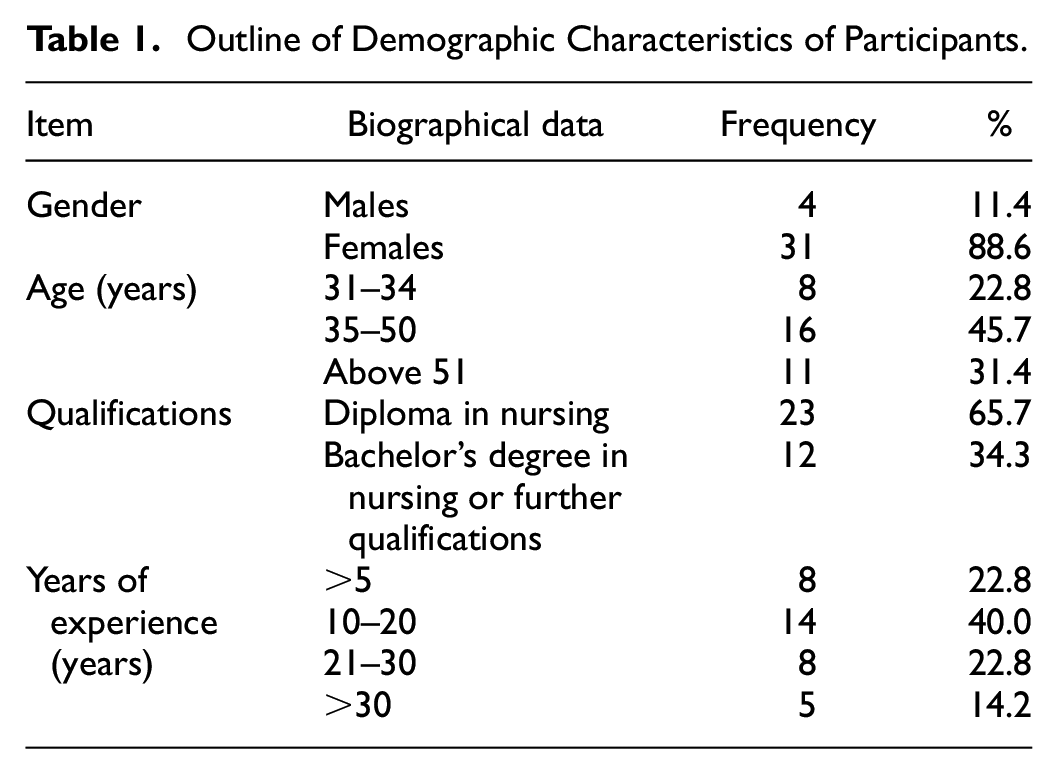
The study’s demographic characteristics comprised 35 professional nurses from the selected public hospitals of Limpopo Province. Most participants were females (n = 31; 88.6%) and were males (n = 4; 11.4%). Participants’ qualifications were Diploma in nursing (n = 23; 65.7%) and a bachelor’s in nursing, including further qualifications (n = 12; 34.3%). Table 1 outlines the demographic characteristics of participants as follows.
Outline of Demographic Characteristics of Participants.
Themes and Sub-Themes Emerging From Data
The study’s findings are discussed according to the data obtained from the qualitative interviews. The results of the data collected from participants, the following four themes emerged as experienced by Professional nurses concerning Continuing Professional Development (CPD) in the selected public hospitals of Limpopo Province are Professional nurses’ understanding of Continuing Professional Development (CPD), Professional nurses’ views about necessary support needed for Continuing Professional Development (CPD), Professional nurses’ views related to in-service training being offered and Identified measures to resolve challenges. The four themes that emerged are described below in narrative form as experienced by nurses about CPD. Table 2 outlines the identified themes and sub-themes.
An Outline of the Identified Themes and Sub-Themes.

Theme 1: Experiences Related to Professional Nurses’ Understanding of CPD
Theme 1 outlines the Professional nurses’ description of how CPD has assisted nurses in being knowledgeable and how CPD boosted their professional self-esteem. They further described the provision of CPD training internal and outside the hospital setting and the CPD structure in place. The discussion of sub-themes is as follows:
Assist Professional Nurses to be Knowledgeable
Participants indicated that CPD has assisted them in becoming knowledgeable and skilled in their profession, and it is the individual’s responsibility to take the initiative and engage in their own learning when presented with the opportunity by their employer. The following comment provides the evidence::
“CPD, according to me, is that the professional nurse should not stay in one place where acquiring of knowledge is concerned; when the department decides to send her for the update, she should already have the willingness and enthusiasm to learn her. CPD means she should be given the opportunity to learn by the employer”
“Continuing Professional Development, I think that is the way uhh… or I would say we as health care workers we need to develop ourselves, which is through training like registering for courses to learn and can be done through workshops, and the in-service it is done to equip us with knowledge as things are changing with we are expected to keep updated with information”
“I will talk about ICU, and we have services regarding ventilator support, we go to Polokwane for those services. They are developing me as an ICU-trained nurse. Sometimes before Covid-19, we would sit down and discuss topics regarding the patients”
CPD Boosts Their Professional Self-Esteem
Participants identified that CPD boosts their self-esteem professionally, motivates them to do their job well, and improves patient care skills. They learn new skills, can practice what they have learned, and can educate patients as well. They see skill development as important as it makes them become more confident and fearless. They wish nurses in the lower category could also improve their skills to gain more insight. They commented as follows::
“CPD activities here are good. On Wednesdays, they give us training; it uplifts and makes us do our job well and we learn new skills.”
“This is good as people get first-hand information. This can lead to high morale amongst staff members as the information related to patient care they have received is immediately put into practice in the wards. I can also teach the patient accordingly.”
“… My presentation skills were improved by me going to the university. When I was a junior nurse, I was fearful to remain in the unit (shift leading), but now I do it confidently because I understand things better since I was trained. Skills development is important. I wish if lower category could study further to understand their role better- they lack insight”.
Provision of Training From (Internal and Outside) the Hospital Setting
Participants indicated that training is best done within the hospital as wards have a lot of opportunities, they are exposed to teaching than out and they feel they also commented that some staff are sent outside for training, but they never give feedback. Other participants indicated that outside training motivates staff to learn more than internal training. The participant commented as follows::
“Mostly in the ward, there are a lot of opportunities to learn, if you want to teach, you are given the opportunity to do so. We have students if they need to be taught something, then we can do it. Some people don’t see the need to teach; they see it as time-consuming. Some nurses don’t feel like attending workshops they feel that it is not necessary”
“I see the most powerful is the in-service training, but the best is training people in the ward because the information reaches them as it is rather than sending one person for in-service who will interpret the information according to her understanding when she gives feedback in the ward.”
“We are asking our nursing service managers and quality managers to send us for outside workshops for development, e.g., pay for our symposia. Right now, we are no longer going for the ICU symposia”
CPD Structure in Place to Develop Health Professionals
Participants indicated that they can further their studies as the management takes them to school and send them to university to study even if they are sent in few numbers, it is evident that there is a functional CPD structure within the hospital to develop staff. They commented as follows:: “It means being taken to school by our seniors for further learning even if I do it myself, I further my studies to develop.”
“We are allowed to do part-time studies, and we have to apply through Human Resources we are given permission and released to study …”
Theme 2: Professional Nurses’ Views About the Necessary Support Needed for Continuing Professional Development
Theme 2 outlines the Professional nurses’ views about necessary support for continuing professional development, giving incentives related to continuing professional development progress, challenges related to staff shortages, and insufficient resources. They further described their dissatisfaction with the improper selection process for professional nurse training. The discussion of sub-themes is as follows:
Giving Incentives Related to Continuing Professional Development Progress
Participants indicated they would be more encouraged to attend and participate in training if given a certificate as an incentive and even tokens of appreciation like stationery, such as pens and books.:
“Identify individuals to perform certain skills to motivate others to learn more and make them pioneers by giving them a certificate of recognition of work well done”
“The staff will be encouraged by incentives as they attend, give us pens and books, for example”
“Workshops are done according to categories of staff; they give us certificates.”
Insufficient Resources
Regarding insufficient resources, participants indicated that lack of resources is a challenge as it makes nursing care difficult and even affects the training of nurses. They commented as follows::
"Quality nursing patient care is providing service to patient using optimal resources at hand."
"Lack of resources and shortage of staff will prevent patients from receiving quality care."
The Improper Selection Process for Professional Nurse Training
Participants viewed this as a challenge, and they verbalized dissatisfaction regarding the process of selection where the “seniority process” is considered a criterion for selection. This process is seen as considering that most older adults don’t complete their studies as some are due to go for a pension when they complete training. According to participants, this is a waste of government funds. This is what they have commented::
“Management should send people to school while they are still young. Benchmarking from other institutions by our managers can also help so that they see how other people do things.”
“Firstly, I’m not discriminating; I can say you cannot take someone who is next to pension; let’s take, for example, 57 years old for training leaving the younger twenty-something active nurses. Sometimes, they will say let’s look at seniority. I would rather say take the younger blood; they are very active and able to do the job not the person who will work two years and go.”
Theme 3: Professional Nurses’ Views (Challenges) Related to In-Service Training Being Offered
Theme 3 outlines the professional nurses’ views on in-service training. They described the following challenges as experienced: poor attendance of in-service training, lack of funds for training, insufficient report giving (feedback) from CPD training by attendees, shortage of staff, and lack of support from managers. The discussion of the sub-themes is as follows:
Poor Attendance of In-Service Training
Most participants commented on poor in-service training attendance. The reason for poor attendance is ignorance and lack of interest, as most professional nurses need to see the importance of attendance. Some indicated that due to staff shortages, they cannot attend, and they miss out on important workshops. This is what they verbalized::
“The hospital offers workshops and in-service training, but the staff is not taking it seriously.”
“I have attended training on many Wednesdays, but attendance was poor. They usually call us from the wards on the day of presentation, but people are not coming as expected.”
“There should be enough staff…attendance can be good if there is more staff. Time of attendance is good, but the challenge is staff shortage.”
“In the hospital, there is a shortage of staff. Sometimes, there are only three people on duty and it’s not possible to attend workshops”
Lack of Funds for Training
Participants indicated that in the hospital where they are working, they are told that there is no money for training purposes, and some participants indicated that they are not invited to workshops outside the hospital due to lack of funds. They commented as follows:
“In our hospital, they will usually tell you that there is no money for training.”
“I think if they can take one person per ward per year for training, it will be better, but financially, they will always say there is no money for workshops.”
Insufficient Report Giving/Feedback From CPD Training
Participants indicated that when nurses go for training on coming back, it is important to give feedback to colleagues regarding the training activities attended. Furthermore, some participants indicated that some of their colleagues go for training and are reluctant to provide feedback, and some participants indicated that information from training is misinterpreted. They commented::
“In the ward/units, you cannot send everyone to attend some remain with patients, they must give feedback when they come from training, they do it usually on Wednesdays when all the staff is on duty so that everybody can benefit”
“When people are trained and they don’t come to give feedback, they don’t apply skills trained, they still stick to old ways of doing things”
Staff Shortage
Most participants indicated that staff shortages challenge them. Management needs to hire enough staff to deal with the shortage, and more staff should be available for training to succeed. They identified that a staff shortage negatively impacts training as nurses miss out on important workshops. They further expressed that the institution cannot be left with less staff if people go for training as patients also need to be taken care of.:
“There should be enough staff. Attendance can be good if there is more staff. Time of attendance is good, but the challenge is staff shortage.”
“They are good, but due to the shortage of nurses we cannot attend workshops to empower. Attendance is not good due to a shortage of nurses. The facilitators are coming, but there are few staff to attend as the patient is the priority.”
“Nurses may miss important workshops. Shortage of staff results in nurses not to be released for training or workshops”
Lack of Support From Managers
Participants indicated they are not receiving support from the manager regarding training issues to offer them time to study. They further indicated that managers should return training to the hospitals and send more people for training. Staff wait too long before they can be sent for training. The following are the comments verbalized::
“I wish managers could bring back training to the hospital. The managers take only two people for training and for those two years. They wait for others to complete before they can send others. I wish they could send more people for training.”
“The district is at a higher level; they should come together with hospital management to show us how work is done through workshops and offer support.”
Theme 4: Identified Measures to Resolve the Challenges
Theme 4 outlines the professional nurses’ identified measures to resolve the CPD challenges as experienced namely, regular attendance of in-service education/seminars, teaching should be of immediate use/related to what is happening, working as a multi-disciplinary team, use of the internet to learn about conditions support expected from managers. The discussion of the sub-themes is as follows.
Regular Attendance of In-Service Education/Seminars
Participants indicated that it is important to have regular attendance of seminars, workshops, and in-service training, and programs are drawn at the beginning of each financial year and more training should take place in the wards and is related to their work. It helps to save patients and staff can develop more, the following are the statements from participants::
“… there are continuous development activities that are taking place in the hospital where I am working, we have got in-service training that are conducted weekly, taking place every Wednesday; what happens is that at the beginning of each financial year, they draw a program for in-service training and they draw a list and send it to each unit/ward so that people can be able to identify problem areas which they need to be developed on…”
“CPD activities here are good. On Wednesdays, they give us training it uplifts and makes us do our job well and we learn skills”
Teaching Should be of Immediate Use Related to What Is Happening
Participants indicated that teaching should be of immediate use related to what is happening they did relevant training that helped them to identify problems in the workplace, and this also helped in identifying hazards. They added that teaching helps reinforce guidelines they must follow as they work. The following are the comments::
“I was trained in Occupational Health and safety (OHS). It helped me identify things in the ward that are posing hazards and I can identify hazards before the hospital OHS team is called”
"We are guided by steps, standards and protocols, e.g. In multi-drug resistant TB (MDR-TB) patients. CPD is done in this way. People need to remind one another work-related issues in this way." (
Multi-Disciplinary Teamwork
Participants verbalized that multi-disciplinary teamwork is an important aspect of quality care. They verbalized that the patient should be involved in his care as well. They verbalized that though they work as a team, everyone must do their work, and the family should also be involved. They commented as follows:: "Participation is to give quality care the patient needs. It means all of us to need to be involved, teamwork is important, and patient needs to be involved in his care also." (
"It means when I’m done with the patient care, every aspect has been touched, like in ICU, I’m ICU trained specialist, we work as a team, means everybody concerned must do his work also considering family, update family concerning the condition of the patient [sic]." (
Use of the Internet to Learn About Conditions
Participants indicated that online training and the Internet could be useful for in-service training. They are able to understand conditions more by checking them and the signs and symptoms on Google. Participants verbalized the following statements::
“The hospital should have online training programs that take place, and WIFI should be available to follow webinars” (
“My view is that hospitals should try and educate staff, register staff for online to keep up with knowledge. I mostly use Google for conditions, to check for signs and symptoms…” (
Discussion of Findings of the Study
This study aimed to explore professional nurses’ experiences of Continuing Professional Development (CPD) in selected hospitals in Limpopo Province. The importance of CPD in nursing cannot be overstated, as it assists professional nurses in becoming knowledgeable and skilled in their profession, leading to enhanced professional growth. As Tuyisenge et al. (2018) noted, CPD has been shown to increase knowledge and approach to nursing care provision once professionals are updated on several skills. This means that when professional nurses are empowered with knowledge and skills, they can provide quality care to patients and feel personally and professionally empowered.
Camp et al. (2017) pointed out that professional nurses prefer CPD training in workshops outside the hospital because of the opportunity to meet with experts and colleagues in their field of study. This preference is particularly true for rural employees who value the face-to-face interactions offered by the workshop/course format. It is also important to note that feedback given by staff post attendance of CPD training is a requirement, as the dissemination of information is important. Nurses must provide constructive feedback to colleagues when coming back from CPD training to empower others.
Poor attendance in in-service training by professional nurses should be avoided at all costs. This can be achieved by regularly ensuring staff attends in-service training to enhance skills. Professional nurses need to understand what CPD is and what it entails, and they should be included in planning the in-service programs and other CPD activities. As Viljoen et al. (2017) pointed out, professional nurses only attend in-service training if they see the importance of doing so. This is because they need to gain knowledge of the importance of CPD, and some did not attend CPD activities as they were not involved in planning training needs. Therefore, nurse managers should ensure that nurses understand what CPD entails and the importance of CPD in the hospital setting. Including them in the planning of activities will motivate them to attend.
Professional nurses appreciate being recognized for participating in CPD training sessions by being rewarded with incentives such as certificates of attendance and CPD points. This will motivate them to attend and participate in CPD sessions and make them feel appreciated by their superiors. As Uddin (2020) stated, providing attractive incentives for trainees motivates employees to stay in their jobs.
Healthcare facilities need adequate resources for practice and quality care nursing care. Lack of resources and staff shortages make nursing care difficult and even affect the training of student nurses. As Feldacker et al. (2017), Haji Mustapa et al. (2021) and Bwanga (2020) noted, CPD could only be effective if there are facility-based resources, such as equipment, supplies, and laboratories, to enable employees to implement new skills and practices.
Lack of funds for training was reported as a barrier to continuing professional development. According to Ikenwilo and Skåtun (2014) and Younes et al. (2019), understanding the needs and barriers to CPD is an essential predecessor to developing effective educational and training programs. In addition, staff shortage and workload make it difficult for staff to request study leaves and attend CPD learning activities. This implies that health authorities should provide funds for CPD training and ensure that healthcare facilities are adequately staffed.
Inadequate support from hospital managers makes it difficult for professional nurses to engage in CPD. As Lee (2011), Mlambo et al. (2021), and Coventry et al. (2015) stated that, learning frequently occurs at the choice and willingness of managers. When managers facilitate professional peer attitudes and offer support effectively in the practice setting, these enormously enhance positive change. This confirms that they will be more productive when supported by professional nurses. The study’s findings indicate that external factors such as support and incentives from the employer are significant for professional nurses’ involvement and access to CPD events. However, the study did not thoroughly investigate the impact of nurses’ internal characteristics on their participation in CPD activities. Future research could examine how self-motivation, self-efficacy, and personal interest influence professional nurses’ participation in CPD programs. Understanding these internal characteristics helps guide the creation of customized initiatives to increase professional nurses’ engagement in CPD activities.
Recommendations
Professional Nurses
Professional nurses should be responsible and accountable for their training with support from managers. Professional nurses should be responsible for disseminating and implementing information received as feedback from training, which is important to empower colleagues who could not attend.
Nurse Managers
Managers should give necessary support and motivate professional nurses regarding poor attendance in-service training by ensuring that professional nurses clearly understand what CPD is. They should include professional nurses in the planning of the in-service programs. The selection process for training needs to be reviewed so that more staff are selected for training to increase the number of specialist professional nurses. Nurse managers must create a supportive atmosphere in the clinical environment that promotes CPD activities and more training opportunities and reduces long waiting periods for staff training.
Human Resource Department (HRD) and CPD Coordinators
Providing opportunities for professional nurses to attend CPD training within and outside the hospital is recommended. To encourage attendance, incentives such as certificates and CPD points should be offered to recognize their participation. Moreover, it is suggested to prioritize outside-the-hospital training as it provides the advantage of a staff meeting with experts and specialists in their field of study, which can serve as a benchmark for their learning and development.
The Department of Health
The authors recommend that the Department of Health address staff shortages by recruiting more staff and empowering existing staff. Adequate resources should also be allocated for effective CPD training. Nurse managers should collaborate with the health department to secure funding for education and training. Furthermore, healthcare institutions must leverage technology to enhance service delivery. Health authorities should prioritize staff advancement by providing opportunities for learning through advanced technology.
Strengths and Limitations
This study provides valuable information on improving Continuing Professional Development (CPD) opportunities for professional nurses and stakeholders in healthcare settings. However, it is essential to note that the study only focuses on professional nurses in public hospitals. Future research should include the opinions of professional nurses from private hospitals and primary healthcare centers to gain a more comprehensive understanding of CPD experiences across different healthcare settings. Data saturation was achieved, indicating the sample size was sufficient for the study’s objectives. The study is limited to professional nurses in public hospitals in Limpopo Province and cannot be generalized to other provinces.
Conclusion
While some professional nurses acknowledged the availability of CPD structures and opportunities in their healthcare settings, addressing barriers such as staff shortages, poor attendance, inadequate funding, lack of support, improper selection criteria, and substandard CPD training programs requires more effective strategies. Nurse managers, the Human Resources Department, CPD coordinators, and the Department of Health are recommended to be informed and updated on what is required to create and sustain effective CPD training in Limpopo Province hospitals.
Footnotes
Acknowledgements
The authors thank all the professional nurses who participated in this study.
Declaration of Conflicting Interests
The author(s) declared no potential conflicts of interest with respect to the research, authorship, and/or publication of this article.
Funding
The author(s) received no financial support for the research, authorship, and/or publication of this article.
Ethical Considerations
The procedures and Ethical clearance for this study were approved by the University of Venda Human and Clinical Trial Research Ethics Committee (HCTREC) (SHS/20/PDC/17/1206).
