




Abstract
The purpose of this study is to examine the normal accident-inducing effect of two network positions: status and structural holes, which are often regarded as critical sources of relational advantages. Contrary to the existing theoretical and practical view that accidents occur due to operational or engineering problems, we suggest that an organization’s status and structural holes in the interorganizational alliance network can also cause accidents. Drawing upon insights from normal accident theory, which highlights the accident-inducing effects of complexity, tight coupling, and slack shortage, we argue that differentiation costs stemming from status and complexity costs from structural holes increase the likelihood of accidents occurring. Moreover, slack shortage increases the accident-inducing effect of status by augmenting differentiation costs, whereas they reduce the accident-inducing effect of structural holes by diminishing complexity costs. The generalized estimating equations results of our empirical study of the U.S. airline industry from 1978 to 2011 strongly support our theoretical arguments. Accidents are more likely to occur when a focal airline holds a higher status in interfirm alliance networks and occupies a structural-hole rich position. Additionally, our results suggest that a shortage of human resource slack amplifies the accident-inducing effect of status while mitigating the effect of structural holes. The implications of the unintended negative outcomes of presumably advantageous network positions and the relational sources of accidents are discussed.
Plain language summary
The normal accident theory suggests that complex systems, tight connections, and limited slack resources can inadvertently lead to catastrophic or system accidents. Extending this concept to interorganizational networks, we propose that two positions commonly seen as advantageous within an interorganizational network, high status and having multiple structural holes, can unintentionally increase the risk of these normal accidents. High-status actors often need to differentiate themselves, which might not align with their core responsibilities. For instance, in the airline industry, by focusing on improving other aspects such as comfort and service, high-status airlines may not fully focus on critical safety matters. Conversely, having numerous structural holes can introduce complexity by involving diverse, non-redundant sources of information. The costs linked to high status and many structural holes can shift an organization’s attention away from operational details, increasing accident likelihood. Inadequate slack capacity magnifies the impact of high status on accidents as handling differentiation tasks becomes harder without resource flexibility. Conversely, limited slack capacity can mitigate the impact of structural holes, directing actors towards core tasks. The analysis using U.S. airline industry data indicates that accidents are more likely when airlines hold high-status or structural-hole positions in alliance networks. Moreover, we found that insufficient workforce capacity heightens the accident risk tied to high status, while dampening the effect of structural holes. Our study demonstrates that accidents can occur as unintended consequences when organizations pursue relational advantages from supposedly beneficial network positions like status and structural holes within interorganizational alliance networks.
Introduction
This interacting tendency is a characteristic of a system, not of a part or an operator; we will call it the “interactive complexity” of the system … For some systems that have this kind of complexity, such as universities or research and development labs, the accident will not spread and be serious because there is a lot of slack available, and time to spare, and other ways to get things done. But suppose the system is also “tightly coupled,” that is, processes happen very fast and can’t be turned off, the failed parts cannot be isolated from other parts, or there is no other way to keep the production going safely. Then recovery from the initial disturbance is not possible; it will spread quickly and irretrievably for at least some time (Perrow, 1984, p. 4).
In “The Next Catastrophe” (Perrow, 2007), the lesser-known sequel to his acclaimed 1984 book “Normal Accidents” (Perrow, 1984), Perrow predicted, a decade before the outbreak of COVID-19, that the frequency of pandemics would rapidly increase in the future. Contrary to the prevalent view that a pandemic is a natural disaster caused by viruses, he attributed the increasing frequency of pandemics to the ever-increasing structural connectivity and concentration of human societies. This 2007 book warned that the rapid growth of cross-border connectivity and concentration, driven by neoliberal globalization in recent years, would lead to the emergence of a virus that, if contained within a particular region, could have remained endemic to the region, but instead became a deadly global pandemic. Paradoxically, the increase in connectivity and concentration has generally been praised as the primary driver of unprecedented global economic growth in the economic policy literature (e.g., Koedijk & Kremers, 1996) and as a key source of diverse relational advantages in the social network literature (e.g., Burt, 1992; Lin, 2002; Lo et al., 2021; Tang et al., 2020). Perrow’s argument shifts our attention from the relational advantages of connectivity to its unexpected negative consequences, which are the perspective through which this study explains the occurrence of accidents at the interorganizational level.
By integrating the insights of normal accident and social network theories, this study focuses on the unintended negative outcomes of network positions in explaining the potential relational causes of normal accidents. Normal accidents, also known as system accidents, refer to the occurrence of “multiple and unexpected interactions of failures” at the system level (Perrow, 1984, p. 5), often leading to catastrophic outcomes in domains such as aviation or nuclear power plants. In this paper, we use the term “accidents” to refer to such system accidents. Based on this definition, we theoretically and empirically analyze the accident-inducing effects of status and structural holes, which are two network positions presumed to be advantageous. The existing network literature has often emphasized the structural opportunities provided by networks. Some network positions generate various relational advantages for occupants, including prestige (Malik & Huo, 2021; Podolny, 1993), informational and control benefits (Burt, 1992; Tang et al., 2020), creativity (Burt, 2004; Soda et al., 2021) and trustworthiness (Lo et al., 2021).
In contrast to this stream of research focusing on favorable network positions and their expected positive outcomes, we examine how such network positions can also generate negative outcomes. While a few prior studies have examined the paradoxical effects of networks as both opportunities and constraints (e.g., Bothner et al., 2012; Peng et al., 2022; Uzzi, 1997), many existing studies on social networks have focused on the benefits or positive outcomes associated with various concepts, such as social capital (Lin, 2002) or relational advantage (Dyer & Singh, 1998). Even the few studies that have considered the negative consequences of social networks often assume a curvilinear relationship (Uzzi, 1997), assuming the plateau effects of a positive relationship. We alternatively argue that network positions can generate unintended negative consequences. In other words, we consider the negative outcomes of presumably advantageous network positions as unintended consequences resulting from the pursuit of relational advantages associated with those positions (cf. Merton, 1936; Selznick, 1957; see also Leslie, 2019 as an example). Specifically, we assert that seeking relational advantages by occupying high-status or structural-hole positions in an interorganizational network may unintentionally lead to normal accidents by increasing differentiation and complexity costs, respectively.
The empirical setting of our study is the U.S. airline industry. We focus on aviation accidents and examine the potential effects of relational positions within a network on accidents. To do so, we analyze a dataset of strategic alliances and accident records in the U.S. aviation industry from 1978 to 2011. We constructed an alliance network among airlines formed through strategic alliances such as code-sharing and maintenance alliances, measured the status and structural holes of each airline within the alliance network, and tested the impact of these relational positions on accidents. Our results show that both status and structural holes increase the likelihood of accidents occurring. Moreover, slack, which is another key variable of normal accidents, differently moderates the accident-inducing effects of status and structural holes. Based on the results, implications for the negative outcomes of presumably advantageous network positions and relational sources of accidents are discussed. First, we contribute to the field of general social theories by systematically discussing the unintended consequences of deliberate, purposeful actions. Second, we expand the literature on accident studies by emphasizing that normal accidents are not just operational or engineering issues within an organization, but also significant relational problems that require a macro interorganizational perspective. Third, our paper contributes to the literature on social networks by underscoring the importance of reevaluating the effects of key variables in social network research, which can also lead to negative outcomes.
Literature Review
Determining the exact cause of a normal accident is a daunting task, not only because it is often a consequence of complex interactions among multiple factors (Perrow, 1984), but also due to the highly diverse types and underlying dynamics of accidents (Grant et al., 2018; Hollnagel, 2004). Despite accidents leading to the sudden downfall of once prosperous organizations, the organizational theory literature has paid little attention to the specific mechanisms of accident occurrence, except for a few pioneering works (e.g., Haunschild & Sullivan, 2002; Perrow, 1984; Weick & Sutcliffe, 2007). The relative lack of interest in accidents within organizational theory may stem from the presumption that accidents are rare exceptions rather than the norm in organizational phenomena. These accidents have primarily been examined in an interdisciplinary field known as accident/security studies. They are largely based on operational perspectives, such as equipment malfunctions, mechanical issues, system failures, or human errors made by operators, which are often identified as the main causes of accidents (e.g., Hollnagel, 2004; Lee & Kim, 2018; Muecklich et al., 2023; J. Reason, 1990). While operational problems play a significant role in accidents, we argue that even after accounting for their effects, relational structures can also be a significant source of accidents.
Normal Accidents as an Unintended Consequence
In his seminal work on the structural causes of catastrophic accidents, Perrow (1984) argued that the combination of system complexity, tight coupling, and slack shortage surprisingly increases the risk of normal accidents. He noted that a system with an excessively large number of tightly interconnected components, operating in a complex but efficient manner with minimal buffer (slack), is highly vulnerable to unexpected total breakdowns. Even a small unplanned interaction between components can disrupt the entire system through a series of chain reactions. Perrow introduced the term “normal accident” to describe these catastrophic events, suggesting that their occurrence in such systems is not surprising or abnormal; but rather normal. A critical question arises regarding the rationale behind organizations choosing such high complexity, tight coupling, and no buffer in their system design. Perrow attributed this tendency to the pursuit of engineering rationality, which prioritizes efficiency as the ultimate criterion of excellence. He emphasized that this approach to system design aims to achieve engineering rationality, whereas the interactions among components that lead to system breakdown are unintended consequences. In other words, a normal accident is an unintended consequence that arises from the pursuit of an extremely functional and efficient system.
Organizational theorists have generally agreed that even a rationally calculated action often results in consequences that are unintended at the outset (e.g., March & Simon, 1958; Merton, 1936; Selznick, 1957; see also Leslie, 2019). In his conceptualization of bounded rationality, Simon (1957) argues that human behavior is intendedly rational but only limitedly rational. If a normal accident is an unintended consequence of an intentional rational action, then understanding the initial intention and underlying rational logic that may increase the likelihood of accident occurrence will improve our knowledge of accident dynamics. Extending this stream of research, we explore the structural factors that are presumed ex ante to increase performance but unintendedly increase the likelihood of accidents occurring ex post at the interorganizational network level (cf., March & Simon, 1958).
Normal Accidents From Networks
Among the various factors that can produce such double-sided consequences, we focus on the structural positions of organizations within interorganizational networks. As mentioned earlier, previous studies on normal accidents have paid little attention to the effects of interorganizational relations, instead primarily focusing on the configuration of technological systems within an organization (e.g., Muecklich et al., 2023; Perrow, 1984, 2007). However, considering the growing trend of interorganizational collaborative operations (e.g., Nooteboom, 2008), interorganizational relations are likely to have an impact on accident occurrence. Therefore, in this study, we examine the dynamics of normal accidents at the interorganizational network level. Interorganizational networks significantly influence organizational actions and performance by shaping the structures of opportunities and constraints (Burt, 1992; Dyer & Singh, 1998; Powell et al., 1996; Uzzi & Spiro, 2005). These networks are often considered a form of social capital that provides a basis for competitive advantage (Dyer & Singh, 1998). By leveraging the relational resources and capabilities offered by interorganizational networks, organizations can implement large-scale strategies that would not be feasible solely with in-house resources. However, the specific advantages derived from interorganizational networks vary depending on an organization’s structural position within the networks (Burt, 1992; Gulati, 1998). This variation also suggests that vulnerability to normal accidents varies depending on an organization’s structural position in the networks.
By assuming that the likelihood of accidents varies across network positions, this study shifts the focus of inquiry regarding the causes of normal accidents from the characteristics of a focal organization to the position that the focal organization occupies in interorganizational networks (cf. White et al., 1976). If a particular position within the interorganizational network is inherently more prone to accidents, then the occurrence of accidents can be considered “normal” for the occupant of that position. Specifically, we argue that an accident is an unintended consequence of the intentional actions taken by the occupant of a network position in pursuit of the relational advantages associated with that position. Therefore, normal accidents resulting from networks are more likely to be observed in network positions that are generally expected to provide greater relational advantages, than in positions with fewer advantages. Our research model examines the effects of two network positions that are presumed to be highly advantageous—status and structural holes (e.g., Burt, 1992; Podolny, 2005). This study discusses whether and how these two presumably advantageous network positions can unintentionally lead to the occurrence of normal accidents.
Hypotheses Development
Status and Differentiation Costs as an Unintended Consequence of Prestige
As the hierarchical order of prestige and deference among social actors, status is an omnipresent phenomenon in relational structures among individuals, groups, organizations, and nations, and it confers prestige to those occupying high status (Gould, 2002; M. Jensen et al., 2011; Malik & Huo, 2021; Podolny, 2005). Compared with lower-status actors, high-status actors often enjoy various advantages, such as lower costs (Podolny, 1993), higher prices (H. Kim & Kim, 2022), and the ability to extract greater effort and contributions from lower-status partners (Castellucci & Ertug, 2010). However, organizational status within interorganizational networks not only provides opportunities but also imposes constraints on the focal organization by shaping expectations regarding the actions of the occupants (M. Jensen et al., 2011; Podolny, 2005). In other words, prestige does not come without a cost. To maintain the prestige associated with high-status positions, actors must differentiate themselves from others by exhibiting distinct behaviors and relational patterns (Bourdieu, 1984), which can often be highly costly (see also Moore et al., 2019). This study refers to the costs incurred in maintaining distinctiveness as differentiation costs, which, we argue, may unintentionally contribute to the occurrence of normal accidents.
First, the differentiation costs of high-status actors may lead to distraction, which could contribute to the occurrence of normal accidents (Bothner et al., 2012). High-status actors, such as star athletes, celebrity CEOs, and influential scientists, often find themselves distracted by actions that are not directly related to their core tasks. The investment of their time and effort in non-task activities is not always a waste. Status hierarchies are socially constructed through interactions among involved parties, who often employ manipulative status tactics, and engaging in non-core tasks is often directly related to maintaining or improving their status (Moore et al., 2019). However, these manipulative status tactics can result in significant distraction, as actors must allocate valuable attention, time, and effort to pursue status goals rather than task goals, leading to potential performance problems. In other words, the diversion of attention from task goals to status goals among high-status organizations may increase the likelihood of accidents occurring. The literature on accidents emphasizes that focused attention is one of the most critical human factors in accident prevention (Grant et al., 2018; Hollnagel, 2004; Lee & Kim, 2018). Preventing accidents requires highly focused attention to every small detail of the task itself. However, as an organization’s status increases, its attention is often diverted away from the operational details of task goals toward status goals, which may consequently heighten the likelihood of accident occurrence.
Second, another aspect of differentiation costs includes heavy bargaining and negotiation resulting from distinctive networking patterns, which could also lead to normal accidents for high-status organizations. High-status actors tend to be connected predominantly with other high-status actors in relational networks because affiliations with low-status actors may undermine their own status (Gould, 2002; Podolny, 2005). Since status can be transferred through affiliations, high-status actors are often hesitant to form ties with low-status actors, ultimately leading to status homophily (Podolny, 2005; see also Au, 2023). However, an unintended consequence of such status homophily with other high-status organizations is the imposition of heavy bargaining and negotiation. When a high-status organization establishes a tie with a low-status organization, the former can exert strong bargaining power in their interorganizational exchanges, prompting greater efforts and contributions from the latter (Castellucci & Ertug, 2010). When a high-status organization interacts with another high-status organization, the focal actor may encounter substantial bargaining and negotiation, often resulting in coordination problems (cf., Williamson, 1985). The prevention of accidents requires effective coordination and coordination problems are particularly critical in collaboration between different organizations compared to collaboration within different departments within a single organization (Powell, 1990). Therefore, the distinctive networking patterns of high-status organizations, which is characterized by preferences for relational ties with other high-status partners, are likely to contribute to the occurrence of normal accidents due to the heavy bargaining and negotiation involved and the resulting coordination problems.
In summary, considering the differentiation costs arising from the distraction of attention caused by non-task status goals and the heavy bargaining and negotiation associated with interactions with other high-status partners, it is likely that high-status organizations are more susceptible to normal accidents than low-status organizations are.
Structural Holes and Complexity Costs as an Unintended Consequence of Diversity
Structural holes are another network position that has received significant academic attention. Social actors who occupy structural-hole positions, bridging diverse alters without redundancy, are known to enjoy various advantages (e.g., Burt, 1992, 2004; Gulati, 1998; Soda et al., 2021), which are related to the brokerage of diversity. For example, a network position with abundant structural holes provides a range of relational options by accessing diverse alters without redundancy, allowing focal actors to easily switch to alternative options if one fails (Burt, 1992). Occupying a structural-hole position also allows for the creation of new advantages by combining diverse information and resources from multiple alters in innovative ways (Burt, 1992, 2004; Soda et al., 2021; Tang et al., 2020). The brokerage of diversity may also help overcome limits of hierarchical governance, since an organization with abundant structural holes can solve the problem of insufficient in-house resources by utilizing diverse relational resources transmitted from interconnected partner organizations while still maintaining a relatively small size (Dyer & Singh, 1998; Powell, 1990). Consequently, the diversity of partners in interorganizational networks has been emphasized as a key structural foundation for fostering innovation (Burt, 2004; Powell et al., 1996; Uzzi & Spiro, 2005).
The advantages of relational diversity based on structural-hole positions, however, come with costs. Managing network relations is challenging, as the relational costs of network governance often exceed the bureaucratic costs of hierarchies and the transaction costs of markets (Powell, 1990; Powell et al., 1996). These relational costs are particularly heavy for occupants of a network position with abundant structural holes (cf., Gulati & Singh, 1998), as they must deal with the highly complex task of building and managing heterogeneous relationships with each of the diverse alters while also non-redundantly mediating interactions between them. In other words, the flip-side of diversity is complexity. An actor in a network position with abundant structural holes not only enjoys various advantages from relational diversity but also suffers from serious complexity costs.
We argue that relational complexity stemming from a position with abundant structural holes in an interorganizational network may increase the likelihood of accidents occurring by increasing the probability of unplanned and unexpected interactions among multiple subunits of diverse partner organizations. This directly relates to Perrow’s central argument (Perrow, 1984). Considering the enormous number and diversity of subunits, partner organizations, and relational ties that the focal organization with abundant structural holes needs to manage, handling all the potential interactions between them becomes immensely complex (Burt, 1992; Powell, 1990). Complexity has long been recognized as a key factor in accident studies, following the work of normal accidents (Dekker, 2011; Perrow, 1984). Organizations rely primarily on ex ante plans and ex post controls to prevent accidents (Grant et al., 2018; Hollnagel, 2004), but both are significantly undermined by complexity. Complex interactions among diverse interconnected subunits and partner organizations can lead to unexpected sequences of events, responding to these unfamiliar contingencies in a timely manner extremely challenging (Perrow, 1984; Weick & Sutcliffe, 2007). Thus, a focal organization near structural holes faces a high level of relational complexity, which can contribute to the occurrence of accidents through unplanned and unexpected interactions.
Relational complexity arising from a structural-hole position can also contribute to accidents because of weak control over the operational process. When a focal organization is positioned at a structural hole between two other organizations, it is tasked with governing the collaborative operations between them (Burt, 1992). However, coordinating operational processes in interorganizational collaborations across different organizations is much more challenging and costly than coordinating processes within the same organization’s subunits, as indicated in the literature on governance structures (Powell, 1990; Williamson, 1985). Hierarchical governance within an organization enables tighter control over the entire process through formal authority and directives (Williamson, 1985), whereas horizontal network governance in interorganizational operations relies on mutual trust and voluntary cooperation (Powell, 1990). Unlike hierarchical governance, a focal organization in an alliance network cannot impose preferred behaviors on partner organizations because of the horizontal nature of network governance. This difference in governance dynamics makes controlling operational processes in network settings more complex. The complexity costs of control problems in network governance radically increase as the number of structural holes that the focal organization occupies increases, since the managerial attention and resources allocated for the control of operational processes are dispersed over many operations among non-redundantly different partner organizations. As a result, the operational process that the focal organization needs to coordinate can easily become uncontrolled, underorganized, and fragmented, increasing the likelihood of normal accidents (cf., Milch & Laumann, 2016).
In summary, we hypothesize that complexity costs stemming from structural-hole positions are likely to have a positive effect on the occurrence of accidents due to the unplanned and unexpected interactions between diverse organizations and subunits and the weak control over operational processes across different organizations.
Moderating Effects of Slack Shortage on Normal Accidents
We now examine how the effects of differentiation costs by high status and complexity costs by structural holes on the occurrence of accidents vary with the amount of slack. Perrow (1984) argued that the risk of accidents occurring in tightly coupled complex systems can be significantly mitigated by the presence of slack (see also Cyert & March, 1963). Bourgeois III defines slack as the “cushion of actual or potential resources which allows an organization to adapt successfully to internal pressures for adjustment or to external pressures for change in policy” (Bourgeois, 1981, p. 30). On the basis of this definition, the literature has focused primarily on the relationship between slack and innovation. A positive relationship between slack and innovation has generally been suggested (e.g., Cyert & March, 1963), whereas agency theorists have reported a negative relationship (M. C. Jensen, 1986). The relationship between slack and accidents has been actively explored, mostly in the field of operations management (e.g., Parast & Golmohammadi, 2021). The concept of slack is broadly defined, allowing for various operationalizations, including organizational design, process control, and the availability of financial and other resources (e.g., Bentley & Kehoe, 2020; Bourgeois, 1981; Cyert & March, 1963). In this study, we focus on HR slack as a moderator, as human resources are critically important strategic assets in service industries such as the airline industry (e.g., Bentley & Kehoe, 2020; Paeleman et al., 2017). We aim to examine whether HR slack differently moderates the effects of status and structural holes on the likelihood of accidents occurring.
First, we hypothesize that a shortage of HR slack further increases the positive effect of status on the occurrence of accidents by intensifying differentiation costs. As discussed earlier, the pursuit of prestige by high-status actors incurs heavy differentiation costs, as they invest significant time and effort in remaining distinctive from others. These non-core tasks, often symbolic in nature, serve as signals of their high status and require dedicated human resources with specialized skills (Moore et al., 2019). Dedicated personnel who specialize in specific activities related to status signaling can perform these non-core tasks more effectively, as in industries such as sports, where dedicated personnel play a crucial role (Bothner et al., 2012). Even for the performance of core tasks, high-status actors are pressured to pursue much more challenging task goals that can signal their distinctiveness from the rest (Bourdieu, 1984; Podsakoff & Farh, 1989). Achieving these challenging task goals often requires specialist HR staff with high expertise in each specific task. For example, high-status actors who primarily interact with other high-status partners require bargaining specialists who can competently negotiate with demanding counterparts. The scarcity of dedicated personnel for non-core activities and the lack of specialized HR for challenging task goals in high-status positions may lead to increased differentiation costs and a greater likelihood of accidents occurring. When a generalist is responsible for performing a variety of extra activities for status signaling alongside their core tasks, their attention becomes significantly distracted. The distraction of attention has been identified as one of the primary causes of accidents in the literature (Crundall et al., 2006). Therefore, we hypothesize that the shortage of HR slack positively moderates the relationship between status and accident occurrence as follows:
In contrast, we hypothesize that a shortage of HR slack has a negative moderating effect on the positive relationship between the number of structural holes and the likelihood of accidents occurring by decreasing complexity costs. Specifically, complexity costs are amplified when there are “excessive” participants beyond the minimum requirement, and HR slack represents this excess. The presence of excessive participants often leads to unexpected events such as accidents (Cohen & March, 1972). When diverse actors participate in an organizational process in a fluid manner, their unplanned interactions with each other and with other factors, such as problems seeking solutions, solutions seeking problems, and choice opportunities, may result in unexpected negative outcomes, including accidents, which is a clear example of complexity costs. While busy and occupied participants may not contribute to complexity, an excessive number of participants are likely to increase the likelihood of accidents through their unexpected interactions. Empirical studies from various fields have shown the negative outcomes associated with complexity stemming from too many participants, as illustrated by the saying “too many cooks spoil the broth!” (Groysberg et al., 2011). The study of the Mann Gulch tragedy also demonstrates the risks of interactions among too many participants in emergency situations (Weick, 1993). As discussed earlier, a focal organization located in a structural-hole position in an interorganizational network suffers from relational complexity, as the focal organization must coordinate interactions between diverse alters. A high level of HR slack means additional complexity for the focal organization near structural holes. In contrast, a shortage of HR slack indicates that HR resources are more likely to be focused on the main task without necessarily incurring complexity. Therefore, we predict a negative moderating effect of HR slack shortage (i.e., the opposite of excessive HR) on the positive relationship between structural holes and accidents.
Methods
Empirical Setting: The U.S. Airline Industry After the 1978 Deregulation
The empirical setting of our study on normal accidents is the U.S. airline industry from 1978 to 2011. This industry provides an appropriate context to test our theoretical hypotheses regarding the effects of interorganizational networks on normal accidents. First, the post-deregulation situation in the U.S. airline industry satisfies the three conditions of normal accidents: structural complexity, tightly coupled processes, and limited slack based on efficiency logic (Perrow, 1984). As a complex and tightly controlled sector, the commercial aviation industry, which offers paid flight services to people and cargo, relies on complex subsystems and extensive automation, increasing its overall complexity (Oliver et al., 2017; Perrow, 1984). Due to the high-speed and high-altitude nature of air transportation, all the subsystems of an aircraft are densely packed within a limited space, necessitating tight coupling of the system. Consequently, even a small failure, such as an inappropriate wire system in a cargo door, could lead to catastrophic accidents, as exemplified by the explosion of United Airlines Flight 811 in 1989. Furthermore, the 1978 Airline Deregulation Act removed several regulations related to market entry and flight pricing, intensifying competitive pressure and driving cost reduction efforts among all airlines (Oliver et al., 2017). Accordingly, it is not surprising that the airline industry has experienced occasional normal accidents.
Second, the highly active interfirm networking within the U.S. airline industry adds further significance to its suitability as an empirical context for examining the argument on normal accidents at the interorganizational level. The intense cost reduction pressures resulting from the competitive environment following the 1978 deregulation have compelled many U.S. airlines to form strategic alliances with other firms (Liou, 2012; Yimga & Gorjidooz, 2019). These strategic alliances have enabled airlines to achieve substantial cost efficiency by engaging in practices such as code-sharing, utilizing partners’ hub-and-spoke systems, and sharing maintenance systems for aircraft, equipment, and IT systems. Consequently, airlines have been able to reduce operational costs while maintaining service quality. However, an unintended consequence of this rapid expansion of alliances is increased multilateralism and complexity of operations (Oliver et al., 2017), which significantly heightens the potential risk of normal accidents. Previous studies on accidents in the airline industry have primarily attributed accidents to market incentives (Borenstein & Zimmerman, 1988), learning from failures (Haunschild & Sullivan, 2002), human errors (Lee & Kim, 2018; J. Reason, 1990), and performance feedback and attribution problems (E. Kim & Rhee, 2017). As previously mentioned, the influence of interorganizational networks in inducing accidents has received limited attention in previous research. Considering the proliferation of interorganizational alliances within the airline industry (Liou, 2012; Yimga & Gorjidooz, 2019), our study focuses on the important yet unexplored effects of interorganizational networks on accident occurrence.
Data Collection and Screening Process
Our sample includes data from the U.S. airline industry between 1978 and 2011. We selected 1978 as the starting point for our research period because it marks the year when deregulation took effect in the U.S. airline industry. To gather information on airlines, we primarily relied on the Airline Encyclopedia (Smith, 2002), which provides comprehensive data on companies in the industry from 1909 to 2000. We supplemented these data from various sources, such as the annual reports of the Air Transportation Association of America, airline websites, investor relation materials, and newspaper articles. Specifically, we used this set of information to construct the main and control variables such as Fleet Change, New Route addition, Headquarter Relocation, Hub airport Establishments, and Strategic Moves (which will be explained in the measurements section). By combining data from these multiple sources, we obtained interorganizational alliance data for 318 airlines during our study period. Accident data and airline classification information (i.e., Low-cost Airline, Cargo Airline) were obtained from databases maintained by the National Transportation Safety Board (NTSB), the Aviation Safety Foundation, and the U.S. Government Department of Transportation (USDOT). We obtained financial and operational data from the OSIRIS database, which provides data for publicly listed companies worldwide, as well as from the USDOT and individual firms’ annual reports.
During the data collection process, we identified two issues. First, smaller airlines, such as scheduled charter airlines, do not disclose financial and operational information. Second, we confirmed that during the observation period from 1978 to 2011, some airlines did not provide consistently traceable and reliable information due to business closures and mergers and acquisitions. Therefore, to ensure rigorous sample selection, this study screened out airlines with these issues from the empirical analysis. Consequently, our statistical analysis for hypothesis testing had to rely on a subset of 105 airlines with complete data, whereas the configuration of network positions utilized data from all strategic alliances involving the 318 airlines. Overall, our longitudinal analyses were conducted using data for a total of 1,260 firm-years.
Research Model
The following research model was established to empirically analyze the effects of network positions and the moderating effects of slack resources on the occurrence of accidents. First, as in the literature on the airline industry (e.g., Haunschild & Sullivan, 2002; E. Kim & Rhee, 2017), airline accidents were the dependent variable of our study. In line with the purpose of this study, we focus on connections and relationships with other organizations, unlike existing studies that focused on human error or operational-level causes of aviation accidents (e.g., Hollnagel, 2004; Lee & Kim, 2018; Muecklich et al., 2023; J. Reason, 1990). Organizational status (e.g., M. Jensen et al., 2011; Podolny, 1993, 2005) and structural holes (Borgatti, 1997; Burt, 1992; Vaughan, 1990), which are the structure and constraint of an actor’s behavior at the interorganizational level, were set as explanatory variables. Figure 1 depicts the relationships among our main theoretical constructs.

Research model.
Measurements
Dependent Variable
Airline accidents are the number of accidents that an airline reported to the NTSB in a given year. The NTSB defines accidents as “an occurrence associated with the operation of an aircraft … in which any person suffers death or serious injury, or in which the aircraft receives substantial damage.” Deliberate terrorist acts, such as the 911 attack, are not classified as accidents according to this definition. As we are interested in the causes of catastrophic failures, our dependent variable also excludes the number of incidents, which are generally minor problems that do not cause serious injury or damage to the aircraft (see Haunschild & Sullivan, 2002; Smith, 2002).
Explanatory Variables
To measure our network-related independent variables, we first created an annual network matrix representing the airlines as nodes and their alliances as ties. We identified the year that an alliance was formed as the tie formation event and the year it ended as the tie dissolution event. To gather data on alliance dissolution, we utilized various public sources such as the Airline Encyclopedia (Smith, 2002), newspaper articles, and investor relation materials. However, information regarding alliance dissolution was often not publicly disclosed. Consequently, we considered an alliance as dissolved if we found: (1) specific information about its dissolution, (2) an initial contract that included a termination date without any public announcement of alliance renewal, or (3) evidence that either the partner exited the industry or merged with another airline. All network ties in our study were considered symmetric since alliances entail mutual agreements between companies. We had the annual network for each of the 34 years, and we used these updated matrices to calculate the two independent variables, status and structural holes. For status, Bonacich’s (1987) measure of power centrality was adjusted. We first calculated the power centrality of the focal airline at the actor-level via the following equation.

where α is a scaling vector that is set to normalize the score, β reflects the extent to which the average centrality of other airlines the focal airline is tied to is weighted,
To measure our second independent variable structural holes, we used the algorithm suggested by Borgatti (1997), which improved the redundancy measure of the original measure suggested by Burt (1992). The algorithm we used to calculate structural holes is as follows:

where piqt is the proportion of i’s relationships in the connection with contact q, mjqt is the marginal strength of the relationship between contact j and contact q, and mijt refers to the quantity in brackets when the ego is tied to that particular alter j in the given year t. The greater this value is, the richer the structural holes of the ego’s networks.
Our moderating variable, Slack Shortage [ln], is the relative flight departures by employee size, which is a reasonable choice in studies of service industries (e.g., C. M. Feng & Wang, 2000; Y. Feng et al., 2015). Flight departures are an important unit of operations in the airline industry (Vaughan, 2021). By dividing the number by the size of human resources, we captured the HR slack shortage the focal airline faced in the given year. Given the skewed nature of the distribution, we log-transformed the variable. We then constructed two interaction variables for our last two hypotheses.
Control Variables
We included the following control variables at various levels to rule out alternative explanations. First, some may argue that the experience of accidents could affect the likelihood of accidents occurring. Given the unexpected aspect of normal accidents, we do not think that actors can learn significantly from previous experiences of normal accidents (see also, Haunschild & Sullivan, 2002; Miner et al., 1996). Nevertheless, to control for any potential learning effects, we included the number of previous accidents in the previous 5 years in our models (Own Prior Experience). Second, the introduction of a new aircraft model is likely to affect the occurrence of accidents in the airline industry. Therefore, we controlled for Fleet Change, which was coded as one if the focal airline adopted a new fleet (J. T. Reason, 1987; Vaughan, 2021). Third, changing flight routes could also induce more accidents, so we controlled for the number of flight route additions. Information about route discontinuation is seldom publicly available, whereas newly added routes are openly publicized. We therefore relied on information about the addition of new routes to measure New Routes [ln], which is the log-transformed number of new international and domestic routes added in a given year. Two of the most important geographical locations for any airline are its headquarters and hub airports. The operations of most airlines are tightly coordinated and controlled in a centralized manner from these physical facilities (Smith, 2002; Vaughan, 1990). When either of these two locations changes, the stability of the entire operation can be significantly affected. We controlled for a dummy variable of whether the focal airline changed its headquarter location (Headquarters Relocation) and a count variable of how many new hub airports it added (Hub Establishment) in the given year (D. Kim & Shin, 2021). Information about these variables was collected from public sources. According to the performance feedback theory of organizational learning, recent negative performance often affects the risk tendency and search activities of organizations (E. Kim & Rhee, 2017), which in turn could affect the likelihood of accidents occurring. Therefore, we also controlled for recent negative performance by including a dummy variable coded as one if the focal airline’s net profit margin was lower than −10% (Significant Loss).
We also included two types of activities that could increase the likelihood of accidents occurring. First, major strategic moves can affect the occurrence of accidents by disrupting organizational operations. We included the annual sum of the following three types of major strategic moves: M&A, joint ventures, and diversifications into other industries (Strategic Moves). We relied on public sources of information, such as newspapers and IR materials, to collect the information. Second, alliances with non-airline-companies could also divert the focal airline’s attention from its core operations, potentially inducing more accidents. Based on public information about alliance formations, we included the number of non-airline-alliance partners in the given year (Non-Airline Alliance Partners). We also included a dummy variable, which was coded as one if the focal airline did not release any public information about airline-alliance partners (No Alliance Partner Information).
At the organizational level, we controlled for two business-objective-related types of airlines, which could affect the likelihood of accidents occurring (Low-Cost Airlines and Cargo Airlines). According to USDOT, Low-Cost Airlines attempt to lower operating costs below the overall industry average, and their focus on cost reduction could positively affect the possibility of accidents. Cargo Airlines concentrate on the transport of cargo by air, which could also differently affect accidents. Since age can be associated with various ecological factors (Hannan & Freeman, 1984), we also controlled for Organizational Age [ln]. Finally, at the field level, we controlled for a few variables. First, we controlled for competitive pressures (Hannan & Freeman, 1977) by including the number of competitors in the given year (Competitive Intensity). Controlling for this variable and the square term is particularly important because the proliferation of alliance networks in the airline industry may be correlated with the number of firms operating in the industry and the consequent effects on accidents. Second, the 9/11 terrorist attack in 2001 was an unprecedented environmental upheaval that fundamentally shook the U.S. airline industry (Drakos, 2019; H. Kim & Gu, 2004). The entire industry was subjected to extreme uncertainty and chaos during the period immediately after the 9/11 attack (Blunk et al., 2006). We therefore controlled for the year dummy variable of the very next year of 2001 (Year 2002). Finally, we included three period dummy variables to control for any potential period effect. All the time-variant control variables are updated annually and lagged 1 year to better address causal relationships.
Statistical Estimation
We used generalized estimating equation (GEE) estimators to analyze both inter- and intra-organizational variations in the occurrence of accidents (Zeger & Liang, 1986). Similar to quasi-likelihood estimation, GEE specifies the relationship between the mean and variance of the dependent variable rather than the full distribution of the population, as is required for cluster-specific maximum likelihood estimators such as random- or fixed-effect models. We specified a negative binomial distribution and that the serial correlation of the residuals is exchangeable across time lags. Using different statistical models such as event history, Poisson regression, and negative binomial regression models yielded fundamentally similar statistical results.
Results
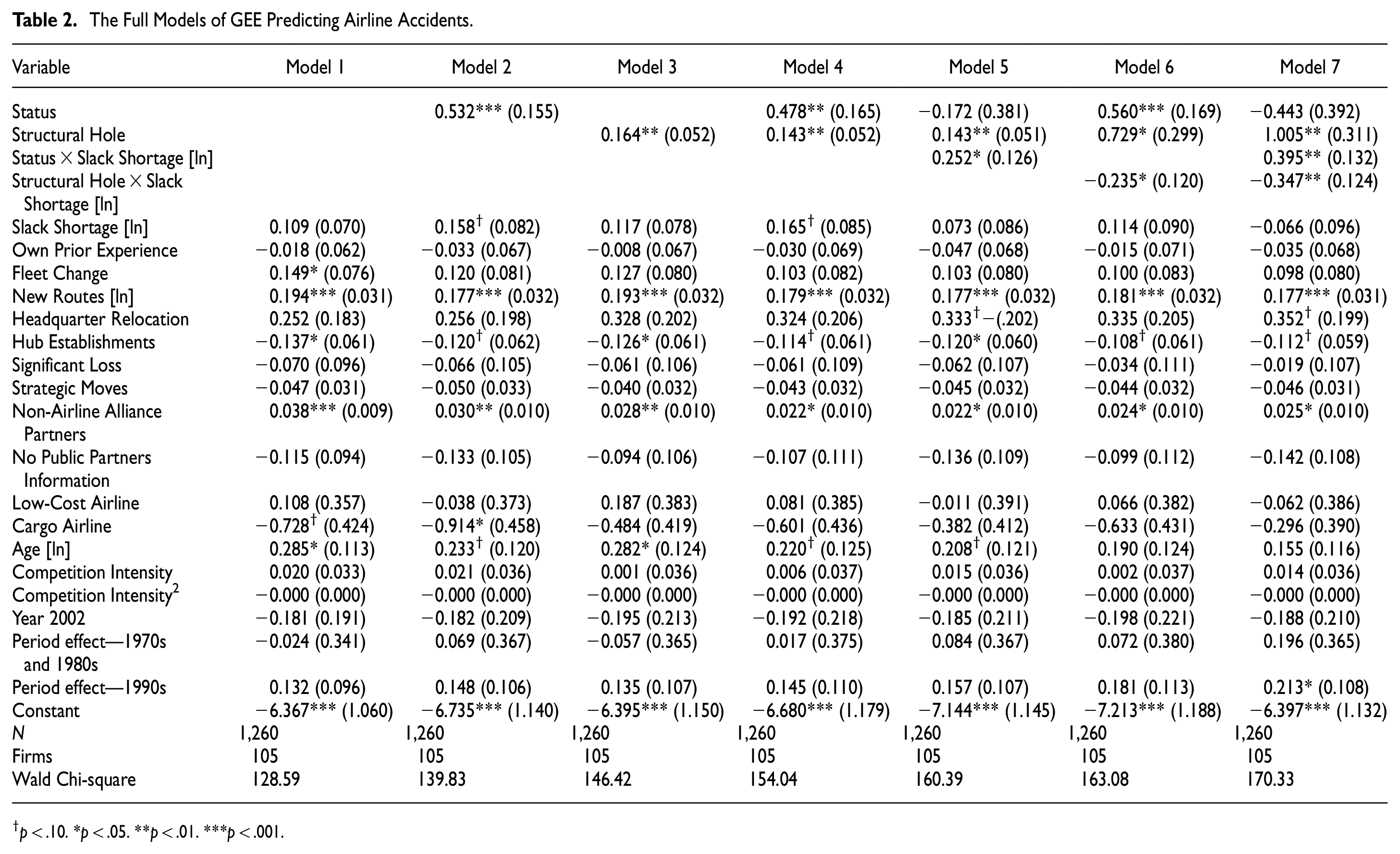
Table 1 summarizes the descriptive statistics and correlations. Although the pairwise correlation between the two independent variables, Status and Structural Hole, is .67, the variance inflation factors (VIFs) for our models are 2.29 for Status and 2.58 for Structural Hole, which are below the recommendation level of 3. The mean VIF for the models was 2.42 as well, so the multicollinearity issues were not significant in our models. Table 2 presents the results of our GEE regression models. The significance levels and directions of our two independent variables and two interaction terms strongly support all four hypotheses. In Model 1, we include control variables, and a few results are noteworthy. The model shows that significant changes in the operation of airlines, such as the additions of new routes, increase the possibility of accidents. However, previous experiences of accidents do not statistically significantly lower the number of accidents, which is aligned with our prediction that given the unexpected aspect of normal accidents, airlines do not necessarily learn from their previous failures. Models 2 and 3 add our first two independent variables, Status and Structural Holes, respectively. Model 2 shows that our first hypothesis, which predicted a positive relationship between status and accidents, is supported by a statistically positive coefficient (.532; p < .001). Model 3 supports our second hypothesis, which predicted a positive relationship between structural holes and accidents with another positive coefficient (.164; p < .001). In Model 4, we include both independent variables and the result corroborates our main arguments about the positive effects of two network positions on normal accidents.
Descriptive Statistics.

The Full Models of GEE Predicting Airline Accidents.
p < .10. *p < .05. **p < .01. ***p < .001.
Models 5 and 6 add the interaction terms between Slack Shortage [ln] and our independent variables, respectively, and Model 7 includes both interaction terms. The results show that both interaction effects are statistically significant in the hypothesized directions (0.395; p < .01 and −0.347; p < .01). The positive effect of the airline’s status on the occurrence of accidents is reinforced by slack shortage, whereas the positive effect of the airline’s structural holes is weakened by slack shortage. As shown in Figure 2a, when an airline’s slack shortage is low (the mean minus one standard deviation), its status has a similar effect on the occurrence of accidents. When the airline’s slack shortage is high (the mean plus one standard deviation), the relationship between status and accidents becomes steeper, providing strong support for H3, which predicted the positive interaction between status and HR slack shortage. The last hypothesis on the negative moderating effect of slack shortage on the relationship between structural holes and accidents is shown in Figure 2b. When an airline has some slack resources (low slack shortage), having more structural holes in its alliance network positively affects the occurrence of accidents. When an airline does not have slack resources (high slack shortage), however, having more structural holes reduces the number of fatal accidents.

(a) The strengthening effect of slack shortage [ln] on the relationship of status to airline accidents and (b) the weakening effect of slack shortage [ln] on the relationship of structural hole to airline accidents.
Discussions
This study examined the effects of two network positions in strategic alliances on the occurrence of accidents in the airline industry from the theoretical perspective of normal accidents. We regarded the occurrence of accidents as an unintended consequence of pursuing relational advantages from presumably advantageous network positions such as status and structural holes in interorganizational networks. Building upon the original normal accident study (Perrow, 1984), which posits that structural complexity, tight coupling, and slack shortage in organizational systems contribute to accidents, we extended these effects to the interorganizational level. We argued that status and structural holes in interorganizational networks inadvertently increase the susceptibility to normal accidents, due to differentiation costs and complexity costs, respectively. Using data from the U.S. airline industry, our empirical analysis reveals that accidents are more likely to occur when a focal airline holds a higher status in interfirm alliance networks and occupies a structural-hole position. Additionally, our results suggest that the shortage of human resource slack, another key variable in normal accident studies, amplifies the accident-inducing effect of status while mitigating the effect of structural holes. The findings of this study have theoretical and practical implications for general social theories, accident studies, and social network analysis literature.
First, this paper contributes to the field of general social theories by systematically discussing and empirically analyzing the unintended consequences of intended purposeful actions (Merton, 1936; Selznick, 1957). We argued that one of the central arguments in normal accident theory is the unintended consequence of purposeful rational action. This study highlights the dual nature of structural positions by illustrating that negative outcomes, such as normal accidents, can arise as unintended consequences of occupying structural positions presumed to generate relational advantages. Importantly, many factors that induce accidents, such as complexity, tight coupling, and slack shortage, are rationally chosen based on sound organizational and design logic, at least in terms of ex ante intention, but ultimately lead to negative consequences ex post. While previous studies in the fields of economics have extensively examined the cost side of rational decision-making (Brent, 2006; Drèze & Stern, 1987), the concept of “unintended (or unanticipated) consequences of an intended (or purposeful) action” has received little attention. We propose that future inquiries into unintended consequences of purposeful actions will yield rich new insights not only in the field of organizational theory but also in all social studies (Leslie, 2019; Merton, 1936; Selznick, 1957).
Second, the findings of this paper contribute to the literature on accident studies by highlighting that the occurrence of accidents is not only an operational or engineering problem within an organization, but also a significant relational problem that requires a macro interorganizational perspective for systematic examination. Most accident studies have concentrated on operational systems or interactions within organizations as the primary causes of accidents (Hollnagel, 2004; Perrow, 1984; J. T. Reason, 1987; Weick, 1993). However, since the 1990s, interorganizational networks comprising multiple entities have become significant, potentially affecting the causes of accidents (Dyer & Singh, 1998; Powell, 1990). This study suggests that accident research should now focus on interorganizational relations to better understand why accidents occur. In fact, high-risk sectors such as the airline or nuclear industries are characterized by active and complex interorganizational interactions among diverse participants (e.g., Haunschild & Sullivan, 2002). As discussed earlier, compared to intraorganizational operations, interorganizational operations are more prone to accidents because of coordination complexity, process misalignment between partners, and weaker control over operational processes (e.g., Milch & Laumann, 2016). Therefore, future studies investigating the relationship between interorganizational interfaces and the likelihood of accidents will yield fruitful and significant contributions.
Third, our paper contributes to the literature on social networks by highlighting the importance of reexamining the effects of key variables in the social network literature that can also lead to negative consequences. Many studies on social networks have focused on the advantages or positive outcomes associated with various labels, such as social capital (Lin, 2002) or relational advantage (Dyer & Singh, 1998). Notably, even the few studies that have considered the negative consequences of social networks have often assumed a curvilinear relationship (Uzzi, 1997). In other words, many studies have treated the negative consequences of a network position as a side-effect or the flip side of an intended positive effect. We think that network positions not only have this type of curvilinear effect or the unintended consequences discussed in this study but also have various negative effects. One of the key criteria for this divergence lies in the definition of ego and alter (Wasserman & Faust, 1994). Depending on how we define the ego and determine the alters in a network analysis, a network position that serves as a relational advantage for the ego is likely to serve as a relational disadvantage for the alter. Social networks can function not only as structural sources of freedom and opportunity but also as sources of control and constraints. Therefore, we encourage future studies to thoroughly and directly explore the various potential downsides of social networks.
Like all academic endeavors, this paper has limitations that future studies can address. First, the limited availability of data posed a significant challenge in our empirical analysis. This study required longitudinal relational data between each pair of airlines, in addition to firm-level data. Collecting the data from different databases, including network information, was a complicated process. Notably, smaller airlines frequently often do not disclose their firm-level details, and some airlines do not provide consistently traceable and reliable information due to business closures and mergers and acquisitions. We are confident in our statistical analysis results, but better access to data could have reinforced their reliability. This limited data availability also prevented us from measuring the main variables in alternative ways to demonstrate the robustness of our empirical results. For example, referring to other research on the airline industry (C. M. Feng & Wang, 2000; Y. Feng et al., 2015; Vaughan, 2021), we acknowledge that aircraft and employees, critical to airline operations and accidents, constitute pivotal organizational resources. We measured slack via relative flight departures by employee size, which is a reasonable measure for labor-intensive service industries such as the airline industry. However, financial resources have often been used in previous studies to measure slack resources (e.g., Greve, 2003; Singh, 1986). We faced challenges in maintaining consistent and reliable financial data due to bankruptcies, business closures, and takeovers over its 34-year observation period. Considering the broad conceptual definition of slack, future studies should explore alternative measures to uncover additional insights.
Additionally, some of the theoretical logics we used to develop our hypotheses were not directly measured or analyzed in the empirical study but were presumed based on theoretical arguments. Therefore, importantly certain arguments presented in the hypotheses section may lack empirical substantiation in real-world settings. For example, we proposed that a focal organization in a network position with abundant structural holes faces complex costs because it needs to coordinate and mediate interactions among diverse alters with different organizational routines and practices. However, we did not measure the actual diversity of organizational routines and practices among the alters. Similar limitations may apply to other arguments in hypothesis development. Thus, future studies should carefully reexamine each step of the procedural arguments to establish a stronger empirical foundation.
Conclusion
In conclusion, this study shifts the focus from traditional causes of accidents, such as operational and engineering problems, to the relational dynamics within interorganizational networks. An examination of the roles of status and structural holes reveals that these network positions, typically seen as advantageous, can inadvertently increase the likelihood of accidents due to differentiation costs and complexity costs, respectively. The findings underscore the importance of considering relational factors and their unintended consequences in accident studies, advocating for a macro interorganizational perspective. This research contributes to broader social theories, the accident literature, and social network analysis by highlighting the dual nature of network advantages and the potential for negative outcomes.
There may be other shortcomings in this study that we may not have recognized. We would like to emphasize that all the limitations of this study are unintentional outcomes of our efforts to create an engaging paper. To meet the professional norm of producing an ideal academic paper that is both comprehensive and concise, we may have encountered normal accidents along the way. These normal accidents are characterized by unintentional trade-offs between the richness of description and the parsimony of our paper. In essence, many of the limitations in this study can be attributed to normal accidents. Notably, academia itself can be considered a high-risk field where limitations and shortcomings are a customary part of the research process rather than exceptional occurrences.
Footnotes
Declaration of Conflicting Interests
The author(s) declared no potential conflicts of interest with respect to the research, authorship, and/or publication of this article.
Funding
The author(s) disclosed receipt of the following financial support for the research, authorship, and/or publication of this article: This study was supported by Yonsei Management Research Institute.

Data Availability Statement
Please contact the corresponding author for data access.