




Abstract
The COVID-19 pandemic has significantly impacted the pharmaceutical retail market, leading to rapid growth in the pharmaceutical e-commerce industry. Currently, the new entrant has three options for business models: offline pharmacy model, normal e-pharmacy model, and Direct-To-Patient (DTP) pharmacy model. To address this issue, this study constructs a dual-channel model that considers the enhancement coefficient of medication experience and incorporates a hospital that dominate the pharmaceutical retail market using the Hotelling model for each of the three models. The study utilizes dual-channel competition theory to compare and analyze optimal pricing and maximum profit of supply chain members under the different models, providing a decision-making mechanism for the new entrant. By comparing profits, the study finds that the DTP pharmacy model outperforms the traditional pharmacy and normal e-commerce models, providing the highest profit and the best medication experience for patients.
Plain language summary
This research paper explores the different business models available to new online pharmacy startups in the pharmaceutical industry. With the significant growth of the pharmaceutical e-commerce market, it is crucial for these startups to choose the most effective model that ensures profitability and provides a positive medication experience for patients. The study compares three business models: traditional offline pharmacy model, normal e-pharmacy model, and Direct-to-Patient (DTP) pharmacy model. The DTP model integrates telemedicine, online healthcare services, and home delivery, offering convenience and personalized care to patients. The research analyzes the optimal pricing and maximum profit for each model using dual-channel competition theory and provides valuable insights for decision-making by new entrants. The findings indicate that the DTP pharmacy model outperforms the traditional pharmacy and normal e-commerce models in terms of profitability and patient satisfaction. It offers higher profits and a better medication experience for patients. This is particularly important in the presence of strong competitors such as public hospitals, which dominate the pharmaceutical wholesale market.
Introduction
Evidently, the COVID-19 pandemic has significantly impacted the pharmacy e-commerce (Wu et al., 2021). During the 3-year period of 2020 to 2022, the Chinese pharmaceutical e-commerce market demonstrated an average annual growth rate of 20%, while the growth rate of physical pharmacies was only 5% (Zhongkang CMH, 2022). With the global healthcare e-commerce market estimated to reach $435.8 billion in revenue by 2025 (MacDonald, 2021), it is foreseeable that in the post-pandemic era, the pharmaceutical e-commerce industry will usher in a period of rapid development.
Currently, new entrant to the pharmaceutical retail market have two options for store models: e-pharmacy or offline pharmacy. However, in China, whichever option is chosen, the new entrant will face a formidable competitor: Public Hospitals. The public hospitals, as government-funded institutions, are also considered as pharmaceutical retailers, providing both medical treatment and drugs to patients. Due to the centralized procurement policy led by the Chinese government, which involves hundreds or thousands of public hospitals collectively tendering for drugs from pharmaceutical manufacturers, the hospitals have an absolute dominance in the pharmaceutical wholesale market. However, the implementation of the “zero-markup” policy by the government requires that the drugs sold by hospitals to patients must be priced at the same level as their wholesale cost. Assuming that new entrant in their early stages of entrepreneurship can only choose one operational model, how should the new pharmaceutical retailers choose in the presence of public hospitals, online or offline?
With the advancement of information technology, a novel pharmaceutical e-commerce model has emerged, namely the Direct-to-Patient (DTP) model. This model involves pharmaceutical companies transferring the retail rights of their products directly to retail pharmacies, bypassing the intermediary wholesaler stage. Patients can purchase prescribed drugs at the pharmacy. The DTP model integrates telemedicine, online healthcare services, and home delivery, which not only facilitates drug sales but also provides medical services to patients, thereby extending sales reach and increasing product accessibility to a wider patient population (Flaherty, 2020). This new pharmaceutical e-commerce model enhances the patient’s medication experience while also increasing costs for e-pharmacies, which represents a third option for new entrant.
Therefore the new entrant faces three viable business models: traditional offline pharmacy model, DTP pharmacy model, and normal e-pharmacy model. In the presence of hospitals, this study will construct different dual-channel supply chain models to compare and analyze the optimal pricing and maximum profit of supply chain members, aiming to provide a decision-making mechanism for new entrant in choosing business models. Furthermore, the rationality of this study will be validated through numerical experiments.
The remainder of the paper is organized as follows. Section “Literature Review” reviews the relevant literature. Section “Models” constructs three models and compares the optimal values under the different models. Section “Numerical Analysis” reports numerical experiments. Section “Managerial Implications” discusses the managerial implications. Section “Conclusion” draws a conclusion and makes suggestions for future research.
Literature Review
This paper presents an analysis of the factors that influence business model choices for new entrant in the pharmaceutical e-commerce environment, with a particular focus on the Direct-to-Patient (DTP) model. Two research areas related to this model are reviewed. Firstly, we examine existing literature on the DTP model from a supply chain perspective, followed by a review of literature on market entry for new entrant.
DTP Pharmacy Model
DTP pharmacy model has experienced rapid development in recent years, yet there has been limited research on DTP pharmacies from the perspective of supply chain. GBI Research (2012), a well-known global market research company, pointed out that the DTP model is beneficial for improving logistics efficiency, reducing circulation costs, and enhancing patient drug safety. DTP pharmacies provide patients with new specific drugs and high-level professional services, including prescription evaluation, medication guidance, tracking and recording medication information, and individualized management of each patient through the establishment of an information system (Shen et al., 2022). Dandan et al. (2018) studied the competition between DTP pharmacies and hospitals, and indicated that the development potential of DTP pharmacies depend on the number of hospitals covered by the business. Han et al. (2022) found through experiments that patient management services provided by the DTP pharmacies may play an active role in extending the duration of cancer cell inhibitors utilization and patient follow-up. Wang et al. (2020) applied the research method of a survey questionnaire to investigate antitumor pharmaceutical care ability and the current status of direct-to-patient pharmacy in China. Wen et al. (2023) investigated 499 DTP pharmacies and concluded that the market share of DTP pharmacies will become larger than before, for the patients shifting from hospitals to DTP pharmacies can make them better layout. Qian et al. (2019) studied the advantages and limitations of the DTP pharmacy model in China from a competitive perspective, and proposed rational suggestions from the perspectives of patients, hospitals, medical insurance, pharmaceutical companies, etc. Yan et al. (2021) used the SWOT method to analyze the strengths, weaknesses, opportunities, and challenges of the DTP pharmacy model, and pointed out that the DTP pharmacy will develop into a new high-end medical service platform based on drug sales. Hu et al. (2018) believed that the development of DTP pharmacies in China is still in its early stages, and the deepening of medical system reform will inject strong impetus into its development.
The research on the DTP pharmacy model mentioned above is primarily qualitative research conducted at a macro level, using research methods such as questionnaire surveys or data collection, and is lacking in theoretical research. To address this gap, this paper will construct a dual-channel pharmaceutical supply chain model based on channels competition theory to examine the strengths and weaknesses of the DTP pharmacy model. Next, this paper mainly draws on relevant research on market new entrant from a micro perspective.
Market New Entrant
In this field, the predecessors have already achieved abundant results. For example, Sharma and Mehra (2020) studied the impact of platform entry on the product market when the profit of the platform’s advertising business depends on the quality of the visited products. Gu et al. (2020) pointed out that entrant need to consider the relationship between traditional physical retail stores and internet services, and only when they complement and coordinate with each other can they promote the market entry of enterprises. Lampert et al. (2019) explained that the choice of geographical location has a decisive impact on the choice of entry strategy for enterprises in the market entry process. Allen et al. (2022) explored the complex dynamics of platform markets and introduce a method to measure the direct and indirect effects of new software introductions. Saxena and Das (2021) used partial least squares structural equation modeling to examine the effects of competitive pressure by new entrant and technological discontinuity on the strategic innovations adopted by incumbent state-owned enterprises in India. Baron (2021) discussed the impacts of the entry on dynamic positioning and product innovation in a vertically differentiated market. Arrieta et al. (2022) modeled the conditions under which firms should enter the market with modular products that support multiple standards instead of an integral product that supports a single standard. Negoro and Matsubayashi (2021) provided a game-theoretic analysis to investigate an entrant firm’s partner selection for offering its new product to a market, particularly to a foreign market. Cheng et al. (2021) investigated the pricing model between an incumbent ferry firm and a new-entrant sea bus firm. Guo and Shang (2023) focused on the competitive strategies of new market entrant in the supply chain of cross-border e-commerce platforms, including information sharing and free shipping.
The above-mentioned researches analyzed the entry strategies from the perspectives of retailers and manufacturers, but did not fully consider the influence of consumer service experience on decision-making. Pharmaceuticals are distinct from common commodities in that they require extensive and wide-ranging post-sales services. For instance, it is necessary to continuously monitor the consumer’s medication status, offer home delivery services, and maintain comprehensive records of the entire medication process. As a result, the post-sales services significantly influence patients’ purchasing decisions. This study will introduce an innovative factor, namely the enhancement coefficient of medication experience, to analyze the effects of new entrant on supply chain members.
Models
In this section, a two-stage dual-channel supply chain is considered, as shown in Figure 1, which includes a pharmaceutical manufacturer, a new entrant and a hospital. The research design of this section is as follows: Firstly, based on the Holing model, two mathematical models (traditional pharmacy model and DTP pharmacy model) are constructed for the new entrant. It is important to note that by setting the medication experience coefficient in the DTP pharmacy model, it can be transformed into normal e-pharmacy model. Subsequently, utilizing the Stackelberg game theory, the optimal profits for the new entrant are determined for all three business models. Finally, the optimal values are compared to derive the optimal decision for the new entrant. The following will provide a detailed explanation of model construction and the process of obtaining the optimal values.

Dual-channel model.
To patients, both the new entrant and the hospital are considered pharmaceutical retailers that procure drugs from the manufacturer and sell them to patients. Owing to the joint procurement of drugs by large domestic comprehensive hospitals through centralized purchasing, they hold an absolute market dominance in wholesale pricing. Therefore, in the hospital channel, we assume that the wholesale price denoted as
To develop the mathematical model for the dual-channel supply chain, we assumed a constant patient population, uniformly distributed patients, and location-based costs, thus the Hotelling model was selected. Consistent with prior research (Chen & Chen, 2019; Larralde et al., 2009; Tao et al., 2020; Zhang et al., 2019), the competition between new entrant and dominant incumbent is depicted in Figure 2. Assuming that the patients are uniformly distributed on the interval of

Hotelling model.
Next, we construct the patient utility functions based on the Hotelling model, and then apply the Stackelberg game method to solve for the optimal retail prices and profits of the supply chain members. To distinguish between the business models, the subscript
Traditional Pharmacy Model
When new entrant opts for establishing new offline retail pharmacy, there are four factors that need to be considered while constructing the patient utility function: pharmaceutical utility

Where

From equation (2), the market segmentation point


Substituting


Equation (6) shows that the profit of the traditional pharmacy
The Stackelberg game order in this scenario is that the pharmaceutical manufacturer first decides on its wholesale price
Opening a New Traditional Pharmacy.
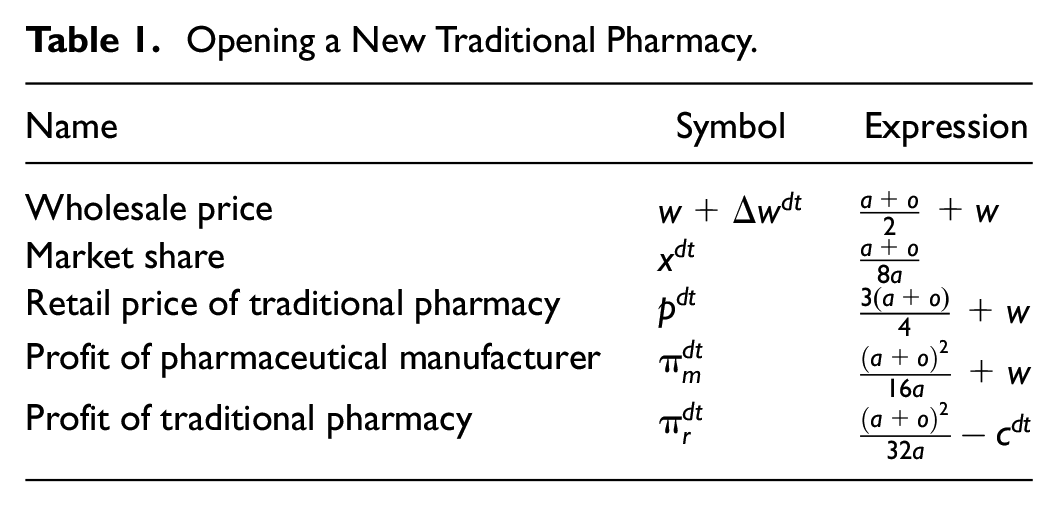
Based on this proposition, it can be inferred that in the current healthcare reform (which aims to eliminate drug markups and increase outpatient fees), if the government sets the outpatient fee too high, some patients may be redirected to offline pharmacies, but this will result in a significant increase in patients’ costs. Therefore, the government can utilize the dominant market position of public hospitals to stabilize the prices of drugs.
DTP Pharmacy Model
Under the DTP pharmacy model, patients can receive their drugs at home while enjoying professional post-sales pharmaceutical services, resulting in a good drugs purchasing experience. Therefore, assuming that the channel utility of the DTP pharmacy, denoted as

Similar to Section “Traditional Pharmacy Model,” when the patient channel utilities of the two channels are equal, the market segmentation point can be obtained.

From equation (3.8), it can be derived that
In this scenario, since the DTP pharmacy provides professional pharmaceutical services, assuming operating costs


Substituting

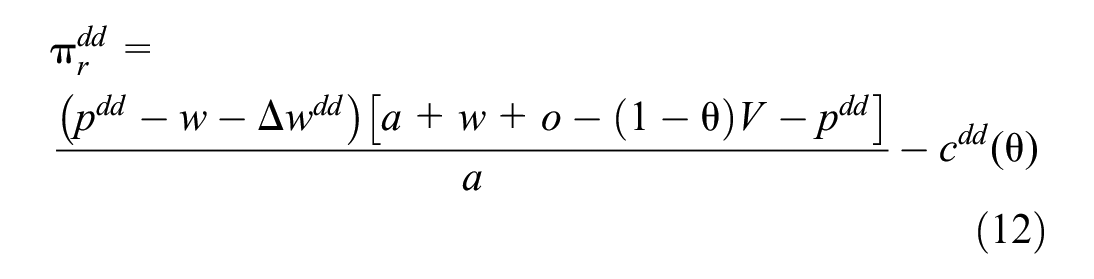
Equation (12) shows that the profit of the DTP pharmacy
By examining the price and profit expressions presented in Table 2, the above proposition can be easily proven. This finding is also consistent with real-world scenarios, where a better medication experience can increase patients’ preference for the DTP pharmacy channel. As the DTP pharmacy provides post-sales services, its drug retail price is also higher. Additionally, it can increase the profit margin for the pharmaceutical manufacturer, leading to active promotion and development of the DTP pharmacy model.
Opening a DPT Pharmacy.
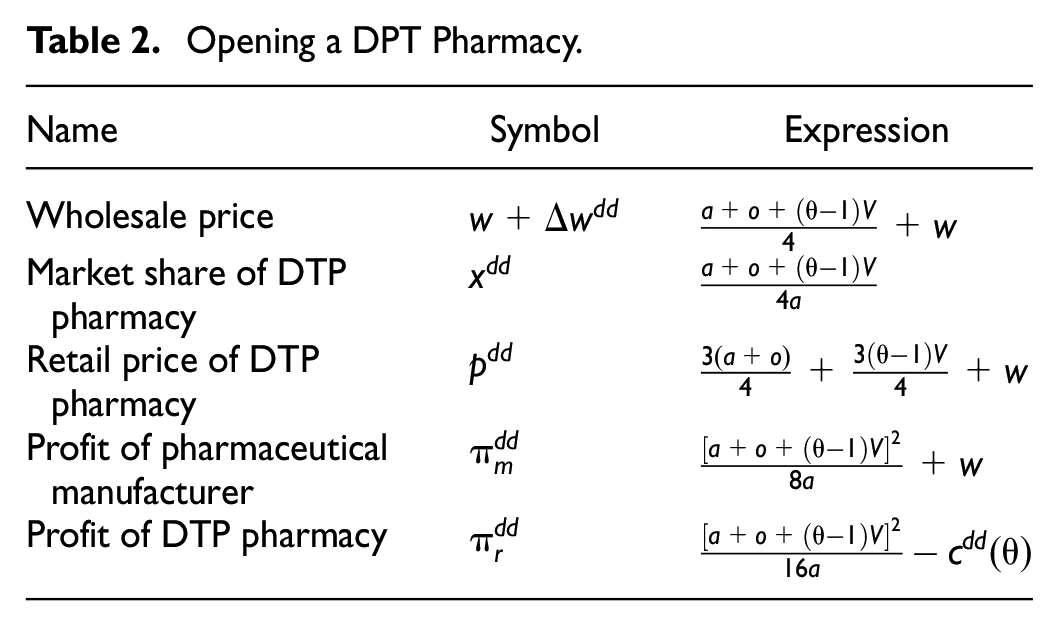
In Table 2, the expression of the DTP pharmacy’s profit suggests that with appropriate cost management, the DTP pharmacy model can be more profitable. When the DTP pharmacy model improves patients’ medication experience through services such as home delivery and medication management, it will inevitably lead to an increase in operating costs. The better the medication experience, the greater the investment cost for the DTP pharmacy. Based on the relationship between effort level and operational costs (Niu et al., 2019; Song and Gao, 2018), this study assumes that the relationship between the operating costs of the DTP pharmacy and the medication experience coefficient is
Then, the profit expression of DTP pharmacy is:

Due to the uncertainty of the signs of
Comparison of Traditional Pharmacy and DTP Pharmacy
By comparing the optimal values of the two modes, a decision-making mechanism for the new entrant to choose their operating mode can be obtained.
As
Using this inequality, the new entrant can conduct quantitative analysis to determine which business model is more suitable, which is a significant contribution of this paper. Furtherly, when the operating cost of the DTP pharmacy are lower than those of the traditional pharmacy, that is, when
Comparison of Traditional Pharmacy and Normal e-Pharmacy
If the DTP pharmacy degrades into a normal e-pharmacy that only provides online sales services, then
Comparison Between Traditional Pharmacy and DTP Pharmacy.

Proposition 5 indicates that compared to the traditional pharmacy model, the normal e-pharmacy model can (a) increase the market share and profit of retailer while keeping retail price unchanged; (b) maintain the wholesale price of the pharmaceutical manufacturer, but increase its profit; (c) from
Comparing Table 3 with Table 4, the DTP pharmacy model is an upgrade of the normal e-pharmacy model, emphasizing more on better medication experience and post-sales services, and the variable part
Comparison Between Traditional Pharmacy and Normal e-Pharmacy.

Numerical Analysis
This section will discuss the decision-making process for new entrant regarding their choice of business model based on real-world scenarios. Firstly, a quantitative analysis will be conducted to assess the impacts of pharmaceutical utility
The parameter settings are as follows: based on the actual situation, assuming the wholesale price
In this case study, it can be seen from Figures 3 to 6 that as the pharmaceutical utility


Based on the aforementioned observations, it can be inferred that the DTP pharmacy model represents the optimal selection for a new entrant. In particular, for drugs characterized by high pharmaceutical utility, limited substitutes, and high dependence on pharmaceutical services (e.g., anti-cancer drugs, original drugs, and other specialized medications), the DTP pharmacy model has the potential to generate higher profits for the new entrant as compared to the other two models.
The impacts of the medication experience coefficient


Managerial Implications
In the current e-commerce era, new entrants seeking to penetrate markets dominated by established retailers have multiple business models to choose from. Drawing from the content of this paper, the following three managerial implications can be inferred:
Compared to the traditional pharmacy model and the normal e-pharmacy model, the DTP pharmacy model performs better in terms of profit, patients medication experience, and profit growth. Therefore, for new entrant to the market, the DTP pharmacy model may be the optimal choice.
Unlike other products, pharmaceuticals require extensive post-sales services, such as ongoing monitoring of patient medication status, home delivery services, and detailed medication records. Thus, medication experience for patients plays an important role in their purchasing decisions. Pharmaceutical enterprises should prioritize medication experience for patients and provide better post-sales services to enhance competitiveness in the market. This rule is equally effective for products of the same type.
Product diversity is a critical factor in determining a company’s success. This study reveals that drugs with high pharmaceutical utility and low substitutability are well-suited for the DTP pharmacy model. Accordingly, enterprises should develop market entry strategies tailored to product categories to maximize their success in the market.
Conclusion
With the implementation of new medical reform policies such as “separation of medicine and pharmacy” and “prescription outflow” in China, the drug retail market has welcomed new formats and vitality. When a pharmaceutical retailer wants to open a new store in a certain market, they can choose between the traditional pharmacy model or the pharmaceutical e-commerce model, and within the pharmaceutical e-commerce model, they can further choose the more specialized DTP pharmacy model. This article compares and analyzes the above scenarios by constructing a dual-channel Hotelling model and obtains the decision-making mechanism for the operating model.
Compared with the traditional pharmacy model, the pharmaceutical e-commerce model (including the DTP pharmacy model and the normal e-pharmacy model) has the potential to increase the retailer’s market share, raise drug retail prices, and boost the profit of the pharmaceutical manufacturer. As a result, manufacturers are likely to promote the development of the pharmaceutical e-commerce industry. In terms of profits for new entrant, the pharmaceutical e-commerce model outperforms the traditional store model. However, if the normal e-pharmacy model is selected, the increase in profits will be limited. Upgrading to the DTP pharmacy model, on the other hand, can yield more substantial profits by offering patients a better medication experience. Furthermore, for specialty drugs with poor substitutability, such as original drugs and anticancer drugs, the DTP pharmacy operating model is particularly suitable.
This study also found that excessive outpatient fees can result in patient diversion from hospitals and an increase in market share and retail prices of pharmacies, ultimately increasing the profit of retail pharmacies and pharmaceutical manufacturers. However, this also inevitably places a greater burden on patients when purchasing drugs. Therefore, it is imperative for the government to set reasonable outpatient fees to alleviate patient burden and guide patient diversion. The conclusions of this analysis not only aid pharmaceutical retailers in their decision-making regarding operating models, but also have important guiding significance for the government when formulating medical reform policies.
There are several intriguing topics that warrant further investigation. With the ever-advancing capabilities of artificial intelligence technology, pharmaceutical e-commerce platforms will be able to provide higher quality pharmaceutical services, including precise and personalized telemedicine offerings. Despite the intensifying competition between online and offline channels, there are promising prospects for collaboration between the two channels by leveraging their unique strengths. Investigating the mechanisms of such cooperation between online and offline channels would be of great value.
Footnotes
Author Note
Ge Yang (1982-), PhD. Research interests: pharmaceutical supply chain, pharmaceutical e-commerce.
Declaration of Conflicting Interests
The author declared no potential conflicts of interest with respect to the research, authorship, and/or publication of this article.
Funding
The author disclosed receipt of the following financial support for the research, authorship, and/or publication of this article: This work was supported by the Natural Science Research Project of Anhui Provincial Department of Education (KJ2021A1480). High-level Talent Program of Anhui Business College (2024KYQD04).
Ethics Statement
Not applicable

Data Availability Statement
Data sharing not applicable to this article as no datasets were generated or analyzed during the current study.