



Abstract
This study focuses on the cognitive abilities of managers and examines the effect of entrepreneurial alertness (EA) of small and medium-sized enterprise (SME) managers on the quality of strategic decision-making and firm performance under uncertain environmental conditions. This study also sheds light on the antecedents of EA that are crucial for SMEs by focusing on the nuances of socio-emotional wealth (SEW) arising from business succession. The results of structural equation modeling based on a questionnaire survey of SMEs in Japan, where the society is aging rapidly and the business succession situation is becoming more serious, show that EA is positively related to the quality of strategic decision-making and firm performance. However, managers’ intrafamilial business succession attributes affect EA negatively and are positively moderated when social capital is formed within families. These findings contribute to the theoretical development of EA by extending the scope of study. Additionally, the findings provide a practical perspective by clarifying the nuances of business succession, which can be problematic for many firms.
Introduction
Recently, firms have been confronted with rapidly growing global competition and increasing digitalization. Such rapid changes cause volatility and uncertainty, which can cause unexpected crises for firms. Managers require skills beyond the typical business environment to promptly recognize, proactively respond to, and navigate crises (Lerbinger, 2012).
To examine responses to crises, previous literature has focused on environmental factors, such as sudden environmental change and resource reallocation (Bergami et al., 2022), the wider community that firms are nested in (Beninger & Francis, 2022), employee labor management (Margherita & Heikkila, 2021), and internal advantages (Wang et al., 2020). In particular, a small or medium-sized enterprise’s (SME) crisis response tends to focus on factors related to business continuity (Alekseev et al., 2022; Dörr et al., 2022; Liu et al., 2022) and support from the government and community (Belghitar et al., 2022; Meurer et al., 2022).
Manager cognition is also an important factor (Helfat & Peteraf, 2015). When managers quickly recognize changes in the business environment, they can construct new strategies. Therefore, managers’ cognition of environmental changes significantly affects a firm’s future potential (Danneels, 2011; Rosenbloom, 2000; Tripsas & Gavetti, 2000). Managers’ roles are more important for SMEs, whose organizational resources are scarce, as their decisions are more directly linked to the performance of the enterprise (Cao et al., 2010; Lubatkin et al., 2006).
This study introduces the concept of entrepreneurial alertness (EA), which refers to managers’ cognitive capabilities (Kirzner, 1973, 1979). EA is more crucial for entrepreneurs running resource-constrained firms than for managers of large firms (Kirzner, 1997).
Previous studies on EA have often focused on managerial EA in startups (e.g., Zhao et al., 2021). Managers’ EA is important for startups that need to align their corporate strategies with the growth of new industries. Similarly, managers’ EA is necessary for SMEs to recognize new business opportunities more quickly when positive environmental changes occur and to achieve business growth (Roundy et al., 2018). However, knowledge of managers’ EA in non-startup SMEs is limited, and there is a research gap in this field. Thus, it is worthwhile elucidating the effect of manager EA on SME performance.
In addition, we consider antecedent factors unique to SMEs, business succession, and social capital formed in the family. Succession issues are crucial when considering the management of SMEs (Bertschi-Michel et al., 2021; Bruce & Picard, 2006). Despite the large number of studies on the antecedents of EA, few have focused on managerial succession (Lanivich et al., 2022). This constitutes the second research gap in the literature.
Third, with the exception of a few studies (e.g., Tang et al., 2021), previous EA studies have focused on positive situations, and the role of EA in crisis situations is not sufficiently clear (Lanivich et al., 2022). Even during crises that lead to negative environmental changes, such as the COVID-19 pandemic, managers’ EA can affect firm performance. This study seeks to identify EA as the driving force behind managerial decision-making, highlighting certain managers’ cognitive capabilities to evaluate business opportunities and employ effective strategies to enhance firm performance during uncertain times.
To fill these three research gaps, this study employs structural equation modelling (SEM) to investigate the effect of EA on the quality of strategic decision making and firm performance based on a survey of SMEs in Japan. Many Japanese SMEs have been in business for a long time and have characteristics that differ from those of start-ups (Chung & Au, 2021). However, management is aging with the aging of society, and succession has become a major issue (Kamei & Dana, 2012; Tsuruta, 2020). This background makes Japanese SMEs an appropriate subject for this study.
The analysis reveals that EA is positively related to the quality of strategic corporate decision making and firm performance. The results also show that managers’ intrafamilial business succession attributes have a negative effect on EA, although they are positively moderated when social capital with the predecessor exists.
This study makes three main contributions to the literature. First, it extends the scope of EA to SMEs and other enterprises beyond its main focus on ventures. Second, whereas most studies on EA focus on competencies related to individuals, this study highlights how managerial attributes such as the presence or absence of a successor and the type of successor affect EA. Third, by analyzing EA in the context of a crisis characterized by extreme uncertainty, this study sheds light on aspects overlooked by existing studies focusing on positive environmental change. These contributions can lead to further theoretical developments in EA research. Furthermore, this study contributes not only to the theoretical development of EA but also to the practical perspective by clarifying the nuances of business succession, which can be problematic for many firms.
Theoretical Background and Hypotheses
Entrepreneurial Alertness
Kirzner (1973, 1979), who conducted pioneering research on EA, characterizes more alert individuals as having antennas that enable them to recognize gaps from limited cues. EA represents the cognitive capability of identifying entrepreneurial opportunities (Gaglio & Katz, 2001). Highly alert individuals discover opportunities previously missed by others. Entrepreneurs’ behavior characterizes the dynamic nature of the market process (Kirzner, 1997). In other words, individuals with EA can quickly seize opportunities ahead of market reactions to new developments.
Kaish and Gilad (1991) were the first to address this concept in management studies, identifying the differences in how entrepreneurs and managers of large firms access information. Empirical studies on EA have primarily been conducted since the 2010s (Chavoushi et al., 2021). Early empirical studies examined the effect of EA on factors mediating firm performance, such as entrepreneurial intention (Samo & Hashim, 2016; Urban, 2020) and opportunity recognition (Li et al., 2015) based on student surveys. More recently, studies have found that EA directly affects mediating factors such as opportunity-related absorptive capacity (Patel, 2019) and firm performance (Adomako et al., 2018).
To develop this framework, we employ both antecedent and outcome variables in EA (Lanivich et al., 2022). Additionally, we focus on the types of business successions that are particularly important to SMEs with respect to EA antecedents.
Entrepreneurial Alertness in SMEs
EA is not only necessary for entrepreneurs in new industries; it is defined as the capability to respond quickly to new business opportunities. Even SMEs with a long history require entrepreneurship to achieve business growth in uncertain environments (Stenholm et al., 2016). Although managers can estimate the perceived financial or operational risks in their business areas, they struggle to understand and deal with uncertainty.
Especially during a crisis such as the COVID-19 pandemic, it is unclear whether firms’ existing ways of dealing with environmental uncertainty are adaptable, making it difficult to develop appropriate strategies (Sharma et al., 2020). Managers with EA may be able to identify opportunities and actively engage in strategic decision-making in uncertain situations. Uncertainty is an individual’s perceived inability to accurately predict an outcome in a given situation (Milliken, 1987); thus, the subjective recognition of decision makers, such as managers, may be important (Sharma et al., 2022).
SME managers’ EA is effective against environmental change, and recent attempts have been made to extend it to entrepreneurial processes and contexts. Roundy et al. (2018) focus on environmental change rather than new industries, considering how environmental changes caused by the construction of a new stadium in a particular area would affect firms in the vicinity. They show that EA affects strategic change and firm performance directly, and that the effect is greater for SMEs than for start-ups. They consider the effectiveness of EA in promoting positive environmental changes. However, whether EA can adapt to negative environmental changes when uncertainty is high has not yet been examined. This elucidation could lead to further theoretical developments and to broadening the context of EA.
Thus, we propose the following hypotheses:
H1a: Manager’s EA is positively related to the quality of strategic decision-making in SMEs during uncertain times.
H1b: Manager’s EA is positively related to the SME’s performance during uncertain times.
In addition, we examine the relationship between strategic change and firm performance, which has been examined in several studies (Reger et al., 1992; Zajac et al., 2000). The effect of EA on firm performance is examined in the context of EA research. Furthermore, moderating effects, such as social networks (Xie & Lv, 2016) and mediating effects, such as firm innovation (Tang et al., 2021) have been studied. Therefore, we also consider the mediating effects of EA on firm performance based on Roundy et al. (2018). EA influences firm performance indirectly through strategic decision-making in an uncertain environment as managers actively pursue business opportunities that others are unaware of.
Therefore, we hypothesize:
H2: The quality of strategic decision-making is positively related to SMEs’ performance during uncertain times.
Business Succession and Its Influence on Entrepreneurial Alertness
Following Valliere’s (2013) seminal work on EA, individual characteristics such as psychometric attributes (Hu et al., 2018; Pirhadi et al., 2021) and prior knowledge (Ma & Huang, 2016; Tang et al., 2021) that precede EA have been examined. However, Adomako et al. (2018) argue that EA theory can be developed by examining new contextual factors that promote EA.
An important variable when considering the EA of SME managers is whether they are founders. This is clear from the many studies on EA that have focused on startup founders. Founders are important in demonstrating entrepreneurship from the establishment stage to the firm’s development process (Gómez-Mejia et al., 2011). Additionally, founders can quickly choose the capital structure of their firms (Burgstaller & Wagner, 2015) and take adaptive actions in response to rapid environmental changes. This means that founders may have high EA and take bold actions, such as reviewing and restructuring the business under uncertainty, which may result in high performance.
However, founders’ EA does not necessarily remain high when the business environment changes. This is because past successes may reduce their alertness to the future business environment (Audia et al., 2000; Tripsas & Gavetti, 2000), and long-term CEO tenure reduces firm innovation (Wu et al., 2005).
If the EA of founders is declining–that is, their cognition has not adapted to the new business environment–a possible strategy to cope with uncertainty is to replace the manager (Rosenbloom, 2000). In industries with high uncertainty, manager succession contributes to high organizational performance (Virany et al., 1992).
Successors in family run SMEs are often chosen by family members (Royer et al., 2008). A unique aspect of family businesses is that key managerial choices are driven by the desire to maintain and enhance the family’s socioemotional wealth (SEW) rather than efficiency or economic means (Gómez-Mejia et al., 2011). Although intrafamilial succession suggests that successors are more likely to share certain temperaments and abilities with their families (Jones & Stout, 2015), the desire to maintain and enhance SEW may be reinforced during intrafamilial succession.
The literature suggests that non-economic objectives, such as the maintenance of value and firm reputation across multiple generations, can increase innovation in new domains (Kammerlander & Ganter, 2015). Managers appointed through intrafamilial succession invest less in innovation but have higher conversion rates to output than founders or non-intrafamilial managers (Duran et al., 2016; Patel & Chrisman, 2014).
Conversely, nepotism is generally frowned upon and considered the antithesis of meritocracy and fairness (Calvard & Rajpaul-Baptiste, 2015). Additionally, SMEs face the challenge of a lack of suitable successors in their families (Tang & Hussin, 2020). In such cases, non-intrafamilial succession may be more appropriate. Although the exploratory approach leads to better performance in non-family firms, it also leads to negative performance when leadership is inherited from the family (Mazzelli et al., 2020). Higher firm performance is achieved when succession occurs among non-family professional managers (Chang & Shim, 2015). Additionally, if managers are internally promoted, they can access the network in the same way as intrafamilial successors, even if they are non-family members (Chung & Luo, 2013).
In retrospect, until further research is conducted on the complex relationship between family influence and firm outcomes (Afonso et al., 2021), it remains unclear whether the organizational culture formed by the family business promotes or inhibits entrepreneurial behavior (Hall et al., 2001).
We considered the negative outcomes that may arise from family run SMEs, especially in the presence of high uncertainty. Uncertainty makes it difficult for family firms to continue their businesses unless they make non-ordinary choices (Firfiray & Gomez-Mejia, 2021). For example, while competitive aggressiveness risks tarnishing a family firm’s reputation under normal circumstances, it may be advantageous and necessary in times of environmental uncertainty (Hernández-Linares et al., 2020).
The view that family run businesses affect entrepreneurship negatively (Naldi et al., 2007) stems from the need to maintain a family’s SEW by retaining ownership. If this ideal is present, decision makers are typically reluctant to take risks and thus fail to fully capture business opportunities (Kallmuenzer et al., 2018). Furthermore, family business managers who strongly identify with high levels of SEW tend to view otherwise attractive external opportunities as threats to their status quo (Ma et al., 2022). This mentality stifles entrepreneurship, whether knowingly or not.
In other words, family inherited managers may lean away from demonstrating entrepreneurship and toward conservative decision-making to preserve SEW from the fear of losing family wealth and goodwill.
Therefore, we propose the following hypotheses:
H3: A manager’s intrafamilial succession attributes are negatively related to EA in SMEs during uncertain times.
Assistance by Predecessors in Business Succession
Resistance to business succession exists at many levels (Handler & Kram, 1988), including family relationships (De Massis et al., 2008). Therefore, successful succession is a major challenge for SMEs. The attributes of the successors themselves are a major factor in their success (Cabrera-Suárez et al., 2001; Chrisman et al., 1998; Goldberg & Woodbridge, 1993; Mussolino & Calabro, 2014; Tang & Hussin, 2020), but situational factors that influence the success or failure of succession are also important. These include relationships with their surroundings, such as the relationship between the predecessor and successor (Cater & Justis, 2009; Venter et al., 2005), managerial autonomy (Goldberg & Woodbridge, 1993), the development of succession plans, the cooperation of stakeholders (Sharma et al., 2003), and succession readiness (Brun de Pontet et al., 2007; Venter et al., 2005).
Another important element is business succession. Regarding how succession can be achieved, a knowledge transfer-based model focusing on tacit knowledge (Cabrera-Suárez et al., 2001) and the seven stages of transition periods leading to structural change (Murray, 2003) were examined. If succession is viewed as a preparation stage, the relationship between the predecessor and successor is considered to have a significant effect (Seymour, 1993). The influence of this relationship becomes more significant when the succession is a long-term process.
However, the effect of cooperation with the surrounding environment is likely to vary, depending on the state of the environment. In large firms under uncertain environmental conditions, it is necessary not only to replace managers but also to replace the management team (Tushman & Rosenkopf, 1996). Similarly, if a manager is replaced but the predecessor remains the chair of the board, it becomes more difficult for the successor to improve the firm’s performance (Quigley & Hambrick, 2012).
Conversely, analyses of relatively small firms may show the opposite effect. In situations of poor performance, smaller firms benefit most from separating the roles of the CEO and chairman of the board (Krause et al., 2022). This finding indicates that cooperation with the environment can enhance CEO performance.
As discussed previously, arguments around business succession models relate to the successors’ attributes and their relationships with their surroundings and predecessors. Concerning Hypothesis 1, this study examines factors specific to family firms, which constitute the majority of SMEs, particularly regarding their relationships with their surroundings.
Trust and goal congruence among family members in family firms affect the firm positively (De Clercq & Belausteguigoitia, 2015). Social capital is a unique feature of family firms. It is the goodwill available to an individual or a group. Its source is the structure and content of the actor’s social relationships, which arise from the information, influence, and solidarity available to the actor (Adler & Kwon, 2002). Particularly in family firms, all actual and potential resources arising from relationships among family firm members are called family social capital (Herrero, 2018), which is one of the most enduring and powerful forms of social capital (Arregle et al., 2007). Sanchez-Ruiz et al. (2019) note that social capital may be enhanced when experienced generations encourage the continuation of positive family dynamics, particularly in intergenerational relationships. Furthermore, Razzak et al. (2021) suggest that the synchronization of family specific resources with firm-specific resources can enhance the performance of family firms.
In other words, although the attributes of intrafamilial business successors may affect EA negatively, social capital unique to family firms can encourage managers to pursue business opportunities.
Therefore, we propose the following hypothesis:
H4: The negative relationship between managers’ intrafamilial succession attributes and EA in SMEs where uncertainty exists is positively moderated by social capital with predecessors (SCP).
Methodology
Analysis Model
To test these hypotheses, this study employs structural equation modeling (SEM) to investigate the effect of EA on the quality of strategic decision making and firm performance. In addition, this study focuses on the antecedent factors unique to SMEs, business succession, and the social capital formed in the family. SEM can be used for the analysis of the interrelations between a large set of factors and variables (Barroso et al., 2018). Due to its advantage in investigating complex relationships between constructs, such as family related moderator (Gómez-Mejia et al., 2023), SEM has been employed by many family business researchers (Astrachan et al., 2014).
Data
Previous literature has mainly focused on the entrepreneurial context and processes used to examine EA and its effect. This study broadens the context in which the utility of EA can be applied and confirms its effect on environmental changes induced by large negative shocks. Firms’ business environment uncertainty has increased suddenly because of COVID-19 (Uddin et al., 2021), and many are experiencing difficulties (Firfiray & Gomez-Mejia, 2021). This is because consumer behavior is changing rapidly and significantly (Sheth, 2020), and firms find it difficult to adequately cope with existing measures (Sharma et al., 2020).
This study is based on survey data of SMEs in Japan, collected through the “Survey on Attitudes Toward Corporate Management and Managers’ Perceptions Under COVID-19.” The selection of target companies and the distribution and collection of questionnaires were facilitated by one of Japan’s largest consulting firms. This firm maintains a comprehensive corporate information system and has access to various data sources through its partnerships with regional financial institutions, securities companies, and chambers of commerce throughout Japan.
Although no preliminary investigation was conducted, a total of 9,000 SMEs located in the three prefectures of Ibaraki, Tochigi, and Gunma were randomly selected from the consulting firm’s extensive database. These areas, due to their proximity to the capital, are characterized by a diverse range of industries rather than specific industrial clusters.
Questionnaires were distributed by mail between August and September 2021, during the COVID-19 pandemic. Managers of the targeted SMEs were requested to complete and return the questionnaires by mail. The returned questionnaires were aggregated and anonymized by the consulting firm before the processed data was provided to us for analysis.
A total of 598 responses were received, of which 482 were valid. The responding companies had an average of 11.4 employees and an average annual turnover of JPY 310 million. Notably, no significant differences were observed in the response rate or respondents’ attributes compared to other surveys conducted during normal times.
Variables
The questionnaire items were self-reported measures based on a five-point Likert scale. Self-report scales are used consistently in EA research because they capture respondent-specific intentions and orientations (Sassetti et al., 2022).
EA, which comprises 13 question items (Tang et al., 2012) is categorized into three dimensions: “scanning and search,”“association and connection,” and “evaluation and judgment.” Among these three dimensions, “evaluation and judgment” has a clearer influence than the others (Tang et al., 2012). A similar tendency is observed in crises caused by negative shocks, such as pandemics (Arnaut et al., 2022). Furthermore, a strong link exists between the evaluation components of alertness and entrepreneurial success (Amato et al., 2017). Therefore, this study also focuses on “evaluation and judgment.” To examine the statistical validity of the results, an exploratory factor analysis was conducted to check the responses to the 13 constituent items. Only the “evaluation and judgment” construct shows a good fit for the factors extracted.
Managers’ attributes are judged from three perspectives: founder, intrafamilial successor, and non-intrafamilial successor. As pointed out in the previous section, business succession is a major challenge for SMEs, and sometimes it is critical to survive in disturbance (Firfiray & Gomez-Mejia, 2021). In particular, the attributes of the business successor, whether intrafamilial or non-intrafamilial, are linked with the condition of cumulated SEW, which may affect EA (Kallmuenzer et al., 2018; Naldi et al., 2007.).
To focus on the effect of business successor attributes, this study uses dummy variables based on the founder for intrafamilial and non-intrafamilial successors to examine their effect on EA.
No publicly available data on corporate performance are available because the targeted firms are privately owned. Therefore, based on Roundy et al. (2018) who primarily targeted SMEs and examined the relationship between EA and performance, a self-reported measure of performance relative to competitors in the same industry is used to determine performance such as “please rate how well you believe your business is performing compared with similar firms in your industry.” Similar questionnaire surveys for SMEs and managers’ EA also use self-reported measures (e.g., Hernández-Linares et al., 2020; Kallmuenzer et al., 2018). Similarly, the quality of strategic decision making is also a self-reported measure: “effect of this strategic decision on the firm” on a scale from 1 (very bad) to 5 (very good).
For the SCP, two items were set from the perspective of actual perceptions of the usefulness of social capital and attitudes toward utilizing it: voluntarily seeking advice from predecessors and whether predecessors are regarded as dependable. Note that these two items were set only for intrafamilial and non-intrafamilial successors and not for founders because of the nature of the questions.
Results
Descriptive Statistics
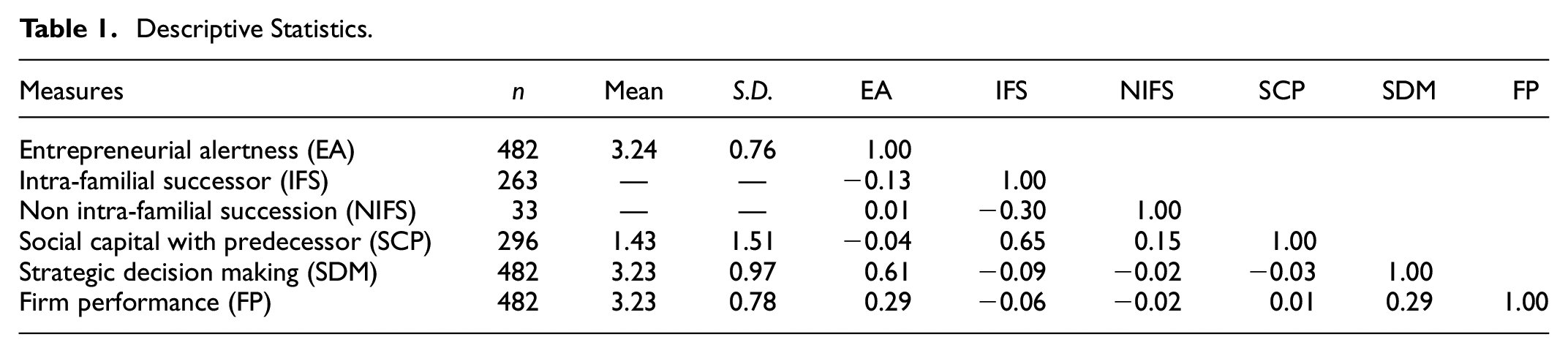
Table 1 presents descriptive statistics showing reliability estimates and correlation coefficient tables. As mentioned, the sample size for items such as EA, quality of strategic decision-making (SDM), and firm performance (FP) is 482. Regarding the attributes of managers other than founders, there are 263 intrafamilial business successors (IFS), whereas there are 33 non-intrafamilial business successors (NIFS). Concerning SCP, this item applies to a sample of 296 individuals, which excludes founders.
Descriptive Statistics.
Assessing the Validity and Reliability
The SEM model in this study showed a good fit for all items according to Hu and Bentler’s (1999) criteria (RMESA = 0.026, GFI = 0.980, CFI = 0.994, AGFI = 0.960, and NFI = 0.977).
As all constructs were obtained from the same respondents to study the relationship between SME managers’ EA, decision making, performance, and social capital, the effect of common method bias was a concern for this study. Herman’s single-factor test (Podsakoff & Organ, 1986) was used to examine the influence of common method bias. Exploratory factorial analysis identified three factors with eigenvalues higher than one. The factor that better explained the variance corresponds to 36.61% of the total. The results showed that common method variance was not a problem with the collected data.
Testing the Hypotheses
To test these hypotheses, this study employs SEM of the relationships between FP, SDM quality, EA, managerial attributes, and support from the predecessor. In particular, the study tests whether a positive relationship exists between the quality of EA, SDM initiatives, and FP (H1a, H1b, and H2); whether a negative relationship exists between intrafamilial succession and EA (H3); and whether support from previous generations of management positively moderates the relationship between intrafamilial succession and EA (H4).
As described below in Figure 1 and summarized in Table 2, all hypotheses are supported.

SEM model and results.
Hypotheses Testing Results.

First, EA not only has a positive effect on the quality of SDM (β = .615, p < .01) but also on firm performance (β = .169, p < .01), which supports H1a and H2b.
Second, the quality of SDM affects FP positively (β = .121, p < .01), which supports H2.
In addition, intrafamilial inheritance attributes affect EA negatively (β = -.450, p < .01), which supports H3.
Finally, SCP positively moderates the relationship between intrafamilial inheritance attributes and EA (β = .045, p < 0.1), which supports H4.
Discussion
This study explores the effect of the EA of SME managers on firms’ strategic decision-making and performance under high uncertainty.
The results show the importance of EA for SME managers by identifying the positive relationship between EA, the quality of SDM efforts, and FP. In particular, this study suggests that EA not only has a direct positive effect on FP, but also a secondary effect on the quality of SDM.
Few studies on EA focus on FP as they are concerned with entrepreneurs instead of managers (Patel, 2019; Tang et al., 2021). EA is a skill required by entrepreneurs to start their businesses. However, the need for EA is not limited to entrepreneurs. Many managers require the ability to identify business opportunities. Managers’ roles are even more important in SMEs with limited resources. Therefore, as the results of this study show, in SMEs, managers’ EA is essential to the growth and survival of the firm.
Many EA studies focus on the capabilities of individuals (Ma & Huang, 2016; Tang et al., 2021). However, other studies have suggested that examining new contextual factors for the antecedents of EA broadens theoretical perspectives (Adomako et al., 2018).
The results showed that intrafamilial succession affected EA negatively. Thus, founders who start a business are likely to demonstrate EA in the environment, even if it differs from that at the start of the business. Therefore, business succession in an uncertain environment can mean that firms face difficult situations. However, this study also found that SCP mitigates the negative relationship between intrafamilial succession and EA. In SMEs, this means that the manager’s role continues not only during their tenure, but also after handing over to their successor.
In a study of large publicly traded companies, top managers’ cognitive capabilities and characteristics played an important role in the interpretation of situations surrounding companies and decision-making. This is known as the upper-echelon perspective (Hambrick & Mason, 1984). One research stream from the upper echelon perspective is the elucidation of the black box of managerial cognition, which can be propelled by a concept integration approach with related research fields (Neely et al., 2020). There is room for further research to consider the results of this study, such as how managers’ cognition and decision-making tendencies are adjusted to business succession attributes and relationships with predecessors, such as chairmen and executive advisers, in large publicly traded companies.
This study was conducted on SMEs experiencing COVID-19 uncertainty. The analyses were set in the context of a crisis characterized by extreme uncertainty caused by a sudden pandemic. In such situations, making unconventional choices is important (Firfiray & Gomez-Mejia, 2021). The ability to quickly identify opportunities and recognize crises may not necessarily be the same. However, the results of this study indicate that EA affects SME management positively, even in crisis situations with high uncertainty. This finding suggests that EA, as a general cognitive ability, functions in different environments. In this respect, the results of this study successfully extend the findings of previous EA studies.
Conclusion
Theoretical Contributions
This study makes several theoretical contributions to the existing literature. First, it broadens the applicability of EA from ventures to SMEs, and possibly to wider settings. The significance of EA differs for newly established ventures and SMEs operating in established industries.
Second, previous EA literature often focuses on the role of EA in a phase of positive environmental change (e.g., Roundy et al., 2018) and does not analyze SMEs in crises caused by negative shocks. This study shows that EA can help firms survive in an environment of uncertainty caused by a specific negative effect.
Third, this study examined the factors that foster EA. It explored the effect of managers’ attributes on EA, such as whether succession has occurred, and what kind of succession has occurred. And this study revealed that this nuance of management and decision-making unique to family firms which were important for managers to evaluate business opportunities and employ effective strategies to enhance firm performance during uncertain times.
Beyond the context of the COVID-19 pandemic in which this study was conducted, uncertainty in the corporate environment is increasingly prevalent. In such circumstances, EA is crucial for managers to identify opportunities and build competitive advantage. Our findings offer valuable insights for researchers studying management in uncertain environments, and they can be applied to many future studies. Furthermore, the results of this study suggest potential avenues for interdisciplinary research, bridging fields such as strategic management, entrepreneurship, and small business studies.
Managerial Contribution
This study has implications for succession, which is a major problem for SMEs. Business succession is one of the most significant problems affecting firm survival in family firms. Various problems exist regarding SME business succession, such as a lack of successors, training of successors, and boarding after succession.
The results of the study also suggest that high EA is useful for SDM and FP in highly uncertain environments, whereas intrafamilial successor attributes affect EA negatively.
If there are candidates for successors in families, it is necessary to consider training from the perspective of making them aware of the need to cultivate EA to achieve high FP, not only in normal times but also in uncertain environments. Furthermore, given that the formation of social capital within a family has a positive moderating effect on EA, it is necessary to examine how the previous generation and surrounding family members can be involved in building official and/or unofficial structures to support current managers after succession.
This study analyzes SMEs and business succession in Japan, where the society is aging rapidly and the business succession situation is becoming increasingly serious. Thus, the findings of this study can offer suggestions not only for developed countries facing a similar type of business succession issue, but also for developing countries that may face it in the future.
Limitations and Implications for Future Research
This study captures only managers’ succession attributes. Future research should comprehensively examine the factors behind succession that influence EA. For example, the noneconomic aspects of businesses are emphasized in family businesses, which comprise most SMEs. However, whether these tendencies have been reinforced over time and/or generations has not yet been examined. Exploring these factors by setting moderator variables, such as years after succession, identifying generations, and/or combinations of them, can further elucidate the antecedents and mechanisms of EA.
In addition, although the hypotheses were constructed and tested based on the assumption of uncertain environments, comparisons with normal times were not performed. Moreover, although the possible effects of EA in this study are described as having more positive outcomes than normal times, intrafamilial business succession may not have a negative effect on EA under normal or stable conditions. This is because EA may be demonstrated during the preservation of SEW. An example would be practices that exploit business opportunities from SEW, such as inherited long-term relationships and local networks, which are not accessible to NIFS. The antecedents in this study, such as EA, intrafamilial business successor attributes, and social capital may be influenced by the context in which the firm is located. Therefore, to further elucidate these nuances, comparisons can be made between normal and crisis periods using longitudinal data.
Despite these limitations, the core concept of EA, which has a positive relationship with the quality of strategic decision making and firm performance, could have various managerial and theoretical implications. Focusing on the attributes of managers and social capital unique to family firms, this study investigates how these factors influence EA. These findings help to explore the antecedents of EA.
In H2 and H4, the antecedents of EA are examined in terms of factors unique to family firms, which account for most SMEs. These results indicate that intrafamilial successors may not be able to demonstrate EA because they prioritize socio-emotional values over rational and economic decisions. However, this study finds that this negative effect is positively moderated when social capital is developed. This feature is unique to family owned firms. For example, in large publicly traded companies, the predecessor’s influence is considered negative because the predecessor’s continued presence restricts the new CEO’s discretion (Quigley & Hambrick, 2012). However, family firms tend to have stronger relationships with their familial predecessors when their continued presence is perceived as a sign of dependability. The intrafamilial business successor attributes and social capital discussed in this study are specific to family firms. However, the nuances of management and decision-making unique to family firms are more significant.
Although the antecedents of EA remain room to be investigated further by identifying factors unique to family firms, this study provides further context for future exploration of this topic. Thus, EA may have a similar positive effect on firms under other types of disruption and uncertainty. In future research, analyzing EA under diverse scenarios could further elucidate the possible effects of managerial EA on firms.
The business environment of SMEs is becoming increasingly uncertain. SMEs with relatively scarce organizational resources are more likely to link managerial decisions directly to firm performance (Cao et al., 2010; Lubatkin et al., 2006). In this study, EA was used to describe the abilities required by SME managers. EA is mainly used in the context of entrepreneurs; however, the focus on SMEs in this study reveals that it could also be beneficial for SME managers. In particular, the finding that EA is influenced by nuances related to business succession and the challenges confronting many SMEs suggests that these conditions may be replicated in large publicly traded companies.
In previous literature and anecdotes, EA has been mostly considered an entrepreneurial trait and natural talent. As this study elucidates the antecedents and effects of EA, future theoretical considerations of EA would benefit from reconceptualizing EA and its antecedents as exploitable capabilities. Theoretical advances made by viewing EA as an exploitable capability of managers and introducing it in various contexts may lead to new practical knowledge on business succession, which is considered crucial for SMEs.
Footnotes
Declaration of Conflicting Interests
The author(s) declared no potential conflicts of interest with respect to the research, authorship, and/or publication of this article.
Funding
The author(s) disclosed receipt of the following financial support for the research, authorship, and/or publication of this article: This work was supported by Nihon M&A Center Inc. and JSPS KAKENHI, Grant Number JP20K13583.

Data Availability Statement
Data sharing not applicable to this article as no datasets were generated or analyzed during the current study.