




Abstract
Building on resource-based view (RBV) and contingency theory (CT), the purpose of this study is to explore how entrepreneurial alertness (EA) can promote entrepreneurial bricolage (EB), and then contributes to improving the new venture performance, with the environmental dynamism as the moderating variable. This study adopted a hierarchical regression analysis to test our hypotheses, using data from 463 founders of new ventures in China. The study found that: (1) EA has a positive effect on new venture performance, (2) EB mediates the effect of EA on new venture performance, (3) environmental dynamism (ED) moderates the relationship between EB and new venture performance, and (4) the mediating effect of EB is also moderated by ED. This article provides valuable and novel insights both theoretically and practically, that makes outstanding contributions to improving the performance of new ventures.
Plain language summary
Purpose: This study aims to explore how entrepreneurial alertness can promote entrepreneurial bricolage, and then contribute to improving the new venture performance, with the environmental dynamism as the moderating variable. Methods: We adopted a hierarchical regression analysis to test our hypotheses, using data from 463 founders of new ventures in China. Conclusions: Entrepreneurial alertness has a positive effect on new venture performance, entrepreneurial bricolage mediates the effect of entrepreneurial alertness on new venture performance, and environmental dynamism moderates the relationship between entrepreneurial bricolage and new venture performance. Moreover, the mediating effect of entrepreneurial bricolage is also moderated by environmental dynamism. Implications: This study (1) completes the theoretical model of how entrepreneurial alertness influences performance by studying the influence mechanism of entrepreneurial alertness on the performance in the context of new ventures, (2) provides novel insights to the entrepreneurship literature by investigating the mediating effect of entrepreneurial bricolage, and (3) contributes to strengthening the understanding of entrepreneurship process and expanding the knowledge base regarding contingency theory in the entrepreneurship field. Limitations: The cross-sectional data herein suggest that the conclusions may not reflect causality. Therefore, the dynamic model should be tested using longitudinal data in the future. This study focuses on the mechanism of entrepreneurial alertness on the performance in the context of new ventures, without considering the different stages of firm development, which should be tested in the future. CMV could still present a limitation, and future research should better control CMV via using questionnaires from multiple data sources.
Keywords
Introduction
Most start-ups faced with resource constraints and environmental uncertainty at an early stage (C. Wang & Zhang, 2022). How to identify valuable business opportunities and obtain the resources to achieve good business performance is still a difficult task. Building on the RBV, the capital such as tangible material and intangible knowledge information is the basis for organizations to acquire core competitiveness (Wernerfelt, 1984). Entrepreneurs positively seek available opportunities and resources to make the new ventures successful in the changing environment. It is necessary to integrate these resources to address new problems and exploit new opportunities (Baker & Nelson, 2005). Given the importance of resources acquisition, prior studies have suggested that firms should concentrate on acquiring resources. It is well known that acquiring resources from the external environment is difficult for new ventures, and the initial capital of start-ups often comes from their own savings or family support (De Clercq et al., 2013). Therefore, the crucial issue of new ventures is how to creatively recombine and exploit existing resources to ensure the entrepreneurial success (Senyard et al., 2014). However, how to strengthen the capability of integrating and reusing existing resources to promote new venture performance remains understudied. In this context, it is vital to explore the relationship between EA, EB and the business performance of new ventures in the dynamic environment.
Entrepreneurial activity is a process of value creation in which entrepreneurs creatively exploit resources to pursue new opportunities (C. Wang & Zhang, 2022). Under the circumstances of resource constraints, entrepreneurs often creatively recombine and exploit resources at hand by EB to deal with new problems and develop new opportunities (Baker & Nelson, 2005). It shows that EB is an important ability for start-ups to solve resource constraints and explore new opportunities to achieve profitability. According to RBV, the capital such as tangible material and intangible resouorce (knowledge and information) is the basis for organizations to obtain core competitiveness (Wernerfelt, 1984). Only when entrepreneurs are highly alert to resource information, can they timely and fully exploit existing resources. However, prior literature did not pay enough attention to the impact of EA on EB, especially in the context of new ventures. Therefore, this article reveals that EA can promote EB, and then contributes to improving the new venture performance.
In addition, CT points out that external environmental factors must affect the relationship between business activities and performance (Salancik et al., 1978). In recent years, the business environment of China is developing rapidly. In the early stage of entrepreneurship, start-ups usually have a strong dependence on the environment (Liu et al., 2019). In order to gain competitive advantage in a rapidly changing environment, start-ups must be able to redeploy resources and capabilities as needed to exploit new opportunities (Teece, 2018). Therefore, it is necessary to explore the moderating effect of ED on the path of EA affecting the performance of new ventures via EB.
To sum up, this study identifies three research gaps and makes the meaningful contributions to the research of entrepreneurship in three aspects. First, previous studies on EA mainly focused on exploring and explaining the process of opportunity identification (Kirzner, 1973), and paid less attention to the important role of EA in resource combination innovation. The theory of EA indicates that EA can be conducive to breaking the existing market equilibrium by introducing new resource combination to achieve a new equilibrium (Kirzner, 2009). Therefore, based on RBV and CT, this study systematically explores the influencing mechanism of EA on the performance of new ventures, regarding EB as the mediating role, expands the theories of EA, and complements and improves the theoretical model of how EA affects the performance of new ventures.
Second, most of prior studies have paid attention to the role of resource integration in the growth of enterprises, ignoring the value of the EB in the path of converting EA into performance in the context of new ventures. This study highlights the role of EB to promote to convert EA into performance. It contributes to providing a novel insight to understand the relationship between EA and the performance of new ventures.
Third, this study explores the moderating role of ED in the process of EB affecting the new venture performance, and reveals the moderating role of ED on the mediating effect of EB. Start-ups need to acquire and integrate resources to face the changes of the market environment and exploit new opportunities in the context of resource shortage. As a result, new companies face more difficulties than mature and large companies. However, the prior studies did not pay enough attention to the transformation mechanism between EA, EB and the performance of new ventures in the dynamic environment. CT indicates that the impact of corporate behavior on performance depends on external environmental factors. We introduced ED as a moderating factor, and EB is regarded as an important organizational behavior for new ventures to cope with the external environment and take strategies to solve the constraints and challenges caused by environmental changes. We contribute to strengthening the understanding of the strategy of improving new venture performance and enriching the theoretical value of CT in the field of entrepreneurship by verifying the moderating effect of ED on the relationship between firm behavior and performance in the context of new ventures.
Literature Review and Hypotheses Development
Entrepreneurial Alertness
The studies on EA are mainly based on two theoretical viewpoints, namely the EA theory of Kirzner (1979) and cognitive schema theory of Gaglio and Katz (2001). First, the EA theory holds that it is the ability to identify opportunities ignored by others without a deliberate search (Kirzner, 1979). Subsequently, some scholars verified Kirzner’s view through empirical research. From the perspective of information search behavior, Kaish and Gilad (1991) suggested that EA is the ability to put individuals themselves in the information flow, so as to maximize the possibility of encountering opportunities without deliberately looking for specific opportunities .
Second, based on the cognitive schema theory, Gaglio and Katz (2001) explained the conceptual model of EA and the process of opportunity recognition from the perspective of cognitive psychology. They suggested that EA is a cognitive ability, a dynamic and evolving cognitive model that can guide attention and information processing, and is highly sensitive to changes in the market environment. Entrepreneurs with cognitive schema show more acute market insight than others, constantly watching and searching for market imbalance. Subsequently, Baron (2006) proposed that EA is an individual’s cognitive ability of entrepreneurial opportunities. Individuals without EA cannot identify or create entrepreneurial opportunities, because they mistakenly judge the market environment and the current required behaviors (Baron, 2006).
EA is an important factor that distinguishes entrepreneurs from non-entrepreneurs (Baron, 2006). It is defined as an ability through which individuals can be more sensitive to the unnoticed environmental features and constantly explore new ideas (Kirzner, 1973, 1979). The scanning and search of information enable entrepreneurs to persist in trying to verify new ideas (Busenitz, 1996). EA is the ability to perceive information such as internal and external events of an organization, new market demands and resource combination, which can facilitate the entrepreneurs to find the links between seemingly irrelevant information, identify neglected market signals, and create products or services that can create business value (Baron, 2006). Therefore, entrepreneurs with high alertness show more acute market insight than others to creatively exploit new strategies to satisfy the market demands (Daniel et al., 2021).
From the perspective of information processing, J. Tang et al. (2012) proposed that EA consists of three dimensions: scanning and search; association and connection; evaluation and judgment. Scanning and search refers to constantly observing changes in the environment to explore new information, new changes and new transfers ignored by others. Association and connection involves the ability to integrate different pieces of information together and the tendency to combine coherent alternatives to these pieces of information. Assessment and judgment focus on whether the new changes or information are valuable, reflecting personal insight into the value of specific information overlooked by others.
Existing literature has focused on exploring the relationship between EA, opportunity identification and firm performance. Entrepreneurial activities include not only opportunity identification, but also many other important progresses, for example, resource combination and strategy decision (Timmons, 1999). Under the dilemma of resource constraints, new ventures must be alert to existing resources at hand to fully exploit their potential value (H. Wang et al., 2023). Based on the RBV, this study suggests that the research scope of EA should be expanded from opportunity identification to resource combination, so as to effectively solve the resource constraint problem of new ventures to exploit new opportunities. However, existing studies have paid less attention to the relationship between EA and resource combination. The purpose of this study is to explore how EA improves the performance of new ventures by promoting EB, and to provide theoretical basis and practical implications for solving the resource constraint of new ventures.
Entrepreneurial Alertness and New Venture Performance
Entrepreneurs with high alertness are more responsive to changes of the business elements in the market environment and have the ability to identify and predict the consequences of future events (Roundy et al., 2018). Therefore, compared with individuals with low EA, they can perceive highly accurate, predictable and innovative business components, and quickly adjust, update and fine-tune their entrepreneurial actions and business strategies (Fatoki & Oni, 2015), which will have a positive impact on business performance.
First, strong scanning and search capabilities of information enable entrepreneurs to respond quickly and flexibly when the balance of the market environment is changing (Roundy et al., 2018). It is because the reactions of high-alertness entrepreneurs tend to be intuitive, instinctive and flexible (Neneh, 2019), and they don’t need to participate in all the cognitive steps of design strategy analysis (Roundy et al., 2018). It allows them to make decisions faster than the others using traditional assessment and classification systems. It can help entrepreneurs acquire competitive advantage and better performance over their competitors by leveraging proactive advantage (Baum & Wally, 2003). Second, association and connection help entrepreneurs acquire new information, creatively and logically make extensions of knowledge structures (J. Tang et al., 2012). It allows connections to be made between new stimuli in the environment and the existing knowledge and experience in the entrepreneur’s cognitive structure to find the connections between seemingly irrelevant events (Roundy et al., 2018). They are then able to react proactively than their competitors (Ardichvili et al., 2003), and successfully create new businesses (Baron, 2006). Finally, evaluation and judgment is a filter of information, which reflects an individual’s insight into the valuable information ignored by others (Reed, 2004). It allows entrepreneurs to select valuable information for themselves from multiple possibilities (Yu, 2001), and have a higher probability of success (J. Tang et al., 2012). Then, entrepreneurs could search for the resources which are conducive to business performance using the new information. To sum up, EA could affect the performance of new ventures positively. Therefore, the following hypothesis is proposed:
H1: EA has a positive impact on the new venture performance.
Entrepreneurial Alertness and Entrepreneurial Bricolage
In 1967, Lévi-Strauss proposed the concept of bricolage, which explains many of the behaviors observed in the small businesses that are able to create something from scratch using material, social or institutional elements that other businesses refuse or ignore. Most start-ups are characterized by severe resource constraints. In order to survive or even thrive, new ventures need to solve problems and exploit opportunities with limited resources, and EB is defined bricolage as the process of dealing with new problems and opportunities by combining resources at hand in a resource-poor environment (Baker & Nelson, 2005).
The definition of bricolage consists of three elements. (1) It is to use the resources at hand, rather than to look for new ones. EB aims to help SMEs explore new opportunities by using the resources at hand to overcome resource acquisition difficulties due to “new” and “small” problems (Guo et al., 2016). (2) It is to recombine and reuse resources for new targets, rather than using them as originally planned. It emphasizes that companies can create innovations that are not foreseeable and can improve outcomes (Wu et al., 2017). (3) It is to take “expedient” (making do). This means that people tend to take action and actively participate in solving problems (the resources at hand can create viable results; Baker & Nelson, 2005).
The RBV indicates that new businesses compete with other organizations based on their own resources and capabilities (Barney, 1991). EB contributes to recombining resources for firm growth of new ventures (Baker & Nelson, 2005). Therefore, being alert to resource-related information in the environment is pivotal to successful entrepreneurship. However, it is often difficult for new enterprises to acquire abundant resources from the external environment (De Clercq et al., 2013), and they need to recombine resources at hand through EB to solve new problems and exploit new opportunities (Baker & Nelson, 2005). EA can promote resource recombination and reuse creatively and indicate the direction of new business development (Allinson et al., 2000). Therefore, EA helps to create causal links between resources and the services those resources can provide, which will improve resource exploitation and promote EB.
The scanning and search abilities help start-ups to have a broader understanding of internal and external information (J. Tang et al., 2012). Scanning and search is often the first step to solve a problem. Only by fully understanding what resources are available in the business (e.g., discarded resources that may be useless by others), can new ventures take proactive actions, actively solve problems, and reuse resources at hand to create feasible results (Maitlo et al., 2020). New resource combinations need to be matched with identified opportunities to find the most valuable way to exploit opportunities. Association and connection enables entrepreneurs to connect new stimuli with existing knowledge and create and extend the link logic between different information (J. Tang et al., 2012). It will be conducive to creating the most valuable resource combination, improving the EB power. Furthermore, evaluation and judgment can filter out invalid information (J. Tang et al., 2012), which helps entrepreneurs to find valuable resource combination as soon as possible in the experiments of recombining the resources to promote opportunity exploitation. Therefore, the following hypothesis is proposed:
H2: EA has a positive impact on EB.
The Mediation of Entrepreneurial Bricolage
Scholars revealed that alertness can encourage entrepreneurs to identify environmental patterns, integrate information and participate in social interactions (J. Tang et al., 2012), which strengthens the competitiveness of enterprises and may affect business performance positively (Saarikko et al., 2014). It is important to explore how the EA converts into business performance. According to the RBV, start-ups compete with other organizations based on their own resources and capabilities (Barney, 1991). EB is a pivotal ability for enterprises to exploit resources as much as possible (Senyard et al., 2014). In the case of resource shortage, entrepreneurs can provide unique services by reorganizing the resources at hand, and then increase the knowledge base of enterprises to solve the problem of resource shortage (Cunha et al., 2014), finally to realize new opportunities and solve new problems (Yu et al., 2020), and strengthen the business value creation (Di Domenico et al., 2010). Therefore, in the path of EA to the performance of new ventures, EB plays an important role.
EA can help entrepreneurs to identify and exploit different resources, and promote business innovation (Allinson et al., 2000). EA can promote entrepreneurs to quickly identify environmental changes and discover potential connections between seemingly irrelevant information (J. Tang, 2008). These environmental information includes not only information related to opportunities, but also information related to resource exploitation (Chavoushi et al., 2021). That is to say, high EA enables entrepreneurs to establish causal links between each different business element, which will improve the level of resource utilization by entrepreneurs. Start-ups create products or services to existing markets with unique selling proposition, or create new markets by leveraging different combinations of resources (Salunke et al., 2013). In the context of new ventures, EB provides a new, effective and creative way to reuse resources (Baker & Nelson, 2005). Through reuse and combination of existing resources creatively, EB contributes to breaking organizational inertia and exploiting resources in the maximum efficiency (Baker & Nelson, 2005). Then new ventures would satisfy the market demands to improve business performance (Hooi et al., 2016). That is, EA can promote opportunity exploitation by facilitating EB (Witell et al., 2017), and be conducive to acquiring good performance (Senyard et al., 2014). Therefore, the following hypothesis is proposed:
H3: EB plays a mediating role between EA and new venture performance.
The Moderation of Environmental Dynamism
ED reflects the changing speed of consumer demand and the intensity of competition faced by enterprises in the market (Dess & Beard, 1984). Based on the RBV, the external environment is a pivotal condition for successful resource management (Burns & Stalker, 1962). As the business environment becomes unstable and uncertain, firms must be able to respond to market changes quickly (Baron & Tang, 2011). Especially for new ventures, the crucial condition to successful entrepreneurship is to effectively respond to changes in the dynamic environment, satisfy the consumer demands ahead of competitors and adapt to new technological changes. EB helps start-ups achieve good performance in a highly competitive environment through restructuring and reuse of existing resources (Senyard et al., 2014).
A highly dynamic environment makes firms spend more resources to monitor market changes (Park & Ryu, 2015). In a highly competitive environment, it is difficult to acquire resources (Zhang et al., 2023). Therefore, it becomes essential to understand market trends and avoid extensive and long-term waste of resources (Lumpkin & Dess, 2001). By reorganizing and reusing existing resources, new ventures could avoid wasting time in searching for and waiting for external resources. It helps to satisfy customer demands in a dynamic environment and adapt to the rapid change of technological change, so that new ventures are able to succeed (Baker & Nelson, 2005). However, when the ED level is low, entrepreneurs can accurately predict customer demands and competitor behavior by using existing experience and existing corporate behavior rules (Liao et al., 2008), without more exploratory and creative behaviors (C. Wang & Zhang, 2022). Furthermore, in a relatively stable environment, the existing operation ability of firms is sufficient to satisfy customer demands, acquire higher profits and competitive advantages (D. Y. Li & Liu, 2014). Therefore, the following hypothesis is proposed:
H4: ED plays a positively moderating effect in the relationship between EB and the new venture performance.
Many firms are faced with severe resource shortage in the early stage of entrepreneurship (Aldrich, 1999). In a dynamic environment, EA enables entrepreneurs to evaluate environmental changes in a cognitive way different from others, and discover potential connections between seemingly irrelevant information (J. Tang, 2008). Deep understanding and correct interpretation of environmental information can help start-ups to connect and combine different resources through EB. Then, by creative reuse and combination of existing resources, EB contribute to dealing with unexpected complex challenges and exploit opportunities, thus improving business performance (Senyard et al., 2014).
When the ED is high, the loss of resource advantage and the risk of existing market segments increases. Therefore, in a dynamic environment, the companies need to quickly identify and interpret information (C. Wang & Zhang 2022), flexibly and efficiently restructure resources to reduce production costs and time, and satisfy consumer demand (Baker & Nelson, 2005). However, as the dynamics of the environment increases, the business environment changes faster, and the correlation between the information becomes blurred. In this context, the advantages of EA are fully utilized. Entrepreneurs with high alertness are more aware of environmental changes, and can identify the underestimated products or factors of production in specific markets (J. Tang et al., 2012). Their high information search, association, and evaluation capabilities facilitate the identification and exploitation of resources and opportunities in the environment (J. Tang, 2008). In order to obtain good business performance, entrepreneurs with high alertness will actively exploit the available resources and their combinations, which facilitates EB. Further more, EB promotes the creative integration of existing resources by new ventures, so that they can exploit new opportunities in time in the context of scarce resources, and improve business performance (Senyard et al., 2014). In other words, high ED promotes the transformation of EA to the business performance via EB in the context of new ventures.
On the contrary, in a stable environment, existing products and services can meet consumer demands, and entrepreneurs do not need to change their understanding of the environment and entrepreneurial behavior frequently (Schmitt et al., 2018). The advantage of EA cannot be fully exploited, and its positive effect on EB will be weakened, so the mediating effect of EB on the relationship between EA and new venture performance will be weakened. In addition, in a stable environment, the demand for exploitation of new opportunities is not urgent, and the effect of EB on business performance will be diminished. In other words, a stable environment weakens the convert relationship between EA, EB and the performance of new ventures. Therefore, the following hypothesis is proposed:
H5: Environment dynamism positively moderates the mediating role of EB in the relationship between EA and new venture performance.
In conclusion, building on the RBV and CT, we conducts a moderated mediating model in which EA affects new venture performance through EB, and whether these effects hold up depends on the ED. Figure 1 depicts the theoretical relationships among these variables.

Conceptual framework.
Sample and Methodology
Sample and Data Collection
Questionnaires were collected for 4 months from October 2022 to January 2023. This study explores how EA affects the performance of new ventures in China. Many scholars regard 8 years as the dividing line between a new venture and a mature one, and suggest that a new venture refer to an enterprise that has been established for less than 8 years (Lin et al., 2018; T. Wang et al., 2017; C. Wang & Zhang, 2022; Zahra et al., 2002). Therefore, this study selects entrepreneurs or core members of entrepreneurial teams who have established new enterprises for less than 8 years as research objects. In addition, in the context of new ventures, entrepreneurs are usually the strategy decision makers, and personal factors have an impact on corporate behavior and performance (Osiyevskyy & Dewald, 2015). Therefore, this study explores the influence mechanism of EA on the performance of new ventures by investigating the data of entrepreneurs at the individual level.
According to the difference in the development of economic, social and cultural in the different regions of China, we conducted a survey in twelve provinces or municipalities. We selected Beijing, Shanghai, Guangdong, and Jiangsu because they are economically developed regions. And they have rapid economic growth and high level of entrepreneurial activity. The economic growth and entrepreneurial activity of Liaoning, Heilongjiang, Fujian, and Jiangxi are at a medium level, while Jilin, Guizhou, Shanxi and Ningxia provinces are relatively slow in economic development and entrepreneurial activity. First, we acquired a list of new ventures via the Federation of Industry and Commerce, Small and Medium Enterprise Bureau, Entrepreneurship Park and entrepreneurship training institutions we cooperated with. Second, part of the list of entrepreneurs was obtained through local alumni associations. Third, samples were collected in a snowballing manner using the research team’s own network. After sorting out the contact information of the samples, the questionnaire was sent out in two ways: first, online questionnaire filling links were sent to the respondents through E-mail, wechat, QQ, and other tools; second, we visited local Entrepreneurship Park to conduct field research and paper questionnaires were distributed. All the questionnaires were filled in anonymously, and the research purpose was explained to the respondents in the guidance or on site and the confidentiality of the research results was emphasized. Finally, 982 questionnaires were distributed and we collected 463 valid questionnaires, yielding a valid response rate of 47.15%.
Table 1 summarizes the characteristics of entrepreneurs and firms. We only studied the new ventures that have been in business for less than 8 years. As the data shows, 51.62% of subjects were male and 48.38% were female, which indicated that the ratio between male and female is balanced in this research. In terms of age, the younger groups (less than 35 years old), accounting for 69.76%, were more heavily represented than the older age groups (more than 35 years old), which is similar to the Global Entrepreneurship Monitor (GEM) 2022/2023 Global Report (https://www.gemconsortium.org/reports/latest-global-report). At education level, the entrepreneurs with bachelor’s degree or equivalent education (44.49%) account for the largest proportion, followed by master’s degree or above, accounting for 26.35% of the total sample, which may have been related to how the questionnaire was distributed. Additionally, 65.66% of respondents have previous entrepreneurial experience, indicating that nearly two-thirds of respondents are serial entrepreneurs. At organizational level, slightly nearly one-third (33.26%) of the firms had been established for 1 to 3 years, and another one-third (32.61%) of firms were for 3 to 6 years, while 17.93% had been established for less than 1 year, and 16.20% for 6 to 8 years. In this study, firms with 11 to 50 (38.44%) and 51 to 100 (37.15%) employees accounted for the largest proportion. In terms of industry, 33.69% were service sector, followed by high-tech industry and manufacturing industry, accounting for 27.65% and 21.60%.
Sample Characteristics.

Measurements
All scales were scored by 7-point Likert scale, ranging from 1 (strongly disagree) to 7 (strongly agree). First, we adopted a Chinese version of the questionnaire translated from English translators. Second, we invited one management professor, three management doctoral students and six entrepreneurs to evaluate the Chinese version of the questionnaire. Finally, we revised the initial version of the questionnaire to ensure its reliability and validity.
Most scholars used subjective measurement to measure the performance of new ventures (Adomako et al., 2018; Boso et al., 2019; Dai et al., 2019; Hernández-Perlines et al., 2021; Robertson & Chetty, 2000; Z. Tang et al., 2010). It is because to acquire objective financial data of start-ups is difficult (H. Li et al., 2005). Therefore, subjective performance indicators have been widely used in previous studies (Wiklund & Shepherd, 2005). In addition, prior studies have found a strong correlation between managers’ self-report and internal performance indicators (Dess & Robinson, 1984). Therefore, we measured new venture performance using seven items, such as retained profits, ROI, sales growth, market share growth, innovative products quantity and customer satisfaction (Dai et al., 2019; Z. Tang et al., 2010).
EA refers to the study of Boso et al. (2019) and J. Tang et al. (2012), which includes eleven items. Following Senyard et al. (2014), EB focuses on “making do,”“using the resources at hand,” and “recombining the resources to solve new problems and exploit opportunities.” Similarly, adapted from Dess and Beard (1984) and Jiao et al. (2013), we measured ED using five items (see Table 2).
Constructs, Reliability, and Validity.

Considering that previous studies have suggested that particular entrepreneur’s and firm’s characteristics, such as gender, age, education level of entrepreneurs, entrepreneurial experience and experience openness, social net work, business size, firm age and industries, may influence business performance (Hernández-Carrión et al., 2017; Shane & Cable, 2002; Zahra et al., 2002), and we controlled these variables. Firm age was measured by the years that a firm had been established (“1” = ≤1 years, “2” = 1–3 years, “3” = 3–6 years, “4” = 6–8 years). Firm size was divide into five levels (“1” = ≤10 employees, “2” = 11–50 employees, “3” = 51–100 employees, “4” = 101–200 employees, “5” = ≥200 employees). Business area was divided into five areas. Experience openness was measured following McCrae (1987) and Donnellan et al. (2006) using five items. Similarly, following Hernández-Carrión et al. (2017), social network was measured using four categories: (a) personal network, (b) association network, (c) professional network, and (d) institutional network.
Reliability and Construct Validity
We adopted SPSS 22.0 and Amos 21.0 software to calculate data. The constructs, reliability and validity of the measurements is shown in Table 2. The threshold of all measurements exceeded 0.7, and the CR (composite reliability) of all measurements exceeded 0.8, showing that the reliability of each scale was sound. The AVE of all scales exceeded 0.5, showing that the convergent validity was good. Further, the CFA indicated that there is a good fit between the observed data and the hypothetical scale (χ2 = 606.845, df = 425, χ2/df = 1.428, P < 0.001, CFI = 0.977, TLI = 0.979, RMSEA = 0.031), which shows that the discriminant validity was good (see Table 3). As shown in Table 4, the correlation between the two latent variables is less than the square root of the AVE, which shows that the discriminant validity was sufficient.
Results of Confirmatory Factor Analysis for Measured Variables.
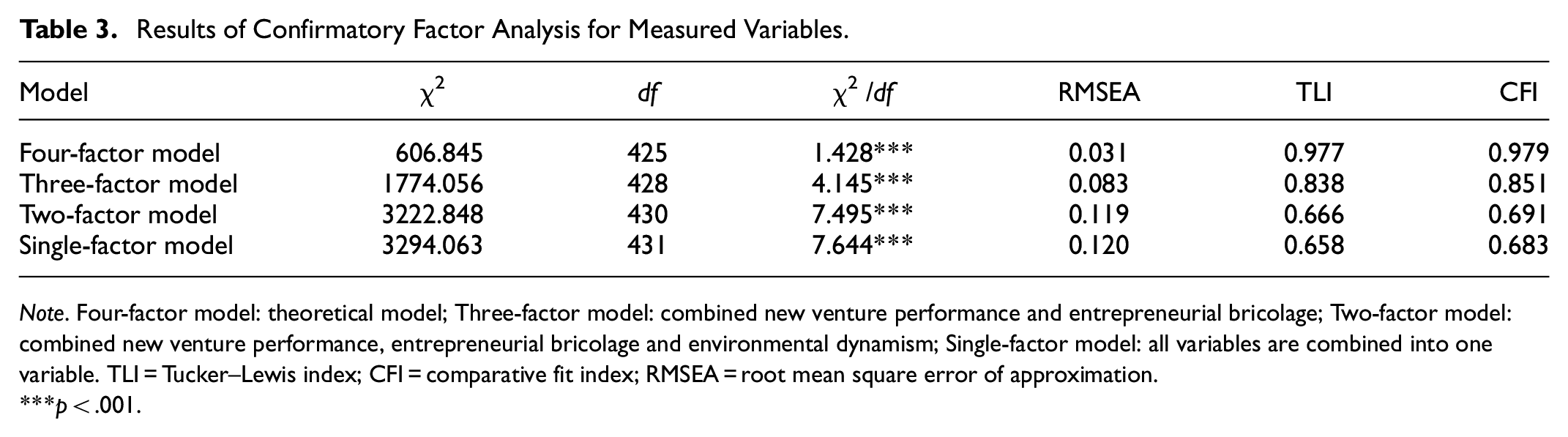
Note. Four-factor model: theoretical model; Three-factor model: combined new venture performance and entrepreneurial bricolage; Two-factor model: combined new venture performance, entrepreneurial bricolage and environmental dynamism; Single-factor model: all variables are combined into one variable. TLI = Tucker–Lewis index; CFI = comparative fit index; RMSEA = root mean square error of approximation.
p < .001.
Non-Response Bias t Test.

Common Method Variance Test
We adopted two actions to prevent and reduce common method variance (CMV; Podsakoff et al., 2003). First, we adopted anonymous filling, made items reversed, and randomized item order to reduce CMV. Second, we used Harman’s one-factor test to test CMV. The results showed that the largest component explained 31.261% of the variance, and no more than half of the explanation. Third, we performed a CFA test to further examine CMV (see Table 3). The single-factor model indicated that all items were linked to a single factor, and the result showed that the observed data did not fit well the alternative model (χ2 = 3,294.063, df = 431, χ2/df = 7.644, P < 0.001, CFI = 0.683, TLI = 0.658, RMSEA = 0.120). Finally, the single-common-method-factor model showed that the results (χ2 = 1,460.471, df = 400, χ2/df = 3.651, p < 0.001, CFI = 0.883, TLI = 0.864, RMSEA = 0.076) were acceptable, but poorer than the theoretical model. Therefore, the results suggested that there was not a serious problem about CMV.
Non-response Bias Test
In this study, we collected 537 valid questionnaires out of 982 questionnaires sent out, with a recovery rate of 54.68% and a non-response rate of 45.32%. Considering that low response rate may cause non-response bias, the non-response bias test was conducted. According to Zhou et al. (2020), we assumed that the last group of respondents are highly similar to the non-respondents. Therefore, the top 25% and the bottom 25% of respondents are compared by independent sample t test in the reply samples for significant differences using different organizational characteristics, including industry, firm size and firm age. When variance was homogeneous, the results show that all t-values were not significant at the 0.05 level (see Table 4). Therefore, the non-response bias was not significant.
Analysis and Results
Table 5 lists descriptive statistics and correlations for all the key variables. Then we used a hierarchical regression analysis to test our hypotheses (see Table 6). Hierarchical regression can reveal the changes of the model after adding new variables. In this study, variables were added one by one to observe the change of regression results. Through the comparison between the models, the results indicated the effects of EA, EB, and ED on the performance of new ventures. R2 shows the explanatory power of the representative model, and when R2 is larger, the new model is more powerful in explaining the results of the study. The largest variance inflation factor in the regression analysis was <3, which indicated the multicollinearity problem was not a serious. We adopted Model 1 and Model 3 to test the influences of all control variables on EB and new venture performance. The results show that entrepreneurial experience, institutional network and experience openness have significant impacts on EB. Compared with firms established less than 1 year, firms established 1–3, 3–6, and 6–8 years all have significant positive impacts on EB. The results show that educational experience, entrepreneurial experience, personal network, and experience openness have significant impacts on new venture performance. Compared with the manufacturing industry, the agricultural industry has a significant positive impact on new venture performance. Compared with firms established less than 1 year, firms established 1–3, 3–6, and 6–8 years all have significant positive impacts on the performance of new ventures. Compared with firms with less than 10 employees, firms with 51 to 100 employees and 101 to 200 employees have significant positive impacts on the performance of new ventures.
Correlation Analysis Results.

Note. NVp = new venture performance; EA = entrepreneurial alertness; EB = entrepreneurial bricolage; ED = environmental dynamism; OE = openness of experience; PEN = personal network; ASN = association network; PRN = professional network; INN = institutional network.
p < .001. **p < .01. *p < .05.
Regression Results.

Note. EA = entrepreneurial alertness; EB = entrepreneurial bricolage; ED = environmental dynamism; PEN = personal network; ASN = association network; PRN = professional network; INN = institutional network; OE = openness of experience.
p < .05, **p < .01, ***p < .001.
In Model 4, we added the independent variable (EA). The finding indicates that EA had a significant positive impact on new venture performance (β = .391, p < .001). Thus, H1 was supported. The R2 values for Model 4 was .604, indicating that Model 4 explained 60.4% of the total variance in the dependent variable. In Model 2, we added the independent variable and found that EA had a significant positive impact on EB (β = .350, p < .001). Thus, H2 was supported. The R2 values for Model 2 was .233, indicating that Model 2 explained 23.3% of the total variance in EB.
Then we tested the mediating effect of EB in Model 6. When including EB in Model 6, the impact of EA on new venture performance was reduced (β = .310, p < .001), and the EB has a positive impact on new venture performance (β = .233, p < .001). By bootstrap analysis, the coefficient of mediation effect was 0.116, and the confidence interval was [0.072, 0.169], and the zero was not included within the confidence interval, indicating that the mediation effect was significant. The results indicates that EB plays a partial mediating role in the relationship between EA and new venture performance, and H3 was supported.
In addition, to verify the moderating effect of ED on the relationship between EB and new venture performance, we conducted Model 8. The result suggests that the interaction of EB and ED has a significantly positive effect on new venture performance, indicating that ED significantly strengthened the relationship between EB and new venture performance (β = .208, p < .001). It is consistent with the view of Walter and Block (2016) that entrepreneurship requires more persistence and technical ability in a highly dynamic environment. Therefore, the positive relationship between EB and new venture performance will be strengthened when the ED level is high, and H4 was supported.
Furthermore, we depicted the moderating effects of environmental dynamics using mean ± 1 SD for the variables (see Figure 2). The picture shows that the environmental dynamism enhanced the positive relationship between the EB and the new venture performance, supporting H4.

Moderating effect of environmental dynamism.
To verify the moderated effect of ED on the mediating effect of EB, we constructed a moderated mediating effect model. Drawing on the study of Preacher and Hayes (2008), we used the PROCESS plug-in of SPSS to test the moderated mediating effect. We divided ED into three levels according to mean ± 1 standard deviation. At different level of ED, we verify the indirect influence of EA on new venture performance. The results suggest that ED significantly positively moderates the mediating effect of EB on the relationship between EA and new venture performance. The effect index is 0.079, and the confidence interval is [0.050, 0.118], which does not contain zero (see Table 7). Thus, H5 was supported.
Test of Moderated Mediating Effect.

Robustness Test
A robustness test can examine the results’ stability. First, we virtualized EA according to the median of 5.500, and we make the hierarchical regression analysis again. The results show that the all hypotheses were still true. Second, we adopted the Bootstrap method to verify the mediating effect of EB and moderating effect of ED (Hayes, 2013), and the conclusions were consistent with the original results. Third, we only used the data which are <6 years (237 cases) and <3 years (388 cases) to test the entire model, and the theoretical model did not change.
Discussion
As the Figure 3 showed, the hypotheses of this study were all tested. The results were discussed in detail as follows:

The theoretical framework of the results.
First, EA positively promotes the performance of new ventures (β = .391, p < .001). Entrepreneurs with high alertness are more likely to recognize environmental changes, process information, and engage in social interactions (McMullen & Shepherd, 2006). They are able to search and scan information widely and discover the market changes in the environment. Then, entrepreneurs creatively combine and use various business elements and environmental resources to exploit business opportunities, thus improving the growth, innovation and the performance of new ventures. It is consistent with Roundy et al. (2018), where EA strengthens the entrepreneurial activities and competitiveness of enterprises, thus having a positive impact on business performance.
Second, EA has a positive impact on EB (β = .350, p < .001). EA can promote entrepreneurs to analyze and identify resources in the internal and external environment, and help entrepreneurs to actively respond to resource problems. When the EA is high, entrepreneurs are highly sensitive to the crucial characteristics of resources and can quickly and accurately find subtle connections between resource elements in fuzzy situations (Neneh, 2019), and establish causal connections between resources and the services they can provide, thus improving the EB. The results support the view of Allinson et al. (2000) that EA can help entrepreneurs restructure and reorganize different resources, point out the direction for enterprise development, and promote business innovation.
Third, EB plays a mediating role in the relationship between EA and performance (Indecx = 0.116, CI [0.072, 0.169]). When including EB in Model 6, the impact of EA on new venture performance was reduced from 0.391 (p < .001) to 0.310 (p < .001), and the EB has a positive impact on new venture performance (β = .233, p < .001). It indicates that entrepreneurs with high alertness have a strong ability to search, connect and evaluate information and resources in the environment, which is helpful to improve the accuracy and effectiveness of EB. The research results support the view of Senyard et al. (2014) that EB can strengthen the value creation of enterprises. By improving the EB, entrepreneurship alertness can promote the resource recombination to create value and gain competitive advantage. Furthermore, EB creates more knowledge and interpretation of how to recombine and reuse the existing resources, which helps organizations exploit resources to generate new products and services to improve business performance (Senyard et al., 2014).
Fourth, ED positively moderates the relationship between EB and the performance of new ventures (β = .208, p < .001). Consistent with Walter and Block (2016), we found that entrepreneurs usually need more skills and abilities to deal with dynamic environments than stable ones. EB enables enterprises to cope well with the challenges brought by environmental changes. There are more diverse opportunities in the changing environment, which facilitates the entrepreneurs to participate in entrepreneurial activities. Start-ups with high EB are able to create new solutions to deal with unstable challenges and opportunities and improve business performance. It is because in a dynamic environment, flexible responses and improvisational EB enable enterprises to respond more quickly to the challenges of environmental changes and market demand changes (Baker et al., 2003). Therefore, ED strengthens the positive effect of EB on the performance of new ventures.
Furthermore, ED positively moderates the mediating effect of EB on the relationship between EA and start-up performance (Indecx = 0.079, CI [0.050, 0.118]). A changing environment contains more diversified information, which brings more intense competition to start-ups (Schmitt et al., 2018). To promote the development of start-ups and acquire competitive advantages, the managers need to strengthen the ability of scanning and connecting environmental information. Then, new ventures have to creatively combine the existing resources to exploit new products or services through EB. Therefore, it will satisfy the ever-changing demands of consumers, which will generate good business performance. Therefore, in a dynamic environment, the mediating role of EB in the relationship between EA and new venture performance would be enhanced.
Conclusions
This study suggests that converting EA into performance of new ventures via EB depends on moderating effect of ED. Using the hierarchical regression analysis to analyze 463 founders of new ventures in China, the results show that: EA has a positive effect on new venture performance. EB mediates the effect of EA on new venture performance. ED moderates the relationship between EB and new venture performance. And the mediating effect of EB is also moderated by ED.
Theoretical Contributions
First, this study highlights the effect of EA on new venture performance. Prior studies have found that EA plays a crucial role in the development of entrepreneurship theory (Zahra, 2007). The results of this study support this view that EA has a pivotal influence on resource combination. This study completes the theoretical model of how EA influences performance by studying the influence mechanism of EA on the performance in the context of new ventures.
Second, prior studies have primarily investigated the relationship between EA and firm performance from the perspective of opportunity identification. In the process of entrepreneurship, opportunity and resources are inseparable (Timmons, 1999). Therefore, consistent with the Timmons (1999) view, we verified the mediating effect of EB between EA and performance. It is necessary for new ventures to combine and use resources to exploit new opportunities. Specifically, entrepreneurial activity takes place when entrepreneurs are willing and able to acquire and combine resources to exploit opportunities as they are identified. Therefore, entrepreneurs need to be alert to any information in the environment that could be conducive to combining resources and exploiting opportunities. Prior literature has paid less attention to how EA influences the performance through resource combination. This study highlights the importance of EB between EA and new venture performance, which contributes to expanding the knowledge base regarding the relationship between EA and the performance of new ventures.
Third, this study enriches the entrepreneurship literature by exploring the contingency factor of ED in the process of converting EA into business performance of new ventures. ED is a situational variable that reflects changes in market or consumer preferences, technological updates, changes in competitors’ behaviors, and fluctuations in product demand and material supply. To achieve a better performance, entrepreneurs need to cope with new problems and challenges caused by dynamic environment through EB (Baker & Nelson, 2005), and EA can effectively promote EB. Although prior literature pays much attention to the influence of external environmental factors on entrepreneurship, the explanation of external environment on the mechanism of entrepreneurship process is not clear. We found that ED positively moderates the relationship between EB and performance. Moreover, it is worth noting that ED positively moderates the mediating effect of EB on the relationship between EA and performance. When the environment is highly dynamic, the impact of EB on the performance of start-ups is stronger, and the mediating effect of EB is also enhanced. In order to achieve a better performance, new ventures should strengthen the effect of EA on EB to combine and exploit the existing resources in the context of resource constraint.
Practical Implications
This study has three practical implications. First, EA promotes the new ventures to exploit opportunities to achieve a better performance. EA empowers entrepreneurs to acquire new information about resource combination to exploit new opportunities and deal with the new challenges. Because improving their EA can allow entrepreneurs to scan and search information more widely, identify subtle connections between different information, evaluate and judge the value of information, entrepreneurs should strive to improve EA. For instance, entrepreneurs should cultivate strong social networks to expand information sources, participate in entrepreneurship education and training actively, and establish communication mechanism in the organization and with the stakeholders to identify new opportunities and combine any resources they can use.
Second, we find that EB has a positive mediating effect between EA and the performance of new ventures. Start-ups are usually faced with the dilemma of resource constraint, which leads to the restriction of production and operation. Meanwhile, opportunities in the market are fleeting. Therefore, new ventures should exploit the existing resources adequately to convert new opportunities into financial performance. In the context of new ventures, existing resources should be creatively combined and used to create value. For example, resources that have been ignored, eliminated, damaged or thought to have only a single function can be given new functions, and worthless or even negative resources can be turned into valuable resources. In addition, allowing and encouraging the employees to use amateur and self-taught skills to create useful services. We find that EA could improve the resources bricolage to acquire the good performance. Therefore, entrepreneurs should pay attention to improving the alertness to resource recombination, which will facilitate the development and exploitation of opportunities.
Third, the indirect effect of EA on new venture performance via EB depends on ED. Specifically, EB would lead to the better performance, and EA would be converted into better performance via EB when the environment dynamism is high. Therefore, entrepreneurs and managers should not only develop their own and organizational cognitive and information processing levels, but also establish management mechanisms to cope with environmental dynamics. Dynamic environment brings high risks and opportunities. New ventures should exploit the resources at hand to deal with the challenges in the environment and convert the opportunities into business economic benefits. In addition, entrepreneurship education and training can improve the EA. Public policymakers should strive to promote the development of entrepreneurship education and relevant services supporting innovation and entrepreneurship. It would help entrepreneurs improve their alertness to the changes of market, and strengthen the entrepreneurs’ confidence and intention to start their own businesses, which will help promote the development of innovation and entrepreneurial activities in China.
Limitations and Future Research
There are three limitations in this study, but it provides directions for future research. First, this study used the cross-sectional data and the conclusions may not reflect causality. Therefore, the dynamic model should be tested using longitudinal data in the future. We should collect data at different time-points to track the dynamic changes of business performance of new ventures. Thus, it is more clear to understand the regular pattern of how the change of independent variable and mediating variable causes dynamic change of business performance. Second, this study focuses on the mechanism of EA on the performance in the context of new ventures, and has not yet explored how EA affects the development of business performance in the context of different stages of enterprise development. However, the impact of EA on firm performance may change at different stages of firm development (Adomako et al., 2018). Enterprises at different stages differ in their ability to acquire resources, identify, and exploit opportunities. Therefore, future research should verify how EA influences firm performance at different stages of firm development. Third, despite using different methods to prevent and test CMV, it could still be one problem. Thus, the study should better control CMV via using questionnaires from multiple data sources in the future.
Footnotes
Acknowledgements
We would like to thank the Fundamental Research Funds for the Central Universities (2412022QD021), the Social Science Found of Jilin Province (2023C51), the Special Project on the Fundamental Research Fund of Jilin University (2022ESD04), the Special Research Project of Northeast Revitalization and Development Institute of Jilin University (23dbzx04), the Social Science Found of Jilin Province (2023C55), and the Social Science Found of Jilin Province (2022C58) for supporting this research.
Declaration of Conflicting Interests
The author(s) declared no potential conflicts of interest with respect to the research, authorship, and/or publication of this article.
Funding
The author(s) disclosed receipt of the following financial support for the research, authorship, and/or publication of this article: This research was supported by the Fundamental Research Funds for the Central Universities (2412022QD021), the Social Science Found of Jilin Province (2023C51), the Special Project on the Fundamental Research Fund of Jilin University (2022ESD04), the Special Research Project of Northeast Revitalization and Development Institute of Jilin University (23dbzx04), the Social Science Found of Jilin Province (2023C55), and the Social Science Found of Jilin Province (2022C58).

Data Availability Statement
The data that support the findings of this study are available from the corresponding author, [Xiu-e Zhang, Emai: zhangxe@jlu.edu.cn], upon reasonable request.