




Abstract
Reading anxiety measures are newly available in English, but none is available in Arabic. The goals of the present study were to adapt the English Reading Anxiety in College Students (RACS) scale to Arabic-speaking college students (RACS-Arabic), evaluate its reliability and other psychometric properties in comparison to the English US sample, and assess its relation to self-assessments of reading ability and measured reading ability. A sample of 226 undergraduate university Arabic-speaking students completed measures of reading anxiety, general and social anxiety, reading self-concept, perception of reading ability, and reading skills. Results showed the brief 10-item RACS-Arabic demonstrated high reliability. Factor loadings were compared to the original RACS English US sample, suggesting reading anxiety in Arabic to be more about reading out loud in front of people and less about not understanding what is read. Results also indicated that reading anxiety was a significant predictor of reading self-concept and self-perception of reading ability after controlling for general and social anxiety, demonstrating the reading-specific nature of reading anxiety. Unlike the English US sample, which demonstrated small but significant associations between reading anxiety and reading fluency, no significant correlation was observed in this sample between RACS-Arabic and oral vowelized word reading efficiency. Future research is needed to explore the relationship between reading anxiety and different measures of Arabic reading ability.
Plain language summary
Reading anxiety is an aspect of mental health that is important to consider for college students. No measures exists thus far to assess reading anxiety among Arabic speaking students. We have adapted and applied the reading anxiety scale that was developed in the United States. The participants are Arabic-speaking college students. Results shows that it is a reliable measure with strong psychometric qualities. Moreover, results showed that reading anxiety in Arabic to be more about reading out loud in front of people and less about not understanding what is read, and it is a good predictor of reading selfconcept. A limitation to this study is that it included reading measures at the word-level. Future studies could explore this in reading comprehension.
Reading anxiety is a specific, situational fear about reading that is distinct from social anxiety and general anxiety (Edwards et al., 2022; McArthur, 2022; McArthur et al., 2021; Piccolo et al., 2017; Soares et al., 2023), and has been argued to be associated with and/or causally related to reading difficulties (Grills et al., 2014; McArthur, 2022; McArthur et al., 2020, 2021). Reading anxiety was introduced by Wallbrown et al. (1978), who described it as an unpleasant emotional reaction toward any activity that involves reading, thus lowering motivation to read (Zbornik, 2001; Zbornik & Wallbrown, 1991), reading frequency (Gençer & Demirgüneş, 2019) and ultimately, reading achievement (Ramirez et al., 2019). Research specific to reading anxiety in college students is very recent and limited in number (Edwards et al., 2022; Soares et al., 2023). Some research exists on the relationship between reading anxiety and reading among children (Grade 1–2: Ramirez et al. (2019); Grade 2: Katzir et al. (2018); Grades 4–5: Macdonald et al. (2021); Grades 4–6: Zbornik & Wallbrown (1991)), yet these studies used different measures and lacked information about the items or the measures’ psychometric properties (McArthur, 2022). McArthur et al. conducted a series of studies that employed different research designs (Francis et al., 2019, 2021; Jones, 2022; McArthur et al., 2016, 2020, 2021; Robidoux et al., 2023), one of which was a longitudinal study (McArthur et al., 2021). These studies have painted a clearer picture of the association between poor reading and emotional problems across childhood (age 5–11 years), and the mechanisms responsible for this association. These major research efforts by McArthur and colleagues resulted in the Poor Reading Anxiety theoretical model (PRAX) (McArthur, 2022) which explained the “vicious cycle” between poor reading and reading anxiety triggered first by poor reading. The PRAX model also shows potential causal pathways between poor reading and reading anxiety with the two being linked by reading self-concept and peer relations, and inattention acting as a “maintenance” variable that links reading anxiety back to poor reading (for the PRAX model, see McArthur, 2022). It is worth noting that the causal pathways between poor reading and reading anxiety proposed in the PRAX model accord with an earlier study by Ramirez et al. (2019) who assessed reading anxiety and reading achievement in first and second grade students and found a bidirectional relationship between reading anxiety and reading achievement, and that reading achievement had a greater impact on reading anxiety rather than the opposite.
Reading anxiety is an aspect of mental health that is important to consider for college students, for whom reading demands are particularly high, as over 80% of college-level assignments involve reading (Simpson & Nist, 2000). However, prior work on reading anxiety in college students is limited. Elgendi et al. (2021) found that college students with a history of reading difficulties had higher academic anxiety and lower academic self-efficacy compared to students with no history of reading difficulties. However, reading anxiety was not evaluated specifically. Only recently have scales for measuring reading anxiety in college students been created for use in English (RACS, Edwards et al., 2022; MoRAT-A, Francis et al., 2020). Edwards et al. (2022) created a brief 10 item measure for assessing reading anxiety in college students. They found the measure to reliably assess reading anxiety in two samples of college students in the US. Edwards et al. (2022) found higher levels of reading anxiety were associated with slower reading fluency, as indicated by a negative correlation of r = −0.30. Another correlation of r = 0.71 showed that higher levels of reading anxiety were linked to a belief that others were better readers than oneself. Individuals with higher reading anxiety also tended to enjoy reading less, with a negative correlation of r = −0.36, and read for pleasure less frequently, as indicated by a negative correlation of r = −0.22. Additionally, Edwards et al. (2022) found that reading anxiety was more related to self-assessments of ability (reading self-concept and self-perception of reading ability relative to others) than to actual measured reading ability (oral reading fluency). Hence, Edwards et al. (2022) suggested that “how a student appraises his or her ability may be more important to reading anxiety than actual ability” (p. 1160). Edwards et al. (2022) further demonstrated the reading specific nature of the RACS scale by showing that reading anxiety exists as a separable factor from general and social anxiety and explains unique variance in reading self-efficacy unaccounted for by general and social anxiety. The RACS measure, being only 10 items, provides a brief yet reliable measure of reading anxiety, however, they also found that the last item on the scale, asking specifically whether they believed they had reading anxiety, correlated highly with their total score. This suggests that when wanting a quick estimate of reading anxiety to be included in a larger battery that may not have time for a large number of items, this single item can provide a quick (yet slightly less precise) estimate of reading anxiety. In contrast, the RAT-A contains 42 questions designed to assess reading anxiety in adults. Soares et al. (2023) evaluated reading anxiety in college students using the RAT-A and showed that university students with poor reading comprehension or a history of reading difficulties had higher levels of reading anxiety, with stronger associations with history of reading difficulties. Worth noting is that Soares et al. findings identified two reading anxiety factors: social and non-social reading anxiety. They also found that neither of these two factors was related to academic achievement, whereas poor comprehension was related to the non-social reading anxiety.
Given the large difference in orthographic structure between English and Arabic, it cannot be assumed that all results from English will directly translate to Arabic. Arabic is a Semitic language used by over 420 million (Gordon, 2005) which has unique characteristics that make it different from the orthographic systems of Indo-European languages. For example, Arabic orthography can be presented with or without short vowels. When words and texts include the short vowels, which are not letters per se, but rather small strokes (diacritics) added to the words, the grapheme-phoneme correspondence are mostly transparent. But this is not typical written material for adults. Nevertheless, the transparency of Arabic orthography should not be perceived in the same way as the transparency in Indo-European orthographies (e.g., Italian) because there are other factors that make the Arabic orthography deeper than how it is described according to the continuum of orthographic depth (Frost, 2005; Landerl et al., 2022; Seymour et al., 2003; Ziegler & Goswami, 2005). This is due to a number of factors (Share & Daniels, 2015; Tibi & Kirby, 2018). For example, the compulsory ligaturing (connecting) feature between some letters, depending on their position in words (initial, medial, or final), creates allography; that is, changing the shape of the letter.
Another important factor in Arabic is diglossia, the linguistic difference between literary Arabic (LA) and spoken Arabic (SA) (for review, see Saiegh-Haddad & Roitfrab, 2014). Noteworthy is that SA varies from one country to another yielding multiple dialects, whereas LA is constant. SA is also learned at homes, whereas LA is taught at school and is encountered in written texts or official speeches. Although there are linguistic similarities between SA and LA, there are differences at the phonological, morphological, and lexical levels. Ibrahim and Aharon-Peretz (2005), explored semantic priming effects in an auditory lexical decision task in spoken Arabic and literary Arabic in Arabic-Hebrew bilingual high schoolers (n = 48). They found that the semantic priming effects were much larger when the primes were presented in spoken Arabic than in literary Arabic, leading the authors to suggest that literary Arabic acts like a second language to the Arabic speakers. Further evidence related to the differences between SA and LA comes from a study by Nevat et al. (2014) who utilized functional magnetic resonance imaging to assess 25 bilingual Arabic-Hebrew female undergraduates on a task that required deciding if two visually presented words belonged to the same semantic category. Results showed that LA had an advantage over SA and this was attributed to the participants’ proficiency in reading in LA because SA is not typically presented in writing. The difference between LA and SA was also tested in a number of studies with children across different stages of reading (see Saiegh-Haddad, 2005). Altogether, all these studies provide evidence for the divergence between the two forms of the language.
These characteristics of Arabic orthography make it very different from European orthographies, and justify testing findings about reading in Arabic. Reading is an essential skill for university students (Quick, 2013), and reading anxiety has been shown to adversely affect emotional well-being and reading ability (McArthur, 2022; McArthur et al., 2020, 2021). These factors make it worth investigating the topic of reading anxiety among Arabic speakers/readers.
No measure of reading anxiety in native-speaking Arabic college students has been provided and evaluated. However, Alkhateeb (2014) assessed the relations between reading anxiety, classroom anxiety, language motivation, and readers’ self-perception in 118 Arab-American middle school students who were studying Arabic as a 2nd language (L2), and found that reading anxiety was significantly correlated with classroom anxiety and reader self-perception. In general, it is acknowledged that research on reading anxiety in first language acquisition (L1), compared to L2, is scarce (Piccolo et al., 2017).
To fill this gap in the literature on reading anxiety among native-speaking Arabic college students, the purposes of the current study were to extend the findings of Edwards et al. (2022) to a sample of Arabic university students by translating the RACS (Edwards et al., 2022) to Arabic (RACS-Arabic), and evaluating its reliability and other psychometric properties in comparison to the English US sample as well as its relation to self-assessments of reading ability and measured reading ability similar to that explored in Edwards et al. (2022). Given the cultural and linguistic differences in Arabic compared to the US English population, we wanted to evaluate whether similar patterns found in the original English sample would extend to Arabic university students. The present study sought to expand upon Edwards et al.’s (2022) findings using the RACS-Arabic in a sample of Arabic speaking college students by examining the correlations between reading anxiety (RACS-Arabic) and word reading efficiency, reading self-concept, and self-perception of reading ability in Arabic compared to others. Here we also attempt to replicate the reading specific nature of reading anxiety finding of Edwards et al. (2022) by assessing whether reading anxiety as measured by RACS-Arabic predicts reading self-concept and self-perception of reading ability compared to others after controlling for general and social anxiety. Thus, the purpose of the present study was to address six research questions, grouped into two categories:
Reading Anxiety in College Students-Arabic Scale
RQ1: Does an Arabic translated version of RACS (Edwards et al., 2022) reliably measure reading anxiety in a sample of Arabic-speaking college students?
RQ2: How do the factor loadings in the Arabic version compare to those in the original RACS English sample?
RQ3: How well does the last item represent the total score?
RQ4: How well does each item differentiate those with differing levels of reading anxiety in Arabic?
The Relations Between Reading Anxiety, Other Affective Measures, and Reading Efficiency
RQ5: How does the RACS-Arabic total score relate to word reading efficiency, reading self-concept, and self-perception of reading ability in Arabic compared to other peers?
RQ6: Does reading anxiety still relate to self-assessments/perceptions of reading ability after controlling for general and social anxiety?
Method
Participants
The participants (n = 226; M age = 20.7, SD = 1.55) are undergraduate university students in the city of Nablus from different programs (humanities and sciences) who were recruited from An-Najah National University in Palestine through an advertised announcement to volunteer in a study in return for partial course credit. All participants were native Arabic speakers studying in programs where Arabic was the main mode of instruction. After obtaining Ethics clearance from An-Najah National University, all participants recruited for the study provided a written informed consent prior to the assessment. Participants were randomly assigned to one of two groups, one of which began with completing the reading anxiety and affective measures before the reading measures, whereas the second group completed the reading test before the reading anxiety and other affective measures.
Measures
Affective Measures
The affective measures were based on those used by Edwards et al. (2022). The items were translated into Arabic and edited by Arabic language experts for clarity. These measures included reading anxiety, reading self-concept, general anxiety, and social anxiety. Each measure is described below.
Reading Anxiety (RACS-A)
Students’ Arabic reading anxiety was assessed using the translated version of the Reading Anxiety College Students (RACS) scale (Edwards et al., 2022) (see Table 1). The measure included ten items that required students to rate their reading anxiety on a 5-point scale with 1 representing “not true for the respondent” and 5 representing “very true for respondent.” Accordingly, higher scores on these items represented higher reading anxiety. The last item asked students explicitly to rate their reading anxiety to investigate the possibility of this one item measuring RA quickly and easily, as was found by Edwards et al. (2022).
Translated Items From English to Arabic.

Reading Self-Concept
Arabic reading self-concept was also adapted from Edwards et al. (2022) asking students to rate their response to the prompt “Do you feel like even when you try hard that you can’t read well or fast enough.” Their rating on a 5-point Likert scale ranged from 1 representing “not true for me at all” to 5 “very true for me.”
Self-Perception of Reading Ability Compared to Others
Participants were asked to rate their perceived Arabic reading ability by responding to the question “Do you think other people always seem to read better or more naturally than you?” using a 5-point Likert scale with 1 representing “not true for me at all” and 5 representing “very true for me.”
Reading Enjoyment
Participants were asked to rate how much they enjoyed reading in Arabic by rating their response on a 5-point Likert scale to the prompt ‘How much do you enjoy reading to yourself?’
Reading for Pleasure Frequency
\Participants responded to the prompt “How often do you read in Arabic for pleasure?” with choices being “Never,” “Occasionally (almost never),” “About once per week,” “Several times per week,” “Daily,” and “Several times per day.”
General Anxiety
Participants’ general anxiety (GA) was assessed using the General Anxiety Disorder (GAD-7); a 7-item anxiety scale (Spitzer et al., 2006). Participants are asked how often over the last 2 weeks they had been bothered by each problem. Each item had four alternatives (not at all, several days, more than half the days and nearly every day). Internal consistency was calculated with Cronbach’s alpha of .87.
Social Anxiety
Social anxiety was assessed using the Mini-Social Phobia Inventory (Connor et al., 2001) which is a three-item scale asking participants to rate the degree to which the symptoms bother them during the past week, with each item having five options (not at all, a little bit, somewhat, very much, extremely). Internal consistency was calculated with Cronbach’s alpha of .86.
Reading Measure
Word Reading Efficiency
Arabic word reading efficiency was assessed using the measure developed by Tibi et al. (2020). All words were vowelized to eliminate the possibility of different pronunciations due to homography for some words. Words were arranged from easy to most difficult based on the following word features: number of letters (2–10 letters), number of syllables (1–6), number of morphemes (1–6), number of ligatures/connections between letters (1–7), and in their orthographic frequency (.03–32,189) following Aralex (Boudelaa & Marslen-Wilson, 2010) with some words having higher frequency than other words. Words were presented on a laminated A-4 sheet in four columns. The participants were asked to read as fast as possible a list of 86 vowelized words. The score was the number of words read correctly in 45 s (M = 58.82, SD = 9.79).
Procedure
Participants were tested individually in a quiet room at their university. Each participant was informed about the study and consent was obtained in writing prior to data collection. All affective measures were presented as a Google document that was typed in Arabic. Testing was completed in one session lasting approximately 45 min. The word reading efficiency measure was also administered individually with a 45 s time limit. The order of testing was counterbalanced such that all participants with odd identification numbers were administered the reading measure before the affective measures, whereas the even numbered participants began with the affective measures before the reading measure.
Results
Results are presented in sections regarding the research questions.
Reading Anxiety in College Students-Arabic Scale
Table 2 shows the means, SDs, and correlations of the items. Means were mostly in the range 2 to 3, indicating low anxiety; the highest mean was for item 4 (Do you worry you don’t understand what you read?) and the lowest was for item 10 (Do you have reading anxiety?). Correlations between items ranged from .33 to .84, suggesting some variability in the relation between items.
Means, Standard Deviations, and Correlations of Each Item and the Total Score on RACS-Arabic.

Note. M and SD are used to represent mean and standard deviation, respectively.
indicates p < .05. ** indicates p < .01.
Internal consistency was calculated with Cronbach’s alpha to be .92, showing high reliability for the Arabic translated version of RACS in an Arabic speaking sample of college students.
To assess the factor loadings of the Arabic translated version of RACS (RACS-Arabic), a confirmatory factor analysis was conducted using the lavaan package (Rosseel, 2012) in R (R Core Team, 2020). Since items were ordinal in nature, the WLSMV estimator was used. To compare these loadings with those of the original English speaking US College sample, we provide the loadings of our RACS-Arabic alongside the original US sample in Table 3. Results revealed similar loadings between the two versions with a few slight differences. The first difference was that item 2 (feeling uncomfortable reading out loud in front of people) loaded at .71 in our RACS-Arabic whereas in the original US sample it loaded at .50. The opposite pattern was observed for item 4 (worrying about understanding), which loaded at .53 in the RACS-A and .70 in the US sample. Overall, the loadings were very similar, showing only some differences across languages.
Results of Confirmatory Factor Analysis.

Note. All loadings are significant at p < .001; χ2(35) = 50.50, p = .044; CFI = 0.96; TLI = 0.95; RMSEA = 0.06.
Edwards et al. (2022) found that the last item in the scale, asking explicitly whether the respondents thought they had reading anxiety, represented the total score well. However, given the language differences and specific difficulties in the translation of the word “anxiety” we wanted to ensure that the last item in the RACS-A could also be used as a quick proxy for reading anxiety in Arabic if needed due to time constraints. The correlation between the last item and the total score (summed score across all items) was .86 (Table 2), indicating that this item represents the total score fairly well.
To investigate how well each of the 10 items differentiated those with various levels of reading anxiety in Arabic, we conducted a graded response model using the ltm package (Rizopoulos, 2006) in R. The model allowing the discrimination parameters to be freely estimated provided a significantly better fit (AIC = 2721.65, BIC = 2858.90, log likelihood = −13.10.82; LRT[9] = 44.2, p < .001) than the model in which discrimination parameters were constrained to be equal across items (AIC = 2747.85, BIC = 2860.39), suggesting that the 10 items differ in discrimination ability. Table 4 shows the discrimination and threshold parameters for each item. A discrimination parameter denotes how well a response from a single item can predict overall latent reading anxiety. A higher discrimination parameter is associated with an item that is better able to differentiate where a student is on latent reading anxiety. Threshold parameters indicate the latent trait score of reading anxiety at which a student has a 50/50 chance of selecting a certain response. For example, item 1 has a threshold parameter of −.74 for selecting a 1, meaning that anyone with a latent trait score of less than −.74 on reading anxiety is more likely to select a 1 than a higher response for that item. The threshold parameter for selecting a 2 for that item is .34 meaning that anyone with a score less than that would be more likely to select a 2 or lower (2 or 1) than a higher response. The threshold parameter for 4 is 2.62 meaning that those with a latent score above 2.62 are more likely to select a 5 on item 1 than a lower response.
Results of Graded Response Model.

Item information curves are shown in Figure 1, showing that items 6 (Does reading make you upset?), 7 (Does reading make you nervous?), and 10 (Do you have reading anxiety?) provide the most information. The test information function is depicted in Figure 2 which shows that the total information provided by the full 10 item RACS-A measure is most for average and above average levels of reading anxiety. This suggests that the test is better at differentiating reading anxiety levels between those at the middle and higher end of reading anxiety and less able to differentiate between reading anxiety levels for those at very low levels of reading anxiety. Item response category characteristic curves for each item can be found in Figures A-J in the appendix of the online supplemental materials. These figures depict the probability of choosing each response option for a given latent trait reading anxiety score.

Item information functions.

Test information function.
The Relations Between Reading Anxiety, Other Affective Measures, and Reading Fluency
In the original English US sample of RACS in Edwards et al. (2022), measured reading ability was less strongly associated with reading anxiety than it was with self-assessments/perceptions of reading ability. To examine whether a similar pattern holds in Arabic speaking college students, correlations were examined between reading anxiety and word reading efficiency as compared to reading anxiety with reading self-concept and self-perception of reading ability compared to others. Compared to the original US sample which showed a small but significant correlation (r = −0.30, p < .01) between reading anxiety and reading fluency, results in this study showed no significant correlation between RACS-Arabic total score and oral word reading efficiency (r = −0.03, p = .752. Similar to the US sample though, larger correlations were observed between self-assessments of reading ability and reading anxiety. The correlation between RACS-A total score and reading self-concept was .71 (p < .001) and the correlation between RACS-A total score and self-perception of reading compared to others was .67 (p < .001) (Table 5). This suggests that, consistent with the US sample, reading anxiety is more related to beliefs about one’s reading ability than to actual measured reading ability.
Means, Standard Deviations, and Correlations.

Note. M and SD are used to represent mean and standard deviation, respectively.
indicates p < .05. ** indicates p < .01.
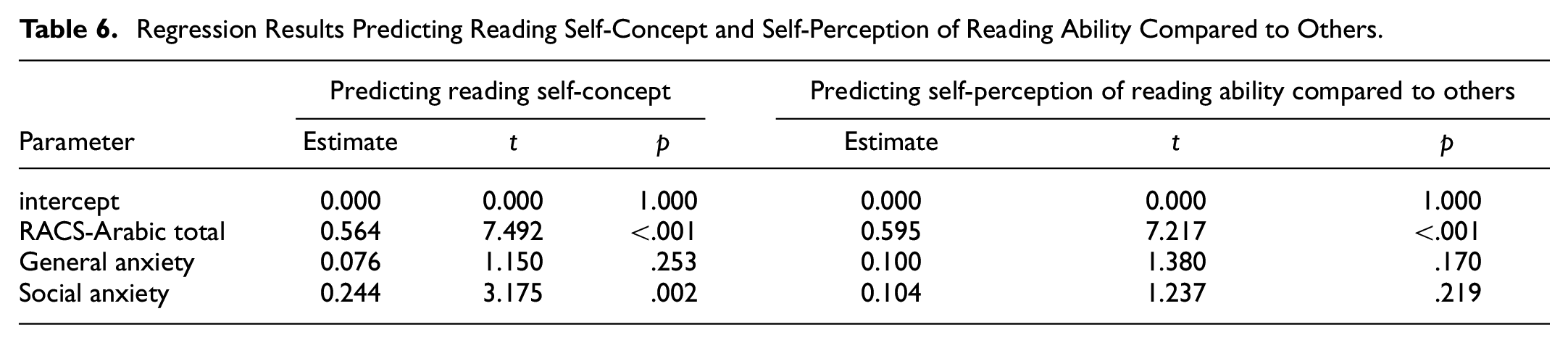
Edwards et al. (2022) found that reading anxiety significantly predicted reading self-efficacy even after controlling for general and social anxiety. To replicate this in the Arabic sample, we ran two multiple regressions, one predicting reading self-concept and one predicting self-perception of reading ability compared to others. Coefficients are presented in Table 6 with all variables z-scored to aid in interpretation of the magnitude of the associations. Results show that in both models, reading anxiety was a significant predictor after controlling for general and social anxiety, indicating the reading-specific nature of reading anxiety and its relation to one’s self-assessments/perceptions of reading ability.
Regression Results Predicting Reading Self-Concept and Self-Perception of Reading Ability Compared to Others.
Discussion
The purposes of this study were to extend the results of Edwards et al. (2022) to an Arabic translated version of RACS (RACS-Arabic) by evaluating the reliability in a sample of university students at an Arabic speaking university, comparing how the factor loadings and item relations differ from that of the English sample, and examining the relationship between reading anxiety, self-assessments of reading ability, and word reading efficiency in Arabic. Results indicated RACS-Arabic to reliably measure reading anxiety in a sample of native-Arabic speaking university students. Furthermore, similar to the original RACS, the last item in RACS-Arabic (specifically asking whether students have reading anxiety) correlated well with the total score, suggesting this single item would serve as a potential quick proxy for reading anxiety in Arabic.
Given the cultural and linguistic differences in the Arabic sample compared to the US English sample, we compared the findings from the original RACS US English sample to those in the present study. Results of the factor analysis showed that for the most part loadings were similar between the two samples. However, there were two items that showed some differences. First, item 2 (uncomfortable reading out loud in front of people) loaded more strongly in the Arabic sample than it did in the original US sample. Conversely, item 4 (worry about understanding what you read) had a stronger loading in the original US sample than the Arabic sample. It is worth noting that the mean for item 4 (worries about comprehension) in the current study is the highest of all the items. This suggests that the students are concerned about comprehension, but being worried about comprehension does not mean that they will have high scores on the rest of the reading anxiety scale. It is possible that comprehension anxiety may be an entirely separate construct. We have no evidence about the causes of these differences, but we can speculate that there are cultural/linguistic differences in what may underlie one’s self-perception of reading ability and thus, reading anxiety. It is possible that US students weigh their ability to comprehend more heavily than word reading accuracy, whereas Arabic students may weigh accuracy as more important, perhaps due to the orthographic challenges encountered in literary Arabic (reviewed earlier in this paper). Alternatively, these differences could be due solely to sampling error and may disappear in larger samples. Future research should attempt to replicate these findings as well as ask targeted questions about anxiety and ability perception as it relates to comprehension and reading aloud. More research is needed to understand what underlies these differences in loadings between samples. These differences need to be replicated and qualitative research may help understand students’ feelings and why these differences were observed between samples. The findings in the present study also replicated the results of Edwards et al. (2022) such that reading anxiety was more related to self-assessments of reading ability than to measured reading ability. This aligns with Soares et al.’s (2023) finding that their university student participants with a history of reading difficulties were anxious about their reading ability and its impact (social and academic) “despite it [reading anxiety] not being related to their academic achievement” (p. 13).
Moreover, our findings show that differences were observed in the magnitude of the correlation between measured reading ability and reading anxiety between samples. Whereas Edwards et al. (2022) found a small (−.3) but significant correlation between reading anxiety and oral reading fluency, no significant correlation was observed in the present study. The lack of correlation in the Arabic sample could be attributed to the measure of word reading efficiency used in the current study which was a list of vowelized words which is not typical of what is encountered at the college level reading. That is, the word reading efficiency measure would have been easier (and more transparent) than reading tasks that would be typical to everyday reading experiences for Arabic college students. Thus, this measure of reading achievement may not have shown relations with reading anxiety due to it not representing the typical reading demands experienced by these students which may limit the generalizability of these findings. Future research should evaluate the relation between reading anxiety and measured reading achievement using other measures of reading achievement that are more aligned with reading tasks encountered by Arabic college students daily such as an unvowelized text reading fluency or reading comprehension tasks. Moreover, the present sample did not include students specifically selected for having reading disabilities who may show a stronger relationship between reading anxiety and achievement.
Lastly, the finding of Edwards et al. (2022) that reading anxiety explains unique variance in reading self-efficacy over and above general and social anxiety was replicated here. Results of the present study showed that even when controlling for general and social anxiety, reading anxiety explained unique variance in both reading self-concept and self-perception of reading ability compared to others. This demonstrates the reading-specific nature of reading anxiety in Arabic. This specificity aligns well with other studies (Children: Jones, 2022; McArthur et al., 2021; Adults: Soares et al., 2023). For example, Soares et al. (2023) found that reading anxiety in university students relates to reading history and reading comprehension even after controlling for trait anxiety. The reading-specific nature of reading anxiety was also confirmed in a large-scale longitudinal study by McArthur et al. (2021) who controlled for a number of possible confounding variables (attention, behavior, peer relationships, and parental education).
Results showed that Arabic speaking college students’ variability in reading anxiety was strongly associated with self-assessments of reading ability measured by both reading self-concept and self-perception of reading ability compared to others. As Edwards et al. (2022) pointed out, the stronger relationship of reading anxiety with self-assessment of reading abilities than with measured reading ability suggests the need to consider these relationships in intervention efforts. Intervention efforts aimed at reducing reading anxiety may need to target self-perception of reading ability in addition to improvements in reading ability itself. It is possible that growth in measured reading ability is not enough to remove the impact on self-perception of reading ability that may be rooted in early reading failure. Interventions improving actual reading ability may better serve the mental health of students by also targeting students’ perception of their own ability. Future research should investigate how to best reduce reading anxiety in college students through leveraging its relationship with self-assessments of reading ability. Particularly for students who no longer (or never did) show measured reading deficits compared to their peers, reporting student’s normative or percentile rank in reading may help alleviate some reading anxiety if this association is rooted in a causal mechanism from perceptions to anxiety. However, based on current results, we are unable to determine causal pathways and future research is needed to better understand how the association between reading anxiety and self-assessments of reading ability may be causally linked. Future research is needed to understand whether improving one’s perception of reading ability will in turn reduce reading anxiety.
Regardless of whether remediation or intervention efforts may reduce reading anxiety in college students, it is important to note that these differences in level of reading anxiety do occur at the college level, with some students experiencing high levels of reading anxiety (Edwards et al., 2022; Soares et al., 2023). Bringing awareness to the mental health needs of students in college, a time when reading demands are particularly high, should include discussions of reading anxiety. More work is required to document the extent of the problem and possible solutions.
Limitations and Future Directions
A number of limitations were present in the study and should be taken into account. First, the word reading efficiency measure employed vowelized, high frequency words, unlike those encountered in college text reading. Therefore, future studies should include unvowelized university-level text reading measures and reading comprehension measures, more similar to the reading demands encountered by college students.
A second limitation is that the sample stemmed from a single university, thus, the findings are restricted to the current sample and its educational system. Future research may aim to include a broader and multi-country sample(s) to be able to draw conclusions about Arabic reading anxiety in general. Results may be different if the participants’ educational system and/or the sociolinguistic context differed.
Third, the current sample was not specially selected for having reading disabilities. Hence, we recommend that future studies of Arabic reading and reading anxiety recruit a purposeful sample of poor readers or dyslexics to be included as part of the sample.
Implications
The current study adds to the limited research on reading anxiety among university students showing that reading anxiety is a universal predicament rather than a language-specific phenomenon. Clearly, further research is needed, more research should be conducted to understand the association between reading anxiety and reading ability in Arabic. Future research is needed to examine potential interventions that may help alleviate reading anxiety and possibly improve their overall mental health. Research should investigate whether interventions designed for alleviating symptoms of other types of anxiety may be effective on reading anxiety as well. Another intervention venue could be geared toward correcting flawed/incorrect self-perceptions, particularly when there is a discrepancy between self-perception and actual performance (Edwards et al., 2022; Soares et al., 2023).
Supplemental Material
sj-docx-1-sgo-10.1177_21582440241295661 – Supplemental material for Reading Anxiety in Arabic University Students
Supplemental material, sj-docx-1-sgo-10.1177_21582440241295661 for Reading Anxiety in Arabic University Students by Sana Tibi, Ashley A. Edwards, John R. Kirby and Soheil H. Salha in SAGE Open
Footnotes
Correction (August 2025):
The article has been updated with some textual changes where anonymization was missed in the methods section.
Declaration of Conflicting Interests
The author(s) declared no potential conflicts of interest with respect to the research, authorship, and/or publication of this article.
Funding
The author(s) received no financial support for the research, authorship, and/or publication of this article.
Inform Consent
Participants who consented were included in this study.

Data Availability Statement
The data that support the findings of this study are available on request from the corresponding author, [S.T].
Supplemental Material
Supplemental material for this article is available online.
References
Supplementary Material
Please find the following supplemental material available below.
For Open Access articles published under a Creative Commons License, all supplemental material carries the same license as the article it is associated with.
For non-Open Access articles published, all supplemental material carries a non-exclusive license, and permission requests for re-use of supplemental material or any part of supplemental material shall be sent directly to the copyright owner as specified in the copyright notice associated with the article.
