



Abstract
The study investigates the influence of various components on tourism students’ attitudes toward statistics, and the causal relationship between these components. A total of 435 students were asked to fill out a questionnaire on the Survey of Attitudes Toward Statistics (SATS). The main data analysis in this study uses exploratory factor analysis (EFA) or principal component analysis (PCA) to look for interdependence relationships between variables in order to identify the dimensions or factors that shape attitudes. Our results show that students’ attitudes toward statistics before and after the learning process tend to be positive, where attitudes toward statistics before learning for each group of student backgrounds show a linear relationship with attitudes toward statistics after learning, except for groups based on work experience. The results of the study also show that the original 4-factor structure, namely, cognitive, affective, difficulty, and value, according to conditions in Indonesia, especially for tourism students, produces four components, namely, value, affect, interest, and difficulty components. For stakeholders, the results of this study have broad implications for the development of a tourism education curriculum, as tourism students increasingly need to be given statistical literacy skills.
Plain language summary
Since tourism has entered higher education, statistical skills are often included in tourism curricula because statistical literacy, scientific reasoning, and argumentation skills are indispensable, as they are the basis for becoming professionals in analyzing data and making informed decisions. However, many students do not realize that they will have a lot of statistics courses when they choose social sciences and humanities, so this often gives rise to a tendency to show negative attitudes, which can often become an obstacle to learning statistical concepts and effective learning. In this paper, we want to prove whether it is true that tourism students have feelings of anxiety and show a negative attitude toward statistics. This paper reveals that the majority of tourism students exhibit a positive attitude tendency, with four components forming their attitudes toward statistics: value, affect, interest, and difficulty.
Introduction
Statistics is a subject with broad application and can be applied in a variety of disciplines, so most majors and concentrations in higher education require knowledge of statistics (Rabin et al., 2021; Snyder et al., 2019; Wild et al., 2018). In many professional contexts and in a society that increasingly relies on quantitative knowledge and evidence, the ability to understand statistical data and apply it in decision making is critical (Black, 2023; Gillborn et al., 2018; Groebner et al., 2018). Unfortunately, they have poor attitudes about statistics (Gopal et al., 2018; Peiró-Signes et al., 2021), have misconceptions about statistics that result in them thinking they cannot understand and apply them, they think statistics is a challenging subject, and they cannot see how statistics might be useful in their professional lives (Perchtold-Stefan et al., 2024; Perc et al., 2017; Salkind & Frey, 2021). Empirical facts show that most tourism students do not show a tendency toward quantitative methods (Huang & Chen, 2016) and find it difficult to face subjects related to numbers and data analysis (Buckley et al., 2015; Cladera et al., 2019; Cook et al., 2019). It is therefore very important to look at students’ attitudes toward statistics because they may have an impact on how effectively they use these tools in the future (Cladera et al., 2019; Male & Lumbantoruan, 2021).
Several studies have been conducted on attitudes toward statistics in the context of learning in higher education (Anasagasti et al., 2024; Cladera et al., 2019; Dani & Al Quraan, 2023; Perchtold-Stefan et al., 2024; Jatnika, 2015; Male & Lumbantoruan, 2021; Peterson, 2016; Sesé et al., 2015). The study of attitudes toward statistics (SATS 28), which was analyzed using factor analysis using either exploratory factor analysis (EFA) or principal component analysis (PCA) and component factor analysis (CFA), is relatively limited, and the findings also vary; some yield four components (Anasagasti et al., 2024; Cladera et al., 2019; Sesé et al., 2015; Whitaker et al., 2022); others yield three components (Cladera et al., 2021b). Studies that discuss attitudes toward student statistics at tourism tertiary institutions, especially those located in Southeast Asia, including in Indonesia, are still very limited, or some do not yet exist. Cladera et al. (2021a) in study of attitudes toward statistics among tourism students in Spain used exploratory factor analysis (EFA), which was conducted on item SATS-28 and analyzed attitudes toward statistics among tourism students, focusing on changes in students’ attitudes toward statistics after they complete the stats course tika. In the current study, the main focus is to highlight the components that shape attitudes toward statistics on tourism students in Indonesia using EFA, which is followed by testing the causality of the components formed. Thus, the aim of this study is to investigate the components that shape attitudes toward statistics among tourism students in Indonesia. The specific question is:
RQ1. Was the tourism student’s attitude toward statistics different before and after the learning process took place?
RQ2. What are the components that shape attitudes toward statistics among tourism students?
RQ3. How does the causal relationship between the components shape attitudes toward statistics in tourism students?
Literature Review
Attitude Toward Statistics in Higher Education
Statistics is a common subject in many college programs. Programs leading to undergraduate and graduate degrees, particularly in the social sciences, often require successful completion of courses in statistics and research (Abbiati et al., 2021; Ayebo et al., 2019; Sharma & Srivastav, 2021). In addition, there are efforts in universities to develop a scholar-practitioner training model that will encourage the use of research techniques to solve real-world problems (Heretick & Tanguma, 2021; Storey & Brian, 2016). However, some emotional problems, such as negative attitudes and anxiety, have been statistically identified in various studies (Perchtold-Stefan et al., 2024; Perc et al., 2017; Salkind & Frey, 2021). A person’s attitude can be defined as a mental and emotional strength that motivates them to act in a certain way toward a certain item or problem due to their disposition, emotion, or thought conditioning toward that item or problem (Perloff, 2016). The concept of attitude is at the core of much research and theory (Tubaishat et al., 2016). According to Krosnick et al. (2018), there is no agreement among scholars about how to define attitude. Although many studies define attitude as a purely emotive construct (Pekrun, 2022), others see it as a multidimensional term (Steinberger, 2020; Wuttke et al., 2020). Attitude toward statistics is a tendency to react favorably or unfavorably to things, situations, or individuals related to learning statistics, which consists of affective, cognitive, and behavioral components (Chiesi & Primi, 2018; Dani & Al Quraan, 2023; Gopal et al., 2018; Mokhele, 2018). According to Aiken et al. (1990), attitudes toward statistics can be seen as “a learned tendency to respond positively or negatively to various items, circumstances, concepts, or personalities.” A positive attitude toward statistics can help students realize the value of statistics in their personal and professional lives, which will motivate them to learn and understand statistics in order to use that information in their daily lives (Smith, 2017). In contrast, unfavorable views have been shown to increase statistical anxiety (Rosli et al., 2017; Trassi et al., 2022), which can hinder students’ ability to learn statistics or limit how much they can acquire practical statistical intuition and use it in the real world (Gal & Ginsburg, 1994).
Statistics is a significant course for higher levels of education because it will expose students to structural concepts and techniques in generating, analyzing, presenting, and interpreting data. Due to the importance of this course, students should have a positive attitude toward it (Mohamed et al., 2012b; Walker & Brakke, 2017), and higher education institutions must provide resource allocation and program development for first-year students (Al-Sheeb et al., 2019). It is hoped that the learning process in the statistics class can be enhanced by good student attitudes toward statistics, and this is also expected to be correlated with better performance on course exams (Cashin & Elmore, 2005; Chiesi & Primi, 2009; Finney & Schraw, 2003). There is a positive and high relationship between attitudes toward statistics and how well graduate and undergraduate students perform on exams in statistics courses (Rabin et al., 2021). Positive student attitudes will contribute significantly to the achievement of learning outcomes (Savelsbergh et al., 2016). Therefore, the development of a positive attitude toward the subject must be the desired outcome of the learning process, in addition to the acquisition of knowledge and skills (Walker & Brakke, 2017). So, at the end of the lesson, the statistics lecturer must be able to determine whether this goal has been achieved. Using an attitude measurement scale for that purpose is helpful. If it is determined that goals are not being achieved, this failure highlights the need to implement educational strategies and activities that will change students’ perceptions of statistics (Cladera et al., 2021b).
The study of students’ attitudes toward statistics has attracted much more attention in recent years. In addition to the purported impact of attitudes on learning (Estrada-Vidal & Tójar-Hurtado, 2017; Leyva-Moral et al., 2017), other factors that may contribute to this interest include the need for statistics as a tool for everyone in today’s society, where numerical data is more common than ever (Frankfort-Nachmias et al., 2019; Wood & Shirazi, 2020), and the value of technical and scientific education in many professional fields (Cerda-Navarro et al., 2017a, b; Leyva-Moral et al., 2017). Research on students’ attitudes toward statistics has been conducted in various fields of higher education because of the importance of attitudes toward academic achievement during and after statistics courses (Anasagasti et al., 2024; Cladera et al., 2019; Dani & Al Quraan, 2023; Jatnika, 2015; Male & Lumbantoruan, 2021; Mutambayi et al., 2016; Perchtold-Stefan et al., 2024; Peterson, 2016; Sesé et al., 2015). Teaching statistics is not only about imparting knowledge but also about motivating students to continue learning the quantitative skills they will need in their professional lives, so the role of attitudes toward statistics requires attention (Gelman & Nolan, 2017).
The Attitude Component to Statistics
Attitude toward statistics is generally described as a multidimensional notion and is defined as a disposition to respond positively or negatively to objects, situations, or individuals associated with learning statistics (Walker & Brakke, 2017). The tendency to respond favorably or badly to things, circumstances, or individuals associated with learning statistics is what is meant by the multidimensional notion of attitudes toward statistics (Gal & Ginsburg, 1994; Hilton et al., 2004; Roberts & Bilderback, 1980; Schau et al., 1995). To manage students’ attitudes effectively, they must be assessed (Jena, 2020; Landers & Armstrong, 2017), so a number of tools to evaluate students’ attitudes about statistics have been developed. Much research has been done on students’ attitudes toward statistics, particularly surveys (Carnell, 2008; Kirk, 2002). Surveys of statistics in tertiary institutions are mostly conducted using various instruments, including the Statistics Attitude Survey (SAS) by Roberts and Bilderback (1980), the Attitude Toward Statistics (ATS) from Wise (1985), and the Survey of Attitude Toward Statistics (SATS) developed by Hommik and Luik (2017) with term SATS-36.
SATS, developed by Schau et al. (1995), is the most careful in producing measures to evaluate the four components of attitudes toward statistics, namely: affect, cognitive competence, values, and difficulties (Cladera et al., 2019; Hommik & Luik, 2017), where a number of studies have been conducted to support the reliability, validity, and multidimensional scores (Whitaker et al., 2022; Sarikaya et al., 2022; von Roten & de Roten, 2023), and used as a role model for attitudes in learning statistics (Persson et al., 2019). A more recent version is an updated survey (SATS-36) adopted to evaluate students’ attitudes toward statistics (Hommik & Luik, 2017; Schau, 2003) in which two subscales (components) and eight more items are added. The SATS-36 scale consists of 36 items divided into six subscales: affect (feelings related to statistics), cognitive competence (attitudes about knowledge and intellectual skills when applied to statistics), value (attitudes about the usefulness, relevance, and value of statistics in personal and professional life), difficulty (attitude about the difficulty of statistics as a subject), interest (individual interest in statistics), and effort (amount of work expended on studying statistics), respectively, 6, 6, 9, 7, 4, and 4 items (Ashaari et al., 2011a, b; Cladera et al., 2021a; Judi et al., 2011a, b; Kiekkas et al., 2015).
Method
Design, Data Collection Procedure and Participants
The quantitative approach chosen in this study is non-experimental research with an applied objective. This research is a correlational study conducted through a survey, which measures and assesses the statistical relationship between different variables. This research was conducted on students from the leading and oldest tourism state universities in Indonesia who took the statistics course for the 2020 to 2021 academic year. A total of 447 students were asked to fill out a questionnaire on the Survey of Attitude Toward Statistics (SATS-28), which was adapted from Ayebo et al. (2019) and Schau et al. (1995). Filling in the questionnaire is done online in the first week of lectures (pre-SATS). Before filling out the questionnaire, students were given an explanation of the purpose of the research and how to fill it out. The time allotted for filling out the questionnaire (self-administered) is approximately 20 to 30 min. After students go through the statistical learning process for one semester, they are asked to fill out the same questionnaire again (post-SATS). After the learning process took place, all pre- and post-SATS answers were collected, and an administrative completeness check of the questionnaire was carried out. It turned out that 435 respondents filled it out completely and validly. Table 1 below is an overview of the demographic profile of the study sample. The samples taken were proportionally random, adjusted to the study program (hospitality, travel, and tourism); class level; gender; origin of high school; study program in high school; and work experience. Table 1 above illustrates that based on the demographics above, the sample characteristics vary quite a bit.
Demographic Description of the Sample.

Instruments
The measurement tool used in this research was the questionnaire on the Survey of Attitude Toward Statistics (SATS-28), which was adapted from Ayebo et al. (2019) and Schau et al. (1995). This tool measures four components or dimensions of attitudes toward statistics, namely: cognitive, affective, technical, and value. There are 28 items used to measure these four dimensions, with details:
- cognitive dimensions (six items),
- affective dimension (six items),
- dimensions of difficulty (seven items), and
- value dimensions (nine items).
SATS uses a 5-point Likert scale (1 = strongly disagree to 5 = strongly agree) and has been tested for reliability and validity (Table 2). Thus, SATS 28 is a validated model of the importance of attitudes in statistics learning (Cladera et al., 2019). An analysis of the reliability of the survey instrument gave a high score with a Cronbach alpha of .921 for all items.
Validity and Reliability Test Results.

p < .05. **p < .01.
Table 3 shows that all 28 of the questions can be used to find out how students feel about statistics.
Descriptive Statistics for SATS.

Calculated from grouped data.
Percentiles are calculated from grouped data.
The lower bound of the first interval or the upper bound of the last interval is not known. Some percentiles are undefined.
Percentiles are calculated from grouped data.
Statistical Procedure
The selection of data analysis techniques is based on the problem formulation, as explained in the introduction. So, to find out the differences in tourism students’ attitudes toward statistics before and after the learning process took place, it was analyzed using descriptive statistics to calculate and compare the mean (M) achievement scores before and after learning, as well as the mean (M), standard deviation (SD), skewness, and kurtosis of items from SATS. The t-test for correlated data is used to determine whether the derived mean is significant or not regarding the relationship between students’ attitudes toward statistics before and after the learning process. Next, to find out what components form attitudes toward statistics and how causal relationships between components shape attitudes toward statistics in tourism students, we use exploratory factor analysis (EFA) or principal component analysis (PCA) to look for interdependent relationships between variables in order to identify dimensions or factors forming attitudes. Factor analysis calculations are carried out using the steps as proposed by Santoso (2017), namely: (a) determining the manifest variables that are considered appropriate to enter the factor analysis stage; test it using Bartlett’s test of sphericity and MSA (Measure of Sampling Adequacy) measurements; (b) Factoring is a core process, namely the process of extracting one or more factors from variables that have passed the previous variable test; (c) Interpretation of the factors formed, especially naming the factors that have been formed and are considered to represent the member variables of the factor; (d) Validation of factor results to ensure that the factors formed are valid, is done by dividing the sample into two parts, then comparing the factor results of sample one with sample two; and (e) Testing the causal model on the components formed by multiple linear regression and testing the causal model using IBM-SPSS 26 and validating it with WarpPLS 8.
Finding
The Attitude of Tourism Students Toward Statistics Before and After the Learning Process Takes Place
Table 4 shows an overview of student attitudes before and after the learning process. The attitude score before the start of the learning process tends to be positive, with a value of 3.35. After the learning took place, the attitude score became 3.52 (there was an increase of 0.17). When viewed from the percentiles and quartiles, it is known that the attitude scores before and after the learning process are all in the 50th percentile or second quartile. However, when viewed from the histogram (Figure 1), it turns out that there has been a significant change, where before the learning process the majority of scores were in a neutral position (3), and after the learning process the majority of attitude scores shifted slightly to position 4 (positive). From table 4, it can also be seen that the attitude skewness value before, after, and the average value show 0.56; −0.015; and 0.342, which are in the range of values −2 to 2, which means that the average score of tourism students’ attitudes toward statistics as a whole is normally distributed (Ghozali, 2016). These results are important for the main data analysis, namely factor analysis, which requires normally distributed data.
ANCOVA Results and Descriptive Statistics for Attitudes Toward Statistics by Student Background.
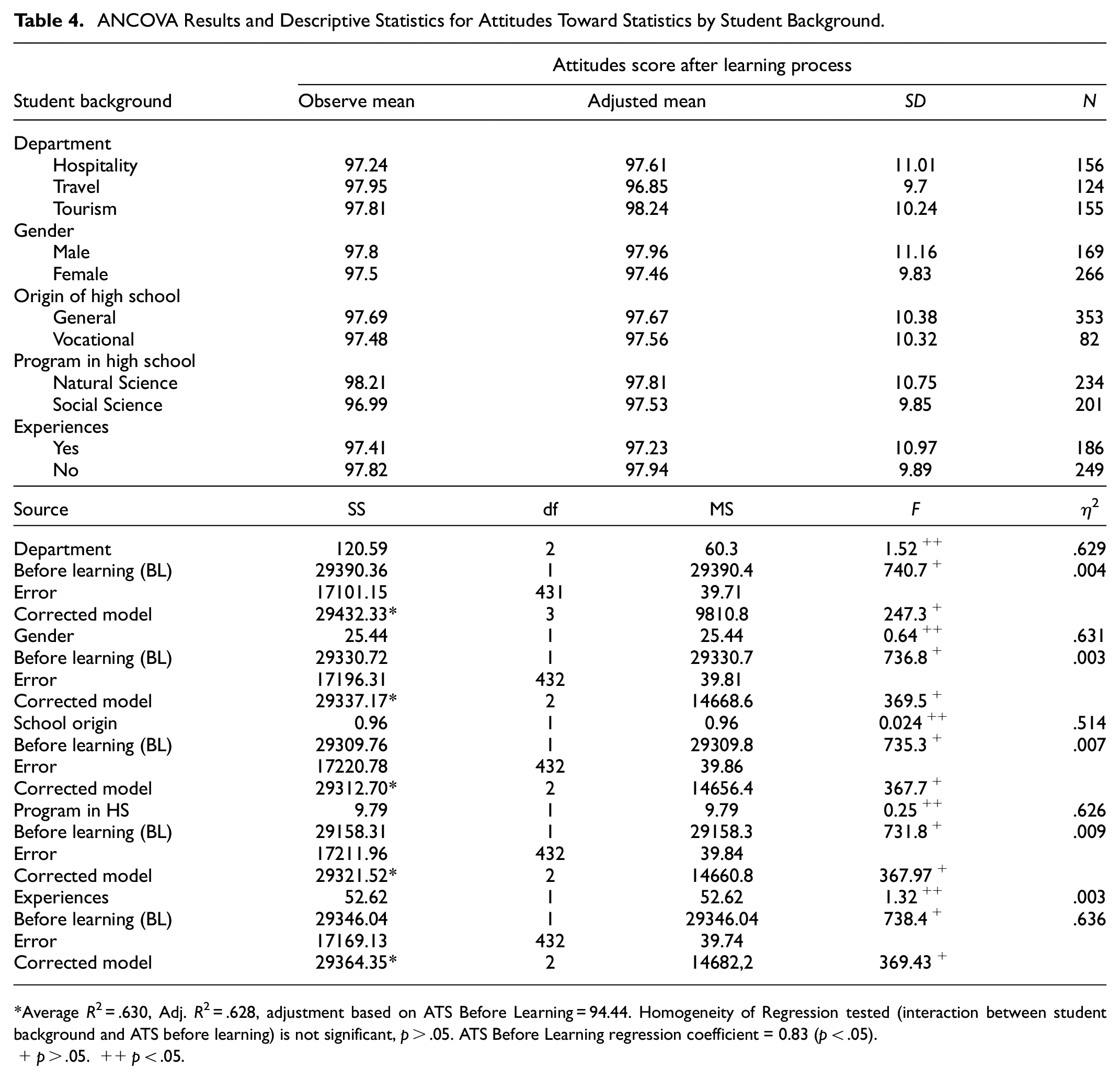
Average R2 = .630, Adj. R2 = .628, adjustment based on ATS Before Learning = 94.44. Homogeneity of Regression tested (interaction between student background and ATS before learning) is not significant, p > .05. ATS Before Learning regression coefficient = 0.83 (p < .05).
p > .05. ++p < .05.
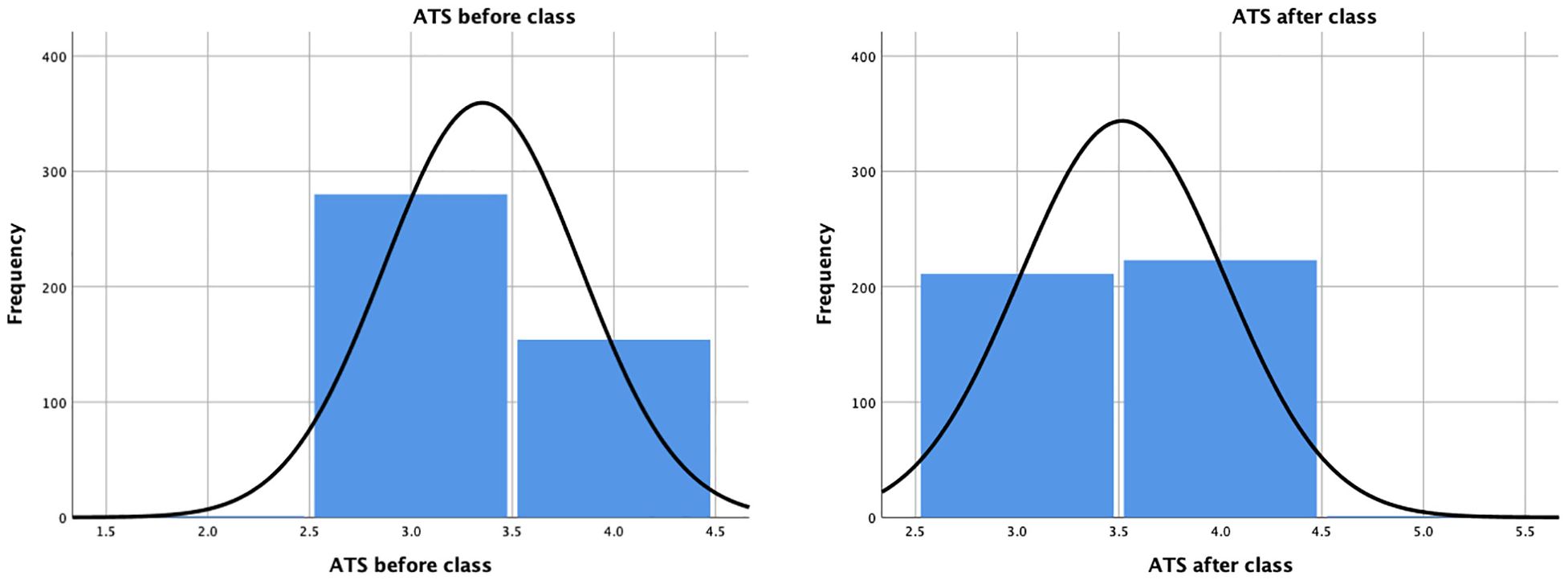
Quartile of average attitude toward statistics before & after learning process.
From the Ancova Table (Table 4), it can be seen that the interaction between student background (department, gender, origin of high school, and program in high school) and attitudes toward statistics before learning is not significant (p > .05). Thus, we can apply ANOVA, except for experiences (F = 6.4; p < .05), for which we cannot apply ANOVA, so we turn to one-way analysis of variance by examining the comparison between the gain scores. Levene’s test of equality of error variances scores attitudes toward statistics after learning that student backgrounds (gender, program, and school origin) are homogeneous (p > .05). Meanwhile, students’ backgrounds were not homogeneous based on departments and work experience (p .05).However, this result is not a problem because covariance analysis is resistant to the inhomogeneity of the data if the sample sizes between groups are relatively equal (Rafter et al., 2003; Veronese et al., 2019).
Attitudes toward statistics before learning (BL) for each group of student backgrounds showed a linear relationship with attitudes toward statistics after learning (p < .05), except for the group based on work experience (p > .05). However, without involving attitudes toward statistics before learning, the test shows that there is no significant difference in scores of attitudes toward statistics after learning that is significant for students with a background of department, gender, origin of high school, program in high school, and work experience. By controlling for attitude scores before learning, all showed p > .05. The influence of attitudes toward statistics before learning and differences in student backgrounds on attitudes toward statistics after simultaneous learning can be seen from the significance numbers in the Corrected Model section. It can be seen that the F values for each group of student backgrounds all show significance values (p < .05), which means that attitudes toward statistics before learning and differences in student backgrounds simultaneously have a significant effect on attitudes toward statistics after learning.
According to the descriptive statistics, both the observed and adjusted averages show that attitudes toward statistics after learning are higher among male students than female students, based on gender. Judging from the origin of school, students who come from a high school science program and do not have work experience are higher than students who come from vocational schools and students who have a social studies background and have previous work experience. Meanwhile, based on the study program background, the observed average shows that students in the travel study program have a more positive attitude toward statistics after learning them than students in tourism and hospitality. However, the adjusted average shows that tourism majors outperform travel and hospitality students.
The results of multiple comparison tests (Table 5) illustrate that attitudes toward statistics after learning (BL) in tourism students for each group of student backgrounds (Departments: Hospitality vs. Travel, Hospitality vs. Tourism, Travel vs. Tourism); gender (Male vs. Female); school origin (Senior HS vs. Vocational HS); program in high school (Natural vs. Social Science); and work experience (Yes vs. No) were not significantly different overall (p > .05); however,
Comparisons of Mean Differences in Attitude toward statistics based on student background.
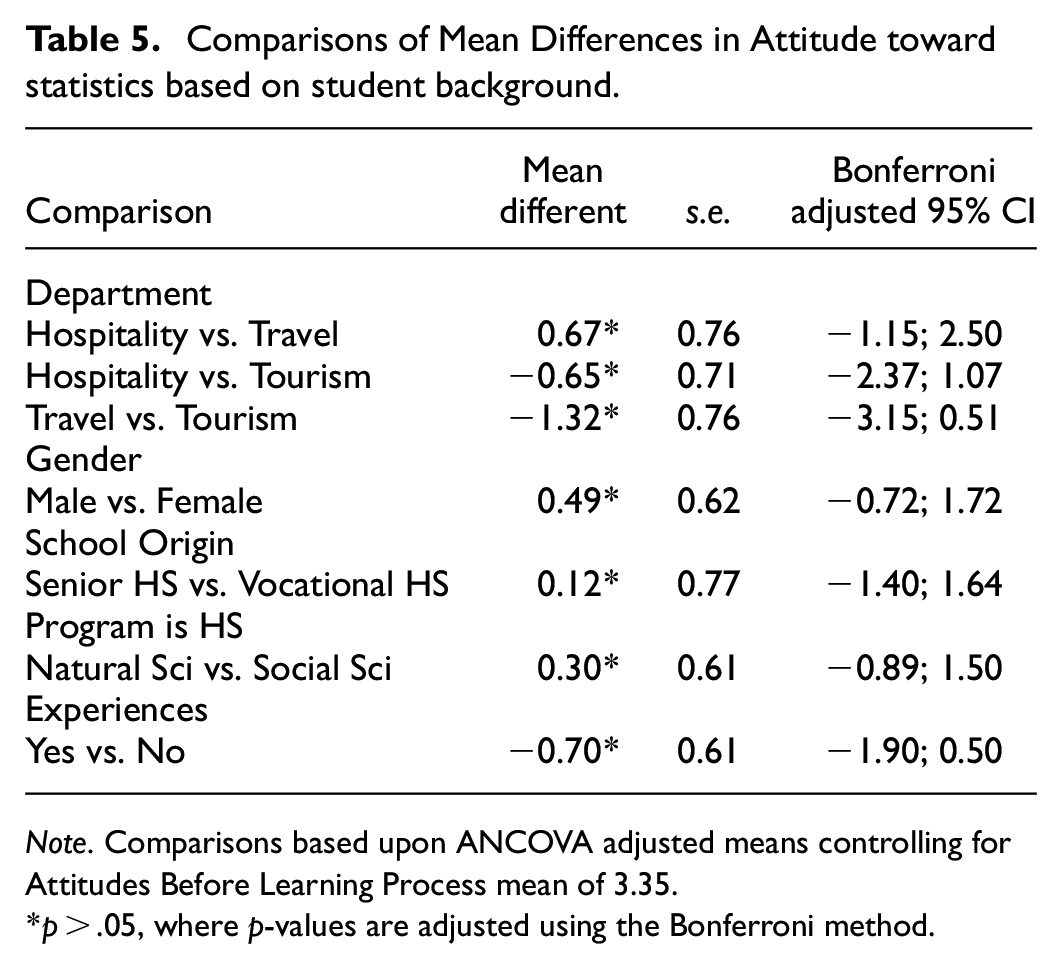
Note. Comparisons based upon ANCOVA adjusted means controlling for Attitudes Before Learning Process mean of 3.35.
p > .05, where p-values are adjusted using the Bonferroni method.
The Components Shape Attitudes Toward Statistics Among Tourism Students
By using exploratory factor analysis (EFA) to look for interdependence relationships between variables in order to identify the dimensions or factors that shape attitudes. The results of the factor analysis feasibility test in this study were carried out in four rounds. The summary of the due diligence results is presented in Table 6. The first round of testing was carried out on all items used in this study (28 items). At this stage, all assumption requirements have been met (correlation matrix determinant, Kaiser-Meyer-Olkin measure of sampling adequacy, anti-image matrix correlation coefficient, and Bartlett’s test of sphericity sign). However, in the factoring process, which is the core process of factor analysis, namely the process of extracting one or more factors from the manifest variables that have passed the previous variable test, there are three items whose communalities extraction values are 0.5 (items 6, 13, and 15). So, in the first round, there were three items that did not meet the requirements and had to be dropped from the factor analysis test. In the second round of testing, there were 25 items tested. As with the first round of testing, all assumption requirements have been met, except for the communalities extraction requirements. There are four items whose values are 0.5 (items 1, 19, 24, and 28). So, in the second round, there are four items that do not meet the requirements and must be dropped. The third round of testing was carried out on 21 items, with results that were not much different from the first and second rounds of testing, where in the factoring process, three items had to be dropped because the communalities extraction value was 0.5, namely items No. 2, 3, and 4. The factor analysis test was completed in the fourth round, which involved 18 items selected from a total of 28 items. In the factoring process, all the items tested had a communalities extraction value greater than 0.5.
Summary of the Results of the Factor Analysis Feasibility Test.

Measures of Sampling Adequacy (MSA).
Extraction Method: Principal Component Analysis.
Extraction Sums of Squared Loadings & Rotation Sums of Squared Loadings.
Thus, until the fourth round, there were 10 items excluded from the test, so that 18 items (manifest variables tested) were selected with factor analysis and resulted in four components. A summary of the results of factor analysis testing with the EFA method can be seen in Table 6. From Table 6, we can see the eigenvalues of each factor. Factor 1 has an eigenvalue of 5.806; factor 2 has an eigenvalue of 2.320; factor 3 has an eigenvalue of 1.427; and factor 4 has an eigenvalue of 1.198. To determine how many components or factors are used in order to explain the total diversity, judging from the eigenvalue, the component with an eigenvalue >1 is the component used. The “cumulative %” column shows the cumulative percentage of the variance that can be explained by a factor. The amount of diversity that can be explained by factor 1 is 32.25%, while the diversity that can be explained by factors 1 and 2 is 45.14%. Thus, the four factors were able to explain the total variance of 59.72%. Based on the fact that the eigenvalues of the four factors are greater than 1 and the cumulative percentage of the four factors is 59.72%, it can be concluded that the four factors adequately represent the diversity of the original variables. The proportion of data diversity explained by each component after the rotation looks more even than before the rotation. The first factor explains the diversity of data with the largest proportion, namely 32.254% according to the extraction method with factor analysis (before rotation), and with factor analysis (after rotation), the diversity of the initial data can be explained by 20.365%. Then, for the second factor explaining the diversity of the initial data with a proportion of 12.88% according to the extraction method with factor analysis (before rotation) and with factor analysis (after rotation), the diversity of the initial data can be explained as being 19.65%. For the third factor explaining the variation of the initial data with a proportion of 7.92% according to the extraction method with factor analysis (before rotation) and with factor analysis (after rotation), the variation of the initial data can be explained up to 11.97%. where the fourth factor explains the diversity of 6.657% before rotation and increases to 7.727% after rotation. It can be seen that the proportion of data diversity, which is more even after rotation, shows that the initial data uniformity explained by each factor is at its maximum. Thus, from Table 7, it can be concluded that only up to four components have an eigenvalue >1, so that this factor analysis produces four components. These four factors produce a factor loading matrix whose values are the correlation coefficients between the variables and these factors. When we examine the variables that correlate with each factor, we find that the resulting factor loading does not provide the expected meaning.
Total Variance Explained.

Sort by order the magnitude of the results of the Rotated Component Matrix based on the components for.
Measures of Sampling Adequacy (MSA).
Rotation Varimax with Kaiser Normalization converged in 5 iterations.
Rotation Method: Varimax with Kaiser Normalization.
Extraction Method: Principal Component Analysis.
<0.05. **>0.50.*** items dropped.
So that the number of loading factor variants in each factor will be at its maximum and can be interpreted clearly, it is necessary to do rotation with the varimax method, where later the original variable will only have a high and strong correlation with certain factors (the correlation is close to 1) and of course a weak correlation with other factors (the correlation is close to 0). The values of the correlation coefficient between the variables and the factors that are formed (loading factors) after rotation can be seen in the following Rotated Component Matrix table. From Table 7, it can be seen that the rotational factor loading has the expected meaning and each factor can be clearly interpreted. Each variable is also only strongly correlated with one factor (no variable has a correlation of 0.5 in all four factors). Thus, it is more appropriate to use factor loadings that have been rotated because each factor can properly explain the diversity of the initial variables. From Table 6, it can also be seen that the transformation matrix values are above 0.5, namely: 0.636; −0.618; 0.635; and 0.684. This shows that the four components formed are correct because they have a high correlation on the main diagonals, so they properly summarize the 18 extracted variables. The four components are the Val component (Value, seven items), Aff component (Affect, six items), Int component (Interest, three items), and Dif component (Difficulty, two items).
The EFA stage after the formation of the attitude factor or component is factor validation. Validation of the factor results is carried out to ensure that the four factors formed are valid. Validation was carried out by dividing the sample into two parts (case 1: sample 1–217, case 2: 218–435) and then comparing the results of the factors in case 1 and case 2. Case 1 received two rounds of factor analysis testing, while Case 2 received up to three rounds of factor analysis testing, yielding seven components as shown in Table 8.
Component Transformation Matrix for Case 1 and Case 2.

Extraction Method: Principal Component Analysis.
Rotation Method: Varimax with Kaiser Normalization.
<0.5.
If the three factors listed above are the initial factors for all samples, then comparing the factors for case 1 (samples 1–217) and case 2 (samples 218–435) from the Component Transformation Matrix shows that the correlation values in the main diagonal for the initial factor are all above 0.5.While the results of factor validation for cases 1 and 2 show that they both produce seven components, judging from the correlation values found on the diagonal of the component transformation matrix, they are less than 0.5. This means that factor analysis testing involving the entire sample is better than the factors in cases 1 and 2. This means that the factors formed initially are stable, and these factors can be generalized to the population (Santoso, 2017).
The Causal Relationship Between the Components Forms Attitudes Toward Statistics in Tourism Students
The causal model test in this study used the regression method using IBM-SPSS 26 and was validated with WarpPLS 8, the results of which can be seen in Figure 2.

Causality model for attitudes toward statistics.
Figure 2 provides the information that all items that make up each component (value, affect, effort, and difficult) are valid because the loading factor is >0.6. The two biggest items that make up the value component are items X2: Statistics are useless for the typical professional, and X3: I’m not going to apply statistics in my profession. While the smallest item in the value component is X1_Statistics, which has no bearing on my life.
Table 9 shows that the calculation of the effect of exogenous variables (value, affect, interest, and difficulty) has a significant effect on the exogenous variable (attitude) directly and is positive. This is because the coefficients of all exogenous variables on attitude show positive values and have a p-value of less than .01; this means that all exogenous variables can be accepted as factors forming attitude.
Direct Effect Test Results.

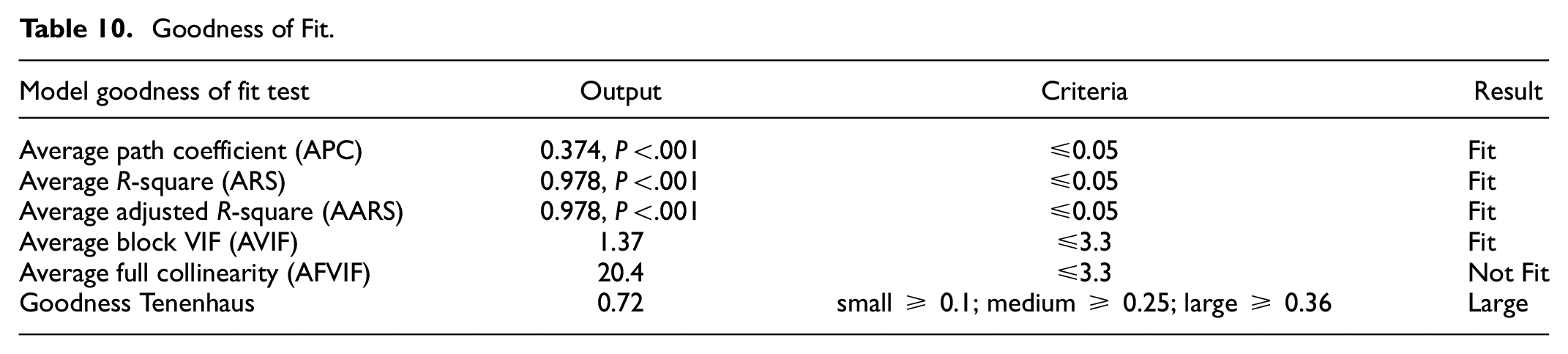
From Table 10, the goodness of fit based on the goodness of model criteria, it can be seen that the model formed is good. For APC, ARS, and AARS, the p-value of 0.001 means that the model formed is good and significant according to ARS and AARS. The AVIF and AFVIF values obtained, respectively, were 1.37 and 20.4, indicating that the model was quite well formed. Goodness, Tenenhaus obtained a value of 0.72, which is included in the large category. Thus, it can be concluded that the ATS causal model that has been formed is good.
Goodness of Fit.
Discussion
The purpose of this study was to reveal attitudes toward statistics before and after learning, examine what components shape attitudes toward statistics among tourism students, and examine causal relationships between the components that shape attitudes toward statistics among tourism students. Our results show that students’ attitudes toward statistics before and after the learning process tend to be positive, as evidenced by the score of attitudes toward statistics before learning of 3.35, and after learning takes place, the attitude score becomes 3.52 (there is an increase of 0.17). When viewed from the percentiles and quartiles, it is known that the attitude scores before and after the learning process are all in the 50th percentile or second quartile. This shows that the attitude of tourism students tends to be positive. For researchers, this was a surprise, because in general, students who are just learning about statistics tend to feel anxious and show negative attitudes (Althubaiti, 2021; Cladera et al., 2019; Khavenson et al., 2012; Kiekkas et al., 2015). However, after the learning process took place, there was a significant change in attitude. These findings confirm that positive effects make students enjoy learning statistics, feel safe, and pay more attention to lessons, while negative effects make students more likely to be bored, anxious, and dislike statistics (Anasagasti et al., 2024; Cladera et al., 2019; Male & Lumbantoruan, 2021; Prayoga & Abraham, 2017; von Roten & de Roten, 2023). The results of this study indicate that the process of learning statistics is able to change students’ attitudes toward statistics, which is in line with the research of (Kiekkas et al., 2015) that the course/learning provides a more positive view of statistics, where statistical assessments correlate more highly with specific attitudes held at the time of assessment than attitudes about statistics held by students at the start of their statistics course (Bayer, 2016; Hadfield, 2023). On the other hand, the process of learning statistics has not been able to change tourism students’ attitudes toward statistics, including the fact that tourism students are still afraid of statistics, dislike statistics, and are unaware that doing statistics requires new ways of thinking as well as numeracy skills. They also do not realize that statistics must be a mandatory part of their profession. In fact, statistics courses in tertiary institutions will encourage the use of research techniques to solve real-world problems (Heretick & Tanguma, 2021; Storey & Brian, 2016), and a positive attitude toward statistics can help students realize the value of statistics in their personal and professional lives, which will motivate them to learn and understand statistics to use that information in their daily lives (Gopal et al., 2018; Hommik & Luik, 2017) and acquire practical statistical intuition and use it in the real world (Gal & Ginsburg, 1994). Changes in the attitude of tourism students toward statistics occurred in the cognitive and difficulty components; meanwhile, for the affective and value components, the attitude changes were not significant. This result is in line with the research of Hagen (2013), which found that students showed only moderate agreement with the idea that statistics would be useful and relevant to their careers, even at the end of the course. In fact, affect describes the emotions and subjective feelings of students about statistics, which are shown by their enthusiasm, comfort, and happiness when studying statistics (Prayoga & Abraham, 2017). However, this finding makes sense because changing things that are cognitive and skillful is relatively easier than changing things that involve affect and values. The affective component, or emotional aspect, is usually deeply rooted as an attitude component, which is the most resistant to influences that might change attitudes (Jones & Cater, 2020). Statistical tests for affective components and scores before and after learning showed insignificant results. This demonstrates that the statistical learning process has no effect on changes in tourism students’ attitudes toward affective and value components. This finding is in line with research, Cladera’s et al. (2021), which showed that students’ levels of fear and insecurity decreased after completing lectures; on the contrary, the average values of the affective and self-confidence components and values worsened. The results of our study also showed that attitudes toward statistics before learning (BL) for each group of student backgrounds showed a linear relationship with attitudes toward statistics after learning (p > .05), except for the group based on work experience (p > .05). However, without involving attitudes toward statistics before learning, the test shows that there is no significant difference in scores of attitudes toward statistics after learning that is significant for students with a background of department, gender, origin of high school, program in high school, and work experience. By controlling for attitude scores before learning, all showed p > .05. This finding is in line with research conducted by Soe et al. (2021), which found that demographic factors do not contribute to attitudes toward statistics and do not differ between classes or study programs.
The results show that the original 4-factor structure, namely, cognitive, affective, difficulty, and value, is in accordance with conditions in Indonesia, especially for tourism students. The results of factor analysis testing using the EFA method yield four components: the value component (value, seven items), the affect component (effect, six items), the interest component (interest, three items), and the difficulty component (difficulty, two items). The four factors are able to explain the total variance of 59.72%. This finding is also similar to research conducted by Adegboye and Jawid (2016), who found that the original 6-factor structure did not fit well with the Afghan data. Exploratory factor analysis identified the five factor constructs that best fit the data and were confirmed by the fit index and likelihood ratio test (Adegboye & Jawid, 2016). These findings are consistent with those of (Chiesi & Primi, 2009; Schau et al., 1995; Whitaker et al., 2022) who discovered that confirmatory factor analysis validates the four-factor scale structure and yields good indexes for reliability and validity. However, the results are different from the study conducted by Ashaari et al. (2011a) and Xu and Schau (2019), which found that the six factors that cause attitudes toward statistics are affective factors, cognitive abilities, grades, difficulties, interest, and student effort. The exploratory factor analysis performed on SATS-28 items in the context of tourism higher education revealed three main components of students’ attitudes toward statistics: anxiety, influence and self-confidence, and values (Cladera et al., 2021b); seven factors were extracted (Khavenson et al., 2012); and the scale’s six-factor structure (Stanisavljevic et al., 2014).
Other results show that the exogenous variables (value, affect, interest, and difficulty) have a significant effect on the exogenous variable (attitude) directly and are positive. Of the four components, it turns out that the difficult component has the greatest influence on attitude, namely 0.45, followed by the affective component at 0.37 (see Table 9). These results are in line with previous literature reviews that suggest that many problems in statistics may not be the result of inadequacy or a lack of talent and ability but may stem from the variables of attitudes, emotions, and motivation (Baloğlu, 2003), and attitudes toward statistics among students include feelings of anxiety, cynicism, disgust, and fear (Glass & Hopkins, 1996; Rosli et al., 2017).
Limitations and Future Research
The limitation in this study is that we have only used a sample of tourism students who are at state universities only. We did not collect respondents from tourism students at private universities. So the recommendation for future researchers is to conduct similar research involving tourism student respondents, both from state universities and from private universities. In addition, the results of this study are only limited to obtaining what are the components that influence the attitudes of tourism students toward statistics, therefore further researchers are recommended to deepen the components of our findings by using a qualitative research approach.
Conclusion
Even though quite a lot of researchers have investigated students’ attitudes toward statistics, which are linked to various variables, both as predictor variables and as independent variables, only a few have done this in tourism universities. Our results show that students’ attitudes toward statistics before and after the learning process tend to be positive and differ significantly. The components that form attitudes toward statistics among tourism students show that the original structure of four factors, namely: cognitive, affective, difficulty, and value, is appropriate to conditions in Indonesia and produces four components, namely: value, affect, interest, and difficulty. Other results show that the components that form attitudes (values, influences, interests, and difficulties) directly have a significant and positive effect on attitudes toward statistics among tourism students.
Footnotes
Declaration of Conflicting Interests
The author(s) declared no potential conflicts of interest with respect to the research, authorship, and/or publication of this article.
Funding
The author(s) received no financial support for the research, authorship, and/or publication of this article.

Data Availability Statement
Data available on request due to privacy/ethical restrictions