




Abstract
There is growing interested in the analysis of academic training in the sustainable field of tourism. However, no explicit body of knowledge has focused on evaluating the performance of a scientific activity in this field. Accordingly, this study systematically reviews academic research on the sustainability of the educational background in tourism universities through a bibliometric analysis. For this purpose, bibliometric tools related to research activity impact indicators and analysis of co-authorship networks and keywords have been used. The results show that the topic analysed is recent and that the number of publications continues to grow. They also show that only some academics have addressed this topic, which implies that more research is needed. Therefore, in this framework, thematic specialization could be a strategic option. Researchers can use these results to approach future studies about suggested research avenues better.
Introduction
Nowadays, there is a constant drive for sustainability (Geng & Maimaituerxun, 2022). In recent years, research in this field has received considerable critical attention (Leal Filho et al., 2018) because its development is of great importance for improving the welfare of society and addressing ecological problems (Gupta & Vegelin, 2016). Figure 1 shows that empirical sustainability analysis involves a multidisciplinary and interdisciplinary approach. This characteristic enables the field to address the global challenges of dealing with the social problems arising from the interaction between nature and society to design strategies that contribute to the sustainable management of natural resources and to design strategies that contribute to people’s present and future quality of life (Leal Filho et al., 2018; Schafer et al., 2010).

Sustainability research area.
Figure 1 shows six categories of research in the empirical analysis of sustainability. We can see that Social Sciences is the category that has analysed this subject the most, with 39% of the total number of publications, followed by Science Technology (27%), and Life Sciences Biomedicine (20%). Figure 2 below shows the different publication categories in the most influential field of sustainability. As seen in this figure, there are eight different Social Sciences research categories. The area with the most significant influence in the sustainability analysis in this field is education, with 49% of the total number of publications. However, only 4% of the total number of articles belonging to Social Sciences belong to the area of tourism, which argues that the empirical literature published until now presents strong evidence of the impact of sustainability on tourism.

Social science research areas.
In the sustainable context, approval of the Agency 2030 at the United Nations summit, which defined 17 Sustainable Development Goals (SDGs), is relevant (Tsalis et al., 2020). The 2030 agenda provides a global framework for each country and region to prioritize and address its sustainable needs locally (Monteiro et al., 2022). Education is one of the sectors that can promote and contribute to achieving the SDGs. Universities, in particular, are essential in this context because they can equip future professionals with the skills and knowledge to address the challenges and opportunities of sustainability (Mori Junior et al., 2019). In addition, universities can influence stakeholders through their capacity and leadership to enable them to adopt more sustainable policies and practices to achieve the 2030 Agenda for Sustainable Development (Clifford & Zaman, 2016; Heryadi et al., 2018). Universities, therefore, provide a holistic approach to the 2030 Agenda and are considered a key aspect in achieving the SDGs (Vilalta et al., 2018).
Consequently, adopting this perspective and responding to different calls for more research on sustainable education in the tourism sector (Chen et al., 2022; Slocum et al., 2019), the main objectives of this article are to systematize the scientific production published so far and to provide a better knowledge base in the field of sustainable education in tourism universities. Ultimately, this study aims to expand the frontiers of knowledge in the educational field of tourism sustainability. To this end, a bibliometric analysis is conducted to answer the following research questions:
What has been the trend in the evolution of the number of articles published on the analysed topic?
Which journals, articles and regions have significantly influenced sustainable education research in tourism universities?
What is the intellectual structure of the knowledge base underlying the grouping of the most influential authors?
What are the most studied emerging research areas in the literature on sustainable education in tourism universities?
What future research lines in sustainability offer to promote sustainability in the area analysed?
To answer these questions and achieve the proposed objectives, we have carried out the steps outlined in Figure 3 through a bibliometric analysis from 1996 (the first published article) to 2021 (the latest available data). The search for articles was carried out in the Web of Science database, where we obtained 113 articles. They provide the necessary data to study the current state of the field (León-Gómez et al., 2021) and identify the trend of a research field (Tan et al., 2021).

Key contents of this research field.
This study contributes to the literature by conducting an intrinsic analysis of the current state of sustainability education in tourism universities. The results can help researchers and practitioners in the tourism sector by providing them with an overview of the epistemological structure of the field and current research topics. This will help them to gain a comprehensive and up-to-date understanding of research in the area under study. Furthermore, it will enable them to understand the dynamic mechanism and theoretical structure. Similarly, these results will also help academic practitioners, as they will be able to use the identified concepts and research trends to improve the training of future tourism professionals and thus enhance sustainable performance in the tourism sector (Camargo & Gretzel, 2017; Geng & Maimaituerxun, 2022).
The paper has seven sections. Section 2 discusses the theoretical basis of sustainability and education in tourism universities and Section 3 presents the research methods used. Section 4 offers the results, including quality, and first and second-generation indicators. Section 5 then develops a knowledge framework with dimensions and aspects of research in this domain. Section 6 discusses our results with previous findings by other authors. The paper concludes in Section 7 with a summary of conclusions and findings.
Theoretical Background
Sustainability has received increasing attention in university education in recent years (Figueiró & Raufflet, 2015). Research in this area has evolved with a growing interest in introducing environmental concerns into university curricula (Stead & Stead, 2010). This has led to increased academic concern about issues related to the integration of sustainability in universities (Audebrand, 2010), which implies a transformation of the current educational model (Rands & Starik, 2009). Thus, university professors have launched numerous sustainability courses, programmes, and initiatives (Caeiro et al., 2013).
On the other hand, as the tentative theory of education for sustainable development states (Åhlberg et al., 2005), the growing importance of sustainability in the tourism sector has led to increased academic concern about how to incorporate this subject into the curricula of tourism universities (Bynum Boley, 2011). Many articles address the environmental perspective of tourism (S. Liu & Li, 2020; Moyle et al., 2021; Seguí-Amortegui et al., 2019; C. Zhang, Xu, et al., 2022), but few have analysed the educational perspective of this relationship (Ochoa Jiménez et al., 2022; Sharma et al., 2021). As a result, there is growing concerned about the need to teach sustainability within the curricula of tourism universities (León-Gómez & Mora Forero, 2022). As Skill Theory states (Amanchukwu et al., 2015), the knowledge and skills students can acquire will be crucial to raising awareness among future tourism professionals of the importance of establishing sustainable practices in the sector (Barber et al., 2011).
Professors play an essential role in sustainable development (McGrath et al., 2021; Tomasi et al., 2020). However, more than their effort to demonstrate sustainable tourism management to students is needed to bring them closer to the practical reality of the subject (Boyle, 2017; McGrath et al., 2021). There is, therefore, a lack of further research on the knowledge of how tourism educators can empower tourism educators to equip students with critical and systematic ways of thinking about how a more holistic and cohesive sustainable tourism industry can be generated over time and thus help to achieve the SDGs proposed by the United Nations in the 2030 Agenda (Cotterell et al., 2019).
Research Methodology
Research Design
This study uses a bibliometric data analysis approach of scientific publications on sustainable education in tourism universities. The bibliometric analysis combines different methods to analyse a body of research qualitatively and quantitatively (Mourao & Martinho, 2020; Santos-Jaén et al., 2021). These methods rely on descriptive publication data on authors, journals, institutions, geographical regions, keywords, and citations to generate networked knowledge maps within a research field to identify research topics and future research directions (C. Zhang, Xiong, et al., 2022). Thus, bibliometric analysis by applying different techniques and indicators allows us to classify the data and make representative summaries (Ertz & Leblanc-Proulx, 2018; Li et al., 2020). This will enable us to understand the published literature’s theoretical architecture and identify significant scientific discoveries (Huang et al., 2019).
Obtaining Data Set
The essential parts of bibliometric analysis are the compilation and evaluation of the data (Zurita et al., 2020). For this purpose, we used the search “subject, title, abstract, keywords” in the Web of Science (WoS), owned by the company Clarivate Analytics. It is a compilation of bibliographic reference databases that collects information from 1800 to the present (León-Gómez et al., 2021). It is one of the most used academic databases, as it compiles large-scale data, and generates statistics based on bibliometric indicators (Wang et al., 2020).
Although there are many bibliometric studies on sustainable education in universities (Grosseck et al., 2019; Hallinger & Chatpinyakoop, 2019; Machado & Davim, 2022), they have yet to focus on analysing this approach in tourism. For this reason, this study focused on exploring the educational system for sustainability in tourism universities. To this end, the search terms used for data collection include “Education,”“Tourism University,” and “Sustainable.” As shown in Figure 4, from the combination of these three keywords, we build the final database on which our article is based. In the initial search, 96% of the total articles we obtained were in English, so we decided to refine our search so that only articles in English would be found in our database. In this way, we obtained a total of 113 articles. Even though the time limit chosen was the maximum possible to avoid distorting the results, we discovered that the first article was published in 1996. Thus, the period analysed was from 1996 to 2021.

The different phases of the data extraction activity.
WoS indexes quality publications from top-ranked international journals and conferences (Zurita et al., 2020). It is also composed of the Core Collection, which comprises the indexes of Science, Social Sciences, and Arts, and Humanities (Ahmad & Batcha, 2019; W. Liu, 2021). Additionally, it has the databases that complement it: Current Contents Connect, Medline, SciELO Citation Index, and KCI-Korean Journal Database (Birkle et al., 2020). As shown in Figure 5, the 113 articles comprising our study are part of four databases in WoS, where we used English as a search filter to compile them.
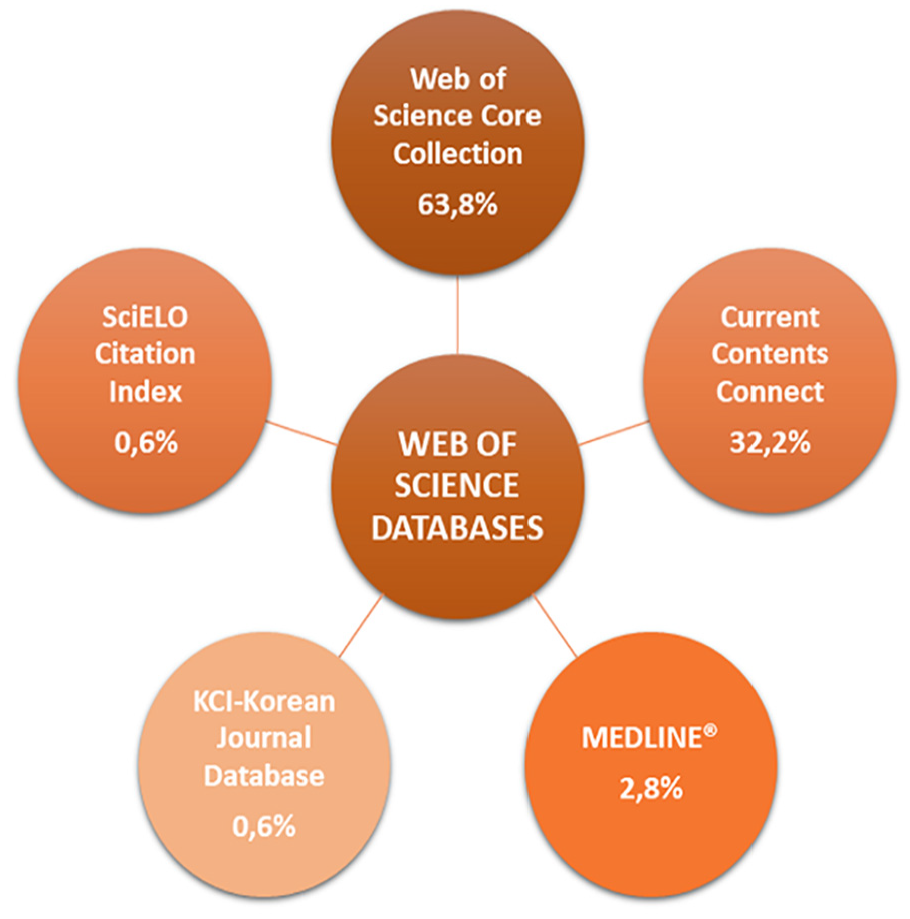
Analysed databases.
Figure 5 shows that the Web of Science Core Collection integrates the most significant publications (63.8%). Therefore, the leading resource of the WOS platform is integrated with numerous databases, such as Citation Index Expanded (SCIE), Sciences Citation Index (SSCI), Arts & Humanities Citation Index (AHCI), Current Chemical Reactions… On the other hand, Current Contents Connect is the second database with the second-highest percentage of integrated articles (32.2%). Current Contents Connect allows access to evaluated academic websites and full-text web documents of three general types of resources: research activities, funding information, and preprints with a temporal coverage from 1998 onward. The other databases shown in Figure 5 have fewer publications as they specialize in different modalities.
After identifying the publication, we looked for errors obtained during the data collection. So, we checked if references to the same author were correct (avoiding typos) and homogenized the keywords in plural and singular. Then, we elaborated a Microsoft Excel database adjusted to perform a more comprehensive analysis without the risk of biasing the results.
Analysis Tools and Indicators
Regarding the bibliometric analysis process, a series of indicators were applied based on the previous study by López-Fernández et al. (2016), who established different types of indicators, classified into two categories:
1. Activity indicators: Their main purpose is to report data on the scope and impact of the articles published. To this end, we analyse the published papers, the productivity of higher educational institutions, journals, geographical regions, and authors. These analyses allow us to observe the evolution of the published literature in quantitative terms.
2. Relational indicators:
a. First-generation indicators: Their principal purpose is to identify the network of co-authors of the analysed topic. To build this framework’s fabric, we studied the works with the most significant impact and the collaborative networks between co-authors. This will allow us to identify whether or not many authors have addressed the topic.
b. Second-generation indicators: They define the conceptual and thematic structure of the scientific domain of the analysed topic. To do this, we make analyses of the co-occurrence of keywords and clusters. In this way, these analyses will allow us to discover emerging trends and themes in the scientific field.
Finally, to apply these indicators, we use the different bibliometric tools explained in Figure 6. This figure shows three columns: The first and second columns show what is to be analysed, and the third column shows the method used. To make the network visualization maps referred to in this figure, we use the VOSviewer software (van Eck & Waltman, 2010). We use this software because it is an efficient instrument for scientific map analysis thanks to its powerful graphical user interface (Wang et al., 2020), which allows you to work efficiently with large datasets and provide a variety of visualization and analysis (Fahimnia et al., 2015).

Bibliometric tools used in this study.
Results
This section presents the statistical analysis of the extracted data. We have divided this section into three subsections based on the type of analysis performed. The first concerns activity indicators, which provide data on the scope and impact of the articles published. The other two subsections refer to relational indicators, which focus on building the conceptual structure of the research domain of sustainability education in tourism universities.
Results of Activity Indicators
The principal aim of this section is to review the evolution of published empirical studies. To this end, we analyse the productivity of published articles, geographical regions, higher education institutions, authors, and journals.
The first step was to analyse the productivity of the articles published. The annual quantitative distribution of publications on sustainability education in tourism universities reflects the state of development, the accumulation of knowledge, and even the field’s maturity. Figure 7 shows the annual evolution of articles published on sustainable education and tourism universities. In addition, Figure 8 performs the same type of analysis but in a different field, in this case, analysing sustainable education in universities in general. Consequently, Figures 7 and 8 allow us to compare the annual growth of these articles with the total number of articles published on sustainability in universities in general.

The life cycle of publications in the study of sustainable education at tourism universities.

The life cycle of publications in the study of sustainable education in universities in general.
Figure 7 shows that the first article analysing sustainability teaching in tourism universities was published in 1996. However, Figure 8 reveals that the study of this subject at the university level, in general, started in 1800 when the first two articles were published. Consequently, sustainability education in tourism universities is a relatively recent field of study (Slocum et al., 2019). Although the interest in providing specific training in sustainability in universities started in 2003, only 6 years later, the interest in tourism education was awakened. Furthermore, in the last 10 years, the number of publications related to sustainability in tourism universities has grown exponentially. During that period, many researchers have tried to find ecological and sustainable solutions to environmental problems caused by pollution (Tan et al., 2021). Finally, Figure 7 shows three research cycles:
1996 – 2008
2009 – 2016
2017 – nowadays
In the first cycle (1996–2008), a few researchers showed interest in analysing the effect of sustainability education on university tourism students. The second cycle (2009–2016) represents a period of gradual proliferation, with the highest number of publications occurring in 2010. Finally, in the development stage (2017–present), publications increased significantly to 17 in 2020. It is expected that the number of published articles will continue to grow, as there are now many researchers concerned with the development of environmental issues (Tan et al., 2021).
On the other hand, we analysed the geographical regions with the most significant influence in the field analysed. Thus, Table 1 shows the contribution of geographic regions to the proliferation of articles on the topic analysed globally. The USA and Spain are the most prolific and influential countries studying the effect of teaching sustainability in tourism universities, with a percentage of publications over the total number of articles of 19.5% and 11.5%, respectively. They are followed by England (10.6%), Australia (8.85%), Romania (7.97%), Canada (7.08%), and Turkey (6.2%). In addition, Table 1 also shows a comparison of the most productive geographical regions worldwide in the relationship between sustainability and university tourism education and sustainability and university education in general. We can conclude that countries like the USA, Spain, England, and Australia try to analyse the effect of sustainability education in tourism universities and universities in general. However, countries such as Romania, Turkey, and Canada have a high degree of specialization in university tourism education but do not significantly influence general university education.
Top 10 Countries With the Most Publications Related to Sustainability Education in Universities.

Source. Web of Science Core Collection (2022).
Figure 9 lists the 10 institutions with the most publications to identify the most relevant research organizations. Twenty-two institutions were included in this bibliometric study on sustainable education and tourism universities. The analysis by country revealed that Spain is the country with the most institutions conducting research on the topic (with 18% of the total number of publications), followed by Indonesia (13%), Canada (10%), and the USA (8.5%). The University of Extremadura has the most papers published, with six articles.

Top 10 institutions with the most publications in sustainability education at tourism universities.
We also analysed the productivity of authors and journals. First, we applied Lotka’s Law to identify the most prolific and influential authors. This Law describes the quantitative ratio of authors to articles published in each subject area and period. Article production is unevenly distributed, with the majority concentrated on a few articles (Urbizagastegui, 1999). Thus, in previous studies, Lotka’s law has been used mainly to describe the distribution of publications within a community of scientists in a given field (Su et al., 2019).
To formulate the equation corresponding to Lotka’s Law, we rely on the model proposed by Pao (1982, 1985). Thus, in Equation 1, we calculate the value of the slope (n) using the least-squares method with the following equation:

Where:
N: Number of even data observed
X: log x
Y: log y
Equation 2 was then used to formulate the model constant (C):

We obtained the following results:
n = −6.261
C = 537
Finally, the general form of Lotka’s Law can be expressed as Patra et al. (2006):

Thus, by substituting the values of n and C in Equation 3, we obtain Equation 4 corresponding to Lotka’s Law:

The Kolmogorov-Smirnov test was used to assess Lotka’s theoretical distribution fit. The critical value obtained by the non-parametric Kolmogorov-Smirnov (K-S) goodness-of-fit test was 0.052. We conclude that the data match Lotka’s rule since the most significant difference between the observed and estimated cumulative frequencies was 0.033, which is below the critical value.
From the data in Figure 10, it was found that 544 authors contributed to the publication of 113 articles, which averages 0.21 articles per author. These results indicated the imbalance in the authors’ production, as we can state that single authorship is very common in this field. About 533 (98%) authors have only one publication, and the rest have only published two articles. Consequently, we can state that even though, at present, the study of sustainability education in tourism universities is becoming increasingly necessary. So far, there are no specialized authors in the field.

Lotka’s distribution.
Providing a comprehensive view of the most prolific and influential authors, summarizes the 10 most relevant authors in the period under study, ordered by the total number of published articles (NP). In addition, information is shown on the h-index (h_index), g-index (g_index), m-index (m_index), total citations received (TC), and year of publication (PY_start). A researcher’s h_index is the maximum number of h of the researcher’s publications, so each has at least h citations (Fenner et al., 2018). So, a scientist has an h-index if his Np articles have at least h citations each and the other (Np− h) articles have ≤h citations each (Gutiérrez-Salcedo et al., 2017). The g-index measures bibliometric productivity based on scientists’ published work (Aria & Cuccurullo, 2017; Gast et al., 2014). G-index considers the number of citations received by the most cited articles of an author, thus differentiating more than the h_index (Arencibia Jorge & Carvajal Espino, 2008). Conversely, the m-index is the proportion of the h-index to the number of years from the author’s first publication (Neme-Chaves & López-Rodríguez, 2021).
Table 2 shows an analytical approach that identifies the most productive researchers. Andrades, L. and Dimanche, F. (co-authors) top the list with two publications and the highest number of citations. Both are considered influential authors in the field under study, as they have the highest h, g, and m indexes. Yurcu, G. and Akinci, Z. (co-authors) share the same values of the indexes, but the total number of citations decreases slightly. All four authors are considered experts in the field under study. The results in show that the most prolific authors in sustainable tourism education do not have many published articles. This can be an opportunity for researchers interested in this topic, as greater publication possibilities can strongly influence the analysed topic.
Top 10 Most Relevant Authors Ranked by the Total Number of Publications.

Source. Web of Science Core Collection (2022).
Furthermore, we can observe that one of the most prolific authors belongs to the University of Extremadura, which, as seen in Figure 9, is considered the university with the most published articles. On the other hand, regarding geographical diversity, we observe that the most productive researchers belong to six geographical areas with the most significant influence on sustainability teaching in tourism universities, as shown in Table 1. This level of geographical diversity does not seem surprising since Table 1 demonstrates the international interest in the topic under study. However, this list does not include authors from the prolific regions shown in this table, such as England, Romania, China, Italy, or New Zealand. This is because the development of publications in geographical regions is unrelated to the most influential authors in their target region. Encouraging international collaborations with influential authors in this field could be interesting.
On the other hand, regarding the productivity of the journals, we report that 83 different journals published the sampled studies. In Figure 11, the brown circles represent the percentage of journals that contribute to publishing articles related to sustainability education in tourism universities. We can see that 58% of the journals have only published one article, compared to 22% that published more than five articles. Likewise, Figure 11 represents the most prolific journals in the analysed field, where the orange rectangles reflect the percentage of articles published by each journal in the field under study: Sustainability has 14 articles (12.39%), followed by Journal of hospitality leisure, sport, and tourism education (JoHLSTE) with 6 articles (5.31%) and Amfiteatru economic with five published articles (4.43%). However, out of the top five journals with the most publications, JoHLSTE is the only journal specializing in all aspects of tourism-related higher education. The conclusions drawn from Figure 11 lead us to the difficulties faced to publish articles, as there is only one specialized journal on the subject. Furthermore, it can provide a significant opportunity for education journals to take advantage of this situation to specialize in the subject or to publish special issues that allow authors to obtain a more substantial number and more significance.
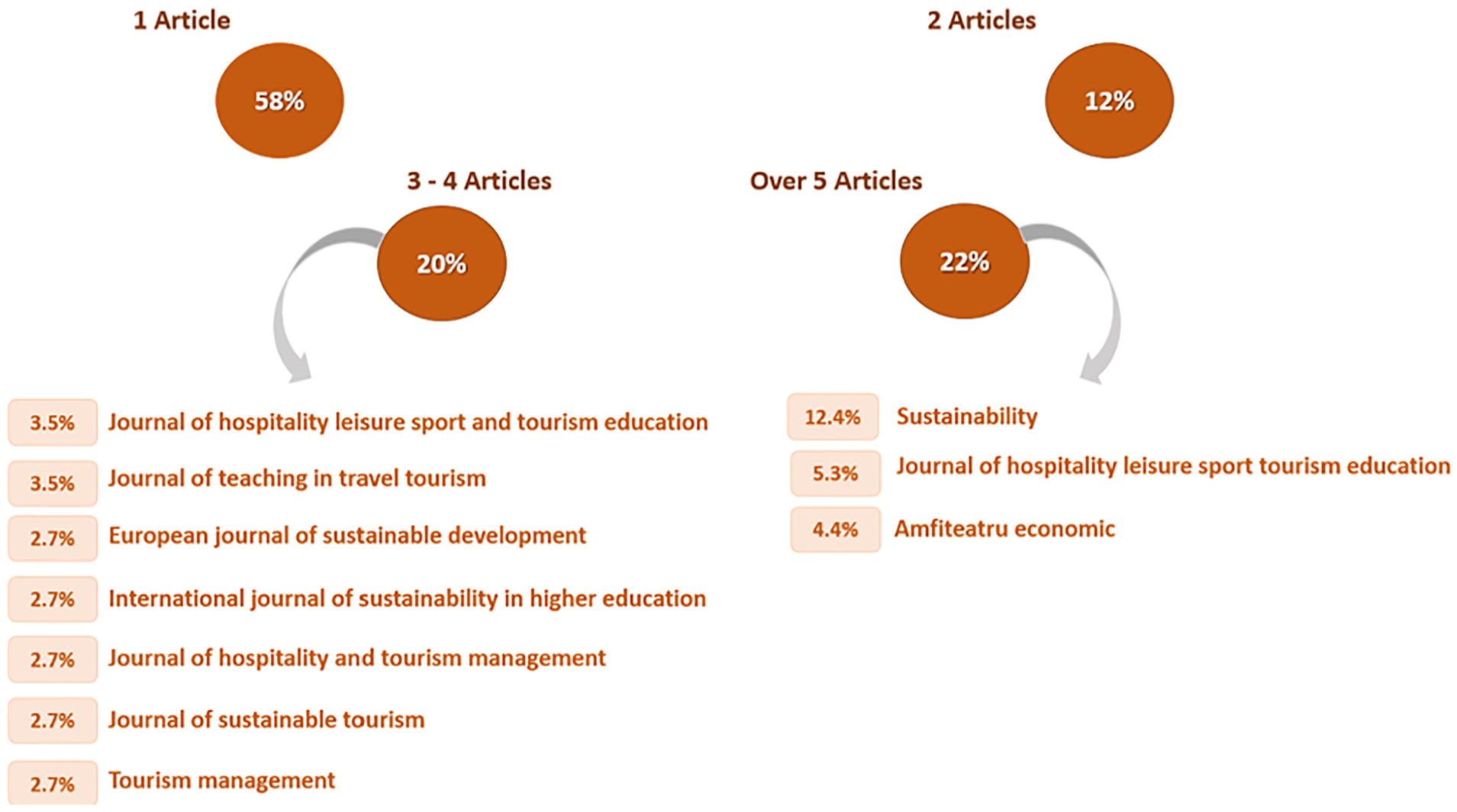
Top 10 journals that contribute most to the publication of articles on sustainability education at tourism universities.
Results of First-Generation Relationship Indicators
After analysing the current activity in the field under study, we conducted a specific study among the elements of this environment. Thus, this section aims to identify the number of authors and contributors with articles that have analysed sustainable education in tourism universities. To this end, two analyses are carried out, the first of the papers with the most impact and the second of the collaborative networks between authors.
We first tried to standardize the measurement of existing co-authorship practices and trends. To do so, we performed a network analysis based on scientific maps and data visualization to illustrate global networks of co-authorship (Park et al., 2016; Van Eck & Waltman, 2018). Co-authorship links have been used to connect the components of these networks. We used the bibliographic files from the WoS database to provide them as input to the VOSviewer to construct the network. Researchers are the map’s components, and the co-authorship linkages serve as the connections between them (Van Eck & Waltman, 2018). The total strength of the link is described as standard weight attributes indicating the strength of the link from one element to another (León-Gómez et al., 2021). Thus, it is possible to perform a co-authorship network analysis, whose nodes are the authors, generating a link between two nodes when two researchers appear in the same publication. Isolated nodes were not discarded to get a complete picture of the level of collaboration between academics in this field. According to the number of publications they have co-authored together, Figure 12 analyses six connected co-authors.

A map density based on network data connected by co-authorship items.
Figure 12 shows that the formal resource-based relationships as a determinant of co-authorship are simple. We only identified four clusters among the most influential researchers, with the most significant sets comprising two elements. The highest total joint strength is found in authors Yurcu, Akinci, Dimanche, and Andrades. Thus, the results show that the main authors work in restricted circles, and therefore more extensive networks are lacking. Furthermore, the different groups do not closely relate, suggesting relatively small overall cooperation. This result suggests that the topic under analysis needs further research, as a few academics have addressed. Therefore, more researchers should consider contributing to the current debate (Malihah & Setiyorini, 2014).
Likewise, this study analysed the productivity of the four research groups found. Only the productivity of the scientific articles listed in Table 3 was analysed, considering that these are the ones with the highest visibility in the international scientific community.
Articles Published by the Four Most Influential Research Groups.

Source. Web of Science Core Collection (2022).
The analysis above establishes some co-authorship network indicators based on the previous study by Rodríguez Gutiérrez and Gómez Velasco (2017). The following stand out: network size, density, and degree centrality.
First, we calculate the network size (N) to establish the number of actors or individuals participating in the social network (Rodríguez Gutiérrez & Gómez Velasco, 2017). Thus, N refers to the number of direct contacts with which each group has a relationship (García Hernández, 2013). The size of the group’s network was measured by considering the number of collaborators participating in the group’s external network (Tichy et al., 1979) so that the network under study comprised 13 different authors who published in the study period.
Next, we studied the network’s density (D) to measure the ratio of the relations present over the maximum number of existing relations.

Where CG corresponds to the degree of centrality of each actor or node, which refers to the number of links of each author.

We can observe in Figure 13 that in the first article, the corresponding relationships are: a(n1, n2) = 1, and for the second article, we would have a(n1, n2) = 1. So, the degree centrality of the author n1 corresponds to CG (n1) = 1 + 1 = 2, the following equation. In addition, we can highlight that several authors (n2, n5, and n6) presented the same degree of centrality. The authors with the highest degree of centrality were n3, n4, n9, n10, n11, n12, and n13, with a value CG(ni) = 4. Therefore, through the map constructed, we concluded that co-authorship among the published works might be the cause of the relationship’s importance and influence.

Links established in author relationships.
In conclusion, a total of 19 links were recorded in the whole network; thus, we can calculate the density of the network through Equation 5:

According to Wasserman and Faust (1994), with a network density close to zero, it can be indicated that there are very few relationships between the authors present in the network.
The highest degree of centrality of an author in the network obtained was 4, therefore CG:

According to Polanco (2006), this low centrality for the whole network indicates that no author centralizes the production in the area under study. In addition, this network visualizes a type of node described by Polanco (2006) as an “isolated node” since no author has been related to all or most other authors.
Results of Second-Generation Relationship Indicators
The main purpose of keyword co-occurrence analysis is to describe a specific field’s core content and structure (Tan et al., 2021) to get information about the examined topics and concepts (Gümüş et al., 2020). For this purpose, we have used VOSviewer to create a map of the co-occurrence of keywords in the analysis of sustainability teaching in tourism universities. Co-occurrence is calculated as the number of times two keywords appear together in the publications (Zurita et al., 2020). The most common word is the largest node in the cluster. Figure 14 shows the co-occurrence network of keywords in sustainability education in tourism universities from 2012 to 2020 after removing all links with a frequency of less than three (and the isolated nodes resulting from that removal). As a result, a total of 44 nodes and 324 links remained. Also, this figure has a color bar in the lower right corner of the visualization, which indicates how the scores are assigned the color. In the overlay visualization in Figure 14, the colors indicate the years of the first appearance of the keywords.
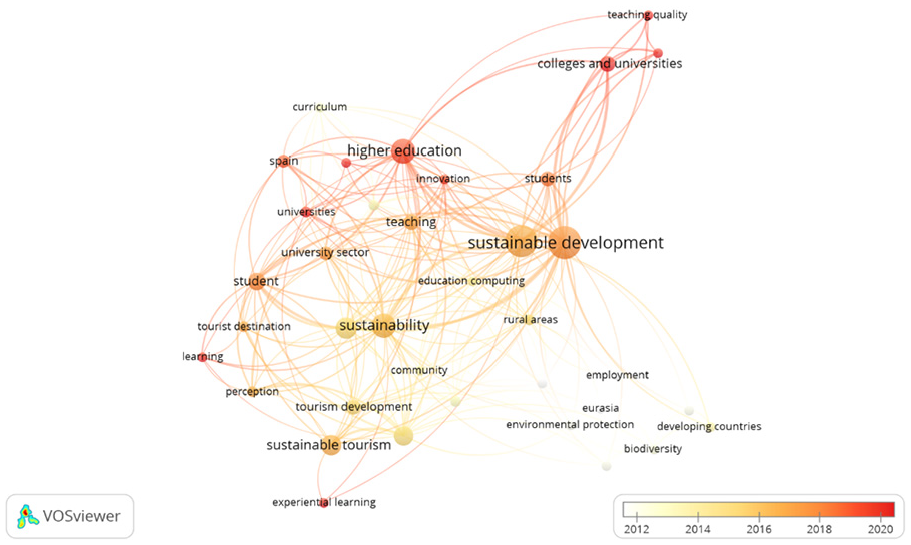
Knowledge domain map of the Keywords co-occurrence network.
From the total number of nodes represented in Figure 14, we can observe that some of these keywords correspond to geographical terms, others to tourism and sustainability, and others to concepts related to university higher education. We can see that the central nodes in this figure are sustainable development, tourism, and sustainability. According to where they are located on the map, these three phrases are essential organizing concepts in empirical studies. The three primary clusters in the map’s structure come together to paint a picture of the literature most heavily influenced by the phrase “Higher Education” (with an occurrence factor of 18).
On the other hand, we construct in Figure 15 a keyword co-occurrence analysis of the abstracts and titles of published articles. In this analysis, VOSViewer provides us with a ranking list of these words according to the year of occurrence in the articles (Moosavi et al., 2021; Van Eck & Waltman, 2018). To carry out this analysis, we selected the “all keywords” option to cover all related words. Tourism product, data, sustainability, and technology, were the most frequently used keywords in recent years in titles and abstracts. This means that the classical activity of sustainable tourism has become obsolete and is evolving into other tourism activities where sustainability and technology are robust cooperation tools.

Network domain knowledge map of keyword co-occurrences in the titles and abstracts of published articles.
Table 4 presents the keywords that first appeared in each period and were most robust in the 2012 to 2021 network. These can be considered emerging themes in these years. The strong presence of keywords related to sustainability in this table is outstanding (e.g., Ecotourism, Sustainability, Sustainable Tourism, Sustainable Development…). We note the presence of sustainable tourism as an emerging theme in 2017, the same year the United Nations General Assembly declared it the “International Year of Sustainable Tourism for Development.” Thus, this year’s main objective was to establish the potential of tourism to help achieve the 2030 Agenda for Sustainable Development, which is universal in scope, and its 17 Sustainable Development Goals (World Tourism Organization, 2017). Another major emerging theme today is the emergence of keywords related to higher education in the university sector. Therefore, we can state that sustainability in education is a new and emerging area of research.
Keywords With the Most Significant Increment of Strength From Their First Appearance.

Source. Web of Science Core Collection (2022).
We identify various thematic groups or clusters by adding up all the sets of occurrences and graphically representing their relationships. In these cases, the strength of the union of the words that compose them is measured using a normalized index. The value of this index is based on the occurrence of individual words and their joint occurrences. This is calculated by López-Fernández et al. (2016):

where Cij measures the strength of association between two words i and j, and Ci and Cj are the absolute frequency of occurrence of words i and j, respectively.
Figure 16 represents the strongest associations between keywords, where the orange rectangles identify the occurrence factor and the gray rectangles the total link strength. The analysis performed identified a total of four clusters that we named University Education (Cluster 1), Environmental Development (Cluster 2), Student Perception (Cluster 3), University Education (Cluster 4), and Sustainable Tourism (Cluster 5), as shown in Figure 16, the cluster name was defined by the keyword, as it is the main node and will thus be better linked to the other keywords in the cluster.
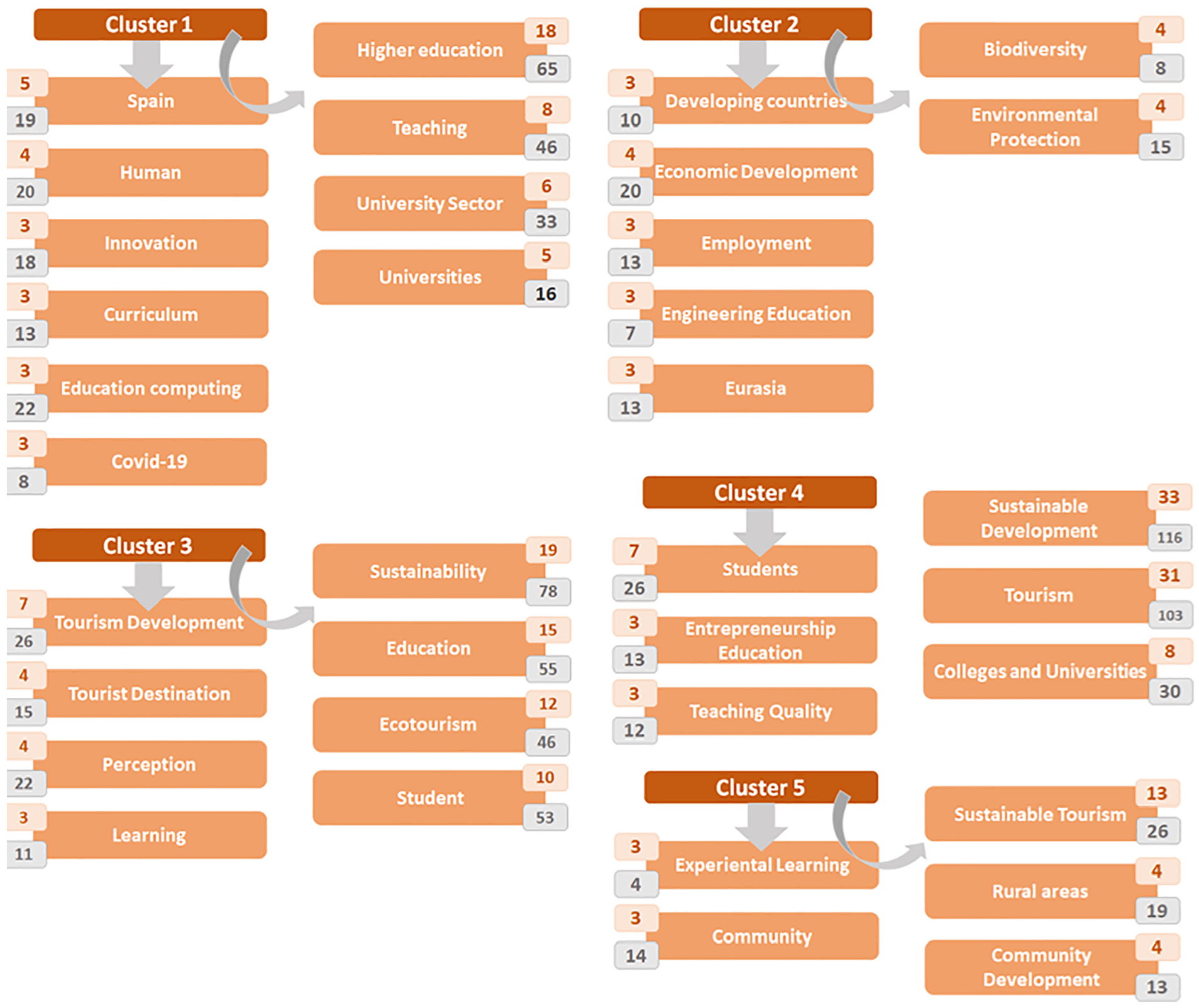
Main cluster of keywords identified.
The first cluster is related to a group of researchers interested in innovation in higher education. However, the second cluster focuses more on the economic impact on environmental biodiversity. Next, another group of researchers is more focused on student education, where student perception of sustainable tourism seems to be the most considered avenue of study. The fourth group, coinciding with cluster 4, is a specialization of the previous one, as its objectives are similar only that it specializes in higher education in sustainable tourism. The last cluster is the only one specializing in sustainable tourism, focusing on rural areas or community development issues. Therefore, this cluster analysis provides the researchers with information on five possible lines of research that they can use for future research.
Knowledge Framework
Through the analysis of the research on tourism and students’ knowledge of sustainability, we can conclude that there are various aspects and dimensions to this framework that, together with the directions, and critical points of research, face complicated challenges to change. Therefore, based on the previous study of Geng et al. (2022), we developed a general theoretical framework of knowledge that provides a reference for future research.
This study develops a theoretical knowledge framework integrated into the sustainable field of university education in tourism. This knowledge framework provides evidence on collaborative and co-occurrence networks. It also develops current research trends in the field analysed, providing readers with an overview of the state of the research. Through the analysis of author cooperation and co-occurrence, the main contents of the research framework are developed to date.
This knowledge framework enables readers to gain an integrated and comprehensive understanding of the topic under analysis from different perspectives. This enables future researchers to obtain influential and relevant publications, potential collaborations, and critical references. It also provides trends in this domain, enabling researchers to make better decisions in their future research and maximize research impacts.
Discussion
This research presents a structured literature analysis of sustainable education in tourism universities. Some published bibliometric studies have analysed the relationship between sustainability and university education. However, a bibliometric analysis studying sustainable education in tourism universities must still be completed. Therefore, this study has provided an overview of the current state of the literature and identifies the research frontiers in this area. Using various bibliometric techniques allowed us to assess the performance of scientific output and identify its conceptual and related intellectual structures.
The activity indicators allowed us to conclude that the interest in analysing specific education in tourism universities is recent since, as stated by Tan et al. (2021), many researchers are now trying to find ecological and sustainable solutions to environmental problems caused by pollution. This interest is shown by the exponential growth in the number of articles published in the last 10 years. Furthermore, our results align with those of Slocum et al. (2019), confirming that the number of published articles is expected to grow. On the other hand, the results also show that the most prolific authors in sustainable tourism education have few published articles. Consequently, as Urbizagastegui (1999) states, researchers specializing in this area manage to be influential even with few published articles. On the other hand, the journals do not stand out in terms of productivity. Thematic specialization is, therefore, a possible strategic alternative (Forliano et al., 2021).
Secondly, we applied the first-generation relational indicators. These indicators allow us to identify whether many researchers have addressed the topic under analysis (López-Fernández et al., 2016). Through a density analysis based on mapping techniques (Van Eck & Waltman, 2018), we conclude that overall cooperation between researchers is relatively small in this area. This result suggests that sustainable education in tourism universities requires more research, as few academics have addressed it (León-Gómez & Mora Forero, 2022). Therefore, more researchers should consider contributing to the current debate (Camargo & Gretzel, 2017; Ochoa Jiménez et al., 2022; Sharma et al., 2021).
Finally, to define the conceptual and thematic structure of the scientific domain of the analysed topic, we applied the second-generation relational indicators. This analysis allows us to discover trends and emerging themes (López-Fernández et al., 2016). Through keyword co-occurrence maps based on previous studies by Moosavi et al. (2021) and Van Eck and Waltman (2018), we concluded that the most used keywords over the last 5 years were Tourism product, data, sustainability, and technology. This means that the classical activity of sustainable tourism has become obsolete (León-Gómez et al., 2021) and is evolving into other tourism activities where sustainability and technology are robust cooperation tools (Rahmadian et al., 2022; Santos-Jaén et al., 2022).
Conclusions
Research on sustainable education in tourism universities is a current concern of researchers and academics. Geographical regions and researchers with a high degree of specialization who have addressed this relationship manage to be influential with few published articles. Due to the few inclusive articles, there remains a significant gap in current research. It would be interesting to increase the number of collaborations at the international level to achieve greater efficiency in the degree of specialization of the analysed relationship.
On the other hand, the analysis of the conceptual and thematic structure of the scientific domain analysed shows that there is currently a great concern on the part of the tourism sector to meet the SDGs defined in the 2030 Agenda by the United Nations. For this reason, there is a growing interest in research on how sustainability education of future professionals in the sector can contribute to the achievement of sustainable development in tourism. However, our results show that the fast growth of the tourism industry is leading to a shift in the involvement in activities necessary to achieve it. In this framework, new technologies are of great importance, as our results show the importance of incorporating this type of tool to achieve sustainable development in the tourism sector. Consequently, the challenge for future research in the sustainable tourism sector will be coping with the changing trends imposed by new technologies. In this context, tools such as R&D and Artificial Intelligence will be crucial to achieving this. This paradigm deserves further research, as educational training should be the critical tool to achieve it.
This research has limitations which can disclose new lines of research. Firstly, the dataset was collected through WoS to obtain higher-quality results. However, this limited the number of analysable articles. Extending this study to the Scopus database would be of great interest. On the other hand, the methodology used in this research has resulted in findings of a more qualitative nature. Future work should therefore take a more quantitative approach, going deeper into each indicator identified in the analysis to analyse the related variables.
The results of this research have empirical implications in three main areas. Firstly, an important implication of these findings is that they contribute to building a theoretical framework that provides an overview of the scientific literature produced for researchers and practitioners interested in the analysis of sustainable tourism education. Secondly, another essential practical consequence is that researchers can use the results of this study to improve their approach to future studies by considering the proposed avenues for future research to answer. Finally, and most importantly for the present study, are the implications of these findings for sustainable education. Practitioners in the tourism education sector could find a good baseline for encouraging the academic development of sustainability in their curricula.
Footnotes
Declaration of Conflicting Interests
The author(s) declared no potential conflicts of interest with respect to the research, authorship, and/or publication of this article.
Funding
The author(s) disclosed receipt of the following financial support for the research, authorship, and/or publication of this article: This project was funded by the Corporación Universitaria Minuto de Dios - UNIMINUTO.
