




Abstract
Since 2000, an increasing number of studies of opinion leaders has analyzed their roles from different perspectives in a wide range of industries. However, few studies had attempted to comprehensively review the existing literature in the past. The purpose of this research is to map the thread and skeleton of the research on opinion leaders from 2000 to 2021. A total of 3,872 related articles have been collected from Wos for scientometrics analysis. The research results show that (1) The research literature on opinion leaders has been in the ascending stage all along, and scholars remain enthusiastic on this research. (2) The most significant contributions mainly come from the United States, Britain, Canada, China, and Australia, but showing no high cooperation intensity. (3) According to the keyword time zone view, it is found that, with the development of time, its influence is gradually reflected on the internet with the development of science and technology. (4) Nine research classifications are able to be drawn in cluster analysis. By using Citespace software, this study is to analyze the last 20-year literature on opinion leaders and sort out their development context, while the data used in this study is merely retrieved from the WoS core database. The boundaries of this study, in the future, could be expanded by considering other types of databases and documents so as to integrate a more comprehensive knowledge map of opinion leaders.
Introduction
In everyday life, individuals make different decisions based on their own preferences, believing themselves to be the ones in control of those decisions. However, in group decision-making processes, people are often influenced by others, leading to decisions that may be inconsistent with or even contrary to their original intentions. Those who exert significant influence and shape the final decisions of others are known as opinion leaders (S. Li et al., 2021; Dong et al., 2024). Opinion leaders, also referred to as “public opinion leaders,” were first introduced by Lazarsfeld in 1940 in his work *The People’s Choice*. Later, in 1948, Lazarsfeld, in collaboration with Elihu Katz, conducted a study on voter behavior in American elections, which led to the development of the “two-step flow of communication” theory. This theory refined the definition of key opinion leaders, suggesting that media information is first transmitted to opinion leaders, who then disseminate this information to the general public. An opinion leader is defined as an individual who is capable of disseminating information and influencing the decisions of others (Corey, 1971), possessing greater persuasive power and influence compared to mass communication. Therefore, it can be concluded that the concept of opinion leaders originated in the political domain.
Based on the concepts of opinion leaders and the “two-step flow of communication” theory, scholars such as Lazarsfeld have conducted multiple surveys in areas such as shopping, social interactions, and current affairs, confirming the presence of opinion leaders in these domains as well. This trend is reflected in the publications that can be accessed through the Web of Science (WoS) database. In the field of shopping and marketing, the information age has provided marketers with more opportunities to reach and attract consumers. They leverage advantages such as information creation and sensitivity to become online opinion leaders, leading to consumer behaviors like impulse buying (Appel et al., 2020; Djafarova & Bowes, 2021; Farivar & Wang, 2022; Helberger, 2020; Wu et al., 2022). In the realm of social media, opinion leaders play a crucial role in shaping public opinion, fostering a favorable environment for public discourse, but they can also have negative effects, such as dominating the creation and dissemination of content related to national image and spreading misinformation (Domenico et al., 2021; Ingenhoff et al., 2021). Additionally, opinion leaders have been studied in other fields, including politics (Geber, 2019; Kertzer, 2022; Valdez et al., 2018), marketing (Dalman et al., 2020; Farivar et al., 2021), and medicine (Gaid et al., 2021; Volpp et al., 2021).
Across various fields of study, opinion leaders are typically defined as individuals with high levels of education who possess credibility and influence within specific domains. Their views and recommendations can significantly impact others’ attitudes, decisions, and behaviors (Harff & Schmuck, 2023; Sun et al., 2024). Although the concept of opinion leadership is not new, the role of opinion leaders has become more critical than ever in today’s era of digital social media and information overload (Crisafulli et al., 2022; Jansen & Hinz, 2022; Lee et al., 2022; Soffer, 2021; Ye et al., 2021). Utilizing opinion leaders, particularly in social contexts, remains a focal point of research in both academia and industry. Understanding the behavior and influence mechanisms of opinion leaders holds significant value for various institutions and groups, including businesses, governments, scholars, and consumers. Businesses need to explore how to collaborate with opinion leaders to promote their products and services; governments must understand how to leverage opinion leaders to disseminate policies and shape public opinion; scholars are tasked with conducting in-depth theoretical and empirical research in this field to provide insights for social practice; and consumers must better identify and evaluate opinion leaders amidst the flood of information to make informed decisions. Therefore, continued research on opinion leaders is essential.
By searching publications in the Web of Science (WoS) database, it can be observed that prior to 2000, articles primarily focused on the political domain, with a limited number of publications each year. However, after 2000, there has been a noticeable growth in the number of articles, with scholars from various fields increasingly associating their research with opinion leaders, thereby expanding the scope of opinion leader studies, enriching theoretical perspectives, and elevating the research in this domain to new heights. Broadly speaking, these articles can be categorized into two types: one focuses on the role of opinion leaders within specific fields, and the other comprises reviews of research on opinion leaders. The former contributes to the application of opinion leaders across different domains, while the latter helps clarify the current state of research on opinion leaders and identify meaningful directions for future research.
However, in terms of content, most reviews tend to concentrate on one or a few specific themes related to opinion leaders, such as reviews of research methods in the study of opinion leaders (Bamakan et al., 2019). There is a lack of comprehensive reviews that systematically summarize the entirety of research findings on opinion leaders. This may be due to the significant challenges in conducting a thorough analysis of large volumes of literature and the inevitable reliance on researchers’ subjective judgment in synthesizing information, which makes it difficult to ensure the objectivity and scientific rigor of the conclusions.
In my review of the research on opinion leader studies, I found that bibliometric methods can address the narrow focus of existing reviews by providing a broader analysis. Therefore, this paper will use the visualization software CiteSpace to review and summarize research on opinion leaders since 2000. It systematically outlines the progress and findings in this field, offering a detailed analysis of the development trajectory in this critical area. This approach aims to capture the overall landscape and fundamental patterns of research, providing valuable references for future research and practice.
Research Design
Analysis Tools
Bibliometrics enables both quantitative analysis (H. Chen et al., 2015) and qualitative analysis (Zhi & Ji, 2012) of literature characteristics within a specific field using various statistical methods. This approach allows users to quickly understand the types and themes of publications, their distribution across authors, institutions, countries, and fields (Calma & Davies, 2017), as well as development trends. It also facilitates the assessment of future research directions (L. L. Li et al., 2009).
CiteSpace, an automated bibliometric software, is primarily used to visualize and analyze trends and patterns in scientific literature (C. Chen et al., 2010). By integrating functions such as co-occurrence analysis, network visualization, and other visualization techniques, CiteSpace allows for comprehensive document analysis (C. Chen, 2006).
In this study, we utilized version V.5.7.R1 of CiteSpace to analyze the articles downloaded from the WoS database. By generating a series of visual maps, we explored key questions such as “What is the current state of opinion leader research?,”“What are the research hotspots?,” and “What are the trending topics?” This analysis provides valuable insights into potential research directions, content, methodologies, and citation references for future studies.
Database Construction
This data collection comes from the core collection database of WoS, which involves multidisciplinary research literature on natural sciences, social sciences, art and humanities, and provides academic citation indexing whose coverage can be traced back to 1900 (Bakkalbasi et al., 2006; Harzing & Alakangas, 2016) and the search services. At present, the high-level academic discovery research papers are based on WoS data sources (Chadegani et al., 2013; Fortunato et al., 2018). Therefore, in order to conduct this research, the database used in this article is the core collection of WoS. “Opinion Leaders” is the subject when searching articles from the WoS, and the search time is May 26, 2021. The specific search method is: select database = Web of Science core collection; subject = opinion leader; time span = 2000–2021; file type = “article” or “review,” language = English. When, the author, title, abstract, keywords, source publications, research directions and references are retained during the downloading course of catalog information of each article from the WoS core collection database for later analysis by the Citespace software. By 25 May, 2021, 3,872 research documents are retrieved using these parameters.
Basic Situation Analysis
In this section, scientific measurement and analysis are carried out to visualize the review of the knowledge areas of opinion leaders. In the pictures of the following chapters, purple indicates the links that occurred in 2000 to 2004, blue indicates links that occurred in 2005 to 2009, and green indicates links that occurred in 2010 and 2014, and yellow indicates The links that occurred in 2015 to 2019, and red indicates the links that occurred from 2020 to May 2021. The transition in color from cold to warm represents the time span from the past to the present (C. Chen, 2006). The detailed color expression is shown in Figure 1.

Citespace software color display.
Status of Published Documents
According to the time distribution of the literature from 2000 to 2021 (shown in Table 1), certain periodic characteristics of the article evolution could be seen. Research has shown that the number of articles of global opinion leaders has grown steadily and is roughly divided into three stages. In the first stable stage, the number of articles published from 2000 to 2006 was less than 100 per year, and the slow speed corresponds to the growth rate of the global economy. In the second stage of slow development, the number of articles showed a slow upward trend from 2007 to 2017. In the third stage of rapid development, from 2018 to 2020, the number of articles published each year increased to more than 300, and in 2021, the number has reached to 157 although only 5 months had passed.
Distribution of Opinion Leaders’ Literature From 2000 to May 2021.
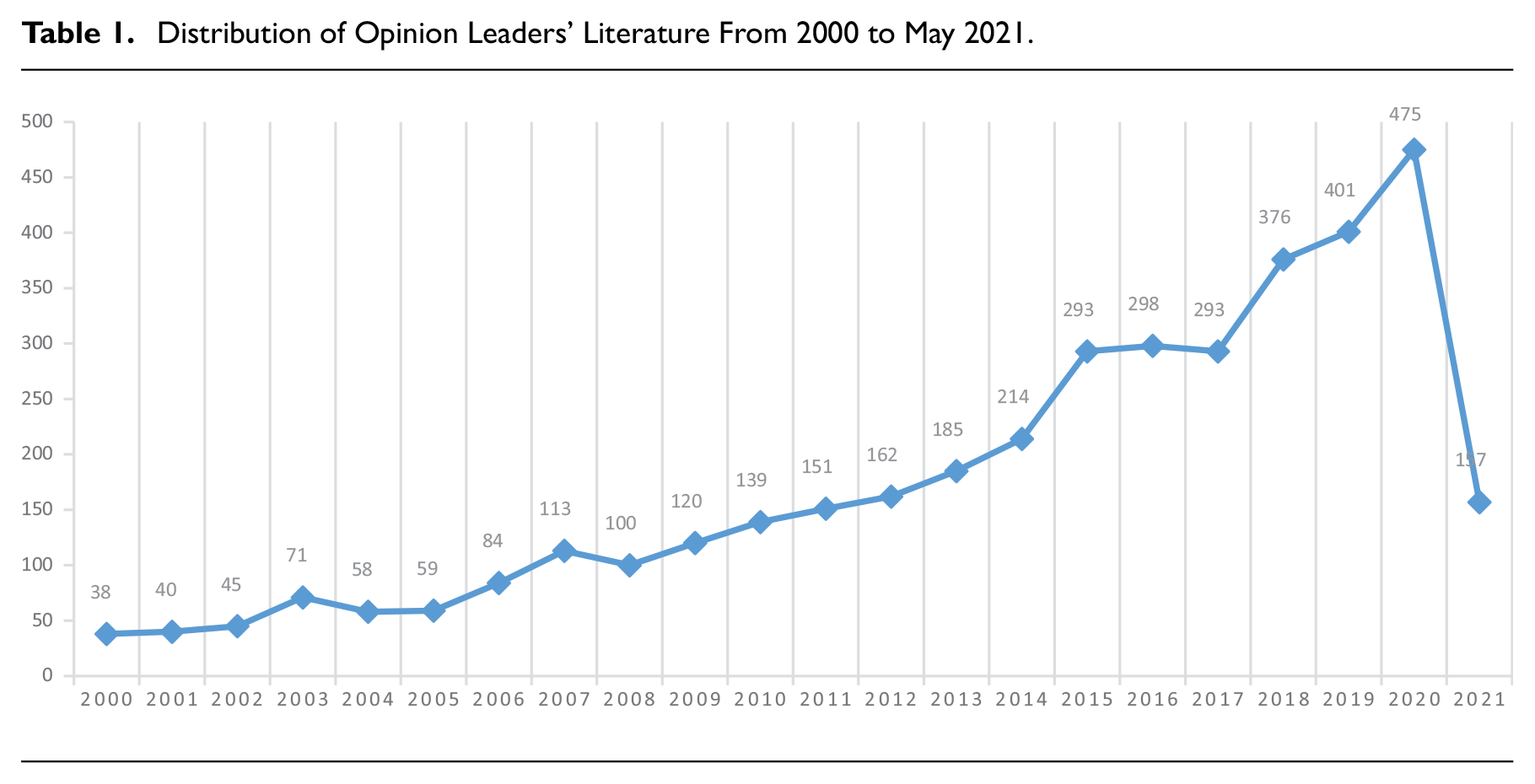

The steadily increasing number of research articles on opinion leaders from 2000 to 2021 globally reflects a growing trend. This phenomenon underscores that opinion leaders, as a significant social and business phenomenon, have garnered extensive academic attention and are playing an increasingly vital role in the information society (Casaló et al., 2020; Schweitzer et al., 2023). The consistent growth in the quantity of articles underscores the importance and complexity of this field. As society and technology continue to evolve, research on opinion leaders will expand further, providing deeper insights for both academia and the business world. This will contribute to a better understanding of social interactions and influence propagation in the information age. Moreover, this trend offers broad research areas and opportunities for future studies, particularly in emerging technologies and cross-cultural research.
Country/Region Cooperation and Institutions
By analyzing the cooperation network between countries and institutions, it can be determined that the key countries and research institutions that have published a large number of publications have had strong influences on the development of urban metabolism, and the cooperation relationship between them can be determined. We found that 74 countries had participated in the research on opinion leaders (Figure 2). The size of the circle in the figure represents the frequency of national publications. The greater the frequency is, the larger the circle is. The connection line between countries refers to whether there is a cooperative relationship between countries. The size of the line represents the amount of cooperation.

Opinion leader research country display.
These institutions are the most effective ones in the research field of opinion leaders in the past 22 years. Statistics on the number of countries and institutions are acquired based on the analysis of the data contained in each document (Table 2). 1,688 publications in the United States are the most surprising among the Top 10 countries/regions/institutions listed in the table, far ahead of others with accounting for 43.595% of the total, close to half of it. The institutions in United States are 8 out top 10, which takes the first place with accounting for 17.253%, such as the University of California system (163 articles), Harvard University (111 articles), the Pennsylvania State System of Higher Education (69), and the Florida State University System (69 articles), University of California, Los Angeles (66 articles), Johns Hopkins University (64), University of North Carolina (63) and University of Texas System (63). The second place comes to the United Kingdom, published 443 publications, the main research institution is the University of London (129 articles). The third is Canada, 354 publications, and the main institution is the University of Toronto (108 articles). Although the number of Chinese publications is 311, the research institutions are relatively scattered, leading to the absence of top 10 institutions in the table.
Top 10 Countries/Regions/Institutions With the Most Publications.

Centrality represents the strength of a node in the entire network, namely the number of connections between it and other nodes; high centrality represents the key nodes that have a great influence on the relationship in the network. Greece, for example, has the highest centrality (centrality 1.11) with the most cooperation with other countries although it did not entered the top 10 in terms of publication volume, followed by Switzerland whose centrality is 1.08, besides, there is close cooperation between the two countries. It can be seen from the combination of the figure and the table that the top three countries, apart from the United Kingdom that have cooperated with other countries and whose centrality is 0.25, the centrality of the United States and Canada is both 0.
Through analysis, it becomes evident that numerous research publications in the field of opinion leaders have been authored by key countries and research institutions. This highlights the international nature of opinion leader research, with collaborative relationships among researchers and institutions forming an extensive knowledge exchange network. This facilitates international cooperation and knowledge sharing in the field of opinion leader research. Some research institutions play pivotal roles in the domain of opinion leader research, which may include research centers, universities, or government laboratories. Their research output and international collaboration are instrumental in advancing the field of opinion leader research.
Co-Citation of Documents
Figure 3 proposes a co-citation network composed of 248 nodes and 274 links, each node represents a document cited in the selected 3,872 articles, and the connection points represent different co-citation relationships. The color indicates the corresponding time period. For example, there are a large number of red links in the figure, which indicates that the time of common citation of this document was mainly from 2020 to 2021, the Larger link points indicate a relatively high citation rate of these articles, which further indicates they are of paramount significance in the knowledge field of opinion leader. The top 10 cited articles in detail can be seen in the figure.

Total citations of documents from 2000 to May 2021.
In the citation analysis (Table 3), the article by Iyengar et al. (2011) stands out with the highest citation frequency, cited 55 times, while Google Scholar reports 1,170 citations. Their study, which analyzed the relationship between opinion leaders in social networks and the adoption of new products, yielded findings that are valuable for both theoretical dissemination and marketing practice. This work has garnered significant interest among scholars, particularly in the context of the rising prominence of e-commerce, and has spurred further research on opinion leaders within the e-commerce domain.
Ranking the top 10 literature citations.

For instance, inspired by Iyengar et al.’s work, Geng et al. (2020) investigated the first-order and second-order effects of influencer endorsements on marketing outcomes in the e-commerce environment, providing e-commerce retailers with insights into the economic value of influencer endorsements. Similarly, Tobon and García-Madariaga (2021) conducted experimental research on the impact of opinion leaders’ word-of-mouth marketing on online consumer decision-making, demonstrating that the influence of opinion leaders’ word-of-mouth marketing on shopping behavior in e-commerce contexts is limited. Zhao et al. (2018), from the perspective of opinion dynamics theory, confirmed through their study of the interaction mechanisms of autonomous agents in the e-commerce environment that the credibility of opinion leaders can enhance their influence within e-commerce. Additionally, Valente and Pumpuang (2007) conducted a study based on nearly 200 cases where opinion leaders were used to promote behavior change. They summarized 10 methods for utilizing opinion leaders to effect behavior change, along with the advantages and disadvantages of each method. This work has provided valuable references for both the practical application and theoretical research of opinion leaders across various fields.
Castellano et al. (2009), drawing from research in physics on collective phenomena arising from interactions between individuals as fundamental units within social structures, conducted a series of studies spanning from opinion, culture, and language dynamics to group behavior, the formation of hierarchies, human dynamics, and social diffusion. Their work offers a reference for opinion leader research from the perspective of statistical physics.
Xu et al. (2014) focused on the original domain where opinion leaders emerged—political elections—but shifted the context to the online platform Twitter. Their study confirmed the feasibility of using user-generated content to assess user characteristics, providing insights into enhancing the influence of tweets and other online content.
Furthermore, the works of Soumerai et al. (1998), Flodgren et al. (1996), Grimshaw and Eccles (2004), and Kelly (2004) have provided critical references for the study of opinion leaders in the healthcare sector.
These articles have been frequently cited in works published from 2020 to 2021, underscoring their ongoing relevance in the field. From these highly cited studies, two key conclusions can be drawn. First, opinion leaders are not confined to a single industry; they play various roles across different sectors and have a profound impact on each field. This demonstrates the broad interdisciplinary applicability of opinion leadership, suggesting that we should actively explore the value and function of opinion leaders in diverse domains. Doing so could provide new avenues for development in many areas. Second, the high citation frequency of these studies indicates the widespread dissemination and academic accumulation of knowledge about opinion leaders within these fields. This not only confirms the high practical value of opinion leaders during different stages of development in these sectors but also provides crucial references for future in-depth and expanded research on opinion leaders. It underscores the need for the academic community to continue studying opinion leaders in these fields, contributing to the sustainable development of these industries and sectors.
Keyword Co-occurrence
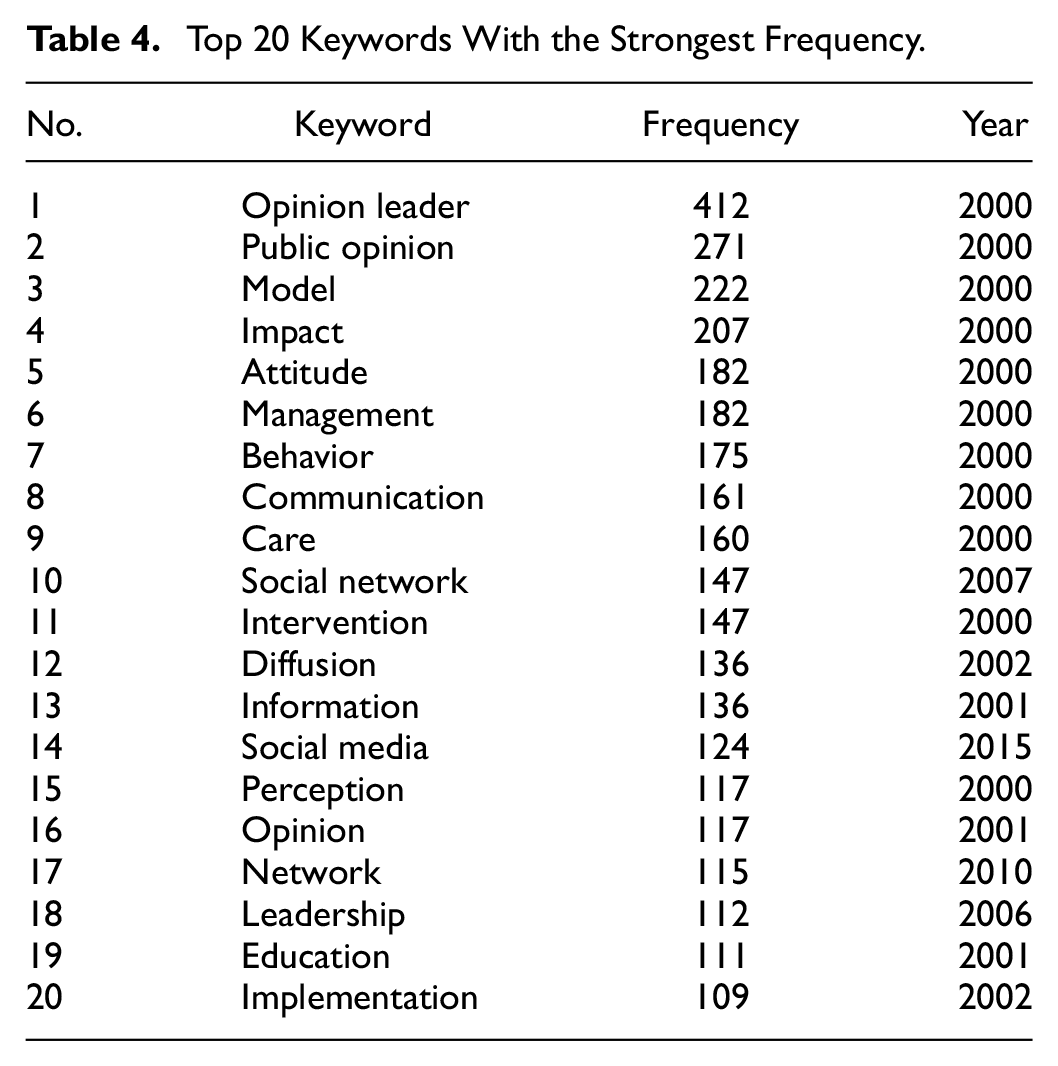
Keywords are the descriptive words of the core content of the article, and the analysis of the co-occurrence of keywords helps to determine the main theme of the opinion leader’s research field. The keyword co-occurrence network includes 100 nodes and 105 links, from 2000 to 2021, the software has identified 101 keywords with strong explosiveness. Table 4 lists the top 20 keywords with the strongest frequency, which all represent the rapidly developing themes in the research field of opinion leaders. “Frequency” refers to the number of occurrence of the research topic. The more the number is, the more concentrated the corresponding keywords are. “Year,” the third column in Table 3, is the time when the keyword first appeared. The keyword “opinion leader” has the highest frequency (412 times). It can be seen that many articles use opinion leaders as the theme, studying its role in various environments. The related to it are “public opinion” (271), “management” (182), “social network” (147), and “Impact” (207), covering the role of opinion leaders in various aspects, not only in different industries but the impact on “attitude” (182), “behavior” (175), and “intervention ” (147).
Top 20 Keywords With the Strongest Frequency.
The keyword co-occurrence network is a static representation of a specific area, which does not take into account the changes over time (C. Chen & Chen, 2005). In contrast, the timezone view is a visualization method that displays the evolution of knowledge over a time span, making it useful for analyzing the research trajectory and shifts in hotspots within a field over a time series (Xie & Yang, 2019).
In this study, building on the keyword co-occurrence network, we opted for the timezone view as our visualization method to trace the evolution of research hotspots in opinion leader studies from 2000 to 2021 (Figure 4). The overall timeline is divided into five stages; however, based on the attributes of the keywords, it can be roughly divided into three significant phases, with 2005 and 2020 as the key dividing points.

Keyword co-occurrence network 2000–2021 May 2021.
Before 2005, the research hotspots focused on the influence of opinion leaders across various industries and fields, with prominent keywords such as “health,”“management,”“elections,” and “foreign policy.” After 2005, with the rise of the digital era, the role of opinion leaders on the internet became increasingly evident, emerging as a major research focus. Keywords such as “social network,”“Twitter,” and “internet” became more prevalent. The period from 2005 to 2020 marks a convergence of these two research phases, where studies on the influence of opinion leaders across different industries and fields coexisted with research related to online information.
Furthermore, internet-related high-frequency keywords continued to be prominent through 2021, indicating that these topics are likely to remain research hotspots for the foreseeable future.
Cluster Analysis
As a data mining technique, cluster analysis can analyze and identify important topics, content and interrelationships (Wilks, 2011). Examining a document cluster can help to classify a large number of studies into different units for management, and then objectively infer the information related to each group or cluster (Si et al., 2019). Through the automatic tagging function of CiteSpace, noun phrases are extracted from titles, keywords or publication abstracts, and they are used as labels for different groups. Using LLR, high-quality clusters with intra-class similarity and low inter-class similarity can be generated (C. Chen et al., 2010).
In this study, 3,872 articles were collected and divided into 9 obvious research clusters according to their keywords (shown in Figure 5). The LLR test shows the clustering results and relative importance levels. The largest cluster number is #2, #8, and the smallest cluster number #4, as shown in the figure. 8 shows that these clusters intersect, which means that some parts between the nine clusters will overlap although they have different label names. The modular keyword clustering in the figure, Q is 0.7898, and the average contour is 0.7722, indicating that the clustering results are suitable for analysis.
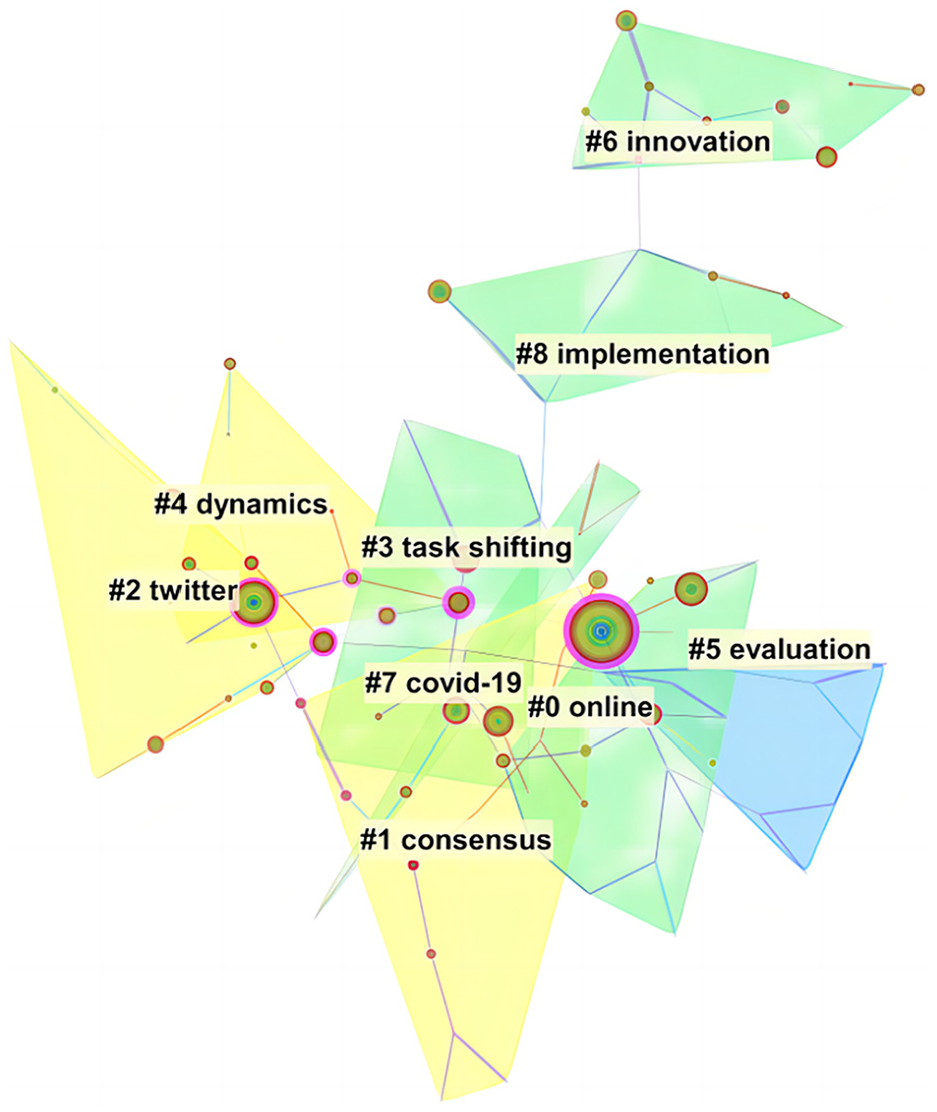
Cluster analysis from 2000 to May 2021.
Table 5 gives further details of these clusters. The contour value between 0 and 1 is usually used to measure internal homology or how similar the object is to its own cluster compared to other clusters. The higher the value is, the more effective clustering is formed. As shown in the table, a high internal uniformity (contour) value between 0.85 and 1 indicates that the items in the cluster are well matched and the cluster is reliable. As found, the different clusters indicate the distinct focus on aspects of the opinion leader problem. These 9 clusters represent the integration of research on opinion leaders in different professional directions in the last two decades.
Cluster Analysis From 2000 to May 2021.

Cluster #2, centered around the keyword “Twitter,” highlights the significant importance of the social media platform Twitter in the field of opinion leader research. Below are some of the top-ranking keywords and related clusters:
Social Media: This keyword signifies the crucial role of social media in opinion leader research. Social media platforms such as Twitter, Facebook, and Instagram have become essential tools for opinion leaders to disseminate their viewpoints and influence audiences. Researchers may explore how social media impacts the phenomenon of opinion leaders and how opinion leaders shape opinions on these platforms.
Network Analysis: Network analysis is a key methodology in opinion leader research. This field encompasses social network analysis, influence network analysis, and opinion leader network analysis, among others. Researchers may focus on identifying and evaluating opinion leaders in various network structures and study their roles within these networks.
Communication: The field of communication has always been at the core of opinion leader research. Researchers may focus on how opinion leaders disseminate information, influence audiences through various communication channels, and interact with traditional media.
Topic Modeling: Topic modeling is a method used to analyze large-scale text data, aiding researchers in understanding the themes and topics discussed by opinion leaders. This helps reveal the issues that opinion leaders are concerned with and the content of their discussions on social media.
Big Data: Opinion leader research increasingly relies on big data analysis methods, as platforms like social media generate vast amounts of data. Researchers may be concerned with how to effectively collect, store, and analyze large-scale data to uncover the behavior and impact of opinion leaders.
These keywords and clusters reflect the multidimensionality and complexity of opinion leader research. Researchers are actively exploring how to better understand and utilize the concept of opinion leaders in the digital environment to meet the demands of modern society and information dissemination. Research in these areas not only contributes to the advancement of academic theory but also provides valuable insights for businesses, governments, and social organizations on how to collaborate with opinion leaders and leverage their insights for strategic decision-making.
Cluster #8, with “implementation” as the dominant keyword, also includes top-ranking keywords such as “computerized,”“acceptability,”“third sector,”“core-periphery analysis,” and “health care.” Here’s an interpretation of these keywords:
Implementation: This keyword suggests how the insights and recommendations of opinion leadersare put into practice in research and real-world applications. This may involve policy-making, project execution, and strategic implementation. It may entail exploring the actual impact of opinion leaders in different domains and how their viewpoints and suggestions are applied in practical decision-making and actions.
Computerized: This term refers to the use of computer and digital technology in methods for identifying, tracking, and leveraging opinion leaders. Computerized methods may include data analysis, text mining, social network analysis, and more, aimed at understanding the behavior and influence of opinion leaders in digital environments. It may also relate to research on opinion leaders in the context of social media and online platforms.
Acceptability: The keyword “acceptability” likely relates to the degree to which the viewpoints and recommendations of opinion leaders are accepted by different societal groups. Researchers may be interested in understanding the acceptability of opinion leaders’ viewpoints among various audiences and how to enhance their acceptability. This involves assessing the influence and credibility of opinion leaders’ viewpoints and the attitudes and acceptance levels of people toward these viewpoints.
Third Sector: The term “third sector” typically refers to non-governmental organizations (NGO), charitable organizations, and social entities, among other nonprofit organizations. It may point to the application of opinion leader research in the third sector, such as non-profit organizations, social service agencies, and charitable sectors. This suggests that the influence of opinion leaders extends beyond the business realm and plays a significant role in the social and philanthropic sectors.
Core-Periphery Analysis: Core-periphery analysis is typically employed to study the key roles and peripheral roles within a network. In the context of opinion leader research, this may refer to examining the relationships between core figures and peripheral figures within opinion leader networks. Core-periphery analysis helps in understanding who plays crucial roles in the network and how they influence the implementation behavior of other members.
Health Care: This term indicates the application of opinion leader research in the healthcare sector. This may involve studying the roles of opinion leaders in healthcare policy, healthcare practices, and patient treatment choices. In the healthcare domain, opinion leader research may focus on how to utilize the viewpoints and recommendations of opinion leaders to improve healthcare policies, practices, and decision-making. Healthcare is a critical field that deals with issues related to public health.
These keywords reflect the diversity and interdisciplinary nature of opinion leader research. Researchers across various domains are paying attention to the implementation, influence, and acceptability of opinion leaders, seeking to understand how they shape policies, practices, and societal changes. Researchers may explore topics related to opinion leader influence on implementation, computerized methods, acceptability, the third sector, core-periphery analysis, and healthcare in different fields and contexts.
This multidisciplinary research contributes to a more comprehensive understanding of the role and impact of opinion leader phenomena in various domains.
Conclusion
1. Through the analysis of the current state of opinion leader research, several key findings emerge:
① The number of global articles related to opinion leaders has steadily increased, attracting widespread academic attention and entering a period of intense research activity.
② The United States is the leading country in terms of publication volume, with major contributors being prestigious institutions such as Harvard University and the University of California system. The United Kingdom, Canada, and China follow closely behind. Although Greece does not rank among the top 10 in terms of publication volume, it stands out as the country with the most collaborations with other nations, fostering a broad knowledge exchange network among researchers and institutions.
③ The article by Iyengar et al. holds the highest citation frequency, followed by works from authors such as Valente and Pumpuang (2007), Grimshaw and Eccles (2004), and Kelly (2004). These 10 highly cited articles span various domains, including e-commerce, political elections, healthcare, statistical physics, and techniques for utilizing opinion leaders, providing critical references for subsequent academic research and practical application.
2. Through the analysis of research hotspots in opinion leader studies, several insights are identified:
① High-frequency keywords in current research, such as “public opinion,”“management,” and “social network,” have emerged as research hotspots in response to societal development needs.
② Keyword co-occurrence analysis has clarified the shifts in research hotspots and trends in opinion leader studies, highlighting that internet-related fields have been and will continue to be key areas of focus for a considerable period.
③ Keyword clustering has identified nine major hotspot themes in opinion leader research, with “Twitter” and “implementation” standing out as primary themes. Most research falls under these categories, indicating their central role in the field.
Limitations and Outlook
This study conducted a knowledge mapping analysis based on literature obtained from the WoS Core Collection database, yielding highly reliable results. However, there are two main limitations to consider:
Limited Scope of Data Sources: Although WoS is regarded as the most authoritative source for the majority of publications, the study may have overlooked relevant articles from other databases or missed the most recent literature due to the fast pace of updates. As a result, the research might not encompass all articles related to opinion leaders.
Constraints in Keyword Co-occurrence Analysis: The co-occurrence of keywords is influenced by the selection of the number of nodes, which could potentially affect the accuracy of the conclusions. However, it is important to note that accuracy is inherently relative and does not compromise the overall reliability of the study’s conclusions.
To address these limitations, future research could expand the scope by incorporating other types of databases and including the latest articles. This approach would help to create a more comprehensive knowledge map around opinion leaders, thereby enhancing the breadth and depth of the research.
Footnotes
Acknowledgements
Research assistance was provided by Jining University Shandong, China.
Author’s Note
Declaration of Conflicting Interests
The author(s) declared no potential conflicts of interest with respect to the research, authorship, and/or publication of this article.
Funding
The author(s) disclosed receipt of the following financial support for the research, authorship, and/or publication of this article: This work was supported by the 2023 Shandong Provincial Federation of Social Sciences Humanities and Social Sciences Project (Key Special Project of Think Tank) “Research on the Endogenous Power and Path of Empowering E-commerce to Promote the Effective Connection between Poverty Alleviation Achievements and Rural Revitalization.” (Project No: 2023-zkzd-062).

Data Availability Statement and Fig Share Reference
Related content can be obtained by contacting the corresponding author.