Abstract
While the stimuli related to negative situations like disasters affect people emotionally negatively, good behaviors toward those in difficult situations can cause us to experience positive emotions or reduce the effects of them. However, it is seen that exposure to kindness related stimuli and perceptions about them have not been sufficiently examined in the organizational context. In this research, the effect of perceptions toward leader’s kindness behaviors on service sabotage and the mediating role of feeling of elevation and employee well-being are investigated through a descriptive field study. In this direction, a questionnaire containing the research variables was applied to the employees of a municipality in Kırıkkale province of Turkey. As a result, it was found that perceptions toward leader kindness behaviors affect service sabotage in the negative direction, and employees’ sense of elevation and well-being positively. In addition, employee wellbeing was found to play a mediating role in the effect of perceptions toward kindness on service sabotage. The findings of the study suggest that perceptions about leader kindness behaviors may have important organizational outcomes. Finally, recommendations for researchers and organizations were developed.
Plain Language Summary
Although leadership is researched in terms of behaviors toward employees, general kindness or kindness behaviors toward out of organization is not take scientific attention. In this research, the effect of perceptions toward leader’s kindness behaviors on service sabotage and the mediating role of feeling of elevation and employee well-being are investigated through a descriptive field study. In this direction, a questionnaire containing the research variables was applied to the employees of a municipality in Kırıkkale province of Turkey. As a result, it was found that perceptions toward leader kindness behaviors affect service sabotage in the negative direction, and employees’ sense of elevation and well-being positively.
Introduction
Nowadays, in which worries of people are widespread due to problems like international conflicts or health diseases, it is seen that even small kindness behaviors can make people happy like donating or saying hello to a stranger. According to a recent American Psychiatric Association poll, about % 90 of people making or receiving an act of kindness, feel better (American Psychiatric Association [APA], 2023). On the other hand, scientific knowledge about organizational effects of kindness is limited. Although different leadership, management and organization approaches acknowledge the importance of issues such as setting ethical standards, being an example to followers in terms of ethics, being virtuous, justice and altruism, it is seen that these are mostly addressed in terms of approaches toward employees and behaviors in the work environment. On the other hand, from the perspective of “Positive Psychology,” the organizational effects of ordinary or heroic acts of kindness toward others or non-organizational units have not been investigated. In fact, acts of kindness can affect those who witness the kindness as well as the recipient and the doer of the kindness. Considering that especially in recent times, communication that includes kindness related stimuli arising from internet technologies is much more common and easy, investigating the effects of witnessing the kindnesses of certain stakeholders such as leaders or managers in the workplace toward humanity or other people has the potential to contribute to achieving organizational goals. Kindness can be expected to be one of the effective methods to lead employees in today’s world where negative emotions such as anxiety are widely experienced.
One of the ways leaders can positively influence their followers is to make them experience positive emotions (Bono et al., 2007; Diener et al., 2020; Goswami et al., 2016; Liang & Steve Chi, 2013; Ozcelik et al., 2008; Zhou et al., 2014). Indeed, the positive effects of positive emotions in the workplace have recently attracted attention (Behnke et al., 2023; Diener et al., 2020; Dreer, 2024; Staw et al., 1994). At this point, it is seen that kindness, which is expressed as behaviors performed for the benefit of others (in terms of exposure, witnessing, etc.) (Hake & Post, 2023; Youngs et al., 2023), can cause people to experience positive emotions (Fredrickson et al., 2008; Kearney et al., 2014; Ouweneel et al., 2014). Since kindness can reduces stress and creates interpersonal bonds, it is possible that it can be used in the work environment, especially by leaders (Fryburg, 2023). However, the effects of kindness on organizational stakeholders, such as employees, have not received enough attention, especially in terms of the leader’s kindnesses to other people outside the organization. So the main purpose of this study is to answer the question of “what can be specific effects of the leader’s kindness behaviors can be in organizational context?.”
Literature Review
Under this title, the concepts of kindness, the effects of kindness in general, feeling of elevation, employee well-being and service sabotage are explained as the main variables of the research.
Kindness and Its Effects
In the literature, it is seen that kindness can be defined in different ways. For example, kindness can be expressed as behaviors that are voluntarily performed for the benefit of others (Chancellor et al., 2018), not as a result of an obligation or an official order, but as a result of a desire inherent in human nature (Johnstone, 2010). As another example, students may explain kindness as helping others (Binfet & Passmore, 2019), while others may use it instead of words such as empathy, altruism or compassion. However, kindness has differences from these concepts. For example, empathy, which is a sense of sharing emotions of others, does not always involve kindness (Haskins et al., 2018) and requires resonating with emotions of others. Altruism or generosity, which usually involve certain costs, may not involve feelings or attitudes of kindness. Therefore, kindness can also be explained as behaviors motivated by genuine warm feelings for others and can be especially recognized by the perceptions of the recipient of the kindness (Canter et al., 2017). Hake and Post (2023) define kindness in the context of health care as behaviors for the benefit of others that are also perceived as kindness by the recipient. For example, behaviors such as greeting patients with a smile and asking them questions about their daily life are perceived as good by patients. In the face of the intangibility and difficulty of measuring concepts such as compassion and empathy, the fact that kindness can be portrayed in concrete behaviors increases interest in the concept in terms of teaching and promoting it.
Studies show that kindness affects the wellbeing of those who perform these behaviors and related variables (anxiety, stress, negative emotions, etc.) (Curry et al., 2018; Galante et al., 2014; Otake et al., 2006; Perkins et al., 2022; Rowland & Curry, 2019). Beyond the acts of kindness performed, remembered (Ko et al., 2021), received, and witnessed acts of kindness can also affect people positively. For example, Buchanan and Sandstrom (2023) have shown in their research that news with negative tones such as death and violence drive the media, that these negatively affect people’s mental health and perceptions of humanity, and that witnessing the kindness of others can play a role in reducing these negative effects. In their experimental research, they concluded that exposure to bad news such as terrorist attacks and immorality (murder, pedophilia etc.) followed by exposure to good news such as volunteering, philanthropy and caring for the homeless maintains positive mood and leads to the belief that others are good. Therefore, it is inevitable that kindness content encountered on social networks such as YouTube (Dale et al., 2017), where inspirational posts about kindness are often encountered alongside posts about evil (Dale et al., 2020), will have positive effects on people. For example, early-adolescents may encounter content and interactions such as bullying on social media, as well as experiences that make them feel good (Lenhart et al., 2011). It is thought that researches on the scope of kindness (routine daily kindness, heroic kindness) or the characteristics of the doer (acquaintance, stranger, leader, colleague, etc.) will contribute to understanding the effects of kindness related stimuli in different contexts.
Indeed, it is observed that witnessing goodness or the moral excellence of others may not always affect solidarity intentions. For example, in Zhang et al.’s (2020) experimental study in which participants were exposed to videos with kindness (helping the elderly, etc.) or control content (city advertisement, etc.), it was found that kindness related stimuli exposure does not affect the individual’s intention to be pro-social. Therefore, exposure to all types of kindness stimuli may not have the same effect, at least in terms of reflection on behaviors, and especially the daily kindnesses that people frequently encounter may not affect social advocacy (Zhang et al., 2020). At this point, behaviors and stimuli related to kindness in the organizational context can be expected to affect employees. It is thought that perceptions about kindness behaviors of leaders who guide and motivate employees with their communication is a topic worthy of research. As a matter of fact, it is seen that kindness attracts limited attention in different approaches and classifications related to leadership.
Feeling of Elevation
Moral elevation refers to an emotional response to moral beauty or excellence (Pohling & Diessner, 2016), feeling moved, impressed and inspired by them (Oliver et al., 2015). As far as it is known, the feeling of elevation, which was first described by Haidt (2000), is explained as a feeling of warmth or joy in the chest that makes the individual want to be more moral.
People can be moved to action by the virtues of others. However, emotions based on the kindness behaviors have not received as much attention in psychology as happiness. In this context, unlike emotions such as amusement and joy, feeling of elevation, gratitude and admiration can arise when witnessing kindness. Elevation is defined as a positive emotion (Freeman et al., 2009; Haidt, 2000) that is stimulated by seeing strong virtues such as forgiveness, loyalty, and generosity (Algoe & Haidt, 2009) and can be felt when witnessing behaviors such as helping a third person or group in a virtuous way as the high good nature of humanity.
Kindness and Leadership
The relationship between leadership kindness and wellbeing can be evaluated primarily in terms of the “internalized moral perspective” dimension of authentic leadership. This dimension means that the leader makes decisions based on values or acts according to internal moral standards (Couris, 2021). In addition to this leadership style, the effects of virtues in the workplace have been widely researched in the literature on ethics. As a leader who can lead followers to higher moral standards or exhibit ethical behaviors, the type of “transformational leadership” (Bass, 1990; Howell & Avolio, 1992) and the type of “authentic transformational leadership” (Bass & Steidlmeier, 1999) in which moral values are prioritized can be evaluated in this respect.
On the other hand, from a Positive Psychology perspective, which is utilized by organization researchers in terms of positive psychology interventions at work (Donaldson et al., 2019; Meyers et al., 2013), importance of positive psychology at work (J. Mills et al., 2013; Turner et al., 2002), or organizational stressors and effect of positive organizational behaviors in workplace (Froman, 2010), it is stated that leadership types such as ethical or transformative leadership are far from determining the characteristics or behaviors of virtuous leaders (Ozkan & Ardic, 2022). As a matter of fact, in the conceptualization of virtuous leadership, in addition to leadership theories, the approaches of Confucius (humanitarianism, trustworthiness) and Aristotle (courage, temperance, justice and prudence) have been used (Hackett & Wang, 2012) and virtue-based ethical leadership measurements have been developed (Riggio et al., 2010). In short, this type of leadership, which refers to having moral passion in decisions and behaviors (Yang, 2021) and consists of dimensions such as courage, temperance, justice, prudence and humanity (G. Wang & Hackett, 2016), and its effects have become a subject of research in the organizational context. However, in this leadership approach, virtues were mostly addressed in terms of the behaviors performed toward organizational stakeholders. On the other hand, leader’s good behaviors toward other people outside the organization and the effects of the perceptions about these behaviors on employees did not attract attention. Since the kindness of the leaders include behaviors for the wellbeing of others beyond the employees, it is thought that it would be useful to investigate the concept of kindness in terms of by this viewpoint.
Employee Wellbeing
Employee well-being, which is defined as the happiness or wellness of employees, is an important variable that affects general life (Yüksel & Yılık, 2022). Employee wellbeing can be measured by a combination of variables such as psychological wellbeing, social wellbeing, workplace wellbeing, subjective wellbeing (Pradhan & Hati, 2022), life satisfaction, workplace satisfaction (Zheng et al., 2015). However, employee wellbeing can also be determined specifically by wellbeing at the workplace, prior to dimensions related to general happiness. From this perspective, employee wellbeing is measured based on positive feelings at work (Aboobaker, 2022).
It is seen that many manager related factors such as manager support (Yin & Wu, 2023), workplace safety (Subramony et al., 2022), organizational wellness climate (Reynolds & Bennett, 2023) are effective in increasing employee wellbeing. In this study, the effect of employee perceptions toward leader’s kindness on increasing employee wellbeing is examined.
Service Sabotage
It is possible for employees to deliberately provide poor service to customers or service recipients. Service sabotage, which is among employee misbehavior commonly encountered in manufacturing or service sectors, refers to not performing the service properly (rudeness, rushing, delaying, etc.) and negatively affects employees, team spirit, friendly relations between employees and customers, service and business performance. Despite the attention paid to variables such as service quality and customer satisfaction in the literature, conscious service sabotage behaviors have not been sufficiently examined (Harris & Ogbonna, 2002, 2006, 2012).
Hypothesis Development
Under this title, research hypotheses were tried to be developed. In this respect, first of all, it should be noted that there is no research on the direct effect of employee perceptions about leader’s kindness behaviors on service sabotage and other variables. On the other hand, research on kindness in different contexts contributed to the development of the research hypotheses.
The Effect of Perception Toward Leader’s Kindness Behaviors on Service Sabotage
Studies about effects of kindness show positive behavioral consequences. For example Algoe and Haidt’s (2009) experimental study shows that kindness motivates people to engage in solidarity behaviors. Within the scope of the research, it is suggested and tested that perceptions about kindness behavior of the leader can affect employees’ service sabotage.
Although there are no studies directly addressing these variables, there are studies showing that perceiving the leader as virtuous affects employees’ commitment to work, relative wellbeing, performance (Tripathi, 2024), moral characteristic (Adewale, 2020), moral behavior (Alshehri & Elsaied, 2022; Hadi & Sahib, 2023; Matokwe, 2021), and organizational citizenship behaviors (Thun & Kevin Kelloway, 2011). Therefore, it can be expected that perceiving the leader as someone who does kindness for others will affects service sabotage behavior (it can be considered as anti organizational, unmoral or ethically problematic). In addition to these, several research shows benevolent leadership affects positive work behaviors or attitudes (Ho & Le, 2023; Grego-Planer, 2022; Rui & Xinqi, 2020; Shen et al., 2023). Based on these explanations, the first hypothesis of the study is put forward to be tested:
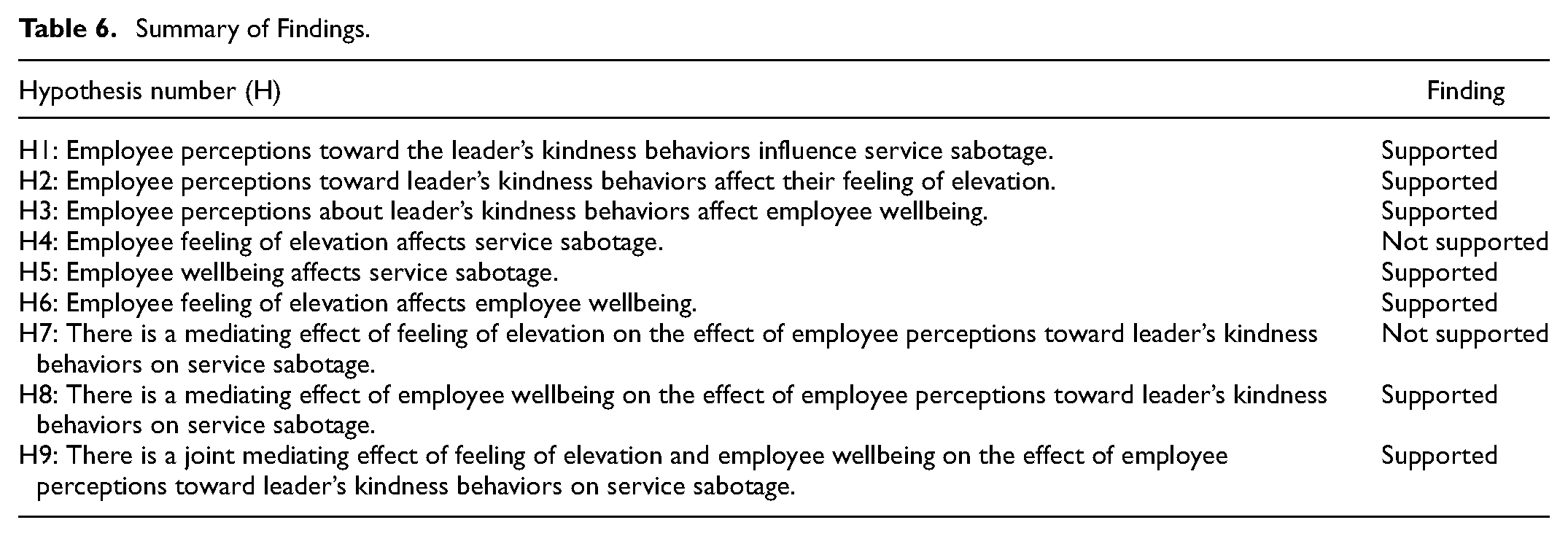
H1: Employee perceptions toward the leader’s kindness behaviors influence service sabotage.
The Effect of Perception Toward Leader’s Kindness Behaviors on Feeling of Elevation
Although no research has been conducted in the context of leadership, it is observed that exposure to kindness related stimuli causes feelings of elevation. Elevation is an emotion that arises in the face of virtue or moral beauty (Haidt, 2003) or occurs in response to the moral excellence of others (Algoe & Haidt, 2009). This emotion, which causes warm feelings in the individual’s chest and motivates them to act more virtuously, has received almost no attention compared to emotions such as gratitude. It is argued that the feeling of elevation is important in understanding human morality (Haidt, 2003).
The idea that exposures to kindness cause feeling of elevation and that kindness affects people through this feeling has been supported in many studies. Oliver et al. (2015) found that inspirational videos about kindness are the source of the feeling of elevation and that this leads to the formation of a common bond between the self and humanity, which in turn leads to a greater sense of connectedness. In Krämer et al.’s (2017) study, it was found that watching videos about kindness caused more feelings of elevation than others (beauty of the world, entertainment, etc.). In short, a large number of studies show that the main outcome of kindness related stimuli is a feeling of elevation.
There is a growing literature about seeing kindness activates elevating and positive emotions (Fryburg, 2022; Fryburg et al., 2021). In psychology, it is possible that the feeling of elevation, which is seen to arise due to kindness, may also arise from stimuli related to kindness in the organizational context. In particular, it is possible that being exposed to the leader’s kindness toward those outside the organization may cause a feeling of elevation in employees. However, it is thought that there is a need for research addressing kindness in this respect. In the study of Vianello et al. (2010), it was found that leader’s interpersonal justice and self sacrifice affect the feeling of elevation. Similarly, stimuli related to the leader’s kindness toward others can be expected to affect employees’ feeling of elevation. Based on these explanations, the following research hypothesis is put forward to be tested:
H2: Employee perception toward leader’s kindness behaviors affects their feeling of elevation.
The Effect of Employee Perceptions Toward Leader’s Kindness Behaviors on Employee Wellbeing
The perception about leader’s acts of kindness toward those outside the organization can be expected to affect employee wellbeing. Although there are no findings directly related to this claim, research on similar variables shows that this hypothesis is worth testing. At this point, first of all, many negative situations such as pandemics, disasters, accidents and news about them cause people to experience emotions such as worry, hopelessness and anxiety (Gasteiger et al., 2021; Johnston & Davey, 1997; McNaughton-Cassill et al., 2009; Riehm et al., 2020) and ultimately lead to reduced wellbeing (Buchanan et al., 2021) and that bad news is more influential or attracts attention than good news (negativity bias; Baumeister et al., 2001; Rozin & Royzman, 2001). On the other hand, it is seen that situations related to kindness affect people positively and can reduce the effects of negative news. At this point, it is argued that watching wellbeing videos can be used as an important method to create positive emotions such as happiness and relaxation to healthcare providers and recipients who experience stress intensely and commonly (Fryburg, 2022). In Fryburg et al.’s (2021) experimental study in a pediatric and dental clinic, it was found that those who watched kindness media felt happier, relaxed, grateful, less disturbed, and more generous compared to watching a children’s program.
In a study conducted by Chancellor et al. (2018) with employees in a workplace, it was concluded that those who observed solidarity behaviors increased their prosaically behaviors. Accordingly, behaviors such as bringing a drink to a colleague at work, helping him/her with his/her task, cheering him/her up when he/she is in a bad mood, helping to carry things or telling him/her something he/she did well can be expected to have organizational effects. Therefore, it is understood that solidarity behaviors as a type of kindness among employees in the work environment positively affect employees.
In addition, researchers, politicians and the general public have argued that kindness can enhance wellbeing. For example, in Cotney and Banerjee’s (2019) focus group study conducted with adolescents aged 11 to 15, it was found that the wellbeing of both the recipient and the doer of kindness was positively affected. As another example; “catastrophe compassion” (Zaki, 2020), which emerges from empathy, causes people to make more donations and voluntary acts of kindness during periods such as pandemics, and such altruistic behaviors contribute to people overcoming stressful situations (Titova & Sheldon, 2022).
Moreover, even if people cannot help others, they may feel relieved when exposed to stimuli related to helping behaviors (Zaki, 2020). As a matter of fact, witnessing the kindness of others can cause people to think that others are good and that there is a solution to suffering, and can lead to emotional and cognitive recovery or increased morale (Algoe & Haidt, 2009; Schnall et al., 2010). Moreover, research on virtuous leadership suggests that virtuous leadership affects employee happiness (Q. I. Wang, 2011), work related wellbeing (through job satisfaction, work-related emotions and dedication to work, and trust in the manager), and trust in the manager (Hendriks et al., 2020). Based on these explanations and the findings in the literature, the third hypothesis of the study is put forward.
H3: Employee perceptions toward leader’s kindness behaviors affect employee wellbeing.
The Role of Feeling of Elevation and Employee Wellbeing
Researches on wellbeing show that the effects of kindness occur mostly through elevation (Pohling & Diessner, 2016). It is stated that the feeling of elevation motivates social bias and commitment behaviors (Algoe & Haidt, 2009). In addition, the feeling of elevation can influence moral or altruistic behaviors (Layous et al., 2017) such as volunteering (Cox, 2010), helping (Schnall et al., 2010) or forgiving (Thomson & Siegel, 2013). Xing et al. (2022) found that ethical leadership affects employee elevation and concluded that the feeling of elevation mediates the effect of ethical leadership on organizational citizenship behaviors. In the study of Vianello et al. (2010), it was concluded that the feeling of elevation mediated the effect of the leader’s ethical behaviors on the ethical behaviors of the followers. In addition, it was found that elevation fully mediated the effect of followers’ organizational citizenship behaviors and emotional commitment to the organization.
In addition, Reizer et al. (2019) found that negative emotions and decreased job satisfaction mediate the effect of motivation on job performance. Therefore, it can be expected that a leader who can make his/her employees experience a feeling of elevation and increase their wellbeing through acts of kindness will influence their attitudes and behaviors in favor of the organization through these variables. Based on these explanations, the following hypotheses of the study are put forward:
H4: Employee feeling of elevation affects service sabotage.
H5: Employee wellbeing affects service sabotage.
H6: Employee feeling of elevation affects employee wellbeing.
H7: There is a mediating effect of feeling of elevation on the effect of employee perceptions toward leader’s kindness behaviors on service sabotage.
H8: There is a mediating effect of employee wellbeing on the effect of employee perceptions toward leader’s kindness behaviors on service sabotage.
H9: There is a joint mediating effect of feeling of elevation and employee wellbeing on the effect of employee perceptions toward leader’s kindness behaviors on service sabotage.
The research model including research variables and relationships among them is shown in Figure 1. In the research model, employee perception toward the leader’s kindness behaviors is the independent variable, service sabotage is the dependent variable, and feeling of elevation and employee wellbeing are the mediating variables:

The research model.
A Field Survey of Municipal Employees
Method
In the study, a survey was conducted with the employees of a district municipality in Kırıkkale province of Turkey. A cross sectional quantitative approach was considered appropriate because it examined the specified perceptions, emotions and behaviors of employees and the relationships between them in organizational contexts. At this point, due to the difficulty of access to organizational sample, through convenience sampling method, 256 municipal employees were reached with the permission and facilitating support of the municipal administration. The self-managed questionnaire forms were hand distributed to the participants in printed form who could be reached at working hours. It took approximately 4 to 5 minutes to fill out the questionnaire. The data collection process was carried out between 24 August and 30 September 2023. With the encouraging support of the municipal administration to scientific research, employees working in departments of the municipality were asked if they were willing to participate in the survey. The survey was administered to those who volunteered to complete it and had the time. The questionnaires were handed over to the employees and were collected on the same day from those who were able to fill them out in a short time. Questionnaires were left to those who wanted to participate in the survey but did not have time due to work, and were visited and collected within the same week. In addition, institution visits were made again to reach those who were not at work, and the same process was carried out for these employees. Participants were informed about the general aim study and voluntary nature of the participation. The collected forms were coded and transferred to the computer environment. The ethical evaluation of the questionnaire is done by Social and Human Sciences Research Ethics Committee of Kırıkkale University and ethical permission was obtained on 18.08.2023.
In designing the research questionnaire, the researches in which the variables were measured were utilized. Accordingly, the six items prepared to measure the perceptions about the kindness of the leader were adapted from Youngs et al. (2023), Gherghel et al. (2021), Canter et al. (2017) and Otake et al.’s (2006) studies. The scale is in five-point Likert form with response options ranging from 1—Never to 5—Always. For the seven items created for the measurement of the feeling of elevation, the measurement in Layous et al.’s (2017) research was utilized. The scale response options are the same as the perceived well-being scale. For the six items about the employee wellbeing at workplace, the scale developed by Zheng et al. (2015) was translated to Turkish. The response options of the scale are in five-point Likert form ranging from 1—Strongly Disagree to 5—Strongly Agree. In order to determine service sabotage, the nine-item scale developed by Harris and Ogbonna (2006) was utilized through translation. The response options the scale is the same as the employee wellbeing at workplace scale. In addition, questions were included to determine demographic characteristics of the participants.
SPSS program version 25 was used for the analyses conducted in the research. Reliability and validity analyses of the measurement tools were conducted and regression analysis was used to test the hypotheses. The mediation effect was measured and reported following the procedure introduced to the literature by Hayes (2018).
Findings
In this section, research findings are presented. Firstly, the demographic characteristics of the sample are presented. Then, normal distribution, reliability and validity analyses, and hypothesis tests were conducted.
Demographic information about the sample is given in Table 1. Accordingly, 70.1% of the participants are male. In terms of marital status, 54.7% of them are married. In terms of age range, 18 to 26 and 27 to 34 age groups correspond to 73.9% of the sample. The education level is mostly high school and below with 59.8%. When the duties of the employees in the organization are analyzed, the rate of employees working as company personnel is the highest with 58.6%. In addition, when the duration of employment in the organization is analyzed, the proportion of employees working between 1 and 5 years is the highest with 62.9%. Seventy-three percent of the employees have an income of 15,1000 TL or less. Finally, 85.9% of participants do not have administrative duties.
Demographic Information of the Sample.

Statistical information about the measurement tools is given in Table 2. According to this, the levels elevation feeling, kindness behavior perception and employee wellbeing have a value above the average according to the five-point Likert scale. On the other hand, service sabotage has a value below the average with 2.26. Kline (2011) emphasizes that if the absolute value of skewness is above 3 and the absolute value of kurtosis is above 10, this indicates a problem. Therefore, it can be assumed that normal distribution is realized for the values calculated in this range. In this study, it is assumed that the distribution is normal within the framework of the skewness and kurtosis values obtained.
Statistical Information of Measurement Tools.

Reliability and validity analyses of the measurement tools are given in Table 3. Accordingly, principal component factor analysis and exploratory factor analysis (EFA) was applied for each scale. EFA is used in evaluating new metrics (Yong & Pearce, 2013) and is often used in evaluating psychological variables (Goretzko et al., 2021). The main purpose of the EFA is to evaluate the structure of the measured variables or identify latent constructs (Fabrigar et al., 1999). Since this research contains adapted scales used in a different context, conducting EFA is preferred. The suitability of the scales for factor analysis was examined by KMO and Bartlett’s test. In addition, Cronbach’s Alpha coefficient was calculated for reliability. All scales are suitable for factor analysis and Cronbach’s Alpha coefficients are at a sufficient level. The perceived kindness behavior scale is unidimensional. The total explained variance is 66.85%. Factor loadings vary between 0.96 and 0.69. Feeling of elevation scale is unidimensional. The total explained variance is 67.44%. Factor loadings vary between 0.87 and 0.77. The employee wellbeing scale is unidimensional. The total explained variance is 64.40%. Factor loadings vary between 0.86 and 0.77. Service sabotage scale is also unidimensional. The total explained variance is 74.17%. Factor loadings vary between 0.92 and 0.75. Cross questions in this scale were excluded from the analysis because they disrupted the scale structure. In the context of these information, it is seen that the explaining level of the measurement tools is quite high.
Reliability and Validity Analyses of Measurement Tools.

| Scale 1: Perceptions toward kindness behaviors of leader (A) (1 dimension, 6 item) | Factor loading |
|---|---|
| OV: Bir hastayla karşılaştığında, yakını olmasa da ihtiyacını karşılamaya çalışır (kan bağışı vb.) | 0,86 |
| EV: When he come across a patient, he tries to meet his/her needs even if he/she is not a relative (blood donation, etc.) | |
| OV: Derdi olanları dinleyip çıkar beklemeden onlara moral verir. | 0,86 |
| EV: He listens to those who have problems and cheers them up without expecting any benefit. | |
| OV: Mutsuz birini gördüğünde, onun iyi olmasınıönemsediğinden, neşelenmesi için elinden geleni yapar. | 0,84 |
| EV: When he sees an unhappy person, he does his best to cheer him/her up because he cares about wellbeing of those in difficult situations. | |
| OV: Zor durumda olanların (afetzede vb.) acılarını azaltmak için gönüllüçaba gösterir. | 0,84 |
| EV: Makes voluntary efforts to reduce the suffering of those in difficult situations (disaster victims, etc.) | |
| OV: İhtiyacı olanlara (gelirsiz, evsiz, hasta, yaşlı, engelli vb.) karşılık beklemeden yardımlar yapar (bağış yapar, zaman ayırır vb.). | 0,80 |
| EV: Provides help (donates, spares time, etc.) to those in need (without income, homeless, sick, elderly, disabled, etc.) | |
| OV: İmkânı varsa hayati bir tehlike içerisinde olan biri için kendisi zarar görme pahasına elinden geleni yapar. | 0,69 |
| EV: If he can, he will do his best for someone in life –threatening danger, even at the risk of being harmed himself | |
| KMO = 0880 Bartlett K2=905,243 p = 0,00 |
|
| Scale 2: Feeling of Elevation (B) (1 dimension, 7 item) | Factor loading |
| OV: Kalbimde sıcak bir duygu hissederim | 0,87 |
| EV: I feel a warm feeling in my heart | |
| OV: Mutlu hissederim | 0,85 |
| EV: I feel happy | |
| OV: Canlanmış hissederim | 0,83 |
| EV: I feel energized | |
| OV: Diğerlerine yardım etmeyi arzu ettiğimi hissederim | 0,81 |
| EV: I feel a desire to help others | |
| OV: Daha iyi bir insan haline gelmeyi istediğimi hissederim | 0,80 |
| EV: I feel that I want to become a better person | |
| OV: İnsanlık hakkında iyimser hissederim | 0,80 |
| EV: I feel optimistic about humanity | |
| OV: Duygusal hissederim | 0,77 |
| EV: I feel emotional | |
| KMO = 0919 Bartlett K2=1131,078 p = 0,00 |
|
| Scale 3: Employee wellbeing (C) (1 dimension, 6 item) | Factor loading |
| OV: Genel olarak mevcut işimden oldukça memnunum | 0,86 |
| EV: In general, I feel fairly satisfied with my present job | |
| OV: İşimden gerçek bir keyif alırım | 0,83 |
| EV: I find a real enjoyment in my work | |
| OV: Her zaman çalışmamı zenginleştirmenin yollarını bulabilirim | 0,79 |
| EV: I can always find ways to enrich my work | |
| OV: Mevcut işimde elde ettiğim başarılardan memnuniyet hissediyorum | 0,78 |
| EV: I feel satisfied with my work achievement in my current job | |
| OV: Çalışma benim için anlamlı bir deneyimdir | 0,77 |
| EV: Work is a meaningful experience for me | |
| OV: İş sorumluluklarımdan memnunum | 0,77 |
| EV: I am satisfied with my work responsibilites | |
| KMO = 0864 Bartlett K2=815,111 p = 0,00 |
|
| Scale 4: Service Sabotage (D) (1 dimension, 7 item) | Factor loading |
| OV: Buradaki çalışanlar işleri kendilerine kolaylaştırmak için hizmet kurallarını görmezden gelir. | 0,92 |
| EV: People here ignore company service rules to make things easier for themselves | |
| OV: Buradaki çalışanlar istediği zaman sunduğu hizmeti aceleye getirir (geçiştirir) | 0,89 |
| EV: People here hurry customers when they want to | |
| OV: Belediyecilik hizmetlerinde (bu sektörde) hizmet alanlardan intikam almak yaygın bir uygulamadır | 0,89 |
| EV: It is a common practice in this industry to “get back” at customers | |
| OV: Bazen buradaki çalışanlar, diğerlerini güldürmek için hizmet alanlara alaycı yaklaşır. | 0,87 |
| Scale 4: Service Sabotage (D) (1 dimension, 7 item) | Factor loading |
| EV: Sometimes, people here “get at customers” to make the rest of us laugh | |
| OV: Hizmet alanlar fakına varmadığında, buradaki çalışanlar bazen kasıtlışekilde hizmeti kötüleştirir | 0,86 |
| EV: Sometimes, when customers aren’t looking, people here deliberately mess things up | |
| OV: Buradaki çalışanlar istediği zamanlarda hizmeti yavaşlatır | 0,83 |
| EV: People here slow down service when they want to | |
| OV: Buradaki çalışanlar kaba davranan hizmet alanlara gereken karşılığı aynı sertlikte verir. | 0,75 |
| EV: People here take revenge on rude customers. | |
| KMO = 0928 Bartlett K2=1541,367 p = 0,00 |
|
| EV: English back translation or original version of the scale item. |
|