




Abstract
The current study was conducted to examine the relationship between Psychological capital (PsyCap), Social capital, Workplace wellbeing, and Employee engagement in Saudi Arabia. Only limited evidence exists about the relationship between the constructs in Saudi Arabia. Data was collected from 395 gainfully employed Saudi samples, using five standardized and validated questionnaires. The data was analyzed using Exploratory and Confirmatory Factor Analysis and Structural Equation Modeling (SEM). SEM was conducted using the R Program. The results indicate a significant positive relationship between PsyCap, workplace wellbeing, and employee engagement with task performance. No significant relationship was found between social capital and workplace wellbeing. By addressing a previously unexplored area, the present study has provided substantial contribution to the literature
Introduction
To have optimal performance in the current globalized work environment, organizations need to continuously adapt, learn, and innovate to survive and thrive. Furthermore, increasingly complex work settings compel employees to involve in extra-role behaviors and enhanced performances (Berg et al., 2017). Therefore, performance is the ultimate criterion by which an employee is judged in the workplace. In addition, various organizational processes like selection, development, compensation, and rewards are dependent on task performance (Ramos-Villagrasa et al., 2019). Therefore, the encouragement to accomplish an unblemished performance becomes all the more critical in the present volatile, uncertain, complex, and ambiguous (VUCA) world. This paper attempts to contribute to the literature by analyzing a few antecedents of performance. However, the antecedents of performance are limited to a few Positive Organizational Behavior (POB). POB has its origin from the positive psychology movement proselytized by Seligman (1998, 1999). Positive psychology, according to Luthans (2002a, p. 697), aims:
“to shift the emphasis away from what is wrong with people to what is right with people—to focus on strengths (as opposed to weaknesses), to be interested in resilience (as opposed to vulnerability), and to be concerned with enhancing and developing wellness, prosperity and the good life (as opposed to the remediation of pathology).”
Luthans argued for applying Positive Psychology in Organizational Behavior (Luthans, 2001, 2002a, 2002b, 2003; Luthans & Jensen, 2002a; Luthans & Stajkovic, 2003). This argument gave rise to the concept of POB, and Luthans is considered the doyen of POB (Luthans, 2002b). He defined POB as:
“the study and application of positively oriented human resource strengths and psychological capacities that can be measured, developed, and effectively managed for performance improvement in today’s workplace” (p. 59).
Luthans (2002a) considered POB psychometrically state-like, trait-like, measurable, and capable of enhancing workplace performance. It strives to comprehend different workplace attitudes and behaviors through a positive dimension. Social scientists have attempted to identity POB constructs, and some of them include hope, optimism, self-efficacy, resilience (Luthans, 2001, 2002a, 2002b, 2003), job satisfaction, workplace happiness and wellbeing, and commitment (Luthans & Youssef, 2007). However, this list is only indicative and not exhaustive. The study intends to examine the relationship among a few task performance (TP) antecedents. The antecedents identified include the POB constructs of Psychological capital (PsyCap), Social capital (SC), Workplace wellbeing (WWB), and Workplace engagement (WE).
PsyCap is a four-construct (hope, self-efficacy, resilience, and optimism) higher-order personal resource construct that can help strengthen employees’ mental health (Luthans, Youssef et al., 2007, p. 21). Each of the sub-constructs and PsyCap as a whole can influence individual, team, and organizational outcomes. Further, PsyCap, in association with workplace SC can influence the WWB at the workplace. According to Putnam (2000, p. 19), SC is the social “connections among individuals.” WWB is a sense of prosperity derived from the workplace (Anwarsyah & Salendu, 2012) and can benefit the individual and the organization. A few social scientists propose the possibility of SC to influence WWB (Alkahtani et al., 2021; Gilbert et al., 2013). In addition, evidence suggests that WWB can influence performance through engagement (Kundi et al., 2021). The study thus intends to identify the relationship of PsyCap and SC on WWB and the serial relationship of WWB on WE and TP. The available empirical evidence regarding the relationships between these constructs is primarily individual or one-to-one and not simultaneous as proposed, which forms the uniqueness of the present study. This dimension has not been studied in Saudi Arabia (KSA).
Further, only scant evidence is available from the Middle East region and KSA about the interrelationships between the identified constructs. KSA and its organizational environment have a unique culture, which is patriarchal and collectivist (Sulphey & Salim, 2021). This cultural uniqueness is also present in organizational settings, which need to be examined empirically. The present study intends to bridge this gap in the literature, and it is expected that the study’s findings would help trigger further empirical examinations of this fecund topic.
Review of Literature
Theoretical Underpinnings
The Resource-based Theory (Grant, 1991) postulates that business success is based on optimal internal resource utilization. The Theory has found its utility in many organizational behavior (OB) studies that seek to elucidate how organizations can have a sustainable competitive advantage (Newbert, 2007). Human capital is one of the most valuable and essential strategic resources contributing to sustainable competitive advantage. Despite the indispensable position of human capital, many organizations fail to provide due importance to it. There is a definite need to understand better the fundamental mechanisms that bind human capital to any firm’s competitive advantage (Coff & Kryscynski, 2011). Such an understanding of human capital, including its micro-foundations and their interactions, would facilitate people-based advantages for the firm (Coff & Kryscynski, 2011). Human capital needs to manifest in organizations as task performance. There are multiple antecedents of task performance. Some of them include workplace identity (Bothma & Roodt, 2012), employee thriving (Kleine et al., 2019; Shahid et al., 2021), wellbeing (He et al., 2019), work engagement (Bothma & Roodt, 2012; Christian et al., 2011).
The construct of PsyCap is distinguishable from certain other forms of capital like human and social capital. Luthans and Youssef (2004) identified PsyCap as an indispensable strategic human capital that can provide a competitive advantage to any firm. PsyCap has its origin from positive psychology and POB (Wright, 2003). According to Luthans and Youssef (2004), PsyCap captures an individual’s observable psychological capacities built and harnessed for performance enhancement. Using several critical criteria of positive psychology literature, Luthans et al. identified four psychological resources (self-efficacy, hope, optimism, and resilience) that form the higher-order paradigm of PsyCap (Luthans, Avolio et al., 2007; Luthans & Youssef, 2007).
According to the Psychological resource theory, individual resources need to be considered pure manifestations of a primary core construct or a cohesive set of resources rather than four isolated components (Zubair & Kamal, 2015). Cozzarelli (1993) argues that the various resources are collaborative and synergetic. Madrid et al. (2018) state that the components of PsyCap may not necessarily make matching contributions toward explicit behaviors. The four subdimensions may have a specific causal sequence. The following section deals with PsyCap.
Psychological Capital
Despite its recent origin, multiple empirical examination has been done on the concept of PsyCap (Alkahtani et al., 2021; Kamei et al., 2018; Luthans & Youssef, 2004). According to Luthans, Avolio et al. (2007), high PsyCap would persistently achieve and redirect their paths toward success. They are also confident and actively overcome challenges, demonstrate resilience at the time of adversity, and are optimistic about current and future success. Another aspect of PsyCap is that it is considered a “psychological resource” that can be objectively assessed, modeled, and managed (Luthans, Avolio et al., 2007; Luthans & Youssef, 2004). Employees having high levels of PsyCap are effective and persistent in their goals and can exercise control over workplace outcomes (Luthans et al., 2016). Further, PsyCap could raise the confidence level of employees to take positive decisions and face risks capable of achieving the desired goals and sustaining the organization in challenging environments (Tang, 2020). Furthermore, studies have found that PsyCap can influence attitude at the workplace (Gibson & Hicks, 2018) and innovation and creativity (Abbas & Raja, 2015; Brunetto et al., 2021; Tang, 2020).
PsyCap is a set of personal resources that enhance workplace engagement, reduce stress and burnout (Abbas & Raja, 2015; Vîrgă et al., 2020), and enhance employee well-being and work performance (Imran & Shahnawaz, 2020). The advantage of PsyCap is that it has the quality of being developmental (Luthans et al., 2006), and hence it can be developed or upskilled in those who are low in PsyCap (Avey et al., 2010; Brunetto et al., 2020). There is ample evidence from different cultures about the positive outcomes of PsyCap (Choi et al., 2019; Luthans & Youssef, 2017) and the possibility of its development for problem-solving and to sustain organizational competitive advantage (Tang, 2020). It can also promote wellbeing, both at and beyond the workplace (Youssef-Morgan & Luthan, 2014). The connection of PsyCap with WWB is discussed in detail in a separate section.
Social Capital
Social capital (SC) is a comprehensive concept that deals with the benefits that could accrue to an organization and is derived from the interactions between members. Putnam (2000, p. 19) defined SC as “social networks and the norms of reciprocity and trustworthiness that arise from them.” SC is an intangible asset of any organization. It involves positive interactions between all the stakeholders (Yu & Junshu, 2013). According to Putnam (1993), SC persists if there is trust in relationships. Further, when there are higher levels of SC, new social equilibria would set in among the members with the possibility of collaboration, trust, reciprocity, and collective health.
SC is a multidimensional concept, and experts have identified three distinct, interrelated dimensions of SC—structural, relational, and cognitive (Nahapiet & Ghoshal, 1998).
The entire network of connections between members in an organization is the structural SC.
Relational discusses various behaviors that influence relationships between people. This could include aspects like trust, respect, and friendship, which impact their behavior.
The cognitive dimension helps in have shared goals and values among the different actors in the organization.
While structural dimension is considered a static attribute within a network, relational dimension is dynamic (Yu & Junshu, 2013).
Arregle et al. (2007) opine that it is not easy to acquire SC, but organizations must cultivate it. Though SC has been extensively examined against an organizational backdrop (Dess & Sauerwald, 2014), ambiguity exists about its antecedents and consequences (Gao et al., 2014; Mignone, 2009). SC entails trust between organizational members (Yen et al., 2015), reciprocity between them, mutual reverence and obligation (Ring, 1996), sharing of information and knowledge voluntarily (Nahapiet & Ghoshal, 1998), and the like. The impact of SC on performance was examined by Leana and Pil (2006) using multivariate statistical techniques. Evidence shows an association between higher levels of SC and organizational outcomes. Nahapiet and Ghoshal (1998) also found SC to influence organizational outcomes positively. It even has a significant direct association with revenue and sales.
Though there is an ever-increasing awareness and attention on the need and value of SC, several essential areas associated with SC and under-explored and need empirical examination (Andrews, 2010). For instance, there exists limited literature about the relationship between SC and WWB. A few studies in this regard include those by Klein (2013) and Ko (2021). All these studies found a relationship between SC and WWB. However, the findings are inconclusive. Thus based on the identified literature gap, the H1 is set as “Social capital has a positive relationship with workplace wellbeing.”
Workplace Wellbeing (WWB)
WWB is vital to organizations as it implicates humanitarian, social, and economic undertones (Colenberg et al., 2021; Jnaneswar & Sulphey, 2021; Liu, 2020). WWB is a sense of prosperity derived from work in general and work’s intrinsic and extrinsic value (Anwarsyah & Salendu, 2012). Mental health and well-being are essential variables that improve organizational performance (Page & Vella-Brodrick, 2009). Fisher (2010) found WWB to be an essential factor that enhances job performance (Crede et al., 2007) and reduces fatigue (Amornpipat & Burapharat, 2019).
WWB is a subjective term that has varied connotations. The available literature about the conceptualization and operationalization of WWB remains highly divided, as it is an “intractable concept” with multiple prolix, ambiguous, and unclear definitions and conceptions (Liu, 2020). What constitutes wellbeing was a serious discussion among social scientists (Brunetto et al., 2021; Fisher, 2010; Ryan & Deci, 2000; Seligman, 2011). Pavot (2008) considered wellbeing a multifaceted construct consisting of two components—affective and cognitive. Others identified it as a broad concept involving affective, cognitive, and behavioral aspects (Seligman, 2011). WWB is beneficial for both individuals and organizations. For individuals, it ensures the quality of life in the backdrop of the current society, which is advanced technologically and economically (Jeffrey et al., 2006). It can lead to health, longevity, productivity, and success (Diener, 2013). For organizations, WWB is needed to attract and retain talent to meet market demands and fulfill growth aspirations. WWB tends to make employees innovators and high performers, whom they seldom can afford to lose. However, it also plays a crucial role in forming unsafe behaviors at the workplace (Smith et al., 2018).
Though several theories back WWB, the most discussed Theory is the Self-determination Theory (SDT), proposed by Ryan and Deci (2000). According to it, three basic psychological needs must be satisfied to foster wellbeing—autonomy, competence, and relatedness. Another proposition is Seligman’s (2011), who proposed the five aspects of human flourishing. They include Positive emotions, Engagement, Positive Relationships, Meaning, and Accomplishment (PERMA). These five elements are supposed to contribute to wellbeing.
The relationship of WWB with other concepts was a matter of serious discussion. For example, it is associated with burnout (Amornpipat & Burapharat, 2019), job performance (Choi et al., 2019; Fisher, 2010), employee engagement (Sari, 2015), and long-term sustainability (Murat et al., 2011). Studies also found it related to higher self-control and self-regulation have more prosocial and potent coping abilities (Chida & Steptoe, 2008; Howell et al., 2007).
Many studies have found a significant positive relationship between PsyCap and WWB (Baron et al., 2016; Brunetto et al., 2021; Culbertson et al., 2010). It also enhances the WWB of employees (Nguyen & Nguyen, 2012). In addition, PsyCap helps generate better coping strategies and positive emotions and enhance wellbeing. For example, Heinitz et al. (2018) found all the factors of PsyCap to be related to WWB. Amornpipat and Burapharat (2019) empirically tested the relationship between PsyCap and WWB and found that the former profoundly reduces job burnout and simultaneously increases physical and mental well-being. On the other hand, Wright and Huang (2012) found work-related dysfunctional wellbeing resulting in a host of negative feelings. A few of them include depression, reduced self-esteem, and burnout. These could adversely affect productivity, increase health costs, and ultimately affect organizational performance.
A significant positive relationship between PsyCap and wellbeing has been found by Avey et al. (2011) and Baron et al. (2016). Koller and Hicks (2016) found PsyCap and wellbeing to be the qualities that facilitate employees to cope with work environments. A few other studies have also found the ability of PsyCap to predict WWB (Brunetto et al., 2021; Imran & Shahnawaz, 2020). A recent study by Alkahtani et al. (2021) proposed a “yin and yang” relationship between PsyCap and WWB. Further, a study by Brunetto et al. (2020) among medical practitioners found PsyCap to explain WWB. Thus, the H2 is proposed as: “PsyCap has a positive relationship with workplace wellbeing.”
Work Engagement (WE)
Kahn (1990, p. 694), based on the Role Theory of Goffman (1961) and Job Design Theory of Hackman (1980), was the first to conceive engagement as “the harnessing of organization members’ (preferred) selves to their work roles.” WE is the unique “psychological state” of an individual with a strong relationship with the workplace (Macey & Schneider, 2008). It occurs when an individual is emotionally connected to others and is cognitively vigilant in his work (Kahn, 1990). Schaufeli et al. (2002) state that WE reflect the importance of personal identity and an individual’s self-evaluation at work.
Shuck et al. (2017, p. 954) identified engagement as “the positive, active, work-related psychological state operationalized by the maintenance, intensity, and direction of cognitive, emotional, and behavioral energy.” Thus, some consider engagement as the opposite of burnout. Schaufeli et al. (2002, p. 74) defined engagement as:
“a positive, fulfilling, work-related state of mind’ and proposed that an engaged employee has a strong sense of vigor toward, dedication to, and absorption in work activities.”
Vigor is the “inner power” that motivates individuals to perform energetically at the workplace; dedication is the willingness of employees to perform their duties and responsibilities passionately. Absorption is being contented and entirely concentrated at work that the individual finds time to pass quickly. Though researchers claim Employee engagement and WE to be the same, there is a marked difference between the two (Kosaka & Sato, 2020). Shuck et al. (2017) opine that the two differ in their focus and definitions. While employee engagement relates to one’s organization, EE is the feeling about one’s work (Kosaka & Sato, 2020; Shuck et al., 2017), and they argue that WE is more appropriate among the two.
Wellins and Concelman (2005) opined that WE is an illusory concept capable of increasing or decreasing performance. Schaufeli et al. (2002) found WE to be the opposite of burnout. According to Schaufeli et al. (2008), WE is positively allied to proactive behavior. Schaufeli et al. (2002) found that lowered WE would lead to low energy among employees and a lack of concentration at work. They also lack the excitement and energy needed to deal with the challenging and turbulent work environment.
WE has its moorings in Social Exchange Theory (SET) (Homans, 1950, 1958, 1984), which postulates that social behaviors are a product of exchange processes. In organizations, exchanges between employers and employees (or reciprocity) could maximize benefits and minimize costs. The Theory explains individuals’ motives at the workplace and why one chooses to become either engaged or disengaged. According to the Theory, if employees consider that they are appropriately treated and valued by employers, they exert wholehearted efforts at the workplace due to higher engagement levels (Alfes et al., 2013). Another theory linked to WE is the Engagement Theory of Kahn (1990). According to this Theory, engagement has three precursor psychological conditions – meaningful work, psychological safety, and experienced availability. These conditions could be influenced by various factors, like job conditions, the social environment, and the individual’s energy levels as associated resources. Other job characteristics, such as social capital, autonomy, feedback, identification, and task relevance, can also contribute to the psychological variables that promote engagement (Bailey et al., 2017). Engaged employees drive innovation, work with passion, and profoundly connect to their organization (Kumar & Dhiman, 2020
Empirical attempts have identified the influence of WE at the workplace, and there is an ever-growing body of evidence about the relation of WWB and WE engagement. Nevertheless, it has been a matter of deep empirical examination. For example, Judge and Locke (1993) found WWB related to job satisfaction. Others opined that the two are “mutually reinforcing” and are vital for optimum individual and organizational performance. For instance, Bevan (2010, p. 16) opined that:
“The relationship between employee health and employee commitment and engagement is muli-faceted. Indeed, there is research evidence that suggests a two-way, possibly self-reinforcing relationship: healthy employees are more committed, and committed employees are more healthy.”
MacLeod and Clarke (2009) identified the relationship of WWB to be a “virtuous Circle.” However, the results are still inconclusive. Brunetto et al. (2020) found WWB to influence organizational resilience. Zhang et al. (2021) discovered that WE mediated job instability and employee safety behavior. Harter et al. (2002), based on the study of 36 organizations, found employee wellbeing to be directly related to business outcomes, productivity, and profitability. It could enhance job commitment and individual passion leading to higher performance (Schaufeli et al., 2009; Sulphey, 2019). It also influences workplace learning (Sandhya & Sulphey, 2019), intention to leave (Sandhya & Sulphey, 2020), and performance (Sandhya & Sulphey, 2019). Schuck et al. (2011) found a correlation between WWB and WE. Thus the present study hypothesizes (H3) that “Workplace wellbeing has a positive relationship with workplace engagement.”
Task Performance
Even though performance is a significant concern in businesses, it has received very little theoretical consideration (Campbell, 1990). However, recent works have attempted to develop the concept further. Task performance came to the limelight through Campbell et al. (1990, 1993). These studies focused primarily on organizational task performance. The construct was then expanded to include non-job-specific or contextual behavior. Van Scotter and Motowidlo (1996, p. 525) identified contextual performance to consist of “a set of interpersonal and volitional behaviors that support the social and motivational context in which organizational work is accomplished.” Both task and contextual performances play a significant role in enhancing effectiveness (Conway, 1999). The focus of the current work is on task performance.
According to Williams and Anderson (1991, p. 606), task performance is: “. . . behaviors that are recognized by formal reward systems and are part of the requirements as described in job descriptions.” Motowidlo et al. (1997, p. 99) define it as “the effectiveness with which job incumbents perform activities that contribute to the organization technical core.” More recently, Aguinis (2013, p. 67) considered TP as “behaviors that contribute to producing a good or the provision of a service.” He identified task performance to necessitate certain habits that differ based on the job. They are often role-prescribed and are usually used in job descriptions (Aguinis, 2013). Task performance consists of cognitive skills derived from knowledge, expertise, and habits, resulting in job responsibility (Pradhan & Jena, 2017). Individual performance is also impacted by certain inherent factors (Carlos & Rodrigues, 2016), which are more than just executing specific tasks and involving a host of organizational activities (Arvey & Murphy, 1998).
A significant positive association between PsyCap and performance has been discovered in several researchers (Luthans et al., 2005; Norman et al., 2008). A few studies found a connection between engagement and work ability (Airila et al., 2014). Bailey et al. (2015), based on 214 studies, identified a robust relationship between WE and task performance. Adekoya et al. (2019) found WE and WWB to enhance efficiency, effectiveness, and resultant performance significantly. A few other researchers also found a significant association between WE and performance (Armstrong et al., 2016; Ellis & Sorensen, 2007). Thus, it is hypothesized that H4: There is a significant positive relationship between Workplace engagement and task performance
Based on the hypothesis formulated for the study, the measurement model is presented in Figure 1.

Measurement model.
Methodology
A cross-sectional and quantitative research strategy was employed since the current study addresses specific research problems. Therefore, this research design is suited for addressing the study’s hypotheses.
Data Collection
The study used a survey methodology to collect data from a sample of working individuals. Data was collected online from a sample of 395 gainfully employed full-time employees working in various industries in Saudi Arabia. The survey instruments for the conduct of the survey were identified based on an in-depth literature review. The survey instruments used are as under:
All the measuring instruments were on a five-point Likert format—strongly agree to disagree strongly. The questionnaire also a demographic section that elicited details like gender, age, marital status, experience, and organization type. Data for the study was collected online using Google Docs. The questionnaire link was posted in a few employees’ social media groups, requesting their cooperation. Only those groups who had gainfully employed members were approached. The administrators of different social media groups were approached, and the link to the questionnaire was posted in the social media group with their help. This technique of data collection method was resorted to as it could ensure maximum reach with the respondent groups. Further, due to the various issues and restrictions related to Covid-19, this was an ideal data collection technique. Both English and Arabic versions were simultaneously administered.
The data collection process took a little over 3 months, by which 395 samples were collected. One hundred and seventy-six (44.6%) males and 219 (55.4%) females responded to the survey. The majority of the sample was married (300–75.9%). 77 (19.5%) were unmarried, and 18 (4.6%) were divorcees. There was wide diversity concerning age, too, with the ages ranging between 19 and 61 years. The average age was 40.52 years. Based on these demographics, the diversity of the sample can be assumed.
Sampling Adequacy
Krejcie and Morgan (1970) have provided a representative sample based on the total population. This table, which was revised by Bartlett et al. (2001). According to them, a sample size of 384 is sufficient for a population of one million. According to Krejcie and Morgan (1970), as the population keeps increasing, the “sample size increases at a diminishing rate and remains eventually constant at slightly more than 380 cases.” Similarly, Suskie (1996) opines that for a sampling error of 5%, a sample of 364 is required. Simon and Goes (2013) suggested this proposition as the “golden standard,” which is accepted in various instances (Alkahtani et al., 2021; Salim et al., 2020; Sandhya & Sulphey, 2019, 2020). Based on these, it is assumed that the collected sample of 395 is adequate.
Furthermore, the sample of 395 adheres to Barclay et al. (1995) and Hoyle (1995)’s rule of thumb for robust path model estimate in SEM. According to Barclay et al. (1995), the sample size has to be ten times the maximum number of scale indicators with the maximum number of formative indicators or ten times the structural paths in the inner path model. On the other hand, Hoyle (1995) believes that 200 samples are enough to conduct path modeling. Based on these, the sample can be considered adequate. The descriptive statistics are presented in Table 1.
Descriptive Statistics.

The results of the correlation analysis of the study variables are presented in Table 2. It can be observed from the table that all the study variables had significant correlations among themselves at .01 level. Age and overall experience had correlations only with PsyCap (.01 level). Overall experience had a correlation that is significant at .05 level for TP.
Results of Correlation Analysis.

Note. PsyCap = Psychological capital; WWB = Workplace wellbeing; WSC = Workplace Social capital; WE = Workplace engagement; TP = Task performance; Exp = experience.
Correlation is significant at .01. *Correlation is significant at .05.
Assessment of Reliability and Validity
The reliability and validity of the measurement model were examined using EFA and confirmatory factor analysis (CFA). This was done on all the variables and items in the research model, as Byrne (2013) proposed.
EFA and confirmatory factor analysis (CFA) were used to test the measurement model’s reliability and validity. Byrne (2013) suggested that this needs to be done on all variables and items in the research model. The outcomes of the FA are presented in Table 3. The factor loadings of EFA presented in the table varied between 0.701 and 0.984. The loadings of CFA were between 0.650 and 0.971. The results show that the factor loading coefficients for both EFA and CFA are well within the 0.50 stipulated by Kline (2016). In addition, high Cronbach’s alphas were recorded for the variables, which varied from 0.814 to 0.904, meeting the stipulation of Nunnally (1978). Thus the CFA results in Table 3 indicate that all the indexes follow the rules of the thump.
Standardized Factor Loading.

The summarized regression weights, AVE and CR values are presented in Table 4. AVE is the measure that assesses convergent validity. The AVE estimate is the average variation in observed variables that a latent construct can explain (Fornell & Larcker, 1981). The AVE is calculated from factor loadings, delta, and items reliabilities. If the AVE of a construct is greater than the shared variance with other constructs, then discriminant validity can be assumed. The AVE in the present study ranged between 0.569 and 0.783. This is greater than the prescribed value of 0.50. The results thus fulfill the stipulations of Aimran et al. (2017), Gefen et al. (2000), Hair et al. (2010), and Kline (2016). Composite reliabilities (CR) are functions of the component weights. CR values indicate the inherent consistency of the measures. The CR values in the present study ranged between 0.752 and 0.928. Table 4 shows that all composite reliability (CR) values are greater than 0.60, as Bagozzi et al. (1991) stipulate.
Standardized Regression Weights.

Any measurement model is considered to have strength if it has convergent and discriminant validities. Convergent validity is “the extent to which the scores of a formatively measured construct correlate with the scores of another construct representing the same concept” (Cheah et al., 2018, p. 3194). Thus, it measures how the individual items are positively correlated with other items in a latent factor (Hair et al., 2017). The CFA output demonstrates that all measurement model variables fit significantly (p < .001) to the proposed research model. This indicates the appropriateness of the convergent validity criterion. Thus, the measurement model satisfies reliability, content, construct, and convergent validity conditions.
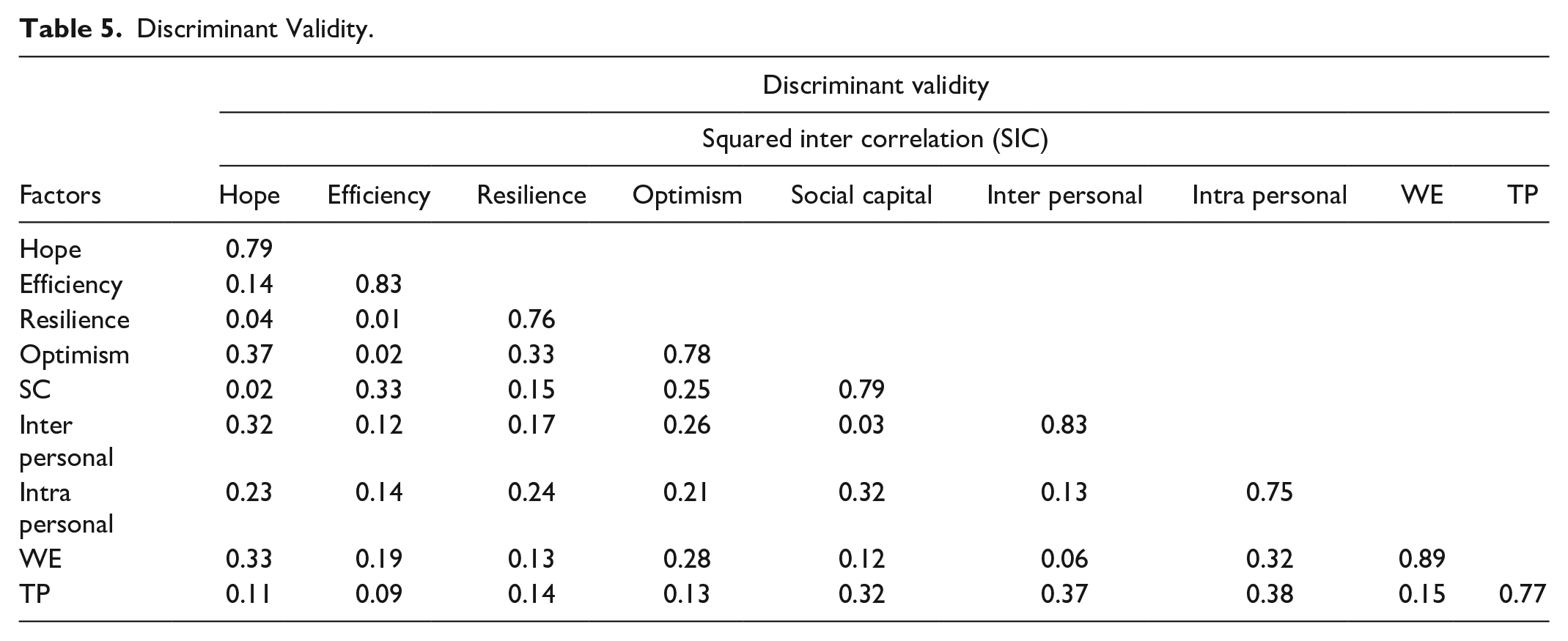
The model’s discriminant validity is presented in Table 5. Discriminant validity denotes that a construct shares more variance than other model constructs (Hulland, 1999). Toward this, the r values of the inter-correlation matrix should not be greater than .70 (Anderson & Gerbing, 1988). In the present study, this condition is met, as none of the r values in Table 5 is greater than .70. Further, Fornell and Larcker (1981) stipulate that the r values have to be lesser than the square roots of AVE (provided as diagonal values in the table). This stipulation is also met.
Discriminant Validity.
The CFA model also had an exceptional fit (Table 6). The GFI (0.913), IFI (0.904), and CFI (0.971) are above the stipulation of 0.90. Further, the AGFI (0.806) and NFI (0.911) meet the stipulation of being above over 0.80. These values signify robust fit.
Fit Indices.

Results
After validating the measurement model with CFA, the hypothesized relationship between the variables was tested using structural equation modeling (SEM). Finally, the R Program and R Studio were run to test the relationship, provided in Figure 2.
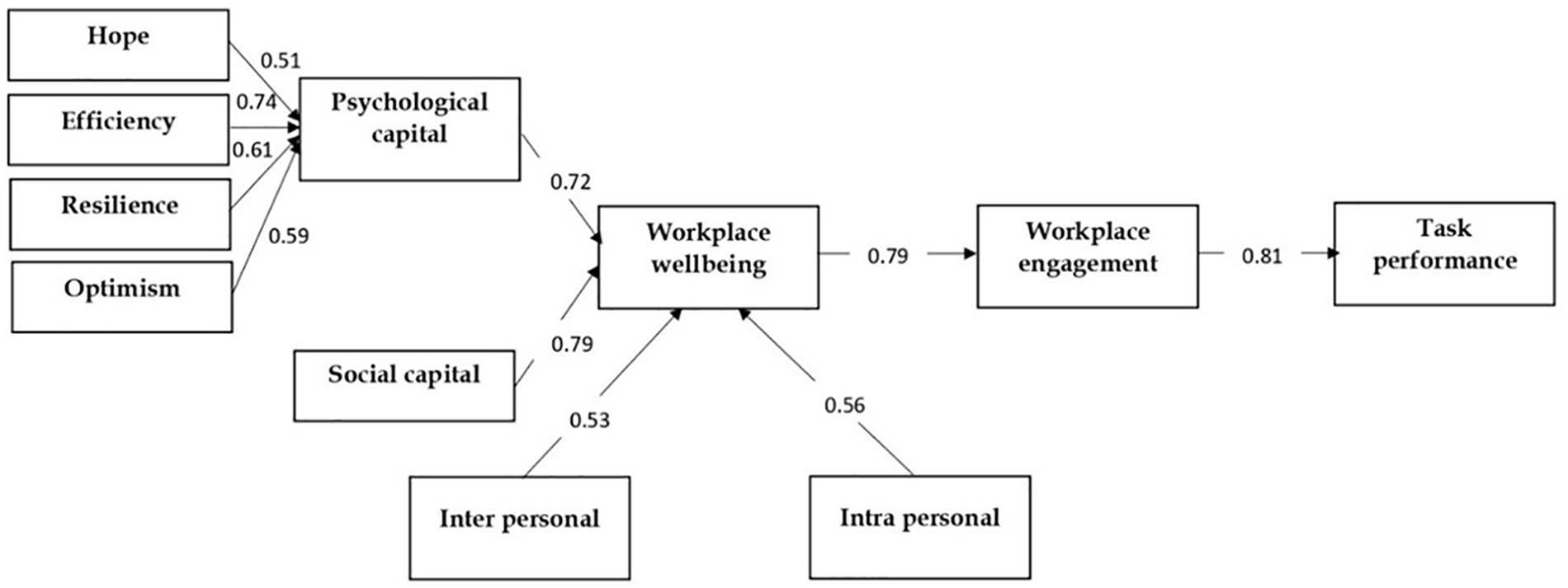
Result of structure equation modeling.
Structural Equation Modeling (SEM)
The multiple advantages of SEM made the researchers use this analysis for the present study. SEM provides a comprehensive and simultaneous examination of all the associations in social science research (Tabachnick & Fidell, 2007). It also assesses the models for predictive validity (Becker et al., 2013) and tests theories that involve various equations and their dependent relationships (Hair et al., 2010). As the present study has multiple variables, SEM is ideal for addressing the research questions. The analysis and observed estimates from the analysis are presented in Table 7.
Structural Equation Modeling Results.

significant at 0.05 level. ***significant at 0.01 level
As there were no misfits in the proposed model, no coefficients, error variables, or new paths were required in the proposed model. The assessment of path coefficients of latent variables is done by comparing the β values. The t-values examine the significance of β, and a high value indicates a strong effect and strengths of respective relationships (Aibinu & Al-Lawati, 2010).
From Table 4, it can be seen that the hypothesis H2 that “Social capital has a positive relationship with workplace wellbeing” is not supported (path coefficient of 0.578 and t-value of 3.21). On the other hand, hypothesis H1 that “PsyCap has a positive relationship with workplace wellbeing” is accepted at 0.05 level (path coefficient of 0.758 and t-value of 7.67). Hypothesis H3, that “Workplace wellbeing has a positive relationship with workplace engagement,” is accepted at 0.01 level (path coefficient of 0.769 and t-value of 8.76. Similarly, hypothesis H4, that “There is a significant positive relationship between Workplace engagement and task performance,” is also accepted at the 0.01 level (path coefficient of 0.766 and t-value of 9.76). Thus, for one supported hypothesis, the t-values are significant at 5%, and for the other two at 1% (Hair et al., 2010). These indicate a strong effect of the identified paths (Figure 3).

Final model.
Discussion
POB involves the application of human resource behaviors, psychological strengths, and capacities that are positively oriented. According to Luthans (2002b), such measurable capacities can be developed and managed to improve performance. However, considering the organizational environment, employee performance, assessment, and development are complex phenomena that need to be approached cautiously. The present study aimed at investigating the relationship of certain POB constructs on task performance. The constructs identified include Psychological and Social capitals, WWB and EE.
The findings supported three of the four hypotheses formulated for the study. However, one of the hypotheses about the relationship between SC and WWB is not accepted. The researchers unexpected this finding, and it is attractive in terms of further research. Though the predominant view about SC is that it is ideal for good health (Ko, 2021), there exists contra view too (Ferlander, 2007; Putnam, 2000). For example, according to Putnam (2000), though social ties are suitable for intimacy, strong bonding networks could lead to strains of varying nature, resulting in conflicts and disappointments, which could negatively impact wellbeing (Due et al., 1999; Thoits, 1985). The same opinion is expressed by Berkman et al., 2000), who found SC with less external information and a high level of social influence could promote unhealthy norms of behavior. Mitchell and LaGory (2002) also found the possibility of bondings in SC having adverse effects on an individual’s wellbeing. Further, the existence of ambiguity about the antecedents and consequences of SC has been expressed by many (Gao et al., 2014; Mignone, 2009).
Most of these studies originated from the western world. Studies that examine this relationship need to be undertaken in Saudi Arabia. Only limited evidence exists about this aspect in the Saudi context. A study undertaken in this direction was Alkahtani et al. (2021). However, this was a conceptual study, and the relationship was not empirically examined. The present study has thus identified the relationship between the two constructs in the Saudi context. This finding opens up the possibility of further exploring the antecedents and consequences of SC in the organizational backdrop.
The robust positive relationship of PsyCap with WWB substantiates earlier findings of Avey et al. (2011), Baron et al. (2016), Brunetto et al. (2021), Imran and Shahnawaz (2020), and Koller and Hicks (2016). These studies were conducted in the western world. Probably this is one of the few studies that has examined the relationship of PsyCap and WWB with a Saudi sample. There is abundant scope to examine the consequences of PsyCap, as there is scarce and inconsistent evidence about it (Alkahtani et al., 2021). The significant positive relationship between WWB and WE is also in line with earlier studies (Schuck et al., 2011). However, there is ample scope to examine this relationship further, as only limited studies have examined this, and the results are still inconclusive.
The findings regarding WE and task performance are as expected. This finding substantiates earlier studies of Armstrong et al. (2016), Bailey et al. (2015), and Ellis and Sorensen (2007). It is significant that the study by Bailey et al. (2015) was metanalytic in nature and was based on 214 empirical studies. Considering that WE can enhance efficiency and effectiveness and resultant performance (Adekoya et al., 2019; Armstrong et al., 2016), the findings of this study are significant.
The study’s empirical findings can be theoretically explained through multiple cognitive mechanisms. For instance, it evidences that human capital, its micro-foundations, and interactions facilitate multiple people-based advantages for the organization (Coff & Kryscynski, 2011). The study has thus upheld the postulation that business success is based on optimal internal human capital utilization, as proposed by the Resource-based Theory (Grant, 1991). Further, the study has extended the vital capability of human capital to enhance a firm’s strategic competitive advantage
Theoretical Contribution
The study has made multiple theoretical contributions to literature. First, this study contributed to understanding the impact of certain POB constructs like Psychological and Social capitals, WWB, and EE on task performance. This is the first study that examined the complex relationship between the identified constructs in Saudi Arabia. This study has thus made a substantial contribution to the literature. Second, as against earlier studies on PsyCap that focused on the association between PsyCap and various work outcomes, the present work has expanded the scope by exploring the impact of PsyCap on task performance through certain other variables.
Next, the study was conducted with Saudi Arabian samples with a unique culture. Saudi Arabia has a collectivist culture, where the attitudes and behaviors of individuals are different from other cultures. Asian societies, in general, are primarily collectivist, and individuals get embedded in their group identity (Kawamura, 2012). They value group goals, harmony and relationships within groups, and their duties and obligations (Hofstede, 2001; Oyserman & Lee, 2007). They are less inclined toward a separate, autonomous self. Individuals of collectivist culture-oriented countries adopt behaviors in tandem with it at the workplace. Thus, this culture would have influenced the findings of the study. Third, the Saudi culture is also known for high power distance. Power distance is the degree to which less powerful members of an organization expect and accept that power is not distributed equally (Hofstede, 2011; Witt, 1996). A higher power gap level occurs due to centralization.
Practical Contributions
Organizations now accord paramount importance to enhancing their employees’ happiness and wellbeing. As such, employee welfare is receiving increased attention from management practitioners. This study has provided many practical implications as it has contributed significantly to employee welfare, wellbeing, and task performance literature. The findings would also help build more effective and healthier organizations with better Workplace wellbeing and Employee engagement. It has also shown that POB constructs contribute toward making organizational experiences meaningful and help employees thrive at the workplace.
Further, PsyCap is identified as a developable state-like psychological resource that is malleable to change (Luthans et al., 2008; Luthans, Avolio et al., 2007). Thus developing PsyCap through inventions would help enhance wellbeing and task performance, which could, in turn, facilitate organizational effectiveness. Finally, the study findings would help organizational leaders as it has successfully built evidence-based literature on PsyCap and its impact on various life domains like work, interpersonal relationships, and health.
Implications
With globalization opening the floodgates of opportunities with technology becoming universally available and the world becoming highly volatile and uncertain, only innovation can make a competitive edge. Toward this, there is a definite need for highly competent and engaged human resources. However, while dealing with this resource, immense care and caution must be exercised, as humans are a bundle of contradictions. Therefore, the study’s findings are of high practical implication and significance as they can help enhance organizational performance.
Most studies about PsyCap, WWB, and WE have their origins in the western world, with only scant and inconsistent evidence available from the Middle East region, which has a unique culture. Further, Saudi Arabia also has a unique culture (Alkahtani et al., 2021; Mohiya & Sulphey, 2021; Sulphey & Salim, 2021), with solid moorings in the teachings of Islam. In addition, studies by Sulphey and Al-Kahtani (2018) and Sulphey and Salim (2021) identified KSA to be patriarchal and collectivist, which percolates to the organizational settings. This aspect needs to be provided due consideration while interpreting the results of behavioral studies. The study has identified the importance of PsyCap, WWB, and WC in enhancing task performance in the Saudi context. As stated earlier, this is one of the few studies with Saudi Arabian samples regarding the impact of POB constructs on performance. The present empirical examination, conducted on a Saudi sample, bridges the gap in the literature about the POB coconstructs involved in the study. The identified relationships between the constructs are relevant in the organizational environment and are a new addition to Organizational behavioral literature. Managers and industry experts could consider the study’s findings while devising strategies to deal with human performance. This must be done with the firm conviction that humans constitute a critical resource in the current volatile world.
Conclusion
The study was undertaken to examine the relationship of POB constructs like PsyCap, SC, WWB, and EE on task performance. Like any other study, the current one also has few shortcomings that require further examination. First, it needs to be acknowledged that the study used self-report measures. It is expected that there could be differences based on individual raters, as Adler et al. (2016) suggested.
Further research could examine whether the findings are replicable with diverse samples, as the cultural dimension has not been provided the required focus in earlier works. Research evidence shows that the various constructs considered for the present study are culture-dependent (Firouzbakht et al., 2018). Further research in the Saudi context needs to take this into account. Studies could be undertaken to determine the causative factors that led to no significant relationship between SC and WWB. It could also be examined whether culture has any impact on the finding. Finally, studies on samples having specific occupations could help better understand the interrelations between the different variables studied. Future studies could also be done to shed further light on the antecedents and consequences of various study constructs. In addition, there could be certain other variables that may exercise direct or indirect effects on the constructs studied. Identifying such variables could help inculcate in employees the required level of WWB, WB, and task performance. Finally, there is scope to replicate the study in other countries in the Middle East and nations with diverse cultures. A comparative study with other cultures could bring exciting results, as the sample for the present study was limited to Saudi Arabia. Thus, a cross-cultural study with samples from different nationalities would provide exciting and inspiring results as it would help ascertain whether culture impacts the variables. The authors would be highly gratified if future researchers examine these vital aspects.
Footnotes
Declaration of Conflicting Interests
The author(s) declared no potential conflicts of interest with respect to the research, authorship, and/or publication of this article.
Funding
The author(s) received no financial support for the research, authorship, and/or publication of this article.
