




Abstract
The topic of “Employability” has gained significant attention in recent years. Its impact on organizational behavior could be seen through the research literature on job loss and job search. Employability is all about gaining and maintaining employment, it involves the ability to move autonomously and to deal effectively with the career-related changes occurring in the current uncertain labor market. This empirical study aims to design and test a research model that investigates the moderating effect of employability on the relationships between job insecurity (JI) and service sabotage (SS). It also measures the impact of (JI) on the (SS) behavior. Frontline employees who were working in three and four-star hotels in Cameroon were the sample of this specific study. To test the study variables, a hierarchical regression analysis was applied and supported the research hypotheses. In line with the study predictions and earlier literature findings (JI) had a significant and positive impact on (S.S). The result interestingly revealed that employability increases the relationship between (JI) and (S.S). The findings of this study offer some insights about employability’s importance and influencing factors on employee’s job choice and their attitudes during job performance in the organizations. Theoretical contribution, practical implications of the empirical findings, and future research directions are provided.
Introduction
Tourism in Cameroon
Excerpts from the World Tourism Organization (UNWTO, 2019) Highlights showed international tourist arrivals in the Sub-Saharan region of Africa grew from 30.7 million people in 2010 to 43.3 million people in 2018. International tourist arrivals in Cameroon have been on a constant increase since 2006. But Yet, International tourist arrivals in Cameroon increased from just over 900,000 in 2016 to 1.1 million compared to 2017, stated by the World Travel and Tourism Council (WTTC, 2017). Even though this is a positive movement, but according to Tichaawa (2017) the potential of the tourism sector by the government of Cameroon must be better identified, and the benefits that it could have by developing it sustainably should be evaluated (Harilal et al., 2019). International tourism receipts stood at USD524 million in 2017 and of the sub-Saharan region, Cameroon ranked in the 126th position out of the 136th Central African nations likely visited by tourists (UNWTO, 2019). The Cameroon government focused on building tourism and establishing the political stability that has been in the country since it got its independence in the 1960s (Richard et al., 2018).
Mary and Ozturen (2019) affirmed that there is little said about the hotel industry of Cameroon. Hence, this study pays some attention. The hospitality industry of Cameroon makes up part of the service sector, among others are telecommunications, trade, and banking. There has been a remarkable growth in overall hotel infrastructure, even though there lie disparities between the hotel infrastructure and the rate of hotel occupancy (Harilal et al., 2019). Also, the hospitality industry and tourism are facing dire challenges because of the diversified nature of the people (bilingualism and over 260 ethnic groups and ethnic languages). International branded hotels remain limited and represented by two Accor Hotel assets (over 300 rooms) under Ibis with one single branded five-star Hilton hotel in Yaoundé. Besides, other significant towns like Kribi and Limbe represent secondary hotel markets and leisure destinations.
The hotel market is yet to undergo any significant change since 2014. At that time average occupancy was at 64%. Hotel growths are ongoing more in Douala and Yaoundé because of the insecurity in the Northern regions and the spread of the “Boko Haram” (Islāmic movement) from northern Nigeria. These affect hotel supply in Cameroon while hotel demand comes from national and African tourists. As with the case of most sub-Saharan countries, demand comes more from business customers. Cameroon was to host the African nation’s cup in 2019 but it was canceled; it would have boosted hotel demand. Coupled with the separatist uproar going on in the Anglophone regions, hotel businesses are being affected everywhere in the country (Richard et al., 2018). Meanwhile, during the era of tourism growth between 2006 and 2017 according to(UNWTO (2019), job opportunities and employment rates increased (Ojong, 2011). Tourism and particularly the hospitality industry are at the frontline of growth and improvement in the country
Employability in Cameroon Context
The problem of underemployment is persisted; “underemployment” is a state of people in the labor force being employed at jobs inadequate on their training or economic needs (Merriam-Webster, 2020; Ojong, 2011) different from the term “unemployment.” Also, the country registered a literacy rate of about 72% (United Nations International Children’s Emergency Fund, 2014), which means that over half the population are literates and have at least attended secondary education. Although a fair amount of the people in the labor force have jobs, they have jobs below their training and economic needs. Hence, increase underemployment.
Therefore, the underemployment situation affects working conditions negatively (Neneh, 2014). The problem is that majority of the population are literates, with employable abilities, facing underemployment and job insecurity. Therefore, being employable and doing under fit jobs, with a certain level of job uncertainty, is a critical issue in the workplace and needs more attention. In line with a project applied in a southern African country, Mozambique: here our main aim is to improve the local people’s employability by rising the quality and changes in both public and private training in all sectors to respond to the developing and demanding request of the labor market of the tourism sector (Castiglioni et al., 2017).
Given that, in this dynamic business setting, in particular for the tourism and hospitality industry, the key challenge is the need to offer high-quality service to clients, attracting and retaining trained and qualified workers for front-line service employment (Karatepe & Ngeche, 2012).
Accordingly, hospitality managers need to provide their employees with sufficient support and a sense of security so that they will be assured about their current working position and will be encouraged to increase their performance at the workplace (Arici et al., 2019). With this realization, Job insecurity has been a top topic of interest among researchers (Chiu & Peng, 2008; Tian et al., 2014; Vander Elst et al., 2014), because it usually has costly consequences for the organizations (Naderiadib Alpler & Arasli, 2020). Job insecurity, defined as an organizational stressor, may influence counter-productive behaviors (Tian et al., 2014) like service sabotage actions, which could be impertinent to an organization’s reputation (Jacobs, 2019). Some scholars (De Witte, 1999; Tian et al., 2014) have investigated and formed several negative organizational outcomes like counterproductive behaviors of employees which are the result of job insecurity in the organizations. Meanwhile, the outstanding number of studies on job insecurity has been focused more on the Western context (Sverke et al., 2002) than the African region. Literature from Africa is still very limited (Vander Elst et al., 2013), especially regarding Sub-Saharan Africa. While investigating the outcomes of job insecurity, scholars have tested several buffers as moderators between job insecurity and several different job outcomes (Kang et al., 2012; Tian et al., 2014). For instance, De Cuyper and Notelaers et al. (2009) found out that employability could impede a stronger influence as a moderator for job insecurity and its negative outcomes. Derived from the human capital theory, employability has the potency to buffer the effect of job insecurity.
This study initiated; therefore, employability as a potential moderator for job insecurity and its outcome. Among the outcomes of job insecurity, service sabotage has not been given real considerations (Berntson et al., 2010; De Cuyper, Baillien et al., 2009; De Cuyper & Witte, 2006; De Witte et al., 2010; Harris & Ogbana, 2011; Kang et al., 2012; Kinnunen et al., 2010; Silla et al., 2009; Tian et al., 2014).
This study thus investigated service sabotage as a potential effect of perceived job insecurity. The topic of service sabotage is predominantly significant in the hospitality industry because the perceived quality of the service is extremely affected by how the service provider acts and speaks with the customer. Service sabotage also damages the organizations’ progression and success as it negatively impacts customers’ perceptions of service quality, willingness to return, and word of mouth behavior to others (Lee & Ok, 2014). However, employability can act as a moderator and may have an alleviation effect on the relationship.
Theoretically, this study makes three salient contributions. First of all, it produced a compelling contribution to the literature on Sub-Saharan Africa. Studies on Sub-Saharan Africa, especially with regard to human resource management (Shen et al., 2009), are very limited. Also, it makes a remarkable contribution to employability studies, which handled employability before as a positive inherent resource that buffers negative behavioral outcomes (Silla et al., 2009). This piece of work portrays employability as a negative influence, capable of alleviating deviant workplace behaviors like service sabotage (De Cuyper, Notelaers et al., 2009). The frustration–aggression theory is the third outstanding contribution, underlying the above relationship. The frustration–aggression theory was used to explain the work attitudes toward revenge (Dollard et al., 1939) like service sabotage behavior. This article explores the effect of job insecurity on service sabotage amid perceived employability.
Therefore, the main purpose of this article is to investigate the moderating function of employability between job insecurity and service sabotage of frontline employees. The first aim is to test that job insecurity perception would lead to service sabotage behaviors. Second, this article aims to affirm the relationship between job insecurity and employability (De Cuyper, Notelaers et al., 2009; Näswall & Sverke, 2010; Silla et al., 2009). Also, another aim is to switch the effect of employability on the service sabotage behavior of frontline employees. Finally, it is necessary to investigate and respond to the inquiry why frontline employees willing to engage in service sabotage and what would a company do to minimize the impact of service sabotage, in a Sub-Saharan country setting, Cameroon. By understanding frontline employees’ motivations to engage in service sabotage, researchers and practitioners can develop guidance organizations may use to avoid or cut service sabotage.
Literature Review and Hypothesis Development
Job İnsecurity and Service Sabotage
Service sabotage is a harmful and undesirable behavior and happens by employees who deliberately destroy or cause damage in the organization; such as slowing down the speed of service, making trouble, and showing and transferring their frustration or aggression to customers (Lee & Ok, 2014; Yeşiltaş & Tuna, 2018). This behavior impedes the relationship between an organization and its customers (Harris & Ogbonna, 2006; Tuna et al., 2016). Yet, just a few papers investigated the sabotage behaviors of customer-interface employees in the hotel industry.
Irrespective of the minuscule researches addressing service sabotage, Harris and Ogbonna (2002, 2006, 2009, 2012) did some empirical contributions. Contrary to archaic service sabotage literature on manufacturing, these authors regarded the service sabotage behaviors of employees directed toward customers, not just on fellow employees. They made a firm emphasis on the antecedents and consequences of service sabotage, based on extensive surveys that yielded practical implications, opening further doors for future studies.
The service sabotage of employees directed toward customers is very important because employee attitudes influence customer satisfaction (Gremler & Gwinner, 2000) especially the customer-interface or frontline employees (Díaz et al., 2017; Payne & Webber, 2006). Frontline employees are expected to behave according to a set of defined manners to customers (Díaz et al., 2017; Lee & Ok, 2014). In other words, they are expected to suppress negative feelings and show positive ones to customers (Diefendorff & Richard, 2003) and this adds to the complexity of the jobs of frontline employees to a point where their jobs seemed cumbersome. Yet, they must act along to ensure the success of their organization, all in the bid to retain customers. For these causes, hospitality literature is in dire need of extensive studies on service sabotage. As seen in other papers, the pseudo display of feelings may tantamount to deviant behaviors.
Notwithstanding the number of papers addressing employee’s manner of coping with stress (Folkman & Moskowitz, 2004), service sabotage has not been given much consideration. Hence, the employee seeks to overcome such organizational stress such as job insecurity by displaying unwanted behaviors (Bouzari & Karatepe, 2018). Job Insecurity is perceived as perceiving a difference between the desired employment situation of the individual and his or her actual situation. Job insecurity can have negative consequences on the outcome of the organizations (Lee & Ok, 2014). Job insecurity is not very pleasant to individuals because it is an expectation of an unintentional change in employment. In this situation, the employee is likely to feel annoyed about this change and displaying this anger by addressing psychological effects, as discussed in the literature (Rousseau, 1995). Therefore, we believe that Job insecurity is a primary and persistent organizational stressor. According to Richter et al. (2013), identifying outcomes of job insecurity is pretty essential because the management would be able to prevent negative consequences or at least apply certain measures to impede the negative outburst. Employees who have perceived job insecurity feel that their psychological needs (Vander Elst et al., 2012) are going to be frustrated. Meaning that, what they relied on to maintain their growth, health and integrity will abruptly end. As some scholars discussed it (Vander Elst et al., 2012) lack of needs frustration would yield poor work-related outcomes and well-being.
The particular concept of job insecurity produces insecurity about the future, meaning that the employees who are working in an organization at the moment do not know if they will be retained in their jobs or if they will be facing downsizing (Karatepe & Vatankhah, 2014). Also, according to many researchers, job insecurity is related to a low level of job satisfaction, organizational commitment, and undesirable behaviors and the relationship between job insecurity and unfavorable outcomes is common among permanent staff (Bouzari & Karatepe, 2018; Chambel & Fontinha, 2009; De Cuyper, Notelaers et al., 2009). Considering critical and unfavorable outcomes related to job insecurity, we have stressed the relationship between job insecurity and service sabotage in this particular article. Therefore, we hypothesized the following:
Job İnsecurity and Employability
The concept of employability was first used at the beginning of the 20th century. Based on the dichotomy between “employable” people (capable and willing and/or needing to work) versus “unemployable” individuals (unable to work and who needed help). An economic conception of employability was then developed” (Guilbert et al., 2016, p. 71).
According to previous studies (Berntson & Marklund, 2007; Bozionelos et al., 2016; De Cuyper et al., 2010), employability is the employee’s perception of his or her capacity to achieve a new job. It is also about improving individuals’ ability to find and take advantage of job and career possibilities within or outside the current workplace setting.
Besides, employability is associated with perceptions of job insecurity, which is a major key component in organizational psychology and the labor market. Currently, according to the literature perceived employability helps workers to deal with job insecurity (Forrier & Sels, 2003a; Sverke et al., 2002). In a way that employability stimulates the sense of being in influence of one’s working life (Fugate et al., 2004), which reduces the destructive impact of job insecurity, in return. This point of view rises visions from researches done by Bakker and Demerouti (2007) on the Job Demands–Resources Model. Job demands talk about the features of the job that employees perceive them oppressive; such as job insecurity and job resources bring together aspects that stimulate individual cognitive development characteristics that can trigger employability to higher levels. Job resources are “considered functional in achieving work goals, but also in reducing the health-impairing impact of job demands” (Bakker & Demerouti, 2007). One of the potential antecedents of job insecurity in many pieces of research has always been Employability (Forrier & Sels, 2003b; Sverke et al., 2002). High-employable workers when compared to low-employable workers in one research were much less prone to undergo job insecurity.
According to Schaufeli (1992), less-educated workers are expected to encounter job insecurity more than educated workers. Therefore, we believe that the educational level can be representative of employability (Elman & O’Rand, 2002; Forrier & Sels, 2003a). Similarly, Human Capital Theory (Becker, 1964/1993) suggests the same predictions as such; those high employable workers with a “strong labor market position” expect an earlier return on their investments; for instance, an increase in their salary level. Employee judgments may be evaluated for non-financial reasons, such as the reduction in job insecurity (Brown et al., 2003; Marler et al., 2002). It concludes that employees are committed to the idea of long-term secure employment as investing in human capital. They argued that highly employable laborers are prone to undergo less job insecurity. While studies have argued that employability may reduce the likely adverse consequences of job insecurity (Naderiadib Alpler & Arasli, 2020). Therefore, We hypothesized the following:
As Frustration–Aggression hypotheses purported by John Dollard since 1939 (Dollard et al., 1939) and were further improved by Leonard Berkowitz in 1969 (Berkowitz, 1989), frustration illustratively does not always occur in a thwarted possibility of goal achievement but also threatens accessibility to reinforcement (Johan, 2007; Van Der Dennen, 2005). Also, Merriam-Webster (2016) described aggression as hostile, destructive, and deviant behavior (expressing anger). Dollard et al. (1939) alleged that frustration begets aggression and if the cause of the frustration is not checked, the frustration would be extended unto a scapegoat. In other words, individuals who feel frustrated either because they cannot get a salary raise, promotion or, fear of losing their job, where they are unable to channel their aggression on their supervisor, manager or, organization, take out their aggression on third parties (family or customers). Perhaps, an established situation of perceived job insecurity would lead to frustration and directed aggression or anger through revengeful actions like service sabotage.
However, employees who resort to adverse workplace behaviors as a result of job insecurity appraisal might be redeemed. The human capital theory set forth claims that employees with a high level of perceived employability hold a strong position in the labor market (De Cuyper et al., 2008). This may indicate that they may be less likely to be influenced by job insecurity. This acclamation ties with the argument put forward in this study, indicating that high leveled employability perceived frontline employees and inhibits sufficient human capital to withstand uncertainty in the work environment. In sum, high leveled employability would mitigate service sabotage behaviors. This study asserts thus that employability has the potential to break the negative effect of job insecurity. This opinion was supported by most scholars (Silla et al., 2009). This study hypothesized the following:
The proposed framework demonstrating the hypothesized relationships can be seen in Figure 1.

Hypothesized model.
Method
Sample and Procedure
Applying the judgmental sampling technique, the sample for the pilot study consisted of several full-time hotel employees who worked in the frontline departments (for instance; the receptionist, concierge, food service people and, room service workers) of the three- and four-star hotels, located in Douala and Yaoundé (Arasli et al., 2014). Tourism in Cameroon is related to the distinctiveness as well as the uniqueness of its natural conditions like in any other developing sub-Saharan African countries (Ankomah & Crompton, 1990). The capital city of the country is Yaoundé and the economic capital city of the country is Douala. The official languages in Cameroon are English and French. Moreover, although the government has good targets to have tourism and hospitality as a revenue-generating industry, the tourism and hospitality industry is still in its initial stages. And most of the service industries of Cameroon are lacking local skilled managerial and non-managerial human resources (Atiatie, personal communication, June 17, 2009).
At the time of our study, there was only one five-star hotel in Yaoundé, two four-star hotels in Douala, and 13 three-star hotels in Yaoundé and Douala towns (Ministry of Tourism [MINTOUR] and Leisure, 2017). Lately, the Cameroon government has started to give special care to tourism issues in the country for achieving better economic growth soon (Clarkson, 2014). One of the objectives of the government through the Ministry of Tourism (MINTOUR) is to closely supervise the development and growth of hotels. Therefore, as a sample, the present study observed According to the result of the pilot study conducted with 15 employees, the questionnaire was found appropriate for data collection. About 450 self-administered questionnaires were distributed by the researchers to the frontline employees after permission was obtained from the hotel’s management. Also, an accompanying letter clearly stating the purpose of the survey and the assurance of anonymity of the respondent’s profile was attached in front of the copies of every questionnaire. The respondents were also informed that after filling the survey they can place it in a box available at the reception desk.
Out of 450 copies distributed, we received 413 questionnaires, within a 2-week time-lapse, for the respondents to fill the questionnaires. In this period, the researchers visited the hotels two times and kindly reminded employees to fill up the questionnaires. This gave a remarkable response rate of 85%. Thirty-two questionnaires were rejected, as a result of missing data; therefore, 381 questionnaires were usable for further analyses. Concerning demographic details of respondents, the gender of 72% of the total 381 respondents were men, whereas the rest 28% were women. Most of them were grown-ups between the age of 25 and 45 years, and just about 6% of them were among elderly contributors. Moreover, 47% of the participants were holding high school diplomas, and 25% of university education, the rest had either a primary school or a secondary school certificate. Looking at the tenure of the employees, 25% have worked in the same organization between 2 and 4 years and the other 35% have been there between 5 and 7 years. Besides, almost 28% of the 381 respondents have been working in the same organization for 11 years and beyond, 12% of them are working for 1 year or less than a year. According to the above profile, 188 employees were from three-star hotels and 193 employees were workers in four-star hotels in Cameroon. The research team could not get permission to research the five-star hotel in Yaoundé.
Measurement
A 20-item survey instrument was used to measure the three abovementioned dimensions (Job Insecurity, Employability, Service Sabotage) together with control variables (age, gender, tenure, and education). Four items measuring employability came from De Cuyper et al. (2008) study. Job insecurity was measured by seven items from Hellgren and Sverke (2003). And finally, the Service sabotage dimension was tested by using nine items from Harris and Ogbonna (2006). All of the items were modified into the 5-point Likert-type scale format (where 1= “strongly disagree,” 2= “disagree,” 3= “neutral/not sure,” 4 = “agree” and 5 = “strongly agree”). As suggested by McGorry (2000), the survey questionnaire was written in English then translated into French, and later again back to English to gain precision (Wang et al., 2014). Back to back translation was to ease data collection in Cameroon, whereby French and English were both official languages of the nation.
Data Analysis
All study constructs were bound to a series of EFA and CFA for clearing issues of convergent and discriminant validity (Anderson & Gerbing, 1988). To test the study variables, a hierarchical regression analysis was used. In Step 1, demographic variables were entered, and then in Steps 2 and 3, job insecurity and employability both were added to predict service sabotage behavior. As suggested by several researchers, the study uses Baron and Kenny’s (1986) approach for testing moderation effects as a guide (Harrington & Kendall, 2006). Therefore, all predicting variables were centered and multiplied (i.e., employability × job insecurity) in Step 4.
Measurement Model
The measurement model was tested in terms of convergent and discriminant validity and composite reliability using confirmatory factor analysis. To test the study variables, a hierarchical regression analysis was applied and supported the research hypotheses. The study also used Harman’s single factor test, the aim was to see if a single factor accounts for more than half (50%) of the variance, which might be problematic according to Podsakoff et al. (2003), as it is an indicative presence of common method variance. Since no single component of the constructs accounted for half of the variance, the issue of common method bias was eliminated. Also, the variables with really high correlations should be exempted because they also indicate the presence of common method bias (Bagozzi et al., 1991). In the present study, further evidence of highly correlated variables was absent (see Table 2).
For model fit, the basic test for reliability, discriminant, and convergent validity was conducted. Following the pieces of advice of Fornell and Larcker (1981) for reliability, the items have been tested for internal consistency where the composite measures in the analysis were above the expected cut-off level of .70. The questionnaire items were compressed under their respective constructs to obtain the composite scores for each construct. According to the measurements, the correlation coefficients of all the constructs did not surpass the cut-off point of .90. This would have implied that any coefficient above .90 meant that distinct variables had failed to represent distinct constructs (Tabachnick & Fidell, 2007).
Results
Measurement Results and Descriptive Statistics
The principal component with varimax rotation was operated to test if the constructs exhibit distinct nature in such a way that the construct’s loading is more than .50 cut-off value or loaded to the expected construct. According to the EFA, results revealed that one item (q1) “I am worried about having to leave my job before I would like to” and (q3) “I feel uneasy about losing my job soon” from job insecurity (JI) loaded on more than one construct. Also, q1 of the same construct standard loading estimates was less than the cut-off value. Therefore, both items (q4 and q5) of job insecurity were dropped and removed from the following analysis. The final results of the EFA provided a three-factor solution with Eigenvalues greater than 1.0 accounting for 62% of the variance. Factor loadings ranged from.491 to .900 which depicted that all items except the two questions abovementioned, loaded clearly on their underlying constructs.
It has been conducted on a series of CFAs using Amos to investigate the goodness-of-fit of the proposed model, chi-square, goodness-of-fit indices (GFI), Normed Fit Index (NFI), comparative fit index (CFI), root mean square error of approximation (RMSEA), and χ2 estimate test (CMIN/DF) were used to evaluate the model (χ2 = 311.9, df = 123, p = .000), (GFI = .90, 1 = maximum fit), (NFI = .86, 1 = maximum fit), (CFI = .91, 1 = maximum fit), (RMSEA = .068, values < .08 indicating good fit), (CMIN/DF = 2.5, values >1 and < 3 are accepted). Hence, the three-item model fit is reasonable and acceptable as suggested in previous literature (Bentler & Bonett, 1980; Bollen, 1989; Jöreskog & Sörbom, 1984; Tanaka & Huba, 1985; Wheaton et al., 1977). All observed indicators loaded significantly on their latent variables. That is all t values were greater than 2.0. Model fit statistics, as well as the significant factor loadings, provided evidence for convergent validity (Anderson & Gerbing, 1988). The reliability of the construct items was measured by Cronbach’s alphas that were above the cut-off point of .70 (Hair et al., 1998) and composite reliability (CR) ranged from .73 to .97, and average variance extract (AVE) was above the cut-off level of .50 (Hair et al., 1998). The result also suggested evidence of discriminant validity. As illustrated in Table 1.
Factor Loadings and Rotated Component Matrix.

Note. Extraction Method: Principal Component Analysis. Rotation Method: Varimax with Kaiser Normalization. Rotation converged in five iterations. AVE = average variance extracted; CR = composite reliability.
As seen in Table 2, gender permeates a significant and positive impact on employability .28** (p < .01 level). Employability also correlated against age, negatively with −.19** at .01 level. This means that as age goes up, the lower the employability felt or vice versa. Also, concerning the gender, male employees perceive themselves as more employable than females. Besides the educational background also showed a positive and significant relation with employability, indicating how important and influential it is when selecting people to fit in their positions. Entirely, employability and service sabotage (.34**) display the highest correlation value which is significant at the .01 level. However, concerning job insecurity and service sabotage, a direct positive correlation at .21** (p<.01 level) is notable as it was hypothesized (H1). Moreover, there is a significant and negative correlation between job insecurity and employability at −.14 is (ns).
Pearson Correlations.
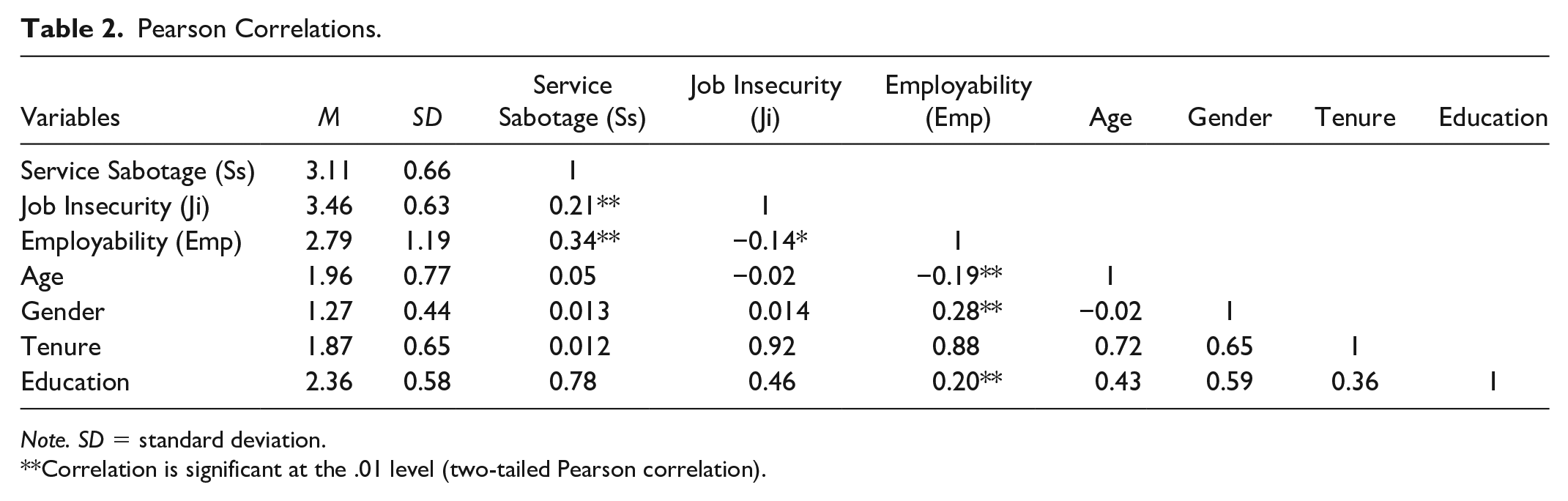
Note. SD = standard deviation.
Correlation is significant at the .01 level (two-tailed Pearson correlation).
Although, a stronger and positive significant relationship existed between employability and service sabotage (.34**; p < .01 level), which is contrary to the assumption given in H3.
As it is displayed in Table 3, the analysis of the multiple regressions with service sabotage being the dependent variable and job insecurity and employability being the independent variables depicted the following results. For the direct effects results, age and gender denoted no significant influence in Step 1, but in Step 2 with the inclusion of job insecurity to the equation, there happened a positive and significant effect by gender (β = .168, p < .05) on service sabotage. This means that male employees have a mere tendency to exert service sabotage behavior. Furthermore, the results showed that job insecurity denoted a significant and positive effect on service sabotage in step two (β = .237, p < .01) and in Step 3, just after employability was added into the equation (β = .239, p < .01). It could be interpreted that job insecurity perception would trigger service sabotage behaviors of frontline employees in Cameroon, supporting the first hypothesis. Based on the aggression–frustration theory, frustration causes aggression, especially when the frustration is caused by failure to achieve an objective or goal. One could posit that perceived job insecurity would cause service sabotage behaviors. Whereby, the customer or co-workers might just be a scapegoat. That is, as time goes on FLE’s may direct their thoughts and efforts negatively, due to having an insecure and irresponsible environment and may start to perceive themselves as undervalued and may try to take a kind of revenge from their institution, by exerting service sabotage behaviors.
Hierarchical Multiple Regression Results: Employability as a Moderation in the Relationship Between Job Insecurity and Service Sabotage.

Note. Age, gender, tenure, and education are measured as control variables. Correlations that are not represented with an asterisk are insignificant. F-Statistics, R2, and ΔR2 represented at four steps (Steps 1, 2, 3, and 4). Service sabotage is the dependent variable and constant. Employability and job insecurity are independent variables.
Correlation is significant at the .05 level (two-tailed). **Correlation is significant at the .01 level (two-tailed).
However, employability indicated a positive and significant relationship with service sabotage (β = .357, p < .01). This result is very rarely seen in the literature and may not conform to the presumed hypothesis (H3), but it affirms the statement that there could be a “dark side” to employability (De Cuyper, Notelaers et al., 2009).
So far, the analysis revealed that employability moderated the effect of job insecurity on service sabotage behaviors of customer contact employees working in the three- and four-star hotels in Cameroon. The moderating influence was indicative (β = .16). Yet, the moderated result did not fall in line with the suggested hypothesis H4; it was presumed that employability would buffer the influence of job insecurity on service sabotage, such that when employability is higher, the effect of job insecurity would get lower on service sabotage and similarly if employability is lower, the effect of job insecurity would increase on service sabotage.
However, employability significantly and positively relates to service sabotage when entered into the equation (β = .357, p < .01) and it increased (β = .360, p < .01) even as with the moderation at Step 4. Noteworthy, the value of job insecurity did not lessen with the influence of employability as it was hypothesized, rather it remained almost the same (β = .238, p < .01). Although unlikely, it seemed that as employability increased, job insecurity’s effect on service sabotage remained high. Meaning that frontline employees with a high level of employability are prone to service sabotage, as they perceived job insecurity. Interestingly, this finding can be likened to that of De Cuyper and Notelaers et al. (2009) who tested the moderating effect of employability between job insecurity and workplace bullying, the outcome was similar to this finding, supporting that under a high level of employability the bond between job insecurity and workplace bullying is stronger.
Discussion
Summary of the Findings
Integrating frustration–aggression theory, and human capital theory, this study proposes and tests a conceptual model to investigate how job insecurity results in service sabotage with the moderating effect of employability. Data obtained from full-time Frontline employees of three- and four-star hotels in Cameroon was used to assess this relationship. The following result supports our conceptual model.
As concern job insecurity and service sabotage, we expected a positive relationship between them. Job insecurity (organizational stressors) and service sabotage (a negative organizational outcome). Based on the aggression–frustration theory, it was suggested that frustration causes aggression, especially when the frustration is caused by failure to meet an objective or goal. One could posit that perceived job insecurity would cause service sabotage behaviors, especially in countries like Cameroon where the job opportunities are not enough, even for the available jobs the job security level is low as well as, for employable workers. Therefore, the risk of service sabotage behaviors by employees is higher. Our results were supported and are also in line with earlier findings in the field of job insecurity (Berntson et al., 2010; De Cuyper, Notelaers et al., 2009; Kang et al., 2012; Silla et al., 2009; Southey & Southey, 2016; Tian et al., 2014). Therefore, our hypothesis H1 was supported.
Concerning perceived employability, we hypothesized that it would be negatively associated with job insecurity, H2, and employees’ sabotage behavior H3. Since employability is one of the strongest aspects of the human resource dimension, it was expected to decline the frontline employees’ perception of job insecurity and reduce the negative organizational outcomes (service sabotage) as supported by previous studies; (De Cuyper et al., 2008; De Cuyper, Notelaers et al., 2009; Kalyal et al., 2010; Kang et al., 2012; Silla et al., 2009). Highly employable workers feel more secure since they can choose the most secure jobs out of many possible options as confirmed by (Human Capital Theory).
It was predicted for job insecurity and employability relations become negative and significant. While the correlation between employability and service sabotage was positive and significant, this result was in line with H2 and contradicting the hypothesized claim H3. The fact remained that perceived employability has the potency to trigger service sabotage as mentioned; but in some cases, we may witness exceptions and find it having a buffering than a triggering effect (De Cuyper, Notelaers et al., 2009).
Furthermore, under a high level of employability, the association between job insecurity and service sabotage is remarkably stronger. Again, it supports the statement by De Cuyper and Notelaers et al. (2009), who believed that employees can sometimes experience the “dark side” of employability. To test this through our hypothesized relationships, we believed that the interface between two variables of job insecurity and perceived employability will contribute to explaining employees’ service sabotage behaviors. Hence, it will act as a buffer to reduce the positive relationship between job insecurity and service sabotage. Nevertheless, according to the results, we found that hypothesis H4 cannot be supported. In contrast, the relationship between our study dimensions was stronger after we include the interaction between job insecurity and employability. Thus, the association between job insecurity and service sabotage was stronger when the employability level was high rather than when it was low .which is the most noteworthy contribution of this research. This contrary result is in line with the one from (De Cuyper, Notelaers et al., 2009) who proved that employability might not always act as a buffer in reducing negative organizational outcomes, but it can sometimes assist it to grow.
Regarding what we identified from perceived employability in the literature, this result appears differently. According to the common belief, perceived employability is a personal resource to help workers to manage job insecurity successfully (Forrier & Sels, 2003a; Silla et al., 2009). Yet, in some settings, it could be like a tool to stimulate negative outcomes, as given by De Cuyper and Notelaers et al. (2009), about the effect of employability on workplace bullying. In this example, employability is active but at the same time an ineffective coping tool.
In summary, our results suggest that there might be a different sort of unproductive employability and it may not be a good moderator for our hypothesized relationship and not a useful tool for employees who are under stress and at risk of job insecurity.
Theoretical Contribution
This study has discussed and related two distinct research areas. The first area is related to job insecurity and has concerned the opinion that job insecurity is extremely spreadable inside an organization and it might also extend across the industry, or even sometimes inside a district or a country (Tian et al., 2014). In the case of Cameroon, there seemed to be a high level of job insecurity, especially in the tourism and hospitality industry. While investigating the literature, examples like counterproductive work behavior, discretionary extra-role and impression management behaviors, workplace bullying, and psychological distress regarding negative impacts of job insecurity on the organization are available (De Cuyper, Notelaers et al., 2009; Kang et al., 2012; Silla et al., 2009; Tian et al., 2014).
The above-mentioned examples are against the interests of an organization and can harm organizational climate including human resources and external customers. In our research, we have tested service sabotage as a negative outcome for job insecurity which is not too far from these examples and is one of the most serious ones. Moreover, Job insecurity also disturbs employees who feel that their jobs are at risk. Employees who experience job insecurity voluntarily or involuntarily feel that the establishment does care only about its resources and benefits responsible for their pain, the employee may direct his or her mental and physical effort to take revenge (Kinnunen et al., 2000). This result improves job insecurity as one of the most important antecedents to employee service sabotage behavior in the organization.
As mentioned before, employability is evaluated as a personal resource, mostly dealing with different demands, for instance, job insecurity and work-life-related variations. Therefore, our second contribution to the literature was to find out that if perceived employability can be tested as the moderator of the relationship between job insecurity and service sabotage. It has also been discussed by De Cuyper and Notelaers et al. (2009) that “highly employable workers may perceive a situation that leads to job insecurity as less threatening than less employable workers.” This is in line with the theory of human capital (Becker, 1964/1993), in which employability as a resource is expected to reduce the job insecurity of employees or even the fear of not having a job chance. Although employability influenced the effect of job insecurity on service sabotage, yet the correlation between job insecurity and employability came out as nonsignificant.
Therefore, according to our results and the above statement, it is suggested that there may be a different sort of employability that can be active but at the same time ineffective (De Cuyper, Notelaers et al., 2009). There is much valuable information in the literature and past researches related to these kinds of coping tools (Baillien et al., 2009). However, the number of studies that have taken this specific issue of employability into account is rare. We hereby declare our study’s main contribution regarding this particular type of employability “Dark Side of employability” in the domain of job insecurity and service sabotage literature.
Practical Implication
The outcome of the present research set forth implications for organizational practitioners. Coupled with outstanding literature (Harris & Ogbonna, 2002, 2006, 2009, 2012; Tung et al., 2013) it was found that hospitality employees used various techniques to lash against the organization when they feel threatened by insecurity at their job sides. They resort to sabotage their organization by displaying deviant behaviors like service sabotage. For such outrageous behavior is seen to be costly to the organization (Karatepe & Ngeche, 2012). Hospitality practitioners could implore breaching techniques to check on service sabotage behaviors. It could be made in such a way that the employee who is guilty of such deviant actions, to be subjected to reparation consequences. Like an awareness reprimand during orientations or training sessions, on such actions. Or to stipulate in worse cases, fines (Harris & Daunt, 2011) on the perpetrator. It could be similar to the pre-action taken by public authorities against deviant and socially harmful behaviors like abuse and smoking.
Also, frontline employees attempt to down-play work stress as a result of perceived job insecurity, to obtain job control (Ogbonna & Wilkinson, 2003) by victimizing third parties like the guests. Demonstrated service sabotage includes trouble making and retarding service processes just to get back at management. The bone of contention here is that practitioners are not aware of the reasons behind these actions as researchers have proven to a certain extent. Therefore, it is salient for hospitality practitioners to investigate the reason behind service sabotages from employees. They should attempt to know if the employees are faced with job insecurity stresses or other causes, especially if there have been increasing complaints of employee misdemeanor (Kao et al., 2014).
Furthermore, it has been known that employees would show negative job behaviors and obstructs performance in response to job insecurity (Reisel et al., 2007). So, for a diminished job insecurity perception, managers could aid frontline employees to develop a career route. The training and development for an actual career and job support counseling (Kang et al., 2012) would give assurance for employment chances. This is in retrospect to the found positive relationship between job insecurity and service sabotage. Managers can also propose jobs with a maximum level of security to recruit and retain highly talented employees because these employees can easily look for alternative job opportunities in case of unacceptable working conditions.
However, unlike several studies (Kang et al., 2012; Silla et al., 2009) perceived employability failed to curb service misbehaviors. Yet the finding seemed like De Cuyper and Notelaers et al. (2009) who found out that bullying in the workplace increased under a high level of employability, contrary to their hypothesis. As seen in this research, the higher the employability, the higher the service sabotage amid the job insecurity. Therefore, the solution for managers in Cameroon would be to critically restructure training programs to include ethics in its very core. Thereby, carefully posing a special style of leadership, like spiritual leadership may work a long way to curb the excesses of employability and the sought-for revenge or transfer aggression.
Limitations and Future Research
Verily, this study had several limitations that could not be overemphasized. The constraint placed by the study method greatly affected the analyses and findings obtained. Future researchers should apply a more viral method for data collection and analysis in such a way that it would capture and bring extensive results. Although the findings drew upon remarkable facts in employability only purported by a few studies before (De Cuyper, Notelaers et al., 2009), other works could implore longitudinal frames. This could give more insight into our understanding of the role of employability on service sabotage. Maybe, an additional insertion of more control variables demographics could bring better comprehension of this fact.
The use of self-report questionnaires is one of the main shortcomings of the method used. An important factor here is common method bias/variance that could change or even increase the correlations or could be the reason for dropping some items because of low loadings. Probably other studies can use different ways to decrease bias. To give some examples, the number of responses can be increased and selected from all hotel workers, instead of only the frontline ones. This will avoid the possibility of selection bias. Besides, applying different data collection tools like interviews along with questionnaires is suggested since mixed methods can improve the validity of the study (Tashakkori et al., 2020).
Taking into consideration that Cameroon is a renowned country blessed with unlimited natural resources, yet there exists just a single five-star hotel in the country (which was not even included in the data collection), gave this research a particular limitation. Future researchers should maximize data collection by collecting data from the only five-star hotel as well. Apart from those, the study could be blamed for geographical limitations. In the future, researchers should attempt to overcome geographical boundaries and do a comparative study between two regions like Cameroon and Nigeria. This would indeed give room for powerful results and actual practical implications for the nations, the industry, and the managers.
The model in this study impeded a shortcoming to the findings and implications to a certain extent. Maybe if this study had implemented employability as a latent variable with all its characteristics (adaptability, social and human capital, and career identity; McArdle et al., 2007) separately, the outcome would have yielded differently. In this case, the next studies should attempt to test employability with all its three dimensions and observe the change for more practical implications. Or other researchers can consider the mediating effect of employability instead of the moderation effect, this will help them to identify a new perspective of its impact. Moreover, positioning other subjective variables instead of employability (for instance, emotional intelligence) to the model is also suggested. Thus, alternative model design and survey methods should be considered in future studies.
Furthermore, the condition for collecting data in sub-Saharan Africa placed this research in a tight sport (Kimbu, 2011). First of all, the fact that the country Cameroon is bilingual made it difficult for the researchers to be able to decide which of the employees Francophone are and which of them are Anglophones. Distributing self-report questionnaires was a difficult process because it was costly and time-consuming. This leaves a very important challenge for future scholars, willing to research sub-Saharan and Cameroon. But, the challenge is worth under-taken because it would yield a better result in the future if by-passed.
Concluding Remarks
This study has contributed to exploring the relationship between job insecurity as perceived by frontline employees and service sabotage, moderated by employability in the special context of Cameroon. Indeed, it has affirmed the negative consequences of job insecurity propounded by plural studies. Also, the immense effort to enrich the employability literature by this work cannot be underestimated. Conclusively, job insecurity causes personal stress that influences negative individual reactions that are inflated by personal resources like employability (which appeared differently on the association between job insecurity and service sabotage). A possible explanation of why employability did not buffer but enhanced the effect of job insecurity on service sabotage is that employees, especially frontline employees are highly affected by job security (Silla et al., 2009). Issues were due to their percentage of misusing of their resources by the management, it could be said that in the face of job insecurity, other resources fade.
Footnotes
Declaration of Conflicting Interests
The author(s) declared no potential conflicts of interest with respect to the research, authorship, and/or publication of this article.
Funding
The author(s) received no financial support for the research, authorship, and/or publication of this article.
