




Abstract
Despite the fact that China’s crowdfunding market has grown rapidly in recent years, project financing failure remains a common occurrence. Based on perceived value and perceived risk theory, this study constructed a research model of supporters’ crowdfunding intention in order to better examine the variations in the elements that affect supporters’ crowdfunding intention under donation-based and product-based crowdfunding types. A questionnaire survey of 450 respondents who had participated in crowdfunding projects showed that project feature could influence crowdfunding intention by affecting perceived attribute. The empirical research yielded the following conclusions. From the project feature level, it is found that project innovation has a significant impact on the perceived attribute of product-based crowdfunding project supporters, while innovation has a small impact on the perceived attribute of donation-based crowdfunding project supporters. However, the project return of donation-based crowdfunding projects has a significant impact on the perceived attribute of supporters. When it comes to perceived attribute, although perceived value has a substantial effect on backers’ intention in both crowdfunding types, perceived risk only has a significant impact on the crowdfunding willingness of product-based project supporters.
Introduction
Crowdfunding is a kind of financing in which start-up company owners gather money from possible investor groups through online platforms in order to launch their ideas (Ferretti et al., 2021; Mollick, 2014). The World Bank’s evaluation of crowdfunding’s potential in developing nations projects that the worldwide market for the practice will grow to $300 billion by 2025. Among these, it is estimated that the Chinese crowdfunding market will reach $50 billion in sales by 2025. In terms of user scale, the Chinese crowdfunding platform witnessed a growth of 18.9% in 2022, reaching over 150 million users. Out of the whole user scale, there were 102 million investors, which is an 18.4% growth and accounts for 68% of the total. This demonstrates the enormous potential and openness of the Chinese crowdsourcing economy. Notwithstanding the regulation of the crowdfunding market in China, in recent years the market has brought about an industry restructuring and a decline in the number of platforms. Industry data revealed that in the first half of 2018, there were 40,274 successful crowdfunding projects in the Chinese market. The crowdfunding amount of these projects reached 13.711 billion RMB, an increase of 25% from the previous year, and there were more than 16 million successful project support person-times. Despite an increase in crowdfunding amount, there is still a low success rate for crowdfunding initiatives. Although the fundraisers precisely design the project to attract financial support from potential investors, there are still many projects that cannot reach the financing amount, resulting in project failure. According to statistics from the crowdfunding website Kickstarter in 2017, up to 60% of projects were left unfunded (Bi et al., 2017). Similar to Kickstarter, Indiegogo had a 10% success record in raising money at one point (Kuppuswamy & Bayus, 2017).
The contrast between the rapid expansion of platforms and the low investment success rate underscores the need for study on the engagement propensity of crowdfunding project backers. As raising the participation of project backers is a significant approach for increasing the success rate of crowdfunding campaigns, it is crucial to understand supporters’ willingness to participate in crowdfunding projects. According to relevant research, there have been an increasing number of studies examining certain aspects of crowdfunding campaigns, such as whether there is a greater degree of uncertainty in a project, whether there is a recommendation from acquaintances, whether the sponsors can keep their pledges faithfully, whether the campaign’s concept is sufficiently alluring, and whether the campaign receives positive media coverage (Alshebami, 2022; Y. Chen et al., 2019; Efrat et al., 2020; Kim & Hall, 2019; Kuppuswamy & Bayus, 2017; Munim et al., 2020; Wang et al., 2019). Additionally, there are research that examine the psychological aspects of crowdfunding contributors. The idea of Gerber and Hui (2013) that trust is an essential intermediary component has been supported by other researchers. According to D. Chen et al. (2014), trust in intermediaries and borrowers is a significant determinant of lenders’ willingness. Alshebami (2022) discovered that perceptions of trust influenced how young Saudi entrepreneurs behaved when using crowdfunding to fund their small firms. These studies may regard trust as a kind of perceived factor. It is worth noting that the perceived feature may not be just a trust factor, other perceptual traits may also influence participants’ willingness to crowdfunding projects (Thaker et al., 2018). However, most investigations may focus solely on the direct effect of these traits on crowdfunding supporters’ willingness to invest in crowdfunding projects, ignoring the underlying mechanism that influences supporters’ propensity to invest in crowdfunding projects.
Based on the form of return, crowdfunding projects can be divided into four categories, namely product-based crowdfunding project, equity-based crowdfunding project, donation-based crowdfunding project, and debt-based crowdfunding project. Product-based crowdfunding is a kind of investment in which contributors agree to get real product or intangible service in exchange for their participation. Equity-based crowdfunding is a kind of investment and finance in which investors agree to receive future income in exchange for a monetary contribution. Donation-based crowdfunding is a form of philanthropy in which the donor receives no tangible or monetary returns on their donation. Debt-based crowdfunding is the direct execution of a credit contract between a lender and a backer, without the intervention of an intermediary. Due to the fact that debt-based crowdfunding is a distinct kind of Internet financing, it will not be covered in detail. Existing research either focused on a certain project type (Wang et al., 2019; Zhang et al., 2020) or did not differentiate between the various types of crowdfunding campaigns (Munim et al., 2020; Zhao et al., 2017). Even though a small number of studies concentrated on crowdfunding type, they mainly focused on direct influencing factors of crowdfunding intention (Liang et al., 2019), and rarely examined direct or indirect effects of different variables on crowdfunding intention. Donation-based and product-based crowdfunding users have low participation thresholds, which means that there are more opportunities for interaction and awareness among potential participants for these two types of crowdfunding projects. Nevertheless, the present research has not provided a clear description and analysis of how the supporters of these two categories of crowdfunding projects are impacted by their readiness to participate in crowdsourcing. Thus, this study will look at the desire of crowdfunding backers to participate in these two distinct project kinds. Thorough examination of the variables that impact the willingness of backers to participate in various crowdfunding initiatives can significantly increase backers’ fervor for crowdfunding, bolster the industry’s vitality, and promote the market’s healthy and long-term growth.
This study aims to employ the model construction approach in order to determine the underlying mechanism influencing the investment propensity of crowdfunding projects. The use of modeling in this work is justified for the following reasons. First, model building can effectively reduce the effects of measurement variations on the entire model. Simultaneously, increasingly complex models can be holistically evaluated. As a result of these factors, this study suggests that the knowledge gap in current research is to analyze the internal mechanism underpinning supporters’ investment propensity in different crowdfunding initiatives. In addition, a study of the available literature reveals that the majority of studies rarely discuss the crowdfunding intentions among different project types.
In comparison to Europe and the United States, China’s crowdfunding business began rather late. It is noteworthy, however, that it became a public favorite after its debut. Following an increase in platforms in 2014, China’s crowdfunding market financing scale expanded steadily and exceeded 20 billion RMB in 2017, accounting for 9% of the global crowdfunding market that year. (Liang et al., 2019). Nonetheless, as a result of the Chinese government’s increased oversight of the Internet industry in recent years, noncompliant crowdfunding platforms have steadily left the market. In this context, the research on Chinese investors’ crowdfunding intent is conducive to a clear understanding of the investment rules of crowdfunding supporters, thereby enabling the project sponsors to better design the project and achieve a higher financing success rate, and promoting the growth and development of the crowdfunding industry in China. Therefore, this research explores the factors that influence investors’ crowdfunding intention based on the two types of projects in which Chinese supporters are more involved: donation-based and product-based projects. This study established a research model of supporters’ crowdfunding intention through empirical test, and further investigated the impact of project feature on perceived attribute and the impact of perceived attribute on intention from the perspective of supporters. In addition, the similarities and differences of the project participation intention affecting elements of two economic environment systems, namely donation-based and product-based crowdfunding supporters, are compared and studied.
The Theoretical Basis of Research Model and Hypotheses
Theoretical Basis
Perceived Value Theory
The Perceived Value Theory (PVT) was first put forth by Zeithaml in 1988. The fundamental idea of the theory is that consumers base their purchase decisions on their overall evaluation of products and services, which is derived from their appraisal of perceived costs and benefits. Since its conception, Perceived Value Theory has attracted a great deal of attention from scholars in a variety of fields and is often used to explain consumers’ preferences and consumption patterns in certain situations. Scholars have investigated PVT’s definition and uses. For example, Sanchez-fernandez et al. (2007) and Zauner et al. (2015) reviewed the implications of the PVT theory and came to the conclusion that the idea of perceived value is complex, multifaceted, and contains situational, individual, and comparative elements. However, Boksberger et al. (2011) analysed the perceived value indicators and measurement methods employed in previous studies, as well as the relationship between perceived value and concepts such as service quality and customer satisfaction. They concluded that more research could be conducted to examine the relationship between perceived value and other marketing constructs. With the development of information technology, e-commerce, online forums, instant messaging, and other online services have proliferated, offering consumers greater choices and lower conversion rates. Understanding users’ behavioural intentions has become an important research subject in the information era, providing PVT with a large application possibility.
Perceived Risk Theory
In Bauer (1960), a Harvard University researcher, expanded upon and summarised the relevant psychological theories to formally develop the concept of perceived risk. The main tenet of perceived risk theory is that any purchasing activity is fundamentally uncertain since an individual cannot fully anticipate all the advantages and disadvantages of their decision, which may elicit unfavourable feelings. In 1964, Cox et al. developed and clarified the concept of perceived risk. They argued that consumers behaved in a goal-oriented manner while making purchases, which means they have certain expectations before they are ready to buy. When consumers think a purchase action would prevent them from reaching their objectives, they will view it as risky. In other words, it produces perceived risk. Subsequently, building on the results of Cox’s study, Cunningham (1967) defined perceived risk as its two fundamental components: severity and uncertainty, and included perceived risk in the empirical analysis of product research to validate these two central elements. The concept of perceived risk has been widely used in many fields, including economics, management, psychology, and information science. As a result, many illuminating research findings have been produced by these applications of perceived risk. For example, a number of academics have investigated the use of perceived risk theory in specific areas or contexts. A few scholars focused on the subject of online consumption, gave a summary of the current status of research on perceived risk in this field, and went into great detail on the elements that affect perceived risk as well as its measurement and scope (Martin & Camarero, 2009; Pelaez et al., 2019). Because of the Internet’s rapid expansion and information technology’s iterative updates, perceived risk theory has been widely used in the study of information systems, including online retail, social finance, online tourism, and knowledge services.
Although perceived value and perceived risk have been applied to consumer studies in a variety of situations, we found that very few studies have integrated these two theories to investigate participants’ willingness to engage in crowdfunding campaigns. Due to certain project-specific characteristics, this study further expands the model based on perceptual feature dimensions, which is more advantageous for our investigation of consumer rules and behavioural patterns during the crowdfunding project participation process. This study aims to build a model of backers’ crowdfunding intention based on the review of extant literature. Project feature and perceived attribute factors are included in the model. In particular, it involves the measurement of a number of factors, including project return, project innovation, perceived value, and perceived risk. The willingness of participants to invest in crowdfunding intention with a focus on donation-based and product-based projects was examined. The primary variables and research hypotheses are described below.
Project Feature
Project Return
Participants in crowdfunding campaigns have the right to get return, and project return vary depending on the type of project (Kim & Hall, 2019). The two most popular types of crowdfunding methods right now among supporters are donation-based crowdfunding and product-based crowdfunding. When it comes to these, product-based crowdfunding prioritizes the acquisition of tangible goods or the enjoyment of services, whereas donation-based crowdfunding is primarily concerned with the intangible return of satisfaction or a sense of accomplishment associated with project participation (Saxton & Wang, 2016). When the crowdfunding project reaches the predetermined goal, the project initiators are able to gain the crowdfund they raised; otherwise, the investor’s money will be returned. The funds raised for projects supported by donations are given unconditionally and directly to the founder. Many experts believe that when potential donors are presented with the crowdfunding return mode, their levels of interest will differ. For instance, Wash and Solomon (2014) argue that product crowdfunding projects returns are more appealing to investors than direct donations. C. Liu and Chen (2022) argued that engaging in public welfare crowdfunding initiatives provides participants with greater spiritual return than doing so in product crowdfunding. Whether or not the supporters of donation-based crowdfunding projects gain excellent experience or whether or not the supporters of product-based crowdfunding projects receive anticipated goods or services as a result of their investment and participation in the project, the project return may influence the supporters’ participation willingness to some extent. Project return is crucial to various sorts of crowdfunding projects, and this characteristic is particularly apparent when stakeholders are the projects’ beneficiaries (Kunz et al., 2017; Lam & Law, 2016; Song et al., 2022). On this basis, the following hypotheses are made in this study.
H1 Project return has a significant positive impact on perceived value.
H2 Project return has a significant positive impact on perceived risk.
Project Innovation
Innovation primarily refers to the level of creativity present in initiatives financed by crowdfunding. A product may garner stronger preferences from potential customers if it is more innovative (Shang et al., 2020). The likelihood that a concept will be adopted by users increases with its level of innovation. Zhang and Chen (2019) discovered that technical advancement can, to some extent, boost the number of backers of crowdfunding initiatives and the likelihood of successful financing. Some researchers investigated the innovation process of crowdfunding projects and held the opinion that open innovation of such projects strengthened the connection between crowdfunding digital platforms and performance (Chu et al., 2019; Yousaf et al., 2022). Innovative angel venture capital programs may entice backers to participate in crowdfunding projects, increasing their financial commitment to the project. Wang et al. (2019) pointed out that successful crowdfunding campaigns will be those that stand out from the crowd in terms of inventiveness. Ordanini et al. (2010) conducted interviews with investors and staff members of three distinct crowdfunding sites and discovered that all of the investors shared the trait of innovation. They also value the creativity of a crowdfunding initiative when it is encouraged. On this basis, the following hypotheses are made in this study.
H3 Project innovation has a significant positive impact on perceived value.
H4 Project innovation has a significant positive impact on perceived risk.
Perceived Attribute
Perceived Value
Perceived value refers to the supporters’ subjectively emotional condition. throughout the early phases of development, perceived value was brought into the e-commerce environment and was described as the expectation that enables customers to think that the transaction partner can fulfill the contract throughout the transaction (Jiang et al., 2021; Schoorman et al., 2007; Venkatesh et al., 2012). Cholakova and Clarysse (2015) pointed out that people will only support crowdfunding campaigns if they believe the project will be worthwhile. According to Yang et al. (2020), the benefits that customers anticipate obtaining from a particular product or service are included in the product value and service value, which together make up the overall value of customers. Businesses can raise the worth of their customers as a whole by providing better goods and services (Zeithaml, 1988). Product value in crowdfunding projects refers to the value components made up of the quality, diversity, function, and other characteristics of the actual product. The value of the project itself to potential backers of a campaign for crowdfunding, including its spiritual and material worth, is used to symbolize the product value in this context. Service value describes the various extra services that the crowdfunding project sponsor offers to consumers from the start to the finish of the crowdfunding project, such as providing thorough and accurate product information, tracking the progress of the project, providing after-sales consulting services, etc. Z. C. Liu et al. (2017) believed that the project information provided through the details page is especially crucial given that the product entity cannot be perceived through the network in the Internet environment. Consequently, giving participants a better consuming experience and increasing their motivation to engage can be accomplished by providing clear and accurate information about the product and the status of the project. On this basis, the following hypothesis is made in this study.
H5 Perceived value has a significant positive impact on crowdfunding intention.
Perceived Risk
Perceived risk can be summed up as the subjective unease that consumers feel while making purchases of goods or services due to the unpredictability of those results. This subjective viewpoint is further interpreted by Cox and Rich (1964) as the consumer’s pre-purchase prediction of unfavorable effects and their detrimental implications. Users’ motivation to use mobile banking and online service applications has been demonstrated to decrease when there is risk (Hong & Cha, 2013; Shen & Chiou, 2010). Alshebami (2022) found that young Saudi entrepreneurs’ perceptions of risk affected how they acted when using crowdfunding to finance their small businesses. The relationship between risks and investment intention in the crowdfunding market still requires additional study, despite several researchers having examined risk categories and the influence of hazards in the market (Efrat et al., 2020; Kim & Hall, 2019; Moon & Hwang, 2018). Under normal circumstances, the willingness of crowdfunding supporters to participate in and make investments in the project may be diminished when they perceive a certain level of risk in the initiative. In other words, there could be an inverse relationship between the perceived risk of crowdfunding supporters and their motivation to raise money. On this basis, the following hypothesis is made in this study.
H6 Perceived risk has a significant negative impact on crowdfunding intention.
On the basis of the foregoing assumptions, a research model of supporters’ crowdfunding intentions is developed in order to ascertain the factors that influence supporters’ propensity to participate in donation- and product-based crowdfunding initiatives. This study begins with project return and innovation as indicators of the project feature, and with perceived value and perceived risk as indicators of the supporters’ perceived attribute. Because the objective of this work is to illuminate the deeper mechanism underlying the willingness to engage in crowdfunding projects, we examine the perceived attribute as a link between the project feature and the intention to participate in crowdfunding. In this study, the first independent variables are project return and project innovation. Value and risk perception characteristics can be used as intermediary variables, with crowdfunding intention as the final explained variable in the study. The conceptual model of backers’ crowdfunding intention is presented below (as shown in Figure 1).

Research model of crowdfunding intention.
Research Method
Measurement
The validity of the suggested model was investigated using a questionnaire based on the preceding assumptions. The questionnaire was divided into three sections. To begin, screening items were developed prior to the formal questionnaire survey in order to differentiate the types of crowdfunding projects in which respondents participated. Respondents with no prior experience participating in donation-based or product-based crowdfunding projects were excluded from the study. Assume respondents participated in two or more crowdfunding campaigns concurrently. In that situation, the questionnaire could be tailored to the kind of projects that require a greater level of engagement or to the respondents’ interests. Second, the project feature, perceived attribute, and crowdfunding intention were all quantified. All questions were graded on a seven-point Likert scale with values ranging from 1 to 7. Thirdly, we analyzed the respondents’ backgrounds using demographic characteristics. It could be emphasized that all variables in the questionnaire had their measurement items extracted from existing mature scales and had been reviewed in advance by specialists in related subjects. Table 1 below summarizes the descriptive data for the questionnaire measurements.
Constructs and Survey Questions.

Sample Collection
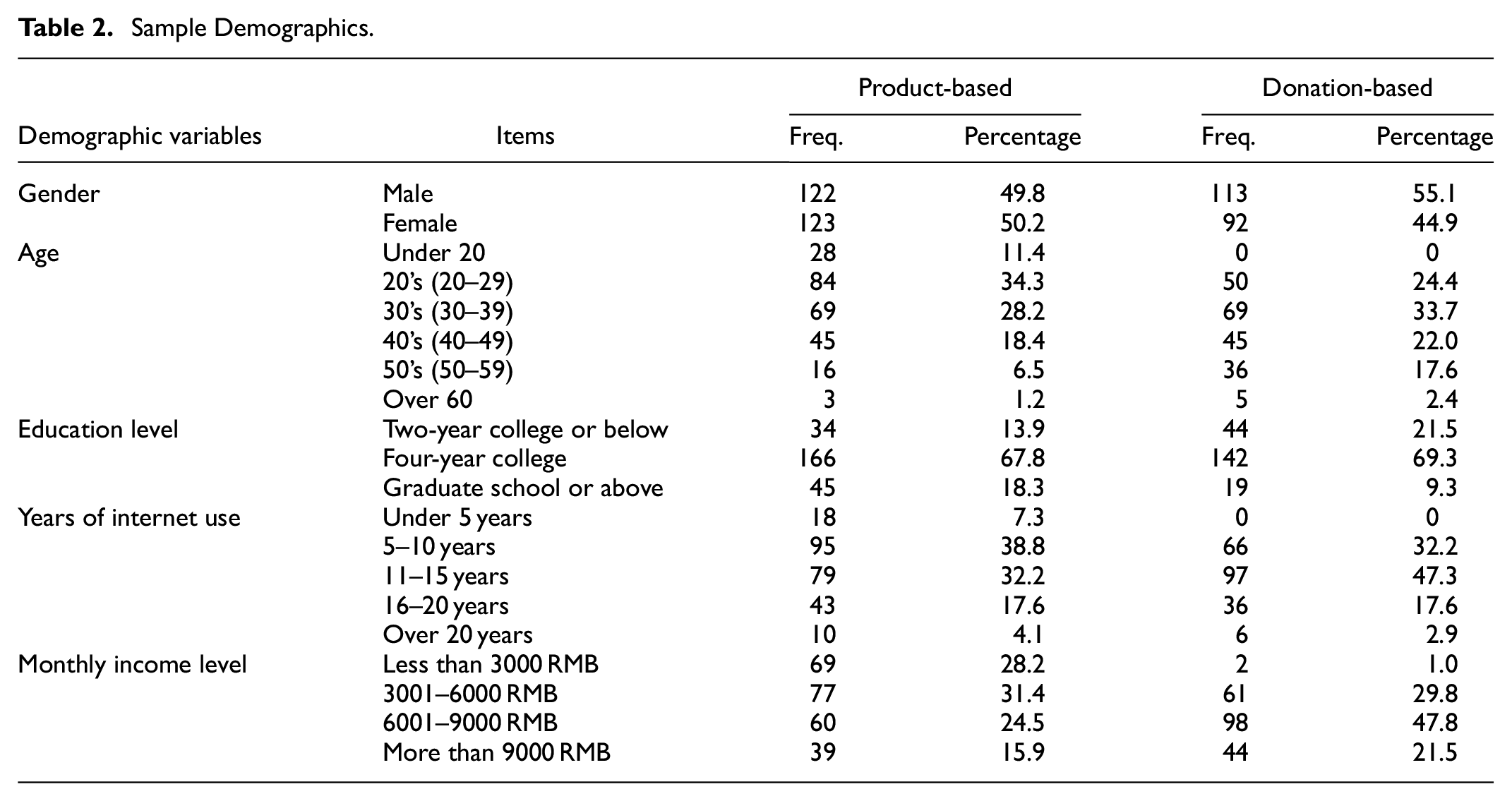
To ensure the accuracy of the obtained data, this article undertakes a comprehensive screening of qualified participants. In the meantime, qualified respondents were informed in advance that they would get a postcard from the school as a mark of thanks for completing the questionnaire. This study’s sample data were collected largely using two methods. Utilizing personal social networking software, the researcher initially sent messages to friends and group members in order to find potential survey respondents. After registering as a member of JD Crowdfunding and Easy Crowdfunding, the user information of the crowdfunding community was used to identify eligible respondents and request their participation in the survey. JD Crowdfunding and Easy Crowdfunding are two example platforms for the rapid expansion of product- and donation-based crowdfunding in China. From February to May of 2019, a survey questionnaire was administered. A total of 461 questionnaires were collected from participants in crowdfunding projects. After excluding invalid questionnaires, 450 valid replies were received. There were 245 valid questions for product-based crowdfunding, and 205 valid questionnaires for donation-based crowdfunding. All of our research samples consist of investors in crowdfunding projects.
From a demographic study standpoint (as depicted in Table 2), we determined that the ratio of males to women who participated in their first crowdfunding project was relatively balanced. The age group most likely to participate in crowdfunding projects consists of middle-aged and young adults between the ages of 20 and 50, constituting around 80% of all participants, demonstrating that the majority of people who participate in crowdfunding initiatives have some financial resources. In terms of education, more than 70% of survey respondents with a bachelor’s degree or more indicated that participation in crowdfunding initiatives is linked to some level of education. In addition, the vast majority of the respondents had at least 5 years of Internet use experience. We also discovered that respondents earning less than 3,000 yuan per month are less likely to participate in crowdfunding activities. A relatively high number of respondents with a monthly income between 6,001 and 9,999 yuan are involved in crowdfunding. According to the statistics for the entire sample, the empirical evidence collected for this study reveals an excellent level of sample coverage.
Sample Demographics.
Data Analysis and Results
Following the development and measurement of the model, we must examine and analyze the scale’s measurement reliability, validity, and fitness indicators. We assessed and predicted the model’s indicators using professional statistical tools such as SPSS and AMOS and then confirmed the corresponding hypotheses stated in the hypothesis section.
Reliability and Validity Analysis
Through reliability and validity research, we first assess the existing measurement scales for distinct variables. Its objective is to determine whether the hierarchy created by the present questionnaire satisfies the model’s requirements. The scale’s reliability and validity are assessed by confirmatory factor analysis. The present study employs factor loading (STD) to assess the reliability of individual measurement items, and the CR value to assess the model’s component dependability. The obtained data indicate that the factor load (STD.) values for all measured items exceed 0.6, and the CR values for all measured items exceed 0.7. All indicators meet the criteria (Hair et al., 1998), showing that the model is very reliable and the scale is stable. The reliability indicator test findings are summarized in Tables 3 and 4.
Summary Table of Confirmatory Factor Analysis for Donation-based Crowdfunding.

indicates significance at the 0.001 level.
Summary Table of Confirmatory Factor Analysis for Product-based Crowdfunding.

indicates significance at the 0.001 level.
The second sort of validity test is the convergent validity test, which is divided into two subtypes: convergent validity and discriminant validity. Average Variance Extracted (AVE) is used to assess convergent validity. Between 0.36 and 0.5, AVE values suggest good convergent validity, while values greater than 0.5 imply optimal convergent validity (Fornell & Larcker, 1981). The AVE values of the model are found to meet the requirements by calculation, showing that the scale’s convergent validity is satisfactory. To determine discriminant validity, the dimension correlation coefficient matrix should be compared. The diagonal bold type in Tables 5 and 6 represents the arithmetic square root of AVE. The diagonal AVE root values are all bigger than the pearson correlation coefficient between this facet and the other facets, showing that the discriminant validity between facets is satisfactory. On the basis of the foregoing data, the model’s validity test results are found to be good.
Inter-construct Correlations for Donation-based Crowdfunding Project.

Note. Diagonal elements in bold are the square roots of AVE. In order to obtain sufficient discriminant validity, these values should exceed the inter-context correlation.
Inter-construct Correlations for Product-based Crowdfunding Project.
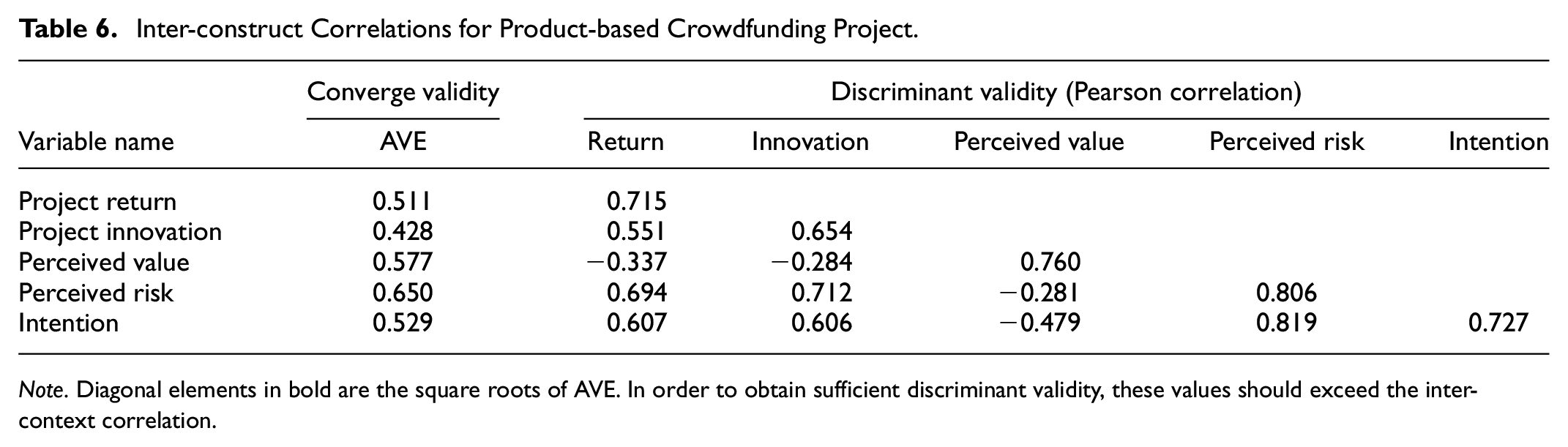
Note. Diagonal elements in bold are the square roots of AVE. In order to obtain sufficient discriminant validity, these values should exceed the inter-context correlation.
Hypothesis Test
The AMOS21.0 is utilized to perform standardized path analysis on the model, and the model’s primary fitness indices are obtained for two types of crowdfunding projects. We also used the model’s fitness index while analyzing model hypothesis testing. We discovered that regardless of the type of crowdfunding model, the fitness index of the model can successfully meet the model’s standard. For example, we report the following indicators for product-based crowdfunding projects: CMIN = 162.44, DF = 83, GFI = 0.921, AGFI = 0.886, TLI = 0.931, CFI = 0.946. The following metrics are reported for the donation-based crowdfunding project: CMIN = 115.98, DF = 83, GFI = 0.930, AGFI = 0.899, TLI = 0.967, CFI = 0.974. Table 7 summarizes the findings of the hypothesis test and depicts the standardized path coefficient as well as level of significance between variables.
Results of the Hypothesis Test.

p < .05; **p < .01; ***p < .001.
Discussion
The results of testing the hypotheses reveal that this study model has a good degree of explanatory power for the intention of supporters to crowdfund. Explanatory power R2 for user crowdfunding intention is 74% for product-based crowdfunding and 68% for donation-based crowdfunding, showing a strong level of explanation. In addition, the explanatory power of the project feature for the perceived characteristic R2 is moderate to high. Two sections of analysis comprise the conclusion. The first examines the impact of project return and innovation on supporters’ perceived attribute, while the second investigates supporters’ propensity to support crowdfunding projects depending on their perceived attribute. First, we explored the path analysis in the existing hypothetical conclusions. In order to analyze and compare the crowdfunding willingness of supporters under two separate crowdfunding models, we also investigated the impact of numerous variables on crowdfunding willingness. As a result of the above research, we determined that the inclination of investors crowdfunding intention differs between the two project forms.
Firstly, we examined the effect of project feature on the perceived attribute. The results of hypothesis testing indicate that variables such as project return and project innovation have varying effects on different crowdfunding campaigns. In product-based crowdfunding projects, project return has a significant positive effect on perceived value (β1 prod = .474, p < .001), but has no such significant effect on perceived risk (β2 prod = −.141). On the other hand, project innovation has a significant positive effect on perceived value (β3 prod = .432, p < .001) and a significant negative effect on perceived risk (β4 prod = −.259, p < .05). In donation-based crowdfunding projects, project return significantly increases perceived value (β1dona = .788, p < .001), and return on crowdfunding project significantly decreases perceived risk (β2dona = −0.351, p < .001). However, project innovation has no discernible effect on either perceived value or perceived risk in donation-based crowdfunding. We further investigated the potential reasons for the differences in project feature to perceived attributes among supporters of two different types of crowdfunding projects. On the one hand, the perceived value of the supporters is greatly influenced by the project return, regardless of whether it is a product-based or donation-based crowdfunding project. In donation-based crowdfunding initiatives, project return significantly lowers backers’ perceived risk, while it has no discernible effect on participants’ perceived risk in product-based crowdfunding projects. Regarding a different project innovation, we discover that it significantly affects supporters’ perceptions of the perceived risk and value of product-based crowdfunding projects, but not those of donation-based project supporters. We can observe it if we examine two distinct kinds of crowdfunding projects. To begin with, physical objects are typically the return option for product-based crowdfunding participants. When backers engage in product-based crowdfunding initiatives, the tangible return on investment has a significant influence on how valuable the project is viewed by backers. Product-based crowdfunding projects see a substantial negative influence on project innovation to perceived risk, whereas no discernible relationship exists between project return and perceived risk. One of these could be the fact that funding for product-based project initiatives is sometimes restricted to a particular level, which explains why the return on such projects is not as large as the perceived risk for backers. Product-based crowdfunding has minimal capital outlay and yields a return that is proportionate to the investment, in contrast to crowdfunding initiatives that demand bigger investment types like equity-based projects. Supporters of the product-based project will not view the risk as much if there is a small return. On the other hand, the degree of project innovation is more significantly impacted by the view of supporters. Product-based crowdfunding initiatives typically draw backers by offering a unique project to the project sponsor for a set amount of time. In contrast to similar ventures, this one is novel and has the ability to convince potential backers of its worth. However, if the project’s level of innovation is too high, investors may get concerned about whether the project can be effectively funded and realised, which could lead to risk perception anxiety about the project’s ability to be finished. Nonetheless, the perceived worth of a product-based crowdfunding project can be raised by a well-thought-out and creative concept. As for the participants of donation-based crowdfunding projects, this study found that project returns had a significant negative impact on the perceived risk of supporters, which may be related to the return types of donation-based crowdfunding projects. Compared with material returns, users are more inclined to seek spiritual rewards when participating in donation-based crowdfunding, that is, to gain the recognition of others or win their own reputation through participating in the project, so as to achieve spiritual satisfaction. Therefore, we believe that the returns of donation-based crowdfunding projects have a significant positive promoting effect on the perceived value of crowdfunding project participants. It is also interesting to find that the higher the return of donation-based crowdfunding projects, the perceived risk of supporters will be significantly reduced. The reason behind this may be that most supporters of donation-based crowdfunding projects are simply pursuing the realization of self-worth in return for participating in projects. Since this kind of non-material return will not bring economic or income loss to project participants, the more the project can meet the spiritual needs of donation-based crowdfunding supporters, the lower the perceived risk would be when supporters participate.
Secondly, we examined the influence of perceived attribute on crowdfunding intention. Both perceived value and perceived risk have a substantial effect on backers’ intention in product-based crowdfunding projects (β5 prod = .744, p < .001; β6 prod = −0.270, p < .001). Although perceived value has a considerable positive effect on crowdfunding intention in donation-based projects (β5 dona = .789, p < .001), perceived risk has a negligible effect on crowdfunding intention (β6 dona = −.090). Similar to the belief that perceived value has an incentive effect on supporters’ crowdfunding intention (Jiang et al., 2021), we found in this study that perceived value has a significant impact on participation intention of both types of crowdfunding projects. Different from the study of Kim and Hall (2019) which found that risk quality and uncertainty level had a significant positive impact on crowdfunding participation, we found that perceived risk had a different impact on supporters’ willingness in the two types of crowdfunding projects. The possible reasons for the difference of perceived risk in the influence of crowdfunding intention of the two projects may as follows. In donation-based crowdfunding projects, perceived risk has no significant impact on the crowdfunding intention. The reason behind this may be related to the relatively flexible investment of donation-based crowdfunding projects. Compared with investors in product-based crowdfunding projects, investors in donation-based projects can choose the amount of investment in the process of participating in projects by themselves. As a result, once prospective investors have a thorough knowledge of the project, they will choose an investment amount that is appropriate for them given their circumstances. On the other side, investors in product-based crowdfunding projects often commit a sizeable amount of capital, and the return cycle is typically lengthy. Consequently, the risks introduced have a significant impact on the likelihood that crowdfunding project backers will invest.
Conclusion and Management Implications
Conclusion
The research model is utilized to analyze the factors influencing the crowdfunding intention of supporters. Through the development of a research model of the crowdfunding intention of supporters, the influence of project feature on perceived attribute and perceived attribute on crowdfunding intention is further studied. The study found some differences in the results for participants in donation-based and product-based crowdfunding projects. From the project feature level, it is found that project innovation has a significant impact on the perceived attribute of product-based crowdfunding project supporters, while innovation has a small impact on the perceived attribute of donation-based crowdfunding project supporters. However, the project return of donation-based crowdfunding projects has a significant impact on the perceived attribute of supporters. For product-based crowdfunding projects, both perceived value and perceived risk of supporters have a significant impact on their participation intention, but for donation-based crowdfunding projects, the important perceived attribute of project participants comes from the impact of perceived value on crowdfunding intention.
Implications
The results of this study may have some implications for crowdfunding sponsors, who can use them to raise money more effectively and attract more backers. Firstly, crowdfunding project sponsors might involve supporters in the creation of the product. They can even instruct backers to produce unique goods to gain a competitive advantage. Also, it is essential to carefully prepare project returns regardless of whether a crowdfunding product is donation- or product-based. Sponsors of crowdfunding campaigns with a donation component can provide appropriate feedback mechanisms so that participants can benefit spiritually from their participation. Sponsors of product-based crowdfunding projects can show a significant return on investment to attract participants. For instance, in crowdfunding campaigns, project sponsors may provide various rates of return to potential investors. The purpose of multiple returns is to appeal to a wider range of investors and satisfy their diverse needs.
Limitation
Since we are comparing and analyzing the participation intentions of donation-based and product-based crowdfunding intention in this study, we make an effort to maintain consistency while developing measurement items to enable comparison analysis. However, in practice, as many crowdfunding project types may have distinctive project characteristics, these characteristics can be further studied in future studies.
Footnotes
Acknowledgements
The authors appreciate the all the editors’ hard work and reviewers’ valuable insights. C.S. contributed to the draft manuscript, model construction, the design, distribution and collection of survey questionnaires, data analysis, and the funding acquisition; X.H. contributed to conceptualization, and revising the manuscript; B.L. contributed to conceptualization, revising the manuscript, and the funding acquisition.
Declaration of Conflicting Interests
The author(s) declared no potential conflicts of interest with respect to the research, authorship, and/or publication of this article.
Funding
The author(s) disclosed receipt of the following financial support for the research, authorship, and/or publication of this article: This research was financially supported by the project of Philosophy and Social Science Planning Project of Henan Province (2022CZZ017), the Soft Science Research Project of Henan Province (242400410257), the National Social Science Fund of China (24BGL311), Key Scientific Research Project Plan of Colleges and Universities in Henan Province (25A630002), and Research Fund for High-level Talents of Henan University of Technology (2022BS010).
Ethics Statement
Ethical review and approval were not required for the study on human participants in accordance with the local legislation and institutional requirements.

Data Availability Statement
The original contributions presented in the study are included in the article, further inquiries can be directed to the first author.