




Abstract
Digital collectibles (DCs) are localized Chinese digital products similar to NFTs, but possess distinct regulatory features. Given the lack of studies on how Chinese consumers adopt DCs, this study develops an integrated framework incorporating perceived value, risk, and regulation factors. Through Grounded Theory analysis of in-depth interviews with 15 early DCs adopters, we identify five dimensions of perceived value and three dimensions of perceived risk. Then we conduct a questionnaire survey (N = 1,037) and use a second-order structural equation model to test the proposed framework. The significant findings are as follows: perceived value enhances DCs ownership intention, with perceived entertainment value showing the strongest effect; perceived risk negatively impacts perceived value, driven by perceived cost risk; perceived regulation increases perceived value while reducing perceived risk; perceived value mediates DCs ownership intention. These findings emphasize the importance of policy communication and reveal the utilitarian-speculative tendencies in DCs adoption.
Plain Language Summary
Aims and Purpose: We wanted to understand what drives Chinese consumers to own digital collectibles, the Chinese-regulated version of NFTs. Our goal was to see how people balance benefits against risks and how government regulations influence their decisions. Background: Digital collectibles are similar to NFTs but follow Chinese regulatory rules. Though the market is growing quickly, we did not know much about what makes Chinese consumers want to buy these digital items. Methods: We talked with 15 early buyers to understand their reasons, then surveyed 1,037 Chinese consumers. We used statistical modeling to look at how value, risk, and regulation influence consumer decisions to own digital collectibles. Results and Importance: The desire to own digital collectibles comes mainly from how valuable people think they are. Surprisingly, fun and social connections matter more than making money. People buy them for entertainment rather than investment. When people understand government rules, they feel more confident about value and less worried about risks. The study shows that perceived value connects regulations, risks, and ownership decisions. These findings explain why some people are drawn to digital collectibles while others remain skeptical, providing valuable insights for policymakers and companies that create these products.
Introduction
Non-fungible tokens (NFTs) are blockchain-based digital certificates increasingly utilized to authenticate digital assets in the metaverse (Sung et al., 2023). The integration of blockchain technology with art has created new possibilities for preserving, displaying, and valuing artworks, contributing to the growth of the digital art economy (Aytas & Karaviran, 2025). NFT projects, comprising unique collections of these digital assets, represent blockchain-based ventures that deliver value to customers (Yilmaz et al., 2023). Recently, the fine art market has been rocked by NFT sales, which have significant implications for auction houses, galleries, dealers, artists, collectors, and investors (Belk et al., 2022). This growing popularity has contributed to the rise of digital collectibles (DCs). DCs are localized Chinese digital products similar to NFTs, but with some distinct characteristics in product development and regulatory governance (Chen et al., 2024).
The growing implications of DCs represent a disruptive technology shift in human society (Belk et al., 2022). However, from the perspective of Diffusion of Innovation (DOI) theory, DCs remain in their early adoption phase. Although some researchers have explored the subjective and objective factors influencing user participation in NFT transactions (Albayati et al., 2023; Lee & Cha, 2024; Nevi, 2022; Perez et al., 2023; Sung et al., 2023; Toraman & Geçit, 2023), there are theoretical and empirical gaps in knowledge about what makes DCs valuable to Chinese consumers.
Cultural and regulatory differences across countries shape how consumer groups understand and interact with digital assets. Consequently, adoption patterns of NFTs and DCs vary significantly between Chinese and international markets. Understanding DCs social acceptance in China requires thorough examination of Chinese consumers’ value recognition and risk perception. This raises key questions: How do Chinese consumers perceive the value of DCs? To what extent does this value perception influence DCs ownership intentions? What other factors mediate this relationship?
To address these research questions, this study draws on perceived value theory (Zeithaml, 1988) as the primary theoretical foundation, which provides a comprehensive framework for understanding consumer evaluation processes in technology adoption contexts. We integrate this with risk perception theory to capture the uncertainty and potential negative consequences that consumers associate with emerging digital assets (Bauer, 1960). Additionally, given the unique regulatory environment surrounding DCs in China, we incorporate regulatory perception as a contextual factor that may influence both value and risk assessments. This theoretical integration allows us to develop a holistic understanding of the complex decision-making processes underlying Chinese consumers’ acceptance of DCs. This study adopts an exploratory-confirmatory mixed-method design, employing grounded theory analysis of early adopter interviews to identify key constructs, then combining these qualitative insights with quantitative validation through structural equation modeling.
NFTs and DCs
The Concept of NFTs and DCs
NFTs are cryptocurrency derivatives created through smart contracts on the Ethereum public blockchain platform (Nadini et al., 2021). They have experienced rapid adoption across various sectors, including art, sports, broadcasting, content creation, and tech-crypto businesses, introducing new ways to organize, consume, move, program, and store digital information (Wilson et al., 2022). NFTs have grown in popularity in the global market, with sales totaling $17 billion in 2021, and are expected to reach $200 billion in 2030 (Xie et al., 2024). China follows this trend, with its NFT market size growing to 280 million RMB in 2021 and projected to reach 28 billion RMB in 2026 (iResearch, 2022).
DCs, also known as China NFTs (Tong, 2022) or NFTCs (non-fungible token collectibles, Fortagne & Lis, 2024), represent localized adaptations of NFTs (Chen et al., 2024). DCs and NFTs share core features in how they are presented as products. Xie et al. (2023) offer a formula to define DCs: “Digital Collectibles = Digital Works + Blockchain + NFT + Collectible Value,” indicating products that exist digitally, verify ownership through blockchain-based NFTs, and possess collectible value.
DCs also reflect China’s distinct approach to digital product development and governance. DCs and NFTs differ in four key aspects: underlying technology, trading methods, legal supervision, and ownership (Chen et al., 2024), serving different purposes in practice. DCs emphasize artistic expression and public accessibility while retaining collectible value. In contrast, NFTs derive value primarily from scarcity and trading potential. Under Chinese regulations, DCs are positioned as digital copyright tools, distinct from NFTs’ financial characteristics (Zhang, Xia, et al., 2022). Due to the different application scenarios of NFTs and DCs, research on distinct aspects of DCs social acceptance is warranted.
Social Acceptance of NFTs and DCs
Understanding user acceptance of DCs requires examining both technological and psychological factors. The multidimensional nature of user value perception in digital contexts has been extensively validated across various technology platforms, with users deriving satisfaction from entertainment, social, and functional benefits that determine engagement behaviors (Pang & Ruan, 2024; Pang & Zhang, 2024b). Research also shows that users develop emotional connections with digital entities, treating them as objects of personal significance rather than mere commodities (Jiang et al., 2022), providing context for understanding emotional investment in DCs.
The Technology Acceptance Model (TAM) is a classic perspective for studying the interactive relationship between new technologies and society, with extensive applications in examining consumer acceptance of blockchain-based digital assets. According to Nevi (2022), factors such as interest and trust significantly influence NFT acceptance. Similarly, Toraman and Geçit (2023) find that perceived compatibility, enjoyment, and trust positively affect perceived usefulness through a mediating relationship. Xie et al. (2024) demonstrate that three types of perceived value (unique, entertainment, and expressive) drive both status consumption and innovativeness in the NFT context. Meanwhile, there is a temporal overlap between COVID-19 and the rise of NFTs (Perez et al., 2023; Wang et al., 2021), showing the hedonic motivations of NFT participants during their leisure time. Additionally, beyond examining the impact of subjective factors on technology acceptance, Albayati et al. (2023) propose a user NFT participation model that incorporates external factors including regulatory, social, technical, and market dimensions. Yilmaz et al. (2023) conduct the first study to explore how consumers derive value from NFT projects by combining perceived value theory with the customer journey. They conceptualize the NFT consumer’s experience journey in three stages: pre-purchase, purchase, and post-purchase deliberations, and explore the reasons for NFT interest through word association tests and descriptive statistics.
Previous studies focus on the drivers behind consumers’ interactions with NFTs, but seldom examine the factors influencing social acceptance of DCs in the Chinese market. Chen et al. (2024) integrate perceived value theory and social identity theory to explore the influencing factors of DCs purchase intention. However, compared with the rapid growth of the DCs market, empirical investigations of DCs social acceptance are still in their infancy.
Moreover, current research on the social acceptance of DCs has largely overlooked the role of perceived regulation. Existing studies on the acceptance of DCs have primarily focused on users’ rational evaluation of the technology itself, with little consideration of how external policies and regulatory environments influence technology diffusion. Although Chen et al. (2024) recognize that the Chinese government’s legal supervision is one of the main differences between DCs and NFTs, they do not incorporate perceived regulation into their model.
To fill the above research gaps, we develop a second-order structural equation model integrating perceived value, perceived risk and perceived regulation to examine the key factors influencing DCs acceptance among Chinese consumers, and explore the influential mechanism of perceived risk and perceived regulation on DCs acceptance, as well as the mediating role of perceived value in it.
In-depth Interviews and Hypotheses Development
Interview Design and Data Analysis
To provide exploratory evidence on this nascent topic, we employ a mixed-method approach combining qualitative interviews and quantitative surveys. Given the limited theoretical understanding of DCs adoption mechanisms, we adopt a sequential exploratory design where qualitative insights inform quantitative validation. Our research follows a three-stage methodological pathway. First, we conduct grounded theory analysis of in-depth interviews with 15 early DCs adopters to capture value drivers and conceptualize dimensions of perceived value, risk and regulation. Second, we integrate these empirical insights with existing literature to develop a theoretical framework and construct a questionnaire survey to examine the effects of value, risk, and regulation perceptions on DCs social acceptance. Finally, we develop a second-order structural equation model to test the proposed framework.
We employ grounded theory (Glaser & Strauss, 1967) as our primary qualitative approach, providing an abductive method for generating theory from empirical field data. As one of the most utilized contemporary qualitative research methodologies (Babchuk, 1997; Bryant & Charmaz, 2007), grounded theory offers particular value for exploring emergent phenomena where existing theoretical frameworks may be insufficient. While traditionally associated with qualitative research, grounded theory has been successfully employed in mixed methods contexts (Babchuk & Boswell, 2023), making it well-suited for our exploratory-confirmatory design. This approach serves dual functions: systematically discovering value-risk-regulation dimensions specific to the Chinese DCs context, where cultural and regulatory factors may create unique adoption patterns, and providing empirical grounding for theoretical model construction that reflects genuine user experiences rather than imposed theoretical assumptions.
The in-depth interviews explored early adopters’ motivations for DCs engagement, guiding our theoretical framework and questionnaire design. The interviews examined early adopters across four dimensions: personal background, attitudes toward DCs, governance perspectives, and value assessment with future outlook. While governance perspectives address regulatory considerations, the other dimensions focus on perceptual factors.
Participants were recruited through snowball sampling within DCs communities on prominent Chinese DC platforms (e.g., Topnod, RedNote, Alibaba Auction, Bilibili, and The One Art), targeting early adopters of DCs for online voice interviews lasting 45 to 60 min. Data collection continued until theoretical saturation was achieved after the 15th interview, following established grounded theory principles where additional interviews yielded no new conceptual insights (see Table 1 for participants’ demographic characteristics).
Basic Information of Participants.

Interview data analysis follows grounded theory’s systematic three-level coding process. First-level coding involves line-by-line extraction of key terms from transcripts, establishing initial dimensional categories through open coding. Second-level axial coding filters factors unrelated to our research objectives, identifying 10 core factors most relevant to DCs adoption decisions. Third-level selective coding synthesizes these factors into three primary theoretical dimensions aligned with established consumer behavior literature: benefit value, functional quality, and social relationships (Babin et al., 1994). This process, documented in Table 2, yields five dimensions of perceived value (economic, entertainment, artistic-cultural, social, and self-extension) and three dimensions of perceived risk (market, technical, and cost). These empirically-derived dimensions subsequently inform our quantitative instrument development and theoretical model specification, providing a robust foundation for understanding DCs adoption in the Chinese market context.
Interview Coding Process and Results.

Theoretical Background and Hypotheses
This section establishes the theoretical foundation for our conceptual model by integrating established technology acceptance models with insights from our grounded theory analysis of early adopter interviews. We recognize the significant roles of perceived value and perceived risk within traditional technology acceptance models. For instance, utilitarian value is a key element in the UTAUT model (Venkatesh et al., 2003), which aligns with the core concept of perceived value (Zeithaml, 1988). Additionally, perceived risk serves as an essential construct in the extensions of the UTAUT2 model, which has been systematically evaluated by Marriott and Williams (2016). Moreover, our interviews revealed the importance of perceived regulation in the context of technology adoption, suggesting that regulatory clarity can substantially influence user acceptance.
Therefore, our theoretical model integrates three core constructs with distinct boundaries: perceived value reflects users’ multidimensional utility assessment, encompassing economic, entertainment, artistic-cultural, social and self-extension dimensions; perceived risk addresses concerns about potential losses associated with technology use; and perceived regulation represents users’ assessment of regulatory effectiveness and policy clarity, constituting a distinct construct that, while conceptually related to broader trust in institutional environments (McKnight et al., 1998), focuses specifically on the regulatory dimension. This integration reflects DCs’ unique characteristics as emerging digital assets influenced by both consumer preferences and regulatory environments.
Perceived Value and DCs Ownership Intention
Value is a crucial factor influencing customer purchase decisions. However, while customers typically cannot assess product value objectively, they make decisions based on their perceived value, which is inherently subjective (Yang et al., 2012). In marketing, perceived value is customers’ evaluation of a product or service’s merits and its ability to meet their needs and expectations, especially compared with its peers. In this study, perceived value is defined as users’ overall preference and comprehensive evaluation of the value embedded in DCs, based on their observations, judgments, and subjective impressions when considering whether to accept or hold DCs.
Perceived value has emerged as a fundamental theoretical construct in consumer behavior research, consistently demonstrating its pivotal role in shaping purchase decisions and product utilization patterns (Dong et al., 2019). The literature suggests that perceived value can help explain attitudes and behavior (Yang & Peterson, 2004), and empirical evidence has systematically documented positive associations between perceived value and various behavioral outcomes, including purchase intention and usage intention across multiple contexts (Eggert & Ulaga, 2002; Turel et al., 2007). Therefore, we propose that:
Consumers differ in how they understand and prioritize the components of perceived value. The dimensions of perceived value can be classified in various ways. Sheth et al. (1991) identify five consumption values influencing consumer choice behavior: functional, social, emotional, epistemic, and conditional. Babin et al. (1994) are among the first to look beyond utility in perceived value, suggesting both utilitarian and hedonic dimensions. Based on interviews and literature review, we conceptualize DCs perceived value through five dimensions: perceived economic value, perceived entertainment value, perceived artistic and cultural value, perceived social value, and perceived self-extension value. Although our interviews identified perceived collectible value as a potential dimension, we excluded it from the model due to limited theoretical support and its overlap with other value dimensions. Given that each dimension may uniquely influence overall perceived value and ownership intention, we will further examine which of these value dimensions demonstrate stronger effects on the overall perceived value and ownership intention of DCs. To address potential concerns about dimensional overlap, particularly among entertainment value, self-extension value, and social value, which share conceptual similarities in personal experience domains, we clarify the theoretical distinctions among these constructs. Entertainment value focuses on interest satisfaction and spiritual pleasure derived from engaging with DCs, while self-extension value emphasizes personal identity expression and symbolic meaning. Social value centers on interpersonal relationships and community belonging through DC ownership. These dimensions represent distinct theoretical constructs with different conceptual foundations, supported by their different literature origins and independent emergence from our grounded theory analysis (see Table 3). All value dimensions maintain clear theoretical boundaries based on their unique focus areas and underlying psychological mechanisms.
Questionnaire Measures, Scale Sources, and Reliability Analysis.

Perceived Risk and Perceived Value
Perceived risk is first introduced to consumer research from psychology by Bauer (1960), who defines it as the potentially unpleasant consequences of consumer shopping behavior, noting that the same risk may result in different perceptions among different consumers. In our study, perceived risk is defined as users’ perceptions and judgments of various potential risks when considering whether to accept DCs. Contemporary research demonstrates that users navigate various perceived risks while seeking digital benefits in technology adoption contexts (Pang & Ruan, 2024; Pang & Wang, 2025). These findings support our multifaceted approach to understanding perceived risk in DCs.
Perceived value and perceived risk are directly and strongly related to consumer behavior (Shapiro et al., 2019). The core of perceived value lies in the trade-off between perceived gains and perceived risks (Wood & Scheer, 1996). Previous studies have demonstrated that perceived risk negatively influences perceived value (Kleijnen et al., 2007; Sweeney et al., 1999), while also negatively predicting purchase intention (Featherman & Pavlou, 2003; Mitchell, 1999). Therefore, we propose that:
Perceived risk includes multiple dimensions. Featherman and Pavlou (2003) demonstrate that various dimensions of perceived risk, including performance risk, psychological risk, financial risk, and social risk, negatively affect consumers’ behavioral intentions toward e-services adoption. Through interviews with early adopters of DCs, this study identifies three dimensions of perceived risk: perceived market risk (including quality issues, trading losses, and fraud), perceived technical risk (involving technical stability concerns and cybersecurity threats), and perceived cost risk (referring to unexpected or unreasonable costs incurred by participants). Different risk dimensions may affect perceived value differently. To better understand the relative importance of these risk factors, our research explores the comparative impact of each risk dimension on users’ overall risk perception of DCs.
Perceived Regulation as Environmental Monitoring
Perceived regulation represents a contextual dimension of environmental trust within the broader framework of institutional confidence. While McKnight et al. (1998) conceptualized institution-based trust as individuals’ belief in structural assurances and situational normality within institutional frameworks, perceived regulation captures users’ cognitive assessment of regulatory effectiveness, policy clarity, and government oversight within a specific domain. This distinction is particularly important in the context of DCs adoption in China, where regulatory policies directly shape market dynamics and user behavior. Unlike general institutional trust that encompasses broad confidence in institutional structures (Kaasa & Andriani, 2022; Yuan et al., 2022), perceived regulation focuses specifically on users’ perceptions of regulatory transparency, policy consistency, and enforcement effectiveness in emerging digital asset spaces. Research demonstrates that context-specific regulatory perceptions can significantly influence behavioral decisions in digital environments, with government oversight serving as a critical environmental factor in technology adoption processes (Zhang, Chen, et al., 2022; Zheng et al., 2022).
Building on our grounded theory findings that revealed the importance of regulatory factors in DCs adoption, we employ Social Cognitive Theory (Bandura, 1986) to examine this environmental influence. Social Cognitive Theory (SCT) posits that when making behavioral decisions, individuals consider not only personal and behavioral factors but also environmental factors. In the context of DCs adoption, people evaluate not just the inherent value or risks of the collectibles but also whether their development is protected by policies and regulations. The potential influence of perceived regulation on the social acceptance of DCs is evident in interviews with early adopters. In this study, perceived regulation refers to users’ perception or recognition of policy controls and governmental oversight in the development of DCs. Research demonstrates that environmental factors significantly influence user behavioral decisions in digital contexts, with studies employing social cognitive theory showing how environmental stimuli affect users’ psychological states and behavioral outcomes (Pang et al., 2025; Pang & Zhang, 2024a).
Several Chinese studies indicate that perceived regulatory and policy factors can influence behavioral decisions. He et al. (2018) find that government regulation has a significant negative effect on perceived privacy risks in the sharing economy. Jiang and Yu (2024) reveal that people’s perception of policies positively influences their innovative behavior in the tourism industry, highlighting regulation’s value-enhancing effect. As DCs are emerging digital assets under regulatory supervision, insights from relevant business domains can inform our understanding of DC adoption. Therefore, we propose that:
Figure 1 presents the proposed conceptual framework.
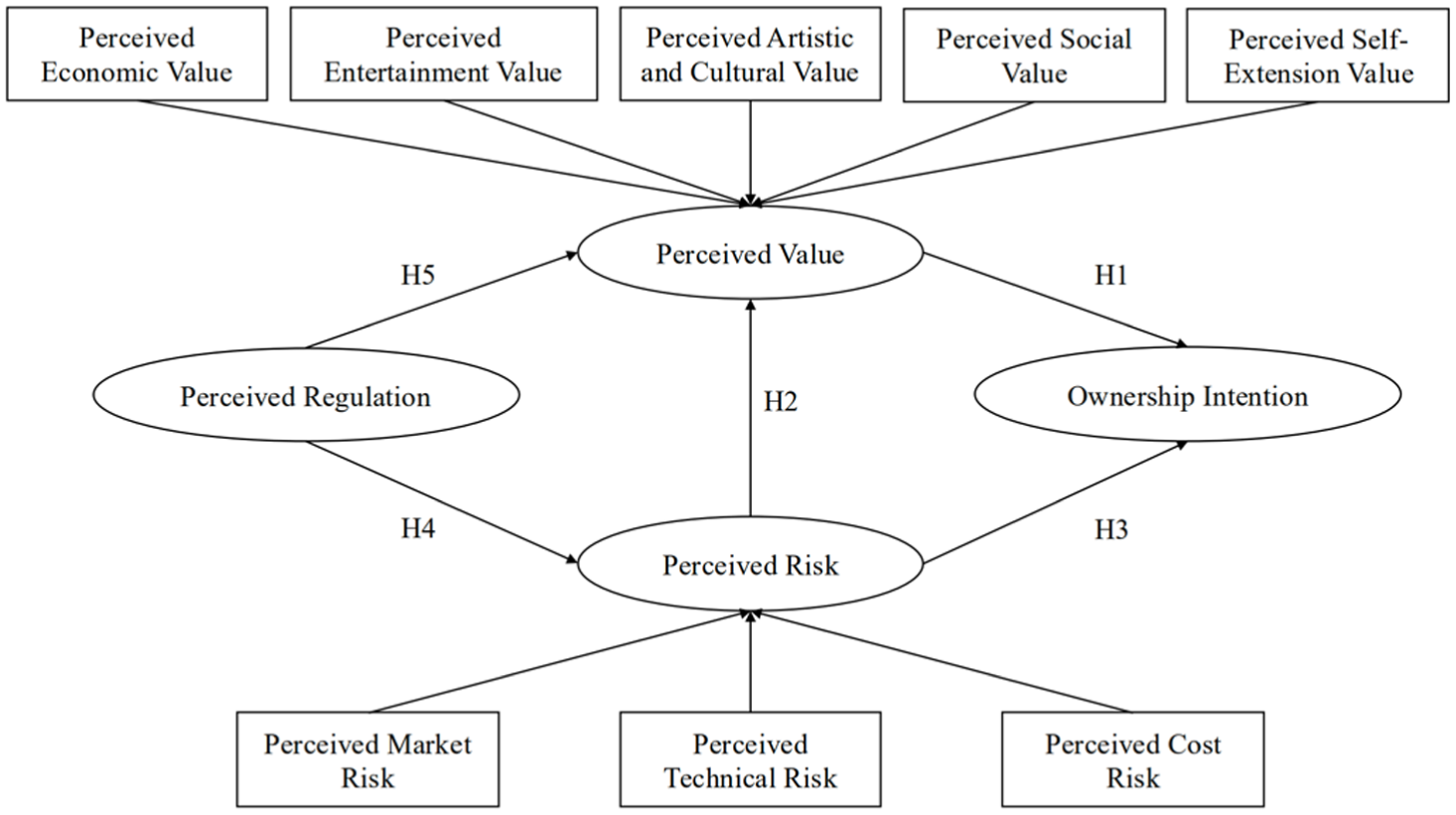
Research model.
Questionnaire Survey
Measurement
The study used well-tested scales adapted to fit the context of DCs and refined based on in-depth interview findings (see Table 3), ensuring both valid and reliable measurements. All latent variables were measured on a 5-point Likert scale, where participants rated how much they agree with statements about DCs (from 1 = strongly disagree to 5 = strongly agree). The survey included both people who have and haven’t used DCs, helping us understand how DCs are being accepted across broader society. To make sure everyone (especially those new to DCs) understood what we’re asking about, the survey began with a mandatory introduction explaining DCs. Participants had to click “I understand” after reading this section before continuing, which also served as an attention check. The questionnaire examined participants’ attitudes towards DCs, ownership status, and demographic characteristics.
Data Collection
The questionnaires were distributed through Wenjuanxing (https://www.wjx.cn), a leading online survey platform in China, from October 8 to October 16, 2024. Wenjuanxing maintains a diverse sample pool of over 6.2 million registered Chinese users with varied demographic characteristics. The platform randomly distributed questionnaires to its existing sample database, ensuring data quality through multiple verification mechanisms including lie detection questions, response consistency checks, attention checks, and IP address anomaly detection. A total of 1,050 questionnaires were collected, of which 1,037 were valid after excluding 13 responses that failed attention checks (effective response rate = 98.76%). The final sample included both users who have and have not used DCs, allowing for a comprehensive examination of DC acceptance patterns across broader social segments rather than limiting analysis to existing users only, with respondents’ demographic characteristics shown in Table 4, indicating reasonable sample representativeness. The sample comprises 52.80% female respondents, with a mean age of 32.64 years (SD = 6.93).
Descriptive Statistics of the Respondent Characteristics.

Model Testing
The dataset was analyzed using covariance-based structural equation modeling (CB-SEM) with SPSS AMOS 23 and IBM SPSS Statistics 27 software.
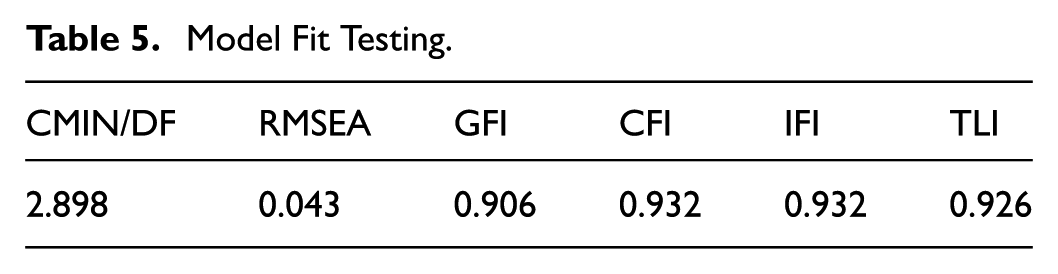
As shown in Table 5, the model demonstrates adequate overall fit indices, with CMIN/DF below 3, RMSEA below 0.05, and all goodness-of-fit indices (GFI, CFI, IFI, and TLI) exceeding 0.9, meeting the cutoff standards (Jackson et al., 2009).
Model Fit Testing.
We evaluate the reliability and validity of the measurement model using three indicators: content validity, internal consistency, and discriminant validity. Content validity was established through preliminary interviews and pilot testing to ensure measurement items were aligned with the DCs context. Internal consistency (as shown in Table 3 and Table 6) was demonstrated by factor loadings exceeding 0.5, with most constructs showing CR and Cronbach’s Alpha above 0.7, which meets the acceptable range recommended by Nunnally (1978). Perceived regulation had slightly lower but acceptable levels (CR = .649, α = .631). This construct adapts established regulatory perception concepts (Bélanger & Carter, 2008) to the novel DCs context through our grounded theory insights. Given this exploratory nature, Hair et al. (2010) suggest that values as low as 0.60 are acceptable. To validate the higher-order constructs (e.g., perceived value and perceived risk), we conducted a second-order confirmatory factor analysis (CFA), which confirmed the relationships between higher-order latent variables and their first-order dimensions, as well as the reliability of the first-order measurement models. For discriminant validity (as shown in Table 7), while correlations existed among variables, the square root of AVE (all exceeding 0.4) for each variable was greater than its correlations with others, demonstrating adequate discriminant validity.
Factor Loadings, AVE, and CR of Latent Variables.

Square Root of AVE and Correlations Among Latent Variables.

Note. Values on the diagonal represent the square root of the AVE for each latent variable. Perceived value and perceived risk are operationalized as second-order constructs, and their correlations and discriminant validity with other latent variables are assessed at the aggregate construct level.
p < .001.
Results
Descriptive Statistics
As shown in Figure 2, perceived value dimensions demonstrate elevated scores, with perceived artistic and cultural value achieving the highest mean (M = 3.98, SD = 0.67), followed by perceived entertainment value (M = 3.91, SD = 0.66), perceived economic value (M = 3.84, SD = 0.65), perceived self-extension value (M = 3.84, SD = 0.70), and perceived social value (M = 3.77, SD = 0.68). Ownership intention also exhibits notably high scores (M = 3.96, SD = 0.74), suggesting a strong propensity among respondents toward DCs ownership. Moreover, perceived risk dimensions generally yield lower scores, with perceived market risk recording relatively higher values (M = 3.26, SD = 1.00), followed by perceived cost risk (M = 2.98, SD = 0.89) and perceived technical risk (M = 2.63, SD = 0.90), with higher standard deviations indicating substantial heterogeneity in respondents’ risk perceptions. Regarding perceived regulation, the mean score (M = 3.51, SD = 0.83) is above the scale midpoint of 3.0, indicating respondents’ general acknowledgment of DCs regulatory oversight.

Mean values of variables.
Hypothesis Testing
The structural equation model is evaluated using the Bootstrapping method with 2,000 samples (results are presented in Figure 3). The coefficient of determination (R2) values for perceived value, perceived risk, and ownership intention were 0.51, 0.18, and 0.75 respectively, suggesting the robust predictive capability of the model. As shown in Table 8, all goodness-of-fit indices exceed their threshold values (Jackson et al., 2009), substantiating the model’s strong explanatory power.

Model Testing Results.
Assessment of Model Goodness-of-Fit Indices.

As presented in Table 9, there is a significant positive association between perceived value and ownership intention. Among first-order constructs, perceived entertainment value emerges as the strongest contributor to perceived value, followed by perceived social value, perceived economic value, and perceived artistic and cultural value. Perceived risk demonstrates a significant negative association with perceived value, while showing no significant relationship with ownership intention. Within the risk dimension, perceived cost risk emerges as the primary contributor to perceived risk, followed by perceived technical risk and perceived market risk. Furthermore, perceived regulation exhibits a significant negative association with perceived risk and a significant positive association with perceived value. Based on these findings, hypotheses H1, H2, H4, and H5 are supported, while H3 is rejected.
Path Analysis Results of SEM.

p < .001.
Mediation Analysis
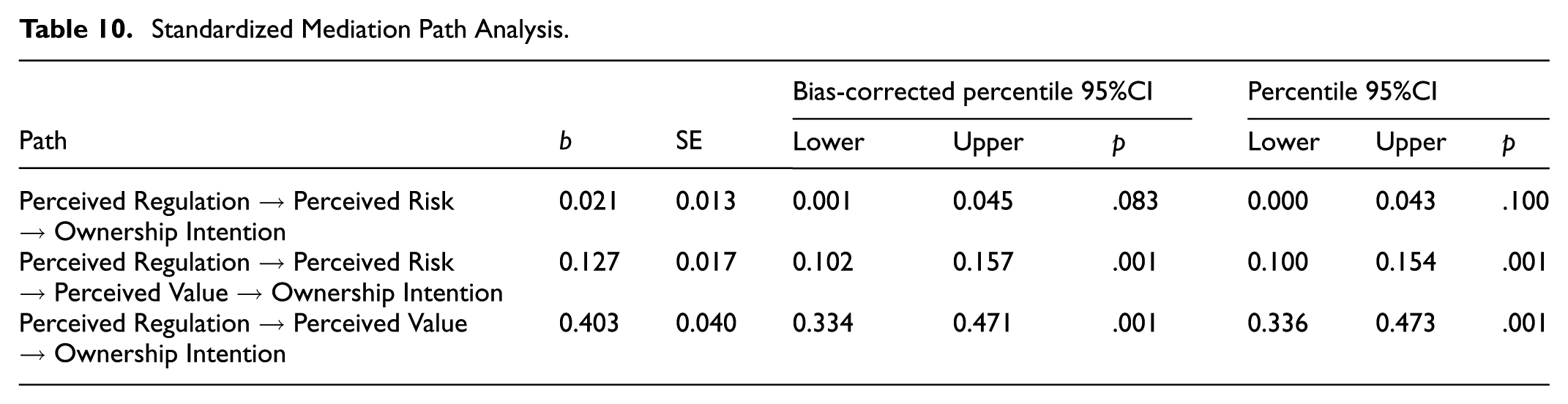
Mediation path analysis is employed to examine the formation mechanism of DCs ownership intention (see Table 10). The mediation pathway “perceived regulation→perceived risk→perceived value→ownership intention” (β = .127, SE = .017, 95% CI [.102, .157], p < .01) and the pathway “perceived regulation→perceived value→ownership intention” (β = .403, SE = .040, 95% CI [.334, .471], p < .01) demonstrate statistical significance. However, the pathway “perceived regulation→perceived risk→ownership intention” (β = .021, SE = .013, 95% CI [.001, .045], p > .05) fails to achieve statistical significance. Analyses reveal that perceived regulation indirectly influences ownership intention through perceived value. Notably, perceived risk shows no direct mediation, only affecting ownership intention through perceived value. These findings establish perceived value as the primary predictor of DCs ownership intention.
Standardized Mediation Path Analysis.
Discussion and Implications
Key Findings
Our empirical analyses reveal four key findings: Perceived value emerges as a significant positive predictor of ownership intention, with perceived entertainment value demonstrating the strongest effect magnitude; Perceived risk exhibits significant negative effects on perceived value, with perceived cost risk emerging as the predominant factor, while showing no significant direct relationship with ownership intention; Perceived regulation shows positive relationships with perceived value and significant negative associations with perceived risk; In the formation mechanism of DCs ownership intention, perceived value serves as a key mediator, through which both perceived regulation and perceived risk exercise indirect effects on ownership intention.
Perceived Value and Its Orientation
Building upon established research on perceived value (Chang & Wildt, 1994; Eggert & Ulaga, 2002; Turel et al., 2007; Wood & Scheer, 1996; Zeithaml, 1988), our analyses reveal that perceived value serves as a key mediating factor in DCs ownership intentions. Individuals’ decisions to own DCs are primarily driven by their assessment of the assets’ value, reflecting both the utility-driven aspects of the DCs market and their social acceptance process.
Our study goes beyond merely revealing the general influence of perceived value. Through in-depth interviews with early adopters of DCs and a review of relevant literature, we identify specific dimensions of perceived value for DCs and validate them through a second-order variable model. The five dimensions of perceived value, in order of importance, are: perceived entertainment value, perceived social value, perceived economic value, perceived self-extension value, perceived artistic and cultural value. Distinct from global NFT consumers, who often give equal weight to emotional and monetary values (Yilmaz et al., 2023), the priorities of Chinese consumers in entertainment and social values could be attributed to the unique regulatory environment in China, where the emphasis on stability and community may lead consumers to prioritize the social and entertainment aspects of DCs over purely economic or emotional gains.
An interesting finding emerges when comparing our qualitative and quantitative results. As revealed in our in-depth interviews, most interviewees primarily emphasized the economic value of DCs, with one participant considering “DCs as a new form of investment” (Interviewee 01). However, some early adopters also mentioned entertainment aspects, with one interviewee admitting that his interest in DCs stemmed from “a sense of play”, finding them a source of tranquility amid his busy life (Interviewee 14). Contrary to the predominant economic emphasis from early adopters, our survey reveals that perceived entertainment value and perceived social value have greater impacts than perceived economic value, highlighting that social acceptance of DCs emphasizes “fun” and “playfulness”. This contradiction reflects the categories of adopters in the Diffusion of Innovations Theory (Rogers, 1962). Early adopters, represented in our interviews, are typically motivated by economic opportunities and technical novelty. In contrast, our broader survey sample includes later adopter segments who prioritize entertainment and social benefits over speculative gains. This pattern suggests that as DCs diffuse beyond early adopters, the value proposition shifts from economic speculation toward entertainment and social utility, indicating a maturing market where intrinsic enjoyment becomes more important than potential financial returns.
Despite high mean scores in perceived artistic and cultural value and perceived self-extension value, their contributions to perceived value and ownership intention were relatively low. This suggests that while consumers recognize these values, their decisions to hold DCs are primarily driven by practical needs such as entertainment, social interaction, and investment, indicating a distinct utilitarian tendency in DCs acceptance.
Balancing Perceived Risk and Perceived Value
Our analyses uncover a distinctive mechanism in the DCs context: perceived risk influences ownership intentions exclusively through value perceptions rather than direct effects. Combined with descriptive statistics results, the overall mean values of perceived risk dimensions are relatively low, with high individual variations. This indicates that people currently have limited understanding and consensus about the potential risks of DCs during their acceptance consideration process. Even when risks are recognized, they do not directly influence ownership intention. Instead, the impact depends on whether perceived risk’s negative effect on value perceptions outweighs the value’s positive predictive effect, reflecting a speculative mindset in DCs acceptance.
This study further explores the differential impacts of perceived risk dimensions on DCs acceptance. Based on the second-order model, the three risk dimensions rank by impact as: perceived cost risk, perceived technical risk, perceived market risk. Interestingly, this result also contrasts with the mean calculation results from descriptive statistics. In the mean calculations, perceived market risk scored highest, followed by perceived cost risk and perceived technical risk. However, in the impact factor model, perceived cost risk and perceived technical risk show relatively stronger influences, while perceived market risk demonstrates a comparatively weaker impact. This suggests that even with limited knowledge or understanding, people are more sensitive to perceived cost risks (such as unreasonable pricing of DCs) and perceived technical risks (such as vulnerability to attacks), whereas perceived market risks (such as financial losses, poor product quality, and fraud) have less impact, suggesting a market confidence that stems from speculative behavior. This pattern was also evident in our interviews. Interviewees consistently mentioned cost concerns, with participants pointing out that “there is too much speculation in the current market, suggesting that this needs to be addressed to maintain consumer confidence” (Interviewees 05 and 10), while technical risks were also discussed, such as “risks of inadequate platform maintenance and potential hacker attacks” (Interviewee 04). These findings suggest that Chinese consumers prioritize tangible, immediate concerns over abstract market uncertainties. Low concerns about market volatility may arise from China’s regulatory landscape, where government oversight fosters a higher level of trust among consumers, contrasting with the findings of Yilmaz et al. (2023), which state that consumers in less regulated markets face a broader range of perceived risks, including significant uncertainties related to market dynamics and speculative behaviors.
The mediation analysis further reveals an interesting pattern that warrants theoretical explanation: perceived risk does not directly influence ownership intention, but rather operates through perceived value. This indirect pathway reflects several well-established psychological mechanisms that are particularly relevant given the unique characteristics of the DCs market. First, consistent with loss aversion theory (Kahneman & Tversky, 1979), consumers are more sensitive to potential losses than equivalent gains. Our findings suggest that risk perceptions are first processed as potential losses that diminish the perceived value proposition, rather than simply reducing purchase intention. Secondly, following bounded rationality principles (Simon, 1955), consumers use simplified decision-making processes when faced with complex choices. The sequential risk → value → ownership pathway indicates that individuals employ a cognitive shortcut where risks are first integrated into value assessments before making ownership decisions. Finally, the risk-as-feelings hypothesis (Loewenstein et al., 2001) suggests that emotional responses to risk are integrated into value judgments before rational ownership decisions are made. These psychological mechanisms are particularly pronounced in the speculative and entertainment-driven DCs market context. The entertainment-focused value orientation identified in our study suggests that consumers approach DCs primarily as sources of experiential satisfaction rather than traditional investment products, where the psychological benefits of participation may override conventional risk-averse decision patterns. This distinctive market dynamic explains why the emotional impact of perceived risks (particularly cost and technical risks) influences how consumers evaluate DCs value, which then drives their ownership intentions.
The Role of Perceived Regulation
Our findings show people’s acceptance decisions are shaped not only by technological attributes but also by their perceptions of the regulatory environment. As one early adopter explained, “policy changes in DCs trading methods would directly affect holders’ returns” (Interviewee 11), demonstrating how regulatory perceptions directly influence value assessments and adoption decisions. Specifically, perceived regulation exhibits significant dual effects: enhancing perceived value while reducing perceived risk. When investors recognize regulatory oversight of DCs and understand the policy environment, they tend to perceive higher value in these assets and report lower risk concerns. Understanding this strong regulatory influence requires examining China’s unique cultural context. Chinese consumers’ relationship with government oversight differs markedly from Western patterns, shaped by deep-rooted cultural values that affect how people interpret regulatory signals.
Traditional concepts like “li”, emphasizing proper order and conduct, continue to shape how Chinese consumers approach new markets. Rather than seeing regulation as government interference, many view it as guidance that helps maintain stability and fairness (Thompson, 2014). This explains why clearer regulatory frameworks actually increased DC adoption intentions in our study, a pattern that might surprise researchers familiar with Western markets.
Within China’s authoritarian system, the cultural emphasis on respecting institutional authority also plays a crucial role in this dynamic. Drawing on deeply rooted Confucian values that emphasize obedience to authority and interpersonal harmony, which continue to guide individual actions and attitudes in modern Chinese societies (Hofstede & Bond, 1988), Chinese consumers demonstrate distinct patterns of regulatory interpretation. Research indicates that respect for authority and acceptance of hierarchical structure remain defining characteristics of Chinese consumer behavior (Chen et al., 2008; Kirkbride et al., 1991). When Chinese consumers see government involvement in regulating DCs, they often interpret such involvement as validation rather than restriction, reflecting these traditional values where authority is viewed as protective rather than constraining. There’s an underlying assumption that if the government is paying attention to something, it must be legitimate and worth protecting consumers from potential harm. This cultural orientation aligns with contemporary Chinese governance’s emphasis on order and balance, as evidenced in political discourse promoting a “harmonious society” (“Confucius makes a comeback,”2007).
This institutional trust extends beyond individual concerns to broader social considerations. Chinese consumers tend to view regulations as protecting community interests, not just limiting individual choices. They are more likely to see government oversight as creating a safer environment for everyone, which then makes them more comfortable participating in the market themselves. This collective orientation toward regulatory benefits contrasts sharply with more individualistic markets, where regulation might be perceived primarily as personal constraint.
These cultural dynamics help explain why the regulatory dimension emerged so prominently in our Chinese sample, and why the mechanisms we identified might look different in other cultural contexts.
Theoretical Implications
Drawing on prior literature of technology acceptance and digital assets, we propose a conceptual model integrating three key constructs: perceived value, perceived risk, and perceived regulation. Through Grounded Theory analysis of interviews with DCs early adopters, we identify the specific dimensions of perceived value (comprising entertainment, social, economic, self-extension, and artistic-cultural dimensions) and perceived risk (including cost, technical, and market risks) in the DCs context. By empirically testing these relationships using a second-order structural equation modeling with survey data from 1,037 DCs users, this study advances the understanding of DCs technology acceptance in three significant ways.
Firstly, we advance theoretical understanding by examining the unique role of value frameworks in the Chinese DCs context, revealing complex value trade-off mechanisms where traditional dimensions intersect with novel digital attributes. Through dimensional analyses, we uncover a distinct utilitarian pattern where entertainment and social dimensions outweigh economic considerations. This finding diverges from conventional consumer products, where economic value often plays a primary role in purchase decisions, highlighting DCs’ distinctive nature as both collectibles and social assets. Our findings show how value priorities are restructured in the DCs market, with entertainment value, social value, and economic value emerging as the key drivers.
Secondly, this study extends risk-value frameworks by uncovering a distinctive mechanism in the DCs context: perceived risk influences ownership intentions exclusively through value perceptions rather than direct effects. This challenges previous empirical findings in consumer research (Featherman & Pavlou, 2003; Mitchell, 1999), suggesting DCs’ dual nature. While their fundamental appeal stems from social and entertainment value, the actual ownership decisions are shaped by a complex interplay of risk perceptions and value assessments rather than typical consumption patterns. The finding positions perceived risk as an external factor that influences adoption decisions primarily by shaping how users assess value.
Thirdly, we broaden social acceptance theory by incorporating regulatory perceptions, demonstrating how they serve to both enhance value assessments and reduce risk concerns, thus highlighting how environmental monitoring shapes technology adoption decisions in regulated markets. Our model demonstrates that consumers’ assessments transcend beyond the technology itself and its directly related stakeholders (such as other users, developers, and owners). They actively “monitor” the broader environment in which the technology develops (such as regulatory environment) and factors influencing its development (such as policy considerations). This theoretical extension enriches our understanding of the socio-regulatory context in technology acceptance decisions, emphasizing the crucial role of regulatory communication and policy advocacy in fostering healthy market development, particularly in regulated digital asset markets.
Practical Implications
The significant influence of perceived regulation underscores the strategic importance of regulatory communication and policy transparency. For policymakers, our findings suggest the need for systematic policy dissemination that works within China’s existing digital governance structure. Specifically, establishing token economy regulations could build upon China’s established fintech regulations, with clear distinctions between DCs as cultural products versus financial securities. Since China prioritizes preventing financial speculation, education programs should focus on DCs as cultural products and digital art rather than investment vehicles. The programs could be integrated into existing consumer protection initiatives led by the China Consumers Association, focusing on helping consumers understand the non-financial nature of DC ownership within China’s regulatory framework. Additionally, leveraging established government communication channels such as WeChat official accounts and local government apps could enhance policy accessibility and public confidence.
For industry practitioners operating in China’s market, understanding the predominance of entertainment and social values aligns well with the government’s emphasis on cultural industry development and digital consumption upgrading. Companies should focus on developing DCs that celebrate Chinese cultural heritage and foster community engagement, while ensuring compliance with data security requirements under China’s Cybersecurity Law and Personal Information Protection Law. Cost-effectiveness measures should consider Chinese consumers’ price sensitivity, particularly given the regulatory restrictions on secondary trading that limit speculative value. The findings about risk perception patterns further suggest the need to proactively address cost and technical concerns while maintaining market confidence in China’s regulated digital market.
Limitations and Future Research
NFTs in the Chinese market are still in their relative infancy. While our study takes an important first step in understanding the mechanisms of DCs adoption through the lens of the value-risk-regulation framework, many questions remain to be explored. Several limitations of our study should be acknowledged, which also suggest promising directions for future research.
Firstly, unlike previous research that combines perceived value theory with the customer journey (liking, purchasing, and holding or selling) (Yilmaz et al., 2023), our study only investigates DCs social acceptance in general terms. Future research could conduct a more granular analysis of drivers at different stages in the Chinese DCs market. This stage-specific approach would provide deeper insights into how value perceptions, risk assessments, and regulatory influences evolve throughout the user journey, potentially revealing distinct patterns of influence at each stage.
Secondly, while our study establishes the mechanisms through which perceived value, perceived risk, and perceived regulation influence DCs ownership intentions, we do not delve deeper into the underlying principles of these relationships. Future research could explore why and how these mechanisms work. For instance, studies could investigate the psychological processes behind how regulatory perceptions enhance value assessments, or examine the specific conditions under which risk perceptions might override value considerations.
Moreover, our research focuses on the Chinese market. As Tong (2022) suggests, different cultural backgrounds and institutional environments can significantly shape how digital innovations are perceived and adopted, so the mechanisms we identified may manifest differently across countries. Therefore, future research could extend our framework to other markets with distinct national characteristics (such as India and Southeast Asian markets) to examine how these adoption mechanisms might vary. Such cross-cultural comparative studies would enhance our understanding of NFT adoption patterns, potentially revealing unique local adaptations of these digital innovations.
Conclusions
This study examined digital collectibles (DCs) acceptance among Chinese consumers by developing a comprehensive framework integrating perceived value, perceived risk, and perceived regulation. We first conducted in-depth interviews with early adopters to uncover the unique and significant role of perceived regulation in DCs adoption within the Chinese context, while also systematically mapping the specific dimensions of perceived value and perceived risk based on the technological characteristics and usage contexts of DCs. The modified model was validated through mixed-method analysis combining grounded theory interviews with structural equation modeling. By examining the mediating role of perceived value and the dual effects of regulatory perception, this study identified several distinctive patterns in Chinese consumers’ DCs adoption decisions. By doing so, this study made considerable theoretical contributions to the digital asset acceptance literature and technology adoption research. First, given that the research stream on DCs and their value drivers is still in its infancy, this study addresses a critical gap by incorporating perceived regulation as an environmental factor that previous research has largely overlooked. Second, we reveal that perceived risk influences ownership intentions exclusively through value perceptions rather than directly, reflecting the speculative, entertainment-driven nature of the DCs market. Third, we provide empirical evidence that entertainment and social values outweigh economic considerations in DCs adoption, challenging conventional assumptions about digital asset valuation. The current study also provided several practical recommendations that benefit both policymakers in developing digital asset regulations and practitioners in enhancing DCs market acceptance in China’s regulated environment.
Footnotes
Acknowledgements
The authors thank all study participants for their valuable time and contributions, and acknowledge the experts who provided guidance and advice throughout the research process.

Ethical Considerations
Our study did not require further ethics committee approval as it did not involve animal or human clinical trials and was not unethical. In accordance with the ethical principles outlined in the Declaration of Helsinki, all participants provided informed consent before participating in the study. The anonymity and confidentiality of the participants were guaranteed, and participation was completely voluntary.
Consent to Participate
Informed consent was obtained from all subjects involved in the study.
Funding
The authors disclosed receipt of the following financial support for the research, authorship, and/or publication of this article: This work was supported by the Chinese Academy of Social Sciences under Grant [No.2024GQZD020; 2024SYZH010].
Declaration of Conflicting Interests
The authors declared no potential conflicts of interest with respect to the research, authorship, and/or publication of this article.
Data Availability Statement
The datasets generated and/or analyzed during the current study are not publicly available due to the scientific research data management policies of the authors’ institutions, but are available upon reasonable request.