



Abstract
This study examines the relationships among perceived price, quality, and value and their impact on the intent to participate in marathon events. An online questionnaire survey was administered to individuals who had participated in a marathon within the past ten years. Participants were selected using purposive sampling. A total of 609 valid responses were collected. The results showed that both perceptions of price and quality of marathon events are significant predictors of intention to participate in marathon events. Moreover, participants’ perceived value mediated the impacts of perceived price and quality on behavioral intention. The findings offer key implications, including ways to promote active participation in marathon events. In addition, the findings emphasize the need to account for and fully understand perceived price and quality when designing marketing strategies aimed at attracting marathon participants.
Keywords
Highlights
All path relationships except that between perceived price and perceived quality are mediated by the perceived value of marathon participants.
The study offers new insight into how perceived value reinforces the relationship between perceived price and quality in Asia’s emerging market of marathon participation.
Development of marketing strategies should include knowledge of perceived price and perceived quality to enhance marathon participation.
Introduction
The popularity of marathon running has led to an increase in marathon events (Hsiao et al., 2020). The surging enthusiasm for marathon running appears to be due to a number of factors: it has evolved into a physical challenge and an activity that offers recreational and social benefits (Hsiao et al., 2020). It has been established that these events have social and economic benefits and encourage healthy behaviors among people (Alexandris et al., 2017). Therefore, researchers strongly emphasize the need to arrange marathons to benefit both the participants and the economy of the hosting community (Li et al., 2021; Ma & Kaplanidou, 2018). Notably, running as a leisure activity holds a lot of advantages, including improved cardiovascular health, reduced risk of cardiovascular disease, and improved mental health (Girish & Lee, 2019; Wicker et al., 2012).
However, Taiwan has recently witnessed a decline in marathon events and participants (Duan et al., 2021). After the number of races reached a peak of 666 in 2015, average 12.5 races per week, there has been a slight downward trend in the number of events since then. The possible reasons for this phenomenon could be attributed to high entrance fees, a high number of confusing events (i.e., misgovernment of marathon events), poor quality of events, and people’s attempts to participate in foreign marathon events (Hsiao et al., 2020; Li et al., 2021). Past studies have found that the entrance fee and the quality of events are major concerns for runners (Duan et al., 2021).
Previous studies have highlighted perceived price and quality of marathon events were considered critical antecedents of individuals’ intention to participate in marathon events (Hillman et al., 2021; Hsiao et al., 2020; Li et al., 2021; Tian et al., 2021). For example, Tian et al. (2021) evidenced the direct impact of the ticket price on consumers’ purchase intentions and the high-cost of running events deterred runners from participating. Hsiao et al. (2020) also found that perceived event quality had a direct effect on the intention to attend running events. These results indicate that enhancing perceived quality can play an important role in increasing participants’ willingness to attend marathon events, particularly when considering the potential impact of perceived price on participation rates. Therefore, it is important for organizers to focus on delivering high-quality marathon experiences in order to ensure people will be willing to participate and return in future years.
Furthermore, previous studies have highlighted the importance of perceived value when participating in physical activities and sport events (Jeong & Kim, 2020; Pickett et al., 2016; Wang & Chiu, 2023). However, individuals’ perceptions and experiences of event values are heterogeneous depending on their expectations of marathon events (Du et al., 2015; Li et al., 2021). For example, some participants may be more focused on the challenge of completing the race and view the event as an opportunity to test their own abilities. Therefore, they may be less sensitive to their cost and event quality (Doyle et al., 2016). Others may want to have a memorable experience in the running events, such as enjoying the atmosphere of camaraderie and seeking memories with their friends. In all cases, these individual experiences will differently shape their perceptions of the event’s values, leading to different levels of intention to participate in marathon events in the future.
Accordingly, the purpose of this study was to examine the relationships among perceived price, quality, and value and their impact on individuals’ intention to participate in marathon events. Social exchange theory (SET) was applied as the theoretical foundation given the exchange nature of different values between participants and running events (Cropanzano & Mitchell, 2005; Li et al., 2021; Hsiao et al., 2020). According to the theory, a social exchange takes place between two or more parties, may include activities and tangibles or intangibles, and could be more or less rewarding or costing (Boateng et al., 2019; Gervasi et al., 2022; Zhang & Liu, 2022; Zhao & Detlor, 2023). For instance, participants who derive more benefits from marathon events are more supportive of marathon development and would participate in an exchange interaction for value. The findings offered key implications, including ways to promote active participation in marathon events. In addition, the findings emphasized the need to account for and fully understand perceived price and quality when designing marketing strategies aimed at attracting marathon participants.
Literature Review
Social Exchange Theory (SET)
SET offers a conceptual basis for this research (Gervasi et al., 2022; Zhao & Detlor, 2023). SET has been utilized in many studies aiming to elucidate why participants support sport events and how participants react to them (Huang et al., 2016; Johnston et al., 2023). SET describes a two-sided rewarding process involving two or more social groups (Cropanzano et al., 2017; Zhao & Detlor, 2023). Sports involvement is when participating in sports activities is considered a key aspect of life and is perceived to offer both hedonic and symbolic value (Boateng et al., 2019; Wang & Chiu, 2023). This study defines exchange value to include runners’ efforts and investments in marathon participation. The level of participants’ sports involvement (e.g., perceived value, price, and quality) influences the formation of inherent expectations, the evaluation of outcomes, and the perceptions of individuals’ behavioral intentions (Jin et al., 2013; Zhang & Liu, 2022). This study explores the impact of perceived value in the context of marathon events using SET, thus addressing limitations in the literature. More specifically, it adopts the context-specific perspective of SET to explain how perceived value facilitates perceived price and quality, which in turn, influences behavioral intentions.
Perceived Value
Perceived value is defined as the evaluation of the cognitive feelings that consumers receive and pay for during the consumption process and the overall utility of the product (Wang & Chiu, 2023), as well as the different feelings that consumers have according to their own habits, preferences, and experiences in purchasing behavior (Sweeney & Soutar, 2001; Voss et al., 1998). Accordingly, this study examined the impact of consumers’ perceived value on their behavioral intention to participate in marathon events.
Perceived Price
Price is the amount of money paid for a product or service and is broadly defined as the amount that consumers are willing to pay in exchange for a product or service of equal value (Kotler & Armstrong, 1997). Moreover, the perceived price is the consumer’s performance or subjective perception of price when purchasing a product or service (Ma & Kaplanidou, 2018), which is the most direct (Theodorakis et al., 2019). In what follows, this study defined perceived price as the marathon participants’ perceptions of the cost of participating.
Perceived Quality
Perceived quality is defined as a global judgment or attitude relating to the superiority of a service (Ma & Kaplanidou, 2018). In addition, perceived quality research in sports and recreation settings has been prolific for the last 20 years because of its applied value (Wang & Lin, 2017). Quality consists of objective quality and perceptual quality (Wang & Lin, 2017; Ma & Kaplanidou, 2018), with accurate quality being the actual technical superiority or internal clues of the product (Tian et al., 2021) and perceptual quality being the subjective judgment of consumers in different contexts (Hsiao et al., 2020). As such, this study primarily focused on marathon participants and explored how perceived quality affected participants’ perceptions and behavioral outcomes in the context of marathon events.
Behavioral Intention
Consumers develop attitudes depending on prior service experiences and frequently engage in a process to decide whether or not to access or avoid a service firm’s offering (Wang & Lin, 2017; Wang & Chiu, 2023). Purchase intention refers to the likelihood that the consumer will attempt to purchase the product (Jin et al., 2013). Moreover, it has been suggested that behavioral intentions affirm the likelihood of instituting a specific behavior (Wang & Chiu, 2023). In this study, the sporting event is considered as the product (i.e., marathon event), and the purchase behavior of the product is the intention to participate.
Hypotheses Development
Relationship Between Perceived Price and Perceived Value of Marathon Events
Price is what a consumer pays to obtain a product or service (Kotler & Armstrong, 1997), and perception is a dynamic process that changes with consumer experiences. Perceived value is a consumer’s subjective judgment of a product or service and directly impacts purchase intentions (Ryu & Han, 2010). Zeithaml (1988) defined perceived value as an overall assessment of a product’s utility on the basis of a consumer’s perceptions of what is received and what is given (perceived sacrifice).
Among the critical factors influencing consumers’ purchase decisions are their perceptions of the product value and delivery service (Kotler & Armstrong, 1997; Petrick, 2004; Shapiro & Drayer, 2012). More specifically, perceived value is a predisposing factor that can forecast future behavior (Bae et al., 2021; Chiu et al., 2019; Bojanic, 1996; Cronin et al., 2000; Petrick, 2004; Tam, 2000). Product quality can predict a consumer’s repurchase intentions compared to consumer satisfaction. In addition, Li et al. (2021) found that price is a quality signal and an essential indicator for a consumer to assess the product (Gerstner, 1985; Parasuraman & Grewal, 2000).
Consumers usually rely on price to determine product quality and invest more money, time, and energy to make related evaluations. From a consumer perspective, perceived quality is defined as what is received, whereas perceived sacrifice is considered as what is lost. Perceived value is the difference between perceived benefits and perceived sacrifice. Consumers experience positive perceived value when they believe what is received is greater than what is sacrificed. Perceived value directly impacts consumers’ purchase intentions. While perceived quality positively influences perceived value, perceived sacrifice has a negative impact. Thus, further discussion is needed on the influence of perceived price and value on the behaviors of marathon participants. Consistent with the literature reviewed above, we have formulated the following two specific hypotheses:
Relationship Between the Perceived Quality and Perceived Value of Marathon Events
There is a positive relationship between perceived value and perceived quality. When a consumer has limited knowledge of a product, he or she only relies on the price to make a purchase decision. The price of unsought goods is strongly related to their quality (Gerstner, 1985; Kuo et al., 2019). Consumers’ purchase decision is closely linked to perceived quality and value. When a consumer thinks that the product or service quality is good, he or she tends to positively assess the product. In other words, a higher perceived value will directly affect a consumer’s purchase intention (Zeithaml, 1988; Kuo et al., 2019).
Specifically, products are broadly defined as superior or excellent.
Cue utilization theory has pointed out that extrinsic and intrinsic cues are the quality indicators of a product (Hsiao et al., 2020; Li et al., 2021; Tian et al., 2021). Perceived quality can be defined as a consumer’s judgment of the quality of a product. Perceived quality is usually not the same as the actual or objective quality but a high-level concept or attitude toward the product, individual judgment. This study defines perceived quality as consumers’ overall assessment of marathon events (Li et al., 2021). As previously mentioned, our research will further discuss the correlation between marathon participants’ perceived quality and value of events and their intention to participate in a marathon. Consistent with the literature reviewed above, we have formulated the following two specific hypotheses:
Mediating Role of Perceived Value in Marathon Events
Research on physical education marketing emphasizes the role of perceived value in predicting consumer behaviors (e.g., Jones et al., 2019; Kuo et al., 2019). Consumers’ purchase decisions are closely associated with perceived quality and perceived value. A positive assessment denotes high perceived value and directly influences consumers’ behavioral intentions (Cronin et al., 2000). Researchers across fields have applied the concepts of perceived price, quality, value, and purchase intentions (Hsiao et al., 2020; Li et al., 2021; Tian et al., 2021), but few discuss them in relation to sports events. Thus, this study examines the relationships among perceived price, quality, value, and behavioral intentions and their impact on marathon participants’ decision-making. Accordingly, we formulate the following hypotheses (Figure 1):

Research model and hypotheses.
Methods
Participants and Procedures
This study used purposive sampling to select individuals who recently participated in a marathon event. An online survey with multiple-choice questions was administered to them. The survey documented demographic data (e.g., gender, age, education, profession, marital status, and household income) during breaks and after the race. Survey participation was voluntary, and all participants were assured of confidentiality. A total of 630 questionnaires were distributed over two days. The survey reported a 97.67% response rate. Among 630 questionnaires, 21 questionnaires were eliminated owing to missing values. The final sample, thus, comprised 609 respondents.
Measures
Perceived price
The perceived price scale was compiled and modified according to Voss et al. (1998) and was used to measure how people’s perceived price influenced their marathon activities. This scale consisted of 9 items (e.g., “The reasonableness of the registration fee for participating in the Taiwan marathon is critical to me” and “It is critical to me that I am willing to pay for the equipment to participate in the Taiwan marathon”). Items were rated on 5-point Likert scale ranging from 1 (strongly agree) to 5 (strongly disagree). Cronbach’s α coefficients assessed internal consistency; the α coefficient was .91. The factor loading of all items ranged from .76 to .96.
Perceived quality
The perceived quality scale was compiled and modified by the study of Wang and Lin (2017) and was used to measure how people’s perceived quality influenced their marathon activities. This scale consisted of 9 items (e.g., “The Taiwan marathon had good transportation connection service” and “The Taiwan regional marathon received positive feedback on the race results”). Items were rated on 5-point Likert scale ranging from 1 (strongly agree) to 5 (strongly disagree). Cronbach’s α coefficients assessed internal consistency; the α coefficient was .91, and the factor loading of all items ranged from .58 to .88.
Perceived value
The perceived value scale was compiled and modified by the study of Sweeney and Soutar (2001) and was used to measure how people’s perceived value influenced their marathon activities. This scale consisted of 9 items (e.g., “Participating in the Taiwan marathon has given me a good image” and “The marathon I registered for in Taiwan was well-received”). Items were rated on 5-point Likert scale ranging from 1 (strongly agree) to 5 (strongly disagree). Cronbach’s α coefficients assessed internal consistency; the α coefficient was .91, and the factor loading of all items ranged from .66 to .91.
Behavioral intention
The behavioral intention scale was compiled and modified by the study of Wang and Lin (2017) and was used to measure how people’s behavioral intention influenced their marathon activities. This scale consisted of 9 items (e.g., “I will actively prepare to participate in the marathon in Taiwan” and “I would like to continue to register for the marathon in Taiwan”). Items were rated on 5-point Likert scale ranging from 1 (strongly agree) to 5 (strongly disagree). Cronbach’s α coefficients assessed internal consistency; the α coefficient was .91, and the factor loading of all items ranged from .68 to .86.
Statistical Analysis
The statistical analysis for this study includes an estimation of the descriptive statistics using SPSS version 23 for Windows. Next, we described the scores of all participant variables used in subsequent statistical analysis. Then, we examined the correlations among variables using hierarchical regression analysis to test if perceived value and perceived quality mediated between perceived price and behavioral intention (Bollen, 1989; Hayes et al., 2017). Moreover, we adopted Baron and Kenny’s three recommended criteria for the mediator effect examination. According to the first standard (path c), the independent variable performs a total effect on the outcome variable. The second standard requires that the independent variable has a direct effect on the mediator variable (path a). In the third standard (path b and c′), the effect of the independent variable on the outcome variable becomes significantly smaller or non-significant after controlling for the mediator (i.e., direct effect; c′ path). The confidence level was set at 95% (p ≤ .05).
Results
Descriptive Statistics
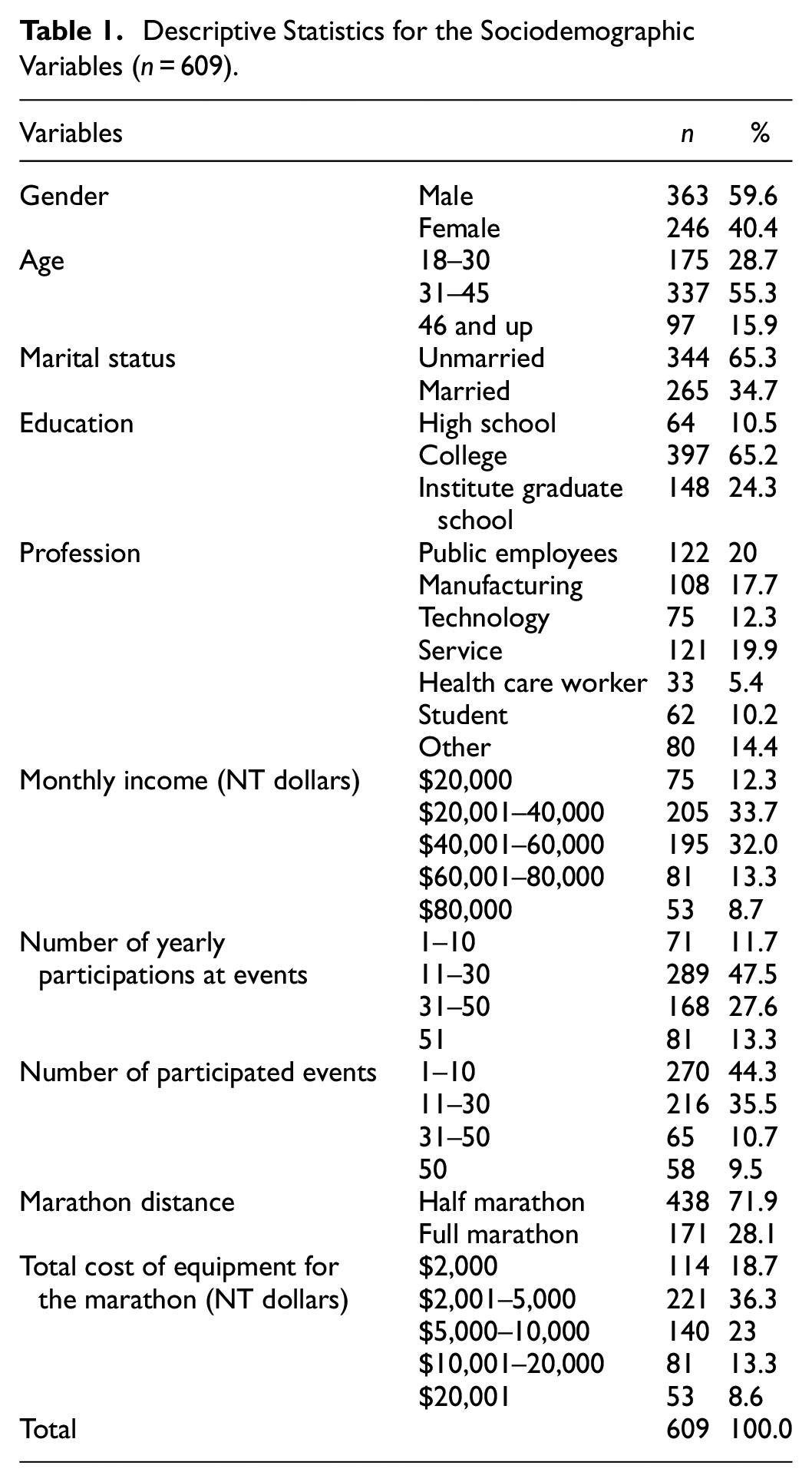
A total of 609 people participated in this study. Regarding the demographic characteristics, 59.6% of the participants were male; 40.6% of the participants were female. Participants’ ages ranged from 18 to 61 years old, and over half of the participants (55.3%) were 31 to 45 years old. Participants who were government/institution workers accounted for 20%, followed by service employees (19.9%), manufacturing employees (17.7%), freelancers (14.4%), technology employees (12.3%), students (10.2%), and healthcare practitioners (5.4%). The participants’ education levels were college (65.2%), graduate school (24.3%), and senior high school (10.5%). In terms of monthly income, 33.7% earned $20,001 to 40,000 or higher. Finally, 44.3% of the participants had participated in 1 to 10 marathon events within the last 5 years (see Table 1).
Descriptive Statistics for the Sociodemographic Variables (n = 609).
Regression Analysis
Furthermore, the significance of the regression model relationships was examined. The regression analysis showed that perceived price had a positive impact on behavioral intention (β = .28, p < .001), supporting
Mediation Analysis
Next, the mediation analysis was carried out to test the mediating effect of perceived value in the research model. The hierarchical regression analysis using SPSS was adopted to conduct a mediation analysis (Baron & Kenny, 1986; Hayes et al., 2017; Hayes & Scharkow, 2013) based on Baron and Kenny’s (1986) three recommended criteria. As per the first criterion (path a), the independent variable must directly affect the mediator variable. In the second criterion (path c), the independent variable must affect the outcome variable. In the third (paths b and c′), the mediator variable affects the outcome after controlling for the independent variable.
As shown in Table 2, the mediation analysis first examined the mediating effect of perceived value on the relationship between perceived price and behavioral intention. First, the perceived price positively affected behavioral intention (c path: β = .28, p < .001). Second, the perceived price positively affected perceived value (a path: β = .25, p < .001). Third, both perceived price and perceived value positively affected behavioral intention (path b: β = .54, p < .001; path c′: β = .15, p < .001), implying the existence of mediation and the partial mediating effect of perceived value in the relationship between perceived price and behavioral intention (Baron & Kenny, 1986; Hu & Bentler, 1999; Hair et al., 2006), supporting
Regression Model Predicting Marathon Participation From the Effect of Perceived Price and Perceived Value on Behavioral Intention.

Note. n = 609.
p < .001.
In addition, we further tested the mediating effect of perceived value in the relationship between perceived quality and behavioral intention. As shown in Table 3, the perceived quality had a significantly positive effect on behavioral intention (c path: β = .41, p < .001). Next, the perceived quality had a significantly positive effect on perceived value (a path: β = .67, p < .001). Third, both perceived price and perceived value positively affected behavioral intention (path b: β = .55, p < .001; path c′: β = .04, p = .896), implying the existence of mediation and the full mediating effect of perceived in the relationship between perceived quality and behavioral intention (Baron & Kenny, 1986; Hayes et al., 2017; Hayes & Scharkow, 2013), supporting
Regression Model Predicting Marathon Participation From the Effect of Perceived Quality and Perceived Value on Behavioral Intention.

Note. n = 609.
p < .001.
Discussion
This study aimed to examine the relationships among perceived price, perceived quality, perceived value, and behavioral intention in marathon participants in Taiwan. The results suggested that perceived value has a mediating impact on the relationship between perceived price and intention to participate. In addition, other factors, such as perceived price, critically affect participants’ intentions via perceived value. First, this study found that perceived price positively impacted behavioral intention (
Notably, perceived quality positively affected behavioral intention (
We further discussed that the participants’ perceived value served as a mediation between perceived quality and the intention to participate in a race, which proved that perceived quality is a critical factor when discussing marathon participation. It was found that perceived value positively mediated the relationship between perceived price and behavioral intention (
Theoretical Implications
This study examined the impact of perceived value on participation in social exchanges, namely marathon events, using SET as a theoretical framework. The analysis demonstrated the utility of SET, thus contributing to the literature on marathon events and SET. The study focused on the relationship between perceived price and perceived quality and highlighted the importance of accounting for this association in marketing strategies to enhance marathon participation. The findings address the gap in knowledge about sports consumer behaviors and the impact of consumer perceptions on intentions to participate.
The study also contributes to the understanding of social structures. In particular, it examined group participation and the context in which interactions occur, thus advancing the literature on perceived value (Gervasi et al., 2022; Hsiao et al., 2020; Oh, 2000). Participants contributed to the context of interactions and engagement, expanding the current understanding of the nature and complexity of marathon events as a social structure. Thus, the study’s findings go beyond the mere identification of exchange relationships and associated benefits (Gervasi et al., 2022; Tian et al., 2021).
In contrast to existing research, this study uses an integrated model that considers perceived value as a bridge rather than a separate link (Boateng et al., 2019; Wang & Chiu, 2023). The findings indicate that participation in marathon activities creates a sense of value and enhances behavioral intentions. Thus, perceived value indirectly affects the perceived price and behavioral intentions.
Finally, this study offers new insights into the role of perceived value in the relational-cognitive mechanism of marathon participants. The findings validate the mediating role of perceived value in the effects of perceived price on behavioral intention (Gervasi et al., 2022; Hsiao et al., 2020). In other words, perceived value is critical in marathon events. The antecedent impacts of perceived value in the context of marathon events are supported by the comprehensive theoretical framework of SET.
Practical Implications
This study offers implications for organizers and marketers of marathon events. First, given its findings on the impact of perceived quality, marathon managers should create more opportunities for interactions between consumers and frontline employees such as front desk staff during service delivery. Providing quality services and experiences will increase service encounters and establish staff-customer relationships, thus enhancing participants’ value perceptions and future behaviors.
Second, service providers should focus on consumers’ subjective perceptions. Recognizing the critical role of perceived value will help achieve higher service performance, identify and integrate dynamic consumer needs, and continuously improve the efficiency of service processes (Boateng et al., 2019). Further, marathon managers should realize that perceived service value is influenced by not only the service itself but also frontline employees, including their responsiveness, flexibility, reliability, competence, and interaction.
Finally, marathon managers should explore effective marketing strategies, including discounts and other incentives to encourage early registration or referrals. The findings can also serve as a reference for sports researchers, academics, and practitioners attempting to better understand the motivations and behaviors of marathon participants.
Limitations and Future Research Directions
This study is not free from certain limitations. First, perceived value is not constant and can differ by service encounter. Thus, future research must adopt an experimental design and control for possible interference variables to examine the impact of perceived value. The findings may offer a better understanding of perceived value in the context of marathon events. In addition, future research could incorporate influential factors to understand the complexity of perceived value including socially interactive behaviors (Gervasi et al., 2022; Hsiao et al., 2020), contextual characteristics (Wang & Chiu, 2023), and impact on consumers’ perceptions and behaviors. Finally, this study does not account for the moderating role of spectators’ characteristics such as gender, occupation, age, education, and income in perceived service quality, value, and consumption. An in-depth analysis of spectators’ evaluations and their moderating role could enhance the efficiency of marketing strategies for the sports industry.
Conclusions
The findings from the present study provided some implications for the event organizers and marketers of recurring major sports events. As the results suggested, participants care about price. If we understand more about the participation level, it would be easier to forecast participants’ behavioral intentions. The results indicated that price is one of the factors affecting consumers’ intention to participate in a marathon. To predict participants’ intentions effectively, we need to take the quality of events along with other factors into consideration when we discuss the perceived price. In addition, the quality of the event is particularly important for the participants and also affects the overall assessment of the event. A positive assessment of the event is a critical condition for participants to decide whether to keep taking part in the event.
Footnotes
Declaration of Conflicting Interests
The author(s) declared no potential conflicts of interest with respect to the research, authorship, and/or publication of this article.
Funding
The author(s) disclosed receipt of the following financial support for the research, authorship, and/or publication of this article: This work was supported by the National Science and Technology Council, Taiwan (award number: NSTC 111-2410-H-032-030-MY2).
