




Abstract
This case study aims to investigate the effectiveness of an online science enhancement program in retaining ethnic minority students in science by providing them with opportunities to interact with cultural role-models of scientists and engineers during the COVID-19 pandemic. The study draws on foundational theories of identity formation and attitudes towards science, as well as research on growth mindsets, to increase students’ participation in science and assess the program’s effects, while also collecting data to develop a new theory. The findings indicate that the online enhancement program successfully facilitated the formation of science identities among the 12 ethnic minority high school students, enhanced their interest in science, and fostered positive attitudes towards science during the pandemic. Moreover, the online interactions with cultural role-models of scientists and engineers supported the students’ science learning and reinforced their science identity. This study also provides guidelines for future research on designing online enrichment programs to enhance ethnic minority students’ science affinities.
Plain Language Summary
This study looks at how online programs can help minority high school students become more interested in science. During the COVID-19 pandemic, many students couldn’t attend school in person. To keep them engaged in science, a special online program was created. The program allowed students to meet and interact with scientists and engineers who share their cultural backgrounds. These role models helped the students see that they, too, could pursue careers in science. The study found that these online interactions made a big difference. The students started to feel more connected to science, developed positive attitudes toward it, and became more confident in their ability to succeed in science fields. The results suggest that similar programs could be a great way to support minority students’ interest in science, even beyond the pandemic. The study also offers ideas for creating future programs that could help more students see themselves as future scientists or engineers.
Keywords
Introduction
The COVID-19 pandemic has presented high school students with unprecedented challenges, particularly as they strive to prepare for college applications (Asanov et al., 2021). Beyond the common difficulties faced by students, such as the inability to participate in in-person classes and the absence of social gatherings with friends (Koo, 2021; Kuhfeld et al., 2020), high school students have also reported limitations in online learning environments. These limitations encompass the lack of critical learning methods such as social and emotional interactions, experiments, primary lab experiences, and direct observations in labs (Koo & Jiang, 2022; Hebebci et al., 2020; Yates et al., 2020). Consequently, the pandemic has severely restricted high school students’ opportunities to learn and engage with the field of science, potentially impacting their diverse learning experiences, which are crucial for college preparation (Koo et al., 2021).
Most high school students are currently participating in distance learning programs through the internet, TV, or radio. This shift can diminish the social pressure that can help motivate students to engage actively in learning when they are in person with teachers and other students (Koo et al., 2021). Additionally, students who struggle with self-discipline may fall behind on difficult science assignments, fail to study adequately for tests, and ultimately suffer from poor science learning. Distance learning environments also present challenges in effectively delivering instructions, particularly hands-on activities, which are one of the most effective educational methods in science (Zarifsanaiey et al., 2024; Zhang et al., 2022). Hands-on learning allows students to directly observe and understand what is happening, making it a particularly successful way to teach kinesthetic learners, who learn best by manipulating or touching materials (Kilrilmazkaya & Dal, 2022). However, online students may find it difficult to understand concepts that they have never directly seen or experienced.
The online learning environment during COVID-19 has the potential to decrease high school students’ interest and achievement in science by isolating them from teachers and peers, decreasing their self-management skills, and limiting opportunities for hands-on learning (Loades et al., 2020).
Literature Review
Ethnic Minority High School Students in STEM
The achievement gap between ethnic minority students and their peers in Science, Technology, Engineering, and Math (STEM) has been identified as a significant problem in the United States (Freeman, 2020). Ethnic minority high school students tend to lag behind their non-minority peers in science achievement, as evidenced by lower grade point averages, standardized achievement tests, higher dropout rates, lower college attendance rates, and other measures of academic success (Bushnell, 2021). Factors contributing to the achievement gap include inadequate access to educational resources and technology, poor-quality education systems, teacher bias and low expectations, lack of parental involvement and education, cultural and language barriers, negative peer influences, and insufficient knowledge about higher education (Yoon et al., 2020).
The COVID-19 pandemic has exacerbated existing educational inequalities for minority students, who have faced limited access to educational resources and professional societies. While online learning has become widely available, minority students often lack access to the internet, data packages, and devices needed for remote learning (Alasuutari, 2020). Technical issues can also hinder their ability to complete coursework, and their living environments may not support participation in online classes (Lourenco & Tasimi, 2020; Torres Martín et al., 2021). Additionally, minority students who face multiple forms of discrimination and exclusion due to gender, ethnicity, age, disability, or gender identity may be particularly vulnerable during the pandemic (Koo, 2021).
Given these challenges, science education must take into account the unique needs of minoritized high school students, especially during the pandemic, to support their academic achievement and close the achievement gap. Efforts to provide individualized and culturally sensitive support for these students should be a priority (Yoon et al., 2020) to sustain their interest in science learning (Pietrocola et al., 2020). However, while studies have examined access to science education for minority students, research on their academic achievement in science during COVID-19 remains underdeveloped. Therefore, it is essential to investigate how minority students are experiencing science education during the pandemic to inform effective interventions and support their success.
Need for Scientist-Student Interaction Programs
Previous studies have demonstrated that interactions between students and scientists have a positive impact on students’ attitudes towards science and their interest in pursuing science-related careers (McReynolds et al., 2020; Galvez et al., 2024 ). The impact of virtual scientist mentoring on middle school students’ science motivation and self-efficacy. The researchers found that students who participated in the mentoring program reported significantly higher levels of science motivation and self-efficacy than those who did not participate. The researchers also found that the mentoring program had a positive impact on students’ attitudes towards science, with students reporting that they were more interested in science and that they saw themselves as more capable of doing science after participating in the program. A summer camp where high school students engaged in hands-on science activities with scientists in science laboratories resulted in increased interest in science and perceived improvement in laboratory skills among participants (Galvez et al., 2024).
Interactions between scientists and students provide students with access to the world of science and scientists and help them see themselves as potential scientists and engineers (Chen et al., 2024; Haeger & Fresquez, 2017). Through interviews and reflective discussions with scientists, high school students in a summer gardening program were able to express their views and construct and deconstruct their mental images of science and scientists, which helped break down barriers and create common experiences between students and scientists (Woods-Townsend et al., 2015). Chen et al (2024) found that after interacting with scientists, students’ interest in science and scientists’ personal lives increased.
However, some high school students do not pursue careers in science due to the lack of advice about future careers in science (Drymiotou et al., 2021). This can lead to a discrepancy between their interest in science and their desire to pursue science-related careers (Woods-Townsend et al., 2015). To address this issue, it is important to provide students with opportunities to interact with scientists and develop an inclusive view of science and its practices. This can help students see themselves as potential scientists and engineers and increase their interest in pursuing science-related careers.
Role Models for Ethnic Minority Identity
A role model is an individual who serves as an example for others, demonstrating positive actions or behaviors (Zenone et al., 2021). The study found that role models could influence viewers’ behaviors through the motivational theory of role modeling, by serving as behavioral models, representing the possible, and being inspirational. Traditional American textbooks tend to feature famous individuals, celebrities, and professional leaders as role models who have achieved great success in Western society (Isik et al., 2021). Research has consistently recognized the importance of role models in influencing student learning (Ahn et al., 2020). A positive role model can offer valuable role-specific information, including performance standards and skill expertise, which can increase feelings of self-efficacy (Ahn et al., 2020).
For ethnically diverse student populations, culture and ethnic background are significant factors in choosing role models (Isik et al., 2021). Students believe that role models from the same ethnic group share a similar cultural background and can better understand the challenges they face as members of a minority group. Studies have found that ethnic minority students prefer to connect with mentors who share similar ethnic and cultural backgrounds to foster better understanding and empathy. However, research indicates a lack of diverse ethnic minority role models and mentors in STEM fields for minority students seeking mentorship and support (Aish et al., 2018). This dearth of role models impedes the success of minority students in STEM fields. Ethnic minority students require cultural role models who can understand their experiences and challenges and provide guidance towards successful pathways (Aish et al., 2018).
Studies have shown that individuals feel more motivated to achieve when they share a common trait (Schmader et al., 2008). When exposed to role models from their own culture, ethnic minority students feel respected and included in their classrooms, promoting greater motivation and success (Marx et al., 2009). Cultural role models offer examples of successful behavior and inspire motivation towards personal and career goals, guiding students towards potential pathways for success (Aish et al., 2018). Additionally, the cultural role models who students interact with can shape their professional identity and behavior at work, serving as projected future professional selves (Kammeyer-Mueller & Judge, 2008). Despite the importance of role models in science education for racially minoritized high school students, research on how ethnic minority students receive science education through science mentoring programs, especially during the unprecedented times of the pandemic, is limited.
Purpose of the Study
This case study aims to investigate the impact of online interactions with cultural role models of scientists and engineers on the science learning and retention of ethnic minority high school students during the COVID-19 pandemic. Specifically, it examines how these interactions may influence students’ science identities, interests, attitudes, and self-concepts. To achieve this goal, the study poses the following research questions:
How do online interactions with cultural role models of scientists and engineers affect minority students’ science identities?
To what extent do online interactions with cultural role models of scientists and engineers enhance minority students’ interest in science?
How do online interactions with cultural role models of scientists and engineers shape minority students’ attitudes towards science?
Can online interactions with cultural role models of scientists and engineers boost minority students’ self-concepts?
Theoretical Framework
In this study, foundational theories from Identity Formation Theory (Schwartz & Panti, 2006), Attitudes Toward Science Theory (Mao et al., 2021), and Growth Mindsets (Dweck, 2024) are employed to comprehensively address the impact of online interactions with cultural role-models of scientists and engineers on the science identities, interests, attitudes, and self-concepts of ethnic minority high school students during the COVID-19 pandemic.
Identity Formation Theory
Identity formation theory serves as a fundamental framework, emphasizing that adolescents establish stable identities through interactions with people. This includes the need for interactions with heroes, mentors, and peers with shared interests. These interactions also involve seeking guidance from cultural role-models on future careers in science (Schwartz & Panti, 2006). In this study, “Science Identity” is used as a conceptual tool to investigate the perceptions of early childhood teacher candidates regarding Science, Technology, and Society (STS). Science identity refers to individuals’ self-perception in relation to science, encompassing their beliefs, experiences, and affiliations within the scientific community (Carlone & Johnson, 2007). This concept is particularly relevant for understanding how teacher candidates, especially those from diverse international backgrounds, navigate their identities in the context of teaching science.
Applying the science identity to international students in scientific fields is crucial for recognizing the unique challenges and opportunities they encounter. International students often face cultural and educational differences that can impact their sense of belonging and engagement in scientific discourse (Baumert et al., 2024). By exploring how these candidates construct their science identities, we can gain insights into their motivations, aspirations, and the barriers they may encounter in their educational journeys. This exploration is essential for fostering an inclusive educational environment that values diverse perspectives in science education (Gonzalez et al., 2018).
However, it is important to acknowledge potential limitations in applying the science identity concept in a multinational context. Cultural difference in the perception of science and technology may affect how individuals relate to their science identities (Hogg & Vaughan, 2018). Additionally, the concept may require adaptation to accommodate different educational systems, pedagogical approaches, and societal values that shape the experiences of international students (Miller & Pardo, 2016). By addressing these limitations, we can enhance the applicability of the science identity framework and gain a more nuanced understanding of its role in shaping the perceptions of teacher candidates in a globalized educational landscape.
Ultimately, choosing science identity as a theoretical framework for this study offers a promising avenue for exploring the perceptions of early childhood teacher candidates. By delving deeper into its application to international students and considering the potential limitations and adaptations of the concept, we aim to strengthen the theoretical grounding of our investigation and contribute valuable insights to the field of science education.
Attitudes Toward Science Theory
Attitudes toward science theory offers essential insights into the development of positive attitudes towards science, closely connected to factors such as motivation, enjoyment, and perceptions of the value of science (Fang & Tsai, 2021). Positive attitudes towards science are not only interconnected with science identity but also guide science-related choices when combined with strong perceptions in the value of science and high levels of science self-efficacy. As students engage with cultural role models through online interactions, this theory provides a lens to examine how their attitudes toward science evolve, potentially influencing their overall science identity and future educational and career choices.
Growth Mindsets Theory
Growth mindsets theory asserts that individual intelligence can grow through effort and that a belief in a growth mindset leads to higher achievement (Grant & Dweck, 2022). This theory has a dual role in the study. First it informs the design of the program aimed at enhancing minority students’ engagement in science and the formation of their science identity. Second, it serves as a vital tool for assessing the impact of the online interactions program and collecting data to contribute to the development of a new theory. Previous research in growth mindset has shown that students who believe they can get smarter and understand that effort makes them stronger are more motivated and achieve higher levels of success (Nguyen, 2020). Minority students who were taught that intelligence is adjustable and understood how the brain grows with effort increased their achievement in science.
These theories provide a comprehensive framework for understanding the multifaceted impact of online interactions with cultural role models on minority high school students’ science identities, interests, attitudes, and self-concepts. By incorporating these theories into our study, we aim to shed light on the complex interplay of factors influencing students’ experiences during the pandemic and their pathways towards successful engagement with science.
Method
This study employs a case study methodology to evaluate the impact of online interactions with cultural role models on high school students from ethnic minority backgrounds, especially focusing on Korean-American students. The case study involves a single, holistic case comprising 12 participants, rather than 12 separate case studies. The research utilizes a quantitative approach to gather data through pre- and post-surveys, which use Likert scales to measure changes in students’ identities, attitudes, interests, and self-concepts towards science education and careers.
Research Design
The “Online Interactions with Cultural Role-Models” is an informal science enhancement program designed by a science and engineering organization to support Korean-American high school students interested in pursuing science-related fields but requiring assistance in learning science. The program’s goal is to foster students’ identities, interests, attitudes, and self-concepts towards science by providing them with opportunities to engage with world-renowned Korean-American scientists and engineers during the COVID-19 pandemic through a series of online sessions on Zoom.
The study is designed for a case study focusing on the collective experience of the 12 Korean-American students in grades 9 to 12. These students participated in five separate sessions with different scientists and engineers specializing in material engineering, applied physics, AI robotics, healthcare, and nano-chemistry. The selection of these professionals was based on their expertise and achievements in their respective fields. Each session included a 30-minute presentation followed by a 60-minute discussion, during which students could ask questions, either orally or through the chat function, covering topics ranging from personal life to research activities.
Participants
The case study enrolled 12 Korean-American high school students, including two in Grade 9, five in Grade 10, three in Grade 11, and two in Grade 12. All participants were interested in STEM careers, although their academic performance in STEM subjects ranged from basic to proficient. Recruitment was conducted nationwide across the United States, including states such as California, Illinois, Texas, New York, Virginia, and Washington. The students were selected from volunteers who demonstrated lower academic performance in STEM areas but showed a strong interest in participating in the study.
Data Collection Procedure
The Korean-American science and engineering association organized a series of five sessions over 5 weeks to provide high school students a realistic view of scientists and their work and to facilitate interaction with these professionals during the pandemic. The association identified and invited 10 world-renowned scientists and engineers across five professional areas to participate in the program. Each 90-minute session consisted of both a presentation and a discussion segment. Students registered for the sessions through an online platform, where they also competed a pre-test. Following the completion of their selected sessions, students were administered post-tests to assess the impact of the program on their attitudes, interests, and self-concepts toward science. This study was approved by the Institutional Review Board (IRB), ensuring the protection of the participants’ rights.
Data Collection Tool
The research study collected quantitative data using pre- and post-tests (Appendix A, Table A1) that consisted of four categories: science identity, interest in science, attitudes toward science, and self-concept of ability. The “Science Identity” category was adapted from Mcdonald et al. (2019), the “Personal Interest” category was modified from Barker and Noyes (2022), the “Self-concept of Ability in Science” category was revised by Fouan & Santana et al. (2017), and the “Attitude toward Science” category was adapted from Mao et al. (2021). A 5-point Likert scale was used, with ratings from 1 “Strongly Disagree” to 5 “Strongly Agree” for positive statements and from 1 “Strongly Agree” to 5 “Strongly Disagree” for negative statements. The scale also ranged from 1 “Not Very Good” to 5 “Very Good” for positive statements and from 1 “Very Good” to 5 “Not Very Good” for negative statements. The test consisted of a total of 25 items and was designed to support participants’ identity formation, personal interest, attitudes, and self-concept of ability. Higher scores indicated that the students were more likely to form a science identity, improve personal interest in science, develop positive attitudes toward science, and promote self-concept of ability, while lower scores indicated that the students were less likely to adopt these positive identities. Table 1 shows reliability of the questionnaires.
Reliability of the Questionnaires in the Study.

Results
The pre-and post-tests were administered to 12 ethnic minority high school students and their results were compared using a paired t-test.
Science Identity
After analyzing the pre-test and post-test results of Science Identity for the 12 ethnic minority high school students who participated in the program, a statistically significant improvement was found (t = 2.883, p < .05). The mean score increased from 3.750 (SD = 0.819) in the pre-test to 4.291 (SD = 0.670) in the post-test, indicating that the online interactions with the cultural role-models positively impacted participants’ science identity. Specifically, most of the participants showed an increase in their science identity scores after participating in the program. Table 2 displays the detailed results of Science Identity.
Results of t-Test and Descriptive Statistics for Science Identity by Group.

p < .05.
Personal Interest
After conducting an analysis of both pre- and post-test results, a significant improvement was observed in the participants’ personal interest in science after they interacted with the cultural role-models during the program. The mean score of the pre-test was 3.834 (SD = 0.823) and the mean score of the post-test was 4.252 (SD = 0.614). The paired t-test showed a statistically significant difference between the pre-test and post-test results (t = 3.059, p < .05). The majority of participants demonstrated an increase in their interest scores after participating in the program. Table 3 is the results of Personal Interest.
Results of t-Test and Descriptive Statistics for Personal Interest in Science by Group.
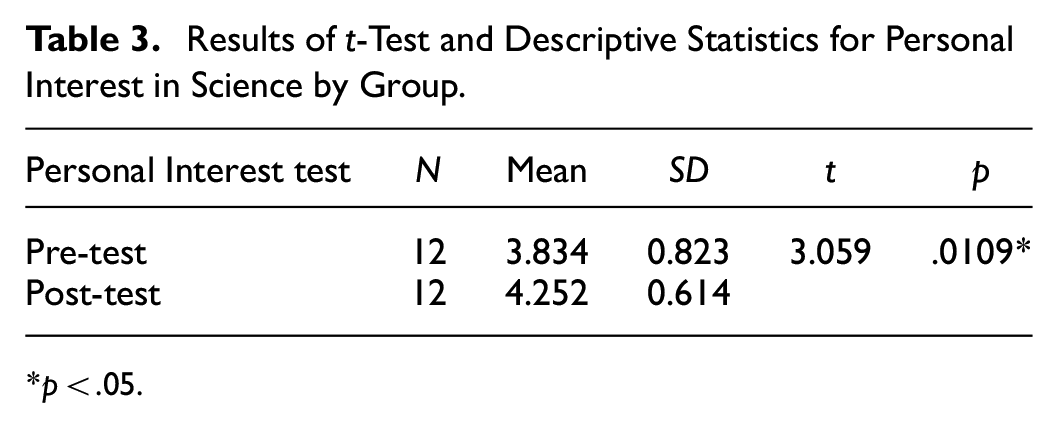
p < .05.
Attitudes Toward Science
The results of the pre-test (M = 3.869, SD = 0.437) and post-test (M = 4.550, SD = 0.282) for attitudes toward science indicate that the online interactions with cultural role models resulted in a highly significant improvement in participants’ attitudes (t = 5.576, p < .001). The majority of participants showed an increase in their attitude scores after participating in the program. The descriptive statistics and t-test results for attitudes toward science are presented in Table 4.
Results of t-Test and Descriptive Statistics for Attitudes Toward Science by Group.

p < .001.
Self-Concept of Ability in Science
The results of the pre-test (M = 4.141, SD = 0.361) and post-test (M = 4.473, SD = 0.480) for self-concept indicate that online interactions with cultural role-models did not result in a significant improvement in participants’ self-concept (t = 2.123, p = .0573). Most participants reported similar scores in their self-concept surveys before and after they participated in the study. Table 5 displays the results of Self-Concept.
Results of t-Test and Descriptive Statistics for Self-Concept by Group.

p > .05.
Discussion
The findings of this study offer valuable insights into early childhood teacher candidates’ perceptions of teaching Science, Technology, and Society (STS) through a project-based interdisciplinary model. The results highlight that candidates recognize the importance of integrating science and technology into their teaching, consistent with previous research emphasizing the need to contextualize science education within societal frameworks (Jenkins, 2010; North American Association for Environmental Education [NAAEE], 2016). This recognition is critical, as it suggests that teacher candidates are beginning to understand the relevance of STS issues in fostering critical thinking and informed decision-making among their future students.
A significant finding is the shift in candidates’ perceptions from traditional, lecture-based approaches to more interactive and participatory methods. This shift aligns with the National Research Council’s (2012) advocacy for engaging students in scientific practices to deepen their understanding of science and technology in societal contexts. The candidates’ interest in incorporating similar strategies in their future teaching reflects a growing recognition of the need for innovative pedagogical approaches in early childhood education, as highlighted by studies emphasizing the effectiveness of active learning strategies in promoting student engagement and comprehension (Freeman et al., 2020).
Additionally, the study revealed that candidates recognized the necessity of employing diverse teaching strategies to address the complexities of STS issues (Yoon & Ko, 2013). Those who engaged in interdisciplinary learning developed a more nuanced understanding of the interconnectedness between science, technology, and societal concerns (Ahn et al., 2020). Candidates felt more prepared to teach STS concepts when they could relate them to everyday life (Aish et al., 2018; Haeger & Fresquez, 2017). This awareness positions them to create inclusive learning environments that cater to the varied needs of their future students. Preparing educators to address both the content of science and technology and the broader social implications of these fields is crucial. By fostering critical awareness through project-based learning, candidates can better equip their students to navigate the complexities of the modern world.
However, the study also identified challenges related to group dynamics and varying levels of participation in collaborative projects. This observation aligns with existing literature discussing the complexities of group work in educational settings (Isik et al., 2021; Shanahan & Shanahan, 2008). The difficulties that arise in collaborative learning environments, particularly unequal participation, can hinder the overall learning experience. Future research could explore strategies for enhancing individual accountability within group projects, ensuring that all members contribute meaningfully. Addressing these challenges is essential for maximizing the benefits of collaborative learning, which has been shown to foster deeper understanding and retention of knowledge (Johnson et al., 2014).
Moreover, the findings suggest that the project-based interdisciplinary model effectively enhanced candidates’ science identities, as emphasized by Carlone and Johnson (2007), who underscore the importance of identity in shaping students’ engagement with science. By fostering a positive science identity, candidates are more likely to view themselves as capable educators who can inspire their future students to appreciate the relevance of science and technology in their lives.
This study contributes to the growing body of literature on STS education by demonstrating the positive impact of a project-based interdisciplinary approach on early childhood teacher candidates’ perceptions. By drawing connections between our findings and existing research (Ahn et al., 2020; Aish et al., 2018; Isik et al., 2021; Tomaskovic-Devey et al., 2022), we underscore the importance of innovative pedagogical strategies in preparing future educators to navigate the complexities of science and technology in society. Future research should continue to explore the long-term effects of such educational models on teacher candidates’ practices and their students’ learning outcomes, further enriching the discourse on effective science education.
Limitations and Recommendations for Future Research
While this case study provides valuable insights into the science learning experiences of ethnic minority students during COVID-19, it is important to acknowledge its limitations. First, the generalizability of the findings is limited due to the small number of participants (12 students). Therefore, the results should be interpreted with caution. Additionally, the study only includes Korean American students with low achievement in STEM, which may limit the representation of ethnic minority high school students in the United States. Future investigations should include more ethnically and racially diverse groups of participants and larger sample sizes to increase the generalizability of the study.
Second, the study only examines the experiences of ethnic minority students at one time point during COVID-19. Future research could conduct longitudinal studies to understand changes in students’ experiences of science learning and interactions with scientist mentors during and after the pandemic. This could include investigating how students adjust to the online learning environment of the pandemic, as well as how their experiences change after the pandemic is over and they return to normal face-to-face learning environments.
Third, the study did not collect detailed information about the gender of the participants (B. L. Miller et al., 2015), which is an important factor to consider in STEM education. Gender differences in science identity, interest in science, attitudes toward science, and self-concept of ability in science have been widely documented, and the impact of role models on female students’ performance in science and their interest in science-related careers has been demonstrated. Therefore, future research should examine the gender-related effects of science education and analyze the impact of role models on minority youth in STEM (i.e., Dasgupta & Asgari, 2004; Flore & Wicherts, 2015; McGee & Robinson, 2020).
Finally, it is important to note that although this study focused on ethnic minority high school students who participated in online interactions with cultural role models, it did not include the experiences of non-ethnic minority students. While the purpose of the study was to investigate the experiences of a vulnerable population, it would be valuable to compare and contrast the experiences of ethnic minority and non-ethnic minority students during COVID-19. Therefore, we suggest that future research explore the experiences of both ethnic minority and non-ethnic minority students in online interactions during COVID-19 to provide a more comprehensive understanding of similarities and differences between these two groups. This would help identify any unique challenges faced by ethnic minority students and could inform the development of more equitable and inclusive online learning environments.
Practical Implications
Our study offers valuable insights for those who work with ethnic minority students in STEM education, including educators, administrators, and parents. We found that interactions with scientists as role models can have significant positive impacts on the science identity development of ethnic minority high school students, which can motivate them to pursue careers in STEM fields. Therefore, we recommend that educators and administrators design and provide special programs in science education that include interactions with scientists as role models to help students develop their science identity and maintain their motivation to learn STEM knowledge and skills.
Given the limitations of in-person learning during the COVID-19 pandemic, our study highlights the potential of online interactive workshops in science as a practical and useful resource for students who have limited access to science education. Moreover, ethnic minority science mentors can provide culturally sensitive and responsive support to ethnic minority youth, which is critical for their success in STEM fields. Therefore, it is important for ethnic minority organizations such as the Asian American Science Educator Association, Trio Program, or McNair Scholars Program to develop and coordinate science mentorship programs specifically tailored to the needs of ethnic minority students. This will provide them with the necessary support and guidance to succeed in STEM fields (Yoon et al., 2020).
Finally, based on our findings, we recommend that K-12 districts provide educational workshops and training for educators and administrators to promote culturally sensitive approaches in science education when working with ethnic minority students. With the growing number of ethnic minority students in K-12 settings, it is crucial for educators to recognize that their cultural backgrounds and acculturative stress are critical factors impacting their academic success and school adjustment. Therefore, educators should be equipped with knowledge and skills to provide student-centered support and programs that are sensitive to the cultural needs of diverse student groups.
Conclusion
This case study makes a significant contribution to the field of science education by demonstrating the effectiveness of online scientist-student interaction programs in increasing and retaining the interest and positive attitudes of underrepresented ethnic minority high school students towards science, thus facilitating the development of a science identity. These findings highlight the need for the creation of online enhancement programs that are specifically designed to enable ethnic minority students to interact with scientists and engineers from their own cultures who can provide appropriate research experiences, advice, and role models in science to help these students learn and sustain their interest in science. Future research can further explore the effectiveness of online interaction programs and the role of cultural sensitivity in science education for ethnic minority students.
Footnotes
Appendix A
Survey Tests.

| Question | Strongly disagree (1) | Disagree(2) | Neutral(3) | Agree(4) | Strongly agree (5) |
|---|---|---|---|---|---|
| Science identity | |||||
| Q1 | My teachers encourage me to do science | ||||
| Q2 | My family and friends encourage me to do science | ||||
| Q3 | I am good at science | ||||
| Q4 | I think of myself as a scientist | ||||
| Personal interest scale | |||||
| Q5 | I think about the science I experience in everyday life | ||||
| Q6 | I am not satisfied until I understand why somethingworks the way it does | ||||
| Q7 | I study science to learn knowledge that will be usefulin my life outside of school | ||||
| Q8 | I enjoy solving science problems | ||||
| Q9 | Learning science changes my ideas about how theworld works | ||||
| Q10 | Reasoning skills used to understand science can be useful in my everyday life. | ||||
| Not very good | Not good | Neutral | Good | Very good | |
| Self-concept of ability | |||||
| Q11 | How good at science are you? | ||||
| Q12 | If you were to rank all the students in yourscience class from the worst to the bestin science, where would you put yourself? | ||||
| Q13 | Compared to most of your other school subjects, how good are you at science? | ||||
| Attitudes toward science | |||||
| Q14 | Science is Fun | ||||
| Q15 | I do not like science, and it bothers me to have to study it. | ||||
| Q16 | During science class, I usually am interested inlearning science more. | ||||
| Q17 | If I knew I would never get to science class again, I would feel sad. | ||||
| Q18 | Science is interesting to me, and I enjoy it. | ||||
| Q19 | Science makes me feel uncomfortable, restless,irritable, and impatient. | ||||
| Q20 | Science is fascinating and fun | ||||
| Q21 | The feeling that I have towards science is a good feeling. | ||||
| Q22 | When I hear the word science, I have a feeling of dislike. | ||||
| Q23 | Science is a topic which I enjoy studying. | ||||
| Q24 | I feel at ease with science, and I like it very much.I feel a definite positive reaction to science. | ||||
| Q25 | Science is boring. |
Acknowledgements
I would like to express my sincere gratitude to the President of the Korean-American Scientists and Engineers Association (KSEA) and their staff for providing financial support for our research study. Their continuous guidance, motivation, enthusiasm, and immense knowledge were invaluable throughout the entire research and writing process of this article. Without their support, we could not have successfully completed this study.
Declaration of Conflicting Interests
The author(s) declared no potential conflicts of interest with respect to the research, authorship, and/or publication of this article.
Funding
The author(s) disclosed receipt of the following financial support for the research, authorship, and/or publication of this article: The sources of funding for this study were from the Korean-American Scientists and Engineering Association.
Ethical Approval
The authors had an approval from the IRB of University of Texas Arlington with minimal risk.

Data Availability Statement
The datasets generated and/or analyzed during the current study are not publicly available due to Institutional Review Board (IRB) restrictions related to participant confidentiality and data protection. However, they are available from the corresponding author on reasonable request, subject to IRB approval and compliance with data protection regulations.