




Abstract
This study examines the role of student-teacher relations on science self-efficacy and science anxiety in face-to-face and distance education. The sample consisted of 309 students attending eighth grade in four different public lower-secondary schools in Turkey and was analyzed using a descriptive model. Student-teacher relation (STR), science self-efficacy (SSE), and science anxiety (SA) questionnaires were administered in both face-to-face and distance education. Gathered quantitative data were analyzed using descriptive statistics, Pearson moment correlation, and a one-sample t-test. The results show that the mean scores of the STR and SSE in face-to-face education are higher than in distance education. The Pearson moment correlation analysis indicates that STR has a significant and positive association with SSE, and a significant negative association with SA, in face-to-face and distance education. In addition, the one-sample t-test found statistically significant differences between the mean scores of the STR and SSE in face-to-face and distance education. This difference is in favor of face-to-face education. Furthermore, the mean scores of SA in distance education are significantly higher than in face-to-face education.
Keywords
Introduction
Previous studies have emphasized cognitive and non-cognitive factors’ effectiveness on students’ achievements (Semeraro et al., 2020). Cognitive factors include reasoning, problem-solving and intangible thinking, and understanding complex ideas (Gottfredson, 1997) and these factors affect the academic achievements of students (Boekaerts, 1995). However, although some students have high cognitive abilities, their academic achievement is low. These students compensate for this deficiency by showing more motivation (Komarraju et al., 2013). Therefore, it is also essential to evaluate non-cognitive factors in increasing academic achievements. These have been defined as untraditional predictors, including attitudinal, behavioral, and personality constructs (Allen et al., 2009), and can be listed as self-efficacy, attitude, anxiety, perception, interest, value judgment, personality, and motivation (Lipnevich & Roberts, 2012). Further, in a recent study by Ramirez et al. (2016), classroom and family environments, as well as STR, have been shown to impact academic achievement. Studies in the literature have found that students who have close relations with their teachers are likely to experience self-efficacy, anxiety, academic interest, and motivation more than students who have more distant relations with their teachers (Martin & Rimm-Kaufman, 2015; Niehaus et al., 2012; Pianta & Hamre, 2009; Roorda et al., 2011; Rudasill et al., 2010; Tosto et al., 2016; Wentzel et al., 2010; Zhou et al., 2020, 2021). Based on the results of these studies, it is thought that the role of the STR on students’ SSE and SA will differ in various education systems. As far as we know, there is no study comparing the role of the STR on students’ SSE and SA in different educational settings. Therefore, this study aimed to investigate the role of the STR on SSE and SA in face-to-face and distance education systems in the context of the Covid-19 pandemic.
Science Self-Efficacy (SSE)
Self-efficacy is a non-cognitive factor associated with achievement (Chen & Usher, 2013; Gibbons et al., 2018). Self-efficacy is the key concept of the social learning theory developed by Bandura (1997). It argues that individuals must have self-confidence in the relevant field before using their skills effectively (Schunk & Pajares, 2002). The social cognitive theory (Bandura, 1997) asserts that internal and external factors influence students’ conduct (Honicke & Broadbent, 2016). One of the internal factors is self-efficacy, through which a person can perceive how to accomplish an assignment or solve a problem (Bandura, 1997), which is a strong factor in students’ success (Zhou et al., 2021). Besides assisting in performing a task, self-efficacy can also assist in effectively applying cognitive, social, emotional, and behavioral skills. Thus, self-efficacy relates to one’s belief in one’s skills and what one can do with them (Bandura, 1997). SSE plays a pivotal role in students’ achievement in science (Watt, 2006). Therefore, students with higher SSE are more likely to engage in science classes and to continue a career in science (Burns et al., 2021), which are generally perceived to be difficult. Hence, SSE is essential in assisting students in coping with the challenges inherent in science and succeeding academically (Patall et al., 2018). Researchers have generally examined anxiety as a negative predictor of self-efficacy in science (Chen & Usher, 2013; Usher & Pajares, 2008). Additionally, many studies have found a negative relationship between self-efficacy and anxiety (Britner & Pajares, 2006; Burns et al., 2021; Gibbons et al., 2018; Usher et al., 2019).
Science Anxiety (SA)
Anxiety, another non-cognitive factor, is also related to academic achievement. Anxiety can be defined as fear and/or tension deriving from stressful situations or as a primary human emotion depending on fear or uncertainty (Lilley et al., 2014). In the education-teaching process, some subject areas cause students great anxiety. These have been related to science and chemistry (Eddy, 2000; Turner & Lindsay, 2003). SA is defined by Udo et al. (2004) as emotions that prevent science learning. Apart from this definition, SA weakens cognition and positive emotions toward learning science (Bryant et al., 2013). These feelings lead to sweaty palms, tension, fear, distress, and difficulty breathing (Oludipe & Oludipe, 2018). Chiarelott and Czerniak (1987) stated that SA could appear before or during learning science topics. In SA situations, students are expected to fear or perform poorly in science lessons (Mallow, 1986). More so, SA considerably affects students needing higher cognitive performance in their academic responsibilities. Furthermore, SA may influence students when they enter specific fields, such as mathematics, science and technology, depending on whether they have prerequisite skills. Mallow and Greenburg (1982) indicated that former negative experiences in science lessons and exposure to anxious science teachers in primary and secondary schools might be reasons for SA. Physics is one of the most prominent courses for SA (Udo et al., 2004). Many studies show that SA is negatively related to self-efficacy, attitude, and academic achievement (Ardasheva et al., 2018; Griggs et al., 2013). However, Mallow and colleagues indicated that SA is positively related to anxiety derived from other courses, such as humanities and social sciences (Mallow, 1994; Udo et al., 2004). While students’ self-efficacy is affected by their anxieties, it can also be affected by external factors. One of these external factors is also the relationship between student and teacher.
Learning Environments and Student-Teacher Relation (STR)
A learning environment is where teachers and students work together to achieve learning goals and do problem-solving activities (Wilson, 1996). Learning environments are created both in and out of the classroom. Learning is conducted face-to-face between the students and the teacher in the classroom and distance education outside the classroom. Therefore, the relation between student and teacher in these two learning environments is important. The STR is a two-way link between student and teacher in face-to-face and distance education systems (McCormick et al., 2013; Pianta, 1999; Zhou et al., 2020). This relation is promoted by attachment theory (Ainsworth, 1989), which states that attachment is an interpersonal emotional bond that creates a safe environment for children to explore the unknown world (Bergin & Bergin, 2009). Teachers can improve relations with their students by focusing on two complementary aspects of classroom interaction (Oludipe & Oludipe, 2018). Therefore, a positive STR not only creates a sound basis for students’ academic engagement (Zee & Roorda, 2018) but also promotes feelings of trust in students, leading to positive emotional changes (Ma et al., 2018; Zhou et al., 2021). In addition, a positive STR makes it easier to teach students who have difficulty learning new or complex content (Hughes & Kwok, 2007). Hence, STR is positively related to students’ achievement and emotional changes (Sanchez Fowler et al., 2008).
The academic achievement of students is at the center of the educational process. Middle school achievement helps students reach their high school and college career goals. Therefore, the low academic achievement of students has worried parents, teachers, counselors, examination institutions, and psychologists. Especially teachers, parents, family members, and peer groups play a particular role in the development of the students’ academic achievement (Considine & Zappalà, 2002). Besides this, many studies in the literature have found that self-efficacy is associated with academic achievement in general and science disciplines (Honicke & Broadbent, 2016; Rittmayer & Beier, 2008; Usher & Pajares, 2008). However, students’ self-efficacy toward science tends to decline during late elementary and middle school (Rice et al., 2013; Rittmayer & Beier, 2008). For this reason, educators have tried to develop strategies to increase students’ self-efficacy (Sparks, 2014). In this context, it has been shown that developing a positive STR is a very effective approach (Jerome et al., 2008). Research has shown that a positive STR positively affects students’ perceptions and self-efficacy (Cadima et al., 2010; Zhou et al., 2020). Therefore, the current study suggested that the STR would be related to students’ SSE. Also, motivation theories suggest that motivational beliefs may be related to students’ perceptions of learning (Shores & Shannon, 2007; Singh et al., 2002). In their studies, Maloney and Beilock (2012) and Ramirez et al. (2016) have shown that students’ negative learning perceptions and anxiety are associated with worse learning outcomes (Maloney & Beilock, 2012; Ramirez et al., 2016). In this context, the STR can also affect factors related to students’ emotions, such as anxiety, and factors related to their motivations, such as self-efficacy (Hattie, 2009; Tosto et al., 2016; Wang et al., 2020). In their study, Zhou et al. (2020) showed that a positive STR increases students’ math self-efficacy scores, and according to Zee and Roorda (2018), it decreases anxiety scores. In addition, it has been reported that a negative relationship between sixth-grade students and their teachers is related to the students’ anxiety levels (Jellesma et al., 2015). Studies with small samples or students with disabilities have shown that the positive STR is negatively related to the anxiety levels of fifth and sixth-grade students (Murray & Greenberg, 2001; Rey et al., 2007). It has been reported that the STR is not only related to self-efficacy and anxiety but also closely related to the learning environment. The STR, the essential element of the classroom environment, has been associated with learning outcomes, and various studies have been conducted (Barile et al., 2012; Wentzel, 2002). Researchers found that the supportive STR was positively related to the mathematics performance of students from grade 1 to grade 9 (Ang, 2005; Hamre & Pianta, 2001; Roorda et al., 2011; Valiente et al., 2008).
During the COVID-19 pandemic, both face-to-face and distance learning environments were created. The two most important components of these learning environments are teachers and students. A positive relationship between teachers and students can increase students’ academic achievement by improving their motivation and self-efficacy. In addition to the role of general cognitive abilities and non-cognitive factors on science achievement, studies have shown that positive STR plays an essential role in students’ math achievement (Engle, 2010; Semeraro et al., 2020; Upadyaya & Eccles, 2014; Zhou et al., 2020, 2021). While similar studies have been widely researched for kindergarten and primary school, more research seems necessary for secondary school (Ahmed et al., 2010). Hence, during the COVID-19 pandemic, STR may also differ in face-to-face and distance learning environments. Few studies have been done on this subject. du Mérac et al. (2022) revealed that student satisfaction in distance education during the Covid-19 pandemic depends on the teachers’ ability to establish positive relations with their students. However, Vagos and Carvalhais (2022) found no difference between the STR in face-to-face and distance education. To our knowledge, there are no studies investigating the role of STR on SSE and SA for lower-secondary school students in face-to-face and distance learning environments. Determining the role of the STR in students’ SSE and SA perceptions in face-to-face and distance learning environments is essential for teachers to communicate with their students. Based on this thought, it is thought that the relationship between students and teachers in face-to-face and distance learning environments will change the perceptions of SSE and SA in lower-secondary school students. Therefore, this study examines the role of STR on SSE and SA of lower-secondary school students in face-to-face (e.g., classroom) and distance (e.g., online) education systems. We believe that the current study makes a significant contribution to the literature because there is no study for this purpose and the findings of the study reveal that the STR in face-to-face education has a positive role on lower-secondary school students’ SSE and SA. For this purpose, we ask, “What is the role of the STR on students' SSE and SA in the face-to-face and distance learning environment?”
Method
Study Design
This study uses a descriptive model with scales (STR, SSE, and SA) for data collection. The study participants are lower-secondary students in the first semester of the 2021 to 2022 academic year. The scales were distributed to participants using a Google form in distance education and by the researcher in face-to-face education. All participants were informed about the purpose of the study before completing the scales, and consent was given. Participants answered questions in the STR, SSE, and SA scales.
Sample
The sample was randomly selected from four different public lower-secondary schools in Turkey. For the application of the scales, permission was obtained from the school administrators by correspondence. The final sample consisted of 309 (180 females and 129 male) students attending the eighth grade with an age range from 14 to 16 years; the mean age was 15 years. Due to the COVID-19 pandemic, students participating in the study took the science course for 7 weeks with face-to-face (in-class education) and 12 weeks with distance education (online education). The scales were applied to the same group by the researchers both during face-to-face and distance education (N = 309).
Measures
SA
Students’ SA scores were collected using the SA scale developed by Kağıtçı and Kurbanoglu (2013). This scale contains 18 items (e.g., “Before I go to science class, I get nervous and anxious,”“I feel restless in science class”), and each item is rated on a 5-point Likert scale ranging from 1 (never) to 5 (always). The Cronbach’s alpha coefficient of the scale was .89.
SSE
Students’ SSE scores were collected with the self-efficacy sub-scale of the science-adapted Motivated Strategies for Learning Questionnaire (MSLQ; Pintrich et al., 1991). The original form of the scale was altered to Turkish by Büyüköztürk et al. (2004). The self-efficacy sub-scale consists of eight items (i.e., “If I study hard enough, I can understand the science class,”“I believe I will get perfect grades in science class”). Each item is rated on a 7-point Likert scale ranging from 1 (not at all true for me) to 7 (very true for me). The Cronbach’s alpha coefficient of the scale was calculated as.86.
STR
Students’ STR scale was taken from the PISA 2012 student questionnaire by Zhou et al. (2020). The perceptions of eighth-grade students about their science teachers were collected with a 4-item STR scale. This scale is a 5-point Likert scale ranging from 1 (strongly disagree) to 5 (strongly agree). While Cronbach’s alpha coefficient of the original STR scale was .93, Cronbach’s alpha coefficient of the scale for the current study was calculated as .80.
Procedure
The first term of the 2021 to 2022 academic year in Turkey is 19 weeks. Students attended science courses in both face-to-face and distance education due to the pandemic. Students (N = 309) attended science courses in face-to-face education for the first 7 weeks out of the 19 weeks and the scales were administered by the researchers. Later, due to the pandemic, the same students attended science courses in distance education for 12 weeks, and the scales were applied again by the researchers. Quantitative data gathered from the same student group were analyzed, and the role of STR on SSE and SA in face-to-face and distance education was examined.
Data Analysis
Quantitative data from the scales were analyzed using descriptive statistics, the Pearson moment correlation, and the one-sample t-test analyses. The descriptive data analysis assessed the role of the STR on students’ SSE and SA. The Pearson moment correlation and the one-sample t-test were used to determine whether there is a relation between SSE, SA, and STR and how significantly this relation can predict each.
Results
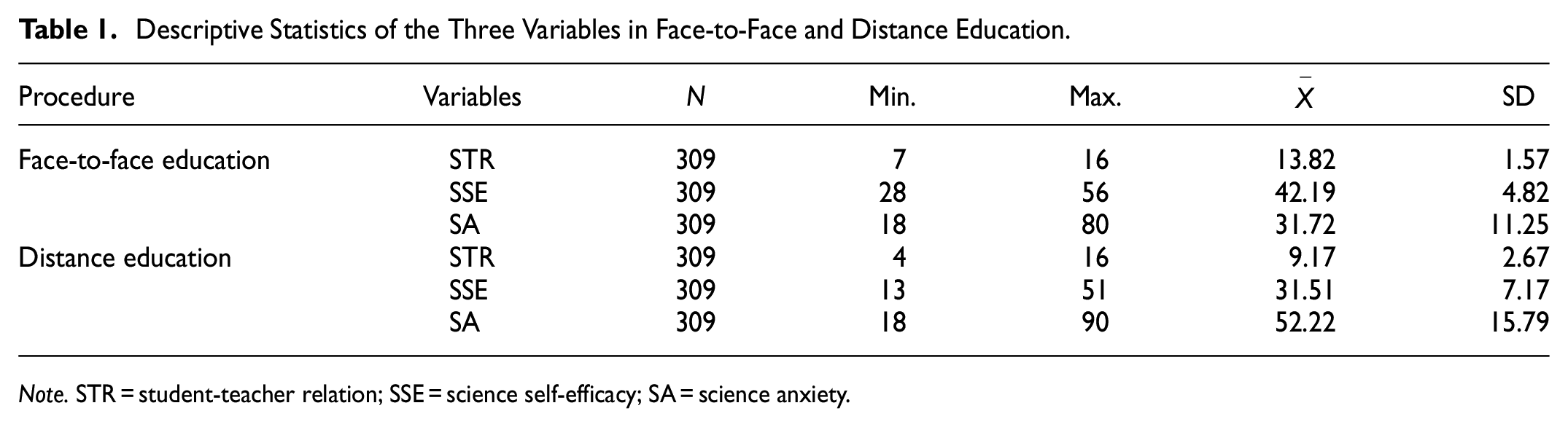
In this study, the total scores for STR, SSE, and SA of the lower-secondary school students in face-to-face and distance education were calculated depending on the STR, SSE, and SA scales. The total scores for each dependent variable were compared and discussed. The number of face-to-face and distance education students, the mean scores, and the standard deviations for each dependent variable are shown in Table 1.
Descriptive Statistics of the Three Variables in Face-to-Face and Distance Education.
Note. STR = student-teacher relation; SSE = science self-efficacy; SA = science anxiety.
The results of the descriptive statistics showed that the mean score of STR (
Correlation Coefficients of the Three Variables in Face-to-Face and Distance Education.

Note. STR = student-teacher relation; SSE = science self-efficacy; SA = science anxiety.
p < .01.
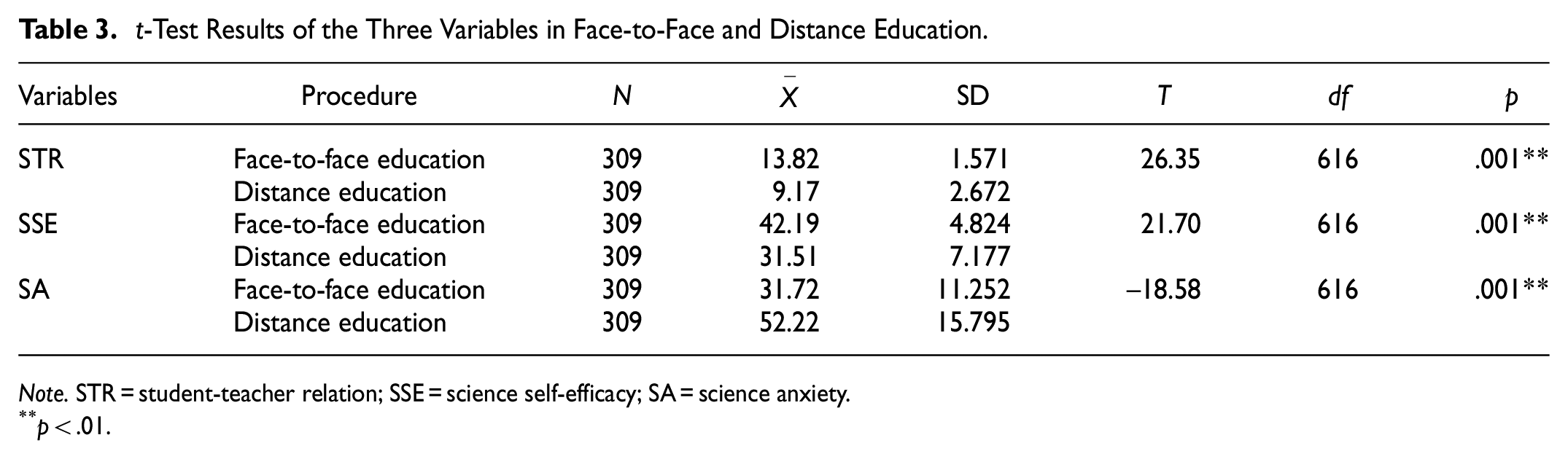
Table 2 shows that there are low, significant positive correlations between STR and SSE in face-to-face (r = .196) and distance education (r = .180). In addition, there are low, significant negative correlations between SSE and SA, in face-to-face (r = −.217) and distance education (r = −.241). The results reveal a low and significant negative correlation between STR and SA in face-to-face (r = −.189) education, while there is a moderate and significant negative correlation in distance education (r = −.356). According to these results, the role of the STR on students’ SA is higher in distance education. One-sample t-test was used to determine the role of the STR on lower-secondary school students’ SSE and SA in face-to-face and distance education (Table 3).
t-Test Results of the Three Variables in Face-to-Face and Distance Education.
Note. STR = student-teacher relation; SSE = science self-efficacy; SA = science anxiety.
p < .01.
As shown in Table 3, the mean score of STR (
Discussion
Previous research has shown that SSE is related to students’ SA with varying degrees; however, there is also a need to examine the role of STR on SSE and SA, as the present investigation does. Relatively little is known about the role of the STR on non-cognitive factors (self-efficacy and anxiety) among lower-secondary school students in face-to-face and distance education. Therefore, the current study investigated the role of the STR on SSE and SA in face-to-face and distance education. The findings are presented and discussed below.
According to the first finding of the present study, there is a difference between the mean scores of STR, SSE, and SA in face-to-face and distance education. The mean score of STR and SSE in face-to-face education is higher than in distance education. In addition, the mean score of SA in face-to-face education is lower in distance education. These findings indicate that STR had a role on students’ SSE in face-to-face education. Results of previous research have also shown that STR has a direct and positive effect on students’ self-efficacy (Ma et al., 2018; Xu & Qi, 2019; Zhou et al., 2021). The positive and supportive relationship between student and teacher facilitates the active participation of students in classroom learning and activities (Ma et al., 2018; Roorda et al., 2011) and thus plays a role in increasing their self-efficacy.
The second finding of the present study showed a significant and positive association between STR and SSE as well as a significant negative association with SA in face-to-face and distance education. According to these results, the role of the STR on students’ SA is bigger in distance education. In this context, reduced STR in distance education leads to an increase in students’ SA. In other studies, at the end of the term, the relation between student and teacher relates to anxiety (O’Connor et al., 2011). The outcome of the current study is the same in face-to-face and distance education. Based on these findings, teachers’ love, advice, and general interaction motivate students to read, participate, and interact, leading to high engagement in face-to-face education. Therefore, if students perceive their teachers as friendly, trustworthy, and helpful, then students’ SSE increase and their SA decrease. These results are consistent with prior studies documenting the positive role of STR (Den Brok et al., 2005; Roorda et al., 2011) and the supportive contribution of self-efficacy in learning activities, including math or science education (Wei & Onsawad, 2007). Likewise, Pianta and Nimetz (1991) reported that students who have positive opinions toward their teachers would have higher academic achievement than students with negative views toward their teachers.
The third finding of the present study indicated significant differences between the STR, SEE, and SA mean scores of students in face-to-face and distance education. These significant differences are in favor of students in face-to-face education. In other words, STR in face-to-face education significantly increased students’ self-efficacy by reducing their SA, which is significantly different from students in distance education. These results show that the quality of STR in face-to-face education directly contributes to SA through SSE. Therefore, improving STR may play an essential role in preventing SA and promoting SSE. As expected, this is consistent with previous research findings (Bergin & Bergin, 2009; Roorda et al., 2011; Zhou et al., 2020, 2021); our findings revealed that SSE was predicted positively by the STR. In addition, as anticipated, the results demonstrated that SA was predicted by the STR negatively. This finding agrees with the results of earlier investigations (Domino, 2009; Hill et al., 2005; Zhou et al., 2020, 2021).
Conclusions and Implications
In conclusion, this study explored how STR increases students’ SSE and reduces SA in face-to-face education. According to the results of this study, the STR had a direct and positive role on students’ SSE in face-to-face education. Therefore, this study contributed by revealing the role of positive STR on SSE and SA in face-to-face education. Since positive STR in face-to-face education has a positive contribution to SSE, a workshop on STR can be organized for educators and administrators. Similarly, in distance education, positive teacher behaviors can increase students’ SSE and reduce their SA. Therefore, it is recommended to develop positive teacher behaviors in distance education. This study has some limitations. This study was carried out in the form of 7 weeks of face-to-face and 12 weeks of distance education with secondary school eighth-grade students. Future studies should consider a study group consisting of students from all grade levels of lower-secondary school and a longer learning-teaching process, which may affect the results of the study. At the same time, the role of STR on SSE and SA in face-to-face and distance learning environments was determined through scales applied to students. Through interviews with students, the role of STR on SSE and SA can be examined using other dimensions.
Footnotes
Declaration of Conflicting Interests
The author(s) declared no potential conflicts of interest with respect to the research, authorship, and/or publication of this article.
Funding
The author(s) received no financial support for the research, authorship, and/or publication of this article.
