



Abstract
Higher education faculty’s autonomous support of online teaching can promote students engagement in online context. This study collected 492 Chinese university students’ survey questionnaires and applied structural equation model to measure their teacher autonomy support, self-efficacy, self-regulated learning (SRL), and online learning engagement. This study adopted self-determination theory (SDT), systematically explored the relationship between teachers’ autonomy support and student learning engagement from the perspective of online contexts, and examined the mediating effects of students’ self-efficacy and self-regulated learning (SRL) in online contexts. This study found that teacher autonomy support had a significant effect on student engagement in online learning, and was mediated by self-efficacy. Teacher-directed support had a significant effect on student engagement in online learning mediated by SRL. Teacher-directed support had a significant impact on online learning with self-efficacy and SRL as the main mediating variables. Therefore, this study gave a fresh perspective to improve students’ online learning engagement, that is to say, teachers were encourage to improve students’ autonomy in practical teaching on the basis of giving students autonomy support. Students can promote online learning engagement by strengthening self-efficacy and self-regulation through organizational exchanges and mutual assistance and cooperation of students.
Plain Language Summary
Teacher Autonomy Support Influence on Online Learning Engagement
Autonomous support for online teaching and learning by higher education teachers can increase students’ engagement in online learning. This study collected 492 Chinese university students’ survey questionnaires and applied structural equation model to measure their teacher autonomy support, self-efficacy, self-regulated learning (SRL), and online learning engagement. This study adopted self-determination theory (SDT), systematically explored the relationship between teachers’ autonomy support and online learning engagement from the perspective of online contexts, and examined the mediating effects of students’ self-efficacy and self-regulated learning (SRL) in online contexts. This study found that teacher autonomy support had a significant effect on student engagement in online learning, and was mediated by self-efficacy. Teacher-directed support had a significant effect on student engagement in online learning mediated by SRL. Teacher-directed support had a significant impact on online learning with self-efficacy and SRL as the main mediating variables. Therefore, this study gives a fresh perspective to improve students’ online learning engagement, that is to say, teachers are encourage to improve students’ autonomy in practical teaching on the basis of giving students autonomy support. Students can promote online learning engagement by strengthening self-efficacy and self-regulation through organizational exchanges and mutual assistance and cooperation of students.
Introduction
In recent years, with the development of information technology, online teaching has gradually become the main mode of university education and the significant way for students to obtain professional and academic qualifications (Lavidas, Petropoulou, et al., 2022; Soffer & Nachmias, 2018). In an online learning environment, learning engagement plays an important role in enhancing students’ success in completing tasks and has attracted widespread attention from a wide range of educators and researchers (Miao & Ma, 2022). Online teaching and learning is a holistic and multifaceted activity that needs to be further explored in order to transform it into an approach that facilitates teaching and learning in higher education. In addition, it is important to recognize the level of engagement of online learners and to acknowledge the instructional practices that are in place to increase that engagement (Miao et al., 2022; Zepke, 2018). Previous studies stated that students’ learning engagement in higher education has been an significant topic in the areas of educational psychology and higher education in recent decades, and one important reason for that is that it has an undoubted relationship with early school dropout. Therefore, teachers, pedagogues, and educational psychologists have made it a major teaching goal to gain deeper understanding of students learning engagement in higher education.
Students’ motivation and learning behavior are influenced by a variety of factors, including their teachers (Miao & Ma, 2022). Teacher support is regarded as one of the most significant factors, as teachers play important roles in motivating students to learn. Guided by Self-Determination Theory (SDT), teacher support is divided into three dimensions: “autonomy support,” “structure,” and “engagement.” This study sets out to investigate how to address learners’ active learning on multiple levels in order to improve learners’ active learning and provide new ideas to solve the current problems faced by online teaching and learning (Lietaert et al., 2015).
Humanistic motivation theory suggests that students will be more motivated if teachers meet their basic needs for autonomy, competence, and relevance (Marshik et al., 2017). A good relationship between teacher and student is particularly important in order for students to be better engaged in their learning (Lavidas et al., 2023). There is a link between psychological needs, motivation, engagement, and academic performance (Reeve, 2012; Ryan & Deci, 2017). From an SDT perspective, context is an important factor that influences how learners learn (Deci & Ryan, 2000). Numerous studies have shown that self-directed learning is an important factor that influences student autonomy (Benita et al., 2014; Lavidas, Papadakis, et al., 2022). This study proposes to extend the existing research by focusing on whether the relationship between teacher autonomy support and students’ autonomous learning behavior and learning engagement in higher education in an online environment can be explained by two aspects: self-efficacy and SRL.
In online education, learners’ self-efficacy plays an important role in improving the effectiveness of online education and increasing the autonomy of online education. Self-efficacy is an important factor affecting the effectiveness of online learning (Prior et al., 2016). Previous findings show that self-efficacy and motivation in university English teaching are positively correlated with students’ ability to learn autonomously. However, the intrinsic link between self-efficacy, SRL, and learning engagement in the online environment has not yet been clearly understood.
Although more research had pointed out that teacher autonomy support could influence students’ learning engagement (Niehaus et al., 2012), it was considerable ambiguity about what potential mediating variables might explain the relationship between teacher autonomy support and students’ learning engagement and how they interacted. Studies have found that self-efficacy and SRL were significantly positive effects to learning engagement. The correlation between teacher autonomy support and self-efficacy and SRL has also been proved (Chemers et al., 2001; Ng, 2018). However, whether self-regulation and SRL can jointly mediate perceived teacher autonomy support and students’ online learning engagement in higher education requires further research. Therefore, this study intends to combine teacher-directed support with online learning engagement through a systematic review of relevant research at home and abroad, and to use it as an entry point for research. Based on this, this study intends to explore the mechanism of the role of teacher-directed support on engagement in online learning from the perspective of teacher-directed support. This paper focuses on the following questions:
RQ1: Does self-efficacy mediate the relationship between teacher autonomy support and online learning engagement?
RQ2: Does SRL mediate the relationship between teacher autonomy support and online learning engagement?
RQ3: Do self-efficacy and SRL have a chain mediating effect on the influence of teacher autonomy support on online learning engagement?
Theoretical Background and Hypothesis
Self-Determination Theory
SDT, as a humanistic theory of motivation, considers human autonomy, competence, and relatedness as the three basic human needs (Ryan & Deci, 2017). Autonomy is a willingness and desire to organize and act in a way that is consistent with self-consciousness; competence is the ability to do something efficiently or to use a skill skillfully; and relatedness is a sense of “connection” or “belonging.” In general, factors that satisfy an individual’s need for autonomy, competence, and relevance in social situations motivate individuals to make autonomous decisions and to behave in a certain way. Individuals act for a variety of different reasons and can be differentiated by their basic level of autonomous decision-making.
Teacher Autonomy Support and Learning Engagement
With the rise of online education, learning engagement has received increasing attention as a key factor influencing learning outcomes (Vayre & Vonthron, 2018). Learning engagement is a multidimensional structure consisting of behavioral, emotional, and cognitive components. Specifically, behavioral inputs include learning habits and learning skills. Emotional engagement is a positive emotion that students show toward teachers, peers, and the learning process. Cognitive engagement is a cognitive behavior performed by a learner to acquire a particular knowledge or a particular skill. Engagement plays a pivotal role in influencing students’ academic achievement and psychosocial development. Therefore, the issue of how to improve students’ engagement in learning has become a common concern for educational policy makers and educators (Miao et al., 2022). Research has shown that social factors such as networks can influence learning engagement (Rajabalee et al., 2019). The findings suggest that there is a relationship between teacher autonomy support and student’s learning engagement in higher education in online environments, thus research on student autonomy is instructive for student autonomy.
Within the framework of SDT, students’ learning behaviors can be categorized as autonomy support, structured, and engaged (Vollet et al., 2017). Autonomy support focuses on encouraging and pushing students to achieve their goals in life, as well as helping them to recognize their own learning behaviors. In online teaching, teachers of autonomous instruction take the students’ perspective so that they can make their own choices based on their learning and when their choices are limited, they give them a reasonable explanation, avoid those controlling words and reduce the unnecessary pressure they put on them (Lee et al., 2015).
Dwivedi et al. (2019) stated that teacher-directed support in online courses has a positive effect on students’ willingness to learn and engagement in learning. Furthermore, building on SDT theory, researchers also found that teacher autonomy support was closely related to students’ adaptive motivation and optimal classroom role (Liu et al., 2021). For example, researchers have found that teachers’ autonomy support leads to increased motivation for students to learn autonomously, which in turn improves their performance in chemistry (Archambault et al., 2020). Furthermore, the latest three rounds of follow-up found that high levels of autonomy support predicted student satisfaction with course content, which in turn facilitated online engagement in course design. In searching for literature related to learning engagement, no article has been found to explore the relationship between the teacher autonomy support and students’ online learning engagement in higher education. This study tries to fill the gaps in literature research and to improve students’ learning engagement ability under the guidance of SDT in higher education in online context. Therefore, we suggest that teacher autonomy support has an impact on online learning engagement. To this end, we propose the following hypothesis:
Mediating Effect of Self-Efficacy
University students’ self-efficacy can also affect their learning outcomes at higher education level. Self-efficacy is one of the key factors influencing students’ academic performance (Chemers et al., 2001). Self-regulation refers to the process by which individuals initiate and maintain their cognitive, emotional, and behavioral aspects of learning and systematically direct them toward individual goals (Chemers et al., 2001). According to Pintrich (2000), autonomous learners strive to monitor, adjust, and control their cognition, motivation, and behavior by setting learning goals and by working with both goals and the environment.
Teacher-directed support is an effective teaching tool provided to students in higher education. Teacher-directed support emphasizes independent learning for students (Reeve & Cheon, 2021). Through a large number of experiments, we can find that teacher autonomy support is an effective teaching method in university English teaching. Recent studies such as Chiu (2021) showed that online learning contexts with a strong sense of autonomy are more conducive to students’ self-directed learning and increase their academic self-efficacy.
Previous research has shown that self-efficacy can have an impact on engagement in online learning (Heo et al., 2020; Wang et al., 2022). The findings indicate that students with higher self-efficacy are more willing to invest more effort, more able to withstand more challenges, and more able to sustain more frustration. High self-efficacy promotes greater student engagement in learning (Heo et al., 2020). In summary, teachers autonomy support affects students’ self-efficacy in higher education, which in turn affects university students’ online learning engagement. However, the research that was related to teacher autonomy support, self-efficacy, and online learning engagement was mostly limited to univariate or two-variable one, and we lacked some research on the mechanism of mediation variables between teacher autonomy support and online learning engagement. Therefore, we argue that teachers’ autonomy support has an impact on learning engagement through self-efficacy in online environment in higher education. To this end, we propose the following hypothesis:
Mediating Effect of Self-Regulated Learning
Another important issue is the need for self-regulated learning in higher education. In Zimmerman’s (2008) study, self-regulation is defined as “a self-generated set of thoughts, emotions, and behaviors that are generated in order to achieve a goal.”Wolters et al. (2005) and Uleanya and Alex (2022) provided a multidimensional approach to self-regulation on three levels: motivational, cognitive, and behavioral. The main regulatory strategies for motivation are self-ordering, organization of the environment, self-talk, and increasing interest. Examples include rehearsal, organization, explanation, monitoring, etc. Finally, three methods such as study time adjustment, help seeking, and self-control can be used as adjustment strategies. Many scholars argue that students facilitate online learning through self-regulation, self-adjustment, and self-regulation of their impact on online learning in an online environment (Lai & Hwang, 2016). Ng (2018) applying the principles of self-directed learning to university students and reporting the positive effects of SRL on their engagement and performance in online learning, Lai and Hwang (2016) concluded that factors such as goal setting, time management, task strategies, help-seeking, and environment all contribute to learners’ emotional engagement, behavioral engagement, and learning performance. Self-regulation contributes to participation in online learning for the purpose of obtaining educational outcomes. Without self-discipline, students would not be able to engage in online learning. Therefore, self-discipline in online teaching and learning is very important.
Teacher autonomy support is the main external environment that influences students’ autonomy and self-directed learning. In recent years, domestic and international scholars have conducted empirical studies on the role of teacher autonomy support in independent learning in schools. Studies have found that teachers’ autonomy support has an impact on students’ independent learning. Won and Yu (2018) showed that students’ perceptions of teacher autonomy support, an important sub-dimension of SRL, had a significant positive impact on their support for teachers, and Grijalva-Quiñonez et al. (2020) found that autonomy was significantly and positively related to students’ autonomy. Teacher autonomy support provides instructional services to students in an “associative” manner (Reeve, 2016). In the teaching and learning process, teachers make greater use of self-directed support, reducing their control over students and focusing more on their needs. Therefore, in online learning, teachers’ autonomy support helps students to better control and adjust their cognition, motivation, and behavior, thus enabling them to better engage in online learning. Therefore, although there is evidence that SRL is an important mediator of teacher autonomy support and the direct effects of SRL on learning engagement are well documented (Miao & Ma, 2022), the role of SRL as a mediator has not been widely explored (Miao et al., 2022). In this paper, we argue that the degree of teacher support for student-directed learning has an impact on student engagement in learning through SRL. To this end, we propose the following hypothesis:
Mediating Role of Self-Efficacy and SRL
The above definition of self-efficacy suggests that it is a response to the desired value of motivation to learn (Lin & Tsai, 2013). In self-adjustment, there is an interaction between self-efficacy and factors such as strategy use, effort, perseverance, goals, self-monitoring, and self-assessment. People with high self-esteem tend to have a strong interest in their lives, they set challenging goals for themselves, and they stick to something. Schunk and Greene (2018) concluded that students with high self-efficacy are more likely to be actively engaged in their learning, last longer, and use SRL strategies more efficiently. Researchers have also noted that the use of self-control strategies can be influenced by self-efficacy (Kingir et al., 2013). Schunk and Greene (2018) argue that self-efficacy is a precursor, mediator, and concomitant of the effects of SRL and is a key factor influencing SRL effectiveness. Not only does self-efficacy predict academic procrastination, but it can also influence metacognitive strategies in college students (Sungur, 2007). Research has found that individual cognitive, behavioral, and environmental factors interact in the process of self-regulation. Self-efficacy had a significant positive impact on online learning outcome in higher education as a significant personal predictor of SRL. According to previous research, it was found that teacher autonomy support was respectively related with self-efficacy, SRL, and learning engagement. Previous research has also reported positive emotions and learning engagement as mediators between teacher autonomy support and learning engagement (Vollet et al., 2017). However, on the one hand, it was controversial for self-efficacy and SRL to have an independent mediating influence between teacher autonomy support and students’ learning engagement in online context in higher education are controversial. On the other hand, it was unclear whether self-efficacy and SRL could play a serial mediating role between teacher autonomy support and students’ learning engagement in online environments in higher education. Thus, this study examines the relationship between teacher autonomy support and students’ learning engagement in online context in higher education and the mediating role of self-efficacy and university students’ online learning engagement using Chinese university students as the study participants. Therefore, based on existing research findings, we propose the following hypothesis:
Method
Sample and Procedure
This study was conducted in the undergraduate mandatory course in the fall semester in 2022 at a large university in China. We adopted a online teaching and learning mode in this class to promote students’ overall language ability. Teachers were required to lecture, answer students’ questions, and provide suggestions or help once every other week through a well-established online English language learning systems, which is the new perspective foreign language teaching and learning platform (Long, 2012). The 16-week course had a 100-minute in-class instruction. After class, students were required to make full use of the online language learning materials, and to complete a variety of self-regulated language learning tasks through online teaching and formative assessment system (Zheng et al., 2015).
A total of 492 university students in a university in China took part in the volunteering survey and were from 1 to 4 years of the university, with one being 39.3% (n = 177) of first year students, the second being 24.5% (n = 110), the third being 21.4% (n = 97), and the fourth being 14.8% (n = 67). Participants were recruited using convenience sampling, as one of the authors was the teacher of the course. Of the subjects taken, 14.8% (n = 75) were history, 16.9% (n = 85) were management, 17.7% (n = 90) were physics, 16.2% (n = 81) were engineering, 13.2% (n = 65) were computing, 13.9% (n = 104) were administration, and 7.3% (n = 36) were “other” subjects. A written questionnaire was distributed in the classroom to gather information.
Measures
All scales in this study used a 5-point scale ranging from 1 for “strongly disagree” to 5 for “strongly agree.”Teacher autonomy support questionnaire was adopted and modified by Jang et al. (2012). This scale has six items. Sample items were, “I feel that my teacher provides me with choices and options” and “My teacher conveys confidence in my ability to do well in the course.” The coefficient alpha for this scale was .938.
The scale was designed and validated for this study using Zheng et al. (2017). The SRL was measured by Barnard et al. (2009) using the Online Self-Regulated Learning Questionnaire (OSLQ). The scale included: goal setting (five items), environmental structure (four items), task strategies (four items), time management (three items), help-seeking (four items), and self-assessment (three items). For example, “I set guidelines for the tasks in the online course” and “I give an overview of what I have learned in the online course in order to check that I understand what I have learned.” The coefficient for this level is .843.
Online learning engagement is a measure based on Sun and Rueda’s (2012) Learning Engagement Scale. The findings show that three dimensions of “behavioral engagement,” “emotional engagement,” and “cognitive engagement” were used in this study. For example, “I watched the video and practice on time” and “I will continue to take classes online that week without taking the test.” The reliability of the alpha coefficient for this scale is .841.
Previous studies have shown that gender and grade are related to university students’ learning engagement or performance (Jiang & Men, 2016). Therefore, in the following analysis, we control for gender, major, and grade level to avoid these control variables’ influence.
Statistical Analyses
Descriptive tests were conducted using SPSS 24.0 software and correlations were analyzed across the study variables. A regression-based path analysis framework was applied, which explores the relationships between conditions through the PROCESS 4.0 macro (Hayes, 2017). The chain intermediary model was examined using Model 6. The model was validated using bootstrap programing. A sample of 5,000 bootstraps was created and a 95% statistical analysis of all intermediate linkage effects was conducted.
Results
Common Method Bias
Because the data were collected in a self-reported manner, the findings of the study may be biased by biases in the general research approach. Thus, Harman’s one-way test (Podsakoff et al., 2003) was used to detect public method bias, and the overall eigenvalue obtained was greater than one when there was no rotation; there were four factors, of which the one-factor interpretation rate was only 24.91%, a significant difference compared to 40%. Therefore, the study did not show a general methodological bias.
Confirmatory Factor Analysis
A validated factor analysis was used to validate the discriminant validity of teacher autonomy, self-efficacy, self-esteem, autonomy and autonomy; and learning engagement). Given the small sample size, this study proposes to use the content-based cut-off strategy proposed by Landis et al. (2000) to cut-off some of the measured variables. If this thus-based measure has many dimensions in the measure, each dimension will be divided into one entry. On this basis, the OLE and SRL were divided into three disciplines. The findings of the CFA are presented in Table 1. As can be seen from Table 1, the hypothetical four-factor model (C2 = 341.425, df = 84, RMSEA = 0.079, CFI = 0.943, NFI = 0.926, TLI = 0.928, IFI = 0.943) fulfils the above recommended conditions and is better than the other available models. This indicates a better discriminant validity for the four main variables.
Measure Model Comparison.

Note. TAS = teacher autonomy support; SE = self-efficacy; SRL = self-regulated learning; OLE = online learning engagement; SE + SRL = self-efficacy and self-regulated learning were combined into one factor.
Descriptive Statistics
Table 2. shows the means, standard deviations, and correlations for all variables used in the present study. The teacher autonomy support was positively related to self-efficacy (r = .537, p < .01); self-regulation (r = .502, p < .01), and learning engagement (r = .556, p < .01). Moreover, self-efficacy was positively related to self-regulated learning (r = .683, p < .01) and online learning engagement (r = .631, p < .01), while SRL was positively related to online learning engagement (r = .782, p < .01).
Descriptive Statistics and Correlation for all Variables.

Note. Gender male = 0; female = 1; Grade 1 = freshman, 2 = sophomore, 3 = junior; 4 = senior (N = 492).
p < .05. **p < 01.
Testing the Hypothesized Model
This study used Model 6 (Hayes, 2017) in SPSS 24.0’s Process 4.0 macro to test a chained mediator model with teacher autonomy support as the independent variable, online learning engagement as the dependent variable, self-efficacy and SRL as chained mediator variables, and gender and grade level as control variables. The findings (Table 3.) indicated that teacher autonomy support was a significant predictor of online learning engagement (β = .557, p < .001). When self-efficacy and SRL were introduced as mediating variables, the predictive power of teacher autonomy support on online learning engagement remained significant (β = .183, p < .001), and teacher autonomy support significantly predicted self-efficacy (β = .532, p < .001) and self-efficacy significantly predicted SRL (β = .583, p < .001). Moreover, self-efficacy (β = .110, p < .05) and SRL (β = .612, p < .001) significantly predicted online learning engagement. Therefore, H1, H2a, H2b, H3a, and H3b were supported.
The Chain Mediating Effect of Teacher Autonomy Support and Online Learning Engagement.

p < .05. ***p < .001.
Table 4 illustrates the overall effects of the direct, indirect, and interlocking control models. The total effects were found to be: 0.706, 0.233, and 0. Tests of the TAS-SE-OLE mediated effect showed that the upper and lower limits of the bootstrap 95% confidence interval did not include 0, that is, self-efficacy mediated the effect of teacher autonomy support on online learning engagement, with a mediated effect of 0.074 (95% CI [0.001, 0.145]), accounting for 10.48% of the total effect. Thus, hypothesis 2 was proved to be correct. Among the mediating effects of TAS-SRL-OLE, teacher autonomy support had some influence on students’ self-adjustment with a mediating effect of 0.159, accounting for 22.52% (95% CI [0.087, 0.238]) of the total effect. Therefore, Hypothesis 3 has some plausibility. The TAS-SE-SRL-OLE chain mediating effect was analyzed and the effect reached a highly significant level with an effect of 0.240, accounting for 33.99% of the total effect (95% CI [0.172, 0.317]). This allowed us to test hypothesis 4. Therefore, this study examined both theoretical and empirical aspects of teacher support autonomy (see Figure 1).
The Direct, Indirect, and Total Effect of Chain Mediation Model.
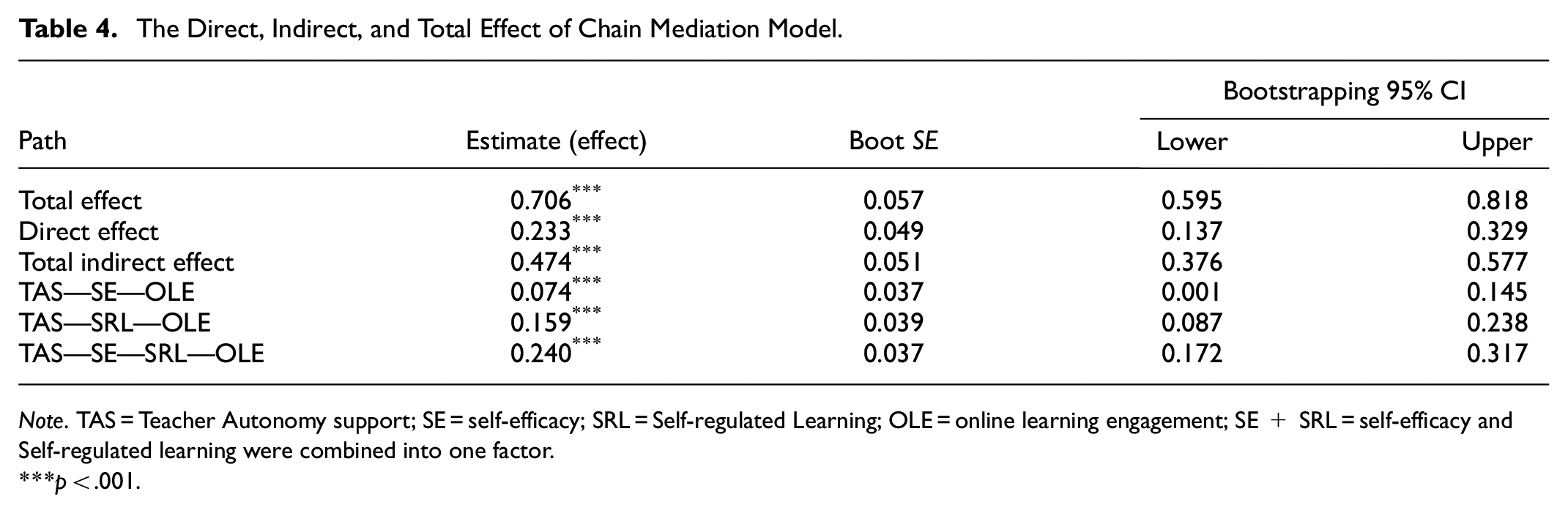
Note. TAS = Teacher Autonomy support; SE = self-efficacy; SRL = Self-regulated Learning; OLE = online learning engagement; SE + SRL = self-efficacy and Self-regulated learning were combined into one factor.
p < .001.
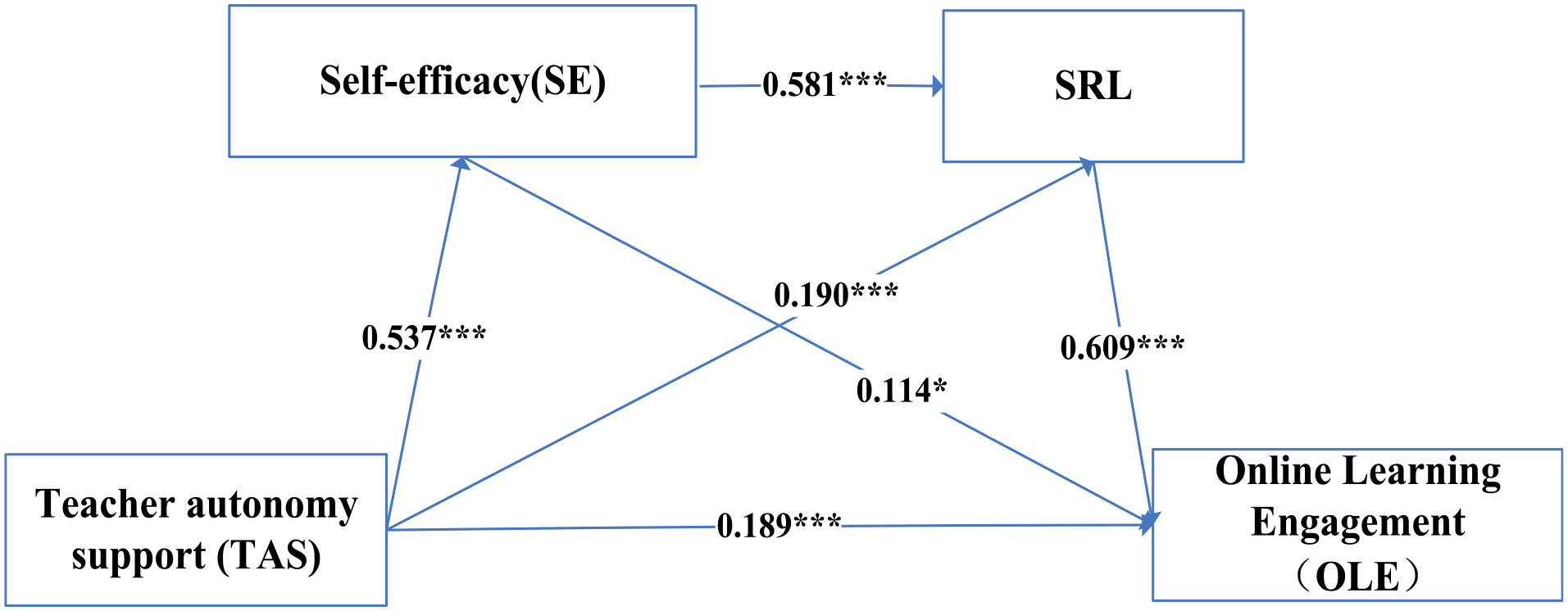
The chain mediating path of teacher autonomy support and online learning engagement.
Discussion
This study intends to use teacher autonomy support as an entry point to investigate the mechanism of its influence on online learning Engagement and the serial mediating roles of self-efficacy and SRL, using the questionnaire method. Firstly, as expected, this study examines the effect of teacher autonomy support on university students’ online engagement, showing that teacher autonomy support has a significant direct influence on university students’ online learning engagement. This is in line with other research, grounded on SDT, that discovered a few partial connections among specific dimensions of each measure; for instance, between perceived autonomy support and behavioral, learning engagement (Roorda et al., 2017).
Our findings find a positive relationship between teacher autonomy support and university students’ online learning engagement. Autonomy-supportive teachers can provide appropriate conditions for optimal learning by applying effective strategies to satisfy students’ basic psychological needs and enhance their autonomous motivation and in turn, facilitate students’ adaptive motivational patterns, learning engagement, and immersion in learning activities (Hall & Webb, 2014). The growth of students’ learning engagement can be promoted by supporting autonomy for teachers and students in higher education in creating and fostering adaptation circumstances in schools and society. Therefore, teachers are advised to learn the crucial skill of how to provide autonomy support in order to achieve students’ learning engagement.
Secondly, this study finds that self-efficacy mediates the influence of teacher autonomy support on university students’ online learning engagement in higher education, indicating that teacher autonomy support significantly and indirectly affects online learning engagement through self-efficacy. Specifically teacher autonomy support could promote self-efficacy and thus enhance university students’ online learning engagement in higher education. This finding supports the previous research findings that teacher autonomy support is significantly correlated with self-efficacy and then has a influence on learning engagement through self-efficacy in online environments (Hagger et al., 2015; Lazarides et al., 2019; Tao et al., 2022)
Consistent with our hypotheses, we found that Through SDT teachers are able to increase engagement in online teaching and learning by supporting students with internal motivators (e.g., self-efficacy, etc.) as well as personal interests, values, preferences, and goals (Reeve, 2016). In particular, students are more actively engaged if they are given the opportunity to be autonomous, to engage in meaningful and relevant activities, and to be able to express their views, wants, and needs online. These behaviors demonstrate important autonomy and opportunities, and support for autonomy will play a positive role in educational practice. The mediated model in this study shows that teacher autonomy support enhances students’ self-efficacy and can increase their learning engagement in online environments in higher education. In online teaching and learning, teachers are advised to create a better teaching and learning environment, use effective teaching strategies and enhance the quality of online teaching and learning to enable students to better meet the requirements in the process of online teaching and learning and to increase their learning autonomy and learning self-awareness.
Thirdly, the role of teacher-directed support on online learning engagement was moderated through SRL, that is, the more teacher-directed support, the higher the students’ SRL levels, which in turn facilitated their online learning engagement. This is consistent with the findings of previous studies (Núñez & León, 2015). SDT suggests that in obtaining teacher autonomy support, students are more likely to be aware of the value and significance of their learning and to promote stronger motivation to learn autonomously. On this basis, students are motivated to self-regulate and monitor their self-learning mechanisms, which leads to self-learning. Teacher support for autonomy creates an atmosphere of autonomous learning in which students feel trusted and supported. It increases students’ sense of autonomy and motivates them to take the initiative in monitoring and regulating their own learning.
Based on SDT, Ryan and Deci (2017) found that during SRL learning, teachers’ autonomy support could moderate students’ internal values, which in turn influenced students’ metacognition and learning strategies, suggesting that internal values are likely to be an important factor influencing students’ learning outcomes. SDT states that the internal factor is the largest internalizing type in the self-regulatory system, which coincides with Vygotsky’s view on internalizing types; that is, the shift from social to individual psychological self-regulatory and controlling roles of individuals. It is therefore possible to introduce the perspective of autonomous decision-making into the existing autonomous decision-making learning model and to introduce the three elements of autonomous decision-making (autonomy, competence, and relatedness) into the autonomous decision-making learning model.
In the academic field, autonomous support from the teacher is an important factor in producing positive findings. In an autonomous learning situation, teachers empathize with students, motivate them, answer questions, and give them sufficient time to complete their learning tasks independently (Reeve & Cheon, 2021; Uleanya et al., 2021). Teachers can provide students with the ability to learn independently and can also create a positive learning environment for students. The higher the level of mental health of the subjects in autonomy-supported classes, the higher their level of mental health (Alivernini et al., 2019).
Finally, Mechanisms of teacher autonomy support on student engagement in online learning. In particular, self-efficacy showed a sequential relationship with SRL and may form an intermediate chain through which it indirectly influences online learning engagement. Unlike past studies, this study proposes and tests mechanisms of the mediated model of how teacher autonomy support, self-efficacy, and SRL positively affect directly or indirectly online student engagement and the four factors’ interacting mechanisms mutually. The findings of this study suggest that the effect of teacher support on students’ engagement in online learning may be related to students’ self-efficacy. Firstly, teacher autonomy support had a significant predictive effect on students’ self-efficacy. Secondly, self-efficacy had a significant effect on socially responsible learning. SRL had a significant effect on engagement in online learning. This study will further explore the mechanism of the role of teachers’ autonomous support on students’ engagement in online learning and provide a theoretical basis for improving students’ engagement in online learning. Previous research has shown that teacher autonomy support, self-efficacy, and SRL are the key factors influencing engagement in online learning. This paper also presents an empirical analysis of the effects of these three factors on engagement in online learning.
According to Zimmerman (2008), SRL is a self-directed learning process that converts mental abilities into learning skills. In this way, students learn with a positive attitude as they are guided by individualized goals and tasks. The findings show that autonomously controlled university students have control over their own learning and are better able to organize, adapt, and evaluate their own learning. On this basis, this paper proposes a new approach to self-awareness assessment. It is widely accepted that in real life, the use of cognitive learning strategies such as SRL relies on these additional motivational factors. Researchers have therefore found that the effectiveness of students’ self-regulation in the learning process is influenced by a number of factors, among them self-efficacy. Self-efficacy significantly predicted SRL strategies. The findings show that learners’ responses to and understanding of motivation during the learning process have a direct impact on their use of learning strategies. The above findings provide empirical evidence that “high-level motivation is a prerequisite for SRL learning” (Schunk & Greene, 2018). In addition, we found significant correlations between three self-efficacy subfactors (verbal self-efficacy, self-regulatory self-efficacy, and expressive self-efficacy) and SRL strategies. These findings suggest that students’ confidence in their linguistic, self-regulatory, and expressive abilities can facilitate cognitive engagement, metacognitive control, and motivational regulation of online tasks (Teng & Zhang, 2020).
Limitations and Future Research
This study contributes to enhance students’ online learning engagement in higher education. However, there are still some limitations. Firstly, the data in this study are cross-sectional, therefore the causal relationships conclusions cannot be cautious. Future research could further validate the model while survey and other procedures provide longitudinal data. Secondly, as all the variables in the study are evaluated through self-reported questionnaires. Although self-ratings can be beneficial to assessing personal internal feelings and thoughts, the subjective nature of these measures is usually hard to control. In the future research, we can adopt objective measures such as implicit measures of emotions, EEG or fMRI to evaluate appraisals and emotions. Besides, teachers or parents can also be asked to report students’ appraisals and emotions that is considered as an alternative approach to evaluation.
Finally, it is likely that computer-recorded information and what is said in asynchronous discussions can complement these observations and interviews well. This study has focused on the role of teachers’ autonomy support, self-efficacy, and self-regulation on participation in online learning, but has not examined the effects of online learning. Based on this, this study proposes the idea of a follow-up study: to expand this study into the field of e-learning by collecting and analyzing data related to e-learning performance and other factors.
Conclusions and Practical Implications
In general, the study structures the moderated serial mediation model which can help us understand the influence mechanism of teacher autonomy support on students’ online learning engagement in higher education. The research findings show that self-efficacy and self-regulation play the mediating roles between teacher autonomy support and students’ online learning engagement. According to this research conclusion, it is recommended that when students perceive more teacher autonomy support, it is easier for them to improve their self-efficacy, then enter the state of self-regulated learning, and carry out learning engagement. In terms of this research conclusion, teachers are advised to improve students’ autonomy in practical teaching. Afterwards, students can perceive more autonomy support from teachers. In giving students autonomy support, teachers should enhance communication and mutual cooperation with students, and further strengthen students’ learning engagement and learning outcomes.
The findings of this paper can be used as a reference for teachers, instructional designers, school administrators and relevant authorities. On this basis, the relationship between teacher autonomy support and engagement in online learning is further explored. The findings of this study suggest that teachers and school administrators should focus on enhancing students’ autonomy in order to increase students’ engagement in learning.
The findings suggest that for students to better engage with online teaching and learning, it is important to enhance students’ autonomy support, increase their self-efficacy and enhance their autonomy to regulate themselves. Teachers should focus on establishing high levels of interaction patterns that allow students’ self-efficacy to be enhanced and their positive emotions to be enhanced, while reducing their negative emotions to be enhanced and allowing them to better engage in online learning. Alternatively, teachers can use conclusive rubrics to measure how students feel about the content and instruction in the online classroom. Teachers can also use tasks as an opportunity for personal development and explain the requirements for particular tasks to increase student buy-in. As decision-making is an essential element in supporting autonomy and self-determination, teaching assistants can encourage teachers to allow students to make their own choices about the various online tasks. During the teaching process, teachers should give full credit to students for their negative responses, be patient when they occur and provide guidance on how to solve the problems they encounter.
The study also highlights the importance of “SRL,” which refers to the monitoring, regulation, and control of one’s own behavior to achieve desired outcomes, with the support of teacher autonomy. In an online environment, it is difficult for students to succeed without the appropriate self-control skills and abilities. In short, in order to fully understand and harness the power of student autonomy, it is essential to use SRL, a language commonly used in online learning. However, students generally have low levels of self-discipline; as mentioned earlier, in order to learn online and to be successful, they must first have the above skills. To help those online learners who lack the skills and experience of self-discipline, it is best to check their level of self-discipline at the beginning of the semester and to give appropriate guidance and support when needed. Teachers should also teach them self-discipline techniques and give them an opportunity to practice SRL as a mentoring program before the start of the school year or while studying online.
Footnotes
Declaration of Conflicting Interests
The author(s) declared no potential conflicts of interest with respect to the research, authorship, and/or publication of this article.
Funding
The author(s) received no financial support for the research, authorship, and/or publication of this article.
Ethical Approval statement
The studies involving human participants were reviewed and approved by Tianjin Normal University Ethics Committee. The participants provided their written informed consent to participate in their study. Written informed consent was obtained from the individuals for the publication of any potentially identifiable images or data included in this article.
Data Availability Statement
Data and code are linked in the manuscript.
