




Abstract
Although previous research has explored psychological constructs such as mindset growth, emotional intelligence, and self-efficacy in general educational contexts, there remains a notable gap in understanding how these factors jointly influence aesthetic engagement in music education. Specifically, limited empirical evidence exists on how mindset growth contributes to emotional and cognitive development that shapes music students’ aesthetic experiences. To address this gap, the present study provides an empirical investigation into the interrelationships among mindset growth, emotional intelligence, self-efficacy, and music aesthetics among university-level music students in China. Based on Social Cognitive Theory and Theory of Positive Emotions, the present study included 2,369 students in 32 universities surveyed with validated and contextually adapted instruments. The constructs were assessed by using the multi-item scales for three aspects of music aesthetics (aesthetic cognition, aesthetic emotion, and aesthetic behavior) and students’ psychological orientations. The data were analyzed by the means of Structural Equation Modelling (SEM) using AMOS 24. The results indicate that an incremental mindset growth is a strong and significant predictor of adolescents’ emotional intelligence and self-efficacy, which again predict their aesthetic appreciation and engagement. These results present theoretical contributions to the fields of both cognitive and affective psychology when considered from within the context of music education and suggest practical benefits of introducing mindset growth and emotional development strategies into music curricula as well.
Plain Language Summary
This study examined how music students’ beliefs about learning and growth influence their confidence, emotional skills, and aesthetic engagement with music. The findings show that students who believe musical ability can improve through effort tend to feel more confident, manage their emotions better, and engage more deeply with the emotional and aesthetic aspects of music. Confidence and emotional skills also play an important role in helping students appreciate musical meaning beyond technical accuracy. For educators, these results suggest that music teaching should support not only skill development but also students’ beliefs, emotions, and aesthetic experiences. Teaching practices that encourage reflection, emotional awareness, and confidence, such as supportive feedback, expressive discussion, and student-centered approaches, such as flipped classrooms, may help students develop stronger musical understanding and aesthetic sensitivity. The study highlights the value of creating learning environments that nurture both artistic growth and emotional engagement in university music education.
Keywords
Introduction
Aesthetic education concerns how individuals perceive, experience, and create beauty through engagement with the world. It has long been regarded as an essential component of human development, closely connected to cultural formation and creative activity. The philosophical roots of aesthetic education can be traced to the late eighteenth century, particularly the work of Friedrich Schiller, who emphasized the role of aesthetic experience in moral and intellectual growth (Schiller, 2016). In the Chinese educational tradition, Cai Yuanpei later advanced aesthetic education as a core element of schooling, highlighting its importance for the holistic development of individuals (Zhao, 2025). Since then, aesthetic education has been widely recognized as a means of fostering emotional awareness, imagination, judgment, and cultural sensitivity.
Within this broader tradition, music education occupies a central position in aesthetic education. Music learning involves not only the acquisition of technical skills but also the cultivation of aesthetic perception, emotional response, and expressive understanding. Through activities such as performance, listening, and interpretation, students learn to recognize musical structure, respond to emotional content, and develop aesthetic judgment (Zhang et al., 2024). Music aesthetics, therefore, refers to students’ cognitive understanding of musical meaning, their emotional experience of music, and their behavioral engagement with aesthetic expression (Hu, 2024). These dimensions together form a core outcome of higher music education.
Previous studies have examined music aesthetics from philosophical, pedagogical, and cultural perspectives, both internationally and within China. Research shows that aesthetic engagement with music contributes to emotional development, creativity, and personal growth (Peng, 2025). However, most existing work has focused on instructional approaches or artistic outcomes, while paying less attention to the psychological factors that support students’ aesthetic development (He, 2025). There is limited empirical research examining how students’ beliefs, emotions, and confidence shape their aesthetic engagement in music learning contexts.
Psychological theories suggest that aesthetic development does not occur in isolation from students’ internal dispositions. Beliefs about learning and ability influence how students approach challenges, regulate emotions, and remain engaged with complex artistic material. Mindset growth refers to the belief that abilities can be developed through effort, learning, and persistence (Han & Stieha, 2020). This belief has been widely associated with motivation, resilience, and adaptive learning behavior. In music education, a growth-oriented mindset may shape how students interpret difficulty, respond to feedback, and remain open to aesthetic exploration (Davis, 2017). Students who believe that musical ability can improve over time may be more willing to engage deeply with expressive interpretation and aesthetic meaning.
In addition to mindset growth, music self-efficacy and emotional intelligence are likely to play essential roles in aesthetic development. Music self-efficacy reflects students’ confidence in their ability to perform and learn musical tasks (Ritchie & Williamon, 2011). Emotional intelligence refers to the ability to perceive, regulate, and use emotions effectively (Jing, 2025). Both constructs have been linked to learning engagement and emotional regulation in educational settings. However, their joint contribution to music aesthetics has received little empirical attention, particularly among music education majors.
This study addresses these gaps by examining the relationships among mindset growth, music self-efficacy, emotional intelligence, and music aesthetics among university music students in China. By focusing on aesthetic cognition, aesthetic emotion, and aesthetic behavior, the study provides a comprehensive view of music aesthetics as a psychological and educational outcome. The findings aim to clarify how mindset growth serves as a foundational belief that shapes students’ confidence, emotional capacities, and aesthetic engagement in professional music learning contexts.
Literature Review and Hypothesis Development
Mindset Growth in Music Education
Mindset, a concept introduced by (Dweck, 2006), refers to individuals’ beliefs about the malleability of their abilities and potential for growth. A mindset growth, which is the belief that intelligence and talent can be developed through effort, practice, and effective strategies, has been consistently associated with positive academic, motivational, and psychological outcomes across diverse educational settings (Dweck, 2006; Williams & Ginty, 2024). Conversely, a fixed mindset leads students to perceive abilities as innate and unchangeable, fostering anxiety, avoidance behaviors, and reduced persistence when confronted with challenges. Therefore, cultivating a mindset growth has become a central goal in contemporary education systems worldwide.
In the field of music education, mindset plays a crucial role in shaping learners’ developmental trajectories, emotional experiences, and artistic identity. International research demonstrates that students with growth-oriented beliefs tend to engage more deeply in practice, show greater resilience during performance setbacks, and exhibit sustained improvement in technical and expressive skills (Twitchell et al., 2025; Weatherly, 2025). Similarly, Chinese studies highlight how a mindset growth enhances students’ motivation, strengthens their commitment to long-term musical training, and supports the development of refined aesthetic judgment, particularly in highly competitive conservatory environments where effort and discipline are culturally emphasized (Huawei & Jenatabadi, 2024). Cross-cultural comparisons suggest that while Western research emphasizes personal mastery, creativity, and self-directed learning, Chinese studies often highlight perseverance, teacher feedback, and collective expectations as key mechanisms through which a mindset growth influences musical development.
Collectively, both Chinese and international findings converge on the idea that mindset-focused pedagogical approaches support not only technical proficiency but also artistic confidence and aesthetic sensitivity. In summary, mindset growth emerges as a universal psychological resource that enhances musical engagement, emotional resilience, and aesthetic appreciation across cultural contexts.
Hypothesis Development
Previous research has consistently shown that mindset growth is positively related to self-efficacy (Harpaz & Vaizman, 2023; Jiang, 2024; Wang & Li, 2024) and emotional intelligence (Rakei et al., 2022; Yavuz Konokman & Ayçiçek, 2025) across educational contexts. Studies indicate that individuals who believe abilities can be developed through effort tend to display stronger confidence in their learning capabilities and more effective emotional regulation. However, to the best of the authors’ knowledge, no empirical studies have directly examined the relationship between mindset growth and music aesthetics among music students. Given the role of growth-oriented beliefs in supporting persistence, emotional engagement, and openness to learning experiences, it is reasonable to expect that mindset growth may also contribute to students’ aesthetic cognition, emotional response, and aesthetic behavior in music education. Based on these considerations, the following hypotheses are proposed:
Self-Efficacy in Music Education
Music self-efficacy is defined as the degree to which individuals believe that they can successfully perform musically (e.g., play or sing music, compose music, or play a musical instrument). It is grounded in Bandura’s (2001) broader theory of self-efficacy and refers to the belief in one’s ability to organize and execute the courses of action required to manage prospective actions or situations. In music education, self-efficacy is an important factor directly affecting musician’s learning and performance experiences. It emerges over time from people’s achievement experiences and, for example, how successful practicing and performing are meant to promote such developing beliefs with help delivered by teachers, peers, and audiences (Xu, 2025). Musicians with positive self-efficacy are generally less susceptible to performance anxiety as they conceive performances as occasions to demonstrate their abilities, as opposed to threats to their self-worth (Benedek et al., 2025). Not only does this confidence mean better quality of performance but it also means better mental health. On the other hand, low self-efficacy leads them to have doubt in their own capabilities, increased anxiety, and the tendency to avoid whatever is difficult that can create a barrier to musical and personal developments.
International studies have consistently shown that self-efficacy predicts goal setting, persistence, and mastery-oriented learning strategies among music students. Research from Western contexts highlights how self-efficacy supports creative exploration, interpretive decision making, and resilience in performance preparation (Dong & Gedvilienė, 2025). Chinese research aligns with these findings but emphasizes the role of authoritative teaching, rigorous practice traditions, and cultural expectations in shaping students’ beliefs about their musical capabilities. For example, studies in Chinese conservatories report that students with stronger self-efficacy demonstrate greater discipline, emotional control, and long-term commitment to musical excellence, particularly in highly competitive learning environments (He & Ding, 2025). Cross-analysis suggests that while Western literature focuses more on individual agency and intrinsic motivation, Chinese research points to the combined influence of self-belief, structured pedagogy, and collective values in strengthening self-efficacy.
In summary, research across cultural contexts demonstrates that self-efficacy is a powerful predictor of musical achievement, emotional regulation, and long-term engagement. These findings support the hypothesis that self-efficacy contributes significantly to students’ involvement with music, their emotional responses, and their aesthetic appreciation.
Hypothesis Development
Previous studies have shown that self-efficacy is positively related to emotional intelligence across educational and psychological contexts (Li et al., 2024; Shubayr & Dailah, 2025; Zaini & Maulidi, 2025). Learners with higher confidence in their abilities tend to regulate emotions more effectively and engage more constructively with challenging tasks. Existing research has also suggested that self-efficacy supports sustained engagement and deeper involvement in artistic and learning activities, which are closely related to aesthetic experience (Huawei & Jenatabadi, 2024; Wang & Zhang, 2025). Although empirical evidence in music education remains limited, these findings provide a theoretical basis for examining the role of self-efficacy in emotional and aesthetic development. Accordingly, the following hypotheses are proposed:
Emotional Intelligence in Music Education
Emotional intelligence is pivotal in music education because musicians must continuously perceive, interpret, and express emotion in both learning and performance contexts. In music-specific settings, emotional intelligence refers to an individual’s capacity to identify, understand, and communicate emotion through musical sound, gesture, and interpretation (Jing, 2025). This ability includes recognizing emotional qualities embedded in musical compositions, interpreting expressive cues, managing emotional states during practice and performance, and conveying emotional meaning effectively to an audience. Research shows that musicians with higher emotional intelligence demonstrate a heightened sensitivity to expressive detail and are more capable of producing authentic, emotionally compelling performances (Huawei & Jenatabadi, 2024). They interpret subtle emotional nuances more clearly, respond more effectively to the emotional demands of different musical genres, and project their own emotional states in ways that strengthen artistic communication (Kaleńska-Rodzaj, 2023). Furthermore, emotional intelligence enhances empathy, enabling musicians to sense audience reactions and adjust their performance accordingly, deepening the performer-listener relationship (Forbes et al., 2025). In ensemble settings, emotional intelligence supports cooperation, synchrony, and interpersonal communication, which are crucial for cohesive and expressive group performance (Nogaj, 2020).
International research highlights the importance of emotional intelligence in promoting expressive performance, creativity, and emotional resilience among music students. Studies from Western contexts often focus on how emotional intelligence improves interpretation, enhances performance quality, and supports effective coping strategies during stressful performance situations (Resnicow et al., 2004). In contrast, Chinese studies emphasize the development of emotional intelligence through structured pedagogical practices, including teacher-directed feedback, parental involvement, and culturally embedded expectations regarding emotional discipline and self-regulation (Yan et al., 2025). These studies argue that emotional intelligence not only enhances expressive performance but also strengthens perseverance, aesthetic judgment, and emotional stability in competitive music learning environments. Cross analysis reveals that while Western research tends to highlight individual emotional awareness and expressive autonomy, Chinese research underscores the role of social context, collective learning, and emotional refinement as part of long-term musical training.
In summary, both Chinese and international research confirm that emotional intelligence is central to musical growth, expressive performance, and aesthetic appreciation. Across cultural contexts, emotionally intelligent musicians demonstrate stronger interpretive skills, richer emotional communication, and deeper engagement with musical meaning. These findings support the importance of emotional intelligence as a foundational psychological factor in the development of music aesthetics.
Hypothesis Development
Emotional intelligence has been widely examined in relation to learning outcomes and emotional regulation in education. However, to the best of the authors’ knowledge, no empirical studies have directly investigated the relationship between emotional intelligence and music aesthetics among music students, either in Western contexts or within Chinese higher education. Given that emotional intelligence supports the perception, regulation, and use of emotions, it is reasonable to expect that it may influence students’ aesthetic cognition, emotional response, and aesthetic engagement in music learning. Based on this theoretical rationale and the identified research gap, the following hypothesis is proposed:
Theoretical Framework
The present study draws on an integrated theoretical framework that combines Social Cognitive Theory (Bandura, 1986) and the Theory of Positive Emotions (Fredrickson, 2001) to explain how mindset growth, self-efficacy, emotional intelligence, and music aesthetics interact within music education. Social Cognitive Theory provides a foundation for understanding how students’ personal beliefs, learning experiences, and social environments shape their confidence and behavioral engagement, while the Theory of Positive Emotions highlights how positive affective processes broaden emotional and cognitive capacities essential for aesthetic appreciation. When combined, these theories explain how growth-oriented beliefs strengthen emotional and behavioral resources, and how emotional intelligence enriches aesthetic cognition, emotion, and behavior. This integrated framework aligns with the multidimensional nature of musical learning, in which cognitive, emotional, and aesthetic processes operate simultaneously.
Social Cognitive Theory
In music education research, SCT has been widely used to explain how musical self-efficacy develops through mastery experiences, social persuasion, vicarious learning, and physiological states (Huawei & Jenatabadi, 2024). Previous studies have shown that students with stronger self-efficacy demonstrate greater persistence during practice, increased resilience against performance anxiety, and stronger engagement in interpretive and expressive tasks (Chen, 2024; Mawang, 2024). Research on instrumentalists, vocalists, and ensemble musicians has also shown that self-efficacy predicts students’ willingness to attempt challenging repertoire, regulate emotional responses, and sustain motivation during long periods of training (Carriage & Thoms, 2024).
Within the present framework, SCT supports several relationships. First, it explains the link between mindset growth and self-efficacy, as growth-minded students are more likely to interpret challenges as opportunities for development. Second, SCT supports the association between emotional intelligence and self-efficacy, since emotional awareness and regulation enhance perceived capability when facing demanding performance situations. Third, SCT aligns with the relationship between self-efficacy and music aesthetic, suggesting that confident learners engage more deeply with musical meaning, expression, and aesthetic behavior. Thus, SCT helps explain how cognitive beliefs and learning experiences shape the psychological foundations that predict aesthetic engagement in music.
Theory of Positive Emotions
In music studies, this theory has been applied to explain how positive emotions emerging from musical performance, listening, improvisation, and ensemble participation enhance creativity, emotional expression, and aesthetic sensitivity (Perdomo-Guevara & Dibben, 2024). Previous research shows that musicians who experience emotions such as joy, inspiration, interest, and curiosity demonstrate richer expressive nuance, greater interpretive flexibility, and deeper aesthetic engagement (Gao et al., 2024). Studies on emotional intelligence among music students have also shown that the ability to recognize and regulate emotions supports more meaningful artistic experiences and reduces performance anxiety (Huawei & Jenatabadi, 2024; Muthuswamy & Ragavendran, 2024).
Within the current framework, the TPE supports the relationship between emotional intelligence and music aesthetics, suggesting that emotional awareness, appraisal, use, and regulation broaden students’ aesthetic interpretation and emotional resonance with music. It also supports the pathway from mindset growth to emotional intelligence, as growth-oriented learners tend to experience more positive affective states during learning, which in turn builds emotional competence. Finally, the theory supports the role of self-efficacy in aesthetic engagement because positive emotions arising from confidence and perceived competence enhance openness, creativity, and artistic exploration. Thus, this theory explains how emotional processes enrich the aesthetic dimensions of musical learning.
Theoretical Advancement and Novelty of the Integrated Framework
Integrating SCT with the TPE offers a novel and comprehensive perspective on psychological and aesthetic development in music education. SCT explains how mindset growth and self-efficacy emerge from learning experiences and shape behavioral engagement, while the TPE clarifies how emotional intelligence and positive affect contribute to creativity, openness, and aesthetic appreciation. Together, these theories create a unified framework that connects cognitive beliefs, emotional processes, and aesthetic outcomes. This integration highlights that music learning is not solely a cognitive endeavor but also an emotional and expressive process in which confidence, emotional awareness, and positive affect mutually reinforce one another. The integrated model supports the idea that growth-oriented beliefs foster emotional resources, which then enrich aesthetic cognition, emotion, and behavior, offering a theoretically robust foundation for examining how psychological development contributes to aesthetic sensitivity among music students.
Method
Ethical Consideration
All the ethical part was respected during this study. Ethical approval was obtained from the university ethics committee prior to data collection. Participants were fully informed of the purpose and procedures of the study and assured that they were free to withdraw from the study without negative consequences. Participation in interviews was based on informed consent. In addition, as all are >18 years, no parental or guardian consent was required. In the interest of de-identification and confidentiality, we have cleaned or redacted all persons’ identifying personal or institutional information from this manuscript for purposes of review or presentation, and from our data.
Description of Research Instruments
Music Self-Efficacy Measurement
Students’ music self-efficacy was measured using the 24-item scale developed by Zelenak (2015). This instrument assesses students’ self-perceived confidence across a variety of music learning and performance contexts. The response format ranges from 1 to 100, allowing students to express their confidence levels in a nuanced and personally meaningful way that captures subtle differences in musical self-concept. The scale incorporates four theoretically grounded sources of self-efficacy: mastery experiences (past achievements in musical tasks), physiological states (internal emotional and physical reactions during music activities), verbal and social persuasion (support and feedback from teachers, peers, and audiences), and vicarious experiences (observing others perform or learn). These dimensions are directly aligned with Bandura’s established framework for self-efficacy development, ensuring strong construct relevance.
The Zelenak scale was selected because it was specifically designed for music education and has demonstrated strong reliability, validity, and cross-cultural applicability in studies involving instrumentalists, vocalists, ensemble performers, and university-level music majors. Its content reflects the unique performance demands, emotional pressures, and skill-based learning processes inherent in music training, making it more suitable for music students than general self-efficacy measures. By providing both an overall score and subscale scores, the instrument offers a comprehensive profile of students’ musical self-confidence, enabling a deeper understanding of how different sources of efficacy influence learning behaviours and performance outcomes. This specificity and theoretical grounding make the Zelenak scale an appropriate and psychometrically sound measure of music self-efficacy in the present study.
The reliability and validity analyses conducted in the current study demonstrate that the Music Performance Self-Efficacy Scale possesses strong psychometric properties. The four subscales showed high internal consistency, with reliability coefficients of mastery experiences (α = .85), physiological states (α = .86), verbal and social persuasion (α = .76), and various experiences (α = .83), which align closely with the reliability range of the original instrument (α = .76–.86). All factor loadings were within the acceptable range of .619 to .876, indicating that each item contributed meaningfully to its corresponding construct. The construct reliability (CR) value of .832 exceeded the recommended threshold of .60, and the average variance extracted (AVE) of .592 met the minimum criterion of .50, confirming adequate convergent validity. Further evidence of construct validity is supported by the measurement model’s goodness of fit indices, including GFI = .911, AGFI = .909, NFI = .961, IFI = .921, CFI = .936, and RMSEA = .037, all of which fall within acceptable standards. These results collectively indicate that the scale demonstrates strong reliability, satisfactory construct validity, and a good model fit for assessing music self-efficacy in the present study.
Emotional Intelligence Measurement
To evaluate emotional intelligence, the study utilized the Wong and Law Emotional Intelligence Scale (WLEIS), a widely recognized self-report tool based on the four-branch model of emotional intelligence (Wong & Law, 2002). The WLEIS includes 16 items divided evenly among 4 distinct dimensions. The Self-Emotion Appraisal (SEA) subscale gauges the individual’s ability to recognize and understand their own emotional states. The Others’ Emotion Appraisal (OEA) measures awareness and interpretation of others’ emotions. The Use of Emotion (UOE) subscale assesses how well individuals employ emotions to enhance cognitive activities such as decision-making and problem-solving. Lastly, the Regulation of Emotion (ROE) evaluates the extent to which individuals can manage their emotional responses effectively, especially under pressure. Together, these dimensions offer a holistic view of emotional intelligence, enabling deeper insight into how individuals navigate social and emotional challenges in both academic and artistic contexts.
The WLEIS was selected for this study because it has consistently demonstrated strong reliability, validity, and cultural adaptability across diverse international and Chinese samples. Its concise structure and clear factor definition make it particularly suitable for academic and performance-oriented contexts where emotional processing plays a central role. In music education, students are required to recognize emotional cues, interpret expressive meaning, regulate performance-related emotions, and communicate emotion to audiences, all of which align closely with the four branches measured by the WLEIS. The scale has also been applied successfully in previous arts and performance studies, where emotional perception, expression, and regulation are essential components of artistic development. Together, these features make the WLEIS an appropriate and psychometrically sound instrument for assessing emotional intelligence in music students.
The WLEIS demonstrated strong psychometric properties in the current study, confirming its suitability for assessing emotional intelligence among music students. All four subscales showed high internal consistency, with reliability coefficients of SEA (α = .88), OEA (α = .84), UOE (α = .82), and ROE (α = .87), which are consistent with reliability values reported in prior international and Chinese validation studies of the WLEIS. The factor loadings for the 16 items ranged from .612 to .854, indicating that each item contributed meaningfully to its respective construct. The CR values exceeded the recommended threshold of .70 for all dimensions, and the AVE exceeded .50, confirming strong convergent validity. The measurement model also demonstrated satisfactory goodness-of-fit, with indices such as GFI = .923, AGFI = .905, NFI = .948, IFI = .957, CFI = .958, and RMSEA = .039, all within acceptable ranges. Collectively, these results demonstrate that the WLEIS possesses strong reliability, robust construct validity, and a good model fit, making it an appropriate and psychometrically sound instrument for evaluating emotional intelligence in the present research.
Music Aesthetics Measurement
The measurement of music aesthetics in this study was structured around three key dimensions: aesthetic cognition, aesthetic emotion, and aesthetic behavior, capturing a comprehensive view of students’ aesthetic engagement with music. The aesthetic cognition dimension included 11 items that assessed individuals’ understanding and analytical perception of musical elements. The aesthetic emotion dimension comprised 10 items focusing on the emotional responses and affective experiences elicited by music. Lastly, the aesthetic behavior dimension consisted of 11 items measuring participants’ observable actions and participatory behaviors related to musical appreciation and involvement. These items were adapted from the foundational work of Diessner et al. (2008) and Qiao and Jiang (2023), whose frameworks have been widely recognized for conceptualizing aesthetic experience across cognitive, emotional, and behavioral domains. Adapting these established scales allowed the current study to retain firm theoretical grounding while tailoring the items specifically to the context of music students, whose aesthetic engagement is shaped by discipline-specific training, performance experiences, and emotional sensitivity to musical expression.
The adapted scale demonstrated strong reliability and validity in the present study. Internal consistency coefficients were high across all three dimensions, with aesthetic cognition (α = .89), aesthetic emotion (α = .91), and aesthetic behavior (α = .88), indicating stable and dependable measurement. Factor loadings ranged from .614 to .872, confirming that each item contributed substantially to its corresponding construct. Convergent validity was supported by CR values above the recommended threshold of .70 for each dimension and AVE values exceeding .50, indicating that the items adequately captured the underlying aesthetic constructs. Discriminant validity was established through comparison of the square root of AVE and inter-construct correlations. The measurement model showed strong goodness-of-fit, with indices such as GFI = .915, NFI = .942, IFI = .956, CFI = .959, and RMSEA = .038, all within acceptable ranges. Collectively, these results confirm that the adapted instrument provides a reliable and valid assessment of music aesthetics and is well-suited for evaluating the cognitive, emotional, and behavioral dimensions of aesthetic experience in music students.
Mindset Growth Measurement
The measurement of mindset growth in this study was based on 10 items adapted from Dweck (2013), which examine individuals’ beliefs about the malleability of intelligence and personal abilities. The items were tailored to assess the extent to which music students believe their musical skills and learning capacities can improve through effort, practice, and sustained engagement. These adaptations ensured that the scale was contextually relevant to the challenges, learning processes, and performance experiences typical in music education. Using Dweck’s foundational framework provides firm theoretical grounding, as the mindset growth construct has been widely validated across diverse educational fields. Modifying the scale for music-specific contexts enabled this study to capture essential components of growth beliefs that are particularly important for musicians, including attitudes toward technical difficulty, persistence in the face of performance setbacks, and the belief that expressive and technical skills can be cultivated through deliberate practice.
The adapted mindset growth scale demonstrated strong reliability and validity in the present study. Internal consistency was high, with a Cronbach’s alpha of .88, indicating stable measurement across items. Factor loadings ranged from .602 to .853, showing that each item contributed meaningfully to the underlying construct. Convergent validity was supported by a CR value of .847, which exceeded the recommended threshold of .70, and an AVE of .531, meeting the requirement of .50 for adequate construct representation. Discriminant validity was confirmed through comparison of the square root of AVE with inter-construct correlations. The measurement model also demonstrated acceptable goodness-of-fit, with GFI = .912, NFI = .934, IFI = .948, CFI = .950, and RMSEA = .042. Collectively, these results indicate that the adapted scale provides a reliable, valid, and contextually appropriate assessment of mindset growth among music students, capturing their beliefs about effort, learning, and continuous improvement in musical practice.
Sample and Sampling Strategy
An adequate sample size is essential for ensuring statistical power and producing reliable research findings. To address this requirement, a priori power analysis was conducted using G*Power, a widely used tool in behavioral and social science research (Faul et al., 2007). Effect size selection is critical in power analysis. Although conventional benchmarks classify effect sizes of .10, .15, and .35 as small, medium, and large (Selya et al., 2012), this study adopted a more conservative effect size of .05. This decision increased the required sample size and reduced the risk of Type II error.
The power analysis assumed 82 predictors, a significance level of .05, and a target power of .80, which are commonly accepted standards in empirical research. Based on these parameters, the minimum required sample size was 1,102 participants (See Figure 1). The final sample included 2,369 music students, which substantially exceeded this requirement. This larger sample provided sufficient statistical power to support the SEM analyses and strengthened the results’ stability and reliability. The sample size, therefore, meets and exceeds accepted methodological standards and supports the rigor of the study design.

Sample size (G*Power).
Data Collection Procedure
The original survey instrument was created in English, and it was reviewed for cultural and linguistic appropriateness by two bilingual individuals who were highly fluent in both English and Chinese. A rigorous forward-backward translation process was used to guarantee that the translation is accurate and context appropriate. It was first translated to Chinese from the English text. Next, another bilingual expert translated the Chinese text to English, free of linguistic inertia. Both the English versions were reviewed at length, and disagreements were resolved together, to maintain the original sense and cultural approach of the instrument.
After the completion of the translated survey a survey online survey was generated for the easy and fast gathering of data. The link was sent through WeChat and reached different undergraduate and postgraduate student groups within 32 Chinese universities.
Given the recruitment procedure used in this study, it is important to acknowledge several sampling limitations. Participants were recruited voluntarily through WeChat-based survey distribution, a commonly used platform in Chinese higher education but one that may introduce self-selection bias. Students who chose to participate may differ systematically from those who did not, particularly in their motivation levels, digital engagement, and interest in psychological or music-related research. As a result, the final sample may not fully represent the broader population of music students across Chinese universities. Although voluntary online sampling is efficient for reaching geographically dispersed participants, future studies may employ more structured sampling strategies or multi-channel recruitment methods to enhance representativeness and reduce potential bias.
Participation in the survey was completely voluntary to ensure anonymity and honest responses. This sampling approach proved to be successful, resulting in 2,369 usable surveys-satisfying the sample size requirement. In addition, a larger sample size contributed to a high degree of power of the study, high reliability and generalizability of the findings, and high degree of detailed data examination.
Results
Descriptive Statistics
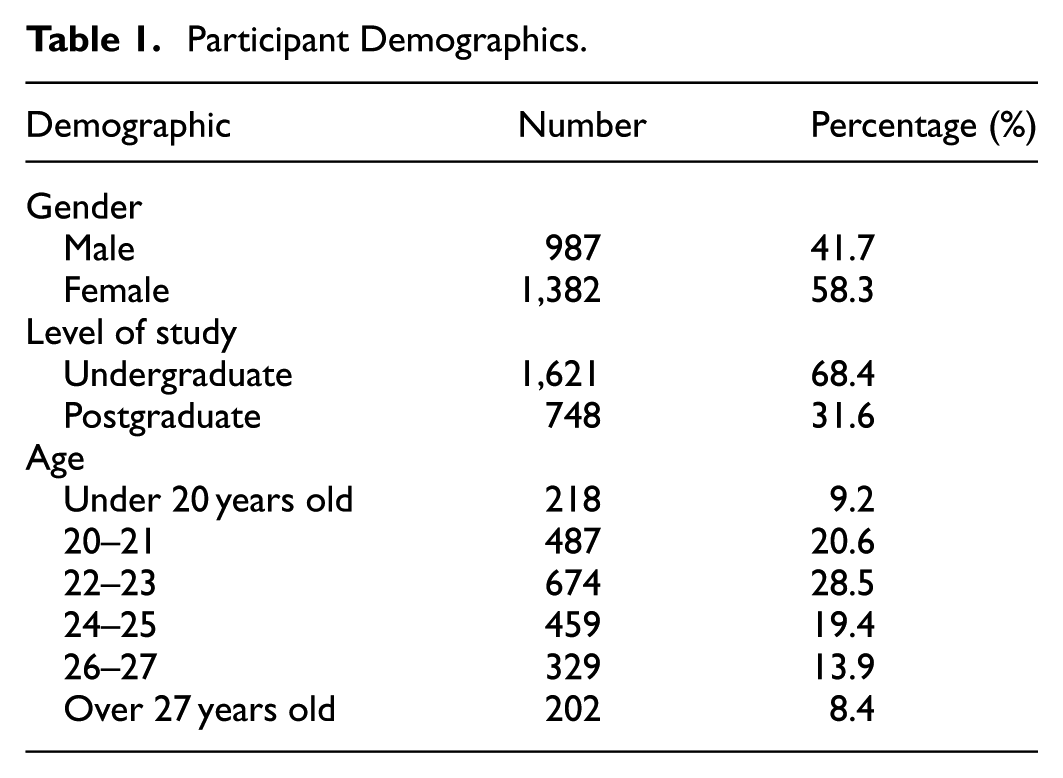
The demographic profile of the study’s 2,369 participants reveals several key trends. In terms of gender, a greater proportion of respondents were female (58.3%), compared to male participants (41.7%), indicating a moderate female majority in the sample. The age distribution shows that the largest group of respondents were aged 25 to 30 years old (28.5%), followed by those aged 18 to 24 (20.6%) and 31 to 35 (19.4%), suggesting that the majority of participants were young adults in early or mid-career stages. Smaller proportions were observed among participants under 18 (9.2%), aged 36 to 40 (13.9%), and over 40 years old (8.5%), reflecting a more limited representation of older or pre-university individuals. Regarding the level of study, the sample was dominated by undergraduate students (68.4%), with postgraduate students comprising 31.6%, indicating a strong undergraduate representation while still maintaining a significant proportion of postgraduate learners. Overall, the sample is diverse in age and education level, with a notable female majority and a primary focus on individuals in the undergraduate phase of their academic journey (see Table 1).
Participant Demographics.
SEM Analysis
To validate the survey instruments and examine the relationships among music students’ mindset growth, self-efficacy, emotional intelligence, and aesthetic engagement, confirmatory factor analysis (CFA) was employed. CFA is a well-established statistical technique used to assess whether observed variables adequately represent their intended latent constructs in accordance with theoretical expectations. The CFA results confirmed the measurement models and demonstrated that each construct was conceptually distinct while remaining meaningfully related to the others. Convergent validity was evaluated through factor loadings, with higher loadings indicating stronger associations between items and their corresponding constructs. Discriminant validity was assessed by comparing the Average Variance Extracted (AVE) values with the squared correlations between constructs, with acceptable validity indicated when AVE values exceeded the squared inter-construct correlations. In addition, CFA supported the examination of structural relationships among mindset growth, self-efficacy, emotional intelligence, and music aesthetics, indicating meaningful associations among these variables. Detailed statistical results, including factor loadings, AVE values, and correlation coefficients, are provided in the accompanying tables and figures to ensure transparency and support the measurement model’s reliability and validity.
Figure 2, Model illustrating the relationships among emotional intelligence, self-efficacy, mindset growth, and music aesthetics. The integrated framework highlights how these psychological factors jointly contribute to the development of students’ music aesthetics. The model proposes that emotional intelligence, self-efficacy, and mindset growth are interrelated and interact to shape aesthetic cognition, emotional engagement, and aesthetic behavior in music learning. In this framework, mindset growth serves as a key psychological orientation that supports both educational development and creative engagement in music education.

Final CFA model.
Table 2 presents the model fit indices before and after applying modification indices (MI)–based refinements. The initial results demonstrated that the structural model achieved an overall acceptable level of fit, with all major indices meeting conventional thresholds commonly cited in SEM literature. Indices such as CMIN/DF, RMSEA, GFI, CFI, PNFI, and TLI all indicated that the model provided a reasonable representation of the observed data. However, some indices, particularly PNFI and RMSEA, were close to their respective threshold values, suggesting room for improvement in model parsimony and approximate fit.
Model Fitting Analysis.

To further enhance model performance, modification indices were examined to identify sources of local misfit. The MI analysis indicated several item pairs with correlated residuals and a small number of weak-loading items that contributed to measurement noise. Incorporating theoretically justified error covariances and refining redundant or weak items resulted in improved model fit across multiple indices, as shown in the post-MI results. CFI, TLI, and GFI increased, indicating stronger comparative and incremental fit, while PNFI improved due to reduced redundancy and greater parsimony. Importantly, RMSEA decreased from .069 to .041, reflecting a more accurate approximation of the population covariance structure.
Table 3 shows the reliability and validity, and correlation between the major variable’s mindset growth, emotional intelligence, self-efficacy and music aesthetic. All the constructs satisfy the acceptable composite reliability (CR) value, which vary from .818 to .926 and exceed the threshold value (.70), indicating a high internal consistency. Likewise, all Average Variance Extracted (AVE) estimates are over .50, indicating good convergent validity as each measure sufficiently explains a large variance in its respective scale.
Construct Reliability, Convergent/Discriminate Validity, and Correlation Matrix.

Notes. CR = composite reliability; AVE = average variance extracted; MSV = maximum shared variance; MaxR(H) = maximum reliability (H).
With respect to discriminant validity, AVE values for constructs are greater than the Maximum Shared Variance (MSV) within any pair of constructs, indicating that the constructs are different from one another logically. In addition, all of the Maximum Reliability (MaxR[H]) values are in line with the CR scores, indicating the consistency of the measurement model.
For inter-construct correlations, significant and positive relationships (p < .01) for all the variables. The strongest correlations appear between Mindset growth and Self-efficacy (r = .711) and between Emotional Intelligence and Music Aesthetic (r = .668), suggesting meaningful associations within the conceptual framework. Overall, these results confirm that the measurement model demonstrates satisfactory reliability, validity, and meaningful interrelationships among constructs.
Using the model, the standardized regression weights, standard error, critical ratio, and p-value of the hypothesized structural paths are established, as shown in Table 4. All five paths emerge as statistically significant (p < .001) and thus offer strong support for the hypothesized directions of the relationships within the structural model. The most significant correlation is found with mindset growth and emotional intelligence (β = .815, CR = 10.722), being the strongest relationship, which indicates that students with a higher mindset growth tend to have a significantly higher emotional intelligence. Likewise, emotional intelligence is significantly associated with self-efficacy (β = .786, CR = 9.898), confirming that socially emotional competencies positively predict students’ belief about their capability to accomplish tasks that are related to academic performance.
Regression Coefficients for Structural Paths.
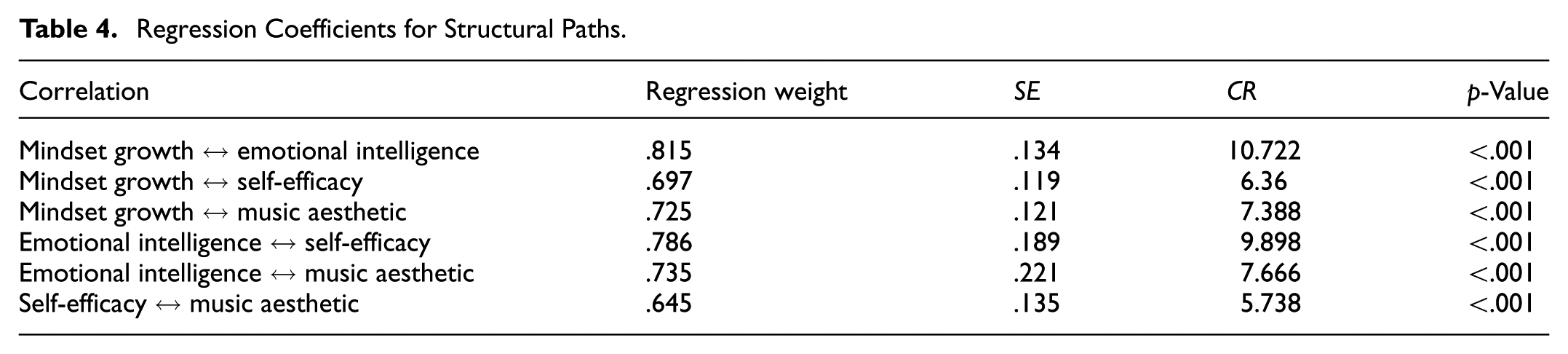
On the aesthetic aspect, mindset growth (β = .725, CR = 7.388) and emotional intelligence (β = .735, CR = 7.666) are strongly positive predictive of music aesthetic, highlighting the role of psychological and emotional traits in cultivation of aesthetic sensitivity in music learning. Secondly, self-efficacy, is strongly related to music aesthetic (β = .645, CR = 5.738), which indicates that the perception of self-confidence in musical skill plays a key component in aesthetic enjoyment. Taken together, these results confirm the proposed model and evidence significant and theoretically sound relationships between mindset growth, emotional intelligence, self-efficacy, and music aesthetics.
The structural model illustrates strong and statistically significant correlations among the main research variables (See Figure 3). Mindset growth is positively associated with music self-efficacy (r = .79), music emotional intelligence (r = .84), and music aesthetic (r = .78), suggesting that students who believe in their capacity to grow are more confident, emotionally attuned, and aesthetically engaged in music education. Music emotional intelligence suggests that students’ sense of ability to perceive, understand and manage emotions would help support aesthetic experiences in music. Similarly, music self-efficacy is highly correlated with music aesthetic (r = .80), suggesting students who have confidence in their musical ability are more likely to make deeper connections and value music. There is also a positive relationship between music emotional intelligence and music self-efficacy (r = .71), reflecting the complementation of emotional skills and musical confidence. Taken together, these findings provide support for a model in which mindset growth serves a central role in the development of emotional and cognitive abilities that cumulatively contribute to enhanced aesthetic appreciation of music among students.

Finalized structural equation model.
Discussion
This study aimed to examine the interrelationships among mindset growth, music self-efficacy, emotional intelligence, and music aesthetics among university music students in China. By testing six theoretically grounded hypotheses (H1–H6), the findings offer both confirmatory evidence for well-established relationships and novel insights into previously underexplored psychological pathways in music education. The discussion is organized in three parts: first, the relationships between mindset growth and the three core outcomes (H1–H3); second, the associations between music self-efficacy, emotional intelligence, and music aesthetics (H4–H5); and third, the unique relationship between emotional intelligence and music aesthetics (H6).
Mindset Growth in Relation to Self-Efficacy, Emotional Intelligence, and Music Aesthetics (H1–H3)
The findings indicate that mindset growth is significantly and positively associated with music self-efficacy, emotional intelligence, and music aesthetics, supporting hypotheses H1 to H3. Together, these results position mindset growth as a foundational psychological orientation that shapes both cognitive–motivational and affective–aesthetic processes in music education.
Mindset Growth and Music Self-Efficacy (H1)
The relationship between mindset growth and music self-efficacy (H1) is the most extensively researched and theoretically grounded pathway in the model, and the current findings align strongly with prior studies. Students who believed that musical ability can be developed through effort, practice, and learning reported higher confidence in their musical performance and learning. This result is consistent with Social Cognitive Theory, which emphasizes that beliefs about personal capability play a central role in motivation, persistence, and behavioral engagement (Bandura, 1986).
Previous international research has consistently demonstrated that growth-oriented beliefs enhance academic and domain-specific self-efficacy by shaping how learners interpret challenge, failure, and feedback (Ting & Yeh, 2024; Zhao et al., 2023). In music education specifically, studies have shown that students with a growth-oriented mindset are more likely to persist through technical difficulty, manage performance anxiety, and engage in deliberate practice, all of which reinforce self-efficacy beliefs (Harpaz & Vaizman, 2023; Rose et al., 2024). Chinese research further suggests that in highly structured and performance-driven music education systems, mindset growth plays a critical role in sustaining confidence under intense evaluative pressure (Jiang, 2024; Wang & Li, 2024).
The strong association observed in the present study suggests that mindset growth influences how students cognitively frame musical challenges, transforming demanding practice and performance situations into opportunities for mastery rather than threats to self-worth. This cognitive reframing strengthens self-efficacy through repeated mastery experiences and adaptive emotional responses. Thus, the results provide robust empirical support for H1 and reaffirm mindset growth as a key antecedent of music self-efficacy.
Mindset Growth and Emotional Intelligence (H2)
Compared to self-efficacy, fewer studies have examined the relationship between mindset growth and emotional intelligence in music education, making the findings related to H2 particularly noteworthy (López-Íñiguez & Bennett, 2021; Rakei et al., 2022). The results demonstrate a strong positive association between mindset growth and emotional intelligence, indicating that students who believe in the malleability of abilities also show greater capacity to perceive, regulate, and utilize emotions in musical contexts. This relationship can be explained by the notion that growth-oriented individuals are more open to emotional learning and self-reflection. Students with a mindset growth are more likely to view emotional challenges, such as performance anxiety or expressive difficulty, as improvable aspects of musicianship rather than fixed limitations. Prior studies have suggested similar patterns, showing that growth-oriented learners exhibit better emotional regulation and resilience in high-pressure performance settings (Yavuz Konokman & Ayçiçek, 2025).
In the context of music education, emotional intelligence is deeply intertwined with expressive interpretation, audience communication, and ensemble collaboration. The present findings suggest that mindset growth contributes to emotional intelligence by fostering persistence in emotionally demanding musical tasks and encouraging reflective engagement with emotional experiences. This supports H2 and extends existing research by empirically linking mindset growth with emotional intelligence in a music-specific setting.
Mindset Growth and Music Aesthetics (H3)
The relationship between mindset growth and music aesthetics (H3) represents the most novel contribution of this study. To the best of our knowledge, no prior empirical research has directly examined how growth-oriented beliefs relate to aesthetic cognition, aesthetic emotion, and aesthetic behavior among music students. The findings indicate that students with higher levels of mindset growth demonstrate deeper aesthetic engagement with music. This relationship can be explained by integrating cognitive and affective mechanisms. Growth-minded students are more likely to remain open, curious, and engaged when encountering complex musical works, allowing them to attend more deeply to expressive nuance, emotional meaning, and artistic intention. From the perspective of the Theory of Positive Emotions, growth-oriented beliefs may foster positive emotional states such as interest, inspiration, and enjoyment, which broaden attention and deepen aesthetic experience.
By empirically demonstrating a direct link between mindset growth and music aesthetics, this study extends mindset theory beyond performance and achievement outcomes and positions it as a psychological foundation for aesthetic sensitivity. The support for H3 highlights mindset growth as a critical yet previously overlooked driver of aesthetic development in music education.
Music Self-Efficacy in Relation to Emotional Intelligence and Music Aesthetics (H4–H5)
The second set of findings concerns the role of music self-efficacy in predicting emotional intelligence (H4) and music aesthetics (H5). The results indicate that self-efficacy is positively associated with both constructs, supporting the proposed hypotheses.
Extensive research in general educational and psychological contexts has shown that self-efficacy is closely linked to emotional regulation, stress management, and adaptive coping (Li et al., 2024; Shubayr & Dailah, 2025; Zaini & Maulidi, 2025). Students who believe in their ability to succeed are more likely to approach challenges with confidence and emotional control. Although fewer studies have examined this relationship among music students, existing research suggests that self-efficacy reduces performance anxiety and supports emotional stability during musical tasks (Huawei & Jenatabadi, 2024; Wang & Zhang, 2025). In the present study, music self-efficacy was found to significantly predict emotional intelligence, suggesting that confidence in musical ability supports emotional awareness and regulation. Confident students are less overwhelmed by emotional demands and more capable of using emotions constructively during performance and learning.
Additionally, the positive relationship between self-efficacy and music aesthetics supports H5. Students who feel capable in their musical skills are more likely to engage deeply with musical materials, persist through interpretive and expressive challenges, and experience greater aesthetic enjoyment during both performance and listening. Previous research has indirectly suggested connections between self-efficacy and aesthetic engagement by demonstrating that confident learners show higher levels of intrinsic motivation, sustained attention, and emotional involvement in artistic activities (Lin & Li, 2021). Some studies in general education and arts-related fields have linked self-efficacy to creative engagement, expressive confidence, and enjoyment, which are closely related to aesthetic experience (Li, 2022; Zhao et al., 2025; Zheng et al., 2025). However, to the best of the authors’ knowledge, no empirical study has directly examined the relationship between self-efficacy and music aesthetics among music students, either in general international research or within the Chinese educational context.
The present findings therefore extend existing literature by empirically validating this relationship in a music-specific setting. The results suggest that self-efficacy may function as a psychological enabler of aesthetic experience by reducing performance-related anxiety, encouraging exploratory interpretation, and allowing students to remain open to emotional and expressive aspects of music. When students trust their musical abilities, they are more willing to immerse themselves in aesthetic processes rather than focusing solely on technical accuracy or fear of failure. This confidence-driven engagement appears to create conditions under which aesthetic cognition, emotional resonance, and aesthetic behavior can flourish, highlighting self-efficacy as a previously overlooked but critical contributor to music aesthetics development.
Emotional Intelligence and Music Aesthetics Among Chinese Music Students (H6)
The final and most distinctive finding concerns the relationship between emotional intelligence and music aesthetics (H6). This study provides one of the first empirical examinations of this relationship among music students, not only in China but also in the broader international literature. The results indicate a strong positive association between emotional intelligence and music aesthetics, suggesting that students who can effectively perceive, regulate, and use emotions engage more deeply with the emotional and cognitive dimensions of music. Emotional intelligence enables musicians to interpret expressive cues, respond to emotional nuance, and form meaningful connections with musical works (Rot et al., 2025; Wang & Zhang, 2025).
In the Chinese music education context, emotional intelligence may be particularly important given high-performance expectations, structured pedagogy, and a strong emphasis on emotional discipline (Jiang & Tong, 2025; Jing, 2025). Students with higher emotional intelligence may be better equipped to navigate these demands while maintaining emotional openness and aesthetic sensitivity. The support for H6 highlights emotional intelligence as a crucial psychological bridge between technical learning and aesthetic experience. By empirically validating this relationship, the study contributes a novel perspective to music education research and underscores the importance of emotional competencies in cultivating aesthetic engagement.
Conclusion
This study provides empirical evidence that mindset growth plays a central and foundational role in shaping music students’ psychological development and aesthetic engagement within higher music education in China. By integrating Social Cognitive Theory and the Theory of Positive Emotions, the findings demonstrate that mindset growth significantly predicts music self-efficacy and emotional intelligence, which in turn contribute to students’ aesthetic cognition, emotional resonance, and aesthetic behavior in music. Beyond confirming well-established relationships between mindset growth and self-efficacy, the study extends existing literature by empirically identifying novel associations between mindset growth and music aesthetics, as well as between emotional intelligence and music aesthetics, relationships that have received little to no direct empirical attention in prior research. These results underscore that aesthetic development in music education is not solely a function of technical skill acquisition, but is deeply influenced by students’ beliefs about growth, emotional competencies, and confidence in their musical abilities. Overall, the study advances theoretical understanding of the cognitive–emotional mechanisms underlying music aesthetics and offers practical implications for designing psychologically informed music pedagogy that supports holistic artistic development.
Theoretical Implications
This study offers critical theoretical implications by integrating Social Cognitive Theory (Bandura, 1986) and the Theory of Positive Emotions (Fredrickson, 2001) to explain psychological processes in music education. Social Cognitive Theory emphasizes the role of self-efficacy and observational learning in shaping behavior. Students who believe in their ability to succeed are more likely to persist in challenging tasks, engage in meaningful learning, and achieve positive outcomes. The present study extends this perspective by demonstrating that mindset growth directly contributes to higher self-efficacy, which in turn supports deeper engagement with music aesthetics. Students with a growth-oriented mindset tend to believe that musical skills can be developed through effort and learning. This finding aligns with Bandura’s view that self-beliefs play a central role in mastery.
The Theory of Positive Emotions complements this framework by explaining how emotional intelligence supports learning and aesthetic engagement. Emotional intelligence, particularly the ability to experience and regulate positive emotions, helps broaden students’ cognitive and behavioral responses. The results suggest that emotional intelligence mediates the relationship between mindset growth and music aesthetics. This indicates that positive emotional states, such as interest, enjoyment, and inspiration, can strengthen the effects of growth beliefs and self-efficacy on music learning. Taken together, these two theories provide a unified explanation of how cognitive beliefs and emotional processes jointly influence aesthetic development in music education. This integrated perspective highlights the importance of fostering both self-beliefs and emotional richness to support students’ musical development and to inform more psychologically responsive and emotionally engaging educational practices.
Pedagogical Implications
The findings of this study offer several critical pedagogical implications for higher music education, particularly for educators who aim to support students’ technical development, emotional growth, and aesthetic engagement. First, the central role of mindset growth suggests that music curricula should explicitly promote growth-oriented beliefs by emphasizing effort, learning processes, and reflective practice rather than fixed notions of talent or innate musical ability. For educators, this means adopting teaching approaches that normalize challenge and error in musical learning. Instructors can use formative feedback, process-focused assessment, and reflective journals to guide students in reinterpreting mistakes and performance anxiety as opportunities for improvement rather than indicators of failure.
Second, the strong relationships among self-efficacy, emotional intelligence, and music aesthetics indicate that psychological development and aesthetic learning should be addressed together in instructional practice. Educators play a key role in creating learning experiences that build confidence while also encouraging emotional awareness and expressive depth. Teaching strategies such as guided emotional reflection after performances, structured peer feedback sessions, and expressive interpretation workshops can help students articulate emotional meaning in music and strengthen both self-efficacy and aesthetic sensitivity. These practices enable instructors to move beyond technical correction and engage students in deeper musical understanding.
In addition, learner-centered approaches such as flipped classrooms may be efficient for educators in music programs. By allowing students to engage with technical materials outside of class, instructors can use in-class time for discussion, emotional interpretation, ensemble interaction, and aesthetic exploration under guided supervision. Ensemble-based learning, improvisation activities, and interdisciplinary collaborations further support educators in fostering empathy, communication skills, and shared meaning-making among students. Importantly, the findings suggest that educators should strive to create psychologically supportive learning environments in which students feel confident, emotionally secure, and encouraged to explore musical meaning beyond technical accuracy. By intentionally integrating growth mindset principles, self-efficacy support, and emotional intelligence development into curriculum design and teaching practice, educators can contribute to a more holistic model of music education that nurtures both artistic excellence and deep aesthetic sensibility among music students.
Study Limitations and Directions for Future Research
While this study provides meaningful insights into the relationships among mindset growth, self-efficacy, emotional intelligence, and music aesthetics in higher music education, several limitations should be acknowledged to provide a balanced interpretation of the findings and to guide future research. First, the study relied exclusively on self-reported data, which may be influenced by social desirability and acquiescence biases, as well as limitations in participants’ self-awareness. Future studies could incorporate additional data sources, such as teacher evaluations, structured observations, performance assessments, or physiological measures, to triangulate on students’ psychological and aesthetic responses.
Second, the cross-sectional design prevents conclusive claims about causality. Longitudinal research would offer clearer insight into how mindset, emotional competencies, and aesthetic sensitivities develop over time, particularly within long-term music training environments. Experimental or intervention-based studies could also test the effectiveness of targeted pedagogical strategies designed to enhance mindset growth or emotional intelligence and examine their causal impact on students’ aesthetic engagement.
Third, the sample consisted solely of students enrolled in Chinese music-related university programs. Although this context offers a valuable understanding of aesthetic development within a rigorous and culturally rich musical tradition, it limits the generalizability of the results to broader or more diverse populations. Music aesthetics and emotional expression are often profoundly shaped by cultural values, pedagogical systems, and artistic norms. Future research should therefore incorporate cross-cultural samples or conduct comparative studies to examine how cultural context influences the interplay between mindset, emotional competencies, and aesthetic experience.
Fourth, the present study did not include a qualitative inquiry. While quantitative modeling provides structural clarity, it may overlook the nuanced ways students personally experience aesthetic emotion, musical meaning, and artistic growth. Integrating qualitative approaches, such as interviews, reflective journals, or focus groups, could offer deeper insights into how students interpret challenges, regulate emotions during performance, and construct aesthetic understanding within their educational environments.
Fifth, the study’s sampling strategy presents an additional limitation. Participants were recruited voluntarily through WeChat-based distribution channels, a method that may introduce self-selection bias. Students who choose to participate in online surveys distributed via social media may differ from non-participants in important ways, such as motivation, digital literacy, engagement with academic content, and attitudes toward psychological constructs like mindset or emotional intelligence. As a result, the sample may not be fully representative of the broader population of music students in China, which can limit the generalizability of the findings. Future studies should consider adopting more systematic recruitment procedures or using multi-platform sampling strategies to reduce potential sampling bias and ensure a more diverse and representative participant pool.
Sixth, because this study was conducted within Chinese higher education institutions, the findings should be interpreted with careful consideration of the cultural and educational context. Music education in China is often characterized by high performance expectations, structured pedagogical approaches, strong teacher authority, and an emphasis on effort, perseverance, and technical mastery. These features may shape how mindset growth, self-efficacy, and emotional intelligence develop and interact with music aesthetics. For example, beliefs about effort and improvement may be more strongly reinforced in collectivist and exam-oriented systems. At the same time, emotional expression and aesthetic engagement may be shaped by culturally embedded norms regarding discipline and emotional regulation. As a result, the observed relationships may not fully generalize to Western or other educational contexts, where music learning often places greater emphasis on individual expression, creative autonomy, and informal learning environments. Future research should therefore examine whether the proposed framework operates similarly across cultural settings by conducting cross-cultural or multi-group analyses. Such comparisons would help determine which relationships are culturally universal and which are context-specific, thereby enhancing the model’s theoretical generalizability and practical relevance.
Seventh, the use of self-report measures introduces the risk of social desirability bias, particularly in music education, where students may feel pressure to present themselves as motivated, emotionally competent, or aesthetically engaged. Participants may therefore have over-reported positive beliefs or behaviors related to mindset growth, self-efficacy, and emotional intelligence. Although anonymity was emphasized to reduce this risk, future research could incorporate alternative data sources, such as teacher evaluations, performance assessments, or observational measures, to triangulate self-reported responses. Furthermore, the generalizability of the findings is limited by the sample characteristics. The study focused exclusively on music students enrolled in Chinese universities and relied on voluntary participation through WeChat-based recruitment. As a result, the findings may not fully represent music students in other cultural contexts or educational systems. Future studies should employ cross-cultural designs, broader sampling strategies, and probability-based recruitment methods to test the robustness of the proposed relationships across diverse populations.
Finally, the constructs examined in this study were broad. Further research could explore subdimensions of emotional intelligence, specific types of self-efficacy (e.g., performance efficacy, improvisation efficacy, ensemble efficacy), or more fine-grained components of aesthetic cognition and emotion. This would provide a richer and more detailed picture of psychological development in music education. Together, these directions have the potential to build a more comprehensive and culturally grounded body of knowledge about how young musicians develop confidence, emotional sensitivity, and aesthetic engagement.
Footnotes
Acknowledgements
We extend our sincere gratitude to the students and faculty members from the participating universities for their invaluable contributions to this research.

Ethical Considerations
The study was conducted in accordance with the ethical standards of the institutional research committee and with the 1964 Helsinki Declaration and its later amendments. Ethical approval was obtained from the Special Committee on Science Ethics of Guangzhou University.
Consent to Participate
Informed consent was obtained from all individual participants included in the study.
Author Contributions
HSJ and SL contributed to conception and design of the study. SL and HSJ organized the database. HSJ performed the statistical analysis. SL and HSJ wrote the first draft of the manuscript. SL and HSJ wrote sections of the manuscript. Both authors contributed to manuscript revision, read, and approved the submitted version.
Funding
The authors received no financial support for the research, authorship, and/or publication of this article.
Declaration of Conflicting Interests
The authors declared no potential conflicts of interest with respect to the research, authorship, and/or publication of this article.
Data Availability Statement
The datasets generated and analyzed during the current study are available from the corresponding author upon reasonable request.*