




Abstract
Foreign language learning (FLL) contexts can influence learners’ interpretations of personal differences and their construction of self-perception. In China, the mix of regional diversity and rapid digitalization in education creates both challenges and opportunities, making it crucial to understand these dynamics. This quantitative study used structural equation modeling (SEM) to investigate and compare the relationships among learners’ personal differences, self-concepts, and self-efficacy in face-to-face and online FLL contexts. Participants involved 2,302 foreign language learners enrolled in blended English language courses, from universities in Eastern, Southern, Central, Northern, Northeast, and Southeast China. These findings validate all four hypotheses, revealing that self-concept has a stronger influence in face-to-face settings (Hypothesis 1), whereas self-efficacy has a more pronounced effect in online environments (Hypothesis 2). Gender and prior test scores significantly affected FLL in face-to-face contexts but not in online contexts (Hypotheses 3 and 4). The findings indicate that personal differences are less powerful in mediating the effects of self-concept and self-efficacy on FLL in online learning environments than in face-to-face ones. Self-concept and self-efficacy both influence FLL in the two environments, but self-efficacy plays a more important and autonomous role in online settings. These findings have critical implications for educators who can leverage the reduced impact of personal differences in online settings to help learners reach their potential. These insights are particularly important in the Chinese context, where promoting equitable and effective learning opportunities across regions remains a priority.
Plain language summary
This study looked at how Chinese students learn foreign languages, especially English, and how their personal traits affect their learning in different types of classrooms—traditional face-to-face versus online. Researchers studied over 2,300 university students from various parts of China to understand how learners see themselves (self-concept) and how confident they feel about learning (self-efficacy) in these different settings. The results showed that students’ self-view matters more in face-to-face classes, while confidence plays a bigger role in online learning. Personal traits like gender and past test scores affected learning more in face-to-face classes than online ones. In online settings, these personal differences mattered less, and confidence had a stronger, more direct influence. These findings suggest that online learning can help reduce the effects of personal background, making it a powerful tool for more equal learning experiences. This is especially relevant in China, where regions vary widely in resources and access to education. The study offers helpful guidance for educators on how to support students more effectively in both online and face-to-face classrooms.
Introduction
Recently, online learning has become a significant trend in foreign language learning (FLL), including English as a Foreign Language (EFL; Dhawan, 2020; Mishra et al., 2020). This shift has significant implications for the learning process, particularly given the pivotal role of the learning environment in shaping learners’ experiences and outcomes (Raes et al., 2020). In traditional classrooms, personal factors like gender shape how students view themselves (self-concept) and their confidence in learning (self-efficacy), both of which impact academic success (Khajavy & Aghaee, 2024; C. Li, 2020). However, the online learning environment creates different conditions impacting how these personal traits influence learning outcomes, presenting both opportunities and challenges (C. Y. Chang et al., 2022; Z. Yu, 2021). As online platforms become more integrated into EFL teaching, it is important to explore how learners view themselves and their abilities in these new settings, along with how personal differences influence this process.
Drawing on Vygotsky’s sociocultural theory, this study acknowledges that learners’ achievements are closely shaped by how they interpret their interactions with the learning environment (Vygotsky, 1978). Concepts such as self-concept and self-efficacy reflect this understanding, as they develop through social interaction and cultural context (Swain et al., 2015). Self-concept refers to individuals’ beliefs about their attributes from emotional, social, and cognitive perspectives (Marsh et al., 2019), whereas self-efficacy denotes confidence in successfully completing tasks (Waddington, 2023). The interplay between self-concept and self-efficacy is especially important in FLL because they are crucial predictors of learning outcomes (Y.-C. Chang & Tsai, 2022; Chen et al., 2022; Mendoza et al., 2022). Both constructs are influenced by contextual factors, and their relationship is mediated by learners’ interpretations of personal attributes (C. Li, 2021; Rubio, 2021) such as gender and previous learning experiences (indicated by the test score in this study).
This study aimed to compare the effects of self-concept and self-efficacy in online and face-to-face EFL learning contexts, focusing on gender and previous learning experiences as mediators. The novelty of this study lies in its focus on comparing the intersections of self-concept, self-efficacy, and personal differences in online and face-to-face EFL contexts. While previous studies have examined the role of gender and learning experiences in FLL (C. Li, 2021; Nikoopour & Khoshroudi, 2021; Q. Yu, 2022) and the relationship between self-concept and self-efficacy (Holenstein et al., 2022; Marsh et al., 2019), few have explored the differences in building these constructs in online and face-to-face contexts. Recent studies suggest that gender differences in FLL are influenced by sociocultural norms (Al Bataineh, 2019; Sung, 2023). However, how these influences play out in online learning remains underexplored. This study addresses this gap by examining how learners understand their identities and abilities in online settings, and how these may differ from face-to-face contexts.
The significance of this study lies in its comparative approach. By examining the effects of self-concept and self-efficacy in online and face-to-face FLL contexts, this study explores how these environments shape learners’ experiences and outcomes. Furthermore, it incorporates gender and previous learning experiences as mediators and control variables, providing a nuanced understanding of the factors influencing FLL. Such insights are crucial for designing inclusive and effective learning environments that cater to the diverse needs of learners. Theoretically, it contributes to understanding the role of personal differences in FLL by comparing their effects across online and face-to-face settings. Practically, the findings elaborate on the opportunities and challenges in online and face-to-face learning environments, which can inform the instructional design of balanced, blended learning.
Literature
Theoretical Backgrounds
This study was grounded in Vygotsky’s sociocultural theory, which emphasizes the importance of social and cultural interactions in shaping learning processes (Marginson & Dang, 2017; Vygotsky, 1978). Within this framework, individual differences, including gender and prior learning experiences, mediate interactions between learners and environments (Swain et al., 2015). Personal differences influence FLL outcomes not only through their objective characteristics but also learners’ subjective interpretations (Panhwar et al., 2016). For example, previous learning experiences may influence FLL through psychological processes such as motivation, willingness to communicate, and language anxiety (Ng, 2021; Sung, 2021). These interpretations are captured in self-concept and self-efficacy, two key psychological constructs that help conceptualize the impact of personal differences on FLL.
Self-Concept
Self-concept refers to an individual’s multidimensional perception of their own attributes, encompassing emotional, social, and cognitive dimensions. In academic contexts, self-concept reflects beliefs about one’s overall competence, shaped by external factors such as feedback, social comparisons, and cultural norms (Brumariu et al., 2023). For instance, FLL is a culturally feminized domain in many contexts (Chaffee et al., 2020). Female learners often exhibit higher motivation than their male counterparts, making them more likely to receive positive feedback that reinforces their self-concept (Fattahi & Nushi, 2021; Sung, 2023). Conversely, male learners may avoid engagement in FLL to maintain alignment with masculine cultural norms, potentially hindering their competitiveness in the field (Chaffee et al., 2020; Nasab & Motlagh, 2017). These gender differences highlight how self-concept operates in shaping FLL through learners’ interpretations of personal characteristics and sociocultural factors.
Self-Efficacy
Self-efficacy is defined as the belief in one’s ability to achieve specific goals through purposeful action, another critical construct shaped by personal differences (Bandura, 2015). While self-concept reflects broad beliefs about oneself formed over time, self-efficacy is more task-specific and can vary across situations. It is often shaped by recent or relevant experiences related to a particular activity. For example, learners who have had positive prior experiences may feel confident in engaging in a conversation using the target language, which boosts their willingness to communicate (MacIntyre & McGillivray, 2023; Torres & Turner, 2016). However, learners with negative experiences may lack such confidence and avoid using the target language (Fallah, 2017; Kim et al., 2024).
Boundary and Relationship
Self-concept grows over time through successes, which can boost self-efficacy. In turn, strong self-efficacy contributes to repeated task success, further strengthening academic self-concept (Chao et al., 2019). Despite the interrelationships, the two constructs focus on distinct psychological aspects.
According to Marsh et al. (2019), the key boundary between self-concept and self-efficacy is that self-concept is a broader, evaluative belief about one’s overall abilities and self-worth, while self-efficacy is a task-specific belief in one’s ability to achieve particular goals. For example, learners may feel confident in writing essays or joining discussions in English due to prior success in these tasks, even if their general language self-concept is low. This study distinguishes self-concept and self-efficacy through definitions, development, psychological focus, and measurements, detailed in Table 1.
Interrelation and Boundary Between Self-Concept and Self-Efficacy.

Self-concept and self-efficacy can operate differently across learning environments (Chao et al., 2019; Marsh et al., 2019). In face-to-face settings, peer comparisons and real-time social feedback amplify the role of self-concept in shaping learners’ engagement and identity. Conversely, online learning environments prioritize independent tasks, asynchronous interaction, and reduced social presence, increasing the influence of task-specific confidence. The transition to online learning contexts adds complexity to how personal differences, self-concept, and self-efficacy interact. While the diminished social interaction in online learning may mitigate gender bias and failure-related anxiety (Hampel, 2019; Y.-J. Lee & Roger, 2023), delayed feedback and limited engagement can intensify feelings of isolation, particularly for learners with low self-efficacy (Ratan et al., 2022; Richardson et al., 2017).
Experimental Backgrounds
Research on self-concept and self-efficacy has advanced in academic contexts. However, studies often focus on broader academic contexts, with limited exploration of formal FLL contexts or direct comparisons between online and face-to-face learning.
Self-Concept in Online Learning and FLL Contexts
Research on self-concept in formal online environments has mostly focused on general academic performance (Guo et al., 2022; Rivers et al., 2021; Simonsmeier et al., 2020). These studies show how online learning affects perceptions of competence and self-worth in academic contexts. In FLL, much of the research focused on examining learners’ self-concept based on their social identities. Informal spaces like chat rooms have been studied for their role in shaping identity and social engagement in language learning (Isbell, 2018; J. S. Lee & Sylvén, 2021; Zhang & Liu, 2024). These findings emphasize online settings’ role in shaping belonging and identity, but offer limited insight into how self-concept relates to academic performance in formal language learning.
In formal online FLL, studies show that learners’ cognitive, emotional, and behavioral engagement can be enhanced through structured feedback mechanisms and strategies, such as balancing synchronous interactions and fostering a sense of connection (Al-Obaydi et al., 2023; Kaufmann & Vallade, 2022; Zeng & Luo, 2024). This engagement improved their self-concept by reinforcing perceptions of competence and active participation. However, research in this area has yet to thoroughly investigate how formal online environments specifically shape foreign language learners’ self-concepts. This gap underscores the need for further investigation of the nuanced impact of online FLL settings on learners’ self-concepts.
Self-Efficacy in Online Learning and FLL Contexts
While self-concept is often studied in relation to broad academic competence, self-efficacy is more commonly examined in task-specific contexts (Du et al., 2021; Grigg et al., 2018). In FLL, self-efficacy significantly influences learners’ willingness to communicate, persistence in learning, and the ability to manage language anxiety, which are crucial for successful language acquisition (Kim et al., 2024; MacIntyre & McGillivray, 2023).
Studies have explored the potential of online FLL settings to enhance learners’ self-efficacy and engagement (Derakhshan & Fathi, 2024; Pikhart et al., 2024; Russell, 2020). However, online FLL also presents unique challenges, including reduced teacher-student interaction and higher cognitive load, which may negatively affect learners’ task-specific confidence (Pikhart & Al-Obaydi, 2023; van der Velde et al., 2021). These difficulties are particularly noticeable in FLL, where interaction and communication are central to learning (Derakhshan & Fathi, 2024).
Current research has not fully examined how self-efficacy works in online formal FLL, particularly its interaction with self-concept. In addition, few studies have examined how online language learning settings affect self-efficacy compared to face-to-face ones.
Interplay of Self-Concept and Self-Efficacy
The relationship between self-concept and self-efficacy has been extensively explored in general academic contexts, with studies demonstrating their reciprocal influence on learning (Arens et al., 2022; Holenstein et al., 2022). In FLL, self-concept shapes learners’ confidence in using the target language, while self-efficacy drives their persistence and ability to overcome linguistic barriers (Chao et al., 2019; Chen et al., 2022; Mendoza et al., 2022).
The dynamic relationship between self-concept and self-efficacy in the online formal FLL context remains unexplored. Limited feedback in virtual settings can hinder self-efficacy development, and changes in learning presence may affect learners’ self-concept (Bárkányi, 2021; Tao & Gao, 2022). Despite these challenges, online settings also narrow disparities, such as gender-related barriers to engagement (L. Wang & Yu, 2023; Z. Yu, 2021). However, how these affordances influence the interaction between self-concept and self-efficacy is underexplored.
Research Gap
As reviewed above, research on self-concept in FLL often focused on informal online spaces such as chat rooms, examining virtual identity construction. This leaves a gap in understanding how formal online environments shape learners’ perceptions as foreign language learners. Similarly, reviewed studies show that online environments can boost learners’ self-efficacy but also present challenges like reduced interaction and higher cognitive load, which may weaken task-specific confidence in FLL. Moreover, while the interplay between self-concept and self-efficacy has been studied in general academics, how it functions in online FLL remains unclear. Little is known about how online settings reshape self-concept and self-efficacy compared to face-to-face ones.
The Current Study
This study addresses the identified gaps by exploring how self-concept and self-efficacy develop and interact in online and face-to-face FLL, with a focus on how gender and prior achievements influence these processes. The study highlights how learners adjust their identities and competencies across various language learning contexts.
Previous research has explored the limitations of online learning, such as reduced social presence and learner isolation. However, this study focuses on the potential to mitigate the negative effects of personal differences. For instance, online environments’ less social interaction and flexibility may lessen gender disparities and ease the effects of past failures on self-perception (Russell, 2020; Q. Yu, 2022). By leveraging these affordances, online learning can create opportunities for an equitable and inclusive FLL experience. Moreover, the comparative approach adopted in this study offers a novel perspective on the dynamic relationships between these constructs in the online and face-to-face contexts.
This study contributes to developing targeted interventions and pedagogical frameworks that support learners’ adaptation to diverse learning environments. These findings are especially valuable for blended learning, where combining online and face-to-face approaches can improve engagement, satisfaction, and achievement (R. Li, 2022; Pikhart et al., 2022; X. Wang & Zhang, 2022).
Methodology
Research Model
This study examines how language learners’ self-concepts and self-efficacy develop in online and face-to-face contexts, considering gender and test scores as control variables. To achieve this, research questions and hypotheses were formulated based on models of personal differences, self-concept, and self-efficacy in FLL. Structural equation modeling (SEM) using SmartPLS 4 was employed to test the hypotheses.
Research Questions
How does self-concept affect English language learning (ELL) in online and face-to-face contexts?
How does self-efficacy affect ELL in online and face-to-face contexts?
How do gender and previous test score moderate the relationships between self-concept, self-efficacy, and ELL in online and face-to-face contexts?
Figure 1 presents the model based on the proposed hypotheses. The dotted arrows indicate hypothetically insignificant effects.
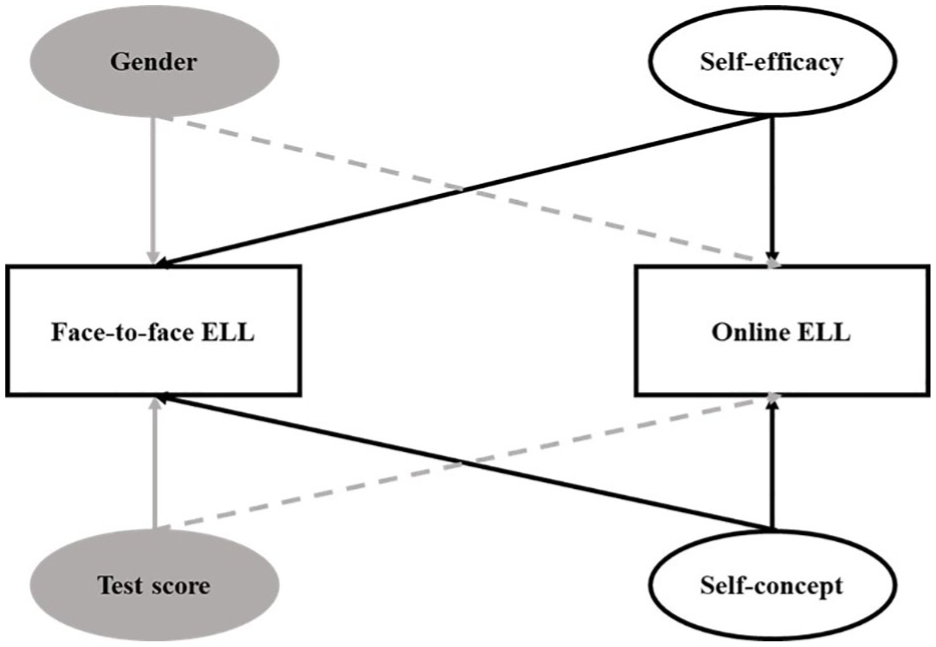
Hypothesized model.
Participants
This quantitative study employed convenience sampling. The participants recruited in this study were enrolled in compulsory blended university English language courses. A total of 2,336 questionnaires were distributed and 2,302 valid responses were retained for analysis after data cleaning, excluding invalid and incomplete responses. The study posed minimal risks, using anonymous questionnaires on non-sensitive learning experiences. Participants were informed about the study’s purpose, confidentiality, and voluntary participation before providing written consent. The sample exhibits considerable diversity. The regional distribution of participants spans across Central Eastern, Southern, Northern, Northeastern, and Southeastern China. The academic backgrounds of participants are varied, encompassing majors such as education, literature, art, economics, technology, and science. This diverse demographic profile enriches the study by providing a broad spectrum of perspectives and experiences related to learning English. Because convenience sampling was applied, the ratios of the participants’ demographic features were not purposefully controlled. However, according to Hair et al. (2013), the effects of ratio differences can be neutralized by sample size. The demographic information of the participants is shown in Table 2.
Demographic Information (N = 2,302).

Instrument
The instrument consisted of two parts. The first part collected demographic details, such as gender, age, university, major, latest English test scores, and language learning duration. This provided a comprehensive understanding of the participants’ backgrounds. The second part included 15 questions assessing participants’ English language learning experiences in online (O-ELL) and face-to-face (F-ELL) contexts, their self-concept (SC), and self-efficacy (SE). All items were measured on a 6-point Likert scale ranging from 0 (“not at all”) to 6 (“very much”).
Questions 1 to 4 focused on participants’ O-ELL, and Questions 5 to 7 assessed F-ELL. These questions were adapted from validated scales by Taguchi et al. (2009) and Shen et al. (2013) and aligned with the study’s focus on exploring ELL in different settings. Examples included “How much do you enjoy learning English online/face-to-face?”
Questions 8 to 11 evaluated SC using the L2 self-scale adapted from Taguchi et al. (2009), validated for Chinese EFL learners to capture self-perceptions as English users and aspirations. Questions such as “Do you think you are fluent in English?” and “Do you believe English is part of your future self?” measure broad, identity-related perceptions of competence.
Questions 12 to 15 measured SE using the scale from Shen et al. (2013), which evaluates self-efficacy in interactions and academic tasks, adaptable to both online and face-to-face EFL contexts. Example questions included “Can you actively participate in discussions in English online/face-to-face?” This reflects the task-specific, context-sensitive nature of self-efficacy, as distinct from the more generalized beliefs captured in self-concept.
Reliability and Validity of Measurement
Construct reliability and validity were assessed using Cronbach’s alpha, rho_A, composite reliability, average variance extracted (AVE), and the heterotrait-monotrait (HTMT) ratio. Cronbach’s alpha for each construct in the study was over the required limit of .70 (Nunnally & Bernstein, 1994). The rho-A is within the scope of 0.826 to 0.959 and composite reliability ranges from 0.829 to 0.970, all above the 0.70 threshold (Jöreskog, 1971). While Cronbach’s alpha above .9 can suggest redundancy, recent studies interpret it alongside the HTMT ratio (Tavakol & Dennick, 2011), as shown in Table 3.
Discriminant Validity.

Note. SC = self-concept; SE = self-efficacy; F-ELL = face-to-face English language learning; O-ELL = online English language learning.
Following Hair et al.’s (2019) benchmarks, all constructs in the SEM model showed acceptable reliability. Cronbach’s alpha and the HTMT ratio confirmed internal consistency. Convergent validity was assessed using the Average Variance Extracted (AVE), which reflects how much of the variance in observed variables is explained by the construct, relative to measurement error. An AVE value above 0.5 indicates adequate convergence (Fornell & Larcker, 1981). Factor loadings were also checked to confirm the strength of each indicator. Hair, Black, et al. (2014) recommend a loading of 0.7 or higher for indicators to be considered reliable. In this study, all key indicators including Cronbach’s alpha, rho_A, composite reliability, factor loadings, and AVE met the recommended thresholds, as presented in Table 4.
Reliability and Validity.
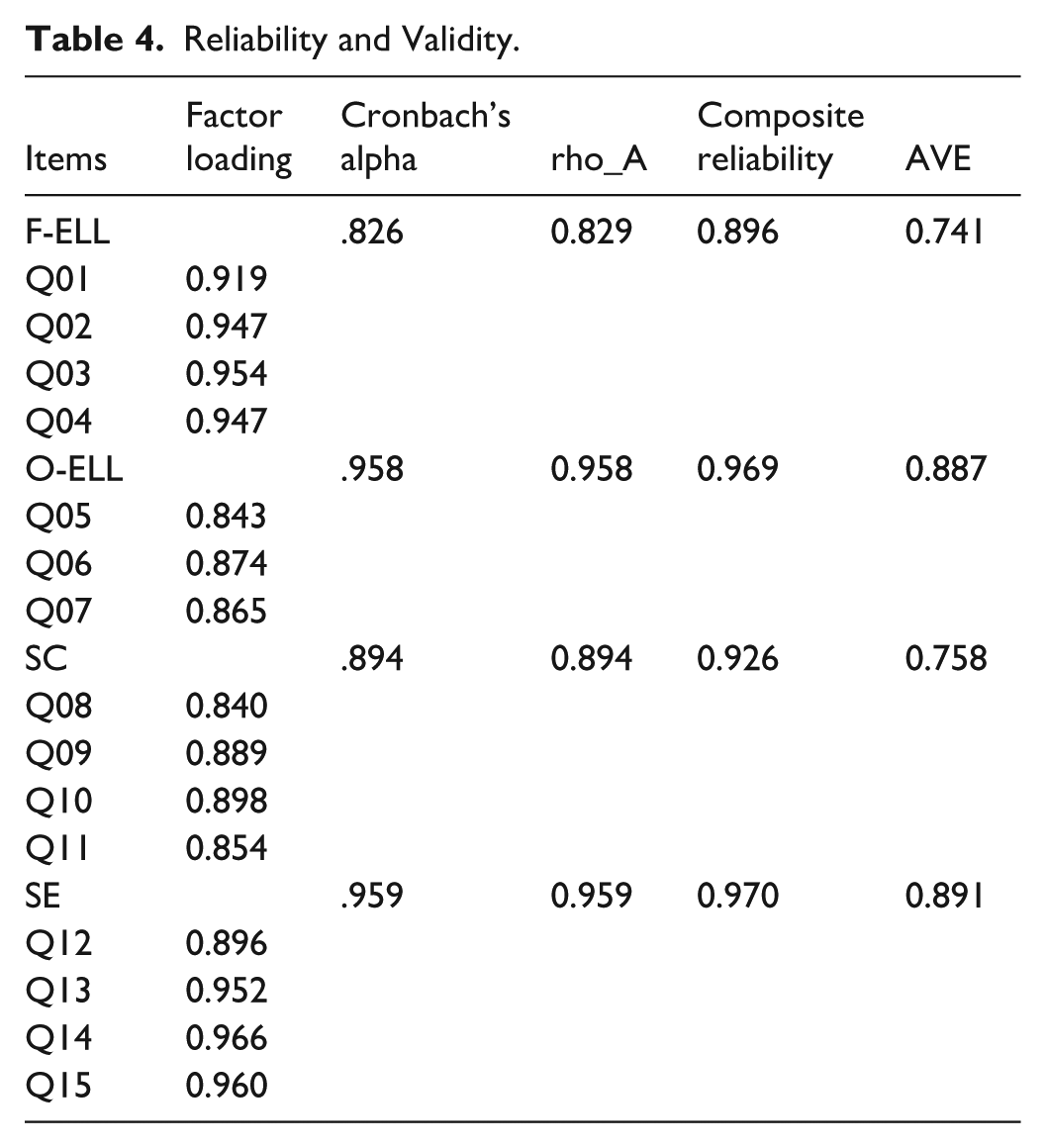
Discriminant validity was assessed using both the traditional Fornell and Larcker (1981) criterion and the more recent HTMT ratio approach (Henseler et al., 2015) (see Tables 3 and 4). In this study, all HTMT values were below the recommended threshold of 0.90 (Sarstedt et al., 2021), indicating satisfactory discriminant validity. Overall, the constructs in this study demonstrated acceptable reliability and validity.
Results
Model Fit
Model fit was evaluated using the Standardized Root Mean Square Residual (SRMR) and the Normed Fit Index (NFI). SRMR measures the average difference between the observed and predicted correlations, with values below 0.08 indicating a good fit (Hu & Bentler, 1998). It is widely recommended for assessing model fit in SEM (Hair, Henseler, et al., 2014). NFI reflects how well the proposed model improves over a null model and is unaffected by the number of variables (Bentler & Bonett, 1980). Values above 0.90 suggest an acceptable fit (Lohmöller, 2013). As shown in Table 5, the SRMR (0.055 < 0.08) and NFI (0.920 > 0.9) of the assessed model for the current study were within acceptable ranges, indicating that the model fits well.
R 2 Value and Model Fit.

The explanatory power of the assessed model was examined using the R2 value. As per Henseler et al. (2009), R 2 values of .75, .50, and .25 indicate substantial, moderate, and weak explanatory power. Table 5 shows R2 values of .579 for F-ELL (moderate explanatory power) and .247 for O-ELL (weak explanatory power). Acceptable R¹ values vary by research context, particularly in educational and psychological research where lower R¹ values may reflect high variability in human behavior (Hair et al., 2013). While O-ELL shows weaker explanatory power, it satisfies model fit criteria based on NFI. Thus, given the strong model fit shown by SRMR and NFI, the difference in explanatory power between F-ELL and O-ELL is acceptable within the study’s analytical framework.
Hypotheses Test
This study examined the following hypotheses:
The hypotheses were tested using the SmartPLS 4 bootstrapping mechanism in the SEM and Process models. Table 6 presents the coefficients, means, standard deviations, t-values, and p-values.
Total Effects.

Note. M = mean; SD = standard deviation.
p < .01.
Results indicate significant effects of self-concept on ELL in both face-to-face (βSC-F-ELL = .715, p < .01) and online contexts (βSC-O-ELL = .404, p < 0.01), with weaker effects in online contexts (βSC-O-ELL < βSC-F-ELL). Thus, Hypothesis 1 is accepted.
Self-efficacy significantly affects ELL in both face-to-face (βSE-F-ELL = .080, p < .01) and online contexts (βSE-O-ELL = .105, p < 0.01), although its impact is weaker compared to self-concept in both contexts (βSE-F-ELL < βSC-F-ELL, βSE-O-ELL < βSC-O-ELL). However, unlike self-concept, self-efficacy has a stronger effect on ELL in online settings than in face-to-face ones (βSE-O-ELL > βSE-F-ELL). Therefore, Hypothesis 2 is accepted.
Gender and test scores were the two control variables examined in the model. As shown in Table 7, gender is a significant control variable for ELL in face-to-face contexts (β = .130, p < .01) but an insignificant one in online contexts (β = −.098, p = .139 > .01). In this case, Hypothesis 3 is accepted. Similarly, test scores function as a significant control variable in face-to-face contexts (β = .079, p < .01) but show no significant control effect in online contexts (β = −.010, p = .357 > .01). To conclude, Hypothesis 4 is accepted.
Control Variables.
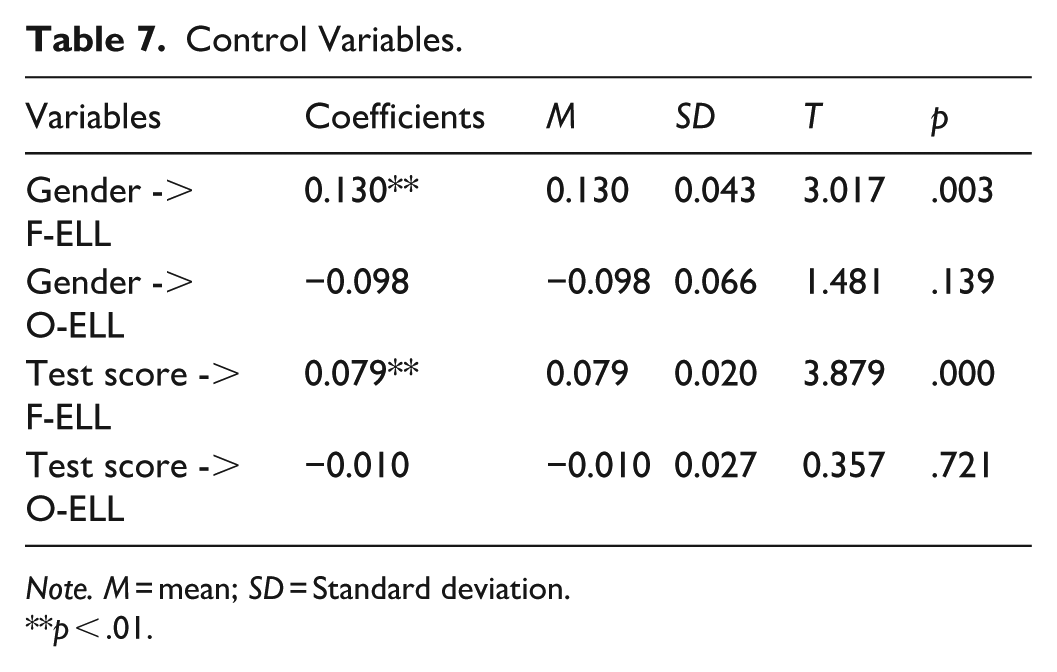
Note. M = mean; SD = Standard deviation.
p < .01.
Based on the hypothesis test results for the total effects and control variables, the assessed model is presented in Figure 2.
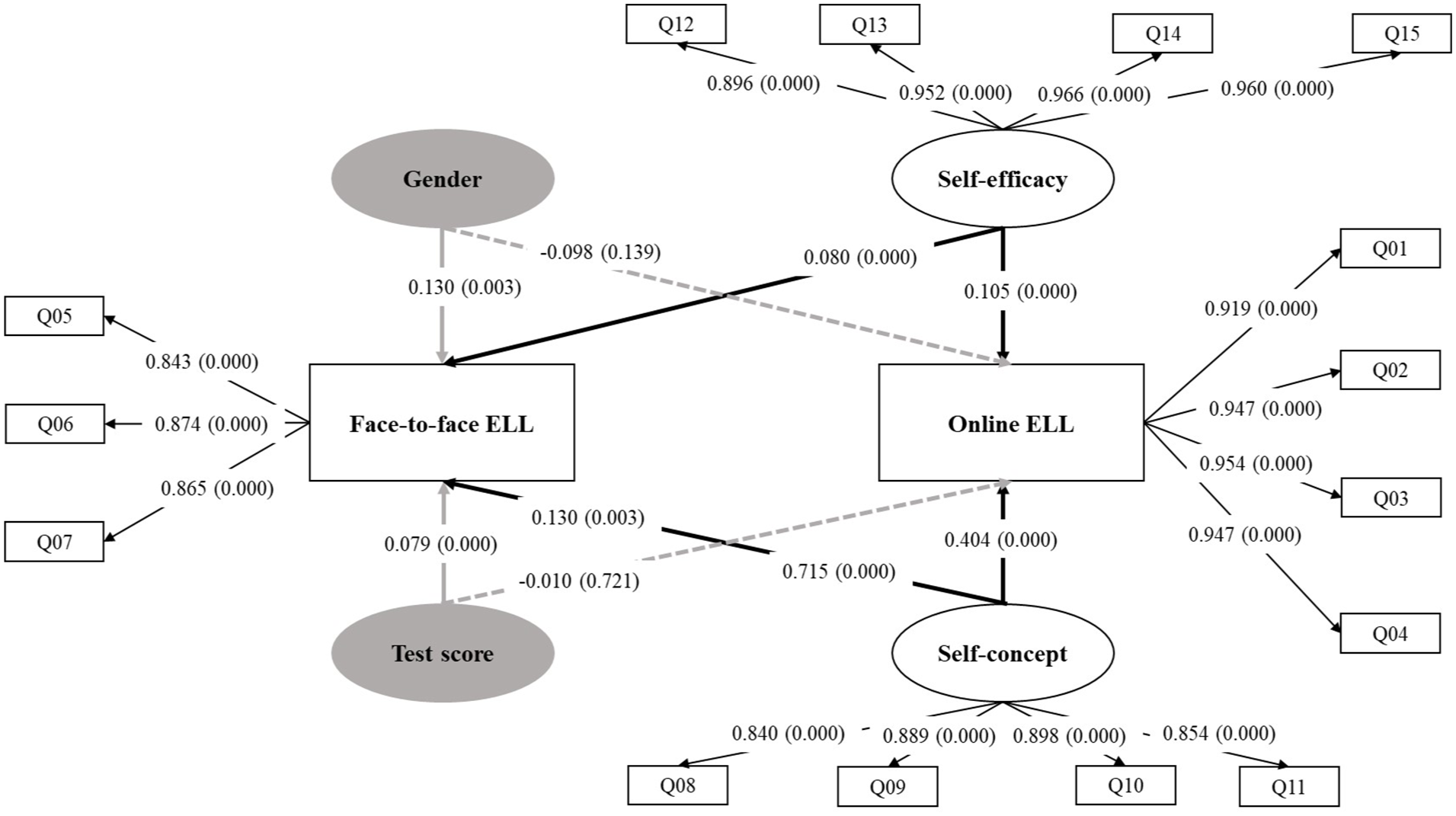
Assessed model.
Discussion
Results show that self-concept significantly impacts ELL in both online and face-to-face settings, with a stronger effect in the latter (Hypothesis 1). This highlights the power of social interactions, immediate feedback, and peer comparisons in shaping learners’ self-concepts in face-to-face environments. Previous studies (Hampel, 2019; Kumi–Yeboah et al., 2018; Rivers et al., 2021) support this, arguing that the rich social presence and physical immediacy in face-to-face classrooms foster learners’ academic self-concept more effectively. Sociocultural theory further reinforces this perspective, suggesting that self-concept develops through learners’ perceptions of their roles and achievements in immediate social contexts (Panhwar et al., 2016; Swain et al., 2015). In China, collectivist learning values and Confucian culture shape academic self-concept, often tying it to external validation from teachers and peers (Yang Hansen et al., 2022). Confucian norms of hierarchy and exam-focused achievement may heighten reliance on face-to-face social cues for developing self-concept (S. Li et al., 2020).
In contrast, online settings reduce the visibility of personal differences, such as gender and prior test scores, which often drive social comparison (Hampel, 2019). This flexibility allows learners prone to anxiety or low self-esteem in traditional classrooms to engage more confidently in online ELL activities. However, the absence of social presence may hinder the development of a stable self-concept, particularly for learners who rely on external validation (Kumi–Yeboah et al., 2018), such as those influenced by Confucian and collectivist learning values.
This contrast raises critical questions regarding how online learning environments can better emulate the supportive social interactions found in face-to-face classrooms. While online settings offer flexibility, mechanisms including peer collaboration and constructive feedback are needed to support self-concept development.
Self-efficacy has significant effects on ELL outcomes in both contexts, with stronger effects in online ones (Hypothesis 2). This reflects the task-specific nature of self-efficacy, which is emphasized in online learning requiring discrete, asynchronous activities like completing independent assignments or contributing to online forum discussions (Bandura, 2015; Kim et al., 2024). Online environments demand more self-regulation and independent problem-solving, making confidence in task completion outweigh general self-perceptions (Y.-C. Chang & Tsai, 2022).
Existing research emphasizes that less immediate social comparison in online settings can bolster learners’ confidence and willingness to take risks in language use (Fallah, 2017; MacIntyre & McGillivray, 2023). This is also a particularly salient advantage in Chinese culture where “face-saving” (miànzi) concerns can inhibit participation in traditional classrooms (Fattahi & Nushi, 2021). The reduced social pressure of online spaces can empower learners who might otherwise avoid risks due to cultural norms.
Nevertheless, the benefits of online environments for self-efficacy development are not without challenges. Delayed feedback and less teacher presence may increase isolation and uncertainty for learners with low self-efficacy (Tao & Gao, 2022). Unlike face-to-face settings with immediate feedback and teacher support, online learning needs deliberate strategies to sustain learners’ confidence. Interactive tools such as visualization of task completion, personalized feedback loops, and peer support networks are essential for mitigating these challenges and sustaining self-efficacy development.
Gender and prior test scores significantly impacted ELL outcomes in face-to-face settings but were not influential online (Hypotheses 3 and 4). In face-to-face language learning, cultural norms and peer dynamics often reinforce gender differences. Female learners tend to show higher motivation but also greater anxiety, while male learners may engage less due to perceived threats to their masculine social identity (Chaffee et al., 2020; Fattahi & Nushi, 2021). In China, language learning is culturally framed as a feminized domain, placing academic pressure on female students while discouraging male engagement (L. Wang & Yu, 2023). This cultural framing helps explain the particularly pronounced gender effects observed in face-to-face settings in this study.
Prior test scores reflect learners’ past achievements. Learners with higher scores tend to exhibit greater confidence and motivation, whereas those with lower scores may experience heightened anxiety and reluctance to engage (Arens et al., 2022). Visible peer comparisons in traditional classrooms exacerbate these effects, reinforcing the link between prior performance and self-perception (C. Li, 2021; Nikoopour & Khoshroudi, 2021). China’s exam-centric education magnifies the impact of prior scores in face-to-face classrooms (Tan, 2020). High achievers enter a validation loop where past success brings endorsement from teachers and parents, while struggling students face compounded disadvantages. However, online learning may disrupt this pattern by shifting focus to specific tasks, offering a temporary relief from evaluation-focused norms (Tao & Gao, 2022).
From face-to-face settings to online ones, the coefficient for self-concept’s influence on ELL outcomes decreased (βSC-F-ELL = .715 > βSC-O-ELL = .404), while that for self-efficacy increased (βSE-F-ELL = .080 < βSE-O-ELL = .105). This suggests that in online environments, self-efficacy plays a more direct and autonomous role in influencing ELL, with less influence from broader personal self-perceptions. This finding aligns with studies highlighting online settings can reduce performance-related anxiety and foster learner autonomy (Derakhshan & Fathi, 2024; Russell, 2020). In such contexts, learners’ engagement is more guided by self-efficacy, which is task-specific and context-dependent. This shift is further supported by the reduced moderating effects of gender and prior test scores in online settings. Since these personal characteristics are closely associated with self-concept, their diminished influence indicates the growing independence of self-efficacy in shaping online ELL.
The findings reflect a transition from identity-based engagement (more linked to self-concept) in face-to-face environments to task-based engagement (more linked to self-efficacy) in online ones. Online settings appear to create a more equal space for learners to engage based on their confidence with language tasks, rather than their past achievements or social identity. This contextual variation further underscores the importance of tailoring learning strategies for each environment. In face-to-face settings, strengthening self-concept through targeted interventions, such as personalized encouragement and peer recognition, can simultaneously enhance self-efficacy. Conversely, in online contexts, designing activities that prioritize task-specific feedback and autonomy can maximize the independent development of self-efficacy, even when self-concept becomes less influential.
Although reduced gender and performance disparities in online settings are promising, they raise questions about engagement and identity construction. Limited visibility and social interaction may hinder the development of collaboration and peer-supported confidence. Thus, balancing reduced disparities with meaningful interaction is key to creating inclusive learning environments.
While the findings offer important insights, their generalizability to other cultural contexts requires careful consideration. As discussed earlier, China’s collectivist learning values and Confucian cultural norms create unique pressures and supports that may not translate directly to other contexts.
Conclusion
This study examined how self-concept, self-efficacy, gender, and prior test scores affect online and face-to-face ELL, highlighting key differences. This study validated all four hypotheses. As per Hypothesis 1, self-concept has a stronger effect in face-to-face settings due to immediate social interaction and peer support. In line with Hypothesis 2, self-efficacy plays a more pronounced role in online environments by fostering task-specific confidence and autonomy. Hypothesis 3 was supported, with gender mediating outcomes in face-to-face contexts but not online. Similarly, Hypothesis 4 was confirmed, as prior test scores were significant mediators in face-to-face settings but lost significance online. These findings underscore the dynamic interplay of these variables across learning contexts. Furthermore, the study highlights the importance of context-specific pedagogical strategies and offers valuable insights into creating inclusive and effective learning environments.
Previous research notes online learning limitations, including reduced belonging and presence (Kaufmann & Vallade, 2022; Pikhart & Al-Obaydi, 2023; Tao & Gao, 2022). However, this study demonstrates that these limitations do not necessarily impede online EFL learning. In contrast, when personal differences have less influence on self-perception in online settings, EFL learners can more freely explore and redefine their roles. This also enables teachers to better support learners in reaching their potential, free from the constraints of personal differences.
Implications
This study offers important theoretical and practical insights into FLL in online and face-to-face contexts. Theoretically, it deepens the understanding of how self-concept and self-efficacy interact across different learning environments. Findings show that online learning can offer a fairer platform by reducing the impact of personal differences. These findings can help design more inclusive curricula that address issues such as gender disparities and performance differences in FLL.
Practically, this study emphasized the importance of tailored strategies to enhance self-efficacy and self-concept. In the online context, tools such as real-time feedback, peer collaboration, and interactive activities can reduce isolation and foster self-efficacy. In face-to-face settings, promoting social interactions and immediate support can strengthen self-concept. These insights support the design of balanced blended learning approaches to maximize student engagement and outcomes. This is especially relevant in the Chinese educational context, where equity in access to quality education remains a priority.
Limitations
This study had several limitations. First, the sample consisted solely of undergraduate students from specific regions of China, which may restrict the generalizability of the findings. Second, while gender and prior test scores were examined, other influential factors, such as motivation, cultural background, and parental involvement, were not considered. Finally, the reliance on self-reported data may introduce bias, suggesting a need for complementary measures in future work.
Recommendations for Future Research
Future research should address these limitations by exploring additional factors such as cultural intelligence, motivation, and socioeconomic status to deepen the understanding of diverse learner needs. Expanding the research to primary, secondary, and vocational education settings would offer broader insights into EFL learning experiences. Additionally, future studies may address self-report bias by incorporating multiple measures such as online learning analytics and peer/teacher ratings.
Footnotes

Ethical Considerations
This study was reviewed and approved by the Ethics Review Committee of the School of Foreign Languages, Sichuan Normal University, China (reference number: 20231206).
Consent to Participate
The participants provided their written informed consent to participate in this study.
Author Contributions
Ruihua Chen: Conceptualization, Methodology, Investigation, Formal analysis, Data Curation, Writing—Original Draft, Writing—Review & Editing. Yanghe Liu: Conceptualization, Methodology, Investigation, Formal analysis, Data Curation, Writing—Original Draft, Writing—Review & Editing, Visualization. Yafu Gong: Conceptualization, Methodology, Investigation, Writing—Original Draft, Writing—Review & Editing.
Funding
The author(s) disclosed receipt of the following financial support for the research, authorship, and/or publication of this article: This work was supported by Academic Degree and Postgraduate Education Reform Project of Sichuan Province (Grant No. YJGXM24-B077).
Declaration of Conflicting Interests
The author(s) declared no potential conflicts of interest with respect to the research, authorship, and/or publication of this article.