




Abstract
This study extensively investigates 4,557 articles pertaining to immigrants’ cross-cultural adaptation (ICCA) published between 1963 and 2022 in Web of Science (WoS)-core collection database by presenting a state-of-the-art bibliometric analysis and visualizing knowledge maps with a set of analytical tools including VOSviewer, CiteSpace, and Bibliometrix. The collected sample covers 9,791 authors, 1,473 sources, 81 countries and regions, and 2,682 institutions. The major aim of the study is to explore the research status and progress on a global scale in terms of different parameters in a quantitative and visual manner and discern the overall development in research hotspots. The research findings reveal that publications on ICCA have registered marked increases over time and that the degree of research varies remarkably in countries/territories, authors, institutions, and sources. A host of scholars are predominantly focused on “acculturation,”“integration,” and “attitude” in addition to “immigrant” themselves, whereas some started to take up research on emerging topics like “social network,”“national identity,”“Syrian refugee,”“resilience,”“social integration,”“work,” and “employment.” Future research directions on ICCA research have been justified accordingly. To the best of our knowledge, our study is the first review of its kind in the field and offers multiple influential research avenues, which may provide unique and essential perspectives and ideas for scholars to carry out relevant research down the road. It is hoped that this study is expected to stir up more research interest in ICCA research.
Plain Language Summary
This study dives deep into 4,557 articles about immigrants’ cross-cultural adaptation (ICCA) published from 1963 to 2022. Using advanced tools like VOSviewer, CiteSpace, and Bibliometrix, the researchers analyze these articles to understand the global research trends. The study looks at data like authors, sources, countries, and institutions involved. The goal is to see how research on ICCA has grown over time and where the hotspots are. The findings show that publications about ICCA have been increasing steadily. Different countries, authors, institutions, and sources have varying levels of involvement in this research. Many scholars focus on topics like “acculturation,”“integration,” and “attitude,” while newer areas like “social network,”“national identity,”“Syrian refugee,”“resilience,”“social integration,”“work” and “employment” are gaining attention. The study also outlines future research directions in ICCA. It is one of the first reviews of its kind in this field, offering valuable insights and ideas for future studies. Hopefully, this study may inspire more interest and research in ICCA, ultimately leading to a better understanding of immigrant experiences.
Keywords
Introduction
In today’s world characterized by the deepening of globalization, international mobility is getting increasingly popular with more people choosing to study, work, live, and travel abroad whom we categorize as immigrants in this study. As immigrants, some people are occasionally exposed to unacquainted cultures, whereas others are likely to be immersed in them for longer periods. Scientific attempts to explore their international cross-cultural experiences have given rise to a large amount of literature on ICCA (Bierwiaczonek & Waldzus, 2016).
Cross-cultural adaptation is generally linked to the experiences of immigrants and sojourners who cross borders to a new country for a variety of reasons. It refers to the temporal evolution of change occurring within individuals who have finalized their previous socialization process in one culture and subsequently associate themselves with a different and unfamiliar cultural context (Kim, 1988). In the midst of cross-cultural adaptation, a large spectrum of an immigrant’s responses to the foreign context may involve either the entire adoption or rejection of the host community’s cultures and values (Sigad & Eisikovits, 2009). When stepping into a new society, immigrants need to develop new modes of behavior and adjustment in a bid to respond to changes taking place in various dimensions. One of the key factors in this process lies in immigrants’ capabilities to maintain their identities even though the immigration process calls for dramatic change and adaptation (Ponizovsky et al., 1998). When migrating to a new land, each and every immigrant can experience a stressful and complex process involving psychological processes like alienation from their home culture, and a big input of energy into the cross-cultural adaptation in the hope of relieving the possible feelings of loss, insecurity, and disappointment as regards the local communities. Over the past decades, scholars have adopted multiple terms like “acculturation,”“integration,” and “adjustment,” in reference to Young Kim’s depiction of the process experienced by an individual settling into a new and unfamiliar sociocultural environment. Such expressions were included in our study to obtain more precise bibliometric data.
A number of researchers in the field have carried out a variety of studies in an attempt to determine or measure the effects of some factors on ICCA, such as host culture, expectations of immigrants, individual reactions, and language issues (Lee & Westwood, 1996). Specifically, people’s attitudes toward immigrants in the host culture can exert a significant influence on the acculturation of immigrants. People of the host country may treat immigrants as potential competitors for job opportunities or even public threats to the fulfillment of social security and food, which may trigger anger, prejudice, racism, and hostility manifesting in various types toward immigrants (Maslow, 1954). Unfriendly words and behaviors make the adjustment and adaptation of immigrants more difficult, which may in turn bring about more social problems. Meanwhile, reduced interaction with immigrants by people of the host culture due to their perceived troublesome matters may also hinder immigrants’ acculturation as a result of feeling isolated, unwanted, and depressed in that their attempts at social engagement with the hosts have suffered major setbacks. In terms of expectations of immigrants, there are primarily two reasons why such factor seems to have an impact on the quality of acculturation of them. First, immigrants who have prior decisions and preparations to move to a new country are motivated to adjust themselves to a distinct sociocultural environment. Second, when immigrants get involved in adaptation-related problems, they do not have expectations of retreating to a social support network or safe haven (Boekestijn, 1988). Nonetheless, immigrants may still encounter negative experiences leading to feelings of despair and helplessness in spite of the preexisting motivation, expectation, and readiness for a new environment because the adaptation process in a new culture is more complex than expected and is affected by a wide range of factors (Mak, 1991). Moreover, as each individual has unique adaptation experiences in the host country, individual reactions differ in the process of cross-cultural adaptation. Quite many immigrants embrace integration or assimilation into the majority group whereas some may keep refusal of the host culture, traditions, and values (Mak et al., 1994). Regardless of immigrants’ individual reactions, the quality of ICCA is mostly affected by age, expected length of stay, and motivation for migration as corroborated by Hanassab (1991) in a study of 77 Iranian women aged between 17 and 32 who migrated to the United States at an average age of 15. Also, the linguistic problems of immigrants pose barriers to their melting into the mainstream as they struggle to socialize with the people of the host country. In a study performed by Ding and Hargraves (2009), it was concluded that the immigrants who reported having language problems were more likely to undergo psychological stress, which may impair their overall health since language barriers can hinder their access to quality of care, and health care except for reduced socialization.
An overwhelmingly large amount of scientific literature with respect to a specific research field usually presents a tricky and complex challenge for researchers and practitioners to form a macroscopic and systematic overview of related scientific information. Over the last several decades, research on ICCA has undergone exponential growth encouraged by, on the one hand, increasing interest and publication spur amongst academic researchers, and, on the other hand, by the accelerated globalization, thus promoting the border-crossing movement of migrants. According to the World Migration Report 2022 issued by the International Organization for Migration, the estimated number of international migrants in 2020 reached 281 million (about 3.6% of the world’s population), or approximately 128 million more than 30 years earlier, in 1990 (153 million), and over three times the estimated number in 1970 (84 million). The total number of international migrants within each country is shown in Figure 1 (McAuliffe & Triandafyllidou, 2021). It is evident that an increasing number of people are migrating to other countries, especially to developed countries (e.g., the United States) and regions (e.g., Europe) despite the fact that the vast majority of people across the globe continue to live in their country of birth. Nonetheless, rigorous studies are nonexistent that make use of bibliometric methods so as to generate a structured and general profile of the research field of ICCA. To fill this knowledge gap, we applied bibliometric techniques and network mapping to the specified field with a view to identifying significant influences and gaining a holistic picture of the major characteristics and fundamental developments in the research domain.

The total number of international migrants within each country (as of November 2019).
The study comprises (a) descriptive analysis in which a systematic analysis was executed with regard to identifying prominent authors, countries/territories, institutions, and journals as well as publications on ICCA research, and (b) network mapping analysis which covers the co-occurrence and clustering of keywords, thematic evolution based on keywords, burst keywords, co-authorship, and bibliographic coupling. The bibliometric information presented in the study is expected to deliver a direct, comprehensive, and clear overview of ICCA research directions and scopes, which may offer tremendous help to readers and scholars by increasing their knowledge to the benefit of their studies and producing significant contributions to both current and future lines of ICCA research. Practically speaking, this study incorporates scattered research results into one body, enabling government officials, policymakers, and other stakeholders to comprehensively perceive the acculturation of immigrants, and related problems for the sake of generating conducive and friendly policies, regulations, and guidelines on the part of immigrants.
Research Materials and Methodology
Bibliometric Analysis
Bibliometrics is the field of study that applies mathematical and statistical methods to the bibliographic details of books and other communication media, providing comprehensive historical insight (Pritchard, 1969). It is an effective method of scientific measurement based on a large volume of bibliographic literature analysis, which is commonly used to describe and explore the state and evolution of a discipline or research field (Van Raan, 2019). By and large, through a systematic review of concrete literature on particular research fields, bibliometrics focuses attention on the analysis of major indicators inherent in publications including authors, sources, contributing countries, and organizations as well as some other labels (Dabirian et al., 2016).
Research Design
In this study, the bibliometric analysis mainly consists of two sections: descriptive and network analyses. The descriptive analysis mainly depicts information measuring the productivity of authors, journals, countries, and institutions whereas the network analysis is meant to explore the relationships among these aspects (Srivastava et al., 2021). The descriptive analysis is conducted based on several impact measures, ranging from the sum total of citations received, and the aggregate number of publications to the citation count for each paper, together with some other commonly-used measures like h/g/m-index (Baker et al., 2020). The h-index represents a researcher’s productivity (quantity of publications) and impact (number of citations generated by the publications), while the g-index is calculated based on the distribution of citations received by a given researcher’s publications. The m-index is the variant of the h-index that displays the h-index per year since its first publication. The network analysis, however, is mainly for plotting maps or network visualization of bibliographic coupling, co-authorship, and keyword co-occurrence. The two-dimension analyses were conducted with the help of several bibliometric tools.
Analytical Tools
In our study, the bibliometric analysis was performed with the help of a set of analytic tools including VOSviewer (Version: 1.6.18; Van Eck & Waltman, 2010), Bibliometrix (Aria & Cuccurullo, 2017), and CiteSpace (Version: 6.1.R6; C. Chen, 2014). To be specific, VOSviewer and CiteSpace were separately used for designing bibliometric networks and charting knowledge maps in the network analysis. The R-tool bibliometrix was mainly used for the descriptive analysis, quantitatively analyzing high-yielding authors, journals, countries, and institutions as well as the top-cited paper, sources, and references.
Bibliographic Data Retrieval
Search Engines
In our study, the Web of Science (WoS)—core collection was chosen for retrieving bibliometric data given a series of reasons presented as follows:
(a) As a reliable database providing an abundance of literature, the WoS core collection has been accepted and utilized by a host of scholars as their first choice for conducting bibliometric analysis (e.g., Sezgin et al., 2022; Wang et al., 2014). In comparison with some other databases, the WoS is highly suitable for bibliometric analysis since it produces data structures with complete elements, such as citation count, impact measures, references, and contributors, which are compatible with many bibliometric analytic tools (Carvalho et al., 2013). Moreover, the database is regarded as the “gold standard” for assessing the scientific and academic performance of researchers and scholars as it is extensively adopted in numerous world rankings.
(b) The WoS database is easy to use, especially for starters and is also equipped with an uncomplicated and advanced search tool. Most importantly, search results in the database can be analyzed, copied, and transferred to some other apps for detailed analysis at any point (Sweileh et al., 2014).
(c) According to Falagas et al (2008), the WoS enjoys distinctive merits compared with Scopus, PubMed, and Google Scholar in that the WoS covers the most scientific publication with the oldest publications dating back to 1900. A major advantage of the database rests with the fact that it entitles users to manually screen for all published articles under a given category or field, which cannot be made possible through Scopus.
Search Criteria and Data Extraction
When it comes to data collection, we built our bibliometric dataset by designing a specific and rigorous protocol that encompasses multiple steps so as to identify the closest matching publications. We covered as many terms as possible in our search query to obtain a relatively comprehensive source of literature related to ICCA research. We searched relevant literature in the WoS-core collection database based on TS = (“cross-cultural” OR “trans-cultural” OR “multicultural” OR “intercultural” OR “cultural” OR “accultur*”) AND TS = (“adaptation*” OR “adjustment*” OR “integration”) AND TS = (“immigrant*” OR “migrant*”). Our search time was in December 2022, and we applied no limit to the time range in our search for the purpose of executing a more thorough bibliometric analysis. The literature types we chose are pure English-language scientific documents (ARTICLE). With the search protocol, our search yielded a total of 4,731 documents for data screening and refinement with a view to minimizing the disturbance of irrelevant or inaccurate samples in line with the data standardization procedures suggested by Taskin and Al (2019). Specifically, the retrieved samples were extracted in the plain text file and duplicates were excluded through CiteSpace. In this process, two duplicates were removed. To further refine the documents, three members were invited to work independently to scrutinize the articles and filter out those with incongruous topics. As for some controversial articles, the procedures of serious discussions and voting were introduced to determine the retention or elimination of them. Following our rigorous examination, 4,557 articles were reserved for bibliometric analysis.
Results and Discussion
Principal Data Information
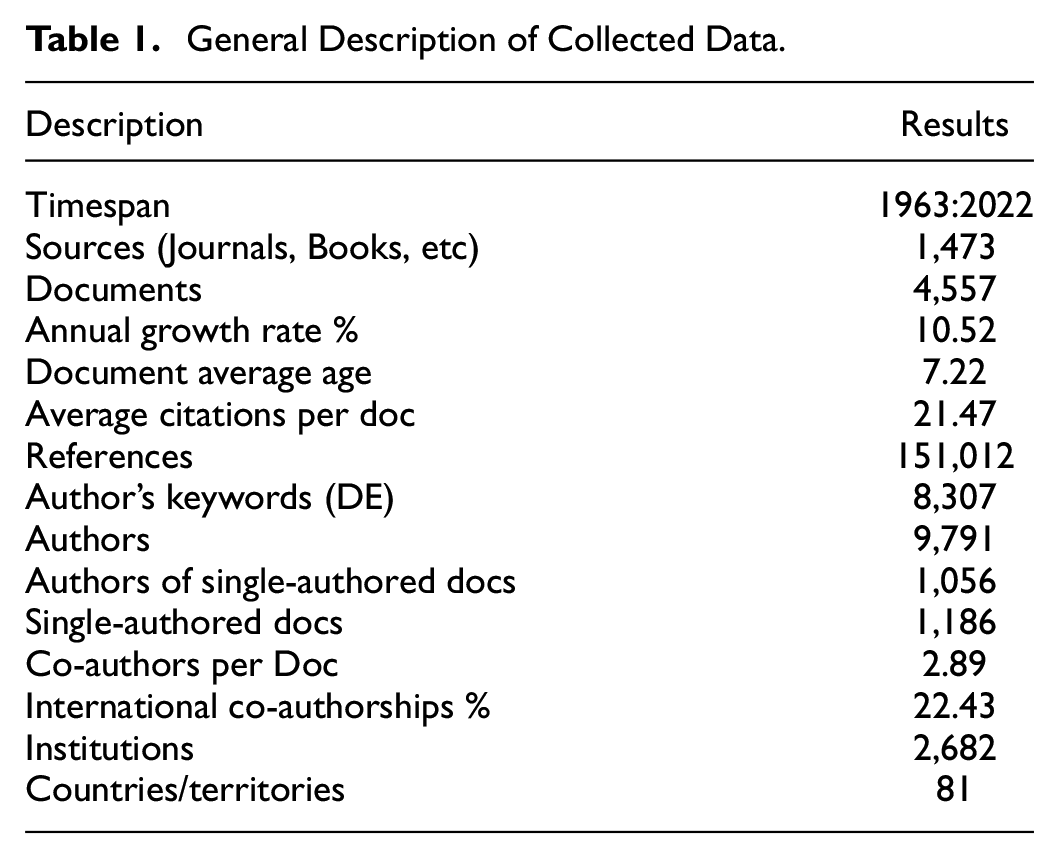
Bibliometric analysis of the collected documents reveals that the 4,557 articles published in 1,473 journals of varied types were inked by 9,791 authors affiliated with 2,682 various institutions from 81 different countries/territories (see Table 1). It is clear that the first article appeared and was indexed on the WoS in 1963 after which the publication of ICCA-related articles experienced an annual growth rate of 10.52%. As shown in Table 1, the sum total of the author’s keywords recorded is 8,307. Of all the articles, 1,186 (26.03%) were single-authored, which might suggest that co-authorship prevails in the field with 22.43% of articles published through international co-authorships.
General Description of Collected Data.
Year-Wise Publication Trend
Figure 2 depicts the annual output of publications in ICCA research. As the graph presents, the number of publications (NP) underwent a steady increase from 1963 to 2005 despite some fluctuations. Ever since then, there was a substantial rise in the number of articles, especially between 2016 (NP = 225) and 2019 (NP = 454) with an annual growth rate of 57.25%. Starting from 2008 (NP = 110), the yearly publications exceeded 100 with 2014 (NP = 205) and 2017 (NP = 303) surpassing 200 and 300 respectively. 2021 (NP = 469) represents the most productive year followed by 2019 and 2020 (NP = 443). According to Maseda et al (2022), the general evolution of publications in the field of ICCA mainly experiences three stages as shown in Figure 1: (a) an initial stage (1963–1990) in which only a fraction of scholars started to conduct research on an emerging scientific domain and published only seven articles altogether; (b) a pre-expansion stage (1991–2005) witnessing 439 publications and an average annual growth rate of 8.8% as a number of researchers were drawn to the field; (c) expansion stage (2006–2022) for consolidating the knowledge in the field as more and more scholars flocked to the research field performing a large-scale of research on various aspects about ICCA and generating the aggregate output of 4,111 papers or approximately 90.2% of the total dataset. The exponential rise in publications may be attributed to several facets of reasons including the increased popularity in the research field of ICCA and enhanced awareness among scholars as immigrant-related issues become increasingly prevalent across the globe, triggering, in some cases, a succession of knotty problems in a few countries/territories (Stockman, 2019). In a nutshell, the field of ICCA research has ushered in its “golden years” characterized by vibrant and vigorous advancement.

The publication trend of ICCA research from 1963 to 2022.
Descriptive Results
Quantitative Analysis of High-Yielding Authors
A quantitative analysis of the most productive authors in terms of the number of publications can help us locate representative researchers in the field of ICCA research. Table 2 gives information about the top 10 most prolific authors in the field affiliated with 9 separate institutions from 7 different countries. The top 10 authors with 249 publications spanning from 1994 to 2014 contributed 5.46% to the sum total of articles. Fons van de Vijver at Tilburg University in the Netherlands ranks first in the number of articles (NP = 31) followed by Dina Birman (NP = 29) at the University of Miami in the USA and John W. Berry (NP = 28) at Queen’s University in Canada. When it comes to the total citations, John W. Berry overwhelmingly surpasses all the other 9 authors with a count of citations of 4,749, which is more than 10-fold the count of Maja K. Schachner from the University of Potsdam in Germany. From the perspective of publication year, Dina Birman and David Lackland Sam at the University of Bergen in Norway are tied for being the earliest authors who generated publications back in 1994.
Most Contributing Authors of ICCA From 1963 to 2022.

The research areas of the ICCA field vary tremendously. With 31 total publications cited 1,249 times, Fons van de Vijver has been the most productive scholar over the past two decades and began to produce research fruits back in 1999. His research focus was mainly on the assessment and test methods regarding cross-cultural adjustment and adaptation (Van de Vijver & Leung, 2021). Dina Birman, a renowned scholar in the field, has published 29 articles with 1,417 citations. Her interests in the research were on the acculturation gap and adjustment challenges among immigrants (Birman, 2006; Birman & Simon, 2014). As one of the most prolific and influential authors, John W. Berry embarked on his journey of scientific production of articles in ICCA research at a very early stage and has been cited the most. He concentrates on the psychological adaptation of immigrants and the mental health of immigrants (Berry, 2001).
Figure 3 shows the temporal production contributed by the top 10 authors during the period of 1994 to 2022. The size of the node represents the number of publications, and the darkness in color is in positive proportion to the total citations of each year. It is evident that the majority of publications are distributed between 2007 and 2022. Dina Birman’s publications cover the widest time frame (1994 to 2022) followed by Félix Neto at the University of Porto in Portugal and David Lackland Sam. Despite being a newcomer compared to his precursors on the list, Maja K. Schachner launched his ICCA publications in 2014 with 19 articles published and 379 citations already. Some other prolific and influential scholars in this research area also include (but are not limited to) Colleen Ward from Victoria University of Wellington, Nigar G. Khawaja from the Queensland University of Technology, Paul Vedder from Leiden University, Maykel Verkuyten from Utrecht University, Saba Safdar from the University of Guelph, Kimberly A. Noels from the University of Alberta, and Linda Juang from the University of Potsdam.
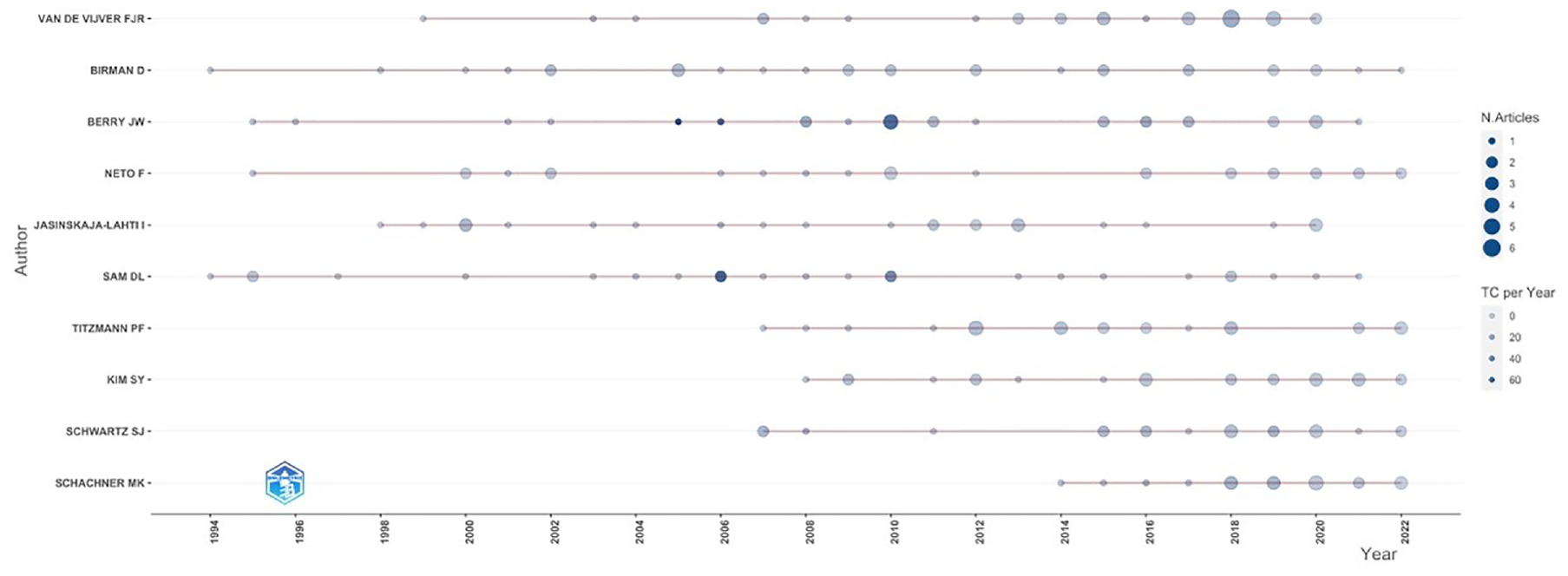
Annual publication counts by the top 10 productive authors from 1994 to 2022.
Quantitative Analysis of High-Yielding Journals
Scientific journals of varied kinds offer important opportunities for scholars to publish their academic and scientific research works. Groups of researchers across various fields contend that the total number of publications and the count of citations in a specific journal are often treated as important indicators for measuring the journal’s impact. In other words, the journals with more papers published and cited enjoy greater impact and prestige in a certain domain of research (Dzikowski, 2018). In our study, we extracted the 20 most productive journals in terms of the number of publications on ICCA research for bibliometric analysis.
As depicted in Table 3, IJIR affiliated with Elsevier in the USA took the lead with 222 publications and 7,750 citations. And it is interesting to note that the journal has the highest count as regards the h/g/m_index, indicating that it is one of the most influential and representative journals in the field of ICCA. The journal is dedicated to spreading knowledge and understanding of theory, research, and practice in the field of intercultural relations covering topics, such as immigrant acculturation and integration; intergroup relations, and intercultural communication. JEMS with Taylor and Francis in the UK comes in second with 150 articles on ICCA published starting from 2003, having received 3,085 times of citations. The journal focuses on the publication of scientific research results in relation to all forms of migration and its consequences, covering such topics as ethnic conflict, discrimination, racism, nationalism, citizenship, and policies of integration. The third spot was secured by JCCP with Sage INC in the USA, recording 88 publications and 2,985 citations. The journal’s thematic discussions are broad in respect of culture, creativity, innovation, and reflections on methods and theory. It presents the latest empirical research findings with respect to major cross-cultural issues in psychology-related areas including social, developmental, cognitive, and linguistic aspects.
List of Leading 20 Journals in the ICCA Research Field.

Another three journals cited more than 2,000 times are Ethnic and Racial Studies (TC = 3,804) by Taylor and Francis, IMR (TC = 3,631) by Sage INC, and IJP (TC = 2,154) with John Wiley and Sons in the UK. Also, International Migration (NP = 70) with Wiley in the USA, Ethnic and Racial Studies (NP = 68), and JIMI (NP = 65) with the publisher Springer Netherlands rank fourth, fifth, and sixth respectively when it comes to the number of publications surmounting the threshold of 50 articles. All such figures suggest that publications on ICCA research in these journals have resulted in a far-reaching impact on the field of research and are gaining increasingly widespread attention among scholars and academics within the circles.
Quantitative Analysis of High-Yielding Countries and Institutions
Identifying the countries contributing the most to ICCA publications enables researchers to gain a better and more comprehensive understanding of the current circumstances in the field and assists them in securing collaborative opportunities in their future studies (Ampese et al., 2022). Table 4 lists the 15 most productive and expressive countries/territories in the field of ICCA research. As presented in Table 4, it is obviously noted that the ranking of NP brings the USA in the first position with 1,311 articles accounting for approximately 28.77% of the sum total, which surmounts the combined publications contributed by its followers: Canada (NP = 354), the UK (NP = 263), Germany (NP = 253), the Netherlands (NP = 227), and Australia (NP = 211). We also included the indices of SCP, MCP, and MCP_Ratio to measure the degree of cooperation among countries, it is noteworthy that Belgium, despite its 15th place in terms of NP, ranks first with 27 out of 64 articles (MCP_Ratio = 0.422) written collaboratively with other countries/territories, followed by Italy with 40 out of 110 articles done through cooperation and China having 68 out of 202 completed in the same way. In terms of the count of citations, the USA is the most influential country with 1,311 articles cited 40,301 times, which outdistances the grand total of citations recorded by Canada (TC = 12,517), the UK (TC = 5,347), Germany (TC = 4,391), the Netherlands (TC = 5,915), Australia (TC = 3,982), and China (TC = 2,463).
Top 15 Productive Corresponding Author Countries.
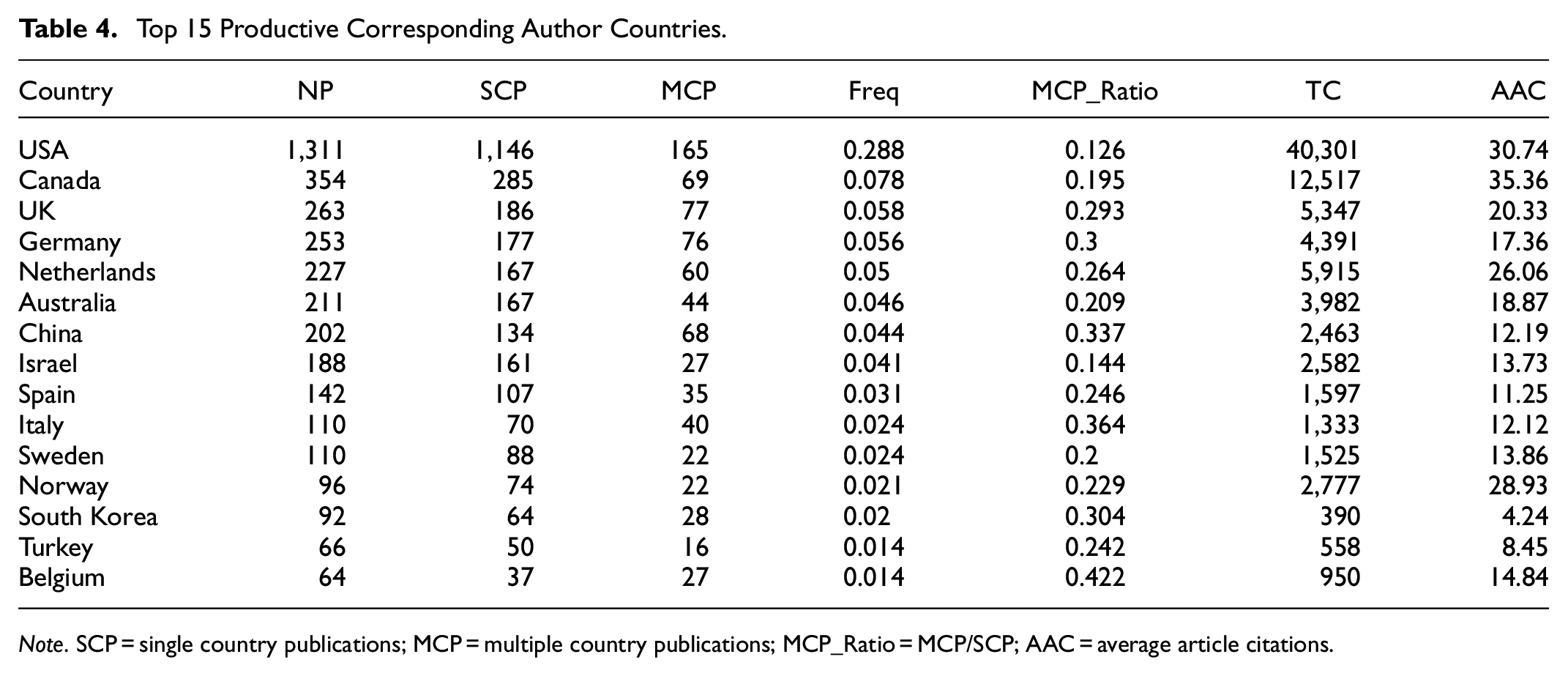
Note. SCP = single country publications; MCP = multiple country publications; MCP_Ratio = MCP/SCP; AAC = average article citations.
In order to grasp the major contributions made by institutions in the field of ICCA research, we shortlisted the most prolific institutions for bibliometric analysis as shown in Table 5 according to the total number of articles published and citation count during the past several decades throughout the world. It is interesting that all the leading institutions come from developed countries among which the USA outnumbers the other 14 countries with six institutions (NP = 311) on the list. This finding is coherent with the fact that the USA is by far the most influential and high-yielding country in ICCA research. University of Illinois (Chicago) in the USA and Utrecht University in the Netherlands are tied with the same number of articles (NP = 68) followed closely by the University of California (NP = 57), University of Queensland (NP = 56), and the University of Amsterdam (TP = 55), and University of Texas (Austin) (TP = 52) from the USA, Australia, the Netherlands, and the USA respectively. In the meantime, we examined the citation measurement of these institutions. It is surprising that Queens University (Kingston) in Canada clinched the top spot with only 42 articles amazingly cited 5,164 times by other papers or 122.95 for each. University of California (Los Angeles) is in the second place with 57 articles cited 3,438 times or 60.32 times for each whereas the University of Helsinki in Finland follows hard on the heels in terms of AAC (50.29) together with the University of Illinois (Chicago) with respect to TC (2,525). In some sense, the results suggest that these institutions are taking the lead in the research field of ICCA.
Top 15 Productive Corresponding Author Affiliations.

Note. Both rankings for 2023. QS = QS World University Rankings; U.S.NEWS = U.S. News Best Global Universities.
Quantitative Analysis of Top-Cited Articles
A host of ICCA-related articles have been published in various sources during the past several decades, which has garnered widespread attention in the scientific community. The most impactful articles based on the measurement of GC are presented in Table 6. All the highly cited papers were published between 1994 and 2010 even though the first article retrieved from the WoS came out in 1963. Berry (2005), which examined the cultural and psychological aspects of conflict and negotiation occurring in the middle of ICCA, published in IJIR from Queen’s University in Canada ranks first in terms of the count of GC (1,378) followed by Portes et al. (1999) (GC = 1,235) from Princeton University in the USA and Berry et al. (2006) (GC=1,036) published in Ethnic and Racial Studies (the UK) and Applied Psychology-An International Review (the UK) respectively. Portes et al. (1999) took a closer look at the concept of transnationalism and some of the common problems facing immigrants. Speaking of the number of LC, Berry et al. (2006) has been locally cited 320 times with an empirical focus on the youth immigrants as to how they acculturate and adapt in a foreign context. Other important papers include Ryder et al. (2000) (GC = 886), Phinney et al. (2001) (GC = 836), and Bourhis et al. (1997) (GC=812). Ryder et al. (2000) compared the unidimensional model of acculturation in three samples of immigrants to figure out the correlations among personality, self-identity, and adjustment. Phinney et al. (2001) presented an interactional model to better comprehend psychological outcomes for immigration by exploring the identity-related questions among immigrants. Bourhis et al. (1997) investigated the dynamic interplay as regards public policy in the host community and the psychological adaptation of immigrants and proposed a social psychological framework—the interactive acculturation model.
Most Influential Articles on ICCA Research.
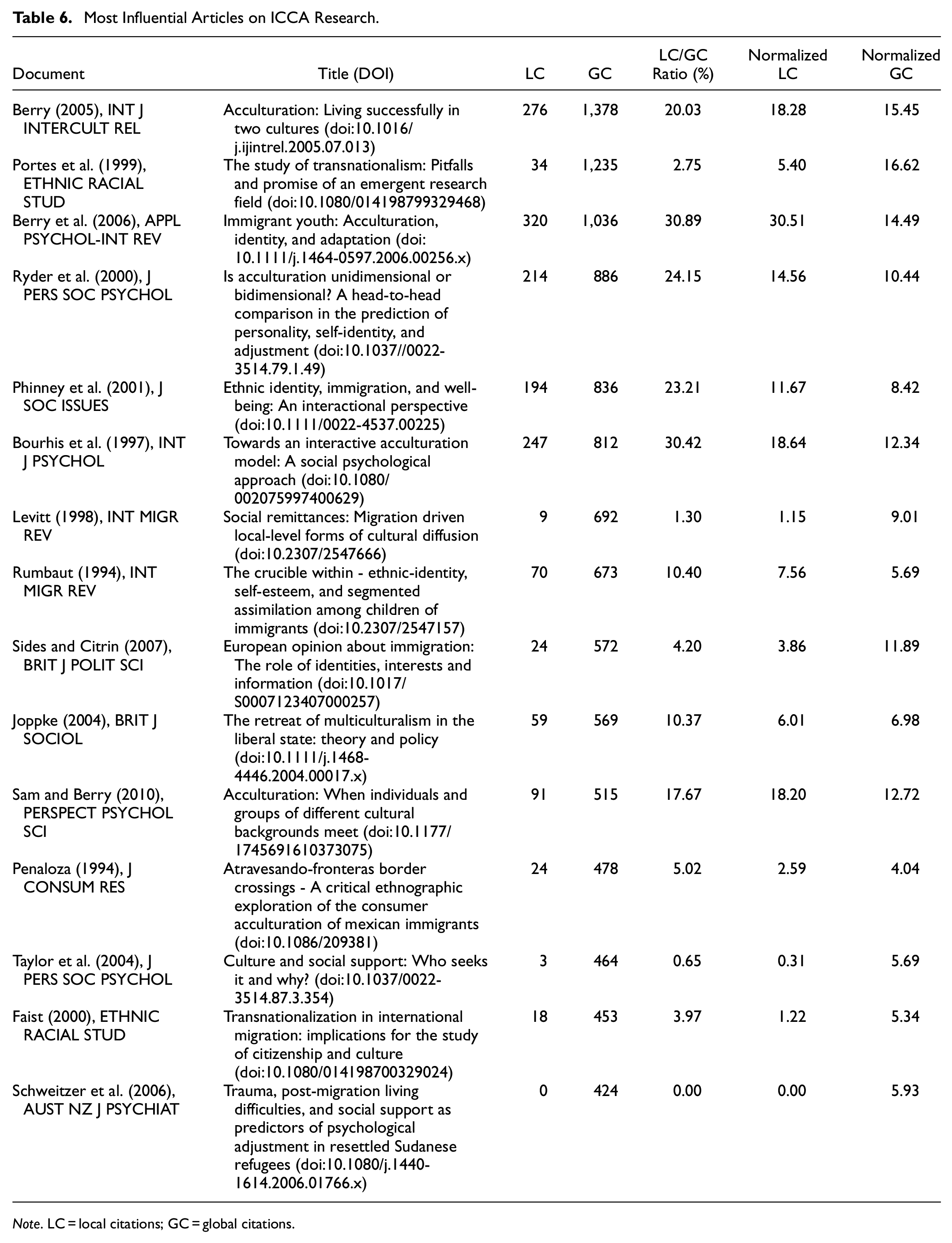
Note. LC = local citations; GC = global citations.
A substantial proportion of the articles in Table 6 touch on various aspects of cross-cultural adaptation among immigrants, and their cultural identity and social identification with the host community. Other prominent issues addressed in these impactful articles encompass the psychological adjustment and well-being of immigrants, public policy in the host community, and social support guiding immigrants’ intercultural adaptation. It is necessary to point out that the majority of top-cited articles were published before 2010, which denotes a dearth of influential works produced in the field in the ensuing years.
Network Analysis
Keyword Co-Occurrence and Clustering
The keywords in a scientific paper are often treated as important indicators of the research focus and numerous scholars and researchers choose to analyze the keywords with high frequency for the purpose of identifying the hotspots in a certain field (e.g., Ellili, 2022; Rejeb et al., 2022). The clustering of major keywords can help scholars gain a general picture of the research field in a vivid and direct manner. In our bibliometric analysis of the keywords, we introduced the formula suggested by Wei et al. (2019) to properly locate the keywords of high co-occurrences in a bid to better understand the major topics of discussion in the field of ICCA research. In line with the formula, Nmax is referred to as the keyword having the strongest frequency.

In this study, Nmax is the keyword “acculturation” with the highest frequency (Nmax = 1,539) based on the readings in VOSviewer. Thus, we can calculate M ≈ 29.38, which means that the keywords with occurrences ≧29 should be the high-frequency keywords suitable for our bibliometric analysis and clustering.
Figure 4 illustrates the network visualization based on keyword co-occurrence results. As presented in the figure, the node size is proportional to the occurrence frequency of keywords. The bigger frames indicate a higher frequency of keywords’ occurrences. Different colors correspond with various clusters of keywords or research topics. And the links connecting different nodes reveal the degree of relationships among keywords. The thicker the links are, the more frequently the keywords appear concurrently in the same literature. As shown in the figure, green and red clusters are more tightly bound while yellow and blue clusters are somewhat diffusive. To figure out the concrete relationships of keywords and delve into the trending research topics in the field, we categorized the major keywords within each cluster in accordance with the occurrence frequency, as stated in Table 7. The clustering of high-frequency keywords provides a significant platform for scholars to perceive the research foci or hotspots in a certain field. Each cluster of keywords is discussed in sequence.

Network visualization based on the co-occurrence of keywords.
Cluster of Major Keywords in the Field of ICCA Research.

The red cluster (cluster #1) consists of 71 keywords with the keyword “integration” having the largest frame of 783 occurrences, which indicates that this cluster mainly touches on the integration of immigrants in foreign contexts. According to Berry (1992), integration is the strategy adopted by immigrants who are willing to retain their own cultural and ethnic identity but at the same time value social and cultural contacts with the dominant society. A considerable quantity of articles highly related to this cluster of keywords care about how immigrants throughout the world integrate into host countries and related issues in the midst of their integration (Bohning, 1991; Jones & Findlay, 1998; Pieterse, 2000). Furthermore, a number of articles conduct comparative studies on immigrants’ integration in different countries (Chen et al., 2013; Jöns et al., 2007; Slonim-Nevo et al., 2007). This may indicate that the comparison-based approach has been widely adopted in the field of ICCA research except for the frequently-used empirical approach. Furthermore, this cluster placed much emphasis on immigrants’ identity and citizenship as well as the education of young immigrants, indicating their potential as hot topics for future ICCA research.
The green cluster (cluster #2) encompasses 65 keywords, among which the keyword “acculturation” has the biggest number of 1,539 occurrences. The central theme of this cluster is the cultural adaptation or acculturation of immigrants, especially adolescents and children. Acculturation is a rather intricate mechanism involving societal and individual levels. It should be noted that the acculturation process entails an unavoidable adjustment to a host culture on the part of a member of a migrant culture, which requires necessary changes in the individual’s traditions, living habits, language usage, lifestyle, and value orientations (Szapocznik et al., 1978). Papers categorized into this cluster fix research attention on the acculturation of immigrants based on a set of research methods. For example, Koydemir (2013) employed empirical research methods in the study of a sample of youth of Turkish descent living in Germany for the purpose of discerning their cultural identifications and acculturation stances and measuring the impact of cultural identifications along with background variables on cognitive and affective aspects of subjective well-being. It was found that identifications associated with heritage culture and mainstream culture were identified to be irrelevant to one another, and both factors exerted some influence on the well-being of immigrants, with the former predicting affective and the latter predicting cognitive well-being. Dimitrova et al. (2014) opted for a comparative approach by comparing (a) differences in acculturation orientations between Turkish ethnic minority groups living in Bulgaria and the Netherlands, and psychological and sociocultural outcomes, and (b) the correlation of acculturation orientations and outcomes in one group that has experienced acculturation for a longer time (Turkish-Bulgarian) than the other group that is newly engaged in acculturation (Turkish-Dutch). The study results revealed that the former group reported a stronger orientation towards their mainstream culture despite a relatively lower degree of life satisfaction, while the latter group projected a stronger affinity with their Turkish heritage culture. Moreover, high frequencies of keywords, such as “mental health,”“discrimination,”“stress,” and “social support” suggested that many studies explored the factors affecting immigrants’ mental health and the corresponding coping strategies (e.g., various forms of social support) against discrimination and acculturative stress.
The 62 keywords grouped into the blue cluster (cluster #3) pay major attention to immigrants as the subject matter of research. Articles in this cluster center on the acculturation experiences of immigrants (refugees included), especially immigrants in the United States. For instance, Kim and Hurh (1993) empirically collected data through interviews of Korean adult immigrants (aged 20 or more) who resided in the United States so as to test their social and cultural adaptation with a conceptual model. And based on the publicly available New Immigrant Survey, Kathawalla and Syed (2022) explored the relationship between diachronic identity integration (how identity is integrated as time passes) and perceived well-being for Muslim immigrants newly migrating to the United States in the occupational and sociocultural domains. In the meantime, some papers of this group take a closer look at women immigrants as they struggle to adapt to their host communities. A case in point was exemplified by Semedo et al. (2020) that examined the experiences of women immigrants from Somalia who were involved in a pain rehabilitation program in Northern Sweden, which led to positive changes in their acculturation and more knowledge about how to cope with acculturative stress and strengthen their self-confidence and well-being.
The yellow cluster (cluster #4) with 23 keywords predominantly deals with the attitudes of immigrants toward various facets of host communities and the attitudes of receiving countries towards them. For instance, Genkova and Groesdonk (2022) investigated the association between ethnic identity, acculturation attitudes, cross-cultural competence, and prejudice and the interplay between acculturation experiences and these relationships among students in Germany. One of the key results showed that there exists a close relationship between unfriendly attitudes (e.g., discrimination, racism, and prejudice) of the host community toward immigrants and their social identity, coping strategies, and cultural intelligence. As contrasted, Ocampo and Flippen (2021) investigated cross-dimension variation in Latino immigrants’ attitudes toward white and black people as well as other Latinos, involving perceived affluence, intelligence, cultural behaviors, and receptivity to contact in a bid to evaluate major theories in the literature pertaining to racial attitudes, such as the effects of socio-demographic factors, forms of insecurity, perceived threat, and social contact. La Roi and Mood (2023) investigated the nexus of young immigrants’ attitudes with respect to family, sexuality, and gender roles with their socio-cultural adaptation in a foreign context and engagement with their Swedish-background peers by comparing attitudes held by first- and second-generation immigrants, and held by youth as compared to those of their parents, and inspecting the temporal evolution in youth’s attitudes.
Overall, it is through cluster analysis of keywords that we can have a better and more detailed understanding of the research foci in the ICCA research. Also, we should know what research topics are mainstream, what research methods are widely adopted by scholars, and what areas should be further explored in the future. In our study, we have determined that a sizable number of ICCA scholars are pouring their energies into the research of social or psychological acculturation, assimilation, and adjustment of immigrants, whereas less attention is paid to how immigrants’ experiences in host communities (affected by an array of factors which include but are not limited to attitudes, social and cultural identifications, gender, race, and occupation) may continue to impact their well-being and socio-cultural adaptation. Such research areas are of critical significance in the long run, thus necessitating scholars in the field to conduct more scientific research.
Diachronic Keyword Analysis: Thematic Evolution
Through thematic evolution analysis, we can explore major changes in research topics across various periods in the field of ICCA research, which may shed light on the future trends of research. The field of ICCA research has undergone a dynamic process of changes in research topics as three-time slices from 1963 to1999, 2000 to 2010, and 2011 to 2022 revealed based on the analysis of keywords.
As can be seen in Figure 5, the size of a rectangle indicates the number of keywords classified as a specific research topic, and the links connecting them represent the evolution of research foci. According to the figure, the keywords “children” and “adolescents” in the first time slice between 1963 and 1999 indicate that the research focus of a considerable number of publications during the period was primarily on the acculturation of young immigrants (Erol & Sahin, 1995; Portes, 1999; Short & Johnston, 1997). In the meantime, a great many articles at that time paid much attention to the adaptation of immigrant families as they migrated from their home countries to host destinations (Baptiste et al., 1997; Ben-David, 1995; Sciarra, 1999). The research topics during the second period between 2000 and 2010 manifest greater diversity and cover a broader spectrum for having more keywords compared with the other two time slices. The presence of keywords, such as “depression’, “psychological well-being,” and “perceived discrimination” at the time means that many scholars began to care about immigrants’ mental and psychological health as they struggled to adjust themselves to new societies and cultures despite a series of adversities like social discrimination (Buddington, 2002; Fuligni et al., 2002). Also, some scholars showed solicitude for immigrants, especially those from Australia and European countries at a time when crowds of people across the globe migrated to such regions for a better life (Barrett et al., 2002; Fomina, 2006; Leung, 2001). Moreover, there are keywords like “cultural diversity” and “cultural identity,” which reveals that some studies during the specified period started to focus on how immigrants maintained their cultural identity while enriching the diversity of host cultures (Britto & Amer, 2007; Dandy & Pe-Pua, 2010). In addition to the concentration on the process of acculturation and adjustment of immigrants, especially the second-generation immigrant youth (Berry & Sabatier, 2010), a relatively large share of research publications revolved around the coping strategies guiding immigrants’ acculturation to the host communities (Matschke & Sassenberg, 2010). In terms of the last time slice from 2011 to 2022, an eye-catching change lies in a sharp growth in the proportion of publications with respect to the acculturation of immigrants as an increasing number of people cross borders out of disparate considerations in a globalized world. To be specific, the focus of immigrants’ acculturation was placed on more concrete elements, such as “psychological adjustment and adaptation,”“sociocultural adaptation,” and “psychological well-being” while some attention to ICCA research was paid to the acculturation challenges confronting immigrants and corresponding strategies given the existence of keywords of “stress” and “acculturation strategies” (Frankenberg et al., 2013; Sochos & Diniz, 2012).
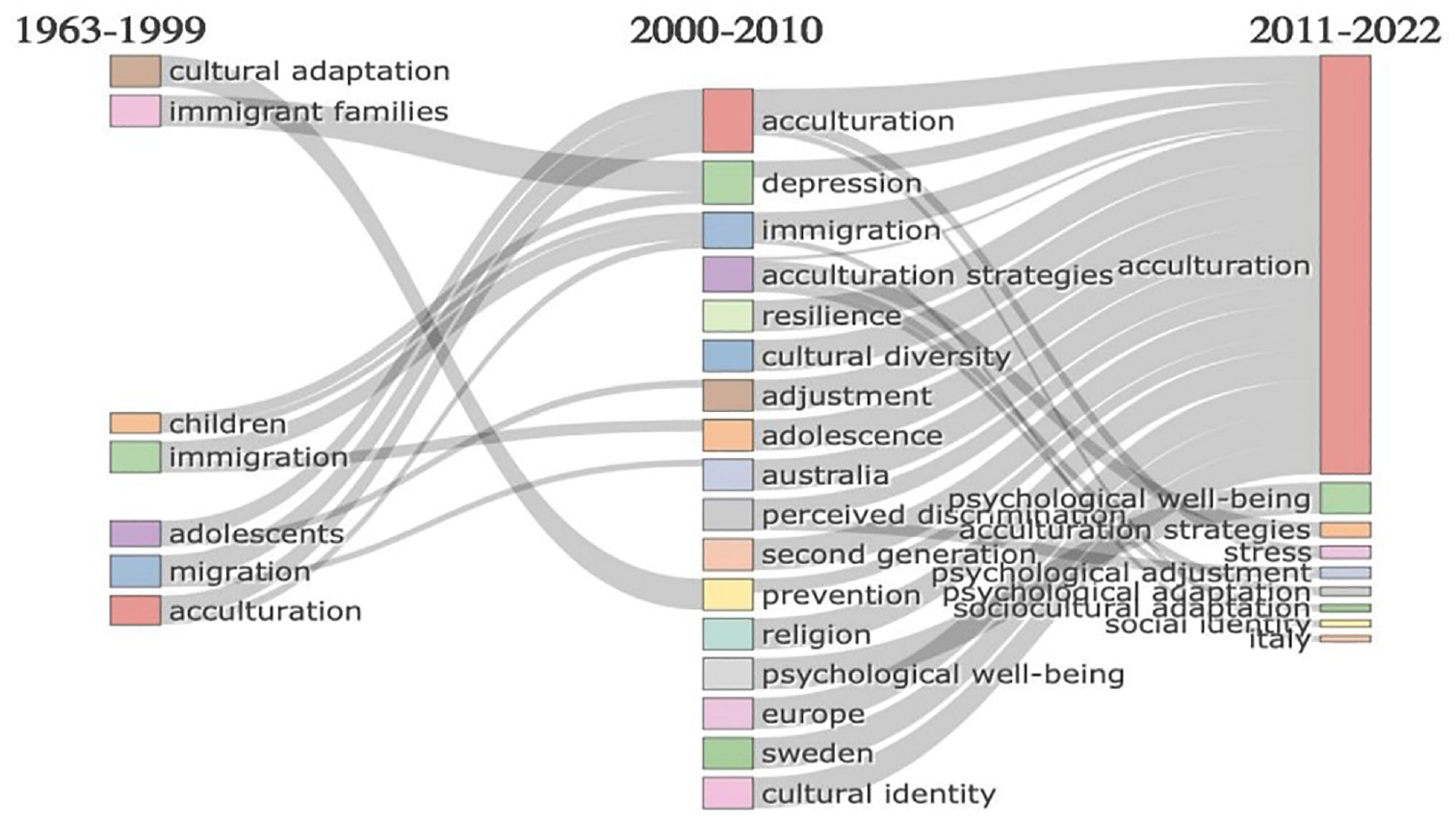
Thematic evolution based on keywords from 1963 to 2022.
By comparing the distribution of keywords in three different time slices, we can naturally come to the conclusion that the major focus has, in a broad sense, remained unchanged despite some variations in the research topics of ICCA. Across the timeline, ICCA research has always centered on the “acculturation,” and “psychological and sociocultural adaptation” of immigrants. Following the 21st century, scholars of ICCA research embarked on their scientific endeavors in the field to pore over a wider range of research topics by supplementing previous research frameworks and proposing theoretically innovative ideas.
Major Analysis of Burst Keywords
The burst of keywords serves as a key indicator of exploring emerging trends and research fronts in scientific research, reflecting the sudden rise in citations within a specified period. With the help of CiteSpace, we can conduct a detailed analysis of burst keywords, a method that can provide helpful insights for scholars to identify the evolution trend of research hotspots in ICCA research. Burst detection, an algorithm developed by Kleinberg (2016), presents a vivid and direct way to record the sudden emergence and changes in references or keywords’ popularity during a given period. Moreover, burst keyword analysis can also be helpful in locating those keywords that have been omitted due to their low frequencies but may contribute to an overall analysis of the hotspots and fronts in ICCA research.
Figure 6 presents the 30 keywords with the strongest citation bursts that fall into the time range set between 1992 and 2022 since no major keyword burst occurred before 1992. As shown in the graph, a blue line indicates a specific timeline and a red segment located in various places of the blue line represents the interval during which the burst of a keyword occurs (Hao et al., 2022). Also, the burst strengths and starting and ending years are displayed in the figure. Normally, the burst intensity is commensurate with the attention given to a research topic and the number of related publications at a given time.

Top 30 keywords with the strongest citation bursts.
As demonstrated in Figure 6, the ICCA research field illustrates a great variety of research topics as different burst keywords show up throughout different periods. The keywords having the most powerful intensity are “stress” (21.14) followed by “Mexican American” (21.09), “United States” (14.61), and “self-esteem” (13.71). The former three keywords burst in the 1990s with the keyword “Mexican American” lasting for 20 years from 1992 to 2012, which ranks first of all the keywords in terms of the time of duration and beginning time. During this period, umpteen publications focused on the acculturation-related issues facing Mexican immigrants in the United States, such as their psychological health, and the social and cultural challenges they met (Iturbide et al., 2009; Rodriguez et al., 2002; Schofield et al., 2008). Starting from 1996, an explosion took place in the publication of articles regarding acculturative stress and pressures inflicted upon immigrants across the world as the keyword “stress” burst all the way to 2010 (Diwan et al., 2004; Jasinskaja-Lahti et al., 2003). During the period, there were numerous empirical studies on immigrant families, international students, and refugees based on relevant intercultural communication theories (Diehl & Schnell, 2006; Pan et al., 2007). It is worth pointing out that the following keywords bursting over the last five years from 2017 to 2022 are “social network,”“national identity,”“work,”“Syrian refugee,”“resilience,”“social integration,” and “employment.” These are emerging research themes in recent ICCA studies and could help scholars determine research fronts in the field, which will work to chart a prospective course for ICCA research in the years to come. In addition, during the period (2014-2019), much research attention was also paid to the acculturation of immigrants living in regions like Western Europe, investigating various facets including assimilation patterns, employment, and well-being,
Co-Authorship Networks
The co-authorship analysis provides a significant and efficient way to examine the collaborative relationships among ICCA authors, contributing institutions, and countries. In this study, network visualization graphs were plotted via VOSviewer based on the co-authorship of authors and institutions. The frame size signifies the number of articles while the thickness of the links symbolizes the frequency of collaboration among various authors and institutions.
Figure 7a displays the co-authorship of authors who have produced a minimum number of documents of 8 that were cited at least 20 times. As a result, 52 authors were selected and divided into 28 pairs in 8 clusters based on their links. Brit Oppedal affiliated with the Norwegian Institute of Public Health owns by far the most co-authorship links of 12 with Dina Birman, Rainer K. Silbereisen, Colleen Ward and Peter F. Titzmann having co-authored 24 publications. Seth J. Schwartz at the University of Texas at Austin comes second with 11 links and has cooperatively published 20 articles with authors, such as Alan Meca, Jennifer B Unger, Paul Vedder, and Su Yeong Kim. Veronica Benet-Martinez at Pompeu Fabra University also enjoys strong scientific collaboration relationships with 10 links and has 10 documents co-authored with Van Oudenhove, Pieter Jan, and others.

(a) Network of co-authorship of authors, (b) authors’ affiliated institutions, and (c) authors’ affiliated countries/territories.
As for the co-authorship of institutions, the threshold was set as having at least 20 publications and 20 citations for each, which led to 64 meeting the standard (see Figure 7b). As demonstrated in the figure, Utrecht University in the Netherlands and the University of Texas at Austin in the United States both have established cooperative ties with 19 institutions across the world and co-authored 68 and 52 publications respectively. Harvard University enjoyed 17 partners and co-authored 28 documents with them. Interestingly, the University of Amsterdam in the Netherlands, the University of Michigan, and the University of California, Los Angeles tied for cooperating with an equal number of 16 institutions. In addition, the other universities with strong collaborative relationships include the University of Minnesota (15 links), McGill University (15 links), Michigan State University (14 links), the University of Miami (14 links), and the University of Illinois at Urbana-Champaign (13 links).
When it comes to the co-authorship of various countries/territories, 43 items were selected as we set the threshold of at least 10 publications and 10 citations. As demonstrated in Figure 7c, the thickness of links is proportional to the cooperation intensity between countries/territories. As Figure 7c illustrates, it is clear that the USA has the largest quantity of co-authored publications followed by Canada, the UK, Germany, the Netherlands, Australia, and China. When it comes to the cooperative relationship, the USA has the most cooperative partners (53) while the UK, the Netherlands, Germany, Australia, and Italy have 52, 44, 42, 39, and 37 collaborators respectively. Obviously, scholars in the ICCA research field from the USA maintained frequent scientific cooperative relationships with Canada, China, South Korea, Germany, the UK, the Netherlands, and Israel.
Bibliographic Coupling of Authors and Affiliated Institutions
In our study, we also visualized the bibliographic coupling of authors so as to probe into the intellectual connections among various authors in the field of ICCA during the period from 1963 to 2022. Figure 8a presents the bibliographic coupling associations among 23 ICCA authors who have contributed a minimum of 10 articles with at least 10 citations. As shown in the figure, there are four clusters connected by numerous links, which means that these highly contributing ICCA authors fall into four major intellectual groups. The strongest link strength (LS) occurs between Maja K. Schachner and Fons van de Vijver (LS = 2,101), followed by Peter F. Titzmann and Rainer K. Silbereisen (LS = 1,580), John W. Berry and David Lackland Sam (LS = 1,348), John W. Berry and Félix Neto (LS = 1,210), and Frosso Motti-Stefanidi and Maja K. Schachner (LS = 773). Also, the spatial closeness between authors reflects their intellectual proximity or affinity in the ICCA research field. For instance, being the top and representative co-authors, John W. Berry and Fons van de Vijver share.
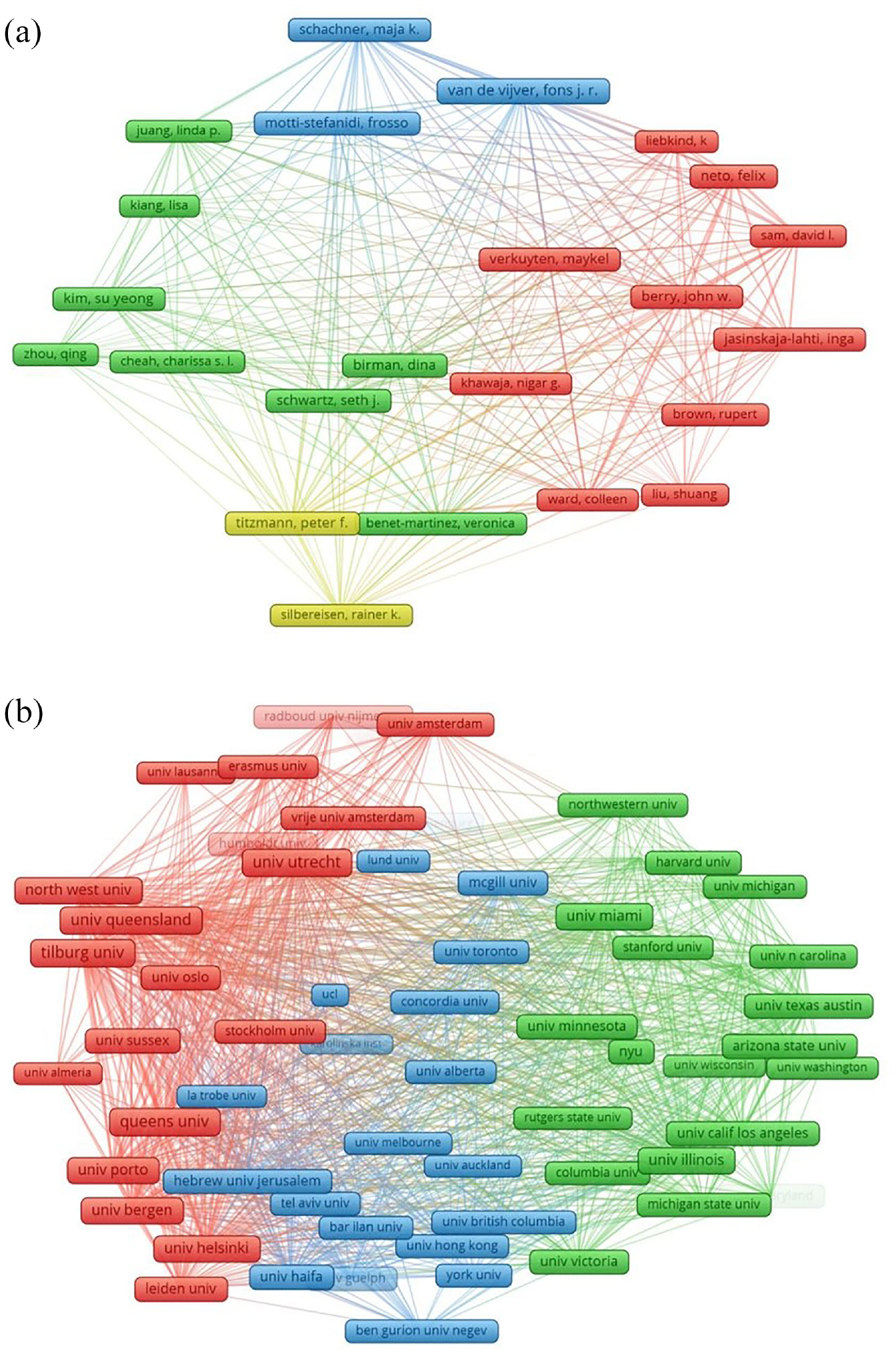
(a) Network of bibliographical coupling of authors and (b) authors’ affiliated institutions.
Figure 8b demonstrates the bibliographic coupling of 64 ICCA authors’ affiliated institutions with at least 20 documents and being cited at least 20 times. Queens University (Kingston) and Tilburg University serve as the strongest bibliographic couple (LS = 2,547), followed by the couples of Queens University (Kingston) and the University of Bergen (LS = 2,474), Queens University (Kingston) and the University of Queensland (LS = 2,275), and the University of Miami and the University of Illinois (LS = 2,081), as well as Queens University (Kingston) and the University of Helsinki (LS = 2,068). The strong links connecting these institutions reveal that they bear enormous similarities in terms of the sources of intellectual impact reflected in ICCA publications.
Bibliographic Coupling of Countries and Territories
The map in Figure 9a reveals how major author-affiliated countries/territories are clustered and correlated based on the bibliographic coupling of countries/territories, namely when two authors affiliated with a country refer to a common third author (Ramos-Escobar et al., 2022). There are 43 countries/territories identified when the threshold was set as a minimum of 10 documents cited at least 10 times. All the selected countries/territories are divided into six clusters, making it possible to directly perceive their correlations. For instance, the green cluster led by the USA is made up of countries including Canada, Australia, China, South Korea, New Zealand, Singapore, Pakistan, and Malaysia as well as Taiwan region, which may be indicative of scholars from these countries and regions have focused their attention, to a large extent, on similar research topics. The USA is located in the center of the graph with the largest number of ICCA-related publications. And the USA and Germany form the closest bibliographic couple due to having the strongest link strength followed by the USA and Canada, the USA and the UK, and the USA and China.
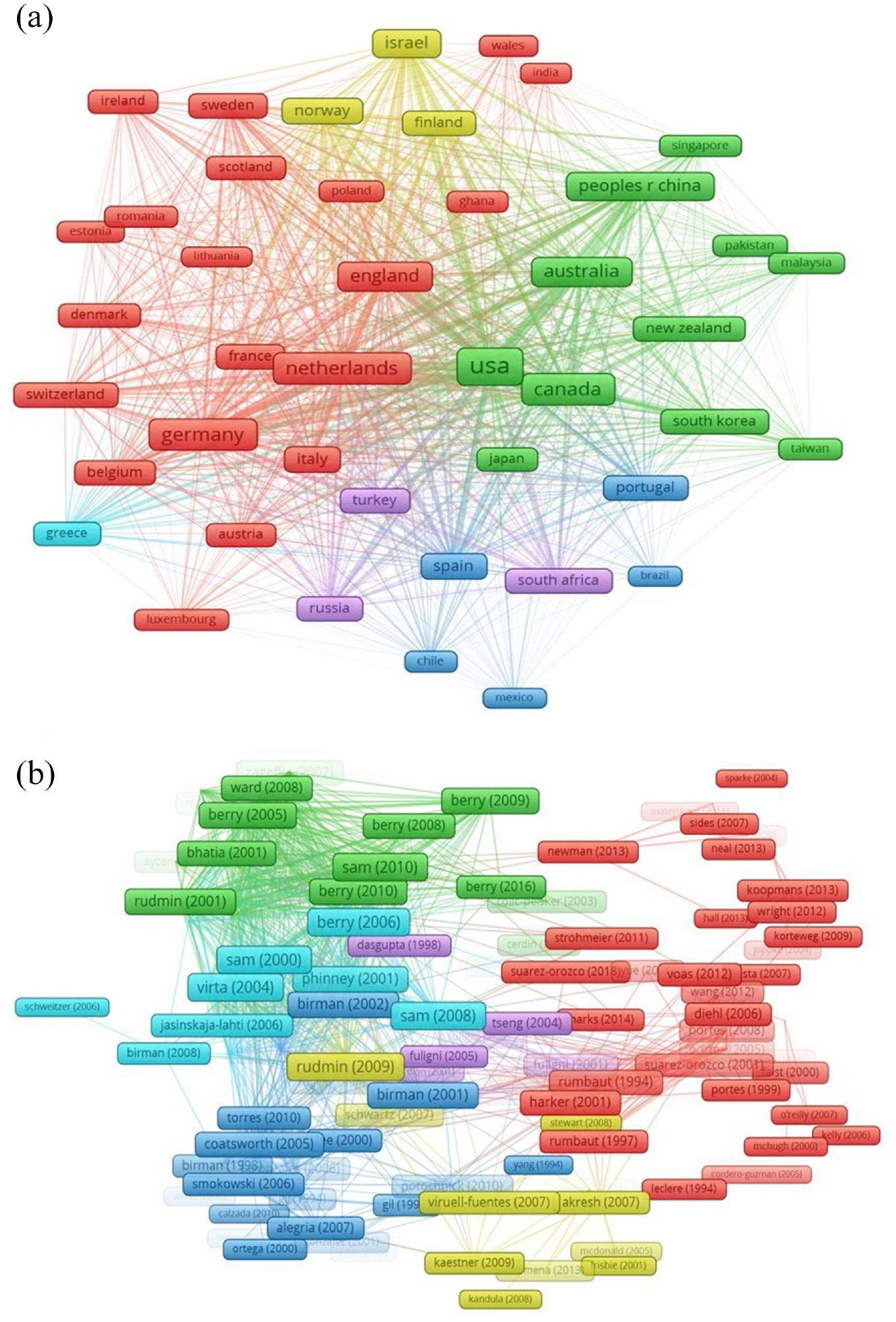
(a) Network of bibliographical coupling of authors’ affiliated countries/territories and (b) articles.
Bibliographic Coupling of Articles
Figure 9b reveals the bibliographic coupling connections based on articles in our study, which are classified into six clusters in specific colors. According to Kessler (1963) and Weinberg (1974), two documents citing a series of shared references can be treated as a bibliographic couple with highly related intellectual content and research focus. The method enables scholars to discern the closeness between articles as they share a certain quantity of references. In our study, the applied threshold of at least 100 citations for each article gave rise to 167 linked documents, and the frame size represents the total link strength. The link strength of a document is consistent with its relationships with other documents. As clearly displayed in Figure 9b, Sam and Berry (2010) comes with the highest link strength (LS = 352) followed by Virta (2004) (LS = 345), Berry et al. (2006) (LS = 335), Sam et al. (2008) (LS = 334), and Rudmin (2009) (LS = 330).
The red cluster (cluster #1) contains 62 articles or 37.1% of the sum total with the highest citation counts. Immigrants’ assimilation, psychological health and well-being, and opinions about immigration constitute popular research themes of this cluster (Harker, 2001). The acculturation of young immigrants is particularly discussed in this cluster (Portes et al., 2005; Rumbaut, 1994). The green cluster (cluster #2) is composed of 33 articles or 19.8% of all, which majorly talks about the social and cultural identities of immigrants, immigrant-majority relations, and acculturation attitudes (Arends-Tóth & Vijver, 2003; Zagefka & Brown, 2002). The blue cluster (cluster #3) includes 32 documents, which predominantly discuss acculturation strategies, stress, and the cultural as well as psychological functioning of immigrants (Coatsworth et al., 2005; Nguyen et al., 1999). The yellow cluster (cluster #4) is made up of 14 items whose central themes are measurements and models of acculturation, and immigrants’ health-related issues (Akresh, 2007; Viruell-Fuentes, 2007). The pink cluster (cluster #5) encompasses 14 documents whose research topics mainly touch on the academic adjustment of youth immigrants (Tseng, 2004), and generational differences in acculturation (Fuligni, 2001; Kwak & Berry, 2001). The light blue cluster (cluster #6) has 12 articles focusing on the psychological adaptation of immigrant youths (Liebkind & Jasinskaja-Lahti, 2000).
Conclusion and Implications
In this study, a bibliometric review was carried out on a global scale to examine an extensive amount of literature on ICCA research from the WoS-core collection database during the period of 1963 to 2022. Our findings illuminate the evolution of ICCA research based on the analysis of multiple bibliometric indicators, such as contributing authors, countries/territories, journals, and academic institutions. It can be observed that ICCA as a field of research has undergone continuous growth, especially following the year 2005. Through detailed analysis of the clustering patterns, the study offered a clearer insight into the collaboration and bibliographic coupling networks, making it possible for researchers to identify hot research topics and themes in this knowledge domain. At present, the social or psychological adaptation of immigrants is a representative hot theme in ICCA research, whereas much more attention should be paid to the international experiences of immigrants in host communities, particularly the interplay between their attitudes, social and cultural identifications, gender, race, and occupation with their overall well-being and socio-cultural adaptation. Moreover, through an in-depth analysis of burst keywords, the comprehensive research results highlighted future research streams in the field when several research topics including “social network,”“national identity,”“social integration,”“employment,”“work,”“refugee” (like Syrian refugee), and “resilience” emerge as the research fronts of ICCA.
Apart from this, our study should have practical implications for policymakers and practitioners working with immigrants to better understand the process of ICCA and related problems in an effort to work out more friendly and inclusive policies and laws and promote peaceful co-existence between immigrants and the majority group, particularly in those countries where hostile activities against immigrants are rampant. First, policymakers can benefit from understanding the global landscape of ICCA research presented in this study. By recognizing the trends, research hotspots, and emerging topics identified through bibliometric analysis, policymakers can gain insights into the evolving needs and challenges faced by immigrant populations. This understanding can inform the development of more effective policies and interventions aimed at supporting immigrants’ integration and well-being in host communities. Practitioners working directly with immigrant populations can also draw valuable insights from this study. The identification of key themes such as acculturation, integration, and attitude, as well as emerging topics like resilience and employment, provides practitioners with a roadmap for addressing the multifaceted needs of immigrants. By aligning their practices with the current research trends and priorities highlighted in this study, practitioners can enhance the relevance and effectiveness of their interventions. Furthermore, the findings underscore the importance of considering the social and psychological adaptation of immigrants within host communities. Practitioners should pay particular attention to factors such as gender, race, occupation, and cultural identification, which play a crucial role in immigrants’ overall well-being and socio-cultural adaptation. By adopting a holistic approach that addresses the intersectionality of these factors, practitioners can better support immigrants in their adaptation processes and promote their successful integration into society.
Limitations and Future Recommendations
Several limitations should be pointed out in spite of some insightful findings presented in the study. First, bibliometric data are subject to limitations such as spelling differences, errors, inconsistencies in subject indexing, changes in journal titles, and variations in presenting authors’ names and initials (Heberger et al., 2010). Second, the reliance on the WoS as the only database for collecting bibliometric data may not capture the entirety of ICCA research, potentially overlooking relevant journal articles indexed in some other reputable datasets. Meanwhile, although the search query was comprehensive, it is challenging to ensure a complete inclusion of every piece of literature on ICCA. Consequently, relevant papers might have been omitted due to the selection of search terms and the authors’ choice of keywords. As a result, this might have further consequences on some of our results, such as the publication trend, the top productive authors, countries, and institutions as well as highly cited papers. Future research should be more comprehensive by using as many keywords as possible and including more databases, such as Scopus, Science Direct, Google Scholar, and PubMed, and incorporating gray literature from government and non-governmental agencies. Third, only articles were selected excluding publications from dissertations, conference papers, books, and comments. Subsequent studies can also retrieve literature on ICCA from those sources. Also, the inclusion of only English-language publications may overlook valuable contributions in other languages, indicating the necessity of adopting a more inclusive linguistic approach in future analyses. Fourth, for bibliometric analysis, we picked out titles, abstracts, and keywords in our sample without selecting full-text papers for content analysis. Even though the three components can function as symbolic indicators reflecting the purposes, gist, and results of certain papers, future studies are supposed to incorporate full texts of chosen literature in a bid to explore broader aspects of ICCA by performing a core content analysis of bibliographic data. Lastly, despite the objective bibliometric data used for quantitative analysis with the help of professional software, the analysis and interpretation of relevant information in our study cannot achieve complete objectivity. Moreover, different search criteria (e.g., the choice of search terms) may result in differing perspectives on the research domain and may lead to different results. Therefore, future studies may be based on more frequent and proactive communication between authors and experts in the field to seek objective and constructive viewpoints in an effort to diminish the inevitable influence of personal subjectivity on data analysis.
Footnotes
Declaration of Conflicting Interests
The author(s) declared no potential conflicts of interest with respect to the research, authorship, and/or publication of this article.
Funding
The author(s) received no financial support for the research, authorship, and/or publication of this article.
Ethical Approval
This article does not contain any studies with human participants performed by any of the authors.

Data Availability Statement
Data sharing not applicable to this article as no datasets were generated or analyzed during the current study.