




Abstract
Education is considered a key element in the formation of human capital, associated with the sustainable development of a country’s economic growth. The study has investigated the relationship between education and Pakistan’s economic growth in the short as well as long run. For measurement, thirty years of data spanning from 1987 to 2016 was used in the study. The data was retrieved from World Development Indicators (WDI) and the Pakistan Bureau of Statistics (PBS). Economic growth was measured from real GDP while education was measured by total years of formal education and government expenditures for education. Pesaran bounds test approach and ARDL model for long and short-run co-integration were applied. The results deduced from the study described that by increasing the labor force education, the real GDP increases with the existence of significant and positive co-integration and confirmed the long-term relationship. It is observed that by increasing the 1% of labor force education, there is a 0.62% increase in real GDP (economic growth) in long run. On the other hand, the results also described the significant and negative co-integration relation between government education expenditures and economic growth (real GDP) in long run. The appearance of this negative relation in results is probably due to the unavailability of total educational expenditures as in this study the education of the labor force increases with decreasing trends in government educational expenditures. This study may be helpful for policymakers in educational policy formulation to enhance the government educational expenditure for improving the education standard of the labor force to boost Pakistan’s economic growth.
Keywords
Introduction
For the development of a country, human resource is one of the fundamental factors along with other factors like physical capital, technologies, natural resources, etc. and for the formation of a country’s human capital, education is the key contributing element. Enhancing the educational status of the labor force increases the individual’s earnings which helps in productivity enhancement and the betterment of the labor force’s social life. According to the new growth theories human capital is the locomotive of the development of the economy (Barro, 1991; Barro & Lee, 1993; Echevarría & Iza, 2006). There is a significant and constructive relationship between GDP per capita and school enrolment of the labor force (human capital) (Barro, 1991). Education improves the efficiency and productivity of the individual, which generates a skilled and efficient labor force with the ability to lead the economy of a country on the path of sustainable economic development (Zaman et al., 2012). In general, it has been assumed that advanced and general education has the same production efficiency. However, in reality, education is hierarchical, and an individual can enter advanced education only after receiving a general education. There are differences in the knowledge, skills, and creativity of hierarchical human capital (Driskill & Horowitz, 2002; Zhou et al., 2021). The labor force with diversity in the level of education, health, and experience significantly influenced labor force participation and employment (Farid et al., 2012). Furthermore, education plays a significant and positive role in the development of the world economy. Due to this imperative association between economic growth and education, the concentration of various empirical studies diverted toward this issue. Based on this significant affiliation, in economic literature, the influence of educational investment on economic growth becomes one of the key research topics. By investing in human capital (education) effective contribution of each individual can be enhanced productively. In reality, there is mixed empirical literature on the nexus of economic growth-education expenditure. The range of the results of educational expenditures’ effect on economic development is from positive to negative or inexistent.
In the world, Pakistan is the 5th most populated country, so it consist of large number of human resource. For the significant use of this bulky number of human resource, education is very important. The educational profile of Pakistan in history is not good. Literacy rate of Pakistan is also low concerning its region (subcontinent), that is, 57% (economic survey of Pakistan, 2015–2016). Education expenditure in Pakistan is also very low and mostly lies between 2% and 2.6% of GDP. The series data of government educational expenditure from the years 1987 to 2016, used in this study, describe that most of the time it decreases and sometimes it remains constant and increases. By observing the above-described phenomenon, this study intends to find a relationship between education and economic development of Pakistan. The null hypothesis of this study is, there is no co-integration relation between the education and economic growth of Pakistan. This research explores that Pakistan’s economic growth increased by increasing the education status for the time series data of years 1987 to 2016. To find out the long-run and short-run relationship between economic growth and education, ARDL (Auto regressive distributive lag) co-integration and error correction models are used in this study. Education is represented by the two variables in this study, one is the education of the labor force and the other is the government expenditure on education. There are two sectors to invest in the field of education, one is the public sector (Government expenditure) and the other is the private expenditure. Data on private spending on education is not available in the case of Pakistan so only government expenditure on education is used in this study.
Review of Related Literature
Plenty of studies described the relationship between education and human capital as well as economic growth (Agasisti & Bertoletti, 2022; Coman et al., 2023). But most of the literature elaborated on the indirect relationship between the education and economic growth by using different indicators of education like the education level of the labor force, school enrolment, educational expenditure etc., of a country (Benos & Zotou, 2014). This issue was also highlighted and researched by Pakistani scholars with different perspectives described later (Kakar et al., 2011).
Human Capital
Human capital is a broader concept that considers whether human capabilities are internal or external, which drives higher income. Among the different kinds of human capital, health and education are considered the most important factors, which are interconnected and essential for human productivity improvement (Shahbaz et al., 2022). In early econometrics, human capital and education are not considered contributing partners in economic development but later on, this concept changed toward their significant relationship. Human capital distribution is a key contributor in the evolution of economies, as well as the distribution of wages of human capital based on skilled and unskilled capability (Galor & Tsiddon, 1997). Human capital is estimated by knowledge, skills, attitudes, abilities, and other acquired characteristics that contribute to the production and is acknowledged as a vital factor to estimate the potential for a country’s economic growth (Duan et al., 2022). According to Lucas (1988), human capital is a key source of increasing returns and divergence in growth rates between developed and underdeveloped countries in the endogenous growth model (Sulaiman et al., 2015). Human capital is associated with workers having a stock of knowledge and skills, relevant to their field, which plays a contributing role in their productivity. In labor economics, this is the main and important idea that the workers’ skills, in their particular field, are the form of capital generated as a result of investment (Acemoglu & Autor, 2011). According to Serrat (2017), human Capital is a measure of the skills, education, capacity, and attributes of labor that influence their productive capacity and earning (Sulaiman et al., 2015). According to OECD (Organization for Economic Co-operation and Development), human capital is defined as, “The knowledge, skills, competencies and attributes embodied in individuals that facilitate the creation of personal, social and economic well-being” (Brian, 2007; Zhou et al., 2021). According to Gries (1999), human capital is embodied in the labor force; and refers to skilled people with accumulated work experience and educational attainment (Dinh Su & Phuc Nguyen, 2022). Schultz (1961) defines human capital as the quantity and quality of workers engaged in work, where quality includes workers’ level of knowledge and proficiency (Liu & Li, 2023).
Human capital has played an increasingly important role in the quality change, efficiency change, and power change of economic growth. Human capital has become an important driving force for endogenous economic growth and a new engine for unleashing economic vitality (Wang et al., 2022). Hanushek (2013) describes that the human capital actually acts as a driver for the progress of an economy and the difference between developed and developing countries is the gap in school attainment, which is lesser in developing countries as compared to developed countries. The increase in the quality of education, by increasing schooling years, of human capital (labor force), increases the share of variation in economic development as well as an increase in their income (Hanushek & Woessmann, 2010). Formal education is the prime influential mechanism for the development of skills of human capital and there is an existence of a long run relationship between the country’s economic growth and education (Asteriou & Agiomirgianakis, 2001; Olaniyan & Okemakinde, 2008). More population does not mean more human capital. The increase in the amount of human capital, as a result of an increase in human capital investment, describes two considerable conditions. The first condition is the large population but little human capital and the second condition is a less population with high human capital with physical capital (Becker et al., 1990). The optimal quantity of education (schooling) increases with an increase in investment in education because of the long-term rate of return and it enhances life expectancy through high wages and other opportunities which helps to promote the economic growth of a country (Kalemli-Ozcan et al., 2000).
Education and Economic Growth
Education is a kind of investment in people, which enhances the human skills and the rate of return on education becomes much high to build effective human capital (natural capital) which contributes to technologically progressive economies. Economic growth is defined as a rise in national income or output per capita over a long period. It is an economic condition in which the rate of rise in national output must outpace the rate of population growth. Economic growth is the long-term expansion of the economy’s productive potential (Okerekeoti, 2022). According to Abid (2020), economic growth is a critical indicator of a nation’s overall financial health (Alam et al., 2022). Economic growth is measured by changes in a country’s Gross Domestic Product (GDP) which can be decomposed into its population and economic elements by writing it as population times per capita GDP (Peterson, 2017).
Education and the economic growth of a country have a significant connection due to improvement in human capital, which is more relevant to technology and physical capital (Blaug, 1976; Gylfason, 2001; Nelson & Phelps, 1966; Wolff, 2000). According to Schiff and Wang (2004), the promoting effect of education on the economy was mainly reflected in the following aspects: education changed production technology (Romer, 1990); education made the workforce more receptive to advanced technology from abroad (Hall & Jones, 1999); and education was conducive to transforming resources into a technological power in economic development (Li et al., 2022). Investment in human capital is the same as investment in physical capital and its rate of return can be measured and conceptualized. There are two types of rate of returns for human capital investment, one is the private rate of return which includes the individual behavior and its individual benefits while the other one is the social rate of return which includes the benefits and returns for the society or country (Goldin, 2016; Johnes & Johnes, 2007; Stevens & Weale, 2004). A contributing role of education in econometrics is that it develops common norms and social interaction within the society (differ in the cultural and religious background) to form a homogeneous society, which helps in political stability for the implementation of economic policies to promote economic growth (Gradstein & Justman, 2002). With the help of the education and training systems, the skills of the labor force are enhanced, which improves labor productivity and their standard of living in a competitive environment as well as boosts the economic growth of that country (Ashton & Green, 1996). Labor force with a high level of education is more active and malleable and can complete the tasks by using their skills more easily as well as can use the new technological equipment in a better way than those who have no education or a low level of education. This indirect effect positively and significantly influences economic growth (Dickens et al., 2006).
In stock of human capital, education is considered the most noteworthy issue, like school enrollment (human capital), which has a productive affiliation with real GDP per Capita (Barro, 1991). Workers having diverse educational levels, skills, and status health significantly influence labor force participation and employment (Farid et al., 2012). In 1986, Romer (1986) explained that people used different endogenous variables like technological progress, research and development (R&D), government expenditure, and human capital (having formal education as input), which are different from each other, for enhancing economic growth.
Government Expenditure
There is a long-run significant and positive relationship between Government expenditure, GDP, gross capital formation, and labor force participation, which designates the meaningful contribution of education between education and economic growth (Hussin et al., 2012; Mekdad et al., 2014; Mercan & Sezer, 2014; Muktdair-Al-Mukit, 2012; Owusu-Nantwi, 2015). A significant and negative co-integration relation exists between GDP (economic growth) and government expenditure on education in the case of Côte d’Ivoire (Kouton, 2018).
From the existing literature, it is concluded that education has a significant and positive relationship with each other while government expenditure on education about economic growth is different. Both Positive and negative relations between education expenditures and economic growth have been reported. In the case of Pakistan, the current literature is not so wide in this case but the researches which exist also show various results. Reza and Valeecha (2012) describe an insignificant relationship between education and economic growth in the case of Pakistan. Riasat et al. (2011) elaborate on the positive and significant relationship between education expenditure in the long-run and negative co-integration in the short run. By following this literature, this study aims to discover the true relationship between education and economic growth by taking two education indicators, that is, education level of the labor force and government educational expenditure. In Pakistan, It is the fact, government expenditure on education is very low and has decreased over time, which is an alarming sign for the policy-makers, which is the alarming sign for the policy maker, considering the existing trend of increasing educational expenditures across the globe.
Methodology
This research investigates the co-integration relationship between education and the economic development of Pakistan. In this study, 30 years of annual data have been used regarding the period 1987–2016. Three variables have been used in the study, that is, real GDP, average education of labor force and educational expenditure in logarithmic means. Y represents the real GDP, labor force education is represented by EDU and expenditure on education is represented by the EXP. The data of the variables have been acquired from world development indicators of the World Bank and Pakistan Bureau of Statistics (PBS).
To find out the effect of education on the development of Pakistan’s economy, two techniques were used in this research, one is the bounds test co-integration approach developed by Pesaran et al. (2001) and the other is the estimation of an Auto Regressive Distributed Lag (ARDL) model. These econometrics techniques find out the relationship at the stationary level of the series and potentially evaluate the long and short-term relationship between variables. Another important significance to choose the bound test technique is that; it describes the true relationship between variables at a low number of time series data and allows the mixture of variables I(0) and I(1) as regressors. The empirical procedure consists of three steps. In the first step, Augmented Dickey Fuller (ADF) unit root test was applied to check the stationary levels of the series. In the second step, the Peseran Bound test approach was used and in the third step, the ARDL model is used to find the long and short-run con-integration between the variables.
Unit Root Test
For proceeding the bounds test approach variable series must be at a stationary level, so for finding the stationary level of the variables Augmented Dickey Fuller (ADF) test was used in this study. ADF test results of this study are given in Table 1.
Unit Root Test.

Note. Δsymbol with the variables represents the series of that variable at first difference.
The results show that all the variables at the level are not stationary while all these variable series become stationary by taking their first difference. This means that all the variable series were represented as I(1).
Co-integration Bound Test Approach
In macro-econometrics, series of many variables are not stationary at the level and become stationary at first difference of that series. We will not face a problem of false regression in the series analysis; while taking the level values of the variables, although the series show the existence of a co-integration relationship (Pesaran et al., 2001). The time series variables show some deviation due to their dynamic behavior in the long run (Enders, 1996). This is the main property of variables, which are co-integrated with each other, and it represents the short-term dynamics. The error correction model is the model which is used to calculate this dynamic behavior of the variables (Enders, 1995).
To implement the bounds test approach, we first established an unrestricted error correction model (UECM) here. The model which is adapted here is like this:
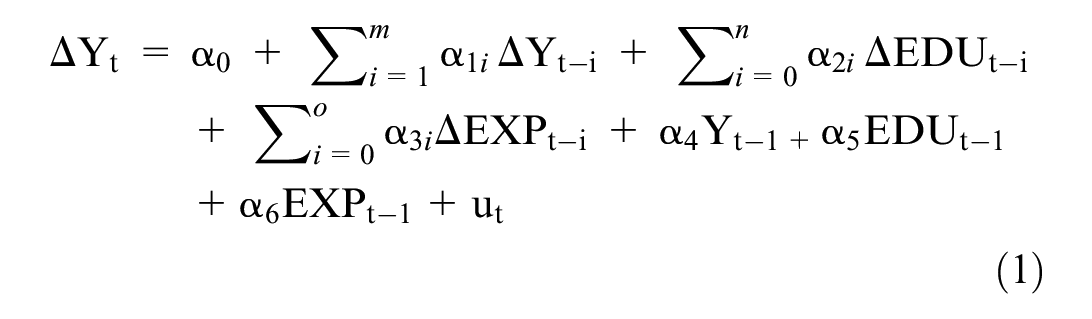
Here Δ expresses the first difference of variable series, alphabets (m, n, o, p) in the equation represents the lag lengths and are determined by using criteria AIC and the error term is expressed by u t . In the bounds test approach, the calculated values of F statistics compared with the Pesaran et al. (2001) described critical values to test the null hypothesis. Two models were used in this study, one with constant and the other with constant and trend. The results of the bounds test are described in Table 2 with critical values for the independent variables at a 10% level of significance.
Bounds Testing Results.

Note. k, symbolizes the number of independent variables. Critical values in these models were taken from Table CI(iii) and CI(v) in Pesaran et al. (2001).
Calculated results in the above table show that the F-statistics value in both models is higher than the upper critical bound value. This is the indication of the rejection of the null hypothesis (H0). It is deduced from the results that there is a co-integration relationship between education and economic growth (described variables). When we confirm the co-integration relation between the variables through the bounds test approach then we estimate the model of Autoregressive Distributed Lag (ARDL) to find out the relationship of the long-run as well as short run.
Long Run Analysis
A mathematical description of the ARDL model, which is established to find out the long-run relationship between variables, is given below:

The calculated results of long-run coefficients, based on estimated models of long run ARDL, are represented in Table 3.
Long Run ARDL Models Estimation and Coefficients.

With respect to the results of Table 3 in the constant ARDL model, it is deduced that the coefficients of government education expenditure and education of the labor force significantly affect the economic growth of Pakistan. According to the values of coefficients, it is concluded that the education of the labor force positively affects the economic growth. One percent increase in education of the labor force produces a 0.623% increase in the economic growth. But the coefficient of government education expenditure is negative, which shows that a 1% increase in education expenditure causes a 0.169% decrease in economic growth. On the other hand, according to the results of the ARDL model with constant and trend, it is concluded that the effect of education on the labor force and government expenditure on education on the economic growth of Pakistan are statistically insignificant. Here, the long run relationship of the underlying variables was measured through the ARDL approach. In this approach, a long-run relationship of the series is said to be established when the F-statistic exceeds the critical value band. The major advantage of this approach lies in its identification of the co-integrating vectors where there are multiple co-integrating vectors. When the conditions of ARDL are properly followed, it may lead to a model fit which prohibits model misspecification, inconsistency, and unrealistic estimates with its implication on forecast and policy. This study is a meagre attempt to explain the nexus between education, Government expenditure and economic growth surrounding the ARDL cointegration technique (Nkoro & Uko, 2016).
Short Run Analysis
Relationships in the short run between variables were calculated based on the bounds test approach through the ARDL error correction model. The mathematical form of the adapted model in this study is given below:

Here ect - 1 is the term which represents the error correction term. It is calculated from a long run relationship and it symbolizes one term lag series in the service series of error terms. Its value must be between 0 and 1 otherwise the model is considered as unstable. Its value may be positive or negative. A negative value of the error correction term shows that the short-run shocks and attains equilibrium in the long run. Its positive value describes that the process is not converging in the long term which shows that it not moving toward the equilibrium.
The calculated results by using the short-run ARDL error correction model in this study are described in Table 4:
Short-Run Error Correction Model Estimation.

According to results presented in Table 4 described that the coefficients of lagged error correction terms in both models are the same as expected, that is, negative and statistically significant. The results show that the error correction term works in these models. A model with a constant, error term coefficient value is −0.319. It means that the deviation is approximately 31.9%, which proceeded in the short-term in the series while going on with each other and dissolve in the long run relationship to gain the equilibrium by attaining the long-term balance again. In the model with constant and trend, the error term correction coefficient, that is, −0.383 is also significant and negative but in this model the long-term coefficient is insignificant, so the results of this model have no co-integration relationship and have significant application.
Diagnostic Tests
For the validity and stability of this study, there is a need to find and check the different diagnostic tests for the data and used models. The results of these tests are given in Table 5.
Diagnostic Test Results.

Results of the diagnostic tests, that is, Durbin Watson, Breusch-Pagan-Godfrey test for heteroskedasticity, jarque-bera for normality, and Breusch-Godfrey serial correlation LM test for serial correlation, disclosed that all the econometric properties are presented by these models. There is no serial correlation in the model’s residuals and they are homoskedastic as well as normally distributed. Tolerance and VIF values, which were calculated by using SPSS software, describe that there is no multi-collinearity between the residuals. Hence it is concluded from the above results that the results of the applicable model are valid and reliable for implementation.
To check the stability of the model CUSUM and CUSUM-Square tests were used. Plots of these tests are represented in Figures 1 and 2.

CUSUM statistics.

CUSUM Square test.
It is deduced from the above results of CUSUM and CUSUM-Square statistics that lines exist within the critical boundaries which indicates the stability of the coefficients as well as long and short-run estimations in the ARDL model.
Conclusion
From the results, education has been viewed as an important determinant of economic growth in the long run. The finding of this study is threefold. First and the most important factor is the human capital which yields a higher equilibrium level of output. Second, education improves the innovative capacity of the economy by promoting new knowledge in society. Third, education may facilitate the diffusion and transmission of knowledge for the implementation of new processes. It is a fact that the existence of a well-educated labor force with the awareness of the new and continuously changing technology, in developed countries, plays a positive and boosting role in their economic growth. This will happen by increasing the knowledge production ability and productivity of the labor force by using that knowledge and skills. The countries, which are in the process of development, can also enhance their economic performance by enhancing the effectiveness of the educational process. An effective educational process contributes to enhancing knowledge and skills through training and improves the productivity of the labor force, which significantly influences the economic growth of that country.
This study held to examine the relationship between education and economic growth in Pakistan regarding in the period years 1987-2016. Generally, the results of this study described that there is a significant and positive co-integration relationship between education and the economic growth of Pakistan as discussed in different studies in the literature (Hussin et al., 2012; Mercan & Sezer, 2014; Reza & Valeecha, 2012), etc. In this paper, two independent variables (education of the labor force and education expenditure) were used with the GDP constant as the dependent variable. ARDL co-integration results describe that there is a significant and positive relation between the education of the labor force (EDU) and economic growth (Y) of Pakistan in long run as well in the short run. According to the results, increasing 1% of labor force education that will increase 0.62% of GDP (economic growth) in the long run. We can also understand this positive relationship with the help of the following graphs which shows a positive increasing trend in Figures 3 and 4.
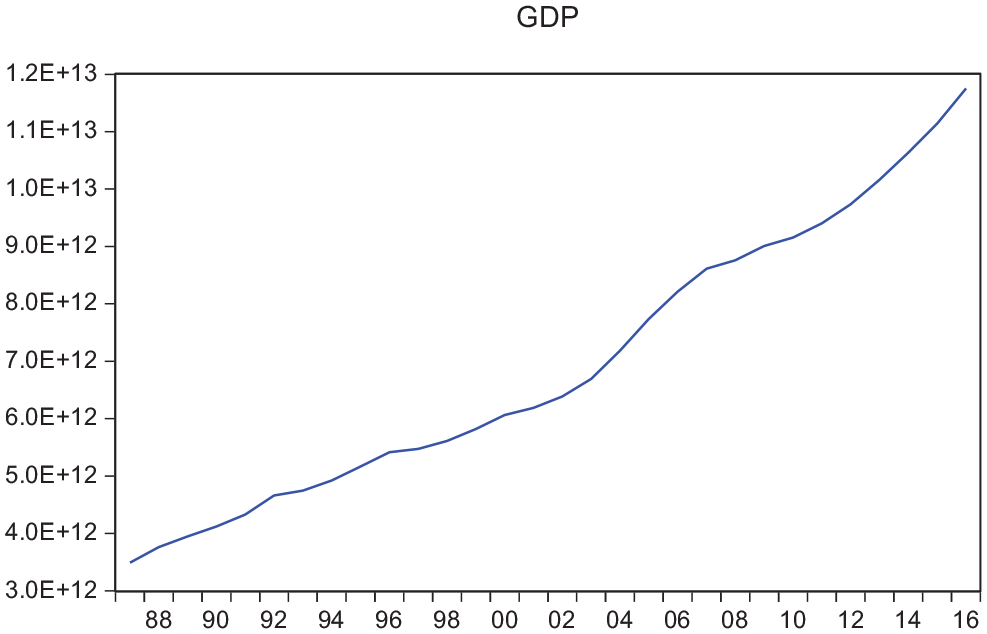
Graph of real GDP from the year 1987 to 2016.

Graph of average education level of the labor force.
On the other hand, the education expenditure has a negative but significant co-integration relation with Y (economic growth). Some studies like those (Kouton, 2018) show that government education expenditure may have a negative relationship with economic growth. In Pakistan’s case the education of the labor force increase with the passage of time but government expenditure on education in the prescribed time of study even later on the decrease. This means that the private expenditure on education helps to increase the education level of the labor force and the data regarding to private expenditure on education is not available at any source. In 1983, there were 74,656 primary and secondary public sector schools while there were only 3,316 primary and secondary private sector schools existed in Pakistan (Jimenez & Tan, 1987). In 1987 there were almost 23 public sector universities and only 2 private sector universities existed in Pakistan. The public universities reached almost 128 and private sector universities reached 83 in Pakistan (Higher Education Commission [HEC], 2022) nowadays, this increase of institutes in both the public sector and especially the private sector described the importance of the involvement of private institutes in enhancing the education level of the labor force as well as the literacy rate of Pakistan. So it may be the possibility of the fact of increasing labor force education, that if the private expenditure on education adds up with the government expenditure then the total expenditure must have a positive and significant relationship with economic growth like many other researchers in literature (e.g., Mekdad et al., 2014; Mercan & Sezer, 2014.
Implications of the Study
It may be the reason that the implementation of the educational expenditure in Pakistan was not in an appropriate manner inefficient way and another reason for the negative relationship was also the less amount of investment in the field of education. The graphs described below also express the negative relationship between these two variables, in which one shows an increasing trend (Figure 5) while the other shows a decreasing trend, expressing a negative relationship between them (Figure 6).

Graph of real GDP.

Government educational expenditures as percentage of GDP.
This study may help in the provision of policy and decision-making countrywide for formulating educational policies to enhance education especially higher education of the labor force by increasing government educational expenditure and maximum utilization of that investment for the enhancement of the economic development of Pakistan. The education sector should be treated as a special sector by immunizing budgetary allocations and focusing on ventures to create opportunities for employment to increase Pakistan’s economic development. It is also necessary to develop a policy for the formulation of a system to accommodate and employ the educated labor force in a significant way to boost economic growth.
Limitations of the Study
This study used Pesaran et al. (2001) and the ARDL technique to measure the economic model. A more comprehensive approach is recommended to get robust results in future studies. Economic growth can also be estimated apart from labor force education and government to measure this complex relationship.
Footnotes
Declaration of Conflicting Interests
The author(s) declared no potential conflicts of interest with respect to the research, authorship, and/or publication of this article.
Funding
The author(s) received no financial support for the research, authorship, and/or publication of this article.

Data Availability Statement
The dataset used in the study is available from the corresponding author on reasonable request.