




Abstract
There is a large variety of photographic composition, and these compositions can illicit different visual and psychological responses in the audience. However, there is limited knowledge of the key factors in these compositions in photography that actually affect the viewing process, and also no empirical support for the relationship between emotional responses and visual cognition. This research applied eye-tracking to calculate the degree of fixation distribution in the process of viewing photographic works through the quantitative characteristics of fixation trajectory in the investigation of the influence of eye-movement information on closed and open image compositions. This research attempts to understand the psychological differences in viewing framed and unframed images and identify the crucial factors that affect the composition of photographic images. Results from the eye movement data found that closed text and photos displayed traits of the principle of closure, and that different compositions can significantly affect the fixation point and sightline distribution. Image compositions with property of closure tend to be more attractive, generating higher number of fixation and longer fixation duration, indicative of easier focus on the primary object in the picture frame and regulating the viewer’s field of view. Photographers try to make good use of frame composition to herd viewer focus as well as increase their interest, making their image composition as complete, concise, pleasant, and pleasurable to the eye, typically applied to landscape, still life or portrait photography. This study has the potential to become a reference that contributes to photography educational and visual communication.
Introduction
Image, rather than text, has become the primary medium of the modern world, an integral part of the public sphere, and a crucial means of recording daily life. Moholy-Nagy (1947) predicted that “the illiterate of the future will be the person ignorant of the use of the camera as well as the pen.” Every person in this day and age is both a viewer of photography and a photographer. Thus, interpreting images and understanding photographic works have become essential tasks for the modern person. Photography is a visual art form that emphasizes the perception of the eye and employs a “visual language” that integrates the visual perception with visual experience to generate aesthetic pleasure. It is a skill that combines technique and image composition. In the process of photographic creation, composition (i.e., layout of a scene) is crucial. Through the application of logical rules and structural forms, composition is used to align photographic works. Aesthetic commonality exists between the composition techniques of photographs and paintings in terms of arranging the primary subject, supporting elements, and background. The quality of photographic composition determines the success or failure of a photographic work. A truly outstanding photographer has the ability to make quick and accurate judgments of the scene layout and composition type, enhancing the harmony and unity of the intended imagery. Although the process of photograph viewing is related to psychology, our relevant knowledge is limited. The subject matter is not only the foundation of artistic aesthetics research but also the primary focus of photography theorists and practitioners. The human image viewing behavior and photographers’ use of compositional techniques to capture viewers’ attention are salient topics worthy of further exploration.
Bloomer (1990) Stated that perception is a kind of message or language. Artists use it to convey ideas and thoughts, and the viewer receives the message and analyzes its meaning. The principle of visual perception acts as an invisible framework supporting the composition and layout of a scene. Gestalt theory refers to the dialectical relationship between a whole and its part, which holds certain referential value for photographic composition—in terms of arranging the primary subject, supporting elements, and background—and facilitates reinterpretation of photography from a new perspective. Zakia (1993, 2002) applied the Gestalt cognitive principle in photographic creation and theory analysis. The principles of figure–ground, simplicity, and grouping in Gestalt theory facilitate further understanding and description of the composition of images to assist novice photographers in overcoming challenges with their vague composition. Lu (2010, 2012) asserted that Gestalt theory has marked and positive effects on photography learning. Research on photography has mostly focused on qualitative discussions of photographic works, photographers, and the application of photographic techniques (e.g., Newbury, 1995; Rogers & Allen, 1996) but has rarely explored the Gestalt photography learning effect and viewing process using objective and quantitative data from the perspective of empirical aesthetics. Chuang et al. (2023) used eye-tracking to explore the influence of Gestalt composition photography on the visual cognition process, and found that different Gestalt photography works significantly affect the eye movement data. Figure-ground and closed photographic works conform to the principle of closure, resulting in the fewest number of fixation and saccades, longest fixation duration, and the most concentrated sightlines, which indicates when a photograph is simplest, easiest to recognize, and aesthetically pleasant. However, their research included various forms of gestalt as stimuli and did not focus on the investigation and comparison between closed and open compositions.
Eye-tracking continues to be an effective and widely applied technology for studying attention as it can precisely record the duration and distribution of attention (Borys & Plechawska-Wójcik, 2017; Henderson et al., 2003; Rayner, 1998). This study is thus based on the perspective of Gestalt theory and applied eye-tracking to investigate the visualization of gestalt closure principle in photographic composition and looked at the sum as well as the parts of how framed compositional works are viewed, with the intention to identify the law of shared visual aesthetic experience, to promote photography inspiration and creativity, and to enhance photographers’ skill for visual expression and ability to attract attention and move the viewer.
Literature Review
Gestalt
Gestalt psychology, a prominent school of contemporary Western psychology first introduced in 1912, explains the underlying law of visual perception based on human psychology. Gestalt psychology proposes that the whole is not equal to the sum of its parts, consciousness is not equal to the collection of sensory elements, and behavior is not equal to the cycle of the reflex arc (Koffka, 1935). This psychological approach involves researching the holistic and aesthetic perception of visual art and experimental observation for application in the field of aesthetics, whereby psychological law and aesthetic art can be combined to lay a solid theoretical foundation for the development of photographic art. The school of Gestalt psychology advocates for the goodness of perceptual stimuli that are pleasing in terms of general visual physiological processes and that constitute the implicit psychological basis for visual aesthetic preferences. Good form generates pleasure responses (Arnheim, 1969, 1974; Gombrich, 1982; Koffka, 1935). Perceptual proximity, similarity, and integrity are related to graphics and image tendencies. Understanding the relationship between Gestalt principles and composition can guide photographers in capturing images that effectively convey information, emphasize the subject, and generate viewer interest. Among the Gestalt principles that have been applied in photography—similarity, proximity, symmetry, figure–ground, and closure—this study focused on the principle of closure (Chuang et al., 2023; Zakia, 1993, 2002).
The principle of closure refers to the tendency to look for a unified cognizable pattern when visually processing a complex arrangement of visual elements. When elements of photographic composition are linked with each other, and the parts approach wholeness, the brain automatically fills in the information required to form a complete image. Therefore, the law of closure is the human psychological tendency to complete an image that is incomplete, discontinuous, or has gaps to rationalize the whole (Ocvirk et al., 2012). In photographic composition, the law of closure can bridge parts of a scene within a certain boundary and fill in the gaps of an incomplete image, thereby enabling perception of the image as a whole and creating strong visual tension. By doing so, photographs can exude feelings such as simplicity, relaxation, liveliness, and freedom, which leave room for the viewers’ imagination and avoid visual closure or aesthetic fatigue generated through complete closure (Chuang et al., 2023; Zakia, 2002, 2013).
Composition
Composition refers to the organization and arrangement of elements in a scene. Photographic composition pertains to the arrangement of the subject in the frame, which determines the layout of other visual elements in the picture. The organization of visual elements forms the photographic scene, which is the core of photography. Studies by Beelders and Bergh (2020) and Sancarlo et al. (2020) all found that composition does affect visual perception, can attract the viewer’s attention, and effectively guide the viewer’s eyes along a predetermined path, making composition a significant component of photography. A well-executed photograph requires careful selection of scenery and appropriate composition. The success of photographic composition depends on the photographers’ aesthetic philosophy and photography skills, adept application of the theoretical knowledge of photography, effective scene composition (i.e., organization and arrangement of elements), and innovative integration of learned information rather than simple instruction adherence. Moreover, crucial factors determining the success of a photographic work include the expression of the energy or communication of a story by the photographer, proper arrangement of various elements in a scene, creation of photographic works that conform to the visual rhythm, and accentuation of the primary subject to attract attention and effectively guide the viewers’ eyes to the scene within the frame; this allows viewer to focus their attention on photographic works worthy of repeated appreciation and extended visual appraisal (Y. C. Lin, 2015).
Application of Open and Closed Composition in Photography
A frame is a structure that gives the interior a sense of space and is also a limitation. The frame restricts not only the physical space, but also isolates and limits the psychological space. Gestalt closure has four important border lines in the scene frame of the picture, which have important visual strength due to the restriction creating a closed space. The field is the composition, and the frame is the boundary. The frame is not only applied to painting and photography but also to movies. The relationship between the subject and the boundary of the picture constitutes two different compositions: open and closed (Bloomer, 1990).
The psychological basis of closed composition suits general aesthetic habits which makes it the most common mainstream form of composition form. It originates from composition expression techniques from an older form of image creation: painting, and uses the frame from the scenery in the shot as a foreground to shoot the subject, which can surround the subject and highlight it. This emphasizes the completeness and balanced arrangement of the picture layout within the frame (Chen, 2009; Peterson, 2012; Ward, 2002). There are no restrictions to the shape of the frame for a framed composition. It can be material, such as a tree or building, or it can be abstract, with contrast between light and shadow. The frame can be flexible and changeable, and it can be fully closed or partially closed, or it can be the entirety of that which is not the subject. However, it should not usurp the focus from the subject. Choosing a closed frame composition can attract the viewer’s curiosity and interest, and help guide the viewer’s line of sight to the main subject of the scene within the frame (Block, 2020; L. Yan, 2019; Yang, 2013). Closed composition photography is suitable for subjects such as landscapes, still lifes, portraits, and expresses images with emotional associations such as seriousness, solemnity, stability, beauty, tranquility, melancholy, and so on. In addition, at the beginning of the movie “The Grand Budapest Hotel,” a closed composition is used to attract the audience’s attention and focus on the limited center of the picture, creating a strong sense of space, and the overall composition presents a balanced and stable state.
On the other hand, open composition is not restricted by the frame and extends visual elements and important information outside the picture. Open framing allows viewers to generate unlimited association beyond the immediate scene. (Mercado, 2022; Yang, 2013) The balance and coordination of a scene are deliberately and vibrantly broken, and the primary subject is not necessarily placed at the geometric center of a scene or at the center of interest or even necessarily presented in its entirety. In this manner it stresses the association with space beyond the scene (Mercado, 2022).
Therefore, photographers use creative experience to select the appropriate composition when shooting. The law of closure derived from Gestalt psychology can be applied to create order in photographic composition, allowing photographers to precisely and objectively express their ideas in a visual context. Viewers can perceive strong feelings, view the layout of the photograph as a whole, focus their gaze on the framed area, and enjoy a universal and stable visual experience. At present, many photographers use the aforementioned principle to realize the full potential of framing photography. For example, the famous contemporary American photographer Ralph Gibson creates photographic works containing rich visual elements; applying Gestalt psychology, he specializes in conveying indescribable emotions and feelings through simple scenes, promoting Gestalt cognition among those who view his works (Figure 1).

Photographic works by Ralph Gibson based on the Gestalt law of closure.
Eye Movement
Vision is the most important way for humans to understand the world and obtain information. More than 83% of information relies on visual perception (J. Lin et al., 2021; L. Yan, 2019). Studies of art and photography have mostly adopted qualitative or questionnaire surveys to obtain viewers’ subjective descriptions of images. People’s eye movements can reveal many of their psychological activities. Eye-tracking technology is a useful method for inferring invisible and microscopic responses effectively and instantaneously during the complex visual cognitive process. Eye-tracking is a common method for detecting visual attention, which can reveal the changing process of a person’s visual focus and attention. (Bicknell et al., 2020; Cronin et al., 2020; Henderson & Hollingworth, 1998; Kruikemeier et al., 2018; Y. Yan et al., 2018). Many psychology studies have reported that eye-tracking is the most direct indicator of the distribution of attention and cognitive processes. A strong correlation exists between fixation position and attention distribution. By collecting eye movement data, we can determine a viewer’s visual perception, the focus of their interest, as well as the duration of such fixations (Duchowski, 2003; Henderson & Hollingworth, 1998; Henderson et al., 1999; Just & Carpenter, 1976; Langton et al., 2000; Liversedge & Findlay, 2000; Megaw & Richardson, 1979; Rayner, 1998; Shimojo et al., 2003; Su et al., 2020; Wright & Ward, 1998). Rayner (1998) pointed out that observing the people’s gaze path allows for direct inference of higher-order cognitive processing (Fink et al., 2019; Rayner, 1998; Rosenberg & Groner, 2022). In research on eye movement in art, visual trajectory tracking, fixation, and fixation duration are often used as indicators. Buswell (1935) determined that when people look at a picture, they mostly focus on the area of their interest, rather than blindly staring at the image (Clay et al., 2020; Wade, 2020).
Eye movement analysis is a crucial research method in psychology studies. The most intuitive method for measuring viewing patterns is the recording of eye movement during viewing of an image. Using the quantitative characteristics of the eye-tracking, this study analyzed the psychological process of viewing photographs that follow the Gestalt law of closure and identified the critical factors influencing photography viewing. If photographic composition has a significant effect on the focus and pattern of photography viewing, the fixation state, saccade, and visual distribution when viewing the same photographic work of different compositions may differ.
Eye movement indicators are divided into intuitive indicators such as heat zone maps, gaze trajectory maps, and statistical indicators including fixation duration, number of fixations, etc. (Sui et al., 2018). This study used complex statistical quantification methods to analyze the changes in eye movement characteristic variables, and conducted qualitative analysis with colorized heat zone maps to visually present duration of the subject’s attention on a certain area, and directly display the results of a large amount of eye movement data (G. L. Yan & Bai, 2018), This can serve to establish objective sight line change indicators, observe psychological patterns, and construct a universal quantified viewing model.
Common eye movement indicators include three types of information: spatial, temporal, and count. In particular, fixation duration and number of fixation are important fundamental indicators for observing eye movement (Ahn et al., 2020; Duchowski, 2003; Hernik & Broesch, 2019; Krejtz et al., 2018; Liao, 2023; Marchezini et al., 2022; Megaw & Richardson, 1979). Therefore, the eye movement observation indicators used in this study are explained as follows:
Total fixation duration (TFD) and number of fixation (NOF): Most studies of visual cognition have focused on the state of fixation. The complexity of the stimulus will affect the average fixation duration (Jeannerod et al., 1968; G. L. Yan & Bai, 2022). The average fixation duration for viewing pictures is longer than reading text at about 300~350ms (Buswell, 1935; G. L. Yan & Bai, 2022; Yarbus, 1967) The total number of fixation and the number of repeated fixations are higher when people have difficulty reading or encounter complex reading material (Rayner, 1998). Fixation duration is defined as the time that the eye dwells on a certain area and is typically measured in milliseconds (ms). Longer fixation duration signifies increased attractiveness of the information of the area, which therefore reflects the participant’s area of interest (de Koning et al., 2010; Henderson & Hollingworth, 1998; Lowe, 2003; Norton & Stark, 1971).
Number of saccades (NOS) and Total saccade duration (TSD): The amplitude of a saccade reflects the displacement of the eyeball from one fixation to the next. The timing of saccade occurrence and saccade preparation anticipating a different location are two distinct operating mechanisms on the physical and psychological levels, respectively, and both are closely related to the visual information processed during fixation (Findlay & Walker, 1999; Liversedge & Findlay, 2000; Matin, 1974; Salvucci & Goldberg, 2000).
Spatial dispersion index (SDI) of fixation: Fixation density, a new index used to describe the degree to which gaze is concentrated, provides information about the spatial distribution of fixation that is lacking in eye movement. Fixation density reflects the degree of dispersion in terms of fixation distribution when viewing closed-frame shots; this information facilitates our investigation into whether people’s gaze is dispersed or concentrated during viewing (Ma & Chuang, 2017).
Methodology
Applying eye tracking, this study explored works with compositions conforming to the Gestalt law of closure and the psychological process of viewing such works. The experiment was conducted to examine the effect of frame types on eye movement information. Specifically, the difference in sightline distribution between closed-frame and open-frame shots was explored to identify the key factors relating to the influence of photographic composition techniques on how people view photographic works. The findings of this study can serve as a reference for photography and art education. The research framework is illustrated in Figure 2.

Research framework.
Experimental Design
Volunteers were paid for participating in the experiment. A total of 11 individuals (8 men and 3 women) volunteered as participants; their age ranged between 18 and 24 years, with a mean age of 20 years. Because eye-tracking research is an experimental method, unlike the questionnaire survey method, which can conduct large-scale observations and surveys, it is the limitation of this study cased on its increased complexity, the exploration of the cause-and-effect relationship of a small number of subjects, having a smaller sample of research subjects. In terms of experimental design, stimuli (i.e., works with open and closed framing) were presented in a random order, and a within-subjects design was adopted; all participants were involved in all experiments. The works of well-known photographers were selected as the research materials. Subsequently, photography experts and scholars were invited to evaluate and screen the photographs that conform to the law of closure. Thirty representative photographs, 15 of each of the two framing types depicting the same scene, making a total of 30 pictures, were used in the official experiment; an example is depicted in Figure 3. In terms of color and format, 6 and 24 of the photographs were in black and white and color, respectively, and 3 and 27 of the photographs were vertical and horizontal, respectively. Every photograph used in the experiment was 1,920 × 1,440 pixels. Under the premise of sufficient viewing time, we recorded the participants’ gaze paths continuously during the viewing process. A total of 30 trials were conducted for the experiment.

Stimuli used in the experiment.
The experimental manipulation was as follows:
Independent variable: Framing shots according to the law of closure (i.e., completely closed and open).
Dependent variable: eye movement information (i.e., total number of fixation, total fixation duration, number of saccades, total saccade duration, and fixation density reflected in Spatial dispersion index (SDI) of fixation).
Hypothesis 1: Framing types produce different viewing patterns and eye movement information.
Hypothesis 2: Closed-frame shots result in higher fixation density and greater attention compared with open-frame shots.
Experimental Procedures
Before the actual experiment, the participants were asked to sit 60 cm away from a 21-in CRT monitor at a standardized testing site. The center of the monitor and the participant were arranged to form a straight line. The width of the monitor produced a viewing angle of approximately 36.8°, and the height of the screen produced a viewing angle of approximately 28.1°.
The Tobii Pro Nano eye tracker was set up with a sampling frequency of 60Hz to record the gaze path of the participants’ right eye. The eye tracker was calibrated using a 9-point calibration procedure, which was necessary for data collection. For familiarization with experimental operation, a practice session was held, and experimental instructions were read at the beginning of the experiment. In the actual experiment, photographic works were presented for 10 s each in an order randomly determined by a computer. Drift correction was performed after every 10 images. To ensure that the participants had a clear view of the images, they were asked to select the images they had viewed after completing the experiment. The experiment process is detailed in Figure 4, with the entire process lasting approximately 10 min.

Experimental flowchart.
Results
According to the aforementioned analysis, framing type affected viewers’ gaze; the difference was particularly marked between photographs with closed and open framing. We further analyzed the two types of photographs in terms of their effects on viewers’ gaze to determine whether different photographic compositions affect eye movement. We noted that framing type had significant main effects on the following dependent variables: number of fixation (F(1, 300) = 17.894, p < .01), total fixation duration (F(1, 300) = 9.430, p < .01), number of saccades (F(1, 300) = 19.413, p < .01), and total saccade duration (F(1, 300) = 22.167, p < .01). Accordingly, closed framing affected gaze distribution in the overall visual recognition. Closed-frame shots resulted in a longer total fixation duration, fewer fixation and saccades, and a higher fixation density than open-frame shots, as summarized in Table 1 and Figures 5 and 6.
Comprehensive Analysis of Eye-Tracking Information with Closed-Frame and Open-Frame Photos and Text.
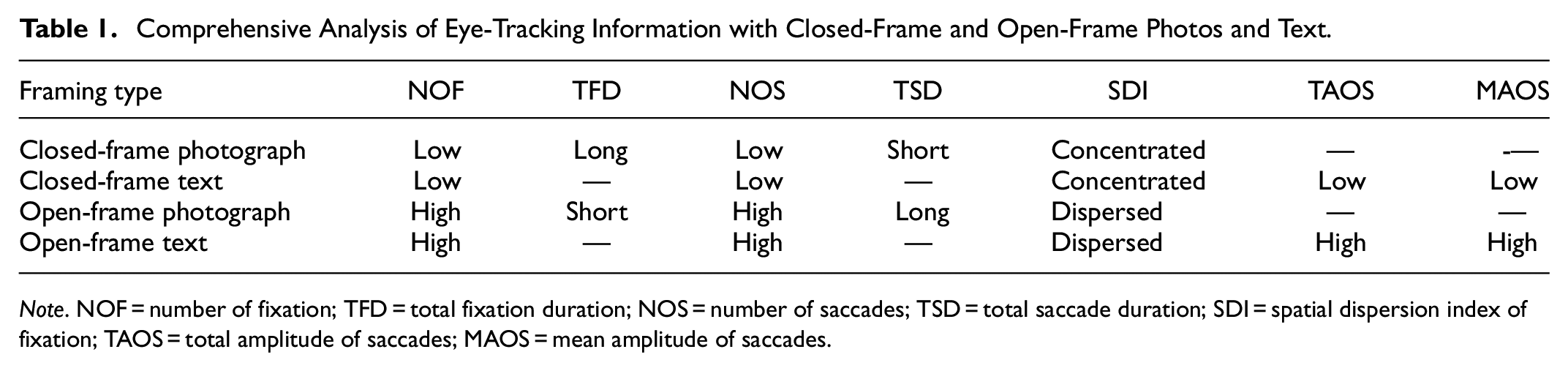
Note. NOF = number of fixation; TFD = total fixation duration; NOS = number of saccades; TSD = total saccade duration; SDI = spatial dispersion index of fixation; TAOS = total amplitude of saccades; MAOS = mean amplitude of saccades.

Closed framing results in fewer fixation and a longer total fixation duration.

Closed framing results in fewer saccades and a shorter total saccade duration.
Fixation density (SDI) reflects the breadth of fixation distribution within the photo structure. Analysis of variance on the framing type and fixation density revealed that framing type had significant main effects on fixation density (F(1, 19) = 185.559, p < .01). Between open-frame and closed-frame shots, fixation density and gaze distribution differed; that is, closed-frame shots had a lower SDI, indicating that gaze distribution was more concentrated, whereas open-frame shots had a higher SDI, indicating that gaze distribution was more dispersed. Further analysis was conducted on the changes in viewing duration of all participants. According to the temporal sequence, stable and significant differences in viewing duration were noted between closed-frame and open-frame shots throughout the viewing process (Figure 7).
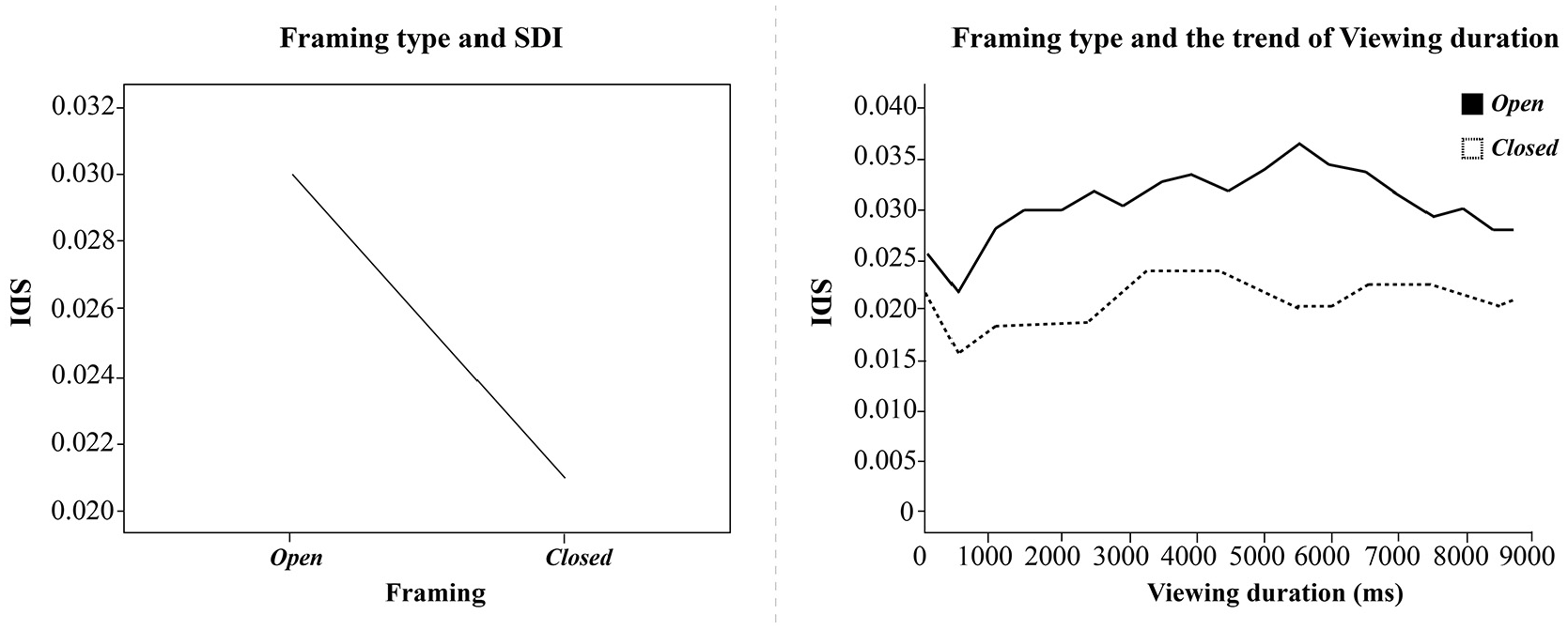
Closed-frame shots have a higher fixation density; significant differences in viewing duration were observed between closed-frame and open-frame shots.
Discussion
High-quality photography enhances people’s sense of aesthetic pleasure and visually conveys the intrinsic mood of the content. Photographic composition is critical for creators structuring a scene, with composition closely related to visual perception. The principle of visual perception acts as an invisible framework that supports the composition layout of a photographic scene. Gestalt theory can be used for work creation and to analyze the theoretical framework related to images. In the past, photographers mostly shot from a subjective perspective with a primary focus on the aesthetic of the photograph; they tended to ignore the effect of Gestalt structure on people’s viewing experience. Photographers must gain an understanding of how people view images and must master the varying compositional characteristics of images, thereby grasping the visual focus, conveying a visual message, and creating works that are aesthetically pleasing.
This study adopted the quantitative research method based on cognitive science and conducted eye tracking to explore Gestalt law as applied in photographic composition. We manipulated photographic works with closed and open framing to determine their different effects on viewers’ fixation and gaze distribution, thereby observing the effects of composition on the psychological process of photograph viewing. According to the obtained results, framing shots that conformed to the Gestalt law of closure regularly limited the range of gaze path and achieved a universal pattern. By contrast, open-frame photographs that did not follow the Gestalt law of closure produced irregular gaze paths. Furthermore, the eye movement information derived from the two framing types differed; hypothesis 1 was thus supported. In particular, the gaze path heat map and quantitative gaze data demonstrated that the participants viewing closed-frame photographic works had significantly fewer fixation, a significantly longer fixation duration, higher fixation density, and greater consensus (Table 1), whereas the participants viewing open-frame photographic works produced opposite results. Gaze distribution reflects the location of attention, and many studies have indicated that longer fixation duration means a greater amount of attention afforded, which can reveal the viewer’s area of interest (Henderson & Hollingworth, 1998; Lowe, 2003).
Therefore, the closed frame composition does indeed affect the viewer’s attention distribution, exhibits sightline-guiding effect and can easily attract viewer interest and focus on the subject. In contrast, open frame composition may elevate the amount of unbound information causing increased complexity and lack of obvious focal points, increasing the number of fixations and saccades as the sightline scatters without unison. This is consistent with the research results of Rayner (1998), who pointed out that people with reading difficulties or when faced with complex materials will have increased number of fixations. This study also found that the eye movement results are similar regardless of colors or the orientation of the photo, which is consistent with research hypothesis 2. The visual heat zone map is shown in Figure 8.

Photographs with closed framing result in fewer fixation and viewers’ gaze being drawn to the primary subject; photographs with open framing produced the opposite results.
The comprehensive results show that both in Ma and Chuang (2017)’s study of closed text and in Chuang et al. (2023) Gestalt’s closed composition photography, the sightline is relatively concentrated consistent with phenomenon observed with the principle of closure. The latter study found that photos of different Gestalt forms do affect the overall eye movement information. In particular, closed photos exhibited different properties from other different Gestalt types. This study thus intended to further verify whether works with or without framed compositions have the same effect. When compared with the studies by Chuang, the results were found to be consistent. The different forms of pictures and texts have both been verified to conform to the Gestalt principle characteristics. Viewing closed text compared with closed frame photos both generated fewer fixation points, longer fixation duration, and more concentrated sightline. The opposite is true when viewing texts and photos with open compositions, since with the pictures with closed compositions make the things in the frame the main subject of the picture. This makes the image more complete, allowing the viewer’s attention to focus on the subject. This can make the visual focus and sightline more concentrated, and thusly the subjective experience is simpler and has a more intense sense of beauty (L. Yan, 2019). The results of this study are consistent with Liu et al. (2020) and Chuang et al. (2023), the research conclusions are similar, as shown in Table 1.
This study uses the method of experimental aesthetics to present experimental evidence. The Gestalt Principle provides a psychological explanation for the study of photographic image art theory. Photographers can make good use of the Gestalt Theory to understand the way the brain perceives and organizes visual information, and through better framing and scene selection create more harmonious and pleasant photographic creations, since this is the core of photographic composition. There are many forms of composition, and different composition methods can generate different visual reactions and emotions in the audience (Lei, 2021; L. Yan, 2019; Yang, 2013). By knowing the viewing psychological process and discerning ways to attract viewer interest and effectively controlling the composition of photographic creations, a more objective and accurate grasp of expression is possible, thus increasing visual cognitive effects and pleasantness, and help to produce good photographic work and make improvements to composition.
The results of this study allow us to further understand the characteristics of closed and open compositions in photography, and the difference between compositions with and without frames. Closed, or closure, composition can indeed funnel viewer interest and visual focus toward the main body of the picture (see Table 1). Subjectively, simpler aesthetics are the best. Working photographers should consider whether the outer frame adds to the overall composition, whether it can exert the power to attract the eye, highlight the subject in the frame for it to be the visual focus, and use the law of closure to create order in the photographic composition. Making good use of frame composition can guide the viewer’s attention to key aspects of an image (see Figure 1). The frame can also buffer against cluttered visual elements, making the picture more complete and concise, conveying the most information in a short period of time, and generating emotional stability and harmony (Lei, 2021; Peterson, 2012; Yang, 2013), which is more suitable for landscapes, still life or emotionally rich portraits. Of course, the role of the frame is not to dominate the scene, nor to be blindly applied without consideration. Open composition, on the other hand, can break up the balance and coordination in the composition of an image. A more lively composition allows the viewer to generate boundless associations beyond the image, suitable for expressing movement, plots, and life scenes as the thematic content, as well as news or documentary-related photography which can often produce intriguing results.
Finally, the results of this study have the potential to inform photography teachers and content creators, contribute to existing basic theories of photography and improvement in the understanding of photography and art psychology. Research results from eye-tracking methods have successfully demonstrated that the frame composition in photography exhibit properties of closure. Follow-up research can move towards exploration into the differences between cultures or that between a novice and an expert. Eye movement and brain wave ERP indicators can also be combined to investigate real-time psychological activities behaviorally and physiologically, to more effectively inform art and design applications, practical photography, and educational reference.
Footnotes
Author Note
This research was conducted while Han-Yi Tseng was at Department of Photography and Virtual Reality Design, Huafan University. She is now at Department of Digital Multimedia Arts, Shih Hsin University and may be contacted at
Declaration of Conflicting Interests
The author(s) declared no potential conflicts of interest with respect to the research, authorship, and/or publication of this article.
Funding
The author(s) received no financial support for the research, authorship, and/or publication of this article.

Data Availability Statement
Data sharing not applicable to this article as no datasets were generated or analyzed during the current study.