



Abstract
Rumination, which can be studied through its associated attentional biases, and is a part of the RDoC Negative Valence Systems constructs of Loss, has been proposed as a key transdiagnostic feature in depression. The current study uses eye tracking measurements to explore how different levels of brooding and reflection rumination interact with attentional biases in a non-clinical sample of high and low ruminators. Methodology: 123 adults were administered questionnaires of rumination, depression and participated in passive viewing task in which they watched sets of angry, happy, sad and neutral faces, while their eye movements were tracked. Findings indicate greater sustained attention toward sad and angry faces and away from happy faces among non-clinical individuals with high levels of brooding rumination, even when controlling for depression scores. The study adds further evidence that brooding rumination and attentional biases to negative stimuli are associated with one another. Behavioral parameters such as attention bias to help us to distinguish high ruminators among non-clinical sample.
Introduction
Ruminations are considered as a class of conscious thoughts associated to depression that orbit around a theme, tending to reappear despite the lack of immediate environmental cues that require or elicit those thoughts (Wyer, 1996). Past research showed that ruminations predict depressive disorders including onset of depressive episodes (Nolen-Hoeksema, 2000). In their literature review, Smith and Alloy (2009) consider ruminations as a multifaceted construct including: repetitive and passive thinking about depression symptoms, causes and consequences of these symptoms; their related circumstances, and a stress-reactive process with a tendency to ruminate on negative interferences following stressful life events. These recurring thoughts can take on an adaptive, problem-solving function as manifested in reflection rumination, or they can bunch up into a stagnant, maladaptive preoccupation as seen in brooding rumination (Armey et al., 2009).
Research Domain Criteria (RDoC) is a research framework for studying mental health problems by integrating information from genomics and circuits of behavior and self-report which help to explore the full range of human behavior from normal to abnormal (Insel et al., 2010). The current study approaches the exploration of ruminations from the NIMH (National Institute of Mental Health) RDoC perspective of Negative Valence Systems within the construct of Loss in an LMIC (low- and middle-income country) context. Both rumination and attentional biases are key components of the RDoC Negative Valence Systems construct of Loss. Therefore this study focuses on rumination rather than depression as predictive variables of attention bias. Ruminations, in specific, are considered to be related to disruptions in corticolimbic circuitry characterized by a lack of down-regulation from prefrontal regions (Langenecker et al., 2014). The circuitry itself is considered to underlie information processing biases, especially for emotional stimuli in depression and rumination (Gibb et al., 2015).
Historically classical cognitive models of schemas (Beck, 1979) hypothesized that individuals with depression are characterized by a negatively biased information processing style, biased perception, biased memory, biased thoughts and rumination and biased attention. Recent research has indicated that above mentioned processes are related to an inability to disengage from negative stimuli—a switching or inhibitory deficit (Langenecker et al., 2014). Attentional bias studies focusing on depression have mainly researched the maintenance of attention to emotional stimuli in contrast to the vigilance hypothesis which is more prominent in anxiety studies of attentional bias. With thus consider extended eye fixation on negative stimuli, as measured using in eye-tracking to reflect top-down, explicit control of attention (Armstrong & Olatunji, 2012).
Findings from clinically depressed populations indicate that there is an association between brooding rumination but not of reflective ruminations with attention to sad faces (Joormann et al., 2006). Owens and Gibb (2017a) found that brooding rumination in a non-clinical population was associated to enhanced sustained attention toward sad faces and diminished attention toward happy faces measured with eye-tracker. In contrast, Duque et al. (2014) in a sample of undergraduate students reported that reflection rumination was associated with attentional bias toward sad and angry faces and away from happy faces. Bar-Haim et al. (2007) consider attentional biases as a robust phenomenon and propose that future research should focus on responding to theoretically-oriented question such as whether attentional bias indicates attention toward specific stimuli, difficulty in disengaging from specific stimuli, or whether they reflect automatic or strategic processes. Understanding these processes in a non-clinical population can help further clarify the maintenance versus vigilance hypothesis on emotional stimuli as related to depression and help identify risk factors that might be related to depression. Previous studies with non-clinical populations indicated that relationship of various attentions related functions such as focusing and shifting were mediated by brooding ruminations (DeJong et al., 2019). This is important fact as inflexible attention focus might increase the risk of depression by reinforcing ruminative thinking thus making them important contributors in developing and maintaining depression symptoms. Furthermore, brooding ruminations among 10 year old children predicted prospective onset of depressive episodes after 20 months event when statistically controlling the level of depression symptoms at initial assessment, meaning that predictive effect of brooding ruminations in children was not because they co-occurred with depressive symptoms (Gibb et al., 2012).
The present study employs eye tracking measurement that enables disentangling engagement form disengagement, as it provides continuous and direct assessment of covert attention (Armstrong & Olatunji, 2012). In a more practical sense if a person has more tendencies to pay more attention to negative stimuli especially when experiencing stressful moments they tend to have more difficulties in employing adaptive responses and show greater increase in depressive symptoms (Feurer et al., 2020). The same authors indicate that hypothetically certain biological mechanisms are responsible for the brains ability to emotional reactivity, for example making for some more quickly to engage and more difficult to disengage from negative stimuli leaving them at increased risk for depression.
A unique feature is that this study was conducted in a non-Western context as opposed to most of existing literature on this topic, it contributes to the exploration of RDoC constructs through affordable and more reliable measures such as eye-tracker in low-resources contexts. Furthermore, research on cognitive bias modification of attention is promising and ruminations appear to play key role in efficacy of these interventions (Arditte & Joormann, 2014). Exploring attention bias in non-clinical sample with high and low ruminators can enhance our understanding of behavioral parameters such as attention bias to help us to distinguish high ruminators among non-clinical sample.
Materials & Method
Participants
Participants initially signed consent forms, filled out the questionnaires and at the end completed the eye-tracking task. The procedures were supervised by two first authors and administration of the questionnaire and eye-tracking task were conducted by two trained master level students of psychology. The study included 123 adult volunteer participants from Kosovo (91 females, mean age = 19.8, SD = 1.97) who were invited to take part in the study by students from the University of Prishtina, Kosovo. Students were given written instructions on the inclusion and exclusion criteria, including (1) Not being a student of the Department of Psychology; (2) Age 18 to 30; (3) Being an acquaintance of the student for more than 2 years and not in romantic relationship with, engaged to, or married to the student. Ethical approval was obtained from Faculty of Philosophy Ethical Committee of University of Prishtina and each individual participating in the study provided their consent to participate in the study.
Measures
Rumination—The Ruminative Response Style [RRS] questionnaire by Nolen-Hoeksema (1987), as cited in Treynor et al., 2003) assesses brooding, reflection, and depression rumination. Although RRS consists of 22 items, seven additional items were included from other questionnaires in order to increase the internal consistency of its subscales (see Whitmer & Gotlib, 2011). Four items were added for brooding rumination two taken from Automatic Thoughts Questionnaire-Brooding Subscale (Hollon & Kendall, 1980) and two from (Ingram & Wisnicki, 1988). Three item for reflective rumination were added one from (Whitmer & Gotlib, 2011) and two from Rumination Reflection Questionnaire (Trapnell & Campbell, 1999). All items were translated by first two authors and back translated by two other mental health professionals. The final version was result of consensus process among persons involved in translation and backtranslation. Prior to use the measures was piloted with 90 university students and Cronbach’s Alpha for the depression rumination subscale was .81, for rumination brooding .71, and for rumination reflection .69. The total scale had a Cronbach’s Alpha of .89 and 1-week test-retest reliability of .82. Brooding and reflective rumination were significantly correlated at r = .64, p < .001.
Depression—Beck Depression Inventory II (BDI II) (Beck et al., 1996), consisting of 21 items which measure the symptoms of depression among youth and adults is used. BDI II exhibited a moderate internal consistency in this study (α = .79). The measure previously was translated and back translated to Albanian and piloted with university students the Cronbach’s Alpha for the scale resulted with .88 and 1-week test-retest reliability resulted with .65 (Arënliu et al., 2000).
Attentional Biases—We used a passive viewing task to evaluate attentional biases (see Owens & Gibb, 2017a), where subjects were exposed for 20 s each to 16 2 × 2 grids consisting in one angry, happy, neutral, and sad face. As they were viewing the screen as they would an album of photos a Tobii x-30 device recorded their eye movements and fixations for the task duration. The facial stimuli were taken from the Karolinska Directed Emotional Faces database (Lundqvist et al., 1998). Validation study of intensity and arousal scale of the database indicated that the database contains a valid set of affective facial pictures (Goeleven et al., 2008).
Attentional Bias Variables—For each participant, we obtained four separate absolute counts of the fixations on each valence face. Total Visit Duration (TVD) shows how much time in milliseconds the subjects allocated to each quadrant across all grids, whereas Fixation Count (FC) is the total number of fixations falling on each quadrant.
We generated four attentional Bias Differentials (BDs) or difference scores for TVD and FC, representing the relative fixations, namely the difference in attentional allocation between angry and happy, sad and happy, angry and neutral, and sad and neutral faces. It was expected that scores would yield negative numbers as our sample is non-clinical and participants would focus more on positive and neutral as opposed to angry and sad faces. We also computed differences between a BD composite score of negative valence (angry and sad) versus positive valence (happy and neutral) faces. Angry and sad faces were grouped together because of the similar behavior of ruminating participants toward them, whereas happy and neutral faces were taken together in order to center the composite score at zero. Descriptive variables for study variables are in Table 1.
Descriptive Statistics for Study Variables.
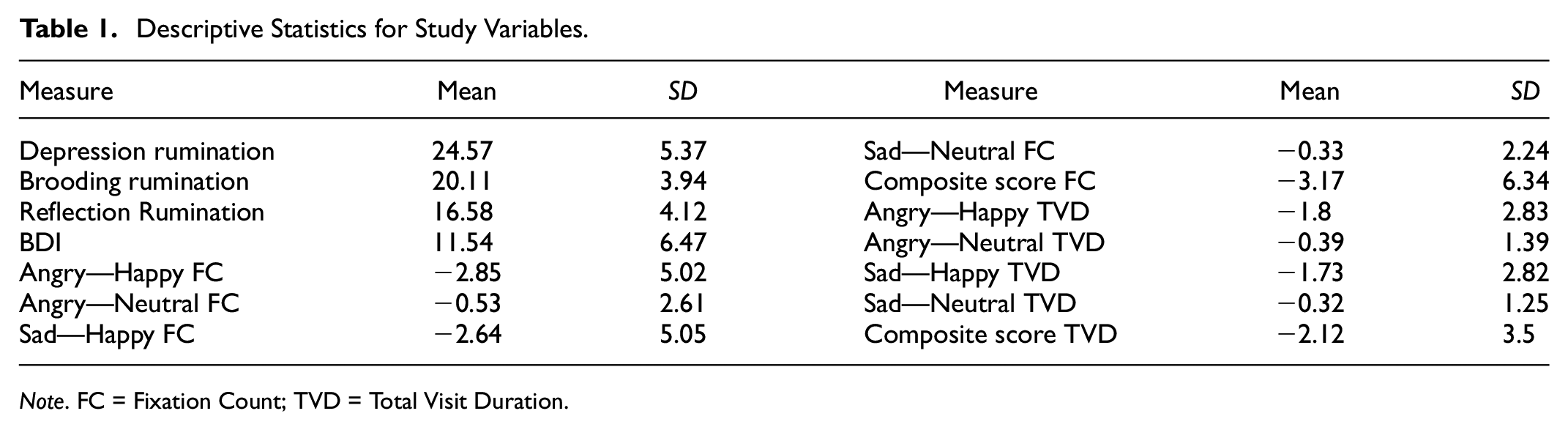
Note. FC = Fixation Count; TVD = Total Visit Duration.
The Spearman-Brown boosted split-half reliability of relative FC for angry valence was 0.90, happy valence 62, neutral valence 0.88, for sad valence 0.54, and for its composite score 0.87. Reliability for relative TVD for angry valence was 0.90, happy valence 65, neutral valence 0.86, for sad valence 0.62, and for its composite score 0.87. All measures administered in the current study are in Albanian language.
Data Analysis
Initially we computed the zero-point and the partial correlations between brooding and reflection rumination and the FC and TVD bias differentials. In partial correlations, we controlled the relationship between the same variables for the mean BDI score. This analysis would identify the variables whose variance could be accounted for by mean BDI scores and would give a hint as to whether the FC and TVD bias differentials are merely operationalizing aspects of depression or measuring other constructs beyond it as well. The goal of this paper is to predict brooding and reflection rumination from the BD eye-tracking variables. Taking in consideration that we have a nonclinical population, expected no to exhibit sufficient variance in both outcomes and predictors to give a significant linear regression model, we decided not to use a linear model. Instead, we partitioned brooding and reflection ruminators into a low and a high rumination group, which have a z-score below −1 or above 1, respectively. Twenty-one participants were categorized into the group with z-scores below −1, whereas 16 had z-scores above 1. The corresponding numbers of participants for low/high reflection ruminators was 21 and 23, respectively. The brooding and reflection ruminators falling within one standard deviation from the mean were not assigned any group and were treated as missing values in subsequent analyses.
The binary logistic regression models were all calculated with base R. Because of complete separation of observations, the odds ratio and its associated confidence interval for Angry-Happy TVD for brooding rumination outliers was calculated using the “brglm” package in R, which uses technique of penalized maximum likelihood estimation. The table below displays the means and standard deviations of the variables used in the study.
Results
Table 2 presents the zero-point correlations between the two outcome variables of interest, brooding and reflection rumination, as well as TVD and FC bias differential variables. Brooding and reflection rumination exhibited significant moderate correlations with the angry versus happy, sad versus happy, as well as the composite relative FC, but not with angry versus neutral or sad versus neutral. The lower part of the table displays the partial correlations of the same variables when controlling for the participants’ mean BDI scores. The analysis shows that brooding rumination is only related to the composite difference after controlling for BDI scores, whereas reflection rumination remains correlated only for FC outcomes of angry versus happy. The sad/angry versus neutral FC correlations with brooding rumination were at the trend level after controlling for BDI scores. Since BD variables are correlated with brooding and reflection rumination scores even when controlling for depression, subsequent analyses will only focus on brooding and reflection rumination as dependent variables.
Zero-Point and Partial Correlations for FC and TVD Variables.

Note. FC = Fixation Count; TVD = Total Visit Duration.
p < .1. *p < .05. **p < .01. ***p < .001.
Table 3 shows the output of various binary logistic regression models predicting the likelihood of inclusion into high versus low brooding or reflection rumination groups with BD variables as predictors. A separate model was set up for every predictor, resulting in one degree of freedom for each model. In the Model for brooding rumination all variables except for Angry-Happy TVD significantly predict high/low brooding rumination outliers with odds ratios greater than one. The model for reflection rumination showed that Angry-Happy FC, Sad-Happy FC, and Sad-Happy TVD significantly predict the likelihood of inclusion into high versus low brooding or reflection rumination. The other BD variables are predictive at a marginally significant level of p < .1. In addition, in order to reflect the dependence of rumination variables on depressive symptoms, we have included depression rumination as a variable in further analyses. Depression rumination is supposed partly to account for the strong correlation between eye-tracking differentials and self-reported BDI scores.
Binary Logistic Regression Models Predicting High/Low Brooding and Reflection Rumination Outliers From Eye-Tracking Variables.

Note. FC = Fixation Count; TVD = Total Visit Duration.
p < .1. *p < .05. **p < .01. ***p < .001.
Discussion
Recently, there has been a call in the scientific community on integrating RDoC into depression research, especially by focusing on ruminations as a transdiagnostic variable (Woody & Gibb, 2015). The existing study is one of the rarer endeavors of integrating RDoC in depression research from a non-western LMIC setting. The findings from this study provide further support toward the validation of the RDoC Loss construct, in that individuals with higher levels of brooding and reflective rumination tend to allocate more attention toward angry and sad and away from happy faces. When controlling for depression, however, only brooding rumination scores are associated with attention to negative stimuli over positive and neutral ones. The findings are in similar as reported by Owens and Gibb (2017b), where non-clinical individuals with higher levels of brooding rumination were characterized by greater and sustained attention to sad faces and less sustained attention to happy faces, even when controlling for depression scores. In the present study, high brooding rumination is associated with biases in attentional control for negative-valence information, specifically toward sad and angry and away from happy faces. Additionally, the current study shows that eye-tracking variables alone significantly predict inclusion into the group of low versus high reflection or brooding ruminators. The study adds further evidence that brooding rumination and attentional biases to negative stimuli are associated. However current findings from study can’t conclude that they cannot be merely attributed to a presence of depression symptoms (Koster et al., 2011). Sustained attention of high ruminators to sad and angry faces might be also related to findings from other studies where higher levels of rumination predict characteristics of people with mixed anxiety and depressive symptoms (Nolen-Hoeksema, 2000). De Lissnyder et al. (2012) found that individuals with higher ruminative tendencies exhibit shifting impairments in working memory from negative stimuli when exposed to exogenous negative stimuli, indicating heightened cognitive vulnerability to depression. Findings from the existing study add further evidence that rumination may be one of the key underlying mechanisms in information-processing biases, such as difficulty in disengaging from negatively salient stimuli (Joormann, 2010) and appear to be automatic rather than strategic process. Current findings could suggest that clinical intervention both in prevention and specifically targeting levels of rumination may strengthen treatment for at risk-youth (Gibb et al., 2012) as the targeting of ruminations in treatment of adults is already taking place (Watkins et al., 2009). Future studies could use eye-tracking assessment to further explore on identifying those with high brooding rumination and include them in preventive and treatment interventions for depression and anxiety especially by using cognitive-behavioral techniques focusing on ruminations. Current findings could lead in testing hypothesis whether targeting attentional control, through clinical interventions could decrease negative ruminative processes, which in return might lead to improved emotional regulation and reduced depressive symptomatology (Hsu et al., 2015).
A major strength of this study is the relatively high split-half reliability of the passive viewing task assessing attentional bias. As similar reliability scores are usually not reported in most published studies in this field (Gibb et al., 2015), usage of potentially unreliable measures may threaten our understanding of psychopathology (Rodebaugh et al., 2016). The relative scores used in this study are an advantage that differentiate allocation of attention toward negative faces (sad and angry) at the expense of happy and neutral faces. These procedures could be conceivably piloted and automated in further research studies in order to potentially introduce it as a preliminary screening measure in clinical settings.
The first limitation of the present study is relatively small sample size of the study for correlational study and the inability to infer a causal relationship between brooding rumination and attentional biases due to its cross-sectional nature. The second limitation of arises because the majority of the sample consisted in women, as literature suggests higher levels of rumination among women (Johnson & Whisman, 2013). The third limitations are low reliability for specific measures such as split half reliability for happy and sad valence and some other variables. Another limitation might be considered adding new items to rumination measure; although internal consistency results were satisfactory future studies should consider using consolidated measures validated factor structure. Last limitation of the study is the use of a fixed eye-tracking device recording data at 30 Hz in the passive viewing task. The present study, however, focuses on mostly global measures of attentional bias capturing the location and frequency of eye fixations while avoiding exact measurements of timing and duration which would diminish the fidelity of the data obtained by using such equipment.
Future studies can focus on experimental manipulation of subjects, thus allowing more conclusive analysis in terms of temporal or bidirectional relations between brooding rumination and attentional biases. Taking in consideration the high level of comorbidity of anxiety and depression symptoms, future studies with non-clinical samples could also focus on an in-depth exploration of threat avoidance or preferential attentional allocation to threatening stimuli. Additionally future studies with larger non-clinical sample could focus on comparing the results for individual with higher and lower depressive trends and control the gender effect on results. This would further help understanding of the RDoC threat construct within the Negative Valence System domain through mean fixation time, number of fixations, and first fixation duration, rather than using global eye-tracking measures as in the present study. Additionally, it is important that more RDoC-related studies be conducted in LMICs, as there is initial evidence that attentional bias to threat may be modulated by participants’ proximity to real threatening situations (Bar-Haim et al., 2010) such as conflict or post-conflict zones or explore the impact of other stressful events in information processing including attention bias and depression (Määttänen et al., 2019). Future studies could look also at cross-cultural differences in terms of on focus such as rumination and possible differences in the results and emic explanations of rumination related constructs. Furthermore, eye tracking measurements appear to be affordable and related to measurable RDoC constructs, showing enough clinical promise and measure reliability to warrant future research and efforts toward LMICs, where findings are primarily based on self-reports. This study proves that implementation of affordable measures of constructs at various units of analysis such as self-reports and behaviors which can lead to insights on brain circuitry can further enrich and generalize the RDoC initiative with valuable information.
Footnotes
Declaration of Conflicting Interests
The author(s) declared no potential conflicts of interest with respect to the research, authorship, and/or publication of this article.
Funding
The author(s) received no financial support for the research, authorship, and/or publication of this article.
