




Abstract
Disgust imageries often shun readers away from attending to important environmental messages. Based on the Limited Capacity Model and Construal Level Theory, an eye-tracking experiment was conducted to test the influence of psychological distance and disgust images on attention to environmental messages. Results indicated that psychological distance moderated disgust images’ influence on attention to environmental communication messages. Disgust images increased attention to environmental messages only under the far distance condition. Additionally, disgust images increased attention to risk information but not efficacy information under the far distance condition, whereas non-disgust images increased attention to efficacy information under the close distance condition. All effects reported above were more salient among participants holding a more pro-environment worldview. Theoretical advances include the use of far psychological distance to reduce defensive reactions and the differential impact of disgust images on risk and efficacy information at the close or far psychological distance. Applied implications highlight the potentials of disgusting/non-disgusting images in emphasizing risk or efficacy information and reducing message avoidance.
Environmental issues are often perceived as abstract, complex, and effectively invisible (Doyle, 2007; O’Neill et al., 2013). While textual information often serves as the primary means of explaining environmental issues, images help visualize complex climate issues and have the power to engage the audience on emotional level (Leiserowitz, 2006). Media practitioners have been weaving images into texts to develop narratives and illustrate abstract climate and environmental news, and people often rely on images to decrypt complexities surrounding environmental issues (Boykoff, 2007). While shocking, dramatic, and disgusting images can capture attention and increase perceived issue salience, these imageries could also backfire and disengage individuals (O’Neill & Nicholson-Cole, 2009). However, prior environmental visual communication research often assumed but rarely directly measured the effect of disgust images on attention. Based on the limited capacity model of motivated mediated message processing (LC4MP; A. Lang, 2006) and the construal level theory of psychological distance (Trope & Liberman, 2010), this research used eye-tracking as a direct measurement of attention in a carefully controlled environment to examined (1) visual attention to environmental messages that feature disgust images and (2) whether psychological distance moderates effects of disgust images on visual attention to different message elements (i.e., risk and efficacy information).
From a theoretical perspective, the LC4MP suggests that people allocate cognitive resources to information processing through appetitive and/or aversive system activations. An increase in appetitive activation would cause more resource allocation and message elaboration. Aversive activation has a curvilinear relationship with resource allocation. An increase in aversive activation causes greater resources allocation until the defensive mechanism is activated, signaling people to stop processing and avoid the threat rather than taking steps to reduce the threat (P. J. Lang, 1995; A. Lang, 2006). This study further explores the defensive mechanism by examining whether psychological distance—the subjective experience of the distance between the self, now, here, and the situation presented in an environmental message—can alter the threshold of the defensive mechanism elicited by highly aversive disgust images in environmental press stories.
This research further examines whether psychological distance influences people’s attention to different types of information presented with disgust images. The construal level theory (CLT) suggests that individuals form concrete or abstract mental representations of objects or events depending on their perceived distances to the observer (Trope & Liberman, 2010). Correspondingly, people tend to pay more attention to higher-level abstract factors when the far distance is involved, while concrete information weighs more in situations perceived as more imminent and proximal (Trope & Liberman, 2010). Building on the CLT, prior research examined how the level of abstraction and concreteness of climate change images affects people’s perceptions of climate change (Duan et al., 2021). Their results indicated that concrete visuals reduced concern or behavioral intentions among conservative and less-efficacious individuals (Duan et al., 2021). Guided by the CLT, we tested how disgust images affect attention to low-level efficacy or high-level risk information depending on the distance cues featured in messages. Additionally, this study examined whether the effects of disgust imagery and psychological distance on attention are consistent across individuals holding different ecological worldviews.
The Role of Images in Environmental Communication
Images act as an important and powerful agent by visualizing abstract environmental issues and linking them with people’s daily routines and experiences (Doyle, 2007). Images accompanying environmental communication messages can help identify threats, personify the issues, and visualize the impacts of climate issues (Smith & Joffe, 2009). For example, A survey of 883 participants at the 21st UN climate summit showed climate change-related visual artwork increased climate policy support (Klöckner & Sommer, 2021). Prior research also demonstrated that a positive descriptive message coupled with a positive image elicited more positive emotional responses than the individual effects of images or messages alone (Poškus et al., 2019). Epstein (1994) argued that people rely on analytical-rational or intuitive-experiential systems to understand risks. The analytical system is deliberate, logical, yet slow. The experiential is affective, fast, and holistic, and involves encoding reality through metaphors and imageries. Therefore, shocking, fearful, or even upsetting images can potentially help raise awareness and make intangible issues tangible by activating the experiential system (Leiserowitz, 2006; O’Neill, 2012).
Witte (1994) defined fear as a high arousal, negative emotional state that results from exposure to a threat. Motivational agents such as perceived severity, susceptibility, or vulnerability would trigger fear responses (Dillard, 1994). Different responses are driven by fear, including self-protective (danger control) and defensive/avoidance (fear control) reactions (Witte, 1994). Danger control focuses on cognitive processes or behaviors to reduce the feared threat. However, when the external danger cannot be controlled or is perceived as non-controllable, individuals will engage in fear control, which is an inhibiting response aimed at controlling the fear by avoiding the message, denying the threat, or counterarguing. Research suggested that an explicit depiction of environmental issues’ consequences may create a sense of powerlessness and thus reduce the intention to take action (O’Neill & Nicholson-Cole, 2009). Similarly, studies that examined images in environmental press stories noticed that images in these stories are usually political, contested, and/or symbolic rather than presenting realistic, fear-inducing, and naturalistic scenes (e.g., Doyle, 2007; O’Neill, 2012), possibly due to media practitioners’ lingering concerns that a high level of fear may trigger cognitive defensive mechanism or fear control, causing fear appeal messages to backfire.
Fear-Inducing Disgust Images and Defensive Cascade
Despite the concern that fear-inducing images could lead to fear control and message avoidance, the motivational potential of threatening, fear-inducing images, especially disgust images, is widely acknowledged in a large body of literature (e.g., Leshner et al., 2010; Wheaton et al., 2013). As a commonly utilized message element in fear appeals, disgust images are defined as negative, arousing stimuli that produce self-distancing reactions (Haidt et al., 1994). Prior research conceptualized disgust as emotional responses resulting from core disgusts, which are closely related to our oral rejection systems (Haidt et al., 1994), or sociomoral disgust elicited by moral or norm violations (e.g., Dijke et al., 2018). While fear is linked to a freezing reaction followed by various fear-control responses, disgust is linked with repulsive feelings and a strong desire for avoidance (Haidt et al., 1997) can expedite the onset of the defensive mechanism.
Similar to the protective motivation theory or extended parallel processing models, the LC4MP suggests that disgust images facilitate emotional and cognitive processing via the aversive motivational systems (A. Lang, 2006). From the evolutionary perspective, the aversive motivational system exists to protect individuals from threats and danger. Negative stimuli related to survival activate the aversive motivational system. Moreover, activating the aversive system is faster than the appetitive system because failing to detect life-threatening danger might be more consequential than not recognizing positive motivators (A. Lang, 2006). The goal of the aversive motivational system activation is protection instead of intake of information. During the initial onset of aversive system activation, cognitive resources are allocated to process and comprehend the situation. However, as the level of aversive activation increases, individuals allocate more mental resources to identifying coping strategies (fear or danger control), and thus reduce cognitive resource allocation to the message (A. Lang, 2006; A. Lang et al., 1996). Therefore, activating the aversive motivational systems lead to an initial increase in cognitive resource allocation, followed by a withdrawal from processing. The phenomenon that aversive stimuli (i.e., disgust images) can increase cognitive resource allocation to message processing only to a certain point before individuals withdraw from the repulsive stimuli is dubbed defensive cascade (P. J. Lang, 1995) or threat threshold (Meczkowski et al., 2016). One of the key factors that determine the effectiveness of disgust images is the point at which the perceived threat or repulsive images are too strong and start triggering the defensive cascade. Capitalizing on disgust images’ motivational potential and delaying the onset of the defensive cascade is vital to the strategic use of disgust images. Prior research examined factors including self-efficacy, response efficacy, moral obligation, perceived susceptibility, severity, and the presence of appetitive cues as the main factors that affect the onset of the defensive cascade (e.g., Chen, 2016; Sarge & Gong, 2019; Thrasher et al., 2016). However, empirical examination of psychological distance as a factor that predicts the likely outcome of fear-inducing disgust images was largely absent from this body of literature.
Psychological Distance and Defensive Cascade
As mentioned above, A higher level of perceived severity or vulnerability is often linked with a faster onset of the defensive cascade (Dillard, 1994, Meczkowski et al., 2016). There is ample support from health communication research showing that when disgust images are used in messages to present an elevated level of threat, participants reported stronger unpleasant reactions and stronger negative facial electromyography (fEMG) activity than when disgust images are absent (e.g., Leshner et al., 2010). However, unlike tangible health-related consequences, environmental issues are often more distant from individuals’ immediate surroundings and involve greater uncertainty (O’Neill et al., 2013).
The perceived psychological distance between viewers and the issue featured in a message may also influence the activation of the defensive cascade when a message features a disgust image. The construal-level theory of psychological distance provides a valuable perspective to address the influence of psychological distance on people’s perception and evaluation of environmental threats such as climate change (Brügge et al., 2015; Chu & Yang, 2020; Jones et al., 2016; Spence et al., 2012). This theory suggests that people only experience the current moment, but they can traverse the physical, social, temporal, and probabilistic distances to experience the past, the future, or hypothetical alternatives. The process of traversing distance is enabled by our mental ability to form abstract mental construal of distanced objects (Trope & Liberman, 2010). As a consequence, abstract or concrete, or in other words, high or low construal level factors should exert different influences on people’s perception, evaluation, and prediction of various circumstances, insofar as concrete information should exert stronger influence when a psychologically close issue is featured. In contrast, abstract information matters more at far distance (Trope & Liberman, 2010). For example, people who recently experienced natural disasters are more likely to react strongly to messages of the same disaster because they can cognitively relate to the message than others who have never experienced any natural disasters (FEMA, 2014).
Based on the construal level theory, psychological distance can influence the processing of disgust images and their accompanying messages in several ways. First, a decrease in perceived distance of environmental risks such as climate change often leads to increased concerns about the issue and heightened risk perception (Chu & Yang, 2020; McDonald et al., 2015; Spence et al., 2012), which may accelerate the onset of the defensive cascade. For example, Chu and Yang (2020) manipulated psychological distance and message framing (risk or efficacy framed in an experiment) using a national sample. Their findings demonstrated that for messages covering events that occurred at a close spatial distance to participants, efficacy framed messages that stressed the feasibility of action boosted participants’ intention to engage in climate mitigation behaviors. Therefore, messages portraying environmental issues such as climate change as proximal threats often lead to an increase in personal relevance of the issue and highlight the imminent nature of the underlying risks. On the contrary, fostering a distant perception of the risks by illustrating the remoteness of environmental threats can leave room for people to contemplate and even act on the issue. McDonald et al. (2015) conducted a systematic review of studies that examined psychological distance and showed prior research commonly found when environmental issues are perceived to be psychologically close, participants responded with intense emotional reactions and message avoidance. Their review recommended that psychological distance could optimize the effect of fear-inducing messages, such that the severity of the threat promoted pro-environmental intentions, while the far psychological distance prevented avoidance (McDonald et al., 2015). Supporting such claims, climate change communication research finds that articulating the closeness of climate change often increases people’s concern, but such messages do not always lead to an increase in intention to act on climate change (Brügger et al., 2015; Chu & Yang, 2020). From the messaging processing perspective, empirical evidence demonstrated that the introduction of disgust images in high-threat messages also resulted in lower recognition accuracy (Leshner et al., 2010). Therefore, people may allocate less cognitive resources to environmental communication messages when close distance and disgust images cooccur in such messages. Differently, as far distance effectively buffers aversive reaction and delays the onset of the defensive cascade, the presence of disgust image may be positively related to people’s attention to a message featuring a psychologically distant event.
In a similar vein, psychological distance research also showed that proximity of environmental issues often leads to heightened negative emotions such as fear (Chu & Yang, 2020). Considering that an unbearable amount of fear often leads to an aversion to stimuli, it is likely that a close distance accompanied by a disgust image may well dissuade audiences from attending to the messages. Differently, as the increase in the psychological distance often results in stronger positive emotions such as hope (Chu & Yang, 2020), the far distance may delay the onset of aversive reaction to messages paired with disgust images.
Taken together, psychological distance affects peoples’ tolerance for disgust images and thus can change the onset of the defensive cascade. Because close distance perception increases perceived susceptibility and severity, using disgust images may create a condition in which a threat threshold is crossed and triggers the defensive cascade and affecting the encoding of the message. On the contrary, distant perception can delay the activation of the self-protective mechanism when a message features disgust imagery. Therefore, we predict psychological distance will moderate the impact of disgust images on attention. Specifically:
Attention to Risk and Efficacy Information
The impact of disgust images and psychological distance on message processing may also differ depending on the message content. As noted earlier, psychological distance exerts an impact on people’s perception and evaluation via its influence on the construal level (Trope & Liberman, 2010). While close distance often prompts attention to low-level concrete information, far distance drives attention to high-level abstract information. Therefore, the psychological distance may moderate the impact of disgust images on attention to various types of information in environmental messages.
Research on the construal level and psychological distance showed that information related to the end-state of a developing issue represents the high-level abstract characteristics of the issue due to its coherence and consistency across different trajectories. Differently, the means to accelerate or delay the occurrence of the end-state often represent the low-level concrete aspect of the issue (Liberman & Trope, 1998; Todorov et al., 2007; Trope & Liberman, 2010). In the context of environmental communication, the riskiness and severity of an issue (i.e., risk information) often capture the expected outcome or end state of the issue, while perceived efficacy in overcoming it relates more to means to delay or even mitigate the risks (Chu & Yang, 2020). In other words, risk information describes or recognizes environmental issues as an existential threat, whereas efficacy information describes actions or simulates confidence to effectively reduce or prevent environmental issues. Liberman and Trope (1998) found that individuals tend to prefer more feasible options at a close distance yet favor more desirable outcomes at a far distance. Other studies also discovered that as psychological distance increased, people’s evaluation focused more on desirability than the feasibility of behavioral options (Chu & Yang, 2020; Todorov et al., 2007). Because risk information corresponds with the desirability of an action (i.e., emphasizing the benefit of mitigating the risk of highlighting the risk of not taking actions), close distance should prompt attention to information about ways to deal with the environmental risk (i.e., efficacy information) while far distance may increase resource allocation to information highlighting the riskiness of the threat (i.e., risk information).
As mentioned earlier, the aversive reaction triggered by disgust images can increase cognitive resources allocated to message processing. This increase in cognitive resources could benefit attention to risk or efficacy information, depending on the perceived psychological distance of the message. Close distance should prompt attention to low-level efficacy-related information, while far distance should drive attention to high-level risk-related information.
Thus, in far distance situations, the processing of risk information should be enhanced due to disgust images triggering additional resource allocation. However, while close distance may facilitate the coping-appraisal processing (i.e., increasing attention to efficacy information to assess the recommended behavior), disgust images combined with close psychological distance trigger the defensive cascade and prevent additional resource allocation to efficacy information. Thus, this study predicted that psychological distance would moderate the impact of disgust images on attention to risk and efficacy information accompanying disgust images. Specifically,
Impact of Ecological Worldview on Processing of Environmental Messages
Although disgust images should automatically compel attentional resource allocation as a biological imperative because humans’ biological and motivational systems respond to media content involuntarily as if they were real (Theeuwes, 1992), the processing of media content is a property of humans instead of media (A. Lang, 2014). An over-emphasis on automatic, involuntary responses will lead to underemphasizing the role of individuals’ goals and aims when processing the message (Leschziner & Green, 2013). Empirical research also showed viewers’ goals and aims can override any stimulus-driven attention capture (Bacon & Egeth, 1994). Intuitively, while some distinctive yet irrelevant messages can draw our attention, we can always move our eyes away and avoid these messages when needed. Several experimental studies (for review, see Frey, 1986) repeatedly demonstrated that individuals would avoid counter-attitudinal threatening messages to avoid cognitive dissonance (Festinger, 1957). Limited capacity theorists also noted that humans evolved to save cognitive resources at every level and use as few resources as necessary unless highly motivated (Clark, 2008; A. Lang, 2006, 2014). Synthesizing these two bodies of research together, the processing of environmental messages is jointly influenced by individuals’ goals and message properties (e.g., disgust images). One factor that will significantly affect individuals’ goals and motivations when processing environmental messages is the ecological worldview.
Ecological worldview refers to a system of beliefs that humans are embedded within and dependent upon the ecosystems (Dunlap et al., 2000). Ecological worldview was found to correlate highly with people’s attitudes toward specific environmental issues (Stern et al., 1999) and perceptions of various environmental risks (Slimak & Dietz, 2006). Empirical research suggests that attitudes toward environmental information seeking are consistently correlated with environmental information-seeking intentions or behaviors (e.g., Ho et al., 2014; Kahlor et al., 2018). This notion is also supported by the cognitive dissonance theory (Festinger, 1957), which suggests that people purposefully select messages matching their attitudes and beliefs to avoid cognitive dissonance. For example, one experimental study exposed participants to attitude-consistent and counter-attitudinal media messages and recorded their reading times (Knoblock-Westerwick & Meng, 2009). The results indicated that reading time on attitude-consistent messages is 36% longer than the average reading time on counter-attitudinal messages, regardless of particular issues. Based on this theoretical and empirical evidence, individuals holding a less ecological worldview toward environmental issues will likely avoid environmental messages.
Considering that selective exposure (i.e., selecting one message over others) occurs before selective attention (i.e., selectively attending to elements within a message), the effects of disgust and psychological distance on visual attention would diminish among individuals who view environmental messages as counter-attitudinal and choose to avoid these messages.
Because a less environmental worldview would lead to avoidance of environmental messages and thus reduce the effect of disgust images and psychological distance on attention, we proposed the following hypothesis:
Method
This study applied a 2 (psychological distance: close vs. distant) × 2 (disgust: high vs. low) between-subjects eye-tracking experiment to test how image disgust levels and psychological distance impact viewers’ attention to environmental messages.
Independent Variables
Disgust served as a between-subject variable where participants read an article featuring either disgust or non-disgust image. Prior research provided different definitions of disgust. Specifically, core disgust is induced by the violation, breach, or alteration of the normal exterior body envelope (Haidt et al., 1994), whereas moral disgust relies on social evaluations and different neurocognitive processes (Yu et al., 2013). This study focused on core disgust instead of moral disgust because core disgust is directly related to the sensory and perceptual input (Yu et al., 2013). To gauge the differences between disgust and non-disgust images, a pretest was conducted with 34 college students rating 16 images selected from existing environmental press stories. Pretest participants used a 5-point semantic differential scale to index the disgust level of each image on three items including sickening, repulsive, and gross (Leshner et al., 2010).
Based on their evaluations, one disgust and one non-disgust image were selected. The disgust image showed severe skin conditions (i.e., peeling skin and large blisters) due to excessive exposure to UV radiation to demonstrate the consequence of continuously increasing UV radiation in mid-and-high latitudes due to ozone depletion. The non-disgust image showed individuals walking under scorching sun but without any sign of skin conditions. A one-way ANOVA verified the difference between the two images in terms of the disgust level (F (1, 32) = 207.45, p < .01, η2p = .27).
Psychological distance was a between-subject variable where participants read either a close or a far psychologically distanced article. A far distance message is conceptually defined as information that is not directly related to the immediate experience of reality (Trope & Liberman, 2010). Similar to prior research (Jones et al., 2016), this study focused on the spatial and temporal distance to achieve the manipulation of psychological distance because (1) the purpose of the current research is to identify the impact of psychological distance rather than the idiosyncratic effect of a particular dimension of psychological distance and (2) prior studies suggested the four dimensions of psychological distances are interrelated. To gauge the difference in psychological distance, two articles were created. One focused on the UV storms and radiation in Singapore and was shown as published in 2005 (i.e., far distance); the other article focused on the same issue in Texas and was shown as published in 2019 (i.e., close distance). To verify the effectiveness of the psychological distance manipulation, all main study participants evaluated the perceived psychological distance at the end of the study using a two-item (e.g., This news included events that happened close to where I live) 7-point scale (1 = “Strongly Disagree” and 7 = “Strongly Agree”). A one-way ANOVA verified the significant difference between the psychologically close (M = 5.47, SD = 1.13) and distant condition (M = 3.01. SD = 1.12, F (1, 116) = 250.20, p < .001, η2p = .53).
Ecological worldview was measured using the New Environmental Paradigm (NEP) developed and revised by Dunlap et al. (2000). The measurement asked participants to evaluate 15 statements (e.g., We are approaching the limit of the number of people the Earth can support; When humans interfere with nature it often produces disastrous consequences) using a 7-point scale (1 = “Strongly Disagree” and 7 = “Strongly Agree”). Participants’ responses to these NEP items were averaged. Higher scores indicated a more pro-environment worldview.
Stimuli
Two press stories about ozone depletion and UV radiation were created. One article is shown as published in 2005 focused on the effects of transnational UV storms between 2003 and 2004 on Singapore (i.e., distant psychological condition), whereas the other article shown as published in 2019 focused on the impact of UV radiation in mid- and high-latitude regions in the U.S. (i.e., close psychological distance). All messages uniformly contained three elements: an image, risk information, and efficacy information. Efficacy information describes what changes can be made to mitigate the situation and how individuals can play a part in bringing changes (Hart & Feldman, 2016). Because this study aims to examine the impact of disgust images on attention to risk and efficacy information, the page layout separated each message element. Specifically, every article has three paragraphs describing the risk (i.e., risk information) followed by one paragraph of efficacy information (Figure 1). To control for source credibility, CNN was used as the source for both articles. Both articles have the same length (342 vs. 344 words) to ensure consistency in argument strength and message complexity. The aforementioned pretest asked participants to evaluate the argument strength of the textual information of these two articles using two Likert-type items adopted from a prior study (Spack et al., 2012), The results confirmed that argument strength was consistent across articles in different conditions (F (1, 32) = 0.97, p = .64).
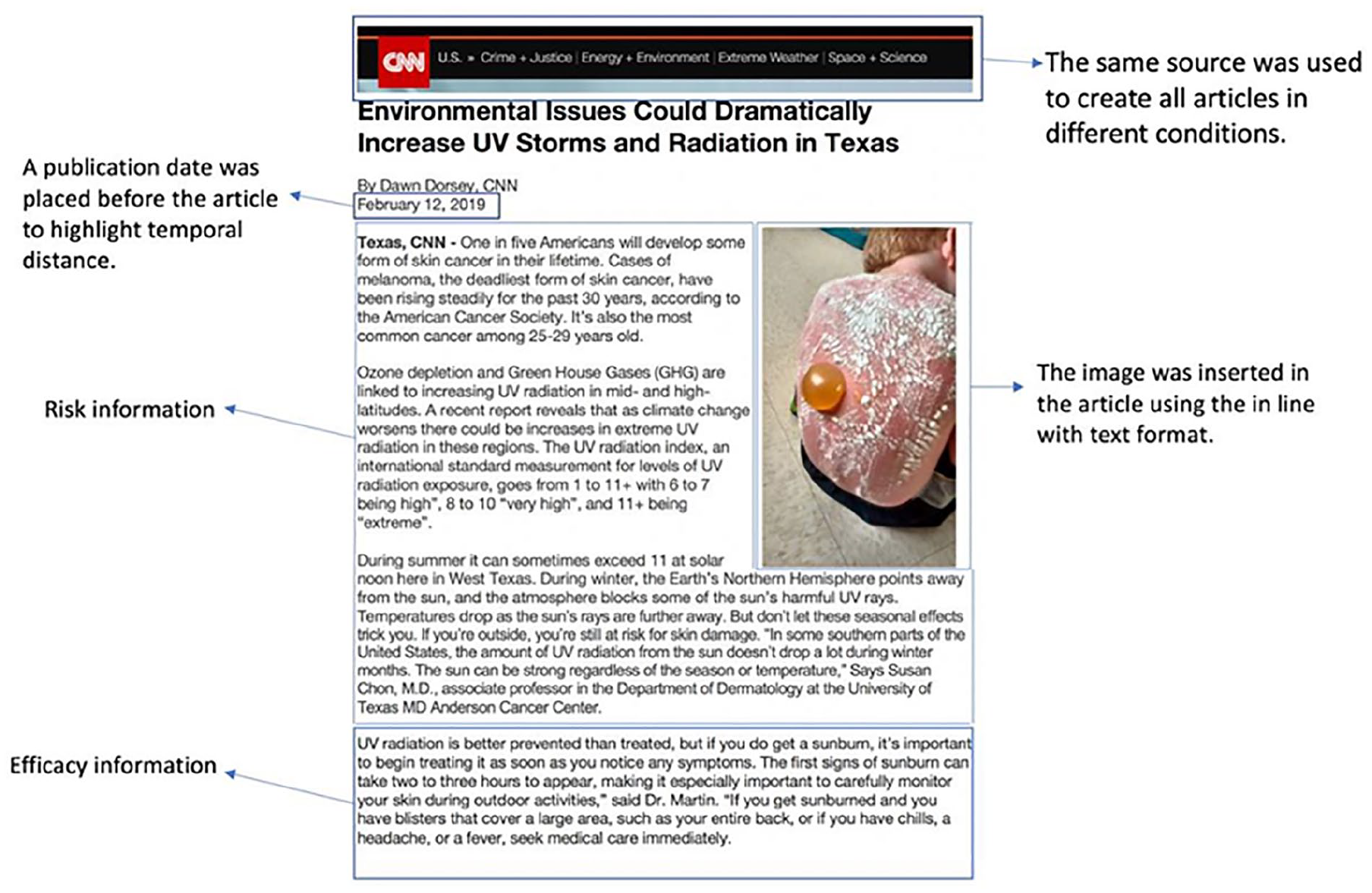
Sample article for the high disgust low psychological condition with layout explained.
Dependent Variables
Visual attention captured during the exposure to the stimulus served as the dependent variable. A large body of psychology and neuroscience applied eye-tracking as a precise and continuous measurement of message encoding (for review, see King et al., 2019). Eye-tracking largely rests on the assumption that message encoding occurs when the foveal avascular zone is directly aligned with an element in an individual’s visual field. When visually encoding a message (e.g., print press stories), viewers’ attention consists of fixations connected by rapid saccadic eye movements. Fixations constitute brief movement when elements in one’s visual field are clearly detected and cognitively processed. This study defined a fixation as a moment when the gaze point remained stationary for more than one-tenth of a second within a 60-pixel radius on screen. Our research adopted the assumption that the total duration of fixations reflects the depth of cognitive processing (e.g., Cummins et al., 2017; Mackert et al., 2013).
Two measures were employed to index visual attention: total reading time and total fixation duration. Total reading time is a ratio-level measurement indicating how many seconds participants visually attended to the article. Total fixation duration is a ratio-level measurement indicating the combined duration (in seconds) of all fixations within the researcher-defined area of interest (i.e., risk information, efficacy information, and image). Because articles in different conditions used the same layout, the size of each area of interest is consistent across conditions.
Participants and Procedures
A sample of 124 participants with normal or correct to normal vision was recruited from a public university in the southwestern region of the U.S and its surrounding communities.
Participants were told to evaluate news stories without knowing the purpose of the study. Pretest participants were excluded from the main study recruitment procedure. Six participants’ data were excluded due to inaccurate calibration, resulting a final sample size of 118 (52.5% = female, Mage = 22.4, SDage = 4.21). Data were collected in individual sessions using the Tobii X2-120 system and sampled at 120 Hz. After the initial gaze point calibration, participants were instructed to read a few articles on a computer while a non-intrusive eye-tracker located on the bottom edge of the monitor continuously recorded gaze data in a non-intrusive way. To avoid sensitizing participants to the research topic and ensure attentional selectivity, five other press stories not pertaining to the research interest were presented with the stimuli.
The Tobii system randomized the presentation order of these articles. Participants were instructed to browse news stories at their own pace by pressing the spacebar on the keyboard to move on to the next article.
Results
Impact of Psychological Distance and Disgust on Attention
In response to
Regression Models Predicting Total Reading Time (in Seconds).

Dummy-coded (1 = far and 0 = close).
Dummy-coded (1 = high-disgust image and 0 = low- disgust image).
To explicate the influence of disgust and distance on participants’ attention to risk and efficacy information, we ran two additional OLS models, respectively predicting attention to risk and efficacy-related information (Tables 2 and 3). The interaction between disgust and distance significantly predicted attention to high-level risk information, and its influence on attention to low-level efficacy information was borderline significant. Simple slope analysis suggested the use of disgust images led to less attention to efficacy information under close distance condition (B = −3.25, SE = 1.25, p = .01), but led to more attention to risk information under far distance condition (B = 7.75, SE = 4.14, p = .06). Therefore,
Regression Models Predicting Total Fixation Duration on Efficacy Information (in Seconds).

Dummy-coded (1 = far and 0 = close).
Dummy-coded (1 = high-disgust image and 0 = low-disgust image).
Regression Models Predicting Total Fixation Duration on Risk Information (in Seconds).

Dummy-coded (1 = far and 0 = close).
Dummy-coded (1 = high-disgust image and 0 = low-disgust image).
Impact of Ecological Worldview on Attention
The three-way interaction among ecological worldview, disgust, and psychological distance was a significant predictor of attention to the message. Specifically, simple slope analyses suggest that only among people with a pro-environment worldview (one standard deviation above the mean), a high-disgust image led to increased attention to the message at far distance (B = 25.03, SE = 6.02, p < .001). Similarly, among participants with a more pro-environment worldview (1 SD above the mean), distance is positively associated with attention when a disgusting image was featured (B = 13.81, SE = 5.78, p = .02), while the direction of the relationship reversed when a less-disgusting picture was embedded in the message (B = −16.35, SE = 6.40, p = .01). Spotlight analysis with the Johnson-Neyman technique revealed that the interaction between disgust and distance framing was only significant among those scoring among the top three quartiles (74.36%) in the ecological worldview scale.
Synthesize the findings above, effects predicted in H1 and H2 are more significant among individuals who hold a more pro-environment worldview.
More interesting results emerged when ecological worldview was included in the models that examined attention to risk and efficacy information (Tables 2 and 3). Ecological value was a significant predictor of attention to efficacy information, where people holding pro-environment views were more likely to pay attention to such messages. Although the three-way interaction among message factors and worldview’s relationships with two outcome variables were approaching significance, a closer look at the simple effects uncovered some exciting findings. Specifically, we found that among environmentalists (i.e., high ecological worldview scores), the use of disgust imagery increased attention to both efficacy (B = 4.15, SE = 1.64, p = .01) and risk (B = 20.89, SE = 5.31, p < .001) in far distance conditions, though the influence on attention to efficacy information is observably smaller. The correlations between disgust and attention to risk or efficacy information were non-significant among those scoring low on the ecological worldview scale. Similar to earlier findings, spotlight analyses also revealed that the interaction between disgust and distance was only a significant predictor of fixation on efficacy and risk information among pro-environmental participations (top 58.12% for attention to efficacy information and top 74.36% for attention to risk information).
Based on the findings reported above, it is arguable that individuals holding a less pro-environment worldview are mostly indifferent to change in disgust and distance. Differently, for those holding pro-environmental attitudes, disgust’s positive influence was also realized mostly through attention to risk information under far distance conditions. We discuss the implications of these findings in detail in the following section.
Discussion
The purpose of this study was three-fold. First, this research empirically verified the impact of disgust images on the effectiveness of environmental messages by testing if disgust images could backfire and disengage the audience. Second, visual attention to fear-inducing disgust images is often assumed but not directly measured in prior research. We extended this body of research using eye-tracking as a precise measurement of visual attention to images and different message components (i.e., risk and efficacy information). Lastly, prior research identified moderating factors such as moral obligation, self-efficacy, and collective efficacy to predict when fear-inducing images would lead to enhanced message effectiveness. We identified psychological distance as another moderating factor that can facilitate or delay the onset of the defensive cascade.
Theoretical Implications
Theoretically, this research continues to support the limited processing capacity and motivated cognition approach. From the limited capacity perspective (A. Lang, 2006), aversive reactions triggered by disgust images increase cognitive resources allocation to message processing, while the far psychological distance delayed the onset of the defensive mechanism. We also found that such effects tend to be stronger among people holding more pro-environment worldviews. One possible explanation is that those who value the environment may be willing to allocate more cognitive resources to process environmental messages, which strengthens the effect of far psychological distance on delaying the defensive cascade.
This research also contributed to the CLT by specifying how psychological distance exerted different impacts on risk and efficacy messages. Recent research showed that manipulating psychological distance to climate change issues did not always increase behavioral intention or explain changes in environmental attitudes (Brügger, 2020; Klöckner & Sommer, 2021). Distance and disgust images also jointly influenced people’s attention to risk and efficacy information. Participants paid more attention to risk information when disgust images were used in far distance conditions, whereas close distance motivated attention to efficacy information when non-disgust images were used. These results provided further support to the LC4MP. Far psychological distance delayed the occurrences of defensive cascade so that additional resources allocation elicited by disgust images benefited the processing of risk information. Another explanation for such difference may stem from the innate association between emotional intensity and distance perception. As highly emotional imageries (e.g., a disgusting image) sometimes promote far distance perception (Van Boven et al., 2010), the presence or absence of disgusting imagery may likely strengthen or weaken the impacts of distance manipulation in our experimental message.
Distance’s salient influence on attention to risk information also indicates that for psychologically distant events, disgust images lead to resource allocation and understanding of the situation, and thus increased attention to risk messaging was observed. Far psychological distance also helped viewers perceive the threat without triggering the defensive cascade as seen in close distance conditions. Differently, distance’s significant impacts on attention potentially showed that in events psychologically close to the audiences, disgust images could scare viewers, so much so that they avoid efficacy messages. The adage, “This won’t happen to me” comes to mind, which explains that viewers paid more attention to efficacy messaging in close distance conditions when non-disgust images are used. Lastly, the impact of psychological distance on attention to risk or efficacy information was more pronounced among people with more pro-environment worldviews. As the results suggested, a less pro-environment worldview led to avoidance of environmental messages and thus reduced the effect of disgust images and psychological distance on attention to risk and efficacy information.
Practical Implications
The findings from this study provide practical recommendations to media practitioners who wish to use fear-inducing disgust images to draw attention and raise awareness yet struggle with selective avoidance of undesirable messages. Pairing disgust images with messages that focus on psychologically distant places from the readers increased attention to the message, especially risk information. When the psychological distance presented becomes closer to the viewer, the use of disgusting images triggers the defense cascade and consequently reduces attention to the message. In these situations, the use of non-disgusting images allows readers to continue allocating cognitive resources without tipping them into an aversive reaction which ends with a defensive mechanism being deployed (Meczkowski et al., 2016). Within the context of environmental communication, popular media coverage on environmental issues often features distant and abstract imageries (Duan et al., 2017). This study identified potential ways to connect with viewers using fear-inducing, aversive images without causing a backfire.
The discussion of climate issues is currently approaching a schism, where supporters and proponents are no longer talking about the same subject (Hoffman, 2011). The proper use of images in messaging to increase attention on the subject could be used to draw sides closer together. As Chu and Yang (2020) suggest, the public has become more familiar with climate change over the years, and the ways our messages are presented must keep evolving. The increased attention from properly using disgusting/non-disgusting images allows practitioners to highlight risk or efficacy information. For media practitioners, the results of this study showed that the selection of images and messaging tactics should be determined by the situation (e.g., local or national events). If showing risk at a larger, more distant scale is the goal, disgust images can be used to increase attention and to help viewers understand the risk. At the local level, non-disgust images need to be used alongside efficacious messaging. This study showed that this combination allowed people to pay more attention to efficacy messages.
This study also has its limitation. First and foremost, we chose to focus solely on participants’ attention to messages instead of assessing these messages’ impacts on their attitudes and behaviors because visual attention is directly linked to message encoding and serves as the gateway to message processing and brief exposure to environmental messages may not be potent enough to significantly change environmental attitudes and beliefs. However, we recommend future research consider incorporating additional measures (e.g., risk perception, topic familiarity, attitude toward pro-environmental policies, etc.) and apply longitudinal study designs to systematically evaluate the cumulative effects of aversive images in environmental communication. Recent studies also started exploring subdimensions of psychological distance, such as egocentric and nonegocentric distances (e.g., Duan et al., 2021). The current research assessed the effects of egocentric psychological distance by manipulating the spatial and temporal distance between the participants’ immediate experience of reality and climate change issues. Future research can continue to explore how sensing others’ proximity to climate change (i.e., nonegocentric distance) may affect people’s risk perceptions and behavioral intentions. The current study may also benefit by utilizing a more demographically diversified sample. We recruited students and people from surrounding communities due to the limited accessibility to laboratory equipment essential to the measure of message fixation and duration. However, we highly recommend that future studies consider testing our paradigm on a more representative group of individuals.
Conclusion
In summary, this study serves as the initial step to connecting research on message processing and psychological distance in the context of environmental communication. By delineating the influence of psychological distance and emotional imageries on people’s attention to different types of environmental communication messages, we identify that emphasizing the proximity of risks such as climate change may be better accompanied by less threatening and disgusting images. As people tend to pay more attention to information regarding how to effectively mitigate and even overcome the proximal threats (i.e., efficacy information), providing more of such information may be effective when close distance and less-threatening imageries were featured. Differently, messages aiming to raise public awareness of some seemingly distant threat may benefit from including more visually stunning images. In the meantime, demonstrating the severity and individual susceptibility to the risks may also promote engagement with the messages when far distance and graphic imageries are utilized.
Footnotes
Declaration of Conflicting Interests
The author(s) declared no potential conflicts of interest with respect to the research, authorship, and/or publication of this article.
Funding
The author(s) received no financial support for the research, authorship, and/or publication of this article.
Ethical Approval
All procedures followed were in accordance with the ethical standards of the responsible committee on human experimentation (institutional and national).
Informed Consent
Informed consent was obtained from all patients at the beginning of each data collection session.
Data Availability Statement
The authors confirm that the data supporting the findings of this study are available from the corresponding author on request.
