




Abstract
In order to explore the cognitive mechanisms and processing involved in incidental vocabulary acquisition, this study examines whether two crucial cognitive factors, attention and working memory, influence incidental vocabulary acquisition during second language reading. Employing a combined online-offline approach, attention, working memory, and incidental vocabulary acquisition were recorded from 47 advanced Chinese learners. This study utilized SPSS for data processing and Mplus to construct the mediation model. The results indicate that degree of attention and working memory predict incidental vocabulary acquisition, with working memory being related to vocabulary processing strategy and serving as a mediator between attentional and incidental vocabulary acquisition. This study contributes to understanding of the cognitive mechanisms underlying incidental vocabulary acquisition and Chinese vocabulary teaching.
Plain language summary
This study investigates how two key cognitive factors—attention and working memory—influence the process of learning new vocabulary unintentionally (incidental vocabulary acquisition) while reading in a second language. It involved 47 advanced Chinese learners and used a combination of online and offline methods to measure attention, working memory, and vocabulary learning. The findings show that both attention and working memory play important roles in learning new words incidentally. Specifically, working memory not only helps with vocabulary processing strategies but also acts as a bridge between attention and vocabulary learning. These results help us better understand how the brain supports incidental vocabulary learning and provide insights for improving Chinese vocabulary teaching.
Introduction
Vocabulary acquisition is a long-term and complex process. Research indicates that to read moderately challenging texts fluently, second language learners need to master at least 10,000 words, and to deeply understand more authentic foreign materials, such as newspapers, approximately 35,000 words are required (Schmitt, 2010). However, accumulating vocabulary is particularly difficult for second language learners. Therefore, exploring effective vocabulary acquisition strategies, optimizing teaching methods, and enhancing the efficiency of vocabulary acquisition are crucial for second language teaching. This helps learners overcome vocabulary learning challenges and achieve more efficient language learning outcomes.
There are two main ways of vocabulary acquisition: intentional learning and incidental learning. Intentional learning refers to learners memorizing words with a specific purpose, which is direct and efficient. However, long-term repetitive memorization can lead to fatigue and boredom, affecting the effectiveness of vocabulary acquisition.
In contrast, many scholars consider incidental vocabulary acquisition through learning activities such as reading to be an important way to expand vocabulary (Gass, 1999; Nation, 2001). In second language acquisition, incidental vocabulary learning typically refers to the process where second language learners, while engaging in meaningful second language learning activities or language use, focus on tasks such as listening, speaking, reading, and writing, and incidentally acquire vocabulary as a byproduct of language skill learning (Laufer & Hulstijin, 2001). Incidental vocabulary acquisition helps learners understand and remember new words in real contexts, thereby improving their practical language application skills. Learners are also exposed to rich cultural and contextual information, which aids in a deeper understanding of the second language and its cultural background. Incidental vocabulary acquisition through meaningful language activities such as reading and listening increases learners’ interest and motivation, making the learning process more enjoyable and effective, and reducing the burden of vocabulary memorization, especially for low-frequency words that are hard to master through intentional learning. It also promotes the integrated development of listening, reading, writing, and speaking skills. Clearly, incidental vocabulary acquisition is an important pathway for expanding vocabulary and deepening understanding.
Current research in the field of incidental vocabulary acquisition (IVA) primarily focuses on second language learners of Indo-European languages, with relatively fewer studies on the IVA of Chinese as a second language. This study fills this gap by delving into the incidental acquisition of vocabulary in Chinese as a second language, marking the first innovative aspect of our research. Furthermore, compared to previous studies, we have further explored the relationship between working memory, the degree of attention, and the outcomes of incidental vocabulary acquisition. This exploration is significant for gaining a deeper understanding of the cognitive mechanisms underlying IVA and contributes to the expansion of research in cognitive science fields closely related to IVA. Lastly, to comprehensively understand the vocabulary acquisition process of learners, we conducted interviews to investigate the link between working memory and vocabulary processing strategies, which constitutes another major innovative point of our study. These innovative aspects collectively enhance the contribution of our research to the academic field.
Literature Review
Attention and Incidental Vocabulary Acquisition
When learners engage in meaningful language learning activities, their attention is focused on tasks such as listening, speaking, reading, and writing. Vocabulary knowledge is considered a byproduct of language skill learning, a process known as IVA (Laufer & Hulstijin, 2001). Research themes in the field of IVA can be primarily divided into three categories: the impact of learner factors on incidental vocabulary acquisition, the effectiveness of incidental vocabulary acquisition under multimedia learning methods, and the exploration of the cognitive processes involved in incidental vocabulary acquisition (Yang & Luo, 2022).
Firstly, in the first category of research, topic familiarity, learning interest, and vocabulary size have been widely discussed. Pulido (2003, 2007) indicated that the degree of learner familiarity with a text affects text comprehension and vocabulary acquisition. Learner interest in a text also influences the effectiveness of incidental vocabulary acquisition (Lee & Pulido, 2017). Peters and Webb (2018) found that vocabulary level can significantly predict the effectiveness of incidental vocabulary acquisition. In the second category of research, Montero Perez et al. (2015) recorded learners’ eye movements while watching subtitled videos and discovered that the longer learners dwelled on the subtitles, the better their vocabulary acquisition outcomes. Some studies have also applied multimedia cognitive learning theory to explore whether bimodal or multimodal annotations can free up memory capacity and reduce cognitive processing difficulty, thereby facilitating vocabulary memory (Boers et al., 2017). The third category of research utilizes eye-tracking experiments to record and analyze second language learners’ attention to vocabulary during the reading process, as well as the impact of learners’ working memory on IVA. Next, we will first introduce research on the influence of attention on IVA.
Attention is considered a prerequisite for vocabulary acquisition (Ellis, 1994). Logan (1997) presented sufficient attention to a linguistic item is necessary to encode it into memory, but the quality of encoding depends on the quality and quantity of attention. Schmitt (2008) also believe the primary principle for maximizing vocabulary learning is to promote learners’ engagement and attention to vocabulary items. Schmidt’s (1990)“Attention Hypothesis” emphasizes that “attention” is the subjective experience of consciously perceiving certain external stimuli. Building upon the “Attention Hypothesis,” Hulstijin and Laufer (2001) proposed the “Involvement Load Hypothesis,” further suggesting that learners’ involvement in target words affects vocabulary acquisition outcomes, with higher involvement leading to better outcomes. However, neither hypothesis provides detailed explanations on how to measure learners’ attention.
Rayner (1998, 2009) proposed the E-Z Reader model, which suggests that eye movements are linked to thought processes, and eye movements reflect real-time lexical processing. An increasing number of studies use eye movement data as a measure of attention to target words and the depth of processing. Godfroid et al. (2010, 2013) and Godfroid (2019) utilized eye-tracking technology to observe the eye movements of English learners as they read texts containing target words (pseudowords) to investigate learners’ attention to new words during reading, and conducted vocabulary tests after reading. Godfroid found that the total fixation time on target words was longer and positively correlated with post-reading vocabulary test score, indicating that IVA requires attentional engagement. Pellicer-Sánchez (2015) found that both native speakers and second language learners had longer total fixation times on target words than on known words when encountering them for the first time, suggesting that both groups noticed the target words and attempted to infer their meanings. Previous studies compared eye-tracking data between target words and known words, supporting the notion that IVA requires active attentional engagement. However, there has been less exploration of the predictive nature of attention and the pathways through which attention influences IVA.
Working Memory and Incidental Vocabulary Acquisition
Working memory, with its limited capacity to process and store information simultaneously (Baddeley & Hitch, 1974), is a pivotal cognitive resource in SLA and IVA, yet its role is a subject of ongoing debate among researchers. While studies by Robinson, Anmarkrud and others have demonstrated a positive correlation between working memory capacity and SLA success, contrasting views by Engel and Gathercole, Yi, and Li suggest that the relationship may not be as straightforward.
On the one hand, SLA is a more controlled learning process that requires greater cognitive resources, thus relying more on working memory and requiring higher working memory capacity (Juffs & Harrington, 2011). Robinson (2012) also emphasized that incidental learning is highly sensitive to individual differences in cognitive abilities such as working memory, but these sensitive reactions may not be immediate and may show delayed effects. In the specific domain of incidental vocabulary acquisition. Anmarkrud et al. (2019), Martin and Ellis (2012), Ruiz et al. (2021), Tang and Chen (2014), Teng et al. (2021), Guan et al. (2021) also found that working memory plays an important role in IVA and retention. Tang and Chen (2014) selected three groups of participants from different proficiency levels and divided each group into high and low working memory capacity subgroups. The results showed that in the higher proficiency group, the vocabulary test score of the high working memory capacity subgroup were higher than those of the low working memory subgroup. It provides evidence that vocabulary learning requires learners to fully utilize working memory to acquire receptive and productive knowledge during input (Teng et al., 2021). Miao (2022) explored the impact of different components of working memory on reading comprehension in English learners and similarly found that only the processing component was significantly correlated with second language reading comprehension, while the storage component showed no correlation with comprehension score.
On the other hand, Engel and Gathercole (2012), Yi (2022), and Li (2004) hold opposing views. Engel and Gathercole examined the impact of working memory on 9-year-old Luxembourgish children learning second languages (German or French) and found that the phonological short-term memory and executive functions of working memory had no significant effect on vocabulary acquisition. Yi (2022) used an operation span task to measure working memory, and found no correlation between vocabulary learning test score and working memory capacity. Li (2004) found that individual differences in working memory capacity did not significantly inhibit the extraction of semantic information or the level of English vocabulary knowledge. Engel and Gathercole explained that vocabulary acquisition tends to be an automated activity that does not rely on working memory.
These divergences highlight the complexity of the role of working memory in language learning and the need for further research to elucidate its specific influence on different aspects of SLA and IVA. Additionally, few studies explored whether the different components of working memory might affect IVA. The impact of the components of working memory on incidental vocabulary acquisition also needs to be investigated.
Attention, Working Memory and Incidental Vocabulary Acquisition
Working memory multi-component model suggests that the central executive component of working memory is responsible for processing information by focusing attention on relevant information while inhibiting irrelevant information (Baddeley & Hitch, 1974). Subsequent models such as Cowan’s (1999) embedded-process model, Engle et al.’s (1999) attention control model, and Lovett et al.’s (1999) rational adaptation control model, while differing in their definitions of working memory, all emphasize the connection between working memory and attention. These models suggest that effective operation of working memory requires allocation of attentional resources, and attentional control and allocation also depend on working memory mechanisms. Working memory and attention are mutually influencing cognitive processes that jointly participate in complex cognitive tasks.
Based on working memory models and Schmidt’s (1990)“Attention Hypothesis,”Robinson (1995, 2003) proposed a model regarding the relationship between attention and memory. This model emphasizes defining attention as conscious monitoring and rehearsal in working memory, which plays a necessary role in learning and subsequent encoding in long-term memory. Working memory and attention interact with each other, thereby influencing second language vocabulary acquisition. Wen and Skehan (2011) also pointed out that in meaning-focused classroom environments, greater working memory capacity enables second language learners to better attend to language forms, facilitating language learning.
Recently, the relationship between working memory, attention, and vocabulary acquisition has become a hot topic in research, with many scholars exploring the interactions among these three factors. Guan et al. (2021) utilized eye-tracking technology to investigate whether working memory capacity affects the integration of target words with text. They found that when reading sentences containing target words, participants with higher working memory capacity exhibited longer first fixation durations, gaze durations, total fixation durations, and regressions to target words compared to those with lower working memory capacity. Their attention was more focused on the target words, indicating immediate integration effects and greater engagement in online integration of vocabulary and text. Similarly, Huang (2022) employed eye-tracking technology to study the relationship between working memory and attention during vocabulary incidental learning. The study revealed that the relationship between attention and vocabulary acquisition is modulated by working memory capacity. Learners with higher working memory capacity tended to allocate more attentional resources to processing target words. These studies unanimously suggest that working memory plays a crucial role in the interaction between attention and SLA. Individuals with higher working memory capacity tend to adopt deeper, more focused cognitive mechanisms, investing more attention in target words to facilitate information processing and effective vocabulary acquisition. Conversely, individuals with lower working memory capacity may employ shallower or avoidance cognitive strategy, limiting their ability to deeply process target words. This series of studies provides valuable insights into the dynamic relationship between attention and working memory in the process of language acquisition, but there still exists a research gap regarding the specific influence pathways.
Although previous studies have preliminarily investigated the relationship between attention and working memory, as well as their impact on IVA, there is disagreement in existing research regarding the role of working memory and attention in IVA. Neither has there been exploration of their predictive roles and the specific influence pathways in IVA, nor of the effects of different functional components of working memory.
To address these research gaps, the present study integrates online and offline research methods, using Reading Span Test to assess participants’ working memory and adopting eye-tracking technology to monitor participants’ eye movements in real-time, and providing accurate and objective data for analyzing attentional allocation. By quantifying attention, working memory, and the functional components of working memory, this study investigates their predictive roles and influence pathways in IVA within the context of Chinese reading environments.
Methodology
Research Question
As introduced above, the current study employs eye-tracking technology to track the eye movements of high-level Chinese proficiency international students studying in China as they read six short passages containing target words, aiming to address the following three questions:
Does attention affect incidental vocabulary acquisition?
Does working memory affect incidental vocabulary acquisition?
Does working memory mediate the relationship between attention and incidental vocabulary acquisition?
Participants
Previous research has shown that learners need to have a sufficient vocabulary size to achieve IVA. In order to minimize the impact of vocabulary size on the experimental results, this study selected 47 high-level Chinese learners as participants. Among them, four participants encountered calibration issues with the eye tracker and were therefore excluded. Additionally, 15 participants had a comprehension test accuracy below 70% and were also excluded. As a result, the final valid sample consisted of 32 individuals, including 20 females and 12 males. These participants ranged in age from 20 to 30 and were international students from various universities in China, with diverse language backgrounds.
All participants had normal or corrected vision, without severe astigmatism, and no history of mental or neurological disorders or reading disabilities. Prior to participating in the experiment, all participants were informed about the purpose of the study, carefully read and signed informed consent forms. Before participating in the eye-tracking experiment, all participants took a Chinese proficiency test using the Chinese Testing System. The test score ranged from level 1 (HSK1 qualified) to level 12 (HSK6 excellent). Participants in this study were required to achieve a proficiency level of HSK5 qualified or above. Each participant who completed the experiment and provided valid data received a financial compensation.
This study will not cause any physical harm to the participants. However, there is a risk of prolonged visual fatigue due to extended reading. This risk has been communicated to the research subjects prior to the experiment. All participants have signed an informed consent form. Written consent was obtained from the Ethics Committee and Reviewer Board of University.
Equipment
Eyeball movements were recorded using the Eyelink II, a head-mounted eye tracker manufactured by SR Research. The text stimuli were displayed in Song font (font size 22) on a computer monitor positioned 68 centimeters away from the participant’s eyes. The experimental reading materials consisted of six pages presented sequentially, with each page containing a similar length of text averaging 411 Chinese characters. There were six target words on each page. To minimize errors in eye-tracking recordings, the positions of the target words on the screen were strictly controlled, ensuring that they did not appear at the beginning or end of each line. Additionally, participants were instructed to rest their heads on a chinrest to minimize head movement and track eye positions more stably.
Materials
Reading Material
To investigate participants’ eye movements during reading, this experiment employed an eye tracker to observe participants as they read six short passages (see Appendix A), with each passage presented on a single page. The passages were tailored to the participants’ Chinese proficiency levels, and four native Chinese speakers with backgrounds in Chinese language learning were invited to read the texts to ensure their linguistic coherence. All four readers confirmed that the texts were fluent. The difficulty level of the texts was evaluated using the Chinese Resource Platform’s Chinese text reading difficulty classification system. Analysis revealed that two passages were classified as HSK Level 4 difficulty, while the remaining four passages were classified as HSK Level 5 difficulty, aligning with the participants’ Chinese proficiency levels.
Target Words
To ensure that the participants had not encountered the target words before the study, pseudowords were selected for this research. In the initial stage of the study, to construct pseudo-words and reading texts more accurately, and to ensure that the process of participants guessing the meanings of “pseudo-words” in the experiment aligns with real reading situations, we conducted a questionnaire survey among 19 high-level Chinese learners. We primarily inquired whether the survey participants consciously inferred the meanings of unfamiliar words during their reading process, and if they did, what methods they employed for such inferences. After the survey, we conducted a statistical analysis of the participants’ responses. The survey revealed that 80% of the participants relied on contextual clues and morphemic meanings for inference. Based on these results, six disyllabic pseudowords were created from high-frequency morphemes that shared similar or related meanings with the target words. These pseudowords included “育立” (appear), “汗烘” (dry), “反分” (different), “除至” (cancel), “把同” (influence), and “击习” (attack), with two being adjectives and four being verbs. The context of the reading materials provided clues to the meanings of the pseudowords. Five native Chinese speakers with backgrounds in Chinese language learning successfully inferred the meanings of the pseudowords from the contextual clues. To enhance the likelihood of participants inferring and acquiring the vocabulary, each pseudoword was presented six times, appearing approximately once per passage, and a sentence may contain at most one target word.
Measurements
Eye Tracking Measurement
To investigate the relationship between attention level and incidental vocabulary acquisition (Question 1), eye-tracking technology was employed to monitor participants’ eye movement data, which served an as indicator of attention level.The measurement of attentional focus on target words adopted two eye-tracking indices: total fixation duration (TFD) and number of fixations (NF). These indices are commonly used in investigating vocabulary processing mechanisms (Pellicer-Sánchez, 2015) and are late-stage indicators of vocabulary processing, primarily associated with higher-order processes such as semantic integration (Libben & Titone, 2009). Total fixation duration (TFD) refers to the total time spent fixating on the region of interest, encompassing all fixation points within that area. Number of fixations (NF) indicates the total number of fixations made within the region of interest, reflecting the cognitive processing load during reading of the material.
Reading Comprehension Test
To ensure participants’ attention to the text content and their careful reading of the material, the researchers informed the participants in advance about a reading comprehension test before the reading session. The test comprised 24 true/false statements, each representing a short sentence that the participants had to judge based on whether it matched the content of the text. Participants received one point for each correct answer, with a total score of 24 points. If a participant’s score fell below 70% of the total score, it might indicate inadequate attention to the text, rendering the data invalid. Following the completion of each text, the comprehension test questions were displayed on the screen of the eye-tracking device, with each question presented on a separate interface.
Vocabulary Test
To address the research questions, a vocabulary post-test was employed to measure the participants’ incidental vocabulary acquisition after 20 min of reading. To ensure that participants acquired vocabulary incidentally during reading, they were not informed about the vocabulary test before reading. The vocabulary test consisted of three types of tasks: word form recognition, word meaning recall, and word meaning recognition.
In the word form recognition task, participants were required to identify the correct spelling of the target word from four options, with distractors closely resembling the correct form or meaning. There were six items in total, with one point awarded for each correct answer.
The word meaning recall task assessed participants’ ability to recall the meaning of the target words. Participants were presented with the target words in a neutral context and were asked to write down their meanings. Again, there were six items, with one point awarded for each correct answer.
In the word meaning recognition task, participants were tested on whether they had established a connection between form and meaning. They were presented with the target words along with five options, including one correct answer and three distractors closely related in meaning and word class, as well as one option “I don’t know”. This task also consisted of six items, with one point awarded for each correct answer.
To minimize interference between tasks, the test sequence was word form recognition, word meaning recall, and word meaning recognition. The test items were administered using the Question Star platform, with each item presented on a separate interface, resulting in a total of 18 interfaces.
Working Memory Test
To investigate the relationship between working memory and incidental vocabulary acquisition (Question 2), the Reading Span Task paradigm (Daneman & Carpenter, 1980) was employed to measure working memory. This test is a dual-task paradigm designed to measure both the processing and storage components of working memory. Given the correlation between second language working memory and SLA, the Reading Span Task in this experiment was conducted in Chinese.
The test comprised 20 sets of sentences, with each set containing 2 to 5 simple sentences, totaling 70 sentences. The sentences were constructed using high-frequency words, with an average length of 12 Chinese characters, and had unrelated content. The final word of each sentence differed. The test was administered using E-prime software, presenting one sentence at a time. Participants were required to judge whether the sentence’s grammar was correct and to remember the final disyllabic word of each sentence. After each set of sentences, a 3 × 3 grid appeared, and participants sequentially selected the disyllabic words they remembered from the preceding sentences. One point was awarded for each correct grammar judgment, representing processing capacity, and one point was awarded for correctly selecting a word in the correct order, representing storage capacity. Prior to the formal test, participants underwent practice sessions until they were familiar with the procedures.
Post-Reading Interview
During reading, participants actively employed various strategies to relate newly acquired information to existing knowledge in their brains. When encountering unfamiliar words, the information chain may be disrupted, requiring strategy to infer the meaning of the unfamiliar words and compensate for the missing information (Kintsch, 1998; Lu, 1999). Such inference does not necessarily shift attention to memorizing word forms. Therefore, to delve into the mechanisms by which participants process target words during reading, we designed a semi-structured interview (see Appendix B) to gain an in-depth understanding of the strategies participants employ when encountering unfamiliar words. Initially, we inquire whether participants can roughly comprehend the content of the reading material, a step crucial for ensuring the validity of the data collected. Subsequently, we probe further to determine if subjects have noticed any unfamiliar words during their reading and ask if they consciously attempt to infer the meanings of these unknown words. Finally, we question the specific methods subjects use to deduce the meanings of unfamiliar words, thereby revealing their particular strategies in vocabulary processing. This progressive questioning, complemented by eye-tracking, aids us in better understanding the cognitive and behavioral responses of subjects when faced with unfamiliar words.
Experiment Procedures
Before the experiment commenced, participants were first briefed on the test content and signed informed consent forms. Following this, they took a Chinese proficiency test using the Chinese Testing System, with only those achieving an HSK5 qualified level or above advancing to the subsequent stage of testing. After successful calibration of their eyes, the participants engaged in an eye-tracking reading experiment, where they were instructed to attentively read six Chinese short texts displayed on the screen without any time constraints. Participants responded to comprehension questions by pressing the A and L keys, unaware of the presence of pseudo-words or upcoming vocabulary tests. Those who scored above 17 points on the reading test moved on to the next stage. Post the reading test, participants were administered the reading span task using E-prime software, practicing the task to familiarize themselves with the procedures before the formal test began. Subsequently, they completed the vocabulary test on the Question Star platform. To gain insights into the strategies employed when encountering unfamiliar words, participants were briefly interviewed after the vocabulary test. Upon completion of the entire experiment, participants received their compensation.
Data Processing
This study used the target word as the region of interest (ROI) and measured the participants’ attention using total fixation duration and number of fixations. Eye-tracking data were exported using Dataviewer software, with data points containing fixation times less than 80 milliseconds or greater than 1,200 ms excluded. To mitigate the influence of reading speed, the eye-tracking data was standardized using z-score.
The scores from the reading span task were exported from E-prime software. The performance in grammatical judgment represented the processing component of working memory, while the recall of vocabulary represented the storage component. Both parts had a total score of 70 points. The processing and storage score of the participants were standardized using z-score, and the average was calculated to obtain the participants’ working memory score.
Based on the interviews with the participants, the strategy adopted when encountering target words can be summarized as follows:
Five participants did not pay attention to the target words.
Fourteen participants inferred the meaning of the words based on the context.
Thirteen participants inferred the meaning of the words based on the morpheme meanings within the target words.
To further understand the distribution of the data, Kolmogorov–Smirnov test was conducted. The results indicated that the processing score and scores from the three vocabulary tests exhibited non-normal distributions, while the other data showed normal distributions. Based on the distribution characteristics, correlation analyses were performed on the respective data sets followed by subsequent analyses.
To investigate the role of attention in vocabulary incidental learning, linear regression analyses were conducted with total fixation duration and number of fixations as independent variables and vocabulary test scores as the dependent variable.
To examine the role of working memory in vocabulary incidental learning, linear regression analyses were conducted with working memory, processing score, and storage score as independent variables and vocabulary test scores as the dependent variable. Additionally, one-way ANOVA was conducted with strategy as the factor and working memory score as the independent variable to compare whether there were differences in working memory among participants using different strategies.
To address research question three, because total fixation time (TFD) and number of fixations (NF) are quantified indicators of attention, the scores of three vocabulary tests are indicators of IVA outcome, Mplus software was used to combine TFD and NF into a new variable called ATTENTION, and form recognition score (FR), meaning recall score (MR), and meaning recognition score (MRR) were combined into a new variable called IVA. Based on the results of the correlation analysis, a mediation model was established, with attention as the independent variable, working memory (WM), processing component (PC), or storage component (SC) as the mediator variables, and vocabulary incidental learning outcome as the dependent variable, to explore the mediating effect of working memory on vocabulary incidental learning outcome. To evaluate the significance of the mediating effect, Bootstrapping method was used with 10,000 resamples to obtain confidence intervals for the mediating effect.
The data analysis was conducted using SPSS 22.0 and Mplus software. Further details of the statistical analysis results can be found in the following data results.
Result
Vocabulary Test Results
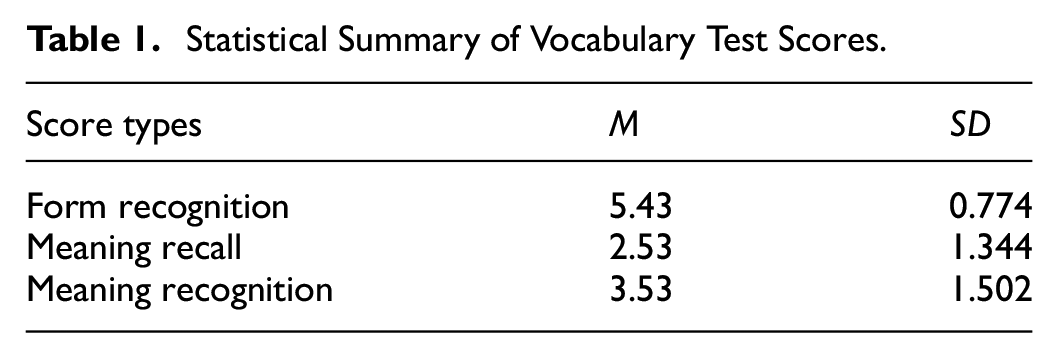
This data result serves as an indicator of incidental vocabulary acquisition.Statistical analysis was performed on the scores of participants in the three types of vocabulary tests. Figure 1 and Table 1 illustrate the distribution of scores for the three tests. In the word form recognition score, two outliers were excluded, resulting in the average score of 5.43 with a standard deviation of 0.774. The average score for word meaning recall was 2.53, with a standard deviation of 1.344. The average score for word meaning recognition was 3.53, with a standard deviation of 1.502.

Statistical graph of vocabulary test scores.
Statistical Summary of Vocabulary Test Scores.
Eye Tracking Data Results
This data result serves as an indicator of attention level. This study selected total fixation duration and number of fixations as two eye-tracking metrics to measure degree of attention. All eye-tracking data was standardized into z-score. The eye movement characteristics of the participants regarding the target words are presented in Table 2. The average z-score for total fixation duration on the target words was 0.31, with a standard deviation of 0.317. The average z-score for the number of fixations on the target words was 0.27, with a standard deviation of 0.321.
Eye-Tracking Statistics for Target Words.

Working Memory Testing Results
This data result serves as an indicator of working memory. Statistical analysis was conducted on participants’ scores in the reading span task, with the mean and standard deviation presented in Table 3: The mean score for working memory storage was 39.34 with a standard deviation of 10.551, while the mean score for working memory processing was 45.25 with a standard deviation of 7.309.
Statistical Summary of Reading Span Task Score.

Results of Correlation Analyses
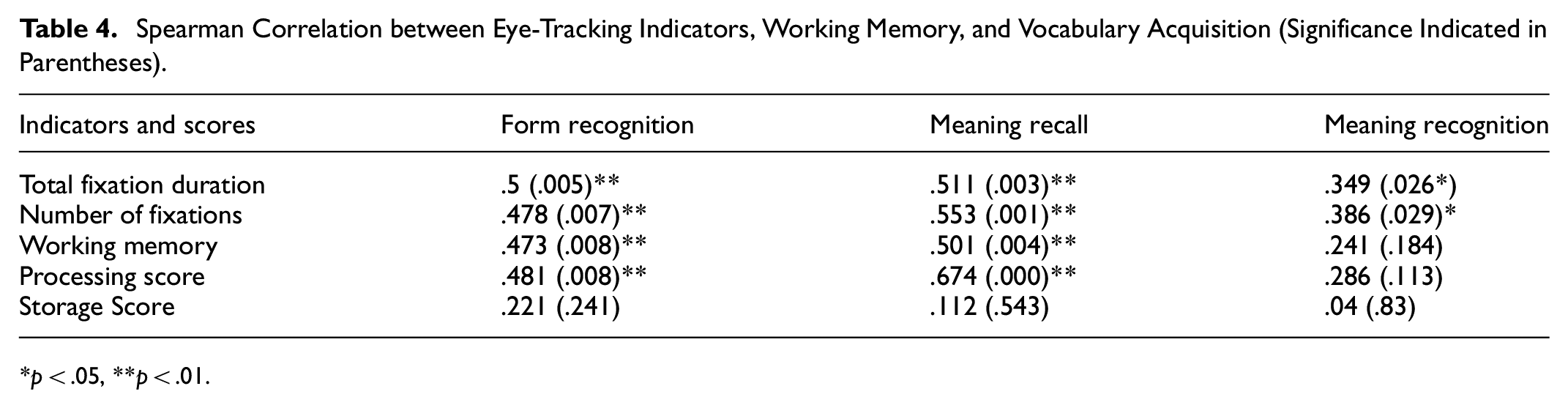
Spearman correlation analyses on the two eye-tracking indicators of target words, working memory score, storage score, processing score, and the scores of three vocabulary tests were conducted. The results are presented in Table 4. Additionally, Pearson correlation analyses were performed on the two eye-tracking indicators and the scores of working memory, storage, and processing, as shown in Table 5.
Spearman Correlation between Eye-Tracking Indicators, Working Memory, and Vocabulary Acquisition (Significance Indicated in Parentheses).
p < .05, **p < .01.
Pearson Correlation between Eye-Tracking Indicators and Working Memory (Significance Indicated in Parentheses).

p < .05, **p < .01.
From the correlation analysis results, it can be observed that both total fixation duration and number of fixations are correlated with the scores of all three vocabulary tests. Working memory and processing score are correlated with scores of word form recognition and word meaning recall, but not with word meaning recognition. Storage score show no correlation with the scores of all three vocabulary tests.
The correlation analysis results indicate that there is no correlation between the two eye-tracking indicators and working memory or storage score. Total fixation duration is significantly positively correlated with processing score, while the number of fixations is positively correlated with processing score as well. Since total fixation duration and number of fixations serve as quantitative indicators of attention, it can be preliminarily concluded that attention is positively correlated with the processing component of working memory.
Regression Analysis Results
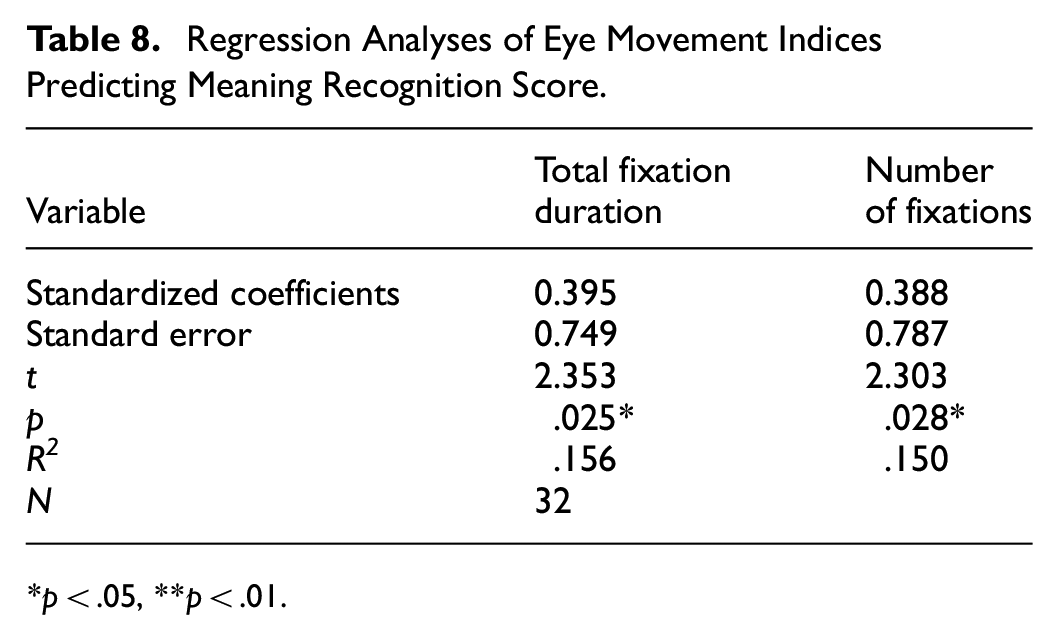
This data analysis is related to Research Question 1&2.Building upon the correlation analysis results mentioned earlier, regression analysis was conducted to examine the role of attention and working memory in vocabulary incidental learning. Total fixation duration, number of fixations, working memory, and processing score were used as independent variables, while form recognition score, meaning recall score, and meaning recognition score were used as dependent variables. Since working memory and processing score showed no significant correlation with meaning recognition score, regression analysis was not performed with these variables. The results of the regression analysis accordingly present in Tables 6 to 8.
Regression Analyses of Eye Movement Indices and Working Memory Predicting form Recognition Score.

p < .05, **p < .01.
Regression Analyses of Eye Movement Indices and Working Memory Predicting Meaning Recall Scores.

p < .05, **p < .01.
Regression Analyses of Eye Movement Indices Predicting Meaning Recognition Score.
p < .05, **p < .01.
Based on the comprehensive regression analysis, it can be concluded that both total fixation duration and number of fixations can predict word form recognition score, word meaning recall score, and word meaning recognition score. Additionally, working memory and processing score can predict word form recognition score and word meaning recall score. Since the three types of vocabulary tests respectively assess the participant’s acquisition of word form, word meaning, and the establishment of form-meaning connections, they serve as indicators of vocabulary incidental acquisition outcomes. Therefore, based on the regression analysis results, the following two conclusions can be drawn:
Attention is significantly positively correlated with IVA and can predict it’s outcomes. Higher degree of attention are associated with better vocabulary incidental acquisition outcomes.
Working memory and processing components are significantly positively correlated with IVA and can predict it’s outcomes. Higher levels of working memory and processing components are associated with better vocabulary incidental acquisition outcomes.
The next subsection will further analyze the influence of working memory on vocabulary strategy.
Correlation Analysis Between Working Memory and Vocabulary Strategy
Based on the results of the previous subsection, we further explore whether working memory is associated with participants’ vocabulary strategy. The strategy used by participants was treated as between-group variables and the differences in working memory, processing score, and storage score among participants using different strategies were compared. Firstly, a test for homogeneity of variances is conducted for the three groups’ working memory, processing score, and storage score, indicating homogeneity of variances. Subsequently, one-way analysis of variance (ANOVA) is performed with working memory, processing score, and storage score as dependent variables and strategy as the independent factor. Tukey’s post-hoc comparison method is then used to further investigate the differences between groups using different strategies. The results of the one-way ANOVA are presented in Table 9, and specific data from post-hoc comparisons are listed in Table 10.
Results of ANOVA for Working Memory, Processing Scores, and Storage Scores.

p < 0.05.
Tukey Post-hoc Comparison Results for Working Memory, Processing Scores, and Storage Scores.

p < .05.
The results indicate that there is a significant difference between groups in working memory and processing score, while the difference in storage score between groups is not significant. This suggests that there are differences in working memory and processing component among participants using different vocabulary strategies, but no differences in storage score.
The Tukey post-hoc comparison results show that participants who used morphemic inference to infer word meanings exhibited significantly higher working memory and processing score compared to those who used contextual inference strategy. Although there were no significant differences between participants who used morphemic inference strategy and who did not attend to the target words, the mean score of the former group were still higher than the latter.
In conclusion, vocabulary strategy is associated with differences in working memory and processing components. Participants with higher working memory or processing components tend to use morphosemantic inference for word meaning when acquiring vocabulary.
Mediation Model of Working Memory
This data analysis is related to Research Question 3. Based on the analyses of results from the previous sections and, now we further explore the relationship between attention, working memory, and vocabulary incidental acquisition. As introduced with the aforementioned results, the two eye-tracking indicators of attention are correlated with processing component, and all three variables can predict vocabulary incidental acquisition outcomes. Therefore, we hypothesize that processing component mediate the relationship between degree of attention and vocabulary incidental acquisition.
Using Mplus to construct a mediation model, with attention (ATTENTION) as the independent variable, processing component (PC) as the mediator, and IVA as the dependent variable. The mediation pathway diagram is shown in Figure 2, and the pathway analysis is presented in Table 11.

Path diagram of the mediation effects of attention, processing component, and IVA.
Pathway Analysis.

p < .05.
The fit indices for the structural equation model are as follows: X2/df = 1.25, p-value = .2699, CFI = 0.986, TLI = 0.970, RMSEA = 0.08, SRMR = 0.041. These indices suggest that the model fits the data well.
We also run the Bootstrap method (with 10,000 samples at a 95% confidence interval). The results are as follows (Table 12).
Analysis of Mediation, Direct, and Total Effects.

In summary, attention has a significant total effect on IVA, but the direct effect is not significant. The processing component’s mediation effect is significant, accounting for 37.5% of the total effect, indicating that processing component partially mediates the relationship between attention and IVA. However, considering the non-significance of the direct effect, it is possible that there are other unconsidered mediator variables further explaining the relationship between attention and IVA. Additionally, the non-significance of the direct effect could be due to the small sample size, leading to insufficient statistical power. Therefore, future research should aim to increase the sample size and employ alternative statistical methods to enhance the sensitivity of the analysis.
Discussion
The Relationship Between Attention and Incidental Vocabulary Acquisition
The results of Spearman correlation analysis and regression analysis revealed degree of attention could predict vocabulary incidental acquisition outcomes: the higher degree of attention, the better the vocabulary incidental acquisition effect. This is consistent with the findings of Godfroid et al. (2013), Godfroid (2019), and Pellicer-Sánchez (2015). The increase in eye movement data in this acquisition reflects participants’ cognitive efforts in guessing the meaning of target words, integrating meanings into context, and establishing form-meaning connections. This conclusion is consistent with the theoretical frameworks of the “Attention Hypothesis” and the “Involvement Load Hypothesis.” Additionally, the present study proves that vocabulary incidental acquisition is conscious. In meaning-focused tasks, learners engage in acquisition with varying degrees of attention and participation, which affects the effectiveness of acquisition.
The Relationship Between Working Memory and Incidental Vocabulary Acquisition
The results of Spearman correlation and regression analysis revealed that working memory has predictive power. This finding is consistent with the study conducted by Tang and Chen (2014), which suggests working memory capacity is an important factor affecting vocabulary learning during reading processes. Learners with higher working memory capacity can maintain more memory units in an activated state. Their mental lexicon networks have richer semantic connections, which can activate more words with semantic relationships, thereby facilitating vocabulary acquisition (Li, 2004). Therefore, under natural reading conditions, working memory capacity is an important factor affecting second language vocabulary acquisition, and higher working memory capacity can promote IVA.
Additionally, the study found no correlation between working memory and word meaning recognition score, which is consistent with the findings of Malone (2018). This may be because the participants’ attention to the target words was mainly for the purpose of understanding the textual content. Even if they successfully inferred the meanings of words through repeated guessing and incidentally learned the forms, however, since they were not explicitly tasked with learning vocabulary, they would not intentionally associate forms with meanings in memory. Therefore, working memory is not related to meaning recognition score.
Through Spearman correlation and regression analysis, it was found that processing components were positively correlated with the outcomes of IVA. However, storage score showed no correlation with vocabulary test scores. According to the processing overlap theory (Friedman & Miyake, 2004), the association between working memory and second language reading is mainly attributed to the processing component. During reading, participants encounter unfamiliar words and need to extract explicit and implicit information from the text, integrate and summarize local information from different parts, activate relevant knowledge in long-term memory, and establish coherent mental representations. This places a significant cognitive load on working memory, requiring the involvement of the central executive system’s processing component, which consequently influences IVA during reading. Since the main focus of participants is to better understand the content of the text when attending to target words, they do not intentionally memorize the word forms and meanings of the target words, hence the limited association with the storage component of working memory.
One-way analysis of variance and Tukey post-hoc comparisons revealed that working memory, processing component, and participants’ vocabulary processing strategy were correlated. The Efficient Suppression Theory (Gernsbacher et al., 1990) can explain this result: when encountering unfamiliar target words, participants with higher working memory tend to employ a suppression mechanism, repeatedly processing the target words to fully comprehend them. In terms of vocabulary strategy, participants are more likely to notice the target words and make efforts to infer their meanings using morphemic inference. However, this strategy increases cognitive load and requires the involvement of the central executive system of working memory. In contrast, participants with lower working memory may choose an avoidance mechanism to alleviate cognitive load. They focus more on overall comprehension of the text and may not continue to infer the meanings of target words if the content is coherent, which manifests as strategy of not intentionally inferring word meanings or using contextual cues to infer word meanings.
This section primarily explores the role of working memory, and the conclusion can be summarized as follows: both working memory and processing component can predict the IVA effect, with higher working memory capacity and processing component associated with better acquisition outcomes. Working memory capacity is related to vocabulary processing strategy, where learners with high working memory tend to use morphemic inference to infer word meanings, while those with low working memory tend to use contextual inference or avoidance strategy for inferring word meanings. The next section will further explore the mediating role of working memory in IVA.
The Mediating Effect of Working Memory
According to the constructed mediation model, it is evident that degree of attention can influence the processing component of working memory, thereby affecting the IVA. The processing component serves as a mediator in the relationship between attention and IVA effect. Higher degree of attention lead to greater activation of the processing component, resulting in a better IVA effect.
The control of attentional model of working memory (Engle et al., 1999) posits that individual differences in attentional control ability are central to working memory capacity. When faced with interference or distracting stimuli, attentional control maintains focus on task-relevant information, thereby explaining the fundamental reason for the relationship between working memory and higher cognitive abilities.
The process of attention allocation includes three stages: alerting, orienting, and detection. During the final stage of detection, more attentional resources are concentrated on specific information, allowing for further processing at a higher level, such as storage and rehearsal in short-term memory and processing in working memory (Tomlin & Villa, 1994). In the reading process, when encountering unfamiliar target words, if attention is dispersed, it may increase interference. Therefore, participants need to utilize attentional control to counteract the effects of proactive interference and increase their attention to the target words, guiding information to be serially transferred between short-term memory, working memory, and long-term memory. When stimuli which is attended to is further activated by the processing component of working memory, participants will guess the meanings of target words, integrate textual information with relevant lexical knowledge in long-term memory, and establish coherent mental representations of vocabulary, thereby achieving IVA.
Considering that the total effect of attention on IVA is significant while the direct effect is not, and the mediating effect of processing component is significant but accounts for only 37.5%, it indicates that the processing component has a partial mediating effect, and there may be other unconsidered mediating variables between attention and outcomes of IVA. In the future, it is necessary to further increase the sample size, enhance statistical power, and further investigate the processing mechanisms of attention in IVA.
Pedagogical Implications
The above findings might shed some light on the understanding of the cognitive mechanisms underlying the IVA process and on Chinese vocabulary teaching, especially, it can provide substantive guidance for optimizing vocabulary teaching strategy. The study proven the predictive role of attention in Chinese vocabulary incidental acquisition. In the compilation of Chinese teaching materials and the design of teaching tasks, Chinese teachers can integrate practical teaching situations and employ appropriate methods to attract learners’ attention to vocabulary, thus assisting students in IVA, alleviating learning pressure, and enhancing learning efficiency. Furthermore, considering the influence of working memory on vocabulary acquisition, teachers should utilize flexible and diverse methods to help students with different working memory capacities adopt varied vocabulary learning strategies for second language vocabulary acquisition. Since working memory capacity can be improved through training, future language teachers can incorporate working memory training tasks into their teaching, aiming to enhance students’ SLA abilities by improving their working memory capacity.
Conclusions
This study employed a combination of offline testing and online eye-tracking technology to examine the effects of attention and working memory on IVA, as well as the mediating role of working memory between attention and IVA. The findings include:
Degree of attention predicts incidental vocabulary acquisition, with higher degree of attention associated with better vocabulary acquisition outcomes.
Working memory and processing components predict incidental vocabulary acquisition, with higher levels of working memory and processing components leading to better vocabulary acquisition outcomes, indicating participants’ inclination toward using morphosemantic inference for word meanings.
The processing component of working memory partially mediates the relationship between attention and incidental vocabulary acquisition. Higher degree of attention result in greater activation of processing components, leading to better vocabulary acquisition outcomes.
The study still has some limitations in its research design that need to be addressed in future research. Firstly, the study recruited advanced Chinese learners as participants, making the findings more applicable to high-level learners. It remains to be further investigated whether these findings are equally applicable to low-level and intermediate-level Chinese learners in terms of incidental vocabulary acquisition. Secondly, the study chose to use the reading span task to explore the impact of second language working memory on incidental vocabulary acquisition. Working memory capacity is highly sensitive to testing methods, yet this study did not employ a variety of testing methods to comprehensively measure working memory. Lastly, to ensure that participants had not been exposed to the reading materials and target words prior to the experiment, the study used self-composed texts and pseudo-words, with controls over the richness of context and the frequency of target word appearances. However, this differs from natural reading environments.
To delve into the cognitive mechanisms of incidental vocabulary acquisition more comprehensively, future research could consider expanding the participant pool to include learners of varying proficiency levels, such as low, intermediate, and high proficiency learners. Future studies could utilize more comprehensive testing methods to investigate working memory, particularly the specific effects of first language working memory. Additionally, future research could involve testing with low-frequency words and authentic texts after thoroughly assessing participants’ vocabulary levels, to more closely resemble natural reading environments.
Supplemental Material
sj-docx-1-sgo-10.1177_21582440251367628 – Supplemental material for An Eye-tracking Study on the Influence of Attention and Working Memory on Incidental Acquisition of Chinese Vocabulary
Supplemental material, sj-docx-1-sgo-10.1177_21582440251367628 for An Eye-tracking Study on the Influence of Attention and Working Memory on Incidental Acquisition of Chinese Vocabulary by Jiawei Wang and Jun Wang in SAGE Open
Footnotes

Ethical Considerations
Written consent was obtained from the Ethics Committee and Reviewer Board of Shanghai Jiao Tong University, with the reference number for the approval “H20230284I.”
Consent to Participate
Informed written/verbal consent was obtained from the participants.
Funding
The author(s) disclosed receipt of the following financial support for the research, authorship, and/or publication of this article: Funder: 2023 Major Research Fund from the National Planning Office of Philosophy and Social Science Grant / Award Number: 23&ZD320
Declaration of Conflicting Interests
The author(s) declared no potential conflicts of interest with respect to the research, authorship, and/or publication of this article.
Data Availability Statement
The datasets generated during and/or analyzed during the current study are available from the corresponding author on reasonable request.
Supplemental Material
Supplemental material for this article is available online at: https://docs.google.com/document/d/1fZ05gHUZhEJE8VOMn_rxL0XvirQUoWSM/edit?usp=sharing&ouid=116103595381993593294&rtpof=true&sd=true.
References
Supplementary Material
Please find the following supplemental material available below.
For Open Access articles published under a Creative Commons License, all supplemental material carries the same license as the article it is associated with.
For non-Open Access articles published, all supplemental material carries a non-exclusive license, and permission requests for re-use of supplemental material or any part of supplemental material shall be sent directly to the copyright owner as specified in the copyright notice associated with the article.
