




Abstract
Hydroelectric power is part of the global energy transition policy, but its production in Colombia requires more collaborative solutions to social conflicts. This research aims to analyze watersheds’ governance as a collaborative framework using a cross-case study based on 53 interviews with the hydropower industry stakeholders in Colombia to describe issues, players, and tools in the context of conflict because of water access complications and violent struggle situations. The results exhibited water consumption complications and land use conflicts caused by the economic sectors of energy and agriculture. The identified transition to peace and the energy industry’s interdependency with the territory are favorable issues for a fairer energy transition to renewables. Governance regimes contribute more to planning and joint execution than evaluation in facing two significant challenges: (1) assessing the impact of the hydropower industry and (2) reducing the asymmetry between players. The research contributes to the energy transition policy with a comprehensive governance framework to better understand the interdependence between the hydropower industry and watersheds in conflict contexts.
Introduction
Three-quarters of greenhouse gas emissions are associated with energy consumption, which has increased by 19% over the last 10 years. In 2021, these emissions increased by 6% due to the post-COVID economic recovery, even though the share of renewable energies in global energy consumption rose to 12.6% in 2020 (REN21, 2022). The target of 1.5 degrees Celsius by 2050 is increasingly unlikely at the current greenhouse gas emissions growth rate. The Net Zero scenario calls for an immediate and permanent reduction in the use of fossil fuels, the development of emission-negative technologies, and the exponential growth of renewable energies to reach a 47% share of electricity in the global energy matrix by 2050 (DNV, 2023). The global energy transition policy requires affordable, reliable, and resilient electricity supplies. It puts energy security issues and a diversified supply of clean generation technologies on the political agenda (International Energy Agency, 2023).
Hydropower plants are highly desirable worldwide for energy transition due to their benefits: the use of renewable sources, flexibility, low average cost of production and opportunities for synergies with irrigation and recreation projects (Maxim, 2014). Rising energy demand and the global commitment to reduce carbon emissions have increased the share of renewables in the electricity generation mix, especially hydropower (Tang, 2020). Currently, hydropower project development occurs primarily in emerging economies (Shen et al., 2011; Zarfl et al., 2014), where conflicts, poverty and economic growth are public issues (Sovacool & Walter, 2018).
According to Zarfl et al. (2014) and Shen et al. (2011), increasing the hydropower construction rate has some positive effects: reducing conflict years and the poverty gap. However, it brings with it adverse environmental effects (alteration of ecosystems, impacts on fishing activities, alteration of the natural cycles of rivers) and social effects (affectation of community spaces with the social and environmental surroundings, deconstruction of the social fabric, changes in land use, etc.) (Osorio, 2018). The main obstacles to hydropower development and utilization include poor water governance, lack of funds and technology, natural disasters and environmental resistance (Lei, 2022).
The energy sector in Colombia has the second greatest demand for water in the country’s economy after agriculture (Instituto de Hidrología Meteorología y Estudios Ambientales, 2019). A large part of the energy infrastructure was developed in the last 50 years; during this time, violence intensified in areas inhabited by vulnerable populations with deficient government support but extremely rich in natural resources (Polanco, 2018).
This context of hydric pressure in the ecosystem and violence forces the energy industry into a key position in watershed governance that might increase asymmetries between players (Duarte-Abadía et al., 2015; Polanco et al., 2023). However, there seems to be growing interdependence between the energy industry and watersheds, reflected in the emerging tools for collaborative governance as defined by the inter-organizational dynamic (Emerson et al., 2012; Ulibarri, 2015; Ulibarri & Scott, 2017).
The current Colombian Energy Transition policy (Departamento Nacional de Planeación et al., 2022) seeks to consolidate the country’s energy transition process by formulating and implementing intersectoral actions and strategies that promote its economic, energy, technological, environmental and social growth to move towards its energy transformation. This policy identifies inefficiency in using energy resources and few measures to promote competitiveness and the economic and social development necessary for a just energy transition. It promotes communication, dialogue, and territorial development, including gender, ethnic and human rights approaches to overcome these difficulties in developing renewable energies.
This study aims to analyze watershed governance as a collaborative framework for a more just energy transition using a cross-case study from the hydropower industry that describes the differences and commonalities of issues, players, and tools in the context of complications of water access and armed conflicts. The cross-case study method is based on the hermeneutical analysis of 53 in-depth interviews carried out with members of the local communities, the energy sector and the government concerning two watersheds of the Colombian Andes.
The research contributes to the energy transition policy with an integrated approach to better understand the interdependence between the hydropower industry and watersheds in conflict contexts. This integrated approach identifies the main problems, actors, and solution tools for a more just energy transition.
The paper is divided into five sections. The first section outlines the problem of managing hydropower plants in stressed and violent ecosystems and how governance and business practices are shaped to address this problem. The second section presents the methodological process. The third section describes the differences and commonalities of the issues, players, and tools for the two watersheds and presents the stakeholders’ perception of watersheds’ governance. The fourth section discusses these results from the perspective of collaborative governance and just energy transition features. Finally, the conclusion describes the theoretical and practical repercussions of the main findings, the limitations of the study, and some topics for future research.
Literature Review
Energy Transition and Social Conflicts in Colombia
Energy transition is a challenge for economic growth and sustainability (Zeraibi et al., 2023). Energy efficiency and renewable energy sources such as solar, wind, and hydropower are effective and significant in curbing greenhouse gases (Jahanger et al., 2022, 2023). Energy consumption has gained significant importance for economic growth in recent decades (Balsalobre-Lorente et al., 2019) despite the latent risk of higher costs in the future due to water shortages (Wang et al., 2023).
The World Energy Council (2023) highlights two common concerns among the world’s top leaders regarding the energy transition. First, UN climate meetings should be made more effective through greater collaboration to overcome the lack of trust. Second, social and institutional innovation is needed to decarbonize the planet with justice and resilience and to strengthen the synergies between energy security, affordability, and sustainability. In Colombia, the current energy transition policy (Departamento Nacional de Planeación et al., 2022) diagnosed, among other aspects, a few measures to promote the competitiveness and development of the sector, especially a few guidelines to promote social development associated with the energy transition.
Colombia possesses a hydropower potential of approximately 56.2 GW (UPME, 2016; Zarfl et al., 2014). The current total capacity of all installed plants is 19 GW, of which 66.2% comes from large hydropower stations (XM, 2023). By 2030, the installed capacity is projected to be 22.3 GW, of which more than 60% will be contributed by hydropower plants (Quiceno et al., 2019; UPME, 2016).
The energy sector in Colombia has the second greatest demand for water in the country’s economy after agriculture. The current consumption is 9,069 million m3 of water per year, corresponding to 24.3% of the demand in the country (Figure 1). By 2030, hydropower development will increase water demand by approximately 95% (Instituto de Hidrología Meteorología y Estudios Ambientales, 2019).

Demand for water in the country’s economy by hydrographic area.
A large part of Colombia’s hydropower infrastructure is in areas historically affected by armed conflict. These areas are inhabited by vulnerable populations that experience poor government support and live surrounded by extremely abundant natural resources (Polanco, 2018). The violence in this region has caused forced displacement, broken trust relationships, and deteriorated neighborliness (Bryan & Gerkey, 2016; Raleigh, 2011).
Energy companies have been investigating voluntary initiatives that allow them to protect their reputations and better adapt to violent contexts (Polanco & Ramírez, 2017; Valor, 2012), such as managing environmental externalities, human rights, employment and community development.
Despite dams’ social and environmental impacts, the efforts to increase renewable energy generation have increased hydropower development (Del Bene et al., 2018; Zarfl et al., 2014). Clean development mechanism funding contributes to green-washing energy companies, social impact evaluations do not correctly grasp the complexity of dam impacts, and several forms of repression and violence against dam opponents have been carried out (Del Bene et al., 2018).
According to Del Bene et al. (2018), the hydropower industry follows an energy model of “renewables extractivism.” There is a need to integrate sustainability thinking and practice into the organizational structure holistically. This need requires a systemic approach with an appropriate management framework to enable corporate sustainability policies’ design, management and communication (Azapagic, 2003). Corporate sustainability of the energy sector depends on public problem-solving, which requires collaboration from surrounding actors regarding shared interest and motivation, trust, proper rules, budgets and other concerns (Emerson et al., 2012; Ulibarri & Scott, 2017). In Colombia, by constitutional and legal provisions, the construction of infrastructure projects in the territories has required the development of negotiation and consensus-building scenarios between the companies and the State on the one hand and the populations on the other. The valuations of the territories differ and are opposed between one and the other actors, especially in the context of the water business (Roa Avendaño & Duarte Abadia, 2013).
In this water context, there is a need to rethink governance structures, knowledge production capacity and decision-making procedures, and the cultural effects of necessary and possible transformations in water governance (Urbinatti et al., 2020). The role of the State will be key in these structures by including regulations aimed at improving efficiency and equity in water use (Razzaq et al., 2019). Additionally, a better understanding of the specific benefits and costs in these contexts is needed to drive more equitable and fairer outcomes and improve the dynamics shaping the future of hydropower. Hydropower plants are expected to share benefits with people living in the areas affected by the project. However, benefit sharing from hydropower still has significant challenges, as the market and the bargaining power of the agents come into play in the joint decision-making process (Razzaq et al., 2022). Benefit sharing can be understood as a “sustainability intervention,” focusing on achieving additional, positive long-term development impact beyond replacing or marginally improving lost assets (Schulz & Skinner, 2022). Whether transboundary hydropower will produce optimal outcomes depends mainly on the underlying benefit-sharing arrangements and explicit recognition and treatment of governance asymmetries that lead to fair outcomes for all stakeholders (Urbinatti et al., 2020). Reaching contractual agreements between the various stakeholders is a challenge that will significantly impact water use (Razzaq et al., 2022). Thus, governance studies must deeply explore how violence and water access complications affect the collaborative process in watersheds impacted by the hydropower industry.
Collaborative Governance and Business Practices
Collaborative governance has been widely explored in the last 20 years, mainly explained by changes in the public sector, where responsibility and authority are increasingly broad (Plummer & Armitage, 2010). Collaborative governance can be understood and approached from different perspectives, recognizing that there is a wide range of drivers and institutional forms in which the dynamics of collaboration can be studied (Ulibarri et al., 2023). In this sense, collaborative governance from a structural perspective is understood as “A governing arrangement where one or more public agencies directly engage non-state stakeholders in collective decision-making that is formal, consensus-oriented, and deliberative and that aims to make or implement public policy or manage public programs or assets” (Ansell & Gash, 2008). From an instrumental perspective collaborative governance is defined as “the processes and structures of decision making and public policy management that engage people constructively across the boundaries of public agencies, levels of government, and public, private, and civic spheres to accomplish a public purpose that could not otherwise be achieved” (Emerson et al., 2012). This perspective, which provides a broad definition, allows for the recognition that there is an extensive range of drivers and institutional forms in which the dynamics of collaboration can be studied (Ulibarri et al., 2023). Bianchi et al. (2021) understand it as the collaboration between multiple actors, generally led by a public sector organization, to create consensus among stakeholders concerning policies that seek to generate public value.
The collaborative governance process requires a leadership style where power is shared. In this collaborative process, there must be trust and a common language as a starting point to build a shared and more complex understanding of the problems. This situation implies discussing concepts and defining terms to describe and analyze problems and opportunities from a common perspective. It also requires access to information and knowledge in a language understandable to all participating actors (Simon & Ceballos, 2023). It implies sharing and taking advantage of the scarce resources of both public and private stakeholders.
Additionally, collaborative governance is a form of network organization that finds a joint solution to problems for which a unilateral solution is challenging (Ulibarri, 2015; Ulibarri & Scott, 2017). Political intervention (state) plays a fundamental role in standardizing processes to minimize environmental externalities and promote sustainable development (Razzaq et al., 2022). Agents first engage in deliberation and negotiation to build trust and a shared understanding of the issues. They subsequently seek to obtain resources and build skills and leadership, translating them into a joint solution (Ulibarri, 2015).
The products of collaborative governance emerge from three types of inter-organizational dynamics explained as follows (Emerson et al., 2012): (1) principled commitment: how participants interact regarding shared interests and individual objectives; (2) shared motivation: the dynamics and collaborative processes that involve understanding, trust, legitimacy and commitment; and (3) capacity for joint action: the resources necessary to sustain the collaborative process including leadership, process structure, rules of the game, quality information, budget and time available from the collaborators.
There is a normative appeal of collaborative governance to solve complex public problems or deliver public goods and services. Access to natural resources and energy supplies is archetypal because a single organization can neither understand nor address these problems (Emerson & Nabatchi, 2015; MacDonald et al., 2018). Through collaborative governance, firms can surmount institutional constraints of corporate sustainability (Moratis, 2016), including social pressure, the reputational effects of environmental impact, and interdependency with stakeholders (Husted & Sousa-Filho, 2017; MacDonald et al., 2018). It involves putting collaborative governance into practice by converting good intentions and formal respect for protocols into real collaboration, paying attention to generating viable and sustainable results from a governance network’s design, implementation, management and leadership (Bianchi et al., 2021).
However, public problems are understood through social learning. Diversity and trust between actors can be addressed through collaborative processes to achieve social learning. As a gain in knowledge and interpersonal relationships, social learning is promoted by trust (Siddiki et al., 2017). According to Husted and Sousa-Filho (2017), public problems can feature significant interdependencies and conflicts between actors that could affect business performance. Husted and Sousa-Filho (2017) argue that collaborative governance is essential for businesses facing public problems. Power dynamics can conflict with idealized notions of “public participation,” mainly when organized by the State. It is essential to recognize the productive possibilities for action that emerge from relational intersections from the perspective of participatory spaces and understandings of “public participation” to include sustained community involvement (Yong, 2020). Thus, trust building and social learning are significant challenges in business performance.
Accordingly, long-term business performance requires a company to have an organization that links economics to the environment and society—not only in its corporate systems (Lozano, 2012) but also in its regard to ethics and politics (Ulibarri & Scott, 2017; Windolph et al., 2014). In Colombia, the challenge for long-term performance connects the energy business to its surroundings; it must be sensitive to specific contexts of water access complications and armed violence to be sustainable.
There is an empirical relationship between hydropower development and public problems such as security, poverty and economic growth (Sovacool & Walter, 2018). This relationship might provide opportunities to shape new governance systems (Lindström & Ruud, 2017) for a more just energy transition, as stated by the current Energy Transition Policy (Departamento Nacional de Planeación et al., 2022).
Case Studies
Two watersheds in the Magdalena-Cauca hydrographic area in Colombia (Figure 2) were chosen as research objects for two reasons. First, the watersheds are affected by hydroelectric power plants operated by the same energy company, which makes it possible to analyze a single business practice for two different contexts. Second, the social conflicts are due to hydropower pressure on the ecosystem and the violence produced by the armed conflict in both watersheds. This context is favorable for analyzing governance as a collaborative framework for a more just energy transition because violence is less prevalent today than in the past, and communication and dialogue are possible (Duarte-Abadía et al., 2015; Ibáñez & Vélez, 2008). The high pressure on the ecosystem mainly results from hydropower’s demand for water, according to the National Water Study 2018 (Instituto de Hidrología Meteorología y Estudios Ambientales, 2019).
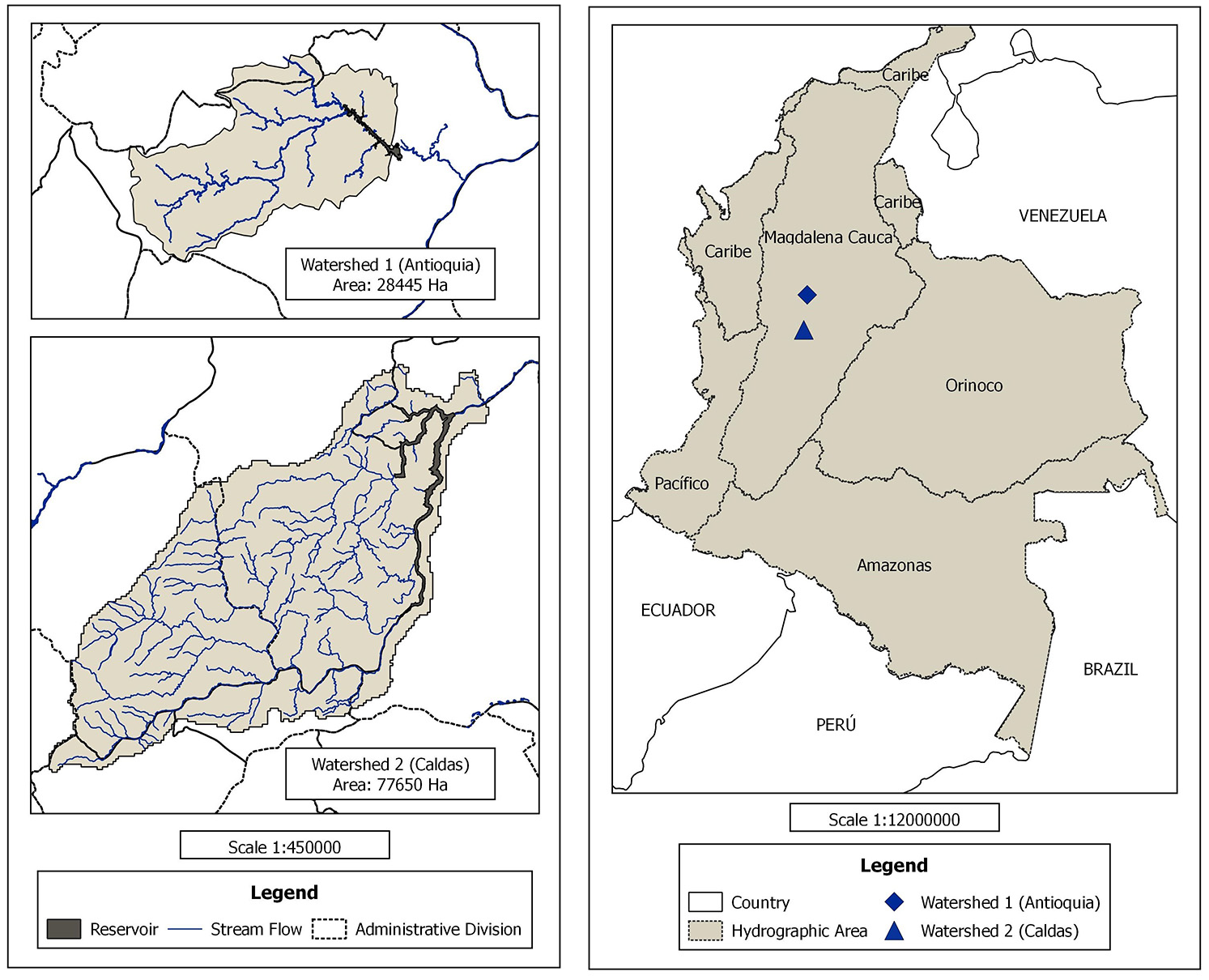
Location of case studies and geographical distribution of hydrographic areas in Colombia.
Watershed 1 is in the department of Antioquia; it has a surface of 28,445 hectares and more than 16,000 inhabitants in the area. The average of the basin’s water supply is 921 million m3 per year, 1.3% of the overall basin’s water supply for Colombia’s hydropower industry (Figure 3). A hydroelectric power plant was built here in the early 1980s with a production capacity greater than 1 GW. According to the official data (Departamento Nacional de Estadística, 2020; Departamento Nacional de Planeación, 2020), approximately 21% of the population in this region is below the poverty line of USD 75 per month, and the inequality in household income is close to 0.5, according to the GINI indicator. About 47% of the territory has conflicts in land use, among which the over-exploitation of the soil by agriculture stands out.

Basins’ water supply.
Watershed 2 is in the department of Caldas; it has a surface area of 77,650 hectares and more than 50,000 inhabitants. The average annual water supply is 2,396 million m3, 3.5% of the overall basin’s water supply for Colombia’s hydropower industry (Figure 3). Additionally, 12% of this water supply is diverted from the other two neighboring watersheds.
A hydroelectric power plant was built in the early 2000s with a production capacity greater than 0.6 GW. According to the official data (Departamento Nacional de Estadística, 2020; Departamento Nacional de Planeación, 2020), approximately 27% of the population in this area is below the poverty line of USD 75 per month, and the inequality in household income is close to 0.5 according to the GINI indicator. About 65% of the territory experiences land use conflicts: the over-exploitation of the soil by agriculture is a significant issue. Only 5% of the territory is included in the National System of Protected Areas.
The armed conflict has affected the environment of these two basins in different ways. Although the department of Antioquia has had more forced displacement, considering the total figures (Figure 4), the department of Caldas has been more affected proportionally to its population (Figure 5). According to the official figures (Red Nacional de Información, 2019), the intensity of the violence has reduced in both departments since 2000. However, the Department of Antioquia currently has higher levels of violence than the Department of Caldas.

The number of people displaced by violence in the administrative departments.

Percentage of displaced people of the department’s total population.
Materials and Methods
This study used a cross-case approach to describe, in the hydropower industry scenario, the differences and commonalities of issues, players, and tools in the context of water access complications and armed conflict. Yin (2009) and Ryan (2012) use the cross-case study method for three reasons. First, little information is available on how this context might influence watershed governance. Second, the researcher aims to identify common variables in given situations; as these variables emerge from the cases, they can be used to make further comparisons. Third, case studies are essential in understanding environment–society interactions in a conflict (Le Billon & Duffy, 2018). Some studies use multiple case studies in the energy sector to analyze sustainability’s social dimension. Sainati et al. (2023) address this issue through a cross-case analysis of comparable energy infrastructures planned and delivered in contexts with different program governance frameworks. Additionally, Gibellato et al. (2022) used cross-case analysis of energy communities as a participative governance structure because it contributes to an in-depth investigation using multiple sources of information and allows the exploration of similarities and differences between cases to reinforce validity. Finally, multiple case analysis has also been used in research on energy companies to identify common forms of innovation due to theoretical saturation processes (Greco et al., 2017).
This cross-case study method was based on 53 in-depth interviews with community members, the energy sector, and the State from two watersheds of the Colombian Andes (Table 1).
In-Depth Interviews Participants.

The energy sector employees were from a large private power generation company. All company employees working with local communities in the study area were interviewed. The public municipal employees and local leaders belonged to two power stations located in areas that have experienced water access complications and armed conflicts. The number of interviews with municipal employees and local leaders was defined by affinity with the research topic and availability during fieldwork.
The open interviews were structured according to the three analytical categories used in a previous study (Polanco, 2018), following the same steps to make a comparison possible: (1) Issues, (2) Players, and (3) Tools.
The analytical category of “Issues” emphasizes the type, problem, and purpose of the actions carried out by the players according to the triple-bottom-line sustainability dimensions and its interactions (Polanco & Ramírez, 2017):
Society: it concerns topics such as building social capital, trust, relationships, and organizational networks.
Environment: it concerns topics such as climate change, biodiversity, and the condition of natural resources, water, and soil.
Economy: it concerns power generation, budgeting, and monetary compensation associated with the impact of hydroelectric facilities.
Society-environment interactions: These topics include training, consciousness, and environmental culture in the territory.
Economy-environment interactions: it concerns topics such as the economy of natural resources (supply and demand), pollution of the environment, and basic sanitation.
Economy-society interactions: these topics include activities for subsistence, food security, production organization, commercialization of farm products, conflict and peace.
The analytical category of “Players” refers to the agents who either live or operate around the influence of the hydropower stations and represent the production sector, state organizations, and organizations from civil society: energy companies, local community, non-governmental organizations, state entities, universities, and development organizations.
The analytical category of “Tools” brings together the means used by the agents to carry out their roles and evaluate their operation in the influence of the hydropower stations: planning, execution, and evaluation.
Conflict and peace emerged as a new subcategory added to the framework. It concerns land access and legal property, illegal economic activities, resettlement, armed conflict, forced displacement, human rights, and institutions.
These analytical categories were selected, considering a holistic focus on sustainability (Bhandari et al., 2018; Polanco & Ramírez, 2017), the continuous improvement approach of corporate management (Moldavska, 2017) and the productive performance focus on collaborative governance (Emerson et al., 2012; Emerson & Nabatchi, 2015).
Encoding allowed for an estimate of the citation frequencies used as ranking criteria—the more an issue was cited, the more important it was considered. The codes are the product of data collection and process analysis with Atlas.ti software. The process was iteratively repeated with each seminal and emerging code until the research team considered each code complete regarding its properties and dimensions (Suárez-Gómez et al., 2021). The coding was based on our interpretation of the meaning of the data, making comparisons between the predefined conceptualizations and the codes themselves in terms of their properties and dimensions (Corbin & Strauss, 2015; Suárez-Gómez et al., 2021).
Next, the citation frequencies were normalized for comparison according to the players’ perceptions. The minimum-maximum procedure was used for data normalization within the range (0,1), where zero was the result of the least cited, and one was the result of the most cited code (Zhou et al., 2012).
Then, a co-occurrence matrix was constructed with Atlas.ti software by crossing the “players,”“issues,” and “tools” categories. Data analysis estimates rank the issues the players were more concerned about, and the tools of action preferred by each player. Finally, interviews were conducted to determine the actors’ perceptions.
Results
The results are presented in three parts. First, the respective rankings for the issues, players and instruments are compared. Second, the ranking of the issues and tools associated with each player is estimated. Third, the more important actors’ perceptions are highlighted to support previous findings.
Issues, Players, and Tools
According to the value of the citations in all interviews for Watersheds 1 and 2, the state, the local community, and energy firms were the three most important players. However, in Watershed 1 (Antioquia), the local community is the most important player; in Watershed 2 (Caldas), the State is the most important player. In both watersheds, NGOs, development organizations, and universities were minor players (Figure 6).
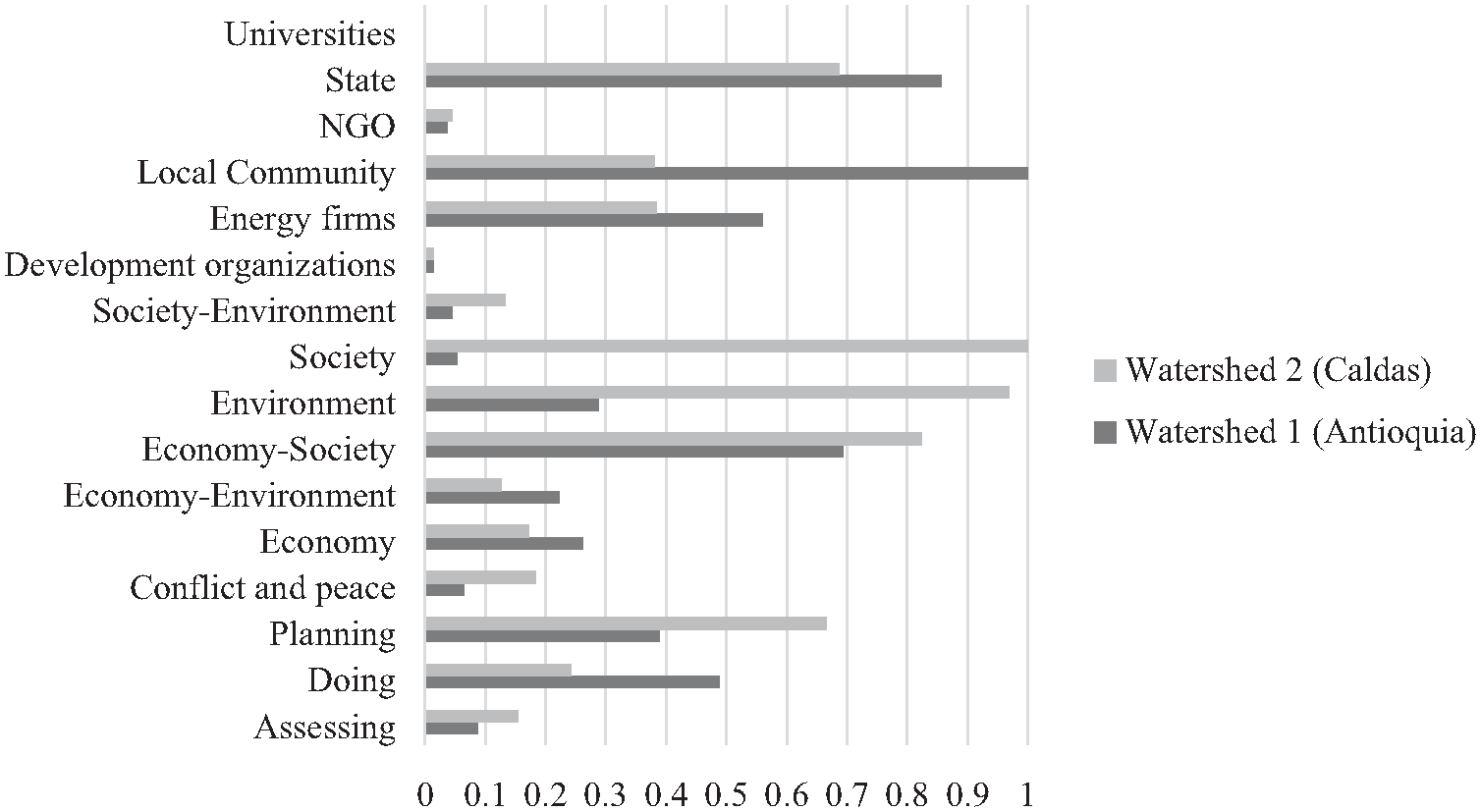
Ranking of players, issues, and tools; comparison of Caldas and Antioquia watersheds.
The economy-society interaction and the environment emerged as the most relevant issues, according to the value of the citations in all interviews for Watersheds 1 and 2. In contrast, the issues of society-environment interaction, conflict, and peace had the slightest relevance among all the interviewees.
Society, the environment, and the economy–society were the more critical issues for Watershed 2 (Caldas). In contrast, the economy-society interaction, the environment, and the economy were the more relevant issues for Watershed 1 (Antioquia). Although conflict and peace were not very important in either of the watersheds, this problem was more important in Watershed 2 (Caldas) than in Watershed 1 (Antioquia) (Figure 6).
Planning and execution were the most important tools, and evaluation was the least cited tool by all the interviewees. Execution seems more important than planning for the interviewees of Watershed 1 (Antioquia). In contrast, planning was more relevant than execution for those in Watershed 2 (Caldas). Evaluation tools had little relevance in either watershed (Figure 6).
Issues and Tools Associated with Each Player
The energy firms, the state entities, and the local community expressed more concern about the necessity of tools for problem-solving than the other players in both watersheds. Issues and tools associated with each player are presented as follows. According to the co-occurrence matrix “players” versus “issues” (Table 2), the local community was the more concerned player regarding the issues of conflict and peace, environment, society, society-environment, and economy-society for watershed 1 (Antioquia). In this case, the state entities were more concerned about the economy and economy-environment issues.
Co-occurrence Matrix “Players” Versus “Issues.” Ranking of Issues Associated with Each Player in Both Watersheds.

Note. CP = conflict and peace; E = economy; En = environment; S = society; SEn = society-environment; EEn = economy-environment; ES = economy-society.
In Watershed 2 (Caldas), the energy firms were the more critical players in economic, society-environment, and economy-society issues. In this case, the state entities were also the more concerned players about the issue of economy-environment interaction. Moreover, this player was highly associated with the issues of conflict and peace, environment, and society.
Finally, players such as development organizations, NGOs, and universities had little linkage with any issue in both watersheds (Table 2).
According to the co-occurrence matrix “players” versus “tools” (Table 3), planning and execution emerged as the essential tools in both watersheds, mainly associated with state entities. The evaluation tools in Watershed 2 (Caldas) were related to the state entities and energy firms—additionally, the local community asked for the implementation of evaluation tools in Watershed 1 (Antioquia).
Co-occurrence Matrix “Players” Versus “Tools.” Ranking of Tools Associated with Each Player in Both Watersheds.

Development organizations, NGOs and universities did not have a relationship with the tools. However, NGOs and universities were part of implementing planning and evaluation tools in Watershed 2 (Caldas).
Therefore, the issue of economy-environment interaction associated with the state entities appears to be addressed by this player through planning and execution tools in both watersheds. In Watershed 1 (Antioquia), the local community’s call for implementing evaluation tools seems to be associated with conflict and peace, environment, society, society-environment, and economy-society. In Watershed 2 (Caldas), the energy firms also perceived the lack of evaluation tools for economic, society-environment, and economy-society issues. Most of these findings were validated according to the players’ perceptions.
Players’ Perceptions
Regarding the players’ perception, similarities and differences were found between the energy company, state employees, and community leaders in both basins (watershed 1—Antioquia and watershed 2—Caldas). The players’ perceptions are presented below in terms of dimensions and interactions for a holistic overview of sustainability.
The Sustainability Dimensions
In the Society component, state employees agree that in Watershed 1 (Antioquia) and Watershed 2 (Caldas) there is recognition of the company’s efforts as an articulating agent between inter-institutional networks that together with different interest groups (State, NGOs, community, etc.) have created action plans aimed at improving the living conditions of the population. The hydroelectric company is perceived as a strategic ally for developing projects in the community. Among the differences, in the case of watershed 1 (Antioquia) there is a perceived difficulty in establishing bonds of trust between the company and the community, which is based on a historical social debt in the territory. All compensation strategies are insufficient for the community. For watershed 2—Caldas, the most dominant tension in this aspect results from the effects on water flow in the territory.
Community leaders perceive that Watershed 1 (Antioquia) and Watershed 2 (Caldas) are marked by a context of armed conflict and violence. In both cases, the territory shows a transformation of the social fabric where they are trying to rebuild trust dynamics, especially with the hydroelectric company. Both contexts coincide in perceiving the importance of the company’s role in the search for the development of the organizational and entrepreneurial capacities of the community. Among the differences, watershed 1 (Antioquia) perceived that the reconstruction of trust relationships has advanced with the support of state, national and local entities. In Watershed 2 (Caldas), there is still a challenge in consolidating trust, on the one hand, due to the role of leftist organizations and, on the other hand, due to weaknesses in communication with the community.
For the company’s employees, both in Watershed 1 (Antioquia) and Watershed 2 (Caldas), inter-institutional collaboration networks have been generated with the company as the articulating entity. This articulation has been oriented towards the economic sustainability of the communities. These communities feel that there are still essential challenges in consolidating trusting relationships. In Watershed 1, there is a perception of insufficient channels and scope in disseminating the company’s results. Likewise, in Watershed 2, trust building is a process that presents important challenges due to the community’s perception of the historical and social debt reinforced by the mistrust generated by social leaders with a leftist political orientation. Among the differences, company employees perceive that in watershed 2 (Caldas), the company is perceived as the entity that should replace the functions of the State in the territory. Meanwhile, in Watershed 1 (Antioquia), the company is perceived as an articulating entity that, together with other actors, tries to overcome the lack of management by state entities.
Regarding the environmental component, local leaders in Watershed 1 (Antioquia) and Watershed 2 (Caldas) perceive problems with deforestation and cattle ranching. The energy company agrees that in both basins, the companies work with the regional environmental authorities to mitigate environmental problems in the territory.
One of the differences in the perception of the State is deforestation. In watershed 1 (Antioquia), this problem is based on cattle ranching, while in watershed 2 (Caldas), it is explained by agriculture. In watershed 1 (Antioquia), the environmental authority perceives a need for monitoring and control. In Watershed 2 (Caldas), the problem is due to the decrease in flow due to the need to feed the reservoir. On the other hand, the energy company perceives that in watershed 1 (Antioquia), there has been more significant progress in managing deforestation. In watershed 2 (Caldas), the company has supported environmental authorities in soil erosion and sediment generation, which affect the useful life of the reservoir. In addition, the company contributed to the problem of water sources contaminated by pesticides from illicit crops.
Local leaders agree that both watersheds have suffered economic impacts on the territory. The community is not clear about the resources contributed. They perceive that the impacts of the hydroelectric plant in watershed 1 (Antioquia) are related to the little benefit in the cost of electricity, even though it is their territory where it is produced. In Watershed 2 (Caldas), the most critical impact is related to the supply of construction jobs. This benefit had a minor impact on the operation stage. For the energy company, the most relevant similarity in both Watershed 1 (Antioquia) and Watershed 2 (Caldas) consists of monetary compensation (transfers from the electricity sector by law). These transfers are aimed at financing environmental projects.
The Sustainability Interactions
Regarding the social-environment issue, the energy company’s employees and local leaders perceive that in watersheds 1 (Antioquia) and 2 (Caldas), the company has advanced environmental awareness through environmental education, especially among young people. However, environmental education training in watershed 2 (Caldas) is provided by the environmental authority and the energy company, while in watershed 1 (Antioquia), it is provided by social promoters. Likewise, state employees perceive that environmental education in the communities has been a fundamental axis of the actions of the energy company and the environmental authorities in both basins. However, in Watershed 1 (Antioquia), there are challenges in the daily work of the community on their farms that have not led to little availability to receive training.
Regarding the economic-environmental issue, local leaders perceive that in watershed 1 (Antioquia), the resources allocated by the company and managed by the environmental authority are difficult for the community to access. In Watershed 2 (Caldas), these strategies have generated displacement and discontent in the community. However, in both watersheds, the company has generated economic strategies to care for the environment, which has led to economic conflicts. Employees also perceive that the company has oriented its actions to reduce the environmental impact of its operations through non-monetary compensation. There is community acceptance of the company’s position. State employees consider the company the leading agent in strengthening joint strategies between the company and other entities to reduce pollution in the territory.
Finally, in the economy-society issue, from the perception of the municipality employees in Watershed 1 (Antioquia), the energy company and other actors have promoted economic activities. However, problems include labor shortages due to displacement and state aid. In watershed 2 (Caldas), community tourism has been an economic activity with few results. However, promoting activities with the support of the energy company has boosted economic activities in the region. For local leaders, watershed 2 (Caldas) presents problems such as illegal mining in the context of insecurity. In Watershed 1 (Antioquia), the company lacks road infrastructure development support.
Regarding the differences perceived by these stakeholders, it was found that they perceive that there are important challenges in the territories due to the presence of large estates. Cattle ranching is an important activity in the territory. The owners of large land extensions are not concerned about the social dynamics of the territory; small landowners are engaged in agriculture and fishing and have the support of the energy company for subsistence economic activities.
Discussion
Violence, the state’s historical absence, the local community’s weakness, and the supremacy of energy companies challenge watershed governance in Colombia. The just energy transition policy seeks to generate more dialogue among actors to strengthen social development. This research corroborated the importance of context in resolving social conflicts affecting renewable energy development and identified governance challenges for a more just energy transition.
The Effect of Social Conflicts on Renewables: Context Matters
In emerging countries such as Chile (Romero Toledo, 2014), Cambodia (Lilja et al., 2017) and Ecuador (Mendieta-Vicuña & Esparcia, 2022), large hydropower plants were commonly justified by their macroeconomic benefits at regional and national levels. However, their physical and symbolic impacts are local, and there is evidence of resistance and large power asymmetries between local communities, energy companies, and the state (Duarte-Abadía et al., 2015). The cross-case analysis presented above showed that the energy business in Colombia is connected to its surroundings because business sustainability is sensitive to specific water access complications and armed violence contexts. According to Villegas Rodriguez et al. (2020), before the 1990s, large hydropower projects were commonly developed despite the population’s rejection due to eviction, low levels of consultation and participation, and few economic and social benefits. As a result, the guerrillas took advantage of social movements to advance in the occupation of the territory, to appropriate popular demands and to capture resources by exploiting natural resources (Centro Nacional de Memoria Historica, 2016).
After the 1990s, energy companies strengthened their work in the territory before, during and after the construction of large infrastructure projects, not only due to the adaptation to contexts of violence but also because of the strengthening of legislation and the demands of multilateral banks (Villegas Rodriguez et al., 2020).
A higher level of water demand causing pressure on the ecosystem and mistrust related to violence are two features of watersheds that challenge the organization models because of non-existent or uncertain evaluation data (Hussey & Pittock, 2012; Liu et al., 2013). This situation is observed in both watersheds due to the need for evaluation tools, as stated by members of the local communities.
Improving environmental conditions such as water quantity and quality was a relevant issue in both watersheds. The different stakeholders agree that companies should work with regional environmental authorities to mitigate environmental problems in the territory.
However, society and economy were perceived differently in each territory because of corporate and social learning processes (Husted & Sousa-Filho, 2017; Siddiki et al., 2017). On the one hand, building social capital and trust were more common issues for respondents in Watershed 2 (Caldas), where energy firms arrived in the early 2000s. There are still difficulties in the consolidation of trust, as explained by communication problems and the community’s perception that, from a historical debt, the company is responsible for the obligations of the State.
On the other hand, in Basin 1 (Antioquia), where the energy firm arrived in the early 1980s, there has been progress in social capital as the hydroelectric company is perceived as an articulating unit oriented to the economic sustainability of the communities. The development of livelihood activities and food security also emerged as significant issues in this basin.
According to official data (Departamento Nacional de Estadística, 2020; Departamento Nacional de Planeación, 2020; Instituto de Hidrología Meteorología y Estudios Ambientales, 2019), environmental issues are associated with two major topics: first, the current consumption of water by energy and agriculture and, second, conflicts in land use, especially the exploitation of the soil by agriculture.
According to public information (XM, 2019), between 2016 and 2018, the energy industry used almost all the water supply in both watersheds. The overall control of hydrological regimes affects fisheries downstream, causing fish scarcity; this has been observed in other locations in Colombia (Duarte-Abadía et al., 2015) and other developing countries (Bhandari et al., 2018).
Moreover, the National Study of Water 2018 (Instituto de Hidrología Meteorología y Estudios Ambientales, 2019) stated that the highest water demand on the ecosystems is centered in the country’s Magdalena-Cauca and Caribe hydrographic areas. In 7% of the National Study cases, water use complications endanger the ecological integrity of watersheds and ecosystem services such as water supplies and regulations.
Social issues were relevant for the interviewees in Watershed 2 (Caldas), perhaps because of the territory’s dynamic of armed conflict. Data on forced displacement suggest that 2005 was the last peak of violence (Red Nacional de Información, 2019). Thus, inhabitants have had time to restore neighborliness and solidarity relationships (Forero-Pineda et al., 2014).
The economy–society issue emerged in Watershed 1 (Antioquia), possibly because of poverty. However, state employees perceive that there has been a boost to economic activities in the region. In Basin 2 (Caldas), local stakeholders perceive problems associated with illegal mining that led to security problems. In developing countries, hydropower plants often follow an energy model based on the extractivism of renewable resources (Sovacool & Walter, 2018).
According to official data reports of forced displacement, the intensity of violence in Colombia is being reduced (Red Nacional de Información, 2019). This situation is probably why the conflict and peace issues are less important than others in both watersheds. Hence, the transition to peace could favor collaborative governance in watersheds with hydroelectric plants (Duarte-Abadía et al., 2015; Ibáñez & Vélez, 2008) since violence is less prevalent today than before, and communication and dialogue are possible.
The Governance Regime for a Peaceful and Just Energy Transition
The corporate and social learning process makes the energy company more proactive and the local community more empowered. The company explores voluntary actions that allow it to protect its reputation and better adapt to social conflicts (Valor, 2012; Villegas Rodriguez et al., 2020). Local communities are more involved in decisions and benefit from transformational relationships (Polanco & Ramírez, 2017). However, the different players’ social conflicts and asymmetry challenge the collaborative processes demanded by the current Colombian Energy Transition Policy (Departamento Nacional de Planeación et al., 2022). First, water access complications and violent struggle situations hinder trust building. Then, few players possess the influence to participate in decision-making effectively. Local communities, state entities, and energy companies are the most mentioned players in the two watersheds. In contrast, NGOs, development organizations, and universities were irrelevant in all the interviews.
After a long period of state absence and local communities’ marginalization, there is a call to restore institutions and empower inhabitants. However, the State cannot rebuild institutions in the short term, as Noda (Noda, 2018) suggested regarding water governance in developing countries. The local capacity of civil society might balance weak state entities and corruption issues (Valderrama-Orozco & Polanco, 2022). However, local communities still do not possess the necessary influence to effectively participate in local decision-making processes (Noda, 2018).
The interdependency with tributary basins in the studied territories leaves the energy companies in a central position among the different players. This situation cries out for corporate leadership in planning and execution. However, insufficient evaluation tools address related business and public issues. According to Emerson et al. (2012), issues such as water and security are being addressed by sharing interests and motivations but with limited information to aid joint action and achievements.
Conclusion
The transition to peace and the energy industry’s interdependency in watersheds are favorable signals for collaborative processes in the two cases in this study. Corporate leadership addresses public issues related to the energy business. Without information to aid joint action and evaluation, no processes for sharing interests and motivations would exist, and the energy transition policy implementation would be challenging.
Two significant issues emerged for collaborative governance of watersheds to be addressed where the hydropower industry is a central player. First, governance products should be geared more toward results, requiring the energy transition policy to be strengthened as a political technology contributing to the measurement and evaluation of the impact of the hydropower industry. Second, collaborative processes should reduce the asymmetry between players by building competencies and leadership in government entities and local communities. In addition, players such as NGOs, development organizations and universities, with little interest or influence, could become strategic partners for joint action and evaluation.
These findings have theoretical and practical implications. The theoretical implications concern the business literature since corporate sustainability is commonly approached from the firm’s theory, whereas here, an institutional approach is proposed to integrate it into governance analysis. Through collaborative governance, firms can surmount institutional constraints of corporate sustainability, including social pressure, the reputational effects of environmental impact, and interdependency with stakeholders.
In practice, the results have implications for implementing the local energy transition policy. This policy promotes communication, dialogue, and territorial development to achieve a fairer energy transition. Through the governance identified in this work, the main problems to be solved, the actors involved, and the tools available in each context can be known to address a fairer energy transition.
Finally, this cross-case study has helped identify the context effect on watersheds’ collaborative governance. This way, social conflicts and governance regimes were analyzed, suggesting issues that need to be addressed in the hydropower industry, according to the Colombian Energy Transition Policy. However, the research was limited to qualitative analysis in only two case studies. Therefore, to obtain more general results, two strategies are suggested for future research. First, more case studies should be carefully selected to ensure they are comparable. The comparative analysis of these new cases should additionally contemplate the participation of regional and national stakeholders such as the Ministry of Environment and the National Environmental Licensing Authority (ANLA).
Second, the analysis should also be quantitative, resorting to the scheme of work of this research to design surveys that provide helpful information for using multivariate techniques such as structured equations modelling. In this way, causal relationships between variables would be possible to establish to strengthen the diagnosis of governance for implementing the just energy transition policy.
Footnotes
Abbreviations
CP conflict and peace
E economy
En environment
EEn economy-environment
ES economy-society
GINI coefficient for inequality measure
GW gigawatts
NGO nongovernmental organization
S society
SEn society-environment
USD US dollar currency
UN United Nations
Authors’ Contribution
Conceptualization and Writing (J.-A. P. and I. J. I.). Methodological Supervision (J.-A. P.). All authors have read and agreed to the published version of the manuscript.
Declaration of Conflicting Interests
The author(s) declared no potential conflicts of interest with respect to the research, authorship, and/or publication of this article.
Funding
The author(s) disclosed receipt of the following financial support for the research, authorship, and/or publication of this article: The Colombian state agency of science supported this work—MinCiencias, the University of Medellín, and the energy company under Grant FP44842-034-2016.
