




Abstract
The three-party evolutionary game model of government, enterprises, and institutions of higher learning is established, and the dynamic evolution process of collaborative innovation behavior is discussed under the two strategies of “incentive” and “non-incentive” chosen by the government. The results show that under the premise of stronger innovation consciousness of the government and institutions and smaller the innovation cost of enterprises, the system is easier to reach the ideal state. The incentive degree of government should be controlled within a reasonable range to prevent enterprises from falling into a bad state because of the temptation of economic interests.
Keywords
Introduction
With the continuous upgrading of technology, it is difficult for a single organization to complete the updating of all technologies and undertake new product development projects or innovation projects independently. Therefore, the innovation project has become a multidisciplinary and interdisciplinary activity, and more and more evolved into a collaborative innovation process of multiparty cooperation. Small and medium-sized enterprises (SMEs) are the main groups to participate in collaborative innovation. SMEs are an important force for social and economic sustainable development, which have the characteristics of relatively specialized product and technical structure, strong adaptability, and flexible operation, which can adapt to the rapidly changing market environment. However, the level of technology research and development is limited by its own scale. This phenomenon enables enterprises to seek resources and knowledge sharing from external resources such as colleges in research and development innovation activities. In recent years, China has made some achievements in collaborative innovation, but there are still many problems to be solved. One of the most prominent problems is the poor sustainability and low conversion rate of collaborative innovation between enterprises and colleges. The reasons for this problem include not only the divergence of goals and culture between the two sides but also the failure of government incentives to make full use of the synergy effect of resources.
Different from enterprises, colleges are specialized organizations engaged in exploratory and creative scientific research activities, and they are important forces for implementing innovation-driven development strategy and building an innovative country. The combination of production and learning is an important part of technological innovation system, which is based on the advantages of SMEs and colleges to achieve the best integration of elements. The essence of collaborative innovation is a kind of cross-cultural cooperative relationship involving the exchange and sharing of resources among different subjects. Actively promoting the exchange activities between enterprises and colleges can not only help SMEs find innovative resources—such as laboratories, technical achievements, and relevant experts—but also effectively introduce innovation resources into SMEs to help them transform and upgrade.
In addition, the factors affecting synergistic innovation are not only technological factors but also government-oriented coordination and supervision factors (Kafouros et al., 2015; Mindruta, 2013). A large number of SMEs to participate in market competition can create a benign competitive market environment, and play a strong role in promoting the improvement of market efficiency and enhancing regional economic vitality. To promote the rapid development of local industries, supervision or coordination under the guidance of the government can bring new development opportunities for SMEs. Innovative technology-based products and services are often the result of the syndication of skills and resources of more than one firm (Poulymenakou & Prasopoulou, 2004). However, owing to different goals and drivers, hurdles have to be overcome to exploit the full potential of such alliances. Therefore, this article constructs the evolutionary game model of collaborative innovation under the guidance of the government to promote the innovation performance of enterprises in a short period of time. It can reduce the cost of research and development, disperse the risk, and fully realize the purpose of resource sharing and complementary advantages.
Literature Review
Collaborative Innovation Behavior of SMEs
Cooperative R&D, contract research, cooperative education, and technology industrialization are the main modes of collaborative innovation for participants (Fontana et al., 2006). From the point of view of the factors affecting collaborative innovation, it is not only technological factors but also non-technological factors that affect the innovation capability and performance of science and technology enterprises. As for the collaborative innovation, the return from the investment coexists with the risk of it (Zhou et al., 2016). Collaborative innovation can make the participants bear some risks, but it can also make the innovation performance of enterprises improve rapidly in a short time. It can not only reduce the cost of R&D and disperse the risk but also realize resource sharing and complementary advantages (Cantner & Graf, 2006; Sammarra & Biggiero, 2008).
SMEs are the relevant participants of collaborative innovation and have made great contributions to the employment rate and economic growth. Their unique characteristics, such as simple organizational structure, internal flexible mechanism, rapid decision-making, and stronger communication, are considered as their inherent advantages in technological innovation (Hossain, 2015). However, in the face of innovation risk, due to its special nature and scale, its bearing capacity is relatively weak. Therefore, SMEs play a unique and complex economic role in technological innovation. This role has been gradually recognized, which has not only aroused greater interest from innovation scholars (Castellaci et al., 2005) but also made governments more aware of the need to support the development of SMEs through tailor-made policy measures. Spithoven et al. (2013) showed the differences in motivation, practice, strategy, and challenge between large and small companies, among which small enterprises are more flexible in the choice of open innovation mode. This flexibility is because for most SMEs, entrepreneurs play a more important role in identifying market opportunities and seeking external innovation resources (Krishnaswamy et al., 2014).
In terms of policy support, Roper and Hewitt-Dundas (2013) believe that in many countries, public funds are provided to universities and R&D centers as catalysts for open innovation, but in fact, public funds should be inclined to the needs of SMEs. Yan and Yu (2013) put forward appropriate policy measures, such as tax incentives, which can effectively help SMEs become active participants in technological innovation. However, excessive incentive policy will make the SMEs get funding lower participation in the challenge of open innovation (Marco et al., 2020).
Evolutionary Game
Early scholars use traditional game theory to analyze and study the process and mechanism of collaborative innovation in different management situations. The traditional game theory holds that both sides of the game are completely rational, but it is impossible to reach the degree of complete rationality under the specific circumstances of the actual problems. Some scholars began to study the dynamic change mechanism of game in the process of collaborative innovation using evolutionary game theory based on the limited rational conditions of the players.
Evolutionary game theory aims to understand the selection pressure that influences the evolution of agents’ strategies that interact with potential conflicts (Adami et al., 2016). Evolutionary game theory endows a static decision-making process with the idea of dynamic evolution, which not only enriches and promotes the development of evolutionary theory but also becomes an important theoretical method in the study of ecosystem stability and microeconomic analysis. Since then, its application has gradually penetrated into other social sciences and behavioral sciences (Lewontin, 1961; Santos et al., 2015; Smith & Price, 1973). Collaborative innovation evolutionary game is ubiquitous in social interaction. It is the cornerstone of social contract, and it also shows typical evolutionary game characteristics in information transmission (Huttegger et al., 2014).
By studying the impact of indirect reciprocity on the game between partners, Santos et al. (2016) found that the leading norms capable of promoting cooperation depend on the size of the community, social norm responsible for raising or damaging a reputation, and the attitude of the two parties involved in the game. X. Xue et al. (2018) investigates the collaborative relationship network in a commercial complex using social network method and in-depth quantitative data analysis. J.-Z. Xu et al. (2014) mainly from the perspective of game theory to analyze the relationship between collaborative innovation system of equipment manufacturing industry, and using the “prisoner’s dilemma model” to analyze the specific system of inter enterprise collaborative relationship, then points out how to maximize the synergy innovation effect system among enterprises and put forward countermeasures for the collaborative innovation in the system by making full use of the main game the system.
Policy Guidance and Supervision
As a policy maker, the government can formulate and improve various policies to promote synergy according to the needs of local development, including support and guidance, preferential taxes and financial subsidies. Yasunaga et al. (2009) show that technology roadmaps made by the government’s initiatives are a kind of knowledge sharing system conducive to technology integration, which can not only provide reference and basis for local policies but also effectively promote the willingness of private enterprises to cooperate with universities. Colwell and Narayanan (2010) believe that developed countries and developing countries should adopt different government support policies. Zhang et al. (2020) show that the implementation of energy-saving policy has a significant inhibitory effect on regional enterprises’ innovation behavior, and enterprises are more likely to give up “exploratory” innovation behavior. Sun and Cao (2018) have found that, embedded in a larger institutional environment, China’s innovation policy network has evolved alongside the economic reform and institutionalization process, which in turn have shaped the innovation policymaking.
On the other hand, the government is the allocator of resources. It has the ability to influence the tasks in the process of collaborative innovation through various ways, such as financial budget, special funds, and tax deduction. It plays a coordinating role between colleges and enterprises and helps optimize the allocation of social resources in all aspects. The innovation output of SMEs is uncertain. Managers tend to be cautious when implementing innovation input. Appropriate government subsidies can effectively support strategic emerging industries, help SMEs obtain resources and support from stakeholders, and directly promote the innovation output of enterprises. A variety of supportive policies help stimulate innovation. Companies that benefit from R&D tax credits and R&D subsidies are more innovative in terms of new products than those that only use R&D tax credits (Bérubé & Mohnen, 2009). Jun and Ling-Yun (2017) and Lin and Luan (2020) also found that moderate subsidy intensity is of great significance to the adjustment of subsidy policy.
A large number of existing literature has proved that industrial policy has a positive effect on the innovation of SMEs, but there is still a lack of comprehensive discussion on the micro enterprise innovation behavior, and the research on collaborative innovation using the method of bounded rational game theory is relatively rare. Literature analysis does not involve the restrictive role of government incentives and rewards and punishment policies on both sides of collaborative innovation, and also lacks the multi-evolutionary game model of government–enterprise–college interaction. The existing research on collaborative innovation mainly focuses on the discussion of elements, characteristics, and significance (Wang & Hu, 2020), while there is relatively little research on the responsibility orientation of each subject in innovation and how to form a more orderly and interactive division of labor among the main bodies. In the collaborative innovation of SMEs and colleges, the benign interaction and coordination between subjects has become the focus of attention. Therefore, on the basis of bounded rationality, this article constructs a dynamic evolutionary game model of government–enterprise–college. The payment cost (or benefit) matrix of the participants in the game is determined, and the determinant of Jacobian matrix and the value of trajectory in the game model are calculated to solve and analyze the stability strategy of multi-party evolutionary game. Through the ode45 solver in MATLAB, the evolutionary path and the position change of equilibrium point of the game among government, enterprises, and colleges are numerically calculated. The game evolution process of the government’s choice of “incentive” policy is analyzed. Finally, some policy suggestions are put forward for the dynamic evolution process.
Analysis of Multi-Party Evolutionary Game Model
Collaborative innovation between enterprises and colleges can effectively improve the transformation of scientific and technological achievements, and the guidance of government policies also plays an important role in the transformation of scientific and technological achievements. Therefore, the participants selected in the game model mainly include government departments, SMEs, and colleges. The main features and introduction of tripartite subjects are as follows:
SMEs: As the technological demanders of innovation, SMEs are restricted by their own scale, technological research and development ability, and other objective conditions. Under the policy incentives, they seek technical assistance or experimental application from external resources represented by colleges. SMEs are profit-making and have keen observation and familiarity with the market. Therefore, SMEs can accurately grasp the direction of innovation and research, and cooperation with colleges in innovation is conducive to breakthrough in a certain field of key technology. They have perfect marketing ability and adaptability, and they can effectively promote the transformation of intellectual property achievements through entrusted R&D or cooperation.
Colleges: As an innovative technology supplier, colleges have the advantages of talent gathering, perfect experimental facilities, and superior advanced technology or R&D conditions. Through the co-construction of technical laboratories and talent training bases, they can better transform the frontier scientific research achievements into practical benefits and cultivate high-tech talents in line with the actual needs for themselves or the society through collaborative innovation with SMEs.
Government: The government plays a dual role of intermediary and supervision in the process of collaborative innovation. On one hand, through policy guidance or incentives, promote SMEs and colleges to establish a good collaborative relationship and maintain the stable development of their collaborative innovation alliance. On the other hand, it is necessary to monitor whether there is risk shifting or speculation in the process of collaborative innovation, and whether the input of innovation resources and the division of intellectual property rights are reasonable.
Basic Assumptions of the Model
Parameter Hypothesis
In the initial stage of the game, it is assumed that the proportion of government stakeholders choosing “incentive” strategy is X and the proportion of “non-incentive” strategy is 1 – X. The proportion of enterprise stakeholders choosing “innovation” strategy is y and the proportion of “non-innovation” strategy is 1 – y. The proportion of institution stakeholders choosing “innovation” strategy is z and the proportion of “non-innovation” strategy is 1 – z.
The normal income of enterprises and colleges under the condition of “non-innovation” are π1, π2, respectively. The benefits of introducing, digesting, and innovating the other side’s technology for synergistic innovation resources are, respectively, as follows R1, R2 (If only one group chooses “innovation” and the other chooses “non-innovation,” the income will be
Multi-Party Evolutionary Game Model
In constructing evolutionary game model, the key is to determine the cost (or benefit) matrix of both players. Under the above assumptions, the revenue matrix of the government, SMEs, and colleges is shown in Table 1. Collaborative innovation capital sharing mechanism clarifies how the government, enterprises, and colleges use knowledge and resources to rapidly integrate and share among organizations: and promote the process of improving the efficiency of national and regional innovation systems. Therefore, in the process of resources, there is a balance formula for the government and the sharing groups. That is to say, in a certain period of time, the government chooses the “incentive” strategy, and the relationship between the cost (C) and the benefits (R) of enterprises and colleges choosing the “innovation” strategy satisfies the following conditions:

When the government adopts the “incentive” strategy, the necessary conditions for enterprises and colleges to choose collaborative innovation are as follows:

Tripartite Income Matrix of Government, Enterprises, and Colleges.

Solution of Stability Strategy in Multi-Party Evolutionary Game
Assuming that the expectation of the college’s incomes are



Assuming that the government expected incomes when choosing “incentive” and “non-incentive” strategies are


Assuming that the expected return of an enterprise when choosing “innovation” and “non-innovation” strategies are


According to the above three-party income calculation results and the basic principle of evolutionary game replication dynamic equation, the replication dynamic equation of government, SMEs, and colleges can be obtained.
The replication dynamic equation of government is as follows:

The replication dynamic equation of colleges is as follows:

The replication dynamic equation of SMEs is as follows:

Research on the Strategic Choice of Colleges and Enterprises Under the Government’s Selection Strategy
In fact, the process of constructing the game relationship among government, enterprises, and colleges is the mutual influence among them. Each actor is not totally independent, and there are certain influences among them. In fact, it is more inclined to multi-party game. To more truly consider the dynamic process of interaction and game among members, a three-party evolutionary game model is constructed, mainly considering the choice of game strategy of the other two parties when one party’s strategy has been determined. The following is an analysis of the game strategy choice between enterprises and colleges when the government chooses the two strategies of “incentive” and “non-incentive.”
The government’s choice of “incentive” strategy
It is assumed that the government adopts “incentive” strategy. Then, the government adopts the probability x = 1 of “incentive” and substitutes it into the replication dynamic equation of enterprises and colleges. Then, the replication dynamic equation of colleges is as follows:

The following formula can be derived from the Equation 15:

According to the stability theorem of replicated dynamic equation and differential equation, three stable state points of F(z) = 0 can be obtained as follows:

The replication dynamic equation of SMEs is as follows:

The following formula can be derived from the Equation 17:

According to the stability theorem of replicated dynamic equation and differential equation, three stable state points of F(y) = 0 can be obtained as follows:

The strategy of local asymptotic stability in dynamic systems is called evolutionary equilibrium which can be equivalent to Evolutionarily stable strategy (ESS) for evolutionary game of two strategies of two populations. Therefore, the ESS of cooperative evolutionary game between SMEs and partners can be obtained only by obtaining the asymptotic stability point of the above replication dynamic equation. From the above calculation process, five local equilibrium points of game matrix can be obtained: (0, 0), (0, 1), (1, 0), (1, 1), (y*, z*). Among them, (y*, z*) is mixed strategy equilibrium points, and the other four are pure strategy equilibrium points.
The Jacobian matrix is as follows:

According to Equation 19, the values of determinant and trajectory of Jacobian matrix are, respectively,
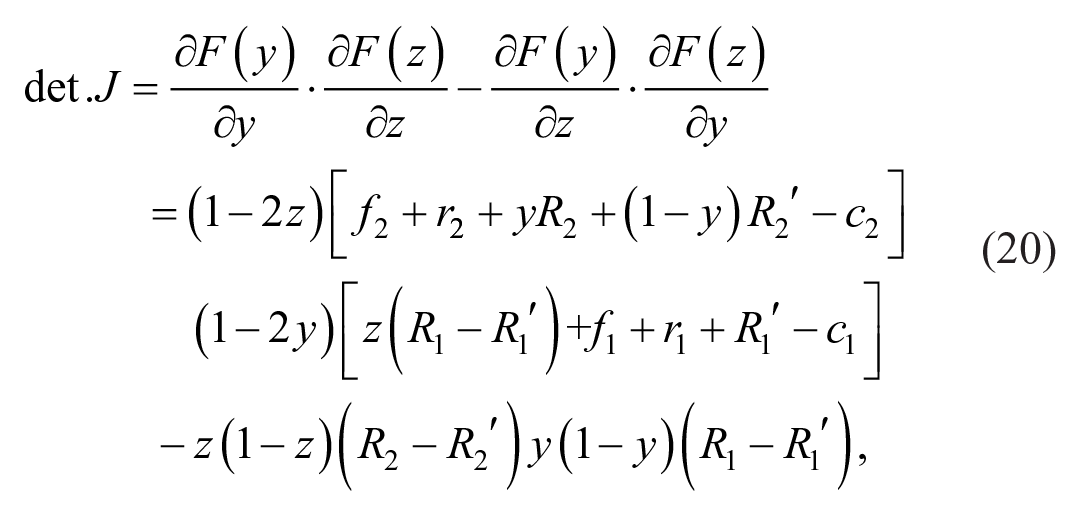

The stability criteria of equilibrium point are as follows:
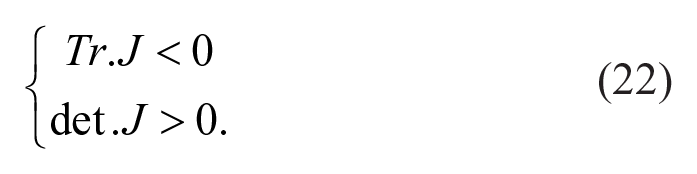
When the government fails to act or publicize collaborative innovation, the loss of economic returns suffered by SMEs and colleges is mainly reflected in the loss of enthusiasm for innovation and the failure to promote innovation achievements. Under the guidance of government inaction, SMEs and colleges voluntarily carry out technological innovation, not only to invest in the cost of technological innovation but also to bear the loss caused by the reduction of enthusiasm, which will eventually lead to less than the input cost. So the long-term benefit analysis f1 + r1 + R1 – c1 > 0 and f2 + r2 + R2 – c2 > 0 are established. The local equilibrium point and mixed strategy equilibrium point are substituted into Jacobian matrix for stability analysis. When
Local Stability Analysis of Game System Under the Government’s “Incentive” Strategy.

Note. Remarks:
ESS = evolutionarily stable strategy.
The government’s choice of “non-incentive” strategy
It is assumed that the government adopts “non-incentive” strategy. Then, the government adopts the probability x = 0 of “non-incentive” and substitutes it into the replication dynamic equation of enterprises and colleges. Then, the replication dynamic equation of colleges is as follows:

According to the stability theorem of replicated dynamic equation and differential equation, three stable state points of F(z) = 0 can be obtained as follows:

The replication dynamic equation of SMEs is as follows:

According to the stability theorem of replicated dynamic equation and differential equation, three stable state points of F(y) = 0 can be obtained as follows:
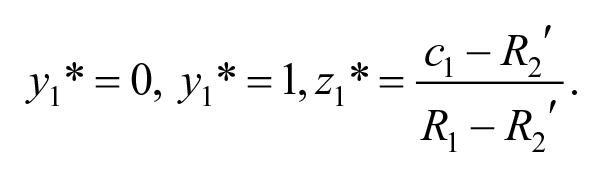
Similarly, five local equilibrium points of the game matrix can be obtained when the government chooses “non-incentive”: (0, 0), (0, 1), (1, 0), (1, 1), (y1*, z1*). Among them, (y1*, z1*) is mixed strategy equilibrium point, and the other four are pure strategy equilibrium points. Reference Equation 19 for calculating Jacobian matrix J1 shows that determinant and trajectory values are, respectively,


Therefore, from the long-term benefit analysis, the benefits of collaborative innovation of enterprises and colleges under government incentives are higher than the costs of collaborative process, so R1 – c1 > 0 and R2 – c2 > 0 are established. When
Local Stability Analysis of Game System Under the Government’s “Non-Incentive” Strategy.

Note. Remarks:
ESS = evolutionarily stable strategy.
Five local equilibrium points of game matrix can be obtained by calculation. Among them, the coordinates of point P* are
The process of constructing the game relationship among government, SMEs, and colleges is the mutual influence among them. Each actor is not completely independent, and there are certain influences among each other. The strategy choice of either party will affect the strategies of the other two parties. In fact, it is more inclined to multi-party game. Considering the choice of game strategies of one party and the other two parties when one party’s strategy is known is an effective means to study the tripartite game. The strategy of local asymptotic stability in dynamic systems is called evolutionary equilibrium. For evolutionary games of two strategies, evolutionary equilibrium can be equivalent to ESS. Therefore, the ESS of cooperative evolutionary game between SMEs and partners can be obtained only by obtaining the asymptotic stable point of replication dynamic equation. The game analysis of system evolution is realized through the change rule of strategy equilibrium point.
Numerical Simulation Analysis
Solving Method and Parameters Selection
MATLAB provides a function for finding numerical solutions of ordinary differential equations. When it is difficult to obtain the analytic solution of differential equation, any corresponding value can be obtained from the expression of the solution according to the specific function form of the solution. Ode is a function specially used to solve differential equations in MATLAB software. There are two types of solving process: variable step size and fixed step size. Different solvers are needed for different types of differential equations, among which ode45 is a variable step-size solver using fourth–fifth-order Runge–Kutta algorithm. The main method is to use the fourth-order method to calculate candidate solutions and the fifth-order method to control errors. As an adaptive step numerical solution of ordinary differential equation, the error of the results is very small. It has been widely used in management, which can satisfy the solution and analysis of game evolution process. Therefore, through the ode45 solver in MATLAB, the evolutionary path and the position change of equilibrium point of the game among the government, SMEs, and colleges are calculated numerically, and the evolutionary process of the game is analyzed.
Usually, there is some time difference between the production of research outputs, such as academic papers and application or registration of patents, and the investment of R&D expenditure. The time lag for producing this kind of research outputs should be considered to evaluate the performance of research activity exactly (Yang et al., 2011). While there is a certain lag in the function of R&D research, the basic research lag period is longer. Therefore, considering from the perspective of long-term development of scientific and technological strategies, the central government in China should not only maintain the total investment of R&D funds but also pay more attention to the coordinated development of different research funding (You & Jiang, 2016). Considering the time lag effect of government policies in the actual operation, the existing policy orientation also has a certain incentive effect on collaborative innovation. Therefore, in the past policies of the government departments concerned, the promotion degree of synergistic innovation is defined as α, the time lag effect coefficient in the new policy orientation is defined as β, and the probability that the government can stimulate the synergistic innovation between enterprises and colleges can be defined as X = α + βx. α = .85 and β = .15 have been used in this study.
Under the support of government policies, the collaborative project research between SMEs and colleges can give full play to the technological innovation ability and enterprise resources of colleges, and improve the transformation of scientific and technological achievements. By interviewing and investigating the Science and Technology Transfer Promotion Center of Shanxi Province in China, the scope of parameter selection is determined on the basis of collecting relevant data and empirical data.
Taking the cooperation project between the enterprise and the college as an example, the suitable parameters are selected. In this collaborative innovation process, the enterprise investment cost includes R&D funds, manufacturing equipment, organization, and marketing resources (c1 = 4.5); whereas, the main investment cost of colleges and universities involves intellectual capital, such as invention patents, technical personnel, experimental facilities, and early sample experiment and detection (c2 = 6). In the collaborative innovation activities, the government incentive is 1, which indicates that the project is an emerging strategic project supported by the government and has the conditions to enjoy preferential policies: after considering a series of policy subsidies, such as government subsidies and preferential taxes (r1 = 3 and r2 = 3.2). Similarly, if both sides fail to complete the collaborative innovation, the punishment will be as follows f1 = 0.5, f2 = 2. It is assumed that the two sides can obtain initial R&D revenue (R1 = 1.5 and R2 = 1.5) after collaborative innovation. However, even if the collaborative innovation strategy is not adopted, the two sides still gradually improve and independently develop their own existing technologies in this field, and they can also obtain certain innovation benefits (
Validity Analysis of the Model
Under the influence of government incentive strategy, the theoretical evolution trend of dynamic game evolution phase diagram between SMEs and colleges is shown in Figure 1. The coordinates of P*(z, y) are (0.5, 0.3) according to the calculation method of mixed strategy stability point, as shown in Figure 2. It can be seen from Figure 1 that A, P*, and B constitute the boundaries of strategy selection in game system. When the government chooses the incentive strategy and the initial point of the game between SMEs and colleges falls in the AP*BC region, the final result of the game will approach the strategy of positive innovation by both sides. In contrast, when the initial point of the game falls in the AP*BO region, the final result of the game will approach the strategy of negative innovation by both sides. According to the initial hypothesis and the tripartite income matrix, it can be seen that the income from encouraging the positive innovation of SMEs and colleges will be higher than the strategy combination of negative innovation of both sides. Therefore, to promote positive innovation, the saddle point P* should be moved to the right or down as far as possible, and the area of AP*BC should be enlarged so as to increase the probability of positive collaborative. Conversely, if the saddle point P* moves to the left or up, the probability of collaborative innovation will be reduced.

Phase diagram of evolutionary game theory.

Diagram of evolutionary game simulation.
Compared with Figures 1 and 2, it can be seen that the evolutionary trend of game between enterprises and colleges is consistent, and the moving direction of P* is affected by the initial parameters. When any parameter of R1, R2, r1, r2, f1, and f2 increases, the P* point moves downward to the right, which promotes enterprises and colleges to approach the positive innovation strategy. On the contrary, when any parameter decreases, the P* point moves to the upper left, the area of AP*BC decreases, and the probability of positive innovation strategies of enterprises and colleges decreases. c1 and c2 are the costs of collaborative innovation. When any parameter of c1 and c2 increases, the P* point moves to the upper left, which promotes both enterprises and colleges to approach the negative innovation strategy. On the contrary, P* points move downward to the right, the area of AP*BC increases, and the probability of positive innovation strategies of enterprises and colleges increases.
The Evolution of Colleges and SMEs Strategy Under the Government’s Influence
When the initial values y and z of different innovation probabilities are selected, the changing trend of replication dynamic equation of enterprises and colleges can be calculated by Equations 13 and 14. Figures 3 to 6 shows the evolution trend of innovation probability when the initial value of colleges innovation probability z0 = 0.2 and z0 = 0.4 and the enterprise innovation probability y0 is in the range 0 to 1, respectively. From the graph, it can be seen that when z0 = 0.2, y0 ≥ 0.7, the game evolution strategy is point (z, y) for (1, 1) and when y0 < 0.7, the game evolution strategy is point (z, y) for (0, 0). When z0 = 0.4, y0 ≥ 0.4, the game evolution strategy is point (z, y) for (1, 1) and when y0 < 0.4, the game evolution strategy is point (z, y) for (0, 0).

Evolution trend of college strategy at different initial values y0 (z0 = 0.2).

Evolution trend of enterprise strategy at different initial values y0 (z0 = 0.2).
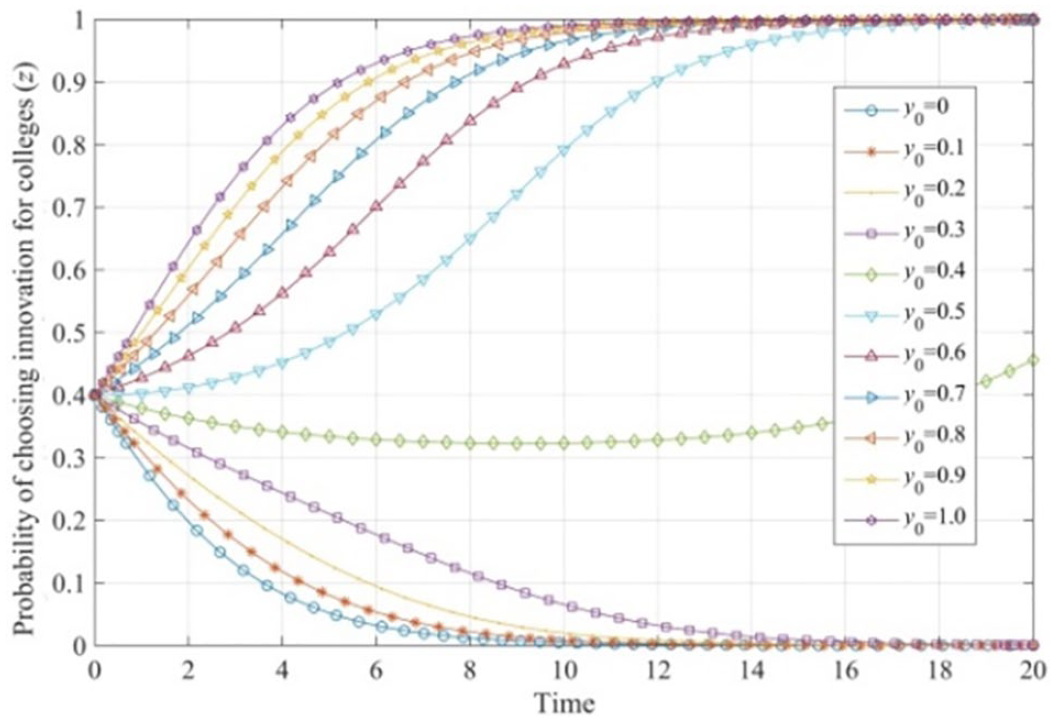
Evolution trend of college strategy at different initial values y0 (z0 = 0.4).

Evolution trend of enterprise strategy at different initial values y0 (z0 = 0.4).
As shown in Figures 7 to 10, when the initial value of innovation probability z0 = 0.6 and z0 = 0.8 and the enterprise innovation probability y0 is 0 to 1 interval, the evolution trend of innovation probability of enterprises and colleges is discussed. It can be seen from Figure that when z0 = 0.6, y0 ≥ 0.3, the game evolution strategy is point (z, y) is (1, 1) and when y0 < 0.3, the game evolution strategy is point (z, y) is (0, 0). And when y0 = 0.4, the enterprise tends to be 1, but there is a certain wavering. It indicates that when the initial intention of the college is small, the enterprise has some doubts about its own interests, which is not conducive to collaborative innovation. However, when y0 = 0.2, because colleges have little desire for collaborative innovation, SMEs do not hesitate to choose negative innovation strategies. Then, colleges to obtain greater benefits, there has been a certain trend of hesitation, and ultimately to the path of negative innovation strategy. When z0 = 0.8, y0 ≥ 0.1, the game evolution strategy is point (z, y) for (1, 1) and when y0 < 0.1, the game evolution strategy is point (z, y) for (0, 0). When colleges have less desire to choose collaborative innovation, y0 = 0.2, the results of enterprise evolution show a certain wavering trend to 1. However, after a long period of running-in, colleges will eventually achieve a stable strategy of collaborative innovation. When the initial innovation probability of colleges is y0 = 0, the evolution of enterprises and colleges eventually leads to negative innovation strategies.

Evolution trend of colleges strategy at different initial values y0 (z0 = 0.6).

Evolution trend of enterprises strategy at different initial values y0 (z0 = 0.6).

Evolution trend of colleges strategy at different initial values y0 (z0 = 0.8).

Evolution of enterprises strategy at different initial values y0 (z0 = 0.8).
Therefore, it can be concluded from Figures 3 to 10 that evolution curves with different initial parameters do not overlap, and the convergence speed of the curve is related to the initial value of innovation probability chosen by enterprises and colleges. In addition, the larger the initial intention, the faster the system evolution tends to collaborative innovation. When the initial innovation probability of enterprises and colleges is greater than the equilibrium strategy point, the system tends to collaborative innovation; the smaller the initial cooperation intention of enterprises and colleges is, the more negative the evolution result of the system tends to be. No matter what incentive measures the government takes, if the initial intention of collaborative innovation of enterprises and colleges is zero, the final result will be negative innovation strategy. Therefore, the government needs to put forward appropriate incentive policies to improve the innovative intentions of enterprises and colleges.
The Influence of Government Incentive Probability on Collaborative Innovation
The government’s incentive role-plays an important role in the evolution of collaborative innovation between enterprises and colleges. Therefore, when the probability of government incentive strategy X = 0.33, the phase diagram of system evolution is shown in Figure 11, and the equilibrium strategy point P*(z, y) is (0.85, 0.82).

Phase map of system evolution with government incentive probability X = 0.33.
When the probability of government incentive strategy X = 0.33, the initial value of innovation probability z0 = 0.2, 0.4, 0.6, and 0.8, respectively, and the innovation probability y0 is in the range 0 to 1, the evolution trend of innovation probability of enterprises and colleges as shown in Figures 12 to 19. It can be seen that when z0 = 0.2, 0.4, and 0.6, y0 = 1, evolution tends to be positive collaborative innovation strategy. When y0 < 1, game evolution strategy is point (z, y) to (0, 0); when z0 = 0.8, y0 ≥ 0.9, evolution tends to be positive collaborative innovation strategy. When y0 < 0.9, game evolution strategy is point (z, y) to (0, 0). Therefore, in a certain range, when government incentives decline, enterprises and colleges must have a higher initial intention to move toward the strategy of collaborative innovation.

Evolution of government incentive probability x = 0.9 colleges strategy (z0 = 0.2).
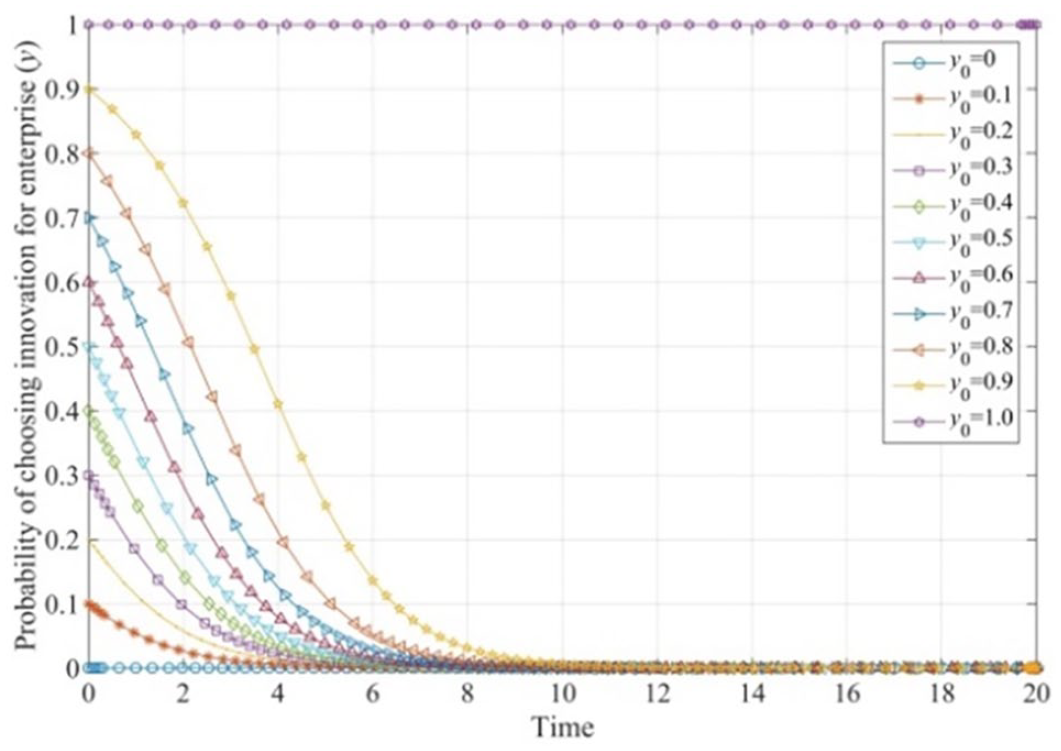
Evolution of government incentive probability x = 0.9 enterprises strategy (z0 = 0.2).

Evolution of government incentive probability x = 0.9 colleges strategy (z0 = 0.4).
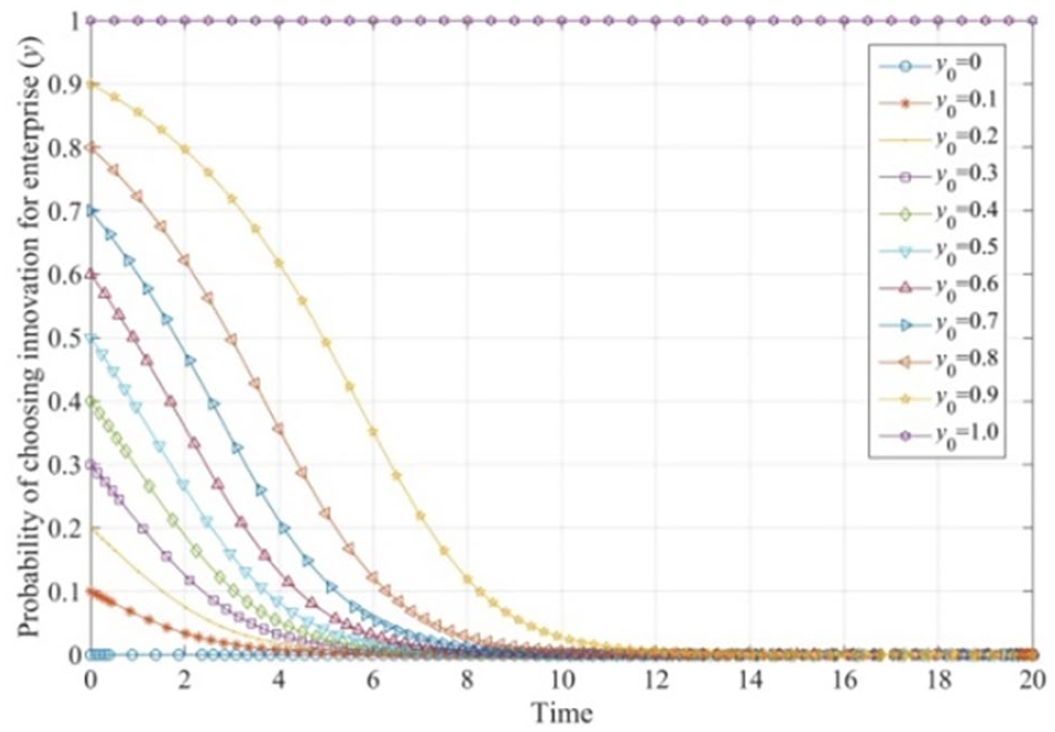
Evolution of government incentive probability x = 0.9 enterprises strategy (z0 = 0.4).

Evolution of government incentive probability x = 0.9 colleges strategy (z0 = 0.6).

Evolution of government incentive probability x = 0.9 enterprises strategy (z0 = 0.6).
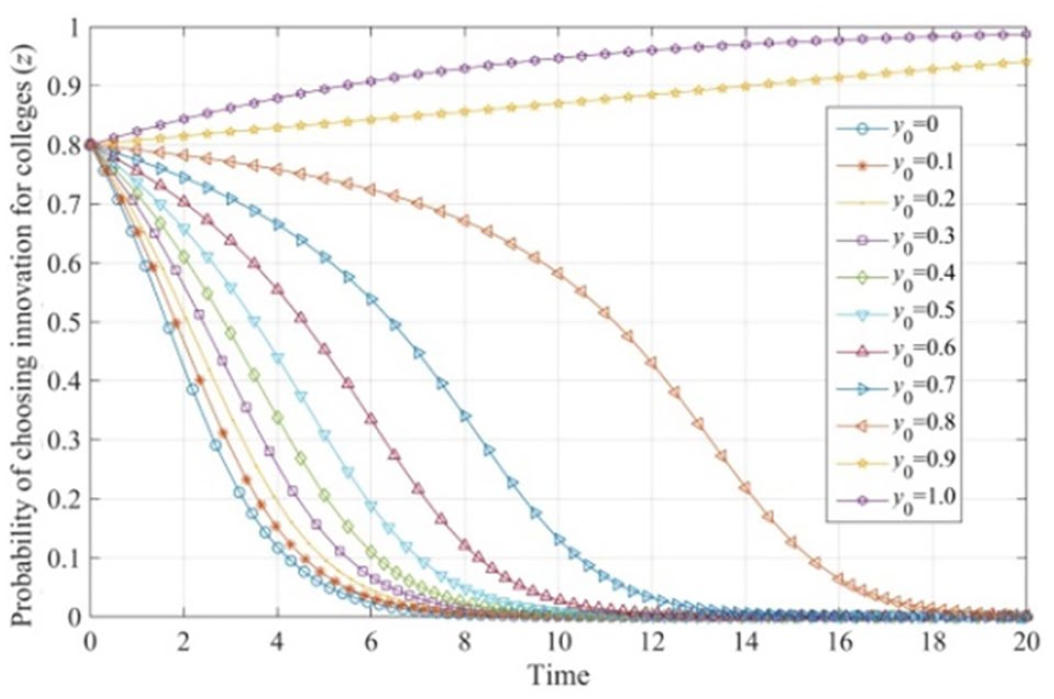
Evolution of government incentive probability x = 0.9 colleges strategy (z0 = 0.8).

Evolution of government incentive probability x = 0.9 enterprises strategy (z0 = 0.8).
Figure 20 can be obtained by constructing three-dimensional coordinates of government incentive probability x, enterprise collaborative innovation probability y, and collaborative innovation probability of colleges z. As shown in the figure, the coordinate value of equilibrium strategy point P gradually decreases as the government incentive probability evolves from 0 to 1. In a certain range, the government should properly enhance the incentive force, so that enterprises and colleges only need a small initial intention to achieve the two sides to choose the strategy of collaborative innovation, so as to achieve the mutual benefit of the three parties. In addition, the movement of equilibrium strategy points is linear, which proves that the model is in line with expectations and effective.

Three-dimensional image of game evolution.
Discussion
Through the above simulation, it can be seen that the curve convergence speed is related to the initial value of innovation probability selected by SMEs and colleges. The larger the initial intention is, the more stable the collaborative innovation state and the faster the system evolution is. In practice, the ways of collaborative innovation between SMEs and colleges, whether it is order training, the construction of training base inside and outside the school or internship, its purpose is mostly to solve students’ internship problems or to purchase technology from colleges by SMEs. Many collaborative innovation behaviors are mere formality and lack substantial content. There are few deep-seated collaborative innovations in a real sense, which makes it easy to stop the collaborative innovation due to unilateral withdrawal. This is caused by the different organizational structure between SMEs and colleges. Enterprises focus on the economic benefits of innovation income, whereas colleges pay more attention to social benefits. At the same time, due to the gradual maturity of human resource allocation marketization, SMEs that do not participate in collaborative innovation can still recruit the required talents from the market, and even employ professional and technical personnel from other institutions with high salary, which leads to the low enthusiasm of some enterprises. If the government wants to rely on policies to promote the deep integration of SMEs and colleges, it needs to guide the two sides to truly realize the mutual flow and exchange of personnel from all sides besides short-term and temporary cooperation. As shown in Figure 20, the government has increased the incentive for collaborative innovation between enterprises and colleges, promoted enterprises and colleges to improve their willingness of collaborative innovation with complementary innovation resources. On this basis, increasing the punishment of unilateral withdrawal can effectively supervise the collaborative innovation behavior of both sides, and fundamentally reduce speculation. Through government supervision, it increases the cost of unilateral not actively participating in collaborative innovation, and reduces the cooperation risk: and promote the establishment of a long-term stable and institutionalized interest community between SMEs and colleges.
To promote the sharing of resources between enterprises and colleges and improve the stability of collaborative innovation system, the following countermeasures and suggestions are put forward. First, we should give full play to the guidance and coordination role of government departments, and improve the incentives for collaborative innovation among enterprises and college. Effectively promote SMEs to actively seek external innovative resources, enhance the awareness of sharing technology, talent, and resources, and form a benign collaborative innovation network. Second, in the process of dynamic evolutionary game, although both sides choose the game strategy according to their own wishes, in some cases, there is a lag effect when the members of the game choose the strategy. It takes a longer period to reach Nash equilibrium when the willingness is weak. Government policy should consider the lag factor according to the specific circumstances when considering the incentive of innovation. Finally, the government, as a participant in the evolutionary game, should take into account the innovative intentions of the remaining players when formulating corresponding incentive policies, to accurately locate incentives and give full play to the role of coordination and supervision. As far as possible, the participants in collaborative innovation should avoid arbitrary actions due to unilateral greedy preferential policies, and make clear the direction of key investment in science and technology in a practical way. Only by breaking through the original closed innovation framework and introducing the social innovation power in the external market into SMEs can we create a good innovation atmosphere, so as to ensure that each participant can cooperate with R&D with the fullest enthusiasm, and enhance the overall strength and industrial competitiveness.
In addition, the external environment of collaborative innovation activities between enterprises and colleges under the government incentive involves many factors, such as specific industry background, market operation mechanism, innovation culture atmosphere. China’s collaborative innovation is in the exploratory stage. The economic development and innovation conditions of different regions are different, and the development status of various industries is different. For example, China’s eastern coastal areas have a strong innovation culture, whereas the western regions are relatively weak. The imbalance of external conditions will affect the subsidy of government incentive policy, the social benefits obtained by the government, and the initial innovation intention of enterprises and colleges. In view of this situation, H3 proposes that the influence of external environment is not considered, and the participants of the game are all in the same environment. Cross regional cooperation is not considered in the game. If the model is applied to a specific region or fixed industry background, the corresponding parameters should be modified according to the actual situation.
Conclusion
Based on the above discussion and analysis, it can be concluded that when government departments choose incentive strategies, the factors that promote the collaborative innovation between SMEs and colleges mainly include three aspects. They are the comprehensive benefits of government financial support, the penalties for non-innovation under government incentives, and the innovation costs that innovators pay in the process of collaboration. Therefore, increasing the financial support of government departments to promote collaborative innovation, or increasing the punishment of innovators who do not actively participate after reaching the intention of collaboration, can effectively enhance the innovation stability between enterprises and colleges. On the other hand, the close integration of innovation subjects, the improvement of innovation resource sharing mechanism, and the effective reduction of innovation cost can better promote the game participants to achieve collaborative innovation strategies.
The research results of this article can provide theoretical basis and reference for collaborative innovation of SMEs and colleges. Our research results provide valuable insights for SME managers, which can balance the company’s advantages and resource allocation in different innovation challenges, so as to improve the success opportunities of collaborative innovation. At the same time, it can also provide reference for the government to formulate policies on collaborative innovation mechanism, and promote the establishment of collaborative innovation alliance to the maximum extent. However, the research content of this article is limited to the collaborative innovation of SMEs and colleges under different incentives, and the analysis and consideration of innovation among SMEs is lacking. In addition, the model only includes a single enterprise and college collaborative innovation. The next research can be done by constructing the innovation alliance model formed by complex network and by further studying the collaborative innovation mechanism of technology alliance.
Footnotes
Author Contributions
Every author contributed equally to this work.
Data Availability
The data used to support the findings of this study are included within the article.
Declaration of Conflicting Interests
The author(s) declared no potential conflicts of interest with respect to the research, authorship, and/or publication of this article.
Funding
The author(s) disclosed receipt of the following financial support for the research, authorship, and/or publication of this article: The research was supported by the major soft science project of Shanxi Province (grant number w20151020), the soft science project of Shanxi Province (grant number w20171015), and Taiyuan University of Science and Technology Scientific Research Initial Funding (20182037).
