




Abstract
This article explores how macroeconomic and environmental policies instituted since the 1990s have altered meanings, imaginaries, and the human relationship to nature in Colombia. The Colombian nation-state is pluri-ethnic, multilingual, and megabiodiverse. In this context, indigenous peoples, Afro-Colombians, and some peasant communities survive hybridization of their cultures. They have developed their own ways of seeing, understanding, and empowering the world over centuries of European rule. However, threats to relatively discrete cultural meanings have increased since major changes in the 1990s, when Colombia experienced the emergence of new and modern interpretations of nature, such as “biodiversity,” and a deepening of globalized neoliberal economic and political management. These policies involve a modern logic of being in the world, the establishment of particular regulatory functions for economies, societies, and the environment, and their spread has been facilitated by webs of political and economic power. We trace their local effects with reference to three indigenous groups.
Introduction
The Colombian constitution of 1991 recognized the pluri-ethnic character of this nation-state for the first time. It acknowledged traditional communities including indigenous groups, Afro-Colombians, gypsies, and peasant groups who rely on their own ways of constructing and practicing nature based on their fashions of seeing and understanding, and empowerment in their territories and places. But the 1990s also saw a marked increase in the threats to the cultural survival of all of these groups, with the emergence of globalized forms of neoliberal, market-led economics and a host of new interpretations of nature, including “biodiversity management.” In this article, we identify these threats, and the relevant policies, illustrated with accounts from three different Colombian societies, the Pijaos, Muisca-Chibcha, and Cofán. Policies resulted from the Washington Consensus in 1989, the embracing of the certification process in the War on Drugs through the U.S. Omnibus Anti-Drug Abuse Act in 1988, and the enactment of biological conservation policies following the Convention of Biological Diversity in 1992. These shaped a decade of important changes to policy, leading to the hybridizations of local discourses of nature with those from “outside” Colombia. This article presents and critiques the deepening of modern ways of knowing in Colombian society with their arrival.
We define the neoliberal globalized project as something that is ongoing—“neoliberalization” is a worldview with modern values that has been spread globally since the 1980s with particular regulatory functions for economies, societies, and the environment (Castree, 2010, pp. 7-13). It prioritizes the idea of individual, corporate, and collective freedom of choice. The state, in this reading, obstructs liberties, and fails in guaranteeing welfare in society. The market, by rewarding “success” and through competition, may take its place. This worldview is programmed, Castree argues, through government policies, and is operationalized when these are translated into practices, whose impacts affect diverse geographies separated in space and time.
The rolling out of neoliberal policies often results in context-specific hybridizations of social practices: old and new, modern and traditional, regional and global. The pluri-ethnic character of Colombia imposes very different rationales across its heterodox geographical space, which also implies that ethnicities may interpret and respond differently to the operationalization of policy.
Our theoretical approach is to read these hybridizations based on the understanding of cultures as “signifying systems” (Williams, 1981). In this reading, meanings are expressed through language and therefore may be studied in discourses (Fairclough, 2010). As Wagenaar (2011) states, from this poststructuralist view, meanings “are actualized in a specific context-in-use, depending on the particular historical circumstances and the specific intentions, challenges, and possibilities the actors face” (p. 111). We use the analysis of texts and interviews to identify relations of power, conflict, and struggle that may result from certain policy initiatives (Wagenaar, 2011).
Discourse analysis may reveal “cycles of hybridization” (García Canclini, 2005; Stross, 1999) or what Escobar (2012) terms “transition discourses.” “Cycles of hybridization” are not “pure” or “homogeneous,” but refer to social practices and/or discourses. They are hybrids of cultural inheritance present in daily life, and prior encounters with other social practices and/or discourses from other groups. Hybridization brings about changes in social practices, and here we look at changes in local approaches to the natural world. We are aware, of course, that communities we call “local” and “traditional” have been hybridizing their social practices with the “modern” for centuries, and therefore we cannot talk of “pure traditional” practices (Escobar, 2012). However, the modern objectification of nature, we argue, has been sharply reinforced since the 1990s.
In practical terms, the study involved an extensive review of the literature on neoliberal impact in Latin America and specifically in Colombia, with a focus on the particular break-points of the 1990s brought about by the policies illustrated above. Semistructured and informal interviews were conducted in the three communities between February and October of 2014 by the first author, and they confirm the emergence of hybridized narratives arising from changing discourses around nature since the 1990s.
The article will first show how modern ontology has actually impacted Colombia since the very beginning of the encounter with the Spanish. During the 1990s, the political economy of Colombia changed to permit the adoption of the neoliberal globalized project, based on modern acceptance of the commodification of the natural world. Then, we explain the Washington Consensus of 1989 and its rationale and consequences, as this was an important scenario that ushered Colombia into the neoliberal globalized project. Then, we outline the set of policies resulting from the Omnibus Anti-Drug Abuse Act in 1988 and the War on Drugs, and the signature of the Convention of Biological Diversity in 1992. We use segments of interviews conducted with indigenous communities to illustrate the hybridizations of discourses of nature in contemporary Colombia among its long-term inhabitants. We end with a brief final discussion and conclusion.
First Encounters With Modernity and Its Effects in Colombia
Relatively “pure” local traditional discourses (i.e., nonmodern) of indigenous peoples existed prior to the encounter with the Spanish in the early 1500s. However, as Giddens (1990) points out, “tradition does not so much resist change as pertain to a context in which there are few separated temporal and spatial markers in terms of which change can have a meaningful form” (p. 37). In this sense, the bringing about of the new modern ontology during Spanish colonization permeated tradition in one way or another, and the more contact a community had with Western society, the more exposed to abrupt cultural changes it became.
At the time of Spanish colonization, Catholic missions were spread throughout the territory, to create “order” and “civilize” “wild-peoples” in remote places (Arango & Sánchez, 2004). Modernity implied the imposition of Christianity as the only manner in which to relate to God, which induced indecision among traditional cultures about gods and God (Heidegger, 1938/1950, 1938/2002). Also, some indigenous peoples were subjected to forced labor to meet tax payments to the Spanish Crown (Arango & Sánchez, 2004). Therefore, traditional cultures were objectified through forms of slavery, and later their need for capital accumulation, leading to their engagement in surplus production and waged labor. Christianity and capitalism imposed new meanings of the “other” in both human and nonhuman domains, and thus traditional social practices were forced to hybridize to adjust themselves to this new order.
The colonization enterprise also induced other novel social encounters. After constant abuses suffered by indigenous peoples, and a subsequent demographic catastrophe during the 16th and 17th centuries, the colonial regime imported slaves from Africa in response to the increasing difficulty in enlisting native workers (Arango & Sánchez, 2004). In addition, the Gypsy community arrived in the country, legally and illegally. They migrated to Colombia fleeing slavery in Eastern Europe (in 1821 and 1851) and later during the First and Second World Wars escaping warfare and persecution (Departamento Nacional de Planeación [DNP], 2010; PRORROM, 2007). Therefore, indigenous peoples not only encountered Spanish traditions and practices but also those of Africans and the Rom Gypsy community.
The modern geopolitical entity of the nation-state implied a new territorial relationship. The state acquired administrative capacity to control space and its people (Heidegger, 1938/1950, 1938/2002; Sakai, 2001). Modernity “cut through the connections between social activity and its ‘embedding’ in the particularities of context of presence” (Giddens, 1990, p. 20), introducing greater separation of time and space through calendars and mapping. It allowed the connection of the local with the global, so that societies became more exposed to hybridization of their social practices with those of others more distant from them (Giddens, 1990).
Modern ontology, as a Western European phenomenon, was expanded with the idea of subjugating those non-Western societies through a particular political, military, and economic apparatus (Sakai, 2001), in the Colombian case under the blessing of Christianity. Modern regimes consider that reason is more truthful than tradition (Giddens, 1990). Reason is acquired through knowledge that is only valid when it is obtained through empirical verification and research (Heidegger, 1938/1950, 1938/2002). Therefore, the practicing and construction of traditional knowledge was diminished greatly as it was forcibly replaced by scientific rationality and Christian cosmogony.
In specific historical moments, particularly from the 18th to the 20th centuries, some countries become “more effective nation-states” than others (Mann, 2002). According to Mann (2002, p. 2), the “most effective nation-states” (i.e., the United States and the European countries) have a combination of “high infrastructural power” (the “state’s ability to implement decisions through its territories”) and “low despotic power” (the “state elite’s ability to take decisions without routine negotiations with groups in the civil society”). Latin America, however, has had different historical moments that delayed the emergence of “effective” nation-states. Within the scope of this article, only one of them will be emphasized, the fact that ethnic differences have remained important.
According to Mann (2002), the organization of societies according to ethnicity and class has led to persistent racial-ethnic problems. Regional differences were magnified by settlement histories. Some regions became industrialized more than others, related more to global economies, and labor unions were far from universal. Ethnic and class diversity, therefore, cut across the spread of globalization and modernity.
This is important because as Troyan (2008) points out, during the 1970s and 1980s in Colombia, landless peasants were claiming their rights under class-based discourses, without significant success. Then, during the 1980s, some members of the movement shifted their claims from class-based to those based on ethnicity, which “allowed the indigenous communities to represent their rights as timeless and as an integral part of their culture” (Troyan, 2008, p. 182), gaining more acceptance across Colombian society. The state saw an opportunity to weaken class-based movements and the subversive actions of some of them (e.g., the Revolutionary Armed Forces of Colombia [FARC], the guerrilla army founded in 1964 after the government attacked communist sympathizers during the period known as la Violencia). International pressures at that time influenced the legitimization of the rights of indigenous peoples as well, such as the International Labour Organization (ILO) Convention on Indigenous and Tribal Peoples No. 169, of 1989.
The rights of some traditional Black (Afro-Colombian) communities were also recognized, as they and indigenous groups were working hand by hand in the constituent assembly that eventually ratified the Constitution of 1991 (Troyan, 2008). During the 1990s, Gypsy communities and other Afro-Colombian groups obtained their ethnic recognition and gained specific rights to land.
Despite this, other claims still based on class have been ignored and diminished greatly after the Constitution was enacted, particularly land claims by the peasantry (Troyan, 2008). This is an important consideration taking into account that the cultural borders between indigeneity and peasantry are blurred in many local settings. In the most recent Colombian Census conducted in 2005 (Departamento Administrativo Nacional de Estadística [DANE], 2010), only 0.01% of Colombians identify as gypsies, 3.4% as indigenous, 10.62% as Afro-Colombians, and the rest (85.94%) do not belong to any ethnicity, although this does not necessarily mean that they forego traditional practices. There are different factors that influence how minority populations choose to identify themselves, a discussion that exceeds our scope in this article.
We argue that in general terms, traditional communities share strong attachments to territory/place that determine their senses of identity and belonging. In terms of discourses and their perpetuation, Colombian indigenous, most Afro-descendants, and some traditional peasant groups hold “relational worldviews” or “relational ontologies” (Escobar, 2012, p. xxii). In the case of indigenous peoples, “relational ontologies” imply that they habitually signify elements of nature as “non-human sentient entities” (Escobar, 2010, 2012). Also, according to Mallarach (2011), Colombian indigenous communities, who have ancestral knowledge about the creation of the world, consider that all the components of nature are sacred, and, therefore, their relationships with their territories are based on values of respect.
Reflecting this, since the very beginning of the encounters with the Spanish and other groups, the local views of some traditional peasant communities have been “negotiated” with those from outside. This was the preexisting situation when major changes came about in the 1990s in Colombia. The neoliberal globalized project, adopted by the country with policies in line with the Washington Consensus, 1989 (Williamson, 1990), entrenched the connection between the local and the modern through its particular economic and environmental policies.
The Washington Consensus (1989)
The Washington Consensus is a set of 10 neoliberal policies, some of them allegedly already practiced in Latin America but brought together by the economist John Williamson (1990, Figure 1). The aim was to provide guidance to the Washington-based international financial institutions and the U.S. Congress, to promote “economic development” in Latin America from the early 1990s. The Consensus emphasized the urgent necessity for these countries to liberalize their economies to become more market-driven. The policies are grouped in two main sets. The first group was issued to correct “Latin-specific maladies,” and the second to lead the promarket agenda in the region. The former comprised policies geared to “macroeconomic stabilization” and “outward orientation.” The latter informed policies related to “removing the entrepreneurial function of the state,” “freeing and enabling markets,” and “complementing markets” (Birdsall, De la Torre, & Valencia Caicedo, 2010).
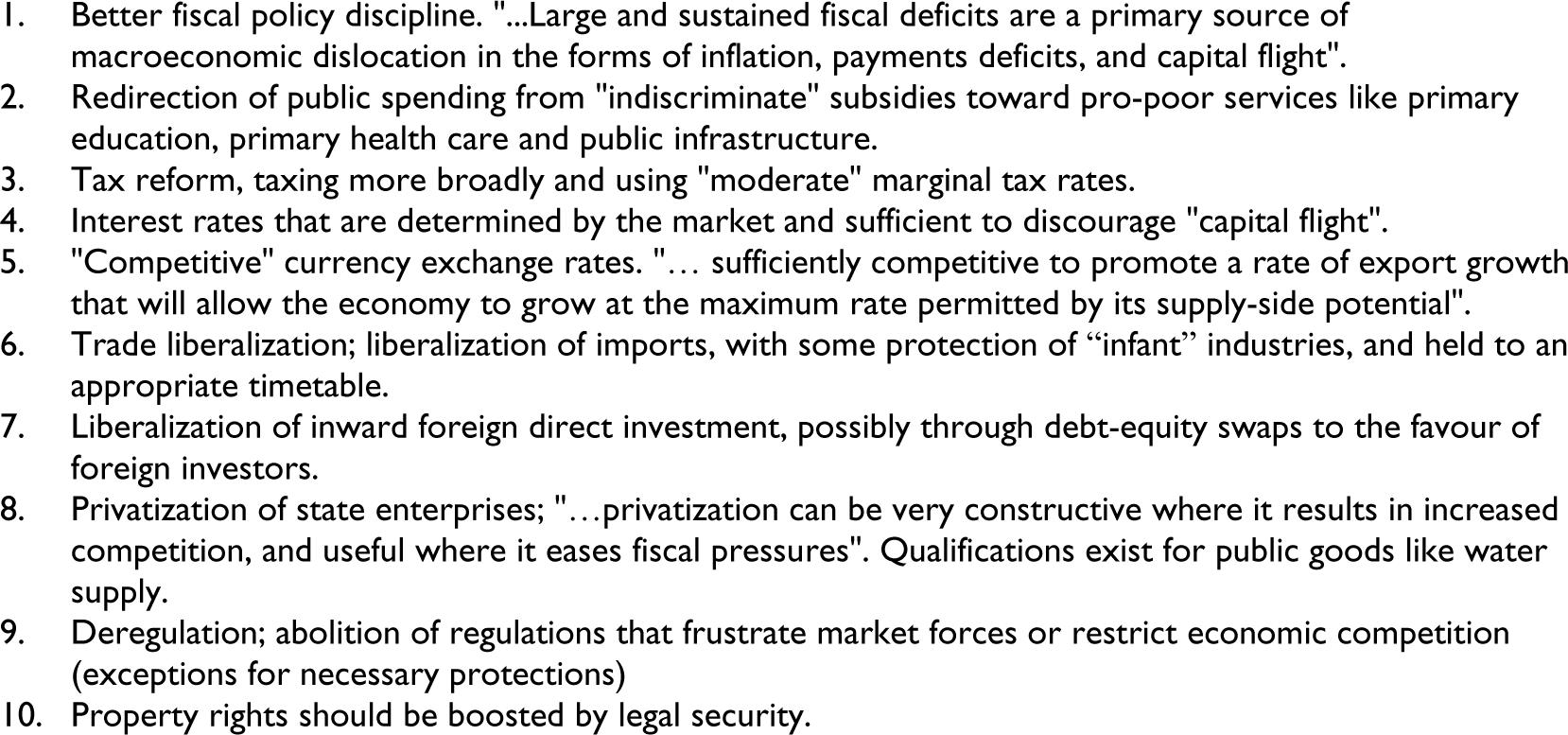
The decalogue of Washington consensus policies.
According to Escobar (2010), “Latin America was the region that most earnestly embraced neo-liberal reforms, where the model was applied most thoroughly, and where the results are most ambiguous at best” (p. 2). This set of policies has led to the exclusion of some sections of society. Exclusion was carried out through authoritarian and antidemocratic policies led by a social and civilizational regime (Santos, 2002), which according to some critics constitutes a new type of fascism (Escobar, 2005). Escobar (2005) argues that financial fascism has enabled the marginalization of entire regions, and even countries that do not follow the conditions imposed by the multilateral financial institutions.
The social and ethnic dimension of the rollout of neoliberal globalization in Latin America is little understood, and the reactions to it have been different in every nation-state (Escobar, 2005). The imaginary of the Consensus, particularly its underpinning by free market capitalism, has been resisted by some nation-states. Some governments have sought very different economic models and strategies, with far greater state controls (e.g., in Venezuela, Ecuador, and Bolivia).
During the 1990s, Colombia, following most of the Latin American countries, adopted the neoliberal economic model in alignment with the Washington Consensus. Its benefits have been elusive, and have imperiled its society (Chase, 2002; Escobar, 2002). President César Gaviria Trujillo (1990-1994) was responsible for the acceleration of “economic openness” (apertura economica) policies after a recession in 1990, and these have continued, favoring a reduction of import tariffs, deregulation of finance, privatization, and opening up to foreign investment. The immersion of the Colombian nation-state into the global economic village deepened over time and across the country.
The Colombian Ministry of Culture (MINCULTURA, 2010) states that some of the threats to Colombian ethnic communities that have increased because of the adoption of the neoliberal globalization are: rapid urbanization and the raised economic integration of regions into the national and international market; the growth of illicit crops to obtain profit and to substitute for failing commodity production; the presence of more illegal armed groups; and poverty, social exclusion, and conflict in regions with forced displacement as a consequence of disputes related to, for example, land appropriation for commercial purposes. The consequences are variable across regions and communities. The social fascism (Escobar, 2005) of the neoliberal globalized project has hit some vulnerable communities displaced by foreign mining companies or land grabs. The spreading of a neoliberal globalized modern model has been a powerful source of a new ontological meaning of being in the world, based on the commodification of the nation’s rich natural resources.
One example of these policies is the Irrigation District “Triángulo del Tolima,” categorized as having national strategic importance (CONPES, 2005). This irrigation project is located in the ancestral territory of the Coyaima and Natagaima peoples, today grouped under the broader Pijaos ethnicity. They form 88% of people settled in the project area (some 17,502 people). The project aims to increase productive potential through the promotion of agro-industrial cropping for the international market, replacing subsistence production. Some members of the Pijao ethnicity in the area explained how the construction of the project has been affecting their relation with territory in different ways, including physical displacement and social effects. There has been an increase in family disintegration as some “workers have broken marriages and have taken wives; even wives have abandoned their children” (Interviewee I, Pijao, Coyaima, May 4, 2014). Cultural impacts include the flooding of areas deemed sacred by the local population. The vulnerability of local communities in the area is aggravated by the presence of illegal armed groups with particular interests in capturing agro-industrial profits. We interviewed Pijao indigenous people who have been directly affected, and some of their comments follow: Paramilitaries came . . . and then four people went missing because as this Triángulo project had already started, the wall was built, the whole project was underway . . . and so they wanted to take control of all of this. The government wanted all of this, all the way down, to be rice crops like in Saldaña . . . four people from here, from this resguardo, from Coyaima, many . . . they [the paramilitary] wanted all this to stay uninhabited so that anyone could come and take ownership of all this . . . there’s no reason for this, I mean, for them it’s a good reason, but for us there’s no reason for it to be like this . . . they went on killing some people there, but then the guerrillas occupied a few times . . . this zone is very tough, and we get caught up in it. (Interviewee I, Pijao, Coyaima, May 4, 2014. Appendix) You could say the fact is that we’ve lost our language, but until now we haven’t lost our territory, but we are demanding that they recognize that this land is ours because now with this Triángulo project, INCODER has given us the resguardos are farms that they have given to us, and where we’ve settled, where we’ve settlement is, the hamlet isn’t recognized, you know what I mean?, so we’re always at risk of someone coming and saying, “you lot, get packing” and how can we defend ourselves?, we’re stuck in this . . . these are threats because they’re threats of displacement, they gave us land over there far away, at least me, I told them “I’m not leaving, I’m going to stay because this is my territory,” I didn’t even go and look at the farms over there, I’m not going there . . . (Interviewee II, Pijao, Coyaima, May 4, 2014. Appendix) Part of the mega project’s plan is to grow tropical fruit for the Europe Union, also [biofuels]; and the other is that the whole of South Tolima was already leased to the mining sector [to exploit] copper, gold, baryte [barium sulphate], coal. (Interviewee III, Pijao, Natagaima, May 10, 2014. Appendix)
The power of the two main armed groups in Colombia opposed to U.S. influence and to the elements of neoliberal reforms, the FARC and the smaller National Liberation Army (ELN), has now diminished somewhat, but for decades, Colombia was host to political conflict driven by a clash of ideology, but economic interests and opposition to neoliberalism were also at its roots. August to September 2013 was the most recent period of intense protests in Colombia, led by a wide constellation of labor unions, students, and citizens supporting the claims of several trade unions, mainly those of potato farmers. They saw the Free Trade Agreements (FTA) that Colombia has made during recent years with the European Union, Canada, the United States, and other countries, as a serious threat to their local economies. Particular claims involved issues related to the property rights for seeds, and the flooding of local markets with imports at lower prices, whereas the cost of production of local products has increased dramatically. 1
Several indigenous communities also participated in these protests. In some cases, they report murders and injuries sustained through attacks on their members during the protests, as some violence occurred in the middle of the confusion (Interviewee II, Pijao, Coyaima, May 4, 2014). An interview with a Muisca-Chibcha indigenous leader in Boyacá Department explained the reasons for the strike, and how negotiations have been somehow controversial as, from their viewpoint, the nation’s leaders have failed to consider the attachment of local communities to place: Well, the agrarian strike is the culmination of what amounts to a complete abandonment of peasantry, ¿isn’t it?, lack of incentives, debt, one of the most significant triggers was the issue of the FTA, food smuggling, credits affecting peasants without guarantees, where there was nothing left to give, consumable goods, the bad practices amongst those, let’s say, other intermediary powers in the food chains, and right at the end, the person who loses out is the small-scale farmer . . . in our case, the people-nation [Muisca-Chibcha Boyacá], several community members are part of the rurality, then they share that territory, and even are part of Community Action Boards . . . as peasants . . . then there is a double standard there, isn’t there? . . . we have had meddling in several issues, haven’t we? . . . even during the agrarian strike . . . in August . . . through the CUPIB, the Coordinating Group of Indigenous Peoples in Boyacá, we organized a forum, before elections, calling the rural people to order, calling the leaders to order . . . we think that it was very interesting how indigenous people attracted attention because there was great uncertainty about what happened there, those agrarian strike leaders, in negotiations and they left people confused about what was going on, so we couldn’t let them talk about seeds, or transgenics, or other things, only about what is really important: territory. (Interviewee IV, Muisca, Tunja, August 24, 2014. Appendix)
In addition, “modern” strategies have been used to resolve social, economic, and ecological crises associated with neoliberal globalization. But some of these have aggravated the problem. Efforts have been superficial, fighting symptoms instead of causes (Santos, 2002). As a response, multiple local struggles are gaining strength associated with the defense of territories, peoples, and resources (Escobar, 2005). This is the case with the employment of aerial pesticide spraying over geographical spaces where illicit crops are present in Colombia, remote locations often inhabited by communities highly rooted to territory and with little option to develop economically in other ways. Aerial fumigation has been validated through the policies issued in the frame of the Omnibus Anti-Drug Abuse Act of 1988, which also accords with the Washington Consensus conditions accepted by Colombia. We now explain these policies, the rationale behind them, and their consequences.
The Omnibus Anti-Drug Abuse Act (1988)
Colombia is a producer of illegal drugs, often controlled by Mafiosi cartels, guerrillas led by the FARC, and paramilitaries. The United States is a prime, but not the only consumer. The spraying of illicit crops with herbicides to combat marijuana trafficking—from Colombia to the United States—started in the late 1970s when Colombia was the primary producer and exporter of the drug (Crandall, 2008). While other Latin countries like Bolivia and Peru preferred manual drug crop eradication (Rincón-Ruiz & Kallis, 2013), aerial fumigation was used in Colombia, allegedly because of the remoteness and inaccessibility of source regions that were effectively under the control of cartels and antistate forces (Thoumi, 2005).
According to Crandall (2008), the aerial strategy did not reduce marijuana production sharply, and nor did it lead to a decrease in the amount of drugs exported to the United States, because marijuana cultivation shifted spatially across the inaccessible terrain, and then returned when operations ended. This pattern is known as the “balloon effect”; the inelastic demand of drugs that will be satisfied by traffickers in one way or another.
During the 1980s, there was a slow expansion in bilateral “cooperation” on the drug issue focused on marijuana eradication; meanwhile, Colombia became the world’s main cocaine producer and trafficker. Between 1989 and 1998, deep institutionalization occurred with the adoption of the United States Omnibus Anti-Drug Abuse Act (this altered and expanded the Foreign Assistance Act of 1961 between the countries). After permitting a range of U.S.-sponsored antidrug measures, in 1998 counterinsurgency policies were incorporated, as there was strong evidence to show the involvement of revolutionary groups such as FARC in the trade. Colombia now produces more than 50% of the heroin sold in the United States, and the drug business still incorporates illegal drug manufacturing, smuggling, international marketing, and drug money and asset laundering (Crandall, 2008; Guáqueta, 2005; Mann, 2002; Thoumi, 2005).
The War on Drugs strategies and narco-delinquency also intensify the Colombian internal war against its revolutionary opponents, contributing to a reduction of state power as it became clear that it did not control all of the national territory. The internal war consists of confrontations among illegal armed groups, or between them and the Colombian army for the control of geostrategic regions. Coca farmers and businesspeople place themselves under the protection of, or become the unwilling subjects of, illegal armed groups to satisfy the large foreign demand for drugs (Mann, 2002; Soledad Suescún & Egea Jiménez, 2011).
In terms of aerial spraying, little changed with the arrival of the U.S.-backed Plan Colombia in the 2000s. Between 2000 and 2008, more than 1 million hectares were sprayed. Rincón-Ruiz and Kallis (2013) analyze the effects of aerial fumigation on drug production itself; on deforestation, health, and agriculture; and on human displacements, concluding that all of them are closely related. The tropical forests chosen for spraying are generally remote, with low levels of rural and municipal development, and a majority rural population comprising mainly indigenous, Afro-descendants, or poor peasant households. They have high levels of natural cover and are often areas where violence already exists (exacerbated after the arrival of coca crops). The surveillance of the state is low, although poverty is high. This means labor is easily recruited as coca trade wages are slightly higher than the norm, offering some stability in incomes and employment. As a consequence of the “balloon effect,” deforestation has also increased to accommodate the growing of drug crops, especially in the tropical rainforest of the Pacific Corridor. Fumigation then displaces coca production to other territories, although it can recirculate at the end of operations (Rincón-Ruiz & Kallis, 2013.)
Rincón-Ruiz and Kallis (2013) find negative correlations between health and agricultural welfare with antidrug spraying. Among some indigenous communities of Nariño Department in Colombia, there were deaths of domestic animals, pollution of water, loss of seeds and medicinal plants, and pollution and destruction of crops for local consumption. They also noted cases of infant mortality and abortions, and rare cases of starvation generated by the destruction of crops. There was no previous consultation or warning about the spraying, even though Colombian law demands that there should be.
We collected some testimonials about the effects of agrochemical spraying on Cofán indigenous communities and their territories in Putumayo Department. According to the interviews, coca spraying started in 2000 and is still ongoing in the region, but since 2007, the indigenous territories have been excluded due to multiple human rights claims directed to the government. The statements show indigenous dissatisfaction not only with the effects of spraying on crops, health, and economy but also with levels of violence and the absence of state support for the affected: Then there was the issue of [aerial] fumigation . . . the hardest one so far . . . that fumigation was in the year 2000 where [sic] it caused . . . lots of damage in self-sufficiency crops, water pollution, damage to the jungle, there was even damage to animals, to many species, where it killed off a part of the medicine that was in the jungle because it was very [in]discriminate fumigation, very hard . . . many people have got sick, children in other communities, from other cultures, for example, the Emberas, they have lost children there because of the fumigation, also some of them have died, then they have stayed sick, because they couldn’t . . . whoever washed in the polluted creeks got skin allergies and lots of things like that, consequences of those fumigations . . . we had hard times that, thanks to that some neighbours who have their crops in the river zone . . . their yucca crops, their plantain crops, they sometimes gave us a bunch of plantain because everything we planted to sell, to buy the things we needed from the market didn’t grow, know what I mean?, It took us more than one year to start producing again. (Interviewee V, Cofán, Putumayo, September 8, 2014. Appendix)
Forced displacement can occur due to aerial fumigations, because of the destruction of land cover. Not all of its victims are involved in drug production. Therefore, forced displacement is one aspect of the physical violence in Colombia resulting from narcotics and the internal war. The latter has some origins in resistance to neoliberal policies; drug production, ironically, exploits international market opportunities. The threats to people when internal war occurs in their territories include among others: intimidation by means of fear and threat; selective murders, especially of targeted community leaders and teachers; rape of women; conscription of children and youth; and the installation of antipersonnel mines around and inside their territories (Rincón-Ruiz & Kallis, 2013; Soledad Suescún & Egea Jiménez, 2011). The next interview segment discusses displacement as an effect of aerial fumigation: . . . well what there was it’s all destroyed, one thing is the government’s interest in fumigating the crops, but then at that moment for us who had already planted peach palm fruit, it wasn’t in our [sic] minds, it was fumigated, some of us who had the famous chagra (forest gardens), the indigenous people who traditionally grow it, it wasn’t well planted, but still, we had chagra, but then the fumigations come and raze everything, after that, I don’t know if they gave us a consignment of food, we got a consignment, we ate it in one week and, the rest of the time?, no one had a wage and that’s hard, we had a time of crisis . . . I remember that my children borrowed money from another student to bring a kilo of rice, and everyone was like that . . . it was a critical time . . . suddenly to begin to work in other dynamics, and they didn’t grow either yucca or plantain, because there were all sprayed, then crops need at least six months, eight months to get a plantain, so that time was really hard, I don’t know what we did then, I don’t remember, but neither, well some people left immediately, but the rest of us have been dumbasses, we just made ourselves stay and eat whatever we could find . . . (Interviewee VI, Cofán, Putumayo, September 7, 2014. Appendix)
Displaced people are uncertain of returning to their original homes. Deterritorialization occurs when victims not only lose their assets and belongings but also their cultural referents, social networks, and sense of community (Soledad Suescún & Egea Jiménez, 2011). Indigenous and Afro-descendant communities are particularly affected as illicit crops are growing in some of their territories (Rincón-Ruiz & Kallis, 2013). Departments located on the Colombian borders, such as Vaupés, Guainía, Amazonas, Nariño, Valle del Cauca, and Chocó, reported the greatest total number of people displaced, but they exist in every Department (Soledad Suescún & Egea Jiménez, 2011).
Corva (2008) maintains that the War on Drugs applies “illiberal governance” by “liberal” nation-states. There is a further irony here. It means the employment of coercive powers on subjects in nation-states under supposed “liberal governance” regimes that ostensibly recognize democratic freedoms. The coercive powers are permitted by a hyper-punitive criminal justice system, which requires the establishment of new categories for crime and criminals associated with drug trafficking. It is presumed that illegal drugs and drug trafficking are dangerous threats to individual and general social security; and that drug consumer countries are really victims of the producer and/or distributor nations. In this sense, the unequal balance of the criminal justice system as part of the War on Drugs allocates all the pressure to control drug trafficking to drug-producer/distributor spaces, despite the 1990 Declaration of Cartagena, which highlighted that the drug problem is an issue for both suppliers and consumers (Corva, 2008; Crandall, 2008; Guáqueta, 2005; Thoumi, 2005).
Within this context, the 1998 Omnibus Act transnationalized the hyper-punitive criminal justice system. Through the Act, the United States has determined which countries should be classified as either major drug-producing or major drug-transit countries. “Major” countries saw direct intervention by the United States, through assistance to fight the drug war. But also, every year, the U.S. government assesses the antinarcotic efforts of every “major” country, and classifies it with one of three certification categories: full (a bilateral narcotics agreement with the United States), denial (i.e., uncooperative), or allowing “vital national interest” exemption from sanctions (Corva, 2008; Crandall, 2008).
It is in this certification process where the relationship between 1998 Omnibus Act and the Washington Consensus becomes most clear. Nation-states who join these processes are part of a “regime of state citizenship in the global economic village” (Corva, 2008, p. 186). And as a demonstration of the highly unilateral, intermestic policy formulation by the United States in the crusade against drugs (i.e., U.S. domestic policy decisions about the War on Drugs, forcing reconfigurations on policy making at the international scale), “major” countries who do not meet U.S. expectations (i.e., those who get “denial” certification) receive strong economic sanctions, in addition to suspension of drug war assistance. These sanctions are not only bilateral, because the United States also uses its “voice and vote” in multilateral financial institutions to deny development assistance to the respective country (Corva, 2008; Crandall, 2008). Therefore, Colombia had to meet certain requirements including the aerial fumigation of illicit crops, despite the lack of positive results.
In addition, the fact that Colombia opened its internal market to global trade much more in the 1990s has reinforced two issues: that poor farmers prefer to grow illicit crops for their added value and that violence goes along with this decision. For example, in 2002, there was a worldwide overexpansion of coffee production that led to oversupply; then the coffee price declined, aggravated by selective barriers to trade, which produced a significant decrease in the price of Colombian coffee. As a consequence, the livelihoods and living standards of peasants depending on this income were endangered. A lack of support by the Colombian state led many directly into coca production, a business more lucrative and stable in terms of longtime employment (Mann, 2002; Messer & Cohen, 2006). There has been a lack of response from several presidents since the 1990s to the fluctuations in the market price of internal products because of their adherence to neoliberal economic policies and price structures driven by supply and demand, with their attendant prejudicial effects on agriculture.
The Green Development Discourse
During the 1990s, at the same time, policies based on green development discourses were enacted in Colombia after “Our Common Future” report was published in 1987 (World Commission on Environment and Development [WCED], 1987). This report was released by the WCED, a United Nations initiative. It searched for a global agenda that diminished the degradation of the environment. The report was one of the early sources of the term “sustainable development,” which means the kind of development that “meets the needs of the present without compromising the ability of future generations to meet their own needs,” which otherwise might be limited by growing natural resources scarcity. “Meeting needs” became synonymous with economic growth (although allegedly greener than untrammeled capitalism); poverty always leads to ecological and other disasters; and therefore it is necessary to look for more employment, “the most essential human need,” to decrease poverty and to diminish global environment degradation (WCED, 1987, p. 16).
The idea of harmonizing development and environment under this new green discourse influenced policy making all around the world, but it quickly became clear that this would be without major challenges to the neoliberal globalized project, in vogue since the 1980s. On the contrary, it ratified many of Williamson’s (1990, Table 1) initial formulations. Economic growth was assumed as the only way societies understand and seek development. Diminishing poverty and improved technology were seen as key strategies to lead sustainable development, without questioning the underlying economic paradigm that permits and objectifies previously nonmarket values.
The first United Nations Conference on Environment and Development was held in Brazil in 1992. It had a large impact. This conference permitted the enactment of the Convention on Climate Change and the Convention on Biological Diversity (CBD). These Conventions provided the rationale for environmental policies at the global level, with some regulation of the human and nonhuman domains based on a dominant logic. For the scope of this article, we explain below some of the policies enacted after the CBD in Colombia, and the effects of their implementation on existing practices and beliefs.
Biological Conservation Policies After the CBD in 1992
The appearance of “biodiversity” as a concept dates to 1988, when it emerged from a political need to find one useful term to employ in dealing with international conservation problems (Wilson, 1988). Wilson (1988) defines biodiversity as “the diversity of life forms,” and a “global resource to be indexed, used, and above all, preserved” (p. 3).
The concept of biodiversity arises in international thinking and policy after the CBD was agreed in 1992. With the CBD, a new meaning of biodiversity was proposed on the basis of its usefulness to humans, in the sense that protection of biodiversity should be an urgent international task to guarantee human welfare (United Nations, 1992). According to CBD (United Nations, 1992), biodiversity means, . . . the variability among living organisms from all sources including, inter alia, terrestrial, marine and other aquatic ecosystems and the ecological complexes of which they are part; this includes diversity within species, between species and of ecosystems. (p. 3)
Colombia, as one of the 157 nation-states signatories of the Convention treaty, had to introduce this new logic of understanding nature in its policies, and through Law 165 of 1994, the principles of the CBD were adopted in full. From then on, Colombia has agreed to conserve biological diversity, to use the components of biodiversity sustainably, and to distribute the benefits derived from genetic resources equitably. “Sustainable use” refers to continued use, rather than resource depletion.
Just before the CBD was signed, in 1991, Colombia reformulated its Political Constitution. The new Constitution did not employ the term “biodiversity” to refer to something related to nature, instead, it uses the terms “natural richness,” “diversity of the environment,” and “natural resources” as synonymous (riqueza natural, diversidad del ambiente, recursos naturales; Presidencia, 1991). The Constitution highlighted the value of cultural knowledge about nature, and the right of the holders of such knowledge to have their perspectives considered alongside the dominant one, which was the importance of the appropriate use and conservation of those “natural resources” through scientific knowledge.
Through the Law 99 of 1993, the term “biodiversity” was introduced for the first time, mirroring the international CBD. In 1996, the first “Biodiversity national policy” was written in Colombia (Política Nacional de Biodiversidad; Presidencia, 1996). It gave a high importance to use values rather than to intrinsic biodiversity, and traditional knowledge was deemed important only as far as it could provide information for future genetic uses of biological materials.
Later on, two influential categorizations placed Colombia at the forefront of international efforts (and pressures) to protect biodiversity. The country was identified as 1 of the 17 megadiverse countries of the world (Mittermeier, Robles Gil, & Mittermeier, 1997), and according to a popular article that has generated some controversy, it harbors sections of 2 of the 25 global biodiversity hotspots: the Tropical Andes and the Chocó/Darién/Western Ecuador (Myers, Mittermeier, Mittermeier, Da Fonseca, & Kent, 2000).
The United Nations “Ecosystems and well-being” report of 2005 introduced further terms and considerations. These included “ecosystem services,” “resilience,” and “socio-ecosystems” (Millennium Ecosystem Assessment [MEA], 2005). “Ecosystem services” refer to the benefits that ecosystems provide to people, and which are necessary for their survival. An ecosystem was defined in the report as “a dynamic complex of plant, animal and microorganism communities and the nonliving environment as a functional unit” (MEA, 2005, p. v).
In 2010, the Colombian legislation on biodiversity was readjusted in line with these new global requirements, and the “National policy for the integral management of biodiversity and its ecosystem services” was issued (Política nacional para la gestión integral de la biodiversidad y sus servicios ecosistémicos; Presidencia, 2010). In this policy, biodiversity is understood as the expression of the life-forms of the planet and as the basis of welfare because these life-forms are essential for human survival. The national policy focuses on the integral management of biodiversity and ecosystem services to maintain and improve the resilience of the latter.
The emergence of concepts such as “biodiversity” and “ecosystem services” has articulated a new relation between nature and society and, also, has generated the expansion of a massive institutional apparatus through the creation of policies and conservation strategies (both national and transnational) based on this single way of understanding nature (Escobar, 1998, p. 55). Through the elevated emphasis on the importance of biodiversity as supplier of ecosystem services, it has imposed a monetary price on nature, and also a relation of causality that does not necessarily respond to the existing and traditional plural interpretations of nature in Colombia (Victorino, 2012).
The yagé case is a clear example of the struggles that rise from encounters of the “local” in defending ancestral traditional knowledge with the “global” intellectual property system as a part of the institutional apparatus developed from the CBD. Yagé is a sacred plant for several ethnicities in the Amazon basin, among them the Cofán ethnicity. Yagé has been used for centuries to connect with ancestors and with nonhuman entities to order the world. However, yagé was patented in 1986 by Loren Miller of the International Medicine Corporation (United States Patent and Trademark Office [USPTO] No. 5752/1986) based on an argument that he discovered a new variety of the plant (Banisteriopsis caapi C.V. Da Vine), which he collected from Ecuador, and he attributed medicinal properties to it. After getting the patent, Miller gained rights to the use of this plant.
Communities were informed about this fact only in 1996 and, under the Coordinating Group of Indigenous Organizations in the Amazon Basin (Coordinadora de las Organizaciones Indígenas de la Cuenca Amazónica [COICA]), they started a battle against bio-piracy with the aid of the international community, and some traditional authorities such as the taita. Querubín Queta, a Cofán, had to travel from the Amazon jungle in Putumayo Department to the United States to defend the indigenous ownership of the plant, and, finally, in 1999, the USPTO revoked the patent, paradoxically not under the argument of defending traditional knowledge but because that variety of yagé had already been described in 1931 as Banisteriopsis caapi (Spruce ex. Griseb.) by C. V. Morton, and therefore could not be patented.
In discussing this case and others, Ragavan (2002) points out that “[t]he CBD does not have a mechanism to deal with circumstances in which the resources have been obtained by misrepresentation or by the communication of inadequate information” (p. 32). A Cofán indigenous person expressing his dissatisfaction with traditional knowledge being stolen by the “Whites” highlights differences in approaches to nature, and specifically to yagé: Look, this is what I want, here we’re going to talk about the plant, even our plant maybe; why do you think we might not want so much research?; what’s the reason?; because now we’re beginning to understand what’s happening, our medicinal plants will start being trafficked, and then we’re the ones who absolutely suffer, so that’s why we don’t allow big research projects, why?, I’m talking about my plant yagé, some time ago it was patented in US, Taita Querubín had to help, well he had to sit and talk with them, we don’t agree, like our own curacas [elder or chief], the important ones, we didn’t let them continue with the patents, that plant is unique, that’s why for us that plant is very sacred, that unique plant was given to us by God, father God and blessed mother have given that plant to the Cofanes only, that plant is truly for the Cofanes, for our work, to always be like a link to him, we carry that plant, that plant for us is like a career of study, from kindergarten all the way to the end, like the study you’re doing right now for the doctorate, and that’s exactly the level of this, that’s why, we as Cofanes don’t allow them to patent there, and in the end it’s what they’re doing with what God has given to us, that’s why. (Interviewee VII, Cofán, Putumayo, September 12, 2014. Appendix)
“Green” projects for environmental conservation (e.g., biofuels and ecotourism) emerged as a response to the new relationship with nature after the 1990s, and the creation of conservation spaces without people has increased throughout the country (Ojeda, 2012). Ojeda presents an example of how policies promoting sustainable management of natural resources under neoliberal conservation strategies such as ecotourism have led to marginalization for local communities through privatization and dispossession in the Tayrona Colombian National Natural Park. Conflicts also result among local community members as they are being classified superficially according to their alleged commitment to the protection of nature. People who adopt discourses and practices since neoliberal conservation emerged are assumed to be “friends-to-nature,” and they are able to continue living in their territory, whereas people who do not accept these practices are considered as “not-green-enough subjects” that have to be displaced as a way of decreasing threats to biological conservation in the area (Ojeda, 2012).
Another related example is the case of the Medicinal Plants Orito Ingi-Andé Flora Sanctuary created in 2007 in Putumayo. The Sanctuary was created for protecting a unique area where two bio-geographical regions converge—the Amazon and the Andes—and Cofán culture is affected because their sacred and medicinal plants are disappearing due to accelerated economic transformation. 2 Consequently, despite Cofán communities controlling their collective territories or resguardos, they have not been able to guarantee their complete autonomy and control of the land.
Over decades, Cofanes have faced the internal Colombian war, aerial fumigation with herbicides, logging and hunting by foreigners, oil extraction, and the colonization of their territories by “Whites.” Some of these processes persist today. The state is complicit in prioritizing the protection of biodiversity and ecosystem services, but safeguards for indigenous territories and their attendant social practices have not enjoyed the same degree of protection. As a result, Cofán communities must survive in this compromised situation. This results in the emergence of new practices, as they become active in the creation and care of their sanctuary, and this transforms their relationship and interaction with nature. They have realized that this is the only way they can protect yagé, alongside other medicinal plants. In the words of one Cofán indigenous person, . . . look, our medicinal plants are [sic] in the land, in the trees, in the fauna and in the flora, all that [wisdom], survival [is in] our medicinal plants, it’s there, all of it, alive, but only when the mountain is untouched, but there aren’t any left on a spoiled mountain, that sort of medicine isn’t there anymore, there are some because they are mysterious, there is one that grows, but another one doesn’t, then that’s why that area that we have is a special area, totally special, like how we have our resguardito, everything there, and that is why we are not [like] another person, as I repeat again, we are not like other people, [for whom] land is to be built on, well, everything, to cut everything down, only for product, [but] it is not that, we preserve ourselves because of her, we live from mother nature. (Interviewee VII, Cofán, Putumayo, September 12, 2014. Appendix)
The commodification of nature through assigning it a metric of economic value is a clear result of neoliberal, market-led economic policy. These neoliberal tools are gaining acceptance in framing conservation strategies. Some international banks and conservation multinational organizations (e.g., the World Wildlife Fund and The Nature Conservancy) support this process (Fürst, 2008; Pengue, 2008). Environmental conservation and also the mitigation of pollution in Colombia are beginning to use “polluter pays” economic arguments; the optimal allocation of tradable pollution rights through the internalization of externalities by those agents that contaminate the environment (e.g., Pigovian taxes) and payments to those that conserve (Pengue, 2008). Reducing Emissions from Deforestation and Forest Degradation (REDD) is now supported by a $4 million United Nations fund in Colombia.
Final Considerations
During the 1990s, Colombian ethnicities continued to encounter the modern penetration of export and trade economies, reifying the commodification of human and nonhuman domains. This was exacerbated through the economic, social, and environmental policies discussed. Relations with nature are being reworked, and new ways of operating and experiencing nature have evolved as hybridized practices. The adoption of the neoliberal globalized project, via the Washington Consensus, has allowed the antagonistic diffusion of an alien, if modern fashion of signifying the world, based on policies promoting free markets and state deregulation. The war on drugs has reinforced aggressiveness, even employing physical violence and forcing displacement, and biodiversity policies have brought about the commodification of nature.
Through these policies, the neoliberal globalized project has conditioned the role of Colombia in the “global economic village,” and in doing so, local/traditional communities have had to hybridize their social practices, often unwillingly. Corva (2008) points out that the sovereignty of state powers has been reconfigured in the interest of a transnational capitalist order. The process has involved the coercive exclusion of marginalized subjects and spaces within and between nation-states, and led to the militarization of domestic police functions, increasingly mobilized against rural and urban underclasses.
Following Castree (2010), the reregulation of nature has occurred. It has included privatization, a transformation into property, and the marketing of nature. The translation of nature into resources, goods, and services is possible when nature becomes tradable in markets, as in the case of dams, oil extraction, and mining projects. This has impacts on local/traditional communities’ territories. Furthermore, when property rights are assigned to elements of nature, communities have to defend their own ancestral knowledge and culture, as with the yagé conflict.
“State roll-back or deregulation” and “friendly-market re-regulation” have also led to hybridizations, as the state has lost some of its regulatory obligations for the control and management of environmental impacts and fair trading relationships. Some communities have had to defend themselves from the destruction of the geographical spaces they inhabit. The state has even blamed socioenvironmental impact assessments conducted prior to new projects as obstacles to development (see the document Conpes 3762 “Policy guidelines for the development of national interest and strategic projects” [Lineamientos de política para el desarrollo de proyectos de interés nacional y estratégicos—PINES] in 2013; CONPES, 2013).
These processes of reregulation and community hybridization are mirrored in local discourses, as our interviews demonstrate. Respondents expressed their disquiet with the manner in which their territories and livelihoods have been affected, and how they have then had to adopt modern and neoliberal practices to sustain some measure of cultural connection.
Nonetheless, as part of this, local groups have learned to communicate their demands in both national and transnational political arenas, and now use modern media to enlist supporters for their claims. “Non-human sentient entities” (e.g., water, mountains) have become political actors in defending other meanings of nature (Escobar, 2010). Bottom-up processes developed at local scales are producing social-environmental networks, although these are often disconnected and uncoordinated (Escobar, 2009). Escobar (2005) names some of them as “anti-globalization and social justice movements.”
In economic terms, these demands, paradoxically, have been enabled by another outcome of neoliberalizing nature (Castree, 2010), the “strong encouragement of ‘flanking mechanisms’ in civil society” (p. 10). A moral economy based on collective ideas of sharing and mutual aid still exists in Latin America, and, if anything, is growing (Bacon, 2013; Burke, 2012; Castree, 2010), even in postconflict situations (De Bremond, 2013). Struggles by local and traditional communities with collective social practices and strong attachments to place have gained support from different members of society, even those that are geographically distant.
Modernity itself may be questioned in the future, in part through this interest in indigenous knowledge and culture (Giddens, 1990). It is quite possible that neoliberal policy making underestimates traditional social practices, perhaps because they are not the result of objective knowledge as understood through Western research (Escobar, 2005, 2010; Giddens, 1990). There has been a renewed effort to promote seeing, knowing, and empowering the world in ways that are privileged above other subaltern worlds (Escobar, 2005). Recent meetings of experts on traditional communities have acknowledged that the current cultural homogenization that has taken place as a result of globalization constitutes a threat to their survival (MINCULTURA & OAS, 2008; United Nations Educational, Scientific and Cultural Organization [UNESCO], 2003). Nonetheless, Colombian indigenous peoples are at high risk of cultural and physical extinction. Also, those indigenous peoples who decide not to have contact with dominant and modern society (those living in voluntary isolation) require additional protection from the state.
Conclusion
Local/traditional communities’ discourses of nature, and, in particular, those of indigenous communities have had to hybridize with those from outside to resist aspects of modernity, a trend that has been exacerbated by neoliberal globalization from the 1990s. The degree of cultural hybridization is ambivalent, and responds to the interpretation that each community has of those forces emanating from “outside.”
However, the real opportunities that Colombian local/traditional communities have in choosing their degree of participation in the neoliberal globalized project have been diminished greatly due to historical losses of territories, to mechanisms of economic and cultural subordination imposed on their communities, and to the internal war that is most active and violent in the remote spaces that many of them inhabit. This creates an innate disadvantage at the moment of “negotiating” social practices and discourses, as old–new cycles of hybridization are produced.
Since the 1990s, local and traditional communities across Latin America have experienced the intensification of a modern ontology through neoliberal and globalized policy making. This fact constitutes a modern colonization, which has led to the cultural and epistemological repression of culture, the transformation of their territories, and the loss of respect for their knowledge.
Footnotes
Appendix
Llegaron los paramilitares . . . entonces aquí desaparecieron cuatro personas porque como estaba ya en miras lo del proyecto de este triángulo, ya se había hecho el muro, se había empezado toda la gestión . . . entonces ellos querían poseer el control de todo esto. El gobierno quería que todo esto de aquí para abajo fueran arroceras así como es allá en Saldaña . . . cuatro personas de acá de este resguardo, de Coyaima, muchas . . . ellos [los paramilitares] querían era mantener todo esto despoblado para que cualquiera viniera y se apropiara de esto . . . eso no es ninguna razón de ser, o sea para ellos sí es una buena razón, pero para nosotros eso no tiene razón de ser . . . ahí siguieron matando un poco de gente, pero entonces hubo varias tomas guerrilleras . . . entonces esta zona es muy difícil, entonces todo este procedimiento nos coge a nosotros en medio. (Interviewee I, Pijao, Coyaima, May 4, 2014) El hecho que nosotros digamos hayamos perdido la lengua, pero nosotros no hemos perdido el territorio hasta el momento, pero sí estamos exigiendo que nos [sic] lo reconozcan porque ahorita con este proyecto del triángulo, el INCODER nos ha reconocido el [sic] área, los terrenos resguardados son [sic] unas fincas que nos han [sic] entregado, y acá dónde estamos asentados, donde tenemos el asentamiento, el caserío no está reconocido, ¿si?, y ahí estamos corriendo el riesgo que venga [sic] alguien y diga, “bueno, ustedes pa’ fuera” y ¿con qué nos vamos a defender?, estamos en esta tarea . . . esas [sic] son amenazas porque son amenazas de desplazamiento, nos entregaron las tierras por allá lejos, yo por lo menos, yo les dije a ellos “yo no me voy, yo de aquí no me voy porque este es mi territorio,” por allá no fui ni a mirar fincas por allá, yo por allá no voy . . . (Interviewee II, Pijao, Coyaima, May 4, 2014) Dentro de la proyección que tiene el megaproyecto es que ahí van a cultivar son frutas tropicales para la Unión Europea, también [biocombustibles]; y lo otro también es que todo el sur del Tolima ya lo entregaron en concesión al sector minero [para explotación de] cobre, oro, barita, carbón. (Interviewee III, Pijao, Natagaima, May 10, 2014) Bueno, el paro agrario es la sumatoria de todo un abandono al campo ¿no?, la falta de incentivos, las deudas, especialmente uno de los detonantes fue el tema de los TLC, el contrabando de alimentos, los créditos afectando a los campesinos sin ningunas garantías, donde ya no daba más, los insumos, y diríamos que las malas prácticas de los, digamos que otros poderes intermedios de las cadenas alimenticias, donde en últimas, el que menos se ha beneficiado ha sido el pequeño agricultor . . . en el caso nuestro, del [sic] pueblo-nación [Muisca-Chibcha Boyacá], varios miembros de la comunidad hacen parte de la ruralidad, entonces ellos comparten allá esos territorios, y hacen parte inclusive de juntas de acción comunal . . . como campesinos . . . entonces ahí hay una doble condición ¿no? . . . nosotros hemos tenido injerencia en varias cosas ¿no? . . . inclusive también en un momento alrededor del [sic] paro agrario . . . en Agosto . . . a través del CUPIB, la Coordinadora de Unión de los Pueblos Indígenas de Boyacá, hicimos un foro, antes de elecciones llamando al orden a los agrarios, llamando al orden a líderes . . . nos parece que fue una cosa muy interesante como los indígenas llamamos la atención porque se creó una incertidumbre muy fuerte de lo que hicieron allá, esos líderes del paro agrario, en negociaciones y dejaron a la gente en incertidumbre, entonces nosotros no podíamos permitir que estuvieran hablando de semillas, que estuvieran hablando de transgénicos, que estuvieran hablando de otras cosas, menos de lo que realmente es el territorio. (Interviewee IV, Muisca, Tunja, August 24, 2014) El tema de la fumigación fue otro fenómeno . . . el más duro todavía . . . esa fumigación fue en el año 2000 onde causó . . . tantos daños en los cultivos de pancoger, la contaminación de aguas, el daño de bosque, fue hasta daño para los animales, para muchas especies, donde se acabó una parte de la medicina que había en los bosques porque fue una fumigación muy [in]discriminada [sic], muy fuerte . . . mucha gente han enfermado, los niños de otras comunidades, de otras culturas, por ejemplo, los Emberas, ellos han perdido niños dentro, por la afectación de la fumiga, también han muerto, entonces han quedado enfermos, porque no se podía, el que se bañaba en las quebradas contaminadas, le creaba alergias a la piel y muchas cosas que, consecuencias que han causado esas fumigaciones . . . nosotros pasamos dificultades que, gracias que algunos vecinos en las zonas del río . . . tienen su cementera, sus yuqueras, plataneras, ellos a veces nos colaboraban con un racimito de plátano porque todo lo que sembraba para vender, pa’ comprar las necesidades del mercado pues no se daba ¿sí?, durábamos como un año largo para poder subsistir un poco. (Interviewee V, Cofán, Putumayo, September 8, 2014) . . . pues lo que había todo se daña, uno es el interés del gobierno fumigar los cultivos, pero entonces no estaba [sic] [en la] mente de algunos que ya cultivábamos chontaduro, se fumigó, algunos que teníamos la famosa chagra, los indígenas por naturaleza, no estaba bien cultivada, pero sí, estaba la chagra, entonces la fumiga viene y arrasa con todo, posterior no sé si nos dieron una remesa, una remesa nos dieron, nos la comimos en una semana y ¿el resto de tiempo?, sin que nadie le genere un salario es duro, ahí pasamos un tiempo de crisis . . . yo me recuerdo que los hijos míos le pedían prestado a otro estudiante para traerse un kilo de arroz, y así pasaba todo mundo . . . se pasó una etapa crítica . . . de pronto empezar a trabajar alg’otras dinámicas y no criaba ni la yuca, ni el plátano, pues ahí todo fumigados, entonces eso depende de siquiera seis meses, ocho meses para que haiga un plátano, enton’ esa etapa fue dura, ahí pues no sé qué hicimos, no recuerdo, pero tampoco, pues algunos se desplazaron de inmediato, pero los demás hemos sido conchudos, hemos esforzándonos ahí de pronto sujetos a comer lo que hubiera . . . (Interviewee VI, Cofán, Putumayo, September 7, 2014) Mire, eso es lo que yo quiero, aquí vamos a ir contando cuestiones de la planta, hasta de pronto nuestra planta, ¿por qué nosotros de pronto no queremos que haya [sic] tanta investigación?, ¿por qué motivo?, porque nosotros ya nos [sic] estamos dando cuenta de [sic] todo lo que se está pasando, nuestra plantas medicinales después ya se vuelve un tráfico, y totalmente ahí nosotros mismos somos los perjudicados, entonces por eso las investigaciones largas [sic] no permitimos, ¿por qué?, hablo de mi planta yagé, un tiempo estuvo patentado en Estados Unidos, mi señor taita Querubín le tocó qué hacer, pues sentar y hablar con ellos, nosotros no estamos de acuerdo, como nuestros propios curacas, los duros, no permitimos para que siga haciendo las patentes, esa planta es único, por eso para nosotros esa planta es muy sagrada, esa planta único lo dejó mi Dios, padre Dios y madre santísima ha dejado netamente son pa’ los cofanes, para los cofanes verdaderamente esa planta es, para trabajos de nosotros, para ser siempre como contacto con él, esta planta lo lleva como una, para nosotros es como una carrera de un estudio, de preescolar hasta toda la terminación, como usted el estudio que está usted ahorita para hacer doctorado, y así mismo es el grado de eso, por eso, nosotros como cofanes no permitimos que hagan esa parte de patentaciones allá, y después que es lo que se está haciendo con lo que mi Dios ha dejado, entonces por eso. (Interviewee VII, Cofán, Putumayo, September 12, 2014) . . . mire, nuestras plantas medicinales está en la tierra, está en el árbol, está en la fauna y en la flora, toda esa [sic] [sabiduría], la pervivencia [está en] nuestras plantas medicinales [sic], está ahí, todo, viva, pero sí cuando esta una montaña virgen, pero montaña como estropeada ya no hay, ya no hay esa clase de medicina, hay una que es porque son misteriosas [sic], hay una planta que se cría, pero otra [sic] no hay, entonces por eso esa área que tenemos es un área especial, totalmente especial, como lo tenemos nosotros este resguardito, todo allá, por eso es que nosotros no somos [como cualquier] otra persona, como vuelvo y repito, nosotros no somos como otras personas, [para las que] la tierra es para construirla [sic], bueno, de todo, tener talado, solo para producto, [pero] no es eso, nosotros nos conservamos verdaderamente porque por ella, de la madre naturaleza vivimos. (Interviewee VII, Cofán, Putumayo, September 12, 2014)
Authors’ Note
The authors wish to thank all the Colombians interviewed for this study, and Imogen Williams for assisting with translations. Constructive feedback from the anonymous reviewer and the editor enabled us to improve the manuscript.
Declaration of Conflicting Interests
The author(s) declared no potential conflicts of interest with respect to the research, authorship, and/or publication of this article.
Funding
The author(s) disclosed receipt of the following financial support for the research and/or authorship of this article: This work was supported by the Colombian Administrative Department of Science, Technology and Innovation (COLCIENCIAS), Scholarship Program “Francisco José de Caldas” (Grant 20110315).