




Abstract
Language disorder (LD), as a public health concern, has received increasing attention from researchers. This study provides an overview of the knowledge domain of LD research and unveils the thematic patterns and emerging trends. A total of 8,649 articles on LD from 2003 to 2022 were collected from WoS and CiteSpace was employed for data analysis. The study focuses on temporal and geographic distribution, top journals, categories, authors, and co-citation analyses of references. The findings indicate that: (1) LD is of most concern in the fields of linguistics, rehabilitation, audiology and speech-language pathology, psychology, and neuroscience; (2) there is a dominance of the USA and England in LD publications; (3) the main thematic patterns include identification of language problems, neurogenetic mechanisms, diagnostic markers, cognitive mechanisms, auditory processing, and motor speech disorder; (4) the emerging trends include criteria and terminology for language problems, cognitive mechanisms, neurobiological factors, diagnostic markers, the population design, and longitudinal design. Future trends suggest a continued interdisciplinary approach into potential origins of LD, integrating new theoretical insights from linguistics, psychology, neuroscience and genetics, and this integration is enhanced by the application of digital technologies and artificial intelligence for improved diagnostic and therapeutic strategies. This scientometric analysis provides valuable insights into the evolving landscape of LD research, underscoring the need for more intense collaboration and further investigations in the field of LD.
Keywords
Introduction
The term Language Disorder (LD) is used to describe individuals who have language problems that persist into middle childhood and beyond (Bishop et al., 2017). Different terms have been used to refer to LD over the years, such as developmental dysphasia, specific language impairment (SLI), and developmental language disorder (DLD; see Reilly et al., 2014, and Bishop, 2014). LD poses a public health concern, as it is associated with an increased risk of school failure, poor employment outcomes, and behavioral, emotional, and social problems (Norbury et al., 2016; Tomblin et al., 2000). The estimated population prevalence of LD in the UK is 9.92%, with 7.58% attributed to an unknown origin (Norbury et al., 2016). Consequently, the study of LD is of great significance and has attracted increasing attention from researchers in various fields.
Research on LD has primarily focused on three main perspectives: language deficits, cognitive mechanisms, and neurogenetic mechanisms. Firstly, studies have investigated language deficits in children with LD. Rice and Wexler (1996) found that English-speaking children with LD struggle with acquiring grammatical morphemes that convey tense. Ehrhorn et al. (2021) examined the potential phonological processing differences among children with separate or co-occurring dyslexia and DLD. Researchers explored the phonological, semantic, and syntactic deficits widespread in SLI, which affect reading comprehension and impair attainment of fluent reading in adolescents (e.g., Bishop & Snowling, 2004). Secondly, researchers have investigated the cognitive mechanisms underlying LD. Gathercole and Baddeley (1990) found that deficits in storing phonological information in working memory may underlie the poor memory performance of children with LD. Ullman and Pierpont (2005) proposed that SLI may result from the abnormal development of the brain structures involved in procedural memory. Using fMRI techniques, Weismer et al. (2005) found that children with SLI exhibit different activation patterns in brain regions related to attention, memory, and language encoding and retrieval, relying on a less functional network of brain regions and showing lower neural activation. Leonard et al. (2007) examined the relationship between processing speed and working memory in children with language impairments and observed that processing factors play a role in LD. Jackson et al. (2020) investigated the declarative, procedural, and working memory systems in children with DLD, and found that they have deficits in the working memory system. Thirdly, researchers have also investigated the neurogenetic mechanisms underlying LD. Vargha-Khadem et al. (1998) proposed that the genetic mutation or deletion in the chromosomal band 7q31 had resulted in abnormal brain development that led to speech and language disruptions. Watkins et al. (2002) provided evidence for a link between the abnormal development of the caudate nucleus and the impairments in oromotor control and articulation in the KE family. Vernes et al. (2008) described the isolation of a novel FOXP2-regulated target with neural functions and provided evidence for its association with language deficits. All these findings enhance our understanding of the causes of LD, aiding in the classification, diagnosis, and treatment of these disorders, and provide important insights into further investigation of LD issues.
Methodologies in the field of LD research encompass a diverse variety of approaches, including observational studies with longitudinal design (e.g., Conti-Ramsden et al., 2018; Norbury et al., 2017; Snowling et al., 2016), population-based design (e.g., Eadie et al., 2015; Norbury et al., 2016, 2017), and experimental studies (e.g., Ehrhorn et al., 2021; Gathercole & Baddeley, 1990). Common assessment techniques include standardized language tests (e.g., Newcomer & Hammill, 2019), neuroimaging (e.g., Lee et al., 2013), and behavioral observations (e.g., Conti-Ramsden et al., 2013). Interventions for individuals with LD typically involve speech and language therapy, aiming to improve their specific linguistic skills (e.g., Roberts & Kaiser, 2011). Multisensory approaches (e.g., Mostafa, 2018; Nijakowska, 2013) and technology-enhanced learning methods (e.g., Martínez et al., 2023) in LD research have also been explored. However, prior studies on LD primarily employ cross-sectional designs, which may not fully capture the developmental changes and potential causal relationships. There is a need for more longitudinal studies to understand the long-term development outcomes of individuals with LD. Some recent research focuses on the impact of emerging factors such as artificial intelligence and robot technology (e.g., Lu et al., 2018), digital technology and apps (e.g., Furlong et al., 2018), on the identification and treatment of language impairments.
A few bibliometric studies have been performed on relative research topics such as autism spectrum disorders (ASDs), motor speech disorders (MSDs), and dyslexia to provide the knowledge mapping in these fields. Using VOSviewer software, Sweileh et al. (2016) conducted a bibliometric analysis of the global scientific research on ASDs from Scopus database (2005–2015), analyzing annual research output, languages, countries, institutions, journals, authors, title terms, highly cited articles, and co-authorship relations. Wang et al. (2021) visualized the knowledge domain of MSDs in linguistics between 2000 and 2019 using the CiteSpace software and Web of Science Core Collection (WoSCC) database and revealed the main thematic patterns and research trends in MSD research. Y. Wu et al. (2022) provided an overview of research status and development characteristics of dyslexia based on analyses of types of articles, years, countries, institutions, journals, authors, author keywords, and highly cited papers, using the Derwent Data Analyzer (DDA) software and WoSCC database.
As evidenced in the literature, the last two decades have witnessed the rapid development of LD research, and there is abundant literature on LD. Therefore, it is essential to classify the publications for the sake of identifying the research focuses and further directions in LD research. A comprehensive and quantitative review exclusively on LD research is highly valuable, as it can provide an overall understanding of the knowledge domain of LD, identifies main research topics, research gaps, and predicts emerging research trends in LD field. However, there is still no research specifically focusing on visualized bibliometric analysis of LD, thus the overall profile and the visualization of the knowledge domain of LD research still awaits investigation. With this in mind, the present study presents a bibliometric and visualized analysis of LD research spanning from 2003 to 2022, using CiteSpace (6.2.R4), a computational visualization tool designed to illustrate the dynamic progress of scientific fields, highlight distinguished scholars and noteworthy studies, identify main research focuses, and detect emerging research trends. A conventional literature review may require a scholar to read a large number of articles in the field and make personal and subjective judgments, while a bibliometric analysis makes use of the big data to provide a comprehensive and objective review of the literature.
The aim of this study is to provide an overview of the status quo and the development of LD research, and to predict the future research trends. The specific research questions are as follows: (1) What is the status quo of LD research (publication years and journals, category distribution, national or regional distribution, most cited authors, and most cited references)? (2) What are the main thematic patterns and research topics in LD research? (3) What are the emerging trends in LD research?
The study makes significant contributions to the field of LD research in the following three main aspects. Firstly, it is the first bibliometric and visualized analysis exclusively on LD research, which makes it possible for emerging researchers to grasp the status quo of LD research, the main thematic patterns and research focuses in the LD field, offering guidance for prospective scholars. Secondly, it identifies the most influential journals, scholars, and references in the field and predicts emerging research trends, which will assist emerging scholars in continuing the ongoing discussion and embarking on their own studies with high efficiency. Thirdly, it may provide insights into interventions for individuals with LD, and inform clinical practice and policy-making in the LD field.
Method
Database Selection
The bibliometric records were retrieved from the Web of Science (WoS) Core Collection Database, which includes the Science Citation Index Expanded (SCI-EXPANDED), the Social Sciences Citation Index (SSCI), and the Arts and Humanities Citation Index (A&HCI). The WoS database is widely recognized in the scientific community and is commonly used by researchers as a bibliographic data source (Gao, 2022; L. Guo et al., 2022; Jiang & Fan, 2022; Liu et al., 2020; Wang et al., 2019, 2021; Y. Wu et al., 2022). It covers virtually all the important databases in arts and science and includes almost all the bibliographic information of the high-quality research papers (Gao, 2022). WoS is among the most reliable, global and independent citation databases which can fulfill the requirement of bibliometric analysis (L. Guo et al., 2022).
Data Collection
The dataset was obtained using the following search strategies:
Topic: “language disorder*” OR “language impairment*” OR “language difficult*,” which means that articles or reviews with these terms in titles, abstracts, or keywords were retrieved. The symbol “*” broadens the search for all the words starting with the retrieved terms (e.g., “difficult*” includes difficulty, difficulties).
Document type: article or review article.
Language: English. Here we focus on the English literature because the majority of publications on LD in WoS are in English (with a percentage of 95.12%). This selection criterion of the English language does not detract from the validity of the current study.
Time span: Jan. 2003–Dec. 2022. Excluding the publications prior to 2003 would not undermine the results, as only few relevant publications can be identified in this period.
A total of 8,649 bibliographic records were retrieved on 12 August 2023 from 1,301 journals across various WoS categories (e.g., linguistics, rehabilitation, audiology and speech-language pathology, neuroscience, clinical neurology, psychology developmental, and psychology experimental). We evaluated the first 100 publication records retrieved, and all of them were in the LD domain, thus verifying the validity of our search strategies.
Data Analysis Tool and Procedures
CiteSpace, developed by C. Chen (2004), is a widely used tool for visual exploration of literature in scientific communities (Gao, 2022; L. Guo et al., 2022; Jiang & Fan, 2022; Liu et al., 2020; Wang et al., 2019, 2021; J. Wu et al., 2022). It can uncover and visualize the intellectual structure of research fields by revealing underlying patterns and emerging trends in scientific literature, with core functions as co-citation analysis and burst detection. Co-citation cluster analysis of references identifies clusters of frequently co-cited articles, revealing the dynamic relationship between research fronts (the most recently cited articles) and intellectual bases (the network of articles cited by these research front articles; C. Chen, 2006; C. M. Chen, 2018). This analysis helps to identify significant themes and research topics within a field by grouping frequently cited articles into clusters, providing insights into the main thematic patterns and research topics in the research field. The burst detection function identifies terms or articles with a significant increase in frequency over specific periods, representing the emerging trends (C. Chen, 2006). Analyzing the most recent citation bursts helps to identify rapidly growing areas of interest, highlighting topics gaining recent attention and importance. Thus, the co-citation cluster analysis of references and burst detection function of CiteSpace provide robust methods for systematically analyzing and visualizing scientific literature, revealing thematic patterns and emerging trends, and addressing key research questions with data-driven insights.
Moreover, CiteSpace offers more detailed and distinct visual representations compared to tools like VOSviewer, and employs various algorithms (e.g., Log-Likelihood Ratio (LLR), Latent Semantic Indexing (LSI), and Mutual Information (MI)) to extract information for cluster interpretations from which scholars can choose. Therefore, in the present study, CiteSpace (6.2.R4) was used to analyze and visualize the knowledge domain of LD research, focusing on geographic distribution, most cited authors, co-citation analyses of references, cluster interpretations, and most recent citation bursts. The research procedures involved in this study are depicted in Figure 1.

Procedures of bibliometric records analyses.
Results
Publication Years and Journals
Annual research outputs are illustrated in Figure 2, which shows a roughly continuous growth of LD literature over time. The number of LD publications experienced a steady increase from 2003 (229 publications) to 2022 (620 publications), indicating a sustained and growing interest among researchers in this area throughout the past two decades. This upward trend can be expected to continue in the near future.

Annual publications on LD in WoS.
These publications on LD appeared in 1,301 journals of a variety of disciplines, which suggested that LD research have attracted attention of researchers from various fields. Journal of Speech, Language, and Hearing Research was the most productive journal (687 records), followed by International Journal of Language and Communication Disorders (401 records) and Clinical Linguistics and Phonetics (253 records). Table 1 presents the top ten most productive journals in terms of LD research output, offering valuable guidance to researchers engaged in LD research as they consider potential submission venues for their work. Table 1 also included the Journal Impact Factor (JIF) of 2022 provided by Journal Citation Reports (JCR) to exhibit the academic level of the journals publishing these articles. Among the top 10 most productive journals, Journal of Autism and Developmental Disorders (IF 3.9), Frontiers in Psychology (IF 3.8), and Research in Developmental Disabilities (IF 3.1) have the top 3 highest Impact Factor.
Top 10 Most Productive Journals.

Category Analysis
According to the bibliometric statistics, publications on LD were classified into 113 categories, indicating a decentralized distribution of LD research across various disciplines. The top 10 categories are presented in Table 2. Linguistics (3,216 records) holds the first position, followed by rehabilitation (3,057 records), audiology and speech-language pathology (2,579 records), psychology (2,222 records), and neuroscience and neurology (2,160 records). This indicates that LD research attracts most attention from researchers in these fields, confirming the interdisciplinary nature of LD research.
Top 10 Categories of LD Research.

Countries (or Regions)
In total, 99 countries (or regions) have contributed to LD research. Table 3 displays the top 10 most prolific countries (or regions) in this research field. The USA (3,559 counts) ranked first in the number of publications, followed by England (1,523 counts), Australia (741 counts), and Canada (624 counts). The USA and England together account for more than half (58.76%) of the global research production, with the USA alone contributing 41.15% of the publications. This indicates the leading position of the USA in LD research, with a clear advantage over the second and third-ranked countries (even when combined). The majority of the top 10 most prolific countries (or regions) are developed countries, with the exception of the People’s Republic of China, which is an emerging country. None of the top 10 countries are from Latin America, Africa, Eastern Europe, or the Middle East, suggesting that these regions have not yet paid as much attention to LD research and also indicating their great potential for LD research in the future. More research outcomes on LD are expected from these regions.
Top 10 Prolific Countries (or Regions) in LD Research.
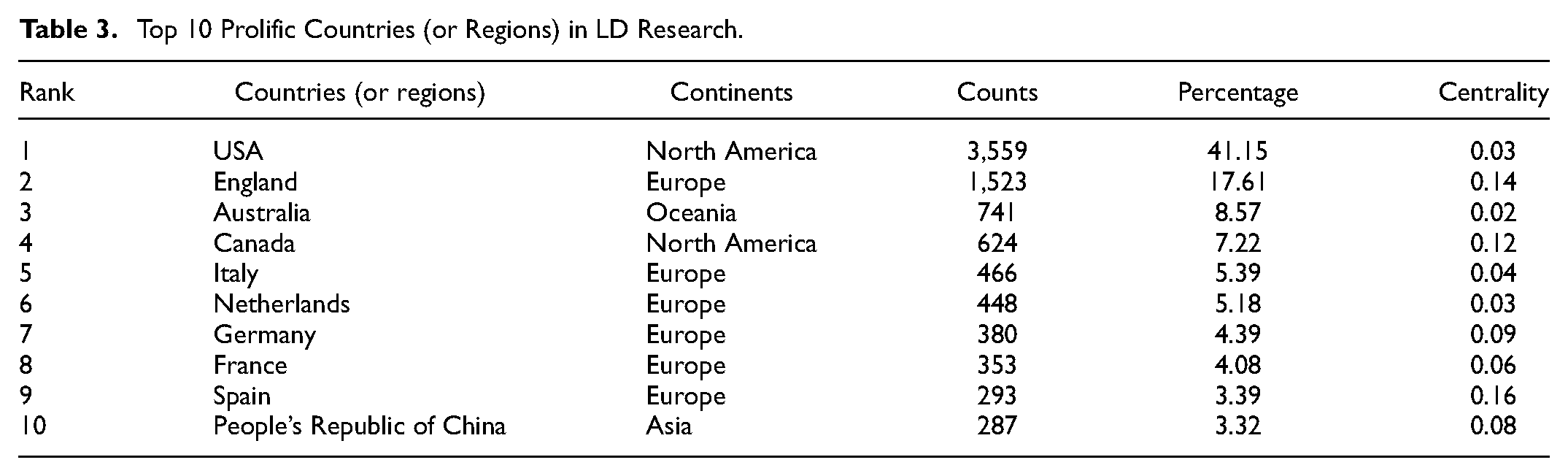
Figure 3 visualizes the collaboration between different countries (or regions) in LD research. The size of the circles represents the volume of publications, while the thickness of the links indicates the strength of collaboration. As shown in Figure 3, collaborations in LD research between different countries (or regions) were frequent. The purple nodes (with a centrality greater than or equal to 0.10) in the country cooperation network appeared in England (0.14), Canada (0.12), and Spain (0.16), indicating their intermediary role in the network.
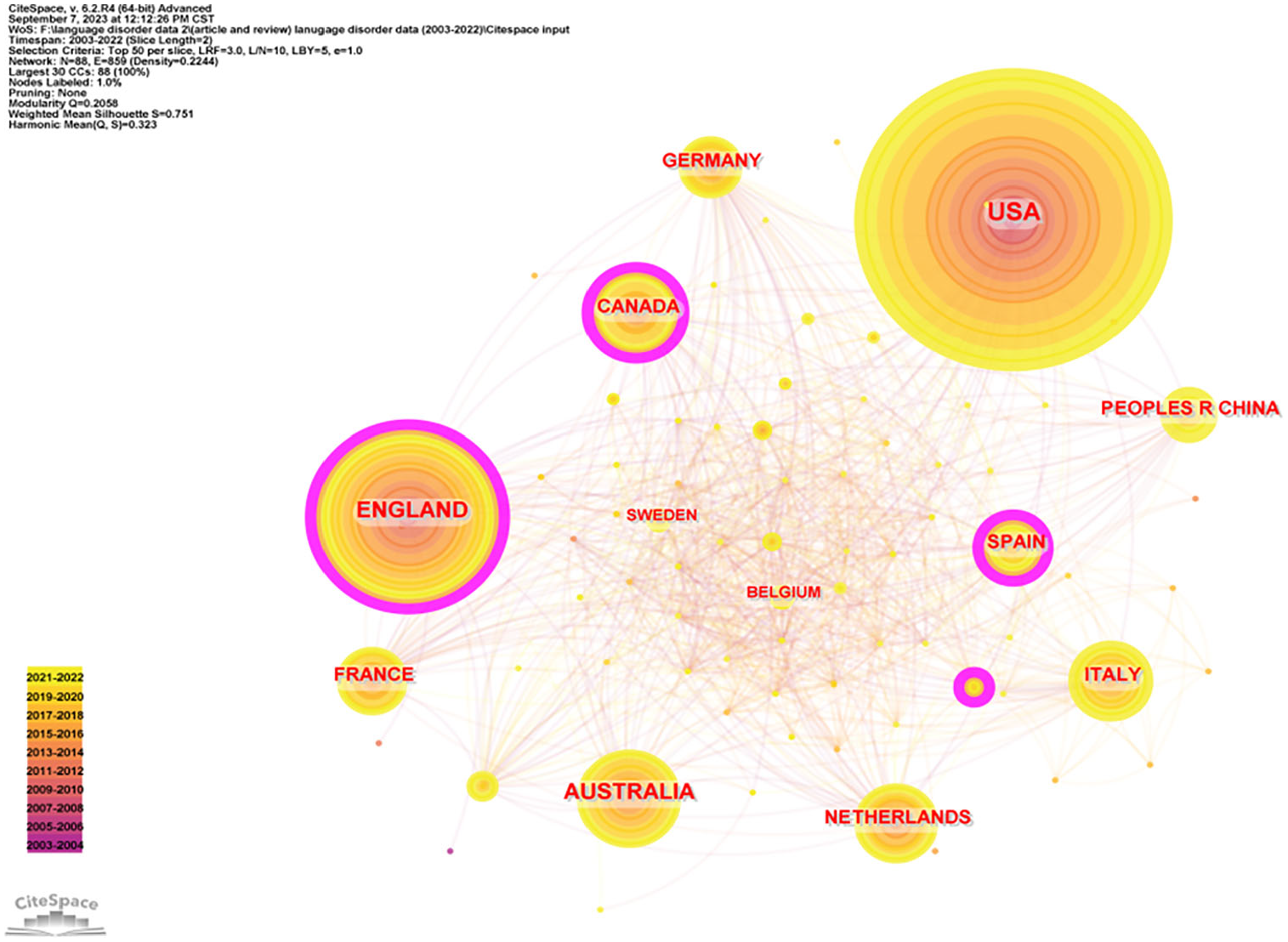
Country (or region) collaboration network in LD research.
Co-Citation Analysis: Most Cited Authors
We conducted a co-citation analysis of authors in LD research. Table 4 presents the top 5 most cited authors, that is, Bishop DVM (2,658 citations), Tomblin JB (1,351 citations), Leonard LB (1,261 citations), Rice ML (1,243 citations), and Conti-Ramsden G (1,122 citations). Bishop DVM (103 publications), Leonard LB (91 publications), and Conti-Ramsden G (82 publications) are also top 3 most productive authors in the field of LD research. Bishop DVM from the University of Oxford emerged as the most productive and most influential author. Professor Bishop has been at the forefront of LD research, and her contributions have greatly enhanced our understanding of the language problems of children and young people. Figure 4 illustrates the author co-citation network, where the purple nodes (with a centrality value greater than or equal to 0.10) represent the authors who play an intermediary role in the network. The five most cited authors - Bishop DVM, Tomblin JB, Leonard LB, Rice ML, and Conti-Ramsden G also play intermediary roles in the author co-citation network. Besides, all of them come from institutions in the USA or England, suggesting the dominant positions of USA and England in LD research.
Top 5 Most Cited Authors in LD Research.

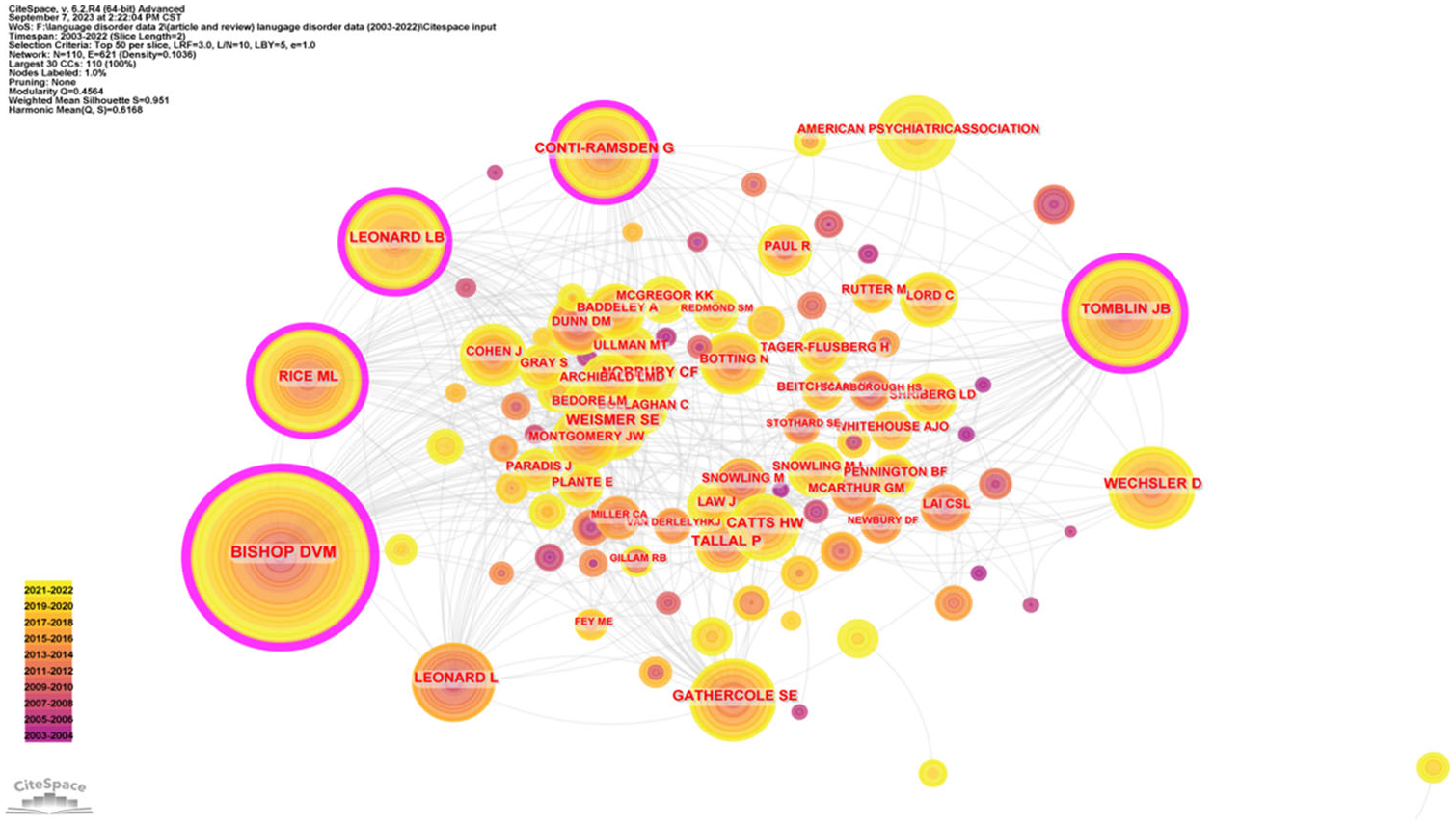
Author co-citation network in LD research.
Co-Citation Analysis: Most Cited References
Most cited references have been regarded as an important indicator in identifying excellent scientific research, and the number of citations can reflect the influence and popularity of certain research articles (Gao, 2022). In this study, we conducted a co-citation analysis of references to identify the most cited references in LD research from 2003 to 2022.The top 50 most cited references in each 2-year period were selected for analysis. The results are visualized in Figure 5, which shows 386 individual nodes and 1,564 links. The nodes in the network represent cited references, and the lines between nodes represent co-citation links. The thickness of a ring around a node is proportional to the count of citations it received. The color of the citation ring indicates the time of the corresponding citations, with blue representing the earliest citations and orange representing the most recent ones. Nodes with a centrality value greater than or equal to 0.1 are visualized with purple rings, indicating their intermediary roles in the network. Table 5 presents the top 5 most cited articles in LD research. The top 2 most cited articles are from Journal of Child Psychology and Psychiatry. It is also noteworthy that among the top 5 most cited articles, two (40%) are from Bishop DVM who is the most productive and most cited author in LD research.

Key articles in LD research.
Top 5 Most Cited Articles in LD Research.

The first most cited article is Bishop et al.’s (2017) study, which proposes a consensus on the terminology used to describe language problems in children. They suggest that the term Language Disorder is used to refer to a set of language difficulties causing functional impairment in daily life, while the term Developmental Language Disorder is used when LD cannot be attributed to a known biomedical cause. A large number of researchers around the world have referred to these definitions of language problems in their studies. The second most cited article is Norbury et al.’s (2016) study, investigating the impact of different nonverbal IQ (NVIQ) criteria on the prevalence, clinical presentation, and functional impact of LD in a UK population. The population prevalence of LD is estimated to be 9.92%, with 7.58% attributed to unknown causes (Norbury et al., 2016). These prevalence rates are frequently cited by other researchers in their studies on LD. The third most cited article is a study by Vernes et al. (2008), which examined CNTNAP2 polymorphisms in children with SLI and found their associations with nonword repetition, a behavioral marker for the disorder. They suggested a link between the FOXP2–CNTNAP2 pathway and language disruption. The fourth most cited article is Bishop and Snowling’s (2004) study, which suggested that two dimensions of impairment are needed to conceptualize the relationship between SLI and developmental dyslexia. The fifth most cited article is the study by Lai et al. (2001), which proposed that FOXP2 is involved in the developmental process culminating in speech and language. These most cited references offer some insights into the focuses in LD research, such as the identification and terminology of children’s language problems and the underlying neurogenetic mechanisms.
Co-Citation Analysis: Cluster Interpretations
Based on the interconnectivity among the nodes of document co-citation analysis, the 8,649 bibliographic records generated 10 main clusters, with a modularity value of 0.711 and a mean silhouette value of 0.869 (see Figures 6 and 7 for different layouts). The size, silhouette value, and mean year of each of the 10 main clusters are shown in Table 6. Among these clusters, it is evident that Cluster #0, Cluster #1, and Cluster #2 exhibit the strongest citation bursts, indicating that these three clusters are the primary and most active areas in LD research.
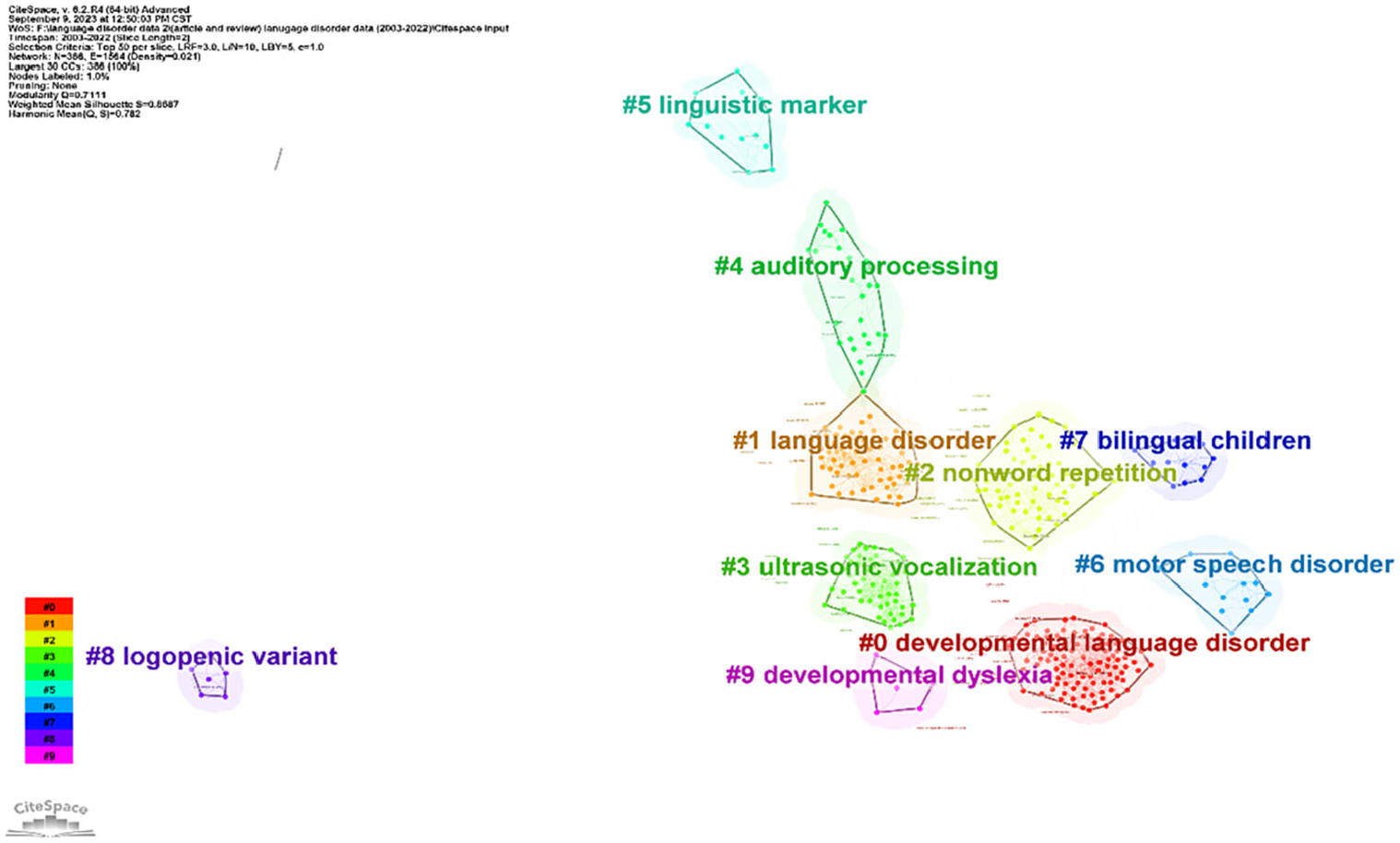
Co-citation cluster view of LD research.

Co-citation timeline view of LD research.
The Size, Silhouette Value, and Mean Year of Each of the 10 Main Clusters.

Cluster #0, labeled as developmental language disorder, focuses on identifying language problems in children. This cluster consists of 102 references. The six most cited references in this cluster are Bishop et al. (2017), Leonard (2014), Norbury et al. (2016), Lum et al. (2012), Bishop (2014), and Bishop et al. (2016). Bishop et al. (2017) presented the findings and recommendations from the second phase of a study that utilized an online Delphi method to establish consensus on criteria and terminology for language problems with children. The first phase of this study was reported by Bishop et al. (2016). Leonard (2014) provided a comprehensive overview of the impairments experienced by children with SLI, their potential origins, treatment, etc. Norbury et al. (2016) investigated the impact of different NVIQ criteria on the prevalence and presentation of LD in a UK population. Lum et al. (2012) supported the predictions of the Procedural Deficit Hypothesis (PDH), which maintains that abnormalities in brain regions constituting procedural memory account for the language deficits, specifically grammar problems, in SLI children. Bishop (2014) discussed the various labels for children’s language impairments. In sum, this cluster is mainly concerned with identifying language problems in children.
Cluster #1, labeled as language disorder, focuses on the neurogenetic mechanisms underlying LD. This cluster consists of 61 references. The six most cited articles within this cluster are Bishop and Snowling (2004), Lai et al. (2001), Newbury, Ishikawa-Brush, et al. (2002), MacDermot et al. (2005), Newbury, Bonora et al. (2002), and Lai et al. (2003). Bishop and Snowling (2004) discussed whether developmental dyslexia and SLI are distinct or share common underlying factors. They suggested that two dimensions of impairment are necessary to conceptualize the relations between these disorders and capture phenotypic features that are crucial to identify neurobiologically and etiologically coherent subgroups. Lai et al. (2001) proposed that FOXP2 is involved in the development of speech and language. In Newbury, Ishikawa-Brush, et al. (2002), a genome-wide scan identified two novel loci related to SLI, that is, chromosome 16q and chromosome19q. MacDermot et al. (2005) discovered the first nonsense mutation in FOXP2 in individuals with different etiological variants of the gene. Newbury, Bonora, et al. (2002) suggested that coding-region variants in FOXP2 do not underlie AUTS1 linkage and that the gene is unlikely to contribute to autism or other common language impairments. Lai et al. (2003) supported the view that impaired sequencing of motor and procedural learning may lead to the FOXP2-related speech and language disorder. Overall, this cluster focuses on the neurogenetic mechanisms underlying language disorders.
Cluster #2 is labeled as nonword repetition, a measure of phonological working memory and a diagnostic marker for language impairments. This cluster encompasses 60 references. The six most cited references in this cluster are Dunn and Dunn (2007), Wiig et al. (2013), Newcomer and Hammill (2019), Leonard et al. (2007), Williams (2007), and Montgomery et al. (2010), Dunn and Dunn (2007) present a standardized assessment tool for measuring receptive vocabulary skills in both children and adults. Wiig et al.’s (2013) study is designed to assess, diagnose, and measure developments in language and communication abilities of individuals aged 5 to 21 years. Newcomer and Hammill (2019) present a test consisting of nine subtests measuring different aspects of oral language, designed to identify children who are significantly below their peers, to determine their strengths and weaknesses in oral language abilities, and to document their progress in remediation programs. Williams (2007) designed a tool to measure the expressive vocabulary skills of children and adults, which involves verbally labeling or defining specific words or concepts depicted on picture cards. Leonard et al. (2007) examined the relationships between working memory, processing speed, and language disorders in children, and suggested that processing factors may lead to language disorders. Montgomery et al. (2010) provided an overview of the relationship between working memory and SLI, emphasizing that working memory can play a role in SLI and that interventions targeting working memory, such as computer-based training programs, may be beneficial. Overall, this cluster is concerned with diagnostic assessment tools and cognitive mechanisms relating to language impairments.
Other clusters within this knowledge domain are also worth mentioning. For instance, Cluster #4, labeled as auditory processing, focuses on the relationship between auditory processing deficits and language disorders. Catts et al. (2005) found that a phonological processing deficit is connected to dyslexia, but not to SLI in the absence of dyslexia, supporting the view that dyslexia and SLI are distinct disorders which can coexist. Rosen (2003) concluded that “auditory deficits are not causally related to language disorders, but rather occur in association with them.”Bishop and McArthur (2005) investigated auditory processing differences in individuals with SLI in a follow-up study using ERPs and behavioral thresholds, and emphasized the importance of studying individual cases rather than focusing on group means. Cluster #5 is labeled as linguistic marker. Weismer et al. (2000) indicated that nonword repetition task performance may serve as a useful indicator for identifying children with LD. Conti-Ramsden et al. (2001) examined and compared four potential psycholinguistic markers for SLI: a third person singular task, a past tense task, a nonword repetition task, and a sentence repetition task. Their results indicated that these markers varied in accuracy, with sentence repetition being the most effective. Cluster #6 is labeled as motor speech disorder. Eadie et al. (2015) found that the prevalence of speech disorder at 4 years old within an Australian cohort was 3.4%. Comorbidity with Speech Sound Disorder (SSD) was 20.8% for poor pre-literacy skills and 40.8% for language disorder. Factors such as gender, socio-economic status, maternal vocabulary, family history of speech and language difficulties, and speech, language, and motor skills at 2 years old predicted SSD (Eadie et al., 2015).
The clusters mentioned above represent the thematic patterns and main focuses in LD research. The interpretations of the clusters reveal that the most active areas in LD research are the identification of children’s language problems, neurogenetic mechanisms, diagnostic markers, cognitive mechanisms, auditory processing, and motor speech disorder.
Co-Citation Analysis: Most Recent Citation Bursts
Burst detection can be used to explore the trends in a research field, and recent ongoing bursts can reveal the future trends to some extent (C. Chen, 2006; H. Guo, 2017; Wang et al., 2019). Here, we explore emerging trends in LD research on the basis of references with most recent citation bursts (see Table 7). The citation bursts with the end year of 2022 are indicative of their likely continuation in the future, along with the popularity of their research topics. A total of 14 references with citation bursts ending in 2022 are classified as representing different emerging future trends.
References With Most Recent Citation Bursts.
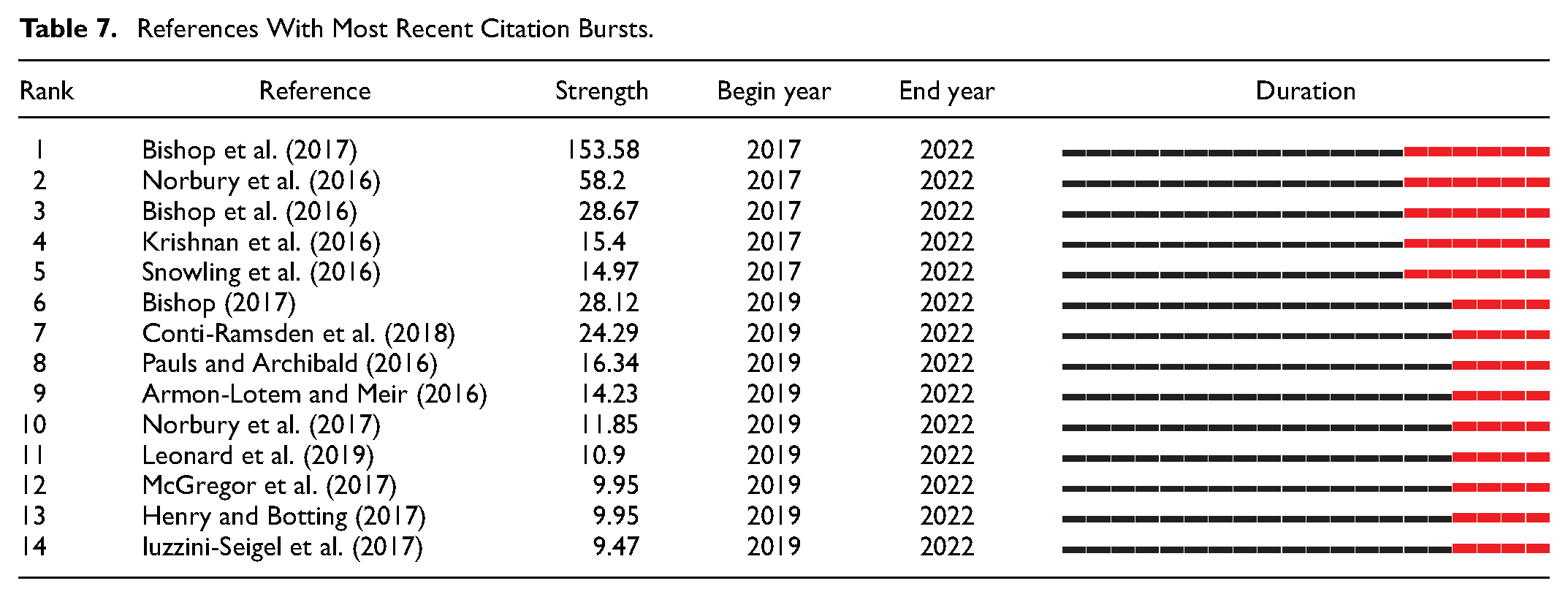

The first category concerns criteria and terminology for language problems with children (Bishop, 2017; Bishop et al., 2016, 2017). The lack of agreement on criteria and terminology for language problems with children affects access to services and hinders research and practice. Bishop et al. (2016) reported on the first phase of the study using an online Delphi method to address these issues, focusing on criteria for LD, while Bishop et al. (2017) reported on the second phase of the study, focusing on terminology for LD. Bishop (2017) reported the qualitative comments from the assessment panel to explore the reasons for the debate in this area.
The second category uses a population-based design to examine children with LD (Norbury et al., 2016, 2017). Norbury et al. (2016) sought to describe the impact of varying NVIQ criteria on the prevalence, presentation, and functional impact of LD in the first UK population study. The prevalence of LD of unknown origin was 7.58%, whereas the prevalence of LD related to an existing medical diagnosis or intellectual disability was 2.34%. Norbury et al. (2017) conducted a population-based survey to examine the growth in core language skills over the initial three school years in children with LD of unknown origin and LD related to an existing medical diagnosis or intellectual disability.
The third category uses a longitudinal design to examine the developmental trajectories of the LD population (Conti-Ramsden et al., 2018; Norbury et al., 2017; Snowling et al., 2016). Snowling et al. (2016) followed children from preschool to middle childhood to characterize three developmental trajectories: resolving, persisting, and emerging LI. Conti-Ramsden et al. (2018), a longitudinal study, found that those with DLD in childhood still have difficulties in their later years of education and early years of employment, yet with individual differences and signs of ongoing improvements. Norbury et al. (2017) used a population-based survey to explore the development of core language skills in children with heterogeneous language disorders over the initial 3 years of school.
The fourth category investigates the cognitive mechanisms underlying language disorders (Henry & Botting, 2017; Leonard et al., 2019; McGregor et al., 2017; Pauls & Archibald, 2016). Henry and Botting (2017) found that children with DLI show domain-general central executive (CE) impairments, along with impairments in verbal short-term memory. Using meta-analysis, Pauls and Archibald (2016) observed reliable differences in inhibition and cognitive flexibility tasks between children with and without SLI. McGregor et al. (2017) explored whether word learning difficulties associated with DLD are due to encoding or retention deficits, and found that encoding, not retention, is the problematic stage. Leonard et al. (2019) found that word learning activities involving repeated retrieval significantly benefit retention, and that children with DLD appear to be weaker at encoding than their TD peers, but their retention over 1 week was indistinguishable.
The fifth category examines the diagnostic markers for language disorders (Armon-Lotem & Meir, 2016; Iuzzini-Seigel et al., 2017). Armon-Lotem and Meir (2016) confirmed that nonword repetition and sentence repetition are valuable tools for identifying monolingual children with or without SLI in Hebrew and Russian. Iuzzini-Seigel et al. (2017) found that speech inconsistency is a core feature of childhood apraxia of speech (CAS) and is a specific and sensitive diagnostic marker for differentiating between speech delay and CAS, but that specificity and sensitivity are stimuli-dependent.
The last category focuses on the neurobiological mechanisms involved in language disorders. Krishnan et al. (2016) concluded that studying the corticostriatal networks in DLD could provide insights into the neurobiological basis of DLD and shed light on potential modes of compensation for intervention.
To summarize, the classification of studies with most recent citation bursts shows that the research trends regarding the criteria and terminology of language problems, cognitive mechanisms, neurobiological factors, and diagnostic markers will continue to attract researchers in the upcoming years. The population-based design and the longitudinal design to examine the developmental trajectories of the LD population are becoming more prevalent in LD field.
Discussion
Based on the bibliographic records collected from the WoS database, the present study provides a macroscopic overview of the knowledge domain of LD research. Overall, there has been a steady increase in LD research from 2003 to 2022, indicating a growing and sustained interest in this field by researchers. This surge of interest in LD research might be attributed to the social health consequences of LD, advancement of research technology, and increased governmental and non-governmental funding for unsolved mysteries related to LD. It can be predicted that researchers will continue to pay a great deal of attention to LD in the coming years. The analysis of top journals shows that the three most productive journals are Journal of Speech, Language, and Hearing Research, International Journal of Language and Communication Disorders, and Clinical Linguistics and Phonetics, which offers valuable guidance to LD researchers when they consider potential submission venues for their work. These and other productive journals come from many different disciplines, the most concerned being linguistics, rehabilitation, audiology, and speech-language pathology, psychology, neuroscience and neurology, indicating the interdisciplinary nature of LD research. Although issues related to LD are still investigated predominantly in the fields of linguistics and rehabilitation, focusing on linguistic deficits associated with LD and their treatments, a diversity of disciplines have been involved in the research, for example, the psychological and neurobiological mechanisms underlying LD. The national (or regional) distribution analysis show that the USA (41.15%) and England (17.61%) are the most productive countries or regions in LD research, accounting for over half (58.76%) of the global research output. One reason for their substantial production percentage may be the substantial governmental and non-governmental funding and support for LD research. Countries (or regions) in Latin America, Africa, Eastern Europe, or the Middle East have not paid as much attention to LD research, possibly due to lack of funding or support, which indicates a large gap in LD literature in these regions. More collaboration in social, psychological and therapeutic research should be established between developed and developing countries (or regions). The author co-citation analysis indicates that the most influential author is Bishop DVM from University of Oxford, who has made significant contributions to our understanding of children’s language problems, especially to achieving a consensus on diagnostic criteria and terminology (e.g., Bishop, 2014, 2017; Bishop et al., 2016, 2017). The five most cited authors Bishop DVM, Tomblin JB, Leonard LB, Rice ML and Conti-Ramsden G also play intermediary roles in the author co-citation network, and all of them come from institutions in the USA or England, again suggesting the dominant role of USA and England in LD research. Scholars with most citations often lead the research trends in the field, and tracking their publications can help emerging scholars gain a better understanding of the research focuses and future directions (Gao, 2022). The co-citation analysis of references identifies the top 5 most cited articles, that is, Bishop et al. (2017), Norbury et al. (2016), Vernes et al. (2008), Bishop and Snowling (2004), and Lai et al. (2001), which offer some insights into the focuses in LD research. Two of the top five most cited articles are from Bishop DVM, the most productive and influential author.
The co-citation analysis of references generates 10 main clusters, indicating the main thematic patterns and research focuses in LD field. The cluster interpretations reveal that the most active areas in LD research include the identification of children’s language problems (e.g., Bishop, 2014; Bishop et al., 2016, 2017; Leonard, 2014; Lum et al., 2012; Norbury et al., 2016; etc.), neurogenetic mechanisms (e.g., Bishop & Snowling, 2004; Lai et al., 2001, 2003; MacDermot et al., 2005; Newbury, Ishikawa-Brush, et al., 2002; Newbury, Bonora, et al., 2002; etc.), diagnostic markers (e.g., Conti-Ramsden et al., 2001; Dunn & Dunn, 2007; Newcomer & Hammill, 2019; Weismer et al., 2000; Wiig et al., 2013; Williams, 2007; etc.), cognitive mechanisms (e.g., Leonard et al., 2007; Montgomery et al., 2010; etc.), auditory processing (e.g., Bishop & McArthur, 2005; Catts et al., 2005; Rosen, 2003; etc.), and motor speech disorder (e.g., Eadie et al., 2015; etc.). The classification of studies with most recent citation bursts shows that the research trends concerning the criteria and terminology for language problems (Bishop, 2017; Bishop et al., 2016, 2017), the underlying cognitive mechanisms (Henry & Botting, 2017; Leonard et al., 2019; McGregor et al., 2017; Pauls & Archibald, 2016), the neurobiological factors (Krishnan et al., 2016), the diagnostic markers (Armon-Lotem & Meir, 2016; Iuzzini-Seigel et al., 2017), the population-based design (Norbury et al., 2016, 2017), and the longitudinal design to examine the developmental trajectories of LD population (Conti-Ramsden et al., 2018; Norbury et al., 2017; Snowling et al., 2016) will continue to attract researchers in the coming years. The co-citation analyses of cluster interpretations and most recent citation bursts provide readers and researchers with an overview of the research focuses and emerging trends in LD field, which show that identification and terminology of children’s language problems, diagnostic markers, cognitive mechanisms, and neurogenetic factors have been and will continue to be of great concern to LD researchers.
In regards to the identification and terminology of children’s language problems, Bishop (2014) pointed out the wide range of terms used to describe children’s unexplained language impairments and the confusion that can result. For example, terms such as dyslexia, attention deficit hyperactivity disorder, and autistic spectrum disorder are used to refer to difficulties in reading, attention and social cognition respectively. There is no agreed term for children with unexplained language problems; some options are language learning impairment, primary language impairment, specific language impairment, or developmental language disorder. The lack of consistency in diagnostic labels causes confusion and hinders research and access to therapy services. Therefore, it is important to achieve a consensus on diagnostic criteria and terminology. Reilly et al. (2014) suggested that the term specific language impairment may be disadvantageous due to the use of exclusionary criteria, and recommended the use of the label language impairment and the adoption of inclusionary criteria that take into account the fluid nature of language development especially during the preschool years. Using an online Delphi technique to reach consensus on these issues, Bishop et al. (2016, 2017) recommended that the term language disorder was used to refer to a set of language difficulties causing functional impairment in daily life and associated with poor prognosis, and that the term developmental language disorder (DLD) was used for language problems with an unknown biomedical cause. DLD can be seen as a subset within a broad category covering the full range of speech, language, and communication problems. As depicted in Figure 8, the term Speech, Language and Communication Needs (SLCN) is a very broad category encompassing a wide range of conditions, including DLD, problems with a physical basis (e.g., dysarthria) or affecting speech voice or fluency, problems due to limited familiarity with the ambient language, etc. The integration of new theoretical approaches from various disciplines such as linguistics, psycholinguistics, neuroscience, and molecular genetics is bringing finer-grained criteria and better psycholinguistically motivated tests for identifying DLD. The conception of DLD is likely to be refined through further research on etiology, associated characteristics and intervention effectiveness (Bishop, 2017).
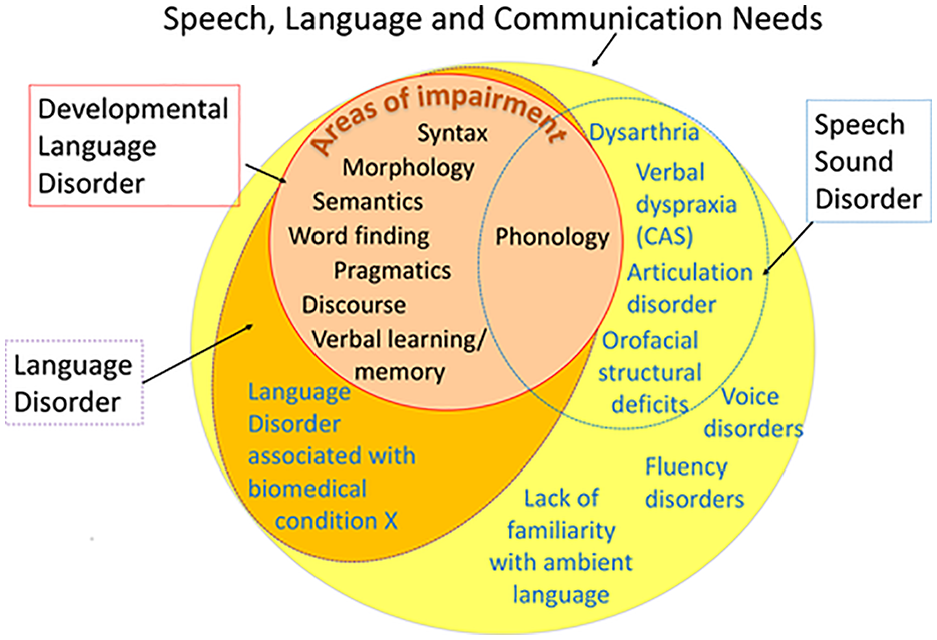
Venn diagram illustration of relationships between different diagnostic terms (Bishop et al., 2017).
In terms of diagnostic markers for SLI, morphology is often identified as a clinical marker that may be characteristic of children with SLI. Weismer et al. (2000) suggested that performance on nonword repetition tasks may serve as a useful marker for language disorder, although not sufficient on its own. Conti-Ramsden et al. (2001) compared four potential psycholinguistic markers for SLI: a past tense marking task, a third person singular task, a nonword repetition task, and a sentence repetition task, and found that the markers varied in accuracy, with sentence repetition being the most effective. Conti-Ramsden (2003) examined children’s performance on two linguistic tasks (noun plurals and past tense marking task) and two processing tasks (digit recall and nonword repetition), and found that past tense marking and nonword repetition were the better markers to identify SLI. Bishop et al. (2006) found that the nonword repetition task as a marker for measuring phonological short-term memory (STM) and the elicitation tasks to assess verb tense marking both effectively identified children at risk for LD. Archibald and Joanisse (2009) examined the use of nonword repetition and sentence recall as markers for SLI and found that sentence recall is an effective clinical marker for SLI and combined language and working memory impairments. Armon-Lotem and Meir (2016) confirmed that nonword repetition and sentence repetition are valuable tools for identifying monolingual children with or without SLI in Hebrew and Russian. Previous research into the diagnostic markers for SLI has yielded inconsistent results. More research is still needed to explore better (combination of) diagnostic markers for SLI.
With regard to the cognitive mechanisms underlying LD, Ullman and Pierpont (2005) proposed the Procedural Deficit Hypothesis (PDH) to explain SLI. According to the PDH, abnormalities in the brain regions constituting procedural memory largely account for the language deficits in children with SLI, particularly their grammar difficulties. The abnormalities also result in difficulties with nonprocedural functions such as working memory, which rely in part on the affected brain regions. Functions such as declarative and lexical memories relying on other brain regions remain largely intact and play a compensatory role for grammar (Ullman & Pierpont, 2005). Leonard et al. (2007) examined the relation between working memory and processing speed in children with LD, suggesting that processing factors may contribute to LD. Henry and Botting (2017) suggested that children with DLI show domain-general central executive (CE) impairments, along with their more established impairments in verbal short-term memory. Jackson et al. (2020) investigated the procedural, declarative, and working memory systems in children with DLD and found that they have deficits in the working memory system. The deficits in verbal declarative memory and procedural memory could largely be accounted for by working memory skills. Yet, further investigation of the relationships between the memory systems is required using tasks measuring learning over long-term intervals (Jackson et al., 2020). Previous research into the working, procedural, and declarative memory systems in children with DLD has yielded inconsistent results. More related studies need to be conducted to enhance our understanding of these cognitive processes underlying LD.
Regarding the neurogenetic mechanisms involved in LD, Lai et al. (2001) proposed that FOXP2 is involved in the development of speech and language. Watkins et al. (2002) provided evidence for a link between abnormal caudate nucleus development and impairments in oromotor control and articulation in the KE family. Bishop et al. (2006) proposed that different genes are involved in causing language difficulties related to phonological short-term memory (STM) and verb morphology, and concluded that language, as a complex function, depends on multiple underlying skills with different genetic origins. Vernes et al. (2008) identified a novel FOXP2-regulated target with neural functions and provided evidence for its link with language deficits in a group of well-characterized families with SLI. The genetic discoveries have placed SLI at the forefront of research, as they can help us understand the unfolding genetic contributions. However, we still know very little about the genes associated with SLI. The investigations of neural and genetic correlates of speech and language disorders may provide significant clues to the underpinnings of speech and language, and that identifying relevant genetic effects may lead to new insights into the causes of these impairments and to improved classification, diagnosis and treatment.
In addition, the interventions for individuals with LD have also been a topic of interest, and various approaches have been explored over the years. Medical and neuropsychological treatments, as discussed by Hagen (1981) concerning LD linked to closed head injury, and Mitchum and Berndt (1995) with their cognitive neuropsychological approach, underscore the importance of diagnosis and cognitive processes in language function. Family and holistic therapies also play a crucial role in the intervention of LD. While Andrews (1986) highlights the significance of involving the family in the treatment process, Hojjati and Khalilkhaneh (2017) evaluate the effectiveness of a holistic multidimensional treatment model for autistic children, underlining the need for tailored interventions. Measurement-based approaches also contribute to the advancement of this field. Molfese et al. (1999) explores the predictive use of event-related potentials (ERPs) in the treatment of LD. Camarata and Nelson (2002) advocate for treatment programs which are designed with advanced measurement techniques. Plante and Gómez (2018) discuss the application of statistical learning principles in treatment and educational settings. Additionally, alternative treatments offer valuable insights to the interventions of LD. For example, Ke and Zhou (2024) focus on emotional treatments for LD, specifically addressing personification abuse in autistic students. Collectively, these studies demonstrate the diverse approaches and considerations in treating language disorders, highlighting the importance of tailored interventions and innovative strategies. In the context of digital transformation and the development of artificial intelligence (AI), new technologies are playing a more important role in supporting people with communication disorders. Some positive impact of technology on speech and language therapy has been observed in various speech disorders (e.g., Aziz et al., 2014; Danubianu & Tobolcea, 2016). In particular, the potential benefits of AI technology in supporting individuals with communication difficulties have been highlighted by studies such as Bhargavi et al. (2023). Overall, the integration of AI and digital technologies presents a promising avenue for improving diagnostic accuracy, treatment outcomes, and communication support for individuals with speech and language difficulties. As technology continues to advance, the role of AI and other technologies in addressing language disorders is likely to expand, which may offer new opportunities for more personalized and effective interventions for individuals suffering from LD.
Conclusion
The present study collected 8,649 bibliometric records in LD research published from 2003 to 2022 and used CiteSpace to quantitatively and visually analyze the publication records in order to map the knowledge domain of LD research and to identify the thematic patterns and emerging trends. The study focuses on temporal distribution and top journals, category analysis, national (or regional) distribution, most cited authors, and co-citation analyses of references.
The major findings of the study are as follows: (1) there has been an overall steady increase in LD studies since 2003, indicating a sustained and growing interest among researchers on LD; (2) LD research, which is interdisciplinary, is of most concern in linguistics, rehabilitation, audiology and speech-language pathology, psychology, and neuroscience; (3) the USA (41.15%) and England (17.61%) account for more than half of the world’s research production in the LD field, indicating the leading position of the USA in LD research, whereas countries (or regions) in Latin America, Africa, Eastern Europe, and the Middle East have not paid as much attention to LD research, indicating a large gap in LD literature in these regions; (4) the cluster interpretations of references show that the main research focuses in LD research include identification of children’s language problems, neurogenetic mechanisms, diagnostic markers, cognitive mechanisms, auditory processing, and motor speech disorder; (5) the references with most recent citation bursts suggest that the research trends concerning criteria and terminology for language problems, cognitive mechanisms, neurobiological factors, diagnostic markers, the population-based design, and the longitudinal design to investigate developmental trajectories of the LD population will continue to attract researchers in the coming years.
This study has the following contributions. Firstly, it provides the first bibliometric and visualized analysis of the knowledge map of LD research, including overall publication trends (publication years and top journals), category distribution, national (or regional) distribution, most influential authors, and most cited references, allowing emerging researchers to quickly understand the landscape and grasp the current status of LD research. Secondly, it identifies the main thematic patterns and research focuses through cluster interpretations, and predicts emerging trends in LD research by detecting ongoing citation bursts, assisting potentially interested scholars in continuing the discussion and embarking on their own studies with high efficiency. Thirdly, it provides some insights into interventions of language disorders, and points out the great potential of digital and AI technologies in addressing LD issues.
The study also has a few limitations. Firstly, false positive and negative results could be obtained regardless of how accurate the keyword searching strategy was. With a total of 8,649 articles, we believed that this could hardly affect the accuracy of the results. Secondly, adopting varied parameters and thresholds in running CiteSpace can yield different mapping structures even though there are no significant changes in the results. Thirdly, the study focuses primarily on presenting a broader picture to illustrate future research trends, rather than a deep and detailed exploration of the frontiers of LD research.
Future review studies could investigate bibliometric records on LD research using co-occurrence keyword detection to gain further insights into thematic patterns and emerging trends. Additionally, researchers could develop detailed trajectories for specific research trends to gain a better understanding of specific aspects. Future research on LD could focus on the following aspects: (1) the conception of DLD and a consensus on the diagnostic criteria and terminology; (2) better (combination of) diagnostic markers for DLD; (3) the working, procedural, and declarative memory systems in children with DLD; (4) identifying relevant genetic effects; (5) the developmental trajectories of the LD population; (6) the impact of digital and AI technologies on the identification and treatment of language impairments.
Footnotes
Declaration of Conflicting Interests
The author(s) declared no potential conflicts of interest with respect to the research, authorship, and/or publication of this article.
Funding
The author(s) disclosed receipt of the following financial support for the research, authorship, and/or publication of this article: This research was supported by Young Teachers’ Research Enhancement Program of Communication University of Zhejiang [Grant Number 20200156], and Global Index Program of Beijing Foreign Studies University [Grant Number 2024SYLZD008].
Ethical Statement/Informed Consent
The study utilized secondary data that is publicly available for which informed consent is not applicable. The authors declare that this is an original work of authors which has been approved by all authors, and the content of the manuscript has not been published or submitted for publication elsewhere.

Data Availability Statement
The datasets generated and analyzed during the current study are available from the corresponding author upon request.