




Abstract
The present study aims to examine parental socialization and adjustment in adolescents and adult children. Participants included 610 adolescents aged 12 to 18 years (M = 16.56; SD = 1.69) and 608 young adults aged 19 to 35 years (M = 23.60; SD = 3.72) from Spain. Parental socialization was assessed through warmth and strictness. Child adjustment was assessed though self-esteem, emotional self-concept, nervousness, and achievement values. Correlation and regression analyses were conducted. Results from predictive models revealed that warmth and strictness were significant predictors of child adjustment, although they showed different directionality. Parental warmth was always identified as a significant predictor: the higher the parental warmth, the higher the emotional self-concept, self-esteem, and achievement, and the lower the nervousness. On the contrary, parental strictness did not predict adjustment and was even a significantly negative predictor of self-esteem and emotional self-concept. In addition and contrary to classical findings from mostly European-American samples, the present findings seem to suggest that parental strictness is unnecessary or even detrimental, while parental warmth offers a significant and beneficial contribution to adjustment. Our findings suggest that even though family is considered less important in young adulthood because parenting has ended, the years of socialization may also explain the adjustment of the adult child.
Parental socialization refers to the process by which adults (e.g., parents or primary caregivers) transmit cultural habits and values to their children so that they can function adequately within their culture (Baumrind, 1978; Climent-Galarza et al., 2022; Maccoby, 1992). Parental socialization has a beginning, but also an end (Baumrind, 1978; Buri, 1991; Garcia, Fuentes et al., 2020; Maccoby, 1992). Parents, as agents of socialization whose main responsibility is the care and protection of their children, can use different strategies during their children’s upbringing. These strategies are based on warmth (e.g., reasoning with the children when their behavior has been incorrect so that they understand the consequences) (Martínez et al., 2019) and/or strictness (e.g., punishing the children when they misbehave) (Martinez-Escudero et al., 2020).
The main objective of parental socialization is for the child to become an autonomous and mature adult, capable of adapting to social demands (Baumrind, 1978; Grusec & Hastings, 2007; Maccoby & Martin, 1983) It ends when the child reaches adult age although not all children achieve these goals and go on to become responsible adult members of their society (Baumrind, 1978; Gimenez-Serrano, Garcia, & Garcia, 2022). Conversely, just like in adolescence, there are important differences in adjustment and competence among young adult children (Aquilino & Supple, 2001; Garcia et al., 2021) However, there is limited knowledge about the association between parenting and adjustment beyond adolescence.
The relationship between young adults and their family is likely to continue after adolescence (when parental socialization is over) (Lambert et al., 2010), but during this stage of life, parents and their adult children share the same status: they are both adults (Baumrind, 1991; Garcia & Serra, 2019). In this sense, the practices used by parents when they were raising children and adolescents can no longer be used with the adult child (Baumrind, 1991; Garcia & Serra, 2019). Once the stage of socialization is over, young adulthood signifies a period of change and challenges, influenced by a variety of developmental factors (Aquilino, 1997; Fuligni & Pedersen, 2002; Mañez et al., 2024). Developmental theorists have hypothesized over the strong influence of early experiences (e.g., family) on adult development (Bowlby, 1969; Freud, 1933), but this has not been extensively tested. The present study aims to examine whether the relationship between differences in adjustment among young adult children and both parental warmth and strictness follows a similar or different pattern to that observed in adolescents. In addition, parental warmth and strictness will be evaluated to confirm if they are predictors of child adjustment.
Theoretical Two-Dimensional Parenting Model
For years, different parental strategies have been studied based on two dimensions: warmth and strictness (Darling & Steinberg, 1993; Lamborn et al., 1991; Maccoby & Martin, 1983). These two dimensions have been defined as theoretically orthogonal or unrelated (Garcia et al., 2019; García & Gracia, 2009; Maccoby & Martin, 1983). Warmth refers to the level of parental involvement and concern during their children’s upbringing (Darling & Steinberg, 1993; Garcia, Fuentes et al., 2020; Martínez et al., 2017) while strictness refers to the degree to which parents exercise authority, set strict limits, and impose themselves on their children (Darling & Steinberg, 1993; Gimenez-Serrano, Alcaide et al., 2022; Villarejo et al., 2020). The dimensions have been given different names, but they always share a common meaning (Steinberg, 2005). The warmth dimension has been referred to with terms such as responsiveness (Baumrind, 1991), love (Schaefer, 1959), assurance (Symonds, 1939), involvement (Chao, 2001) and acceptance (Martinez et al., 2012). The strictness dimension has been referred to with terms such as demandingness (Baumrind, 1991), control (Sears et al., 1957), domination (Symonds, 1939), imposition (Martínez et al., 2017), or supervision (Lamborn et al., 1991).
When studied together, theoretically orthogonal dimensions allow the categorization of parents (i.e., the so-called parenting styles) (Darling & Steinberg, 1993; Garcia et al., 2019; García & Gracia, 2009; Maccoby & Martin, 1983). On the one hand, parents characterized by high scores on the warmth dimension are involved parents who express love toward their children and use reasoning with them (i.e., authoritative and indulgent styles). However, authoritative parents use imposition and punishment as a form of correction (high strictness) while indulgent parents do not resort to these types of imposition (low strictness) (Riquelme et al., 2018; Steinberg, 2001). On the other hand, parents characterized by low scores on the warmth dimension are those who are not very involved, do not use reasoning and dialog, and invest little time in getting to know their children (i.e., authoritarian and neglectful styles). Authoritarian parents, unlike neglectful parents, do discipline their children when they misbehave in a strict and harsh manner (Queiroz et al., 2020; Steinberg et al., 1994).
The Optimal Parenting
Parental socialization has broad consequences (beneficial in some cases, but also detrimental in others) on the psychosocial development of children. For decades, the degree of parental warmth and strictness has been consistently related to differences in the psychosocial adjustment of children (Baumrind, 1967, 1971; Darling & Steinberg, 1993; Lamborn et al., 1991; Steinberg et al., 1992, 1994). Classical studies, mainly conducted with middle-class European-American families, identify that the combination of high strictness and high warmth (i.e., authoritative style) is related to higher scores in children’s psychosocial adjustment (Lamborn et al., 1991; Steinberg et al., 1994). Conversely, when one of these two dimensions has low scores, children’s psychosocial adjustment is linked to a mixed profile: some benefits, but also costs (Lamborn et al., 1991; Steinberg et al., 1994). Thus, children from authoritarian families (high scores on strictness, but low on warmth) tend to score well on obedience and academic and social adjustment but fail in their self-perceptions. By contrast, children from indulgent families (high scores on warmth, but low on strictness) show good self-perceptions, but fail in their social adjustment, have behavioral problems, high somatic stress, and low school performance. Finally, lower adjustment is associated with low scores on both warmth and strictness dimensions (i.e., children from neglectful families) (Lamborn et al., 1991; Steinberg et al., 1994).
Cross-Cultural Variations in Optimal Parenting
It appears that the combination of high strictness and high warmth is not always associated with higher psychosocial adjustment scores in all cultural contexts (Baumrind, 1972; Chen et al., 2024; Darling & Steinberg, 1993; García & Gracia, 2009; Palacios et al., 2022). For example, research conducted in the United States, but with ethnic minority families such as Chinese-Americans (Chao, 2001) and African-Americans (Deater-Deckard & Dodge, 1997), shows that parenting characterized by high strictness and low warmth (i.e., authoritarian families) is related to some psychosocial benefits. Additionally, some benefits related to the authoritarian parenting style have also been found in studies with adolescents from Arab Societies (Dwairy et al., 2006; Dwairy & Menshar, 2006). Thus, the relationship between parental socialization and adjustment may not always be the same in all contexts and cultural environments (Baumrind, 1972; Chao, 1994; Sandoval-Obando et al., 2021; Valente et al., 2017). It is widely recognized that the cultural context in which parents are raising their children might affect the impact of parenting on child adjustment (Darling & Steinberg, 1993; Garcia et al., 2019; García & Gracia, 2009; Pinquart & Kauser, 2018).
A growing set of emergent studies conducted mainly in Latin American and European countries did not find the same results as research conducted with European-American families (Calafat et al., 2014; García & Gracia, 2009; Martinez et al., 2020; Perez-Gramaje et al., 2019; Riquelme et al., 2018). Warmth seems to be beneficial, but strictness could be unnecessary or even detrimental (Gallarin et al., 2021; Martínez et al., 2021; Martinez-Escudero et al., 2023). The combination of high warmth and low strictness (characteristics of indulgent families) is related to equal or even better results than the combination of high warmth and high strictness (characteristics of authoritative families) (Alcaide et al., 2023; Musitu-Ferrer, León-Moreno et al., 2019; Queiroz et al., 2020). These results are observed in different criteria of psychosocial adjustment indicators, such as academic performance (Fuentes et al., 2019; Fuentes, Alarcón, Gracia, & Garcia, 2015), internalization of social values (Martinez et al., 2020; Martínez & García, 2007), empathy (Fuentes et al., 2022), drug use (Calafat et al., 2014; Riquelme et al., 2018) including alcohol consumption (Fuentes, Alarcón, Garcia & Gracia, 2015; Garcia, Serra et al., 2020), and delinquency (Climent-Galarza et al., 2022).
Culture and Optimal Parenting
Overall, classical studies identify benefits associated with parenting styles characterized by high strictness, mostly combined with high warmth (authoritative parenting) but, in some cases, even with low warmth (authoritarian parenting). On the contrary, in the so-called Digital Society, there is emergent research, mainly based on studies conducted in Europe and South America, in which benefits of high warmth and low strictness (indulgent parenting) have been identified (Garcia et al., 2019; Hung, 2022; Pinquart & Kauser, 2018). Discrepant results about the optimal parenting style have been explained by the cultural context in which parental socialization takes place (Darling & Steinberg, 1993; Garcia et al., 2019; García & Gracia, 2009; Pinquart & Gerke, 2019). In any part of the word, families can always be defined by the extent to which they use parental warmth and strictness within the same cultural context. However, family is part of a context based on particular social and cultural values.
According to findings from studies with middle-class European-American families, parenting based on strictness could help children to assume and internalize social norms, but when combined with parental warmth it could foster the child’s individuality and self-confidence (Baumrind, 1983; Darling & Steinberg, 1993). However, it seems that parental strictness without warmth is also beneficial in ethnic minorities in the United States (Baumrind, 1972; Chao, 2001). This type of parenting style (i.e., authoritarian) could have detrimental consequences on children who could perceive their family as unloving and intrusive (i.e., European Americans), but in a context of risk and few opportunities (e.g., African Americans) children could perceive that, through strictness without warmth, their family is giving them the security and confidence that the neighborhood does not offer (Baumrind, 1996; Deater-Deckard et al., 1996). Furthermore, it has been hypothesized that in ancient societies (e.g., Arab and Asian societies) the benefits of parental strictness without warmth could be related to the social value of families (collectivism), in which the relationships between members (e.g., parents and children) are based on hierarchy (Dwairy et al., 2006; Triandis, 1989). It is possible that strictness without warmth could be beneficial, partly because of the cultural assumption that children need to be trained and disciplined and that children are expected to fulfill a family obligation to behave well (so as not to dishonor the family, which is what defines their identity) (Chao, 1994; Ho, 1986). On the contrary, findings with families in Europe and Latin America, seem to suggest that warmth is enough even without strictness, maybe because family is especially valued (collectivism), but the relationships between members are more horizontal and egalitarian (Garcia et al., 2019; Reyes et al., 2023). Children might internalize the social and cultural values transmitted by parents when they feel loved and appreciated by their family, without the need for parents to be intrusive and surveillant (Martínez et al., 2021; Martínez & García, 2007).
Parenting and Psychosocial Adjustment
Among the goals of parental socialization, it is necessary that children develop self-confidence, as well as good emotional regulation together with good social adjustment, represented by the internalization of social norms and values (Baumrind, 1978; Darling & Steinberg, 1993; Grusec & Hastings, 2007; Maccoby & Martin, 1983). Regardless of the stage of life, benefits related to high self-esteem and self-concept have been widely described (Fuentes et al., 2020; Garcia, Martinez et al., 2018). Based on a multidimensional approach of the self (i.e., self-concept), emotional self-concept includes the self-perceptions about one’s own emotional state and the ability to cope with the correct responses in specific situations (Fuentes et al., 2020; Garcia, Martinez et al., 2018). Emotional self-concept is positively related to emotional intelligence (Herrera et al., 2019), well-being and academic success (García-Martínez et al., 2023), as well as to less maladjustment (Maiz & Balluerka, 2018) and problems (Cornellà-Font et al., 2020; Malo-Cerrato et al., 2018). By contrast, nervousness represents a degree of instability and emotional maladjustment associated with personal and adjustment problems (Garcia & Serra, 2019; Greenberger et al., 1975). The internalization of social values is related to prosocial behaviors and is a protective factor against aggressive behaviors (Grusec & Hastings, 2007; Martinez et al., 2020). Among the social values identified, achievement values can help adolescents and adults reach their goals by offering guidance and energy during the process, especially when faced with obstacles and difficulties (Sagiv & Schwartz, 2000; Schwartz, 1992).
Parenting Beyond Adolescence
Most studies have examined the influence of parenting on development during adolescence, but few have focused on young adulthood, a stage of life when adult children are no longer under the supervision and care of their parents (Aquilino, 1997; Fuligni & Pedersen, 2002; Lambert et al., 2010). Entry into the adult world (when children reach adulthood) marks the end of parental socialization, but little is known about the influence of the experiences during the socialization years. It may be especially important to identify whether parenting matters beyond adolescence, when children become adults because they reach legal age (Baumrind, 1978; Fuligni & Pedersen, 2002; Maccoby, 1992). If there were no relationship (either positive or negative) between parenting and the psychosocial adjustment of young adults, the task of parental socialization would be irrelevant once it is completed.
A few studies have examined the consequences of parenting on adult children beyond adolescence. However, some of the studies did not analyze the two parental dimensions. They only focused on parenting during the socialization years based on a model of three parenting styles including the authoritative, authoritarian, and permissive styles (Buri, 1991; Turner et al., 2009; Waterman & Lefkowitz, 2017). Other studies focused only on adult children (Candel, 2022; Gimenez-Serrano, Alcaide et al., 2022; Manzeske & Stright, 2009; Parish & McCluskey, 1992), without comparing them with the socialization of those still being raised by their parents. Another limitation of past studies has been the use of different criteria for adjustment for adult children and others, according to age (Stafford et al., 2016). Therefore, it is important to examine both children who are being raised by their parents (e.g., adolescents) and children whose parenting process has ended (e.g., young adults) with a theoretically consolidated model based on the two main dimensions (warmth and strictness). Comparing these two groups with the same criteria can provide relevant evidence on the parenting correlates. It is also particularly relevant to identify whether optimal parenting is based on warmth and strictness, as suggested by the classical studies mainly from European-American families (Darling & Steinberg, 1993), or just on warmth regardless of strictness, as suggested by some recent studies (Garcia et al., 2019).
The Present Study
During adolescence, the influence of family decreases as the influence of peers increases. Peers are beneficial and provide a sense of belonging and support in developing identity, but are also sometimes ruled by group standards which could be socially inadequate (Eccles et al., 1993; Grusec & Goodnow, 1994; Martínez & García, 2007) Adolescence has been identified as a developmental stage which is related to some degree of psychosocial vulnerability or difficulties (Arnett, 1999; Riquelme et al., 2018). For example, compared to childhood or adulthood, adolescents are more likely to report lower rates of self-perception (Harter, 1988; Robins & Trzesniewski, 2005), as well as greater difficulties at school (Veiga et al., 2015, 2023) and externalizing problems (Hernández-Serrano et al., 2021; Pedersen et al., 2013). Young adults show greater maturity than adolescents, which is associated with some developmental gains (e.g., in self-esteem) and new positive challenges such as entering university, living outside the family home, or more stable romantic relationships (Aquilino, 1997; Orth et al., 2010; Steinberg, 2007). However, some problems that arise in adolescence, far from diminishing in adulthood, seem to continue and even increase (Evans-Polce et al., 2015; Schulenberg & Maggs, 2002). For example, alcohol consumption tends to start in adolescence and appears to be higher during young adulthood (Garcia, Serra et al., 2020; Schulenberg & Maggs, 2002). It is possible that young adults who did not internalize the socializing message of their parents during the socialization years, now that they are adults, without parental supervision and monitoring, do not have adequate self-regulation (Garcia, Serra et al., 2020; Villarejo et al., 2024).
Entering the adult world is particularly complex, given that young people must face new challenges as adults and responsible members of society. All of this without being under the required responsibility of parents or teachers (Aquilino, 1997; Fuligni & Pedersen, 2002; Lambert et al., 2010). There are important differences in adaptation and competence among young adults, especially at a stage associated with major changes that come with entering the adult world, such as the start of university studies, first jobs, relatively stable relationships, or experiences of independence (Aquilino, 1997; Bartholomew & Horowitz, 1991; Fuligni & Pedersen, 2002; Lambert et al., 2010).
Particularly in the family context, parental socialization is over (e.g., parents can no longer punish their adult children if they do not conform to family norms). However, the relationship between parents and adult children tends to continue, but in a more egalitarian form. Some adult children maintain closer contact with their parents than others probably in part because they voluntarily develop a sense of obligation to support, help and respect their family (Fuligni & Pedersen, 2002). Transitions to marriage, cohabitation, and full-time employment have been associated with closer, more supportive, and less conflicted relationships between parents and their adult children (Aquilino, 1997). However, adult life is especially marked by diverse and multiple influences, so an important question is whether there is a relationship between young adult development and parenting during the socialization years similar to those in adolescence. Additionally, another important question is whether the optimal parenting style is based on greater warmth accompanied by greater strictness or based on greater warmth without strictness.
This present study examined whether the relationship between adjustment and both parental warmth and strictness among young adult children follows a similar or different pattern to that observed in adolescents. In addition, it tested whether parental warmth and strictness are predictors of child adjustment. Adjustment in adolescents and young adults was assessed through emotional self-concept, self-esteem, nervousness, and achievement. Likewise, although not the focus of the study, age and sex differences were analyzed to confirm if the findings in adjustment variables are in line with multiple previous findings. It was expected that there would be a relationship between parenting and child adjustment not only in adolescence, but also in young adulthood, with a similar, though not identical pattern. Additionally, warmth was expected to contribute beneficially to child adjustment, whereas strictness was expected to be unnecessary or even detrimental.
Method
Participants and Procedure
The present study was conducted with Spanish participants. Spain has been characterized as a society in which family has a special relevance (influenced by collectivism), although relationships among family members tend to be relatively egalitarian (Garcia et al., 2019; Martinez et al., 2020; Martínez & García, 2007). Spain is one of the European countries in which an indulgent parenting style (warmth, but not strictness) has been associated with good outcomes (Calafat et al., 2014; Reyes et al., 2023), although the relationship between each parental dimension (i.e., warmth and strictness) and child adjustment has been less specifically studied.
The sample of this study consisted of a total of 1,218 Spanish participants, of whom 719 (59%) were female and 499 (41%) were male (M = 20.07; SD = 4.55). This sample was divided into two age groups, in one group the process of parental socialization had not yet been completed (adolescents) and in the other group it had (young adults). The group of adolescents had 610 participants aged between 12 and 18 years (M = 16.56; SD = 1.69), of whom 364 (59.7%) were female and 246 (40.3%) were male. A total of 608 participants were young adults aged 19 to 35 years (M = 23.60; SD = 3.72) of whom 355 (58.4%) were women and 253 (41.6%) were men.
The statistical power was calculated with the G*Power program to establish the sample size needed to ensure adequate statistical power, as well as to calculate the sensitivity for the final sample size (Faul et al., 2009). The a priori power analysis showed that a sample of 1,302 observations was required to find statistically significant differences for a small effect size (R2 = .010, R = .100), adjusting by type I error probability of .05 and a power of .95, (Faul et al., 2009; Pérez et al., 1999). Additionally, the sensitivity analysis revealed that with the sample size of the study (N = 1,218) by adjusting a probability of type I error of .05 and a power of .95, statistically significant differences could be found with a small effect size (R2 = .011, R = .103) (Cohen, 1977; García et al., 2008).
The research project was approved by the College Research Ethics Committee (CREC) of the Nottingham Trent University for studies involving humans. In the case of adolescents, they were recruited from the entire list of high schools. To reach the planned sample size, heads of every high school invited to participate were contacted. If the high school declined to participate, a replacement high school was chosen from the entire list until the required sample size was achieved. Young adult participants were recruited in undergraduate education courses. They received some course credit for their participation (Garcia et al., 2021; Garcia & Serra, 2019; Manzeske & Stright, 2009).
Participants met the following requirements (a) they were Spanish, as well as their parents and grandparents; (b) they lived in two-parent nuclear families with a female mother or primary caregiver and a male father or primary caregiver; and (c) in the case of adolescents, parental consent was mandatory. All respondents provided the required information voluntarily and provided informed consent. In addition, the anonymity of the information provided for the study was guaranteed. To ensure the anonymity of responses, identifiers and survey data were stored in separate records, directory passwords were protected, and sensitive files were encrypted (Garcia et al., 2021; Martinez-Escudero et al., 2023).
Participants were given an informed consent document. Participants read and, if they agreed to participate in the research, signed an informed consent form in which they showed their approval to participate in the study knowing that the data would remain anonymous and that the research would not harm them. Moreover, the informed consent document informed participants about the study following the Helsinki principles. Participants were informed that contribution was voluntary and that they could withdraw from the procedure and no longer take part in the study if they desired to do so (Garcia et al., 2021; Martinez-Escudero et al., 2023).
All participants completed an online survey previously prepared with the different items of interest for the study. The questionnaires were examined for questionable response patterns (García et al., 2011; Tomás & Oliver, 2004) and those participants whose responses were questionable were removed from the sample due to implausible inconsistencies between negatively and positively formulated responses (i.e., subjects who respond with greater or lower scores on items written in the direction of the scale, but also on those in the opposite direction of the scale) (Garcia et al., 2021). For this reason, about 1% (n = 12) of the participants were eliminated from the sample.
Measures
Parental Warmth and Strictness
Parental warmth was measured with the 20 items from the Warmth/Affection scale (WAS) (Rohner, 2005). The WAS scale is widely used in parenting studies and offers a reliable measure of the degree to which children perceive their parents as loving, responsive, and involved. In this sense, the WAS scale is a measure with good psychometric properties which is frequently used across the world to evaluate children’s and adults’ perceptions of parental warmth (i.e., the extent of affection, love, care, comfort, support, or nurturance that parents can feel or express toward their children, p. 297) (Khaleque, 2013). A sample of an item is “Are really interested in what I do”. For adult children, the WAS adult version was used. The WAS adult version contains the same items written in the past tense (e.g., “Were really interested in what I did”). Cronbach’s alpha for this scale was .943. Parental strictness was measured with the 13 items on the Parental Control Scale (PCS) (Rohner, 2005). The PCS is frequently used in parenting studies and assesses the degree to which children experience strict parental control with firmness, demand, and severity over their behavior (Ali et al., 2015; Gimenez-Serrano, Alcaide et al., 2022; Martinez-Escudero et al., 2020). In this sense, the PCS scale is a good psychometric measure widely used across the world to evaluate children’s and adults’ perceptions of parental control (i.e., the extent to which parents insist on compliance with their demands, directives, rules, prescriptions, and proscriptions, see p. 643) (Rohner & Khaleque, 2003). A sample of an item is “Are always telling me how I should behave”. For adult children, the PCS adult version was used. The PCS adult version contains the same items written in the past tense (e.g., “Were always telling me how I should behave”). Cronbach’s alpha for this scale was .889. On both the WAS and the PCS, adolescents and young adult children answered in a Likert-type response scale ranging from 1 (“almost never true”) to 4 (“almost always true”). Higher scores on the two scales represent high parental warmth and strictness. The Warmth/Affection scale (WAS) and the Parental Control Scale (PCS) are reliable and valid measures to assess parental socialization during the socialization years (García, Serra et al., 2018; Martinez-Escudero et al., 2020) and also in adult children, when parental socialization is over (García, Serra et al., 2018; Garcia et al., 2021; Gimenez-Serrano, Alcaide et al., 2022; Martinez-Escudero et al., 2020).
Self-esteem
Self-esteem was measured through the 10 items of the Rosenberg Self-Esteem Scale (RSE), (Rosenberg, 1965). This scale explores personal self-esteem, feelings of self-worth and self-respect. Examples of items are “ I am able to do things as well as most other people” or “I certainly feel useless at times”. Of the 10 items in the scale, 5 were positively stated and the remaining 5 were negatively stated. Responses were collected via a 4-point Likert-type scale ranging from 1 (“almost never true”) to 4 (“almost always true”). Scores for negatively stated items were reversed. The RSE is one of the most popular measures to assess global self-esteem and is widely used across the world. Its Spanish version has good psychometric properties (Martín-Albo et al., 2007). Higher scores on the scale indicate greater self-esteem. Cronbach’s alpha value was .869 for the aforementioned scale.
Emotional Self-Concept
Emotional self-concept was measured with the 6 items of the emotional scale from the AF5 Self-Concept Form 5 (Garcia & Musitu, 1999). The emotional scale from the AF5 Self-Concept Form 5 assesses the general self-perception of the emotional state and its responses to specific situations of daily life that require a certain degree of commitment and involvement (Fuentes et al., 2020; Garcia, Martinez et al., 2018). Examples of items are “I become nervous when the teacher (superior) asks me a question” or “I get scared easily” (reversed items). Responses were represented on a 4-point Likert-type scale ranging from 1 (“almost never true”) to 4 (“almost always true”). The AF5 scale has been validated by CFA analysis in different languages such as Spanish in Spain (Garcia, Martinez et al., 2018; Murgui et al., 2012) and Chile (J. F. García et al., 2011), Portuguese in Portugal (Garcia et al., 2006) and Brazil (Garcia, Martinez et al., 2018) as well as in English (García et al., 2013), and more recently, Chinese (Chen et al., 2020) showing the AF5 scale to be an invariant structure by sex, age and language (Chen et al., 2020; Garcia, Martinez et al., 2018; García, Serra et al., 2018). In particular, the AF5 is one of the most popular measures of self-concept widely used in studies with adolescents and adults in the Spanish language (Cornellà-Font et al., 2020; Reyes et al., 2023; Zurita-Ortega et al., 2018). It presents good reliability and validity and its factor structure has been confirmed in CFA analysis (Murgui et al., 2012; Tomás & Oliver, 2004). It does not present method effects (Tomás & Oliver, 2004) and has been used to validate other scales of self-perceptions (Fernández et al., 2022; Martín-Albo et al., 2007). Higher scores on the scale indicate greater emotional self-concept. Cronbach’s alpha value was .758.
Nervousness
Nervousness was measured with the eight items of the nervousness scale of the Psychosocial Maturity questionnaire (Garcia & Serra, 2019; Greenberger et al., 1975). Nervousness is a set of elements that form the person throughout life and that allow to know how he/she behaves in certain life situations. More specifically, it measures the degree of emotional stability of the person in terms of anxiety and/or tension. Examples of items are “I consider myself impatient with the indecision or slowness of others in complicated situations” or “I get irritated easily”. Responses are reported in a 4-point range from 1 (“almost never true”) to 4 (“almost always true”). The nervousness subscale includes the person’s difficulties to adequately regulate his or her emotions in difficult situations. The Psychosocial Maturity Questionnaire is an instrument developed in the Spanish language based on the classical scales in which maturity is conceptualized as the adaptation of the individual to society demands (individual, social and interpersonal) (Garcia & Serra, 2019; Greenberger et al., 1975). Specifically, the nervousness subscale measures the person’s difficulties in adequately regulating their emotions during difficult situations. The Psychosocial Maturity Questionnaire has been used in different investigations and presents good reliability indices (Garcia et al., 2021; Gimenez-Serrano, Garcia, & Garcia, 2022; Villarejo et al., 2024). Higher scores indicate higher nervousness. Cronbach’s alpha value was .782.
Achievement
Achievement was measured with the 4 items of the achievement scale of Schwartz’s Values Inventory (Schwartz & Sortheix, 2018). The subscale of achievement evaluates the priority toward ambition, influence, competence, or success in achieving objectives. Examples of items are “Ambitious (Hard working, high level of aspirations)” or “Capable (Competent, efficient…)”. Responses were represented on a scale from 1 to 99, with 1 corresponding to “not important in my life” and 99 to “essential in my life”. Modifications were conducted to obtain a score index ranging from 0.10 to 9.99 (Garcia et al., 2019). Schwartz’s Values Inventory has been widely validated to measure the Theory of Human Values (Schwartz & Bilsky, 1987) in more than 200 cross-cultural samples from over 60 countries (Schwartz, 1992; Schwartz & Sagiv, 1995). The Theory of Human Values is based on 10 value types that have been related to a wide range of indicators of adjustment across the world (Schwartz & Bilsky, 1987; Schwartz & Sagiv, 1995; Vecchione & Schwartz, 2022). Specifically, the priority toward achievement represents the extent to which individuals give value and significance toward personal success by demonstrating competence according to social standards (Vecchione & Schwartz, 2022). Internalization of achievement values has been related to good self-regulation and school performance (Vecchione & Schwartz, 2022; Wigfield et al., 2017). Higher scores indicate greater priority toward achievement values. Cronbach’s alpha value was .632.
Data Analyses
Correlation analysis and multiple linear regression analysis were conducted. The variables of the correlation analysis were the two main parenting dimensions (i.e., warmth and strictness) and the specific children’s adjustment criteria (i.e., self-esteem, emotional self-concept, nervousness, and achievement). The correlation analysis takes into account data from both adolescent and young adult children. In the multiple linear regression analysis, the dependent variables were the children’s adjustment criteria (self-esteem, emotional self-concept, nervousness, and achievement), and the predictors were the parenting dimensions (i.e., warmth and strictness), age and sex of the participants.
Results
Parenting and Adjustment: Comparisons Between Adolescents and Young Adults
Table 1 displays the results from the correlation analysis between parenting dimensions and child adjustment. Some statistically significant correlations were found between parenting dimensions and child adjustment. A common pattern was found among adolescent and adult children: higher parental warmth was associated with higher child adjustment, whereas parental strictness showed no relationship with child adjustment or was even detrimental. Higher parental warmth was associated with higher adult and adolescent children’s self-esteem and achievement, but lower nervousness. Higher parental warmth was also associated with higher emotional self-concept in adolescent children. Parental strictness showed no relationship with adolescent children’s adjustment. For young adult children, higher parental strictness was related to higher nervousness and lower self-esteem and emotional self-concept. Additionally, some indicators of adjustment were positively correlated with each other. In adolescents and young adults, the same pattern was found: higher self-esteem was related to higher emotional self-concept and achievement, but lower nervousness. Higher nervousness was also related to lower emotional self-concept.
Correlations Between Parenting Dimensions and Child Adjustment.
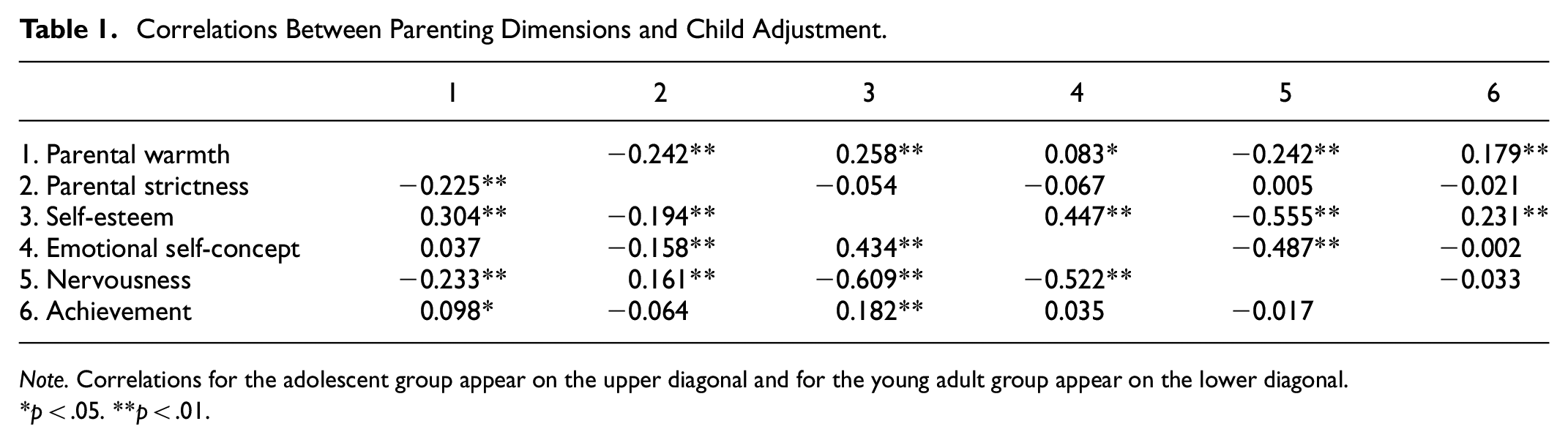
Note. Correlations for the adolescent group appear on the upper diagonal and for the young adult group appear on the lower diagonal.
p < .05. **p < .01.
Predictive Models of Adjustment
Table 2 displays the results from the multiple linear regression analyses. A multiple linear regression model was conducted for each child adjustment criteria (i.e., self-esteem, emotional self-concept, nervousness, and achievement), as a linear function of parenting dimensions (i.e., warmth and strictness), age and sex.
Multiple Linear Regression Coefficients Between Parenting Dimensions, Age and Sex and Child Adjustment.

p < .05. **p < .01. ***p < .001.
Overall, the results of the linear multiple regression analysis were in line with those obtained in the correlation analysis. Parental warmth was a predictor of child adjustment in the four models (p < .05), whereas parental strictness showed no relationship with child adjustment (p > .05) or was identified as a significant predictor (p < .05), but in a different direction than parental warmth.
Regarding the prediction of child adjustment based on the two parental dimensions, the following results stand out. First of all, parental warmth significantly (p < .05) and positively predicted self-esteem and emotional self-concept. However, the opposite occurs with parental strictness, self-esteem and emotional self-concept were significantly (p < .05) and negatively predicted by parental strictness. On the one hand, higher scores on parental warmth positively predicts self-esteem and emotional self-concept in the child. On the other hand, higher scores on parental strictness are associated with low self-esteem and emotional self-concept. Second, nervousness was negatively predicted by parental warmth (p < .05) while parental strictness did not predict this child adjustment criteria (p > .05). Only higher scores on parental warmth were associated with low child nervousness. Finally, achievement was significantly (p < .05) and positively predicted by parental warmth, but parental strictness did not reach a level of statistical significance (p > .05). Higher scores on parental warmth were related to a higher level of child achievement.
Although it was not the main objective of this study, the following results stand out for the prediction of child adjustment based on age and sex. Age of the child was a significant (p < .05) positive predictor of self-esteem and emotional self-concept, but not a significant predictor of nervousness and achievement (p > .05). The older the child, the higher the self-esteem and emotional self-concept (p < .05). It can be observed that self-esteem and emotional self-concept were higher in young adults than in adolescents. Sex of the child was only a significant predictor for self-esteem, emotional self-concept, and nervousness (p < .05). It can be observed that self-esteem and emotional self-concept were higher in male individuals than in female individuals while the contrary occurs for nervousness, female individuals scored higher than male individuals.
Discussion
The present study analyzed the relationship between the two main dimensions of parental socialization (warmth and strictness) and child adjustment through emotional self-concept, self-esteem, nervousness, and internalization of achievement values. The study examined whether the relationship between adjustment in young adulthood and both parental warmth and strictness follows a similar or different pattern to that observed in adolescence. It also sought to test whether parental warmth and strictness are predictors of child adjustment. The association between parental socialization and child adjustment for both adolescent and young adult children showed a theoretically consistent pattern, similar but not identical. The family may have a beneficial, but also a detrimental contribution. Parental warmth might be a positive contribution to child adjustment, but parental strictness might not be necessary or may even be detrimental.
Age-group specific analyses revealed a similar pattern in the association between parental dimensions and child adjustment. In adolescents, higher levels of parental warmth were related to higher emotional self-concept, self-esteem, and achievement, as well as lower nervousness. The same was also observed in young adults, higher parental warmth during socialization years was associated with higher self-esteem and achievement, but lower nervousness. On the opposite side, strictness showed no relationship with adjustment indicators in adolescents. In young adults, greater strictness during the years of socialization was related to lower emotional self-concept and self-esteem, and higher nervousness.
The results of the regression analysis showed warmth to be a predictor in the four predictive models, with parental strictness either not predicting adjustment or predicting it in the opposite direction. Regarding parental warmth, the predictive models revealed that the greater the parental warmth, the more likely the children were to report higher emotional self-concept, self-esteem, and performance, but lower nervousness. By contrast, strictness was not a significant predictor in two of the models (nervousness and achievement), and when it was a significant predictor, it was in the opposite direction. Interestingly, the results showed that when parents are more strict, their children are expected to have lower emotional self-concept and self-esteem.
The present study was conducted in a European country (i.e., Spain) and the findings provide new and relevant evidence on parental contribution to child adjustment (Calafat et al., 2014; García & Gracia, 2009; Martinez et al., 2020; Perez-Gramaje et al., 2019; Riquelme et al., 2018). By contrast, the findings of the present study seriously question some evidence from studies with European-American families that suggest the benefits of high warmth in combination with high strictness (Baumrind, 1967, 1971; Darling & Steinberg, 1993). Specifically, the present findings are in accordance with those with European-American families which highlight the association between parental warmth and optimal child scores, but are contrary in terms of the benefits of parental strictness (e.g., obligation for children to do things as parents say, strict parental habits, use of behavioral punishment) (Darling & Steinberg, 1993; Lamborn et al., 1991; Steinberg et al., 1994). According to classical studies with European-American families, parental strictness combined with warmth (authoritative style), identified as positive parenting, would be related to greater adjustment (Darling & Steinberg, 1993; Lamborn et al., 1991; Steinberg et al., 1994), but the findings of the present study do not coincide with this on the strictness dimension. The present findings suggest that only higher warmth and lower strictness helps children reach maximum levels of adjustment in terms of developing a good image of their general qualities (i.e., self-esteem) as well as their emotional and self-regulation abilities (emotional self-concept). Similarly, in terms of protection against nervousness and achievement value orientation, parental warmth is also beneficial regardless of parental strictness.
The present study follows the two-dimensional theoretical model (warmth and strictness), which is widely used in research around the world to identify positive parenting behaviors for child adjustment. In addition, the criteria used in the present study (i.e., self-esteem, emotional self-concept, nervousness, and achievement) are in line with other frequently used measurements in previous parenting research, including self-perceptions (Barber et al., 1992; Lamborn et al., 1991), emotional regulation (Steinberg et al., 1994), or priority toward social values (Martínez & García, 2007). However, according to the present findings, the optimal parenting strategy seems to be different from that found in previous research conducted with mainly European-American families (Darling & Steinberg, 1993; Lamborn et al., 1991; Steinberg et al., 1994), although the results agree with other recent studies conducted in Europe and South America (Calafat et al., 2014; Garcia et al., 2019; Martinez et al., 2020). Variation in the optimal parenting style could be due to the cultural context in which parenting takes place. Additionally, the present study extends the study of parenting not only to the socialization years but also beyond adolescence. Other studies have also identified that young adult adjustment is related to parenting during the socialization years, although they have not specifically measured the two dimensions (Buri, 1991; Candel, 2022; Waterman & Lefkowitz, 2017).
According to the present findings, it is possible that parental warmth provides children with security and confidence in themselves and their abilities. This would allow them to explore the world and face difficulties and problems, while favoring emotional stability as a result of the parental offer of support and security. In addition, parental warmth might also benefit children’s curiosity and interest in the world, developing a high priority toward achievement because they can explore and learn in a safe environment. Parental strictness appears to be unnecessary or may even have high costs for child adjustment in terms of low self-esteem and poor appraisal of one’s own self-regulatory emotional qualities (emotional self-concept). It is possible that the regular use of high levels of strictness may have a detrimental impact on children’s appraisal of themselves as valuable individuals with good qualities. It might also make it difficult for them to develop confidence and security in their emotional self-regulation skills.
On the contrary, some previous research seems to identify parental strictness as being a positive component in parenting because it seems to encourage children’s behavior to be in accordance with social and cultural values (Darling & Steinberg, 1993; Grusec & Goodnow, 1994). According to findings mainly from European-American families, the use of strictness should be accompanied by warmth (authoritative style) so that children not only develop their individuality, but also obey their parents and conform to social norms and values (European-American children of authoritarian parents, who use strictness without warmth, seem to perceive that their family does not love or care about them) (Baumrind, 1971, 1983; Lamborn et al., 1991). In other contexts, the use of strictness could be effective even without warmth. Probably when families live in contexts characterized by less opportunities, violence, and poverty (e.g., African American families). In this context, the use of strictness despite the lack of warmth (i.e., authoritarian style) could provide the safety and security that the neighborhood does not offer (Baumrind, 1996; Deater-Deckard et al., 1996). Moreover, it is possible that in Arab and Asian societies, parental strictness without warmth may not have the detrimental effects identified in studies of Western families (Dwairy et al., 2006; Triandis, 1989). Family is especially valued in collectivist cultures, although parent-child relationships are culturally hierarchical (parents should rule, and children should obey), which could explain why the authoritarian style does not have negative consequences as children may accept the authority of their family over them (Chao, 1994; Ho, 1986).
Likewise, the results of the present study revealed the importance of good adjustment both during the years of parental socialization years (adolescence) and beyond (young adulthood). The results of the correlations between the indicators of adjustment for adolescents and adults studied separately exhibited a common pattern. Thus, adolescents and young adults with high self-esteem had better emotional adjustment in terms of good appraisal of their qualities (emotional self-concept) and low levels of nervousness, as well as high priority for achievement. In turn, higher emotional self-concept was related to lower nervousness in both adolescents and young adults. Priority for achievement was uniquely associated with higher self-esteem.
In the regression models, the effects of age and sex were also tested. It is important to note that age and sex differences in adjustment (self-esteem, emotional self-concept, nervousness, and achievement) are consistent with previous research findings. On the one hand, age was a statistically significant predictor of the emotional self-concept and self-esteem models. Young adulthood seems to be associated with improvements in self-perceptions, both in self-esteem and emotional self-concept. These results seem to confirm that there are age-related differences in adjustment from adolescence to young adulthood (Garcia & Serra, 2019; Orth et al., 2010). Young adults seem to have more emotional resources and confidence in their qualities and abilities (Aquilino, 1997; Fuligni & Pedersen, 2002). On the other hand, sex was a statistically significant predictor in three of the four regression models (except for achievement values). Thus, the results showed that male individuals were predicted to have higher scores on emotional self-concept and self-esteem, as well as lower nervousness. Sex-related differences also seem to be important in explaining the differences in adjustment and competence; the pattern of vulnerability in the studied indicators seems to be more accentuated in women than in men (Garcia & Serra, 2019; Orth et al., 2010).
Some limitations of the present study should be considered. The study uses cross-sectional data, so no time-related causal relationships can be inferred. Future studies should follow children through adolescence and young adulthood to analyze the relationship between parental socialization and adjustment using longitudinal evidence (Aquilino & Supple, 2001). Also, the measure of parental socialization is based on children’s rather than parents’ reports. However, the accuracy of children appears to be more reliable and more closely matched to reality than that of the parents (Barry et al., 2008; García & Gracia, 2009), and the same measures have also been used for adolescent and adult children based on age-invariant measures for adolescents and adults (Ali et al., 2015; Garcia & Serra, 2019). Finally, the methodology of the study is non-experimental, so it is not possible to establish cause-effect relationships between family and child adjustment.
This present work has important implications for families and society. Adolescence can be a period of certain psychosocial vulnerability compared to adulthood, but parents also often have difficulties with their adolescent children (Musitu-Ferrer, Esteban-Ibañez et al., 2019; Steinberg & Morris, 2001). In the transition to adulthood, adolescents should develop autonomy and good self-regulation, which could be favored by warmth as confirmed by the present study (Steinberg & Morris, 2001). Although most parenting interventions encourage not only warmth but also strictness (Sanders et al., 2022), according to the present findings the strictness component may be unnecessary or even detrimental. Once the adolescent reaches legal age, parenting is over (Baumrind, 1978; Maccoby, 1992). Adult children, as adults in society, have to face different psychosocial challenges without the care and protection of their parents (Fuligni & Pedersen, 2002; Lambert et al., 2010; Mañez et al., 2024).
Like adolescents, adult children seem to benefit from parental warmth during the socialization years (Axpe et al., 2023; Ortega et al., 2023). Interestingly, the main findings of this study seem to suggest that parenting strictness is especially detrimental in adult children, when parental socialization is completed (the more parental strictness, the less self-esteem and emotional self-concept, and the more nervousness). However, future research should identify with longitudinal evidence the consequences of parenting on adjustment in adolescence and adulthood, especially to identify whether the effect of one or the other dimension on children’s adjustment changes over time. Finally, it is likely that those parents who applied positive parenting during the socialization years may have not only better adjusted children, but also better relationships with their parents (Fuligni & Pedersen, 2002)., although this last point will need to be measured in future studies with specific measures of parent-child relationships in young adulthood.
Conclusions
The findings of the present investigation suggest that adjustment (in terms of emotional self-concept, self-esteem, nervousness, and achievement priority) exhibits age-related differences in young adulthood compared to adolescence, as well as sex-related differences. However, regression models reveal the key role of the family, both beneficial and detrimental. There is a time when parental socialization is complete and young adults, like their parents, have the same status (both are adults). However, few studies have studied the relationship between adjustment and family socialization in adulthood. The implications of these results are important because they show that family has a significant effect (whether beneficial or detrimental) not only during the socialization years but also beyond adolescence, when parental socialization is over. Specifically, according to regression analyses, high parental warmth and low strictness are beneficial factors. They predict that children will be more likely to have higher emotional self-concept, self-esteem, and achievement, as well as less nervousness.
Therefore, the findings of the present study seriously question the classical studies conducted with mainly European-American families (Lamborn et al., 1991; Steinberg et al., 1994). These studies suggest that high parental strictness, one of the main components of the so-called optimal or positive parenting (i.e., authoritative style, characterized by high warmth and high strictness) is always beneficial when it comes to child adjustment. In addition, the cultural context in which parents raise their children seems to be important because the consequences of the parental dimensions on child adjustment may not always be the same (Garcia et al., 2019; Pinquart & Kauser, 2018). Thus, the results of the present study confirm findings from a growing body of recent studies, mainly in European and Latin American countries (Calafat et al., 2014; Martinez et al., 2020). According to these studies, the results show significant benefits for adjustment only when there is high parental warmth and low strictness.
Footnotes
Declaration of Conflicting Interests
The author(s) declared no potential conflicts of interest with respect to the research, authorship, and/or publication of this article.
Funding
The author(s) disclosed receipt of the following financial support for the research, authorship, and/or publication of this article: The research reported in this study has been supported by grant CIAICO/2021/252 (Conselleria for Innovation, Universities, Science and Digital Society, Generalitat Valenciana), which provided the support for open-access publication fees. Additionally, it has been partially supported by grants FPU20/06307 (Ministry of Universities, Government of Spain), and ACIF/2016/431 and BEFPI/2017/058, which provided funding for a research stay at Nottingham Trent University, United Kingdom (Generalitat Valenciana and European Social Fund).

Data Availability Statement
The data used in this study are available from the corresponding author upon reasonable request.