




Abstract
The potential impacts of corporal punishment continue to be debated among scholars and policy makers, yet no clear picture has emerged. This study examined the relationship between parental corporal punishment and psychological adjustment among young adults (n = 271) aged 19 to 25 years at a Malaysian public university. Participants completed measures of the ADULT PPQ: Physical Punishment Questionnaire and the ADULT PAQ: Personality Assessment Questionnaire. The findings revealed that parental corporal punishment is a prevalent phenomenon in Malaysia. All parental punishment variables, that is, harshness, justness, and forms of punishment, correlate significantly with the psychological adjustment. The study also showed that perceived parental harshness and maternal justness were found to be the strongest predictors of one’s psychological adjustment for each parent. Paternal and maternal punishment, however, do not differ significantly in predicting young adults’ psychological development. Besides that, the parental prediction model only accounted for 13% to 15% of the variance in psychological adjustment, suggesting that not every child perceived corporal punishment as parental rejection. The results showed that remembered corporal punishment is associated with greater or lesser psychosocial adjustment, depending on whether that corporal punishment was perceived as harsh or just.
Introduction
It has been debated for a long time on whether corporal punishment on children should be allowed or banned. With the awakening of various worldwide movements defending the rights of children, any form of violence in disciplining children is regarded as a violation of children’s fundamental rights to human dignity. The United Nations Convention on the Rights of the Child (2007) has emphasized the elimination of all corporal punishment, however light, as well as all other cruel or degrading punishments. However, corporal punishment is still prevalent worldwide (Durrant & Ensom, 2012). Corporal punishment, as stated by Straus and Donnelly (2009), is a practice to correct children’s behaviors by imposing physical force to cause pain, but not injure. Although the intention of corporal punishment is not to injure a misbehaving child, caregivers tend to increase the harshness of corporal punishment as the effects of corporal punishment decreases over time (Save the Children, 2005). In some cases, this has led to child abuse (Zolotor, Theodore, Chang, Berkoff, & Runyan, 2008).
Parents play an important role in children’s psychological development, and this has gained attention in literature. According to the interpersonal acceptance-rejection theory (IPARTheory; or formerly referred to as the PARTheory), as advocated by Rohner, Khaleque, and Cournoyer (2008a), children need parental love and their perception of parental warmth (or acceptance) is positively associated with their psychological adjustment. In contrast, children who withdraw from warm parenting would feel rejected by caregivers. Rohner et al. (2008a) categorized parental rejection behavior into four expressions—(a) cold and unaffectionate (e.g., lack of parental affection), (b) hostile and aggressive (e.g., pinch and hit), (c) indifference and neglecting (e.g., pay no attention to children), and (d) undifferentiated rejection (e.g., children feel unloved). Based on these statements, if children repeatedly receive corporal punishment, they might perceive the punishment, especially the harsher punishments, as parental rejection. Thus, punished children may regard themselves as rejected that could result in psychological maladjustment. Psychological maladjustment in this sense refers to aggressive behavior, low self-esteem, being dependent, negative self-adequacy, emotional unresponsiveness, emotional instability, and negative worldview.
Previous research yield mixed findings on the impacts of corporal punishment. Some researchers reported a clear link between corporal punishment and poor psychological outcomes (duRivage et al., 2015; Justicia, Benitez, Pichardo, Fernandez, & Fernandez, 2006; Ministry of Women, Family and Community Development & United Nations Development Programme [MWFCD & UNDP], 2014; Ohene, Ireland, McNeely, & Borowsky, 2006; Straus & Donnelly, 2009). For example, internalizing and externalizing problems (Chen & Liu, 2011), and suppressed cognitive development (Talwar, Carlson, & Lee, 2011). Furthermore, there is accumulating evidence that the detrimental psychological effects of corporal punishment continue into adulthood (Ali, Khaleque, & Rohner, 2015; Smith, Lindsey, & Hansen, 2006; Spencer, 1999). On the contrary, Ferguson (2013) found that corporal punishment, in particular spanking, has only trivial effects on psychological outcomes. A more recent research conducted by Gershoff and Grogan-Kaylor (2016) found that spanking brings the same detrimental effect as physical abuse on child development. As there is little evidence supporting the benefits of corporal punishment, it was therefore hypothesized that there is a significant and positive relationship between parental corporal punishment and psychological maladjustment among young adults.
The current study was conducted to contribute to this field of study. First, although mounting evidence suggests that rejected children tend to end up with severe psychological maladjustment (Khaleque, 2013; Khaleque & Rohner, 2013; Miranda, Affuso, Esposito, & Bacchini, 2016), IPARTheory does not specifically state the relationship in perception between parental warmth and psychological adjustment (Yoo & Miller, 2011). In addition, results from related studies remain inconsistent (Cournoyer, Sethi, & Cordero, 2005; Yoo & Miller, 2011). Considering this, the current research can be viewed as an attempt to illustrate the relationships between parental punishment variables and children’s psychological adjustment to add empirical evidence to the literature.
Second, although given the prevalence and adverse impacts of corporal punishment, relevant studies were predominantly done in Western countries. Hence, relatively little is known about the local context—Malaysia, a plural society. The current study detailed the corporal punishment scenario in Malaysia and attempted to explore to what extent corporal punishment is associated with psychological maladjustment among young adults. The current research, to this point, will be a significant endeavor to fill the research gap.
Corporal punishment has been found to be a favorable technique to manage children’s behaviors, including but not limited to Malaysia (Kumaraswamy & Othman, 2011; Lansford & Deater-Deckard, 2012). The current findings were anticipated to provide some insights into the associations between the use of corporal punishment and children’s psychological development over their life. Children are regarded as the pillars of a nation. If children are at risk of potential harmful effects due to corporal punishment, it may cause destructive impacts on national development and reduce the possibility of achieving desired milestones. Therefore, this study will be helpful in exposing and educating parents and caregivers on the residue outcomes of corporal punishment.
Method
Participants
The sample consisted of 324 young adults studying at a Malaysian public university. Of the participants, 169 (52.2%) were males while 155 (47.8%) were females. The age of the participants ranged from 19 to 25 years with an average age of 21.64 (SD = 1.739). As for ethnic composition, 206 (63.6%) were Malays, 101 (31.2%) were Chinese, 14 (4.3%) were Indians, and three (0.9%) were Sabahans or Sarawakians.
Study Design
This study is a quantitative research using survey research design. Two sets of self-reports were used to collect data on participants’ corporal punishment experience during childhood and their current psychological adjustment status. The rationales of using self-reports are that self-report surveys—pencil-and-paper questionnaires in particular—allow participants to think and answer the items in the questionnaire at their own convenience, and enable researchers to compare collected data between groups easily (Muijs, 2004). The original questionnaires were translated into Malay language. The original and translated questionnaires have been validated to ensure conceptual equivalence by experts in the field. Participants could choose to either respond in the original or translated questionnaires based on their preference. Data were then quantified and statistically analyzed to examine the relationship between the measured variables.
Instruments
ADULT Physical Punishment Questionnaire (ADULT PPQ): Father and Mother
The ADULT PPQ: Father and Mother (Rohner, Ripoll-Nunez, Moodie, & Ruan, 2008b) was used to capture past experience on corporal punishment. The questionnaire contains 27 items to measure the various perspectives of corporal punishment for each parent, including frequency (e.g., overall, my father/mother punished me “only once or twice/not often/occasionally/fairly often/very often”), severity (e.g., overall, when my father/mother punished me it was “not hard at all/not very hard/a little hard/very hard”), consistency (e.g., my father/mother punished me on one occasion for doing something wrong, but he/she didn’t punish me on other occasions for doing the same thing), predictability (e.g., when I misbehaved, I never knew from one time to the next if my father/mother would punish me), numbers of incidents per week (e.g., on the average, my father punished me ___ times in any given week when I was a child), fairness (e.g., as a general rule, I felt it was “very unfair/a little unfair/a little fair/very fair” when my father/mother punished me), deservedness (e.g., as a general rule, I felt I “almost never/sometimes/often/almost often” deserved it when my father/mother punished me), the use of explanation (e.g., before punishing me, my father/mother explained what I did was wrong and why it was wrong), and forms of punishment (e.g., he or she spanked me on my bottom with an open hand). Apart from that, two additional composite scales—harshness (by adding up frequency and severity) and justness of punishment (by adding up fairness and deservedness)—were derived from the data. In this study, the translated questionnaires have fair test–retest reliability, that is, ranging from 0.72 to 0.85 for each subscale.
ADULT PAQ: Personality Assessment Questionnaire
This study used the ADULT PAQ (Rohner & Khaleque, 2008) to access participants’ overall psychological adjustment based on seven personality dispositions—hostility and aggression (e.g., I feel resentment against people), dependency (e.g., I like to be given encouragement when I have failed), negative self-esteem (e.g., I get disgusted with myself), negative self-adequacy (e.g., I think I am a failure), emotional unresponsiveness (e.g., I have trouble expressing my true feelings), emotional instability (e.g., I get upset when things go wrong), and negative worldview (e.g., life for me is a good thing). The psychological adjustment index is produced by summing up scores on the seven personality dispositions. A higher psychological adjustment score denotes a poor overall psychological adjustment.
This self-report questionnaire consists of 63 items with a 4-point Likert-type scale ranging from almost never true to almost always true. Participants responded to the items according to the degree to which the statements describe themselves. The Cronbach’s alphas for each personality disposition ranged from .75 to .91 in the current study.
Statistical Analysis
Data analysis was mainly carried out with SPSS software (Version 18). Below are details of the statistical analysis methods:
I. Descriptive statistics (e.g., frequency and percentage) were computed to summarize participants’ responses to their corporal punishment experienced during childhood and current psychological adjustment.
II. Comparisons between groups were made by independent t test. A p value <.05 was taken to indicate a significant statistical difference.
III. Pearson correlations were used to indicate the relationships emerging from parental punishment variables and participants’ psychological adjustment index.
IV. The Fisher r-to-z transformation was used to test whether paternal and maternal punishment variables differ significantly in relation to children’s psychological development.
V. Standard multiple regressions were performed to examine whether parental punishment variables have any effects on participants’ psychological adjustment.
Results
The Results of Schema Relating to Corporal Punishment
The basic information on corporal punishment
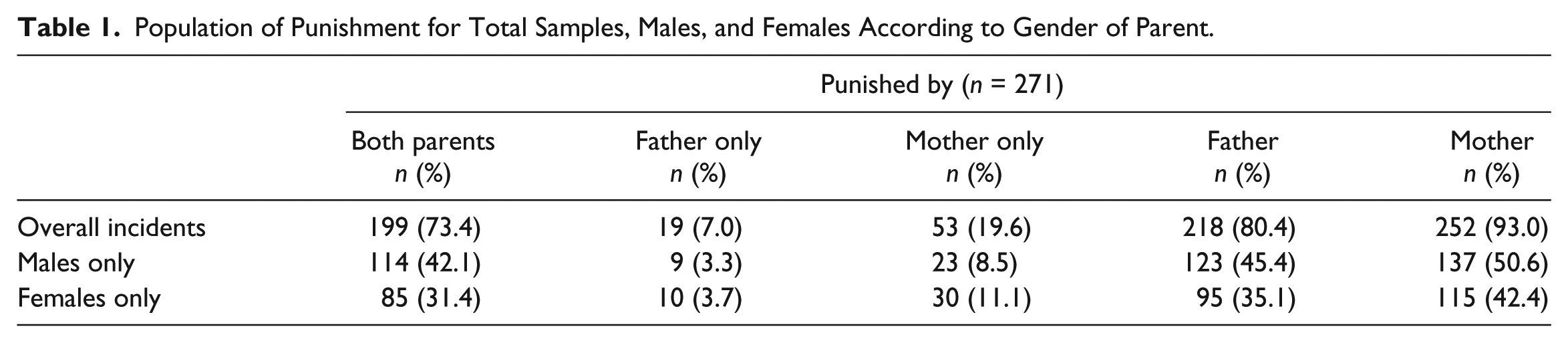
Out of the 324 participants, 271 participants (83.6%) had experienced corporal punishment during childhood. As shown in Table 1, of this corporally punished population, 199 participants (73.4%) received corporal punishment from both parents. Mothers were also more likely to punish children than fathers (93.0% of incidents compared with 80.4%).
Population of Punishment for Total Samples, Males, and Females According to Gender of Parent.
According to Table 2, more than half of participants perceived their parents (father = 61.1%; mother = 61.5%) as somewhat consistent in conducting punishment for their wrongdoings. Besides, participants did not have much difficulty in predicting parental punishment (father = 56.9%; mother = 60.7%) if they did something wrong.
Summary Statistics of the Reported Consistency, Predictability, Incidents per Week, Timing, and Use of Explanation Before Punishment According to Gender of Parent.

On the contrary, an overwhelming majority of participants (92.6% for paternal punishment; 94.0% for maternal punishment) received punishment no more than 2 times in any given week. Overall, participants received punishment at a very low rate (0.64 incidents for father; 0.62 incidents for mother).
For timing, a large portion of the participants claimed that their parents (81.7% for father; 80.6% for mother) punished them on the spot or after a short while. Only 6.0% of fathers and 7.9% of mothers punished their misbehaved children after a very long time (e.g., after a few days).
The results on the use of explanation before punishment were mixed. Excluding around one tenth of parents who reportedly almost never gave a reason for conducting punishment, the percentage of parents who “sometimes,” “often,” and “almost always” gave reasons does not have an obvious deviation.
Table 2 further reveals that parents did not significantly differ on consistency, predictability, number of incidents per week, timing, and the use of explanation before punishment.
The harshness, justness, and sum of punishment
Two perspectives of punishment are worth noting from Table 3. First, the harshness of punishment was evaluated based on frequency and severity. Most of the participants received parental punishment infrequently during childhood (father = 89.0%; mother = 88.9%, when “only once or twice,” “not often,” and “occasionally” were aggregated). Regarding severity, a greater part of the participants judged parental punishment (father = 50.4%; mother = 63.5%) as “not hard at all” and “not very hard.” In general, participants judged that paternal punishment (M = 4.66; SD = 1.628) was harder than maternal punishment (M = 4.49; SD = 1.674). Nonetheless, the perceived harshness did not differ between father and mother, t(468) = 1.098, p = .273.
Summary Statistics of Reported Frequency, Severity, Harshness, Fairness, Deservedness, and Justness of Punishment According to Gender of Parent.

Second, the justness of punishment was computed by summing up fairness and deservedness. Regarding the fairness of punishment, more than 60% of the participants perceived that the punishments given by their parents were quite impartial (father = 63.3%; mother = 68.2% after combining “very fair” and “a little fair”). Conversely, less than 10% of them judged the punishments as very unfair. Notwithstanding that most of the participants judged the parental punishment as fair; concerning deservedness of physical punishment, more than half of them thought that they were not deserving of being punished by their parents (father = 57.8%; mother = 54.7%). On the contrary, approximately 20% of participants thought that they were almost always deserving of the punishment endorsed by their parents. Interestingly, participants were more likely to perceive maternal punishment (M = 5.54, SD = 1.702) as fairer than paternal punishment (M = 5.36, SD = 1.633). Nonetheless, the justness of punishment was not significantly different between parents, t(468) = −1.122, p = .262.
The forms of reported corporal punishment
The forms and sums of punishment that attracted the attention of the current study are illustrated in Table 4. The findings indicate that fathers and mothers differed in forms of punishment. “Hit” (49.5%) and “ear twisting” (63.9%) were the most reported forms of punishment for fathers and mothers, respectively. The findings further indicate that mothers (M = 3.74, SD = 2.433) practiced a greater variety of forms of punishment than fathers (M = 3.46, SD = 2.507). However, they did not differ in term of forms of punishment, t(468) = −1.221, p = .223.
Summary Statistics of Reported Forms and Sum of Punishment.

Overall Psychological Adjustment
The psychological adjustment index was calculated by summing up the seven personality dispositions, that is, aggression, dependency, negative self-esteem, negative self-adequacy, emotional unresponsiveness, emotional instability, and negative worldview. Table 5 depicts the results.
Summary Statistics of Psychological Adjustment Index.
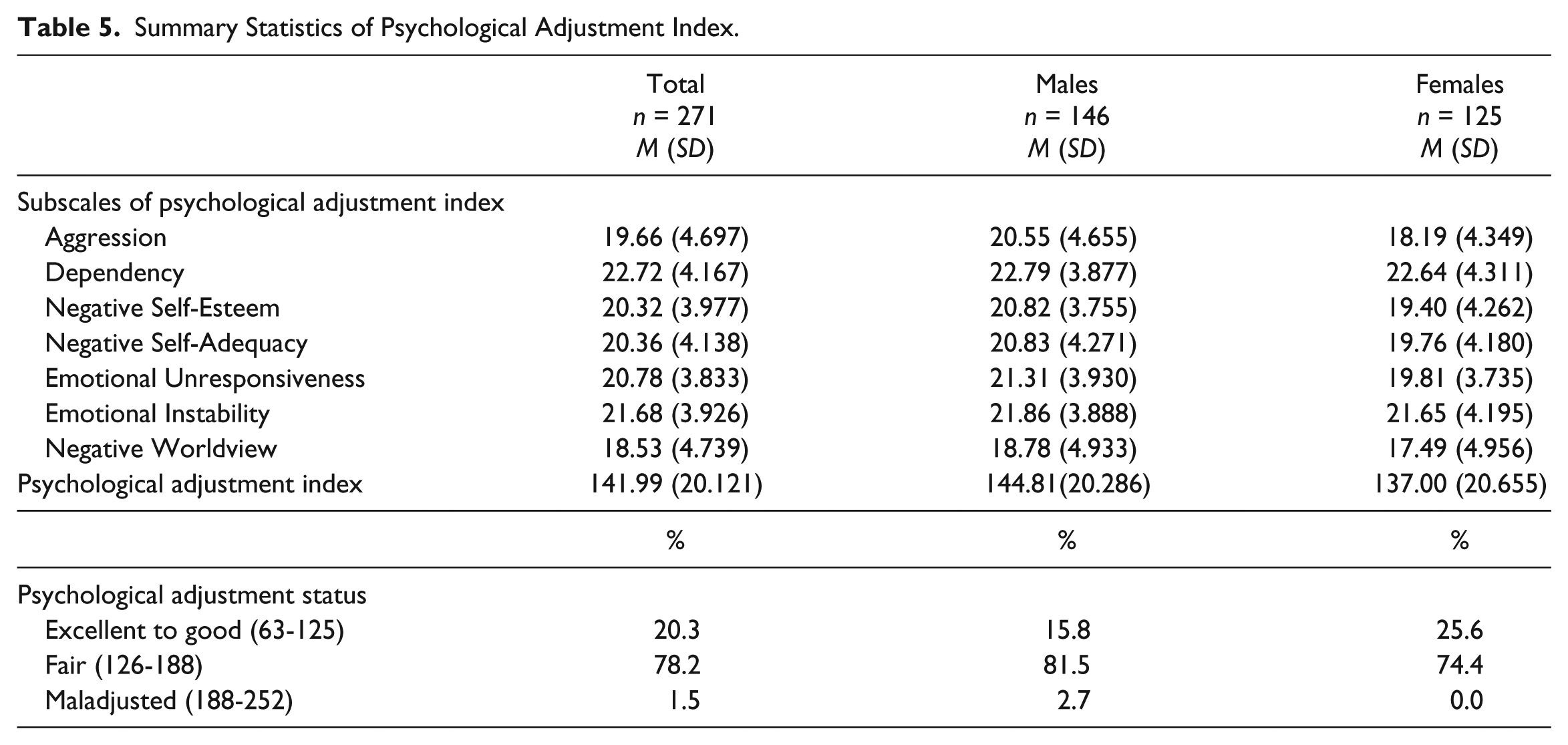
According to Rohner and Khaleque (2008), each personality disposition has a midpoint score of 22.5 and participants who score at or higher than the midpoint score indicate more overall maladjustment. All participants, as shown in Table 5, were well-adjusted across the seven personality dispositions, except for dependency. Participants, regardless of gender, were found to be more maladjusted in dependency (males, M = 22.79, SD = 3.877; females, M = 22.64, SD = 4.311). That is, participants appeared to have stronger internal wishes to obtain emotional care from their significant others.
The overall psychological adjustment scores for participants equaled to 141.99, indicating participants were psychologically well-adjusted as this is lower than the midpoint score of 157.5. The computed psychological adjustment index was further analyzed qualitatively into three categories (modified from Mathurin, Gielen, & Lancaster, 2006). Although participants were punished during childhood, all female participants and 97.3% of male participants were found to be fair or excellent in their psychological adjustment.
Gender made a significant impact on young adults’ psychological adjustment. Males (M = 144.81, SD = 20.286) scored significantly higher than females (M = 137.00, SD = 20.655) on psychological adjustment index, t(269) = 3.132, p = .002. Furthermore, it was found that males scored higher than females in all personality dispositions. That is, males tend to be more maladjusted than females.
Relationships Between Parental Punishment and Psychological Adjustment
Correlations among parental punishment variables and the psychological adjustment index are presented in Table 6. Overall, parental harshness and maternal justness were significantly related to the seven subscales of psychological adjustment as well as the total score to all subscales of psychological adjustment index, in spite of the fact that the emerged relationships were weak.
Correlation Matrix of the Parental Punishment and Psychological Adjustment.

Correlation is significant at the .05 level (two-tailed). **Correlation is significant at the .01 level (two-tailed).
The results further reveal that parental harshness and sum of reported forms were positively and significantly correlated to the overall psychological adjustment index. In other words, participants who received more forms of or more intense punishment are prone to have poor psychological adjustment. Besides that, parental justness was significantly and negatively associated with the psychological adjustment index, indicating that the fairer the punishment, the healthier the psychological adjustment.
On the scale of comparison, paternal harshness exerted the strongest influence on participants’ psychological development as compared with other variables, r = .310, n = 218, p < .05. However, maternal justness was found to be the second strongest predictor in predicting overall psychological maladjustment, r = −.287, n = 285, p < .05. When all correlations between parental corporal punishment variables and psychological maladjustment were transformed into z scores using Fisher r-to-z transformation. Fathers and mothers were not significantly different in shaping children’s psychological development (z ranges from –0.117-1.286, p > .05). These results indicate that there is no significant difference between fathers and mothers in influencing children’s psychological adjustment.
Multiple regressions were run to predict participants’ psychological adjustment index from parental harshness, justness, and sum of punishment. As shown in Table 7, the prediction model for paternal punishment was statistically significant, F(3, 214) = 10.386, p < .05. This model explained for approximately 13% of the variance of psychological adjustment index. Only paternal harshness was statistically significant to the prediction in which higher levels of paternal harshness led to significant problems in psychological adjustment.
Standard Multiple Regression Results.

Note. Dependent variable = psychological maladjustment.
Table 7 further shows that maternal punishment variables statistically predict the psychological adjustment index, F(3, 248) = 14.719, p < .05, R2 = .151. A well-adjusted psychological index was predicted by higher levels of maternal justness and lower levels of maternal harshness. Apart from that, maternal justness received the strongest weight in the model, followed by maternal harshness.
Discussion
The findings show that corporal punishment is quite prevalent in Malaysia. This is in complete agreement with Kumaraswamy and Othman’s (2011) results. This might be due to cultural and historical factors. In Malaysia, ancient proverbs stress the importance of disciplining children via punishment—for instance, “Sayangkan anak tangan-tangankan” (Malay proverb) and “不打不成器” (Chinese proverb). Both proverbs translate into “spare the rod and spoil the child.” Malaysian parents primarily believe that they have the right to use corporal punishment and it is accepted by society. In addition, mothers are more likely to use corporal punishment than fathers. This result is consistent with the studies that found mothers having a higher rate of the use of corporal punishment than fathers (Douglas, 2006; Jambunathan & Counselman, 2002). This result also adds new empirical evidence to the research conducted by Lansford et al. (2010), in which the researchers found that mothers in most countries (i.e., China, Colombia, Italy, Jordan, Kenya, the Philippines, and the United States) used corporal punishment more frequently than fathers except Sweden and Thailand. This higher percentage of maternal punishment in Malaysia might be explained by the low involvement of Malaysian women in the labor force (MWFCD & UNDP, 2014) and that mothers bear the primary responsibility for raising children properly.
Overall, more than 60% of the participants judged both their parents as consistent in carrying out punishments. If the participants committed any wrong, most of them could anticipate their punishment. They received the punishments almost immediately with explanations. Punishment may be effective if it is given immediately and tied to the wrong (Lahey, 2012; Larsen, 2010), as well as giving a short and simple explanation (Baumrind, 1996). Alampay et al. (2017), however, found that frequent punishment is closely related to child negative outcomes regardless of how the punishment is delivered. By far and large, Malaysian parents use corporal punishment in the hopes of eliminating an unacceptable behavior promptly and effectively. However, the effectiveness of given explanations in fostering desired behaviors among children remains unknown in the present study.
Regarding the frequency and severity of corporal punishment, a large majority of participants seldom receive punishments while a plurality of them judged the punishment as mild. The former result likewise appears in other studies reporting that American parents rarely endorsed corporal, approximately 9 times per year (Gershoff, 2010; Straus & Donnelly, 2009). The latter result, on the contrary, agrees well with Lansford et al. (2010).
Concerning the harshness of corporal punishment, Kumaraswamy and Othman (2011) reported that most Malaysian parents use mild corporal punishment. This finding supports the current study. Despite the current findings that show a difference percentagewise, there is no distinct gap between the participants who judged the received punishment as harsh or mild. In fact, there is no clear cut between mild and harsh punishment (Berlin et al., 2009). Therefore, caregivers should think twice in using corporal punishment as harsh punishment would incite children to act aggressively toward others, leading to rejection by peers (Lahey, 2012). Weiss, Dodge, Bates, and Pettit (1992) also reported that children who were punished harshly might have trouble in interpreting others’ words and actions as well as misinterpreting the given punishment as an act of hostility that does not exist. Even worse, harsh punishment may lead to a number of personality disorders (Afifi, Mota, Dasiewicz, MacMillan, & Sareen, 2012).
When it comes to justness of punishment, more than 60% of the participants perceived their punishment as being fair. Notwithstanding that more than half of the participants judged that they were not deserving of the punishment, the finding is in line with Mathurin et al. (2006). As mentioned above, most punishments were delivered along with explanations, but the explanations do not seem persuasive enough to help children understand their mistakes. Furthermore, the perceived harshness and justness of punishment did not differ significantly between both parents, supporting the findings of Steely and Rohner (2006).
The gender of parents appears to be a factor resulting in the variability of the reported forms of corporal punishment. “Hitting” and “ear twisting” were the foremost reported form of punishment conducted by fathers and mothers, respectively. These results are consistent with those reported by Straus and Stewart (1999). The researchers found that “hitting” was one of the common modes of physical punishment used to discipline children. “Hitting” in the present study refers to hitting a misbehaving child with an object (e.g., belt) that can be regarded as a harsher punishment. Fathers were more likely than mothers to use harsh punishment. Fathers or rather men are basically more violent than women due to biological factors (Stillman, Maner, & Baumeister, 2010). Besides that, to a certain extent, the forms of punishment vary across cultural settings. For example, most Guyanese mothers reportedly stick to spanking in disciplining children (Roopnarine, Jin, & Krishnakumar, 2014).
The psychological adjustment index was used to evaluate the overall psychological adjustment of the participants. Although they had received corporal punishment during childhood, they are mostly well-adjusted psychologically. This result supports the idea raised in other research that corporal punishment harms psychological well-being only if children perceive the punishment as a form of parental rejection (Rohner, Bourque, & Elordi, 1996). In addition, Mathurin et al. (2006) also stated that the cultural acceptance of the use of corporal punishment leads participants to adjust reasonably well in their psychological dispositions. The correlation analysis, however, shows that corporal punishment was associated with participants’ psychological development. These findings are concurrent with other similar research across cultures (Aucoin, Frick, & Bodin, 2006; Gámez-Guadix, Straus, Carrobles, Muñoz-Rivas, & Almendros, 2010; Steely & Rohner, 2006). The findings also reveal that corporal punishment causes prolonged consequences on the children, even after they become young adults—a finding consistent with Spencer (1999). Thus, feeling rejected by parents and caregivers may lead to unhealthy psychological development (Rohner et al., 2008a; Yoo & Miller, 2011).
The current findings show that parental punishment variables were significantly correlated to young adults’ overall psychological adjustment. Corporal punishment variables, however, differ between parents. In relation to children’s psychological adjustment, paternal harshness and maternal justness appeared to be the strongest predictor for each parent. This distinction occurs perhaps because of the fact that fathers and mothers tend to bring up children in different ways and that the traditionally expected parental roles are different. For example, some researchers claimed that in comparison with mothers, fathers reportedly tend to used more severe punishment methods (Nobes, Smith, Upton, & Heverin, 1999). On the contrary, when severe punishments become a culturally accepted practice, maternal acceptance together with justness, but not harshness, decreases children’s behavioral problems (Roopnarine et al., 2014). Besides that, the parental sum of punishment, although significantly associated with psychological adjustment, fades when combining parental harshness. This finding indicates that the harshness of corporal punishment, or the extent of physical abuse, contributes more significantly to children’s psychological adjustment (Bender et al., 2007; Lansford et al., 2010; Lindert et al., 2014). Apart from that, other forms of corporal punishment are found to have a trivial effect on psychological development, for example, spanking (Ferguson, 2013). These findings highlight that the degree to which corporal punishment predicts psychological adjustment is a function of how a child judges the remembered punishment as harsh or just.
The current findings also demonstrate that parents do not have discriminatory effects in relation to children’s psychological adjustment. In other words, fathers or mothers do not override each other in predicting children’s psychological adjustment. Previous studies, however, yield inconsistent results worldwide. For instance, Nelson and Coyne (2009) reported that fathers exerted a stronger influence than mothers did on children’s psychological development while Doyle, Pecukonis, and Lindsey (2015), in contrast, drew opposite findings. Parents around the world come from culturally different backgrounds. Hence, parents unavoidably have variating effects on their children’s psychological development.
As claimed by Rohner et al. (2008a), 21% of adults’ psychological adjustment can be related to parental acceptance and rejection during childhood. The current findings, however, show that the prediction model for fathers and mothers only explained about 13% to 15% of the variance in psychological adjustment, leaving over 80% of the variance to be explained by other factors. Research conducted by Morris and Gibson (2011) also found that the link between corporal punishment and children’s later development is weak. In reality, parental rejection can occur without corporal punishment at all. As a matter of fact, many other factors also play a role in shaping one’s psychological development, including environmental and biological factors (McCrae et al., 2000; Rohner et al., 2008a).
Although the current research was carefully designed, there were some limitations. First, due to the nature of the cross-sectional study, it is very difficult to make causal inferences in relation to corporal punishment and psychological adjustment. To yield solid causal inferences, a longitudinal study could be carried out. Second, the current study only used self-report measures. A single-method data collection might cause the relationships between variables to be intensified (Jex & Britt, 2014). To mitigate this issue, qualitative data could be included in future research. Third, the research participants only consisted of undergraduates while young adults from other social segmentations have been ignored. Thus, a more representative sample that consists of participants from various social economic backgrounds should be used to better represent the Malaysian community at large. Finally, current researchers, as human beings, may unavoidably interpret data at certain levels of subjectivity. To add objectivity, future research could involve more researchers to provide a broader point of view.
Implications and Conclusion
Implications
Many parents believe that corporal punishment is an effective strategy to correct children’s misbehaviors (Gelles, 2005). For example, when parents use corporal punishment to stop an undesired behavior (at least until the pain subsides), misbehaving children will stop that undesired behavior. However, some parents might not even know the reasons in endorsing punishment and its adverse impacts (Oveisi et al., 2010). In many cases, corporal punishment fails to modify unwanted behaviors. Grogan-Kaylor and Gro (2004) and Straus, Sugarman, and Giles-Sims (1997), for instance, found that corporal punishment did not just fail to stop antisocial behaviors but rather encouraged them later on in life.
On the contrary, the findings from the current study verify that corporal punishment during childhood continues to exert an influence on one’s psychological development later in life. Exposure to higher levels of parental harshness and sum of punishments as well as lower levels of justness puts children at risk of being psychologically maladjusted. Parents should be aware of this. As reported by Oshio, Umeda, and Kawakami (2012), childhood adversity events (e.g., parental maltreatment) bring detrimental effects to adults’ subjective well-being. Thus, the mind-set of using corporal punishment as a method to teach children appropriate behaviors should be abandoned.
Conclusion
This research investigated the residual effects of corporal punishment on young adults’ psychological adjustment. Corporal punishment, as the findings suggest, is a frequent parenting practice in Malaysia. Childhood corporal punishment, in the current study, has been shown to have effects on children’s psychological development. The extent of psychological adjustment has relevance to the degree of the harshness, justness, and sum of punishment. Of these variables, paternal harshness and maternal justness were the strongest predictors of offspring’s psychological adjustment. That is, the association between remembered corporal punishment and current psychological adjustment differed depending on the subjective evaluation of whether the punishment was harsh or just. The current findings also reveal that fathers and mothers are equally important in affecting children’s psychological development.
Footnotes
Authors’ Note
Present study is a survey research which aimed to provide empirical evidence of the relationships between parental corporal punishment and offspring psychological adjustment. The current study is a noninvasive study. This study also does not deal with medical research and vulnerable groups. Furthermore, the sample consisted of undergraduates who have reached the age of maturity, that is, aged 18 years and older. All procedures performed involving human participants and research paradigms have been approved by the governing institution. To conduct the research ethically, the current researchers were required to ensure that all participants in this study were voluntary and will remain anonymous. All collected information was treated as confidential, and no sensitive data were collected. All given questionnaires did not contain identifying information. Each individual set of questionnaires was identified by numbers.
Informed Consent
To ensure participants could remain anonymous throughout the study, the researchers did not collect any identifying information, including signed informed consent forms from the participants. Instead, consent from participants was implied with the completion and submission of the questionnaires.
Declaration of Conflicting Interests
The author(s) declared no potential conflicts of interest with respect to the research, authorship, and/or publication of this article.
Funding
The author(s) received no financial support for the research, authorship, and/or publication of this article.