




Abstract
This study investigated how marital power influence adolescents’ social adjustment in China, based on a sample of 759 middle school students. While prior research has largely focused on marital relationships and co-parenting, few studies have examined adolescent adjustment through the lens of marital power. Using latent profile analysis in Mplus, four marital power types were identified: shared power, contested power, wife-dominant, and husband-dominant. Shared-power families represented the largest proportion and reported the highest levels of couple satisfaction with power distribution. Different marital power structures were significantly associated with distinct adolescent social adjustment outcomes. Adolescents from shared-power families exhibited significantly higher levels of self, interpersonal, behavioral, and environmental adjustment compared to those from the other three family types. They also demonstrated better functional outcomes, characterized by higher positive adjustment and lower negative adjustment levels, particularly in contrast to adolescents from contested-power and husband-dominant families. Notably, contested-power families were associated with the poorest adjustment across all domains. To further investigate the underlying mechanisms, mediation analyses showed that perceived marital power—by both husbands and wives—positively predicted adolescents’ positive adjustment and negatively predicted maladjustment. Furthermore, parental co-parenting quality emerged as a statistically significant partial mediator, suggesting that marital power influences adolescent adjustment in part by fostering more unified parenting practices, which in turn enhance adolescent social adjustment.
Introduction
The famous psychologist Adler stated, “The tendency to chase power is already present in infancy, and through power, individuals gain influence over their environment and others.” Power is the primary influence in all social relationships, including marriage. Marital power relationships reflect resource inadequacies and decision-making freedom between spouses and interactions in negotiating solutions and conflicts (Zheng & He, 2008). Therefore, power continually influences individuals’ cognitive, emotional, and behavioral paradigms (Keltner et al., 2003). The more power one has in a relationship, the more influence one exerts on other members. In the case of the family’s treatment of children, power distribution between spouses impacts various aspects of children’s personality development and academic achievement (Cox & Paley, 2003).
Marital power is a key component of family relationships, which constitute a critical context for adolescent development (Cox & Paley, 2003). Social adjustment refers to the degree to which an individual attains the expected developmental goals in the process of interacting with the environment (Cavell, 1990). Adolescence is a critical transition period marked by rapid physical and psychological changes as individuals move from immaturity to maturity (Zou et al., 2015). The dual pressures of social change and personal development often lead to difficulties in both physical and psychosocial adjustment among adolescents (Lamblin et al., 2017). Therefore, exploring the factors influencing adolescents’ social adjustment from the perspective of marital power relationships is crucial to their development.
Most existing research on the adolescents’ social adjustment primarily focuses on the perspectives of marital relationships and parenting styles (Pedro et al., 2012). However, few studies have been published on the development of adolescents’ social adjustment to marital power, especially on how marital power affects children’s social adjustment. The family of origin plays a crucial role in shaping adolescents’ values, cognition, and behavior (O'Leary et al., 1996), and power distribution between spouses serves as the origin point of marital power relationships (Keltner et al., 2003). Through the fulfillment of marital power, family resources are allocated, control is implemented, and parenting goals are achieved. Therefore, as a fundamental factor shaping the family environment, exploring the relationship between marital power and adolescents’ social adjustment helps to uncover the mechanisms underlying adolescents’ psychological development and behavior.
Furthermore, current research on marital power mainly explores the factors influencing marital power, with fewer studies focusing on the outcomes of marital power. Most studies on the effects of marital power are concentrated on the impact on spouses’ physical and mental health, while the influence on child education has been overlooked. Current research has not reached a consensus on measuring marital power, with debates focused on static versus dynamic and objective versus subjective measurements. On the one hand, most existing literature focuses on the static outcomes of marital power, equating power with decision-making, emphasizing that an increase in one party’s power inevitably leads to a decrease in the other party’s power (Safilios-Rothschild, 1970). This measurement method ignores the dynamic nature of power (Bogue et al., 2008). It fails to reflect the power flow in marital relationships, which does not account for the ongoing conflict, management, and negotiation process between spouses. On the other hand, power has both an “objective” level of actual family power and a “subjective” level of psychological experiences of power (Anderson & Berdahl, 2002). Whether husbands and wives have power positions in marital decision-making that align with their expectations is vital. Therefore, the measurement of marital power should also consider the perceived power levels experienced by individuals.
Based on this, the contributions of this paper are as follows: First, this study expands the research on marital power in the context of China by measuring marital power from two perspectives—“subjective” marital power perceptions and “objective” family power distribution. This categorizes Chinese marital relationships into different types, allowing for a more in-depth and detailed explanation of the formation logic of marital power relations. Second, the study extends research on the effects of marital power, focusing on its influence on adolescents’ social adjustment, providing a new perspective on adolescent development. On the one hand, the study compares adolescents’ social adjustment in families with different types of marital power; on the other hand, it directly tests the impact of husbands’ or wives’ perceptions of power on adolescents’ social adjustment, thereby more comprehensively revealing the influence of marital power relationship on adolescents’ social adjustment development. Finally, the study constructs a model of the influence of marital power and co-parenting on adolescents’ social adjustment, revealing the internal mechanisms affecting adolescent social adjustment (Figure 1).

Theoretical framework.
Literature Review
Marital Power
Marital power was initially defined as the ability of each spouse to influence the other according to their preferences in important family matters (Mirowsky, 1985). The measurement of marital power has long been a subject of debate. Based on the theories of “multiple indicator synthesis” and “major family decisions,” researchers have equated power with decision-making, typically measuring marital power through the outcomes of family decisions. Most scholars adopt a multidimensional and relative approach to measuring power, combining decision-making authority over daily household affairs, the division of household labor, and significant family matters as separate variables. The sum of these multidimensional indicators is then used to measure marital power (A. Q. Xu, 2004; Y. Zhang, 1994). This measurement method conceptualizes marital power as a competitive “zero-sum game,” where the increase in power of one spouse inevitably leads to the decrease in power of the other. It overlooks the dynamics and cooperative nature of marital power relationships.
Bogue et al. (2008) argued that marital power should be examined from the perspective of dynamic power processes, emphasizing the complexity and cooperation in spousal interactions rather than framing them as simple win-lose confrontations. They pointed out that marital power is not only reflected in static decision-making outcomes but is also formed through long-term interaction and negotiation, reflecting the dynamic adjustment of power relationships. Therefore, they developed a marital power scale that integrates both static outcomes and dynamic power processes, and the reliability of this scale has been verified in several studies (Leonhardt et al., 2020; Oka et al., 2016). However, in China, only Chen incorporated the degree of communication about mutual annoyances and the frequency of disagreements over money into an analysis of power processes (Chen, 2010), while most studies still rely on traditional static measurement methods.
Furthermore, marital power includes both an “objective” level of substantive household power and a “subjective” level of psychological perceived power (Anderson & Berdahl, 2002). Existing studies primarily rely on objective “relative power” indicators, focusing on the actual distribution of household power, and tend to overlook the subjective perceptions of power within the family. Even when the objective power distribution is unequal, both spouses often justify and legitimize the structure, perceiving themselves as having higher levels of power within the marriage. Therefore, relying solely on objective indicators has limitations, as it overlooks the role of subjective perceptions of power. A comprehensive analysis of marital power should integrate both objective and subjective dimensions.
Adolescent Social Adjustment
Social adjustment is a dynamic process in which individuals adapt to or change the environment to achieve a harmonious state. It is also a comprehensive reflection of psychological and social coordination within social life (Zou et al., 2015). Scholars have held different views on how to assess social adjustment. In the past, much of the research on social adjustment focused primarily on the negative aspects of adolescent adjustment, such as emotional adjustment (Schultz et al., 2000) and aggressive behaviors (Kawabata et al., 2011), with less emphasis on the positive aspects. Focusing solely on negative adaptive functions can lead to an incomplete assessment of adolescents’ adjustment levels. Zou et al. proposed a “domain-functional” theoretical model for assessing the social adjustment levels of secondary school students, which highlights self-adjustment, behavioral adjustment, interpersonal adjustment, and environmental adjustment as key developmental domains throughout adolescence (Zou et al., 2012). These four domains are distinct, meaning that individuals who show positive adjustment in one domain may show negative adjustment in another. Additionally, the mutual independence between positive and negative adjustment functions (Cowen, 1994) indicates that a decrease in negative adaptive behavior does not necessarily lead to an increase in positive adaptive behavior (Rhule et al., 2006; Schmukle et al., 2002). However, existing research has seldom explored in detail how family factors specifically affect the development of positive and negative functions in different domains of adolescent adjustment. Based on the “domain-functional” structural model of social adjustment developed by Zou et al. (2012), this study systematically analyzes how family factors influence adolescents’ social adjustment across the four domains of self, interpersonal, behavioral, and environmental adjustment, as well as the positive and negative adaptive functions in each domain.
Family Factors and Adolescent Development
Currently, research on family factors and child development primarily focuses on the impact of family interactions, parental roles, and co-parenting behaviors on the social and emotional development of children and adolescents. Zhao (2024) explored the direct effect of parental involvement on the behavioral development of Chinese adolescents and found that active parental participation in behavior, emotions, and education significantly promotes adolescents’ persistence in learning, expression abilities, and knowledge absorption. Shimotomai (2020) analyzed the changes in Japanese adolescents’ perceptions of parental social power and its impact on attachment relationships. The results indicated that similarity in perceived parental power helps promote the development of a higher level of secure attachment in adolescents. Qian et al. (2020), in their research from the father’s perspective, examined the effect of co-parenting relationships on children’s emotional regulation. The study revealed that co-parenting relationships indirectly predict children’s emotional regulation through family functioning, with marital satisfaction serving as a moderating factor. Wang et al. (2023) researched left-behind children in China and found that positive co-parenting behavior by mothers directly contributes to improving children’s school adjustment levels and further supports their social development by strengthening the parental attachment relationship.
Although existing studies have extensively revealed the important role of family interactions, parental involvement, and co-parenting behaviors in adolescents’ social and emotional development, these studies primarily focus on the direct impact of family behaviors. Research on the deeper mechanisms of family power structures remains relatively limited. Specifically, there is a lack of exploration into how the distribution of marital power, through shaping cooperative parenting relationships, indirectly influences the developmental pathways of adolescent social adjustment. To address this gap, this study takes marital power dynamics as the starting point and systematically examines its influence on adolescent social adjustment through the co-parenting mechanism. The aim is to provide a new perspective on improving adolescent social adjustment from the perspective of marital power relations.
Marital Power and Adolescent Social Adjustment
Marital power, as a crucial executive subsystem in the overall family system, significantly influences children’s social adjustment levels. The marital power relationship dominates communication, conflict resolution, and other modes of interaction, as well as role equality among primary family nurturers (Feinberg, 2003). According to social learning theory, parents, as the primary caregivers, play a critical role in shaping their children’s preferences in observational learning. The different forms of marital power dynamics influence adolescents’ preferences regarding whom they observe and learn from (McCoy et al., 2013). Adolescents also naturally acquire their parents’ conflict resolution strategies and communication patterns (Cummings & Davies, 2002; Prioste et al., 2020).
We propose that marital power impacts adolescent social adjustment for the following reasons. Existing research has shown that families with imbalanced marital power tend to exhibit lower levels of personality compatibility between parents and more marital conflict (LeBaron et al., 2014; Leonhardt et al., 2020). Couples with shared power tend to foster a relatively relaxed communication atmosphere, which allows them to adopt more constructive approaches to conflict resolution (Chen, 2010). As a result, children can learn how to appropriately solve problems, which helps reduce problematic behaviors and increases the likelihood of exhibiting prosocial behaviors (X. Zhang et al., 2017). Hence, we propose the following hypothesis:
The Mediation Effect of Co-parenting
Co-parenting refers to collaborative activities among adults with child-raising responsibilities (Liu & Wu, 2015). According to Feinberg’s co-parenting ecological model, co-parenting is an essential mediator in analyzing family factors that influence children’s social adjustment levels (Feinberg, 2003). This model systematically examines the relationship between co-parenting and the family system at three levels: individual, intrafamily, and extrafamily. Feinberg’s study states that co-parenting is centrally situated in the network of marital relationships, parenting behaviors, and child development, influencing all components. Similarly, Bronfenbrenner’s process-person-context-time model divides environmental factors into proximal and distal, emphasizing that the influence of the distal environment on children’s development proceeds through the proximal process (Bronfenbrenner, 2005). Co-parenting, in contrast to marital power relations, is a proximal process that affects child development. Marital power relations may indirectly affect adolescents’ level of social adjustment through co-parenting. In addition, family systems theory emphasizes that each family member interacts to form distinct, interconnected subsystems; the balance of the entire family system is most beneficial for child development (Minuchin, 1985). Therefore, parents’ emotional experiences and marital power behavioral patterns can often be transferred to co-parenting subsystems with the same effectiveness, further influencing adolescent social adjustment.
Research has demonstrated that co-parenting can indirectly influence children’s social adjustment levels as a mediating variable (Baril et al., 2007; Floyd et al., 1998). Negative consequences in marital relationships, characterized by conflicting and demeaning co-parenting, cause children to experience high levels of anxiety and depression (Katz & Low, 2004). Conversely, co-parenting mitigates the impacts of marital conflict on children’s social adjustment (Stevens, 2002). Baril et al. (2007) suggested that co-parenting behaviors mediated marital relationships and adolescent risk behaviors based on a study of 177 two-parent families. Similarly, a follow-up study by Lu et al. (2019) confirmed that fathers’ solidarity in co-parenting mediated fathers’ marital quality and adolescent trouble behaviors. Furthermore, a meta-analysis of co-parenting and child behaviors found that the effect values of co-parenting remained significant after controlling for marital relationships and parenting behaviors (Teubert & Pinquart, 2010). Therefore, we propose the following hypothesis:
This study was conducted in two parts to explore the marital power distribution patterns in China and further examine the impact and mechanisms of marital power on adolescent adjustment. First, the initial part of the study used nuclear families in Beijing as the sample. Through a questionnaire survey, the current state of marital power was analyzed from two dimensions: subjective power perception and objective household power. Based on individuals’ specific tendencies in different power observation items, marital power was classified into various types, and differences in co-parenting behaviors and adolescent development were explored across families with different kinds of marital power. In the second part, a mediating model was constructed to examine the effects of husbands and wife’s power perceptions on co-parenting dimensions, including solidarity, consistency, conflict, and disparagement, on adolescents’ positive and negative social adjustment levels. This part of the study tested the different pathways through which marital power, via co-parenting, influences adolescents’ social adjustment levels.
Research Design
Research Sample and Data Source
Data were collected through questionnaires. The Institutional Review Board of the School initially approved all procedures. The sample included students from six grade levels, ranging from middle school to high school, and their parents across four schools. Three of these schools were located in urban Beijing, while one was in suburban Beijing. First, in October 2022, the researchers contacted the school to obtain survey permission. They introduced the purpose of the survey and various precautions to the class teachers when conducting the study. Next, in November 2022, the researchers visited each class to explain the purpose of the questionnaire and issued detailed instructions. The students brought back the parents’ questionnaire, and the parents filled it in, placed it in the envelope issued in advance, sealed it, and returned it to the class teacher for unified collection to ensure the questionnaire’s anonymity and confidentiality. Before collecting the questionnaires, the researchers informed students and parents that the survey was for academic purposes only and would not cause any harm. Participants were also advised that they could withdraw from the study at any time without consequence. Informed consent was obtained from parents before distributing the questionnaires, and all participants provided explicit consent to take part in the study.
Finally, in December 2022, after the survey, the researchers distributed small gifts to the students and parents. A total of 1,100 family questionnaires were distributed in this study, 912 matching questionnaires were recovered, and 759 valid questionnaires were retained for nuclear families living with their parents.
The average age of the student sample was 14.33 years, with the average ages for Grade 7, Grade 8, Grade 9, Grade 10, Grade 11, and Grade 12 being 12.48, 13.47, 14.45, 15.3, 16.45, and 17.16 years, respectively. The proportion of students in each grade was 26.2%, 20.7%, 21.1%, 11.2%, 9.4%, and 11.4%, respectively. The proportion of male students was 49.9%. Single children constituted 66.7% of the sample, and 81.7% of students resided in urban areas. In the parent samples, the average age of fathers was 43.95 years old), and that of mothers was 41.60. The average years of education were 12.13 for fathers and 12.02 for mothers, while the percentage of those who had earned a bachelor’s degree or above was 35.9% for fathers and 35.0% for mothers.
Research Variables
Marital Power
This study used two methods to measure marital power. First, marital power was measured using the Marital Power Index developed by Bogue et al. (2008). This scale captures individuals’ subjective perceptions of power dynamics within the marital relationship. Although originally based on an unpublished conference presentation, the scale’s structure and validity have been subsequently supported and applied in peer-reviewed research (e.g., LeBaron et al., 2014; Oka et al., 2016). The scale consists of 15 items rated on a 5-point Likert scale (1 = strongly disagree, 5 = strongly agree), with higher scores indicating greater perceived equality or shared power within the relationship. It includes two subdimensions: power processes (e.g., “My spouse tends to belittle or ignore my opinions”; “When I want to discuss a problem in our relationship, my spouse often refuses to talk about it”) and power outcomes (e.g., “My spouse has more influence in our relationship than I do”; “When disagreements arise, my spouse’s opinion usually prevails”). The measure conceptualizes marital power along a continuum from one partner holding more influence to shared power dynamics. The Chinese scale version underwent rigorous processes to ensure content validity. After translating the original scale into Chinese, it was first back-translated into English by independent experts from the English and psychology departments. The scale was administered to a small group of couples during the presurvey stage. The research team further revised and finalized the Chinese version of the administered scale without changing the original meanings. The Cronbach’s alpha coefficients for the couple power scale were .887 (husband) and .884 (wife), respectively.
Secondly, this study employs a single comprehensive indicator, “who holds more power in the family?” to measure the distribution pattern of absolute power between spouses, reflecting individuals’ relative influence in the marital relationship. On the scale, 1 to 3 represents husband dominance, equal power, and wife dominance. In addition, “Are you satisfied with your position with your spouse?” measures the degree to which both spouses are satisfied with their power status. A scale of 1 to 5 indicates “very dissatisfied” to “very satisfied.”
Co-Parenting
This study measures co-parenting utilizing the Parental Co-parenting Questionnaire revised by Liu et al. (2017). The questionnaire features 29 items on a 7-point scale and contains four dimensions: solidarity, consistency, conflict, and disparagement. Example items for each dimension include “My father affirms or praises me in front of my mother,”“My father agrees with my mother on standards for my behavior,”“My father shows hostility toward my mother,” and “My father belittles my mother in front of me.” Higher scores indicate more positive co-parenting and more solidary, consistent behaviors. Lower scores indicate more negative co-parenting and conflicting behaviors such as arguments and disagreements. The Cronbach’s alpha coefficients for fathers in the dimensions of solidarity, consistency, conflict, and disparagement were .851, .888, .909, and .929, respectively; the Cronbach’s alpha coefficients for mothers in these dimensions were .862, .934, .915, and .903, respectively. The Cronbach’s alpha coefficients for father co-parenting and mother co-parenting were .833 and .872, respectively.
Adolescent Social Adjustment
Based on the Adolescent Social Adjustment Scale developed by Zou et al. (2012), this study measured the four dimensions of adolescents’ self, interpersonal, behavioral, and environmental adjustment, along with two polarities of positive and negative adjustment. Example items include “I am full of hope for my future” and “I often feel disappointed in my performance.” The questionnaire adopts a 5-point Likert scale with a total of 50 items. The higher the score is on the positive adjustment dimension, the better the individual’s social adjustment status, and vice versa; the opposite is true for the negative adjustment dimension. In this study, Cronbach’s alpha for the two dimensions of adolescent social adjustment, positive and negative social adjustment, were .938 and .923, respectively. The overall social adjustment Cronbach’s alpha was .808.
Analytical Strategy
To explore the distribution patterns of marital power in Chinese families and the impact and mechanisms of marital power on adolescent adjustment, this study used latent profile analysis (LPA) with Mplus 8.0. Various types of marital power were classified based on the specific selection tendencies of husbands and wives across different power observation items. Confirmatory factor analysis (CFA) and mediation effect tests were conducted to examine the mediating mechanisms through which marital power influences adolescent adjustment. Additionally, SPSS 26.0 was used to perform reliability analysis on the scales, and multivariate analysis of variance was applied to compare the differences in co-parenting and adolescent social adjustment among families with different perceptions of marital power. For the mediation effect tests, SPSS was also used to check for common method bias and perform descriptive statistics, correlation analyses, and hierarchical regression analyses.
Results Analysis
Comparison of Husbands’ and Wives’ Perceived Power Across Different Household Characteristics
This study first analyzed the differences in husband and wife power perceptions across various family types to gain a more comprehensive understanding of different marital power distribution patterns. To examine the overall differences in marital power among different families, this study set the demographic variables of the students and their parents as the independent variables. In addition, the dependent variable refers to each spouse’s reported perceived power level measured by the Marital Power Index Scale developed by Bogue et al. The results are shown in Table 1. The only significant difference in husbands’ perceived power exists according to the children’s genders when testing the difference in mean scores, which means that the perceived power is higher in households with boys than girls. On the other hand, wives’ perceived power levels differed significantly according to children’s household registration place and couples’ educational and income differences. In particular, women in households possess higher power levels when their children have city registration, the wife’s education level is equal to or higher than the husband’s, and her income is higher than the husband’s.
Comparison of Husbands’ and Wives’ Perceived Power Across Different Household Characteristics (M/SD).

Note. Sample size = 749, N = number.
p < .05. **p< .01.
Analysis of Different Marital Power Distribution Patterns
We measured marital power using two approaches. The first one is that husbands and wives separately reported their marital perceived power levels. The Mplus potential profile model analysis was used to classify marital power perceptions into two possible high and low power categories based on individuals’ specific tendency to choose between different power observations (Tein et al., 2013). Although AIC, BIC, and BIC indexes of the husband’s power perception were the smallest when retaining three categories, LMR was not significant, the model classification accuracy index was higher when retaining two categories, supporting the retention of two categories. The AIC, BIC, and BIC indexes of the wife’s power perception are also the smallest when retaining three categories, but the classification accuracy index is less than that of the two-category model. Considering the fitting index and the explainability of the real situation, two categories of husband and wife’s power perception models were selected as the best model (Entropy husband = Entropywife = 0.92, LMR < 0.0001, Phusband’s high power ratio = .508, Pwife’s high power ratio = .597). Results are shown in Table 2. Husbands’ perceptions of power and wives’ perceptions of power are separately categorized into two potential categories: high power and low power. On this basis, marital power relationships are classified into four types: shared power, with the highest percentage of 42.3%; followed by contested power, with 31.8%; wife high power, with 17.4%; and husband high power, with a small percentage of 8.6%. Among these types, the power perception scores of both spouses in the power-sharing class show that the husband and wife scored high, that is, both parties actively shared family affairs through cooperation and felt more elevated levels of power. Husbands in husband-high-powered households experience more power, while wives perceive their husbands as having more influence in the marital relationship than they do, representing a high husband-wife power perception type; the opposite is true for spouses in wife-high-powered households. In power-competing families, both spouses scored low on power perceptions. They perceived their spouses as more dominant, often accompanied by power confrontation and competition. Regarding personal power satisfaction, spouses in power-sharing families ranked the highest with no gender difference. In both husband and wife high-power families, the power-constrained partner is less satisfied with their position. Conversely, both spouses are at a low level of satisfaction in power-competing families.
Marital Power Description Statistics and Correlation Analysis.

The second measurement examines the distribution pattern of marital power using a single comprehensive indicator, “who has more real power in the family.” The results show 63.2% equal-power families, 15.4% = husband-dominated families, and 21.4% wife-dominated families. The distribution of marital power relationships is consistent with the first measurement. Two manifestations of affirmative families were distinguished: harmonious win-win affirmative and competitive adversarial affirmative families. The results of multiple comparisons show that the highest level of satisfaction with both spouses’ power positions is found in shared-power-type families with no gender difference. The power-wielding partner in the husband-high power/wife-high power family has a lower power position satisfaction level. The power-limited partner in the husband-high/wife-high power family and the spouses in the power-competing family ranked lowest in their satisfaction levels.
Comparison of Co-parenting Behaviors in Different Marital Power Relationship Families
This study divides co-parenting behavior scores into upper and lower subgroups by the top 30% and bottom 30% proportions to explore the differences in co-parenting behaviors with different marital power patterns. The distribution of participants in four types of spousal power relationships, namely, shared power, husband high power, wife high power, and power competing, are compared for the upper and lower subgroups on various co-parenting dimensions (see Table 3).
Comparison of the Distribution of High/Low Groups of Co-parenting Behaviors.

Note. The proportion (%) of the distribution in the high and low groups on each coparenting subdimension in marital power type families is shown in parentheses.
p < .01. ***p< .001.
Overall, there are significant differences in co-parenting styles across marital power relationships. Shared-power families exhibit the highest percentages of high co-parenting groups on the solidarity, harmonious, and positive dimensions, followed by husband-high-power and wife-high-power families. In contrast, competing-power families rank the lowest and have the highest percentage of high groupings on the conflict behavior and disparagement behavior dimensions. High subgroups of parental conflict levels are at overall high levels in husband high power structure families, and fathers show more inconsistent and derogatory parenting behaviors than mothers.
Comparison of Adolescent Social Adjustment Levels in Various Marital Power Relationship Families
We conducted a multivariate ANOVA based on the “domain-function” theoretical model of the Social Adjustment Scale for adolescent students, with the four spousal power relationships are independent variables and the four adjustment domains and two adjustment functions are dependent variables (see Table 4). According to the results, the main effects of the categories of marital power relationships were significant (Fdomain = 2.18, p < .001; F function = 3.45, p < .001), and the mean scores of all dimensions of adolescents’ social adjustment represent considerable differences.
Test for Differences in Mean Scores of Adolescent Social Adjustment Dimensions (M/SD).

Note. a, b is used to reflect the results of multiple comparisons. If there are no letters, it indicates that the mean score of this category is not significantly different from other categories. If two categories share the same letter, it indicates no significant difference between their mean scores. If the letters are different, it indicates a significant difference. The arrangement of the mean scores follows the design where a > b.
p < .01. ***p< .001.
Further comparison by multiple analyses suggests that the mean scores of adolescents with self, environmental, and social adjustment in shared-power families are significantly higher than those in the other three family categories. Regarding interpersonal and behavioral adjustment, shared-power mean scores are considerably higher than the competing-power scores. Regarding positive and negative adjustment functions, the positive adjustment of shared-power adolescents significantly exceeds those of power-competing. The mean scores of negative social adjustment of husband-high-power and power-competing are remarkably below those of the shared-power type.
Hypothesis Testing Results
Confirmatory Factor Analysis
A series of confirmatory factor analyses (CFAs) by Mplus 8.0 were conducted to test the discriminant validity of the study variables. The test results are shown in Table 5. The fit of the seven-factor model for the influence of the husband’s power perception on adolescent social adjustment (χ2/df = 1.981, RMSEA = 0.036, SRMR = 0.074, CFI = 0.907, TLI = 0.902) was significantly better than that of the competition model. Similarly, the fit of the seven-factor model for the influence of the wife’s power perception on adolescent social adjustment (χ2/df = 1.991, RMSEA = 0.036, SRMR = 0.087, CFI = 0.909, TLI = 0.903) was significantly better than the competition model, indicating good discriminant validity among the variables influencing adolescent social adjustment based on marital power.
Confirmatory Factor Analysis.
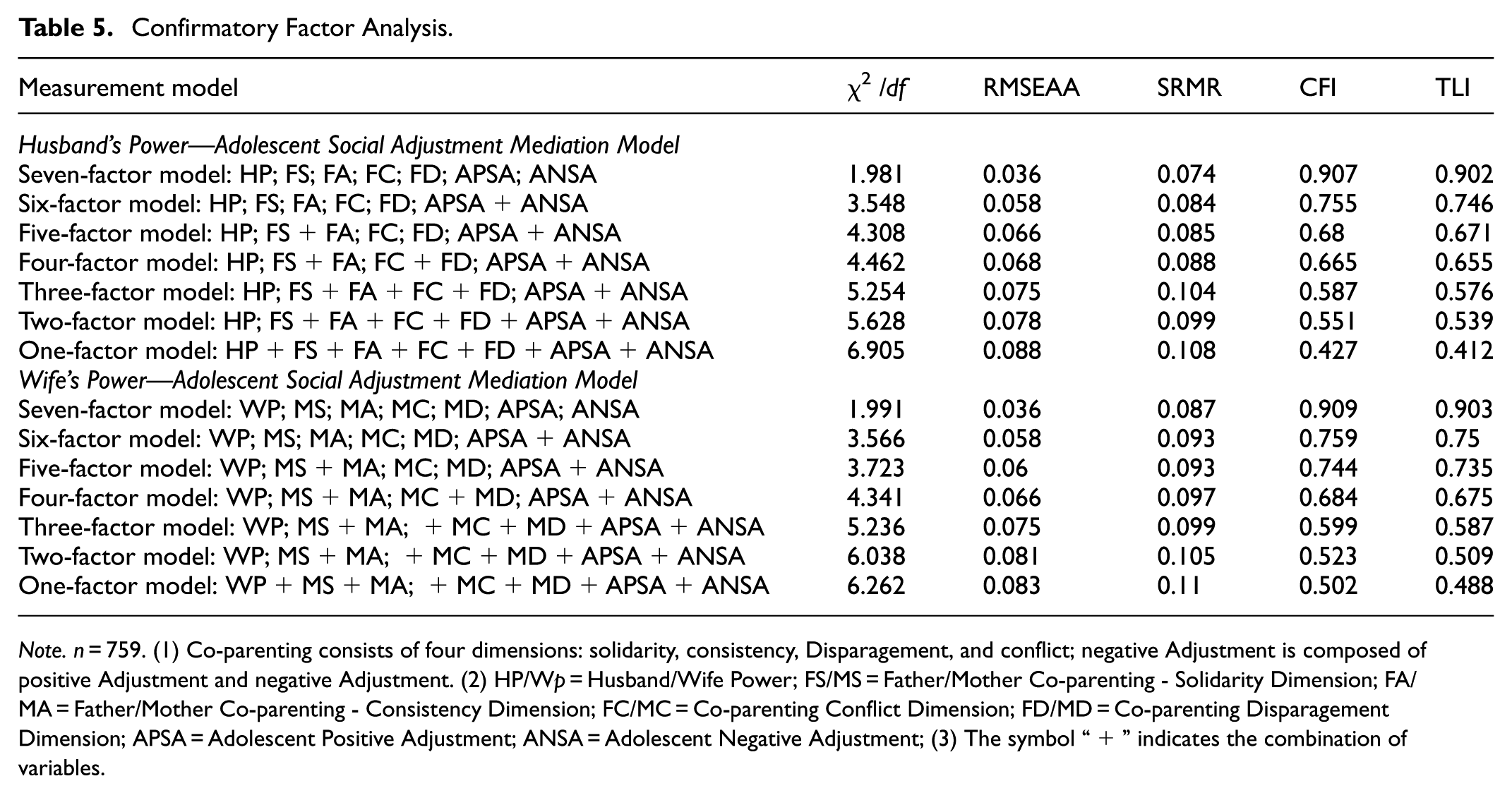
Note.n = 759. (1) Co-parenting consists of four dimensions: solidarity, consistency, Disparagement, and conflict; negative Adjustment is composed of positive Adjustment and negative Adjustment. (2) HP/Wp = Husband/Wife Power; FS/MS = Father/Mother Co-parenting - Solidarity Dimension; FA/MA = Father/Mother Co-parenting - Consistency Dimension; FC/MC = Co-parenting Conflict Dimension; FD/MD = Co-parenting Disparagement Dimension; APSA = Adolescent Positive Adjustment; ANSA = Adolescent Negative Adjustment; (3) The symbol “+” indicates the combination of variables.
Common Method Bias
In this study, all responses were collected through self-report measures designed in line with the research objectives. Husbands or wives completed the sections on power perception, while adolescents provided the data for father or mother co-parenting and adolescent adjustment. This multi-source data collection approach inherently reduced the potential for common method bias. Additionally, techniques such as anonymous responses and reverse scoring were employed to control for common method bias. Furthermore, the Harman single-factor test was conducted to assess common method bias. All variables related to father or mother co-parenting and adolescent adjustment were included in an exploratory factor analysis, and the unrotated factor analysis results were examined. For the father and mother data, 14 and 13 factors with eigenvalues greater than 1 were extracted, respectively. The first common factor explained 23.84% (father) and 24.47% (mother) of the variance, both below the 40% threshold of the total variance (Zhou & Long, 2004). Thus, the data for this study did not exhibit significant common method bias.
Descriptive Statistics and Correlations
Descriptive statistics and Pearson correlation coefficients are presented in Table 6. The results show that husbands’ power perceptions are significantly and positively related to adolescents’ perceptions of father co-parenting in solidarity (β = .10, p < .001) and consistency (β = .13, p < .01), as well as to adolescents’ positive social adjustment (β = .12, p < .01). Similarly, wives’ power perceptions are positively related to adolescents’ perceptions of mother co-parenting in solidarity (β = .15, p < .01) and consistency (β = .18, p < .01), and to adolescents’ positive social adjustment (β = .10, p < .01). In contrast, husbands’ power perceptions are negatively related to adolescents’ perceptions of father co-parenting conflict (β = −.15, p < .01) and disparagement (β = −.10, p < .01), as well as to adolescents’ negative social adjustment. Likewise, wives’ power perceptions are negatively related to adolescents’ perceptions of mother co-parenting conflict (β = −.19, p < .01) and disparagement (β = −.21, p < .01), and to adolescents’ negative social adjustment (β = −.23, p < .01). Thus,
Means, Standardized Deviations, and Correlations.

Note. sample Size = 749.
p < .05. **p < .01.
Main Effects Analysis
To explore the relationship between spousal power perceptions and adolescent adjustment, hierarchical regression analysis was conducted using SPSS 26.0. The results, shown in Table 5, indicate that when adolescent positive social adjustment was the outcome, regression analysis with gender, age, and husband’s power perception as predictors revealed a significant positive relation between husband’s power perception and adolescent positive social adjustment (β = .149, p < .05). Similarly, when using gender, age, and wife’s power perception as predictors, wife’s power perception was significantly related to adolescent positive social adjustment (β = .094, p < .05). When adolescent negative social adjustment was the outcome, regression analysis with gender, age, and husband’s power perception showed a significant negative relation between husband’s power perception and adolescent negative social adjustment (β = −.092, p < .01). Similarly, with gender, age, and wife’s power perception as predictors, wife’s power perception was significantly related to adolescent negative social adjustment (β = −.098, p < .01). Therefore,
Mediating Effect Test
This study employed both the stepwise method and bootstrapping to examine the mediating effect of co-parenting (Wen & Ye, 2014). The results of the stepwise regression are presented in Table 7. After controlling for gender and age, husband and wife power perceptions were introduced into the model, with the four dimensions of co-parenting (solidarity, consistency, conflict, and disparagement) as the dependent variables. The results showed that husband power perception had a significant positive effect on co-parenting solidarity (β = .183, p < .01) and consistency (β = .211, p < .01) and a significant negative effect on co-parenting conflict (β = −.209, p < .01) and disparagement (β = −.107, p < .01). Subsequently, regressions were conducted with positive and negative social adjustment as the dependent variables, including husband power perception and the four dimensions of co-parenting in the model. The results indicated that after incorporating the four dimensions of co-parenting, the effect of husband power perception on positive social adjustment became non-significant, whereas its effect on negative social adjustment remained significant (β = −.092, p < .01). Similarly, wife power perception had a significant positive effect on co-parenting solidarity (β = .282, p < .01) and consistency (β = .337, p < .01), and a significant negative effect on co-parenting conflict (β = −.28, p < .01) and disparagement (β = −.243, p < .01). After including the four dimensions of co-parenting in the model, the effect of wife power perception on positive social adjustment became non-significant, while its effect on negative social adjustment remained significant (β = −.098, p < .01). Thus,
Multilevel Regression Results.

p < .05. **p < .01. ***p < .001.
Additionally, the results of the bootstrapping analysis with 5,000 resamples further tested the mediation effects, as shown in Table 8, with specific paths illustrated in Figure 2. The results revealed that the 95% confidence intervals (CIs) for the effect of husband power perception on adolescent positive social adjustment through the four dimensions of co-parenting (solidarity, consistency, conflict, and disparagement) were [0.012, 0.072], [0.014, 0.048], [0.014, 0.049], and [0.003, 0.027], respectively. Meanwhile, the 95% CIs for the effect of husband power perception on adolescent negative social adjustment through the four dimensions of co-parenting were [−0.050, −0.008], [−0.038, −0.010], [−0.074, −0.024], and [−0.048, −0.006], respectively. Additionally, the 95% confidence intervals (CIs) for the effect of wife power perception on adolescent positive social adjustment through the four dimensions of co-parenting (solidarity, consistency, conflict, and disparagement) were [0.034, 0.091], [0.015, 0.053], [0.019, 0.060], and [0.015, 0.051], respectively. Meanwhile, the 95% CIs for the effect of wife power perception on adolescent negative social adjustment through the four dimensions of co-parenting were [−0.056, −0.020], [−0.033, −0.008], [−0.102, −0.040], and [−0.080, −0.037], respectively. All confidence intervals did not include zero. Therefore,
Mediation Effect Test.


Path analysis.
Discussion and Prospects
Discussion
Toward marital power structures, this study shows that 42.3% of families have a shared power structure, with no significant difference between urban and rural areas. These findings align with previous research that highlights the prevalence of egalitarian family power structures, especially in modern societies (Ma et al., 2011). Marital power structure significantly predicts relationship satisfaction, with couples in shared power structures reporting the highest satisfaction, while those in competing or unequal power dynamics report the lowest. This underscores the importance of mutual recognition and constructive communication for marital happiness. Additionally, husbands typically hold more power in families with male children, likely due to stronger paternal investment in same-sex children (Q. Xu & Wang, 2019). In contrast, women hold more power in families where they have equal or higher education than their husbands or occupy high-status non-agricultural jobs, in line with the resource hypothesis (Safilios-Rothschild, 1970). These findings suggest that modern values of gender equality and resource access shape the distribution of marital power.
In terms of co-parenting, significant differences were found in co-parenting styles across families with different marital power structures. Parents in power-sharing families are most likely to develop a united co-parenting approach, followed by those in husband- or wife-dominated families. In contrast, parents in power-competing families tend to engage in negative co-parenting, showing more conflicts and devaluation. These findings align with previous research (Katz & Low, 2004; Pedro et al., 2012; Stevens, 2002), showing that couples who communicate openly and empower each other contribute to more positive co-parenting. In contrast, competitive marital power dynamics are linked to negative parenting behaviors.
The study found significant differences in how marital power impacts adolescents’ social adjustment across various domains. Families with shared power were most beneficial, with adolescents showing the best outcomes in self, interpersonal, behavioral, and environmental adjustment, characterized by high positive and low negative transformation. In contrast, adolescents from power-competing families had the worst adjustment outcomes, highlighting the importance of marital power in shaping children’s personalities (Rhule et al., 2006). Further comparison of husband-dominated and wife-dominated families revealed distinct effects. Adolescents in husband-dominated families had poorer self and environmental adjustment, while those in wife-dominated families struggled more with interpersonal adjustment. These findings confirm the independence of positive and negative adjustment functions (Zou et al., 2012), emphasizing that reducing negative behaviors does not necessarily lead to positive adjustment. Additionally, the results underscore the unique contributions of both parents to children’s development, suggesting that the long-term effects of marital power distribution on adolescents’ adjustment merit further research (Franz et al., 1991).
This study found that the perceived power levels of both parents positively influence adolescents’ positive adjustment and negatively affect their negative adjustment, consistent with previous research on the role of marital power balance in children’s social development (Lindahl et al., 2004). Power imbalances between spouses often lead to more marital conflict and negative emotions, spreading “emotion contagion” throughout the family, which increases the likelihood of problematic behaviors and maladjustment in adolescents (LeBaron et al., 2014; Schoppe et al., 2001). In contrast, when spouses share power, their communication improves, creating a harmonious family atmosphere that benefits adolescents’ physical and psychological development (Erel & Burman, 1995). Additionally, cooperative parenting behaviors were identified as a mediator between marital power and adolescents’ social adjustment. Previous studies have confirmed the value of this mechanism (Baril et al., 2007; Kolak & Vernon-Feagans, 2008), supporting the spillover hypothesis of family systems theory (Minuchin, 1985) and the ecological model of cooperative parenting (Feinberg, 2003). A balanced distribution of marital power fosters family stability and positive parent-child interactions, promoting adolescents’ psychological and behavioral adjustment. When both parents engage in supportive, positive parenting behaviors, adolescents’ positive adjustment improves, and their risk of negative behaviors decreases, aligning with prior findings (Feinberg & Kan, 2008).
Theoretical Implications
The main contributions of this study can be summarized in three aspects. First, this study validates a combined subjective–objective framework that captures the dynamic nature of marital power in the Chinese context. Second, it extends the scope of marital power research by linking it to adolescents’ social adjustment, thus broadening the theoretical boundary. Third, it constructs a mediating model of marital power–co-parenting–adolescent adjustment, offering a more comprehensive explanation of the mechanisms underlying adolescent development.
First, the core debate in marital power research lies in its conceptualization and measurement. However, there remains a lack of widely recognized and applied measurement tools, which has to some extent constrained the development of the field. Previous studies often relied on family decision-making outcomes (e.g., decision-making authority or household division of labor) as the primary indicators (A. Q. Xu, 2004; Y. Zhang, 1994), but such approaches overlook the dynamic and processual nature of marital power. Grounded in the Chinese cultural context, this study adopts a combined subjective–objective measurement approach that captures both spouses’ subjective perceptions and the dynamic process of marital power. Based on this framework, marital power in Chinese families is classified into four types: shared power, wife-dominant power, husband-dominant power, and contested power. On the one hand, this study demonstrates the reliability and validity of the measurement approach in a Chinese sample, offering a new tool and perspective for subsequent empirical research; on the other hand, it echoes scholarly calls to shift from viewing marital power as an individual possession to examining it as an ongoing relational process—“powering” (Leonhardt et al., 2020; Safilios-Rothschild, 1970). Moreover, the framework demonstrates cross-cultural applicability. For example, Salimi and Rezaei (2024), using data from Iranian university couples, similarly validated its effectiveness in assessing both the processes and outcomes of marital power.
Second, this study broadens the theoretical scope of marital power research. Prior scholarship has predominantly examined its influence on marital outcomes such as satisfaction and happiness (Cox & Paley, 2003). By contrast, the present study shifts attention to adolescent developmental outcomes, thereby highlighting the intergenerational consequences of marital power. By linking marital power to child education, it demonstrates how variations in marital power structures shape adolescents’ social adjustment. This extension not only enlarges the theoretical boundaries of marital power research but also addresses a critical omission in existing frameworks, which have largely neglected its implications for child and adolescent development.
Third, this study advances understanding of the mechanisms underlying adolescent social adjustment. While adjustment has long been a central focus in psychology and family research, extant studies have primarily emphasized parent–child relationships or family structure (Lamblin et al., 2017), with comparatively little attention to the marital subsystem. This study introduces an integrative model linking marital power, co-parenting, and adolescents’ social adjustment, revealing how marital power indirectly shapes adolescents’ adaptive behaviors through its influence on co-parenting. In doing so, it supplements and extends current theoretical accounts of adolescent adjustment and underscores the mediating role of co-parenting within the family system. These contributions open new avenues for empirical investigation and provide theoretical grounding for family education and intervention strategies.
Practical Implications
This study demonstrates that different marital power structures have distinct implications for adolescents’ social adjustment, with practical significance across three domains: family education guidance, marital relationship intervention, and adolescent mental health promotion. Advancing adolescents’ adjustment requires both institutional support and active family engagement in restructuring power relations and strengthening co-parenting, thereby enabling policy initiatives and family practices to form a coordinated support system for healthy development.
First, it is necessary to incorporate family education into policy guidance, and family education guidance should be adapted to specific marital power structures. At the policy level, governments and schools should design stratified curricula, integrate them into community-based public services, and ensure inclusiveness through sustainable funding. Evidence-based parenting practices should also be disseminated via media and community initiatives. At the family level, differentiated strategies are required: joint-power families can reinforce egalitarian communication and co-parenting; conflict-power families should prioritize conflict resolution and cooperative parenting training to mitigate adverse consequences; and husband- or wife-dominant families should progressively pursue power balance to prevent excessive parental burden and preserve parenting quality.
Second, marital relationship intervention is critical, as power-sharing marital arrangements most effectively support adolescents’ social adjustment. At the policy level, governments and communities should institutionalize marital education at key life stages—premarital preparation, the perinatal period, and school entry—supported by dedicated funding, inter-sectoral collaboration, and quality monitoring. Public agencies and communities should also provide targeted counseling on communication, negotiation, and conflict management. At the family level, joint-power couples should consolidate egalitarian interaction; conflict-power couples should develop negotiation mechanisms to reduce conflict spillover; and husband- or wife-dominant couples should recalibrate role allocation through shared responsibility and active engagement, thereby fostering a stable and supportive environment for adolescent development.
Third, adolescent development and mental health promotion require systemic co-parenting mechanisms that embed family power structures into both policy and practice. At the policy level, national and regional strategies should incorporate family-related factors, strengthen school–family–community collaboration, and provide targeted services for high-risk families, including psychological counseling, social-emotional learning, and peer support. Community-based youth programs may also embed family interaction modules to enhance adolescents’ adaptability. At the family level, cooperative parenting should be consistently practiced: joint-power families can strengthen parental collaboration; conflict-power families should employ co-parenting to buffer the effects of marital discord; and husband- or wife-dominant families should ensure joint parental involvement to prevent role imbalance and sustain adolescents’ security and self-worth.
Limitations and Future Research Directions
This study utilized cross-sectional data to explore the immediate effects of marital power in nuclear families on adolescents’ social adjustment through co-parenting. However, adolescence spans a broad developmental range, and there may be significant differences in the developmental stages at the onset, middle, and late phases of adolescence. Additionally, the family environment evolves in response to children’s growth across different developmental stages (W. X. Zhang & Chen, 2009). Therefore, future research could extend this inquiry by examining the long-term effects of marital power on co-parenting and adolescents’ social adjustment using longitudinal data.
The study primarily concentrated on the influence of marital power within families on adolescents’ social adjustment. However, in China, the phenomenon of “intergenerational parenting” is particularly prevalent, with many families depending on grandparents for child-rearing. Future research could consider incorporating the distinctive cultural aspects of child-rearing in China by including other primary caregivers as part of the family power structure. Comparative studies could further enhance our understanding of how family power dynamics influence adolescent development in the Chinese cultural context.
Furthermore, the impact of co-parenting on adolescents’ social adjustment may be context-dependent and influenced by various individual factors. In particular, adolescents differ in their sensitivity to the family environment. Future research could incorporate individual difference variables (e.g., personality traits, self-control, attachment style) to examine their moderating roles in the marital power–co-parenting–social adjustment pathway. Introducing such psychological and social variables into the model would enhance both the applicability and explanatory depth of the conclusions.
Footnotes
Acknowledgements
The authors would like to acknowledge Project of National Social Science Foundation of China (grant numbers 18BRK002) and thank all the editors and reviewers for their suggestions.

Ethical Considerations
All procedures performed in studies involving human participants were in accordance with the ethical standards of the institutional and/or national research committee, and with the 1964 Helsinki declaration and its later amendments or comparable ethical standards. This study was approved by the Ethics Committee of Beijing Normal University (Approval Number: ZGY036).
Consent to Participate
Informed consent was obtained from all individual participants included in the study.
Funding
The authors disclosed receipt of the following financial support for the research, authorship, and/or publication of this article: This study was conducted by Project of National Social Science Foundation of China (grant numbers 18BRK002).
Declaration of Conflicting Interests
The authors declared no potential conflicts of interest with respect to the research, authorship, and/or publication of this article.
Data Availability Statement
The data that support the findings of this study are available from the corresponding author upon reasonable request.