




Abstract
The aim of the study was to determine whether the level and structure of young adults’ materialism varied depending on parental attitudes toward upbringing and whether a negative assessment of the family of origin’s material situation and a low level of meeting material needs in childhood contributed to the formation of materialistic attitudes. The sample comprised 453 individuals: 335 women (74%) and 118 men (26%). The results indicated that parental attitudes toward upbringing played an important role in forming materialistic orientations in young people. Materialism is associated with parental attitudes of rejection and over-protection. A hierarchical cluster analysis was performed to determine whether the level and structure of young adults’ materialism varied depending on their parents’ attitudes toward upbringing. The analysis revealed that groups with different perceptions of these parental attitudes viewed them solely within the scope of variables describing materialism as the importance of possessing and acquiring money to fulfill one’s main goals in life (that being the case for all its dimensions). The “traditional” understanding of materialism (and the most common one in specialist literature), that is, regarding the possession of material goods as a source of happiness and an indicator of success in life, was non-differentiating.
Introduction
Materialist and consumerist attitudes are becoming more present in our lives because we are setting life goals, building self-esteem, and forming beliefs about others. Thus, psychologists view these attitudes as an important topic within research into human functioning. Despite the large amount of research into materialism, the mechanism by which it is engendered and the role of upbringing in its formation are still unclear. It is expected that the family plays an important role in the process because its impact is the strongest and is present throughout a person’s life. This claim seems to be justified by previous research (Flouri, 1999, 2004; Górnik-Durose & Dziedzic, 2013; Kasser, Ryan, Couchman, & Sheldon, 2003; Kasser, Ryan, Zax & Sameroff, 1995). However, as most of this research was conducted in Western countries with developed consumer cultures, these questions should also be studied in central and eastern Europe.
Although materialism is not a new concept in psychology, it is certainly a complex and heterogeneous one requiring further exploration and contextual research (Burroughs & Rindfleisch, 2002; Kilbourne, Grünhagen, & Foley, 2005). The concept also arouses controversy because it does not allow for easy or full classification in terms of “good” and “evil.” A vast majority of researchers have remained critical of materialism, defining it as a dark side variable (Burroughs & Rindfleisch, 2002) and pointing to its strong negative relationship to happiness, a sense of well-being, and satisfaction with life (Belk, 1985; Burroughs & Rindfleisch, 2002; Richins & Dawson, 1992) as well as several other intra- and inter-psychical variables (see Kasser, 2002). Some also point to the positive aspects of materialism (Holt, 1997; Micken & Roberts, 1999, as cited in Kilbourne et al., 2005) or its positive and negative aspects (Csikszentmihalyi & Rochberg-Halton, 1981, as cited in Górnik-Durose, 2002). Thus, positive or “instrumental” materialism sees possession as a means of accomplishing aims and achieving non-material goals inclusive of values aimed at self-fulfillment. However, negative or “terminal” materialism makes possession a goal in itself (Csikszentmihalyi, 2000).
Although materialism has been extensively researched, no consensus has been reached concerning its definition. Researchers argue whether materialism is a trait (Belk, 1985), attitude (Moschins & Churchill, 1978), value (Richins & Dawson, 1992; Richins, 2004), or perhaps something altogether different (Górnik-Durose, 2002). This study uses the conceptualization proposed by Richins and Dawson (1992) that predominates in contemporary psychology. Richins and Dawson (1992) understand materialism as the “value which guides human choices and behaviour in various situations related to consumption and operationalize it as the set of beliefs concerning the value attributed to material goods in the individual’s life” (p. 308). Materialism manifests itself in three areas. The first area is the tendency to judge one’s success and that of others by the quantity and quality of possessions (the role of possessions in defining success). The second is the propensity to identify the possession of goods with happiness and satisfaction (the role of acquisitions in happiness). The third area is the central place in life accorded to the acquisition of goods (acquisition centrality). Because thinking about materialism solely in the context of material goods seems to produce an incomplete picture of the phenomenon, Richins and Dawson’s conceptualization was extended by adding another component, that is, the importance of money and its role in achieving one’s main goals in life.
Of course, questions related to the drive to acquire money have already appeared in materialism research, especially in studies on the relationships between materialism and a sense of well-being (Kasser & Ryan, 1993, 1996; Richins & Dawson, 1992; Schmuck, Kasser, & Ryan, 2000). However, as suggested by Srivastava, Locke, and Bartol (2001), studies explicitly or implicitly assumed that individuals who had high financial aspirations and appreciated money would wish to allot it toward making purchases and consumption. Nevertheless, high financial aspirations and the tendency to attach importance to money may also be based on other “positive” motives, such as the need to secure one’s own and/or one’s family’s future or the need to be independent. According to Csikszentmihalyi and Rochberg-Halton (1981), these motives are part of the “instrumental” form of materialism (as cited in Górnik-Durose, 2002) rather than “terminal” motives, such as the willingness to enhance one’s status or the desire to gain admiration and/or arouse jealousy from others.
Origins of Materialism
Many researchers have studied the essence and correlations of materialism, but few have undertaken research into the origin of the phenomenon. To date, the issue has mainly been explored in countries with developed consumption cultures that are suffering from the adverse consequences of materialism due to its expansion. Studies into the determinants of this materialistic orientation have been conducted by many researchers (e.g., Cohen & Cohen, 1996; Flouri, 1999, 2004; Kasser et al., 1995, 2003). The issue of materialism has been present in Poland for less than 10 years (Górnik-Durose, 2002), but studies into the origin of the phenomenon have only recently started to appear (Górnik-Durose & Dziedzic, 2013). The studies quoted above (Górnik-Durose & Dziedzic, 2013; Kasser et al., 1995, 2003) explain the origin of materialism in the context of a model designed by Kasser et al. (2003), which points to two paths that lead to materialism: deprivation and socialization. The former presents materialism as a compensation strategy (i.e., materialism as the effect of important psychological needs that were not satisfied in childhood). The latter emphasizes the role of internalizing and modeling behaviors that lead to learning materialistic patterns (i.e., materialism as an effect of behavior modeling). The study presented in this article considers the aspect of deprivation, and the analysis focuses on the relationship between parental attitudes toward upbringing and young adults’ materialism. It also considers two additional socioeconomic variables: a subjective assessment of the family of origin’s material situation and the degree to which one’s material needs in childhood are met, which is subjectively perceived.
The relationship between parental attitudes and children’s materialism has been studied by many researchers, including Cohen and Cohen (1996), Flouri (2004), Kasser et al. (1995), and Górnik-Durose and Dziedzic (2013) in Poland. Their results indicate that a materialist orientation is engendered by attitudes that do not involve a need for belonging and closeness; these attitudes lack consistency and are associated with excessive control. Such attitudes hinder the growth of individual and social resources, disrupt the individuation process (Plopa, 2005, 2008), and create an opening for deficit compensation through the development of a materialist orientation and thus a focus on goods and money (Kasser et al., 1995). The concept of parental attitudes proposed by Arrindell et al. (1999) was adopted in the present study. Arrindell et al. distinguish three types of parental attitudes exhibited by mothers and fathers: emotional warmth, over-protection, and rejection. In view of the results cited above, over-protection and rejection seem to foster a materialistic orientation.
Research Issue
The aim of this study was to analyze the relationships between parental attitudes and materialism. Materialism is understood here as the importance of possessing and acquiring material goods and money to achieve one’s main goals in life. The following research questions were examined in this study.
Based on existing literature and the results of previous research, it was assumed that a materialistic orientation would be fostered by parental rejection and over-protection (Flouri, 1999, 2004; Górnik-Durose & Dziedzic, 2013; Kasser et al., 1995). The relationships between young people’s materialistic orientations and mothers’ parental attitudes were expected to be stronger than relations between the former and parental attitudes exhibited by fathers (Górnik-Durose & Dziedzic, 2013).
To answer this question, it was necessary to divide the entire group of participants into subgroups characterized by the specific parenting styles exhibited by mothers and fathers.
Method
Sample
The study surveyed individuals aged 18 to 34 years old. The participants were full-time and evening students at the University of Warsaw, the University of Social Sciences and Humanities in Warsaw, the Academy of Special Education in Warsaw, the University of Łódź, the University of Computer Sciences and Skills in Łódź, the Academy of Music in Łódź, and the Łódź University of Technology. In all, 530 individuals were surveyed, and 453 individuals were qualified for analysis. The resulting participants comprised 335 females (74%) and 118 males (26%).
Instruments
The study utilized a research strategy based on an adult’s retrospective assessment of childhood and growing up. The questionnaire method was applied.
Maternal and paternal upbringing attitudes were examined using the Polish version of the My Memories of Upbringing Egna Minnen Beträffande Uppfostran (s-EMBU ) inventory (Arrindell et al., 1999). The tool measures parental upbringing attitudes on three dimensions: emotional warmth, rejection, and over-protection. The reliability of the specific dimensions in the presented study was as follows:
emotional warmth: Cronbach’s αM = .867; Cronbach’s αF = .915;
rejection: Cronbach’s αM = .786; Cronbach’s αF = .838; and
over-protection: Cronbach’s αM = .774; Cronbach’s αF = .778.
The subjective assessment of the family of origin’s material situation and the degree to which one’s material needs were met in childhood were determined using closed-ended questions on a demographic questionnaire.
Materialism was studied using two scales: the Material Values Scale (MVS) by Richins (2004) and the Motives for Making Money Scale by Srivastava et al. (2001).
The MVS is the Polish adaptation of the abbreviated MVS by Richins (2004). Richins’ tool comprises 15 items forming three subscales that address three aspects of materialism: Success, Happiness, and Centrality of possessions. The success subscale measures the tendency to assess one’s own success and the success of others based on the quantity and quality of possessed goods. The Happiness subscale measures the tendency to equate possessions with a source of happiness and satisfaction with life. The Centrality subscale measures the centrality of possessions in an individual’s life. The MVS was adapted for Polish conditions by Wąsowicz-Kiryło (2013). Similar to the version devised by Richins, the adapted version consists of 15 items and contains three subscales: Success, Happiness, and Centrality of possessions. However, the study presented here does not conform to the three-factor structure, which is consistent with the results from other Polish studies. Exploratory factor analysis was conducted, and the results indicated four main components with eigenvalues above one, which cumulatively accounted for 54% of the variance. However, due to the unsatisfactory reliability of the received subscales, factor analysis was performed again by applying a solution suggested by the scree plot for two and three components. Because of this procedure, a proper version of the MVS was produced. This version comprised 9 test items and contained two subscales: Success and Happiness. The Success subscale included 5 items—the same as the original questionnaire version, whereas the Happiness subscale was made up of 4 items, which was also the same as Richins’ scale. A subsequent analysis performed on the 9-item questionnaire version examined its internal structure. Exploratory factor analysis was used using the principal components analysis method with Oblimin rotation and Kaiser normalization. The results for sample selection adequacy were satisfactory (Kaiser–Meyer–Olkin [KMO] = 0.822; Bartlett’s sphericity test χ2 = 941.08, df = 36, p < .001; Bedyńska & Cypryańska, 2007). Two principal components were reached cumulatively and accounted for 51.57% of the variance. The next step was to determine the reliability of both subscales selected as a result of factor analysis. To that end, Cronbach’s alpha method was applied. Item 14 comprising the Happiness subscale lowered Cronbach’s α coefficient value and weakly correlated with the other items; therefore, it was dropped from the scale. In this way, the final 8-item version of the tool was reached. The Cronbach’s α statistical values were .724 for the Success subscale and .727 for the Happiness subscale. The psychometric characteristics of the scale formed by combining items included on both subscales were also tested. The Cronbach’s α coefficient value for these characteristics was .783.
The Motives for Making Money Scale enables the diagnosis of materialism in relation to the importance of money in value realization. In its original version, the tool comprises 10 subscales with three items each. The subscales are Security, Family Support, Market Worth, Pride, Leisure, Freedom, Impulse, Charity, Overcoming Self-Doubt, and Social Comparison. The reliability of the specific subscales measured by Cronbach’s α coefficient ranges from .73 to .92 (Srivastava et al., 2001). These subscales form three superior dimensions, which were isolated by Srivastava et al. (2001) as a result of second-order factor analysis. These dimensions are positive motives, freedom of action, and negative motives. Their reliability values are .86, .91, and .94, respectively.
The scale was adapted for Polish conditions by Poraj-Weder for the purposes of this work, and Srivastava et al. (2001) gave consent for the tool to be adapted. The translation was done using the back-translation procedure and competent raters. As in the original version, data concerning motives for making money were subjected to second-order factor analysis. The results received, however, were only partly consistent with the original solution. Based on these results, four dimensions were isolated instead of three, as in the original version.
The positive motives dimension grouped the security, family, support, market worth, and pride scales. It expressed the tendency to treat money as a means of obtaining one’s life necessities (e.g., “I want to secure basic needs,” “I want to secure the future of my children”), a measure of market worth (e.g., “I want to get just compensation for my efforts”), and a measure of achievements in life (e.g., “I want to know that I can handle challenges posed by life”). It proved to be identical to the positive motives dimension isolated by Srivastava et al. (2001).
The freedom of action dimension grouped the leisure and impulse scales. It expressed the tendency to treat money as a means allowing for a comfortable, nice, and entertaining life (e.g., “I want to let my mood guide me at times so that I can blow money while shopping just for the thrill of it,” “I want to enjoy luxuries”). This dimension differed fundamentally from the original freedom of action dimension (Srivastava et al., 2001), which treated money as a means of carrying out values.
The negative motives dimension grouped the overcoming self-doubt and social comparison scales. It was tantamount to perceiving money as a means of overcoming one’s deficiencies and gaining an advantage over others (e.g., “I want to show that I am better than my acquaintances, siblings, relatives,” “I want to prove that I am not as dumb as some people assumed I was”). It proved identical to the negative motives dimension isolated by Srivastava et al. (2001).
The charity scale comprised one scale of the same name. It entailed treating money as a means of serving others (e.g., “I want to donate money to those who need it”). In the factor solution assumed by Srivastava et al. (2001), charity did not form a separate factor; instead, it was part of the freedom of action component.
Research Results
The first aim of the study was to verify the relationship between role models in the family and young people’s materialism. The analyses indicated several interesting, though relatively weak, relationships among the analyzed variables.
Relations Between Parental Attitudes and Materialism (Understood as the Importance of Possessing and Acquiring Material Goods for Value Realization)
The first step was to analyze the relationship between maternal and paternal attitudes toward upbringing and materialism that equates the possession of goods with success and happiness. Statistically significant relationships between paternal attitudes toward children’s upbringing for both success and happiness were revealed. Both forms of materialism correlated positively with attitudes of rejection and over-protection and negatively with an attitude of emotional warmth. In relation to maternal attitudes toward upbringing, positive relationships were found between treating possessions as a measure of success and an attitude of over-protection and between seeing possessions as a source of happiness and attitudes of over-protection and rejection (p < .10). Detailed results from the analyses are shown in Table 1.
Relationships Between Maternal and Paternal Attitudes Toward Upbringing and Materialism (Understood as the Importance of Possessing and Acquiring Material Goods for Value Realization).

Correlation is significant at the .05 (two-tailed). **Correlation is significant at the .01 level (two-tailed).
(t) - correlation is significant at the level of tendency
Relations Between Parental Attitudes and Materialism (Understood as the Importance of Possessing and Acquiring Money for Value Realization)
This study also aimed to analyze the relationship between parental attitudes toward their children’s upbringing and materialism, understood in this section as the importance of possessing money to realize values. In relation to maternal attitudes toward upbringing, the attitude of acceptance (emotional warmth) proved to be vital. It was positively correlated with the positive motives dimension and with the freedom of action and charity dimensions at the level of tendency, thus indicating good or “instrumental” materialism (Csikszentmihalyi & Rochberg-Halton, 1981, as cited in Górnik-Durose, 2002). An attitude of over-protection was positively correlated with the negative motives dimension, which equates money with the ability to overcome one’s deficiencies and gain an advantage over others; therefore, bad (“terminal”) materialism was indicated. The attitude of rejection also correlated with the negative motives dimension at the level of tendency.
A very similar set of results was received for the fathers. The attitude of acceptance correlated positively with the positive motives and charity dimensions, while the attitude of rejection correlated negatively with the positive motives dimension and positively with the negative motives dimension. The attitude of over-protection correlated positively with the negative motives dimension (Table 2).
Relationships Between Maternal and Paternal Attitudes Toward Upbringing and Materialism (Understood as the Importance of Possessing Money for Value Realization).
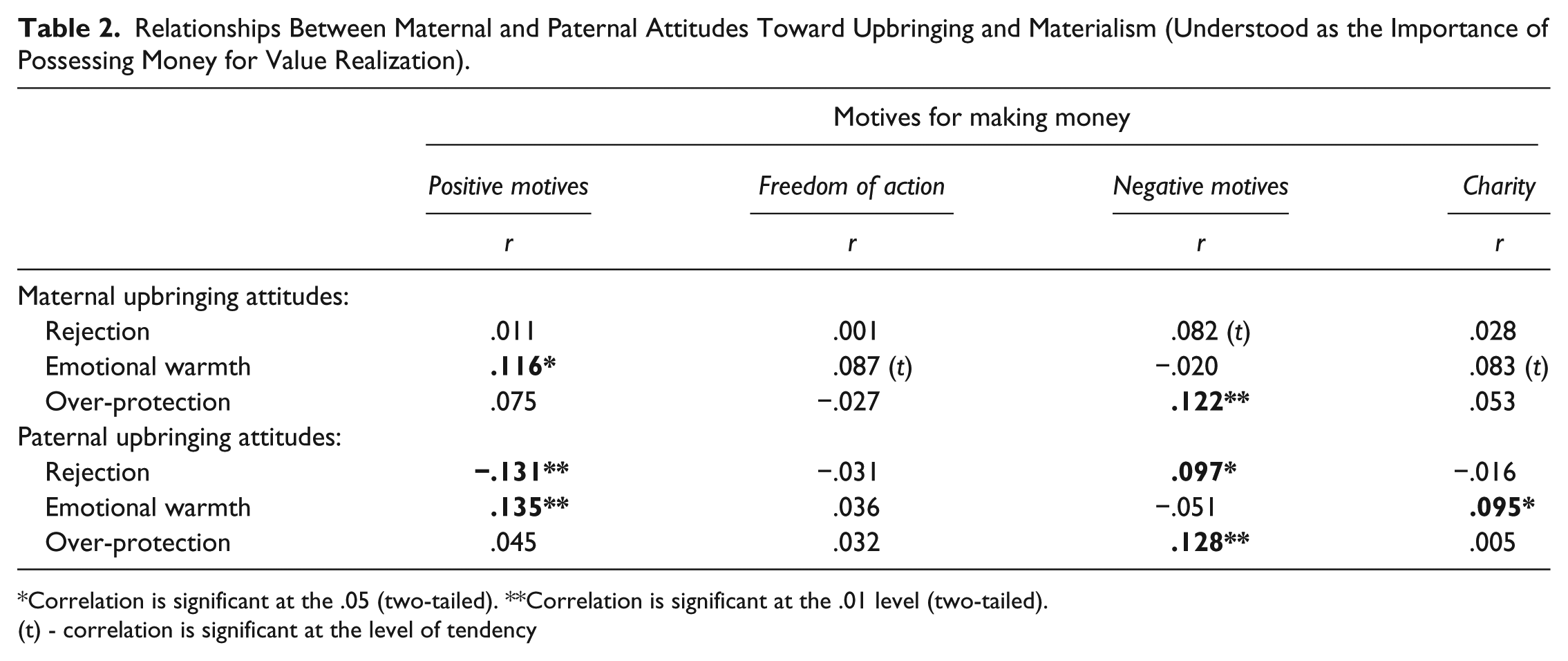
Correlation is significant at the .05 (two-tailed). **Correlation is significant at the .01 level (two-tailed).
(t) - correlation is significant at the level of tendency
To answer the second question, it was first necessary to isolate and describe groups comprising mothers and fathers who exhibited specific types of parental attitudes and then to determine whether those groups showed differences in the level and structure of materialism.
Parenting styles
Ward’s (1963) method of hierarchical clustering analysis was used (StatSoft, Electronic Statistic Textbook) to assign individuals to groups according to parenting styles. Ward’s method was chosen to minimize variance within clusters and to group participants exhibiting similar parenting styles. The analysis was based on empirical data describing parenting styles exhibited by mothers and fathers.
The analysis was conducted for three, four, and five clusters. An optimal value was received for four clusters comprising 163, 181, 74, and 38 individuals. Differences between each group’s parental attitudes toward upbringing are shown in Table 3 and are illustrated in Figure 1.
Differences in a Retrospective Assessment of Maternal and Paternal Attitudes Toward Upbringing in Selected Clusters.
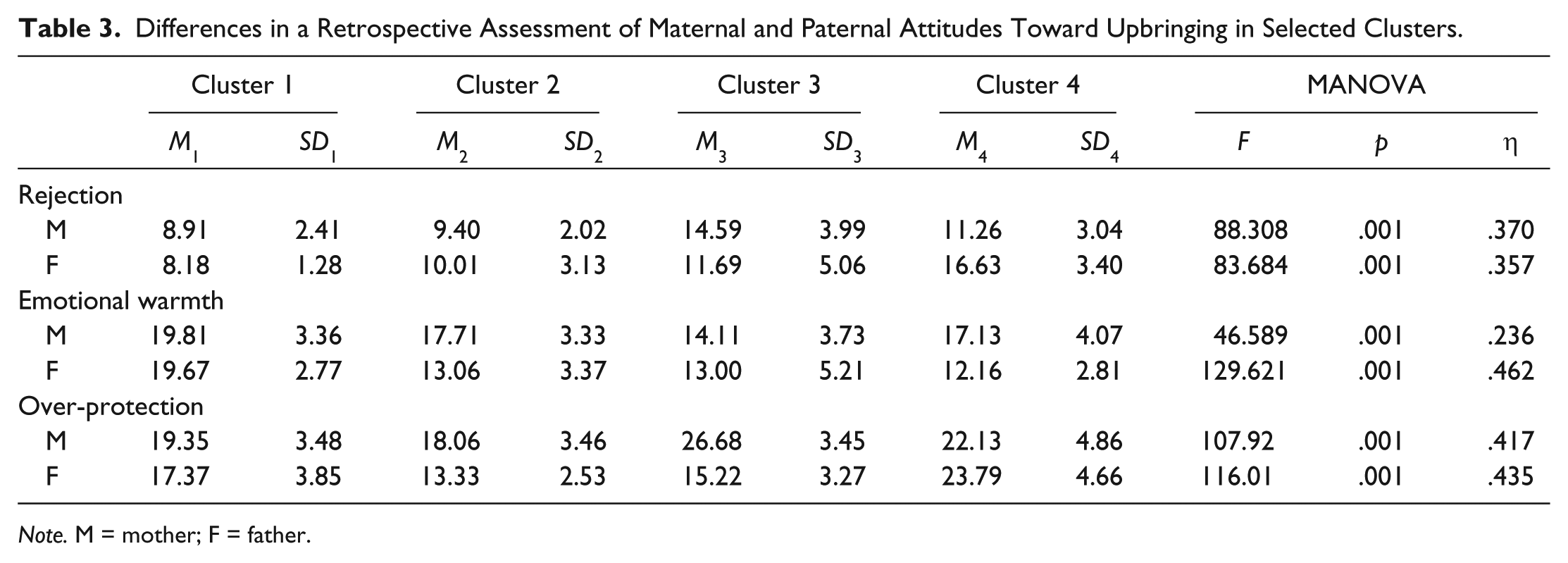
Note. M = mother; F = father.

Retrospective assessment of maternal and paternal attitudes toward upbringing in studied groups.
The isolated groups are represented by (1) individuals who perceived their mother’s and father’s parenting styles as normal; (2) individuals with a positive perception of their mothers and who perceived their fathers as isolating; (3) individuals who perceived their mothers as distant and controlling and their fathers as inconsistent; and (4) individuals who perceived their mothers as over-protective and their fathers as rejecting and controlling.
Individuals who perceived their mother’s and father’s parenting styles as normal (Cluster 1) differed from the others on all the dimensions of parental attitudes toward upbringing. The only exception was for the attitude of rejection exhibited by the mother (similarly “remembered” in the first and second clusters). Thus, individuals in the first group had the lowest scores regarding the father’s attitude of rejection in comparison with the other clusters (p = .001). Moreover, they received the most emotional warmth from both parents. They scored moderately on the over-protection attitude, which indicates its normal intensity (parents are perceived as protective but not controlling).
Individuals with a positive perception of their mothers and who perceived their fathers as isolating (Cluster 2) were characterized by a complex array of scores. Hence, they differed in regard to maternal parenting styles from the third cluster (p = .001) and the fourth cluster (p = .001) on the rejection dimension, from the first and second clusters on the emotional warmth dimension, and from all the clusters on the over-protection dimension (p = .001), in which they scored the lowest in comparison with the other groups. The array of scores for maternal attitudes toward upbringing indicates a similarity between the parenting style in the second cluster and the style characterizing the first cluster, that is, individuals who perceived the parenting style of both parents as normal. However, in the second cluster, the profile is clearly less beneficial; mothers are perceived as less emotionally warm and less protective. Consequently, this cluster specifies these maternal parenting styles as “positive” but not “normal” or “desirable.”
When analyzing paternal parenting styles, participants in the second cluster differed from the others on the rejection (p = .001) and over-protection (p = .001) dimensions. In terms of the attitude of rejection, they scored higher than the individuals in the first cluster did and lower than the individuals in the third and fourth clusters did, while they scored the lowest compared with the other clusters on the over-protection dimension. In addition, the participants differed from individuals in the first cluster in the emotional warmth dimension. Therefore, in comparison with the other clusters, fathers in this cluster seem emotionally cool, uninterested in their children, and “absent” in the upbringing process.
Individuals who perceived their mothers as distant and controlling and their fathers as inconsistent (Cluster 3) differed from the others on all the dimensions of maternal attitudes toward upbringing. They received the highest scores on the rejection (p = .001) and over-protection (p = .001) dimensions and the lowest scores on the emotional warmth (p = .001) dimensions compared with the other clusters. Such an array of scores makes this maternal parenting style the least beneficial compared with the other clusters.
In terms of paternal parenting styles, participants in the second cluster differed from the others on the rejection (p = .001) and over-protection (p = .001) dimensions. Regarding the attitude of rejection, the participants scored higher than the individuals in the first and second clusters and lower than the individuals in the fourth cluster. For the attitude of over-protection, they scored higher than individuals in the second cluster and lower than individuals in the first and fourth clusters. This structure indicates an inconsistency in upbringing, as fathers seem simultaneously rejecting, protective, and emotionally cool. Together with emotionally cool, rejecting, and controlling mothers, they create a clearly adverse environment for the process of individuation.
Individuals who perceived their mothers as over-protective and their fathers as rejecting and controlling (Cluster 4) differed from the other clusters for maternal parenting styles on the rejection (p = .001) and over-protection (p =.001) dimensions and from clusters 1 (p = .001) and 3 (p = .001) on the emotional warmth dimension. Thus, for the attitude of rejection and over-protection, they scored higher than individuals in the first and second clusters and lower than individuals in the third cluster, whereas they scored lower than individuals in the first cluster and higher than individuals in the third cluster for the attitude of emotional warmth. The scores on the over-protection and emotional warmth dimensions are especially significant to the qualitative description of this cluster. Their intensity indicates a clear perception of mothers as over-protective (although not controlling).
In terms of paternal parenting styles, the participants in this cluster scored the highest on the rejection (p = .001) and over-protection (p = .001) dimensions in comparison with the other clusters. Moreover, they differed from the first cluster (p = .001) on the emotional warmth (p = .001) dimension, where they received lower scores. Such an array of scores indicates a strongly negative perception of paternal parenting styles. Fathers are perceived as exceptionally strict, rejecting, controlling, and emotionally cool.
The clusters that emerged from the analysis were further characterized by socioeconomic variables. Participants assigned to a given group were tested for the subjective assessment of their financial situation and the satisfaction of their needs during childhood. To that end, a different significance test was performed between two independent proportions (Ferguson & Takane, 2009). The results of this analysis are shown in Table 4.
Subjective Assessment of the Family of Origin’s Material Conditions and the Degree to Which One’s Material Needs Were Met During Childhood in Isolated Clusters.

The results are based on two-tailed tests at the .05 level.
The numbers in parentheses refer to the numbers of clusters with which certain cluster differ (for example, there are statistically significant differences in negative assessment of the family of origin’s material situation between clusters: 1 and 2, and 1 and 4)
Statistically significant differences were found for the first and second clusters (p = .05) and for the first and fourth ones (p = .05). The percentage of individuals who perceived the material conditions in which they grew up as negative was higher in the second and fourth clusters than in the first cluster.
The last element of the deprivation path in the presented study was then tested, that is, the degree to which one’s material needs were met during childhood. Similar to the subjective assessment of material conditions, a different significance test was performed between two independent proportions (Ferguson & Takane, 2009). The percentage of individuals who assessed the degree to which their material needs were met during childhood as unsatisfactory was lower in the first cluster than in all the others (p = .05). Moreover, the percentage of individuals who stated that their parents went above and beyond in meeting their material needs was higher in the first cluster than in the fourth cluster No other differences regarding satisfaction were observed among the clusters.
Differences Between Clusters With Respect to the Level and Structure of Materialism
The objective of the next stage of analysis was to answer the second research question, namely, whether different parenting styles result in varying intensities and structures of materialism in young adults. To answer that question, a MANOVA between groups was conducted. The groups determined in the hierarchical cluster analysis were treated as the independent variable. Two dependent variables were used:
materialism understood as the importance of possessing and acquiring material goods to achieve one’s main goals in life, which are defined as success and happiness; and
materialism understood as the importance of possessing and acquiring money to achieve one’s main goals in life, which are defined as positive motivation, freedom of action, negative motivation, and charity.
The results indicated that participants differed only on variables describing materialism as the importance of possessing and acquiring money to achieve one’s main goals in life. In addition, inter-group differences in materialism understood in this way were found for all four of its dimensions: positive motives, F(3, 452) = 2.758, p = .042, η2 = .018; freedom of action, F(3, 452) = 2.871, p = .036, η2 = .019; negative motives, F(3, 452) = 2.719, p = .044, η2 = .018; and charity, F(3, 452) = 2.914, p = .034, η2 = .019. Although the results were statistically significant in each case, their strength measured with the
Differences in the Components of Materialism in Isolated Clusters.

To check whether the structure and intensity of specific components of materialism in a cluster differed from the structure and intensity of materialism in other clusters, a series of unpaired t tests was performed. For these tests, the first, second, and third clusters constituted the first group and the second group included “classified” participants, excluding those individuals in a cluster that constituted the first group for comparisons. The results of these analyses are provided in Tables A1 to A4 in the appendix.
Individuals who perceived the parental styles of both their parents as normal (Cluster 1) scored higher in comparison with the other clusters on the positive motives dimension, t(377.44) = 2.512, p = .010, and at the level of tendency on the freedom of action, t(454) = 1.735, p = .083, and charity, t(454) = 1.800, p = .072, dimensions. Individuals in the second cluster differed from those in the other clusters on the same dimensions—significantly on positive motives, t(454) = −2.657, p = .008, and at the level of tendency on charity, t(454) = −1.769, p = .078—but the differences were in the opposite direction. Individuals who perceived their mothers as distant and controlling and their fathers as inconsistent (Cluster 3) differed from those in the other clusters on the freedom of action, t(91.95) = −2.364, p = .020, dimension in that they received significantly lower scores. Finally, individuals who perceived their mothers as over-protective and their fathers as rejecting and controlling (Cluster 4) scored higher in comparison with the other clusters on the negative motives, t(454) = 2.746, p = .006, dimension and lower (at the level of tendency) on the charity, t(454) = −1.839, p = .067, dimension.
Discussion
The results of these analyses indicated that parental attitudes toward upbringing play an important role in forming young people’s materialistic orientation.
The hypothesis regarding the positive relationship between young people’s materialism and parental attitudes of rejection and over-protection was confirmed. The conclusion applies both to materialism understood as the importance of possessing and acquiring material goods for value realization and to materialism understood as the importance of possessing and acquiring money for value realization. The attitude of over-protection seems to be especially adverse. It clearly contributes to the belief that possessed goods are a guarantee of happiness and success and that money serves to overcome doubts and to gain an advantage over others (“terminal” materialism). In turn, attitudes toward upbringing that support the individuation process, which is associated with emotional warmth, contribute to forming positive motives for earning money and treating it as a means to fulfilling constructive goals and values (“instrumental” materialism). In addition, fathers’ attitudes toward upbringing are negatively related to materialism in terms of viewing possessions as a measure of success and a source of happiness.
It is quite surprising and contrary to previously held assumptions that paternal (rather than maternal) attitudes toward children’s upbringings appeared to be more important in forming young people’s materialistic orientations. Relationships between materialism (understood as the importance of possessing and acquiring both material goods and money for value realization) and the attitude of rejection exhibited by mothers were observed only at the level of tendency (the attitude of over-protection played a significant role). This result requires further verification because according to information provided by the specialist literature, abnormal maternal attitudes are central to forming young people’s materialistic orientations (Flouri, 1999, 2004; Górnik-Durose & Dziedzic, 2013; Kasser et al., 1995).
However, studies by Kasser et al. (1995) and Flouri (1999) only examined mothers. Therefore, the hypothesis regarding the impact of paternal attitudes toward children’s upbringings on young people’s materialism was de facto not verified. However, studies by Górnik-Durose and Dziedzic (2013) used a retrospective assessment of parental attitudes to analyze differences between groups that were isolated based on a configuration of goals in life (individuals with materialistic orientations were compared with individuals oriented toward spiritual development and individuals oriented toward achieving psychophysical harmony). These studies produced results indicating inter-group differentiation between both maternal and paternal attitudes toward upbringing. In both these cases, inconsistent and demanding attitudes proved to be important. Although the strength of the effect was decidedly higher for maternal attitudes toward upbringing, the results indicated that not only maternal but also paternal attitudes toward children’s upbringing play a role in forming young people’s orientation in life. This result was also confirmed in a study conducted by Poraj-Weder and Dzierżek (2012) that compared differences between life goals among groups that were isolated based on the quality of parental attitudes toward children’s upbringing. The object of the analyses was to determine which maternal and paternal attitudes toward upbringing are differentiating in relation to forming materialistic orientations operationalized by attaching a high importance to goals related to money, image, and fame. The results revealed that individuals who perceived parental attitudes toward upbringing as normal assessed goals indicating materialistic orientations significantly lower than did individuals who perceived maternal attitudes toward upbringing as inadequate (inconsistent, over-protective) or those who perceived paternal attitudes as inadequate (rejecting, excessively demanding, do not support autonomy).
The other aim of the study was to determine whether the level and structure of young adults’ materialism varied depending on how they perceived their parents’ style of parenting. The cluster analysis used in the study divided the participants into four groups based on their perception of maternal and paternal parenting styles. The four clusters were divided as follows: (1) individuals who perceived their mother’s and father’s parenting styles as normal; (2) individuals with a positive perception of their mothers and who perceived their fathers as isolating; (3) individuals who perceived their mothers as distant and controlling and their fathers as inconsistent; and (4) individuals who perceived their mothers as over-protective and their fathers as rejecting and controlling.
The groups differed in their subjective assessment of the material situation and subjectively perceived the degree to which their material needs were met during childhood. The first cluster contained the highest the percentage of “satisfied” individuals in comparison with the other clusters. In contrast, the fourth cluster comprised the largest number of individuals who experienced deficiencies in both areas.
A comparative analysis of the each groups regarding specific components of materialism (understood as the importance of possessing and acquiring material goods and money to achieve one’s main goals in life) revealed interesting results.
First, the studied groups differed only on the scope of variables describing materialism as the importance of possessing and acquiring money to achieve one’s main goals in life (this was the case for all its dimensions). Materialism in its “traditional” and most common understanding, that is, the possession of material goods as a source of happiness and an indicator of success in life, was non-differentiating. This was a surprising result that requires further empirical verification because it indicates a higher importance for the component that associates materialism with gathering money (rather than with gathering goods) and, more specifically, with various motivations that underlie gathering money.
In terms of the motives for gathering money, the relationships revealed were as expected. Positive parenting styles on the part of both parents (Cluster 1) or only mothers (Cluster 2) created favorable conditions for shaping positive motives for gathering money, which are typical of “instrumental” materialism. However, negative parental attitudes toward upbringing, especially on the part of fathers (Cluster 4), resulted in the development of negative compensatory motives, which represent “terminal” materialism.
Thus, the hypothesis that the deprivation path leads to materialism was confirmed for parental attitudes toward children’s upbringings.
In terms of the formulated expectations, an apparently contradictory result was received for the third cluster. Negative maternal attitudes toward upbringing associated with excessive control and emotional distance combined with inconsistency in paternal upbringing (Cluster 3) resulted in the inhibited development of motives connected with the freedom of action dimension, which leads to the tendency to treat money as a means of obtaining a comfortable, nice, and entertaining life. Cluster three’s high reluctance to freely and “materialistically” dispose of their money may result from a need for security that was not satisfied in their childhood because of disturbed relationships with their mothers (Uchnast, 1991). This deficit may trigger behaviors aimed at ensuring security for oneself, which is manifested in various areas of life, including one’s attitude toward money and a reluctance to squander it and spend it to indulge oneself.
The issue is very interesting in the context of the deprivation-related roots of materialism. However, it requires further research and empirical verification through analysis carried out on a representative sample using instruments that are more sophisticated. The sample and the measures used in this study both somewhat limit the results of this research.
In interpreting the results of the study, one should note the structure of the sample; 74% of the participants were women. It is possible that this disparity biased the results. The study should be repeated with a representative sample of an appropriate size.
The instruments used in the study have good psychometric properties, although they do rely on self-assessment. While such tools are widely accepted in studies on parental attitudes and materialism, they are sensitive to situational and temporal factors. Therefore, alternative assessments on parental attitudes toward children’s upbringings and materialism that corroborate or extend the results of this research would be desirable.
In conclusion, the results of the present study show that parents can effectively help their children live lives governed by “being” rather than “having” by ensuring well-functioning family environments for them. This result is very important. The ubiquitous mercantilism in social relations and the belief that possessions define our identities pose a serious threat to the proper development of the young generation and provide fertile grounds for the growth of materialism as a character trait. The role of the family is particularly important in this context. A child’s materialist orientation is shaped and strengthened within the family. When they are accepted and loved, children grow in an atmosphere conducive to the development of self-esteem and the adoption of a system of values that helps them resist harmful external influences and make free choices. However, deficits in this area lead them to seek compensation in the form of goods and money, although such a lifestyle does not guarantee a sense of well-being.
Footnotes
Appendix
Differences Between the Fourth Cluster and the Other Clusters in the Components of Materialism.
| Cluster 4 |
Other clusters |
||||||
|---|---|---|---|---|---|---|---|
| M 4 | SD 4 | M OC | SD OC | t | df | p | |
| The importance of possessing and acquiring material goods to achieve one’s main goals in life | |||||||
| Success | 9.55 | 3.24 | 8.95 | 3.04 | 1.161 | 454 | .246 |
| Happiness | 10.29 | 2.56 | 9.73 | 2.55 | 1.292 | 454 | .197 |
| The importance of possessing and acquiring money to achieve one’s main goals in life | |||||||
| Positive motives | 24.68 | 4.41 | 24.81 | 3.84 | −.207 | 454 | .836 |
| Freedom of action | 18.36 | 4.93 | 17.88 | 4.44 | .624 | 454 | .533 |
| Negative motives | 17.41 | 5.64 | 14.59 | 6.09 | 2.746 | 454 | .006 |
| Charity | 14.08 | 6.28 | 16.09 | 6.48 | −1.839 | 454 | .067 |

Note. Size of the fourth cluster, n = 38; size of the other clusters, n = 418.
Declaration of Conflicting Interests
The author(s) declared no potential conflicts of interest with respect to the research, authorship, and/or publication of this article.
Funding
The author(s) disclosed receipt of the following financial support for the research and/or authorship of this article:The publication was financially supported with the uiversity grant: DSM 106510/2013