




Abstract
The aim of this work was to examine the relationships between climate change experiences and perceived individual and social norms related to climate change, individual and collective efficacy, and implementation of pro-environmental behaviors among a group of young adults from Pakistan. We examined these variables among 373 young adults in Pakistan and differentiated them into those who reported direct experience with climate change and those who did not. Findings show that 179 participants felt they had directly experienced a climate change event. Results also show that they were more likely to follow individual and social norms, perceive higher levels of individual and collective efficacy, and were more likely to adopt pro-environmental behaviors. Among participants who reported having had a direct experience, perceived social norms and individual self-efficacy emerged as predictors of pro-environmental behaviors, whereas among participants who reported not having had a direct experience, only perceived social norms were significant predictors. These results underscore the importance of sharing information about good environmental practices.
Introduction
Climate change phenomena are occurring more and more frequently, and consequently more and more people are affected. Extreme weather events and natural disasters are likely to increase in the foreseeable future, affecting large numbers of people. Adaptation and mitigation of environmental problems caused by climate change are among the most important challenges of our time. Many researchers agree that behavioral changes are needed to address this problem and that actions at the individual household level have great mitigation potential (e.g., Atchike et al., 2022; Elavarasan et al., 2022; Huang et al., 2022; Jinru et al., 2022; Luo et al., 2023; Schultz & Kaiser, 2012). Studies in the U.S., for example, have shown that direct residential energy use accounts for 38% of national and 8% of global greenhouse gas emissions (Dietz et al., 2009; Gardner & Stern, 2008; Pistochini et al., 2022). Thus, as Qin et al. (2022) suggest, households that engage in many pro-environmental behaviors (PEB, hereafter) could lead to significant reductions in GHG emissions. PEB has been described by Rezapouraghdam et al. (2018) as engaging in activities that promote sustainable practices by reducing or eliminating negative environmental impacts (see also Javeed et al., 2022). Thus, as Mackay and Schmitt (2019) and Chang et al. (2022) point out, it is important to understand what influences people’s attitudes toward climate change and their PEB.
Literature Review
Studies have shown that individual experiences of climate-related events-such as flooding-are most strongly associated with PEB (Myers et al., 2013; Spence et al., 2011; van Valkengoed & Steg, 2019; Whitmarsh et al., 2022). Although most empirical results are based on cross-sectional comparisons between individuals, it is not clear whether or not experiencing an extreme weather event is correlated with PEB. This question is very interesting because personal experiences of climate change may have a greater impact by making certain climate change events more accessible. In addition, experiencing extreme weather events can evoke strong emotional feelings about environmental issues. Because being personally affected also increases the perceived risk of further negative impacts, it should increase the propensity to engage in mitigating behaviors, that is, PEB (Clayton, 2020; Clayton & Karazsia, 2020; Clayton & Manning, 2018; Doherty, 2018; Doherty & Clayton, 2011; Howe et al., 2019; Rüttenauer, 2021; Simon et al., 2022; Swim et al., 2009).
According to Higginbotham et al. (2014) and Lawrance et al. (2022), responses to climate change begin with experiences (direct or indirect) that correspond to the emotional response, which may lead to problem solving, for example. The link between perceived threat and climate action is based on the assessment of the ability to cope with the threat, which can be described as self-efficacy, an important predictor of behavior (Bandura, 1983; Rainear & Christensen, 2022). Self-efficacy is confidence in one’s ability to successfully handle a situation or accomplish a task (Bandura, 1977; Nelson et al., 2022). Previous research has shown that promoting PEB such as recycling and waste prevention has a positive impact on perceptions of environmental harm (Fatima & Azhar, 2021). It has been shown that people who learn, understand, and apply PEB feel more competent about the solutions and are therefore more likely to adopt such behaviors (Buttigieg & Pace, 2013; Vorobeva et al., 2022). People who feel powerless over climate change may feel relief when they take action and realize that they are capable of making a difference. In addition, confidence in one’s own abilities and feelings of self-efficacy can increase simply by trying to solve the problem (Sultana, 2022). Like individual self-efficacy, collective efficacy is also important and can be developed through involvement in environmental organizations (Ding, 2022). When working together within the community, individuals often experience a type of collective efficacy that overcomes feelings of powerlessness and grows from the awareness that they are not alone, but that others are also working on solutions to environmental problems such as climate change (Buttigieg & Pace, 2013; Schwartz et al., 2023): It acts as a motivator for protective behaviors in response to health threats (Pakmehr et al., 2020).
Perceived individual and societal norms appear to play an important role in the decision to engage in PEB. Individuals place themselves and others into social groups based on salient aspects of their social identity (Hogg & Turner, 1987; Hornung, 2022). According to Fritsche et al. (2018), individuals form appraisals and exhibit pro-environmental (or anti-environmental) behaviors according to the norms of the groups to which they assign themselves (Hoffmann et al., 2022). Social group norms can be particularly influential in shaping these rules or defining group goals (Ehrhart & Naumann, 2004). Individuals influence and promote norms among their followers thanks to the sense of strong identification they evoke because they are prototypical representatives of their group and because they constantly emphasize an inclusive group identity (Cialdini & Jacobson, 2021; Davidson & Kecinski, 2022). After identifying with a group, individuals align their evaluations and actions with the environmental standards and goals of their group (Fritsche et al., 2018).
As Davidson and Kecinski (2022) suggest, direct experience with climate change and even gradual ecological change have been shown to trigger acute negative emotional reactions that can, in some cases, lead to disengagement. On the contrary, some studies suggest that climate change events can also have the opposite effect, reinforcing people’s thinking about and responses to climate change (e.g., Albright & Crow, 2019; Davidson & Kecinski, 2022; Demski et al., 2017; Lyons et al., 2018), so immediate experiences may be an important precondition for PEB. For example, Spence et al. (2011) found that experiencing disasters caused by climate change leads to increased concern and willingness to reduce energy consumption (see also Davidson & Kecinski, 2022). As described by Tierney (2019) and Chang et al. (2022), previous disaster experiences, as well as the perception of being part of a collective, lead to the use of a larger repertoire of adaptation strategies, which includes PEB.
Extreme climate events have become a regular phenomenon in South Asia, and Pakistan has faced weather-related problems in almost all parts of the country (Abid et al., 2019; Fahad & Wang, 2020). In Pakistan, the average temperature increase over the last 50 years has been about 0.3°C per decade. This one-third increase per decade is slightly higher than the global average, which was about 0.2°C per decade over the same period. Therefore, a retrospective estimate shows that the temperature in Pakistan will increase by about 1.0°C from 2000 to 2030 (Hussain et al., 2021). For example, as described in the Climate Knowledge Portal (2019), average rainfall in the arid plains of Pakistan and the coastal belt has declined by 10% to 15% since 1960. The number of heavy rainfall events has increased since 1960, and the nine heaviest rainfall events in a 24-hr period were recorded in 2010. Recent evidence suggests that glaciers in the upper reaches of the Indus Basin may be growing due to increased winter precipitation in the Himalayan region over the past 40 years. In addition, a German think tank recently ranked Pakistan fifth on its list of countries most affected by climate change. Yale College’s Environmental Performance Index is even more alarming, listing Pakistan at 176th (followed by Bangladesh at 177th and India at 180th). Lahore, here in Pakistan, is one of the most polluted cities in the world. A United Nations report estimates Pakistan’s annual economic losses from climate change at $26 billion in the worst-case scenario (EPI, 2022; Fahad & Wang, 2020; Hussain et al., 2021). The issue is gaining momentum in the country, and several studies have been conducted recently that demonstrate interest in PEB (Abdel Wahed et al., 2022; Nisar et al., 2021; Tariq et al., 2022).
Current Study
Ogunbode et al. (2022) conducted a study of negative emotions, climate change, and PEB in 32 countries. They found that climate anxiety had no significant positive association with PEB in Pakistan, where the weakest association between climate anxiety and PEB was observed. Based on these premises, we aimed to examine the relationships between climate change experiences and perceived individual and social norms related to climate change, individual and collective efficacy, and PEB implementation in a group of young adults from Pakistan. More specifically, we aimed to describe perceived individual and social norms, individual and collective efficacy beliefs, and PEB by comparing those who believe they have had direct experience with climate change (DEX from here in the text) with those who believe they have not (NOT-DEX from here in the text). In this distinction lies the novel aspect of the study: we identified two groups of subjects, those who believe they have experienced a climate change event and those who do not. The importance of this distinction lies in the fact that PEB needs to be understood in a systemic perspective, not only at the political, economic, and social levels, but also at the behavioral level: individuals, groups, and communities all need to adapt to the new environmental and social challenges we face. Therefore, studies of how direct experiences of climate change relate to various psychological and social predictors of PEB could lead to more effective improvement of these behaviors.
The second objective of this study was to analyze how individual and social norms and efficacy beliefs are related to PEB implementation at DEX and NOT-DEX. The third objective of the study was to examine whether individual and social norms and efficacy beliefs function as predictors of PEB on DEX and NOT-DEX.
Based on the above literature, we hypothesized that DEX participants would have higher levels of individual and social norms related to climate change, individual and collective efficacy gains, and PEB. Second, we hypothesized that PEB would be positively related to all variables included in both DEX and NOT-DEX. Regarding the more specific causal relationship between environmental norms, self-efficacy, and PEB in DEX and NOT-DEX, we did not have a specific hypothesis due to the controversial results of previous studies and assumed an exploratory goal.
Method
Participants
Based on the consideration that the total number of possible participants was1,570, the minimum number of observations to achieve a 95% confidence level and a 5% margin of error was 309. About 373 young adults residing in Pakistan participated in the survey (61% men and 39% women). Thus, the responses we collected allowed for a sufficient margin. Their ages ranged from 18 to 30 years (Mean = 24.22; SD = 2.88). Eighty-six percent of the participants were single and 14% were married. Thirty-seven percent were enrolled in a bachelor’s degree program and 63% were enrolled in a master’s degree program. Participation in the study was voluntary, and there was no compensation (or additional benefits) for participation.
Measures
An anonymous paper and pencil questionnaire, specifically designed for the purpose of the study, was distributed to the sample. Below are the sections of the questionnaire. An anonymous paper and pencil questionnaire, specifically designed for the purpose of the study, was distributed to the sample.
− Experience with climate change was measured by one item, developed by one of the authors of this study based on the work of van der Linden (2015). Participants were asked if they perceived they were affected by climate change. A 5 point Likert scale anchored at strongly disagree to strongly agree.
− Perceived individual norms related to climate change were measured using two items (Doran & Larsen, 2016). Participants were asked the extent to which they perceived concern for the environment as an important part of themselves and their existence as a young person (responses 1–5 Likert scale). Range: 2 to 10. Cronbach’s alpha: .76.
− Perceived social norms related to climate change were measured using four items (Doran & Larsen, 2016). Participants were asked the extent to which the four statements applied to people of the same age related to concerns and fears about climate change and its future impacts (responses 1–5 Likert scale). Range: 4 to 20. Cronbach’s alpha: .79.
− Climate self-efficacy (individual and collective) was assessed using the Perceived Climate Self-Efficacy Scale (Doran et al., 2015, 2017). Participants were asked to indicate the extent to which they agreed with a series of statements, five of which related to individual self-efficacy and five of which related to collective efficacy. For example, “Through my own everyday behaviors (e.g., purchasing, consumption, and energy use practices), I can make an important contribution to mitigating climate change”; “I trust that we as young people can do our part to solve the climate crisis” (responses 1–5 Likert scale). Range of each scale: 5 to 25. Cronbach’s alpha: .85 and .89, respectively.
− PEB were examined using a list of 14 items (Ojala, 2018). Participants were asked to indicate how often they engaged in each of these behaviors or activities to protect or minimize negative impacts on the environment in the past year. For example, “Used alternative or public transportation (e.g., bus, train, bicycle, scooter, etc.)”; “Consciously reduced waste.” (responses 1–5 Likert scale). Range: 14 to 70. Cronbach’s alpha: .92.
Procedure and Data Analysis
The ethics committee of the National College of Business Administration & Economics of Lahore approved this research project, which included the department chair and academic director. Data were completed and collected by the research students who were specially trained by one of the researchers. In accordance with the Declaration of Helsinki (World Health Organization, 2019; see also Shrestha & Dunn, 2019), an information letter and informed consent form were given to the participants along with the questionnaire. Completion of the questionnaire took approximately 15 min. Economics students (from different cities in Punjab and Khyber Pakhtunkhwa provinces) were asked to complete the questionnaire during class. Permission was obtained from the teacher and the coordinator. To increase the number of participants, the snowballing method was used. Students then collected 2 to 5 additional questionnaires each from other students within 2 to 3 weeks. There were no grades, credits, or money for this activity, so it was voluntary.
Data were processed using SPSS version 28 (IBM Corp., Armonk, NY, USA). Reliability of measurements was assessed using Cronbach’s alpha. One-way ANOVA analyses were performed to measure differences between DEX and NOT-DEX. Eta squared was calculated to estimate effect size. Correlations were calculated to examine relationships between climate change experiences and perceived individual and social norms, individual and collective efficacy, and PEB.
Multiple regression analyses were conducted to assess the effects of perceived individual and social norms and individual and collective efficacy on PEB.
Findings
Descriptive Statistics
To examine the relationships between climate change experiences and perceived individual and social norms, individual and collective efficacy, and PEB, correlation analyses were conducted. For results, see Table 1.
Correlation Analysis Between Climate Change Experience and Perceived Individual and Social Norms, Individual and Collective Efficacy and PEB.

Note. PEB = pro-environment behavior. **Correlation is significant at .01. *Correlation is significant at .05.
As shown in Table 1, the increase in direct experience of climate change is associated with a significant increase in all variables included in the study. For a more focused comparison between those who reported direct experience with climate change and those who did not, we decided to exclude from the analyses those who were in the middle range of the “being directly affected by climate change” item, that is, those who answered “neither agree nor do I agree.” Thus, 59 individuals were excluded.
Based on the item measuring perceived experience of climate change, we constructed a dummy variable that divided the remaining subjects into two groups of 314 participants (82.4% of the total sample). The first group (indicated as DEX) consisted of participants who reported having direct experience with climate change; more specifically, it included individuals who responded “agree” or “strongly agree” to the item “directly affected by climate change” The second group (indicated as NOT-DEX) included individuals who felt they had no direct experience with climate change (they responded “disagree” or “strongly disagree”). The two groups are mutually exclusive and did not overlap. DEX included 179 participants (57%) and NOT-DEX included 135 participants (43%). A one-way Anova analysis was conducted to compare DEX and NOT-DEX on perceived individual and social norms, individual and collective efficacy, and PEB. The results can be found in Table 2.
Perceived Individual and Social Norms, Individual and Collective Efficacy and PEB: Comparison Between DEX and NOT-DEX (One-Way ANOVA).

Note. M = mean; SD = standard deviation; F = Fisher’s ratio; p = p value; η2 = eta squared.
As shown in Table 2, compared to NOT-DEX, DEX showed a stronger orientation toward environmental norms (both individual and social norms), higher levels of individual and collective efficacy, and stronger implementation of PEB.
Correlation Analysis
To find out how perceived individual and social norms and individual and collective efficacy are related to PEB in DEX and NOT-DEX, correlation analyses were performed. Tables 3 and 4 show the results for DEX and NOT-DEX, respectively.
Correlation Analysis in DEX.
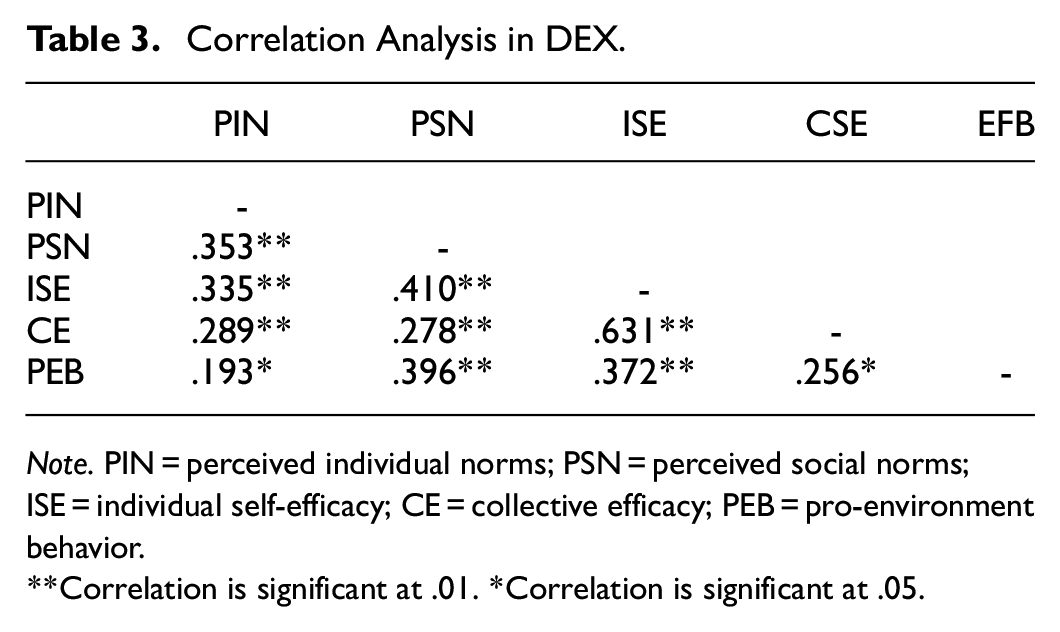
Note. PIN = perceived individual norms; PSN = perceived social norms; ISE = individual self-efficacy; CE = collective efficacy; PEB = pro-environment behavior.
Correlation is significant at .01. *Correlation is significant at .05.
Correlation Analysis in NOT-DEX.
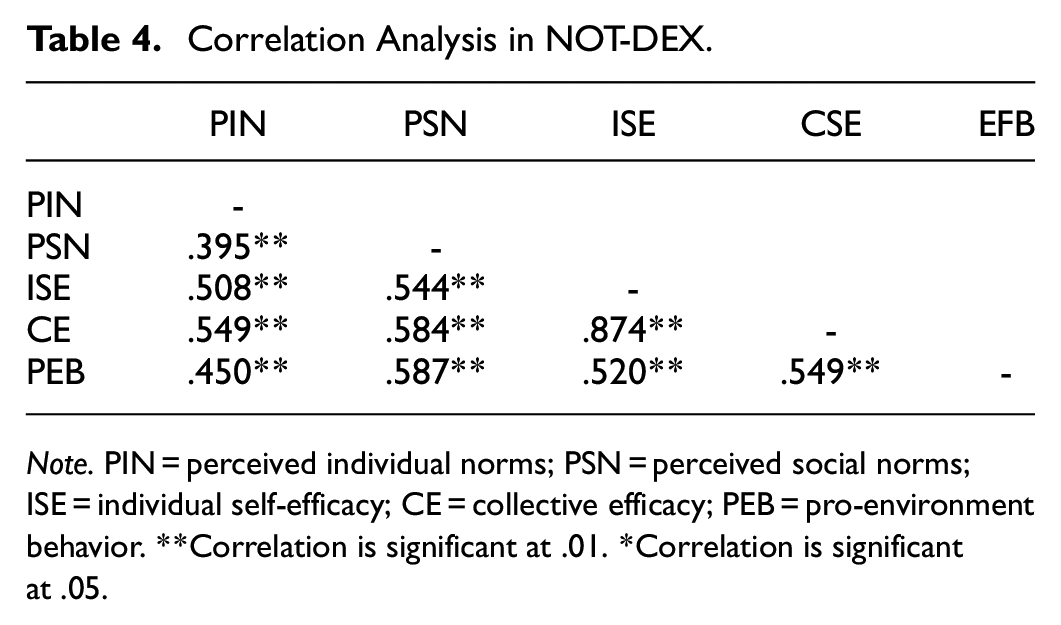
Note. PIN = perceived individual norms; PSN = perceived social norms; ISE = individual self-efficacy; CE = collective efficacy; PEB = pro-environment behavior. **Correlation is significant at .01. *Correlation is significant at .05.
As shown in Tables 3 and 4, all variables included in the study were related to each other at both DEX and NOT-DEX. In particular, perceived individual and social norms and individual and collective efficacy were significantly and positively related to PEB. The correlations were particularly strong in the case of NOT-DEX. Even though all variables considered in DEX had higher values (see Table 2), the relationships between them were particularly strong in the case of NOT-DEX.
Multiple regression analyses were performed to assess the effects of perceived individual and social norms and individual and collective efficacy on PEB. Tables 5 and 6 show the results for DEX and NOT-DEX, respectively. The regression model explained approximately 20% of the variance for DEX (R2 = .218) and 40% for NOT-DEX (R2 = .403).
Regression Analysis in DEX. Dependent Variable: PEB.

Regression Analysis in NOT-DEX. Dependent Variable: PEB.

As shown in Tables 5 and 6, in the case of DEX, perceived social norms and individual self-efficacy were found to be predictors of PEB, whereas in the case of NOT-DEX, only perceived social norms were significant predictors.
Discussion
In our literature review, we found that the decision to engage in PEB was related to perceived individual and social norms, as well as individual and collective efficacy. For our study, we examined these variables among a group of young adults in Pakistan and differentiated them into those who reported having direct experience with such climate change events and those who did not. The results show that DEX is more likely to follow individual and social norms, perceive higher levels of individual and collective efficacy, and be more willing to adopt PEB. Thus, the first hypothesis was confirmed. This result is particularly interesting. According to Ogunbode et al. (2022), the data on the nature of experience (direct or not) can be explained by climate change. They suggest that when studying PEB, variables need to be introduced that target what type of climate change experience is perceived. One possible explanation lies in the construct theory of psychological distance (Cheng et al., 2022; Rudiak-Gould, 2014). According to this theory, an event perceived with a high psychological distance appears abstract to the subject, with few details and low emotional correlates. In contrast, an event experienced firsthand is characterized by trauma, negative emotions, and experienced stress. At the same time, it could also lead to a greater awareness of the need to change the environment to mitigate the effects of climate change. It triggers a concrete concern for one’s own future and that of one’s community (Innocenti et al., 2023; Pahl & Bauer, 2013). This concern can lead to the adoption of PEB. In addition, DEX perceived greater self-efficacy than NOT-DEX. This may be related to the need to feel able to cope with further climate change events and environmental stressors, to learn from past experiences, and to grow after trauma, both for themselves and for the community. Survivors of climate change events may have the capacity to grow after these events (Hwong et al., 2022; Sattler et al., 2018; Yuhan et al., 2021; Zeligman et al., 2019). Kurian et al. (2016) examined another potentially mediating factor, spirituality, and associated individuals’ daily spiritual practice with “more perceived growth” and “lower PTSD symptoms” (p. 6). Werdel (2020) highlighted the unique role that religion and spirituality play in trauma disasters due to climate change. The author suggested that people who perceive (and experience) natural disasters could also be helped to grow through spirituality. In addition, work by Schultz and Zelezny (1998) has shown that values, particularly Schwartz’s self-transcending values, play a central role in predicting PEB (see also Lin & Li, 2022). This is a variable that we did not consider. Future research could further explore the possible mediating role of values, such as spirituality, in motivating people to engage in PEB after a direct experience with a climate change event.
As expected (hypothesis 2), all variables included in the study (perceived individual and social norms, individual and collective efficacy, and PEB) were related to each other at both DEX and NOT-DEX. Interestingly, the relationships between the variables were particularly strong in the case of NOT-DEX, although all variables considered had higher values on DEX. This result is not easy to interpret and we intend to explore it with further data analysis, considering, for example, the mediating role that other variables might play.
As Tabernero and Hernández (2011) found, individuals who care more about PEB set more ambitious goals, are more satisfied with the behaviors adopted, and feel more intrinsically motivated. Their study highlights the mediating role of intrinsic motivation in the relationship between self-efficacy and PEB. From a social cognitive perspective, Bandura (1977) asserts that creating appropriate learning contexts and experiences generates interest and new input, with self-efficacy and affective responses playing an important role. According to Bandura (1983), perceptions of self-efficacy explain how people develop an implicit interest in tasks for which they originally had no intrinsic motivation, as evidenced by the satisfaction they experience when participating in PEB (Salehi & Pazokinejad, 2022). Similarly, Locke and Latham (2002) discuss that any activity can arouse people’s implicit interest if the activity is challenging and provides feedback on success and goal achievement (Mar et al., 2023). Intrinsic and extrinsic motivation were not examined in this study. Further research could consider this and analyze this variable in more detail.
Because correlation analysis does not provide information about the causal relationship between variables, these results should be interpreted with great caution. For example, it is possible that the respective perceptions of one’s direct experience with climate change were in turn influenced by individual and social norms, individual and collective efficacy, or other variables that we did not consider.
Regarding the causal relationship between environmental norms, self-efficacy, and PEB, in the case of DEX, perceived social norms and individual self-efficacy were found to be predictors of PEB, whereas in the case of NOT-DEX, only perceived social norms were significant predictors. One possible explanation for the significant role of perceived social norms in both groups lies in the reference groups that influence individual and social norms and, consequently, the decision to participate (or not) in PEB (Boon-Falleur et al., 2022; X. Wang et al., 2016). A reference group that is particularly important to adolescents and young adults is a person or group of people who significantly influence another person’s behavior (Bearden & Etzel, 1982; Crandon et al., 2022). By enforcing conformity to group norms, reference groups influence individual PEB, lifestyle, self-concept development, and attitude formation. Group members who tend to conform to the group norm, in turn, influence members’ perceptions and ultimately their behavior. The opinions of reference groups can lead to positive attitudes toward members of that group and influence an individual’s decision about which PEB to pursue. Accordingly, people are more likely to engage in a particular behavior if it is consistent with the norms of a behaviorally relevant group membership (Constantino et al., 2022; White et al., 2009). For example, Terry et al. (1999) found that individual and social identity influenced intentions to participate in household recycling and to report recycling behavior. They found that the perceived norm of a behaviorally relevant reference group influences behavioral intentions (see also Lu & Wang, 2022). Thus, people’s decision making seems to be influenced by the norms of the reference group (Koo et al., 2015; Singh et al., 2022). Finally, individual self-efficacy plays an important role only at DEX. It is likely that individual self-efficacy influences PEB implementation especially among those who have experienced climate change and therefore have tested their own capabilities and are more aware of their direct role in intervening on behalf of the environment.
Limits
This study has several limitations. First, it is a cross-sectional study, so the results can only refer to the sample included in the study. The results may not be generalizable. Long-term studies and investigations before and after a climate change event could be useful to better understand the phenomenon and the influence of the studied variables on PEB. Second, we did not analyze possible differences in responses based on sociodemographic data. For example, J. Wang and Kim (2018) and Weckroth and Ala-Mantila (2022) found that higher income leads to more environmental awareness and less skepticism, so this variable could influence climate change perceptions and concerns. Further research could analyze in more detail how sociodemographic variables influence PEB. In addition, we did not consider climate change consequences such as eco-anxiety and eco-worry (Innocenti et al., 2023, Ogunbode et al., 2021) and media exposure (Maran & Begotti, 2021): many people know about climate change because they receive information indirectly through the media. Such content can elicit a variety of emotional responses, including anger, sadness, despair, fear, and guilt. Future studies could examine the relationship between media exposure and responses related to climate anxiety. Another limitation is that we measured perceived direct experience of climate change with a single item and did not give a specific definition of a climate change event, so participants may not have perceived that they were exposed to a climate change event because they tend to deny or downplay it. Or, on the contrary, they emphasize a weather phenomenon that has nothing to do with a climate change event (Osaka & Bellamy, 2020). Further research could analyze in more detail the different weather phenomena associated with climate change (e.g., temperature anomalies, floods, melting ice) and their perceptions of climate change or other phenomena, such as seasonal variations. Finally, social desirability (Van de Mortel, 2008), that is, the tendency of participants to give answers that they believe convey a positive image of them, might have influenced the results of the study. In addition, individuals who are particularly environmentally conscious may have chosen to participate in the study. Further research might consider using a scale to examine propensity for social desirability and levels of concern about climate change.
Conclusion
In conclusion, this study provides insight into the possibility of developing PEB in a group of young adults from Pakistan. Overall, consistent with previous studies, the results show that PEB are related to perceived individual and collective efficacy and norms. These findings underscore the importance of sharing information about good environmental practices, both to people who have perceived climate change and to those who have not. In this context, Corral-Verdugo et al. (2016) and Steg (2023) recommend a number of strategies to encourage individuals and groups to adopt PEB, such as informing people about the impacts of climate change and how to deal with it through the media. As mentioned earlier, studies show how information about reducing energy consumption can influence individuals’ behavior, and this reduction could lead to significant reductions in GHG emissions (e.g., Atchike et al., 2022; Elavarasan et al., 2022; Huang et al., 2022; Jinru et al., 2022; Luo et al., 2023; Qi et al., 2022). These strategies require whole community input: social policies, for example, could help reward PEB at the individual and group levels. In their meta-analysis, Maki et al. (2016) found that both financial and cash incentives had a stronger effect on PEB adoption (see also Vorobeva et al., 2022). An example might come from the university in Pakistan: Akhtar et al. (2022) described that green training and development programs (e.g., workshops and seminars) can provide participants with expertise and skills for managing environmental activities. It should be noted that reward packages relate to the acquisition of specific skills and competencies (and not just performance), as these are considered important factors for long-term performance (Vorobeva et al., 2022). In addition, knowledge of environmental laws can prevent serious accidents or illegal emissions. Disincentives include negative reinforcements such as criticism and warnings and may be necessary to encourage people to adopt PEB. Therefore, governments and communities could develop reward systems to encourage PEB through the use of incentives and disincentives.
Footnotes
Declaration of Conflicting Interests
The author(s) declared no potential conflicts of interest with respect to the research, authorship, and/or publication of this article.
Funding
The author(s) received no financial support for the research, authorship, and/or publication of this article.

Data Availability Statement
Data sharing not applicable to this article as no datasets were generated or analyzed during the current study.