



Abstract
Mistreatment in the workplace is a recurring and persistent threat to employee health and organizational productivity. Research has shown that there are five times as many cases of workplace mistreatment reported in China as in the United States. Therefore, we established the mistreatment-employee health relationship in Chinese companies. The search was conducted in the Web of Science, EBSCOhost, PsycInfo, and Google Scholar databases. The search terms used were “China,” “mistreatment,” “abuse,” “neglect,” “exploitation,” and “violence.” The search was not limited by the year of publication. The search found 1,527 articles, 65 of which met the inclusion/exclusion criteria and were used for data analysis and quality assessment. Our results show that the overall prevalence of abuse varies significantly but ranges from 18.5% to 94.6%. Psychological aggression by supervisors and customers was common in the healthcare industry. The experience of abuse was positively correlated with adverse consequences such as emotional fatigue, addiction, and suicidal ideation. By providing evidence of the effects of mistreatment, this study aims to help researchers and practitioners align their policies with global labor standards.
Introduction
Mistreatment has been compared to an epidemic: a recurring and ongoing source of threat to employee health and well-being (Feldblum & Lipnic, 2016). A report by the co-chairs of the EEOC selected task force (Feldblum & Lipnic, 2016) found that more than 30% of employees in the U.S had filed workplace harassment-related complaints. Further, an average of 15 employees die each day from work-related injuries, including those related to the mistreatment of employees (OSHA, 2020). In China, the situation is probably even worse. Official reports recorded about 75 deaths daily, with 15% associated with mistreatment (CLB, 2020). Despite growing attention and awareness of the link between mistreatment and health, the extent of abuse in Chinese companies remains largely unknown.
Workplace mistreatment is defined as interpersonal behavior aimed at harming employees at work (Bowling & Beehr, 2006). An employee’s experience of mistreatment can take many forms, including abuse, violence, harassment, bullying, ostracism, and discrimination (McCord et al., 2018). This behavior may be perpetrated by customers, co-workers, or supervisors. Mistreatment varies in severity, cause, and motivation and potentially leads to high employee stress, burnout, and psychological stress (McCord et al., 2018). At the organizational level, this leads to loss of productivity and economic loss associated with sickness leave (L. Y. Dhanani et al., 2021).
There is limited research investigating the effects of workplace mistreatment on health and well-being in China (Lu et al., 2020; Magnavita et al., 2019; Nielsen et al., 2020; Nyberg et al., 2021; Pacheco et al., 2021). Only one study estimated the overall prevalence of mistreatment in China to be 62.4% (Lu et al., 2020). The study also estimated that certain types of mistreatments (e.g., verbal abuse) ranged from 6.3% to 61.2%.
Research has established the relationship between workplace mistreatment and sleep-related problems (Magnavita et al., 2019; Nielsen et al., 2020), musculoskeletal disorders, decreased mental health (Pacheco et al., 2021), and health-related absenteeism (Nyberg et al., 2021). However, the results are not conclusive as most samples are from high-income countries and focus primarily on individual perpetrators, most prominently supervisors. For example, in Magnavita et al. (2019) review of 15 countries, only 3.3% of the 119,361 participants were from China. In a review of 29 studies by Pacheco et al. (2021), more than half were conducted in the Americas, and only four were in Asia. Therefore, these studies underestimate the prevalence of mistreatment in Eastern, low-and middle-income economies and their findings may not reflect the actual trends in countries like China. In this study, China is a generic term for countries with a common language and cultural heritage; namely mainland China, Hong Kong, Taiwan, and Macau.
It is unclear whether these studies are also applicable to the Chinese situation for several reasons. First, as China witnessed rapid industrialization, urbanization, and economic growth, attention shifted to labor law and policy. Many media reports highlighted the infringement of Chinese workers’ rights (Kuo & Chen, 2021) and, in extreme cases, death (Ming, 2021). These reports provide an opportunity to investigate the prevalence of mistreatment in China and update previous records (Lu et al., 2020). Second, cultural differences can affect employee awareness and response to abuse. Studies have shown that China’s prevailing collectivist coping strategies differ from individualist ones (Yeh et al., 2006). Such values promote emotional self-restraint and hypervigilance (H. Kim & Markus, 2002) and influence how they deal with mistreatment (Chokkanathan, 2018). Examining mistreatment in this context creates awareness that promotes early detection and intervention (Groth et al., 2019). Finally, previous reports point to the lack of systematic statistics on the extent of mistreatment in China (Eurofound and International Labour Organization, 2019). Lu et al. (2020) study focuses on China, but they only investigate healthcare professionals, and the results cannot be generalized to all work situations.
To fill this gap, we conducted a systematic review of the prevalence and impact of mistreatment on the health and well-being of Chinese employees. Specifically, we disaggregated mistreatment by type of perpetrator (supervisor, co-workers, or customer) and alternative health outcomes (physical, behavioral, cognitive, domain-specific, and emotional). We also analyze mediators and boundary conditions that can exacerbate the effects of mistreatment. We perform a systematic literature review because it will help us to synthesize and summarize the research on different types of mistreatments from multiple sources. By systematically organizing this literature, we will identify gaps in the existing research and draw conclusions about the current state of knowledge. We could not perform a meta-analysis because of the heterogeneity of our studies. Further, our sample was likely to have publication and reporting biases that would result in inadequate summarization. To fulfill our objectives, we have organized this study in various sections; methods, discussion, implications, limitations and future directions.
Methods
Following best practices for systematic reviews, we followed the Preferred Reporting Items for Systematic Reviews and Meta-Analyses (PRISMA; Page et al., 2021) and pre-registered the study protocol and search strategy (PROSPERO ID: CRD42021283114)
Search Strategy
The search was conducted in the Web of Science, EBSCOhost, PsycInfo and Google Scholar databases on 24th August 2021 to extract articles published in English. The search terms used were “China,”“mistreatment,”“abuse,”“neglect,”“exploitation,” and “violence.” We examined existing systematic reviews and adopted their keywords and their versions (Fischer et al., 2021; Fosse et al., 2019; Hodgins et al., 2014; Lugosi, 2019; Schilpzand et al., 2015, 2016; Sommovigo et al., 2019; Yu et al., 2020). For Web of Science, our search was as follows: (“bullying” OR “harassment” OR “incivility” OR “mobbing” OR “victimization” OR “ill-treatment” OR “rudeness” OR “bad manners” OR “discourtesy” OR “disrespect”) AND (“work” OR “workplace” OR “work-related” OR “job-related”) AND (“health” OR “well-being” OR “well-being”) AND (“China” OR “Chinese”). The detailed search terms are in Supplemental Appendix 1.
This initial search yielded 1,527 articles, of which 763 articles were from the Web of Science, and the rest were from EBSCOhost (274), APA PsycInfo (487) and Google Scholar (3). We identified 727 duplicates through automatic duplication detection by Mendeley referencing tool (version 1.19.18) and hand search. Finally, we removed two articles that were not in English, leaving 798 articles for further screening.
Inclusion/Exclusion Criteria
We had three inclusion criteria during the screening and eligibility stages. Articles were included if: (i) they had undergone the peer-reviewed process; (ii) they included participants residing in China; and (iii) they applied quantitative or mixed methods.
We excluded 387 articles not relevant to the study leaving 431 eligible articles. Two reviewers screened individual titles and abstracts. All the receivers reached a consensus on any conflicts during the inclusion/exclusion process. They excluded several articles on closer inspection because they did not report outcomes related to health and well-being (n = 71); the geographical location was outside of China or was not mentioned (n = 39); the mistreatment happened in contexts other than the workplace (e.g., at school or among couples; n = 98); not peer-reviewed articles (n = 72); the articles had been retracted (n = 1); they were not quantitative studies (e.g., qualitative; n = 85). A total of 65 studies retrieved from the databases fulfilled the inclusion criteria and were used in the review. See Figure 1 for the PRISMA flow diagram that describes the inclusion/exclusion process.

PRISMA 2020 flow diagram for new systematic reviews, which included searches of databases, registers, and other sources.
Data Extraction and Analysis
We extracted critical parameters from the studies into an Excel spreadsheet. The following parameters were extracted from the studies: author, journal name, country, theoretical framework, study design, the context of the study, perpetrators, measuring instrument, type of abuse, main findings, mediators, and moderators. Two team members assessed each of the extracted articles, and any uncertainties were resolved by contacting a third independent reviewer.
Quality Assessment
Two research team members independently evaluated the quality of each study using a quality rating tool adopted from previous systematic reviews (e.g., Cummings et al., 2010). A discussion with a third independent reviewer resolved any differences. A customized tool (See Supplemental Appendix 2) was used to evaluate four areas of each study: study design, sampling, measurement, and statistical analysis. The tool consisted of 13 items, and a total of 14 possible points could be assigned to each study. Twelve items were rated 0 (not met) or 1 (met), and one item measuring mistreatment was rated 2 (objective observation), 1 (self-report), and 0 (not met). As per instruction within the tool, a global rating was given for the study. Global scores were assigned to each study as instructed by the tool. After scoring, each study was categorized as high (10–14 points), medium (5–9 points), or low (0–4 points). The lead author reviewed and confirmed that all the studies had been extracted, analyzed, and assessed.
Results
Most of the 65 studies included in the final sample were performed in Mainland China (n = 46). The rest were conducted in Taiwan (n = 16), Hong Kong (n = 1), and Macau (n = 1). One study compared the impact of gender discrimination and job-related outcomes in the United States, Mainland China, and Hong Kong. Table 1 summarizes the studies included and their key findings. The majority of the studies were from health (n = 25), accommodation and catering (n = 7), education (n = 8), information communication and technology (n = 10), leasing and business services (n = 3), manufacturing (n = 4), and transport, storage and post (n = 2) industries. The mistreatment originated from the supervisor (n = 23), co-workers (n = 3), or customers (defined broadly to include patients, students, and the public; n = 19). The other studies either examined multiple perpetrators (n = 5) simultaneously or were not specific (n = 15). Most of the studies examined abusive supervision (n = 19), workplace violence (n = 16), customer mistreatment (n = 9), incivility (n = 8), and bullying (n = 5). Gender discrimination, verbal violence, toxic work environments, despotic leadership, psychopathic leadership, perceived victim identity, consumer behaviors, and cyber-bullying were examined in single studies.
Study Characteristics and Workplace Mistreatment Outcomes.
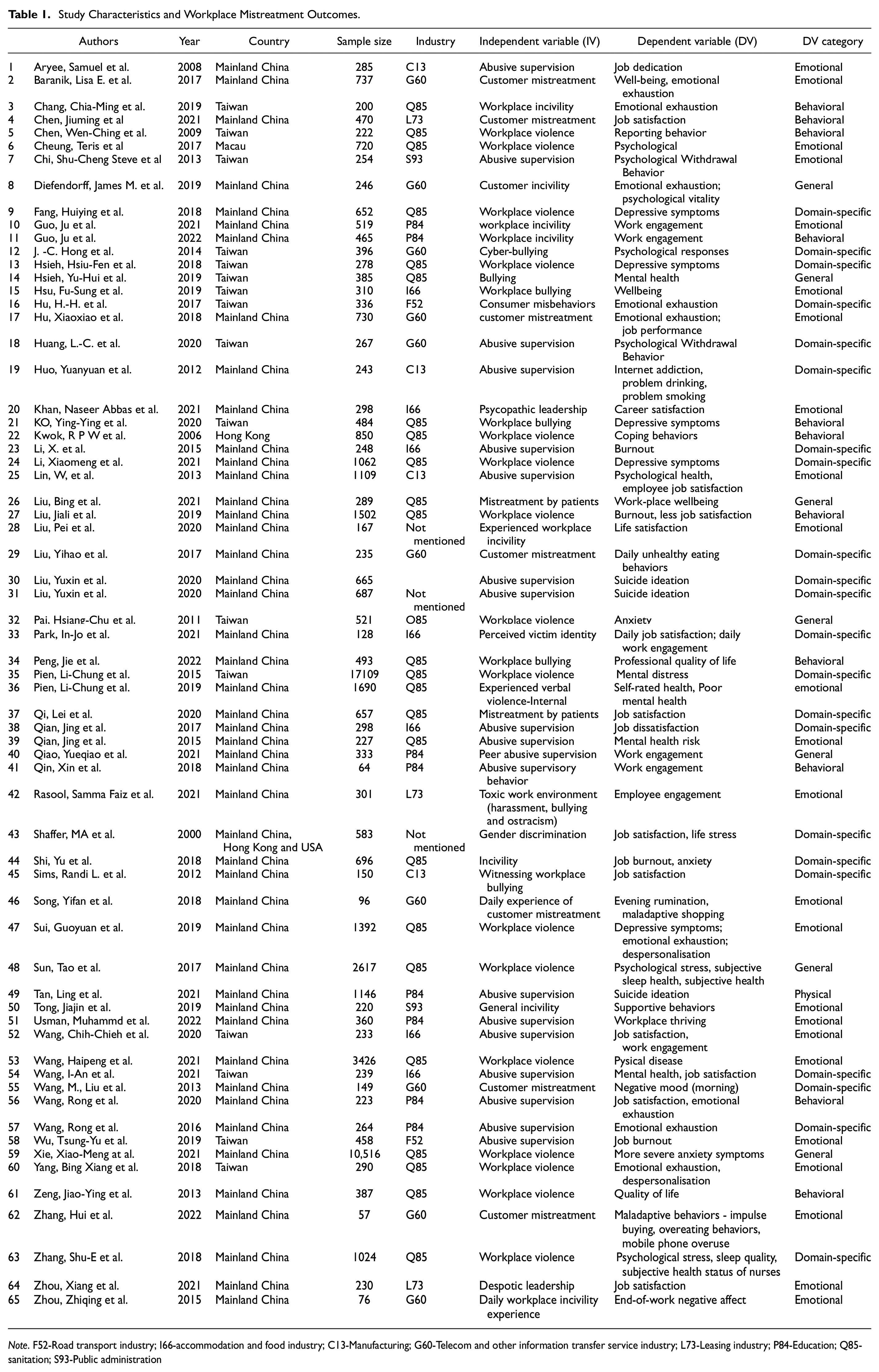
Note. F52-Road transport industry; I66-accommodation and food industry; C13-Manufacturing; G60-Telecom and other information transfer service industry; L73-Leasing industry; P84-Education; Q85-sanitation; S93-Public administration
First, we summarize prevalence estimates indicating the scale and frequency of workplace mistreatment in China, followed by disaggregating studies by perpetrators (e.g., supervisors, co-workers, and customers). Then we summarize the mediators and moderators that influence the mistreatment-health and well-being relationship. Finally, we report on the findings of the quality assessment.
Prevalence of Mistreatment
First, we report on the prevalence of mistreatment in China. Fourteen studies reported a prevalence of mistreatment (W. C. Chen et al., 2009; Cheung et al., 2017; Kwok et al., 2006; J. Liu et al., 2019; Pai & Lee, 2011; Pien et al., 2015, 2019; Sui et al., 2019; H. Wang et al., 2021; Xie et al., 2021; B. X. Yang et al., 2018; Zeng et al., 2013; S. E. Zhang et al., 2018). The prevalence rates reported in these studies reflects the number of employees who reported being abused (or witnessed) divided by the total number of employees in the sample. These studies only investigated mistreatment in hospitals (workplace violence). They conceptualized mistreatment based on the definitions of the International Labor Organization, the International Council of Nurses, the World Health Organization, and the Public Services International (ILO/ICN/WHO/PSI, 2003). The survey questions asked if the participants had experienced at least one mistreatment incident in the workplace (i.e., have selected at least one item on the scale of the abuse) or if they acknowledged they had experienced/observed the abuse. Employees were considered victims or witnesses of abuse if they answered “yes” to the question “Have you ever experienced any of the following types of mistreatment during the 12 months before the survey” (Pien et al., 2015).
Prevalence rates varied across countries (Kwok et al., 2006; J. Liu et al., 2019; Sui et al., 2019; H. Wang et al., 2021; Xie et al., 2021; B. X. Yang et al., 2018; Zeng et al., 2013). In Mainland China, mistreatment was at its highest in 2013 at 82.4% (Zeng et al., 2013), followed by 77.5% (Sui et al., 2019), 75.4% (S. E. Zhang et al., 2018), 52.2% (H. Wang et al., 2021) and lowest in 2021 at 18.5% (Xie et al., 2021). The other studies reported prevalence rates of 76% in Hong Kong (Kwok et al., 2006), 57.2% in Macau (Cheung et al., 2017), and 94.6% in Taiwan (B. X. Yang et al., 2018).
The participants were allowed to identify more than one type of mistreatment within a specified timeframe. They reported having experienced two (n = 1), three (n = 3), four (n = 3), five (n = 2), seven (n = 2) types of mistreatments by selecting verbal abuse, physical violence, sexual harassment, psychological violence, bullying, and discrimination. Sexual harassment (n = 11), verbal abuse/threats (n = 11), physical violence (n = 11) were the most examined types of mistreatments. In all the studies, Yang et al. (2018) reported the highest prevalence rates for sexual harassment (63.4%), physical violence (81.9%), and verbal abuse/threat (92.1%). S. E. Zhang et al. (2018) reported the lowest prevalence rate of sexual harassment (5.9%), and Xie et al. (2021) reported the lowest prevalence rates for physical violence (8.4%) and verbal abuse (15.8%). Figure 2 shows the prevalence of mistreatment by category.

Prevalence of mistreatment by category.
In the surveys, participants needed to recall when they were mistreated. The participants reported whether they had been abused in the last month (e.g., past week, n = 1), previous 6 months (n = 1), previous 12 months (n = 9), or a time frame longer than 12 months (n = 3).
The studies had different ways of reporting prevalence. Eight studies reported the prevalence rate as a single value. Out of these, one study had a prevalence rate of less than 50%. This study had a large sample size of 10,516 (Xie et al., 2021). The rest had sample sizes that ranged from 290 to 3,426 participants (Cheung et al., 2017; Kwok et al., 2006; Sui et al., 2019; H. Wang et al., 2021; B. X. Yang et al., 2018; Zeng et al., 2013; S. E. Zhang et al., 2018). In a study by Zeng et al. (2013), workplace violence in 22 counties/cities in mainland China ranged from 4.7% to 14.7% for men and 6.4% to 14% for women. The disparity in mistreatment for men was higher than for women. Other factors that influenced the prevalence of mistreatment were work routines, working hours, patient gender, educational background, faculty, tenure, and position.
The prevalence of mistreatment in China varies according to conceptualization, measurement, timeframe, and type of mistreatment. These studies were conducted using quantitative methods such as surveys and interviews, while others were conducted using qualitative methods such as case studies and ethnographic research. The quality of the studies varies, with some studies being more rigorous than others. Overall, however, these studies have provided valuable insights into the prevalence and nature of mistreatment of Chinese employees. A weakness of these studies is that they are often limited in scope and rely heavily on self-reported data. This means that the results of the studies may not be representative of the entire population of Chinese employees. Additionally, the studies often lack control groups, making it difficult to draw conclusions on the impact of mistreatment on employee performance. Few studies consider the cultural context in which mistreatment occurs, but we can conclude that more 18.5% do.
Perpetrators of Mistreatment
The studies used two approaches in identifying the perpetrators of mistreatment. First, 34 studies asked employees to rate labeled measures (e.g., abusive supervision, customer/consumer behavior) and items that mentioned the perpetrator (e.g., I believe that my supervisor has “victimized” me; Park et al., 2021). One study (Khan et al., 2021) asked the supervisors to rate their behavior. The rest of the studies used unlabeled measures (e.g., workplace violence; n = 22) but requested the participants to indicate the source of violence (n = 8).
Studies were analyzed based on the reported means. Three studies had means that exceeded 30. Hsieh et al. (2019), M = 30.24; SD = 10.92, N = 385) and Ko et al. (2020), M = 34.5, SD = 13.3, N = 484) used the 22-item Negative Acts Questionnaire (NAQ-R) developed by Einarsen et al. (2009) to measure workplace violence. Qian et al. (2015) had a mean of 35.23 (SD = 12.46, N = 227), and abusive supervision was measured using 15-items developed by Tepper (2000).
For ease of analysis, the mistreatment types were classified into five categories: bullying, incivility, psychological aggression, sexual harassment, and violence. These categories were synthesized from the mistreatment scale items and measures and adopted from previous literature (L. Y. Dhanani et al., 2021). The majority of the studies examined either psychological aggression (n = 34) or workplace violence (n = 18). The rest examined bullying (n = 4), incivility (n = 8), and sexual harassment (n = 1). Supervisors (n = 21) and customers (n = 10) were the main sources of psychological aggression. Customers (n = 12) and co-workers (n = 5) perpetrated workplace violence. Studies that examined sexual harassment, bullying, and incivility did not specify the perpetrator (anonymous). Eight studies reported perpetrators (Cheung et al., 2017; Ko et al., 2020; Kwok et al., 2006; Pai & Lee, 2011; Peng et al., 2022; Sun et al., 2017; J. H. Yang et al., 2019; Zeng et al., 2013). The breakdown of the relationship between perpetrator and mistreatment category is shown in Figure 3a. Employees in the eight industries experienced supervisor psychological aggression, and customer psychological aggression was common in four industries; anonymous incivility was in three industries. Employees in the health, social security, and social welfare industry experienced all types of mistreatments from all the perpetrators. Figure 3b shows the distribution of mistreatment across industries.

(a) The relationship between perpetrator and mistreatment category and (b) the relationship between mistreatment category, perpetrator and industry.
Figure 4 shows the distribution of studies examining the perpetrators of mistreatment over the years. As shown in Figure 5, numerous outcomes were examined concerning mistreatment. For ease of analysis and discussion, these outcomes were grouped into five broad categories; physical (e.g., somatization and insomnia), behavioral (e.g., eating disorders, addictions), cognitive (e.g., decision making), domain-specific (e.g., work engagement, and job satisfaction), emotional (e.g., mood and emotions) and general (e.g., general well-being).

The distribution of studies examining the perpetrators of mistreatment over the years.

Impact of mistreatment on employee health and well-being
The relationship between mistreatment and the outcomes varied across studies, and some positively associated mistreatment with worse physical (n = 1) and behavioral (n = 10) outcomes. Similarly, a positive association between mistreatment and adverse health outcomes was mainly observed in studies investigating domain-specific (n = 6) and emotional-based well-being (n = 21). The findings reveal that employees’ experience of mistreatment is negatively correlated with health and well-being outcomes such as work engagement (Guo et al., 2021), job satisfaction (C. C. Wang et al., 2020), and thriving (Usman et al., 2022).
Employees’ experience of mistreatment was positively correlated with undesirable outcomes such as emotional exhaustion (Chang et al., 2019), addictions (Huo et al., 2012), and suicide ideation (Y. Liu et al., 2021). This negative impact varied with the type of mistreatment and perpetrator. For instance, the risk of sleep disturbance was higher when the perpetrator of violence was internal (e.g., supervisor or a co-worker; OR = 5.684, 95% CI [4.195, 7.702]) than when it was an external perpetrator (e.g., client; OR = 2.991, 95% CI [2.301, 3.889]) (Yoo et al., 2016). Employees reported the highest level of maladaptive behaviors—impulse buying (r = .44, p < .001), mobile phone overuse (r = .26, p < .001) and unhealthy eating behaviors (r = .33, p < .01) when mistreated by customers (H. Zhang et al., 2022).
In five studies, the mistreatment-health and well-being relationship was insignificant. For instance, Huo et al. (2012) examined the relationship between abusive supervision and problem drinking (r = .06, ns). H. Zhang et al. (2022) examined the relationship between customer mistreatment and overeating behaviors (r = .09, p = .37). Tong et al. (2019) found that both the general experienced incivility-supportive behaviors (r = .04, p = n.s) and general observed-supportive behaviors relationship (r = .01, p = n.s) was insignificant. Tong et al. (2019) found that the relationship between experienced incivility and emotional exhaustion was positive but insignificant (r = .13, p = ns).
Six studies found the relationship between mistreatment and work engagement was insignificant with positive (three studies) and negative (three studies) relationships. The studies that reported positive outcomes were collected from student samples (Qiao et al., 2021; Qin et al., 2018). Ten studies did not specify the perpetrator but reported the highest level of anxiety (Duru et al., 2018; Shi et al., 2018), emotional exhaustion (Sui et al., 2019; Tong et al., 2019), burnout, depression (X. Li & Wu, 2021; Sui et al., 2019) and stress (Chan et al., 2008; Hong et al., 2021; Pien et al., 2015; Shaffer et al., 2000). Mistreatment triggered higher levels of negative affect (r = .29, p < .001) and anger
Impact of Mistreatment on Employee Health and Well-Being.

Supervisors were identified as the leading source of mistreatment in China, followed by customers and employees. These studies also found that abusive supervision was associated with higher levels of distress than co-worker and customer mistreatment. This suggests that mistreatment by management can harm employees more than abuse by colleagues or customers. The study also found that employees who were abused by their superiors were more likely to report significant adverse health and well-being, whereas other studies found the effects to be more subtle. For example, some studies have found that abuse can lead to increased stress and anxiety, while others have found that abuse can lead to improved resilience and coping skills. Additionally, some studies have found that abuse can lead to lower job satisfaction and engagement, while others have found that abuse can lead to increased workplace stress and burnout. Finally, abuse can lead to lower organizational commitment, poorer job performance, and increased intention to leave. Therefore, managers must treat their subordinates fairly and maintain a healthy and productive work environment. Overall, workplace abuse can have a wide range of negative effects on both individuals and organizations. It is important that employers recognize the potential consequences of abuse and take steps to ensure that all employees are treated with respect and dignity. However, a weakness of these studies is that they often lack a comprehensive approach. Most studies focus on a single aspect of mistreatment while failing to consider emotional abusee or neglect and the wider context of the work environment.
Mediators
Mistreatment is usually considered an event that affects distal outcomes (e.g., engagement and satisfaction) through direct mechanisms (e.g., negative affect, Fischer et al., 2017). Thirty-three out of 65 studies in our review examined mediators. Recent reviews of the literature on mistreatment (Lugosi, 2019; Sommovigo et al., 2019; Yu et al., 2020) have identified three categories of proximate mechanisms: (i) individual and personality factors, (ii) organizational factors, (iii) interpersonal, social, and cultural-based factors. We draw upon these frameworks here. Emotional exhaustion was the most common mediator (Aryee et al., 2008; Chi & Liang, 2013; Huang et al., 2020). Negative mood, self-efficacy, psychological needs, strain, and rumination were used in two studies. The other mediators were used only once. As shown in Table 3, the proposed mediators fall into one of these categories.
Proposed Mediators.
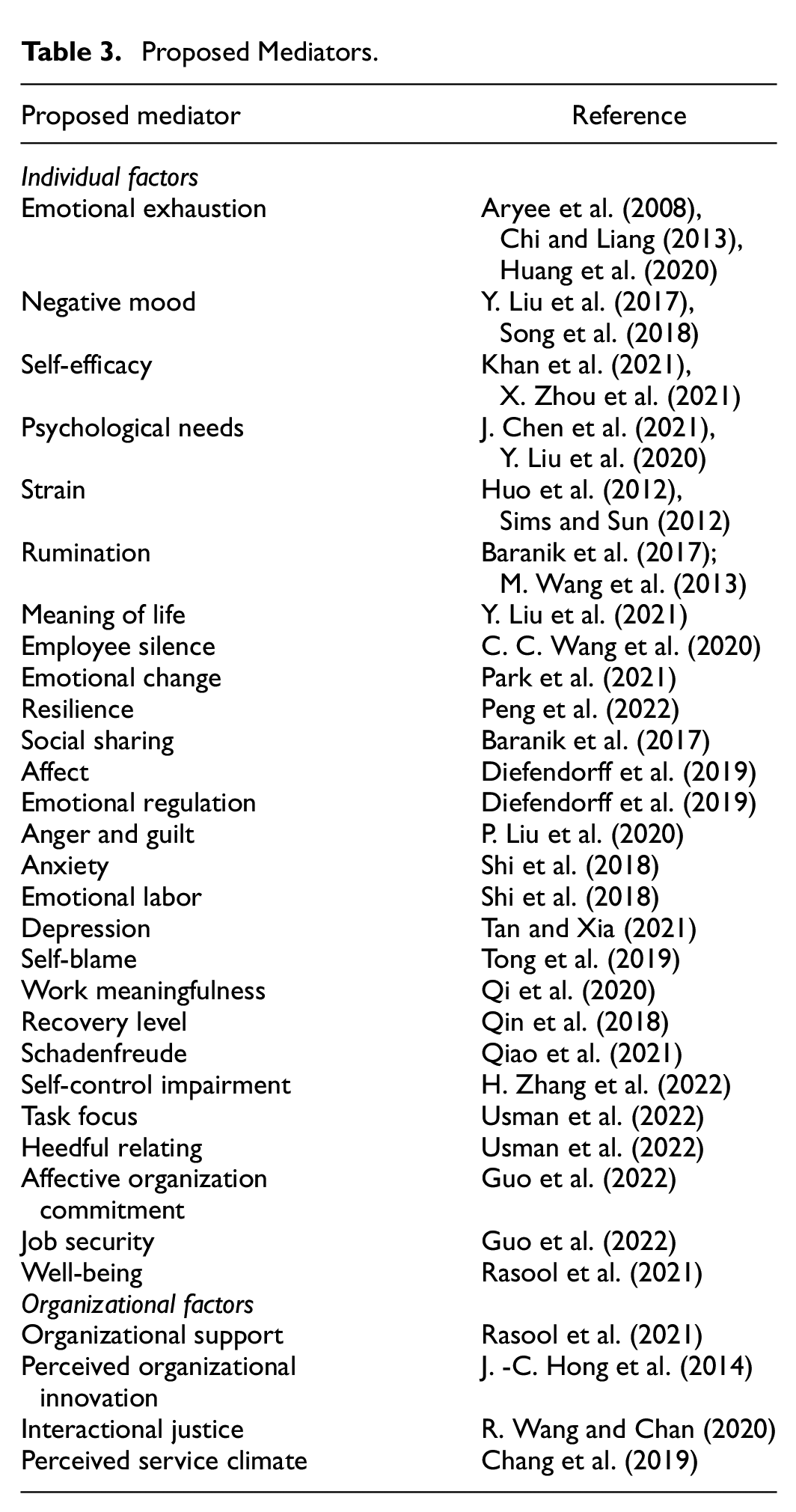
All the reviewed studies either examined single mediators or mediators from one category. Further, similar mediating mechanisms were explained using multiple frameworks. For instance, emotional exhaustion as an outcome of abusive supervision was explained by the conservation of resources theory (Chi & Liang, 2013) and the job demands-resources model (Huang et al., 2020). Customer mistreatment predicted negative mood (or affect) as explained by the social mindfulness theory (Song et al., 2018), self-regulatory theories (Y. Liu et al., 2017), and control theory of emotional labor (Diefendorff et al., 2019). As an exception, the mediating effect of psychological needs (e.g., need for autonomy, relatedness need) was only examined using the self-determination theory (SDT; J. Chen et al., 2021; Y. Liu et al., 2020). Interestingly, these psychological needs had inconsistent mediating effects. For instance, the relationship between abusive supervision and suicidal ideation was partially mediated by needs for competence and relatedness (Y. Liu et al., 2020). Y. Liu et al. (2020) also found that the need for autonomy (b = −0.06, ns) did not mediate this relationship. J. Chen et al. (2021) found that relatedness needs satisfaction had no mediating effect on the relationship between customer mistreatment and job satisfaction (B = −0.10, S.E. = 0.09, p > .05).
Moderators
Across all studies, 55 moderators were proposed and tested. Like the mediators, the moderators fell into three categories; (i) individual and personality factors, (ii) interpersonal, social, and cultural factors, and (iii) organizational factors. The detailed list of moderators and their effects is shown in Table 3. Studies reported that the domain-specific health outcomes (e.g., work engagement) were significantly higher when moderated by individual and personality factors, for example, self-perceived employability and schadenfreude (witnessed incivility). However, Qin et al. (2018) study found the indirect moderating effect of empathic accuracy on the relationship between abusive supervision and work engagement was negative and significant (β = −.50, p < .05).
Eleven of these studies found that the proposed moderators do not affect the main relationships. Three of these studies examined the effect of the interaction between mistreatment from internal perpetrators (e.g., customers) and various moderators on health outcomes. They found that perspective-taking intervention (Song et al., 2018) surface acting (Baranik et al., 2017), learning (H. Zhang et al., 2022), sleep quality (Y. Liu et al., 2017), emotional contagion susceptibility (B. Liu et al., 2021), training and participation (Hu et al., 2018) did not moderate the relationship between mistreatment from customers and negative mood (γ = −0.14, p > .10), cognitive rumination (γ = 0.22, p = .35), social sharing of negative work events (γ = 0.19, p = .24), healthy food consumption (γ = 0.01, p < .05), emotional exhaustion (γ = 0.19, p > .05), workplace well-being (β = .003, n.s.), and self-control capacity impairment (γ = 0.25, p = .30). Two studies examined the interaction between abusive supervision, ethical leadership (R. Wang & Chan, 2020), and cooperative goal interdependence (Qiao et al., 2021). They found that these moderators did not influence interactional justice and work engagement (B = − 0.01, p = .80). One study indicated that psychological capital (PsyCap) did not moderate the relationship between workplace incivility and emotional burnout (Chang et al., 2019). As a second stage moderator, emotional exhaustion did not moderate the relationship between emotional change and daily work engagement (γ = −0.04; p > .05) (Park et al., 2021).
The findings of these studies reveal that employees who are mistreated may use different coping strategies to manage their stress, such as avoidance, problem-solving, or seeking social support. These strategies can have a direct impact on their health and wellbeing. These studies found that boundary conditions, such as social support, can buffer the effects of stress on health outcomes, meaning that individuals with higher levels of social support are less likely to experience negative health outcomes due to stress.
Quality Assessment
The quality assessment was based on study samples, research design, and analysis (Table 4). The final 65 studies used cross-sectional, experience sampling (ESM), experiments, and time-lagged research design. The majority of the studies were rated medium (n = 45) quality. The rest were either high (n = 19) or low (n = 1) quality. Only 25 studies were prospective, partially due to the influence of time on mistreatment. Only one study used probability sampling, as most studies either used random or convenience sampling methods to study mistreatment in specific groups or units. Fifteen studies addressed the appropriateness of sample size, and 39 studies were multisource. All the studies addressed respondents’ anonymity, and 56 met the minimum response rate threshold of 60%. Fifty-nine studies had reliable and valid mistreatment measures. Sixty-one had valid study instruments, and the reported study outcomes were reliable. Fifty-seven reported the outcome correlations, and only nine managed the outliers.
Summary of Quality Assessment-65 Included Quantitative Studies.

This item scored 2 points. All others scored 1 point.
The quality of studies examining the relationship between mistreatment and employee health and well-being in China is generally high. Most studies have used rigorous methods to collect data and analyze the results. For example, many studies have used large sample sizes, employed valid and reliable measures, and used sophisticated statistical techniques to analyze the data.
Discussion
Our review found that mistreatment impacts employee health and well-being. The prevalence of mistreatment in China varies in terms of conceptualization, measurement, timeframe, and type of mistreatment. In terms of conceptualization, mistreatment in China is often defined as any form of physical, psychological, or sexual abuse, neglect, exploitation, or discrimination. In terms of time frame, mistreatment can be measured over a short period of time or over a longer period of time (Cole et al., 2016). In terms of type of mistreatment, it can include physical abuse, psychological abuse, and sexual abuse. Physical abuse can include hitting, slapping, pushing, kicking, or any other type of physical force. Psychological abuse can include verbal abuse, threats, intimidation, isolation, and manipulation. Sexual abuse can include any type of unwanted sexual contact or activity (L. Y. Dhanani et al., 2021; McCord et al., 2018).
Supervisors were identified as a major source of mistreatment in China followed by customers and then co-workers. Supervisors were identified as the primary source of mistreatment due to their power and authority over employees (Schilpzand et al., 2016). Customers were identified as a source of mistreatment due to their ability to make demands and complaints that employees must comply with (ILO, 2019). Co-workers were identified as a source of mistreatment due to their ability to create a hostile work environment and engage in bullying or other forms of harassment (Hershcovis & Barling, 2010).
The prevalence of mistreatment among Chinese employees is difficult to measure, as it is often unreported due to fear of retribution or lack of awareness of legal rights. However, our findings reveal an overall prevalence ranging from 18.5% to 94.6%. Prevalence of mistreatment was highest in Taiwan (94.6%) compared to Mainland China (82.4%), Hong Kong (76%), and Macau (57.2%). Similar to China, mistreatment is prevalent in the West. According to the World Health Organization, prevalence of workplace mistreatment in the US is estimated to be between 25% and 50% (L. Y. Dhanani et al., 2021). A survey of over 1,000 Chinese employees found that nearly half of employees had experienceH. d mistreatment in the workplace (Zhang, 2021). Additionally, a study of over 1,000 Chinese migrant workers found that nearly two-thirds had experienced some form of discrimination in the workplace. The study found that the majority of migrant workers felt that their employers did not respect their rights or provide them with adequate protection (Han et al., 2014). These findings suggest that mistreatment of employees is a serious issue in China and that more needs to be done to ensure that all workers are treated fairly and with respect.
Implication of the Study
Theoretical Implications
The study of the relationship between workplace mistreatment and employee health among Chinese employees has five theoretical implications. First, we develop a theoretical framework that can explain this relationship. The mistreatment of Chinese employees can have a significant impact on their health and well-being. Our findings are consistent with previous research that has found that workplace mistreatment can lead to physical and psychological health problems. Mistreatment can include physical, psychological, and emotional abuse, as well as discrimination and harassment. This mistreatment can lead to a range of physical and mental health issues, such as depression, anxiety, and post-traumatic stress disorder. It can also lead to decreased job satisfaction, decreased productivity, and increased absenteeism (L. Y. Dhanani et al., 2021). In addition, mistreatment can lead to feelings of isolation, low self- esteem, and depression. Victims of mistreatment may also experience physical symptoms such as headaches, stomachaches, and difficulty sleeping. In extreme cases, mistreatment can lead to suicidal thoughts or actions.
Second, we highlight the theories that were presented as explanatory mechanisms of the relationship between workplace mistreatment and employee health. Figure 6 shows the framework developed to guide our discussion. From the proposed framework, we believe that the Affective Events Theory (AET; Weiss & Russel, 1996) fits the data better. Affective events theory (AET) suggests that employees’ reactions to workplace events are based on their emotional responses to those events. These emotional reactions are determined by the perceived level of importance of the event. AET suggests that employees’ reactions to mistreatment in the workplace can be negative, leading to decreased job satisfaction, decreased commitment to the organization, and increased turnover intentions. Employees may also experience psychological distress, such as anxiety, depression, and anger. Additionally, employees may respond to mistreatment by retaliating against the perpetrator, either through direct or indirect means. This can lead to further conflict and a decrease in organizational productivity. In our review, workplace mistreatment had an impact on employee attitudes and behaviors leading to poor employee health and well-being.

Proposed framework.
Third, we highlight pre-mistreatment interventions strategies that would help employees prepare for and cope with stressful events before they occur. Compared to post-treatment interventions (i.e., strategies used to help individuals cope with the aftermath of a stressful event), pre-mistreatment interventions are more effective in preventing mistreatment. Previous studies have found that pre-mistreatment interventions can be effective in reducing the severity of symptoms and the need for more intensive treatment (Colizzi et al., 2020; Sirey et al., 2020). For example, a study of pre-treatment interventions for depression found that those who received pre-treatment interventions had significantly lower levels of depression symptoms than those who did not receive pre-treatment interventions (Sirey et al., 2020). Additionally, those who received pre-treatment interventions were less likely to require more intensive treatment than those who did not receive pre-treatment interventions (Colizzi et al., 2020). These strategies can include education and training on appropriate behavior, policies and procedures to prevent mistreatment, and systems to monitor and respond to potential mistreatment.
Fourth, these findings suggest that mistreatment in China and the West differs significantly. Our literature review revealed that mistreatment of Chinese employees can include things like long working hours, low wages, and lack of job security. In US forms of mistreatment include discrimination, harassment, and unfair wages (X. Zhang et al., 2019). The studies in our review tended to focus on physical and psychological abuse, while studies in the West have tended to focus on emotional abuse and neglect (L. Y. Dhanani et al., 2021). In addition, the studies we reviewed tended to focus on the effects of mistreatment on the victims, such as the domain-specific (e.g., work engagement and job satisfaction) and emotional outcomes (e.g., negative emotions, rumination and suicide ideation). While the studies in the West focused on factors that lead to mistreatment, such as poverty, lack of education, and social isolation (Willness et al., 2007). They have also looked at the role of cultural norms and values in perpetuating mistreatment (L. Dhanani et al., 2019). In addition, research in the West has examined the impact of mistreatment on individuals, families, and communities (Okubo et al., 2022). Finally, studies in the West have explored the effectiveness of interventions to reduce mistreatment and promote positive outcomes (Okubo et al., 2022).
Finally, workplace hierarchies and cultural factors play an essential contextual role in the perception of mistreatment in reviewed articles. Qin et al. (2018) found that abusive behavior had a short-term positive impact on supervisors’ recovery and work engagement. Lin et al. (2013) showed that subordinates with low (high) power distance orientation were affected by abusive supervision and had a more dramatic impact on their health and well-being. Under these circumstances, Chinese supervisors gain a sense of control through abusive behavior (Farh et al., 2007; Jiang & Gu, 2016; Vogel et al., 2015). Mistreatment is considered primarily unfair and inappropriate in the West, but in China, cultural values such as power distance orientation determine social stratification and the perception of behavior (Farh et al., 2007; Vogel et al., 2015).
Managerial Implications
The findings of this study have important implications for managers. First, it is important for organizations in China to have policies and procedures in place that protect employees from mistreatment by managers. Supervisors were identified as a major source of mistreatment in China followed by customers and then co-workers. Abusive supervision was associated with higher levels of distress than co-worker and customer mistreatment. This suggests that mistreatment by management can harm employees more than abuse by colleagues or customers. Studies have shown that Chinese supervisors gain a sense of control through abusive behavior (Farh et al., 2007; Jiang et al., 2016; Mitchell et al., 2015). They feel that they can get more work out of their employees by using fear and intimidation. There is evidence that abusive supervision has a short-term positive impact on supervisors’ recovery and work engagement (Qin et al., 2018). However, such behavior creates a hostile work environment in which employees are afraid to speak up or challenge their superiors. This behavior has negative long-term consequences, including lower job satisfaction and commitment to the organization, increased job stress, and willingness to quit. Therefore, it is important that managers are aware of the possible negative impacts of their actions and not to engage in behavior that may compromise the health and well-being of their employees.
Second, managers can try to better understand their employees’ individual motivations and needs, and work to create a workplace where employees feel appreciated and valued. For instance, they can offer incentives such as bonuses, provide more training and development opportunities, and create a more positive and supportive work environment. Since abusive supervision can arise from individual factors, cultural influences, and management style (Oh & Farh, 2017), these managers can be encouraged to change their behavior by seeking counseling or therapy, attending workshops or training programs on effective management and communication, and reading books or articles on effective leadership and management. Employees must also be trained to recognize signs of management abuse and to know who to turn to if they are treated in such a manner.
Third, managers should be aware of the signs of workplace mistreatment from other sources such as customers and co-workers. Managers can watch for changes in employee behavior. If employees become more withdrawn or seem to be avoiding certain people or situations, this may be a sign that they are being mistreated (M.-S. Kim & Duda, 2003). Another way to detect mistreatment is to monitor employee productivity. If employees start to produce less work or make more mistakes, this may be a sign that they are being stressed out or mistreated. Finally, managers can also look for physical signs of stress, such as changes in eating or sleeping habits, or increased illness. These managers can create a system in which employees can report any incidents of mistreatment. This will help managers to be aware of any issues that may be occurring and take action to address them. Additionally, managers can create a code of conduct that employees are expected to follow, which will help to establish expectations for appropriate behavior. Finally, managers can provide training on how to handle difficult situations and how to deal with difficult people. This training can help employees to feel more confident and capable of dealing with difficult situations, which can help to reduce the occurrence of mistreatment.
Fourth, multinational companies should pay attention when implementing well-established marketing strategies in the Chinese market. There is evidence that marketing strategies such as “the customer is always right” or “service with a smile” are effective in the West but can have unintended consequences in a hierarchical society like China’s (C. S. Kim & Aggarwal, 2016). According to C. S. Kim and Aggarwal (2016) these modern marketing strategies force employees to do whatever it takes to please their customers, even if it is not in their best interests. In addition, customers expect excellent service and do not tolerate mistakes. Foreign companies should understand the underlying cultural values of marketing in China, recognize the potential for misunderstandings caused by cultural differences, take action, and ensure that their marketing strategies are adapted to the Chinese people. These businesses should establish clear policies and expectations regarding customer service, train their employees on how to properly interact with customers, and establish systems for expeditiously handling customer complaints and grievances. Furthermore, it is important to remember that customer service is an important part of doing business in China and good customer service is highly valued by Chinese consumers.
Finally, reforms have been implemented to mitigate mistreatment in Chinese companies. Recently, the Chinese government amended The Law on the Protection of Women’s Rights and Interests, proposing a mechanism to prevent and punish perpetrators of sexual harassment (Halegua, 2021). In addition, they have improved working and living conditions through increased trade union activity, improved wages, advocacy for higher levels of education, and improved public security systems (ILO, 2016). One of the country’s long-term reform priorities is the pursuit of “shared prosperity” by addressing inequality and social division. The long-standing “996” overtime policy of technology companies (such as Alibaba and Tencent) has been outlawed (Edward White, 2021), and employees can indemnify workplace responsibilities (Zhou, 2020). Despite the changes, victims of abuse rarely seek relief from Chinese courts, suggesting that corporations have not reconciled their policies with the latest International Labor Organization standards (ILO, 2019). Therefore, the government through the organizations should allow employees to protect themselves from mistreatment by teaching them about their rights and reporting any abuse to their union or to the government. They can also try to form a collective bargaining agreement with their employer to protect themselves from mistreatment.
Limitations and Future Direction
Our study had some limitations due to the review methodology and the studies involved. First, the meta-analysis could not be performed due to the heterogeneity of the studies. Second, because of the research phenomenon, the studies had publication and reporting biases that would result in inadequate summarization. We also acknowledge that including studies published in English may have introduced a linguistic bias.
We identified four limitations from the studies included in the review. First, most of the studies used convenience or snowball sampling techniques to test the causality hypotheses. Such studies tend to be endogenous if the predictors (whether they are classified as predictors, mediators, or moderators) correlate with the error terms of the outcome variables (Antonakis et al., 2010; Antonakis & House, 2014). Due to the endogenous bias, it was impossible to draw firm conclusions about the direction and magnitude of the observed effects. Second, there was a conceptual and empirical overlap between mediators and moderators (e.g., psychological needs), which created redundancy. Third, it was challenging to draw comparisons between studies that provided prevalence rates due to diversity in the conceptualization of mistreatment, varying mistreatment measures, language bias introduced through translation, or sample selection (Duan et al., 2019; Magnavita & Heponiemi, 2012). Finally, mistreatment was investigated retrospectively in the majority of the studies. Still, the authors attributed a causal role to the experience of mistreatment when interpreting the results without ascertaining whether the same outcomes were present also in subjects who had not been abused.
This review examined all health-related consequences associated with mistreatment. The studies reviewed focused on physical health, behavioral health, domain-specific health, and emotional health. However, none of the studies have examined the effect of mistreatment on cognitive health. Mistreatment adversely affects employee cognitive health, including memory, decision making, and behavioral control (CDC, 2011; He et al., 2021). Center for Disease Control (CDC, 2011) reported that about 16 million people in the United States suffer from a cognitive impairment that costs the government more than the U.S. $ 647 million annually. Considering the ramifications of cognitive health on individuals and organizations, future research should investigate the reverse causality between cognitive health and mistreatment. Previous studies have shown that a decline in action control, episodic memory, and perceptual speed was associated with increased mistreatment risk (Dong et al., 2011), especially among the Chinese geriatric population (M. Li & Dong, 2021). Future studies should investigate the relationship between the mistreatment of younger workers and cognitive health (e.g., born between 1980–2000). These workers makeup 60% of the workforce, have better education and are willing to speak their minds (Hou et al., 2018).
Further, these studies should divest into industries that have not been investigated previously. The studies in this review focused on the client- and customer-facing industries. Although service employees are likely to be mistreated, these findings can only be generalized by investigating mistreatment in other contexts. Future research should focus on labor-intensive and mechanized industries such as construction, agriculture, hunting, forestry, and fishing.
Submission Declaration
This manuscript is not under consideration elsewhere and has never been published. We confirm that it will not be submitted for publication elsewhere without the agreement of the Managing Editor
Supplemental Material
sj-docx-1-sgo-10.1177_21582440231211417 – Supplemental material for Impact of Workplace Mistreatment on Employees’ Health and Well-Being in Chinese Firms: A Systematic Review
Supplemental material, sj-docx-1-sgo-10.1177_21582440231211417 for Impact of Workplace Mistreatment on Employees’ Health and Well-Being in Chinese Firms: A Systematic Review by Cynthia Atamba, John Kipngetich Mosonik, David Stuckler, Lincoln Jisuvei Sungu, Cornelia Melinda Adi Santoso and Halima Habuba Mohamed in SAGE Open
Supplemental Material
sj-xls-2-sgo-10.1177_21582440231211417. – Supplemental material for Impact of Workplace Mistreatment on Employees’ Health and Well-Being in Chinese Firms: A Systematic Review
Supplemental material, sj-xls-2-sgo-10.1177_21582440231211417. for Impact of Workplace Mistreatment on Employees’ Health and Well-Being in Chinese Firms: A Systematic Review by Cynthia Atamba, John Kipngetich Mosonik, David Stuckler, Lincoln Jisuvei Sungu, Cornelia Melinda Adi Santoso and Halima Habuba Mohamed in SAGE Open
Footnotes
Declaration of Conflicting Interests
The author(s) declared no potential conflicts of interest with respect to the research, authorship, and/or publication of this article.
Funding
The author(s) received no financial support for the research, authorship, and/or publication of this article.

Supplemental Material
Supplemental material for this article is available online.
References
Supplementary Material
Please find the following supplemental material available below.
For Open Access articles published under a Creative Commons License, all supplemental material carries the same license as the article it is associated with.
For non-Open Access articles published, all supplemental material carries a non-exclusive license, and permission requests for re-use of supplemental material or any part of supplemental material shall be sent directly to the copyright owner as specified in the copyright notice associated with the article.
