




Abstract
The study aimed to explore the factor structure and psychometric properties of the Chinese version of the Family Resilience Assessment Scale for Children with Disabilities (FRAS-CWD). Due to the complexity of family resilience and the particularity of disabilities, there is a lack of reliable and valid tools to evaluate family resilience for children with disabilities in China. Data were collected from 767 Chinese parents of children with disabilities. Item analysis (IA), exploratory factor analysis (EFA), and confirmatory factor analysis (CFA) were used to test the discrimination of items, determine the factor structure and model fit, also with a Cronbach’s alpha for reliability test. EFA analysis yielded a 34-item 7-factor structure of the FRAS-CWD, which demonstrated satisfactory model fit by CFA analysis. The FRAS-CWD also showed good internal consistency. The FRAS-CWD is reliable and valid for evaluating family resilience for children with disabilities in China, reflecting the Chinese socio-cultural characteristics. Relevant professionals and practitioners such as family therapists and social workers can use the FRAS-CWD to assess family strengths and facilitate intervention for families of children with disabilities experiencing adversity.
Introduction
Since the 1990s, the concept of resilience has been recognized by scholars studying family stress and coping, to solve various family problems (Hawley & DeHaan, 1996). Family resilience is a growing crucial topic for families of children with disabilities (Bayat, 2007; Duca, 2015; Hartshorne et al., 2013; Liu & Xiao, 2018 ; Zhao et al., 2021), as those parents have to make the most of family strengths to promote their kids’ growth and development. The research paradigm of family resilience for children with disabilities follows the positive perspective that tends to explore family potential and use social resources to resolve the plight of families, rather than the deficit perspective that regards disability as a biological deficit and always associates it with the burden and grief (Lalvani & Polvere, 2013). Substantial research has indicated that the majority of families of children with disabilities demonstrate positive adaptation and change in the face of adversity concerning disabilities (Blacher & Baker, 2007), involving resisting stigma, establishing new rules, rituals, and practices, and promoting inclusion of children with disabilities and their families into their communities (Knestrict & Kuchey, 2009; Llewellyn et al., 2005). Due to the complexity of family resilience and the particularity of disabilities, it is necessary to evaluate family resilience with effective tools to identify family strengths and enhance the family resilience of children with disabilities. However, there is a lack of reliable and valid tools to evaluate the family resilience of children with disabilities from a positive perspective. This study thus aims to address this problem by constructing a measurement tool and examining psychometrics by using a sample of Chinese families of children with disabilities.
Theoretic Framework of Family Resilience for Children With Disabilities
Definition and Theory of Family Resilience
The definition of family resilience mainly focuses on two perspectives: a trait and a process (Oh & Chang, 2014). The former is represented by the McCubbins, who defined family resilience as the characteristics, dimensions, and properties of families, which help them to resist disruption in the face of change and to adapt in the face of crisis (H. I. McCubbin & McCubbin, 1988). That is, family resilience is regarded as a series of abilities possessed by a family. The latter emphasized that family resilience is a dynamic (Luthar et al., 2000) and long-term process of adaptation (Hawley & DeHaan, 1996; Patterson, 2002) and interaction with internal and external environments. For example, Walsh (1996, 2002, 2016) considered the family as a functional system and defined family resilience as the capacity and process of the family, to withstand and recover from stressful life challenges, and thus become stronger and more resourceful. Such a perspective extends the focus on family stress, coping, and adaptation for developing family resilience (Patterson, 2002). It viewed family as a functional system that not only expands the family from a parent-child binary relationship to an extended relationship network but also regards such network as embedded environments that could foster and strengthen resilience. This suggests understanding the concept of family through system theory, eco-systemic theory, and developmental view, emphasizing the interactive and contextual nature of the concept (Deborah, 2008 ).
By highlighting the trait of family resilience and building on the existing theoretical research, M. A. McCubbin and McCubbin (1996) developed the Family Adjustment and Adaptation Response Model (FAAR). The FAAR divided the process of family coping with adversity into adjustment and adaptation stages. The adjustment stage includes five assessment levels in descending order: (5. family schema, 4. family coherence, 3. family paradigms, 2. situational appraisal, and 1. stressor appraisal); The adaptation stage involves family problem-solving and coping. This model is a prevention-oriented one that focuses on finding and testing factors of family resilience.
Based on a competence-based and strength-oriented paradigm, Walsh (1996, 2003, 2013, 2016) established a family resilience framework that consisted of three processes, including family belief systems, organization, and communication/problem-solving. Each process consists of three sub-processes. Specifically, the family belief systems include making meaning of adversity, positive outlook, and transcendence and spirituality. The organizational processes are composed of flexibility, and connectedness, and mobilize social and economic resources. The communication/problem-solving processes consist of clarity, open emotional sharing, and collaborative problem-solving. This framework focuses on family strengths and constructs a conceptual framework to identify key family resilience processes.
The Family Resilience Assessment Scales
In the 1990s, M. A. McCubbin and McCubbin (1996) developed the Family Hardness Index (FHI; α = .720) consistent with the FAAR model. The FHI involves 20 items under three dimensions responsibility, control, and challenge. Even though the FHI could not accurately reflect the resilience-building process, it has been translated and used in several countries, for example, the Swiss version (α = .86; Persson et al., 2016), Chinese version (α = .803; Liu et al., 2014 ). It is worth noting that one item in the Chinese version of FHI was removed, due to the influence of cultural difference.
Based on Walsh’s family resilience framework, Sixbey (2005) developed the Family Resilience Assessment Scale (FRAS, α = .96). It is a 54-item English-language questionnaire including six dimensions: family communication and problem-solving (FCPS), utilizing social and economic resources (USER), family connectedness (FC), maintaining a positive outlook (MPO), family spirituality (FS), and ability to make meaning of adversity (AMMA). Chiu et al. (2019) indicated that the FCPS (α = .96) of the FRAS had 27 items and may have item redundancy, future studies should reduce the items of this factor. Even so, the scale has received considerable attention and has been widely used in empirical studies on family resilience in various situations, such as international adoptees (Buchanan, 2008), vocational rehabilitation clients (Openshaw, 2011), autism spectrum disorder (Plumb, 2011), attention-deficit hyperactivity disorder (Holman, 2014), college students (Duncan et al., 2021), etc.
Moreover, its adaption and validation studies were carried out in other languages and contexts. Validation studies have been conducted with participants from Turkey (Kaya & Arici, 2012), Singapore (Chew & Haase, 2016), South Africa (Isaacs et al., 2018), Poland (Nadrowska et al., 2021), Russian (Gusarova et al., 2021), mainland China (Li et al., 2016), Taiwan China (Chiu et al., 2019), and Hongkong China (Chu et al., 2022). The adapted versions of the scales differ in three aspects: the number of factors or factor items obtained in the analysis, the presence of a total scales or subscales score, and the name of the subscales and items were changed for the different cultures, language, and contextual differences. For example, The Afrikaans version FRAS (α = .97; Isaacs et al., 2018) also maintained the structure and items of the original scale, but the factor maintaining a positive outlook was replaced with family and community outlook, family spirituality had low internal consistency (α = .38), and ability to make meaning of adversity had only two items. The Turkish version (Kaya & Arici, 2012; a = 0.92) included four factors with 44 items: family communication and problem-solving (FCPS), utilizing social and economic resources (USER), maintaining a positive outlook (MPO), and ability to make meaning of adversity (AMMA). The Polish version (Nadrowska et al., 2021) maintained the structure and items of the original scale, but the factor loading of the items We will accept gifts from neighbors and We seek help from neighbors were relatively low (<0.4) at 0.32 and 0.33 respectively. Moreover, there were three studies were identified to adapt and validate the FRAS in Chinese. Li et al. (2016) adopted the FRAS in Chinese with university students in mainland China who might not have experienced of family adversity. The Chinese version of the FRAS (a = 0.95) contains only 3 factors with 32 items: family communication and problem-solving (FCPS), utilizing social and economic resources (USER), and maintaining a positive outlook (MPO), due to the original 6-factor FRAS has a poor fitting index in their study. Chu et al. (2022) validated the other Chinese version with Chinese family caregivers in Hong Kong China, which yielded 5 factors (a = 0.72–0.96)with 42 items. Chiu et al. (2019) have adapted another Chinese version (α = .96) with the people with children with developmental delay in Taiwan China, which retained the 6 factors of the original scale with a total of 53 items, but this adaptation did not carry out exploratory factor analysis.
In addition to adapting to foreign scales, domestic academics in China have also tried to construct local tools to evaluate family resilience. For example, Dai (2008) constructed a scale (α = .912) that involves two key factors with ten subfactors. The first key factor refers to the family beliefs with three subfactors, including interpretation of adversities, positive foresight, and excellence in life. The second key factor involves the family strengths with seven subfactors, including problem-solving, intimacy and harmony, social support, well-ordered, emotion-sharing, clear communication, cooperation, and coordination. Dai’s scale was tested by the Chinese sample of typical middle-school students, and contains 49 items. The connotation of the factor family strengths of Dai’s scale echoed organizational patterns and communication/problem-solving of Walsh’s family resilience framework. This indicated that this scale was consistent with Walsh’s theory of family resilience framework, while the number and name of major processes in this scale have been changed due to cultural factors. Similarly, Janet et al. (2023) constructed the Chinese Family Resilience Scale (C-FRS; α = .98) by referencing Walsh’s conceptual model of family resilience. The C-FRS involved three key factors with nine subfactors, with a total of 35 items, and was tested with a sample of 1,020 Chinese families with at least a child or an adolescent aged between 10 and 22 years in Hongkong under COVID-19.
Families of Children With Disabilities and Cultural Context in China
According to the latest national census data in China, the number of families with at least one family member with a disability reached 70.5 million, accounting for 17.8% of the total number of families (National Bureau of Statistics [NBS], 2006). For children with disabilities aged 17 and below, 85.4% of their guardians are parents (Chen et al., 2014). This means that their families are mainly responsible for taking care of children with disabilities in China. This is because the Chinese people are family-oriented and attach great importance to blood relationships and family/clan concepts. This reflects the traditional culture of China in which the collective interests of the family precedes individual interests, which is opposite to the Western culture in which the goals of individuals are before their loyalty to groups such as their families or employer (Huo, 2018). The Chinese also tend to consider children with disabilities as a family responsibility, which is different from the Western view of social responsibility for disability. Moreover, the support to Chinese families of children with disabilities started relatively late when compared with Western countries, and most of such welfare is directed to individual disabled children instead of targeting their families. Therefore, the disparity between Chinese and Western family cultures and the development of welfare policies for children with disabilities may affect the meaning and composition of family resilience for children with disabilities. It is thus necessary to explore the factors structure of resilience for families of children with disabilities in China.
The Current Study
For the well-being of children with disabilities and their families, it is of great importance to explore their families’ resilience to promote their potential and utilize their social resources to cope with adversity. Unfortunately, research on family resilience for children with disabilities is still in its infancy. Most research tends to adapt existing scales (e.g., FHI and FRAS) to assess family resilience of children with disabilities. Little is known regarding the framework of family resilience of children with disabilities. Moreover, the factor structure and specific items of the existing scales of family resilience were often changed due to cultural adaptability and participants’ characteristics in different social cultures. For example, the studies of Chinese scholars (Li et al., 2016) also demonstrated that the scale did not have sound cultural suitability in China. The domestic scales (i.e., Dai’s FRAS in mainland China, and Jenet’s C-FRS in Hongkong of China) were developed by taking ordinary families as samples. Compared with such families, families with disabled children have unique characteristics.
This study tends to adopt Walsh’s family resilience model as the theoretical basis for the development of the Chinese version of the family resilience scale for children with disabilities in China. In Walsh’s family resilience framework, family resilience is a dynamic process in which the family is regarded as a unit that interacts with others and the environment to promote its growth in adversity. The key processes in the framework identified assessment variables and provided clear constructs for family resilience assessment. Based on this theoretical framework, this study aims to construct the factor structure and measurement index system for family resilience of families with disabled children in the current Chinese cultural background. It is hypothesized that the constructed Family Resilience Assessment Scale for children with disabilities in the context of China is consistent with Walsh’s family resilience framework. This study aims to answer the following two specific research questions:
What is the factor structure of the Family Resilience Assessment Scale for children with disabilities in the context of China?
Is the Chinese Family Resilience Assessment Scale for Children with Disabilities valid and reliable in the context of China?
Method
Participants
Convenience sampling of 767 parents of children with disabilities was recruited from special education schools and rehabilitation institutions in Chongqing, Henan, Guizhou, and Guangzhou of China. The basic information of participants is shown in Table 1.
Demographic Characteristics of Participants (n = 767).

The research design and process of this study strictly followed the principles of informed consent, confidentiality, and avoidance of injury. The informed consent letter was presented to participants to explain the research purpose. Only if the participants agreed to participate in this study, they would be presented with items and make responses.
Initial Theoretical Dimension and Questionnaire Construction
Based on Walsh’s family resilience framework discussed before, a semi-structured interview was conducted with 20 families of children with disabilities, to construct initial dimensions and a questionnaire of the family resilience assessment scale for children with disabilities in China. The interviewees were all parents or grandparents of children with disabilities, as there is a tradition in Chinese families for the elder generation to help raise the children. First of all, they were willing to communicate with researchers to truly express their psychological process and situation in coping with their child’s disability. Second, considering their representativeness, they covered different family roles, such as father, mother, or grandparents; Different household registration, such as rural and urban; Different levels of education, such as secondary school and below, or college and above; Different types and different age groups of disabled children, etc. The interview involved such questions as What challenges did your family face with a child’s disability, and how did you deal with them? How do you think the relationship among your family members? What support and help have you received? How do you communicate with your family members to solve problems? All interviews were recorded and transcribed in written form. Constant comparative analysis (Fram, 2015) was used to group similarities and differences in family members’ descriptions of basic characteristics of family resilience. It was found that parents’ description of family resilience mainly involved nine themes (Table 2): the ability to make meaning of adversity, positive outlook, transcendence and spirituality, family restoration, family connectedness, utilizing social and economic resources, communication, emotional sharing, and collaborative problem-solving. The nine themes indicated the initial dimensions of the family resilience assessment scale for children with disabilities in China.
Interviews Results.

After that, the 55 specific items on the initial nine dimensions were constructed and evaluated by experts in the disabilities domain. Some of the items were constructed mainly based on the more widely used Western FRAS of Sixbey (2005) and the domestic FRAS of Dai (2008). For example, under the dimension of utilizing social and economic resources in the initial Chinese FRAS-CWD, the description of the item We ask neighbors for help and assistance referenced descriptions of items underutilizing social and economic resources in the FRAS (Sixbey, 2005). Under the dimension of Positive outlook in the initial Chinese FRAS-CWD, the description of the item We can always find something happy in my family referenced to descriptions of items under positive foresight in the domestic FRAS (Dai, 2008).
The questionnaire adopts a five-point scoring method, ranging from 5 = very strongly agree to 1 = very disagree. The items were randomly arranged and self-evaluated.
Data Collection and Analysis
The data were collected by sending questionnaires to parents of children in special education schools and rehabilitation institutions in Chongqing, Henan, Guizhou, and Guangzhou of China. To ensure the validity of the questionnaire answers, the researchers used oral inquiry for those with lower education levels or old age and answered the questionnaire for them. After removing invalid copies, 767 valid copies are obtained (no blank items, no obvious contradiction between mutually verified items, no plagiarism, and random answers), basic information of the participants is shown in Table 1.
The data were collected twice, firstly, 310 preliminary questionnaires were sent, 300 valid copies were received and sample A was obtained. Sample A was input into SPSS version 19.0 for item analysis and exploratory factor analysis to obtain a formal questionnaire. Secondly, 500 formal questionnaires were distributed to the parents of children with disabilities. 467 valid copies were received and sample B was obtained. Sample B was also input into SPSS version 19.0 for confirmatory factor analysis operated by Amos22.0 and reliability analysis calibrated by Cronbach’s alphas.
Results
Item Analysis
The extreme group comparison method for sample A was used to evaluate the appropriateness of items in the FRAS-CWD in China. According to the operating procedure of the extreme group comparison method of item analysis (Qiu, 2013, p. 315), the scores of all items were added together and the total scores are arranged in descending order. The top 27% of the scores were seen as the high-score group. The bottom 27% of the scores were seen as the low-score group. An independent sample T-test was carried out on the two groups. It was found that there was no significant difference in the score of item 16, indicating that the discrimination degree of this item was not enough. Item 16 was deleted, and the 54 items left remained for further testing.
Validity Test
Exploratory Factor Analysis
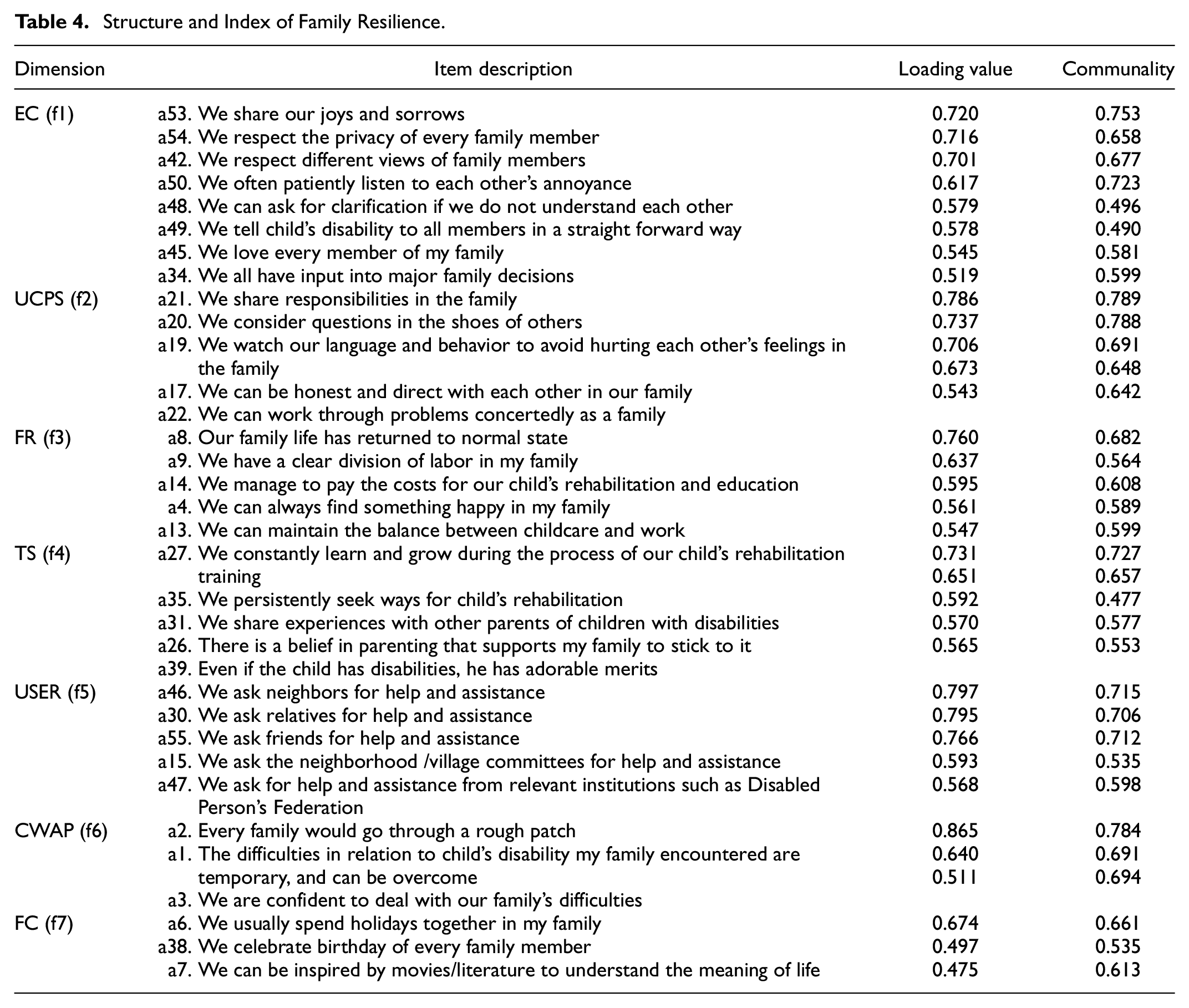
Exploratory factor analysis (EFA) was conducted for the remaining 54 items of Sample A, by using the principal component analysis (Wu, 2010, pp. 477–488). Both orthogonal rotation and oblique rotation methods were used to identify the appropriate factor rotation method, and at last orthogonal varimax rotation was used as similar results on the factors and items were gained (Kieffer, 1998). It was found that the remaining 54 items were suitable for EFA: the KMO value is 0.950, and the Bartlett’s Test is significant (p < .00, df = 10,188.680). After conducting EFA many times, 7 factors with 34 items were determined. The 7 factors meet the requirement that their eigenvalue is greater than 1 and the loading of each item is greater than 0.40 (Wu, 2010, pp. 477–488; Tables 3 and 4). There is no fuzzy item distribution. Based on the meaning expressed in each item, the seven factors were named emotional communication (f1), understanding and Cooperative Problem-solving (f2), family restoration (f3), transcendence and spirituality (f4), utilizing social and economic resources (f5), coping with adversity positively (f6), and family connectedness (f7). The seven factors could explain 64.16% of the variance of the total variation in family resilience of children with disabilities (Table 3).
Eigenvalue and Variance Contribution Rate of Family Resilience Factors.

Structure and Index of Family Resilience.
Confirmatory Factor Analysis
The maximum likelihood estimation method was used for CFA to investigate whether the data fit the hypothesized measurement model of family resilience structure (Table 5). The model fit was assessed mainly by absolute fit indices, incremental fit indices, and parsimony fit indices (Hooper et al., 2008). Considering the frequency of utilization and stability of indices (Wu, 2009, pp. 40–52), the absolute fit index involves χ2/df, SRMR, and RMSEA, the incremental fit index includes IFI and CFI, and the parsimony fit index involves PNFI and PCFI. As can be seen from Table 5, χ2/df is 2.51, SRMR is 0.05, RMSEA is 0.06, IFI is 0.91, CFI is 0.91, PNFI is 0.77, PCFI is 0.82, which comply with the requirements that χ2/df should be ranged from 1 to 3, SRMR and RMSEA<0.08, IFI and CFI>0.90, PNFI and PCFI>0.50 (Wu, 2009, p. 52). However, some factors were found to be moderately or highly correlated (Figure 1), and the second-order CFA was conducted again (Figure 2).
First Order Fit Index.


First-order CFA of family resilience structure.

Second order CFA of family resilience structure.
As shown in Table 6, it was found in the second-order CFA that χ2/df is 2.82, SRMR is 0.06, RMSEA is 0.06, IFI is 0.89, CFI is 0.89, PNFI is 0.77, and PCFI is 0.82. Except for the values for IFI and CFI are slightly lower than 0.90, other indexes all reach the ideal standard. Despite this, the model can be acceptable. The CFA of the family resilience model of children with disabilities is sound, and the structural validity is good, which meets the requirements of psychometrics.
Second-Order Fit Index.

Reliability Test
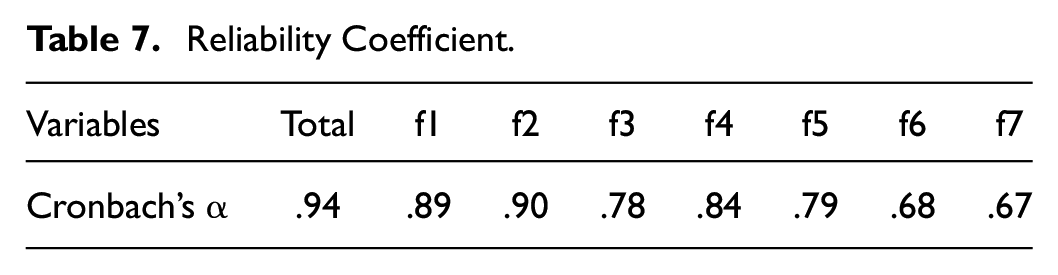
Cronbach’s alphas of the FRAS-CWD in China is 0.94 and Cronbach’s alphas of each factor are all above .67 (Table 7), complying with the requirements of psychometrics (Devellis, 1991; Wu, 2010, p. 237). It shows that the seven-factor model has good reliability.
Reliability Coefficient.
Discussion
The study constructed a family resilience assessment scale for children with disabilities and tested its psychometric properties using a sample of 767 family members of children with disabilities in China. It was found that the Chinese FRAS-CWD involves seven factors with 35 items, and the internal consistency reliability of the overall scale and seven factors ranged from 0.67 to 0.94, which indicated good reliability.
The Chinese FRAS-CWD is conceptually consistent with Walsh’s family resilience framework model, which involves the three key process belief system, organizational processes, and problem-solving and communication processes. The belief system involves the subscales of coping with adversity positively and transcendence and spirituality on the Chinese FRAS-CWD, the organizational processes include the subscales of family restoration, utilizing social and economic resources, and family connectedness, and the problem-solving and communication processes point to the subscales of emotional communication and understanding and Cooperative Problem-solving. Such consistencies explain similarities between the Chinese FRAS-CWD and the Western FRAS (Sixbey, 2005) which was also established based on Walsh’s theoretical framework. For example, both share similar dimensions and items about utilizing social and economic resources and family connectedness. This demonstrates the fact that the evaluation of family resilience shares common features across different cultures, in terms of psychological material, and economic conditions.
Due to the fact that family resilience depends on social and cultural environments, the family resilience construct may be slightly different. The Chinese FRAS-CWD with seven factors differs from the 6-factor scale (Isaacs et al., 2018; Nadrowska et al., 2021; Sixbey, 2005), 4-factor scale (Gusarova et al., 2021; Kaya & Arici, 2012) in the number of factors. Compared to others, the seven-factor model of the Chinese FRAS-CWD better echoes Walsh’s family resilience framework model. The specific differences in factor structure are present as follows.
First, coping with adversity positively on the Chinese FRAS-CWD, which is similar to the maintaining positive attitude of the Chinese scholar Li’s FRAS (Li et al., 2016) and the meaning-making and positive outlook of Singaporean FRAS (Chew & Haase, 2016), actually involves two dimensions of the Sixbey’ FRAS, the making meaning of adversity and the positive outlook. For one thing, the similarity between the Chinese FRAS-CWD, The Chinese Li’s FRAS, and the Singaporean FRAS demonstrates cultural consistency because they share the Eastern culture which is influenced by the Chinese traditional culture. For another thing, there is a conceptual overlap between the two dimensions, making meaning of adversity and the positive outlook in Sixbey’s FRAS, indicating optimistic attitudes. That is why the two dimensions are combined as one in the Chinese FRAS-CWD, demonstrating cultural differences between the East and West.
Second, emotional communication and understanding and Cooperative Problem-solving in the Chinese FRAS-CWD together respond to the family communication and problem-solving on Sixbey’s FRAS and other adaptions in the context of Turkey (Kaya & Arici, 2012), Poland (Nadrowska et al., 2021), and Russian (Gusarova et al., 2021). The emotional communication in the Chinese FRAS-CWD emphasizes emotional sharing, communication, and interaction among family members, and the understanding and Cooperative Problem-solving in the Chinese FRAS-CWD highlights problem-solving. The two factors echo Walsh’s family resilience framework model better, compared to Sixbey’s family communication and problem-solving which possesses 27 items, and other adaptions.
Third, the Chinese FRAS-CWD contains transcendence and spirituality that is different from the spirituality in the Western FRAS (Sixbey, 2005) and its adaptations in other cultural contexts. The transcendence and spirituality in the Chinese FRAS-CWD refer to the Chinese parents’ continuous efforts and belief in a better life, which is consistent with the research of Chinese scholar Li et al. (2016), whereas the spirituality in the West FRAS (Sixbey, 2005) and other adaptations mostly involves religion. It might be that Chinese society lacks orthodox religious belief on the whole, replaces religion with ethics or esthetics, and believes in supernatural power and providence, which is limited to the worship of heaven and earth, of ancestors, of saints, and belief in Confucianism, Buddhism, and Taoism, with Confucian ethics as the core. Confucianism has become the core content of Chinese culture and gradually evolved into the religion-like ethics affecting the Chinese nation most deeply and extensively (Wang, 2012). That’s why in family transcendence and spirituality, the item We think there is some uncontrollable supernatural force in the world Showed low load values and was deleted. In the interview, some parents said that they do not trust any religion or god, and they depend on themselves for everything, which also proved that supernatural power and providence were not religious. It indicated that family spirituality is related to social culture.
Fourth, the family restoration in the Chinese FRAS-CWD, which refers to the capacity of family recovery, is not found in the West FRAS and other adaptations. The reason might be related to the personality and the Chinese culture that attaches great importance to the obligations and responsibilities of the family. That is, parents should take full responsibility for the education and grow-up guidance of their children (Jia & Gong, 2017). As a result, many children with disabilities in China are taken care of by their parents or grandparents. With a strong sense of family responsibility, they are willing to sacrifice their interests for the family and to make unremitting efforts for the upbringing and rehabilitation of children with disabilities. Research has also shown that the sense of family responsibility plays a mediating effect between family identity and willingness to sacrifice for the family (Cui et al., 2013). Meanwhile, the typical characteristics of Chinese people, such as diligence, patience, contentment, loyalty, filial piety, benevolence, and righteousness, are conducive to forming individuals’ internal resilience. Most parents of children with disabilities experienced the psychological process of denial, self-blame, guilty, confusion, frustration, and acceptance (N. Zhang & Rong, 1997). They actively adapt to adversities, constantly learn and transcend themselves, and improve their realm of life.
There are also several differences in items. First, the utilizing social and economic resources of the Chinese FRAS-CWD added relatives and relevant government departments based on community, neighbors, and friends in the west FRAS (Sixbey, 2005). The interpersonal relationship in traditional Chinese society takes the individual as the center, and forms the pattern of difference sequence (Fei, 2005, p. 34) based on blood relationship. Influenced by the traditional Confucian culture, this Social relationship pattern has not changed fundamentally. This validates Chew and Haase’s (2016) belief that Chinese and Singaporeans are more willing to turn to relatives for help. However, The reason why the modern West shows less about such “differential pattern” is that its cultural, social, and political development goes beyond affinity (such as the religious tradition of external transcendence, the civic republican tradition, modern democratic politics, and the developed civil society; Sun, 2020), its social organization is a group pattern, in which everyone belongs to a certain group (Zhou, 2022). Therefore, the factor utilizing social and economic resources in the west FRAS (Sixbey, 2005) does not involve relatives as an item but involves neighbors and communities related to geography. In addition, as the Chinese government attaches great importance to the cause of the disabled and increases the financial support for disabled children and their families, this study added items- asking for help from community-level organizations, neighborhood committees, and relevant government departments. However, the FRAS (Sixbey, 2005) did not involve this item due to the times and participants’ family adversities.
Second, the family connectedness of the Chinese FRAS-CWD does not involve items related to community and friends, which is inconsistent with the FRAS (Sixbey, 2005) and other adaptations. One reason might be that the Chinese FRAS-CWD does not set questions related to community and friends as Walsh’s connotation of “connection” only involves family relations. Another possible reason might be related to the pattern of different sequences of Chinese interpersonal relations as discussed above. The third reason involves the community culture and changes in China. The community in China emphasizes relatives, neighbors, and friendship in traditional rural society. It is a community based on blood relationship, geography, or spirit, which is a social group of a homogeneous population with the same values and beliefs, close relations, friends, and mutual assistance (R. Zhang, 1990, p. 145). With the progress of industrialization and urbanization in China, urban communities have taken on a new, temporary, and superficial form of living together. This forms a social group of heterogeneous populations with deliberate and willful choice of will or rationality. In this kind of community where people are separated from each other, neighbors, and even do not know each other. Moreover, Chinese parents tend to regard disability as a matter of losing face. That is why they seldom talk about their children with disabilities and ask for help in front of their friends and neighbors. This is also confirmed in our interview in which the acceptance of the community toward children with disabilities was not optimistic. Furthermore, Chinese parents believe that disability is a family matter, whereas taking care of disability is the responsibility of the whole society in the West.
Third, the item we used to keep our thoughts and feelings in our mind on clear communication of Sixbey’s FRAS (2005) was deleted on that of the Chinese FRAS-CWD. The connotation of this item is actually consistent with the Chinese cultural tradition in which the Chinese people would rather keep any thoughts to themselves than express their thoughts and feelings, and they tend to be reserved and introverted, and they generally do not speak out their thoughts directly or tell bad things to their family members. The problem is that the item as a reverse design is not suitable for the factor clear communication in the Chinese FRAS-CWD. That is also the reason why the item our family members often openly express their feelings to each other on the emotional expression of Sixbey’s FRAS (2005) was deleted on that of the Chinese FRAS-CWD.
Compared with the Western FRAS, The Chinese FRAS-CWD is more suitable for evaluating the family resilience of children with disabilities. The items of the Chinese FRAS-CWD reflect the specificity of families of children with disabilities. For example, in item 47 on the factor utilizing social and economic resources, We ask for help and assistance from relevant institutions such as the China Disabled Person’s Federation, which involves the function of institutions about disabilities.
Limitations and Suggestions
The construction of the family resilience scale is an ongoing process. Future research should consider the following aspects. First, the sample size needs to be expanded. Due to the time and energy, the sample size of the study is small, which may affect the research conclusion and lead to the underrepresentation of the research conclusion. In future research, the sample size should be expanded. Second, family resilience should be assessed as a unit. Assessing family resilience from an individual perspective may lead to deviation in objectivity and accuracy of research results, so future research should be aimed at measuring multiple family members in a household. Third, Future research should be conducted to explore the factor structure of the family resilience scale of children with disabilities in the different sub-cultural systems of China because China involves many sub-culture and remote areas. Moreover, the family resilience of children with disabilities is a dynamic process, and its factors may change with the gradual improvement of parents’ cognition, children’s rehabilitation status, national policies, and social support.
Conclusion
The seven-factor Chinese FRAS-CWD reflects traditional Chinese culture and demonstrates good psychometric properties, It is reliable and valid for assessing the family resilience of children with disabilities. This study implies the use of the FRAS-CWD in family intervention and support for children with disabilities research to promote family resilience and ease family burden and pressure in society.
Footnotes
Declaration of Conflicting Interests
The author(s) declared no potential conflicts of interest with respect to the research, authorship, and/or publication of this article.
Funding
The author(s) received no financial support for the research, authorship, and/or publication of this article.

Data Availability Statement
The datasets generated during and/or analyzed during the current study are available from the corresponding author on reasonable request.