




Abstract
With the rapid development of e-commerce, Online shopping has not only brought convenience to people’s lives, but also accelerated the explosion of express delivery. As a device that provides 24-hr self-service pickup and delivery services, smart lockers are increasingly accepted by more and more express delivery companies and consumers. However, in rural China, there are few outlets and low usage rates for express delivery cabinets. Especially for the elderly, the use and acceptance of smart lockers are significantly lower. Therefore, how to improve the usage intention of intelligent express delivery cabinets has become a problem that needs to be solved in the development process of smart rural areas. This study develops a theoretical model based on the Unified Theory of Acceptance and Use of Technology (UTAUT), and conducts empirical testing to determine the key factors affecting the willingness of rural Chinese consumers to use smart lockers. This study used a questionnaire survey method to collect data, and a total of 240 valid questionnaires were collected. The partial least squares (PLS) method was used to measure and test the research hypotheses. The results indicate that performance expectancy, facilitating conditions, price value and technology anxiety have a positive impact on consumers’ intention to use. There is no significant relationship between effort expectancy and social influence and users’ behavioral intention to use smart lockers. The results of this study will help enrich UTAUT, provide valuable information for enterprises, and contribute to the implementation of smart villages strategies.
Introduction
In recent years, the development concept of “Smart” has been increasingly valued, especially in rural areas. Smart Village is a new concept proposed by the European Commission regarding rural development. Smart villages refer to the use of digital technology and innovation in daily life to improve their quality, improve public service standards, and ensure better utilization of local resources. It mainly targets villages that have decreased due to remoteness and population reduction (Komorowski & Stanny, 2020). Because in 2022, China’s urbanization rate reached 65.22%, and there are still 491 million people living in rural areas. The quality and level of rural development will affect the quality of life of nearly half of China’s population (X. Zhang & Zhang, 2020). By 2050, the world’s population aged 65 and above will reach one-sixth (Özsungur, 2022). As of the end of 2022, the population of elderly people aged 60 and above in China was 280 million, accounting for 19.8% of the total population (Bian et al., 2023). It is worth noting that the proportion of elderly population in rural China is relatively high, with 23.81% and 17.72% of elderly people aged 60 and 65 and above respectively, which are 7.99 and 6.61 percentage points higher than those in cities (Q. Chen et al., 2023). The increase in the elderly population is an important fact that involves social and economic issues. Therefore, the Chinese government seeks to achieve the upgrading and progress of agricultural regions by exploring the enormous potential of information and communication technology (ICT) and e-commerce (Özsungur, 2022).
Due to the COVID-19 pandemic, it has brought unprecedented growth to e-commerce (Bhatti et al., 2020). The rapid development of e-commerce has brought about a growing demand for online consumption, while also promoting an increase in the number of package delivery services (Kshetri, 2018). Millions of packages need to be delivered to online shoppers in a fast and cost-effective manner every day. But in the traditional delivery service mode, delivery personnel need to contact customers, arrange delivery times, and take remedial measures for unexpected situations. For example, traffic congestion, package damage, and customer departure. This resulted in the delivery of the last mile taking up most of the time and cost, and becoming the most critical issue affecting the efficiency of logistics services (Wolfram, 2016). Therefore, the use of smart lockers for the last mile of delivery has received attention from the retail and logistics industries. Customers only need to grab their phone and enter the pickup code on the smart lockers screen or use a mobile application. For example, use WeChat and Alipay to scan the QR code on the smart lockers to take out the package (Kuo, 2020; X. Wang et al., 2021). With the support of technology, pick-up customers do not have to worry about the operating hours of the collection point and issues such as no one at home signing for delivery, as the smart lockers can be picked up 24 hr a day. This eliminates the inefficiency caused by failed door-to-door delivery and redelivery, minimizing traffic congestion and environmental pollution. Especially in the post pandemic era, smart lockers can effectively avoid direct contact between recipients and couriers, reducing the risk of epidemic transmission (Djelassi et al., 2018; Yuen et al., 2019).
Online shopping is gradually becoming a new consumption model for rural residents, and rural areas have become a new engine for the development of e-commerce (Wei et al., 2020). However, currently, rural logistics infrastructure in China is weak, distribution networks are scattered, and the final distribution efficiency and experience have not yet reached the urban level (Y. Wu et al., 2022). Many rural residents still cannot fully benefit from the convenience brought by digital technology (X. Zhang & Zhang, 2020). China is entering an aging society, with young labor entering cities, and the degree of aging in rural areas is much higher than in cities. (Bai et al., 2020; Q. Chen et al., 2023). Therefore, how to improve the last mile delivery of rural logistics is related to the transformation of China’s rural e-commerce and the construction of smart villages (Zeng, 2019).
Existing literature on customers using smart lockers for last mile delivery has mostly focused on cities (Tsai & Tiwasing, 2021; Yuen et al., 2019; M. Zhou et al., 2020). However, there is still a lack of research on the preferences of Chinese rural electronic customers in the final delivery field. Especially in the context of severe aging of the rural population in China, it is crucial to help the elderly better adapt to the digital age (Shi et al., 2021). In recent years, scholars have discussed the factors that affect consumers’ willingness to use smart lockers. For example, convenience, privacy, security, and reliability (Tsai & Tiwasing, 2021; Yuen et al., 2019). However, few studies have used extended UTAUT to test the intention of rural consumers to use smart lockers. In addition, research on the interaction between technology and the elderly is still very limited. Especially in the literature, there is little research on the interaction between smart lockers and the elderly (Özsungur, 2022). Therefore, in order to fill the research gap, this study extended UTAUT to increase price value and technological anxiety, in order to understand the willingness of Chinese rural consumers to use smart lockers.
Literature Review
Smart Lockers
Smart lockers also known as parcel lockers or express pickup cabinets, are easier to reach parcel delivery points and can provide 24-hr self-service and simplified parcel delivery processes (Tsai & Tiwasing, 2021). Currently, scholars have conducted research on smart lockers. Yuen et al. (2019) analyzed the determining factors of customers using smart lockers for last mile delivery, and the results showed that the impact of convenience, privacy, security, and reliability on customer intentions is entirely mediated by perceived value and transaction costs. Tsai and Tiwasing (2021) studied the intention of Thai consumers to use smart storage cabinets, and the results showed that convenience, reliability, privacy security, compatibility, comparative advantage, complexity, perceived behavioral control, and attitude can affect the intention of Thai consumers to use smart storage cabinets. Yusoff et al. (2023) explored the factors that influence consumers’ willingness to use parcel lockers. Performance expectancy and compatibility strongly influences the willingness to use parcel lockers. However, previous literature has limited discussion on the factors influencing consumer psychological preferences and lacks a theoretical framework to examine the interactive effects of various factors. Therefore, it is necessary to identify the psychological factors that affect rural consumers’ decision-making in order to increase their interest in using smart lockers.
Elderly’s Intention to Use Technologies
Technology is believed to improve the daily life of elderly people and increase their well-being (Yap et al., 2022). Scholars discussed the impact of technology on the elderly. Ahmad et al. (2020) used the Technology Acceptance Model (TAM) as the theoretical basis to explore the factors that affect the willingness of elderly diabetes patients to continue using digital health wearable devices, and found that perceived usefulness and perceived ease of use have a significant impact. Magsamen-Conrad et al. (2015) applied the use and satisfaction theory to examine the motivation of individuals from different generations to use tablets, and found that older adults use tablets the least and are driven by benefits. Pal et al. (2019) found that perceived uselessness and self-efficacy were not significant in identifying the main barriers to elderly people using smart homes, as older adults traditionally were unwilling to accept new innovative solutions. Hanif and Lallie (2021) pointed out that performance expectations and perceived cyber security risks are the main determining factors for the willingness of the elderly population in the UK to use mobile banking applications. The above research results provide different perspectives for explaining the adoption of technology behavior by elderly people. However, research on the use of smart delivery cabinets by the elderly is still insufficient. Especially in rural areas, the trend of aging is more pronounced (Bai et al., 2020). Therefore, this study analyzes the determining factors of rural population’s willingness to use smart lockers from the perspective of smart rural construction.
Unified Acceptance and Use of Technology (UTAUT)
The Unified Theory of Acceptance and Use of Technology (UTAUT) has been widely applied since it was proposed by Venkatesh et al. (2003). This theoretical model proposes four constructs, namely performance expectations (PE), effort expectations (EE), social impact (SI), and facilitation conditions (FCs). UTAUT has become the most influential theoretical model in the field of information technology applications, with strong explanatory power for user acceptance intentions. This theoretical model has been validated in different countries and cultures. For example, Chao (2019) applied the UTAUT model to predict the factors that influence students’ behavioral intention to use mobile learning, and found that satisfaction, trust, performance expectations, and effort expectations have a significant positive impact on behavioral intention. Dai et al. (2019) applied the UTAUT model and found that resistance to change (RC) and technical anxiety (TA) had insignificant impact on the use of wearable devices in dementia patients. J. Chen et al. (2022) found that perceived cost, performance expectations, and hedonic value all have a significant impact on the willingness of elderly users to use wearable devices. X. Wang et al. (2023) pointed out that effort expectations, performance expectations, and social influence are positively correlated with the behavioral willingness of elderly people to use smart elderly care products. However, few studies have used UTAUT to test the intention of rural consumers to use smart lockers. Rural elderly people tend to have technical anxiety and are more sensitive to prices (Kamal et al., 2020; Yap et al., 2022). Therefore, technological anxiety and price value are important variables that cannot be ignored (Jeon et al., 2019). This study takes technology anxiety and price value as new variables to understand the willingness of rural consumers to use smart lockers, and determines which factors are the determining factors affecting their behavioral intentions. The conceptual framework is shown in Figure 1.
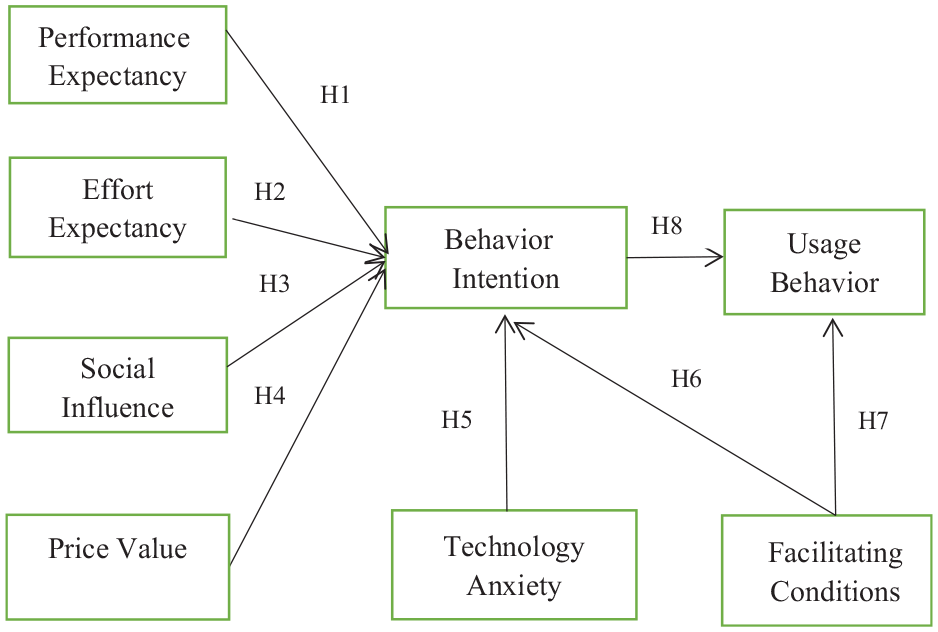
Conceptual framework.
Performance Expectancy, Effort Expectancy, Social Influence and Behavioral Intention
In the UTAUT model, performance expectancy (PE) refers to the degree to which users believe that using a new technology or system will help improve work or task performance. Many scholars have pointed out that performance expectancy has a positive impact on willingness to use. For example, Jeon et al. (2019) found that performance expectancy is an important determinant of customers’ intention to book airline tickets using smartphone applications. M. Zhou et al. (2020) found that performance expectancy is the determining factor for consumers to adopt self-service parcel services in the last mile (Penney et al., 2021).
Effort expectancy (EE) is defined as the degree of ease associated with using the system (Venkatesh et al., 2003). Effort expectancy has a positive impact on willingness to use. For example, Penney et al. (2021) found that effort expectancy is a factor that affects consumers’ willingness to use mobile currency services. Hoque and Sorwar (2017) found that effort expectation has a significant impact on users’ behavioral intention to adopt mHealth services.
Social influence (SI) refers to the degree to which a person believes that someone important to them should use a new system (Gupta et al., 2018). Gupta et al. (2018) found that social impact is an important predictor of intention to use smartphone applications. Bhatiasevi (2016) found a positive correlation between social impact and behavioral intention to use mobile banking (Baabdullah, 2018). Previous research on the UTAUT model has shown that performance expectancy, effort expectancy, and social influence are important determinants of behavioral intention (Penney et al., 2021; Venkatesh et al., 2003). Therefore, we propose the following three hypothesis:
Price Value and Behavioral Intention
Price value (PV) is defined as the cognitive trade-off between consumers’ perceived system value and the cost of acquiring or using new technologies (Gupta et al., 2018). With the use of new technologies, consumers constantly compare the costs incurred with the potential savings that new technologies may bring. Some consumers are more sensitive to prices, especially elderly consumers who are more sensitive to prices due to having more leisure time (Alalwan, 2020; C. F. Chen et al., 2020; Yu et al., 2021). For example, in April 2020, Hive Box Technology Co., Ltd.’s Fengchao express cabinet was kept free of charge for ordinary users for 12 hr. After exceeding the time limit, a fee of 0.5 yuan was charged for every 12 hr, with a maximum of 3 yuan. This method sparked a lively discussion. Therefore, in May 2020, Fengchao Express Cabinet adjusted its service by extending the free storage time from 12 to 18 hr. After exceeding the limit, a fee of 0.5 yuan per 12 hr was charged, with a maximum of 3 yuan (Shi et al., 2022). Therefore, the price value will have an impact on the willingness to use (Kamal et al., 2020). Therefore, we propose the following hypothesis:
Technology Anxiety and Behavioral Intention
Technology anxiety (TA) is a negative emotional response related to the fear or discomfort people experience when considering using technology. Technical anxiety has been identified as the main issue affecting the willingness of elderly people to adopt mobile health services (Deng et al., 2014; Moudud-Ul-Huq et al., 2021). In addition, the decline in physical and cognitive abilities may lead to higher levels of anxiety, which may further reduce their willingness to use innovative technologies. Older users have higher levels of technical anxiety than younger users (Tung & Chang, 2007; Venkatesh et al., 2012). Tung and Chang (2007) believe that technology anxiety is the most important variable in their research that has a negative impact on behavioral intention. Therefore, we propose the following hypothesis:
Facilitating Conditions, Behavior Intention and Usage Behavior
Facilitating conditions (FC) refers to individuals who believe in the existence of an organizational and technological infrastructure that can be used to assist them in using the required technology (Venkatesh et al., 2003). Yi et al. (2006) found that facilitating conditions is a direct determinant of behavioral intention and technological use. Boontarig et al. (2012) found that FC positively affects the behavioral intention and behavior of using smartphones in medical services. Shi et al. (2022) confirmed that convenience conditions can affect the willingness of Bangladeshi farmers to adopt the Internet of Things. Therefore, we propose the following three hypothesis:
Methodology
Questionnaire Design
This study uses quantitative survey techniques as the main data collection method. The survey questionnaire is mainly divided into three parts. The first part explained the purpose of the study to the respondents. The second part of the questionnaire is the basic demographics characteristics, including gender, age, education level and monthly income. The third part of the questionnaire includes measurement items, with a total of 27 measurement items. All items measuring the research structure were measured with the 5-point Likert scale. 1 means “highly disagree,” 2 means “disagree,” 3 means “average,” 4 means “agree,” and 5 means “highly agree.” The items of each construct are listed in the Table 1.
Summary of Construct With Measurement Items.

Data Collection and Sample
A total of 250 questionnaires were collected from June 11th to 30th, 2023. The selection of respondents is based on the convenience sampling method. A total of 100 questionnaires were distributed through offline visits to five villages in China, while the remaining 150 questionnaires were supported by placing a hyperlink on the Questionnaire Star website. To ensure that the data results of the questionnaire survey are more scientific and accurate. The survey subjects are all rural smart lockers users in China. After excluding the questionnaires that did not pass the quality inspection, 240 questionnaires were used for further analysis. Demographic data are shown in Table 2.
Demographic Details of the Respondents.

Data Analysis
The Partial Least Squares (PLS) method is a statistical analysis technique based on Structural Equation Modeling (SEM), used to test and validate the relationship between the proposed model and the assumed structure (Venkatesh et al., 2012). There are two reasons for choosing PLS-SEM in this study. Firstly, this study aims to explore the theoretical extensions of established theories; Secondly, measure the impact of different constructs and all possible causal relationships between them, and predict key constructs (Fornell & Larcker, 1981; Hair et al., 2013; Hair, Hult et al., 2013; Ramayah et al., 2018).
Results
Measurement Model
In the appraisal of reflective measurement model, it incorporates internal consistency, indicator reliability, convergent validity and discriminant validity. The Cronbach’s alpha values and composite reliability (CR) values are used to test the reliability. As shown in Table 3, the lowest value of Cronbach’s alpha is .710, and the lowest value of CR is .824, both exceeding the recommended minimum threshold value of 0.7, indicating good reliability. The convergent validity was tested with AVE. Table 3 shows that the minimum value of AVE is 0.611 which exceeds the recommended minimum threshold value of 0.5, thus supporting convergent validity (Hair, Hult et al., 2013; C. Wang et al., 2022).
The Results of Reliability and Validity Analysis.

In order to test the discriminant validity, we conducted a test. Table 4 shows that the AVE value of each construct is greater than its correlation with other constructs, which conforms to the standards of Fornell and Larcker (1981) and Hair, Hult et al. (2013).
Correlations of Constructs and AVE Values.

Structural Model
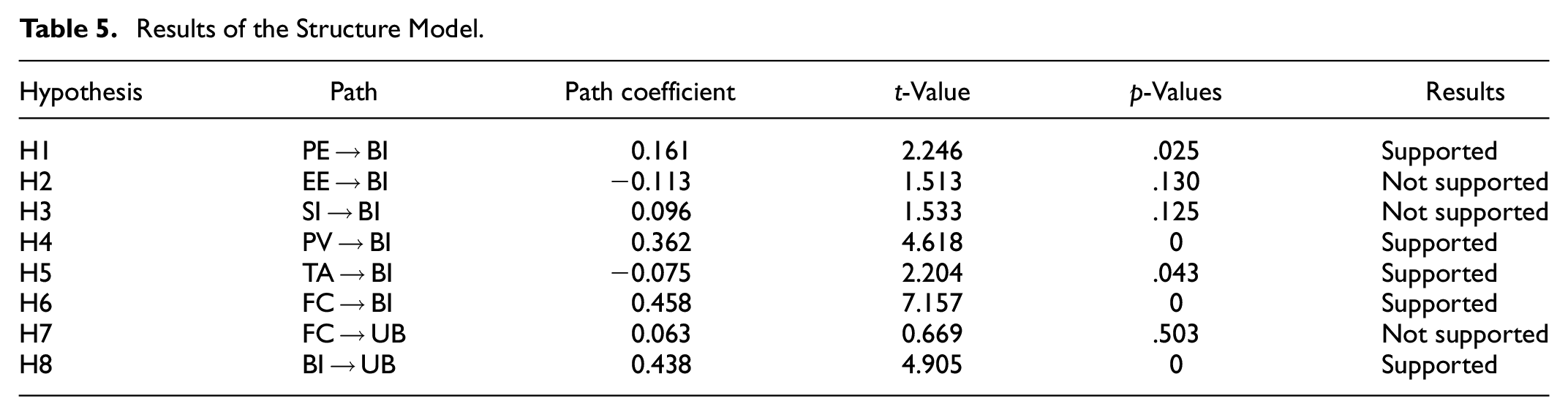
The empirical results and hypothesis test results of the structural model are summarized in Table 5. Of the eight hypotheses, five were supported. The bootstrap sampling method is used to estimate the relationship between the theoretical model and the hypotheses, and tested the relationship between dependent and independent variables by path coefficient (β) and t-statistics. The results for the structural model are shown in Table 5.The results show that the relationships between PE and BI (t = 2.246, β = .161, p < .05), PV and BI (t = 4.618, β = .362, p < .05), TA and BI (t = 2.204, β = −.075, p < .05), FC and BI (t = 7.157, β = .458, p < .05), BI and UB (t = 4.905, β = .438, p < .05) were significant. Thus H1, H4, H5, H6, and H8 were supported. However, EE and BI (t = 1.513, β = −.113, p > .05), SI and BI (t = 1.533, β = .096, p > .05), FC and UB (t = 0.669, β = .063, p > .05) were insignificant. Thus H2, H3, and H7 were not supported.
Results of the Structure Model.
Discussion
This study applies the UTAUT model to investigate the intention and behavior of Chinese rural consumers to use smart lockers. Explore the factors that may affect the expected and actual use of smart lockers. This study innovatively adopted the UTAUT model with an extended structure to test the proposed relationship, supplementing relevant literature with newly added price value and technology anxiety constructs. The specific discussion is as follows.
The empirical results of this study indicate that PE had a significant positive impact on BI, which is consistent with previous studies (Hoang et al., 2021; K. Zhang & Yu, 2022). Therefore, users will not choose products without functionality. The use of smart lockers to enhance consumers’ requirements for accepting and delivering packages is the foundation for maintaining consumers’ willingness to continue using them. When consumers feel that smart lockers can improve their efficiency, they tend to use them.
The empirical results confirm that EE has no significant impact on BI. Therefore, consumers believe that using smart lockers is difficult and requires more effort, so they have less willingness to adopt them. This may be because there are fewer outlets for smart lockers in rural China, consumers have not used smart lockers frequently and have low proficiency. Another possible explanation is that due to merchants placing advertisements on the interactive interface of the smart lockers, the advertisement pop-up affects consumers’ use of the smart lockers. Especially for the elderly, it is more troublesome. Previous studies have also confirmed this result (Alghazi et al., 2021; X. Wu et al., 2021).
The empirical results of this study indicate that SI had no significant impact on BI. Previous studies have also confirmed this result (L. L. Zhou et al., 2019). This may be because rural consumers are not concerned about aspects related to social factors, their social circle is relatively narrow, and there are few relatives or friends who suggest using smart lockers. In addition, social media rarely promotes the use of smart lockers in rural areas, as well as the convenience and advantages they bring. Therefore, in this study, social influence is not a positive factor in behavioral intention.
PV has been found to have a significant impact on consumers’ willingness to use smart lockers, which is consistent with previous studies (Alalwan, 2020; C. F. Chen et al., 2020; Yu et al., 2021). This indicates that rural consumers are more concerned about the value of currency when formulating their intentions to use or reject smart lockers. In other words, if the convenience and reliability that come with smart lockers are considered higher than the monetary cost paid, consumers seem more willing to use them, believing that they are worth it.
TA had a significantly negative relationship with the BI, which is consistent with previous studies (Moudud-Ul-Huq et al., 2021; Venkatesh et al., 2012; Yu et al., 2021). This indicates that consumers in rural China are still quite anxious about smart lockers, especially the elderly. They are not very familiar with technology, so their perception of technical anxiety is stronger. In addition, due to the influence of advertisements on the interactive interface of the smart lockers. Therefore, they are more likely not to use smart lockers.
FC has been shown to have the strongest positive impact on BI, while it has no significant impact on UB. Previous studies have also confirmed this result (Bian et al., 2023). This may be because with the development of technology, the internet and smartphones have gradually become popular in rural China. Consumers can easily download and use shopping apps, which weakens the role of facilitating conditions in actual use. In addition, another reason may be that rural consumers lack knowledge and guidance on the use of smart lockers.
This study investigated the relationship between BI and UB and identified a positive relationship between them. Previous studies have also confirmed this result (Penney et al., 2021; Venkatesh et al., 2012; K. Zhang & Yu, 2022). This indicates that consumers are willing to use smart lockers.
Conclusions
Theoretical Implications
At present, research on the intention to use smart lockers is mostly based on resource matching theory (Tsai & Tiwasing, 2021; Yuen et al., 2019), transaction cost economics theory (Tedjo et al., 2022; Yuen et al., 2019), and service quality (Tang et al., 2021). There is relatively little research on using UTAUT to test customer intentions and behaviors toward using smart lockers. Therefore, this study adopted an extended theoretical model, which emphasizes several determining factors of customer intention and behavior to use smart lockers, namely performance expectancy, effort expectancy, social influence, price value, technology anxiety, and facilitating conditions. And it provides a unique contribution to explaining the customer’s intention and behavior to use smart lockers. Further enhanced the explanatory power of the UTAUT theoretical model in the context of providing self-service.
Another contribution is that this study for the first time explores the impact of price value and technology anxiety on customer intention to use smart lockers. The empirical results indicate that performance expectancy, price value, technology anxiety, and facilitating conditions have a significant impact on the behavioral willingness of Chinese rural consumers to use smart lockers. However, the research results indicate that there is no significant relationship between effort expectancy and social influence on consumer behavioral intention to use smart lockers. There is no significant correlation between facilitating conditions and usage behavior. Through empirical analysis of this study, the relationship between determining factors and consumer willingness and behavior to use smart lockers was determined, and the theoretical logic of influencing factors was further clarified.
Practical Implications
In addition to contributing to theory, the results of this study can also be used by providers of smart lockers to develop better strategies to increase the willingness of rural customers to use this self-service technology. The study by Özsungur (2022) suggests that individual interaction with technology will help improve their sense of happiness and quality of life. Mobile Internet applications play an important role in improving the quality of life, and have made positive contributions to the mental health of retired adults (Magsamen-Conrad et al., 2015). Therefore, this study identifies the target market for specific products and provides practical guidance for the application of smart lockers in the construction of smart villages in China through empirical research, which is beneficial for decision-makers and managers to develop marketing strategies (Baki, 2023).
This study indicates that EE has no significant impact on BI. Therefore, local governments should actively collaborate with providers of smart lockers to layout smart lockers in rural areas, and set up smart lockers based on data on rural residents, transportation convenience, and package density. Because the presence of devices is more effective when they are close to the user and frequently used (Lee et al., 2017). Meanwhile, due to the traditional unwillingness of elderly users to accept new innovative solutions, enterprises should optimize their functional design. For example, system developers should create a more user-friendly and well-designed user interface, set up navigation and “help” buttons to help reduce the difficulty of consumer use (Pal et al., 2019; Shi et al., 2022). In addition, in order to accelerate the popularization of smart lockers, it is necessary to have a deeper understanding of consumers, understand their knowledge and resources. Connect and control through mobile phones, providing a one-stop solution to meet some of the daily needs of consumers. For example, combining the functions of self-service vending machines, smart lockers can provide some small items, such as emergency medicine, beverages, and tissues (Park et al., 2018).
On the other hand, smart lockers providers also need to further utilize social media platforms for promotion. For example, WeChat and Tiktok. Because these platforms may help promote effective electronic word-of-mouth. This will increase consumers’ willingness and behavior to use smart lockers in the future (Yusoff et al., 2023). Price value has a significant impact on usage intention, which means that consumers will compare the costs and benefits of using smart lockers (Shi et al., 2022). Therefore, smart lockers providers should minimize or eliminate the monetary cost of smart lockers used by rural consumers to the greatest extent possible. Especially for the majority of rural consumers who are considered impoverished, they tend to choose free or cheap products (Tam et al., 2020).
Compared to young people, elderly people are often considered to have certain unique characteristics. For example, having less experience using operating systems and software and having a certain level of technical anxiety (Iancu & Iancu, 2020). Therefore, these characteristics need to be considered when developing and commercializing intelligent solutions for them (Pal et al., 2019). Optimize advertising placement on the interactive interface by using a more user-friendly and user-friendly interface. Prevent consumers from accidentally touching advertisements that affect the user experience, thereby reducing their technical anxiety. This has been proven to significantly reduce the anxiety of elderly people in developing countries about technology use, which will also be a big step in reducing the rural digital divide (Dai et al., 2019; Gundu, 2020).
Limitations and Future Research Directions
In addition to the contribution of research, there are two main limitations that can be addressed in future research. Firstly, this study is based on an extended UTAUT model, introducing price value and technology anxiety factors to explore the willingness and behavior of rural consumers to adopt smart lockers. In the future, different constructions can be added to expand applicability. Such as perceived risk and personal innovation. To reveal more reliable research results on the use of smart lockers in rural areas of China. The second limitation is that this study is a quantitative study conducted through online and offline distribution of questionnaires. Future research should investigate sufficient data within a wider range of rural areas to better understand the adoption intentions of rural consumers through a combination of qualitative and quantitative methods. Especially in the context of an aging society, it can respond to the needs of specific regions and bring lasting and positive changes to specific social groups.
Footnotes
Declaration of Conflicting Interests
The author(s) declared no potential conflicts of interest with respect to the research, authorship, and/or publication of this article.
Funding
The author(s) received no financial support for the research, authorship, and/or publication of this article.

Data Availability Statement
The data that support the findings of this study are available from the corresponding author, upon reasonable request.