




Abstract
Smart courier lockers, as a common form of digital infrastructure, are examined in this study to understand how older adults engage with intelligent services in everyday life. The research investigates how social surroundings and individual information capabilities influence expectations and adoption intentions. Findings show that both environmental support and social cues affect how older users evaluate digital technologies, while information literacy plays a role in shaping these responses. By incorporating both contextual and cognitive dimensions, the study provides a more integrated view of later-life technology engagement. It extends existing knowledge by introducing information literacy as a moderating factor, offering a refined understanding of user diversity within ageing populations. The results offer practical guidance for improving the accessibility and inclusiveness of smart public services, particularly for digitally marginalised groups. These insights are also relevant to policymakers, designers and educators seeking to promote more equitable digital participation across age groups.
Plain Language Summary
For this paper, a UTAUT-SOR model was constructed to explore the psychological mechanisms of older adults’ use of smart devices, including information literacy, and taking their use of smart courier lockers as the research objective. The findings suggest that social influences and facilitating conditions affect older adults’ willingness to use smart courier lockers by influencing their performance expectancy and effort expectancy, both of which affect their willingness to use the smart courier lockers. In addition, information literacy was shown to moderate the processes of social influence in affecting performance expectancy, of social influence in affecting effort expectancy and of facilitating conditions in affecting effort expectancy. These results reveal the psychological processes of older adults when considering the use of smart devices, and they provide theoretical guidelines to assist in the integration of older adults into the digital society.
Introduction
The continuous expansion and growing maturity of the e-commerce sector, particularly in China, have not only reshaped conventional retail landscapes but also driven the rapid development of the express delivery industry (Kang et al., 2021). In this period of transformation, the express sector plays a pivotal role as the link between distribution centres and end consumers (Seghezzi et al., 2021). Faced with rising demand and evolving service expectations, the industry is actively seeking ways to enhance operational efficiency, reduce delivery time and improve overall customer satisfaction (Lemardelé et al., 2021). However, due to time constraints affecting consumer pickup, traffic congestion and insufficient manpower for delivery personnel, express delivery directly into the hands of recipients is accompanied by high costs and is extremely time-consuming (Seghezzi et al., 2021). Deploying intelligent parcel lockers offers a practical solution to these challenges. Greater adoption of smart delivery lockers not only streamlines parcel distribution but also contributes to reducing packaging consumption and enhancing recycling efficiency. Not only does this improve the green development of the express industry, but it also diversifies delivery, providing choice and enabling the logistical system to improve redundancy (Pinchasik et al., 2025). However, to popularise the use of intelligent express lockers, it is necessary to consider the willingness of all groups of people to use them, among whom, older people may experience more obstacles to their use (Christensen et al., 2009).
Under the present circumstances, where social health is steadily improving, life expectancy is increasing and the ageing population continues to grow, older adults are facing mounting pressures. In particular, the rapid pace of digital transformation has intensified the challenges they encounter in daily life, placing additional demands on their ability to adapt. Greater attention is therefore needed to support their physical and psychological well-being. The use of smart devices is expected to help relieve some of the everyday burdens they experience (Niehaves & Plattfaut, 2014). On one side, the acceleration of digital processes provides channels through which senior citizens can obtain information, socialise and enjoy the entertainment provided through the internet and their smart devices (Friemel, 2016; Singh et al., 2024). On the other hand, as China’s population continues to age, many older adults encounter barriers due to limited access to education and training. These constraints not only hinder their understanding and use of emerging technologies but also contribute to the widening of the existing digital divide (K. Zhang et al., 2025). These challenges become particularly evident when older adults interact with smart courier lockers, as many struggle with unfamiliar operating systems and limited digital proficiency (Arcury et al., 2020). They may hold a conservative or resistant attitude towards new things and lack confidence in their own cognitive and learning abilities (Talukder et al., 2020). Therefore, exploring the determinants shaping older adults’ readiness to adopt smart courier lockers, taking corresponding measures to improve their willingness to use them and then assessing their resulting satisfaction are all important aspects, not only in promoting the use of smart express cabinets but in assisting senior citizens to take advantage of all the digital world offers.
Many scholars have conducted research into these and similar issues. For example, in terms of the factors shaping consumers’ intention to adopt smart parcel lockers in the context of final-leg delivery, numerous earlier investigations have shed light on customers’ perceptions of their need for smart courier lockers and how to improve customer acceptance of this new delivery method (Ngan et al., 2025; Yuen et al., 2019). Existing studies that consider older people and smart devices may be divided into two groups. One group considers how smart devices can be used to provide better senior care services (Marston & Musselwhite, 2021; H. J. Yang et al., 2025), while the other is concerned with how older people can use smart devices better and how they can be gradually transformed and integrated into the digital society (Lythreatis et al., 2022).
Substantial progress has been achieved across various disciplines in understanding the role of smart technologies. However, these previous studies have focused on how smart devices can be used to provide better senior care services, without paying attention to seniors’ willingness to use the suggested smart devices. Therefore, in this paper, we focus on the specific application scenario of older adults using smart courier lockers as an example that can reveal the complex psychological mechanisms affecting older adults’ engagement with everyday smart devices, with particular emphasis on their own perspectives. The findings illuminate key barriers that limit older adults’ engagement with smart technologies, offering a foundation for more targeted interventions. Such insights may assist technology developers, service providers and policymakers in crafting inclusive digital strategies that support older adults’ integration into an increasingly digital society. In particular, the study identifies key psychological and perceptual factors that should be considered when developing age-friendly smart services for everyday use.
This paper begins by contextualising the increasing relevance of smart technologies in ageing societies and outlining the specific challenges faced by older adults. A critical review of related studies and theoretical underpinnings follows, leading to the proposal of a new research model and a detailed formulation of the associated hypotheses. The subsequent section outlines the research design, including scale development, sampling strategy and analytical approach. Empirical findings are then presented and interpreted. The discussion synthesises the results with theoretical and practical considerations, highlighting implications for age-inclusive digital innovation. This study also acknowledges certain limitations, such as the use of a single research context, which may affect the generalisability of the conclusions. Future research is encouraged to adopt mixed-methods approaches to gain a more comprehensive understanding of how older adults actually adopt and use technology, thereby contributing to the development of more inclusive digital solutions.
Relevant Studies and Hypotheses Development
Technology Engagement Among Older People
A growing body of international research has explored how older adults engage with and adopt smart technologies. The Aging and Technology special issue of Gerontology and Geriatric Medicine, introduced by Marston and Musselwhite (2021), presents 12 papers that cover a diverse range of international scholarship within the field of ageing and technology. Findings from these studies highlight how technological adoption among older individuals may enhance various aspects of their lives, such as cognitive functioning, emotional and physical well-being and everyday routines. Nevertheless, older adults often encounter a combination of affective and social barriers, including apprehension about technological complexity, concerns over trust and privacy, and limited support networks to facilitate skill acquisition and sustained use. B. Y. B. Kim and Lee (2017) conducted a review of how smart technologies are currently applied in managing chronic illnesses among elderly populations and explored how to enhance the ‘Internet + Chronic Disease Management’ environment through publicity, training, funding, monitoring and evaluation. They highlighted the importance of enhancing the ‘management’ aspect through increased publicity, training, funding, supervision and evaluation. Their work further emphasised that smart tools may improve communication between patients and clinicians and support adherence to medical regimens.
Duque et al. (2021) observed that voice-activated assistants can enrich seniors’ experiences by offering novel ways to access content, interact and feel companionship. Similarly, Macdonald and Hülür (2020) demonstrate that digital communication can play a meaningful role in enhancing older adults’ social connectedness and well-being, while also highlighting how its effectiveness varies depending on individual circumstances and interaction contexts. Busch et al. (2021) suggest that younger generations, upon recognising the value of digital technologies, may actively influence older adults’ adoption by promoting their social utility. The research highlights how support and encouragement from younger family members, particularly those with whom older adults share close emotional ties, can positively influence their acceptance of emerging technologies. Building on these insights, Yap et al. (2022) identified seven primary influences on older adults’ technological engagement, spanning technical, psychological, social, individual, financial, behavioural, and contextual domains. Luo et al. (2019) suggested that older adults’ engagement with mobile phone technologies is shaped by a multifaceted set of influences, including personal dispositions, contextual conditions, and perceived ease of integration into daily routines. Their findings underscore the need to consider both individual characteristics and environmental enablers when promoting the uptake of digital tools among ageing populations. Maswadi et al. (2022) concluded that cultural background and awareness of technological benefits significantly shaped seniors’ intentions to adopt smart home solutions. Their analysis also highlighted the complex interplay between seniors’ attitudes, contextual factors and technology-related perceptions, all of which shape their overall intention to adopt smart home solutions.
Theoretical Foundations
As a synthesis of multiple established theories, the unified theory of acceptance and use of technology (UTAUT), introduced by Venkatesh et al. (2003), has since become a widely referenced framework in studies of digital adoption and information systems (Venkatesh et al., 2016). The model brings together a variety of established perspectives on how individuals come to accept and use new technologies. By combining insights from different strands of prior research, it captures both personal and contextual factors that shape user behaviour. This integrated approach enhances its ability to explain adoption patterns across different settings. The framework further recognises that users’ demographic and situational characteristics may condition how these influences operate, acknowledging that adoption patterns are rarely uniform across different populations or contexts (Dwivedi et al., 2019; Y. Yang et al., 2023). Within this framework, individuals’ engagement with technology is understood as the result of a dynamic interplay between internal perceptions and external influences, shaped by both psychological responses and surrounding conditions (Al Moteri & Alojail, 2023; Khechine et al., 2016).
The rise of consumer technology required the UTAUT to be extended to include the consumer’s environment. Heerink et al. (2010) for instance, introduced a modified technology acceptance model that incorporated users’ attitudes and anxiety in evaluating the use of socially assistive agents among older adults. To address the limitations of the original UTAUT in capturing the nuances of consumer-oriented contexts, Venkatesh et al. (2011) highlighted the role of trust as a critical determinant, particularly in environments involving perceived risk and interpersonal reliance. Building on this, Venkatesh et al. (2012) further extended the model to account for experiential and behavioural factors, thereby broadening its applicability beyond workplace settings. Since then, scholars have progressively refined and extended the model to accommodate evolving user behaviours and contextual complexities in digital adoption (H. J. Yang et al., 2025). This ongoing evolution of the UTAUT reflects a growing recognition that technology adoption is shaped by a complex interplay of psychological, contextual, and experiential factors, especially in settings outside formal organisations such as households and individual use scenarios.
Building on cognitive and behavioural models such as UTAUT, the stimulus–organism–response (SOR) framework introduces a complementary perspective by foregrounding the role of environmental cues in shaping psychological states and subsequent behaviours. It describes that various elements in the environment act as stimuli (S) that work together to stimulate a person’s (the organism’s) internal state (O), thereby stimulating their behavioural response (R) (Jacoby, 2002). Within this framework, environmental stimuli serve as catalysts that initiate cognitive and affective evaluations, thereby setting the behavioural decision-making process in motion (Koo & Ju, 2010). The organism component captures an individual’s cognitive and emotional state, functioning as the internal link that interprets and transforms external stimuli into behavioural responses, while responses can be broadly categorised into convergent and avoidance responses (Islam & Rahman, 2017). In recent years, SOR model has been applied to retail shopping environments and social media environments a great deal, with the dual aim of examining how external environmental cues influence individuals’ mental and emotional processes, as well as how they shape behavioural inclinations (Hameed et al., 2025; Shamim et al., 2024).
The SOR model has been populated and extended by researchers in various domains. For example, S. Jang and Namkung (2009) proposed an extended Mehrabian–Russell (MR) model to explain the behavioural intentions of restaurant consumers by tailoring the original framework to include stimuli and emotional indicators unique to restaurant settings. In a digital context, Islam and Rahman (2017) employed the SOR model to investigate how various design features of online brand communities influence users’ cognitive and emotional engagement, ultimately shaping brand loyalty. Their study also highlighted the moderating role of gender in shaping these psychological and behavioural responses. In order to analyse user loyalty to cultural heritage destinations, Liu et al. (2024) proposed an SOR-based framework that captures how experiential perceptions and user satisfaction collectively shape loyalty outcomes. The SOR model has also been used to explain user responses in virtual tourism contexts, where factors such as environmental concerns and travel-related anxiety were found to shape users’ willingness to engage in immersive experiences (Talwar et al., 2023).
The UTAUT primarily addresses how individuals come to engage with emerging digital tools, while the SOR model explores how external situational cues influence internal psychological and emotional processes. This study combines the UTAUT with the SOR model to develop a theoretical model for studying older adults’ intentions to use smart courier lockers. As shown in Figure 1, the explanatory components of UTAUT can be mapped onto the stimulus–response pathways outlined by the SOR framework, offering a more comprehensive understanding of the behavioural formation process. In this conceptual alignment, external influences correspond to environmental stimuli, while users’ internal evaluations and expectations represent the organismic layer that mediates behavioural intentions. Moreover, by emphasising users’ internal cognitive and emotional processes, the SOR model offers valuable insight into the psychological mechanisms that drive intention formation.

Integrated conceptual model combining UTAUT and SOR model.
Development of Hypotheses
In the UTAUT, social influence describes the degree to which an individual’s technology usage is shaped by others’ views and behaviours (Venkatesh et al., 2003). Rather than a simple concept, social influence encompasses diverse principles and manifestations (Li et al., 2018; H. Zhang et al., 2025). Social psychologists have explored not only the mechanisms of social influence, such as persuasion and conformity, but also how influence unfolds dynamically across multiple sources and targets (Mason et al., 2007). Social influences can be categorised into informational and normative influences, with informational influence coming from a rational assessment of information and normative influence coming from adherence to group norms (Spears, 2021). In the context of this research, social influence refers to interpersonal cues and perceived social expectations from surrounding individuals such as family, friends and neighbours. A study by Eccles and Wigfield (2020) states that social and cultural contexts influence individuals’ expectations and subjective values. Lenarduzzi (2015) used semi-structured interviews to demonstrate that social factors can impact the expectation of effort in the software development process. Drawing upon prior empirical findings regarding social influence, we can infer that when the population around the older people expresses favourable views about technology use, older people’s expectation that the use of smart courier cabinets will improve their work performance may be raised, while their expectation regarding the perceived effort needed to operate smart courier lockers may be reduced. Based on these insights, the following hypotheses (Hs) are proposed:
The notion of facilitating conditions pertains to individuals’ perceptions of whether appropriate organisational and technological infrastructure is in place to support their use of a system (Tsai & Tiwasing, 2021). Facilitating conditions include factors such as technical support, training, ease of use and availability, which reflect the individual’s subjective perception of the technical and organisational resources required to perform the behaviour (Venkatesh et al., 2008). This perceived support affects cognitive mechanisms linked to the formation of intention, though it may not directly predict behavioural execution (San Martín & Herrero, 2012). In simpler terms, when users feel that their organisation or community offers adequate support for using a specific technology, their perception of facilitation is likely to strengthen (Al Shamsi et al., 2022), then the facilitating conditions for that technology will improve. In this study, the construct of facilitating conditions is operationalised as older adults’ perceived access to the tools and assistance required to operate the smart courier locker system (El-Masri & Tarhini, 2017). Prior research has shown that perceptions of support and infrastructure significantly shape individuals’ intention to adopt smart technologies, including mobile banking and wearable devices (Ambarwati et al., 2020; Lu et al., 2021; Rana et al., 2024). From this, we can infer that if older adults feel adequately supported and assisted when they use a smart courier locker, their expectations of system performance will increase, they will perceive the system as easier to use (Hoque & Sorwar, 2017) and be willing to invest more effort in learning how to use it. These considerations suggest the following hypotheses:
Performance expectancy describes the degree to which users expect that adopting a specific technology will enhance their task performance (Venkatesh et al., 2003). More specifically, it encompasses an individual’s expectation of the effect of the technology in terms of their own increased productivity, reduced errors and improved quality of work (Camilleri, 2024). Users are more likely to react positively and intend to use new devices and technologies if they believe they will help them get what they want or achieve their goals in a more convenient and efficient way (Dwivedi et al., 2019; Martins et al., 2014). Empirical research on wearable smart technologies indicates that users’ expectations of performance exert a strong influence on their behavioural intentions (Rabaa’i et al.’, 2022; Singh, 2023). Research into mobile payments has also shown the importance of performance expectancy on user acceptance (Huang & Kao, 2015). In this study, performance expectancy refers to older adults’ belief that smart courier lockers can effectively assist them in receiving deliveries. Accordingly, the study puts forward the following hypothesis:
Effort expectancy describes users’ perception of how easy it is to use a given system (Pal et al., 2018). This sense of ease is shaped by individual perception and is closely linked to competence and trust (Scherer et al., 2015). Venkatesh (2000) proposed a theoretical model based on an ‘anchoring and adjustment’ perspective to explain the determinants of system-specific effort expectancy. In this model, user perceptions of effort expectancy are primarily influenced by factors such as control, intrinsic motivation (e.g., gaming), and emotional engagement. Previous studies have confirmed that effort expectancy affects people’s willingness to adopt smart technologies (Al-kfairy et al., 2024; Maswadi et al., 2022; Teng et al., 2024). Research on smart medical devices has revealed that increased system complexity may reduce users’ willingness to adopt them (Lu et al., 2021), suggesting the potential impact of effort expectancy. Similarly, Ambarwati et al. (2020) reported that effort expectancy significantly influenced users’ willingness to engage with m-learning platforms. Older adults may be more reluctant to use smart courier lockers if they believe that using them requires greater effort. Thus, the following hypothesis is proposed:
Information literacy refers to the capacity to identify the need for information and to locate, assess and apply it in an effective manner (Nikou & Aavakare, 2021). The growth of the internet has greatly enriched the amount and sources of information available, but it has also lowered the cost of information production and dissemination. This means that a large amount of information, from a variety of sources, is readily available (Hunsaker & Hargittai, 2018), but, at the same time, it has made it more difficult to judge the authenticity and reliability of that information (Metzger, 2007). Researchers have explored how individuals’ levels of information literacy influence their readiness to adopt digital learning technologies, and the findings suggesting a direct relationship between information literacy and the intention to adopt digital technologies in educational contexts (M. Jang et al., 2021; Nikou et al., 2022). Similarly, empirical investigations into nursing students’ willingness to accept smart devices have highlighted the significant role of information literacy in influencing acceptance behaviours (Choi et al., 2021). Therefore, it can be inferred that older adults with higher information literacy have stronger information cognition and discrimination skills, are better able to understand and evaluate information in their environment (Tennant et al., 2015), are more capable of sourcing information from multiple channels and using it efficiently to address practical issues (Yeo et al., 2024). Such older adults are more inclined to perceive the benefits of smart courier lockers when usage by their peers is observed, making them more susceptible to social influence. In contrast, those with lower levels of information literacy may struggle to appreciate the benefits of these lockers and therefore exhibit reduced sensitivity to social cues (Wang et al., 2009). When the surrounding environment provides technical support and resources relating to smart courier lockers, older individuals with higher information literacy tend to engage proactively with available information, which in turn enhances their confidence and fosters acceptance of smart courier lockers (Pal et al., 2018). Conversely, those with limited information literacy may struggle to retrieve and apply relevant information, even in supportive environments, thus impairing effective utilisation. On this basis, this study suggests the following hypotheses:
Research Methodology
This study aims to explore how older adults engage with digital technologies embedded in their everyday lives, with a particular focus on the adoption of smart courier lockers as a representative example. By examining user interactions within this familiar service context, the research seeks to understand the cognitive and environmental factors that influence adoption intentions. A quantitative approach was adopted using a structured questionnaire, and the proposed conceptual model, which integrates elements from the UTAUT and SOR model, was tested through partial least squares structural equation modelling (PLS-SEM) using SmartPLS (version 3.3.9).
Research Design
In June 2023, a preliminary investigation involving 30 older adults was conducted in Hangzhou, Zhejiang Province, China. This initial phase aimed to evaluate how clearly and comprehensibly the questionnaire items were formulated. The data were collected by distributing questionnaires in neighbourhoods where there were smart courier lockers. Questionnaires were distributed through community activity centres, supermarkets and pharmacies frequented by senior citizens. Prior to participation, respondents were briefed on the study’s objectives. They were also assured that all personal data would remain strictly confidential. Participants were screened before the distribution of the questionnaires, and participants were asked if they knew about or had used smart courier lockers. Considering the fact that the participants were older adults and might have difficulties in completing the questionnaire, the on-site researcher assisted participants in completing the questionnaire when necessary.
Following the pilot study, the formal questionnaire survey was conducted in August 2023 using the Wenjuanxing online survey platform. The sample was limited to individuals aged 55 and above. All participants voluntarily took part in the survey after being briefed on its aims and scope. The researchers also obtained informed consent and assured participants that their responses would remain confidential and serve academic research purposes only. Participants who indicated in the initial screening that they had never heard of or used smart courier lockers were excluded. In addition, responses with completion times under 3 min, response patterns showing low variation (e.g., straight-lining), or incorrect answers to attention-check questions were removed. Based on these criteria, 403 valid questionnaires were deemed suitable for inclusion in the final analysis. Table 1 offers a descriptive summary of the demographic distribution among the eligible respondents.
Demographic Characteristics of the Sample.

Scale Development
In order to include appropriate questionnaire items (as shown in Appendix 1), the scale was developed by referring to relevant papers that considered the scenario of older adults using smart courier lockers. Selected items adapted from the original scale proposed by Venkatesh et al. (2003) were incorporated, along with items adapted from more recent studies (Al-Saedi et al., 2020; Madigan et al., 2017; Martins et al., 2014; Pal et al., 2018; Tseng et al., 2013). In addition, the questionnaire drew on a relevant measurement study on information literacy (Nikou & Aavakare, 2021; Norman & Skinner, 2006).
Research Results
Measurement Model
We first evaluated the measurement model to determine whether the latent constructs and their corresponding indicators satisfied established psychometric criteria. As shown in Table 2, all Cronbach’s alpha (CA) values were above .792 and all composite reliability (CR) values exceeded .878, well surpassing the recommended threshold of .70 (Hair et al., 2019), which confirms strong internal consistency. In addition, all standardised factor loadings were greater than 0.708, indicating sound indicator reliability. The average variance extracted (AVE) for each construct also exceeded the 0.50 benchmark (Fornell & Larcker, 1981), thereby supporting the model’s convergent validity.
Construct Reliability and Validity.

To assess discriminant validity, we first applied the Fornell and Larcker’s (1981) criterion, which states that the square root of each construct’s AVE should exceed its correlations with any other construct. As shown in Table 3, all diagonal values fulfil this requirement, indicating that each construct shares more variance with its own indicators than with others. In addition to this method, we examined the heterotrait–monotrait (HTMT) ratios, which ranged from 0.062 to 0.754 (as shown in Table 3). These values are well below the commonly accepted threshold of 0.85 (Hair et al., 2019), suggesting a clear distinction between constructs. The combined results from both assessments provide strong evidence that the constructs in the model are empirically distinct from one another. Therefore, the measurement model can be considered to exhibit adequate discriminant validity, supporting the reliability of subsequent structural analysis.
Discriminant Validity.

Note. Bolded values on the diagonal represent the square roots of the AVEs. Values above the diagonal denote the HTMT ratios, while those below indicate the inter-construct correlations.
Common Method Bias (CMB)
To minimise the potential impact of CMB, a combination of procedural and statistical strategies was implemented in line with the recommendations of Podsakoff et al. (2003). During the questionnaire design and administration phases, participants were clearly informed of the academic nature of the study, assured of the anonymity and confidentiality of their responses and reminded that their participation was entirely voluntary. They were also told they could withdraw at any time without any negative consequences and that there were no right or wrong answers, encouraging honest and thoughtful responses. From a statistical perspective, we applied the full collinearity assessment approach suggested by Kock (2015). Using SmartPLS (version 3.3.9), we calculated variance inflation factor values for all constructs, which ranged from 1.557 to 2.326. These values fall well below the accepted threshold of 3.3, indicating that CMB is unlikely to have compromised the validity of the study’s findings.
Structural Model
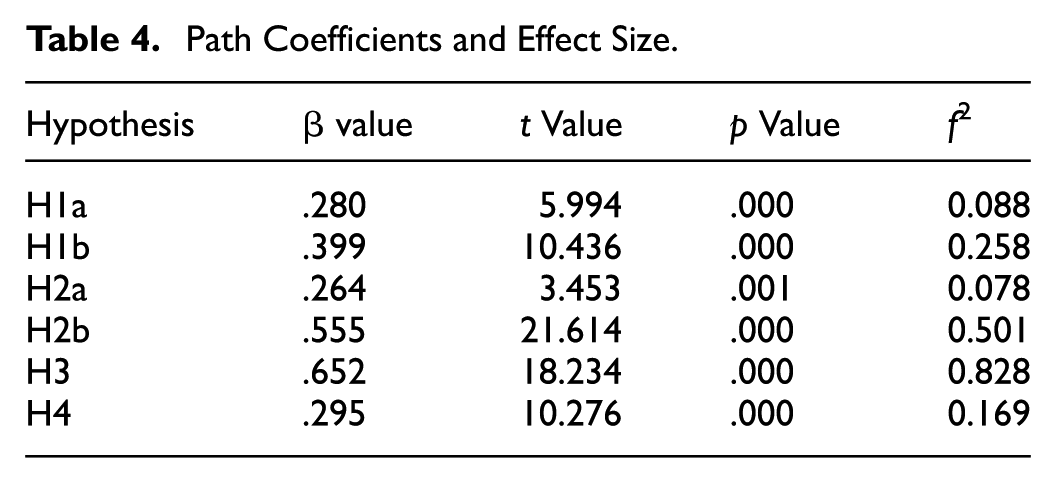
We evaluated the structural model using the bootstrapping procedure with 10,000 resamples in SmartPLS (version 3.3.9). Figure 2 presents the path coefficients (β) and the statistical significance of each path derived from the model testing. Most hypothesised paths were supported by the results, indicating that the proposed structural relationships were largely validated. One exception was H6a, which did not reach statistical significance. Overall, these findings suggest that the model demonstrates satisfactory explanatory power and reliability.

Hypothesis testing results for the structural model.
Following the criteria proposed by Shmueli and Koppius (2011), we used R2 values to evaluate the explanatory power of the model. As shown in Figure 2, the key outcome variable, which is the intention to use smart courier lockers, had an R2 of .489. This suggests a satisfactory level of explanatory strength (Henseler et al., 2009). To assess predictive relevance, we further followed Hair et al. (2019) and computed Q2 statistics. All Q2 values were greater than zero in this study, indicating acceptable predictive accuracy across constructs (Chin, 1998). Furthermore, effect sizes (f2) were computed to assess the extent to which each exogenous variable contributed to the explanation of its respective endogenous construct. As suggested by Cohen’s (1988), f2 values of approximately 0.02, 0.15, and 0.35 may be interpreted as indicative of small, moderate, and substantial effects, respectively. As shown in Table 4, our results conform to these thresholds, supporting the model’s explanatory and predictive capabilities.
Path Coefficients and Effect Size.
Multigroup Analysis
Information literacy is a widely differentiated trait among older adults, to examine how varying levels of information literacy affect the path relationships of willingness to use, we conducted a multigroup analysis using partial least squares (PLS-MGA), following the procedure outlined by Sarstedt et al. (2011). Based on the answers to questions about the level of information literacy among the older adults, we considered those with scoring between 1 and 3 were classified as having low information literacy and those with scoring between 5 and 7 were considered high information literacy. We excluded those with a moderate level of information literacy whose mean scores were greater than 3 and less than 5. Table 5 displays the differences in structural path coefficients between the high and low information literacy groups. No significant moderating effect was found for information literacy on the path from facilitating conditions to performance expectancy (p = .161). However, information literacy significantly moderated three other paths: from social influence to performance expectancy (p = .001), from social influence to effort expectancy (p = .008), and from facilitating conditions to effort expectancy (p = .000). These findings suggest that information literacy plays a meaningful role in shaping the structural relationships between key variables.
Multigroup Analysis Results Based on Information Literacy Levels.
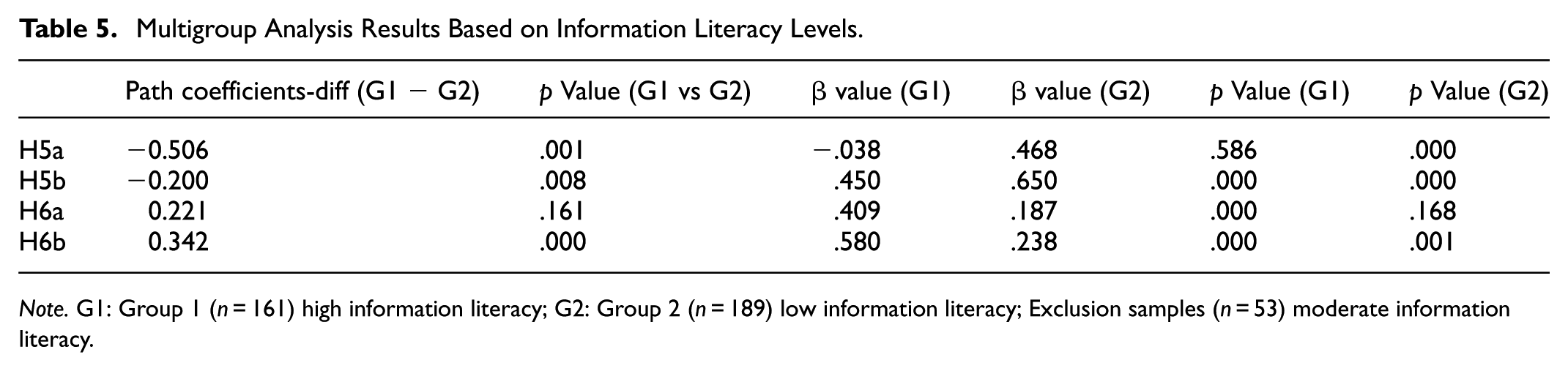
Note. G1: Group 1 (n = 161) high information literacy; G2: Group 2 (n = 189) low information literacy; Exclusion samples (n = 53) moderate information literacy.
To be more specific, first, the moderating effect of social influence on performance expectations significantly varied between participants with different levels of information literacy: it was significant at low literacy levels (p = .000), but not significant at high levels (p = .586). Additionally, information literacy levels showed a significant disparity in moderating the impact of social influence on effort expectations, with a β value of 0.650 at the low literacy level notably higher than the β value of .450 at the high level. This suggests that individuals with limited information literacy are more likely to be influenced by social cues when forming their expectations about the effort required. Marked variation was also observed in how facilitating conditions moderated effort expectations depending on information literacy levels, with β values of .580 and .238 for high and low literacy groups, respectively. These results imply that facilitating conditions exerted a stronger influence on effort expectations among older adults with higher information literacy. Overall, information literacy levels significantly influenced the moderating roles of social influence (on both performance and effort expectations) and of facilitating conditions on effort expectations; however, no notable difference emerged in how facilitating conditions moderated performance expectations.
Discussion
In this study, we used the specific case of older adults’ use of smart courier lockers to examine how perceived external conditions influence their willingness to adopt this technology. We aimed to uncover the psychological mechanisms underlying their decision-making. Guided by the SOR and UTAUT models, we established a theoretical framework to examine key determinants of older adults’ behavioural intentions to adopt smart courier lockers, with a particular focus on social and cognitive influences. Furthermore, we investigated how information literacy may account for variations in how older adults perceive and respond to external facilitating factors. Drawing on the empirical evidence, we summarised the main conclusions as follows.
The results addressed the core research questions by confirming the hypothesised relationships among key constructs. The findings showed that social influences and facilitating conditions affected older adults’ performance expectations and effort expectations in relation to smart courier lockers positively, thereby influencing their willingness to use the lockers. When older adults see other people using smart courier lockers, they may perceive those devices as convenient, reliable and safe, which enhances their performance expectations for smart courier lockers (Ma et al., 2020). At the same time, older people may learn methods and techniques for using smart courier lockers through their communication with other people, thus enhancing their confidence and acceptance of the lockers, and this will enhance their effort expectations in relation to smart courier lockers (Heerink et al., 2010; B. Kim et al., 2025; Liao et al., 2025). In this study, the facilitating conditions included the compatibility, technical support and resource availability for the smart courier lockers. When older adults learn that smart courier lockers have supportive conditions, they may start to believe that it is easy and convenient to use the device. This further enhances their effort expectation in relation to the smart courier lockers (Pal et al., 2018; Shang et al., 2024). Perceiving compatibility with existing equipment and facilities may also lead elderly users to view the lockers as practical and convenient, thus reinforcing their performance expectancy regarding smart courier lockers (M. X. Zhang, 2023). Consistent with previous studies, these results reaffirm that older adults’ willingness to engage with new technologies emerges through ongoing interaction between internal evaluations and the social environment in which those technologies are embedded (Ngan et al., 2025; Teng et al., 2024).
To gain a deeper understanding of individual differences, we further investigated whether information literacy alters the strength of these relationships. Our findings indicate that information literacy is a critical factor in determining how older adults interpret and respond to social and contextual cues. Specifically, under the same conditions of social influence, older adults with low levels of information literacy evidenced more significant effects of social influence on their performance expectancy and effort expectancy than those with high information literacy. Older adults with low levels of information literacy are not sufficiently familiar with modern information channels, such as the internet and the new media, so their access to information is more limited (Niehaves & Plattfaut, 2014). They rely mainly on word-of-mouth from the people around them as well as on propaganda reports in the traditional media, such as TV and newspapers. In this situation, they are more likely to be influenced by the usage habits and evaluations of people around them, as well as by media reports, since these constitute their primary sources of information (Chang et al., 2024; de Veer et al., 2015). Because they frequently acquire their information from a single channel, it is difficult for them to form their own judgements by comparing and verifying different sources of information; thus, they are more susceptible to social influence. In contrast, highly information literate older adults are more familiar with modern information channels, they acquire their information through numerous internet platforms and social media, and they thus have the opportunity to screen the information for authenticity (Heart & Kalderon, 2013; Hunsaker & Hargittai, 2018). They are able to obtain their information from a wider range of channels and to evaluate product performance more rationally by comparing and verifying different information sources. Highly information literate older adults are thus more adept at utilising information to guide their decisions and are less likely to be swayed by the subjective evaluations of those around them (Xin et al., 2025; C. L. Zhang et al., 2025). In summary, higher levels of information literacy among older adults substantially attenuate the influence of social cues on both performance and effort expectancy.
In addition, older adults with higher levels of information literacy demonstrated greater responsiveness to facilitating conditions in shaping both effort expectancy and performance expectancy, compared to their lower-literacy counterparts. This may be attributed to their enhanced ability to access and utilise diverse informational resources, which allows them to better recognise and benefit from technological support systems. Being more sensitive to facilitating conditions means that they are also more likely to establish confidence in the product. In contrast, older adults with low information literacy are less likely to perceive and utilise these resources and are therefore less affected by facilitating conditions. The effect of facilitating conditions on performance expectancy was less affected by literacy level than their effect on effort expectancy. This may be due to the fact that conditions such as express locker compatibility and technical support are more intuitive and can be perceived and evaluated by older adults with varying levels of information literacy; therefore, there is no significant difference in their effects on performance expectations.
Implications and Limitations
Theoretical Implications
By combining the UTAUT and the SOR model, this paper developed an integrative conceptual model to examine the antecedents shaping older adults’ behavioural intention towards the adoption of smart courier lockers. The UTAUT primarily focuses on elucidating users’ acceptance of and engagement with emerging technological solutions (Dwivedi et al., 2019), while the SOR model accounts for how external stimuli shape individuals’ internal cognition and emotional responses (Jacoby, 2002). By integrating these two theoretical models, this paper constructs a comprehensive and systematic research framework, thus providing a more comprehensive theoretical perspective for explaining the behavioural intentions of older adults when using smart devices. This integrated framework is expected to broaden the academic discourse in adjacent domains and stimulate novel avenues for future scholarly exploration.
During the research process, information literacy was introduced as a moderating variable to further enrich the research model. The findings revealed that information literacy significantly shaped how social influence affected both performance and effort expectancy. Additionally, its moderating role was also evident in the relationship between facilitating conditions and effort expectancy. These insights not only provide a new approach for studying the psychological mechanisms of older adults’ use of smart devices, but they also provide new ideas for research in related fields. The paper reveals the complex psychological process underlying older adults’ use of smart devices, which can help researchers to understand the behavioural intentions of older adults in greater depth.
Through its integration of the UTAUT with the SOR model, and also through its exploration of the effect of information literacy on different pathways, this study further expands the application of the two theories and provides theoretical support for subsequent related studies. The findings suggest that social influences and facilitating conditions affect older adults’ performance expectancy and effort expectancy in relation to smart courier lockers, and this affects their willingness to use the smart courier lockers.
Practical Implications
This study examined the degree and direction of influence of each variable in the model on willingness to use technology, thus revealing the influencing factors and the mechanisms behind elderly people’s willingness to use smart courier lockers. The study provides valuable suggestions for the promotion and optimisation of the use of everyday smart devices, as represented by the smart courier locker.
First, drawing on the empirical findings, this study provides actionable insights to support the development of strategies that enhance older adults’ receptiveness to and intention to engage with smart technologies. The results demonstrate that social influences and facilitating conditions affect older people’s performance and effort expectancy, which subsequently influence their behavioural intention to adopt smart courier lockers. Therefore, policy makers can formulate policies corresponding to these influencing factors, such as increasing publicity around smart devices and supporting enterprises in building and developing more smart device operating equipment to improve the recognition and acceptance of smart devices by the older generation.
Second, the findings of this study can support smart device manufacturers in refining their offerings to better address the specific preferences and behavioural tendencies of elderly users. Instead of making generic upgrades, manufacturers are advised to tailor improvements based on key influencing factors. These factors include social influence, the availability of supportive conditions and users’ expectations regarding both performance and effort. For example, vendors can improve the operating interfaces of smart devices to make them more compatible with the usage habits of older people, and they can enhance training to improve the competence of their staff in guiding older people in the use of smart devices. Through these measures, smart device manufacturers can better meet the needs of the older generation and increase their willingness to use the smart devices.
Third, this paper provides insights into the education of senior citizens. It was found that information literacy plays a moderating role in shaping how social influence and facilitating conditions affect both performance and effort expectancy. Therefore, the education sector should offer tailored training programmes to enhance older adults’ information literacy, thereby strengthening their competence in using smart technologies. In addition, families and society can pay attention to the information literacy education of their older members and provide them with more learning opportunities and platforms to help them adapt better to the digital society.
Limitations and Future Study
By focusing on factors influencing older adults’ intention to use smart courier lockers, the research examines the underlying mechanisms through which these factors shape their engagement with smart technologies. The findings contribute to enhancing the quality of life for senior citizens, further promote the development and digital transformation of the courier industry and provide a reference for the comprehensive construction of a digital society and a smart ageing system. Nevertheless, several limitations remain that warrant attention and offer directions for future research.
First, this study focuses on the use of smart courier lockers, which is a common scenario, close to daily life, but the types and uses of smart devices are very diverse, and the problems encountered in the process of using them are many and varied, so the results of a study on smart courier lockers cannot be applied to all smart devices. Second, the data were collected through online surveys targeting older adults. Although this method facilitated timely data acquisition, it may have led to certain limitations. Specifically, older individuals who are more comfortable with digital technologies are more likely to respond, potentially introducing bias into the sample. Moreover, some respondents may have faced difficulties in understanding or completing the questionnaire in an online format, which could affect the accuracy of their responses. Third, many older adults are inexperienced in the use of smart courier lockers, and as a result, they may have been unable to fully understand the questions in the questionnaire or to evaluate objectively their own willingness to use them and the factors that influence them. In addition, older adults’ attitudes towards smart courier lockers may be shaped by social influence rather than representing their independent views. Collectively, these factors may compromise the validity and reliability of the survey results, thereby affecting the overall quality of the study’s data.
To address the limitations of this study, future research could improve and expand on the following aspects. First, the scope of the study could be expanded to include not only smart courier lockers, but also other commonly-used smart devices, such as smart phones, smart watches and smart TVs, thereby enhancing the study’s breadth and practical relevance. Second, the methodology and technology of the study could be improved by using not only questionnaires but also other data collection methods, such as interviews, observations and experiments, this triangulation of methods would help strengthen both the comprehensiveness and robustness of the findings. Third, future studies are encouraged to go beyond examining behavioural intention alone and incorporate actual usage behaviour, where possible. This may involve the use of system-generated usage data or longitudinal tracking, which would provide a more comprehensive understanding of how intention translates into real-world adoption. With these improvements and expansions, future research can be expected to explore more effectively the willingness of the elderly to use smart devices and the factors influencing them, providing more valuable guidelines and suggestions for the design, promotion and application of smart devices, and thus making a greater contribution to the establishment of a digital society and the development of smart ageing.
Conclusion
Understanding how older adults engage with digital services in everyday contexts requires attention not only to their surrounding environment but also to their capacity to make sense of and respond to technological change. The present research contributes to this understanding by offering a more integrated view of the factors that shape older adults’ readiness to adopt smart technologies in later life. Rather than focusing solely on external provision or technical design, the findings reveal the importance of individual capabilities in interpreting social cues and navigating support structures. Such insights broaden the lens through which later-life digital engagement is approached. From a practical perspective, the results offer direction for promoting more inclusive digital participation. Stakeholders involved in technology development, service provision and policy planning may draw on these findings to support more responsive and age-friendly design. Ensuring that older adults are not left behind in the digital transition demands more than infrastructure—it calls for thoughtful alignment of resources, education and social engagement. As digital services continue to proliferate across all areas of life, the meaningful inclusion of older generations remains both a societal priority and an ethical imperative.
Footnotes
Appendix
Measurement Items.

| Factors | Items | Sources |
|---|---|---|
| Social influence | 1. Friends or family members around me use smart courier lockers. 2. Friends or family members recommend that I use smart courier lockers. 3. I think many people already use smart courier lockers. |
Tseng et al. (2013), Venkatesh et al. (2003) |
| Facilitating conditions | 1. The smart courier locker is compatible with other facilities I already use. 2. When I encounter a problem using a smart courier locker, the relevant technical staff help me solve it. 3. I think that the smart courier locker system is equipped with various resources related to its technical operations, such as an app. 4. There is a group of people living nearby who already use the smart courier locker, and they can help me use it. |
Madigan et al. (2017), Tseng et al. (2013), Venkatesh et al. (2003) |
| Effort expectancy | 1. Learning to use a smart courier locker was easy for me. 2. My interactions with smart courier lockers have been clear and understandable. 3. I can operate the smart courier locker by myself. 4. I find the smart courier locker easy to use. |
Madigan et al. (2017), Pal et al. (2018), Venkatesh et al. (2003) |
| Performance expectancy | 1. The smart courier locker is useful in my daily life. 2. The smart courier locker helps me to accomplish tasks more quickly. 3. The smart courier locker can improve the efficiency of my collection of express delivery. 4. I think smart courier locker is extremely useful. |
Al-Saedi et al. (2020), Pal et al. (2018), Venkatesh et al. (2003) |
| Information literacy | 1. I know how to find helpful information on the internet. 2. I feel confident in using information from the internet to make decisions. 3. I can tell high-quality from low-quality resources on the internet. |
Nikou and Aavakare (2021), Norman and Skinner (2006) |
| Intention | 1. I expect that I will use the smart courier locker in my daily life in future. 2. I intend to use the smart courier locker in the future. 3. I plan to collect future express deliveries by using a smart courier locker. 4. I expect to use the smart courier locker frequently. |
Al-Saedi et al. (2020), Martins et al. (2014) |

Funding
The authors disclosed receipt of the following financial support for the research, authorship, and/or publication of this article: This study was supported by the National Social Science Foundation of China, grant number 22BGJ037; the Fundamental Research Funds for the Provincial Universities of Zhejiang under Grant GB202301004; and the Zhejiang Province University Students Science and Technology Innovation Activity Program, grant number 2023R403013 and 2023R403009.
Declaration of Conflicting Interests
The authors declared no potential conflicts of interest with respect to the research, authorship, and/or publication of this article.
Data Availability Statement
The data used to support the findings of this study are available from the corresponding author upon request.