




Abstract
The purpose of this paper is to assess the competitiveness of science and technology innovation (STI) in national center cities in China (NCCC), identify the factors that limit their STI competitiveness, and propose ways to enhance their competitiveness. Firstly, a four-level evaluation index system is created by selecting 13 elements and 60 indicators from five STI dimensions: foundation, environment, input, output, and performance. Then, we use entropy-weighted TOPSIS, systematic cluster analysis, and geo-detector to conduct a comprehensive evaluation and cluster comparison analysis in the dimensions of time and space, and identify the driving forces and interactions. Our study reveals significant differences in the STI competitiveness of the nine NCCCs and their five subsystems. It also shows that the STI competitiveness of the old first-tier NCCCs in the developed regions of eastern China is generally higher than that of the new first-tier NCCCs in the less developed regions of central and western China. The suggestions proposed in this paper, such as enhancing the “head-wolf effect,” following the “city-by-city approach,” and promoting synergistic development, will not only help the NCCCs to become top-notch global STI centers but also serve as a reference for cities in other countries seeking to boost their STI competitiveness.
Plain language summary
The purpose of this paper is to assess the competitiveness of science and technology innovation (STI) in national center cities in China (NCCC), identify the factors that limit their STI competitiveness, and propose ways to enhance their competitiveness. Firstly, a four-level evaluation index system is created by selecting 13 elements and 60 indicators from five STI dimensions: foundation, environment, input, output, and performance. Then, we use entropy-weighted TOPSIS, systematic cluster analysis, and geo-detector to conduct a comprehensive evaluation and cluster comparison analysis in the dimensions of time and space, and identify the driving forces and interactions. Our study reveals significant differences in the STI competitiveness of the nine NCCCs and their five subsystems. It also shows that the STI competitiveness of the old first-tier NCCCs in the developed regions of eastern China is generally higher than that of the new first-tier NCCCs in the less developed regions of central and western China. The suggestions proposed in this paper, such as enhancing the “head-wolf effect,” following the “city-by-city approach,” and promoting synergistic development, will not only help the NCCCs to become top-notch global STI centers but also serve as a reference for cities in other countries seeking to boost their STI competitiveness.
Keywords
Introduction
In today’s increasingly fierce global competition, science, technology, and innovation (STI) has become a crucial factor in determining a country’s comprehensive national strength and international status. The competitiveness of STI in National Central Cities (NCCCs), as the core area of a country’s politics, economy, and culture, is even more crucial to the competitiveness and future development potential of the whole country. According to “the Global Innovation Index 2023,” China’s innovation index jumped from 29th in 2015 to 12th in 2023, and the number of its global top clusters jumped to the first place in the world for the first time (World Intellectual Property Organization (WIPO), 2023). Therefore, studying the competitiveness of STI in NCCC can provide some reference for the development of STI in cities of other countries.
The term “NCCC” was first proposed in the “National Township System Planning (NTSP)” in 2005, which is the core city of China’s township system, playing an important role as a center and hub in China’s finance, management, culture, and transportation, and an important gateway role in promoting international economic development and cultural exchange. From February 2010 to February 2018, nine NCCCs, including Beijing, Tianjin, Shanghai, Guangzhou, Chongqing, Chengdu, Wuhan, Zhengzhou, and Xi’an, were approved for construction by the “Department of Urban and Rural Planning (NTSP) 2010–2020” and the “National Development and Reform Commission (NDRC).” The STI competitiveness refers to the comprehensive level of scientific and technological inputs, outputs, the degree of integration between STI and economy, as well as the scientific and technological potential of a country or a city reflected through research and development, technological innovation, technology transfer and other activities in a certain scientific and technological supportive environment (X. Zhang & Song, 2001). The study of urban STI competitiveness originates from the research on national STI competitiveness and urban competitiveness, the former can be traced back to the Science and Engineering Indicators published in 1973 (National Science Foundation, 2022), while the latter can be traced back to the “National Competitiveness Model” and the “Diamond Competitiveness Model” in the 1980s (Porter, 1990). At present, the research in the above two fields has basically formed a set of relatively mature theories, but the research on the competitiveness of STI in NCCC has not yet formed a set of general theories (Yang et al. 2022; Ye et al., 2022). The research gaps are reproduced below. Firstly, the concept of the competitiveness of STI in NCCC is not clearly defined, resulting in an imperfect evaluation index system, such as fewer evaluation levels, narrower coverage of indicators, and unreasonable weight distribution, which leads to the evaluation results being somewhat biased. Secondly, the existing evaluation methods are relatively simple and lack the comprehensive application of interdisciplinary and multiple methods.
Therefore, this study aims to clearly define the connotation of the STI competitiveness in NCCC, construct evaluation models, and comprehensively apply multidisciplinary evaluation methods such as entropy-weighted TOPSIS, cluster analysis, and geo-detector to comprehensively evaluate the STI competitiveness of the nine NCCCs, cluster analysis and its driver detection, and explore the key factors that constrain their competitiveness of STI, to find out the core path to improve it. This will not only provide some methodological references for the subsequent research of scholars but also provide some decision-making support for the managers of global city governments. This paper is structured as follows. Section “Literature Review” summarizes the relevant literature and puts forward the research questions. Section “Construction of Evaluation Model” constructs the evaluation model of urban STI competitiveness. Section “Analysis of Evaluation Results” integrates the evaluation methods such as entropy-weighted TOPSIS, systematic cluster analysis and geo-detector to perform the comprehensive evaluation of the STI competitiveness of nine NCCCs in 2019 to 2021 in the time-space dual dimensions, cluster comparative analysis and detection of their driving forces. Section “Discussion and Conclusion” reviews the research findings and policy implications, and summarizes the conclusions, contributions, and future research directions.
Literature Review
The Construction-Related Categories of NCCC
Firstly, from the viewpoint of strategic positioning and the role of cities, the concept of NCCC is very similar to the concept of a world (global, international) city, which was first mentioned in the book “The Evolving City.” This concept refers to a type of city that has an absolute advantage in world business activities (Geddes, 1915). Later, the concept, characteristics and functions of world cities were mainly explained from the perspectives of economic globalization, transnational corporations, international division of labor, and the theory of central place (Hall, 1966; Hymen, 1972; John, 1986; Saskia, 1991). It explores the cooperative relationship between world cities, city hierarchy, industry-city relationship, and the layout of corporate headquarters from the perspectives of city clusters and city network systems (Csomós, 2013; Dębińska & Pałubska, 2021; Ganau & Rodríguez-Pose, 2022; John et al., 2019; Taylor, 2001; Taylor & Csomós, 2012; Pan & Xia, 2014; Pan et al., 2015).
Secondly, the concept of “NCCC” was initially proposed by the former Ministry of Construction of China in 2005. Subsequently, scholars have conducted comprehensive research on various aspects related to NCCC, such as its concept, characteristics, functions, competitiveness, radiance, high-quality development, comprehensive carrying capacity, innovation capacity, and efficiency of green development (Guan, 2018; He et al., 2017; Z. G. Li et al., 2021; Pan & Yang, 2018; Song, 2013; Tian, 2014; Tian et al., 2015; Y. F. Wang & Ni, 2020; B. B. Zhang & Peng, 2021). Currently, NCCC has become a focal point of academic research and a subject of competition among local governments in China (Gong & Zhang, 2021; Z. H. Wu & Fan, 2023; W. J. Wu & Huang, 2019; P. W. Yin et al., 2023; Wu, 2019).
The Evaluation Index System for the STI Competitiveness of NCCC
The research of urban STI competitiveness is a new field that combines urban competitiveness and national STI competitiveness.
Firstly, urban competitiveness research can be traced back to the 1990s, with extensive studies on its concept, evaluation index system, influence mechanism, and evaluation model (Ye et al., 2022). The theoretical framework of the evaluation model is broadly categorized into explanatory and demonstrative analytical frameworks. The former focuses on exploring the interrelationships among the influencing factors of urban competitiveness from a qualitative analysis perspective, such as “Diamond Competitiveness Model” (Porter, 1990), “Labyrinth Model” (Begg, 1999), “six-factor model” (Sotarauta & Linnamaa, 1998). The latter focuses on constructing quantifiable evaluation index systems and models from both qualitative and quantitative dimensions, such as “international competitiveness model for metropolitan areas” (Boddy, 1999), “dual-framework model”(Kresl & Singh, 1999), “pyramid model” (Gardiner et al., 2004), “bowstring model” (Ni, 2002), and “flywheel model” (Ni, 2010).
Secondly, In the 1970s, research on national STI competitiveness began, with a strong focus on its concept, evaluation index system, and evaluation model (Aisaiti et al., 2022; Jeon et al., 2021). Notably, renowned evaluation index systems include the Science and Engineering Indicators (SEI), the European Innovation Scoreboard (EIS), the Global Innovation Index (GII), and Global Competitiveness Index Report (GCI), World Competitiveness Yearbook (WCY), National Innovation Index Report (NII), and China Innovation Index (CII) (Z. W. Zhang & Lei, 2021).
Additionally, there is a growing interest in the competitiveness of national (regional) center cities in STI among scholars and local governments (Buesa et al., 2006; J. G. Wang & Du, 2023; Y. F. Wang & Ni, 2020; Worth et al., 2007; Yu, 2015; Zeng et al., 2023; B. B. Zhang & Peng, 2021).
The Evaluation Method for the STI Competitiveness of NCCC
The commonly used evaluation methods for assessing STI competitiveness in cities and regions include factor analysis, principal component analysis, hierarchical analysis, mutation level method, data envelopment analysis, entropy-weighted TOPSIS method, cluster analysis, geo-detector, and others (Z. R. Chen, 2015; J. B. Chen et al., 2021; Ni et al., 2021; J. G. Wang & Ni, 2020; Z. H. Wu & Fan, 2023; C. Y. Wang & Du, 2023; B. Z. Wang & Zhao, 2019). For example, Qiu and Cao (2023) developed a framework to identify and evaluating the disruptive technologies in smart cities using entropy-weighted method and hierarchical analysis method. The feasibility and effectiveness of their framework were verified in the field of information science. Yang et al. (2022) employed statistical analysis and geo-graphic probes to deeply analyze the overall characteristics and driving factors of the STI competitiveness in Chinese cities based on the global urban STI competitiveness index system.
Review of Studies on the STI Competitiveness of NCCC
In the various studies on the STI competitiveness of NCCC, research institutions and scholars have conducted thorough and extensive research primarily focusing on three dimensions: the construction-related categories of NCCC, the evaluation index system of urban STI competitiveness, and the evaluation method of urban STI competitiveness. This research has yielded unique results, providing theoretical support, ideas and methodological guidance for further study. However, there are some issues in the existing literature that need to be addressed.
Firstly, the NCCC is a very Chinese concept, which is closely related to the idea of a global city in terms of strategic positioning and functional characteristics. However, the former places more emphasis on its core controlling role within the national township system and its function as a gateway for international connectivity within the global city network system, while the latter focuses on examining characteristics, functions, and industry-city interactions from the perspective of international connectivity. At present, the NCCC such as Beijing, Shanghai and Guangzhou have effectively utilized their role as external gateways and are on par with world cities. On the other hand, other NCCC such as Tianjin, Chongqing, etc. play a more central control role and are still some distance away from being considered global cities. In addition, scholars have mainly focused on evaluating the competitiveness, radiation, and high-quality development of NCCC, but have given less attention to their STI competitiveness.
Secondly, the study of urban STI competitiveness is a new research area that combines national STI competitiveness and urban competitiveness. Research institutions and scholars have focused on its concept, evaluation index system and evaluation model, and have made some notable research findings. However, there are some issues that need to be addressed. Firstly, current research on STI competitiveness concentrates on regional central cities and pays less attention to NCCC. A comprehensive research framework has not yet been established. Secondly, the concept of STI competitiveness of NCCC has not been clearly defined, leading to a lack of solid theoretical support for the evaluation index system, fewer evaluation levels, and narrower coverage of indicators. Thirdly, there is a lack of research that delves into the essence of STI competitiveness for NCCC and constructs an evaluation model from a systems cybernetics perspective.
Thirdly, although the existing research methods have their own characteristics, all of them have certain defects. For example, there is subjective assignment in the hierarchical analysis method. The economic significance of principal components (factors) is not clear in principal component and factor analysis method. The calculation process of the mutation level method is cumbersome. The entropy-weighted TOPSIS method is a comprehensive evaluation method that combines the information entropy-weighted method and the TOPSIS model to form a multi-indicator system. It absorbs the advantages of the objective assignment of the former and utilizes the characteristics of the latter’s calculation simplicity to ensure the scientific and reasonableness of the calculation results, and improves the credibility and validity of the evaluation results (Kim et al., 2022; Liu et al., 2016; Y. Y. Zhang, 2022). Cluster analysis is now classified according to the characteristics of sample data information, which has the advantages of convenient calculation and objective and credible classification results, and is now widely used in classification research in urban, industrial, and industry fields (S. J. Li et al., 2019; Ni et al., 2021; M. Q. Yin & Xie, 2018; B. J. Zhang et al., 2019). Geo-detector is a spatial statistical analysis method that explores whether spatial heterogeneity exists and reveals whether the driving forces and interactions behind it exist (Wang et al., 2010). The method includes a risk detector, a factor detector, an ecological detector, and an interaction detector, and its biggest advantage is that it does not have too many assumptions (i.e., it discards traditional assumptions such as homoskedasticity, normal distribution, and so on), and it can effectively overcome the limitations of the traditional statistical methods in dealing with categorical variables, thus gaining the favor of an increasing number of scholars in the fields of geography, regional economics, and urban economics (S. Y. Chen & Yu, 2023; Han et al., 2023; Hu et al., 2011; Qin et al., 2023). Most of the existing literature utilizes one or two of these three approaches, and studies that integrate them have still not been found.
In summary, the relevant studies on the evaluation of the STI competitiveness in NCCC mainly have the following problems. Firstly, the number of studies is small, and a more trustworthy research framework has not yet been formed. Secondly, the core concepts are not well defined, resulting in the lack of solid theoretical support for its evaluation index system, fewer evaluation levels and narrower coverage of indicators. Thirdly, the existing evaluation methods are relatively solitary and lack the comprehensive application of multiple methods. Therefore, this study proposes to solve the above problems. Firstly, the evaluation index system for STI competitiveness in NCCC is designed based on the principles of system cybernetics. It involves solidifying the theoretical foundation, clarifying the evaluation concept, and establishing the evaluation index system. Additionally, the evaluation model for STI competitiveness in NCCC is constructed using methods such as entropy-weighted TOPSIS, systematic clustering analysis, and Geo-detector, following the evaluation procedure of standardizing indicator data, assigning information entropy power, conducting TOPSIS comprehensive evaluation, comparing evaluation results, and detecting driving forces and interactions.
Construction of Evaluation Model
Evaluation of the competitiveness of urban STI is a systematic project involving the comprehensive application of multiple evaluation objects, levels, indexes and methods, and its main steps include clarifying the evaluation objects, establishing the evaluation index system and constructing the evaluation model.
Evaluation Objects and Data Description
The Evaluation objects was conducted on nine NCCCs, including Beijing, Tianjin, Shanghai, etc. Since Xi’an was only established as a NCCC in “the Guanzhong Plain City Cluster Development Plan (NDRC Planning [2018] No. 220)” in February 2018. To ensure the completeness, comparability and consistency of the data, the panel data of the evaluation indexes of STI competitiveness of nine NCCCs in 2019-2021 were collected. The data come from “the 2020 to 2022 China Urban Statistical Yearbook,”“2020 to 2022 China Torch Statistical Yearbook” and “the 2020 to 2022 Beijing Statistical Yearbook” and other statistical yearbooks of the nine NCCCs.
Evaluation Indicator System
The evaluation index system is the core of the comprehensive evaluation of multiple indicators, which mainly includes consolidating the speculative foundation of evaluation, clarifying the principles of evaluation concept, clarifying the ideas of evaluation design, and establishing the evaluation index system.
Theoretical Basis of Evaluation
Firstly, the connotation of NCCC’s competitiveness in STI is clearly defined, and then from the perspective of system theory, it is assumed that the intrinsic operation mechanism of each component of its competitiveness in STI is in line with the “pyramid” structural system.
(1) Core concepts
At present, scholars have given the definitions of NCCC and regional (city) STI competitiveness respectively, but the STI competitiveness of NCCC has not been clearly defined. Therefore, this paper considers that it refers to mega-centers that play a core controlling role in China’s urban system and play an important role as a functional node in the global urban network system, Rooted on the basis of strong economic volume, sufficient talent reserves, rich cultural deposits and reasonable economic structure, it makes full use of perfect infrastructure and beautiful urban environment, promotes the concentration of a large number of scientific research institutes, innovative enterprises, STI talents and other innovation factors, forms STI carriers, through high-intensity uninterrupted investment in human capital and physical capital, innovative achievements such as new sciences, technologies, processes, products, organizations and services in a sustained and continuous manner to meet the needs of economic and social development, and promotes the industrialization of such innovations, realizes the sustainable and high-quality development of urban STI, and ultimately achieves the goal of the unity of economic, social, and ecological benefits of the city, and the continuous enhancement of the well-being of urban residents.
(2) Operation Mechanism Assumptions
Based on the above definition, the following hypotheses are suggested.
H1: The STI foundation is the root soil
Urban STI competitiveness is based on a series of past monetary aggregation, talent reserves, cultural accumulation and economic structure. It is a public platform for maintaining municipal innovation activities, which is characterized by fundamentality, durability and public nature. Among them, monetary aggregation and talent reserve are hard indicators and “prime movers” of innovation activities, constraining the input level of STI factors, while cultural accumulation and economic structure are soft indicators and “drivers” of innovation activities, constraining the sustainability of innovation activities.
H2: The STI environment is the framework platform
The STI environment is a series of framework platforms that impact the development of innovation activities, including infrastructure and STI carriers. It not only provides innovation carriers for STI, but also provides infrastructure carrying capacity, which determines the formation and evolution direction of urban STI competitiveness. Among them, the carrying capacity of infrastructure such as communication, transportation and life represents whether the public innovation conditions are complete, which together constitute the “hotbed” for the development of high-tech industry and the “habitat” for the innovation and entrepreneurship of high-tech personnel. STI carriers reflect the synergistic innovation ability among innovation subjects, which mainly stems from the industry-university-research partnership and industrial technology innovation alliance formed by high-tech enterprises, crowdsource space, university S&T parks and other innovation subjects.
H3: The STI input is the four pillars and eight columns
STI input is the fundamental guarantee to maintain the progress of innovation activities and the scientific operation of the innovation system, including human capital and physical capital. It not only reflects the city’s investment in innovation development, but also reflects the government’s attention to the progress of STI. Since in the knowledge production function, the growth of new knowledge depends on the human capital invested in the production of new knowledge in a country (region), that is, the results of new knowledge, new technology, and new system must be ultimately accomplished by the innovative talents, but the STI cannot be separated from the support of physical capital, either.
H4: The STI output is the key element
STI output is a key component of evaluating the competitiveness of urban STI, including STI achievements and industrialization of STI achievements. It is not only a concentrated manifestation of the consequences of STI activities, but also determines the quality of the city’s STI competitiveness. Among them, STI achievements should be reflected in the results of new ideas, new knowledge, new technology, and new products obtained by science and innovation subjects through a series of STI activities; while the industrialization of STI achievements is reflected in the ability of whether STI achievements can be industrialized, whether new products can be formed and new industries can be derived.
H5: The STI performance is the target destination
STI performance determines the target destination of urban STI competitiveness, including the pecuniary benefits, societal benefits and sustainability of STI activities. It not only examines whether STI activities can be conducted in a sustainable manner, but also examines whether they can improve economic efficiency and whether they can bring about social equity. Among them, the sustainability of STI activities reflects whether they are sustainable and whether they can continue to encourage the high-quality development of the city’s economy and society. The pecuniary benefits reflect whether STI activities can improve the economic efficiency of enterprises, the consumption capacity of residents and the level of social welfare. The societal benefits reflect whether they can improve the ecological environment, the level of medical care, transportation and communication, and the standard of living of residents.
To summarize, it is assumed that the internal operation mechanism of the components of urban STI competitiveness fits the “pyramid” structural system (see Figure 1). Among them, the STI foundation constitutes the root soil, the STI environment constitutes the framework platform, the STI input constitutes the four pillars and eight columns, the STI output constitutes the key elements, and the STI performance constitutes the tip of the pyramid, that is, the ultimate destination of STI activities.

Evaluation indicator system for the competitiveness of urban STI.
Philosophy Principles of Evaluation
The evaluation of urban STI competitiveness is essentially a comprehensive evaluation method with multiple evaluation objects and indicator systems. To ensure the objectivity, credibility and effectiveness of the evaluation results, the core is tantamount to construct an evaluation index system that is systematic and hierarchical, scientific and operable, comprehensive and typical, dynamic and stable. Therefore, it should follow the following principles.
(1) Integration of systematically and hierarchy
According to system cybernetics, a complex system often consists of multiple subsystems, each subsystem consists of multiple elements, and each element is reflected in different indicators. It is assumed that the internal operation mechanism of the components of urban STI competitiveness, which are mutually supporting and constraining, fits the “pyramid” structure system. Therefore, the evaluation index system should be constructed from macroscopic to mesoscopic and then to microscopic.
(2) Integration of science and operability
The design of the evaluation index system should follow the principle of scientific on the one hand, that is, the selected evaluation indexes can objectively and truthfully reflect the endowment and characteristics of STI of nine NCCCs, and can comprehensively and objectively reflect the real relationship between its subsystems and elements. On the other hand, it should follow the principle of operability, that is, the evaluation index data should be consistent, comparable and quantifiable, and easy to measure, collect and quantitatively analyze.
(3) Integration of comprehensiveness and typicality
It should follow the principle of comprehensiveness on the one hand, that is, each element should be in a position to comprehensively reflect the characteristics of all its evaluation indexes, and each subsystem should be able to synthesize the attributes of all its elements. On the other hand, it should follow the principle of typicality, that is, the evaluation indicators should have representativeness, and should not be too much and too detailed, so that the indicators are too cumbersome and overlap each other, and should not be too little and too simple, so that the information of the indicators is distorted and the contents are missed.
(4) Integration of dynamism and stability
It is all a long-term dynamic process, but also need to maintain relative stability at a certain point in time, STI only in the continuous dynamic change in the vitality, but its quality only to maintain the steady state to have a fixed force.
Evaluation Design Ideas
According to the relevant theories of system cybernetics, technical economics and competitiveness economics, and based on the assumption of the “pyramid” structure system, and following the concepts and principles of the construction of the evaluation index system, and combining with the actual situation of STI in NCCC. With reference to a large number of relevant literatures on urban competitiveness and STI competitiveness, the evaluation index system is divided into four levels such as the target level, the subsystem level, the factor level, and the indicator level by adopting a top-down, layer-by-layer approach, and a set of multi-category multilevel and multifaceted indicators of urban STI competitiveness covering one first-level index, five second-level indexes, 13 third-level indexes, and 60 fourth-level indexes is constructed in the end. The steps are as reproduced below.
Step 1: Formulate the basic framework of the evaluation index system
Referring to the existing evaluation index systems of urban competitiveness and STI competitiveness, considering both the scientific, comprehensive and representative nature of evaluation indicators and the consistency, availability and comparability of data, initially formulate the basic framework and levels of the evaluation index system, and clarify the meanings of the indexes at all levels and their measurement methods.
Step 2: Define the specific content of the four levels of evaluation indicators
Frequency counting of evaluation indicators in research related to STI, and selection of evaluation indicators with higher frequency, such as expenditure on science and technology and education, full-time equivalent of R&D personnel, and the number of patent applications granted, etc., to revise and improve the evaluation indicator system.
Step 3: Collect sample data of four-level evaluation indicators
As the data of the four-level evaluation indicators involve the STI situation of nine NCCCs in 2019 to 2021, it is necessary to consult several yearbooks, such as “2020 to 2022 China Urban Statistical Yearbook” and “2020 to 2022 China Torch Statistical Yearbook,” which belong to the sample data with multiple indicators, multiple time points and multiple objects. In the process of reviewing the data, inconsistencies in statistical caliber and incomplete statistical indicators will inevitably occur, and the evaluation index system has yet to be amended and improved.
Step 4: Construction of evaluation model
Since the four-level evaluation indicators involve multiple fields and the quantitative outline is not uniform, it is necessary to standardize the data and determine the weights of the indicators at each level, and then construct the evaluation model and compile the application by using appropriate evaluation methods.
Step 5: Conduct comprehensive evaluation, comparison and analysis
Input the indicator data of the nine NCCCs to carry out comprehensive evaluation, and according to the empirical results, carry out comparison and analysis.
Establish the Evaluation Index System
The top-down, layer-by-layer in-depth method is adopted to establish the evaluation index system, with the following steps.
Step 1: Formulate the names of the target layer, subsystem layer and element layer
The target layer is the general outline of the evaluation index system, which should obviously be the city’s STI competitiveness (η). The subsystem layer consists of the subsystems that play a supporting role for the whole innovation system, that is, the five major subsystems competitiveness, such as STI foundation (η1), environment (η2), input (η3), output (η4), and performance (η5). The element layer consists of elements that affect the competitiveness of STI subsystems and are determined by their significance and characteristics, that is, 13 elements including monetary aggregation (η11), talent reserve (η12), ……, and sustainability (η53) (see Table 1).
Step 2: Determine specific evaluation indicators for the indicator layer
The indicator layer consists of evaluation indicators that directly reflect the elements of STI, that is, it consists of 60 indicators such as gross regional product (GRP), local financial income, ……, the per capita expenditure on science and education and other 60 indicators (see Table 1).
Evaluation Indicator Systems for the Competitiveness of Urban STI.

Note. Data from “2020 to 2022 China Urban Statistical Yearbook,”“2020 to 2022 China Torch Statistical Yearbook,” as well as “Beijing Statistical Yearbook 2020 to 2022,” and other statistical yearbooks of nine NCCCs. The same below.
Constructing Evaluation Model
In this paper, the methods of entropy-weighted TOPSIS, systematic cluster analysis and geo-detector are comprehensively applied. Among them, the former is a comprehensive evaluation method of multi-indicator system formed by the cross-fertilization of information entropy-weighted method and TOPSIS method.
Information Entropy-Weighted Method
It is an objective empowerment method, the principle of which is to calculate the information entropy using the evaluation index data, and the larger the information entropy, the smaller the coefficient of variation, that is, the smaller the weight should be in the comprehensive evaluation.
First, the information entropy weights of evaluation indicators such as indicator layer, element layer and subsystem layer are calculated layer by layer by applying the information entropy-weighted method (see Table 1), and the measurement steps are reproduced below.
Step 1: Build a standardized evaluation matrix
It is assumed that the indicator layer is composed of m evaluation objects and n evaluation indicators, that is, the evaluation matrix

In the formula,
Step 2: Calculate information entropy
Calculate information entropy Rj according to


Step 3: Calculate the coefficient of variation
The coefficient of variation

It is not difficult to know that the smaller the information entropy
Step 4: Calculate information entropy-weighted
The information entropy-weighted

Entropy-weighted TOPSIS Evaluation
TOPSIS was firstly proposed by C. L. Huang and K. Yoon in 1981, which is a “Technique for Order Preference by Similarity to Ideal Solution” (TOPSIS). The principle is to determine a positive ideal solution and a negative ideal solution for each evaluation index of all evaluated cities, and then calculate the Euclidean distance between them and the positive and negative ideal solutions, thus calculating the degree of closeness, which takes a value between [0, 1], and the closer it is to 1, the higher the evaluation.
After the information entropy-weighted is determined, it is introduced into the TOPSIS model, and the comprehensive closeness degree (comprehensive evaluation indicator) of the element layer, subsystem layer, and target layer (see Table 1) is calculated layer by layer. The steps are reproduced below.
(1) Calculate element layer closeness
Step 1: Identify positive and negative ideal solutions
The highest and lowest values of


Step 2: Calculate Euclidean distance
By using the information entropy-weighted method and Euclidean distance weighted average operation, it can be derived that the distance of each city’s standardized evaluation index from the progressive ideal solution and the negative ideal solution are


In the formula, the indicator weight vector
Step 3: Calculate the element layer closenes
The closeness of each urban element layer indicator can be computed according to the distance of

The larger the value of
Step 4: Sort and compare
By ranking the closeness
(2) Calculate the closeness of the subsystem layer and the target layer
Taking the element layer closeness
Similarly, all the above evaluation steps are repeated to obtain the target layer closeness η and ranking, according to which the evaluation analysis is performed.
Systematic Cluster Analysis
Cluster analysis is the grouping of similar research objects into classes. The basic idea is to divide the samples (variables) into several classes according to the distance (similarity) of the sample data, and the principle of classification is to minimize the distance (i.e., maximum similarity) within the same class and maximize the distance (i.e., minimum similarity) between different classes, which aims to maximize the homogeneity of the objects within the class and maximize the heterogeneity of the objects between the class and the class. Cluster analysis can be utilized not only to categorize samples, called Q-type cluster analysis, but also to categorize variables, called R-type cluster analysis. According to the categorization, the methods can be divided into systematic clustering method, fuzzy clustering method, K-mean method, etc.
Here, the systematic cluster analysis method is used to cluster the STI competitiveness in the nine NCCCs. The basic steps are reproduced below.
Step 1: Calculate the distance
Here, the closeness degree

Step 3: Merge the two closest classes into a new class
Here, the distance between classes has to be calculated. Due to the shape of the class being diverse, there are many methods for calculating the distance between classes, including the shortest distance method, the class average method, etc. Among them, due to its good clustering performance, the class average method is the most common clustering method. This method also includes between-group linkage and within-group linkage. The former only considers the average distance between two classes of measurement objects, while the latter averages all the distances between all measurement objects in two groups.
If there are p and q measure objects in the class

If the distance

Then, Merge two classes into a new class
Step 4: Repeat the above clustering process
The distance between the new class and the current classes are still calculated using the class average method, and according to whether the distance between the two classes is less than or equal to the predetermined threshold T, to decide whether to cluster into a new class, until the number of classes is equal to 1.
Step5: Draw a clustering tree diagram and determine the number and class of classifications.
Step6: Analyze the characteristics of each different class.
Geo-detector Detection
To specifically measure the extent to which each subsystem (or element) can explain the changes in the STI competitiveness of NCCC, and to further measure the interactions among the five subsystems (or 13 elements), it is urgent to introduce the geo-detector method for the detection of drivers and their interactions.
Geo-detector is commonly used in the analysis of spatially stratified heterogeneity and the detection of the driving forces behind it. The core principle the case is that, if an independent variable in a region is an important influence on the change of its dependent variable, then their spatial distributions should be similar. Obviously, if the stronger their spatial similarity is, then that independent variable is an essential driver of the change in the dependent variable, and vice versa, it is an unimportant driver. Compared to further spatial discretization methods, geo-detector has two significant advantages. Firstly, it can detect both numerical and qualitative data. Secondly, it can effectively detect whether two-factor interaction exists and the strength of the interaction. Drawing on the approach of scholars Ma et al. (2023) and Xu et al. (2023), we mainly use factor detectors and interaction detectors.
(1) Factor detector
The factor detector aims to detect the spatial heterogeneity of the city’s STI competitiveness η using q-values as well as to assess the extent to which a subsystem’s STI competitiveness

Among them,

Here, the number of groups of the dependent variable η or independent variable (
The q value varies from 0 to 1. If the grouping is given in η, the higher the q value is, the more prominent the spatial heterogeneity of η is. If the grouping is given in
(2) Interaction detector
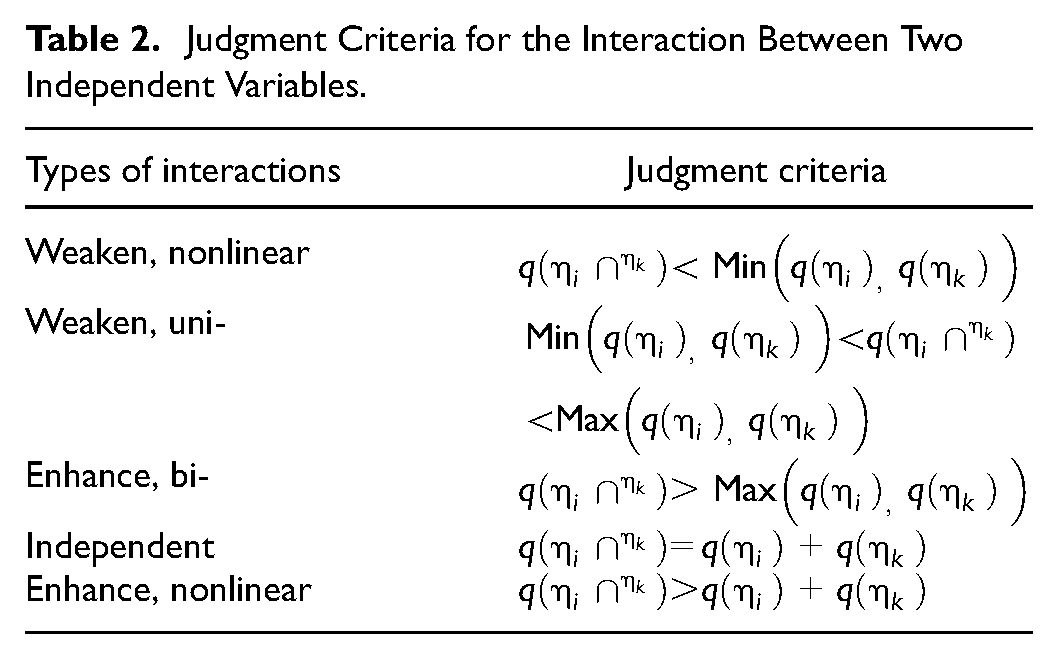
The interaction detector is designed to compare
Judgment Criteria for the Interaction Between Two Independent Variables.
Analysis of Evaluation Results
Based on the evaluation indicator data of the STI competitiveness of nine NCCCs from 2019 to 2021, this section applies entropy-weighted TOPSIS, systematic cluster analysis, and geo-detector to conduct evaluation and analysis. The results are reproduced below.
Evaluation Process and Results
Firstly, the evaluation index data of the nine NCCCs in 2019 to 2021 are taken as the basis, Then, entropy-weighted TOPSIS method is used to measure and analyze the competitiveness of urban STI. Tables 3 to 8 presents the results.
The STI Elements Competitiveness of Nine NCCCs in 2019.

The STI Elements Competitiveness of Nine NCCCs in 2020.

The STI Elements Competitiveness of Nine NCCCs in 2021.

The STI Competitiveness and Its Subsystems Competitiveness of Nine NCCCs in 2019.

The STI Competitiveness and Its Subsystems Competitiveness of Nine NCCCs in 2020.

The STI Competitiveness and Its Subsystems Competitiveness of Nine NCCCs in 2021.

Secondly, using the STI competitiveness (η) and its subsystem competitiveness (

Cluster analysis tree of the STI competitiveness of nine NCCCs in 2021.
Finally, the η of the nine NCCCs in 2019 to 2021 is taken as the dependent variable, which is obviously a numerical variable, while the
The Detection Results of STI Subsystems Competitiveness Drivers in the nine NCCCs From 2019 to 2021.

The Detection Results of the Interaction of STI Subsystems Competitiveness in the nine NCCCs From 2019 to 2021.

Note. The main diagonal elements represent the detection results of drivers of STI subsystems competitiveness, and the other elements represent the detection results of the interaction of STI subsystems competitiveness.
The Detection Results of STI Elements Competitiveness Drivers in the nine NCCCs From 2019 to 2021.

The Detection Results of the Interaction of STI Elements Competitiveness in the nine NCCCs From 2019 to 2021.
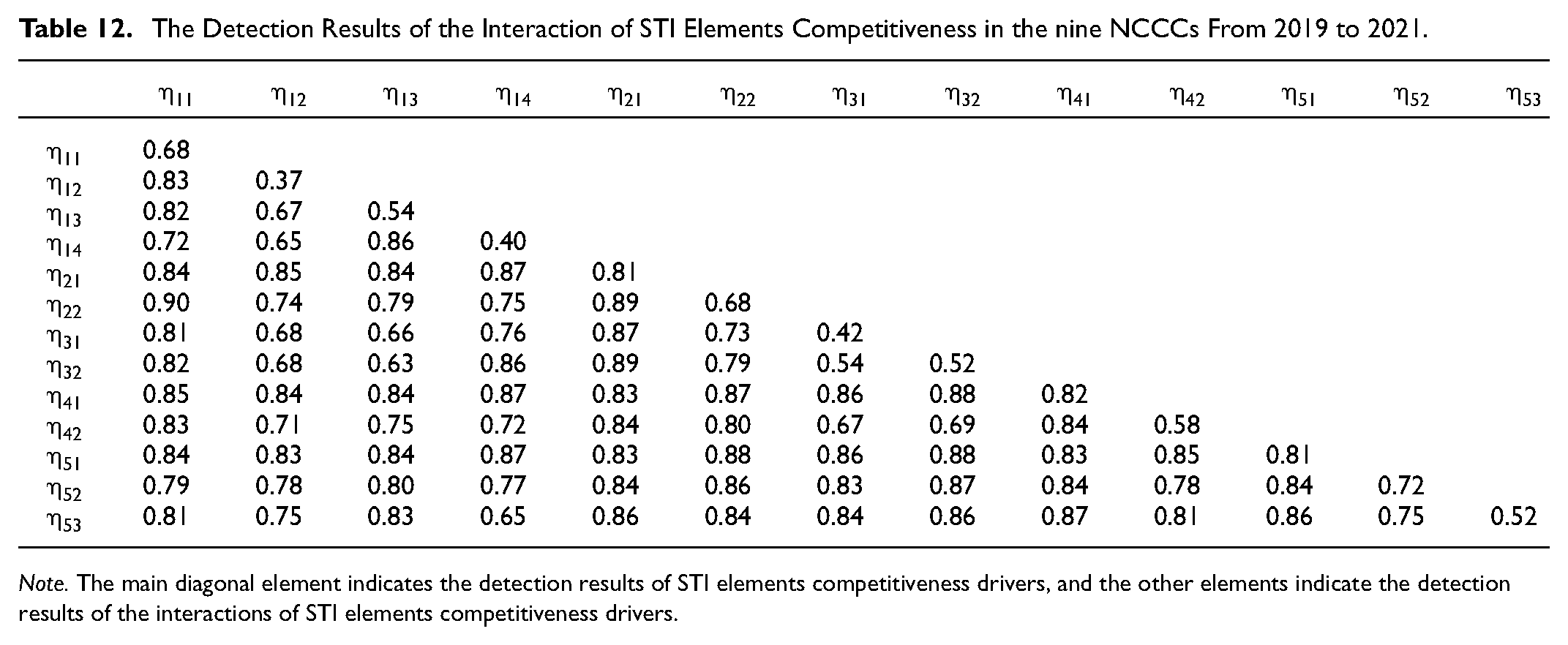
Note. The main diagonal element indicates the detection results of STI elements competitiveness drivers, and the other elements indicate the detection results of the interactions of STI elements competitiveness drivers.
Analysis of Entropy-Weighted TOPSIS Evaluation Results
The STI Foundation Competitiveness
From Tables 6 to 8, the average of the STI foundation competitiveness of the nine NCCCs in 2019 to 2021 is [0.43, 0.46], the range interval is [0.59, 0.63], and the coefficient of variation range is [0.41 0.51], indicating that their differences in STI foundation are relatively small and their rankings are relatively stable.
From the ranking point of view, the first tier is Beijing, Shanghai, Guangzhou and Wuhan, whose STI foundation competitiveness is greater than 0.43, indicating that they have a more solid STI foundation. This can be checked by the fact that the closeness of their economic foundation, talent reserve, cultural precipitation, and economic structure transformation is mostly higher than their average. For example, Beijing’s cultural accumulation has always ranked first, Shanghai’s Monetary aggregation and economic structure transformation have continued to rank first (see Tables 3–5). The second tier is Chongqing, Tianjin, Zhengzhou, Chengdu, and Xi’an, whose STI foundation competitiveness is lower than 0.43, indicating that their STI foundation is not solid.
The STI Environment Competitiveness
From Tables 6 to 8, the average of STI environment competitiveness is [0.42, 0.57], the range is [0.80, 0.87], and the coefficient of variation is [0.47, 0.68], indicating significant differences in their STI environment and significant changes in their rankings.
From the ranking perspective, the first tier of Beijing, Shanghai and Guangzhou have no change and their STI environment competitiveness is all greater than 0.56, indicating that their STI environments are beautiful. This is also included in the fact that the STI elements competitiveness of infrastructure and innovation carriers is higher than the average value. For instance, Beijing’s science and innovation carrier ranks first in 2019 to 2020, Beijing’s infrastructure ranks first in 2020 to 2021, and Shanghai’s innovation carrier ranks first in 2021 (see Tables 3–5). The ranking of the second echelon cities fluctuates greatly, with Tianjin and Chongqing rising year by year, while Zhengzhou and Xi’an fell year by year, and Chengdu and Wuhan stable.
The STI Input Competitiveness
From Tables 6 to 8, the average of STI input competitiveness is [0.41, 0.50], the range is 1, and the coefficient of variation is [0.59, 0.69], indicating significant differences in their STI input competitiveness, but relatively stable rankings.
From the ranking opinion, Beijing, Guangzhou, Wuhan, and Xi’an in the first tier are relatively stable, indicating their strong competitiveness in the STI input competitiveness. This is also included in the fact that the STI elements competitiveness such as human capital and physical capital are closer than their average. For example, Beijing’s human capital and physical capital continues to rank first (see Tables 3–5). The rankings of Shanghai, Tianjin, Chengdu, and Chongqing in the second tier have slightly changed, while Zhengzhou has always been at the bottom.
The STI Output Competitiveness
From Tables 6 to 8, the average of STI output competitiveness is [0.35, 0.44], the range is [0.69, 1.00], and the coefficient of variation is [0.65, 0.70], indicating a significant difference in their STI output competitiveness and a significant change in ranking.
From the ranking perspective, Beijing, Shanghai, and Guangzhou are ranked in the first tier. This is also included in the fact that the STI elements competitiveness of STI achievements and their industrialization is mostly above average. For example, Beijing’s STI achievements continues to rank first, while Guangzhou’s STI achievements industrialization ranked first in 2020 (see Tables 3–5). The rankings of Zhengzhou and Xi’an in the second tier gradually declined, while the rankings of Chongqing and Chengdu gradually rose, and the rankings of Tianjin were stable.
The STI Performance Competitiveness
From Tables 6 to 8, the average of STI performance competitiveness is [0.42, 0.43], the range is [0.77, 0.85], and the coefficient of variation is [0.58–0.66], indicating significant differences in their STI performance competitiveness and fluctuating rankings.
From the ranking perspective, Beijing, Guangzhou, and Shanghai are ranked in the top three. This is also included in the fact that the STI elements competitiveness, such as pecuniary benefits, social benefits and sustainability of STI, are all higher than their average values. For example, in 2019 to 2020, the societal benefits and sustainability of Beijing STI ranked first, while the pecuniary benefits of Shanghai STI ranked first (see Tables 3–5). The rankings of Chengdu, Xi’an, and Zhengzhou in the second tier tend to stabilize during fluctuations, while the rankings of Tianjin have gradually increased.
Analysis of Systematic Clustering Results
From Tables 6 to 8, the mean of the STI competitiveness is [0.42, 0.50], the range is [0.83, 0.91], and the coefficient of variation is [0.55–0.65]. It shows that their STI competitiveness varies widely, but the ranking remains relatively stable.
As indicated in Figure 2, the nine NCCCs can be divided into three types. The first category is the balanced competitive superiority type, which includes Beijing, Shanghai and Guangzhou, whose is ranked among the top three and ranked consistently. The reasons are as following. Firstly, they have a solid STI foundation. They are all located in the developed areas of eastern China, belonging to the old first-tier NCCC, with profound economic and cultural deposits, various types of talents, a reasonable economic structure, and the mode of economic growth has turned to be driven by the innovation chain and the industrial chain. Secondly, they get a great STI environment and a high level of STI performance. Their transportation, communication, medical and living infrastructures are relatively unspoiled, providing an excellent investment and business environment for STI enterprises and talents, and vigorously building STI platforms and carriers, thus obtaining high STI performance.
The second category is the uneven competitive development type, including Wuhan, Chengdu and Xi’an, whose rankings are in the middle three, and the rankings of Chengdu and Xi’an fluctuate. The reason is because they are in the less developed regions of central and western China and belong to the new first-tier NCCC, which have certain shortcomings as well as long comings in STI. For example, Xi’an is always at the bottom of the list in terms of STI performance in 2019 to 2021, while Chengdu is ranked eighth in terms of its STI foundation in 2019 and Wuhan is ranked seventh in terms of its STI performance in 2020, but they have a more obvious advantage in terms of STI input.
The third category is the balanced competitive development type, including Chongqing, Tianjin and Zhengzhou, whose is ranked in the bottom three, and the rankings of Zhengzhou and Chongqing fluctuate a lot. The cause is that they haven’t obvious competitive advantages but have outstanding competitive disadvantages. For example, Chongqing is still at the bottom of the list in terms of STI foundation, Zhengzhou is always at the bottom of the list in terms of STI input. In addition, they only had individual years in which the highest ranking for the STI subsystems competitiveness was only fourth.
Analysis of Geo-Detector Detection Results
Analysis of the STI Subsystems Competitiveness Driving Detection Results
Firstly, from the results of the driving force detection (see Table 9), the p-value of the companion probability of the q-value is less than .05, which indicates that the competitiveness of the five major STI subsystems has a significant impact on the STI competitiveness. In addition, their importance is ranked in descending order as STI environment, foundation, performance, output, and input.
Secondly, from the results of the interaction detection (see Table 10), taking the interaction of STI foundation and STI environment as an example, since
Analysis of STI Elements Competitiveness Driving Detection Results
Firstly, from the consequences of the driving force detection (see Table 11), the p-value of q-value is less than .05, which indicates that the impact of 13 STI elements competitiveness is significant. In addition, in terms of their importance ranking, the top five are STI achievements, infrastructure, pecuniary benefits, societal benefits and monetary aggregation, and the bottom five are STI sustainability, physical capital, human capital, economic structure, and talent reserve.
Secondly, from the detection results of the interaction (see Table 12), taking the interaction between the monetary aggregation and talent reserve as an example, since
Discussion and Conclusion
Discussion of Research Findings and Policy Implications
Discussion of Research Findings
(1) Evaluation index system
Unlike the existing studies, this paper introduces a four-level evaluation index system based on system cybernetics. It aims to consolidate the theoretical foundation of evaluation, clarify the principle of evaluation concept, define the design idea of evaluation, and establish the evaluation index system. The innovations are reproduced below.
Firstly, the connotation of the STI competitiveness of NCCC is clearly defined for the first time. Secondly, it is assumed that the internal operation mechanism of the components of urban STI competitiveness conforms to the “pyramid” structure. Among them, the STI foundation constitutes the root soil, the STI environment constitutes the framework platform, the STI input constitutes the four pillars and eight columns, the STI output constitutes the key elements, and the STI performance constitutes the tip of the pyramid. Thirdly, a set of multi-category, multi-level and multi-factor evaluation index system is constructed, which covers one first-level index, five second-level indexes, 13 third-level indexes, and 60 fourth-level indexes.
(2) Evaluation model
Unlike the existing studies, this paper introduces an evaluation model that focuses on the design of the evaluation procedure. The evaluation procedure includes indicator data standardization, information entropy-weighted assignment, TOPSIS comprehensive evaluation, clustering and comparison of evaluation results, and the detection of driving forces and interactions. The innovations are reproduced below.
Firstly, the paper innovates by applying entropy-weighted TOPSIS and systematic cluster analysis to comprehensively evaluate and compare the competitiveness of the STI and its subsystems. The analysis reveals significant heterogeneity in the competitiveness of the subsystems related to environment, input, output, and performance of STI. These subsystems can be classified into three types: balanced competitive superiority, uneven competitive development, and balanced competitive development. The paper further provides examples of cities falling into each type based on their STI competitiveness.
Secondly, the study applies the factor detector and interaction detector to comprehensively detect the driving force and interaction for the competitiveness of the five STI subsystems and its elements. It found that the evaluation system of STI competitiveness in the nine NCCCs has a “pyramid” structure driven by the interaction and synergy of the five subsystems and elements. The single-factor driving strength is ranked in descending order as STI environment, foundation, performance, output, and input. The strongest interaction is between STI environment and the input and output of STI, while the weakest is between the input and output of STI.
Discussion of Policy Implications
The research findings mentioned above have several important policy implications.
Firstly, it is crucial to enhance the “lead wolf effect.” It is essential to fully understand the developmental patterns of new, cutting-edge, and competitive industries during the catch-up stage of STI. We need to prioritize boosting the STI competitiveness of leading cities such as Beijing, Shanghai, and Guangzhou, aiming to transform them into globally renowned centers for STI advancement.
Secondly, it is necessary to adopt a “city-by-city approach.” The nine NCCCs are at different stages of STI development and possess unique geographical advantages and policy benefits. Therefore, it is challenging to replicate successful STI development experiences across different cities. Hence, we should adhere to the governance concept of tailoring policies according to each city’s specific conditions. Additionally, we should establish the principle of leveraging strengths and addressing weaknesses in the direction of STI. Eastern China’s NCCCs should focus on making significant advancements in global cutting-edge science and technology, cutting-edge core technologies, strategic emerging industries, and future industries, aiming to become global hubs for high-precision and top-notch STI. Meanwhile, NCCCs in central and western China should leverage their internal strengths to compensate for deficiencies, relying on their distinct industrial strengths and utilizing various science and technology creation platforms and carriers at all levels. This approach will facilitate the integrated development of distinctive industrial chains, innovation chains, and value chains.
Finally, we need to strengthen the synergistic advancement. To deepen our understanding of the urban STI system, it is essential to accurately grasp the inherent correlation between the five major subsystems and 13 key elements within the system. This involves promoting the synergistic force of the elements and subsystems, and maximizing the two-factor enhancement effect. Additionally, we must appropriately handle the relationship between the city’s STI and its economic progress, social governance, and openness to the outside world, in order to facilitate cooperation across various fields.
Conclusions and Contributions
The study’s conclusions and contributions are summarized below:
Firstly, the theoretical model defines the STI competitiveness of NCCC for the first time, proposing that the evaluation system is a “pyramid” structure driven by the interaction and synergy of five subsystems and 13 elements. A multi-category, multi-level, and multi-factor evaluation index system is then constructed.
Secondly, the empirical analysis reveals significant heterogeneity characteristics in the STI competitiveness and its five subsystems in the nine NCCCs. They can be classified into types of balanced competition superiority, uneven competition development, and balanced competition development. It is noted that the STI competitiveness of the older first-tier NCCCs in the developed regions of eastern China is generally higher than that of the newer first-tier NCCCs in the less developed regions of central and western China. The study also verifies the existence of a “pyramid” structure in the evaluation system of STI competitiveness of NCCC, with the STI environment and foundation as the core driving subsystems, and the STI results, infrastructure, pecuniary benefits, societal benefits, and monetary aggregation as the key driving elements.
Finally, in terms of policy implications, the recommendations to strengthen the “head-wolf effect,” adhere to the “city-by-city way,” and enhance synergistic advancement are elucidated.
The above conclusions will not only help the NCCC to build a first-class global STI center, but also help to provide some experiences for further national cities to enhance their STI competitiveness. However, this is based on the political, economic, scientific and technological systems of NCCC, and when absorbing them, cities in other countries should take them into consideration of their own realities and adopt them selectively.
Limitations and Prospects
In the future research, on the one hand, it is therefore proposed to further screen and optimize the evaluation index system of urban STI competitiveness. For example, add ecological benefits (e.g., urban green coverage, PM2.5 index, energy utilization efficiency) to the STI performance competitiveness, then add global connections (e.g., air passenger and freight connections, technological personnel and enterprise connections, internet popularity, etc.), and social inclusion (e.g., social equity index, social security index, housing cost index, medical and health index, and commercial convenience) to societal benefits. On the other hand, it is therefore proposed to systematically integrate the evaluation methods such as entropy-weighted TOPSIS, cluster analysis and geo-detector to develop a set of evaluation system for the competitiveness of urban STI.
Footnotes
Author Contributions
Since this manuscript is a sole author, the design of the study, conducting the study, analyzing the data and writing the paper was done by the author alone.
Declaration of Conflicting Interests
The author declared no potential conflicts of interest with respect to the research, authorship, and/or publication of this article.
Funding
The author disclosed receipt of the following financial support for the research, authorship, and/or publication of this article: This work was supported by the humanities and social sciences research funding project of the Henan Provincial Department of Education [grant number 2019-ZZJH-346].
Ethical Approval
This article does not contain any studies with human participants performed by any of the authors.

Data Availability
The datasets generated during and/or analyzed during the current study are available from the corresponding author on reasonable request.