




Abstract
The ongoing Russo-Ukrainian conflict has exerted a marked impact on global energy dynamics, consequently impairing the functional capacity of economies globally. Situated within the archetype of a small, open economy, South Korea has unavoidably experienced these economic tremors. This study, therefore, uses the South Korean example to scrutinize the reverberations of the Russo-Ukrainian war on pivotal macroeconomic constituents, primarily through the prism of the energy market. Utilizing Bayesian estimation methods and impulse response functions as instrumental tools for empirical exploration, the result delineates that an uptick in energy prices—a positive energy price shock—concludes in a downturn in firm output, investment, and petroleum product consumption. This shock simultaneously instigates a downswing in household consumption of petroleum goods and wage levels, counterbalanced by an elevation in household consumption of non-petroleum goods. Intriguingly, as the Russo-Ukrainian conflict endures, the impact of energy price shocks on the fluctuation of key macroeconomic indicators in Korea seems to be attenuating. This study serves as an adjunct to the preexisting Korean academic corpus on this subject, offering fresh insights that enhance the overall understanding of these complex economic phenomena.
Plain language summary
Purpose: This study uses the South Korean example to scrutinize the reverberations of the Russo-Ukrainian war on pivotal macroeconomic constituents, primarily through the prism of the energy market. Methods: Bayesian estimation methods and impulse response functions Conclusions: the positive energy price shock triggered by the conflict instigates a contraction in firm output, investment, and petroleum goods consumption. Meanwhile, households react to the surge in energy prices with a contraction in petroleum goods consumption and a decline in wages, offset by an expansion in non-petroleum goods consumption. Interestingly, the analysis unveils a temporal dimension to this economic impact. As the Russia-Ukraine war continues, the influence of energy price fluctuations on the volatility of key macroeconomic variables in Korea appears to diminish, indicating a potential adaptation mechanism within the South Korean economy.
Keywords
Introduction
The ongoing conflict between Russia and Ukraine represents a significant exogenous shock to the global energy markets, profoundly influencing the price dynamics in countries like South Korea, a crucial node in the energy import network. With Russia being a significant natural gas exporter (Stern, 2014), South Korea, an importer of similar magnitude, is indelibly affected by the conflict’s energy price implications. Further, as South Korea relies heavily on Russia for its oil supply (Cui et al., 2023), the geopolitical tensions directly transpose onto the Korean oil price structure. South Korea, as an energy-importing nation, is thus on the receiving end of the conflict’s adverse effects, primarily through escalating energy prices. As of March 2022, South Korean consumer prices reflected a year-on-year surge of 4.1% according to statistics from the Bank of Korea, the second time the inflation rate breached the 4% mark since December 2011, marking a notable instance of oil prices’ influence on consumer prices, as illustrated by Ahn and Lee (2023). The upswing in international oil prices and raw material costs, exacerbated by the Russo-Ukrainian conflict, has begun to distinctly imprint on the Korean economy. An examination of individual product categories underscores petroleum items as the significant contributors to these price rises. The substantial inflation in gasoline (27.4%), diesel (37.5%), and paraffin (47.1%) prices, in line with He (2023)’s work on oil price shocks, cumulatively added 1.32% points to the total price rise. Mirroring these trends, March 2022 saw a 31.2% year-on-year surge in the prices of petroleum products in Korea. The implications of oil price escalations extend to other industrial goods as well, given oil’s central role as a raw material (Park et al., 2022; Shin & Balistreri, 2022). The consequent increase in production costs precipitated a 6.9% price inflation for industrial items. The oil price spike, triggered by the Russo-Ukrainian conflict, has had palpable repercussions on Korea’s macroeconomy. As per the insights from Park et al. (2022)’s research on economic responses to energy price increases, the resultant inflation in imported goods prices threatens the competitiveness of Korea’s exports. Concurrently, potential slowdowns in consumer spending could decelerate consumer investment, thereby potentially inhibiting Korea’s economic prosperity (Perkins, 2023; Zilibotti, 2017).
In consideration of the preceding discussion, the fundamental objective of this article is to probe the ramifications of the Russo-Ukrainian conflict on South Korea’s macroeconomic landscape through the lens of energy price fluctuations. Deploying Bayesian estimation and impulse response functions, this empirical investigation furnishes intriguing insights into the complex interplay between energy prices and key economic indicators. The study reveals that a positive energy price shock—a sudden and significant increase in the price of energy—precipitates a contraction in a firm’s output, investment, and petroleum product consumption. This phenomenon underscores the critical role energy prices play in shaping the productive capacities and strategic decisions of firms. Intriguingly, our study also elucidates the intricate dynamics of household consumption patterns in response to these energy price shocks. It demonstrates that escalating energy prices result in a simultaneous contraction in household consumption of petroleum goods and wage levels. Concurrently, an intriguing counterbalance emerges in the form of an uptick in household consumption of non-petroleum goods. This nuanced understanding of consumption behavior provides a more comprehensive picture of how households navigate and adapt to economic shocks. Furthermore, as the Russo-Ukrainian conflict extends, the influence of energy price shocks on the volatility of key macroeconomic indicators in Korea appears to be diminishing. This observation brings to light the intriguing potential of economic resilience and adaptability in the face of prolonged geopolitical unrest.
This study offers four substantial contributions to the existing body of literature on the macroeconomic implications of geopolitical conflicts, with a particular focus on the Russo-Ukrainian War’s impact on South Korea. (1) Through an extensive literature review, I identified a notable dearth of research that specifically investigated the Russo-Ukrainian War’s macroeconomic effects on Korea. This study fills this research void, providing a crucial perspective on a topical geopolitical issue. (2) Drawing on the cornerstone research of Park and Meng (2023) that analyzed the global macroeconomic repercussions of oil price shocks, I incorporate the use of Bayesian estimation techniques and impulse response functions. This methodology enables a detailed exploration of the South Korean economic terrain amidst the ongoing Russo-Ukrainian conflict, thereby shedding new light on the macroeconomic ripple effects of geopolitical instability in global energy markets. (3) This study extends the groundbreaking work of Baumeister and Peersman (2013) that elucidated the macroeconomic outcomes of energy price shocks. By probing further into the asymmetric impacts of positive energy price shocks on both firm and household behaviors, we reveal a previously uncharted counterbalancing effect. This nuanced insight enhances our comprehension of the ways in which economic actors respond to energy price volatility, thus expanding the scholarly discourse within this field. (4) This study enriches the influential paradigm of economic resilience in geopolitical conflicts, as outlined by Basher et al. (2016). The findings of this study highlight the intriguing observation of the diminishing impact of energy price shocks on South Korea’s key macroeconomic indicators as the Russo-Ukrainian conflict persists. This revelation provides a novel viewpoint on economic adaptability in the midst of protracted conflicts, thereby adding a dynamic layer to the extant literature and paving the way for future research.
The organization of the remaining parts of the article is shown by: Section “Literature Review” performs an examination of the relevant previous literature; Section “Model” offers the model; Section “Results and Discussions” assesses and discusses the findings; and Section “Conclusions” delivers the conclusions drawn from the study.
Literature Review
This article embarks on an exhaustive exploration of the prevailing literature, aiming to establish a robust theoretical underpinning for our study. The Korean economy, already grappling with the burdens of the Russo-Ukrainian conflict, now faces the global oil crisis. Within this complex tapestry, He and Lee (2022) shed light on the ripple effects of energy price fluctuations on the macroeconomic landscape, using Korea as a case study. Their findings underscore the multifaceted impact of sudden energy price shifts—marked by a contraction in output, labor supply, capital stock, and energy consumption and an expansion in consumption, wages, goods price levels, inflation, and deposit interest rates. Similarly, Masih et al. (2011) corroborate these findings by employing the vector error correction model for their empirical investigation. In a recent study, Sokhanvar and Bouri (2023) employed the quantile autoregressive distributed lag model to probe the impact of the Ukrainian conflict and new sanctions on Russia on commodity prices, which revealed a surge in oil and gas prices. Adding to this, Akay and Uyar (2016), through the lens of a nonparametric method—the additive model—sought to unravel the intricate relationship between crude oil prices and various economic indicators. Using the Teräsvirta Neural Network test proposed by Teräsvirta et al. (1993), they discerned that oil price shocks might have symmetric impacts on certain macroeconomic indicators while eliciting asymmetric responses from others. Furthermore, through a structural vector auto-regressive approach, Lee and Cho (2021) categorized unexpected events in global crude oil and Korean gasoline markets into six distinct shocks. Interestingly, they noted that the oil supply shock did not significantly influence gasoline prices but induced harm to the Korean macroeconomy. In contrast, demand-side shocks in the global crude oil market precipitated a sharp increase in Korean gasoline prices but left the macroeconomy relatively unscathed. Building on this, C. Park et al. (2011) deployed a structural vector regression model to delve into the influence of oil price changes on regional macroeconomic variables. They noted a negative response in both short- and long-run lag structures to industrial output and pricing changes, with the impact being more pronounced in three provincial regions compared to the capital area. This regional disparity in oil price influence has been further substantiated by studies from Ahmed et al. (2019), Cunado et al. (2015), Eryiğit (2012), Hoffmaister and Roldos (2001), Jbir and Zouari-Ghorbel (2009), Pata and Kartal (2023), and Punzi (2019). Taken together, these scholarly contributions provide a nuanced understanding of the multifarious effects of energy price variations on the macroeconomic fabric, offering fertile ground for further debate and research.
Ran and Voon (2012) undertook an in-depth exploration of the effects of oil price shocks on South Korea, deploying a suite of analytical tools including recursive vector regression, vector error correction models, and panel data models. Despite the variety of model configurations, their research intriguingly revealed no significant impact on the real gross domestic product. Departing from previous research conclusions, their panel regressions surfaced positive, statistically significant effects on unemployment with a lag of three time periods, along with substantial contemporaneous impacts on consumer price inflation. In a parallel vein, Park and Shin (2018) utilized a global vector regression model to empirically scrutinize the influence of oil prices on the Korean economy. Their pre-crisis temporal analysis unveiled a notable correlation between oil prices and domestic variables in Korea. They concluded that the influence of oil prices was particularly pronounced in the context of real equity prices, real exports, and real production, but its role was relatively subdued in other cases. Lee and Song (2012) ventured further into this economic puzzle, employing a Bayesian dynamic stochastic general equilibrium model to assess the potential ramifications of rising oil prices on the Korean economy. Their counterfactual simulations offered a fresh perspective on the evolving consequences of global oil shocks on the Korean economy. They found that the detrimental impacts of global oil shocks and their role in Korean business cycles had diminished owing to a decrease in the relative use of crude oil in the economy. This held true despite the relatively stable nature of global oil shocks over time. These findings resonate with the work of Alom et al. (2013), Bildirici and Kayıkçı (2022), Hwang (2011), Khan et al. (2019), Kim et al. (2019), and Ju et al. (2016), all of whom echoed the consensus that shifts in oil prices significantly influence the Korean economic landscape. Overall, this compendium of academic discourse offers fertile grounds for debate, presenting a comprehensive, nuanced, and thought-provoking panorama of the role of oil price fluctuations within the macroeconomic dynamics of Korea.
The prior literature exploration sets the groundwork for the research posited in this article, revealing the intricate economic dynamics between global events and national economies. The 2022 Russo-Ukrainian conflict presents a unique case with significant macroeconomic reverberations for South Korea. Among these, the disruption to South Korea’s export sector and investment landscape is of utmost importance owing to the escalating geopolitical tensions. As the intensity of the Russo-Ukrainian conflict amplifies, South Korea grapples with the possibility of substantial energy shortages in the near term, threatening its economic equilibrium. This scenario paints a stark backdrop against which the ensuing investigation of this article unfolds. Through the lens of this real-world challenge, this article aims to illuminate the complex interplay between geopolitical conflicts and national economic trajectories, offering a platform for robust debate and novel insights.
Model
Household
Let’s posit the existence of an emblematic household, symbolizing the entirety of households within the given economic construct. This representative household serves as a microcosmic reflection of the aggregate behaviors and preferences exhibited within the system. With this construct in mind, we turn to the model of the constant relative risk aversion (CRRA) utility function. This particular utility function has gained considerable traction within economic literature due to its unique ability to encapsulate the consistent risk aversion behavior exhibited by the representative household, regardless of shifts in consumption patterns. Thus, the CRRA utility function provides a robust framework for delving deeper into the nuances of household economic decision-making in the face of uncertainty and risk.

In equation (1), we use

In equation (2),



Firm
Presuming a state of perfect competition pervades the market landscape, we turn our focus to a representative firm. This typical enterprise deploys a mix of inputs to undertake production: capital and labor sourced from households and petroleum-based raw materials, reflecting the interconnectedness and reciprocal nature of economic actors. The firm’s production process is assumed to adhere to the framework of a Cobb-Douglas production function, a widely accepted representation of the technology of production. This form encapsulates the varying degrees of input contribution and the inherent substitutability between them. It can be formally expressed as follows:

In equation (7),

In equation (8),

In equation (9),


Russian-Ukrainian War
He (2023) postulated that the repercussions of catastrophic events percolate through the macroeconomy, influencing both production technology and petroleum prices. He argued that such events wield a profound influence on the allocation of resources, such as human capital and intangible assets like patent technology. Moreover, these cataclysmic occurrences can disrupt the equilibrium of petroleum supply and demand, causing drastic changes in petroleum pricing. Within the purview of this article, the war between Russia and Ukraine is treated as a catastrophic event of this magnitude. Its impact on petroleum pricing within the South Korean context is of particular interest. The manifestation of this impact is represented as follows:

In equation (12),
Market Equilibrium
The condition for market equilibrium is given by the following expression:

Results and Discussions
Parameter Calibration and Parameter Estimation
The sources of parameterization for this study are twofold: some parameters are gleaned from the extant body of authoritative South Korean literature, while others are generated through the use of South Korean data in conjunction with Bayesian estimation. In terms of parameter calibration, this research follows the guidance of He and Lee (2022) in setting the depreciation rate at 0.008. Taking cues from He (2022), we adopt a weighted value of 0.2 for labor relative to consumption. The weighted value between general consumption goods and petroleum consumption goods, at 0.75, is inspired by the works of An and Kang (2011) and Cunado et al. (2015). We also lean on the findings of Choi and Hur (2015) and Lee and Song (2012), who suggest a discount factor of 0.98. As for Bayesian estimation, this study harnesses monthly data for the Korean consumer price index and petroleum price index spanning from February 15, 2022, to October 20, 2022. This period, marked by the conflict between Russia and Ukraine, was chosen deliberately for its relevance. In line with the methodologies employed by Kwok (2022), Mu and Yan (2022), Mutascu and Sokic (2023), and Pham and Sala (2022), we detrend both the consumer price index and the petroleum price index via the Hodrick-Prescott filter, preserving only the cyclical components. The outcomes of the Bayesian estimation are presented in Table 1.
Results of Bayesian Estimation.

Simulation Disregarding the Influence of the Russo-Ukrainian Conflict
In this segment, our primary objective is to conduct an in-depth exploration of the impact wrought by fluctuations in petroleum prices on the principal macroeconomic variables within the economic framework of South Korea. This encompasses a comprehensive array of factors, including gross domestic output, household consumption excluding petroleum, prevailing wage levels, the degree of petroleum consumption within households, aggregate investment, and the level of petroleum consumption within the firm-based sector. The outcomes derived from the application of the impulse response function, a powerful tool for understanding the dynamic effects of random disturbances in the system, are set forth in a clear and concise manner in Figure 1. This graphical representation provides an intuitive visualization of the influence of petroleum price changes on the aforementioned economic indicators, facilitating a deeper understanding of the intricate interplay between these key components of the South Korean economy.

Simulation results disregarding the influence of the Russo-Ukrainian conflict.
Figure 1 casts an illuminating spotlight on the far-reaching impact of a positive energy price shock on the economic landscape. It precipitates a measurable contraction in a firm’s output, investment, and consumption of petroleum goods. This phenomenon is fundamentally grounded in the principles of economics: escalating energy prices have a domino effect, increasing the firm’s operational costs and subsequently moderating the firm’s appetite for petroleum-based goods. The crux of this dynamic becomes apparent when marginal costs eclipse marginal revenues, necessitating a firm to pare back both output and investment. Interestingly, the shockwave of rising energy prices also reverberates through households, influencing their consumption behavior. Households respond to this price shock by curtailing their consumption of petroleum goods while augmenting their expenditure on non-petroleum goods. The explanation for this shift lies in the negative correlation between energy prices and household demand for petroleum products, which indirectly stimulates a crowding-in effect for non-petroleum goods consumption. One unforeseen outcome of the energy price shock is its influence on household wages, which decline. This surprising observation underscores the potential for energy prices to have ripple effects not just on direct consumption and production activities but also on income levels and labor markets. The economic significance of these findings is considerable. They underscore the complex interplay between energy prices and various key economic variables, highlighting the centrality of energy price dynamics in shaping macroeconomic trends. These findings contribute to a burgeoning body of literature exploring the impact of energy price shocks. For instance, our observation of reduced firm output resonates with the findings of Herrera et al. (2019) and Kilian and Park (2009). However, the nuanced shifts in household consumption patterns revealed in our study introduce a fresh perspective. While a decrease in household consumption of petroleum goods is consistent with prior research (Demirer et al., 2020; Murshed & Tanha, 2021), the concurrent increase in non-petroleum goods consumption unveils a subtler aspect of household adaptive behavior. This observation invites further exploration to decipher the underlying mechanisms guiding household consumption choices in the face of energy price fluctuations. In conclusion, these findings enrich our understanding of the multifaceted effects of energy price shocks and underscore the need for nuanced consideration of such shocks in economic policy formulation and forecasting.
Simulation Regarding the Influence of the Russo-Ukrainian Conflict
The objective of this subsection is to unravel the intricate tapestry of the macroeconomic implications of the Russia-Ukraine war on South Korea, with a particular emphasis on energy prices. The geopolitical upheaval that commenced in March 2022 set the stage for significant alterations in South Korea’s economic landscape, most notably in the realm of petroleum prices. In the midst of this geopolitical storm, data from the South Korean Statistical Office offers a stark illustration of the war’s economic ramifications: Petroleum product prices in the country experienced a staggering 31.2% surge compared to the same month in the previous year. This surge was driven by significant increases in the prices of gasoline (27.4%), diesel (37.9%), and kerosene (47.1%), collectively contributing 1.32% points to the overall price increase of 4.1%. This ripple effect of rising energy costs has made its presence felt in the realm of industrial goods, a sector that is intricately linked to crude oil prices. The hike in raw material costs has been reflected in a direct and proportionate increase in production expenses, with consequential effects on the prices of oil-intensive industrial commodities, which have witnessed a 6.9% uptick. Navigating this complex economic landscape, we turn to equation (12) to calibrate the variable, effectively quantifying the influence of the Russia-Ukraine conflict on South Korea’s petroleum prices. With a view to encompassing a broad range of potential impacts, this study adopts real data on South Korea’s oil prices and derives four distinct values for the parameter (

Simulation results regarding the influence of the Russo-Ukrainian conflict (

Simulation results regarding the influence of the Russo-Ukrainian conflict (=0.3).
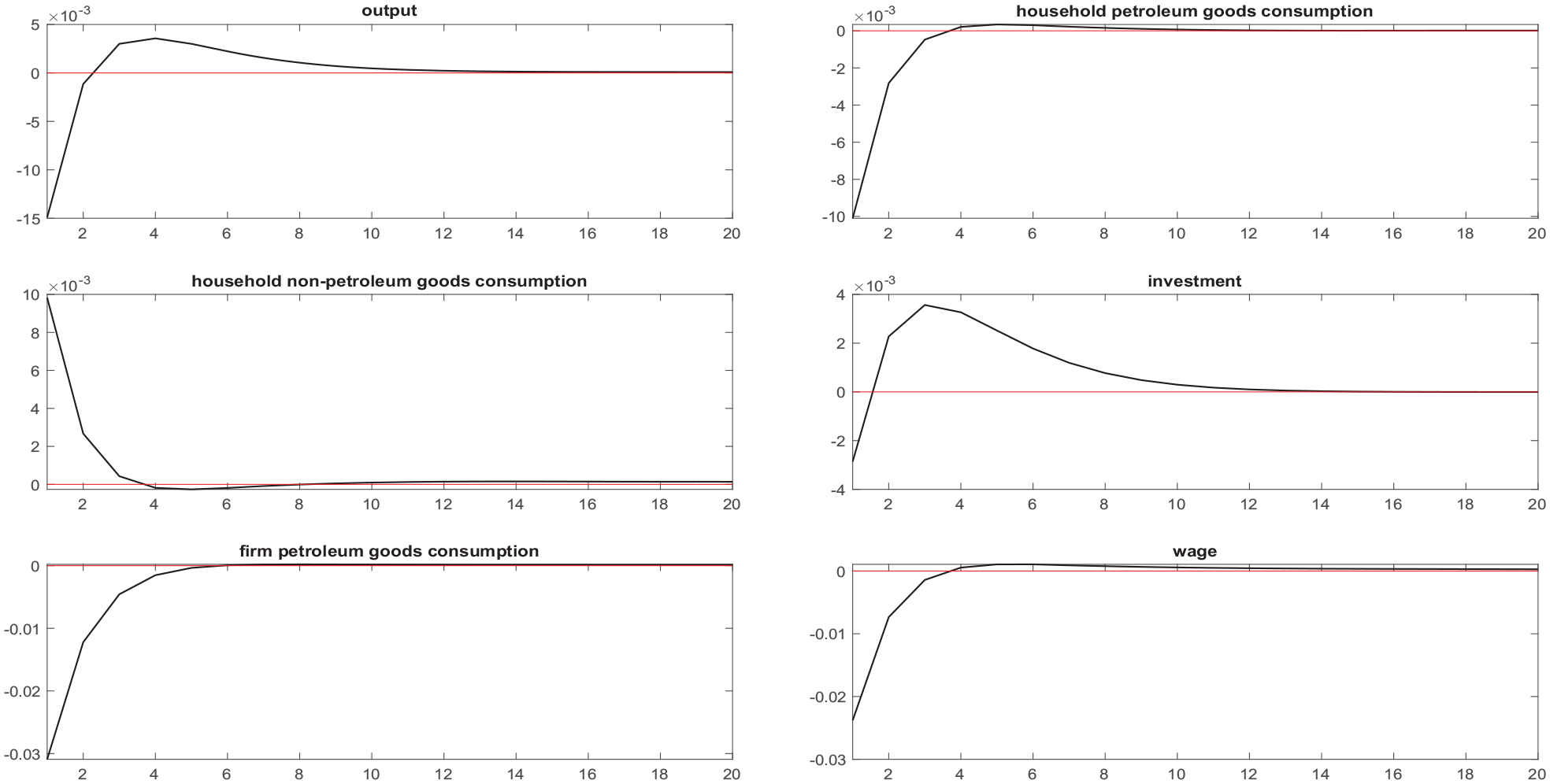
Simulation results regarding the influence of the Russo-Ukrainian conflict (=0.4).

Simulation results regarding the influence of the Russo-Ukrainian conflict (=0.5).
The Russia-Ukraine war triggered a contraction in the global energy supply, sparking an escalation in energy prices. As delineated in Figures 2 to 5, this positive energy price shock precipitated a contraction in firm output, investment, and petroleum goods consumption. Simultaneously, the shock reverberated across the household sector, precipitating a decline in petroleum goods consumption and wages, while non-petroleum goods consumption experienced an upswing. As a small, open economy, South Korea was inherently vulnerable to this global energy shock, a manifestation of the disruption to its domestic supply-demand equilibrium. The Russia-Ukraine war, by destabilizing the global energy supply-demand balance, effectively transmitted this shock to Korea’s macroeconomic system. However, a striking observation emerges from the juxtaposition of outcomes across Figures 2 to 5: as the Russia-Ukraine conflict persists, the effect of energy price shocks on the volatility of key macroeconomic variables in Korea appears to be diminishing. This intriguing pattern can be interpreted through the lens of three plausible explanations. First, in a bid to safeguard its macroeconomic stability and bridge the energy gap triggered by the Russia-Ukraine war, Korea has potentially recalibrated its energy import portfolio, pivoting away from Russia and Ukraine and toward other energy-exporting nations. This strategic shift would have insulated Korea’s economy, to some extent, from the war-induced energy price shocks. Second, Korean firms may have embarked on a quest for alternative production materials to supplant those originally sourced from Russia and Ukraine. This proactive strategy could mitigate the ripple effects of the energy shortfall on Korea’s macroeconomic volatility. Third, South Korea has potentially redoubled its efforts toward energy source development and the exploitation of existing domestic energy reserves, thereby bolstering its energy self-sufficiency. Such measures could alleviate the economic impacts of the Russia-Ukraine conflict on a broader scale. Interestingly, these findings are consistent with empirical observations of South Korea’s macroeconomic performance during this period. They resonate with the implications of energy price shocks delineated in seminal works (Akhter et al., 2020; Sharif et al., 2020; Wen et al., 2021). However, the study also unveils a novel aspect: the diminishing effect of energy price shocks on macroeconomic volatility in the context of a persistent geopolitical conflict. This highlights the potential for strategic adjustments, both at the firm level and the policy level, to buffer an economy against external shocks.
Conclusions
The protracted conflict between Russia and Ukraine has significantly disrupted the global equilibrium of energy supply and demand, leading to notable inefficiencies in economic performance worldwide. As a small, open economy, South Korea’s energy sector and broader macroeconomic stability have been markedly impacted. Consequently, this study takes South Korea as a focal point to examine the reverberations of the Russia-Ukraine war on the nation’s key macroeconomic variables, mediated through its energy market dynamics. Empirical analysis, harnessing Bayesian estimation and impulse response function methodologies, reveals that the positive energy price shock triggered by the conflict instigates a contraction in firm output, investment, and petroleum goods consumption. Meanwhile, households react to the surge in energy prices with a contraction in petroleum goods consumption and a decline in wages, offset by an expansion in non-petroleum goods consumption. Interestingly, the analysis unveils a temporal dimension to this economic impact. As the Russia-Ukraine war continues, the influence of energy price fluctuations on the volatility of key macroeconomic variables in Korea appears to diminish, indicating a potential adaptation mechanism within the South Korean economy.
Drawing upon the insights gleaned from this empirical investigation, we can delineate five consequential policy recommendations. (1) The Russia-Ukraine conflict accentuates the significance of South Korea expanding its energy supply networks. A heavy reliance on particular regions can render the nation vulnerable to geopolitical uncertainties. Therefore, it is imperative to enact strategic initiatives to foster alliances with a more diversified range of energy-exporting countries, thereby mitigating geopolitical risks and enhancing energy security. (2) The Korean economy’s vulnerability to petroleum price shocks, as revealed by this study, underscores the pressing need to propel investments towards renewable energy sources. Stimulating the creation of a sustainable, domestic energy infrastructure can diminish foreign energy dependency, buffer the economy against such external shocks, and foster long-term economic stability. (3) The observed shrinkage in firm output and investment consequent to energy price shocks underlines the necessity to cultivate energy efficiency within Korean enterprises. Policies could be formulated to encourage the adoption of energy-saving practices, potentially through fiscal incentives for firms that achieve a reduction in energy consumption or make investments in energy-efficient technologies. (4) The findings also indicate that investors in South Korea, especially those operating in high energy-consuming sectors, may encounter amplified risks due to energy price volatility. Promoting the utilization of financial derivatives such as futures and options contracts could offer a shield against these risks. Regulatory authorities should contemplate crafting a conducive environment for seamless access to these financial instruments, thereby equipping firms to insulate against future energy price shocks. (5) The negative repercussions of energy price shocks on household wages and consumption bear broader societal implications. Policymakers must ensure the implementation of robust social safety nets to safeguard the most vulnerable during periods of economic volatility. This could encompass measures like temporary subsidies or financial support for affected households, thereby ensuring societal well-being remains intact amidst global economic challenges.
In addition to the contributions of this investigation, it is important to recognize the inherent constraints that shape the scope and applicability of the findings, while these limitations also delineate potential avenues for further research. ① Research Limitations: (1) The analysis in the present study presupposes the constancy of geopolitical circumstances, as exemplified by the Russia-Ukraine conflict. Yet, the inherent dynamism of geopolitical landscapes implies that future trajectories of the conflict could substantively modify the conclusions herein. (2) The robustness of the study is tethered to the quality and completeness of the data utilized. Hence, any discrepancies or inaccuracies in the data could inherently influence the derived conclusions. (3) While the research incorporates a temporal dimension, it is confined to a specific timeframe. An exploration of impacts over diverse time periods could furnish different insights, which could potentially restrict the universality of the current findings. (4) The research primarily focuses on the interplay between energy market dynamics and key macroeconomic variables, possibly overlooking other significant factors such as policy alterations or technological innovations, thereby constraining the scope of the investigation. (5) Given the study’s focus on South Korea, the extrapolation of the findings to other economies with differing structures and energy consumption behaviors might be limited. ② Future Research Directions: (1) Subsequent research could widen the geographical canvas to encapsulate multiple economies, thereby yielding a more encompassing understanding of the global repercussions of such geopolitical conflicts. (2) Future inquiries might consider the inclusion of additional pertinent variables to offer a more comprehensive depiction of the economic consequences of geopolitical conflicts. (3) To gain a deeper understanding of the enduring impacts and possible adaptation mechanisms, subsequent investigations could undertake longitudinal studies spanning different stages of the conflict. (4) An appraisal of the effectiveness of various policy responses to such energy price shocks could offer invaluable insights to policymakers. (5) Future research endeavors might also delve into scenario analyses, such as prognosticating the impacts of protracted conflicts or abrupt resolutions, thereby better preparing economies for such contingencies.
Footnotes
Declaration of Conflicting Interests
The author declared no potential conflicts of interest with respect to the research, authorship, and/or publication of this article.
Funding
The author received no financial support for the research, authorship, and/or publication of this article.

Data Availability Statement
All data generated or analyzed during this study are included in this published article.