




Abstract
E-learning platform (ELP) provides economic and efficient channels to share and learn knowledge online without time and location restrictions. Earlier studies have identified determinants that impact students’ intention to use new technologies in different learning contexts, yet few have tried to investigate the effect of students’ satisfaction of basic psychological needs during the adoption process. Based on the framework of UTAUT2, this study has tested the mediating role of satisfaction of basic psychological needs to better comprehend the relationships between the antecedents and intention. The partial least square structural equation modeling was used for data analysis, findings indicate that performance expectancy, learning value, hedonic motivation, and habit significantly impact students’ willingness to adopt ELP for college English study. As for the mediating effect of students’ satisfaction of basic psychological needs, it fully mediates the relationship between effort expectancy, facilitating conditions, and intention while partially mediating the relationship between performance expectancy, learning value, hedonic motivation, habit, and intention. The study aids in grasping the key factors to increase students’ adoption of ELP and offers recommendations to increase students’ participation, learning efficiency, and their satisfaction of basic psychological needs for competence, autonomy, and relatedness during college English study with ELP.
Introduction
Modern information technology has greatly changed our lives, including its profound impact on education, particularly in foreign language learning. E-learning platform (ELP) has been developed as an effective information technological instrument to facilitate language learning without being constrained by time and place (Zacharis & Nikolopoulou, 2022). ELP offers flexible communication channels, an abundance of learning resources and a wider range of options for students to learn college English. College English, as a compulsory public basic course for non-English majors, aims to enhance students’ overall English proficiency, independent learning skills, cross-cultural communication abilities, critical and creative thinking, and academic communication on a global scale (Feng, 2014). Compared to traditional language education, ELP provides college English learners with a comfortable and authentic language learning environment. Interactive platforms allow students to complete learning activities, ask questions, and communicate with classmates and instructors, thereby improving their language proficiency and communication skills. ELP has been widely used in higher education, particularly during times of epidemics, and has shown significant benefits for English language learners (Saikat et al., 2021). However, despite efforts to promote educational digitalization, online learning still faces challenges. Students may not be psychologically prepared for the transition from traditional face-to-face learning to online learning (Zou et al., 2021). Implementation of ELP also encounters challenges such as low participation and completion rates, limited engagement, low learning efficiency, and high dropout rates among students (Cai et al., 2020; Qiao et al., 2021; Xu et al., 2022). To address these issues, it is crucial to identify the factors that influence students’ intention to use ELP for college English study and understand the relationship between these factors and behavioral intention (BI).
Literature Review on Students’ Adoption of Language Learning Technologies
Previous studies have adopted various theoretical models to investigate language learners’ intention to use various technologies in different contexts (Alfadda & Mahdi, 2021; Ebadi & Raygan, 2023; S. Q. Huang & Hamdan, 2023; Nguyen & Chu, 2021; Sulistiyo et al., 2022; Zhang & Yu, 2022). Most of research focuses on identifying determinants for learners’ intention to use new technologies for language study with different theoretical models. One commonly used model is the Technology Acceptance Model (TAM), which has been expanded to investigate predictors of college students’ intention to adopt mobile-assisted language learning technologies. It has been found that perceived usefulness and perceived ease of use have a significant impact on students’ BI (Chen & Zhao, 2022; H. T. Hsu & Lin, 2022). Based on the Unified Theory of Acceptance and Use of Technology (UTAUT), other studies have identified key determinants for students’ intention to use language learning technologies. These include perceived expectancy (PE), effort expectancy (EE), social influence (SI), facilitating conditions (FC), and other variables in different learning settings (Al Arif et al., 2022; An et al., 2023; Shen et al., 2023; Zhang & Yu, 2022). A few studies have also used UTAUT2 to explore additional antecedents for students’ intention to adopt language learning technologies. Some of the most notable ones include price value, hedonic motivation (HM), habit (HB), and other variables (Bessadok & Hersi, 2023; Deng et al., 2023). From this body of research, it is clear that different variables predict students’ adoption of various language learning technologies in different contexts. Therefore, it is important to identify the factors that affect students’ use of ELP for college English study.
Furthermore, several studies have examined the mediating and moderating effects of potential variables to gain a deeper understanding of the relationship between antecedents and the intention to use new technologies in language learning contexts. Razzak and Jassem (2021) investigated the moderating effect of self-efficacy and the mediating effect of attitude and BI on the relationship between mobile-assisted language learning usage behavior and its antecedents. In order to better understand the possible relationship between perceived usefulness and second language learners’ continuous intention for technology adoption, Wang et al. (2022) found that integrative motivation and flow serve as chain mediators between perceived usefulness and continuous intention. H. T. Hsu and Lin (2022) incorporated psychological constructs into the TAM model to explore the factors influencing the continuous use of mobile-assisted language learning for studying English as a foreign language. They showed that perceived ease of use has a moderating effect on BI through perceived usefulness. Additionally, motivation has been examined as a moderator in the relationship between the antecedents and learners’ BI to use language massive open online courses (L. Hsu, 2023). Deng et al. (2023) found that e-satisfaction and habit mediate the relationship between drivers and college students’ continuous intention to use ELP for English study. These studies collectively demonstrate that psychological factors and motivation are positively associated with students’ intention to use technologies for language study. While many of these studies have focused on the influence of psychological factors and motivation on antecedents or students’ BI to use new technologies for language learning, few have explored their mediating effect on the relationship between antecedents and BI. This gap in research highlights the need to investigate the mechanisms through which antecedents influence BI via these psychological factors and motivations (He & Li, 2023; L. Hsu, 2023; Jeon, 2022).
Intrinsic motivation plays a crucial role in determining individuals’ intention to use new technologies. It is primarily influenced by individuals’ satisfaction of basic psychological needs (SBPN) for competence, autonomy, and relatedness (Y. M. Huang, 2016; Ryan & Deci, 2000). This study extends the UTAUT2 model by incorporating the SBPN construct. The aim is to create a theoretical framework that can predict factors affecting learners’ BI to use ELP for English learning and illustrate the interplay between these relationships. The UTAUT2 model has strong explanatory power for users’ BI to accept new technology. It explains over 70% of the variance in users’ intention to adopt and use new technologies (Venkatesh et al., 2016). SBPN, as a psychological motivating factor, provides the necessary psychological nourishment to motivate students towards their BI (Ryan & Deci, 2000). Identifying the main factors influencing students’ adoption of ELP can facilitate the successful implementation of ELP for online English learning. Testing the mediating role of SBPN not only enhances understanding of the relationship between antecedents and BI but also helps fulfill students’ basic psychological needs for autonomy, relatedness, and competence. This, in turn, provides the psychological nourishment needed to increase participation, enhance engagement, improve learning efficiency, and further encourage the use of ELP for college English study.
Grasping the main impacting factors on students’ adoption of ELP can facilitate the successful implementation of ELP for further online English learning. Testing the mediating role of SBPN helps not only better understand the relationship between the antecedents and BI, but also better fulfill students’ basic psychological needs of autonomy, relatedness, and competence, which would provide psychological nutriments to strengthen participation, intensify engagement, and improve learning efficiency, what’s more, heighten inclination to further utilize ELP for college English study.
Theoretical Background and Hypotheses Development
Theoretical Background: UTAUT2
Various theoretical models have been proposed to investigate the factors that determine users’ acceptance and usage of new technology. One such model is the Technology Acceptance Model (TAM), which was introduced by Davis in 1989 and is based on the theory of reasoned action and the planned behavior theory. TAM is a well-known model used to explain users’ acceptance of information systems. The main factors in this model are perceived usefulness and perceived ease of use. While TAM has been widely used to identify the drivers of students’ acceptance and usage of various learning technologies in different settings, it primarily considers individual subjective feelings and does not fully account for external factors such as environmental and cultural influences. As a result, it may not cover all situations and factors that can influence users’ BI.
To address the limitations of TAM, the Unified Theory of Acceptance and Use of Technology (UTAUT) was proposed by Venkatesh et al. in 2003. UTAUT includes four key constructs: PE, EE, SI, and FC. In order to enhance the predictive and explanatory power of the model, TAUT was further extended to UTAUT2 by adding three variables, HM, HB, and price value, which focused on consumer contexts in addition to organizational contexts (Venkatesh et al., 2012). It is recommended to use UTAUT2 in the early stages of adopting and using new technology, as it can explain up to 74% of the variance in BI for new technology adoption (Venkatesh et al., 2016). Additionally, Venkatesh et al. (2012) suggested that researchers validate this model in different research contexts and explore additional predictive factors to improve the prediction of users’ adoption of new technologies. While UTAUT2 has been frequently used in consumer settings, where price value has a significant influence on users’ intention to use new technology, it is not applicable in educational contexts. In educational settings, students do not need to pay for technology, but they do need to invest time and effort in using it for learning purposes. In this study, the construct of learning value is used to replace the concept of price value in the learning context, as there is no monetary cost associated with using ELP for English study (Ain et al., 2016). Instead, students benefit from using ELP to improve their English proficiency and communicative skills. Pertinent research in the learning context has also demonstrated that learning value positively predicts intention for technology adoption (Zacharis & Nikolopoulou, 2022).
Although the UTAUT2 model has been widely used to predict the factors that influence users’ willingness to adopt new technologies in various academic contexts, such as the use of metaverse technology for basketball learning by university students (Yang et al., 2022), the adoption of e-learning systems for architectural management study by undergraduates (Tandon et al., 2021), and the acceptance of e-learning platforms for medical education by college students (Prasetyo et al., 2021), there is a lack of research that applies the UTAUT2 model to investigate the drivers for learners’ intention to use new technologies in language learning settings. Furthermore, there is even less research that explores the mediating role of SBPN in the relationship between antecedents and students’ intention to adopt ELP for college English study. Additionally, there is a glaring lack of research investigating the psychological motivations behind the usage of ELP (L. Hsu, 2023; Rai, 2020). Considering that the predictability of UTAUT2 variables is influenced by different contexts, mediators, and moderators, this research extends the UTAUT2 model to identify the drivers for students’ intention to use ELP for college English study and test the mediating effect of SBPN on the relationship between antecedents and BI to use technologies in language learning settings.
Hypotheses Development
Relationship Between Antecedents and Students’ Intention to Adopt ELP
Performance Expectancy (PE) refers to the degree to which new technology can enhance performance or benefit users when engaging in specific tasks (Venkatesh et al., 2012). In the context of this research, PE represents the benefits that students gain from using ELP for college English study. PE is a crucial factor in predicting users’ intention to use new technologies (Venkatesh et al., 2003, 2012). Previous studies have confirmed that PE plays a significant role in students’ willingness to adopt and use online learning tools for studying English as a foreign language (H. T. Hsu & Lin, 2022; Wang et al., 2022). In this study, behavioral intention (BI) refers to the extent to which students intend to adopt ELP for college English learning. If students perceive that using ELP for college English studying is beneficial and useful, they are more likely to adopt it. Therefore, the following hypothesis can be formulated:
H1: PE positively affects students’ intention to adopt ELP for college English study.
Effort Expectancy (EE) measures the level of ease and effort required to use new technologies. It assesses whether individuals find it easy to use new technologies and whether they can interact with them without encountering barriers (Venkatesh et al., 2012). In the context of this research, EE refers to the ease with which students can use ELP to learn college English, without exerting excessive mental or physical effort. Numerous previous studies have confirmed that EE is a significant predictor of users’ adoption of new technologies in language learning environments (Chen & Zhao, 2022; He & Li, 2023). If the operation instructions for ELP are clear and students find it easy to use, they are more likely to accept and utilize it for their college English studies. Therefore, it can be assumed that:
H2: EE positively affects students’ intention to adopt ELP for college English study.
Social Influence (SI) refers to the influence of peers, family, friends, and other significant individuals on users’ decision to adopt a specific technology (Venkatesh et al., 2003). When deciding whether to use a new technology for language study, individuals often interact with each other or are influenced by the ideas of important people around them (L. Hsu, 2023; Li et al., 2021). Wilson et al. (2021) pointed out that social cognitive factors, such as considering the ideas of important others, can predict individuals’ intention to adopt new technologies. In this study, the opinions of friends, classmates, teachers, and peers play a significant role in shaping students’ BI. When choosing ELP for college English study, students typically give considerable weight to the positive thoughts expressed by important individuals in their social circle. The following hypothesis is proposed to examine the relationship:
H3: SI positively affects students’ intention to adopt ELP for college English study.
Facilitating conditions (FC) refers to the level of technical support and availability of necessary resources that individuals can receive from an organization to facilitate their use of new technologies (Venkatesh et al., 2003). According to Dwivedi et al. (2017), the adoption of a new technology by consumers can be facilitated and supported through a seamless connection between suppliers and recipients. In the context of this study, universities provided infrastructure, equipment (computers, stable internet connection), learning resources, and technical support to facilitate students’ adoption of ELP for college English study. This support was especially emphasized when students faced difficulties. Zhang and Yu (2022) found that when students perceive sufficient support to use new technologies, they are more likely to adopt ELP for college English study. Therefore, it can be assumed that:
H4: FC positively affect students’ intention to adopt ELP for college English study.
Hedonic motivation (HM) refers to the happiness and pleasure that individuals experience when using a new technology. HM can be used to predict an individual’s willingness to adopt a new technology (Venkatesh et al., 2012). According to the theory of hedonism, people are constantly seeking pleasure, avoiding pain, and considering the pursuit of happiness as their most important daily goal. Individuals exert the greatest effort to achieve the highest possible level of happiness (Plato, 1976). Customers’ acceptance of products is influenced by the emotions and sentiments they experience while using them, and products that provide enjoyment and pleasure are more likely to be embraced (Moons & De Pelsmacker, 2012). In this study, students are more likely to use ELP for college English learning if they find it fascinating and enjoyable. Therefore, the following assumption can be made:
H5: HM positively affects students’ intention to adopt ELP for college English study.
Learning value (LV) is used to replace price value in this learning context. Price value was initially proposed by Venkatesh et al. (2003) as the perceived balance between advantages and disadvantages of utilizing new information technology. A product has value in the eyes of consumers if it can deliver benefits. From the viewpoint of students, learning value is the cognitive compromise between perceived benefit of utilizing a particular technology for learning and the time and effort required to do so (Ain et al., 2016). Although using modern technologies is free for students, they still need to put in time and effort to get the most out of their study (Ain et al., 2016). In this study, students’ willingness to allocate more time and effort to using ELP for college English learning would be influenced by benefits they can derive from using it. The hypothesis can be stated as follows:
H6: LV positively affects students’ intention to adopt ELP for college English study.
Habit (HB) refers to the degree to which individuals exhibit habitual or automatic behavior when using a new technology (Venkatesh et al., 2012). The use of new technologies can become automatic through frequent practice, eventually developing into a habit. Davis and Venkatesh (2004) argue that habit plays a crucial role in the adoption of new technologies. In this study, students who regularly use ELP for college English learning—including activities such as online word searching, word recitation, studying course material, participating in classroom activities, engaging in English forums, and taking exams—are more likely to develop positive habitual behaviors, which in turn increases their likelihood of using ELP for college English learning. Consequently, it can be assumed that:
H7. HB positively affects students’ intention to adopt ELP for college English study.
Mediating Effect of Satisfaction of Basic Psychological Needs (SBPN)
Self-determination theory explores human motivational behaviors and posits that individuals are inclined to be intrinsically and extrinsically motivated to engage in certain behaviors (Ryan & Deci, 2000). Previous research has demonstrated that users’ intrinsic motivation is more influential than extrinsic motivation in determining their intention to use new technologies (Y. M. Huang, 2016; Yoo et al., 2012). Intrinsic motivation primarily depends on individuals’ SBPN for competence, autonomy, and relatedness. The need for competence refers to the desire to feel capable and proficient in carrying out an activity, the need for relatedness involves the perception of belonging and connection to others, and the need for autonomy entails the willingness and volition to regulate and control one’s own behavior (Deci & Ryan, 2011). With the accessibility of technical support and necessary resources (FC), the habitual use (HB) of ELP for English learning helps students complete English learning tasks and activities more efficiently (PE) and achieve academic performance (LV) with little effort (EE). This positively influences students’ SBPN for autonomy, motivating them to regulate their English study unconsciously and automatically. It also enhances their sense of relatedness, intensifying their desires to practice basic English skills and share knowledge with classmates and friend. Additionally, it improves their English proficiency and academic performance in terms of competence (Osei et al., 2022; Wood, 2016). Previous research indicates that supportive interactions with peers, friends, teachers, and family (SI) help people feel understood, cared for, and empowered to take self-directed actions (autonomy), foster self-confidence to take on various tasks (competence), and feel a sense of belonging (relatedness), all of which have a positive impact on SBPN (Leversen et al., 2012; Milyavskaya and Koestner, 2011; Shin & Park, 2022). In the learning context, happiness and enjoyment derived from using a new technology are closely linked to academic success (Mega et al., 2014), academic self-control (Villavicencio & Bernardo, 2016), self-realization (Ryan & Deci, 2000), and school affiliation (Tian et al., 2016). These factors contribute to fostering students’ SBPN for competence, autonomy, and relatedness. SBPN servers as the underlying motivational mechanism that provides individuals with psychological nutriments necessary to engage in an activity and influence their behavior intentions (Ryan & Deci, 2000). Previous studies have demonstrated that SBPN and intrinsic motivation play a significant role in predicting users’ decision to use e-learning systems (Sørebø et al., 2009; Yoo et al., 2012). Moreover, research suggests that there is a correlation between the antecedents and SBPN, and SBPN affects users’ inclination to adopt new technologies (L. Hsu, 2023; Sun and Gao, 2020). Based on these findings, the following hypotheses can be proposed:
H8. SBPN mediates the relationships between (a) PE, (b) EE, (c) SI, (d) FC, (e) LV, (f) HM, (g) HB and students’ intention to adopt ELP for college English study.
Based on the above theoretical foundation and hypotheses, the following conceptual framework (Figure 1) was proposed for this research.

Theoretical framework.
Research Design and Methodology
Participants
Given the importance and significant proportion of undergraduate students in China’s higher education system, the samples for this study were selected from undergraduate students in some public universities in Guangxi. These students used various online learning platforms for college English learning. Since this study investigates the factors that affect students’ intention to adopt ELP in college English learning, no specific personal information or performance would be disclosed, and therefore no ethical agreement was required. College English teachers assisted in presenting the participant information sheet to help participants make an informed decision about whether or not to participate in this research. Subsequently, the participant consent form was presented to obtain students’ consent. Only after this process could participants scan a QR code to begin answering the questionnaire. Before answering the questions, students are encouraged to respond based on their actual experiences and thoughts regarding the use of ELP in college English learning. Students have the right to withdraw from the research at any time and the confidentiality of their information is ensured. Table 1 shows the descriptive statistics of the participants.
Demographic Information of the Participants (N = 636).

Instrument Development
This research utilized a quantitative methodology with a cross-sectional survey. To enhance the implementation of online learning, data was collected online using Tencent questionnaire, which allows researchers to create customized surveys. The questionnaire consisted of three parts. The first part clearly stated the research purpose, while the second part covered demographic details of the respondents. The third part consisted of 38 items for eleven variables, measured using a 5-point Likert scale ranging from strongly disagree (1) to strongly agree (5). These measurement items were adapted from previous studies and modified to fit the context of the present research. The constructs of UTAUT2 were based on the work of Venkatesh et al. (2012) and Ain et al. (2016), with reliability ranging from .74 to .94. The items for SBPN were adapted from Ke and Zhang (2010), with composite reliability ranging from .82 to .92. To summarize the essence of SBPN, a reflective-formative higher order construct, a global item Generally, using ELP to learn English is satisfactory was created. To ensure questionnaire uniformity and equivalence, every question was back-translated. Information technology staff and college English teaching professionals were invited to assess the face and content validity of the questionnaire, ensuring that the questions adequately reflected the concept of each construct. A total of 903 questionnaires were collected, of which 636 were valid after excluding invalid responses such as neutral replies, diagonal lined answers, and alternate extreme pole answers. The response rate was 72.4%. Considering the guideline of having ten times the number of measured items for the sample size (Wu, 2010), 636 samples were used for further data analysis. Given the presence of both reflective and formative constructs in the model, partial least squares structural equation modeling (PLS-SEM) was employed for data analysis. PLS-SEM is effective in analyzing the indirect and direct effects of mediating effects in complex research models (Hair et al., 2017). The analysis was conducted in three steps: the evaluation of the measurement model, the evaluation of the structural model, and the testing of mediating effects. Data analysis was performed using IBM-SPSS 22 and SmartPLS 3.3 software packages.
Data analysis and Results
Common Method Variance (CMV)
Pearson correlation analysis was conducted to assess common method variance. In Table 2, the correlation coefficients between constructs (between .459 and .790) are less than .9, demonstrating that there is no common method bias (Bagozzi et al., 1991).
Pearson Correlation Analysis.

Note. Correlation is significant at the .01 level (two-tailed). CO is SBPN for competence; AU is SBPN for autonomy; RE is SBPN for relatedness.
Measurement Model Evaluation
In this study, the construct of SBPN is a reflective-formative higher order construct with three lower order constructs, Autonomy, Competence, and Relatedness. According to self-determination theory, each specific need of SBPN is independently significant and necessary for individuals’ psychological health (Deci & Ryan 2000). Additionally, these needs have different criteria for satisfaction and fulfillment (Karkkola et al., 2018; Ryan & Deci, 2017). This demonstrates that the first order constructs cannot be substituted for SBPN. This research used the embedded two stage approach for the validation of the measurement model (Sarstedt et al., 2019).
In stage one, the repeated indicators approach was used to create a null model for the first-order reflective constructs of SBPN without any structural relationships. The evaluation of the reflective constructs included testing their internal consistency reliability, individual item reliability, convergent validity, and discriminant validity. Table 3 shows that all Cronbach’s Alpha (CA) values (between .871 and .882) and composite reliability (CR) values (.920–.927) are higher than .7, indicating that all constructs have internal consistency reliability. The factor loadings of all constructs (between .875 and .912) are higher than .7, indicating individual item reliability. The average variance extracted (AVE) of all constructs (between 0.793 and 0.809) is higher than 0.5, indicating convergent validity. Additionally, each construct’s square root of the AVE is greater than its intercorrelations with other constructs in Table 4, supporting discriminant validity (Hulland, 1999).
Psychometric Properties of Measurement Model in Stage One.

Discriminant Validity with Fornell-Larcker Criterion in Stage One.

In stage two, the scores of the lower order components of SBPN in stage one were used as items for the formative construct of SBPN. The assessment procedure outlined by Hair et al. (2017) was followed to evaluate it. The procedure consists of three steps: redundancy analysis, checking for collinearity or multicollinearity, and assessing the significance level and relevance of indicator weights. First, redundancy analysis was conducted to evaluate the convergent validity of the constructs. A global single item, Generally, using EPL to study college English is satisfactory, was created to summarize the essence of SBPN during the research design period and used as an endogenous single-item construct to validate the formative measurement of SBPN (Sarstedt et al., 2019). The global measure item was pretested and evaluated by experts before data collection to ensure convergent validity. The path coefficient between the constructs was found to be 0.823, and the R2 value was .677 for the endogenous construct, indicating convergent validity of the formatively measured SBPN. Second, the variance inflation factor (VIF) value of each formative indicator was checked to assess collinearity issues. The VIF values of all formative indicators of SBPN were found to be between 2.833 and 3.528, which is below the suggested threshold value of 5 (Hair et al., 2017), indicating no critical levels of collinearity. Third, bootstrapping with 5,000 sub-samples was conducted to examine the significance and relevance of each formative indicator’s outer weight, which represents its relative contribution or importance to forming SBPN. The results, as shown in Table 5, indicate that the weights of all indicators exceed the recommended value of 0.1 (Lohmöller, 1989). The t-values for the weights of formative indicators are all above 1.96, the p-values are all below .01, and all 95% confidence intervals do not contain the value 0, demonstrating the significance of all outer weights of formative indicators (Hair et al., 2011).
Psychometric Properties of Measurement Model in Stage Two.

p < .05. **p < .01. ***p < .001.
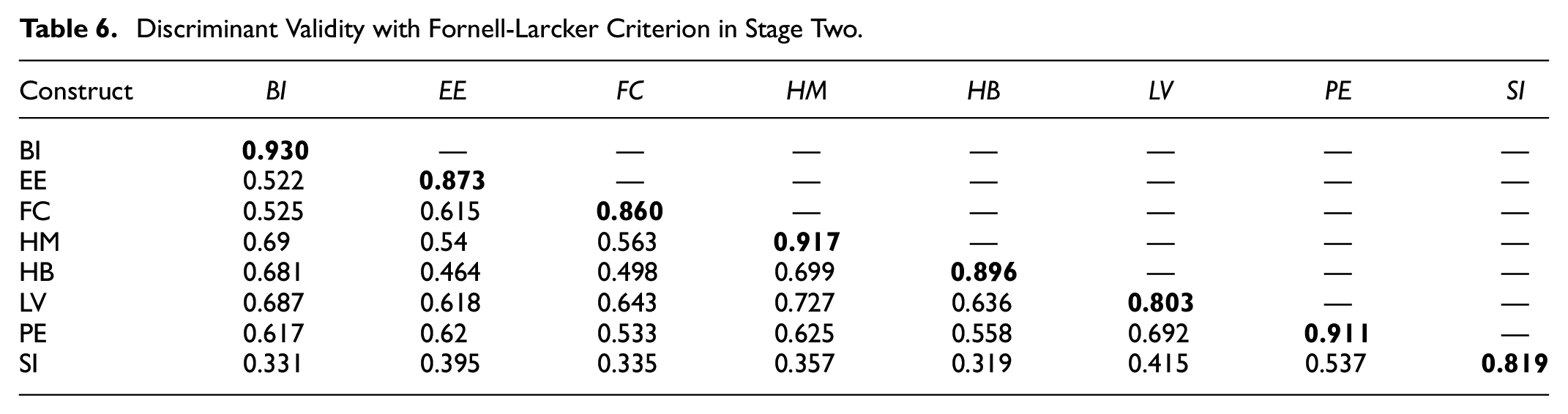
Reflective constructs were validated after assessing the formative construct of SBPN. Table 5 shows that all values of CA and CR are higher than .7, indicating internal consistency for each construct. The factor loadings for all reflective items are above 0.7 (Hulland, 1999), suggesting that the measurement items effectively reflect the concept of each construct and demonstrate item reliability. All AVE values are greater than 0.5, indicating convergent validity for each construct. To assess discriminant validity, the Fornell-Larcker Criterion and heterotrait-monotrait ratio (HTMT) were used. Table 6 shows that the diagonal value of each construct in boldface is greater than its correlation with any other constructs in any row or column. Table 7 shows that all correlation values of HTMT are below the threshold value of .85 (Henseler et al., 2015). The bootstrapping results of HTMT indicate that the 95% confidence intervals do not contain the value 1. These results confirm that all reflective constructs possess discriminant validity.
Discriminant Validity with Fornell-Larcker Criterion in Stage Two.
Discriminant Validity with HTMT in Stage Two.

The evaluation results of the measurement model indicate that both reflective and formative constructs demonstrate satisfactory levels of reliability and validity. Collinearity checking was also conducted prior to evaluating the structural model. As presented in Table 8, all VIF values are below the threshold value of 5 (Hair et al., 2017). Therefore, there are no significant collinearity issues among the constructs, allowing for the evaluation of the structural model to proceed.
Results of R2, Q2, and VIF.

Evaluation of Structural Model
Bootstrapping was used for the structural model evaluation, with 5,000 subsamples and two tails set. In Table 8, the R2 value for SBPN and BI is .673 and .680, respectively. This indicates that the independent variables can substantially explain the variance in students’ SBPN and their willingness to use ELP for English learning (Hair et al., 2017). The Q2 value for SBPN and BI is 0.556 and 0.577, respectively, both of which are larger than 0. This demonstrates that the independent variables have predictive relevance for dependent variables. According to the ƒ2 values in Table 9, SBPN (ƒ2 = 0.222) exerts the largest effect on students’ intention to use ELP for English learning and habit (ƒ2 = 0.145) has the largest effect on students’ SBPN.
Direct Relationship Results and Structural Model Results.

p < .05. **p < .01. ***p < .001 (two-tails).
The path coefficients in Table 9 show that PE, LV, HM, and HB are positively correlated with students’ intention to use ELP for college English learning, of which HB displays the strongest relationship, followed by HM, LV, and PE. All their t-values are above 1.96, p-values are below .05 and 95% confidence intervals do not contain the value 0, indicating that all these path coefficients are significant. Then, it can be concluded that PE, LV, HM, and HB significantly impact students’ willingness to adopt ELP for college English learning, therefore, H1, H5, H6, and H7 are supported. In contrast, EE, SI, and FC have no significant effect on students’ inclination to use ELP for college English learning. In the path from EE to BI, t value (0.368) is less than 1.96, p-value (.713) is higher than .05, and 95% CI [−0.06, 0.085] includes the value 0, indicating that H2 is not supported. In the path from SI to BI, t value (0.614) is less than 1.96, p-value (.539) is higher than .05, and [−0.06, 0.034] includes the value 0, indicating that H3 is not supported. In the path from FC to BI, t value (0.603) is less than 1.96, p-value (.546) is higher than .05, and [−0.095, 0.049] includes the value 0, indicating that H4 is not supported.
Mediating Effect Analysis
This research followed Zhao et al.’s (2010) procedures to adopt bootstrapping for assessing the mediating effect of SBPN on the linkage between PE, EE, SI, FC, LV, HM, HB, and BI. All results are shown in Table 10.
Mediating analysis.

Regarding the mediating paths of PE → SBPN → BI, LV → SBPN → BI, HM → SBPN → BI, and HB → SBPN → BI, the findings indicate that the 95% confidence intervals for both the indirect and direct effects do not include the value 0. This suggests that SBPN partially mediates these relationships, as both indirect and direct effects are statistically significant. The positive product of the direct effect (positive) and the indirect effect (positive) further supports that SBPN represents complementary mediation for these four paths, confirming H8a, H8e, H8f, and H8g.
In the paths EE → SBPN → BI and FC → SBPN →BI, the 95% confidence intervals for the indirect effects do not contain the value 0. However, the 95% confidence intervals for the direct effects include the value 0. This indicates that SBPN fully mediates the relationship in these two paths, as the indirect effects are significant while the direct effects are insignificant. Thus, H8b and H8d are supported.
In the path SI → SBPN → BI, the 95% confidence intervals for both the indirect effect [−0.050, 0.007] and the direct effect [−0.060, 0.034] include the value 0. Therefore, SBPN does not exert any mediating effect on the relationship, as both the indirect and the direct effects are not significant. This does not support H8c.
Discussion and Implications
Discussion
Based on the UTAUT2 framework, this study has identified the factors that influence students’ willingness to use ELP for college English study. It also tested the mediating role of SBPN. PE has a positive impact on students’ intention to adopt ELP for English study. This finding aligns with the research results of Al Afri et al. (2022) and An et al. (2023), which suggest that the more efficient ELP is, the higher students’ intention to use it for English learning. Therefore, it is recommended for universities to not only raise students’ awareness of the usefulness and importance of using ELP for English study, but also to enhance the functionality and performance of ELP to help students complete English learning tasks and activities more efficiently.
Similarly, LV significantly influences students’ willingness to adopt ELP for college English study. This finding is consistent with previous research by Ain et al. (2016) and Prasetyo et al. (2021), which indicate that students are more likely to dedicate more time and effort to using ELP for college English learning when they perceive more benefits and value. Therefore, programs that align with students’ academic and career goals can be designed to improve their language skills, academic performance, and job prospects.
Furthermore, the finding that HM significantly influences students’ willingness to adopt ELP for English study confirms the results of Li et al. (2021) and Shen et al. (2023). These studies show that the more pleasure and enjoyment students derive from using a new technology, the more likely they are to adopt it for college English study. Students’ interest in a new technology, the fun it brings, and the interesting content provided by ELP all contribute to their internal motivation, which in turn strengthens their intention to adopt ELP for college English study. These findings suggest that ELP developers should integrate elements of fun and enjoyment into the design and gamify the learning activities to enhance students’ motivation and engagement. Virtual rewards can also be implemented to create a sense of competition and achievement.
Additionally, HB significantly affects students’ willingness to adopt ELP for college English study. Students who are accustomed to using IT products are more likely to adopt ELP due to their increased reliance on information-based products (Moorthy et al., 2019). Universities can encourage the regular and consistent usage of ELP by integrating it into students’ daily routines, providing prompts and reminders, and offering incentives such as progress tracking, personalized recommendations, and certificates of completion.
However, EE has no significant impact on BI, which is consistent with previous research results (An et al., 2023; Zacharis & Nikolopoulou, 2022). One possible reason may be that students attach more importance to usefulness of ELP (Prasetyo et al., 2021); another reason may be that students, as digital aborigines, live in a world surrounded by digital products and are very good at using advanced information technology. It is very easy for them to use ELP for college English study, which is not a complex system for them.
It is worth noting that SI has no significant impact on students’ willingness to adopt ELP for English study, contrary to the findings of Al Arif et al. (2022). A valid reason may be that living in the internationalized age, students recognize the importance of online learning on their own, without the influence of friends, classmates, teachers, and peers (Tandon et al., 2021), ELP is seen as the best option for learning English.
Similarly, FC has no significant influence on students’ willingness to use ELP, which aligns with the conclusions of Agyei and Razi (2022). This can be attributed to the simplicity of the technological tools supporting students’ use of ELP (Xu et al., 2022) and the younger generation’s proficiency in using new technologies (Diño & de Guzman, 2015). Therefore, FC does not significantly impact students’ willingness to adopt ELP for college English study.
The partially mediating effect of SBPN on the link between PE, LV, HM, HB, and BI shows that this relationship is not a straightforward causal one. It suggests that PE, LV, HM, and HB influence SBPN, and SBPN in turn influences BI. However, the partial mediation of SBPN implies that there are other potential mediating factors that were not examined in this study, which may further explain these relationships. On the other hand, the fully mediating effect of SBPN on the connection between EE, FC, and BI suggests that SBPN completely aligns with the proposed theoretical framework for these relationships. However, SBPN does not have a mediating effect on the relationship between SI and BI. It is possible that there are unidentified variables that could stimulate the link between SI and BI.
Considering the importance of SBPN, it is crucial to ensure that the design and features of ELP adequately address students’ fundamental psychological needs for autonomy, competence, and relatedness. This can be achieved by incorporating more flexibility and opportunities into the learning process. Additionally, providing personalized feedback to each student and fostering a supportive learning community through discussion forums or peer interactions is also essential.
Implications
This study has utilized UTAUT2 to examine the factors that influence students’ inclination to use ELP for college English study and has also investigated the mediating role of SBPN. Theoretically, the study goes beyond exploring the determinants of students’ willingness to use ELP and expands the scope and theoretical depth of UTAUT2 by focusing on the mediating role of SBPN. In the context of college English learning, this research contributes by incorporating learning value and SBPN into the UTAUT2 framework. The results demonstrate that SBPN not only has a significant impact on students’ willingness to adopt new technology, but also acts as a mediator between antecedents and BI. Understanding the mediating effect of SBPN is crucial for enhancing student participation, learning efficiency, and successful implementation of ELP for college English study.
From a practical standpoint, the research findings provide suggestions for improving student participation, engagement, and learning efficiency. Policymakers responsible for online education management should raise students’ awareness of the necessity and benefits of using ELP for English learning in the digital age. Universities should provide technical support, infrastructure facilities, reliable internet connection, and user-friendly technologies to enhance the accessibility and acceptability of ELP. Simplifying the operation procedures of ELP, such as organizing learning resources and functions into user-friendly categories, can save students time and effort. Additionally, incorporating visually appealing interfaces and game-based incentive mechanisms into ELP can make online English learning more interactive, engaging, and stimulating. For example, setting up breakthrough games and PK games aligned with learning objectives and students’ proficiency levels, and implementing a reward system can motivate students to use ELP and enhance their participation and engagement in English learning. To enhance students’ learning efficiency, universities can organize technical training sessions to help them better understand the benefits and advantages of using new technology. This will enable students to make full use of its various functions, thereby improving their language skills and proficiency. ELP developers can explore ways to improve and maximize its functions and usefulness, allowing students to complete English class activities more quickly and efficiently. English instructors should conduct research to understand students’ actual needs and language proficiency levels. This will help them design teaching materials, activities, and learning environments that enable students to effectively complete tasks within their capabilities. Additionally, incorporating learning tasks that require cooperation and teamwork will foster a respectful and caring language learning environment.
By implementing these measures, students’ academic self-assurance will increase, and they will feel competent in carrying out all activities. With easy access to necessary resources and technical support, students can efficiently use ELP to complete English learning tasks and activities. This will lead to academic achievement and the gradual formation of good study habits. Throughout this process, students will feel capable of regulating and controlling their English study with ELP, as well as a sense of belonging through communication and cooperation with classmates and teachers. Students’ SBPN for autonomy, relatedness, and competence will provide them with the psychological nourishment necessary to strengthen their participation in college English study with ELP. This will improve their engagement, learning efficiency, and further promote the use of the ELP for further study.
Research Limitations and Future Research
However, there may be additional potential mediators or moderators that were not considered. Additionally, the sample size primarily consists of Guangxi college students who use ELP to learn English,
Although the research results provide fresh insights for increasing the implementation of ELP for college English learning, there are still some limitations in the current research. In order to further grasp the connection between antecedents and BI, the study added LV into the UTAUT2 model in the learning context and examined the mediating influence of SBPN. However, there may be additional potential mediators or moderators that were not considered. Additionally, the sample size consists of Guangxi college students who use ELP to learn English, without investigating the usage of ELP in other regions or for learning other subjects. This lack of investigation could impact the generalizability of the research findings. Future research on different disciplines in different regions would be promising due to the variances between the various disciplines. Lastly, the influence of individual traits, organizational variables, systems, and cultures was not taken into account.
Conclusion
This research investigates the factors impacting students’ intention to adopt ELP for college English study using the UTAUT2 framework and the mediating effect of SBPN based on self-determination theory. The research model has a high ability to explain the variance in students’ intention to use ELP for college English learning, reaching almost 70%. According to the research results, PE, LV, HM, and HB significantly affect students’ intention to use ELP for college English study, while EE, SI, and FC have no effect on students’ willingness to use ELP for college English study. SBPN exhibits a mediating effect for all path relationships except the path SI → SBPN → BI. This study can help university education administrators, college English instructors, and ELP designers better understand not only the determinants that influence students’ willingness to use ELP for college English study, but also the key psychological factors that meet students’ SBPN for competence, autonomy, and relatedness. This understanding can enhance students’ active participation, engagement, and learning efficiency during college English study with ELP.
Footnotes
Acknowledgements
The authors thank the students for participating in this study.
Contributions
Conceptualization, methodology, data analysis, writing—original draft preparation: P.D. and B.C.; data curation, writing—review and editing: W.Z. and X.F.; literature review, discussion, reading—approving the final manuscript: all authors. All authors have read and agreed to the published version of the manuscript.
Declaration of Conflicting Interests
The author(s) declared no potential conflicts of interest with respect to the research, authorship, and/or publication of this article.
Funding
The author(s) disclosed receipt of the following financial support for the research, authorship, and/or publication of this article: This study was supported by Foreign Language Teaching and Research Projects from SFLEP[2022GX0005] and The 14th five year planning projects of Guangxi Education sciences [2023ZJY561].
Ethical Approval
As this study explores the factors that impact students’ intention to adopt ELP for college English study without revealing any specific personal information or human performance, there is no need for ethical agreement.
