




Abstract
This study empirically investigates the role of blockchain technology awareness in the adoption of electronic government (e-government) services in the northern part of Cyprus. With data collected from a random sample of 374 individuals eligible to use e-government services, a conceptual model that combines the Unified Theory of Acceptance and Use of Technology (UTAUT2) and the e-Government Adoption Model (GAM) was assessed. In addition to finding support for some predictors already used in prior literature, the current study investigated whether awareness of blockchain technology through its role in increasing trust would also enhance users’ intention for e-government adoption. Findings have shown that increasing blockchain technology awareness can contribute to building trust and facilitate e-government adoption. Policymakers should consider developing awareness campaigns to enhance trust and get the public to adopt the offered online services.
Highlights
This study empirically investigates the role of blockchain technology awareness in the adoption of e-government services in the northern part of Cyprus.
The conceptual model combines the extended Unified Theory of Acceptance and Use of Technology 2 (UTAUT2) with e-Government adoption models (GAM).
To collect data, a questionnaire was created and distributed to individuals eligible to use e-government services in the northern part of Cyprus.
Hypotheses were developed in accordance with the structure of the research by conducting SEM.
The findings of the study revealed that the awareness of blockchain technology through its role in increasing trust also enhances the intention of users to adopt e-government services.
The findings also demonstrated that “performance expectancy,”“price value,” and “self-efficacy” have a strong positive significant relationship with the intention to adopt e-government services.
In the development of small island economies, increasing citizens’ e-government awareness, as well as blockchain technological applications, should be considered a top priority.
Main motivation of this paper includes the empirical investigation of the role of blockchain technology awareness in adopting e-government services which contributes to the theoretical literature and the context of regions experiencing high uncertainty.
Introduction
The world is experiencing significant transformations with technological advancements. A revolution in Information and Communication Technologies (ICT) has fueled a rapid acceleration in the use of technology. Ning et al. (2021) argued that employing ICT is no longer a luxury but a necessity for sustainable development. Hence, various developing countries have embraced ICT to reduce corruption, improve the economy, and provide citizens with a more democratic environment (Bertot et al., 2010; Ning et al., 2021). For over two decades, governments have implemented programs to switch from traditional service delivery to online services to improve efficiency and effectiveness. This transition benefits government agencies, employees, and citizens, facilitating their lives (Al-Omari & Al-Omari, 2006). Even though ICT helps the development of countries in various aspects and increases the managerial efficiency and productivity of public administration (Yildiz, 2007), the adoption of electronic government (e-government) services has varied.
Several countries have had varying levels of success in e-government adoption. Even in economically advanced countries that have stronger technical infrastructure and high-speed internet, citizens have not adopted e-government services with the speed that had been expected (Carter et al., 2016). While the infrastructure for service delivery is necessary, it is insufficient to adopt e-government services. Bélanger and Carter (2008) claimed that a lack of trust in e-government services impacts its adoption. Kassen (2022) predicted that general mistrust in government also leads to mistrust in e-government services. Therefore, users may refuse to adopt e-government when they do not have sufficient trust. Prior studies indicated that despite the advancements in ICT and the benefits it brings to countries’ economic and social development (Fernández-Portillo et al., 2020), there is still a lack of trust in many societies (Banister & Connolly, 2011; Carter et al., 2016; Colesca, 2009).
Blockchain technology is a current development that increases government public services’ security and transparency (Diallo et al., 2018). It is also known as a distributed ledger technology that consists of immutable blocks to transfer data without needing a middleman (Martinovic et al., 2017). The adoption of blockchain technology in the Information Systems (IS) area has been the subject of theoretical and empirical research. However, Dubey et al. (2023) pointed out a significant gap in knowledge related to blockchain technology at the individual, organizational, social, and national levels. Batubara et al. (2018) claimed that blockchain technology created trust among the participants in the digital environment. Kshetri (2017) noted that blockchain technology can be used to reduce corruption once applied by the government for public transactions and documentation. Several developing countries have begun to adopt blockchain to prevent corruption and fraud while fostering development (P. R. D. Cunha et al., 2021; Ning et al., 2021). According to Adam and Fazekas (2018), blockchain-based e-government services in underdeveloped nations have exciting potential; however, the authors argue that it is too early to state this due to the scarcity of examples.
Technology adoption and diffusion research began in 1960 with Rogers's (1995) theory of “diffusion of innovation” (Lai, 2017). An understanding of innovation adoption followed Rogers’ theory. Innovation adoption has grown significantly based on theoretical insights from the organization and behavior-centered theories (van Oorschot et al., 2018). Various research studies have used numerous adoption theories or combinations of adoption theories to understand users’ behavior toward adopting innovative technologies. In addition, in the last decade, neuromarketing research tools have begun to be used to understand users’ unconscious and subconscious behavior (Alsharif, Salleh, Abdullah, et al., 2023). Besides that, recent e-government adoption studies in the literature have focused on developed countries where e-government services are already in use (Carter et al., 2016). To help reduce barriers to the sustainable development of countries (P. R. D. Cunha et al., 2021), there are calls in the literature for empirical studies that consider how blockchain technology might influence the adoption of electronic services in developing nations as well (Batubara et al., 2018). This study investigates how blockchain technology awareness influences citizens’ intentions to adopt e-government services in a region with high uncertainty. We posit that blockchain technology awareness increases trust in ICT, leading to a greater intention to adopt e-government services.
Recent studies regarding blockchain technology are mostly descriptive rather than experimental. This study differs from other e-government adoption studies by focusing on blockchain technology awareness in the context of e-government adoption. Numerous researchers have emphasized that there is a lack of research on the contributions of blockchain technology in e-government and other fields (Dubey et al., 2023). The findings of our study revealed that awareness of blockchain technology positively affects users’ intentions to adopt e-government by increasing their trust in ICT. This is an important indication that involving blockchain technology in e-government can make a great contribution to other regions of the world that are isolated from the world and where uncertainty is high, such as the northern part of Cyprus.
The rest of the study is organized as follows: Section 2 briefly overviews the relevant literature on e-government adoption, particularly emphasizing blockchain technology adoption. Section 3 describes the research setting. Sections 4, 5, and 6 discuss the research model, methodology, and empirical findings. Section 7 provides a discussion. Sections 8 and 9 outline practical and theoretical implications, respectively. Section 10 presents concluding remarks and recommendations for future studies. Finally, the last section includes the study’s limitations.
Literature Review
E-Government Adoption
The issue of e-government adoption has become a vital topic that gained more momentum in the late 1990s. Many governments worldwide have started with simple steps, such as developing web pages to provide information (one-way communication) about the government and its services. Two-way communication, transactions between governments and their citizens, and the integration of various services have subsequently become a challenge in the evolution of e-government services (AL-Shehry et al., 2006; Moon, 2002). Numerous e-government maturity models have been developed in the literature to guide countries (Fath-Allah et al., 2015). Maturity models are specifically designed to offer governments the ability to measure progress and guide the incremental (from immature to the mature stage) implementation and development of e-government applications for sustainable progress (D. Kim & Grant, 2010). While the stages of maturity models may be independent of each other, most involve three stages, namely, publishing information (first stage), interaction (second stage), and transaction (third stage) (Al Nagi & Hamdan, 2009).
Holden et al. (2003) emphasized that e-government provides faster, more efficient, and more effective services to all stakeholders through its web-based structure. The scholars also stated that all traditional services (tax, vehicle registration, driver’s license, etc.) could be provided online 24/7 if there is a strong ICT infrastructure. On the other hand, several technical and non-technical obstacles may be encountered in e-government adoption (Colesca, 2009). According to many researchers, these obstacles may include a lack of technological infrastructure, a digital divide, cultural acceptance, trust in government and ICT, and awareness of the benefits of e-services (Colesca, 2009; Jaeger, 2003; Jaeger & Thompson, 2003; Tung & Rieck, 2005).
Governments worldwide are experimenting with innovative technologies to best serve the needs of public-service consumers and ensure that resources are used efficiently to maximize public value (Ubaldi et al., 2019). Further, Hujran et al. (2023) argued that the e-government maturity model stages lack the inclusion of emerging technologies (such as blockchain, the Internet of Things, and artificial intelligence).
Blockchain Technology
Blockchain was first introduced in 2008 in an article on Bitcoin published by the author(s) Satoshi Nakamoto. In this article, Bitcoin was presented as a purely peer-to-peer version of electronic money that allows online payments to be sent directly from one party to another without going through a financial institution (Nakamoto, 2008). In this context, blockchain technology can be defined as a digital ledger where transparent and tamper-proof transactions are made on peer-to-peer nodes of the distributed network without the approval of a trusted authority (Yaga et al., 2019).
In technical terms, the blockchain uses a consensus mechanism or algorithm that allows all transactions to be hashed and recorded in blocks. Hashing is a one-way cryptographic function to secure original data in a blockchain (Konashevych & Poblet, 2018; Lykidis et al., 2021). A consensus mechanism is used to verify the consistency of transactions and thus establish trust within the network among all participants (Batubara et al., 2018). There exist various consensus mechanisms, some of which are proof-of-work (Gervais et al., 2016) and proof-of-stake (Nguyen et al., 2019). To create a new block, the hash value – that is a digital fingerprint that can uniquely identify a block (M. Gupta, 2018)- of the previous block is used, and the next block is generated and then added to the chain. This process continues by linking all blocks with the hash of the previous block, and this collection of chains of blocks is called the ledger (Lykidis et al., 2021). Transactions that are successfully verified by the majority of nodes can be added to the chain and must be updated over the network (Allessie et al., 2019). Since all nodes in the network can store an exact copy of blocks, it becomes difficult to tamper or hack. Several researchers argue that blockchain has become one of the most promising technologies as it allows peer-to-peer transactions without intermediaries and has the potential to verify and permanently retain public records of all transactions (Alexopoulos et al., 2019).
The benefits and drawbacks of blockchain technology have attracted the interest of the Information Technology Development community. Tomlinson et al. (2021) argued that blockchain technology has dark and bright sides. Several researchers argue that blockchain technology can enhance security, transparency, accountability, and trust in the public sector while preventing corruption (Alexopoulos et al., 2019; Batubara et al., 2018; Khayyat et al., 2020). Kshetri (2017) noted that using blockchain technology in government transactions can reduce corruption while increasing transparency and accountability. Further, Marikyan et al. (2022) stated that the transparency and traceability of blockchain technology can reduce data misuse, increasing confidence in the quality of services provided. As previously noted, once the data is recorded in a block, depending on the consensus mechanism, it becomes immutable and tamper-proof. Therefore, distributed ledger technology may offer strong trust since it is exceedingly difficult to hack (Pauletto, 2021). Qureshi and Xiong (2018) highlighted that blockchain technology’s transparency and immutability characteristics may help significantly reduce corruption and falsification, especially in developing countries.
Several scholars further highlighted the importance of blockchain experiments in various fields, such as Central Bank Digital Currencies (CBDCs), healthcare, and supply chain to provide public benefits and improve government transactions (P. R. D. Cunha et al., 2021; Tomlinson et al., 2021). Blockchain may allow countries to ensure electronic records’ security, interoperability, and transparency in various sectors, such as health and supply chain management (P. R. Cunha et al., 2020). Numerous authors claimed that blockchain examples applied to e-government are limited (Adam & Fazekas, 2018), and the idea that trust is increased with blockchain technology has not been proven yet (Ølnes et al., 2017; Sullivan & Burger, 2017). Therefore, investigating the role of blockchain technology in adopting e-government services in North Cyprus, a non-European Union (non-EU) region with high uncertainty and corruption, could be beneficial for any other regions of the world suffering from corruption.
Technology Adoption Theories/Models Review
In prior literature, various research theories/models have been used to explain the behavioral intention of the citizens and predict the adoption of e-government. Many of these models focus on technology adoption, which includes the models developed previously. The models of technology adoption have been combined in many studies to develop extended models. Thus, many researchers claimed that behavioral intention in technology adoption can be explained more comprehensively (Colesca & Dobrica, 2008; Lean et al., 2009; Rodrigues et al., 2016; Shareef et al., 2011; Weerakkody et al., 2013). Additionally, neuromarketing tools have begun to attract great attention for their innovative approach to investigating unconscious and emotional factors that traditional adoption theories cannot explain. Various researchers argue that traditional adoption theories may be insufficient, especially in advertising. Therefore, neuromarketing tools are needed to investigate brain activity to understand better consumers’ unconscious and subconscious reactions (Pilelienė et al., 2022). Several researchers claim that this may help to examine the connection between the neurological connections of consumers’ brains and their physiological responses to advertising (Alsharif et al., 2022).
Some of the theories/models that have been widely used in the prior literature on e-government adoption are (see Table 1): the innovation diffusion theory (Rogers, 1995); the Theory of Planned Behavior (Ajzen, 1991); the Technology Acceptance Model (Davis, 1989); the Unified Theory of Acceptance and Use of Technology (Venkatesh et al., 2003); an extended version of UTAUT; and UTAUT2 (Venkatesh et al., 2012).
Technology Adoption Theories/Models.

Source. Own preparation.
UTAUT is the model that is the combination of the Theory of Planned Behavior, Innovation Diffusion Theory, and Technology Acceptance Model. It tries to explain the intention of the consumers. UTAUT2 is the extended version of UTAUT that primarily focuses on the context of citizens’ intention of technology acceptance. According to Venkatesh et al. (2012), UTAUT2 increased explained variance in behavioral intention by 18%. Shareef et al. (2011) indicated that behavior to adopt e-government differs based on maturity levels of services. The e-Government Adoption Model (GAM) was developed by Shareef et al. (2011) to investigate the behaviors of citizens regarding adopting e-government. Lallmahomed et al. (2017) claimed that the GAM model fills the gap in a way that other technology adoption theories, such as UTAUT2 could not explain.
The conceptual model of the current study (see Figure 1) was designed by combining four constructs of the UTAUT2 and three constructs of the GAM model. Precisely, our model included “performance expectancy,”“price value,”“social influence,” and “facilitating conditions” from the UTAUT2 model, while “perceived trust” (modified as “trust in ICT”), “self-efficacy,” and “perceived awareness” (modified as “blockchain technology awareness”) were included from the GAM model. Blockchain technology awareness was employed to understand whether it could be a predictor to help increase users’ trust in ICT to improve the e-government adoption rate of citizens. Trust in ICT has been used as a mediator between the predictor of blockchain technology awareness and behavioral intention to adopt e-government.

Conceptual model.
Research Setting
The research was conducted in the northern part of Cyprus, which is not a member of the European Union and is under a separate administration from the internationally recognized Republic of Cyprus. Turkish Cypriots reside under their administration in this internationally unrecognized region.
The Turkish Cypriot administration has been working on developing e-government services for over 20 years. However, these efforts may have been hindered by the restrictions and embargoes imposed on the administration. With limited resources, the Turkish Cypriot administration currently provides numerous e-services to their community within the scope of e-government initiatives. The e-government services are partially integrated and are offered by various government offices forming islands of automation. The e-government services provided include online payments of a few public offices such as social insurance, provident funds, and road tax. Online information and document verification of several public services are also provided (Source: https://edevlet.gov.ct.tr).
In developing and small island developing countries, corruption level is high, due to the lack of adequate infrastructure and policies to ensure transparent management (Gökçekuş & Sonan, 2020; Sari, 2017). According to Transparency International’s Corruption Perception Index (TI-CPI) score in 2020, North Cyprus remained below 43, the average of 180 countries (on a scale of 0–100, 0 indicated very high, and 100 indicated no corruption). The reports of TI-CPI highlighted that North Cyprus ranks 104th among 180 countries with 36 points out of 100 (Kendir, 2021). The isolation from the international community and being away from external control may be significant reasons for elevated corruption perceptions. Gökçekuş and Sonan (2020) explained corruption as the abuse of power or position entrusted to a public official for personal gain. This study in an area controlled by the Turkish Cypriot administration may provide important implications for other unrecognized or isolated regions trying to develop e-government systems.
Many researchers believe that e-government is a highly effective tool in reducing corruption (Bertot et al., 2010; Sari, 2017; Shim & Eom, 2008) because it increases the capacity to have transparent management (Eyupoglu & Kaya, 2020). Innovations, such as blockchain technology, can decrease corruption (K. Kim & Kang, 2019), increase trust in transactions (Palfreyman, 2015), and positively influence economic, social, and human development (Papadaki & Karamitsos, 2021). Numerous scholars (Alexopoulos et al., 2019; Khayyat et al., 2020) agreed that studies related to blockchain technology are limited, and there is a need for further investigation for empirical evidence. This study investigates the role of blockchain technology awareness in the adoption of e-government by Turkish Cypriots within their administration. Despite the study focusing on a disputed part of the island, it offers insights applicable to uncertain and corrupt regions worldwide, illuminating e-government adoption in similar contexts.
Research Model
Conceptual Model Development
Following a large-scale literature review, the studies related to developing countries that show similar patterns as North Cyprus were examined in detail. As indicated by Shareef et al. (2011), behavior toward adopting e-government differs based on maturity levels of services. E-government adoption’s service maturity is at various levels: static, interaction, and transaction. At the static level, stakeholders can only view, collect, and download some forms, and there is no communication between the governments and their citizens. The interaction level provides two-way communication, such as solving issues encountered in an electronic environment. However, many countries have not yet reached the transaction level where all transactions are completed online, and this is not deemed essential for a comprehensive model. (Shareef et al., 2011).
Therefore, this study combined the UTAUT2 model and the GAM model, which also fit into the context of e-government services carried out in North Cyprus since they are not yet fully interactive. In the e-government context, blockchain technology is new and needs to be explored since a few countries have begun deploying blockchain-based e-government services. Further, our conceptual model includes blockchain technology awareness to examine how it may influence trust in ICT and how this may affect people’s intentions to adopt e-government services.
Hypotheses
The UTAUT2 model has been used since it helps increase the explained variance in behavioral intention by 18% (Venkatesh et al., 2012). Based on our conceptual model and the constructs of the UTAUT2 model, we examined the behavioral intention of users in North Cyprus to adopt e-government services.
Compared to other studies on technology adoption, our model excluded three variables: hedonic values, effort expectancy, and habit. In studies that explore the adoption of e-learning, it is also important to consider whether pupils have fun while learning using the e-learning system. Therefore, hedonic values that express perceived playfulness, fun, enjoyment, and reward must be considered in adopting such technology (Ain et al., 2016; Mehta et al., 2019; Oluwajana et al., 2019). E-government systems provide online services such as passport or navigation permit renewal, and tax payments, which users are obliged to fulfill. Thus, users do not expect using the e-government system to provide hedonic pleasure.
Effort expectancy refers to the ease customers use technology (Venkatesh et al., 2012). According to Venkatesh et al. (2003), similarities exist between effort expectancy and the constructs, indicating that the users perceive the system as easy to use. This study employs self-efficacy from the GAM model which determines users’ computer skills and the effective usability of ICT services (Shareef et al., 2011). We can measure users’ ability, skill, and knowledge in using e-government services with the self-efficacy construct. To avoid redundancy, we excluded the effort expectancy, which was fully covered by self-efficacy.
Habit refers to the degree to which people are prone to accomplish behaviors automatically through learning or experience (Limayem et al., 2007). In e-services such as e-learning, habit is considered an essential predictor of user acceptance (Ain et al., 2016; Mehta et al., 2019). Pauline Chitra and Antoney Raj (2018) underline the importance of e-services ‘’E-learning is commonly referred to the intentional use of networked information and communication technology in teaching and learning”. However, users do not have enough time to build a habit of using e-government services during the initial stages of adoption (Tamilmani et al., 2018). Since we are investigating whether citizens are interested in using e-government services, the habit would be a trivial construct, thus, it is removed.
The following four key constructs of the UTAUT2 were used in our model, namely; “performance expectancy,”“price value,”“social influence,” and “facilitating conditions” (Venkatesh et al., 2012). Additionally, three key constructs namely “perceived trust (as trust in ICT)” in the e-government context, “self-efficacy,” and “perceived awareness (as blockchain technology awareness)” were retrieved from the GAM model (Shareef et al., 2011). The following hypotheses were developed to examine each construct’s direct effect on the behavioral intention of e-government adoption and the indirect effect of “blockchain technology awareness” through “trust in ICT.”
Performance Expectancy and Intention
Performance Expectancy is the degree to which users gain benefits when certain activities are performed using a technology (Venkatesh et al., 2012). Users’ expectations of a system’s usefulness influence their preferences. Fast, accurate, and convenient results increase user adoption and behavioral intention. If users perceive inadequate benefits and insignificant improvements, they may not disrupt their routine for the new system. Hence, greater perceived benefits increase user intent to utilize innovative technology. Several studies have emphasized that performance expectancy is a strong predictor explaining the perception of users’ behavioral intention toward technologies (Alawadhi & Morris, 2008; Lallmahomed et al., 2017; Weerakkody et al., 2013). This construct has been used in the current study to help explain users’ perceptions of the benefits of e-government services, such as the ability to make quick transactions, increase daily performance, and reduce service time. Therefore, we propose that:
Price Value and Intention
Price Value refers to individuals bearing the monetary cost of using the technology in the consumer environment (Venkatesh et al., 2012). In the e-government acceptance context, price value is considered a benefit that citizens may gain compared to the costs they incur by using e-government services. For instance; if the time is saved and the convenience of using online services is higher than the price that would be paid for the use of such services, there may be a higher level of price value. Visiting government offices multiple times is costly (e.g., transportation fees), and waiting in the queue in the physical environment is a waste of time. However, accessing an electronic environment rather than visiting a government office may be more convenient for citizens. Fu et al. (2019) stated that consumers associate high prices with high-quality products/services and low prices with low-quality products/services. Alsharif, Salleh, Abdullah, et al. (2023) argued that it may be appropriate to use neuromarketing and physiological techniques that can reveal the unconscious aspects to measure how consumers perceive, experience, and react to different price levels of products/services. In our study, we re-conceptualized the price value to understand how citizens perceive the service value when interacting with e-government services. In the same way that price value is a determinant of intention to accept technology in the commercial domain, the perceived trade-off of online service may be a fundamental determinant of intention to use it in the e-government context (Krishnaraju et al., 2016). Thus, we propose that:
Social Influence and Intention
Social Influence refers to the extent to which others – family members and friends- believe citizens should use a particular technology (Venkatesh et al., 2012). People are social beings, and their environment can easily influence them. For instance, if individuals observe that an acquaintance uses a new technological device or service and believe that it is beneficial for them, they may also accept to use the device or the service. As the rate of individuals using any technological device or service increases, their willingness to adopt the service also increases. Thus, social influence may be an effective construct in adopting such services. However, in some studies, due to cultural factors, social influence was found to be insignificant in e-government acceptance (Alshehri et al., 2013; Lallmahomed et al., 2017). Nevertheless, the correlation between social influence and behavioral intention has been examined by numerous scholars and found to be significant (Al-Shafi & Weerakkody, 2010; B. Gupta et al., 2008; Tung & Rieck, 2005; Voutinioti, 2013). Hence, we propose that:
Facilitating Conditions and Intention
Facilitating Conditions is the degree to which an individual is convinced of the appropriate organizational and technical infrastructure (Venkatesh et al., 2012). The weakness of ICT infrastructure in developing countries may hinder the adoption of e-government. However, if governments upgrade the organizational and technical infrastructure, they could remove barriers to adopting e-services. Therefore, when citizens believe they have enough resources, they adopt e-services faster (Weerakkody et al., 2013). Based on the statistics, many developing countries are free from barriers to technical infrastructure (Kemp, 2021). Numerous scholars have studied the association between facilitating conditions and behavioral intention, and they discovered a statistically significant relationship between them (Alshehri et al., 2013; Kurfalı et al., 2017; Lallmahomed et al., 2017; Rodrigues et al., 2016; Voutinioti, 2013). While Verkijika and De Wet (2018) found an indirect, meaningful relationship between the intention and facilitating conditions through effort expectancy, Krishnaraju et al. (2016) failed to discover any relationship between the two constructs. Therefore, we propose that:
Self-Efficacy and Intention
Self-efficacy refers to the individuals’ ability to use technology to accomplish a specific task (Compeau & Higgins, 1995). Bandura’s self-efficacy theory discusses how individuals’ choice of activities is affected by how much effort is spent and how their aversive experience will persist against an obstacle (Bandura & Adams, 1977). While for active internet users, using e-services is easier, for people with insufficient skills, it may be particularly challenging. Increasing Internet usage and smartphones have led most people to acquire self-efficacy skills. Nevertheless, Shareef et al. (2011) argued that the citizens’ adoption of e-government will be hindered due to unequal technological resource allocation across the digital divide. In the TAM model (Davis, 1989) and other similar research (Agarwal & Prasad, 1999), the intention and its relationship to actual adoption have been widely addressed. In Shareef’s study (Shareef et al., 2011), predictors of GAM are directly linked to adoption, and other studies (AlAwadhi, 2019; Alharbi et al., 2017; Almaiah et al., 2020) have shown a strong link between intention and adoption behavior. We expect that self-efficacy would increase the intention to adopt e-government services, thus, we proposed that:
Blockchain Technology Awareness and Trust in ICT
Human nature is prone to resisting change. They tend to be mistrustful when confronted with something they do not understand. Their confidence might grow as their understanding of the situation or issue grows and they recognize that change is not a threat. The term “awareness” relates to how knowledgeable or conscious a person is of a certain service and how familiar they are with the benefits such a service may provide (Dombrowski et al., 2014). Further, Levy (2013) argued that awareness or being aware causes the activation of favorable linked perceptions. Numerous researchers emphasized the importance of awareness in accepting electronic services since it lessens individuals’ concerns (Awoleye et al., 2008; Dulle & Minishi-Majanja, 2011; Najafi, 2012). Radanovic et al. (2018) investigated the awareness of blockchain and found that most participants were unfamiliar with blockchain technology. Further, Ku-Mahamud et al. (2019) pointed out that studies on awareness of blockchain are needed.
Perceived Awareness has been added to the GAM model to understand citizens’ awareness of the benefits of e-government services as it will positively affect behavioral intention (Shareef et al., 2011). We adapted perceived awareness in our model as blockchain technology awareness and added it as a predictor to examine its effect on trust in ICT. In e-services, users must know how their personal/sensitive data is protected. If users know that there is adequate protection in the electronic environment, their confidence in e-services may also be positively influenced. According to Carter and Bélanger (2005), trust is a highly significant predictor that increases users’ intention toward e-government adoption.
Blockchain technology is an innovation that utilizes distributed ledger mechanisms to establish a trustworthy environment for all parties (Pauletto, 2021), eliminating intermediaries and preventing corruption and forgery of official documents (Kshetri, 2017; Natarén & Herran, 2019). Sullivan and Burger (2017) claimed that the root of the trust problem can be eliminated with the attempt of a blockchain approach. Further, Papadaki and Karamitsos (2021) suggested that exploring the relationship between blockchain and trust is important, especially in developing countries and regions with elevated levels of corruption and uncertainty. In the current literature, empirical evidence on the relationship between blockchain technology and trust in ICT is scarce (Alexopoulos et al., 2019; Khayyat et al., 2020). To fill this gap, we propose that:
Trust in ICT and Intention
Trust is a broad concept and has been defined in several ways by researchers in literature. Carter and Weerakkody (2008) noted that trust is a significant factor in the e-government adoption context. This factor has been used not only as “trust” but differently such as “Perceived Trust” (Shareef et al., 2011), “Trust in Technology” (Colesca, 2009), “Trust in the Internet” (Bélanger & Carter, 2008), “Trust Internet” (Lallmahomed et al., 2017), and “Trust in e-government” (Alzahrani et al., 2017; Warkentin et al., 2002). In the context of e-commerce and e-government, “perceived uncertainty,”“perceived risk,”“perceived security,” and “perceived privacy” were indicated as the antecedents of perceived trust (Al-Adawi et al., 2005; Shareef et al., 2011). Al-Hujran et al. (2015) hypothesized that trust is directly and positively associated with the perceived ease of use and perceived public value of e-government services. In our study, the “perceived trust” construct was adapted from the GAM model (Shareef et al., 2011) and modified as “trust in ICT.” In the current study, we defined “trust in ICT” as the antecedents of perceived uncertainty, risk, security, and privacy in the electronic environment, specifically in an e-government context.
Reliability and citizen adoption of e-government services are closely connected. To reduce resistance to change, users in online environments require assurance regarding security and privacy measures. Several studies have highlighted the significance of perceived privacy, especially concerning personal or sensitive data, as a major concern for users engaging with online platforms (Angst & Agarwal, 2009; Shareef et al., 2008). Trust in electronic platforms is directly influenced by the perceived security and privacy measures (Carter & Bélanger, 2005). On the other hand, Al-Adawi et al. (2005) claimed that perceived uncertainty can impact trust and contribute to the rejection of e-government services. This uncertainty, categorized as environmental and behavioral uncertainty (Bélanger & Carter, 2008), is directly associated with perceived trust (Cox & Rich, 1964).
Several researchers studied the correlation between trust in the Internet and the intention to use e-government and discovered that trust enhances actual behavior (Amagoh, 2016; Bélanger & Carter, 2008; Carter & Bélanger, 2005; Weerakkody et al., 2013). Besides, Lallmahomed et al. (2017) found that citizens’ resistance to adopting e-government decreases as trust in the Internet increases. Thus, we propose that:
Research Methodology
Our study employed a quantitative research method. Quantitative methods involve using standardized questionnaires and random sampling to gather individual data, making the results generalizable. The quantitative approach establishes correlations between variables and ensures the data’s validity and objectivity through numerical analysis and independent replication (Dudwick et al., 2006). This method often uses questionnaires to collect data, enabling researchers to reach a large sample quickly and cheaply (Gay & Airasian, 2002). While the quantitative method provides generalizable and objective data, it often fails to capture the perceptions and beliefs of individuals and may reflect researchers’ biases. Consequently, quantitative methods may limit researchers’ ability to incorporate insights and hinder discoveries (Dudwick et al., 2006). Our conceptual model combined UTAUT2 and GAM, with supporting hypotheses developed following a comprehensive literature review. The conceptual model was assessed with data from a random sample of individuals. This section includes the sampling and data collection process, explanations of all items (measures) included in our questionnaire, and describes the data analysis process in detail.
Sampling Method and Data Collection
We used a quantitative method to collect data from individuals eligible to use e-government services through a questionnaire. Initially, we used paper questionnaires but later switched to an online questionnaire due to the Covid-19 pandemic. We contacted the participants through email or mobile applications based on their preferences. For those who preferred paper, we handed out physical copies. The data collection spanned approximately 6 months, from April to October 2020.
A random probability sampling method (Teddlie & Yu, 2007) was applied for data collection, enhancing the findings’ generalizability to the population of interest. In North Cyprus, the addresses of individuals are updated regularly, as electoral rolls are updated before each public election. Thus, we obtained the voter list from the Turkish Cypriot administration’s Supreme Election Board before data collection. This helped us gather the required information for our study from a random selection of voters. Despite using random sampling for data collection, certain demographic groups chose not to participate and were underrepresented. Thus, this introduced selection bias as a limitation.
We first calculated (see Appendix Equation A.1) the sample size by using the number of voters in the last elections in North Cyprus. We found that a minimum sample of 383 people was needed. 450 questionnaires were distributed (online and offline) to the randomly selected participants. Around 400 valid questionnaires were collected, and after discarding invalids, we had 374 valid questionnaires for data analysis. The response ratio was calculated as 83%. Since the number of valid questionnaires we collected was slightly lower than the minimum sample size based on Equation A.1, we further investigated whether our valid sample would be adequate for conducting PLS-SEM analysis. Appendix Table A.2 shows the minimum sample size requirement for different significance levels and varying ranges for Pmin and the expected path coefficient magnitudes based on the inverse square root method (Hair et al., 2021 p.18). When we consider that in similar studies, the minimum path coefficient ranges between 0.11 and 0.20 at p = .01, approximately 251 observations would be adequate for our study ( Hair et al., 2021 p. 18), thus our valid questionnaires would be sufficient for PLS-SEM analysis.
Measures
The questionnaire had 38 questions, excluding demographic questions. Apart from the main questionnaire questions, we collected demographic data from the participants, such as age, occupation, education level, and computer usage level. The questionnaire was prepared in English and then translated into Turkish, the local language, before it was distributed. All the constructs used in the questionnaire were measured by a five-point Likert scale, ranging from “Strongly Disagree” (1) to “Strongly Agree” (5).
Variables From UTAUT2
Our model includes four of the seven UTAUT2 constructs developed by Venkatesh et al. (2012): performance expectancy, price value, social influence, and facilitating conditions. The questionnaire included these four constructs and was built mainly on the UTAUT2 model with minor revisions.
Performance Expectancy
We combined items several researchers used and adapted to our study (Venkatesh et al., 2012; Weerakkody et al., 2013) to measure performance expectancy. We measured performance expectancy using a seven-item scale, adhering to the original survey questions (see Appendix Table A.1).
Since e-government is associated with technology, we believe users’ performance expectancy for general technology can indicate their performance expectancy for e-government services. A previous study has indicated that a coefficient of Cronbach alpha (Nunnally, 1975) of .87 was produced (Lallmahomed et al., 2017). In our study, the high Cronbach alpha coefficient was assessed as .936. Cross-loadings of items less than .7 were dropped for further analysis.
Price Value
Unlike the original model of Venkatesh et al. (2012), we used the price value in terms of perceived service value, however, without changing the original construct name. We measured the price value using the four-item scale (see Appendix Table A.1). We rephrased the statements to fit our aim to test whether users find e-government services time and money-saving compared to traditional government services. Previous studies obtained a high Cronbach alpha value of .95 (Lallmahomed et al., 2017). We obtained a .838 Cronbach alpha value and significant cross-loadings for all items.
Social Influence
To measure social influence, we used a four-item scale (see Appendix Table A.1) by combining the items used by Venkatesh et al. (2012) and Lallmahomed et al. (2017). We rephrased the statements to fit in e-government services and included one more question: “I only use the e-government services when required.” The previous study by Lallmahomed et al. (2017) obtained a value of .89 for Cronbach alpha with a three-item scale. In our study, we obtained a higher Cronbach alpha value of .921. Cross-loadings were significant except for the last item that we added.
Facilitating Conditions
For facilitating conditions, we used the scale of six items (see Appendix Table A.1) from Weerakkody et al. (2013) for measurement. We rephrased the statements for covering e-government services because the related authors focused on traffic department services. We dropped the second item of the facilitating conditions construct since a similar item was used in the self-efficacy construct. On the other hand, Lallmahomed et al. (2017) used a 4-item scale and obtained a low Cronbach alpha of .72. In the current study, our scale produced a Cronbach alpha of .853. Two items with cross-loadings below .70 were dropped.
Variables From GAM
To discover the critical factors that enable citizens to adopt e-government services with different maturity levels, the GAM was developed by Shareef et al. (2011). We have included perceived trust as “trust in ICT,” self-efficacy, and perceived awareness as “blockchain technology awareness” from the GAM model.
Self-Efficacy
Self-efficacy was measured with a three-item scale (see Appendix Table A.1) adapted from Lallmahomed et al. (2017). Lallmahomed et al. (2017) obtained a Cronbach alpha value of .86. In the current study, cross-loadings of all items were significant, and the scale used produced the highest Cronbach alpha value of .955.
Trust in ICT (Perceived Trust)
To measure trust in ICT, we used a six-item scale (see Appendix Table A.1), which we obtained from Shareef et al. (2011) and Weerakkody et al. (2013). A three-item scale was used, and Lallmahomed et al. (2017) obtained a Cronbach alpha of .86. Our study obtained a Cronbach alpha of .914, and the insignificant item was dropped.
Blockchain Technology Awareness (Perceived Awareness)
Blockchain technology awareness is the construct that was adapted from the perceived awareness construct of the GAM model. As stated by many researchers, there is a gap in explaining the relationship between blockchain technology and trust in ICT (Batubara et al., 2018; Khayyat et al., 2020). To fill the niche in the literature, we examined the role of blockchain technology awareness by adding it as a predictor to measure its effect on trust in ICT. We adapted the scales developed by Lallmahomed et al. (2017), and in this study, a five-item scale was developed (see Appendix Table A.1) to measure this construct. Blockchain technology awareness was developed particularly for this study. This construct did not exist in the original GAM model. We obtained a Cronbach alpha of .927, and all items’ cross-loadings were significant. The statements for this construct focused on participants’ awareness, such as “I am aware of the advantages of Blockchain Technology” and “I believe that my security would be protected through Blockchain Technology.”
Behavioral Intention to Adopt e-Government
A three-item scale adapted from Lallmahomed et al. (2017) measured behavioral intention to adopt e-government. Previous studies have indicated the scale’s high reliability, with a Cronbach alpha value of .879 (Alharbi et al., 2017) and .880 (Lallmahomed et al., 2017), respectively. The current study found a Cronbach alpha of .951.
Data Analysis Process
After data collection, an analysis was performed using Smart PLS 3.0. Numerous disciplines use PLS-SEM, such as human resource management (Ringle et al., 2020) and management information systems (Ringle et al., 2012). First, a pilot study was conducted after collecting approximately 75 valid questionnaires to test the validity of questionnaire items. The questionnaire items were not changed except for a few typo corrections. All the negatively worded items in the questionnaire were reverse-coded. Therefore, all those questions were coded in the opposite direction as “Strongly Disagree” (5) to “Strongly Agree” (1).
We followed the two-step approach proposed by Chin (2010) to analyze the data. First, the measurement model was evaluated. The reliability and discriminant validity of the constructs were assessed. Descriptive statistics were calculated. Cronbach’s Alpha values, composite reliability, and average variance extracted (AVE) were calculated. Further, pair-wise correlations were reported, illustrating all diagonal values of the correlation matrix that were higher than those below each diagonal value. The variance inflation factor (VIF) was measured to test the level of collinearity. Subsequently, the structural model was performed to determine the relationship between the constructs and test the hypotheses. The bootstrapping approach was applied to assess the direct and indirect paths in the structural model.
Empirical Findings
Descriptive Statistics
Table 2 demonstrates the descriptive statistics obtained from 374 individuals. The questionnaire results showed that the distribution by gender was almost equal. According to the age bands, it was observed that the highest participation rate was in the 36 to 45 year-old band with 33%, and the lowest was in the 56 years and over band with 9.7%. Almost half of the participants had bachelor’s degrees (48.8%), with a further 21.8% having master’s and another 8% having doctorate degrees. Considering the distribution by occupational groups, the density includes public services officers (including municipality employees and workers, police officers, etc.) and private sector employees. Other groups (student, academician/teacher, retired) have almost equal participation rates. Apart from that, it was observed that 65.9% of the respondents rated themselves as intermediate-level computer users.
Descriptive Statistics.

Source. Own preparation.
Measurement Model
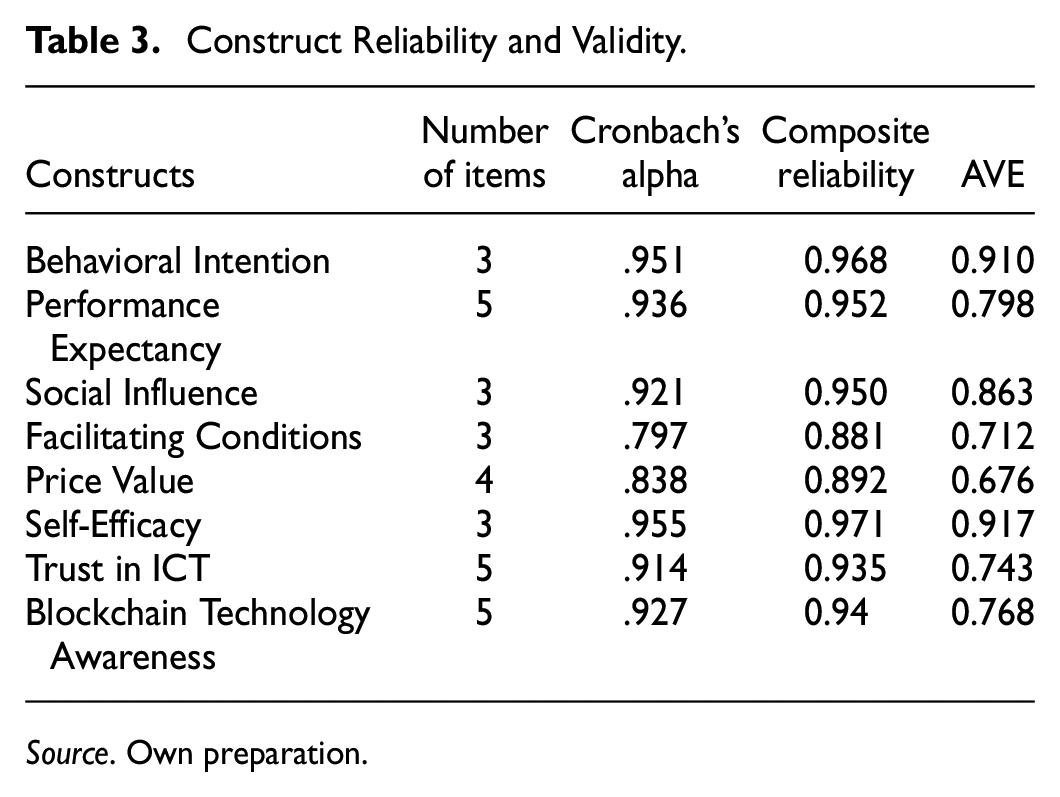
Analyzes for internal validity, Cronbach’s Alpha (Cronbach, 1951), composite reliability (CR), and average variance extracted (AVE) were conducted and presented in Table 3. Recommended values of composite reliability (Jöreskog, 1971) were assessed as “acceptable in exploratory research” between the range of .60 and .70, “satisfactory to good” between .70 and .95, and “problematic” when 0.95 and above. Therefore, in our model, Cronbach’s alpha values of all constructs are met. Cronbach’s alpha values were used to explain the internal consistency of questionnaire data collected in this study (Hinton et al., 2014). According to Hinton et al. (2014), four different ranges of composite reliability were advised. .90 and above are “excellent,” .90 to .70 “high,” .70 to .50 “high medium,” and below .50 “low.”
Construct Reliability and Validity.
Source. Own preparation.
Therefore, according to the recommended values, facilitating conditions and price value are “high,” and the rest of the constructs are “excellent.” Hence, the role of the constructs used in this study to explain the behavioral intention to use e-government services in northern Cyprus ranged from “excellent” to “high”.
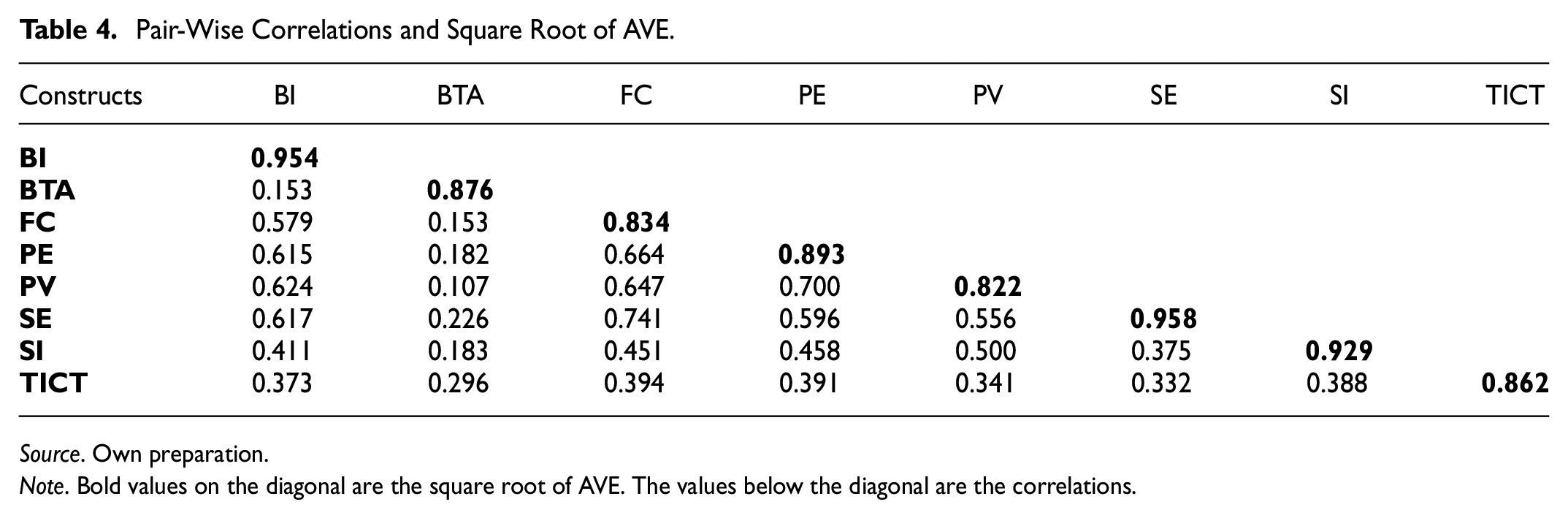
On the other hand, AVE is used as a metric to explain the convergent validity of each construct. AVE values of 0.50 or higher indicate that the constructs explain at least 50% of the items’ variance (Hair et al., 2019). In our model, all the constructs are valid. Pairwise correlations and latent variables’ significance levels are shown in Table 4. According to Fornell and Larcker's (1981) criterion, the square root of the AVE of any latent variable should be greater than its correlation with any other latent variable.
Pair-Wise Correlations and Square Root of AVE.
Source. Own preparation.
Note. Bold values on the diagonal are the square root of AVE. The values below the diagonal are the correlations.
In our model, all diagonal values of the correlation matrix are higher than the correlations below each respective diagonal value. Hence, we can conclude that there is evidence of discriminant validity.
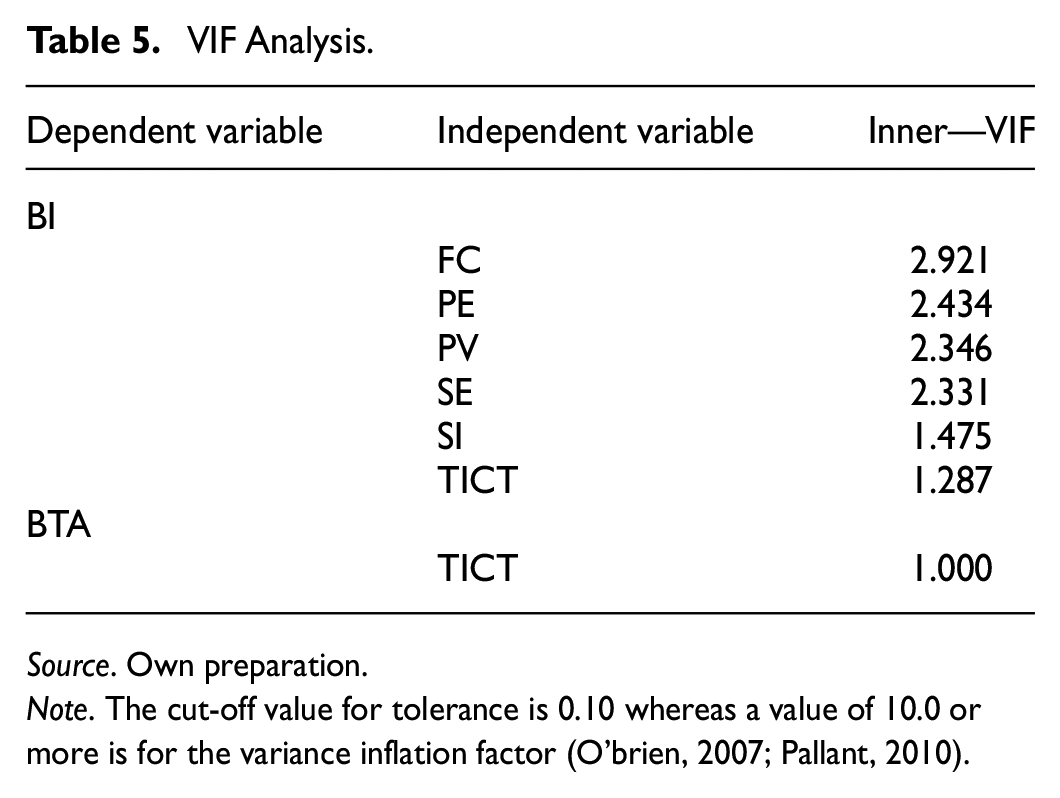
In the social sciences, questionnaires are a common tool for collecting data (Mathers et al., 1998). Podsakoff et al. (2003) pointed out that numerous ways in which data obtained using questionnaires can be compromised, and the common method bias may be the potential problem. For instance, the questionnaire may contain various issues that could expose the sensitive data and individual opinions of respondents. This may lead respondents to prevent reflecting their beliefs or thoughts accurately regarding the subject being investigated. Harman’s single-factor test has been criticized by Fuller et al. (2016) for being inconsistent in providing accurate results and lacking precision in detecting common method variance in data. In this regard, Kock (2015) proposed a comprehensive method for gathering variance inflation factors (VIFs) of each model’s latent variable called a full collinearity test for PLS-SEM. In our study, we used VIF analysis to test (see Table 5) the collinearity of inter-association among the independent variables. The occurrence of a VIF value greater than 3.3 shows that the model may include common method bias, which is a clear indication of pathological collinearity. Hence, if all VIF results are equal to or lower than 3.3, then we can say that the model is free from common method bias (Kock, 2015). In our study, all VIF values are below the suggested threshold. Thus, common method bias is not a potential threat to the proposed model.
VIF Analysis.
Source. Own preparation.
Note. The cut-off value for tolerance is 0.10 whereas a value of 10.0 or more is for the variance inflation factor (O’brien, 2007; Pallant, 2010).
Having checked the VIF analysis, we tested the model fit criteria. Table 6 shows that likelihood ratios (chi x2 ms or bs/degrees of freedom) suggest that chi x2 values are robust to sample size, so it is suitable (Bentler & Bonett, 1980). We also provide other important statistical indicators, such as baseline comparison: the Standardized Root Mean Residual (SRMR) and the Normed Fit Index (NFI) support the case.
Goodness of Fit.

Source. Own preparation.
Note. See (Bentler & Bonett, 1980) and (Bélanger & Carter, 2008) for confirmation of cut-off points.
In the structural equation model, we apply for the current study, association in the same period of two random variables is unaffected by residuals, and the statistical estimates are fine in terms of a good model fit. It is expected to have an SRMR value of less than .08 for the correct model. Due to the small sample size, the unspecified model’s SRMR value is greater than .08. Therefore, when the sample size is increased, the SRMR value tends to be slightly smaller (Cho et al., 2020). On the other hand, the NFI value is expected to be close to 1 for a better fit. The number of parameters used in the model affects the result of NFI. The more parameters, the better NFI results (Bentler & Bonett, 1980).
It is crucial to mention that the conceptual model has a good model fit, and the hypotheses were tested by conducting Smart PLS 3.0. The hypotheses testing results are given in Figure 2 and Table 7. Based on the results, hypotheses except for H3 and H4 were accepted and found to be significant in measuring participants’ intention to adopt e-government services.

Results of the structural model.
Hypotheses Testing.

Source. Own preparation.
Note. ns = not significant.
Significant at p < .001. **Significant at p < .05.
Structural Model
Structural Equation Modeling (SEM) was constructed to examine the relationship (how the constructs are related to each other) between the dependent and independent variables. The structural model results (see Figure 2) illustrate the hypotheses and results that influence the adoption of e-government services.
The coefficient of determination (R-square) value is the sample’s predictive power (Rigdon, 2012). Higher values of the R-square indicate better explanatory power, with a range from 0 to 1. R-square values are considered .75 “Substantial,” .50 “Moderate” and, .25 “Weak” (Hair et al., 2011; Henseler et al., 2009). R-square values as low as .10 are regarded as “satisfactory” in some areas depending on the context (Purwanto & Sudargini, 2021). In this respect, our model’s R-square values are .525 and .087, indicating 52% (moderate effect) and 8.7% (weak) of the variance, respectively.
Bootstrapping: Hypotheses Testing
The bootstrap methodology was used to examine the statistical significance of path coefficients to explain the structural model’s dependent variable (behavioral intention; Chin, 1998).
The results of the hypotheses testing (see Table 7) indicated that all proposed hypotheses were statistically significant at either p < .001 or p < .05. Increasing blockchain technology awareness positively affects citizens’ trust in ICT. Therefore, blockchain technology awareness indirectly increases the intention to adopt e-government. Facilitating conditions and social influence were insignificant. However, performance expectancy, price value, and self-efficacy have statistically significant direct effects on the behavioral intention of e-government adoption in the northern part of Cyprus.
The indirect effect (see Table 7) indicated a full mediation effect between blockchain technology awareness and behavioral intention through trust in ICT. Blockchain technology awareness indirectly increases the intention to adopt e-government services.
Discussion
Our study shows that performance expectancy (β = .190, p < .05) is significantly linked to the dependent variable. This indicates that individuals in northern Cyprus are positively influenced by the usefulness of e-government services, supporting H1. When we compare these results with the findings of prior studies in the literature, we see that numerous researchers also reported statistically significant findings between performance expectancy and intention to adopt e-government (Kurfalı et al., 2017; Lallmahomed et al., 2017) except for Meiyanti et al. (2018) and Mensah (2019) who found an insignificant correlation between performance expectancy and behavioral intention to use e-government services.
Price value (β = .271, p < .001) is the most influential factor on the dependent variable, indicating that individuals in our sample perceive e-government services to be less costly than traditional services. Thus, H2 is supported. We can see that this finding from our island aligns with the study conducted on the island of Mauritius by Lallmahomed et al. (2017), who reported that perceived price value was found to be significant, suggesting that citizens’ intent to use e-government services depends on the monetary trade-offs related to traditional services.
Social influence (β = .039, p = .406) has no substantial effect on the intention to use e-government services, hence H3 is not supported. Although prior findings in different settings led us to expect a relationship between social influence and the intention to adopt e-government, our study did not find social influence to be the main consideration for users in adopting e-government. This aligns with several previous studies that also found no significant effect on social influence, attributing this lack of significance to the lack of experienced users, which may hinder the acceptance of e-government services (Lallmahomed et al., 2017; Meiyanti et al., 2018; Mensah, 2019).
Further, facilitating conditions (β = −.007, p = .918) have no substantial effect on the intention to use e-government, thus H4 is not supported. This suggests that facilitating conditions is not a pre-condition for users in northern Cyprus to use e-government services. This study aimed to measure individuals’ intention to adopt e-government services. Our findings suggest that owning or not owning a computer does not necessarily indicate individuals’ intentions to use these services. Contrary to our results, several previous studies found a strong association between facilitating conditions and intention (Alawadhi & Morris, 2008; Lallmahomed et al., 2017; Mensah, 2019), fostering adoption. Similar to our results, Meiyanti et al. (2018) also reported that facilitating conditions does not affect behavioral intention to adopt e-government services.
Self-efficacy (β = .314, p < .001) has a positive significant relationship with behavioral intention to adopt e-government, which suggests that H5 is supported. This indicates that individuals believe they have sufficient skills to use e-government services. The findings of Lallmahomed et al. (2017) regarding self-efficacy contradict our results. The researchers expected computer self-efficacy to be negatively correlated with intention, suggesting that even if citizens can use e-government services, they may choose not to. Further, Mensah and Mi (2018) also reported that self-efficacy does not significantly influence the intention to use e-government in Ghana.
On the other hand, our findings suggest that blockchain technology awareness (β = .296, p < .001) was statistically significant in increasing trust in ICT, indicating that H6 is supported. In our study, we found a positive relationship between awareness and trust, meaning that as awareness increases, trust also increases. Knowing the complex nature of technological innovation (such as blockchain and artificial intelligence) can confuse people. However, being aware of the benefits of the related technologies will trigger them to change their attitudes positively. As Baker and Bellordre (2004) emphasized, awareness is how individuals perceive the benefits of their activities. Our results have shown a positive and significant correlation between blockchain technology awareness and trust in ICT. Thus, we may indicate that when blockchain technology awareness increases, trust in ICT also increases.
Further, trust in ICT (β = .027 p < .05) has been estimated to have a statistically significant role in users’ intention to adopt e-government, which indicated that H7 is supported. The direct effect suggests trust in ICT strongly influences the intention of e-government adoption. The indirect effect between blockchain technology awareness and intention is empirically proven to be significant through trust in ICT. Due to the mediator effect, blockchain technology awareness has a transitive relationship with intention. A significant correlation exists between trust in ICT and awareness of blockchain technology, indicating that as awareness of blockchain technology increases, users’ trust in ICT also increases. Then, individuals’ intentions may be positively influenced to adopt e-government services. Al-Hujran et al. (2015) found that trust statistically impacts perceived public value and positively influences citizens’ e-government adoption behavior. Similarly, Zorali and Kanipek (2023) noted that trust in Internet, through performance expectation, positively influenced users’ intention to use e-government. However, contrary to our results, Mensah (2019) reported that trust in the internet was an insignificant predictor of the intention to use e-government.
Practical Implications
The findings of this study revealed several practical implications that may benefit policymakers in regions of the world with high uncertainty. Blockchain technology awareness was added to our model to understand its role in e-government adoption. Some researchers have claimed that blockchain technology can help reduce corruption (Aarvik, 2020) and increase transparency and accountability (Palfreyman, 2015). The findings revealed that citizens’ awareness of blockchain technology may increase their trust in ICT and thus contribute to adopting e-government. Therefore, one of the implications for policymakers may be that the lack of awareness may hinder or slow the adoption of e-government. Further, adopting e-government worldwide can be hampered by inadequate facilitating conditions, especially in developing countries or regions with high uncertainty, such as Northern Cyprus. The lack of ICT infrastructure is one of the most significant enabling factors and is a major barrier to adopting and implementing e-government projects. Adoption of e-government services may be hindered by insufficient ICT network infrastructure. Our research indicates that citizens believe the basic infrastructure to utilize e-government (Hypothesis 4) is inadequate. Another implication for policymakers could be a lack of technical infrastructure that may limit the adoption of e-government services.
Theoretical Implications
The findings of our study also have several theoretical implications. One of the important findings of our study is that we re-conceptualized the price value in UTAUT2 to understand how citizens perceive the service value when interacting with e-Government services. Our model included price value, and our findings have shown a significant correlation between the re-conceptualized price value and the behavioral intention to adopt e-government services.
Interestingly, facilitating conditions, which are important predictors of many research findings, were insignificant in our study. This may be a striking result specific to regions where uncertainty is high, such as the north of Cyprus. It also shows that users may be reluctant to adopt e-government services due to the lack of existing infrastructure.
Our study combined UTAUT2 and GAM in the context of e-government adoption, providing a strong theoretical framework for future research studies. Scholars may consider building on this groundwork to investigate further the relationship between technology adoptions, various disciplines such as government contexts, and emerging technologies such as blockchain. Dubey et al. (2023) highlighted a notable gap in theoretical and empirical research on adopting blockchain technology in the IS field, lacking insights into various factors at the individual, organizational, societal, and national levels. Our study found that blockchain technology awareness improves trust in ICT and enhances the users’ intention to adopt e-government services. This framework can provide a basis for investigating additional factors and developing theoretical models better to understand e-government adoption in the evolving digital environment.
Conclusion and Recommendations for Future Studies
This study focused on the role of blockchain technology awareness in adopting e-government in northern Cyprus, a non-EU member region. It is important to note that our research contributes to e-government adoption in regions experiencing high uncertainty and a lack of international recognition. Various e-government projects have been developed over the last 20 years in the northern part of Cyprus. We have combined UTAUT2 and GAM models by retrieving a few constructs to investigate the role of blockchain technology awareness in adopting e-government services in our study.
In our conceptual model, we used four constructs of the UTAUT2 and three of the GAM models. Trust in ICT has been used as a mediator between blockchain technology awareness and behavioral intention to examine whether users’ intentions will increase to adopt e-government. Our findings revealed that performance expectancy, price value, and self-efficacy strongly and positively impact the intention to adopt e-government services. Further, facilitating conditions and social influence have an insignificant effect on e-government adoption. Our results demonstrated that blockchain technology awareness may increase citizens’ trust in ICT, which can help improve their intention to adopt e-government services. Thus, this study contributes to the existing literature on e-government adoption and blockchain technology in emerging countries as well as in regions with high uncertainty by combining and extending two important theories such as UTAUT2 and GAM. Numerous scholars have highlighted a lack of empirical evidence to understand the relationship between the role of blockchain and trust in ICT (Alexopoulos et al., 2019; Khayyat et al., 2020). The findings of this study fill the relevant gap by demonstrating that blockchain technology awareness plays a significant role in increasing trust in ICT for the users’ intention to adopt e-government. Further, the results of this study are crucial for creating a roadmap to effectively implement e-government, especially in developing countries and regions with high uncertainty, by integrating emerging technologies like blockchain.
Based on the findings of our study, we offer several key recommendations to governments and researchers for future studies and policy development. Our findings highlight the importance of incorporating user feedback in the design of e-government services. The most critical insight from our study indicates that increased awareness of blockchain technology correlates with higher trust in ICT. Therefore, we propose the following actions:
As a final point, we would like to make a few suggestions to shed light on future work. Our study expected and hypothesized that blockchain technology awareness would increase trust in ICT. Our findings show that this relationship is statistically significant, but the overall explanatory power indicated by R-square indicates that there are factors other than blockchain technology awareness to use e-government services that may influence intention, allowing for future research. Therefore, there is room for improvement, especially by extending our approach to identifying other factors influencing citizens’ trust. Further, by including variables from the GAM and UTAUT2 models excluded from our model, other researchers may find more explanatory factors for the intention to adopt e-government services.
Limitations of the Study
The e-government services in northern Cyprus face challenges due to partial integration and limited user satisfaction. The pandemic further constrained data collection, potentially biasing the results toward highly educated participants from specific groups such as public sector employees and academics. For this reason, the participants of this study turned out to be highly educated (78.6%), which implies that there may be some issues in generalizability. Nevertheless, this limitation may also be considered an advantage since, according to Campbell (2002), collecting data for a particular study should involve people with a high level of knowledge and expertise on the subject. Additionally, Yin (2009) claimed that it provides the strength to deal with inaccurate data and all kinds of biases.
The participant’s age group was centered on the 25 to 45 age band, where individuals have significant online experience compared to older users. Future research should consider including diverse age groups and conducting benchmarking studies to provide more conclusive and comprehensive insights into e-government adoption. Therefore, we reiterate that our sampling method may lead to selection bias of certain underrepresented demographic groups. Although our study contributes to the literature both theoretically and practically in the context of developing countries and regions with high uncertainty, the scope of the findings may have limited generalizability to contexts that have quite diverse cultural and social dynamics since it was analyzed only on data collected from the north of Cyprus. There may be other indicators of the role of blockchain technology in adopting e-government that were not examined in this study. Quantitative research, despite offering generalizable and objective data, often overlooks individual perceptions and beliefs and may reflect researchers’ biases, thereby limiting the incorporation of insights and the potential for discoveries. Given the limited factors considered in our study, it is important to explore additional factors using different approaches such as qualitative or mixed methods. These approaches could uncover new insights about the contribution of blockchain technology to e-government adoption that are yet to be revealed.
Footnotes
Appendix
Credit Author Statement
Declaration of Conflicting Interests
The author(s) declared no potential conflicts of interest with respect to the research, authorship, and/or publication of this article.
Funding
The author(s) received no financial support for the research, authorship, and/or publication of this article.

Data Availability Statement
Data sharing not applicable to this article as no datasets were generated or analyzed during the current study.